Communication

A Model for Oxygen Transport from Blood in Microvessels to Tissue

Department of Chemical and Biological Engineering, American University of Sharjah, Sharjah P.O. Box 26666, United Arab Emirates
Appl. Sci. 2023, 13(6), 3805; https://doi.org/10.3390/app13063805
Submission received: 6 February 2023 / Revised: 11 March 2023 / Accepted: 11 March 2023 / Published: 16 March 2023
(This article belongs to the Section Applied Biosciences and Bioengineering)

Abstract

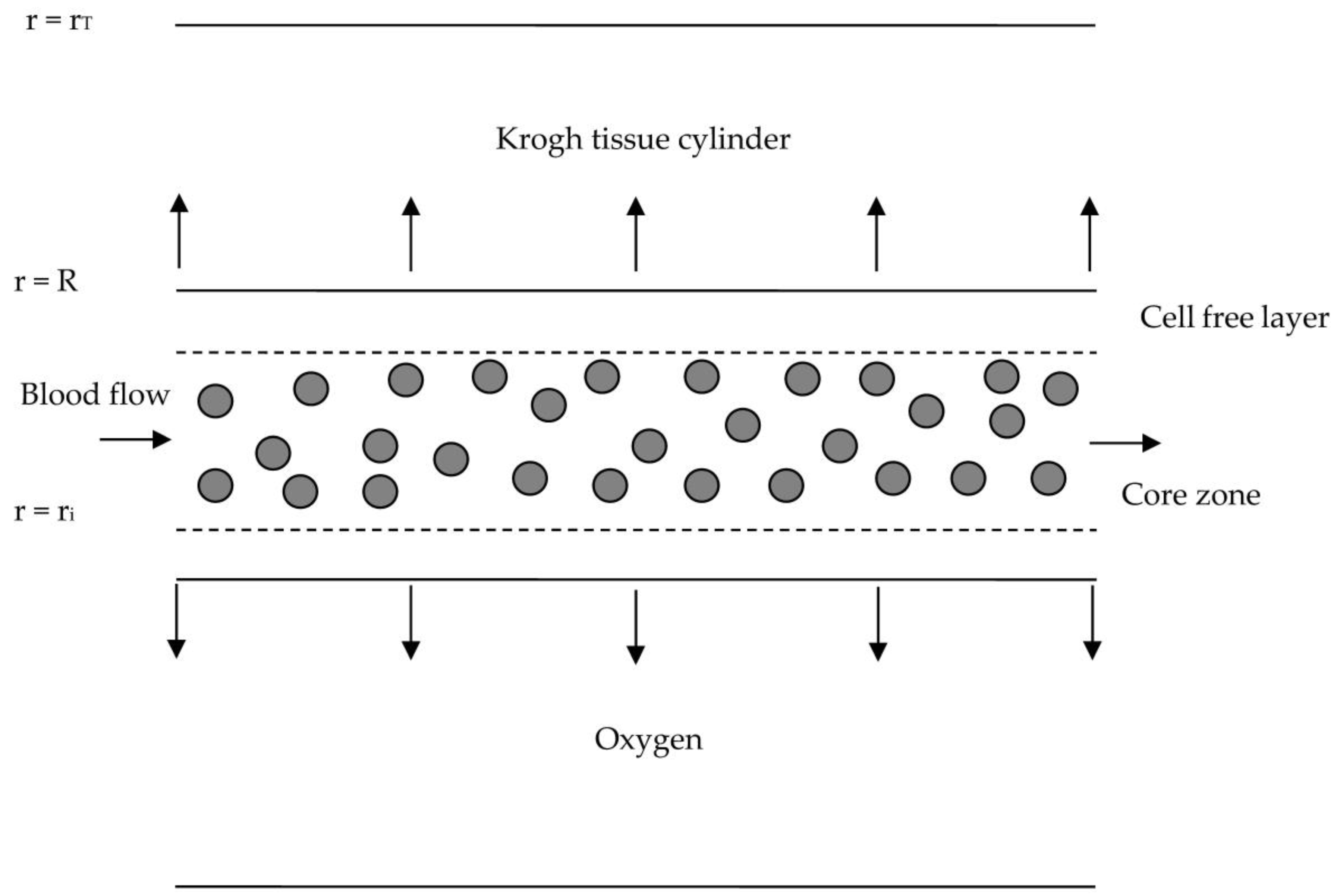
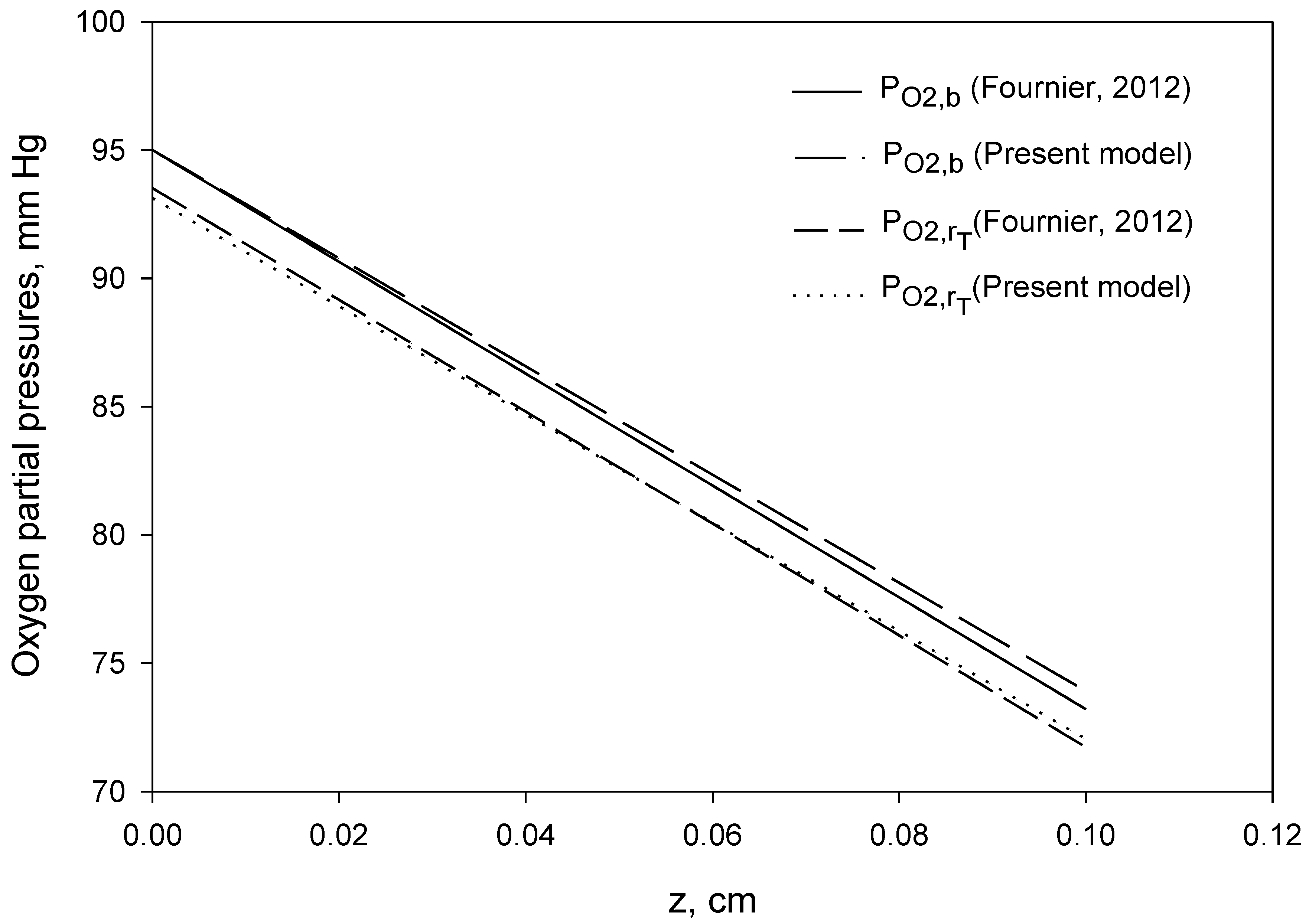
Oxygen is vital for cellular energetics and metabolism in the human body. Blood transports oxygen to the tissues with hemoglobin in red blood cells playing a key role in the transportation of oxygen. To account for the Fåhraeus and Fåhraeus–Lindqvist effects, we use Haynes marginal zone concept, which subdivides each microvessel into a cell free layer surrounding a core region of uniform red blood cells concentration. The marginal zone concept is used to develop a steady state model for the transport of oxygen from blood to tissue where chemical reaction of oxygen occurs to produce energy. The approach is based on fundamentals of fluid flow and mass transfer in the two zones while accounting for the role of hemoglobin in the transport process and including mass transfer and chemical reaction in the tissue to produce energy using the Krogh cylinder concept. In contrast to transport modeling of solutes such as glucose, the present model includes the key role of hemoglobin in the transport of oxygen from blood to tissue. The model is analytical and provides analytical expressions for the oxygen level profiles in the blood cell free layer, the core zone, and the Krogh cylinder. The results are found to agree with published results in the literature for oxygen transport from blood in capillary size microvessel to its Krogh tissue cylinder. The model is not restricted to transport from capillaries and includes transport of oxygen from microvessels to tissue in general. Extensions of the model include further investigations in the case where changes in the blood microvessel or red blood cells occur due to pathological conditions.
Keywords: Fåhraeus effect; oxygen; blood flow; tissue; Krogh cylinder; marginal zone theory Fåhraeus effect; oxygen; blood flow; tissue; Krogh cylinder; marginal zone theory