iEnhancer-Deep: A Computational Predictor for Enhancer Sites and Their Strength Using Deep Learning



Abstract
1. Introduction
2. Materials and Methods
2.1. Benchmark Dataset
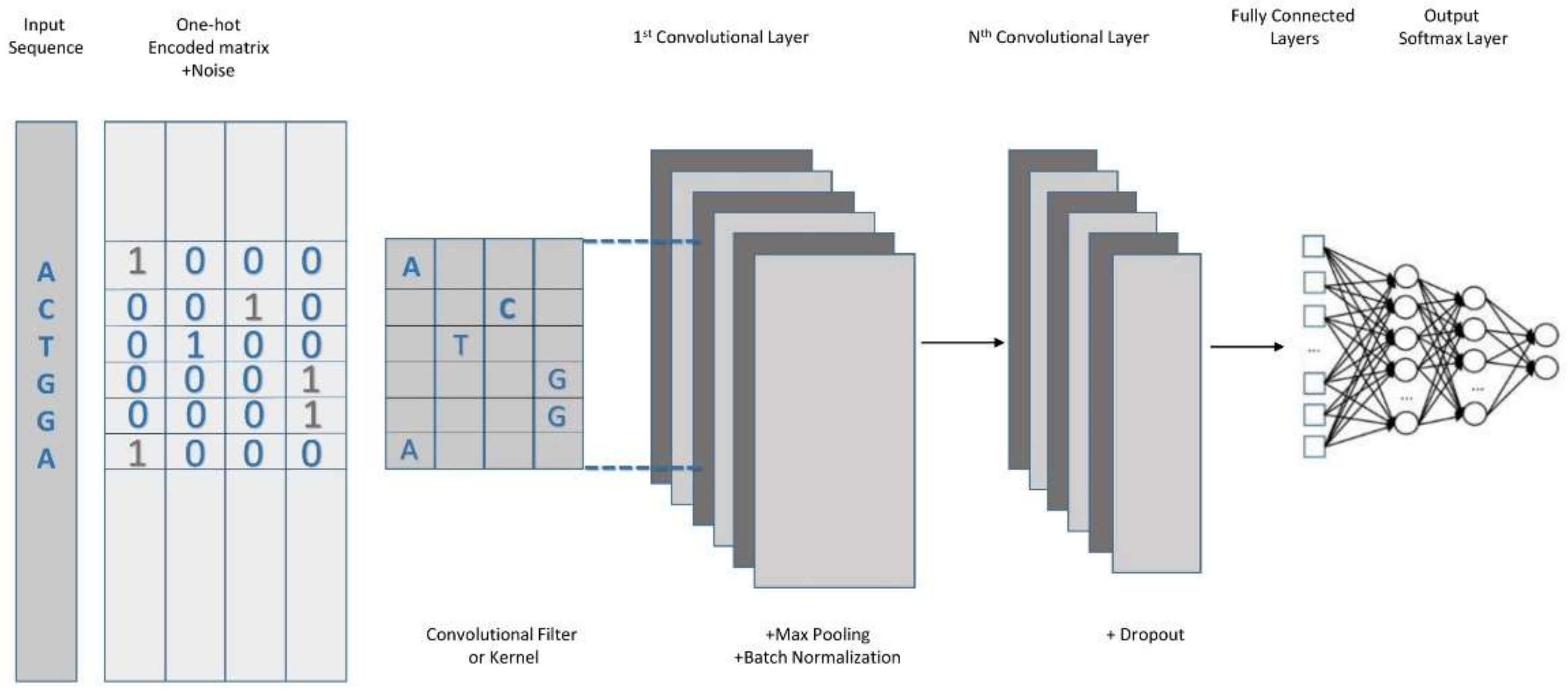
2.2. Methods
2.3. Gaussian Noise
2.4. Evaluation Parameters
3. Results and Discussion
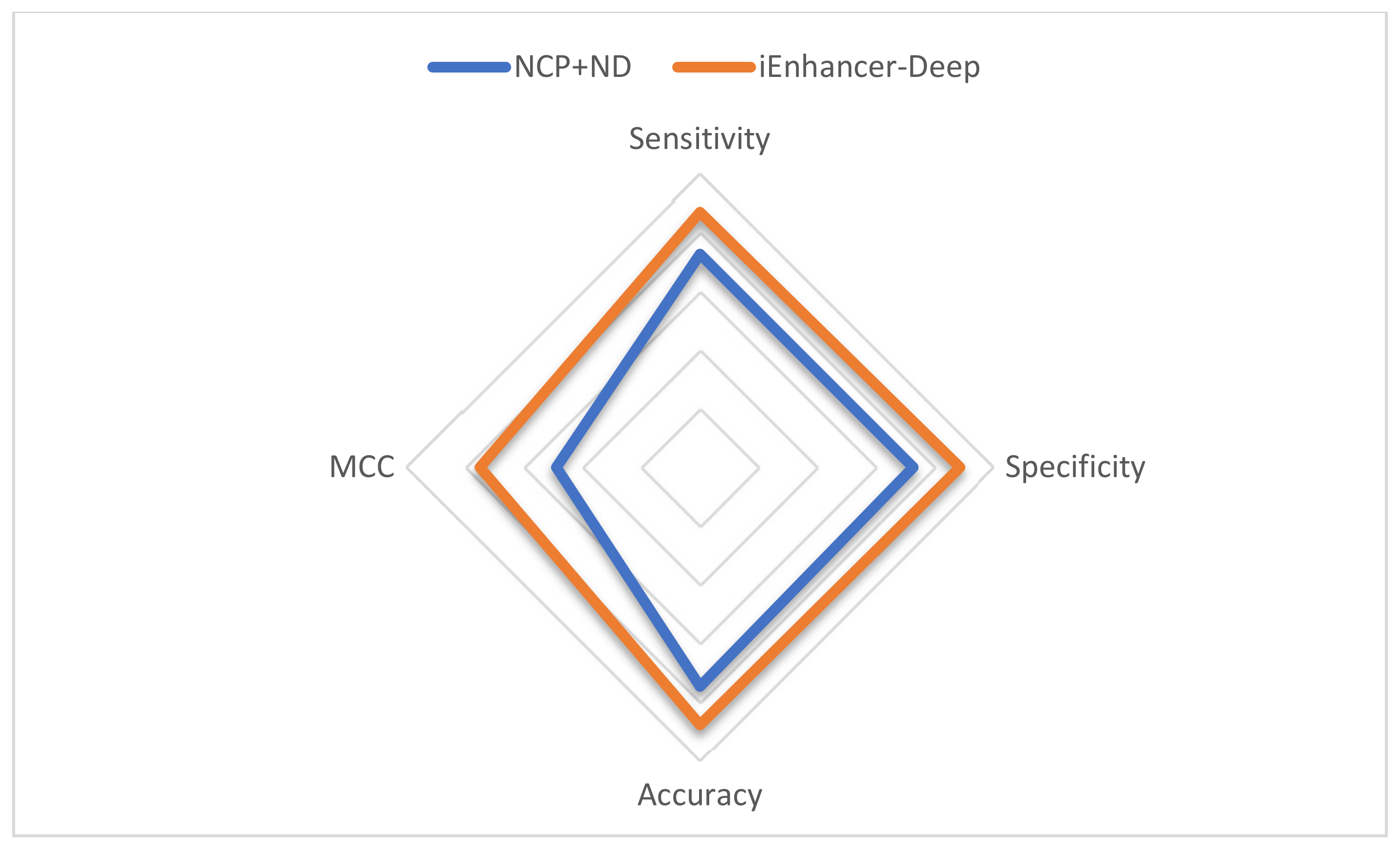
3.1. Effect of Different Encoding Techniques
3.2. Cross-Validation Test
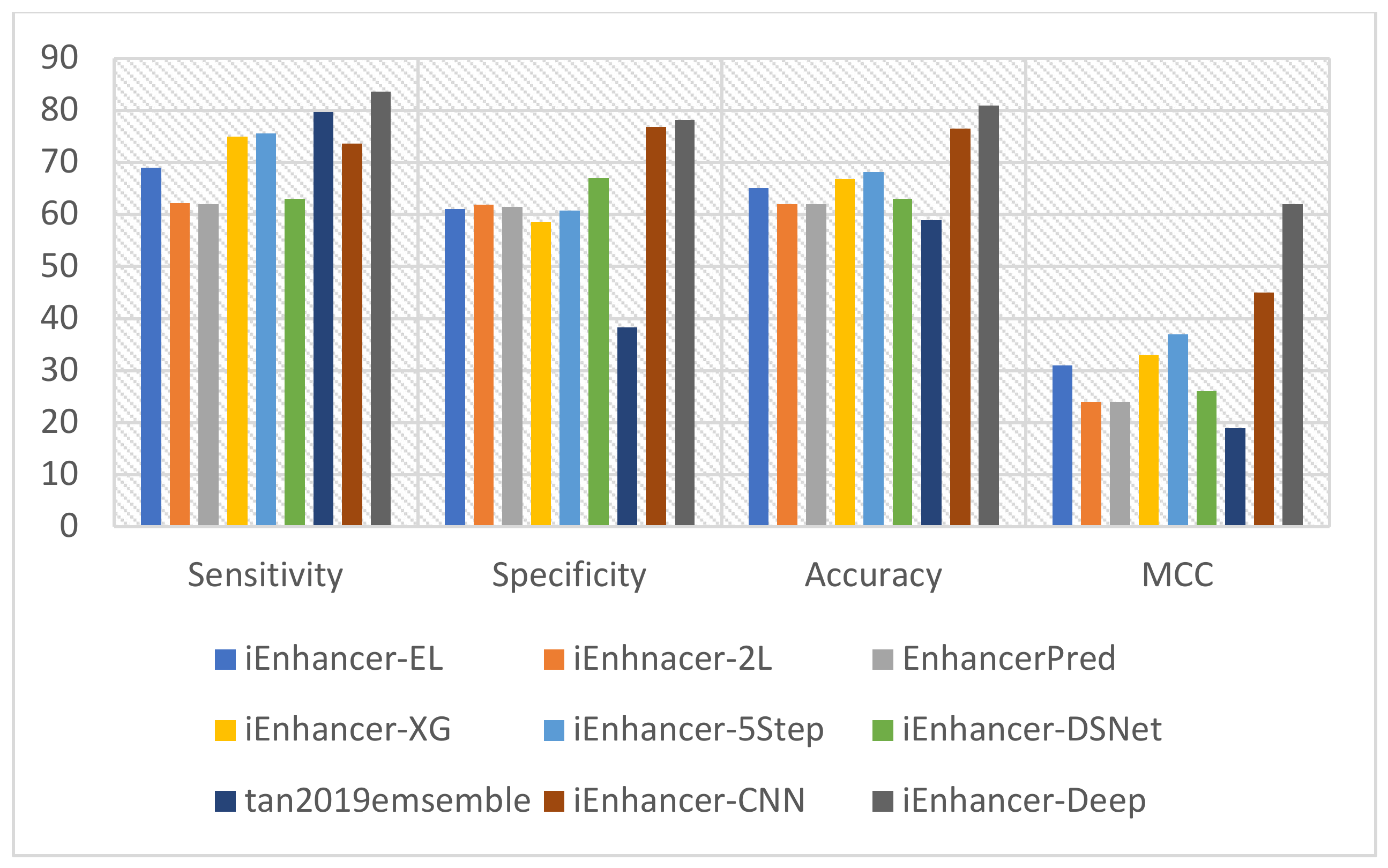
3.3. Performance Comparison with Existing Methods
3.4. Independent Dataset
3.5. Cross-Species Test
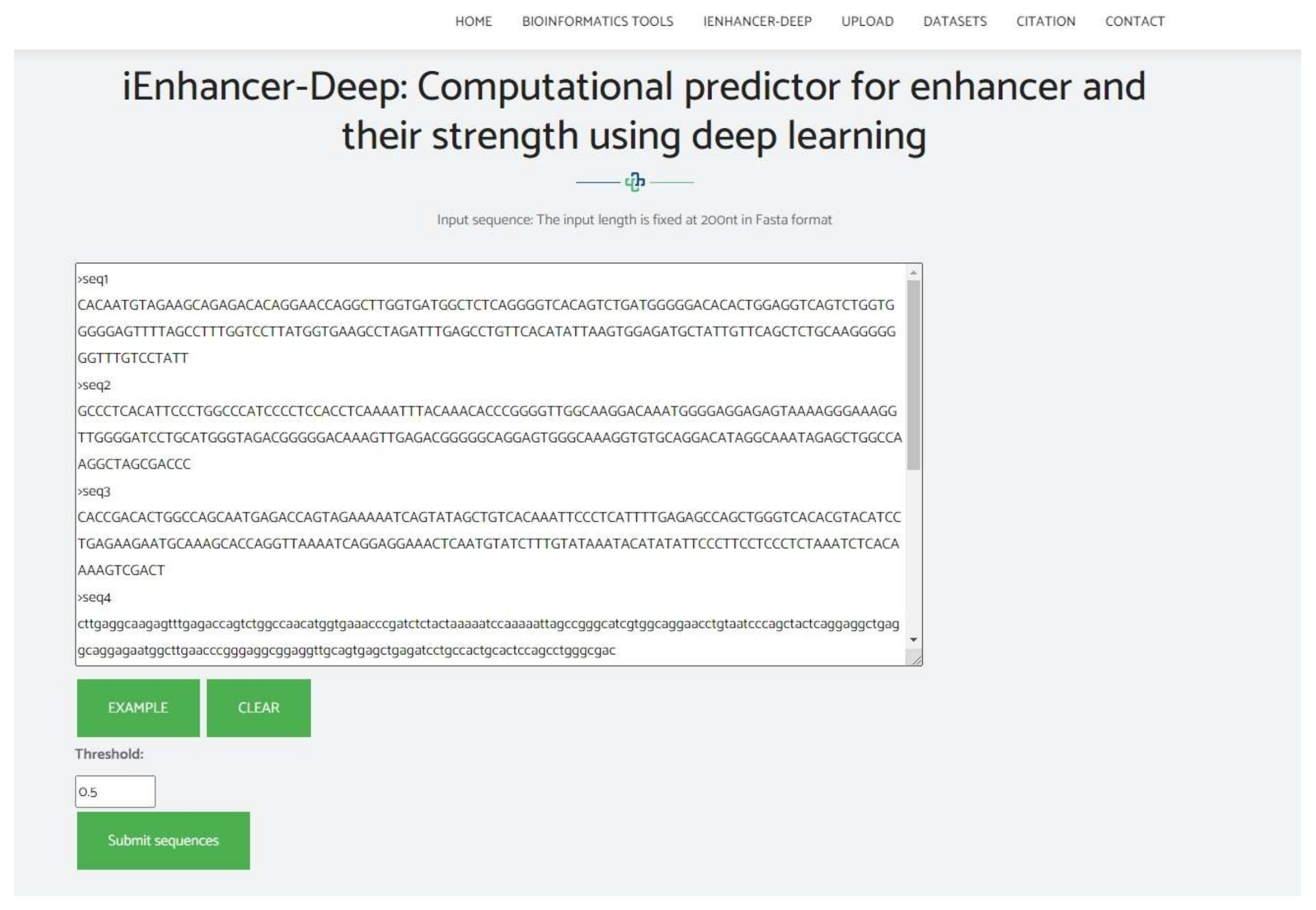
4. Web Server
- -
- Click on the following link to access the web server http://nsclbio.jbnu.ac.kr/tools/iEnhancer-Deep/ (accessed on 17 November 2021);
- -
- Options to copy/paste, upload, or simply write the DNA sequence in the input box in FASTS format are available;
- -
- For results, press the ‘submit sequence’ option;
- -
- One thousand is the largest number of sequences that our server can instantaneously sort.
5. Conclusions
Author Contributions
Funding
Data Availability Statement
Conflicts of Interest
References
- Pennacchio, L.A.; Bickmore, W.; Dean, A.; Nobrega, M.A.; Bejerano, G. Enhancers: Five essential questions. Nat. Rev. Genet. 2013, 14, 288–295. [Google Scholar] [CrossRef] [Scilit]
- Plank, J.L.; Dean, A. Enhancer function: Mechanistic and genomewide insights come together. Mol. Cell 2014, 55, 5–14. [Google Scholar] [CrossRef] [Scilit] [PubMed]
- Liu, B.; Fang, L.; Long, R.; Lan, X.; Chou, K.-C. Ienhancer-2l: A twolayer predictor for identifying enhancers and their strength by pseudo ktuple nucleotide composition. Bioinformatics 2016, 32, 362–369. [Google Scholar] [CrossRef] [Scilit] [PubMed]
- Bejerano, G.; Pheasant, M.; Makunin, I.; Stephen, S.; Kent, W.J.; Mattick, J.S.; Haussler, D. Ultraconserved elements in the human genome. Science 2004, 304, 1321–1325. [Google Scholar] [CrossRef] [Scilit] [PubMed]
- Boyd, M.; Thodberg, M.; Vitezic, M.; Bornholdt, J.; Vitting-Seerup, K.; Chen, Y.; Coskun, M.; Li, Y.; Lo, B.Z.S.; Klausen, P.; et al. Characterization of the enhancer and promoter landscape of inflammatory bowel disease from human colon biopsies. Nat. Commun. 2018, 9, 1–19. [Google Scholar] [CrossRef] [Scilit]
- Shlyueva, D.; Stampfel, G.; Stark, A. Transcriptional enhancers: From properties to genome-wide predictions. Nat. Rev. Genet. 2014, 15, 272–286. [Google Scholar] [CrossRef] [Scilit]
- Firpi, H.A.; Ucar, D.; Tan, K. Discover regulatory DNA elements using chromatin signatures and artificial neural network. Bioinformatics 2010, 26, 1579–1586. [Google Scholar] [CrossRef] [Scilit]
- Rajagopal, N.; Xie, W.; Li, Y.; Wagner, U.; Wang, W.; Stamatoyannopoulos, J.; Ernst, J.; Kellis, M.; Ren, B. Rfecs: A random-forest based algorithm for enhancer identification from chromatin state. PLoS Comput. Biol. 2013, 9, e1002968. [Google Scholar] [CrossRef] [Scilit]
- Erwin, G.D.; Oksenberg, N.; Truty, R.M.; Kostka, D.; Murphy, K.K.; Ahituv, N.; Pollard, K.S.; Capra, J.A. Integrating diverse datasets improves developmental enhancer prediction. PLoS Comput. Biol. 2014, 10, e1003677. [Google Scholar] [CrossRef] [Scilit]
- Fernández, M.; Miranda-Saavedra, D. Genome-wide enhancer prediction from epigenetic signatures using genetic algorithm-optimized support vector machines. Nucleic Acids Res. 2012, 40, e77. [Google Scholar] [CrossRef] [Scilit]
- Ghandi, M.; Lee, D.; Mohammad-Noori, M.; Beer, M.A. Enhanced Regulatory Sequence Prediction Using Gapped k-mer Features. PLoS Comput. Biol. 2014, 10, e1003711. [Google Scholar] [CrossRef] [Scilit] [PubMed]
- Kleftogiannis, D.; Kalnis, P.; Bajic, V.B. DEEP: A general computational framework for predicting enhancers. Nucleic Acids Res. 2014, 43, e6. [Google Scholar] [CrossRef] [Scilit] [PubMed]
- Bu, H.; Gan, Y.; Wang, Y.; Zhou, S.; Guan, J. A new method for enhancer prediction based on deep belief network. BMC Bioinform. 2017, 18, 418. [Google Scholar] [CrossRef] [Scilit]
- Yang, B.; Liu, F.; Ren, C.; Ouyang, Z.; Xie, Z.; Bo, X.; Shu, W. BiRen: Predicting enhancers with a deep-learning-based model using the DNA sequence alone. Bioinformatics 2017, 33, 1930–1936. [Google Scholar] [CrossRef] [Scilit]
- Liu, B.; Li, K.; Huang, D.-S.; Chou, K.-C. ienhancer-el: Identifying enhancers and their strength with ensemble learning approach. Bioinformatics 2018, 34, 3835–3842. [Google Scholar] [CrossRef] [Scilit] [PubMed]
- Khanal, J.; Nazari, I.; Tayara, H.; Chong, K.T. 4mccnn: Identification of n4-methylcytosine sites in prokaryotes using convolutional neural network. IEEE Access 2019, 7, 145455–145461. [Google Scholar] [CrossRef] [Scilit]
- Tayara, H.; Chong, K.T. Improving the Quantification of DNA Sequences Using Evolutionary Information Based on Deep Learning. Cells 2019, 8, 1635. [Google Scholar] [CrossRef] [Scilit]
- Nazari, I.; Tayara, H.; Chong, K.T. Branch Point Selection in RNA Splicing Using Deep Learning. IEEE Access 2018, 7, 1800–1807. [Google Scholar] [CrossRef] [Scilit]
- Tahir, M.; Tayara, H.; Chong, K.T. irna-pseknc (2methyl): Identify rna 2′-o-methylation sites by convolution neural network and chou’s pseudo components. J. Theor. Biol. 2019, 465, 1–6. [Google Scholar] [CrossRef] [Scilit]
- Ali, S.D.; Alam, W.; Tayara, H.; Chong, K. Identification of Functional piRNAs Using a Convolutional Neural Network. IEEE/ACM Trans. Comput. Biol. Bioinform. 2020, 1. [Google Scholar] [CrossRef] [Scilit]
- Tayara, H.; Tahir, M.; Chong, K.T. iss-cnn: Identifying splicing sites using convolution neural network. Chemom. Intell. Lab. Syst. 2019, 188, 63–69. [Google Scholar] [CrossRef] [Scilit]
- Tahir, M.; Hayat, M. Machine learning based identification of protein—Protein interactions using derived features of physiochemical properties and evolutionary profiles. Artif. Intell. Med. 2017, 78, 61–71. [Google Scholar] [CrossRef] [Scilit] [PubMed]
- Wei, L.; Luan, S.; Nagai, L.A.E.; Su, R.; Zou, Q. Exploring sequencebased features for the improved prediction of DNA n4-methylcytosine sites in multiple species. Bioinformatics 2018, 35, 1326–1333. [Google Scholar] [CrossRef] [Scilit] [PubMed]
- Ali, S.D.; Kim, J.H.; Tayara, H.; Chong, K.T. Prediction of RNA 5-Hydroxymethylcytosine Modifications Using Deep Learning. IEEE Access 2021, 9, 8491–8496. [Google Scholar] [CrossRef] [Scilit]
- Jia, C.; Yang, Q.; Zou, Q. NucPosPred: Predicting species-specific genomic nucleosome positioning via four different modes of general PseKNC. J. Theor. Biol. 2018, 450, 15–21. [Google Scholar] [CrossRef] [Scilit] [PubMed]
- Khanal, J.; Tayara, H.; Chong, K.T. Identifying Enhancers and Their Strength by the Integration of Word Embedding and Convolution Neural Network. IEEE Access 2020, 8, 58369–58376. [Google Scholar] [CrossRef] [Scilit]
- Jia, C.; He, W. EnhancerPred: A predictor for discovering enhancers based on the combination and selection of multiple features. Sci. Rep. 2016, 6, 38741. [Google Scholar] [CrossRef] [Scilit]
- Fu, L.; Niu, B.; Zhu, Z.; Wu, S.; Li, W. CD-HIT: Accelerated for clustering the next-generation sequencing data. Bioinformatics 2012, 28, 3150–3152. [Google Scholar] [CrossRef] [Scilit]
- Bari, A.G.; Reaz, M.R.; Choi, H.-J.; Jeong, B.-S. DNA encoding for splice site prediction in large DNA sequence. In International Conference on Database Systems for Advanced Applications; Springer: Berlin/Heidelberg, Germany, 2013; pp. 46–58. [Google Scholar]
- Wei, L.; Chen, H.; Su, R. M6APred-EL: A Sequence-Based Predictor for Identifying N6-methyladenosine Sites Using Ensemble Learning. Mol. Ther. Nucleic Acids 2018, 12, 635–644. [Google Scholar] [CrossRef] [Scilit]
- Ying, X. An Overview of Overfitting and its Solutions. J. Phys. Conf. Ser. 2019, 1168, 022022. [Google Scholar] [CrossRef] [Scilit]
- Matthews, B. Comparison of the predicted and observed secondary structure of T4 phage lysozyme. BBA Protein Struct. 1975, 405, 442–451. [Google Scholar] [CrossRef] [Scilit]
- Cai, L.; Ren, X.; Fu, X.; Peng, L.; Gao, M.; Zeng, X. iEnhancer-XG: Interpretable sequence-based enhancers and their strength predictor. Bioinformatics 2020, 37, 1060–1067. [Google Scholar] [CrossRef] [Scilit] [PubMed]
- Le, N.Q.K.; Yapp, E.K.Y.; Ho, Q.-T.; Nagasundaram, N.; Ou, Y.-Y.; Yeh, H.-Y. iEnhancer-5Step: Identifying enhancers using hidden information of DNA sequences via Chou’s 5-step rule and word embedding. Anal. Biochem. 2019, 571, 53–61. [Google Scholar] [CrossRef] [Scilit] [PubMed]
- Asim, M.N.; Ibrahim, M.A.; Malik, M.I.; Dengel, A.; Ahmed, S. Enhancer-dsnet: A supervisedly prepared enriched sequence representation for the identification of enhancers and their strength. In International Conference on Neural Information Processing; Springer: Berlin/Heidelberg, Germany, 2020; pp. 38–48. [Google Scholar]
- Tan, K.K.; Le, N.Q.K.; Yeh, H.-Y.; Chua, M.C.H. Ensemble of Deep Recurrent Neural Networks for Identifying Enhancers via Dinucleotide Physicochemical Properties. Cells 2019, 8, 767. [Google Scholar] [CrossRef] [Scilit]
- Chicco, D. Ten quick tips for machine learning in computational biology. BioData Min. 2017, 10, 35. [Google Scholar] [CrossRef] [Scilit]
- Tianshun, G.; Qian, J. EnhancerAtlas 2.0: An updated resource with enhancer annotation in 586 tissue/cell types across nine species. Nucleic Acids Res. 2020, 48, D58–D64. [Google Scholar]
- Bo, Z.; Zhang, W.; Zhang, T.; Liu, B.; Jianga, J. Genome-Wide Prediction and Validation of Intergenic Enhancers in Arabidopsis Using Open Chromatin Signatures. Plant Cell 2015, 27, 2415–2426. [Google Scholar]
- Ivica, L.; Bork, P. Interactive Tree Of Life (iTOL) v4: Recent updates and new developments. Nucleic Acids Res. 2019, 47, W256–W259. [Google Scholar]




| Layer | Parameters |
|---|---|
| Input | - |
| Gaussian Noise | Standard deviation = 0.2 |
| Conv1D | Kernels = 128 |
| Kernel size = 7 | |
| Group Normalization | Groups = 2 |
| Max pooling | Window size = 2 |
| Dropout | Dropout rate = 0.2 |
| Conv1D | Kernels = 256 |
| Kernel size = 6 | |
| Group Normalization | Groups = 2 |
| Max pooling | Window size = 2 |
| Dropout | Dropout rate = 0.15 |
| Conv1D | Kernels = 256 |
| Kernel size = 5 | |
| Group Normalization | Groups = 2 |
| Max pooling | Window size = 2 |
| Dropout | Dropout rate = 0.04 |
| Flatten | - |
| Dense | Nodes = 16 |
| Output | Nodes = 1 |
| Chemical Properties | Class | Nucleotides |
|---|---|---|
| Ring Structure | Purine | [A, G] |
| Pyrimidine | [C, T] | |
| Hydrogen Bond | Strong | [C, G] |
| Weak | [A, T] | |
| Functional Group | Amino | [A, C] |
| Keto | [G, T] |
| Stage | Model | Sensitivity | Specificity | Accuracy | MCC |
|---|---|---|---|---|---|
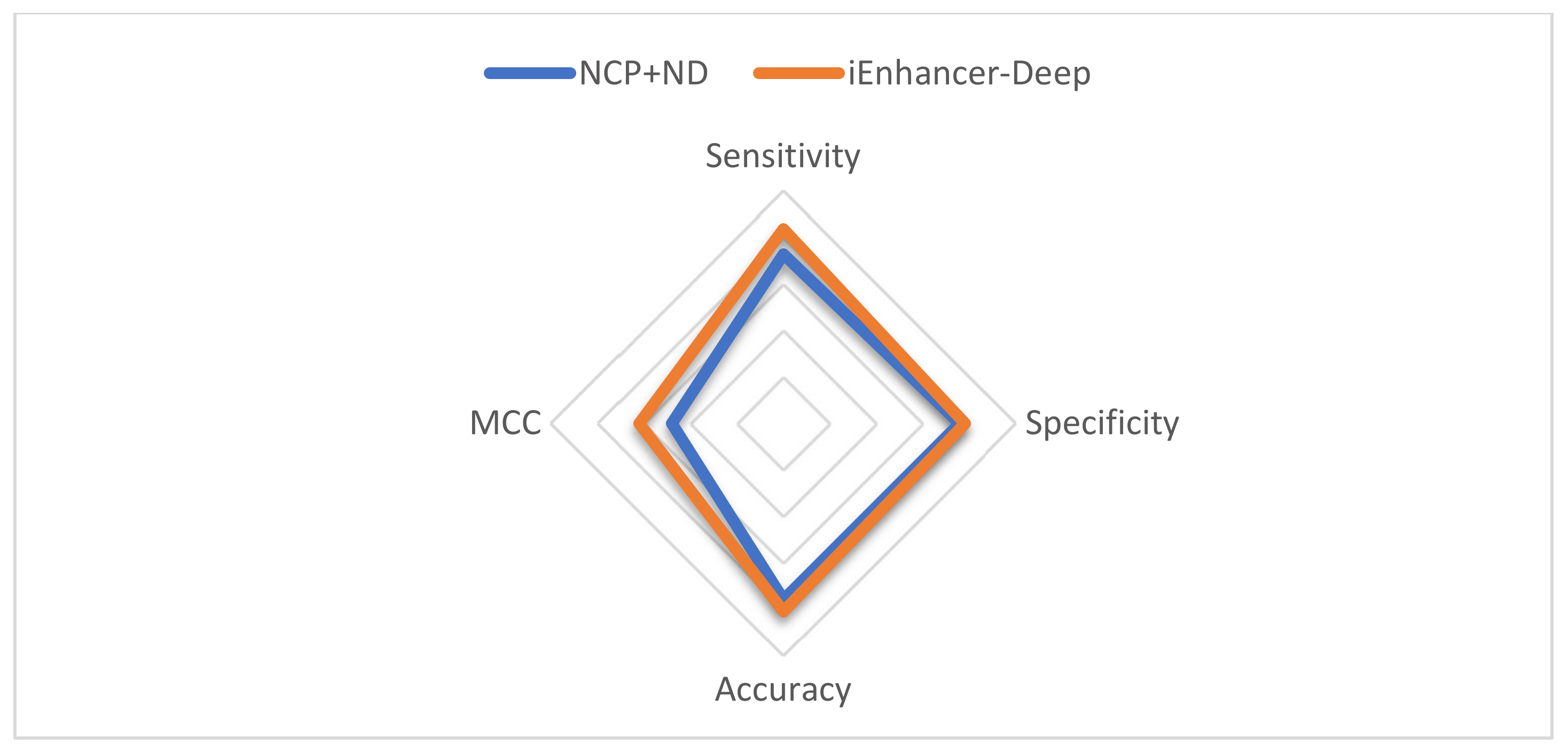
| Stage 1 | NCP+ND | 72.7 | 72.7 | 74.59 | 0.49 |
| iEnhancer-Deep | 86.99 | 88.54 | 87.77 | 0.75 | |
| Stage 2 | NCP+ND | 72.6 | 75.9 | 75.9 | 0.48 |
| iEnhancer-Deep | 83.57 | 78.16 | 80.86 | 0.62 |
| Stages | Sensitivity | Specificity | Accuracy | MCC |
|---|---|---|---|---|
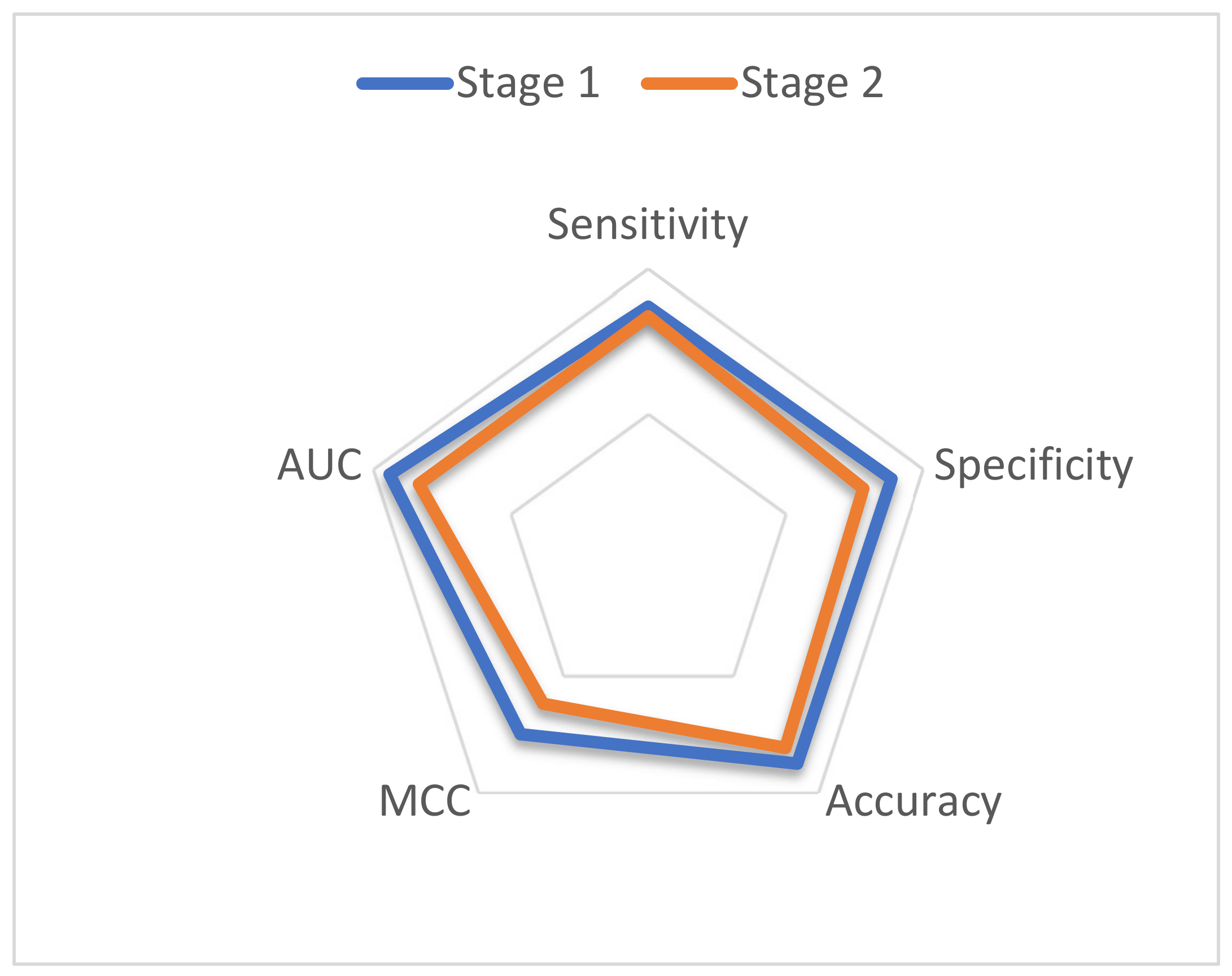
| Stage 1 | 86.99 | 88.54 | 87.77 | 0.75 |
| Stage 2 | 83.57 | 78.16 | 80.86 | 0.62 |
| Model | Sensitivity | Specificity | Accuracy | MCC |
|---|---|---|---|---|
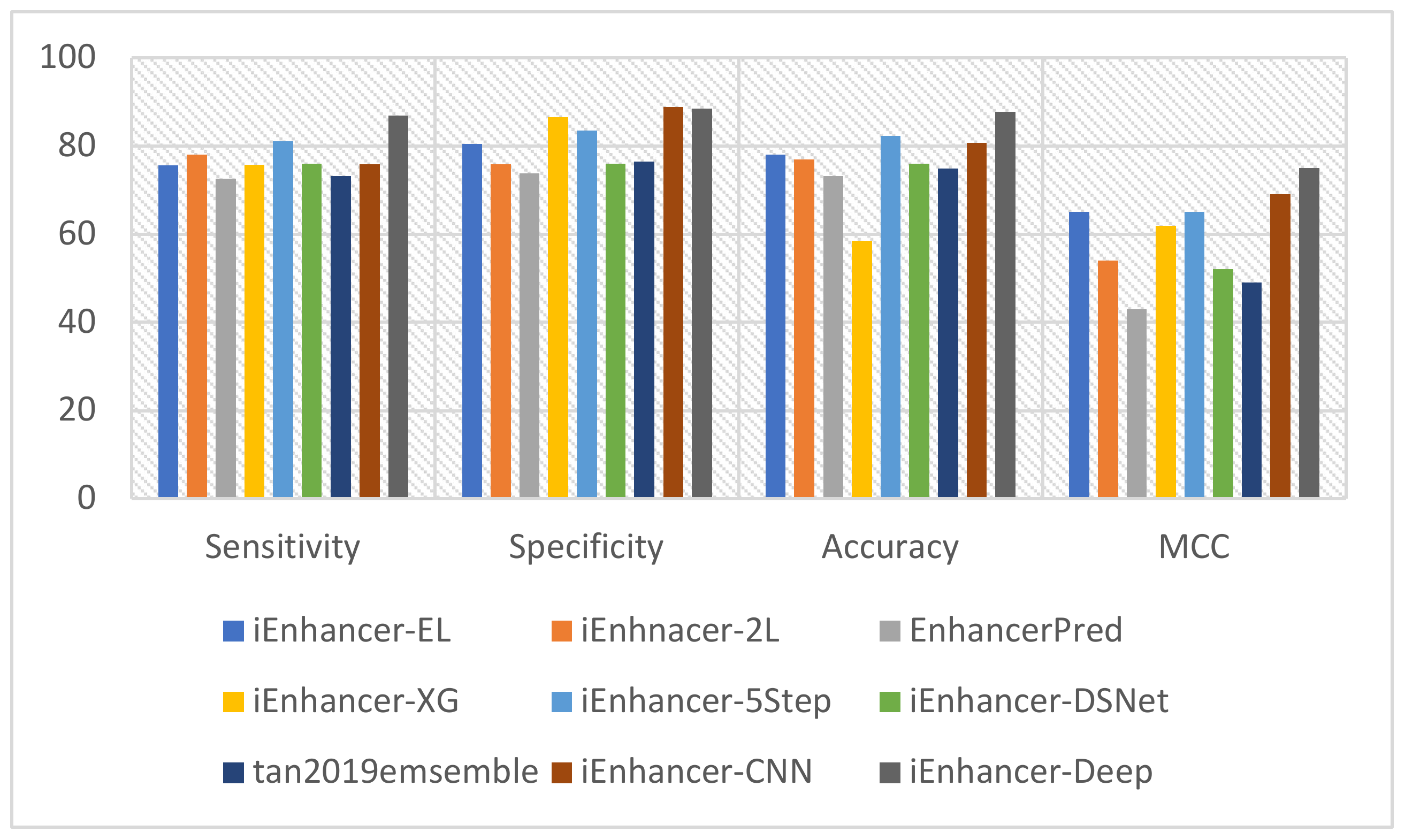
| iEnhancer-EL | 75.67 | 80.39 | 78.03 | 0.56 |
| iEnhnacer-2L | 78.09 | 75.88 | 76.89 | 0.54 |
| EnhancerPred | 72.57 | 73.79 | 73.18 | 0.43 |
| iEnhancer-XG | 75.70 | 86.50 | 58.55 | 0.62 |
| iEnhancer-5Step | 81.10 | 83.50 | 82.30 | 0.65 |
| iEnhancer-DSNet | 76.00 | 76.00 | 76.00 | 0.52 |
| tan2019emsemble | 73.25 | 76.42 | 74.83 | .49 |
| iEnhancer-CNN | 75.88 | 88.88 | 80.63 | 0.69 |
| iEnhancer-Deep | 86.99 | 88.5 | 87.77 | 0.75 |
| Model | Sensitivity | Specificity | Accuracy | MCC |
|---|---|---|---|---|
| iEnhancer-EL | 69.00 | 61.05 | 65.03 | 0.31 |
| iEnhnacer-2L | 62.21 | 61.82 | 61.93 | 0.24 |
| EnhancerPred | 62. 67 | 61.46 | 62.06 | 0.24 |
| iEnhancer-XG | 74.94 | 58.55 | 66.74 | 0.33 |
| iEnhancer-5Step | 75.53 | 60.80 | 68.10 | 0.37 |
| iEnhancer-DSNet | 63.00 | 67.00 | 63.00 | 0.26 |
| tan2019emsemble | 79.65 | 38.28 | 58.96 | 0.19 |
| iEnhancer-CNN | 73.64 | 76.8 | 76.43 | 0.45 |
| iEnhancer-Deep | 83.57 | 78.16 | 80.86 | 0.62 |
| Model | Sensitivity | Specificity | Accuracy | MCC |
|---|---|---|---|---|
| iEnhancer-EL | 71.00 | 78.50 | 74.75 | 0.4969 |
| iEnhnacer-2L | 71.00 | 75.00 | 73.00 | 0.4604 |
| EnhancerPred | 73.50 | 74.50 | 74.00 | 0.4800 |
| iEnhancer-CNN | 78.25 | 79.00 | 77.50 | 0.5850 |
| iEnhancer-Deep | 81.5 | 67.00 | 74.02 | 0.4902 |
| Model | Sensitivity | Specificity | Accuracy | MCC |
|---|---|---|---|---|
| iEnhancer-EL | 54.00 | 68.00 | 61.00 | 0.2222 |
| iEnhnacer-2L | 47.00 | 74.00 | 60.50 | 0.2181 |
| EnhancerPred | 45.00 | 65.00 | 55.00 | 0.1021 |
| iEnhancer-CNN | 65.25 | 76.10 | 75.00 | 0.3232 |
| iEnhancer-Deep | 73.00 | 49.00 | 61.00 | 0.2266 |
| Model | Species | Total Enhancers | TP | FN |
|---|---|---|---|---|
| iEnhancer-CNN | M. musculus | 34,696 | 19,500 | 15,196 |
| iEnhancer-Deep | 22,184 | 12,512 | ||
| iEnhancer-CNN | D. melanogaster | 8060 | 4748 | 3312 |
| iEnhancer-Deep | 4511 | 3549 | ||
| iEnhancer-CNN | C. elegance | 11,870 | 4076 | 7794 |
| iEnhancer-Deep | 4381 | 7489 | ||
| iEnhancer-CNN | A. thaliana | 5871 | 462 | 5409 |
| iEnhancer-Deep | 855 | 5016 |
Publisher’s Note: MDPI stays neutral with regard to jurisdictional claims in published maps and institutional affiliations. |
© 2022 by the authors. Licensee MDPI, Basel, Switzerland. This article is an open access article distributed under the terms and conditions of the Creative Commons Attribution (CC BY) license (https://creativecommons.org/licenses/by/4.0/).
Share and Cite
Kamran, H.; Tahir, M.; Tayara, H.; Chong, K.T. iEnhancer-Deep: A Computational Predictor for Enhancer Sites and Their Strength Using Deep Learning. Appl. Sci. 2022, 12, 2120. https://doi.org/10.3390/app12042120
Kamran H, Tahir M, Tayara H, Chong KT. iEnhancer-Deep: A Computational Predictor for Enhancer Sites and Their Strength Using Deep Learning. Applied Sciences. 2022; 12(4):2120. https://doi.org/10.3390/app12042120
Chicago/Turabian StyleKamran, Haider, Muhammad Tahir, Hilal Tayara, and Kil To Chong. 2022. "iEnhancer-Deep: A Computational Predictor for Enhancer Sites and Their Strength Using Deep Learning" Applied Sciences 12, no. 4: 2120. https://doi.org/10.3390/app12042120
APA StyleKamran, H., Tahir, M., Tayara, H., & Chong, K. T. (2022). iEnhancer-Deep: A Computational Predictor for Enhancer Sites and Their Strength Using Deep Learning. Applied Sciences, 12(4), 2120. https://doi.org/10.3390/app12042120