

Eye-Tracking in Interactive Virtual Environments: Implementation and Evaluation

Abstract
1. Introduction
1.1. The Argument for Eye-Tracking
1.2. Eye-Tracking in VR
1.3. Current State of the Research Field
2. Methodological Issues
2.1. Eye-Tracking Technology Applied in VR
2.2. Levels of Interpretation
2.3. The Complex World behind the Projection
- Head movement is tracked by the VR headset (or a motion capture setup for whole body movement). Unless otherwise limited, its six degrees of freedom (6DoF) [45] allows direct rotation (3DoF) and movement (3DoF) in real space. User kinetic movement is translated directly into the virtual space, altering the camera’s rotation and position.
- Locomotion user interfaces allow translating movement into the virtual world—be it through abstraction, movement metaphors, or actual movement tracking. Up to six degrees of freedom are also possible, depending on the complexity and usability of the physical user interface (e.g., keyboard and mouse vs. a VR controller, treadmill, or other (experimental) devices [46]). There is a trade-off between the complexity of a locomotion user interface and the quality of sensory input it offers (e.g., keyboard facilitates on/off movement along one axis at a constant pace—it is a simple interface, but the lack of bodily kinesthetic feedback makes it susceptible to motion sickness [26]; a complex interface such as full-body motion capture allows for realistic, precise movement sensation—at a cost of setting up the interface, physical space demands, and significant purchasing costs). Locomotion user interfaces influence users’ perceived ease of movement and distance estimation [47]; they can even facilitate new ways of working with digital content [48,49]. They may also influence viewing behavior—this, however, has not been addressed in any research to date.
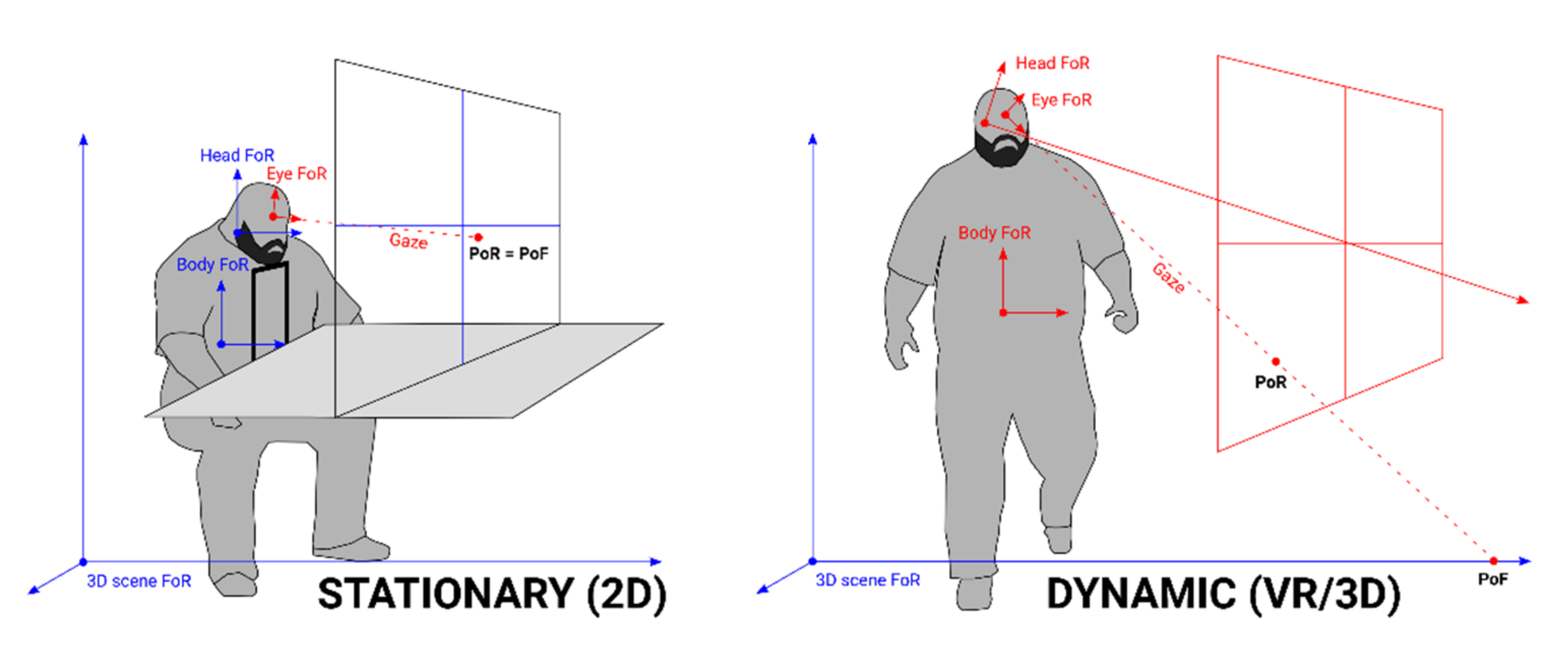
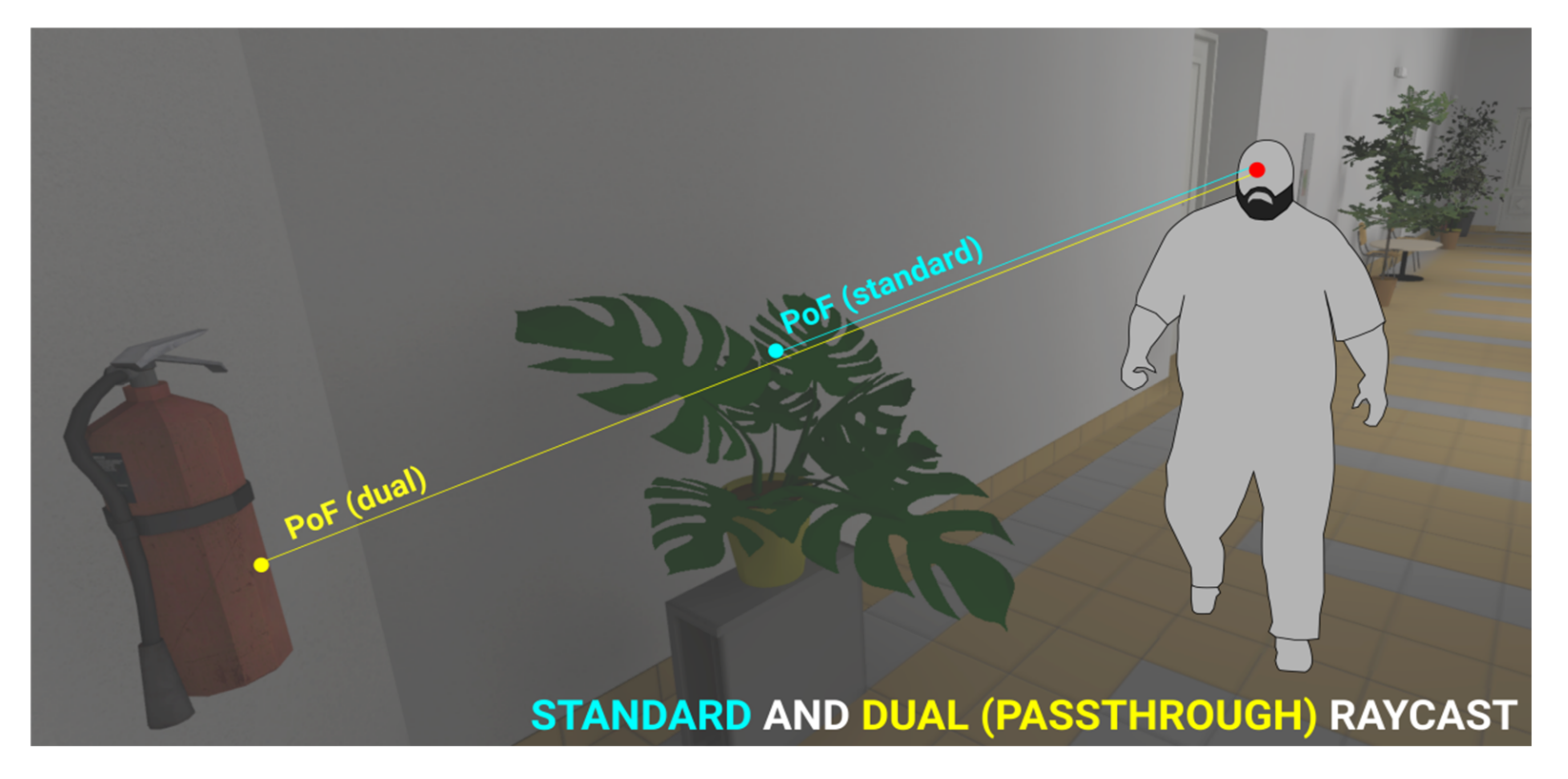
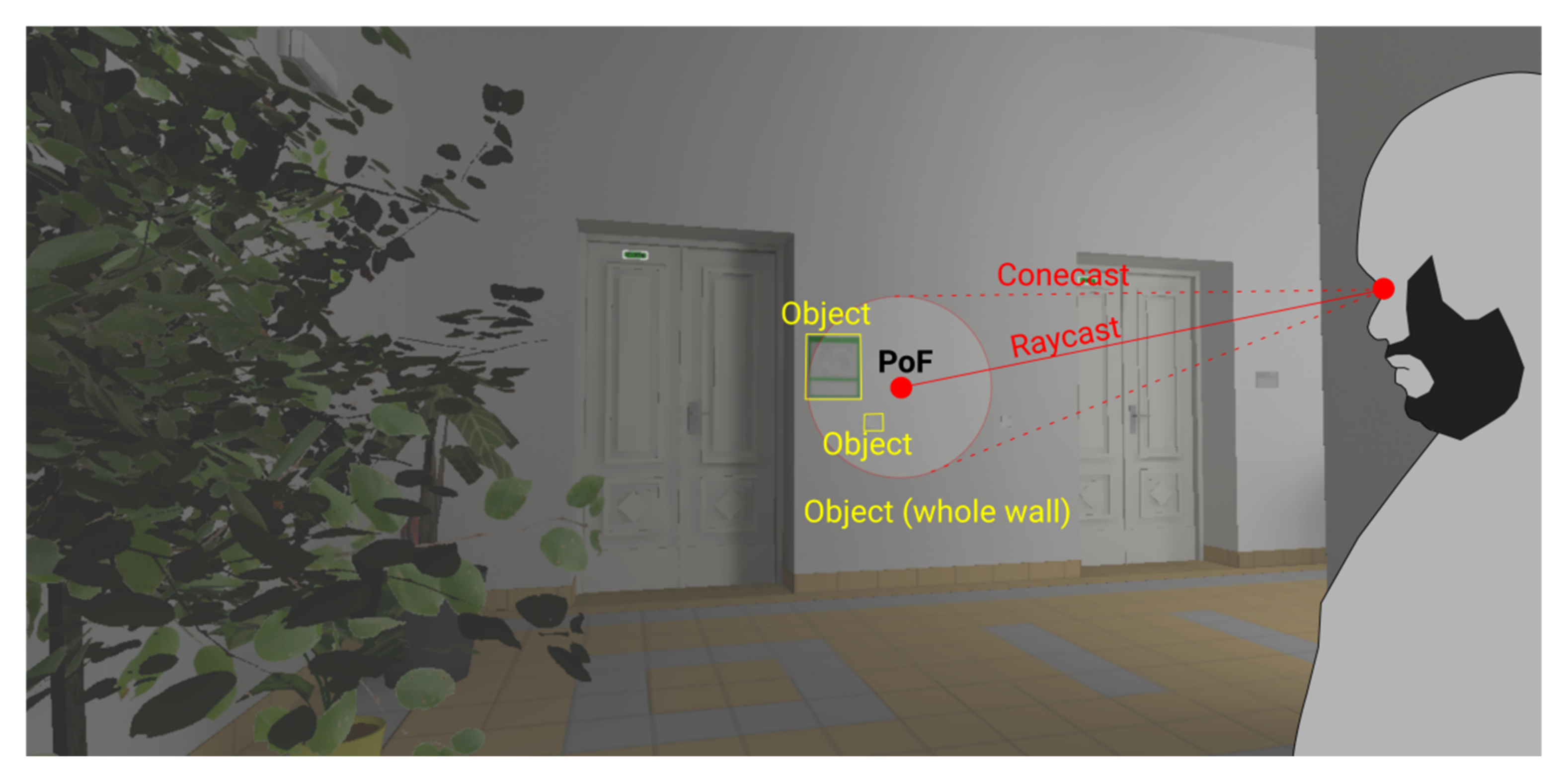
- Eye gaze coordinates are transformed into raycasts, which extend into the virtual world, i.e., by using the point of regard eye coordinate and camera position/rotation in the virtual world. As the ray is cast, it lands onto a spatial coordinate in the virtual world (point of fixation, PoF), provided something is in the ray’s path to land on (3D objects or surfaces).
- Static camera, static scene. The VR user observes the virtual world through a stationary, immovable virtual camera with zero degrees of freedom, and the only registered physical movement is eye movement. The user’s eye movements have no dynamic or interactive function attached, effectively equating this interpretation level to that of traditional 2D eye-tracking with static stimuli and the user resting on a chinrest. This is the simplest eye-tracking interpretation level, as the point of regard is the only relevant variable. The point of fixation transition is unnecessary since all the virtual coordinates seen on the screen are the only coordinates there are. Even if the presented scene is a 3D visualization with varying depth, the point of regard data set will always be transformed to the same point of fixation data set, with 1:1 projection. The acquired data can therefore be reduced to point of regard or worked with as if the stimulus were a static 2D image.Level of interpretation complexity: eye coordinates over time.
- Static camera, dynamic scene. The user has no control over the virtual camera position or rotation, giving them no possibility to change the perspective from which the presented stimuli are seen. The experimental scene can, however, dynamically change in front of the user’s eyes. In 3D, this would involve a predefined animation or other actors (AI, or other users with dynamic movement enabled). In classic eye-tracking studies, this can be equated to presenting a video. The majority of experimental control is still retained, i.e., the camera’s rotation/position is shown through the virtual camera, but knowing which content is shown, and the order in which it is shown, depends on whether the dynamics are deterministic (e.g., predefined animation vs. another user with dynamic controls). Regardless, this type of scene must be evaluated frame-by-frame. In these types of continuous scene, the positions of objects and their AoI coordinates change in time.Level of interpretation complexity: eye coordinates over time with scene movement.
- Dynamic camera, static scene. All interaction occurring in this type of scene is movement interaction [52], i.e., the user manipulates the virtual camera. The degree of complexity in recording and evaluating such movement increases significantly since the researcher abdicates control of the camera to the user, and thereby loses control of what is shown to the user, when it is shown, the order in which it is shown, from what angle and distance it is shown, and the overall scene composition. The user’s ability to navigate through the virtual scene depends on the physical controller and how the physical controller translates into the virtual scene (in-engine character controller [53]), and how many degrees of freedom such a controller provides, i.e., whether the camera can be rotated and moved and the extent of this movement. Even with simple camera dynamics, the three-dimensionality of a scene, i.e., the virtual space coordinates at and from which the user looks, and the distance between the user camera and the point of regard, must be considered for eye-tracking evaluation purposes. Free movement of the camera may cause 3D objects to occlude other objects, creating difficulties in interpretation [54]. Given the rather low precision of VR eye-trackers, measurement artifacts can originate at the border of multiple neighboring objects. The depth irregularity of a 3D scene and the potential measurement error is also projected irregularly onto objects in the 3D scene (objects at greater/varying distances accumulate more absolute-distance measurement errors than near objects of similar size since the eye-tracking precision error is based on angles, and the absolute distances between angle-based raycasts increase with depth). This level of eye-tracking complexity in 3D VR has no parallel in traditional eye-tracking in 2D.Level of interpretation complexity: eye movements over time with user movement and scene movement (synchronously).
- Dynamic camera, dynamic scene. All the interpretation issues mentioned above apply to this classification. In this case, other actors besides the user can also manipulate the projection and composition of the scene. At the user interaction level, these may be other (concurrent) user interfaces, controllers, or interaction metaphors, which allow selection, manipulation, systemic control, or symbolic input. Scene manipulation may occur at the level of individual objects, groups of objects [52], or the entire virtual scene [55]. At the execution level, events happening in the scene may be user-driven (interaction) or autonomous (AI or script-based), with or without feedback (visible, audible, or unregistrable), with or without affordances [56], (communicating or not communicating to the user that events or objects are potentially (inter)actible). Other users (multiplayer), AI, or interactive scripts may also instill changes within the scene. All these factors raise a new set of computational and visualization questions in the interpretation and visualization of a series of point of regard coordinates that target moving objects (especially when the user is concurrently moving in a different direction, or using a different controller).Level of interpretation complexity: eye movements over time with user movement and scene movement (asynchronously or a multitude of concurrent movements).
2.4. The State of Other Implementations
3. Implementation
3.1. The Technology That Is Available and the Technology That Is Used
3.2. The Program Architecture
3.3. Levels of Working with Eye-Tracking Data
- Eye-tracking calibration data (success/failure, or more detailed accuracy value);
- Timestamp for each log entry (time, up to milliseconds);
- User coordinates (positional Vector3 in the virtual world);
- User camera rotation (rotational Vector3 in the virtual world);
- Eye-tracking rotation relative to the user camera rotation or the point of fixation (Vector3).
- Eye-tracking rotation relative to the user camera rotation and point of fixation—both;
- Gazed 3D object name (object.name value);
- Gaze distance from the user camera to the point of fixation (in meters);
- Data loss metric, i.e., a check for missing eye inputs;
- Fixation metric, i.e., a check for whether eye-tracking fixation is occurring, based on the eye-tracker movement velocity and its near-time history, all relative to camera movement;
- Other potential physiological measurements of the eyes, if supported by the API (e.g., pupil dilation size or measurement accuracy);
- Other potential derived variables.
3.4. Setting Up the 3D Environment for Eye-Tracking
3.5. Data Acquisition and Related Algorithms
3.6. Data Cleaning, Curation, and Related Algorithms
3.7. Data Visualization and Related Algorithms
4. Discussion and Conclusions
4.1. Contributions to Eye-Tracking in VR
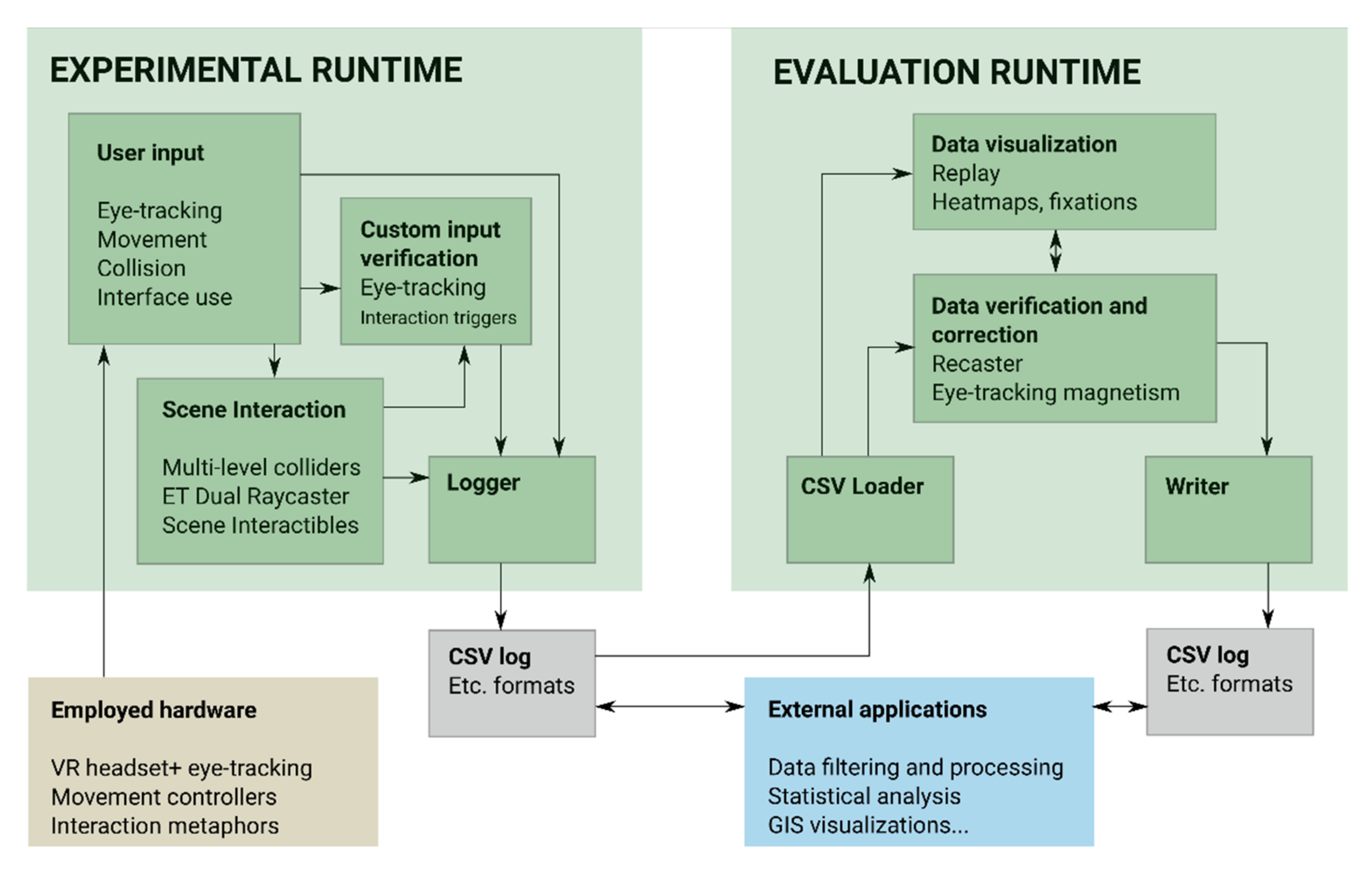
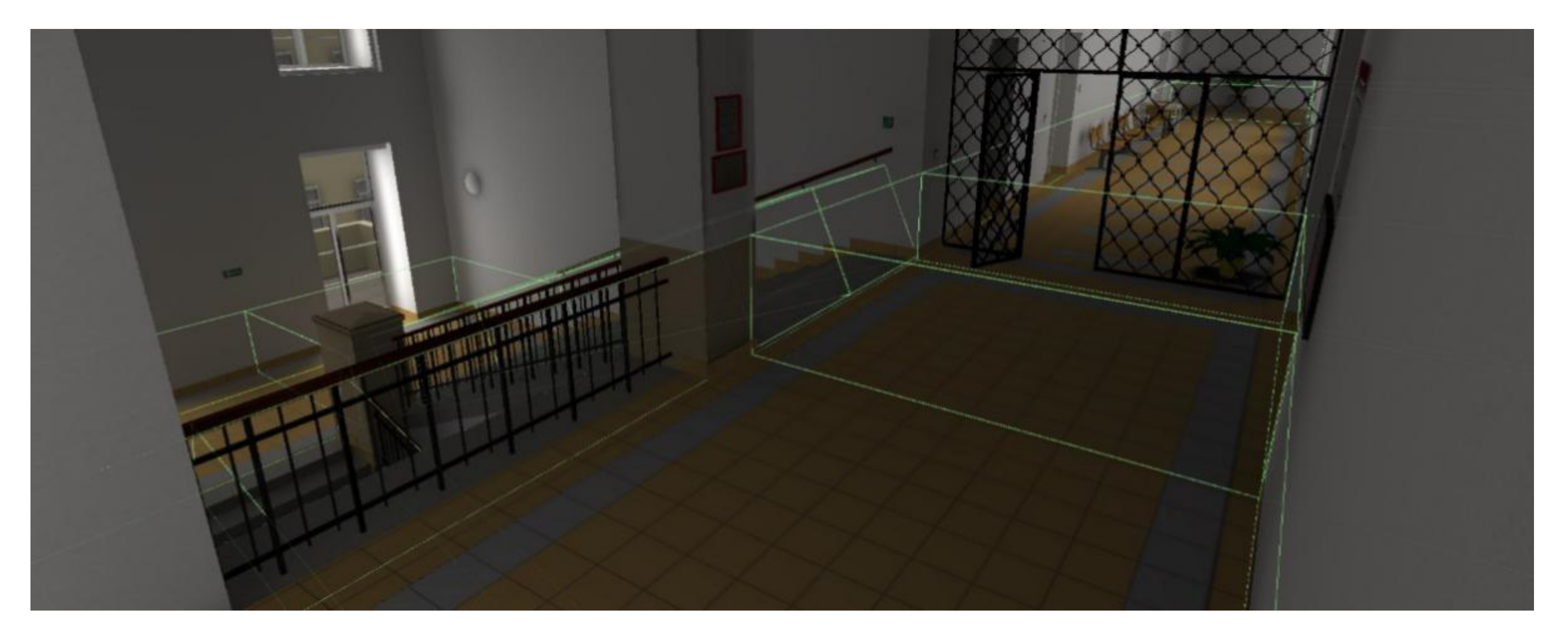
- experiment\PathScript.cs is our custom-built logger. On its own, it implements generic logging functionality (i.e., user movement, user interface usage, and user collision with other objects (e.g., spatial polygons depicted in Figure 5)). Moreover, custom logs to be passed to it, to be written into CSV files. Eye-tracking data can be one of such custom inputs.
- experiment\DualRaycaster.cs is an extended implementation of the raycaster function provided by the SRanipal API [62]. The second raycaster can be specified to pass through some virtual environment object layer(s) (Section 3.5, Dual Raycaster). It utilizes the PathScript logger to produce eye-tracking CSV logs. The logged variables are derived from the variable listing needed for further eye-tracking data processing (Section 3.3).
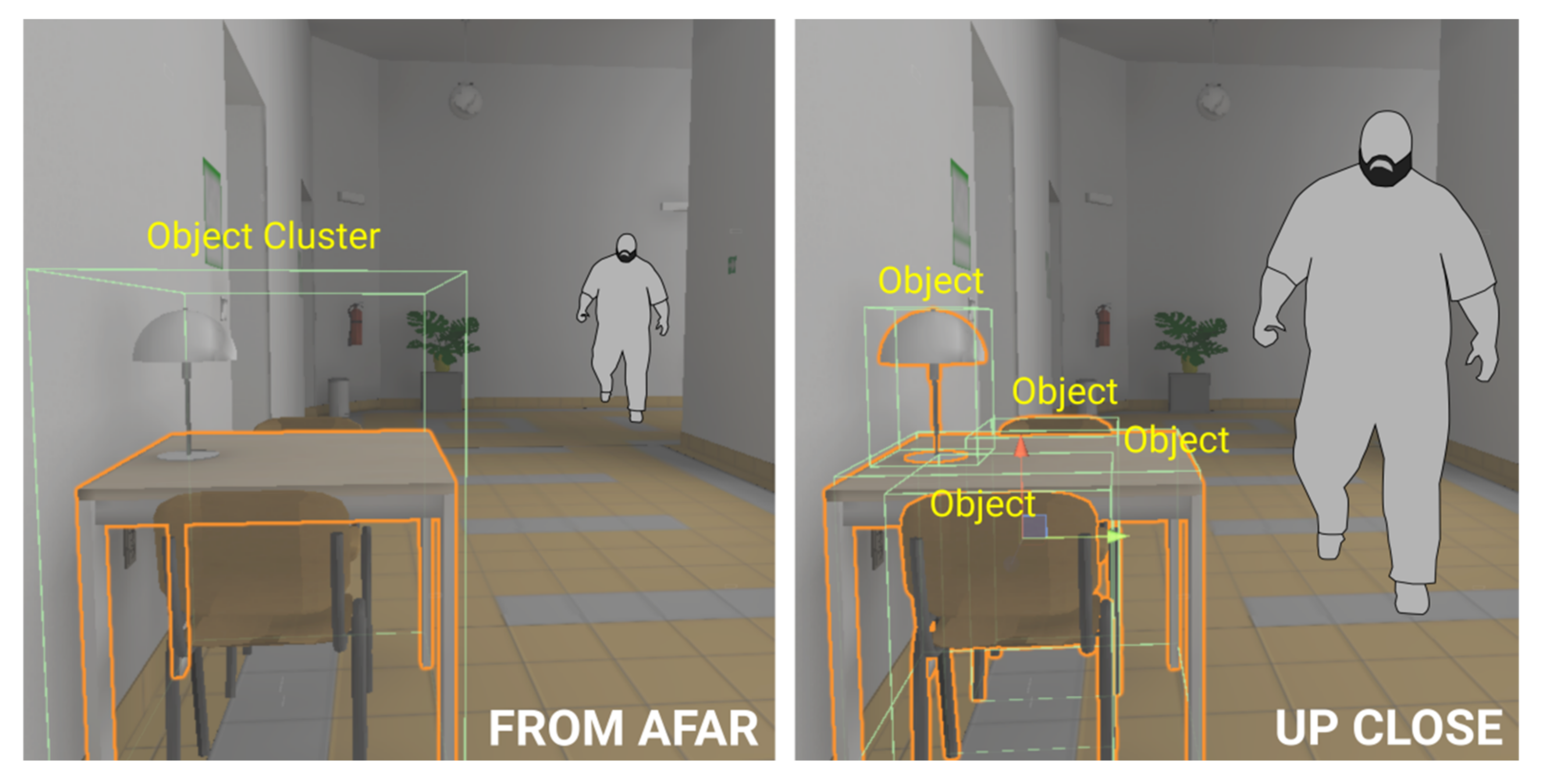
- experiment\MultiLevelColliderClient.cs and experiment\MultiLevelColliderServer.cs is a server-client solution for segmenting eye-tracking colliders (AoI) according to the user-object distance (Section 3.5, Multi-level collider segmentation). The server-client separation is intended so that the collider switching logic can be customized regardless of the collider-switchable objects present in a 3D scene—meaning that multiple clients subscribe to one server. Depending on server implementation and set-up (performance and evaluation heuristics), multi-level eye-tracking colliders are switched through the experimental runtime.
- verification\CSVReader.cs is an auxiliary script that loads CSV files back into the evaluation runtime (Section 3.2), to be converted into a List<Dictionary<>> data structure. Such data structures can be processed further by data cleaning (Section 3.6) and data visualization (Section 3.7) algorithms.
- verification\Recaster.cs is a re-raycasting script intended to reprocess existing eye-tracking data onto a scene with post-hoc altered 3D object and 3D object collider naming/structuring (Section 3.6, Recaster). The script utilizes CSVReader to load existing data; the 3D coordinates (user positional, user camera rotation, and eye-tracking angle) are used to re-raycast eye-tracking gaze onto the altered virtual environment, and the acquired results are saved, again, using PathScript.
- verification\et_recalculation.pde is an external script written in Processing programming language. The script processes eye-tracking CSV files produced by the raycaster/logger, to filter out junk data, data loss, and gaze segments too brief to be considered fixations. The provided verification\et_recalculation_sample\ directory also contains example input data and their reprocessed counterparts.
- visualization\ReplayScript.cs provides replays on acquired user behavior data including eye-tracking data, if existent (Section 3.7, Replay script). As the script loads a user’s CSV log using CSVReader, it takes control of the evaluation runtime camera to move and rotate through the virtual scene in real-time in a same way as the user (as specified by the positional and rotational vectors included in the CSV file). Eye-tracking data can be visualized, e.g., as a small white sphere rendered at the PoF positional vector, as hit by the eye-tracking raycast back in the experimental runtime.
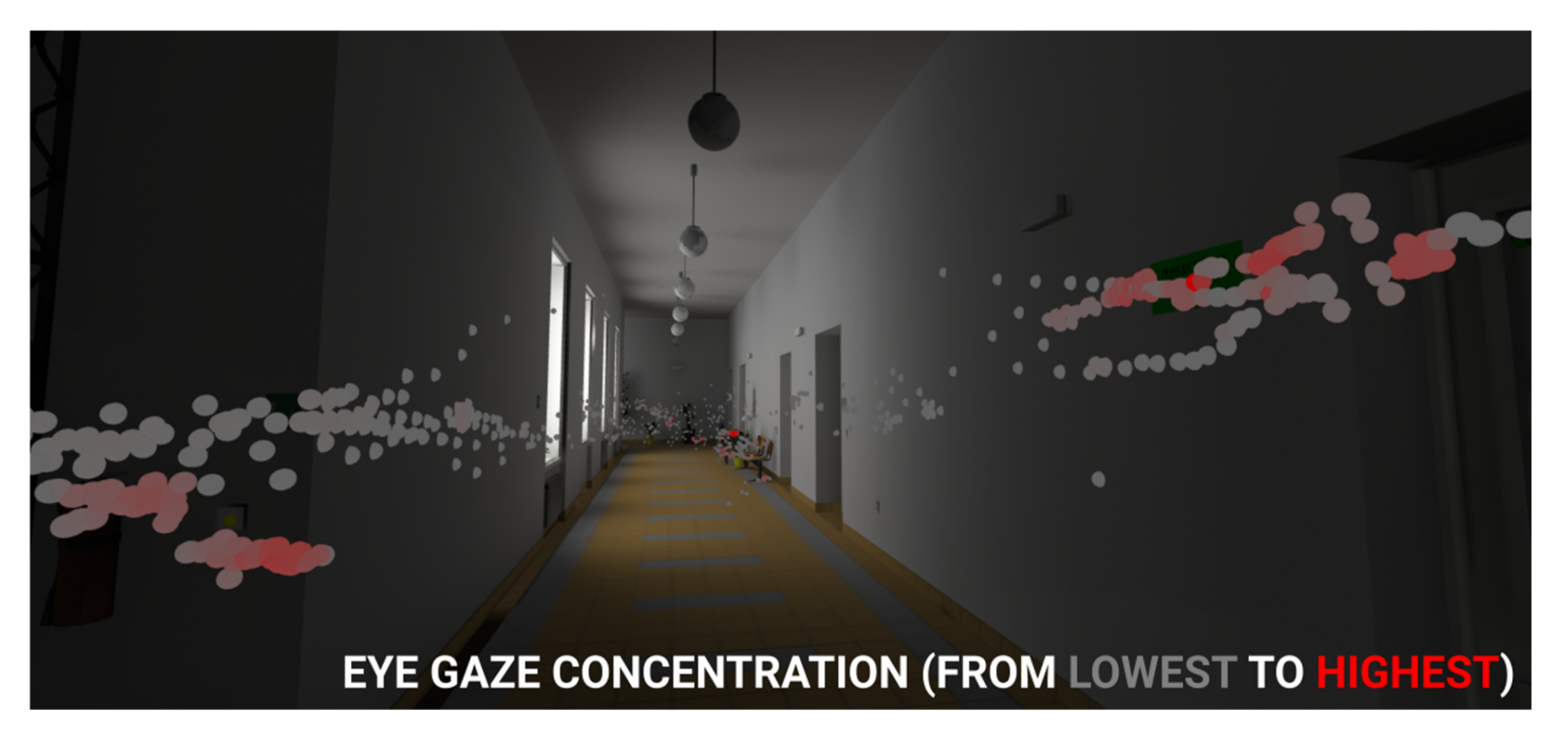
- visualization\HeatmapVisualizer.cs and visualization\PathVisualizer.cs are two examples of visualizing existing CSV data (Section 3.7, Heatmap algorithms). PathVisualizer uses Unity LineRenderer class to show user movement trajectory through the virtual environment. HeatmapVisualizer processes eye-tracking data (Figure 10). Given the computational difficulty of processing large quantities of eye-tracking data, the example HeatmapVisualizer already contains some optimizations: a setting to process only interval subsets of eye-tracking data, and another setting to process only area subsets of eye-tracking data (the area can be defined by assigning a spatial polygon).
4.2. Future Prospects
Author Contributions
Funding
Institutional Review Board Statement
Informed Consent Statement
Data Availability Statement
Acknowledgments
Conflicts of Interest
References
- Gliner, J.A.; Morgan, G.A.; Leech, N.L. Research Methods in Applied Settings: An Integrated Approach to Design and Analysis; Routledge: London, UK, 2017. [Google Scholar]
- Strube, M.J. Psychometric principles: From physiological data to psychological constructs. In Principles of Psychophysiology: Physical, Social, and Inferential Elements; Cacioppo, J.T., Tassinary, L.G., Eds.; Cambridge University Press: Cambridge, UK, 1990; pp. 34–57. [Google Scholar]
- Rayner, K. The 35th Sir Frederick Bartlett Lecture: Eye Movements and Attention in Reading, Scene Perception, and Visual Search. Q. J. Exp. Psychol. 2009, 62, 1457–1506. [Google Scholar] [CrossRef] [Scilit] [PubMed]
- Hooft, E.A.J.V.; Born, M.P. Intentional response distortion on personality tests: Using eye-tracking to understand response processes when faking. J. Appl. Psychol. 2012, 97, 301–316. [Google Scholar] [CrossRef] [Scilit] [PubMed]
- Tsianos, N.; Germanakos, P.; Lekkas, Z.; Mourlas, C.; Samaras, G. Eye-tracking users’ behavior in relation to cognitive style with inane-learning environment. In Proceedings of the Ninth IEEE International Conference on Advanced Learning Technologies, Riga, Latvia, 15–17 July 2009. [Google Scholar] [CrossRef] [Scilit]
- Sasson, N.J.; Elison, J.T. Eye tracking young children with autism. J. Vis. Exp. 2012, 61, 3675. [Google Scholar] [CrossRef] [Scilit] [PubMed]
- Coetzee, R.; Regel, S. Eye movement desensitisation and reprocessing: An update. Adv. Psychiatr. Treat. 2015, 11, 347–354. [Google Scholar] [CrossRef] [Scilit]
- Ekman, P. Emotion in the Human Face; Malor Books: San Jose, CA, USA, 2015. [Google Scholar]
- Changing Minds. Eyes: Body Language. 2012. Available online: http://changingminds.org/techniques/body/parts_body_language/eyes_body_language.htm (accessed on 31 July 2021).
- Yarbus, A.L. Eye Movements and Vision; Plenum Press: New York, NY, USA, 1967. [Google Scholar]
- Falck-Ytter, T. Gaze performance during face-to-face communication: A live eye tracking study of typical children and children with autism. Res. Autism Spectr. Disord. 2015, 17, 78–85. [Google Scholar] [CrossRef] [Scilit]
- Sharma, K.; Giannakos, M.; Dillenbourg, P. Eye-tracking and artificial intelligence to enhance motivation and learning. Smart Learn. Environ. 2020, 7, 1–19. [Google Scholar] [CrossRef] [Scilit]
- Shipman, K. MetaHumans—A look past the Hype. Puget Systems. 2021. Available online: https://www.pugetsystems.com/labs/articles/MetaHumans---a-look-past-the-Hype-2139 (accessed on 31 July 2021).
- Buswell, G.T. How People Look at Pictures: A Study of the Psychology and Perception in Art; University of Chicago Press: Chicago, IL, USA, 1935. [Google Scholar]
- Wade, N.J. Pioneers of eye movement research. i-Perception 2010, 1, 33–68. [Google Scholar] [CrossRef] [Scilit]
- Cornsweet, T.N.; Crane, H.D. Accurate Two-Dimensional Eye Tracker Using First and Fourth Purkinje Images. J. Opt. Soc. Am. 1973, 63, 921–928. [Google Scholar] [CrossRef] [Scilit]
- Charlier, J.; Hache, J. New instrument for monitoring eye fixation and pupil size during the visual field examination. Med. Biol. Eng. Comput. 1982, 20, 23–28. [Google Scholar] [CrossRef] [Scilit]
- Van de Kerkhof, M.; Benschop, J.; Banine, V. Lithography for now and the future. Solid-State Electron. 2019, 155, 20–26. [Google Scholar] [CrossRef] [Scilit]
- Safin, R.; Garipova, E.; Lavrenov, R.; Li, H.; Svinin, M.; Magid, E. Hardware and software video encoding comparison. In Proceedings of the 59th Annual Conference of the Society of Instrument and Control Engineers of Japan (SICE), Chiang Mai, Thailand, 23–26 September 2020; pp. 924–929. [Google Scholar] [CrossRef] [Scilit]
- Cognolato, M.; Atzori, M.; Müller, H. Head-Mounted Eye Gaze Tracking Devices: An Overview of Modern Devices and Recent Advances. J. Rehabil. Assist. Technol. Eng. 2018, 5, 1–13. [Google Scholar] [CrossRef] [Scilit] [PubMed]
- Ewalt, D.M. Defying Reality: The inside Story of the Virtual Reality Revolution; Blue Rider Press: New York, NY, USA, 2018. [Google Scholar]
- Levy, R.M. The virtual reality revolution: The vision and the reality. In Virtual Reality—Human Computer Interaction; Xinxign, T., Ed.; InTech: Šid, Croatia, 2012; pp. 21–36. [Google Scholar]
- Zhan, T.; Yin, K.; Xiong, J.; He, Z.; Wu, S.-T. Augmented Reality and Virtual Reality Displays: Perspectives and Challenges. iScience 2020, 23, 101397. [Google Scholar] [CrossRef] [Scilit] [PubMed]
- Portman, M.E.; Natapov, A.; Fisher-Gewirtzman, D. To Go Where No Man Has Gone Before: Virtual Reality in Architecture, Landscape Architecture and Environmental Planning. Comput. Environ. Urban Syst. 2015, 54, 376–384. [Google Scholar] [CrossRef] [Scilit]
- Griliopoulos, D. The Virtual Reality of Virtual Worlds—Improbable. 2017. Available online: https://www.improbable.io/blog/the-virtual-reality-of-virtual-worlds (accessed on 21 September 2021).
- Mayor, J.; Raya, L.; Sanchez, A. A Comparative Study of Virtual Reality Methods of Interaction and Locomotion Based on Presence, Cybersickness and Usability. IEEE Trans. Emerg. Topics Comput. 2021, 9, 1542–1553. [Google Scholar] [CrossRef] [Scilit]
- Pan, X.; Hamilton, A.F. Why and How to Use Virtual Reality to Study Human Social Interaction: The Challenges of Exploring a New Research Landscape. Br. J. Psychol. 2018, 109, 395–417. [Google Scholar] [CrossRef] [Scilit]
- Sussman, A.; Hollander, J.B. Cognitive Architecture: Designing for How We Respond to the Built Environment; Routledge: London, UK, 2015. [Google Scholar]
- Kiefer, P.; Giannopoulos, I.; Raubal, M.; Duchowski, A. Eye Tracking for Spatial Research: Cognition, Computation, Challenges. Spat. Cogn. Comput. 2017, 17, 1–19. [Google Scholar] [CrossRef] [Scilit]
- Patney, A.; Kim, J.; Salvi, M.; Kaplanyan, A.; Wyman, C.; Benty, N.; Lefohn, A.; Luebke, D. Perceptually-Based Foveated Virtual Reality. In Proceedings of the ACM SIGGRAPH 2016 Emerging Technologies, Anaheim, CA, USA, 24–28 July 2016. [Google Scholar]
- Tobii. Tobii XR SDK, 2021a. Available online: https://vr.tobii.com/sdk/ (accessed on 25 August 2021).
- Statham, N. Use of Photogrammetry in Video Games: A Historical Overview. Games Cult. 2020, 15, 289–307. [Google Scholar] [CrossRef] [Scilit]
- Yan, J.; Kensek, K.; Konis, K.; Noble, D. CFD Visualization in a Virtual Reality Environment Using Building Information Modeling Tools. Buildings 2020, 10, 229. [Google Scholar] [CrossRef] [Scilit]
- Zhao, J.; Wallgrün, J.O.; LaFemina, P.C.; Normandeau, J.; Klippel, A. Harnessing the Power of Immersive Virtual Reality—Visualization and Analysis of 3D Earth Science Data Sets. Geo-Spat. Inf. Sci. 2019, 22, 237–250. [Google Scholar] [CrossRef] [Scilit]
- Krejtz, K.; Duchowski, A.T.; Niedzielska, A.; Biele, C.; Krejtz, I. Eye Tracking Cognitive Load Using Pupil Diameter and Microsaccades with Fixed Gaze. PLoS ONE 2018, 13, e0203629. [Google Scholar] [CrossRef] [Scilit]
- Duchowski, A. Eye Tracking Methodology: Theory and Practice, 3rd ed.; Springer International Publishing: Cham, Switzerland, 2017. [Google Scholar]
- Lappi, O. Eye Tracking in the Wild: The Good, the Bad and the Ugly. J. Eye Mov. Res. 2015, 8, 1–21. [Google Scholar] [CrossRef] [Scilit]
- Clay, V.; König, P.; König, S. Eye Tracking in Virtual Reality. J. Eye Mov. Res. 2019, 12. [Google Scholar] [CrossRef] [Scilit] [PubMed]
- SR Research. EyeLink 1000 Plus Technical Specifications. 2017. Available online: https://www.sr-research.com/wp-content/uploads/2017/11/eyelink-1000-plus-specifications.pdf (accessed on 18 October 2021).
- Sipatchin, A.; Wahl, S.; Rifai, K. Eye-Tracking for Clinical Ophthalmology with Virtual Reality (VR): A Case Study of the HTC Vive pro Eye’s Usability. Healthcare 2021, 9, 180. [Google Scholar] [CrossRef] [Scilit] [PubMed]
- VRgineers. XTAL Technical Specification. 2021. Available online: https://vrgineers.com/xtal/technical-specification/ (accessed on 25 October 2021).
- Varjo. Getting Started with Varjo Plugin for Unity. 2021. Available online: https://developer.varjo.com/docs/v2.1.0/unity/getting-started-with-varjo-plugin-for-unity (accessed on 25 October 2021).
- Khronos Group. The Open XR Specification. 2021. Available online: https://www.khronos.org/registry/OpenXR/specs/1.0/pdf/xrspec.pdf (accessed on 25 August 2021).
- Hornsey, R.L.; Hibbard, P.B. Contributions of Pictorial and Binocular Cues to the Perception of Distance in Virtual Reality. Virtual Real. 2021, 25, 1087–1103. [Google Scholar] [CrossRef] [Scilit]
- Chandrasekera, T.; Fernando, K.; Puig, L. Effect of Degrees of Freedom on the Sense of Presence Generated by Virtual Reality (VR) Head-Mounted Display Systems: A Case Study on the Use of VR in Early Design Studios. J. Educ. Technol. Syst. 2019, 47, 513–522. [Google Scholar] [CrossRef] [Scilit]
- Kitson, A.; Hashemian, A.M.; Stepanova, E.R.; Kruijff, E.; Riecke, B.E. Comparing leaning-based motion cueing interfaces for virtual reality locomotion. In Proceedings of the 2017 IEEE Symposium on 3D User Interfaces, Los Angeles, CA, USA, 18–19 March 2017; pp. 73–82. [Google Scholar]
- Keil, J.; Edler, D.; O’Meara, D.; Korte, A.; Dickmann, F. Effects of Virtual Reality Locomotion Techniques on Distance Estimations. ISPRS Int. J. Geo-Inf. 2021, 10, 150. [Google Scholar] [CrossRef] [Scilit]
- Berger, M. Exploring and Transforming Spaces through High-Dimensional Gestural Interactions. Adv. Cartogr. GIScience ICA 2021, 3, 1–8. [Google Scholar] [CrossRef] [Scilit]
- Adobe Inc. Medium. Top 3D Sculpting Tools for Virtual Reality Authoring. 2021. Available online: https://www.adobe.com/products/medium.html (accessed on 23 December 2021).
- Pietroszek, K. Raycasting in Virtual Reality. In Encyclopedia of Computer Graphics and Games; Lee, N., Ed.; Springer: Cham, Switzerland, 2018; pp. 1–3. [Google Scholar]
- Ihemedu-Steinke, Q.C.; Erbach, R.; Halady, P.; Meixner, G.; Weber, M. Virtual Reality Driving Simulator Based on Head-Mounted Displays. In Automotive User Interfaces; Meixner, G., Müller, C., Eds.; Springer: Berlin/Heidelberg, Germany, 2017; pp. 401–428. [Google Scholar]
- Gillies, M. What Is Movement Interaction in Virtual Reality For? In Proceedings of the 3rd International Symposium on Movement and Computing, Thessaloniki, Greece, 5–6 July 2016; pp. 1–4. [Google Scholar]
- Unity Technologies. Character Controller. 2021. Available online: https://docs.unity3d.com/Manual/class-CharacterController.html (accessed on 25 August 2021).
- Motamedi, A.; Wang, Z.; Yabuki, N.; Fukuda, T.; Michikawa, T. Signage Visibility Analysis and Optimization System Using BIM-Enabled Virtual Reality (VR) Environments. Adv. Eng. Inform. 2017, 32, 248–262. [Google Scholar] [CrossRef] [Scilit]
- Ugwitz, P.; Stachoň, Z.; Pospíšil, P. Rendering a series of 3D dynamic visualizations in (geographic) experimental tasks. In Proceedings of the 8th International Conference on Cartography and GIS, Nessebar, Bulgaria, 20–25 June 2020; pp. 628–634. [Google Scholar]
- Steffen, J.H.; Gaskin, J.E.; Meservy, T.O.; Jenkins, J.L.; Wolman, I. Framework of Affordances for Virtual Reality and Augmented Reality. J. Manag. Inf. Syst. 2019, 36, 683–729. [Google Scholar] [CrossRef] [Scilit]
- Pettersson, J.; Albo, A.; Eriksson, J.; Larsson, P.; Falkman, K.W.; Falkman, P. Cognitive Ability Evaluation Using Virtual Reality and Eye Tracking. In Proceedings of the 2018 IEEE International Conference on Computational Intelligence and Virtual Environments for Measurement Systems and Applications (CIVEMSA), Ottawa, ON, Canada, 12–13 June 2018. [Google Scholar]
- Tobii. Eye-Tracking Analytics. 2021. Available online: https://vr.tobii.com/sdk/learn/analytics/ (accessed on 18 October 2021).
- Halladay, K. Practical Shader Development: Vertex and Fragment Shaders for Game Developers; Apress: New York, NY, USA, 2019. [Google Scholar]
- WorldViz Inc. Sightlab VR. 2021. Available online: https://www.worldviz.com/virtual-reality-eye-tracking-for-research-solutions (accessed on 26 August 2021).
- Rönngren, D. OpenXR Announces the First Extension for Eye Tracking. 2020. Available online: https://blog.tobii.com/openxr-announces-the-first-extension-for-eye-tracking (accessed on 31 July 2021).
- Tobii. Get Started Developing with the HTC VIVE Pro Eye Using Tobii XR SDK. 2021. Available online: https://vr.tobii.com/sdk/develop/unity/getting-started/vive-pro-eye/ (accessed on 18 October 2021).
- Epic Games. The Most Powerful Real-Time 3D Creation Tool—Unreal Engine. 2021. Available online: https://www.unrealengine.com/ (accessed on 18 October 2021).
- Unity Technologies. Unity Real-Time Development Platform. 2021. Available online: https://unity.com/releases/release-overview (accessed on 18 October 2021).
- Bergsman Lind, T. Quixel Joins Forces with Epic Games. 2019. Available online: https://quixel.com/blog/2019/11/12/quixel-joins-forces-with-epic-games (accessed on 26 September 2021).
- Beardsall, R. Unreal Engine 5 And Nanite Virtualized Geometry—What Does It Mean For Content Creators? 2020. Available online: https://medium.com/xrlo-extended-reality-lowdown/unreal-engine-5-and-nanite-virtualized-geometry-what-does-it-mean-for-content-creators-b4106accd306 (accessed on 26 September 2021).
- Romero, M.F.; Sewell, B. Blueprints Visual Scripting for Unreal Engine: The Faster Way to Build Games Using UE4 Blueprints; Packt Publishing: Birmingham, UK, 2019. [Google Scholar]
- Ugwitz, P.; Herman, L.; Stachoň, Z. 3D Visualization of Historical Buildings: Methods, Their Utility in the Tourism Industry and Beyond. Regionální Rozvoj Mezi Teorií a Praxí 2021, 1, 43–62. [Google Scholar]
- Unity Technologies. Post-Processing. 2021. Available online: https://docs.unity3d.com/Manual/PostProcessingOverview.html (accessed on 25 August 2021).
- Volk, R.; Stengel, J.; Schultmann, F. Building Information Modeling (BIM) for existing buildings—Literature review and future needs. Autom. Constr. 2014, 38, 109–127. [Google Scholar] [CrossRef] [Scilit]
- Gu, N.; London, K. Understanding and facilitating BIM adoption in the AEC industry. Autom. Constr. 2010, 19, 988–999. [Google Scholar] [CrossRef] [Scilit]
- Tridify Ltd. Tridify Convert. 2021. Available online: https://www.tridify.com/ (accessed on 25 August 2021).
- Tridify Ltd. Tridify BIM Tools. 2021. Available online: https://assetstore.unity.com/packages/tools/utilities/tridify-bim-tools-125779 (accessed on 25 August 2021).
- Unity Technologies. ProBuilder. 2021. Available online: https://unity.com/features/probuilder (accessed on 25 August 2021).
- Blender Foundation. Blender—A 3D Modelling and Rendering Package. 2021. Available online: https://www.blender.org/ (accessed on 25 August 2021).
- Luebke, D.P. Level of Detail for 3D Graphics; Morgan Kaufmann: Amsterdam, The Netherlands, 2003. [Google Scholar]
- Aversa, D.; Dickinson, C. Unity Game Optimization: Enhance and Extend the Performance of All Aspects of Your Unity Games, 3rd ed.; Packt Publishing: Birmingham, UK, 2019. [Google Scholar]
- Austin, J. Fix your (Unity) Timestep. 2019. Available online: https://johnaustin.io/articles/2019/fix-your-unity-timestep (accessed on 29 September 2021).
- Farrell, J.E. Fitting Physical Screen Parameters to the Human Eye. In The Man-Machine Interface; Macmillan: Basingstoke, UK, 1991; pp. 7–23. [Google Scholar]
- Lengyel, E. Foundations of Game Engine Development; Terathon Software LLC: Lincoln, CA, USA, 2016; Volume 1. [Google Scholar]
- Guenter, B.; Finch, M.; Drucker, S.; Tan, D.; Snyder, J. Foveated 3D Graphics. ACM Trans. Graph. 2012, 31, 1–10. [Google Scholar] [CrossRef] [Scilit]
- Nystrom, R. Game Programming Patterns. Genever Benning. 2014, pp. 321–353. Available online: https://gameprogrammingpatterns.com/ (accessed on 16 January 2022).
- Kurzhals, K.; Weiskopf, D. Space-Time Visual Analytics of Eye-Tracking Data for Dynamic Stimuli. IEEE Trans. Vis. Comput. Graph. 2013, 19, 2129–2138. [Google Scholar] [CrossRef] [Scilit]
- Unreal Engine. Decals. An Overview of the Decals Example Level. 2022. Available online: https://docs.unrealengine.com/4.27/en-US/Resources/ContentExamples/Decals/ (accessed on 5 January 2022).
- Llanes-Jurado, J.; Marín-Morales, J.; Guixeres, J.; Alcañiz, M. Development and Calibration of an Eye-Tracking Fixation Identification Algorithm for Immersive Virtual Reality. Sensors 2020, 20, 4956. [Google Scholar] [CrossRef] [Scilit]
- Saleem, W.; Belyaev, A.; Wang, D.; Seidel, H.-P. On Visual Complexity of 3D Shapes. Comput. Graph. 2011, 35, 580–585. [Google Scholar] [CrossRef] [Scilit]
- Bulthoff, H.H.; Edelman, S.Y.; Tarr, M.J. How Are Three-Dimensional Objects Represented in the Brain? Cereb. Cortex 1995, 5, 247–260. [Google Scholar] [CrossRef] [Scilit]
- Ikonen, T. Lightweight CSV Reader for Unity. 2014. Available online: https://bravenewmethod.com/2014/09/13/lightweight-csv-reader-for-unity/ (accessed on 5 January 2022).
- SensoMotoric Instruments. Event Detection. In BeGaze Manual Version 3.4; SensoMotoric Instruments: Teltow, Germany, 2014; pp. 315–325. [Google Scholar]
- Hofmann, G.R. Who Invented Ray Tracing? Vis. Comput. 1990, 6, 120–124. [Google Scholar] [CrossRef] [Scilit]
- Yamu, C.; van Nes, A.; Garau, C. Bill Hillier’s Legacy: Space Syntax—A Synopsis of Basic Concepts, Measures, and Empirical Application. Sustainability 2021, 13, 3394. [Google Scholar] [CrossRef] [Scilit]
- Lachambre, S.; Lagarde, S.; Jover, C. Unity Photogrammetry Workflow; Unity Technologies: San Francisco, CA, USA, 2017. [Google Scholar]
- Fuhl, W.; Kuebler, T.; Santini, T.; Kasneci, E. Automatic Generation of Saliency-Based Areas of Interest for the Visualization and Analysis of Eye-Tracking Data. In Proceedings of the Conference on Vision, Modeling, and Visualization, Stuttgart, Germany, 10–12 October 2018; pp. 47–54. [Google Scholar]
- John, B.; Raiturkar, P.; Le Meur, O.; Jain, E. A Benchmark of Four Methods for Generating 360 Saliency Maps from Eye Tracking Data. Int. J. Semant. Comput. 2019, 13, 329–341. [Google Scholar] [CrossRef] [Scilit]
- Soler-Dominguez, J.L.; Camba, J.D.; Contero, M.; Alcañiz, M. A Proposal for the Selection of Eye-Tracking Metrics for the Implementation of Adaptive Gameplay in Virtual Reality Based Games. In International Conference on Virtual, Augmented and Mixed Reality; Springer: Cham, Switzerland, 2017; pp. 369–380. [Google Scholar]
- Ugwitz, P.; Šašinková, A.; Šašinka, Č.; Stachoň, Z.; Juřík, V. Toggle Toolkit: A Tool for Conducting Experiments in Unity Virtual Environments. Behav. Res. Methods 2021, 53, 1581–1591. [Google Scholar] [CrossRef] [Scilit]
- Ware, C. Information Visualization: Perception for Design; Morgan Kaufmann: Burlington, MA, USA, 2020. [Google Scholar]
- ESRI. ArcGIS 3D Analyst. 2022. Available online: https://www.esri.com/en-us/arcgis/products/arcgis-3d-analyst/overview (accessed on 5 January 2022).
- Parsons, T.D.; Rizzo, A.A. Initial Validation of a Virtual Environment for Assessment of Memory Functioning: Virtual Reality Cognitive Performance Assessment Test. CyberPsychology Behav. 2008, 11, 17–25. [Google Scholar] [CrossRef] [Scilit]
- Hanus, A.; Hoover, M.; Lim, A.; Miller, J. A Collaborative Virtual Reality Escape Room with Passive Haptics. In Proceedings of the 2019 IEEE Conference on Virtual Reality and 3D User Interfaces (VR), Osaka, Japan, 23–27 March 2019; pp. 1413–1414. [Google Scholar] [CrossRef] [Scilit]
- Delgado, J.M.D.; Oyedele, L.; Demian, P.; Beach, T. A Research Agenda for Augmented and Virtual Reality in Architecture, Engineering and Construction. Adv. Eng. Inform. 2020, 45, 101122. [Google Scholar] [CrossRef] [Scilit]
- Lele, A. Virtual Reality and Its Military Utility. J. Ambient. Intell. Humaniz. Comput. 2011, 4, 17–26. [Google Scholar] [CrossRef] [Scilit]
- Visser, H.; Watson, M.O.; Salvado, O.; Passenger, J.D. Progress in Virtual Reality Simulators for Surgical Training and Certification. Med. J. Aust. 2011, 194, S38–S40. [Google Scholar] [CrossRef] [Scilit]
- Herman, L.; Popelka, S.; Hejlová, V. Eye-Tracking Analysis of Interactive 3D Geovisualization. J. Eye Mov. Res. 2017, 10. [Google Scholar] [CrossRef] [Scilit]
- Šašinka, Č.; Stachoň, Z.; Sedlák, M.; Chmelík, J.; Herman, L.; Kubíček, P.; Šašinková, A.; Doležal, M.; Tejkl, H.; Urbánek, T.; et al. Collaborative Immersive Virtual Environments for Education in Geography. ISPRS Int. J. Geo-Inf. 2018, 8, 3. [Google Scholar] [CrossRef] [Scilit]
- Šašinková, A.; Ugwitz, P. Cross-Cultural Differences in the Processing of Complex Virtual 3D Scenes. In Proceedings of the 32nd International Congress of Psychology, Prague, Czech Republic, 18–23 July 2021. [Google Scholar]
- Čeněk, J.; Tsai, J.-L.; Šašinka, Č. Cultural Variations in Global and Local Attention and Eye-Movement Patterns during the Perception of Complex Visual Scenes: Comparison of Czech and Taiwanese University Students. PLoS ONE 2020, 15, e0242501. [Google Scholar] [CrossRef] [Scilit]


Publisher’s Note: MDPI stays neutral with regard to jurisdictional claims in published maps and institutional affiliations. |
© 2022 by the authors. Licensee MDPI, Basel, Switzerland. This article is an open access article distributed under the terms and conditions of the Creative Commons Attribution (CC BY) license (https://creativecommons.org/licenses/by/4.0/).
Share and Cite
Ugwitz, P.; Kvarda, O.; Juříková, Z.; Šašinka, Č.; Tamm, S. Eye-Tracking in Interactive Virtual Environments: Implementation and Evaluation. Appl. Sci. 2022, 12, 1027. https://doi.org/10.3390/app12031027
Ugwitz P, Kvarda O, Juříková Z, Šašinka Č, Tamm S. Eye-Tracking in Interactive Virtual Environments: Implementation and Evaluation. Applied Sciences. 2022; 12(3):1027. https://doi.org/10.3390/app12031027
Chicago/Turabian StyleUgwitz, Pavel, Ondřej Kvarda, Zuzana Juříková, Čeněk Šašinka, and Sascha Tamm. 2022. "Eye-Tracking in Interactive Virtual Environments: Implementation and Evaluation" Applied Sciences 12, no. 3: 1027. https://doi.org/10.3390/app12031027
APA StyleUgwitz, P., Kvarda, O., Juříková, Z., Šašinka, Č., & Tamm, S. (2022). Eye-Tracking in Interactive Virtual Environments: Implementation and Evaluation. Applied Sciences, 12(3), 1027. https://doi.org/10.3390/app12031027