Article

Modified Uncertainty Error Aware Estimation Model for Tracking the Path of Unmanned Aerial Vehicles


by
Rui Fu
1,
Mohammed Abdulhakim Al-Absi
2,
Young-Sil Lee
3,
Ahmed Abdulhakim Al-Absi
4,* and
Hoon Jae Lee
5,*
1
Blockchain Laboratory of Agriculture and Vegetables, Weifang University of Science and Technology, Weifang 262700, China
2
Department of Ubiquitous IT, Graduate School, Dongseo University, 47 Jurye-ro, Sasang-gu, Busan 47011, Republic of Korea
3
International College, Dongseo University, Busan 47011, Republic of Korea
4
Department of Smart Computing, Kyungdong University, Goseong 24764, Republic of Korea
5
Division of Information and Communication Engineering, Dongseo University, 47 Jurye-ro, Sasang-gu, Busan 47011, Republic of Korea
*
Authors to whom correspondence should be addressed.
Appl. Sci. 2022, 12(22), 11313; https://doi.org/10.3390/app122211313
Submission received: 19 September 2022 / Revised: 3 November 2022 / Accepted: 4 November 2022 / Published: 8 November 2022
(This article belongs to the Special Issue Security and Privacy in Smart Healthcare Applications)

Abstract

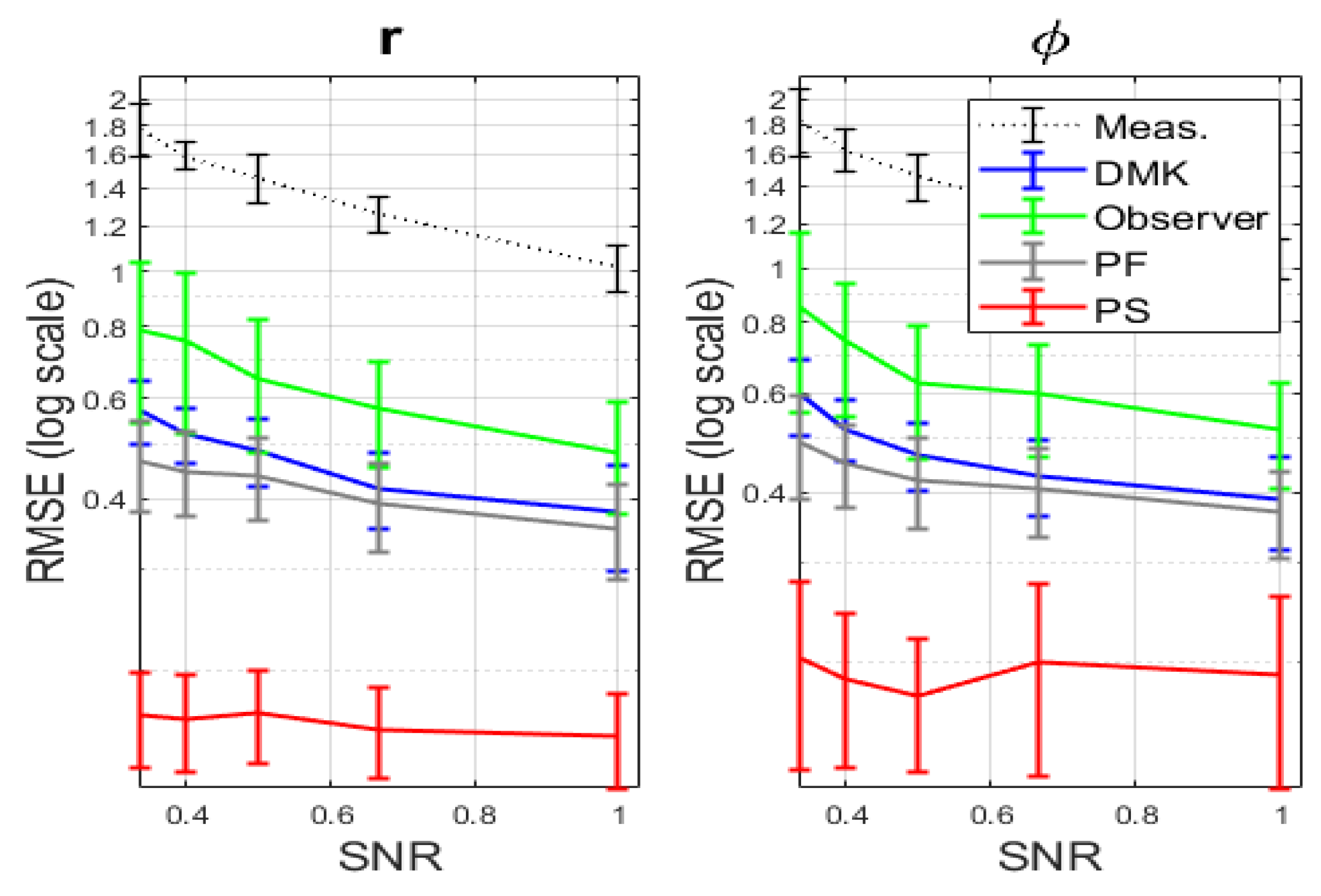
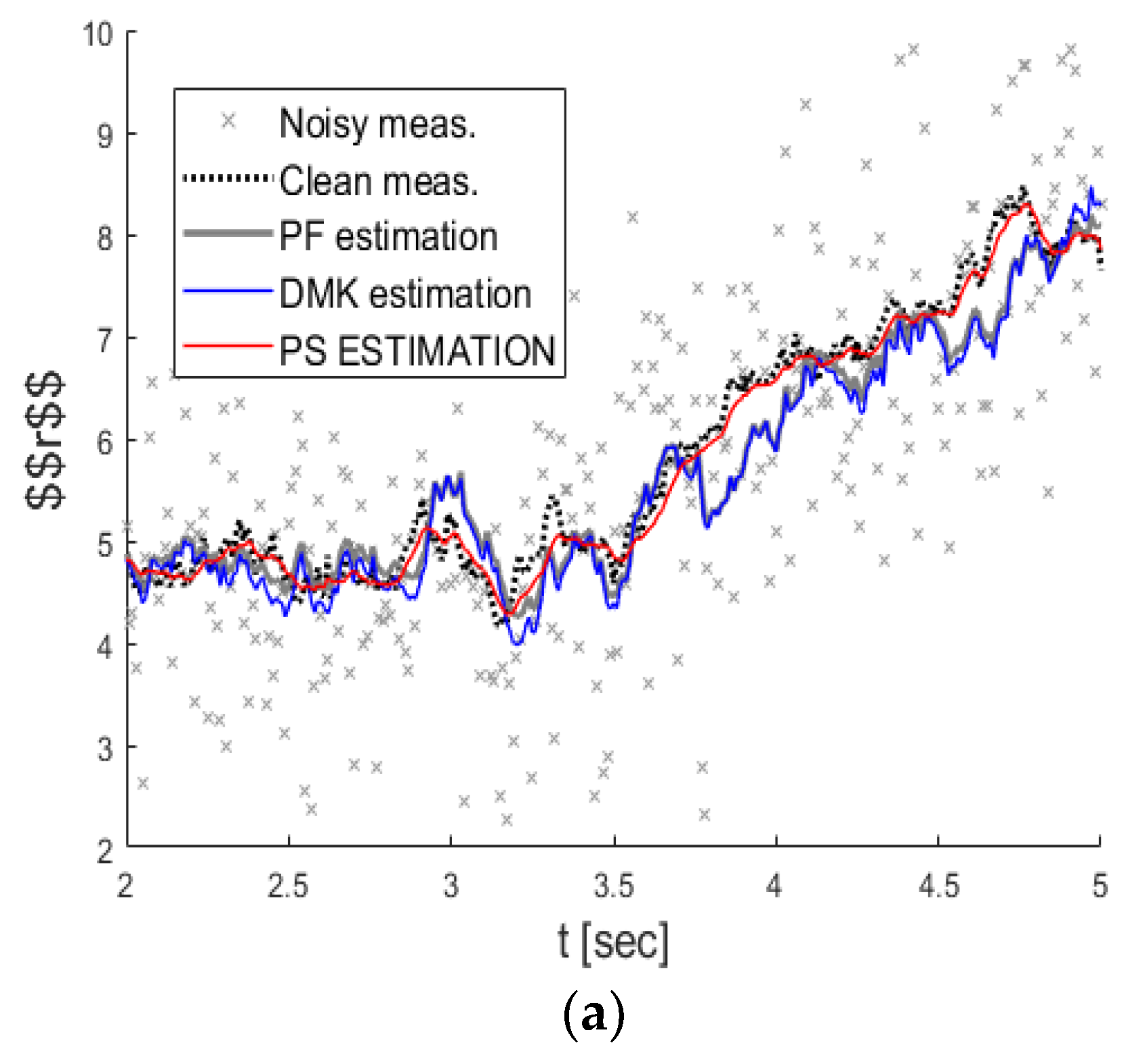
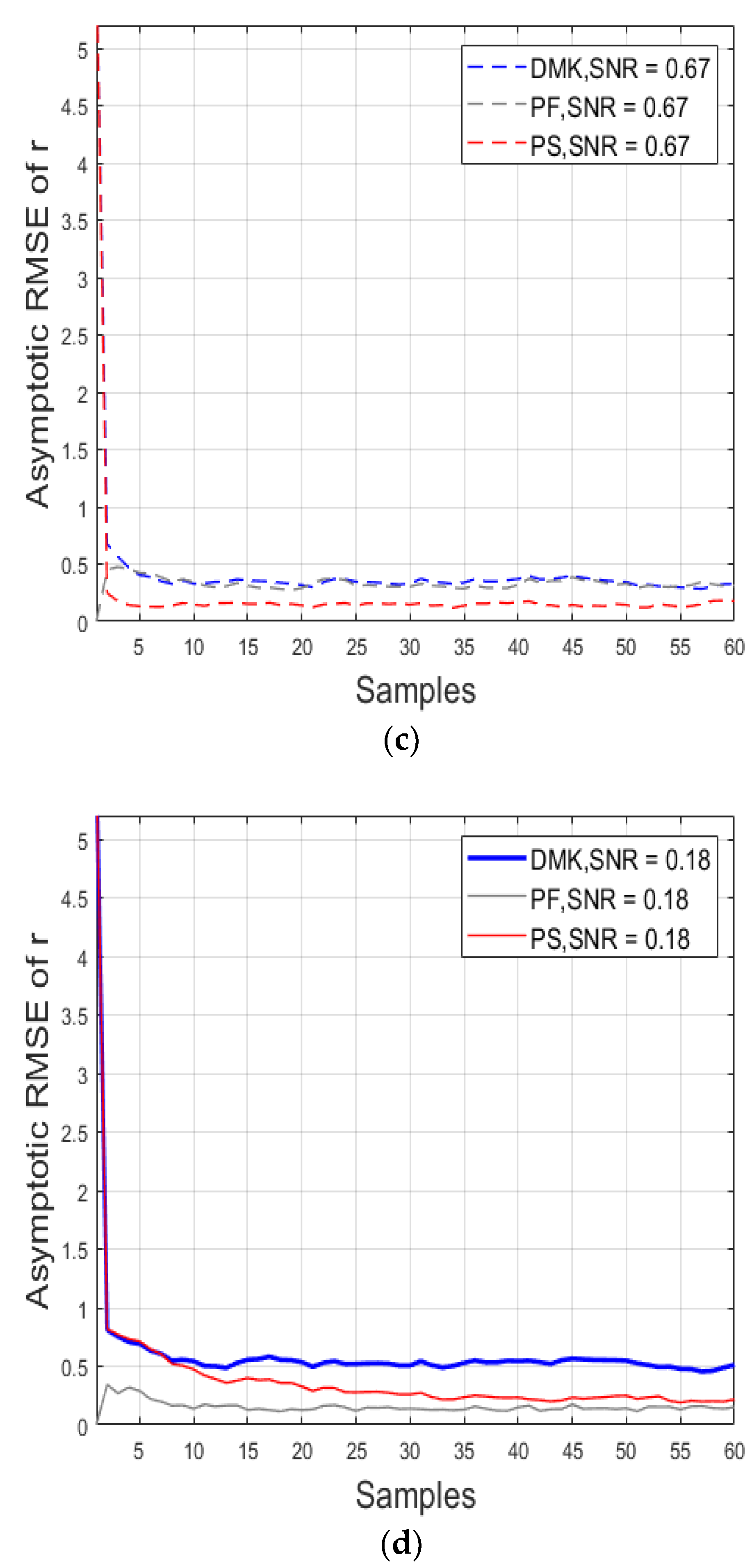
Recently, with the advancement of technology, unmanned aerial vehicles (UAVs) have had a significant impact on our daily lives. UAVs have gained critical importance due to their potential threat. In this study, the problem of UAV tracks were investigated. The first study deals with a particle filter (PF) and a diffusion map with a Kalman filter (DMK). From the experimental analysis, it is found that both PF and DMK are very suitable for drone tracking because the trajectories of drones are highly uncertain in highly dynamic and noisy environments. To address this problem, we introduce a Kalman filter (KFUEA) for drone tracking based on uncertainty and error. The KFUEA uses regularized least squares (RLS) to minimize measurement errors and provides an appropriate balance between confidence in previous estimates and future measurements. The experiment was conducted to evaluate the performance of KFUEA compared to PF and DMK, taking into account the high uncertainty and noisy UAV tracking environment. The KFUEA algorithm achieved an excellent result in the root mean square error (RMSE) compared to the non-parametric filtering algorithms PF and DMK.
Keywords: drones; tracking; UAVs detection; radar; RLS drones; tracking; UAVs detection; radar; RLS