Article

Modelling of Failure Behaviour of 3D-Printed Composite Parts

by
Madhukar Somireddy
1,2,
Aleksander Czekanski
2,* and
Sundar V. Atre
1
1
Department of Mechanical Engineering, University of Louisville, Louisville, KY 40292, USA
2
Department of Mechanical Engineering, York University, Toronto, ON M3J 1P3, Canada
*
Author to whom correspondence should be addressed.
Appl. Sci. 2022, 12(21), 10724; https://doi.org/10.3390/app122110724
Submission received: 23 September 2022 / Revised: 18 October 2022 / Accepted: 20 October 2022 / Published: 23 October 2022
(This article belongs to the Special Issue Composite Structures - Modelling, Testing and Manufacturing)

Abstract

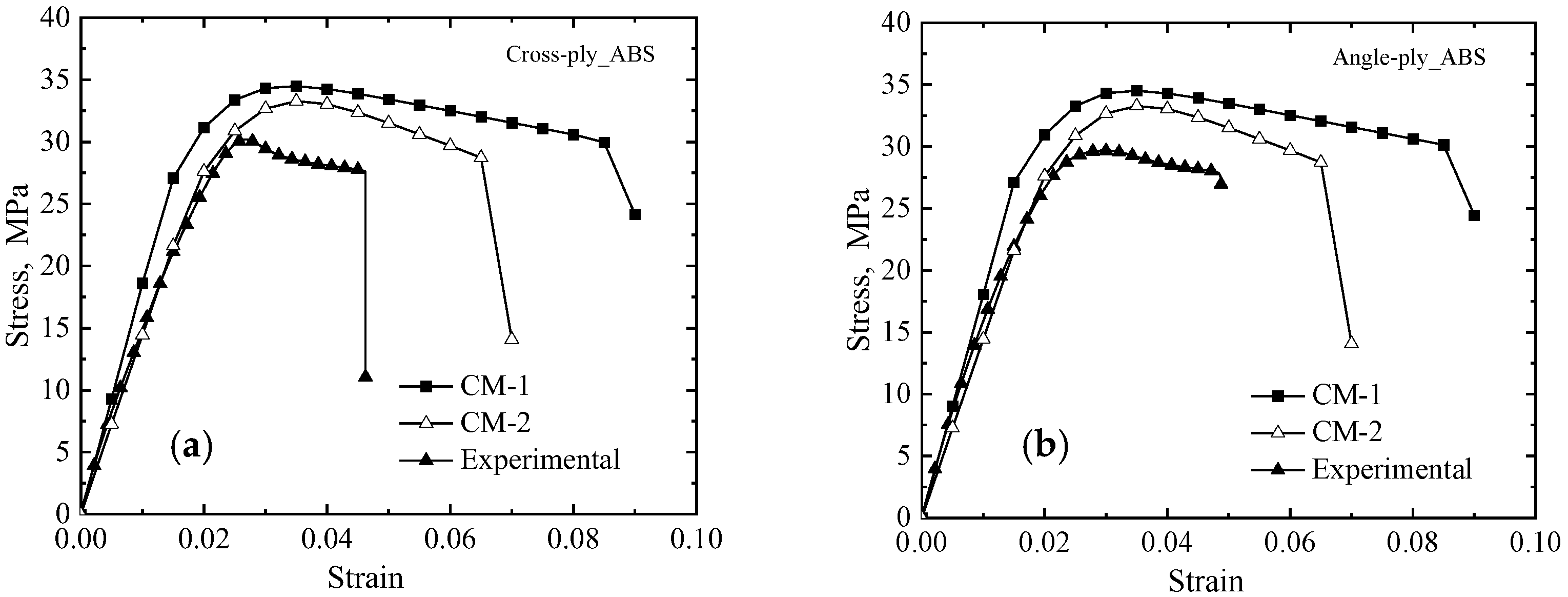
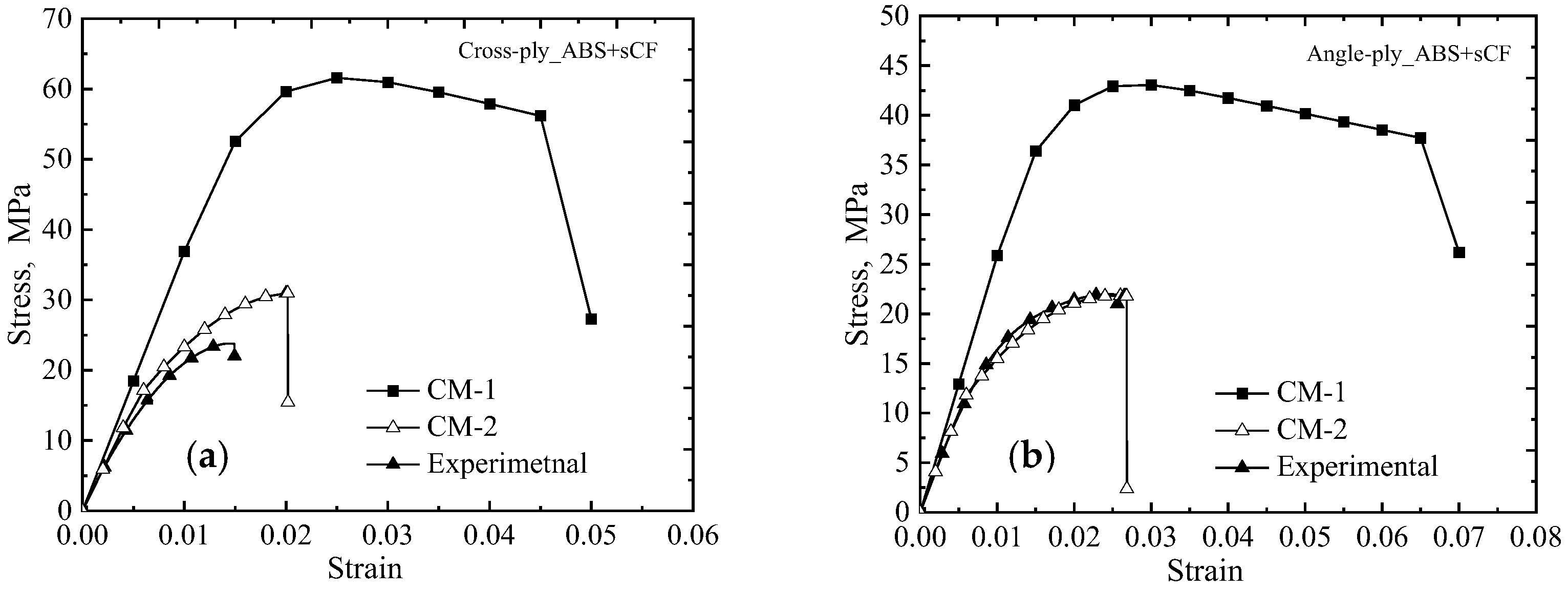
Failure in 3D-printed composite parts is complex due to anisotropic properties, which are mainly governed by printing parameters, printing strategy, and materials. Understanding the failure behaviour of materials is crucial for the design calculations of parts. Effective computational methodologies are yet not available for accurately capturing the failure behaviour of 3D-printed parts. Therefore, we proposed two different computational methodologies for modelling the failure behaviour of 3D-printed parts. 3D-printed parts subjected to uniaxial tensile loading were considered for modelling. In the first method, the computational model employed nonlinear properties of virgin material, and the model predicted higher values than the experimental results. This method provided idealistic nonlinear behaviour of 3D-printed parts. The difference in the results of experimental and computational is significant, especially in the case of 3D-printed composites. In the second method, the computational model utilized nonlinear material data from mechanical testing results and the model predicted accurate nonlinear behaviour of 3D-printed parts. This method provided realistic material behaviour of 3D-printed parts. Therefore, for effective design and analysis, it is suggested to use the latter computational methodology to capture the failure behaviour of 3D-printed parts accurately.
Keywords: 3D printing; composite structures; computational modelling; failure modelling 3D printing; composite structures; computational modelling; failure modelling