Abstract
In order to realize the accurate prediction of the vibration fatigue life of the beam in service, a loose coupling analysis method is proposed to carry out vibration fatigue analysis of a beam with an initial crack. In modal analysis, the initial crack segment is replaced with a torsion spring, and the damping loss factor is introduced by the complex modulus of elasticity; for the simply supported beam, the inherent vibration characteristic equation of the cracked beam is derived. In vibration fatigue analysis, the interaction between the crack’s growth and vibration analysis is considered, and a loose coupling analysis method is proposed to conduct modal dynamic response and vibration fatigue analysis simultaneously. Results indicate that the crack’s relative location and depth determine the modal of the cracked beam, and crack parameters, damping loss factor and external excitation frequency are important factors for the vibration fatigue life of the beam.
1. Introduction
As modern industry develops rapidly, the development trend for large equipment are the extreme environments of high speed, high temperature and high pressure, and factors causing the failure of the engineering structure are increasing. In the service process of large mechanical equipment, vibration fatigue is one of the most important failure factors. In the vibrating environment, when the external excitation frequency is close to the natural frequency of the structure, resonance failure is caused in the engineering structure, which will in turn cause major losses to personnel and affect property safety. For engineering structures, the fatigue crack is an important structural health problem, and safety accidents caused by cracks in engineering structures are very common. Therefore, dynamic characteristics analysis of structures with cracks is essential, and conducting modal analysis and vibration fatigue life analysis of cracked structures has great engineering value.
In the past 40 years, vibration fatigue analysis of the cracked structures has received extensive attention from scholars. Dentsoras and Dimarogonas [1,2] systematically studied the fatigue crack growth mechanism under the resonance condition based on the Paris equation [3]. Dentsoras and Kouvaritakis [4] assumed a polymer material beam was under the resonance condition, and systematically investigated the influence mechanism of the excitation frequency on crack growth. Colakoglu [5] derived the relationship between the crack initiation life and the structural damping changes. Eldoǧan and Cigeroglu [6] developed an in-house numerical code to conduct vibration fatigue analysis of a cracked cantilever beam, and investigated the influence of damping ratio on the vibration fatigue life of the cantilever. Jassim et al. [7] conducted the vibration fatigue analysis of the cracked beam by the numerical method, and carried out the vibration fatigue experiment of the cracked beam for verification. Demirel and Kayran [8] designed a rectangular cross-section cracked beam, and applied the Dirlik’s damage model to investigate a random vibration fatigue mechanism in the frequency domain numerically and experimentally. Liu and Barkey [9] used the energy principle to derive the friction damping loss factor based on the Coulomb friction model, and investigated the coupling mechanism of vibration analysis and crack’s growth. Wu et al. [10] established the high frequency vibration-induced fatigue failure experimental platform of the cracked beam, and analyzed the influence of dynamic stress, acceleration and operational modal on the vibration fatigue life. References above provided a variety of solutions for vibration fatigue analysis of the cracked beam, but these methods had certain defects. In the theoretical method, the interaction between crack growth and the stress field is not considered; in the numerical method, the crack growth cannot be tracked; in the experimental method, the workload is huge and the cost is high.
Structural vibration induces fatigue crack propagation, and fatigue crack propagation also changes the vibration characteristics and stress field of a structure, and then the crack growth behavior is affected. Scholars have carried out a lot of analysis and research to consider the complexity of the interaction between vibration and fatigue crack propagation, Shih and Chen [11] considered the interaction between stress intensity factor and crack axis, and established a model for fatigue life and crack axis analysis. Shih and Wu [12] used the generalized Forman equation [13] to simulate the crack growth, and analyzed the influence of the vibration on the crack growth of a rectangular plate with a unilateral crack. Wu and Shih [14] assumed the periodic load excitation was acting on the rectangular plate with a unilateral crack, and studied the non-linear vibration response characteristics. Liu and He [15] considered the coupling effect of vibration analysis and crack’s growth, and proposed a new method to conduct the vibration fatigue analysis of cracked beams by introducing the complex elastic modulus. Assuming that the cyclic loading was acting on a V-notched cantilever beam, Liu and Barkey [16] investigated the crack growth characteristics by experimental method, and proposed a new method to predict remaining life. Appert and Gautrelet [17] designed the shaker vibration fatigue experimental plan of the cracked beam, and investigated non-linear behavior and remaining life. Considering the coupling effect between vibration analysis and the crack’s growth, the references above provide several solutions to predict the remaining life of a beam. In the vibrating environment, there is interaction between the stress field and the crack field, and the modal dynamic response and vibration fatigue analysis need to be carried out at the same time.
In this paper, a loose coupling analysis method is proposed to carry out vibration fatigue analysis for a simply supported beam under a typical harmonic excitation. Assuming that the crack does not grow in each vibration cycle, and the crack grows at the end of each vibration cycle. For simplicity, only the first order natural frequency of the cracked beam is considered. According to the loose coupling analysis method, modal, dynamic response and vibration fatigue analysis can be carried out synchronously in each vibration cycle, and the influence of crack’s parameters, damping loss factor and external excitation frequency on the fatigue life is investigated.
2. Modal Analysis
2.1. Model of Cracked Beam
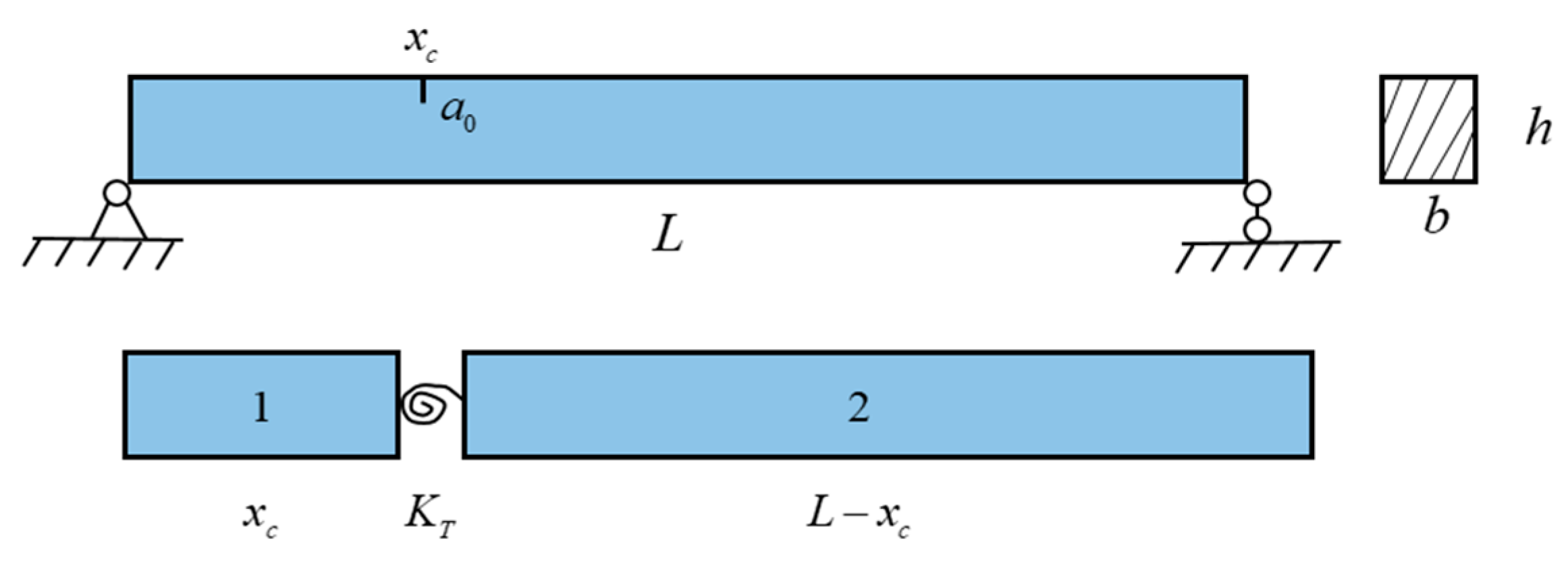
As shown in Figure 1, the research object is a rectangular cross-section beam with an initial transverse crack. The length, height and thickness of the beam are , and , respectively, and the position and depth of the crack are and , respectively.
Figure 1.
Model of the beam with a unilateral crack.
Based on the crack, the beam can be transformed into a two-segment elastic beam with no mass torsion spring. For simplicity, the torsion spring coefficient is considered only. The torsion spring coefficient [18] of the crack can be equivalent, as follows:
where is the Poisson ratio; is the complex modulus of elasticity [19], and ; is the material damping loss factor; is the relative depth of the crack, ; and is the flexibility correction function [20] obtained through the strain energy density function:
2.2. Modal Analysis
As shown in Figure 1, the homogeneous slender straight beam can be regarded as the Euler-Bernoulli beam [21], and the vibration differential equation can be expressed as:
where is the material density; is the cross-section area of the beam; and is the cross-section moment of inertia.
Equation (3) is a fourth order homogeneous differential equation with constant coefficients, and can be solved by the separation variable method [22]:
Substitute Equation (4) into Equation (3), and motion equations of two stage beams can be yielded:
where is the frequency constant, and ; are the undetermined coefficients, which can be determined by boundary conditions.
Due to the simply supported beam, boundary conditions can be written as follows:
Substitute Equation (5) into Equation (6), algebraic equations with undetermined coefficients can be obtained, which can be transformed into the matrix form:
where is the coefficient determinant matrix.
Through the condition that the algebraic equations have nonzero solutions, the value of the coefficient determinant is zero, then natural frequencies of the simply supported cracked beam can be obtained:
3. Vibration Fatigue Analysis
3.1. Dynamic Response Analysis
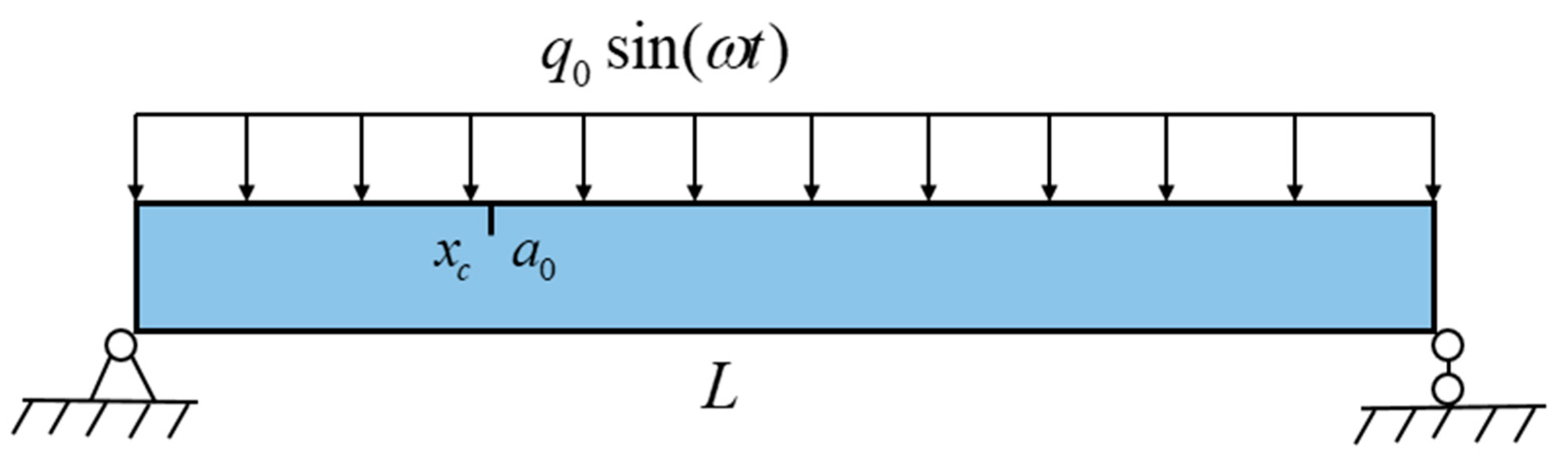
Assume that the cracked beam is under the distribution harmonic excitation shown in Figure 2, then vibration response equations can be expressed, respectively, as follows:
Figure 2.
Model of the beam under distribution harmonic excitation.
Boundary conditions can be written, respectively, as:
Substitute Equation (9) into Equation (10), and undetermined coefficients can be obtained. Assume that the unilateral crack is the open crack, and the normal stress at the cross section can be derived:
where is the distance to neutral axis of the beam.
For the beam under the distribution harmonic excitation, assume , and the maximum stress expression at the crack tip () can be written as:
3.2. Stress Intensity Factor
Stress intensity factor at the crack tip can be derived as follows:
where is the stress intensity factor; is the maximum stress; and is the crack correction factor: .
Under the distribution harmonic excitation, the stress intensity factor at the crack tip can be derived as follows:
3.3. Loose Coupling Analysis Method
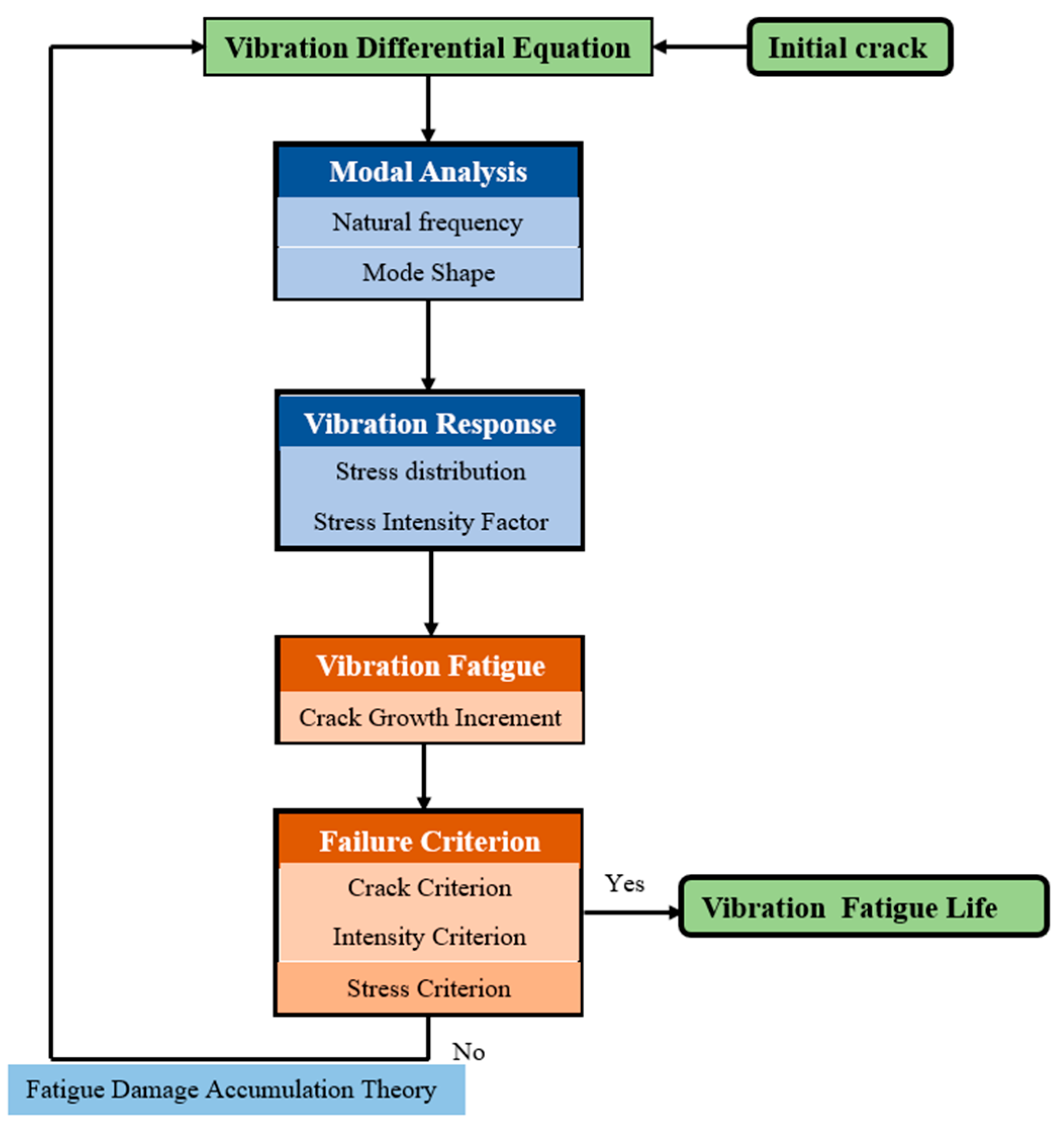
In the vibration of the cracked beam, the interaction occurs between the cracked beam vibration and crack’s growth. Crack growth will change the modal and dynamic response of the beam, and affect the stress field distribution; variation of the stress field distribution of the cracked beam will also change the crack growth rate. In this paper, a loose coupling analysis method is proposed to conduct the vibration fatigue analysis of the cracked beam. Assume that the crack length is constant in each cycle of vibration, and the crack will grow at the end of each cycle. Crack growth and cracked beam vibration analysis are in segmented data transmission form, which means that data transmission occurs at the end of each vibration cycle. The flow chart of loose coupling analysis method is shown in Figure 3.
Figure 3.
Flow chart of loose coupling analysis method.
Paris Law [23] can be applied to describe the crack growth rate in this paper:
where , are the constants of beam material; and is the crack growth rate.
Substitute Equation (14) into Equation (15), and the crack growth rate can be obtained:
After periodic vibration, the crack growth increment can be calculated:
Assume , and .
Equation (17) can be transformed as follows:
where is the crack growth increment after periodic cycle.
According to the fatigue damage accumulation theory, the depth of the crack can be calculated:
where is the number of cycles; and is the depth after periodic cycles.
3.4. Fatigue Failure Criterion
The following three fatigue failure criteria are applied in this paper:
Criterion 1: if the depth of the crack reaches to the neutral layer of the beam, the beam will be destroyed.
where is the critical crack depth, .
Criterion 2: if the stress intensity factor reaches to the material fracture toughness, the beam will be destroyed.
where is the maximum stress intensity factor; and is the material fracture toughness.
Criterion 3: if the maximum stress at the crack surface reaches to the material ultimate strength, the beam will be destroyed.
where is the maximum stress at the crack surface; and is the material ultimate strength.
4. Results and Discussions
Assume that geometric dimensions of the beam are as follows: , and . The structural material is the low carbon alloy steel AISI1050, and material parameters are as follows: , , , , , , , and .
4.1. Natural Frequency
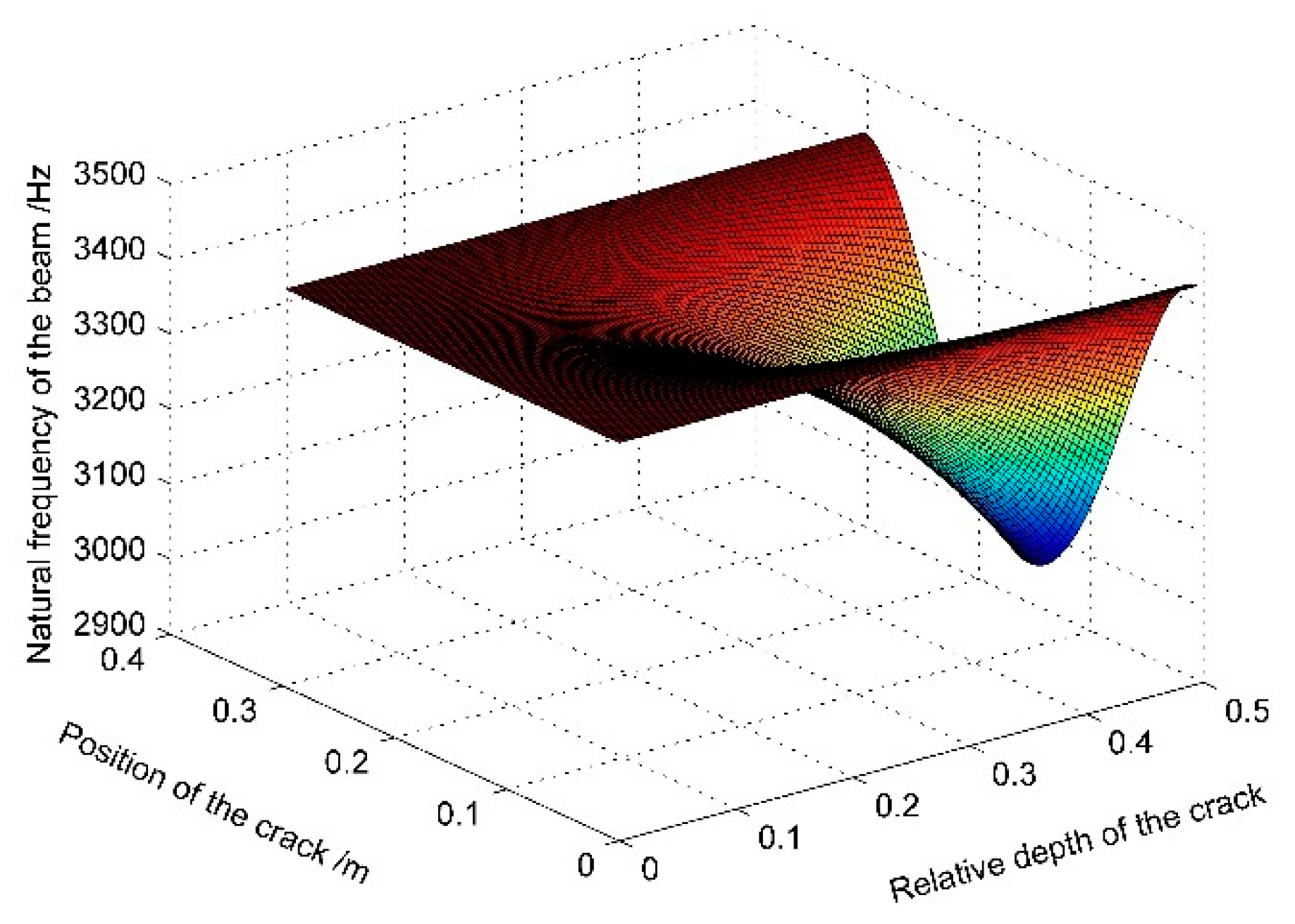
For the simply supported cracked beam, the geometric parameters of the crack are as follows: and . As the relative position and depth of the crack change, the first order natural frequency variation is shown in Figure 4.
Figure 4.
First order natural frequency variation.
As shown in Figure 4, the crack is the important factor affecting natural frequencies of the beam, which cannot be ignored. As the crack’s relative depth increases, the first order natural frequency of the beam gradually decreases, and the amplitude of the decrease gradually increases. From the perspective of the crack’s relative position, the first order natural frequency variation is symmetrical in the middle section of the simply supported beam. When the crack is in the middle part of the simply supported beam (), the first order natural frequency decreases faster as the crack’s relative depth increases.
4.2. Relative Positions
Assume that the crack’s geometric parameters are as follows: , and , . At the resonance condition, vibration fatigue lives are shown in Table 1.
Table 1.
Vibration fatigue lives as the crack’s geometric parameters change.
As shown in Table 1, the crack’s geometric parameters are important factors affecting the vibration fatigue life of the beam. From the perspective of the crack’s relative position, the vibration fatigue lives of the beam are symmetrical in the simply supported beam, and the vibration fatigue life of the beam with the same-depth crack at the midpoint is the least. As the crack is close to the middle section of the simply supported beam, the amplitude of the beam’s vibration fatigue life gradually decreases. As the relative depth of the crack decreases, the vibration fatigue life of the cracked beam gradually decreases.
4.3. Damping Region
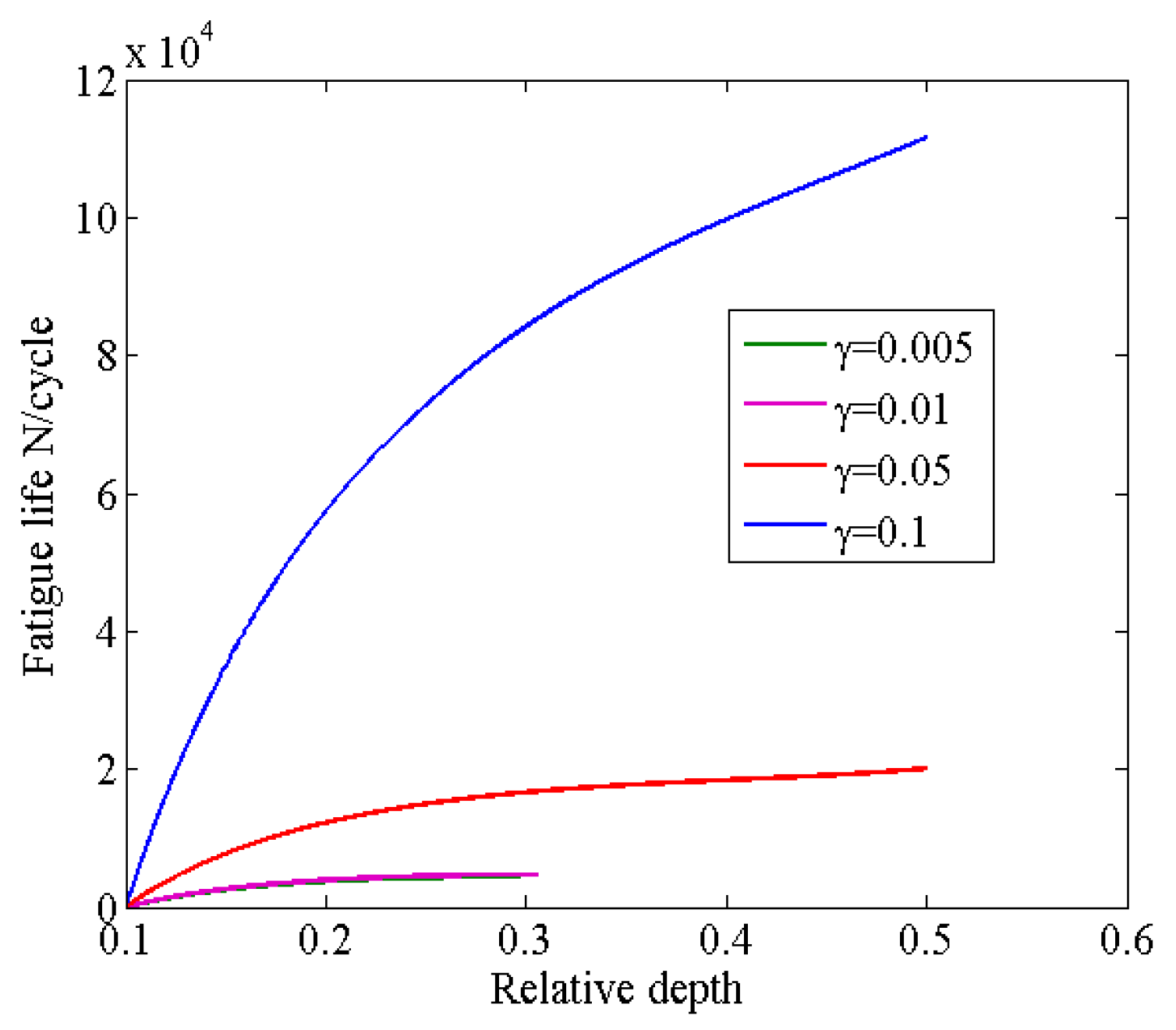
Assume that the crack’s geometric parameters are as follows: , and , . Vibration fatigue life curves are shown at the resonance condition, in Figure 5.
Figure 5.
Vibration fatigue life curves as the damping loss factor changes.
As shown in Figure 5, the damping loss factor is another important factor affecting the vibration fatigue life of the beam. When , the simply supported beam will be destroyed at around , because the maximum stress at the crack’s surface reaches to the material ultimate strength. As the damping loss factor gradually increases, the vibration fatigue life of the beam increases. The influence of a small damping loss factor on the vibration fatigue life is not obvious, but a big damping loss factor will greatly influence the vibration fatigue life of the cracked beam.
4.4. Resonance Region
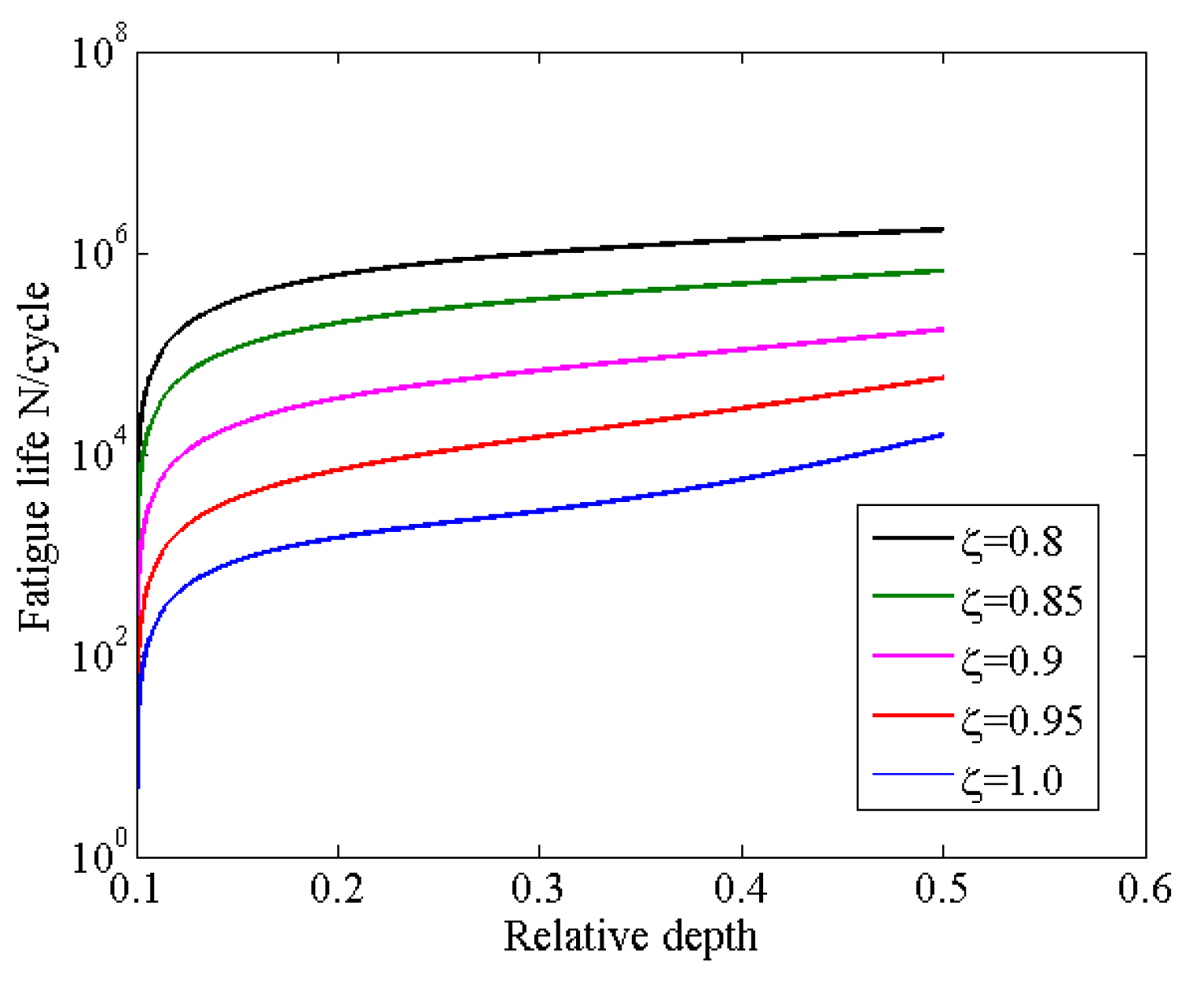
Assume that the crack’s geometric parameters are as follows: , and , . Define the ratio of the external excitation frequency and natural frequency as the frequency ratio and . Vibration fatigue life curves with different are shown in Figure 6.
Figure 6.
Vibration fatigue life curves with different .
As shown in Figure 6, the external excitation frequency is another important factor affecting the vibration fatigue life of the beam. At the resonance condition, the vibration fatigue life is much less than that of other frequency ratios in the resonance region. When the external excitation frequency is closer to the first order natural frequency, the vibration fatigue life becomes shorter, and the decreasing amplitude of the vibration fatigue life decreases exponentially.
5. Conclusions
Considering the interaction between vibration analysis and crack’s growth, a loose coupling analysis method is proposed to conduct the vibration fatigue analysis of a beam with a unilateral crack. The crack’s geometric parameters are important factors to determine the modal of the beam, and damping loss factor and external excitation frequency are external conditions for the vibration fatigue life of the beam, which cannot be ignored.
The innovations of this manuscript are as follows:
(1) The loose coupling analysis method proposed can conduct modal dynamic response and vibration fatigue analysis simultaneously, which will more accurately calculate the crack growth increment;
(2) A theoretical method for vibration fatigue behavior of the cracked beam provides a theoretical basis for health monitoring of the beam in service.
Author Contributions
Conceptualization, Y.M. and J.W.; methodology, Y.M.; software, K.M. and L.F.; validation, Y.M., K.M. and L.F.; formal analysis, Y.M.; investigation, J.W.; resources, Y.M. and G.C.; data curation, K.M.; writing—original draft preparation, J.W.; writing—review and editing, Y.M.; project administration, G.C. All authors have read and agreed to the published version of the manuscript.
Funding
This research received no external funding.
Institutional Review Board Statement
Not applicable.
Informed Consent Statement
Not applicable.
Data Availability Statement
Not applicable.
Conflicts of Interest
The authors declare no conflict of interest.
References
- Dentsoras, A.; Dimarogonas, A.D. Resonance controlled fatigue crack propagation. Eng. Fract. Mech. 1983, 17, 381–386. [Google Scholar] [CrossRef]
- Dentsoras, A.J.; Dimarogonas, A.D. Fatigue crack propagation in resonating structures. Eng. Fract. Mech. 1989, 34, 721–728. [Google Scholar] [CrossRef]
- Paris, P.C.; Erdogan, F. A critical analysis of crack propagation laws. J. Fluids Eng. 1963, 85, 528–533. [Google Scholar] [CrossRef]
- Dentsoras, A.J.; Kouvaritakis, E.P.; Kouvaritakis, E.P. Effects of vibration frequency on fatigue crack propagation of a polymer at resonance. Eng. Fract. Mech. 1995, 50, 467–473. [Google Scholar] [CrossRef]
- Colakoglu, M. Measurement and Analysis of Damping Factor in Engineering Materials to Assess Fatigue Damage; Washington University: Washington, DC, USA, 2001; pp. 1–68. [Google Scholar]
- Eldoǧan, Y.; Cigeroglu, E. Vibration fatigue analysis of a cantilever beam using different fatigue theories. In Topics in Modal Analysis; Springer: New York, NY, USA, 2014; Volume 7, pp. 471–478. [Google Scholar]
- Jassim, Z.A.; Ali, N.N.; Mustapha, F.; Jalil, N.A. A review on the vibration analysis for a damage occurrence of a cantilever beam. Eng. Fail. Anal. 2013, 31, 442–461. [Google Scholar] [CrossRef]
- Demirel, G.İ.; Kayran, A. Implementation of Dirlik′s damage model for the vibration fatigue analysis. Procedia Struct. Integr. 2019, 21, 101–111. [Google Scholar] [CrossRef]
- Liu, W.; Barkey, M.E. The effects of breathing behaviour on crack growth of a vibrating beam. Shock. Vib. 2018, 2018, 2579419. [Google Scholar] [CrossRef] [Green Version]
- Wu, X.; Xie, C.; Liu, K.; Wu, S.; Wen, Z.; Mo, J. Study on high frequency vibration-induced fatigue failure of antenna beam in a metro bogie. Eng. Fail. Anal. 2022, 133, 105976. [Google Scholar] [CrossRef]
- Shih, Y.; Shih, Y. Analysis of fatigue crack growth on a cracked shaft. Int. J. Fatigue 1997, 19, 477–485. [Google Scholar]
- Shih, Y.S.; Wu, G.Y. Effect of vibration on fatigue crack growth of an edge crack for a rectangular plate. Int. J. Fatigue 2002, 24, 557–566. [Google Scholar] [CrossRef]
- Forman, R.G.; Kearney, V.E.; Engle, R.M. Numerical analysis of crack propagation in cyclicloaded structures. ASME J. Basic Eng. 1967, 89, 459–463. [Google Scholar] [CrossRef]
- Wu, G.Y.; Shih, Y.S. Dynamic instability of rectangular plate with an edge crack. Comput. Struct. 2005, 84, 1–10. [Google Scholar] [CrossRef]
- Liu, W.G.; He, H.L. An Analytical Method for Vibration Fatigue of Cracked Beams. In Advanced Materials Research; Trans Tech Publications Ltd.: Bäch, Switzerland, 2012; Volume 479, pp. 783–786. [Google Scholar]
- Liu, W.; Barkey, M.E. Prediction on Remaining Life of a V-Notched Beam by Measured Modal Frequency. Shock. Vib. 2019, 2019, 7351386. [Google Scholar] [CrossRef]
- Appert, A.; Gautrelet, C.; Khalij, L.; Troian, R. Development of a test bench for vibratory fatigue experiments of a cantilever beam with an electrodynamic shaker. In Proceedings of the MATEC Web of Conferences, Poitiers, France, 27 May–1 June 2018; EDP Sciences: Les Ulis, France; Volume 165, p. 10007. [Google Scholar]
- Douka, E.; Loutridis, S.; Trochidis, A. Crack identification in beams using wavelet analysis. Int. J. Solids Struct. 2003, 40, 3557–3569. [Google Scholar] [CrossRef]
- Dentsoras, A.J.; Dimarogonas, A.D. Resonance controlled fatigue crack propagation in a beam under longitudinal vibrations. Int. J. Fract. 1983, 23, 15–22. [Google Scholar] [CrossRef]
- Wu, Q.; Guo, S.; Li, X.; Gao, G. Crack diagnosis method for a cantilevered beam structure based on modal parameters. Meas. Sci. Technol. 2019, 31, 035001. [Google Scholar] [CrossRef]
- Andreaus, U.; Spagnuolo, M.; Lekszycki, T.; Eugster, S.R. A Ritz approach for the static analysis of planar pantographic structures modeled with nonlinear Euler–Bernoulli beams. Contin. Mech. Thermodyn. 2018, 30, 1103–1123. [Google Scholar] [CrossRef]
- Vidal, P.; Giunta, G.; Gallimard, L.; Polit, O. Modeling of composite and sandwich beams with a generic cross-section using a variable separation method. Compos. Part B Eng. 2019, 165, 648–661. [Google Scholar] [CrossRef] [Green Version]
- Pugno, N.; Ciavarella, M.; Cornetti, P.; Carpinteri, A. A generalized Paris’ law for fatigue crack growth. J. Mech. Phys. Solids 2006, 54, 1333–1349. [Google Scholar] [CrossRef]
Publisher’s Note: MDPI stays neutral with regard to jurisdictional claims in published maps and institutional affiliations. |
© 2022 by the authors. Licensee MDPI, Basel, Switzerland. This article is an open access article distributed under the terms and conditions of the Creative Commons Attribution (CC BY) license (https://creativecommons.org/licenses/by/4.0/).