

Augmented Reality and Gamification in Education: A Systematic Literature Review of Research, Applications, and Empirical Studies
 ,
,  ,
,  and
and
Abstract
:1. Introduction
Justification, Aims, and Research Questions
- RQ1: What are the benefits of combining and integrating augmented reality and gamification into the educational process?
- RQ2: What is the distribution among empirical studies, proposal and prototype papers, as well as review, conceptual, and theoretical papers?
- RQ3: In which countries have most related studies been carried out?
- RQ4: What have been the main findings of the related studies regarding the use of augmented reality and gamification in education?
- RQ5: At which educational stage is the use of augmented reality and gamification more commonly applied?
- RQ6: What is the main focus of the studies regarding students’ cognitive and social–emotional development?
- RQ7: What sample has mostly been used in the experiments of the related research?
- RQ8: What have been the most relevant objectives and aims of the studies concerning the use of augmented reality and gamification in education?
- RQ9: Which are the main areas, topics, and subjects the use of augmented reality and gamification is more widely studied and applied?
- RQ10: What measurements (research instruments, tools, methods, and variables) are mostly used in the studies regarding the use of augmented reality and gamification in education?
- RQ11: What development tools, methodologies, and operating systems are mostly used to develop educational augmented reality applications?
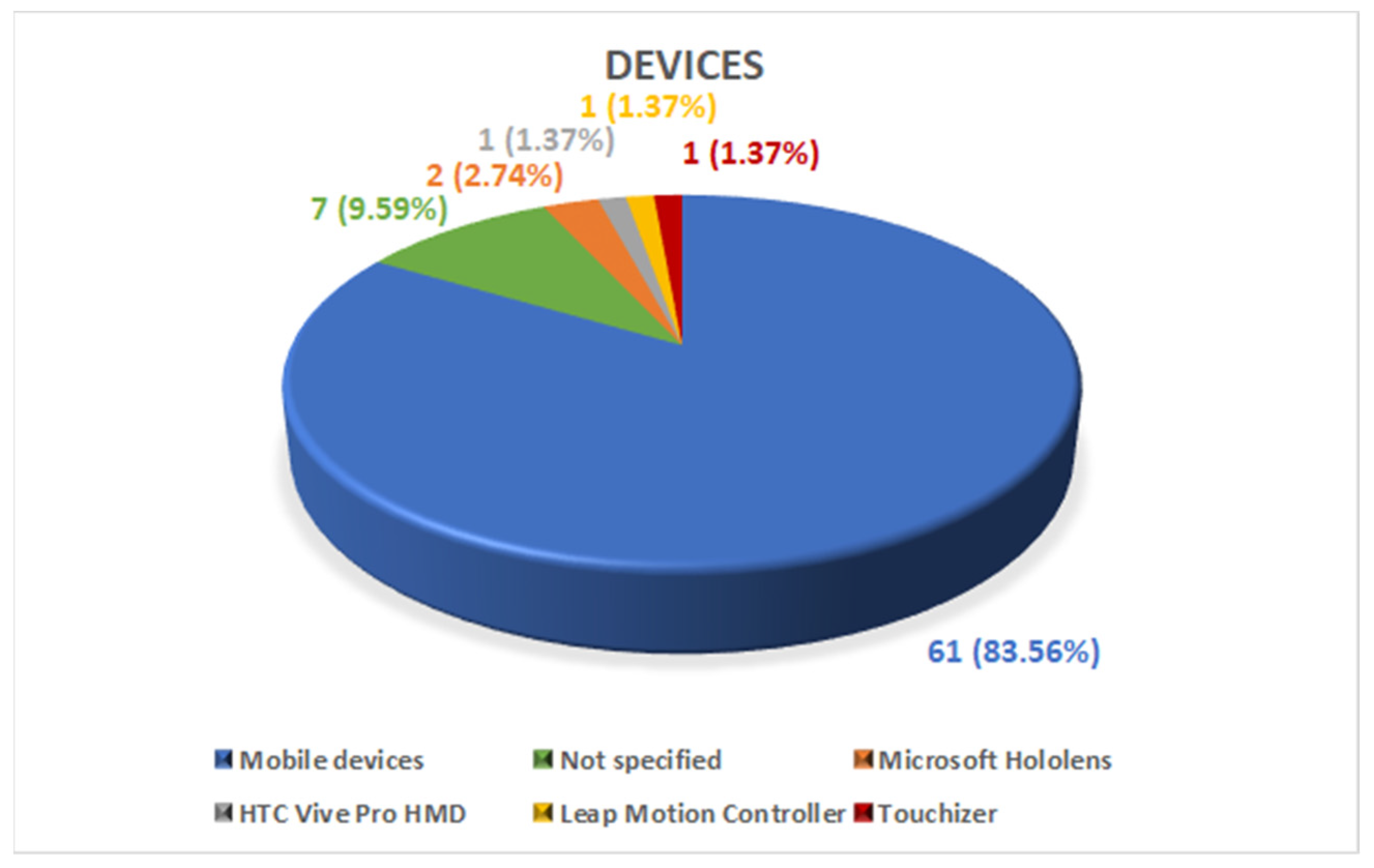
- RQ12: What devices are mostly used to carry out augmented reality experiments?
- RQ13: What gamification mechanisms and elements are mostly used in gamified educational augmented reality applications?
- RQ14: What areas, topics, and subjects do the proposed applications, frameworks, methodologies, and models focus on?
- RQ15: Do the main findings of the different types of studies (empirical studies, proposals, and prototype papers, as well as review, conceptual, and theoretical papers) examined lead to the same conclusions?
2. Augmented Reality in Education
3. Gamification in Education
4. Methodology
4.1. Research Design
4.2. Systematic Literature Review Process
- Country in which the experiments were conducted;
- Educational stage;
- Focus area;
- Developmental category;
- Sample;
- Main aims;
- Research method;
- Main variables;
- Measurement—research instruments and tools;
- Application name;
- Application development methodology;
- Development tools;
- Operating system;
- Devices used in the experiment;
- Gamification elements;
- Main findings.
5. Results

| Ref. | Country | Aims |
|---|---|---|
| [232] | Malaysia | To explore how using gamification and augmented reality can engage students in language learning. |
| [234] | Australia | To examine how augmented reality and tangible user interfaces can assist in learning computer science concepts and programming skills, such as debugging. |
| [235] | Hungary | To showcase how gamified elements and augmented reality can provide immersive practicing exercises. |
| [236] | Spain | To enhance the educational process of teaching and learning mathematics through the combinational use of gamification and augmented reality. |
| [237] | United States | To showcase how the use of blockchain and augmented reality can assist in keeping track of digital assets in virtual spaces. |
| [238] | Germany | To present a gamification concept for augmented reality virtual laboratories to increase students’ practical skills. |
| [239] | Hungary | To explore how augmented reality tools that utilize gamification elements can increase students’ spatial skills. |
| [240] | Greece | To showcase how an extended reality platform that uses gamification can support conventional educational practices in laboratory-based training. |
| [241] | Italy | To present an augmented reality application enriched with game design elements to facilitate university students’ learning about human anatomy. |
| [242] | India | To design and create an augmented reality game that promotes primary school students’ programming skills development. |
| [243] | Spain | To showcase the potential of using gamified augmented reality experiences through mobile applications in educational context. |
| [244] | United States | To propose an interdisciplinary approach using augmented reality and gamification elements to support students’ mathematics learning. |
| [245] | The Netherlands | To present a framework for creating mixed reality gamification applications to allow students to train in immersive 3D environments. |
| [246] | Finland | To show how an augmented reality application can support and guide students during their orientation week. |
| [247] | United States | To suggest how an augmented reality escape room could support and enrich a wide range of learning experiences. |
| [248] | Greece | To present the developmental process of creating an augmented reality application that uses gamification aspects to support learning and teaching activities. |
| [249] | Argentina | To present a gamified augmented reality application that aims at supporting collaborative learning, enriching students’ learning experiences, and increasing teacher–student interaction. |
| [250] | Thailand | To propose a gamified augmented reality application to enhance students’ grit. |
| [251] | Mexico | To explore how augmented reality applications that use gamification elements can support and increase students’ reading abilities as a means to further strengthen their personal, work, and social relations. |
| [252] | Greece | To evaluate whether mixed reality digital games can support and enhance future learning and teaching of various educational contexts. |
| [253] | Italy | To show a prototype gamified augmented reality application that aims to improve cultural heritage learning. |
| [254] | Romania | To showcase the results of applying a gamified augmented reality application to facilitate foreign language learning while making it more enjoyable. |
| [255] | Brazil | To propose an augmented reality framework that uses gamification elements to facilitate and support the learning process of students with intellectual disabilities. |
| [256] | Taiwan | To present the benefits of using content-aware augmented reality applications in educational settings. |
| [257] | Greece | To explore how gamified augmented reality experiences can support lifelong learning and cultural education based on an augmented reality application, which focuses on the subject of science. |
| [258] | Greece | To explore how augmented reality and gamification can facilitate and support the comprehension of subject-specific matters while engaging learners in an enjoyable experience. |
| [259] | Mexico | To present the development of an augmented reality mobile application that uses gamification elements to improve students’ geography knowledge. |
| Ref. | Country | Aims | Main Findings |
|---|---|---|---|
| [260] | United States | To discuss the history of instructional design and technology field in four time periods while presenting technologies such as augmented reality, gamification, mobile learning, etc. | In order for new technologies to be adopted in education, teachers should realize their value, experience positive effects themselves, and feel confident and comfortable when using them. Learning and instructional design theories have evolved to technology-centered to address the new requirements. |
| [261] | Philippines | To propose a supplementary learning tool framework for developing educational applications using augmented reality, Unity, and Vuforia to enhance the learning process. | Augmented reality and gamification as supplementary learning tools are effective. |
| [262] | Spain | To present the key elements that must be taken into account when creating online tools that utilize gamification and augmented reality. | When combined with gamification, mixed reality applications can offer several benefits to students and the educational process. |
| [263] | Portugal | To comprehend and analyze the gaming strategies that can be used in immersive technologies to improve foreign language learning. | Using gaming strategies along with immersive technologies, and particularly augmented reality can facilitate and enhance foreign language learning. |
| [264] | Spain | To present a research project that applies an instructional technology-based model in a bilingual education context using augmented reality and gamification. | The use of gamification and augmented reality resulted in several educational benefits, such as improved health awareness, engagement, and linguistic skills, and increased physical exercise. |
| [265] | Portugal | To provide an overview of the concepts of immersive learning systems and gamification strategies. | n/a |
| [266] | United Kingdom | To analyze the existing virtual and augmented reality taxonomies while focusing on their interconnection with gamification elements. | A proposed taxonomy and its facets were presented, which classify immersive technologies based on several attributes, including gamification. |
| [267] | Australia | To present the advances made in the educational sector via the Unity game engine and to showcase how it can contribute to teaching students to use immersive technologies. | Practices were suggested to better implement gamification and mixed reality applications in education during the COVID-19 pandemic. |
| [268] | China | To examine the factors of an augmented reality application design that can better support students’ early language acquisition. | The main augmented reality learning activities and design strategies were presented. Specifically, the use of game mechanisms with a discovery strategy improved students’ motivation. |
| [269] | United States | To showcase how gaming technology innovations in the form of digital games and augmented reality can impact education and particularly in the field of health and physical education. | n/a |
| [270] | Spain | To present and analyze some indicative applications and activities that use ICT, including games and augmented reality in teaching activities. | Augmented reality, gamification, and mobile learning have the potential to reshape educational practices and offer improved learning outcomes. |
| [271] | India | To examine how augmented reality, gamification, and adaptive learning can increase the engagement of Massive Open Online Courses (MOOCs). | When adopted by MOOCs, augmented reality, gamification, and adaptive learning can lead to more interactive, pervasive, and engaging learning environments in diverse educational domains. |
| [272] | United States | To present instructional design principles that can assist in the development of improved augmented reality learning experiences. | Fantasy, challenge, and curiosity are the main design principles that can leverage the unique affordances of augmented reality in education. |
Summary of the Results and Main Findings
6. Discussion
7. Conclusions
Author Contributions
Funding
Institutional Review Board Statement
Informed Consent Statement
Data Availability Statement
Conflicts of Interest
References
- Becker, S.A.; Cummins, M.; Davis, A.; Freeman, A.; Hall, C.G.; Ananthanarayanan, V. NMC Horizon Report: 2017 Higher Education Edition; The New Media Consortium: Austin, TX, USA, 2017. [Google Scholar]
- Daniel, S.J. Education and the COVID-19 Pandemic. PROSPECTS 2020, 49, 91–96. [Google Scholar] [CrossRef] [Green Version]
- Pokhrel, S.; Chhetri, R.A. Literature Review on Impact of COVID-19 Pandemic on Teaching and Learning. High. Educ. Future 2021, 8, 133–141. [Google Scholar] [CrossRef]
- Prensky, M. Digital Natives, Digital Immigrants Part 2: Do They Really Think Differently? Horizon 2001, 9, 1–6. [Google Scholar] [CrossRef]
- Chang, C.Y.; Lai, C.L.; Hwang, G.J. Trends and Research Issues of Mobile Learning Studies in Nursing Education: A Review of Academic Publications from 1971 to 2016. Comput. Educ. 2018, 116, 28–48. [Google Scholar] [CrossRef]
- Admiraal, W.; Huizenga, J.; Akkerman, S.; Dam, G.T. The Concept of Flow in Collaborative Game-Based Learning. Comput. Hum. Behav. 2011, 27, 1185–1194. [Google Scholar] [CrossRef] [Green Version]
- Anastasiadis, T.; Lampropoulos, G.; Siakas, K. Digital Game-Based Learning and Serious Games in Education. Int. J. Adv. Sci. Res. Eng. 2018, 4, 139–144. [Google Scholar] [CrossRef]
- Crisol-Moya, E.; Romero-López, M.A.; Caurcel-Cara, M.J. Active Methodologies in Higher Education: Perception and Opinion as Evaluated by Professors and Their Students in the Teaching-Learning Process. Front. Psychol. 2020, 11, 1703. [Google Scholar] [CrossRef]
- Zeidler, D.L.; Sadler, T.D.; Simmons, M.L.; Howes, E.V. Beyond STS: A Research-Based Framework for Socioscientific Issues Education. Sci. Educ. 2005, 89, 357–377. [Google Scholar] [CrossRef]
- Barab, S.; Dede, C. Games and Immersive Participatory Simulations for Science Education: An Emerging Type of Curricula. J. Sci. Educ. Technol. 2007, 16, 1–3. [Google Scholar] [CrossRef]
- Billingsley, G.; Smith, S.; Smith, S.; Meritt, J. A Systematic Literature Review of Using Immersive Virtual Reality Technology in Teacher Education. J. Interact. Learn. Res. 2019, 30, 65–90. [Google Scholar]
- Zawacki-Richter, O.; Latchem, C. Exploring Four Decades of Research in Computers & Education. Comput. Educ. 2018, 122, 136–152. [Google Scholar] [CrossRef]
- Hughes, J.; Thomas, R.; Scharber, C. Assessing Technology Integration: The RAT–Replacement, Amplification, and Transformation-Framework. In Proceedings of the Society for Information Technology & Teacher Education International Conference, Orlando, FL, USA, 19 March 2006; Association for the Advancement of Computing in Education (AACE): Waynesville, NC, USA, 2006; pp. 1616–1620. [Google Scholar]
- Robinson, R.; Molenda, M.; Rezabek, L. Facilitating Learning. In Educational Technology; Routledge: London, UK, 2013; pp. 27–60. [Google Scholar]
- National Research Council. Education for Life and Work: Developing Transferable Knowledge and Skills in the 21st Century; National Academies Press: Washington, DC, USA, 2012. [Google Scholar] [CrossRef]
- Akçayır, M.; Akçayır, G. Advantages and Challenges Associated with Augmented Reality for Education: A Systematic Review of the Literature. Educ. Res. Rev. 2017, 20, 1–11. [Google Scholar] [CrossRef]
- Wu, H.-K.; Lee, S.W.-Y.; Chang, H.-Y.; Liang, J.-C. Current Status, Opportunities and Challenges of Augmented Reality in Education. Comput. Educ. 2013, 62, 41–49. [Google Scholar] [CrossRef]
- Nah, F.F.-H.; Zeng, Q.; Telaprolu, V.R.; Ayyappa, A.P.; Eschenbrenner, B. Gamification of Education: A Review of Literature. In Lecture Notes in Computer Science; Springer International Publishing: Cham, Switzerland, 2014; pp. 401–409. [Google Scholar] [CrossRef]
- Majuri, J.; Koivisto, J.; Hamari, J. Gamification of Education and Learning: A Review of Empirical Literature. In Proceedings of the 2nd International GamiFIN Conference, Pori, Finland, 21–23 May 2018. [Google Scholar]
- Burbules, N.C.; Callister, T.A. Watch IT: The Risks and Promises of Information Technologies for Education; Routledge: London, UK, 2018. [Google Scholar]
- Ratten, V.; Jones, P. Covid-19 and Entrepreneurship Education: Implications for Advancing Research and Practice. Int. J. Manag. Educ. 2021, 19, 100432. [Google Scholar] [CrossRef]
- Caudell, T.P.; Mizell, D.W. Augmented Reality: An Application of Heads-up Display Technology to Manual Manufacturing Processes. In Proceedings of the Twenty-Fifth Hawaii International Conference on System Sciences, Kauai, HI, USA, 7–10 January 1992; IEEE: Piscataway, NJ, USA, 1992; Volume 2, pp. 659–669. [Google Scholar] [CrossRef]
- Azuma, R.T. A Survey of Augmented Reality. Presence Teleoperators Virtual Environ. 1997, 6, 355–385. [Google Scholar] [CrossRef]
- Johnson, L.; Levine, A.; Smith, R.; Stone, S. The 2010 Horizon Report; New Media Consortium: Austin, TX, USA, 2010. [Google Scholar]
- Carmigniani, J.; Furht, B.; Anisetti, M.; Ceravolo, P.; Damiani, E.; Ivkovic, M. Augmented Reality Technologies, Systems and Applications. Multimed. Tools Appl. 2011, 51, 341–377. [Google Scholar] [CrossRef]
- Lee, K. Augmented Reality in Education and Training. TechTrends 2012, 56, 13–21. [Google Scholar] [CrossRef]
- Chen, P.; Liu, X.; Cheng, W.; Huang, R. A Review of Using Augmented Reality in Education from 2011 to 2016. Innov. Smart Learn. 2017, 13–18. [Google Scholar] [CrossRef]
- Lampropoulos, G.; Keramopoulos, E.; Diamantaras, K. Enhancing the Functionality of Augmented Reality Using Deep Learning, Semantic Web and Knowledge Graphs: A Review. Vis. Inform. 2020, 4, 32–42. [Google Scholar] [CrossRef]
- Lampropoulos, G.; Keramopoulos, E.; Diamantaras, K. Semantically Enriched Augmented Reality Applications: A Proposed System Architecture and a Case Study. Int. J. Recent Contrib. Eng. Sci. IT Ijes 2022, 10, 29–46. [Google Scholar] [CrossRef]
- Kesim, M.; Ozarslan, Y. Augmented Reality in Education: Current Technologies and the Potential for Education. Procedia-Soc. Behav. Sci. 2012, 47, 297–302. [Google Scholar] [CrossRef] [Green Version]
- Hincapie, M.; Diaz, C.; Valencia, A.; Contero, M.; Güemes-Castorena, D. Educational Applications of Augmented Reality: A Bibliometric Study. Comput. Electr. Eng. 2021, 93, 107289. [Google Scholar] [CrossRef]
- Goff, E.E.; Mulvey, K.L.; Irvin, M.J.; Hartstone-Rose, A. Applications of Augmented Reality in Informal Science Learning Sites: A Review. J. Sci. Educ. Technol. 2018, 27, 433–447. [Google Scholar] [CrossRef]
- Bacca-Acosta, J.L.; Baldiris, S.; Fabregat, R.; Graf, S.; Kinshuk. Augmented Reality Trends in Education: A Systematic Review of Research and Applications. J. Educ. Technol. Soc. 2014, 17, 133–149. [Google Scholar]
- Karakus, M.; Ersozlu, A.; Clark, A.C. Augmented Reality Research in Education: A Bibliometric Study. EURASIA J. Math. Sci. Technol. Educ. 2019, 15, em1755. [Google Scholar] [CrossRef]
- Sirakaya, M.; Alsancak-Sırakaya, D. Trends in Educational Augmented Reality Studies: A Systematic Review. Malays. Online J. Educ. Technol. 2018, 6, 60–74. [Google Scholar] [CrossRef]
- López-Belmonte, J.; Moreno-Guerrero, A.-J.; López Núñez, J.A.; Pozo Sánchez, S. Analysis of the Productive, Structural, and Dynamic Development of Augmented Reality in Higher Education Research on the Web of Science. Appl. Sci. 2019, 9, 5306. [Google Scholar] [CrossRef] [Green Version]
- López-Belmonte, J.; Moreno-Guerrero, A.-J.; López-Núñez, J.-A.; Hinojo-Lucena, F.-J. Augmented Reality in Education. A Scientific Mapping in Web of Science. Interact. Learn. Environ. 2020, 1–15. [Google Scholar] [CrossRef]
- Avila-Garzon, C.; Bacca-Acosta, J.; Kinshuk; Duarte, J.; Betancourt, J. Augmented Reality in Education: An Overview of Twenty-Five Years of Research. Contemp. Educ. Technol. 2021, 13, ep302. [Google Scholar] [CrossRef]
- Alvarez-Marin, A.; Velazquez-Iturbide, J.A. Augmented Reality and Engineering Education: A Systematic Review. IEEE Trans. Learn. Technol. 2021, 14, 817–831. [Google Scholar] [CrossRef]
- Mystakidis, S.; Christopoulos, A.; Pellas, N. A Systematic Mapping Review of Augmented Reality Applications to Support STEM Learning in Higher Education. Educ. Inf. Technol. 2021, 27, 1883–1927. [Google Scholar] [CrossRef]
- Billinghurst, M.; Kato, H.; Poupyrev, I. The Magicbook-Moving Seamlessly Between Reality and Virtuality. IEEE Comput. Graph. Appl. 2001, 21, 6–8. [Google Scholar] [CrossRef]
- Martín-Gutiérrez, J.; Fabiani, P.; Benesova, W.; Meneses, M.D.; Mora, C.E. Augmented Reality to Promote Collaborative and Autonomous Learning in Higher Education. Comput. Hum. Behav. 2015, 51, 752–761. [Google Scholar] [CrossRef]
- Lin, C.-Y.; Chai, H.-C.; Wang, J.; Chen, C.-J.; Liu, Y.-H.; Chen, C.-W.; Lin, C.-W.; Huang, Y.-M. Augmented Reality in Educational Activities for Children with Disabilities. Displays 2016, 42, 51–54. [Google Scholar] [CrossRef]
- Fidan, M.; Tuncel, M. Integrating Augmented Reality into Problem Based Learning: The Effects on Learning Achievement and Attitude in Physics Education. Comput. Educ. 2019, 142, 103635. [Google Scholar] [CrossRef]
- Chen, C.; Wang, C.-H. Employing Augmented-Reality-Embedded Instruction to Disperse the Imparities of Individual Differences in Earth Science Learning. J. Sci. Educ. Technol. 2015, 24, 835–847. [Google Scholar] [CrossRef]
- Gavish, N.; Gutiérrez, T.; Webel, S.; Rodríguez, J.; Peveri, M.; Bockholt, U.; Tecchia, F. Evaluating Virtual Reality and Augmented Reality Training for Industrial Maintenance and Assembly Tasks. Interact. Learn. Environ. 2015, 23, 778–798. [Google Scholar] [CrossRef]
- Radu, I. Why Should My Students Use AR? A Comparative Review of the Educational Impacts of Augmented-Reality. In Proceedings of the 2012 IEEE international symposium on mixed and augmented reality (ISMAR), Atlanta, GA, USA, 5–8 November 2012; IEEE: Piscataway, NJ, USA, 2012; pp. 313–314. [Google Scholar] [CrossRef]
- Di Serio, Á.; Ibáñez, M.B.; Kloos, C.D. Impact of an Augmented Reality System on Students’ Motivation for a Visual Art Course. Comput. Educ. 2013, 68, 586–596. [Google Scholar] [CrossRef] [Green Version]
- Chiang, T.H.; Yang, S.J.; Hwang, G.-J. An Augmented Reality-Based Mobile Learning System to Improve Students’ Learning Achievements and Motivations in Natural Science Inquiry Activities. J. Educ. Technol. Soc. 2014, 17, 352–365. [Google Scholar]
- Coimbra, M.T.; Cardoso, T.; Mateus, A. Augmented Reality: An Enhancer for Higher Education Students in Math’s Learning? Procedia Comput. Sci. 2015, 67, 332–339. [Google Scholar] [CrossRef] [Green Version]
- Ozdemir, M.; Sahin, C.; Arcagok, S.; Demir, M.K. The Effect of Augmented Reality Applications in the Learning Process: A Meta-Analysis Study. Eurasian J. Educ. Res. 2018, 18, 165–186. [Google Scholar] [CrossRef] [Green Version]
- Khan, T.; Johnston, K.; Ophoff, J. The Impact of an Augmented Reality Application on Learning Motivation of Students. Adv. Hum. -Comput. Interact. 2019, 2019, 7208494. [Google Scholar] [CrossRef] [Green Version]
- Ibáñez, M.B.; Portillo, A.U.; Cabada, R.Z.; Barrón, M.L. Impact of Augmented Reality Technology on Academic Achievement and Motivation of Students from Public and Private Mexican Schools. A Case Study in a Middle-School Geometry Course. Comput. Educ. 2020, 145, 103734. [Google Scholar] [CrossRef]
- Sahin, D.; Yilmaz, R.M. The Effect of Augmented Reality Technology on Middle School Students’ Achievements and Attitudes Towards Science Education. Comput. Educ. 2020, 144, 103710. [Google Scholar] [CrossRef]
- Sotiriou, S.; Bogner, F.X. Visualizing the Invisible: Augmented Reality as an Innovative Science Education Scheme. Adv. Sci. Lett. 2008, 1, 114–122. [Google Scholar] [CrossRef]
- Yuen, S.C.-Y.; Yaoyuneyong, G.; Johnson, E. Augmented Reality: An Overview and Five Directions for AR in Education. J. Educ. Technol. Dev. Exch. 2011, 4, 11. [Google Scholar] [CrossRef]
- Cheng, K.-H.; Tsai, C.-C. Affordances of Augmented Reality in Science Learning: Suggestions for Future Research. J. Sci. Educ. Technol. 2013, 22, 449–462. [Google Scholar] [CrossRef] [Green Version]
- Cabero-Almenara, J.; Barroso-Osuna, J. The Educational Possibilities of Augmented Reality. J. New Approaches Educ. Res. 2016, 5, 44–50. [Google Scholar] [CrossRef] [Green Version]
- Alkhattabi, M. Augmented Reality as e-Learning Tool in Primary Schools’ Education: Barriers to Teachers’ Adoption. Int. J. Emerg. Technol. Learn. Ijet 2017, 12, 91. [Google Scholar] [CrossRef] [Green Version]
- Iatsyshyn, A.; Kovach, V.; Romanenko, Y.; Deinega, I.; Iatsyshyn, A.; Popov, O.; Kutsan, Y.; Artemchuk, V.; Burov, O.; Lytvynova, S. Application of Augmented Reality Technologies for Preparation of Specialists of New Technological Era. In Proceedings of the 2nd International Workshop on Augmented Reality in Education, Kryvyi Rih, Ukraine, 22 March 2019; pp. 181–200. [Google Scholar]
- Garzón, J.; Kinshuk; Baldiris, S.; Gutiérrez, J.; Pavón, J. How Do Pedagogical Approaches Affect the Impact of Augmented Reality on Education? A Meta-Analysis and Research Synthesis. Educ. Res. Rev. 2020, 31, 100334. [Google Scholar] [CrossRef]
- Bower, M.; Howe, C.; McCredie, N.; Robinson, A.; Grover, D. Augmented Reality in Education–Cases, Places and Potentials. Educ. Media Int. 2014, 51, 1–15. [Google Scholar] [CrossRef]
- Garzón, J.; Pavón, J.; Baldiris, S. Systematic Review and Meta-Analysis of Augmented Reality in Educational Settings. Virtual Real. 2019, 23, 447–459. [Google Scholar] [CrossRef]
- Cai, S.; Wang, X.; Chiang, F.-K. A Case Study of Augmented Reality Simulation System Application in a Chemistry Course. Comput. Hum. Behav. 2014, 37, 31–40. [Google Scholar] [CrossRef] [Green Version]
- Ibáñez, M.-B.; Delgado-Kloos, C. Augmented Reality for STEM Learning: A Systematic Review. Comput. Educ. 2018, 123, 109–123. [Google Scholar] [CrossRef]
- Sırakaya, M.; Alsancak-Sırakaya, D. Augmented Reality in STEM Education: A Systematic Review. Interact. Learn. Environ. 2020, 1–14. [Google Scholar] [CrossRef]
- Osadchyi, V.; Valko, N.; Kuzmich, L. Using Augmented Reality Technologies for STEM Education Organization. In Journal of Physics: Conference Series; IOP Publishing Ltd.: Bristol, UK, 2021; Volume 1840, p. 012027. [Google Scholar] [CrossRef]
- Gargrish, S.; Mantri, A.; Kaur, D.P. Augmented Reality-Based Learning Environment to Enhance Teaching-Learning Experience in Geometry Education. Procedia Comput. Sci. 2020, 172, 1039–1046. [Google Scholar] [CrossRef]
- Irwansyah, F.S.; Yusuf, Y.; Farida, I.; Ramdhani, M.A. Augmented Reality (AR) Technology on the Android Operating System in Chemistry Learning. In IOP Conference Series: Materials Science and Engineering; IOP Publishing: Ltd: Bristol, UK, 2018; Volume 288, p. 012068. [Google Scholar] [CrossRef]
- Zhang, J.; Sung, Y.-T.; Hou, H.-T.; Chang, K.-E. The Development and Evaluation of an Augmented Reality-Based Armillary Sphere for Astronomical Observation Instruction. Comput. Educ. 2014, 73, 178–188. [Google Scholar] [CrossRef]
- Carlson, K.J.; Gagnon, D.J. Augmented Reality Integrated Simulation Education in Health Care. Clin. Simul. Nurs. 2016, 12, 123–127. [Google Scholar] [CrossRef]
- Eckert, M.; Volmerg, J.S.; Friedrich, C.M. Augmented Reality in Medicine: Systematic and Bibliographic Review. JMIR Mhealth Uhealth 2019, 7, e10967. [Google Scholar] [CrossRef]
- Tang, K.S.; Cheng, D.L.; Mi, E.; Greenberg, P.B. Augmented Reality in Medical Education: A Systematic Review. Can. Med. Educ. J. 2020, 11, e81. [Google Scholar] [CrossRef]
- Ma, M.; Fallavollita, P.; Seelbach, I.; Von Der Heide, A.M.; Euler, E.; Waschke, J.; Navab, N. Personalized Augmented Reality for Anatomy Education. Clin. Anat. 2016, 29, 446–453. [Google Scholar] [CrossRef] [PubMed]
- Chang, K.-E.; Zhang, J.; Huang, Y.-S.; Liu, T.-C.; Sung, Y.-T. Applying Augmented Reality in Physical Education on Motor Skills Learning. Interact. Learn. Environ. 2020, 28, 685–697. [Google Scholar] [CrossRef]
- Soltani, P.; Morice, A.H. Augmented Reality Tools for Sports Education and Training. Comput. Educ. 2020, 155, 103923. [Google Scholar] [CrossRef]
- Turan, Z.; Meral, E.; Sahin, I.F. The Impact of Mobile Augmented Reality in Geography Education: Achievements, Cognitive Loads and Views of University Students. J. Geogr. High. Educ. 2018, 42, 427–441. [Google Scholar] [CrossRef]
- Serafin, S.; Adjorlu, A.; Nilsson, N.; Thomsen, L.; Nordahl, R. Considerations on the Use of Virtual and Augmented Reality Technologies in Music Education. In Proceedings of the 2017 IEEE virtual reality workshop on k-12 embodied learning through virtual & augmented reality (KELVAR), Los Angeles, CA, USA, 19 March 2017; IEEE: Piscataway, NJ, USA, 2017. [Google Scholar] [CrossRef]
- Sermet, Y.; Demir, I. Virtual and Augmented Reality Applications for Environmental Science Education and Training. In New Perspectives on Virtual and Augmented Reality; Routledge: London, UK, 2020; pp. 261–275. [Google Scholar] [CrossRef]
- Liu, P.-H.E.; Tsai, M.-K. Using Augmented-Reality-Based Mobile Learning Material in EFL English Composition: An Exploratory Case Study. Br. J. Educ. Technol. 2013, 44, 1–4. [Google Scholar] [CrossRef]
- Perry, B. Gamifying French Language Learning: A Case Study Examining a Quest-Based, Augmented Reality Mobile Learning-Tool. Procedia Soc. Behav. Sci. 2015, 174, 2308–2315. [Google Scholar] [CrossRef] [Green Version]
- Challenor, J.; Ma, M. A Review of Augmented Reality Applications for History Education and Heritage Visualisation. Multimodal Technol. Interact. 2019, 3, 39. [Google Scholar] [CrossRef] [Green Version]
- Ibañez-Etxeberria, A.; Gómez-Carrasco, C.J.; Fontal, O.; García-Ceballos, S. Virtual Environments and Augmented Reality Applied to Heritage Education. An Evaluative Study. Appl. Sci. 2020, 10, 2352. [Google Scholar] [CrossRef] [Green Version]
- Radosavljevic, S.; Radosavljevic, V.; Grgurovic, B. The Potential of Implementing Augmented Reality into Vocational Higher Education Through Mobile Learning. Interact. Learn. Environ. 2018, 28, 404–418. [Google Scholar] [CrossRef]
- Landers, R.N. Developing a Theory of Gamified Learning. Simul. Gaming 2014, 45, 752–768. [Google Scholar] [CrossRef]
- Nacke, L.E.; Deterding, S. The Maturing of Gamification Research. Comput. Hum. Behav. 2017, 71, 450–454. [Google Scholar] [CrossRef] [Green Version]
- Deterding, S.; Dixon, D.; Khaled, R.; Nacke, L. From Game Design Elements to Gamefulness. In Proceedings of the 15th international academic MindTrek conference on envisioning future media environments—MindTrek’ 11, Tampere, Finland, 28–30 September 2011; ACM Press: New York, NY, USA, 2011. [Google Scholar] [CrossRef]
- Deterding, S.; Sicart, M.; Nacke, L.; O’Hara, K.; Dixon, D. Gamification. Using Game-Design Elements in Non-Gaming Contexts. In Proceedings of the 2011 annual conference extended abstracts on human factors in computing systems—CHI EA ’11, Vancouver, BC, Canada, 7–12 May 2011; ACM Press: New York, NY, USA, 2011. [Google Scholar] [CrossRef]
- Deterding, S. Gamification: Design for Motivation. Interactions 2012, 19, 14–17. [Google Scholar] [CrossRef]
- Seaborn, K.; Fels, D.I. Gamification in Theory and Action: A Survey. Int. J. Hum. Comput. Stud. 2015, 74, 14–31. [Google Scholar] [CrossRef]
- Kapp, K.M. The Gamification of Learning and Instruction: Game-Based Methods and Strategies for Training and Education; John Wiley & Sons: New York, NY, USA, 2012. [Google Scholar]
- Palomino, P.T.; Toda, A.M.; Oliveira, W.; Cristea, A.I.; Isotani, S. Narrative for Gamification in Education: Why Should You Care? In 2019 IEEE 19th International Conference on Advanced Learning Technologies (ICALT); IEEE: Piscataway, NJ, USA, 2019. [Google Scholar] [CrossRef]
- Hamari, J.; Koivisto, J.; Sarsa, H. Does Gamification Work?—A Literature Review of Empirical Studies on Gamification. In Proceedings of the 2014 47th Hawaii International Conference on System Sciences, Waikoloa, HI, USA, 6–9 January 2014; IEEE: Piscataway, NJ, USA, 2014. [Google Scholar] [CrossRef]
- Kim, S.; Song, K.; Lockee, B.; Burton, J. What Is Gamification in Learning and Education? In Gamification in Learning and Education; Springer International Publishing: Cham, Switzerland, 2017; pp. 25–38. [Google Scholar] [CrossRef]
- Sitzmann, T. A Meta-analytic Examination of the Instructional Effectiveness of Computer-based Simulation Games. Pers. Psychol. 2011, 64, 489–528. [Google Scholar] [CrossRef]
- Hanus, M.D.; Fox, J. Assessing the Effects of Gamification in the Classroom: A Longitudinal Study on Intrinsic Motivation, Social Comparison, Satisfaction, Effort, and Academic Performance. Comput. Educ. 2015, 80, 152–161. [Google Scholar] [CrossRef]
- Manzano-León, A.; Camacho-Lazarraga, P.; Guerrero, M.A.; Guerrero-Puerta, L.; Aguilar-Parra, J.M.; Trigueros, R.; Alias, A. Between Level up and Game over: A Systematic Literature Review of Gamification in Education. Sustainability 2021, 13, 2247. [Google Scholar] [CrossRef]
- Subhash, S.; Cudney, E.A. Gamified Learning in Higher Education: A Systematic Review of the Literature. Comput. Hum. Behav. 2018, 87, 192–206. [Google Scholar] [CrossRef]
- De Sousa Borges, S.; Durelli, V.H.S.; Reis, H.M.; Isotani, S. A Systematic Mapping on Gamification Applied to Education. In Proceedings of the 29th annual ACM symposium on applied computing, Gyeongju, Korea, 24–28 March 2014; ACM: New York, NY, USA, 2014. [Google Scholar] [CrossRef]
- Dicheva, D.; Dichev, C.; Agre, G.; Angelova, G. Gamification in Education: A Systematic Mapping Study. J. Educ. Technol. Soc. 2015, 18, 75–88. [Google Scholar]
- Martí-Parreño, J.; Méndez-Ibáñez, E.; Alonso-Arroyo, A. The Use of Gamification in Education: A Bibliometric and Text Mining Analysis. J. Comput. Assist. Learn. 2016, 32, 663–676. [Google Scholar] [CrossRef]
- Swacha, J. State of Research on Gamification in Education: A Bibliometric Survey. Educ. Sci. 2021, 11, 69. [Google Scholar] [CrossRef]
- Sailer, M.; Homner, L. The Gamification of Learning: A Meta-Analysis. Educ. Psychol. Rev. 2019, 32, 77–112. [Google Scholar] [CrossRef] [Green Version]
- Sanchez, É.; Ney, M.; Labat, J.M. Jeux sérieux Et pédagogie Universitaire: De La Conception à l’évaluation Des Apprentissages. Rev. Int. Des Technol. En Pédagogie Univ. 2011, 8, 48. [Google Scholar] [CrossRef]
- O’Donovan, S. Gamification of the Games Course; University of Cape Town: Cape Town, South Africa, 2012. [Google Scholar]
- López, P.; Rodrigues-Silva, J.; Alsina, Á. Brazilian and Spanish Mathematics Teachers’ Predispositions Towards Gamification in STEAM Education. Educ. Sci. 2021, 11, 618. [Google Scholar] [CrossRef]
- Ortiz, M.; Chiluiza, K.; Valcke, M. Gamification in Higher Education and Stem: A Systematic Review of Literature. In Proceedings of the EDULEARN Proceedings, Barcelona, Spain, 4–6 July 2016; IATED: Valencia, Spain, 2016. [Google Scholar] [CrossRef] [Green Version]
- Dehghanzadeh, H.; Fardanesh, H.; Hatami, J.; Talaee, E.; Noroozi, O. Using Gamification to Support Learning English as a Second Language: A Systematic Review. Comput. Assist. Lang. Learn. 2019, 34, 934–957. [Google Scholar] [CrossRef]
- Dehganzadeh, H.; Dehganzadeh, H. Investigating Effects of Digital Gamification-Based Language Learning: A Systematic Review. J. Engl. Lang. Teach. Learn. 2020, 12, 53–93. [Google Scholar]
- Sandrone, S.; Carlson, C. Gamification and Game-Based Education in Neurology and Neuroscience: Applications, Challenges, and Opportunities. Brain Disord. 2021, 1, 100008. [Google Scholar] [CrossRef]
- Nevin, C.R.; Westfall, A.O.; Rodriguez, J.M.; Dempsey, D.M.; Cherrington, A.; Roy, B.; Patel, M.; Willig, J.H. Gamification as a Tool for Enhancing Graduate Medical Education. Postgrad. Med. J. 2014, 90, 685–693. [Google Scholar] [CrossRef] [Green Version]
- McCoy, L.; Lewis, J.H.; Dalton, D. Gamification and Multimedia for Medical Education: A Landscape Review. J. Osteopath. Med. 2016, 116, 22–34. [Google Scholar] [CrossRef] [Green Version]
- Ang, E.T.; Chan, J.M.; Gopal, V.; Shia, N.L. Gamifying Anatomy Education. Clin. Anat. 2018, 31, 997–1005. [Google Scholar] [CrossRef]
- Fernandez-Rio, J.; de las Heras, E.; González, T.; Trillo, V.; Palomares, J. Gamification and Physical Education. Viability and Preliminary Views from Students and Teachers. Phys. Educ. Sport Pedagog. 2020, 25, 509–524. [Google Scholar] [CrossRef]
- Ferriz-Valero, A.; Østerlie, O.; Martínez, S.G.; García-Jaén, M. Gamification in Physical Education: Evaluation of Impact on Motivation and Academic Performance Within Higher Education. Int. J. Environ. Res. Public Health 2020, 17, 4465. [Google Scholar] [CrossRef] [PubMed]
- Kamalodeen, V.J.; Ramsawak-Jodha, N.; Figaro-Henry, S.; Jaggernauth, S.J.; Dedovets, Z. Designing Gamification for Geometry in Elementary Schools: Insights from the Designers. Smart Learn. Environ. 2021, 8, 36. [Google Scholar] [CrossRef]
- Chans, G.M.; Castro, M.P. Gamification as a Strategy to Increase Motivation and Engagement in Higher Education Chemistry Students. Computers 2021, 10, 132. [Google Scholar] [CrossRef]
- Mellor, K.E.; Coish, P.; Brooks, B.W.; Gallagher, E.P.; Mills, M.; Kavanagh, T.J.; Simcox, N.; Lasker, G.A.; Botta, D.; Voutchkova-Kostal, A.; et al. The Safer Chemical Design Game. Gamification of Green Chemistry and Safer Chemical Design Concepts for High School and Undergraduate Students. Green Chem. Lett. Rev. 2018, 11, 103–110. [Google Scholar] [CrossRef]
- Rose, J.A.; O’Meara, J.M.; Gerhardt, T.C.; Williams, M. Gamification: Using Elements of Video Games to Improve Engagement in an Undergraduate Physics Class. Phys. Educ. 2016, 51, 055007. [Google Scholar] [CrossRef]
- Jagušt, T.; Botički, I.; So, H.-J. Examining Competitive, Collaborative and Adaptive Gamification in Young Learners’ Math Learning. Comput. Amp Educ. 2018, 125, 444–457. [Google Scholar] [CrossRef]
- Lo, C.K.; Hew, K.F. A Comparison of Flipped Learning with Gamification, Traditional Learning, and Online Independent Study: The Effects on Students’ Mathematics Achievement and Cognitive Engagement. Interact. Learn. Environ. 2018, 28, 464–481. [Google Scholar] [CrossRef]
- Barringer, D.F.; Plummer, J.D.; Kregenow, J.; Palma, C. Gamified Approach to Teaching Introductory Astronomy Online. Phys. Rev. Phys. Educ. Res. 2018, 14, 010140. [Google Scholar] [CrossRef] [Green Version]
- Mahat, H.; Hashim, M.; Norkhaidi, S.B.; Nayan, N.; Saleh, Y.; Hamid, N.; Hidayah, N.; Faudzi, N.A.M. The Readiness of Geography Teacher Trainees in Gamification Approach. Rev. Int. Geogr. Educ. Online 2021, 11, 720–734. [Google Scholar]
- Ouariachi, T.; Li, C.-Y.; Elving, W.J.L. Gamification Approaches for Education and Engagement on Pro-Environmental Behaviors: Searching for Best Practices. Sustainability 2020, 12, 4565. [Google Scholar] [CrossRef]
- Jung, C. Gamification for Environment Education Based on the Extended Cooperation. J. Korea Game Soc. 2017, 17, 37–46. [Google Scholar] [CrossRef]
- Rivas, E.S.; Palmero, J.R.; Rodríguez, J.S. Gamification of Assessments in the Natural Sciences Subject in Primary Education. Educ. Sci. Theory Pract. 2019, 19, 95–111. [Google Scholar] [CrossRef]
- Moseikina, M.; Toktamysov, S.; Danshina, S. Modern Technologies and Gamification in Historical Education. Simul. Gaming 2022, 53, 104687812210759. [Google Scholar] [CrossRef]
- Bonacini, E.; Giaccone, S.C. Gamification and Cultural Institutions in Cultural Heritage Promotion: A Successful Example from Italy. Cult. Trends 2021, 31, 3–22. [Google Scholar] [CrossRef]
- Gomes, C.; Figueiredo, M.; Bidarra, J. Gamification in Teaching Music: Case Study. EduRe’14 - International Virtual Conference on Education, Social and Technological Sciences; Valencia Polytechnic University: Valencia, Spain, 2014; pp. 1–19. [Google Scholar]
- Jayalath, J.; Esichaikul, V. Gamification to Enhance Motivation and Engagement in Blended eLearning for Technical and Vocational Education and Training. Technol. Knowl. Learn. 2020, 27, 91–118. [Google Scholar] [CrossRef]
- Page, M.J.; McKenzie, J.E.; Bossuyt, P.M.; Boutron, I.; Hoffmann, T.C.; Mulrow, C.D.; Shamseer, L.; Tetzlaff, J.M.; Akl, E.A.; Brennan, S.E.; et al. The PRISMA 2020 Statement: An Updated Guideline for Reporting Systematic Reviews. Int. J. Surg. 2021, 88, 105906. [Google Scholar] [CrossRef]
- Liberati, A. The PRISMA Statement for Reporting Systematic Reviews and Meta-Analyses of Studies That Evaluate Health Care Interventions: Explanation and Elaboration. Ann. Intern. Med. 2009, 151, 65–94. [Google Scholar] [CrossRef] [Green Version]
- Higgins, J.P.; Thomas, J.; Chandler, J.; Cumpston, M.; Li, T.; Page, M.J.; Welch, V.A. Cochrane Handbook for Systematic Reviews of Interventions; John Wiley & Sons: New York, NY, USA, 2019. [Google Scholar] [CrossRef]
- Webster, J.; Watson, R.T. Analyzing the Past to Prepare for the Future: Writing a Literature Review. MIS Q. 2002, 26, xiii–xxiii. [Google Scholar]
- Aksnes, D.W.; Sivertsen, G. A Criteria-Based Assessment of the Coverage of Scopus and Web of Science. J. Data Inf. Sci. 2019, 4, 1–21. [Google Scholar] [CrossRef] [Green Version]
- Creswell, J.W.; Clark, V.L.P. Designing and Conducting Mixed Methods Research; Sage publications: Thousand Oaks, CA, USA, 2017. [Google Scholar]
- Molero, D.; Schez-Sobrino, S.; Vallejo, D.; Glez-Morcillo, C.; Albusac, J. A Novel Approach to Learning Music and Piano Based on Mixed Reality and Gamification. Multimed. Tools Appl. 2020, 80, 165–186. [Google Scholar] [CrossRef]
- Sobandi, B.; Wibawa, S.C.; Triyanto, T.; Syakir, S.; Pandanwangi, A.; Suryadi, S.; Nursalim, A.; Santosa, H. Batik AR Ver.1.0: Augmented Reality Application as Gamification of Batik Design Using Waterfall Method. J. Phys. Conf. Ser. 2021, 1987, 012021. [Google Scholar] [CrossRef]
- Sudarmilah, E.; Irsyadi, F.Y.A.; Purworini, D.; Fatmawati, A.; Haryanti, Y.; Santoso, B.; Bakhtiar, D.N.; Ustia, N. Improving Knowledge about Indonesian Culture with Augmented Reality Gamification. IOP Conf. Ser. Mater. Sci. Eng. 2020, 830, 1–6. [Google Scholar] [CrossRef]
- Ramli, R.Z.; Marobi, N.A.U.; Ashaari, N.S. Microorganisms: Integrating Augmented Reality and Gamification in a Learning Tool. Int. J. Adv. Comput. Sci. Appl. 2021, 12, 354–359. [Google Scholar] [CrossRef]
- Carlos-Chullo, J.D.; Vilca-Quispe, M.; Castro-Gutierrez, E. Voluminis: Mobile Application for Learning Mathematics in Geometry with Augmented Reality and Gamification. In Communications in Computer and Information Science; Springer International Publishing: Cham, Switzerland, 2020; pp. 295–304. [Google Scholar] [CrossRef]
- Mota, J.S.; Canedo, E.D.; Torres, K.S.; Leao, H.A.T. AssociAR: Gamified Process for the Teaching of Children with Autism Through the Association of Images and Words. In Proceedings of the 2020 IEEE frontiers in education conference (FIE), Uppsala, Sweden, 21–24 October 2020; IEEE: Piscataway, NJ, USA, 2020; pp. 1–8. [Google Scholar] [CrossRef]
- Zsigmond, I.; Buhai, A. Augmented Reality in Medical Education, an Empirical Study. In Computational Science and Its Applications—ICCSA 2021; Springer International Publishing: Cham, Switzerland, 2021; pp. 631–640. [Google Scholar] [CrossRef]
- López-Faican, L.; Jaen, J. EmoFindAR: Evaluation of a Mobile Multiplayer Augmented Reality Game for Primary School Children. Comput. Educ. 2020, 149, 1–20. [Google Scholar] [CrossRef]
- Lin, H.-C.K.; Lin, Y.-H.; Wang, T.-H.; Su, L.-K.; Huang, Y.-M. Effects of Incorporating AR into a Board Game on Learning Outcomes and Emotions in Health Education. Electronics 2020, 9, 1752. [Google Scholar] [CrossRef]
- Aoyama, R.; Tse, H. Using Augmented Reality and Gamification to Make History Field Trips More Engaging for University Students. In Proceedings of the 6th International Conference on Language, Education, Humanities and Innovation 2017, the Interdisciplinary Circle of Science, Arts and Innovation, Singapore, 22–23 April 2017; pp. 142–151. [Google Scholar]
- Lee, S.-M.; Park, M. Reconceptualization of the Context in Language Learning with a Location-Based AR App. Comput. Assist. Lang. Learn. 2019, 33, 936–959. [Google Scholar] [CrossRef]
- Lin, H.-C.K.; Lin, Y.-H.; Wang, T.-H.; Su, L.-K.; Huang, Y.-M. Effects of Incorporating Augmented Reality into a Board Game for High School Students’ Learning Motivation and Acceptance in Health Education. Sustainability 2021, 13, 3333. [Google Scholar] [CrossRef]
- Silva, F.; Ferreira, R.; Castro, A.; Pinto, P.; Ramos, J. Experiments on Gamification with Virtual and Augmented Reality for Practical Application Learning. In Methodologies and Intelligent Systems for Technology Enhanced Learning, 11th International Conference; Springer International Publishing: Cham, Switzerland, 2021; pp. 175–184. [Google Scholar] [CrossRef]
- Ying, O.L.; Hipiny, I.; Ujir, H.; Juan, S.F.S. Game-Based Learning Using Augmented Reality. In Proceedings of the 2021 8th international conference on computer and communication engineering (ICCCE), Piscataway, NJ, USA, June, 22–23 June 2021; pp. 344–348. [Google Scholar] [CrossRef]
- Perry, B. Gamified Mobile Collaborative Location-Based Language Learning. Front. Educ. 2021, 6, 1–15. [Google Scholar] [CrossRef]
- Korosidou, E.; Bratitsis, T. Gamifying Early Foreign Language Learning. In Internet of Things, Infrastructures and Mobile Applications; Springer International Publishing: Cham, Switzerland, 2020; pp. 726–737. [Google Scholar] [CrossRef]
- Wommer, F.G.B.; Sepel, L.M.N.; Loreto, E.L.S. Insects GO: A Gaming Activity for Entomology Teaching in Middle School. Res. Sci. Technol. Educ. 2021, 1–15. [Google Scholar] [CrossRef]
- Rebollo, C.; Remolar, I.; Rossano, V.; Lanzilotti, R. Multimedia Augmented Reality Game for Learning Math. Multimed. Tools Appl. 2021, 81, 14851–14868. [Google Scholar] [CrossRef]
- Yonemoto, K. Reinforcing International Students’ Language Skills for Disaster Preparedness: A Case Study of Gamification That Utilizes Augmented Reality Technology. In Digital Games and Language Learning; Bloomsbury Academic: London, UK, 2021; pp. 163–192. [Google Scholar] [CrossRef]
- Lu, A.; Wong, C.S.K.; Cheung, R.Y.H.; Im, T.S.W. Supporting Flipped and Gamified Learning with Augmented Reality in Higher Education. Front. Educ. 2021, 6, 1–11. [Google Scholar] [CrossRef]
- Logothetis, I.; Papadourakis, G.; Katsaris, I.; Katsios, K.; Vidakis, N. Transforming Classic Learning Games with the Use of AR: The Case of the Word Hangman Game. In Learning and Collaboration Technologies: Games and Virtual Environments for Learning; Springer International Publishing: Cham, Switzerland, 2021; pp. 47–64. [Google Scholar] [CrossRef]
- Stefanidi, E.; Korozi, M.; Leonidis, A.; Arampatzis, D.; Antona, M.; Papagiannakis, G. When Children Program Intelligent Environments: Lessons Learned from a Serious AR Game. In Proceedings of the Interaction Design and Children, London, UK, 12–15 June 2021; ACM: New York, NY, USA, 2021. [Google Scholar] [CrossRef]
- Ortiz, G.; Garcia-de-Prado, A.; Boubeta-Puig, J.; Cwierz, H. A Mobile Application as Didactic Material to Improve Learning on Distributed Architectures. In Proceedings of the 2020 International Conference on Computational Science and Computational Intelligence (CSCI), Las Vegas, NV, USA, 16–18 December 2020; IEEE: Piscataway, NJ, USA, 2020. [Google Scholar] [CrossRef]
- Somakeerthi, D.C.S.; Silva, G.W.I.U.D.; Silva, L.D.T.D.; Chandrasiri, S.; Joseph, J.K. Amazon Biology: An Augmented Reality-Based e-Book for Biology. In Proceedings of the 2020 2nd International Conference on Advancements in Computing (ICAC), Colombo, Sri Lanka, 10–11 December 2020; IEEE: Piscataway, NJ, USA, 2020; pp. 410–415. [Google Scholar] [CrossRef]
- Wang, D.; Khambari, M.N.M. An AR-Based Gamified English Course in Vocational College Through Interest-Driven Approach. Univers. J. Educ. Res. 2020, 8, 132–137. [Google Scholar] [CrossRef]
- Thamrongrat, P.; Law, E.L.-C. Analysis of the Motivational Effect of Gamified Augmented Reality Apps for Learning Geometry. In Proceedings of the 32nd Australian Conference on Human-Computer Interaction, Sydney, Australia, 2–4 December 2020; ACM: New York, NY, USA, 2020; pp. 65–77. [Google Scholar] [CrossRef]
- Plecher, D.A.; Eichhorn, C.; Seyam, K.M.; Klinker, G. ARsinoë—Learning Egyptian Hieroglyphs with Augmented Reality and Machine Learning. In Proceedings of the 2020 IEEE International Symposium on Mixed and Augmented Reality Adjunct (ISMAR-Adjunct), Piscataway, NJ, USA, 9–13 November 2020; pp. 326–332. [Google Scholar] [CrossRef]
- Chagas, J.; Santiago, P.; Conci, A. BN Anatomy an Interactive Augmented Reality System for Learning Bone Anatomy. In Proceedings of the GET 2020: 13th International Conference on Game and Entertainment Technologies, Zagreb, Croatia, 23–25 July 2020; pp. 206–210. [Google Scholar]
- Alqahtani, H.; Kavakli-Thorne, M. Design and Evaluation of an Augmented Reality Game for Cybersecurity Awareness (CybAR). Information 2020, 11, 121. [Google Scholar] [CrossRef] [Green Version]
- Dan, W.; Khambari, M.N.M.; Wong, S.L.; Razali, A.B.M. Evaluation of a Gamified Augmented Reality Mobile App to Support English Language Learning Among Non-Native Speakers. In Proceedings of the 28th international conference on computers in education, Asia-Pacific Society for Computers in Education, Virtual, 23–27 November 2020; pp. 1–6. [Google Scholar]
- Wolf, M.; Wehking, F.; Söbke, H.; Londong, J. Location-Based Apps in Environmental Engineering Higher Education. In Proceedings of the DELbA 2020: Workshop on Designing and Facilitating Educational Location-Based Applications, Online, 15 September 2020; pp. 1–14. [Google Scholar]
- Stefanidi, E.; Arampatzis, D.; Leonidis, A.; Korozi, M.; Antona, M.; Papagiannakis, G. MagiPlay: An Augmented Reality Serious Game Allowing Children to Program Intelligent Environments. In Transactions on Computational Science XXXVII; Springer: Berlin/Heidelberg, Germany, 2020; pp. 144–169. [Google Scholar] [CrossRef]
- Rodríguez, M.; González, E.J.; González-Miquel, M.; Díaz, I. Motivational Active Learning in Chemical Engineering. In Computer Aided Chemical Engineering; Elsevier: Amsterdam, The Netherlands, 2020; pp. 2017–2022. [Google Scholar] [CrossRef]
- Schez-Sobrino, S.; Vallejo, D.; Glez-Morcillo, C.; Redondo, M.Á.; Castro-Schez, J.J. RoboTIC: A Serious Game Based on Augmented Reality for Learning Programming. Multimed. Tools Appl. 2020, 79, 34079–34099. [Google Scholar] [CrossRef]
- Durão, N.; Moreira, F.; da Silva Costa Ferreira, M.J.; Pereira, C.S.; Annamalai, N. The State of Mobile Learning Supported by Gamification and Augmented Reality in Higher Education Institutions Across Three Continents. Rev. EDaPECI 2020, 20, 130–147. [Google Scholar] [CrossRef] [Green Version]
- Durão, N.; Moreira, F.; Ferreira, M.J.; Pereira, C.S.; Annamalai, N. A Comparative Study about Mobile Learning with Gamification and Augmented Reality in High Education Institutions Across South Europe, South America, and Asia Countries. In Proceedings of the 2019 14th Iberian Conference on Information Systems and Technologies (CISTI), Coimbra, Portugal, 15 June 2019; IEEE: Piscataway, NJ, USA, 2019; pp. 1–6. [Google Scholar] [CrossRef]
- Kang, Y.-S.; Chang, Y.-J. Using an Augmented Reality Game to Teach Three Junior High School Students with Intellectual Disabilities to Improve ATM Use. J. Appl. Res. Intellect. Disabil. 2019, 33, 409–419. [Google Scholar] [CrossRef]
- Patricio, J.M.; Costa, M.C.; Manso, A. A Gamified Mobile Augmented Reality System for the Teaching of Astronomical Concepts. In Proceedings of the 2019 14th Iberian Conference on Information Systems and Technologies (CISTI), Coimbra, Portugal, 15 June 2019; IEEE: Piscataway, NJ, USA, 2019; pp. 1–5. [Google Scholar] [CrossRef]
- Gardeli, A.; Vosinakis, S. ARQuest: A Tangible Augmented Reality Approach to Developing Computational Thinking Skills. In Proceedings of the 2019 11th International Conference on Virtual Worlds and Games for Serious Applications (VS-Games), Vienna, Austria, 4–6 September 2019; IEEE: Piscataway, NJ, USA, 2019; pp. 1–8. [Google Scholar] [CrossRef]
- Lin, S.Y.; Chen, M.P.; Wang, L.C.; Kao, Y.T.; Zou, D.; Xie, H. Enhancing Low Achievers’ EFL Learning with Interactive Digital Technologies. In Proceedings of the 27th International Conference on Computers in Education, ICCE 2019, Kenting, Taiwan, 2–6 December 2019; Asia-Pacific Society for Computers in Education. 2019; pp. 617–623. [Google Scholar]
- Choolarb, T.; Premsmith, J.; Wannapiroon, P. Imagineering Gamification Using Interactive Augmented Reality to Develop Digital Literacy Skills. In Proceedings of the 2019 the 3rd International Conference on Digital Technology in Education, Tsuru, Japan, 25–27 October 2019; ACM: New York, NY, USA, 2019; pp. 39–43. [Google Scholar] [CrossRef]
- Noor, N.M.; Ismail, M.; Yussof, R.L.; Yusoff, F.H. Measuring Tajweed Augmented Reality-Based Gamification Learning Model (TARGaLM) Implementation for Children in Tajweed Learning. Pertanika J. Sci. Technol. 2019, 27, 1821–1840. [Google Scholar]
- Molloy, W.; Huang, E.; Wunsche, B.C. Mixed Reality Piano Tutor: A Gamified Piano Practice Environment. In Proceedings of the 2019 International Conference on Electronics, Information, and Communication (ICEIC), Auckland, New Zealand, 22–25 January 2019; IEEE: Piscataway, NJ, USA, 2019. [Google Scholar] [CrossRef]
- Mei, B.; Yang, S. Nurturing Environmental Education at the Tertiary Education Level in China: Can Mobile Augmented Reality and Gamification Help? Sustainability 2019, 11, 4292. [Google Scholar] [CrossRef] [Green Version]
- Chujitarom, W.; Piriyasurawong, P. The Effect of the STEAM-GAAR Field Learning Model to Enhance Grit. TEM J 2019, 8, 255–263. [Google Scholar] [CrossRef]
- Su, C.-H. The effect of users’ behavioral intention on gamification augmented reality in STEM (GAR-STEM) education. J. Balt. Sci. Educ. 2019, 18, 450–465. [Google Scholar] [CrossRef]
- Wei, X.; Yang, G.; Weng, D. The Influence of Mobile Augmented Reality-Based Sandbox Games on Chinese Characters Learning. In Image and Graphics Technologies and Applications; Springer: Singapore, 2019; pp. 436–446. [Google Scholar] [CrossRef]
- Bell, J.; Cheng, C.; Klautke, H.; Cain, W.; Freer, D.; Hinds, T. A Study of Augmented Reality for the Development of Spatial Reasoning Ability. In Proceedings of the 2018 ASEE Annual Conference & Exposition Proceedings, Salt Lake City, UT, USA, 24–27 June 2018; ASEE Conferences. 2018; pp. 1–14. [Google Scholar] [CrossRef]
- Castañeda, M.A.; Guerra, A.M.; Ferro, R. Analysis on the Gamification and Implementation of Leap Motion Controller in the i.e.d. Técnico Industrial de Tocancipá. Interact. Technol. Smart Educ. 2018, 15, 155–164. [Google Scholar] [CrossRef]
- Ati, M.; Kabir, K.; Abdullahi, H.; Ahmed, M. Augmented Reality Enhanced Computer Aided Learning for Young Children. In Proceedings of the 2018 IEEE Symposium on Computer Applications & Industrial Electronics (ISCAIE), Penang, Malaysia, 28–29 April 2018; IEEE: Piscataway, NJ, USA, 2018; pp. 129–133. [Google Scholar] [CrossRef]
- Costa, M.C.; Patricio, J.M.; Carranca, J.A.; Farropo, B. Augmented Reality Technologies to Promote STEM Learning. In Proceedings of the 2018 13th Iberian Conference on Information Systems and Technologies (CISTI), Cáceres, Spain, 13–16 June 2018; IEEE: Piscataway, NJ, USA, 2018; pp. 1–4. [Google Scholar] [CrossRef]
- Francese, R.; Risi, M.; Siani, R.; Tortora, G. Augmented Treasure Hunting Generator for Edutainment. In Proceedings of the 2018 22nd International Conference Information Visualisation (IV), Fisciano, Italy, 10–13 2018; IEEE: Piscataway, NJ, USA, 2018; pp. 524–529. [Google Scholar] [CrossRef]
- Khambari, M.N.M. Blending Gamification and Augmented Reality in XploreRAFE Module: Intriguing Excitement and Promoting Collaborative Learning Among Learners in Higher Education. In Proceedings of the 26th International Conference on Computers in Education, Manila, Philippines, 26–30 November 2018; Asia-Pacific Society for Computers in Education. 2018; pp. 625–630. [Google Scholar]
- Janes, C.; Andrews, T.; Adbel-Maguid, M. Designing an Augmented Reality Smartphone Application for the Enhancement of Asthma Care Education. In Advances in Intelligent Systems and Computing; Springer International Publishing: Cham, Switzerland, 2018; pp. 11–17. [Google Scholar] [CrossRef]
- Plecher, D.A.; Eichhorn, C.; Kindl, J.; Kreisig, S.; Wintergerst, M.; Klinker, G. Dragon Tale—A Serious Game for Learning Japanese Kanji. In Proceedings of the 2018 Annual Symposium on Computer-Human Interaction in Play Companion Extended Abstracts, Melbourne, Australia, 28–31 October 2018; ACM: New York, NY, USA, 2018; pp. 577–583. [Google Scholar] [CrossRef]
- Abdullah, F.; Kassim, M.H.; Sanusi, A.N.Z.; Tidjani, A.A. Experimenting Technology Enhancement Active Learning with Support of Mobile Device, Gamification and Augmented Reality Application. Adv. Sci. Lett. 2018, 24, 7871–7875. [Google Scholar] [CrossRef]
- Ierache, J.; Mangiarua, N.A.; Becerra, M.E.; Igarza, S. Framework for the Development of Augmented Reality Applications Applied to Education Games. In Lecture Notes in Computer Science; Springer International Publishing: Cham, Switzerland, 2018; pp. 340–350. [Google Scholar] [CrossRef]
- Ati, M.; Abdullahi, H.; Kabir, K.; Ahmed, M. Implementation of Augmented Reality in the Teaching of Young Children. In Communications in Computer and Information Science; Springer International Publishing: Cham, Switzerland, 2018; pp. 287–297. [Google Scholar] [CrossRef]
- Buzko, V.L.; Bonk, A.V.; Tron, V.V. Implementation of Gamification and Elements of Augmented Reality During the Binary Lessons in a Secondary School. Educ. Dimens. 2018, 51, 74–83. [Google Scholar] [CrossRef] [Green Version]
- Pombo, L.; Marques, M.M. The EduPARK Mobile Augmented Reality Game: Learning Value and Usability. In Proceedings of the 14th International Conference Mobile Learning, Lisbon, Portugal, 14–16 April 2018; International Associationn for Development of the Information Society (IADIS). 2018; pp. 23–30. [Google Scholar]
- Song, D.; Xu, H.; Yu, T.; Tavares, A. An Enjoyable Learning Experience in Personalising Learning Based on Knowledge Management: A Case Study. EURASIA J. Math. Sci. Technol. Educ. 2017, 13, 3001–3008. [Google Scholar] [CrossRef]
- Chujitarom, W.; Piriyasurawong, P. Animation Augmented Reality Book Model (AAR Book Model) to Enhance Teamwork. Int. Educ. Stud. 2017, 10, 59. [Google Scholar] [CrossRef] [Green Version]
- Salah, J.; Abdennadher, S.; Atef, S. Galaxy Shop: Projection-Based Numeracy Game for Teenagers with down Syndrome. In Serious Games; Springer International Publishing: Cham, Switzerland, 2017; pp. 109–120. [Google Scholar] [CrossRef]
- Faisal, S. Gamification of Foreign Language Vocabulary Learning Using Mobile Augmented Reality. IEEE DOI 2017, 10. [Google Scholar] [CrossRef]
- Moreira, F.; Durão, N.; Pereira, C.S.; Ferreira, M.J. Mobile learning with gamification and augmented reality in Portuguese High Education. In Proceedings of the 9th International Conference on Education and New Learning Technologies (EDULEARN17), Barcelona, Spain, 3–5 July 2017; IATED: Valencia, Spain, 2017; pp. 4263–4273. [Google Scholar] [CrossRef] [Green Version]
- Pombo, L.; Marques, M.M.; Lucas, M.; Carlos, V.; Loureiro, M.J.; Guerra, C. Moving Learning into a Smart Urban Park: Students’ Perceptions of the Augmented Reality EduPARK Mobile Game. IxDA 2017, 35, 117–134. [Google Scholar] [CrossRef]
- Liu, Y.; Holden, D.; Zheng, D. Analyzing Students’ Language Learning Experience in an Augmented Reality Mobile Game: An Exploration of an Emergent Learning Environment. Procedia Soc. Behav. Sci. 2016, 228, 369–374. [Google Scholar] [CrossRef] [Green Version]
- Salman, F.H.; Riley, D.R. Augmented Reality Crossover Gamified Design for Sustainable Engineering Education. In Proceedings of the 2016 Future Technologies Conference (FTC), San Francisco, CA, USA, 6–7 December 2016; IEEE: Piscataway, NJ, USA, 2016; pp. 1353–1356. [Google Scholar] [CrossRef]
- Brown, T.M.; Smith, T.R.; Gabbard, J.L.; Gilbert, J.E. Augmenting Mathematical Education for Minority Students. In Proceedings of the 2016 IEEE 16th International Conference on Advanced Learning Technologies (ICALT), Austin, TX, USA, 25–28 July 2016; IEEE: Piscataway, NJ, USA, 2016; pp. 260–264. [Google Scholar] [CrossRef]
- Bicen, H.; Bal, E. Determination of Student Opinions in Augmented Reality. World J. Educ. Technol. Curr. Issues 2016, 8, 205–209. [Google Scholar] [CrossRef] [Green Version]
- Chen, M.-P.; Liao, B.-C. Augmented Reality Laboratory for High School Electrochemistry Course. In Proceedings of the 2015 IEEE 15th International Conference on Advanced Learning Technologies, Washington, USA, 6–9 July 2015; IEEE: Piscataway, NJ, USA, 2015; pp. 132–136. [Google Scholar] [CrossRef]
- Sheng, L.Y. Modelling Learning from Ingress (Google’s Augmented Reality Social Game). In Proceedings of the 2013 IEEE 63rd Annual Conference International Council for Education Media (ICEM), Singapore, 1–4 October 2013; IEEE: Piscataway, NJ, USA, 2013; pp. 1–8. [Google Scholar] [CrossRef]
- Davis, F.D. User Acceptance of Information Technology: System Characteristics, User Perceptions and Behavioral Impacts. Int. J. Man-Mach. Stud. 1993, 38, 475–487. [Google Scholar] [CrossRef] [Green Version]
- Yusoff, A.F.M.; Romli, A.B. Usability of Mobile Application (Mobile Apps) in The Course of Science, Technology and Engineering in Islam (M-ISTECH) Polytechnis in Malaysia. Malays. Online J. Educ. 2018, 2, 18–28. [Google Scholar]
- Pekrun, R.; Goetz, T.; Frenzel, A.C.; Barchfeld, P.; Perry, R.P. Measuring Emotions in Students’ Learning and Performance: The Achievement Emotions Questionnaire (AEQ). Contemp. Educ. Psychol. 2011, 36, 36–48. [Google Scholar] [CrossRef] [Green Version]
- Kiili, K. Digital Game-Based Learning: Towards an Experiential Gaming Model. Internet High. Educ. 2005, 8, 13–24. [Google Scholar] [CrossRef]
- Liang, H.; Xue, Y.L. Understanding Security Behaviors in Personal Computer Usage: A Threat Avoidance Perspective. J. Assoc. Inf. Syst. 2010, 11, 394–413. [Google Scholar] [CrossRef] [Green Version]
- Keller, J.M. The Systematic Process of Motivational Design. Perform. Instr. 1987, 26, 1–8. [Google Scholar] [CrossRef]
- Davis, F.D. Perceived Usefulness, Perceived Ease of Use, and User Acceptance of Information Technology. MIS Q. 1989, 13, 319. [Google Scholar] [CrossRef] [Green Version]
- Witmer, B.G.; Singer, M.J. Measuring Presence in Virtual Environments: A Presence Questionnaire. Presence: Teleoperators Virtual Environ. 1998, 7, 225–240. [Google Scholar] [CrossRef]
- Wommer, F.G.B.; Loreto, E.M.S.; Sepel, L.M.N.; Loreto, E.L.S. Retracing and Rewriting Hooke’s Micrographia Book for Teaching History of Science. J. Biol. Educ. 2017, 52, 155–165. [Google Scholar] [CrossRef]
- Reyes, A.M.; Villegas, O.O.V.; Bojórquez, E.M.; Sánchez, V.G.C.; Nandayapa, M. A Mobile Augmented Reality System to Support Machinery Operations in Scholar Environments. Comput. Appl. Eng. Educ. 2016, 24, 967–981. [Google Scholar] [CrossRef]
- Likert, R. The Method of Constructing an Attitude Scale. In Readings in Attitude Theory and Measurements; Fishbein, M., Ed.; John Wiley & Sons: New York, NY, USA, 1967; pp. 90–95. [Google Scholar]
- Fu, F.-L.; Su, R.-C.; Yu, S.-C. EGameFlow: A Scale to Measure Learners’ Enjoyment of e-Learning Games. Comput. Educ. 2009, 52, 101–112. [Google Scholar] [CrossRef]
- Codish, D.; Ravid, G. Academic Course Gamification: The Art of Perceived Playfulness. Interdiscip. J. E-Learn. Learn. Objects 2014, 10, 131–151. [Google Scholar] [CrossRef] [Green Version]
- Brooke, J. SUS: A Quick and Dirty’ Usability Scale. Usability Eval. Ind. 1996, 189, 4–7. [Google Scholar]
- Chau, P.Y.K.; Hu, P.J.-H. Information Technology Acceptance by Individual Professionals: A Model Comparison Approach. Decis. Sci. 2001, 32, 699–719. [Google Scholar] [CrossRef]
- Teo, T. Modelling Technology Acceptance in Education: A Study of Pre-Service Teachers. Comput. Educ. 2009, 52, 302–312. [Google Scholar] [CrossRef]
- Ryan, R.M. Control and Information in the Intrapersonal Sphere: An Extension of Cognitive Evaluation Theory. J. Personal. Soc. Psychol. 1982, 43, 450–461. [Google Scholar] [CrossRef]
- Pearce, J.; Ainley, M.; Howard, S. The Ebb and Flow of Online Learning. Comput. Hum. Behav. 2005, 21, 745–771. [Google Scholar] [CrossRef]
- Pintrich, P.R.; Smith, D.A.D.; Garcia, T.; McKeachie, W.J. A Manual for the Use of the Motivated Strategies for Learning Questionnaire (MSLQ); University of Michigan, National Center for Research to Improve Post-secondary Teaching and Learning: Ann Arbor, MI, USA, 1991. [Google Scholar]
- Faragher, R.; Brown, R.I. Numeracy for Adults with down Syndrome: It’s a Matter of Quality of Life. J. Intellect. Disabil. Res. 2005, 49, 761–765. [Google Scholar] [CrossRef]
- Caldiera, V.R.B.G.; Rombach, H.D. The Goal Question Metric Approach. Encycl. Softw. Eng. 1994, 2, 528–532. [Google Scholar]
- Hsieh, M.-C.; Kuo, F.-R.; Lin, H.-C.K. The Effect of Employing AR Interactive Approach on Students’ English Preposition Learning Performance. J. Comput. Appl. Sci. Educ. 2014, 1, 45–60. [Google Scholar]
- Emerson, R.M.; Fretz, R.I.; Shaw, L.L. Writing Ethnographic Fieldnotes; University of Chicago Press: Chicago, IL, USA, 2011. [Google Scholar]
- Noor, N.M.; Yussof, R.L.; Yusoff, F.H.; Ismail, M. Gamification and Augmented Reality Utilization for Islamic Content Learning: The Design and Development of Tajweed Learning. In Communications in Computer and Information Science; Springer: Singapore, 2018; pp. 163–174. [Google Scholar] [CrossRef]
- Laricchia, F. Mobile OS Market Share 2021. In Statista. 2022. Available online: https://www.statista.com/statistics/272698/global-market-share-held-by-mobile-operating-systems-since-2009/ (accessed on 13 April 2022).
- Resnyansky, D. Augmented Reality-Supported Tangible Gamification for Debugging Learning. In Proceedings of the 2020 IEEE International Conference on Teaching, Assessment, and Learning for Engineering (TALE), Piscataway, NJ, USA, 8–11 December; pp. 377–383. [CrossRef]
- Tóth, R.; Zichar, M.; Hoffmann, M. Improving and Measuring Spatial Skills with Augmented Reality and Gamification. In Advances in Intelligent Systems and Computing; Springer International Publishing: Cham, Switzerland, 2020; pp. 755–764. [Google Scholar] [CrossRef]
- Nebril, J.; Benito, A.; Nolla, Á. Augmented Reality in Mathematics Education: A Gamification Proposal for Secondary School. In Proceedings of the CIVINEDU Conference 2020: 4th International Virtual Conference on Educational Research and Innovation, 28–9 September 2020; pp. 155–157. [Google Scholar]
- Suvajdzic, M.; Oliverio, J.; Barmpoutis, A.; Wood, L.; Burgermeister, P. Discover DaVinci—A Gamified Blockchain Learning App. In Proceedings of the 2020 IEEE International Conference on Blockchain and Cryptocurrency (ICBC), Piscataway, NJ, USA, 3–6 May 2020; pp. 1–2. [Google Scholar] [CrossRef]
- Alptekin, M.; Temmen, K. Gamification in an Augmented Reality Based Virtual Preparation Laboratory Training. In The Challenges of the Digital Transformation in Education; Springer International Publishing: Cham, Switzerland, 2019; pp. 567–578. [Google Scholar] [CrossRef]
- Toth, R.; Zichar, M.; Hoffmann, M. Gamified Mental Cutting Test for Enhancing Spatial Skills. In Proceedings of the 2020 11th IEEE International Conference on Cognitive Infocommunications (CogInfoCom), Piscataway, NJ, USA, 23–25 September 2020; pp. 299–304. [Google Scholar] [CrossRef]
- Kiourt, C.; Kalles, D.; Lalos, A.; Papastamatiou, N.; Silitziris, P.; Paxinou, E.; Theodoropoulou, H.; Zafeiropoulos, V.; Papadopoulos, A.; Pavlidis, G. XRLabs: Extended Reality Interactive Laboratories. In Proceedings of the 12th International Conference on Computer Supported Education; SciTePress—Science and Technology Publications: Setúbal, Portugal, 2–4 May 2020. [Google Scholar] [CrossRef]
- Argo, A.; Arrigo, M.; Bucchieri, F.; Cappello, F.; Paola, F.D.; Farella, M.; Fucarino, A.; Lanzarone, A.; Bosco, G.L.; Saguto, D.; et al. Augmented Reality Gamification for Human Anatomy. In Lecture Notes in Computer Science; Springer International Publishing: Cham, Switzerland, 2019; pp. 409–413. [Google Scholar] [CrossRef]
- Sharma, V.; Talukdar, J.; Bhagar, K.K. CodAR: An Augmented Reality Based Game to Teach Programming. In Proceedings of the 27th International Conference on Computers in Education, Kenting, Taiwan, 2–6 December 2019; Asia-Pacific Society for Computers in Education. 2019; pp. 1–3. [Google Scholar]
- Cwierz, H.; Díaz-Barrancas, F.; Pardo, P.J.; Guisado, J.I.; Ruiz-Palma, C. Improving programming learning with augmented reality and gamification. In Proceedings of the EDULEARN19 Proceedings, Palma Spain, 1–3 July 2019; IATED: Valencia, Spain, 2019; pp. 1–4. [Google Scholar] [CrossRef]
- Deng, L.; Tian, J.; Cornwell, C.; Phillips, V.; Chen, L.; Alsuwaida, A. Towards an Augmented Reality-Based Mobile Math Learning Game System. In Communications in Computer and Information Science; Springer International Publishing: Cham, Switzerland, 2019; pp. 217–225. [Google Scholar] [CrossRef]
- Hensen, B.; Koren, I.; Klamma, R.; Herrler, A. An Augmented Reality Framework for Gamified Learning. In Advances in Web-Based Learning—ICWL 2018; Springer International Publishing: Cham, Switzerland, 2018; pp. 67–76. [Google Scholar] [CrossRef]
- Nguyen, N.; Muilu, T.; Dirin, A.; Alamäki, A. An Interactive and Augmented Learning Concept for Orientation Week in Higher Education. Int. J. Educ. Technol. High. Educ. 2018, 15, 35. [Google Scholar] [CrossRef] [Green Version]
- McFadden, C.; Porter, S. Augmented reality escape rooms as high-engagement educational resources. In Proceedings of the ICERI2018 Proceedings, Seville, Spain, 12–14 November 2018; IATED: Valencia, Spain, 2018; pp. 4361–4365. [Google Scholar] [CrossRef]
- Rammos, D.; Bratitsis, T. Inclusive Strategies for the History Subject in 6th Grade of Greek Primary School. In Proceedings of the 8th International Conference on Software Development and Technologies for Enhancing Accessibility and Fighting Info-Exclusion, Thessaloniki, Greece, 20–22 June 2018; ACM: New York, NY, USA, 2018; pp. 227–233. [Google Scholar] [CrossRef]
- Gramajo, M.G.; Lezcano, F.T.; Lobo, S.G.; Juarez, G.; Fraga, A.L. SIMNET: Simulation-Based Exercises for Computer Network Curriculum Through Gamification and Augmented Reality. In Proceedings of the 2018 IEEE World Engineering Education Conference (EDUNINE), Buenos Aires, Argentina, 11–14 March 2018; IEEE: Piscataway, NJ, USA, 2018; pp. 1–5. [Google Scholar] [CrossRef] [Green Version]
- Chujitarom, W.; Piriyasurawong, P. STEAM-GAAR Field Learning Model to Enhance Grit. Int. Educ. Stud. 2018, 11, 23–33. [Google Scholar] [CrossRef] [Green Version]
- Flores, P.G.R.; Medina, J.A.M.; Mendivil, E.G.; Villarreal, A.R.V. Using Augmented Reality and Kinect Technologies to Promote Reading Habits. In Lecture Notes of the Institute for Computer Sciences, Social Informatics and Telecommunications Engineering; Springer International Publishing: Cham, Switzerland, 2018; pp. 75–85. [Google Scholar] [CrossRef]
- Zikas, P.; Bachlitzanakis, V.; Papaefthymiou, M.; Kateros, S.; Georgiou, S.; Lydatakis, N.; Papagiannakis, G. Mixed Reality Serious Games and Gamification for Smart Education. In Proceedings of the European conference on games based learning, Academic Conferences International Limited, Paisley, UK, 6–7 October 2016; pp. 805–812. [Google Scholar]
- Petrucco, C.; Agostini, D. Teaching Cultural Heritage Using Mobile Augmented Reality. J. E-Learn. Knowl. Soc. 2016, 12, 115–128. [Google Scholar]
- Dita, F.-A. A Foreign Language Learning Application Using Mobile Augmented Reality. Inform. Econ. 2016, 20, 76–87. [Google Scholar] [CrossRef]
- Colpani, R.; Homem, M.R.P. An Innovative Augmented Reality Educational Framework with Gamification to Assist the Learning Process of Children with Intellectual Disabilities. In Proceedings of the 2015 6th international conference on information, intelligence, systems and applications (IISA), Corfu, Greece, 6–8 July 2015; IEEE: Piscataway, NJ, USA, 2015; pp. 1–6. [Google Scholar] [CrossRef]
- Shih, D.-T.; Lin, C.L.; Tseng, C.-Y. Combining Digital Archives Content with Serious Game Approach to Create a Gamified Learning Experience. Int. Arch. Photogramm. Remote Sens. Spat. Inf. Sci. 2015, XL-5/W7, 387–394. [Google Scholar] [CrossRef] [Green Version]
- Eleftheria, C.A.; Charikleia, P.; Iason, C.G.; Athanasios, T.; Dimitrios, T. An Innovative Augmented Reality Educational Platform Using Gamification to Enhance Lifelong Learning and Cultural Education. In Proceedings of the IISA 2013, Piraeus, Greece, 10–12 July 2013; IEEE: Piscataway, NJ, USA, 2013; pp. 1–5. [Google Scholar] [CrossRef]
- Eleftheria, A.; Plessa, C.; Chatziparadeisis, I.; Tsolis, D.; Tsakalidis, A. Design and Development of Educational Platform in Augmented Reality Environment Using Gamification to Enhance Traditional, Electronic and Lifelong Learning Experience. In Proceedings of the BCI’13: 6th Balkan Conference in Informatics, Thessaloniki, Greece, 19–21 September 2013; ACM: New York, NY, USA, 2013; pp. 92–95. [Google Scholar]
- Ramírez, P.; Ramírez, H.; Infante, L.D.; López, J.M.; Rosquillas, J.; Villegas, A.L.; Santana, D.; Vega, D. de la Explora méxico: A Mobile Application to Learn Mexico’s Geography. Procedia Comput. Sci. 2013, 25, 194–200. [Google Scholar] [CrossRef] [Green Version]
- An, Y. A History of Instructional Media, Instructional Design, and Theories. Int. J. Technol. Educ. 2021, 4, 1–21. [Google Scholar] [CrossRef]
- Carlo, G. Augmented Reality and Gamification: A Framework for Developing Supplementary Learning Tool. Int. J. Comput. Sci. Res. 2021, 5, 595–612. [Google Scholar] [CrossRef]
- Mattera, M.; Gava, L.; Urena, R.; Ropero, E. Backing the Right Horse: Gamification and Mixed Realities in Higher Education. In Proceedings of the 2021 the 4th International Conference on Information Science and Systems, Edinburgh, UK, 17–19 March 2021; ACM: New York, NY, USA, 2021; pp. 138–142. [Google Scholar]
- Pinto, R.D.; Peixoto, B.; Melo, M.; Cabral, L.; Bessa, M. Foreign Language Learning Gamification Using Virtual Reality-a Systematic Review of Empirical Research. Educ. Sci. 2021, 11, 222. [Google Scholar] [CrossRef]
- Ramírez-Verdugo, M.D.; López, M. Gamification and Augmented Reality to Upgrade Elementary Bilingual Education Students’ Health and Engagement. In Interdisciplinary Approaches toward Enhancing Teacher Education; IGI Global: Hershey, PA, USA, 2021; pp. 95–118. [Google Scholar] [CrossRef]
- Cleto, B. Learning Systems and Gamification. In Advances in Medical Technologies and Clinical Practice; IGI Global: Hershey, PA, USA, 2021; pp. 54–67. [Google Scholar] [CrossRef]
- Motejlek, J.; Alpay, E. Taxonomy of Virtual and Augmented Reality Applications in Education. IEEE Trans. Learn. Technol. 2021, 14, 415–429. [Google Scholar] [CrossRef]
- Cook, J.; Brown, M.; Sellwood, M.; Campbell, C.; Kouppas, P.; Poronnik, P. XR Game Development as a Tool for Authentic, Experiential, and Collaborative Learning. Biochem. Mol. Biol. Educ. 2021, 49, 846–847. [Google Scholar] [CrossRef]
- Fan, M.; Antle, A.N.; Warren, J.L. Augmented Reality for Early Language Learning: A Systematic Review of Augmented Reality Application Design, Instructional Strategies, and Evaluation Outcomes. J. Educ. Comput. Res. 2020, 58, 1059–1100. [Google Scholar] [CrossRef]
- Bruno, L.E. Get Gamified: Promoting Augmented Reality and Digital Game Technology in Education. In Augmented Reality Games I; Springer International Publishing: Cham, Switzerland, 2019; pp. 237–251. [Google Scholar] [CrossRef]
- Moreno Martinez, N.M.; Leiva Olivencia, J.J.; Matas Terron, A. Mobile Learning, Gamification and Augmented Reality for the Teaching and Learning of Languages. Int. J. Educ. Res. Innov. IJERI 2016, 6, 16–34. [Google Scholar]
- Chauhan, J.; Taneja, S.; Goel, A. Enhancing MOOC with Augmented Reality, Adaptive Learning and Gamification. In Proceedings of the 2015 IEEE 3rd International Conference on MOOCs, Innovation and Technology in Education (MITE), Amritsar, India, 1–2 October 2015; IEEE: Piscataway, NJ, USA, 2015; pp. 348–353. [Google Scholar] [CrossRef]
- Dunleavy, M. Design Principles for Augmented Reality Learning. TechTrends 2013, 58, 28–34. [Google Scholar] [CrossRef]
- Talley, T. The STEM Coaching Handbook; Routledge: London, UK, 2016. [Google Scholar] [CrossRef]
- Nielsen, J. Why You Only Need to Test with 5 Users. In Nielsen Norman Group. 2000. Available online: https://www.nngroup.com/articles/why-you-only-need-to-test-with-5-users/ (accessed on 13 April 2022).
- Romero, M.; Usart, M.; Ott, M. Can Serious Games Contribute to Developing and Sustaining 21st Century Skills? Games Cult. 2014, 10, 148–177. [Google Scholar] [CrossRef]
- Sung, Y.-T.; Chang, K.-E.; Liu, T.-C. The Effects of Integrating Mobile Devices with Teaching and Learning on Students Learning Performance: A Meta-Analysis and Research Synthesis. Comput. Educ. 2016, 94, 252–275. [Google Scholar] [CrossRef] [Green Version]
- Lally, V.; Sharples, M.; Tracy, F.; Bertram, N.; Masters, S. Researching the Ethical Dimensions of Mobile, Ubiquitous and Immersive Technology Enhanced Learning (MUITEL): A Thematic Review and Dialogue. Interact. Learn. Environ. 2012, 20, 217–238. [Google Scholar] [CrossRef] [Green Version]
- Kearsley, G.; Shneiderman, B. Engagement Theory: A Framework for Technology-Based Teaching and Learning. Educ. Technol. 1998, 38, 20–23. [Google Scholar]
- Dede, C.J.; Jacobson, J.; Richards, J. Introduction: Virtual, Augmented, and Mixed Realities in Education. In Virtual, Augmented, and Mixed Realities in Education; Springer: Cham, Switzerland, 2017; pp. 1–16. [Google Scholar] [CrossRef]
- Rupp, M.A.; Odette, K.L.; Kozachuk, J.; Michaelis, J.R.; Smither, J.A.; McConnell, D.S. Investigating Learning Outcomes and Subjective Experiences in 360-Degree Videos. Comput. Educ. 2019, 128, 256–268. [Google Scholar] [CrossRef]
- Romasz, T.E.; Kantor, J.H.; Elias, M.J. Implementation and Evaluation of Urban School-Wide Social-Emotional Learning Programs. Eval. Program Plan. 2004, 27, 89–103. [Google Scholar] [CrossRef]
- Johnson, L.; Becker, S.A.; Estrada, V.; Freeman, A. NMC Horizon Report: 2015 Museum Edition; The New Media Consortium: Austin, TX, USA, 2015; pp. 1–50. [Google Scholar]
- Marín-Díaz, V. The Relationships Between Augmented Reality and Inclusive Education in Higher Education. Bordón. Rev. Pedagog. 2017, 69, 125. [Google Scholar] [CrossRef] [Green Version]
- Simões, J.; Redondo, R.D.; Vilas, A.F. A Social Gamification Framework for a k-6 Learning Platform. Comput. Hum. Behav. 2013, 29, 345–353. [Google Scholar] [CrossRef]
- Dede, C. Immersive Interfaces for Engagement and Learning. Science 2009, 323, 66–69. [Google Scholar] [CrossRef] [PubMed] [Green Version]
- Shapley, K.; Sheehan, D.; Maloney, C.; Caranikas-Walker, F. Effects of Technology Immersion on Middle School Students’ Learning Opportunities and Achievement. J. Educ. Res. 2011, 104, 299–315. [Google Scholar] [CrossRef]
- Beck, D. Augmented and Virtual Reality in Education: Immersive Learning Research. J. Educ. Comput. Res. 2019, 57, 1619–1625. [Google Scholar] [CrossRef]
- Brown, J.S.; Collins, A.; Duguid, P. Situated Cognition and the Culture of Learning. Educ. Res. 1989, 18, 32–42. [Google Scholar] [CrossRef]
- Kolb, D.A. Experiential Learning: Experience as the Source of Learning and Development; FT Press: Upper Saddle River, NJ, USA, 2014. [Google Scholar]
- Jonassen, D.H. Thinking Technology: Toward a Constructivist View of Instructional Design. Educ. Technol. 1990, 30, 32–34. [Google Scholar]
- Roseth, C.J.; Johnson, D.W.; Johnson, R.T. Promoting Early Adolescents’ Achievement and Peer Relationships: The Effects of Cooperative, Competitive, and Individualistic Goal Structures. Psychol. Bull. 2008, 134, 223–246. [Google Scholar] [CrossRef]
- Sharan, Y. Cooperative Learning for Academic and Social Gains: Valued Pedagogy, Problematic Practice. Eur. J. Educ. 2010, 45, 300–313. [Google Scholar] [CrossRef]
- Prodromou, T. Augmented Reality in Educational Settings; Brill: Leiden, The Netherlands, 2019. [Google Scholar]
- Gimbert, B.; Cristol, D. Teaching Curriculum with Technology: Enhancing Children’s Technological Competence During Early Childhood. Early Child. Educ. J. 2003, 31, 207–216. [Google Scholar] [CrossRef]
- Rajanen, M.; Rajanen, D. Usability Benefits in Gamification. GamiFIN 2017, 87, 95. [Google Scholar]
- Hamari, J.; Koivisto, J. Working Out for Likes: An Empirical Study on Social Influence in Exercise Gamification. Comput. Hum. Behav. 2015, 50, 333–347. [Google Scholar] [CrossRef]
- Liu, D.; Santhanam, R.; Webster, J. Toward Meaningful Engagement: A Framework for Design and Research of Gamified Information Systems. MIS Q. 2017, 41, 1011–1034. [Google Scholar] [CrossRef]
- Rodrigues, L.F.; Costa, C.J.; Oliveira, A. How Gamification Can Influence the Web Design and the Customer to Use the e-Banking Systems. In Proceedings of the International Conference on Information Systems and Design of Communication—ISDOC’14, Lisbon, Portugal, 16–17 May 2014; ACM Press: New York, NY, USA, 2014. [Google Scholar] [CrossRef]
- Huotari, K.; Hamari, J. A Definition for Gamification: Anchoring Gamification in the Service Marketing Literature. Electron. Mark. 2016, 27, 21–31. [Google Scholar] [CrossRef] [Green Version]
- Kiryakova, G.; Angelova, N.; Yordanova, L. Gamification in Education. In Proceedings of the 9th International Balkan Education and Science Conference, Edirne, Turkey, 16–18 October 2014. [Google Scholar]
- Sweetser, P.; Wyeth, P. GameFlow: A Model for Evaluating Player Enjoyment in Games. Comput. Entertain. 2005, 3, 3. [Google Scholar] [CrossRef]
- Haugstvedt, A.-C.; Krogstie, J. Mobile Augmented Reality for Cultural Heritage: A Technology Acceptance Study. In Proceedings of the 2012 IEEE international symposium on mixed and augmented reality (ISMAR), Atlanta, GA, USA, 5–8 November 2012; IEEE: Piscataway, NJ, USA, 2012. [Google Scholar] [CrossRef]
- Tan, W.H. Gamifikasi Dalam Pendidikan Pembelajaran Berasaskan Permainan; Penerbit Universiti Sultan Idris: Tanjung Malim, Malaysia, 2015. [Google Scholar]
- Mayer, R.; Mayer, R.E. The Cambridge Handbook of Multimedia Learning; Cambridge University Press: Cambridge, UK, 2005. [Google Scholar]
- Zichermann, G.; Cunningham, C. Gamification by Design: Implementing Game Mechanics in Web and Mobile Apps; O’Reilly Media, Inc.: Sebastopol, CA, USA, 2011. [Google Scholar]
- Malone, T.W.; Lepper, M.R. Making Learning Fun: A Taxonomy of Intrinsic Motivations for Learning. Aptitude, Learning, and Instruction 1987, 223–254. [Google Scholar]
- Georgiou, Y.; Kyza, E.A. Relations Between Student Motivation, Immersion and Learning Outcomes in Location-Based Augmented Reality Settings. Comput. Hum. Behav. 2018, 89, 173–181. [Google Scholar] [CrossRef]
- Swartout, W.; van Lent, M. Making a Game of System Design. Commun. ACM 2003, 46, 32–39. [Google Scholar] [CrossRef]
- Crocco, F.; Offenholley, K.; Hernandez, C. A Proof-of-Concept Study of Game-Based Learning in Higher Education. Simul. Gaming 2016, 47, 403–422. [Google Scholar] [CrossRef]
- Pozo-Sánchez, S.; Lampropoulos, G.; López-Belmonte, J. Comparing Gamification Models in Higher Education Using Face-to-Face and Virtual Escape Rooms. J. New Approaches Educ. Res. 2022, 2, 1–16. [Google Scholar] [CrossRef]
- Sylwester, R. How Emotions Affect Learning. Educ. Leadersh. 1994, 52, 60–65. [Google Scholar]
- Barab, S.; Zuiker, S.; Warren, S.; Hickey, D.; Ingram-Goble, A.; Kwon, E.-J.; Kouper, I.; Herring, S.C. Situationally Embodied Curriculum: Relating Formalisms and Contexts. Sci. Educ. 2007, 91, 750–782. [Google Scholar] [CrossRef]
- El-Masri, M.; Tarhini, A. A Design Science Approach to Gamify Education: From Games to Platforms. In Proceedings of the ECIS 2015 Research-in-Progress Papers, Münster, Germany, 26–29 May 2015. [Google Scholar]
- Dondlinger, M.J. Educational Video Game Design: A Review of the Literature. J. Appl. Educ. Technol. 2007, 4, 21–31. [Google Scholar]
- Klopfer, E.; Squire, K. Environmental Detectives—The Development of an Augmented Reality Platform for Environmental Simulations. Educ. Technol. Res. Dev. 2007, 56, 203–228. [Google Scholar] [CrossRef]
- Dunleavy, M.; Dede, C.; Mitchell, R. Affordances and Limitations of Immersive Participatory Augmented Reality Simulations for Teaching and Learning. J. Sci. Educ. Technol. 2008, 18, 7–22. [Google Scholar] [CrossRef]
- Robson, K.; Plangger, K.; Kietzmann, J.H.; McCarthy, I.; Pitt, L. Is It All a Game? Understanding the Principles of Gamification. Bus. Horiz. 2015, 58, 411–420. [Google Scholar] [CrossRef]
- Sharples, M.; de Roock, R.; Ferguson, R.; Gaved, M.; Herodotou, C.; Koh, E.; Kukulska-Hulme, A.; Looi, C.-K.; McAndrew, P.; Rienties, B.; et al. Innovating Pedagogy 2016: Open University Innovation Report 5; Institute of Educational Technology, The Open University: Liverpool, UK, 2016. [Google Scholar]
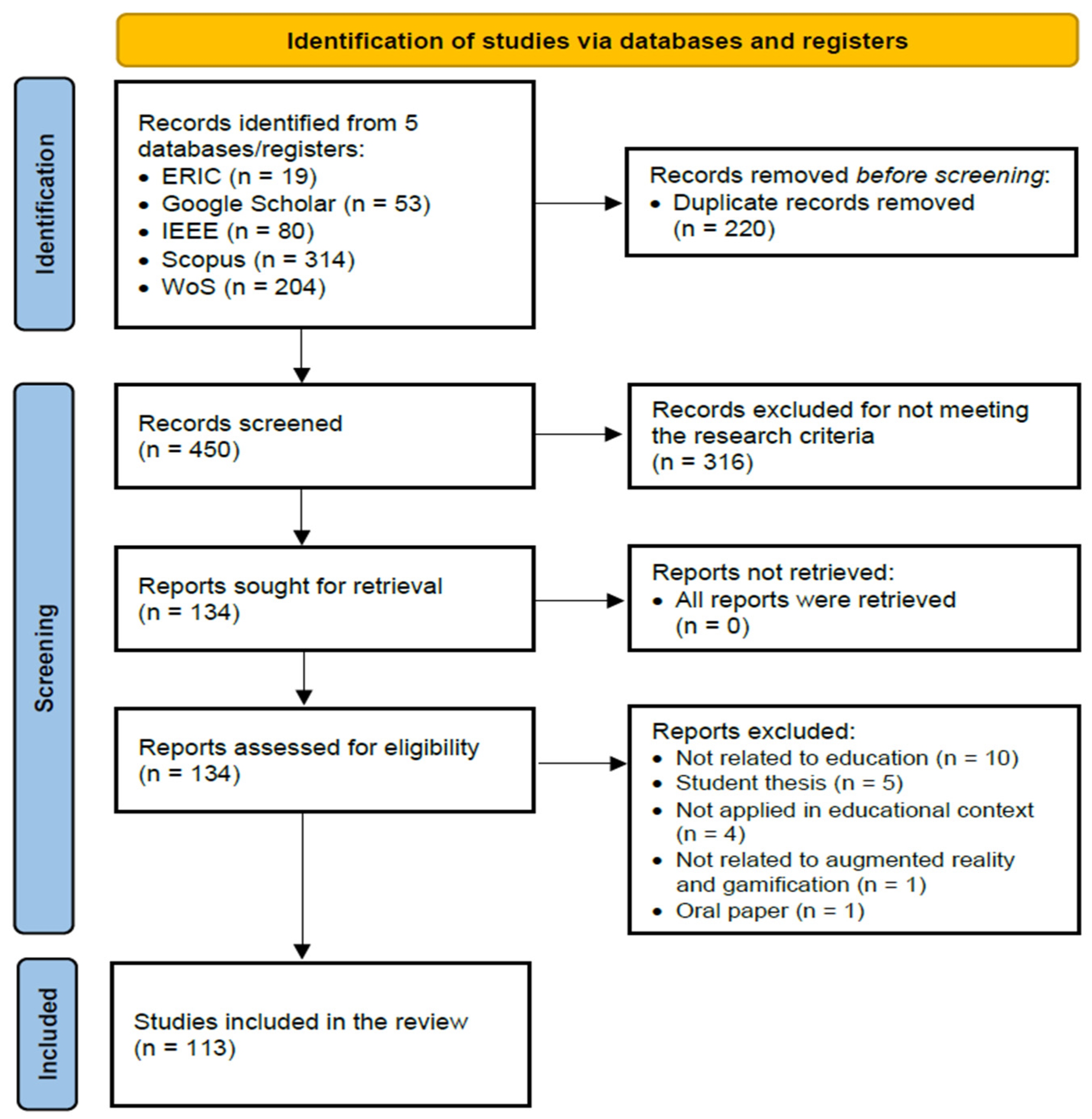
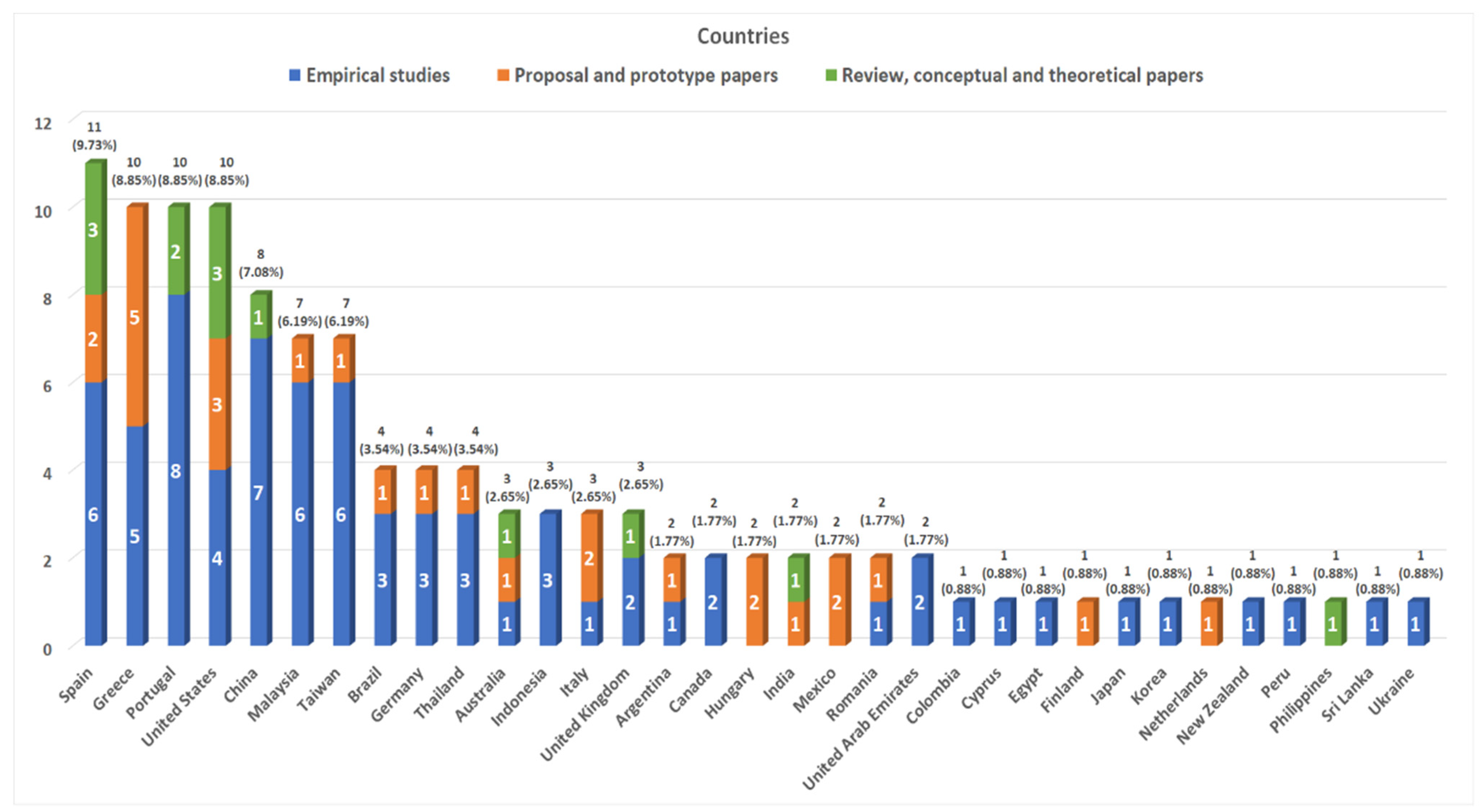
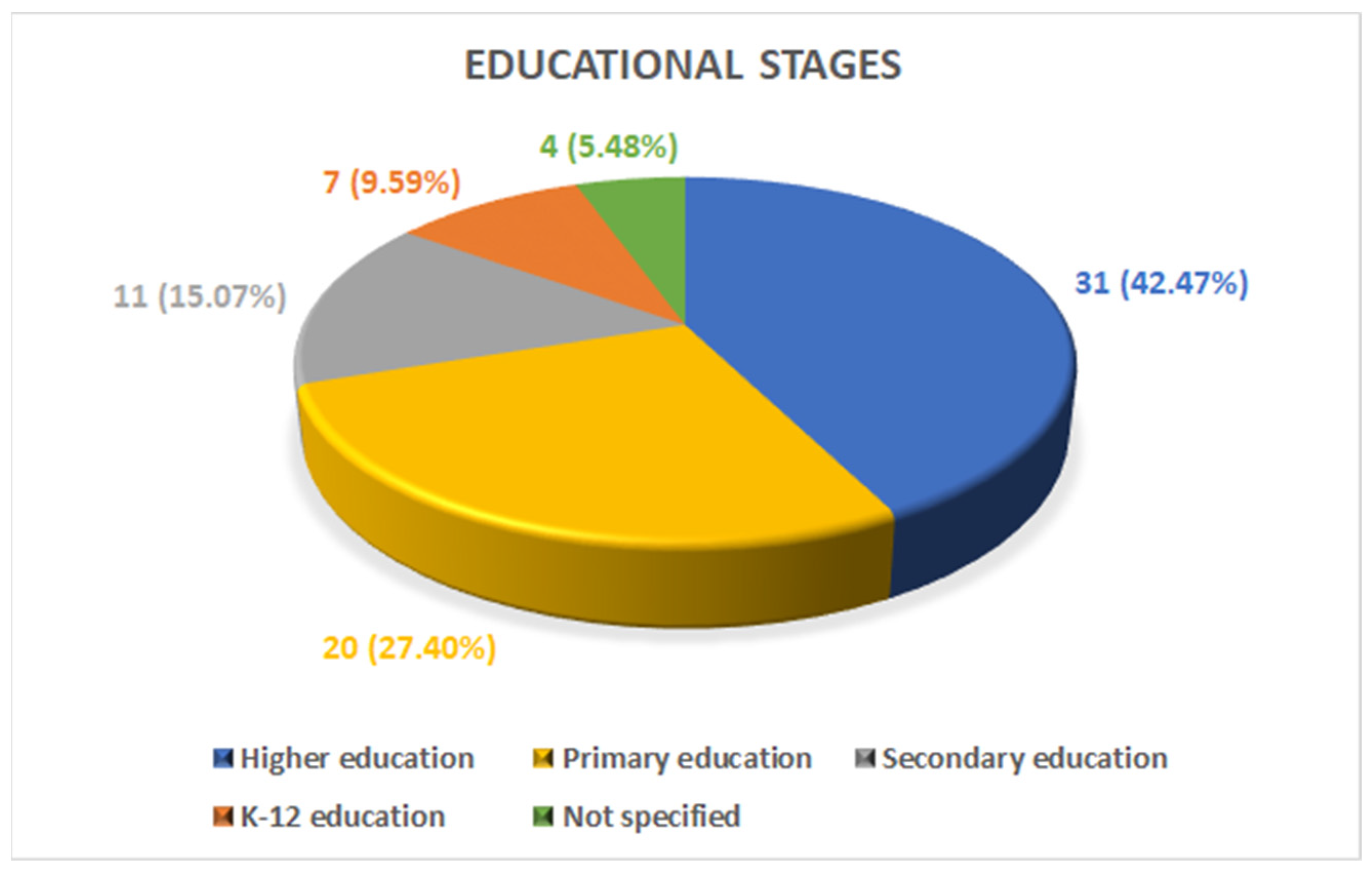
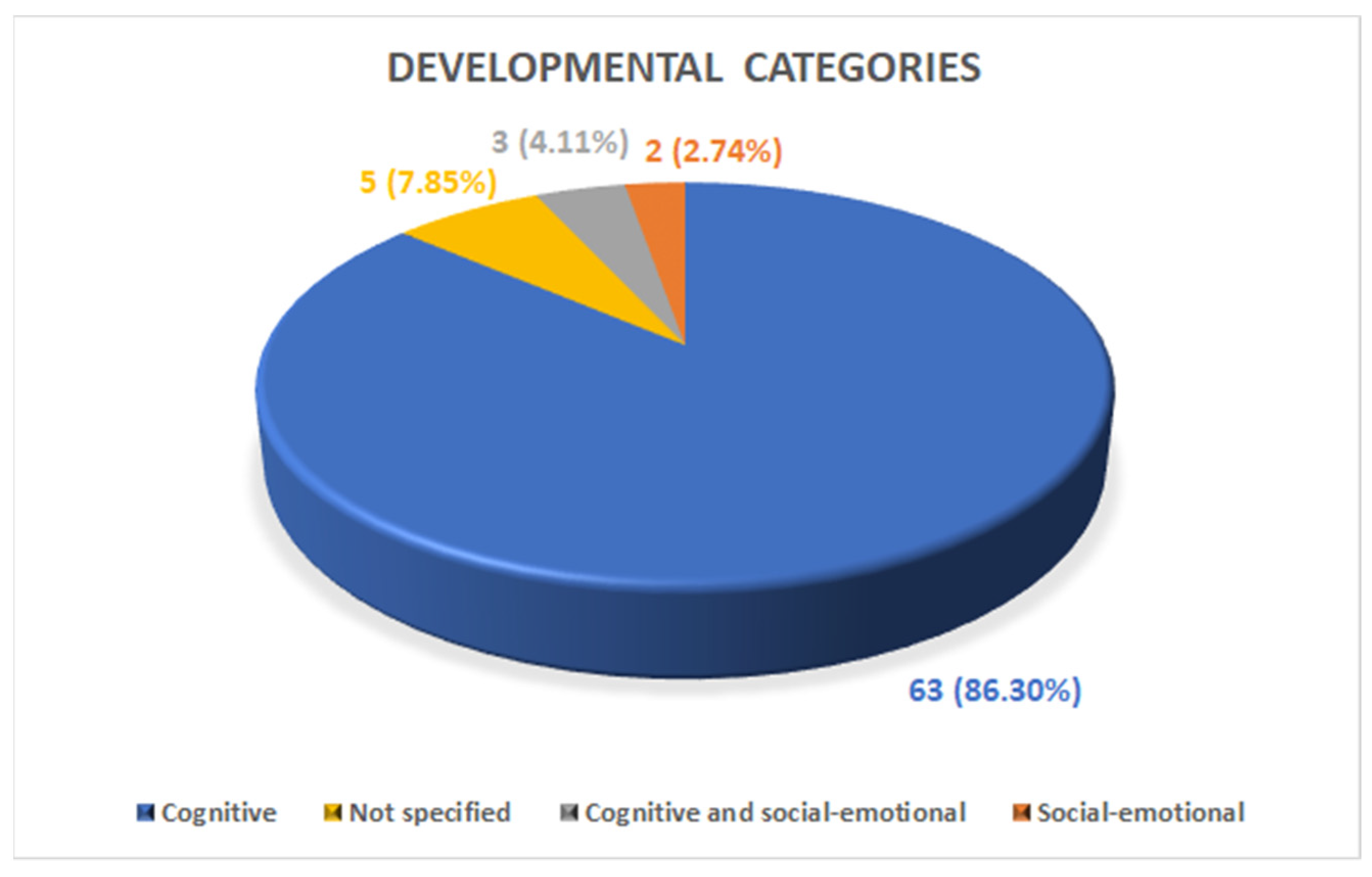
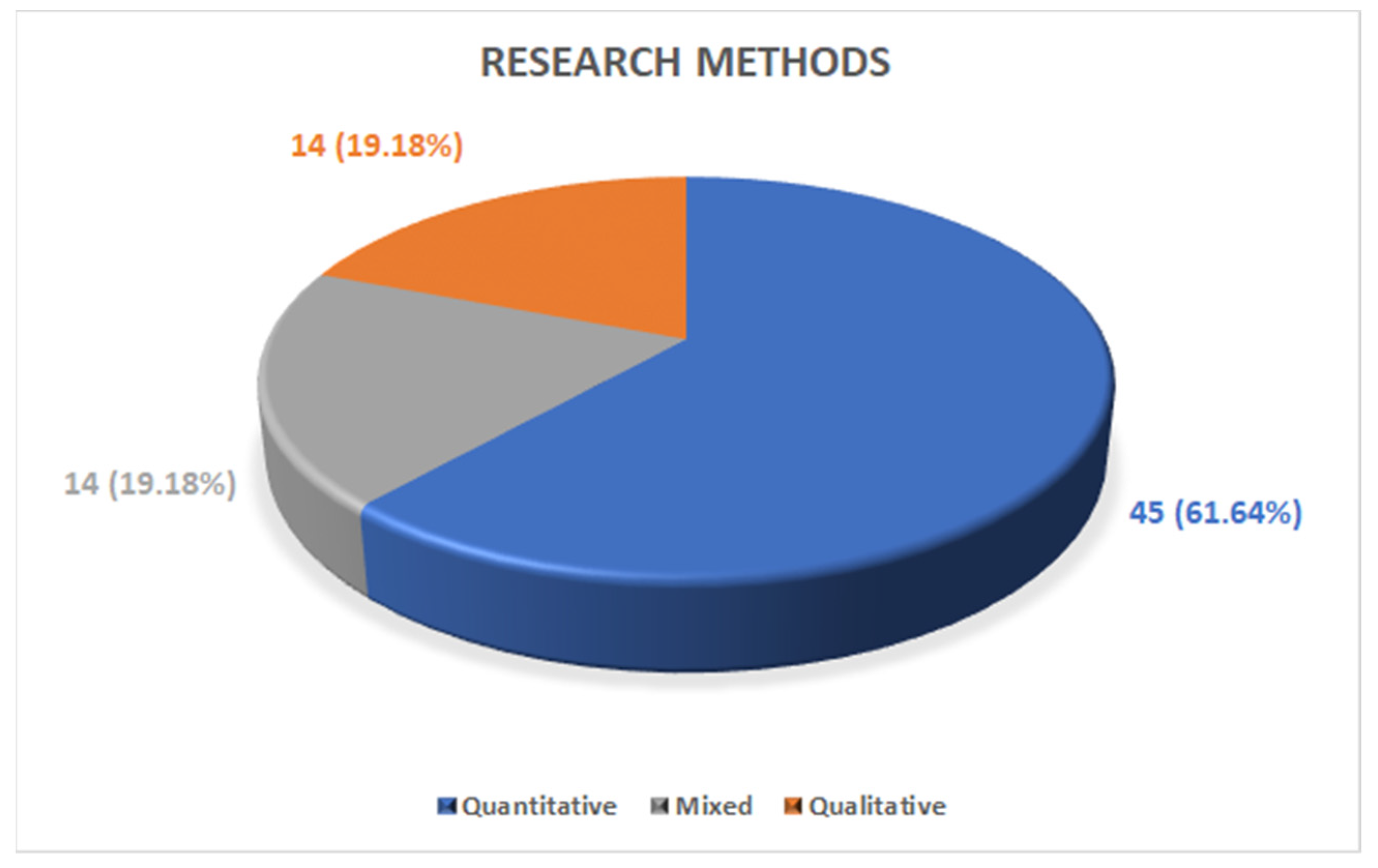
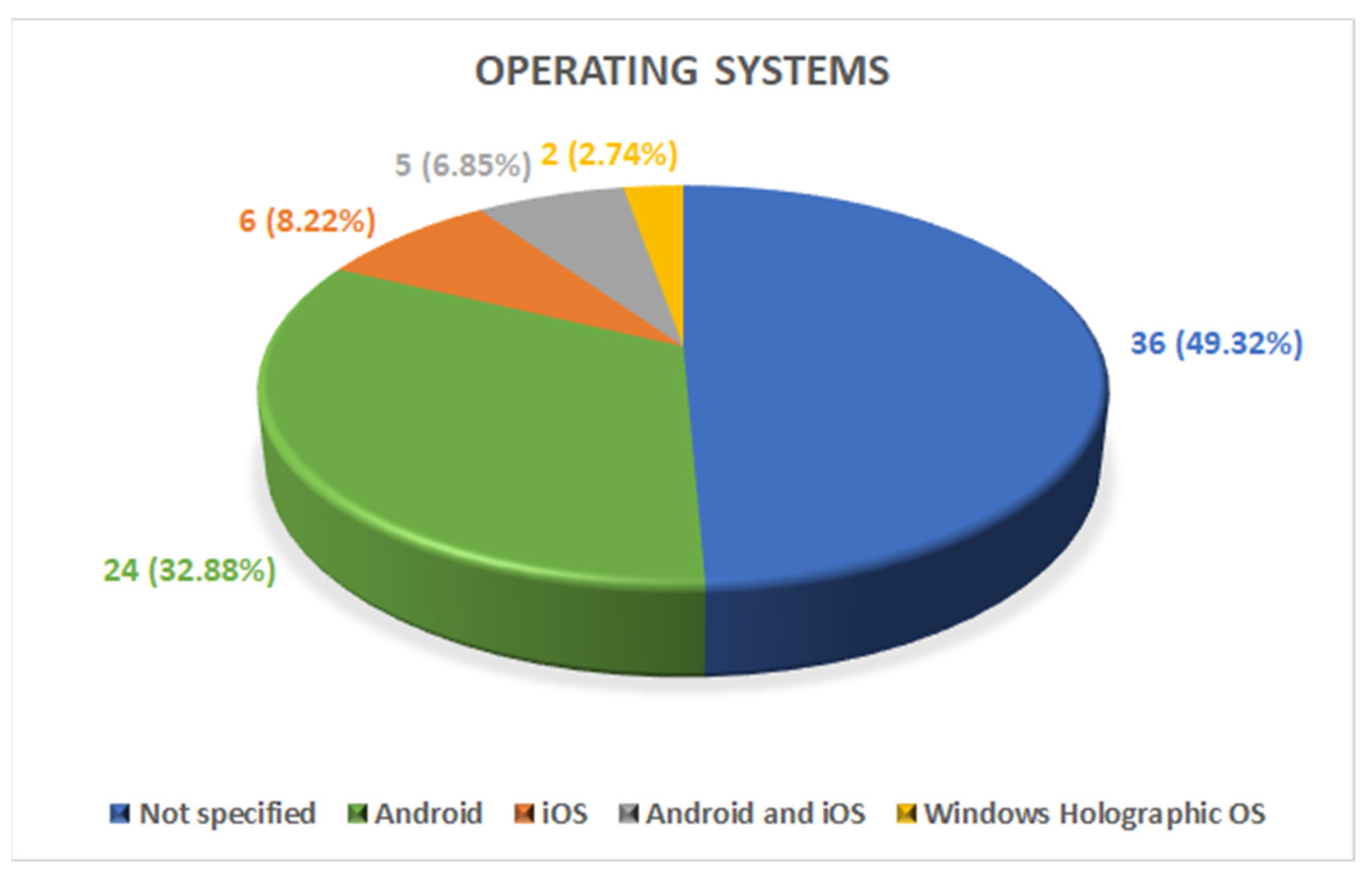

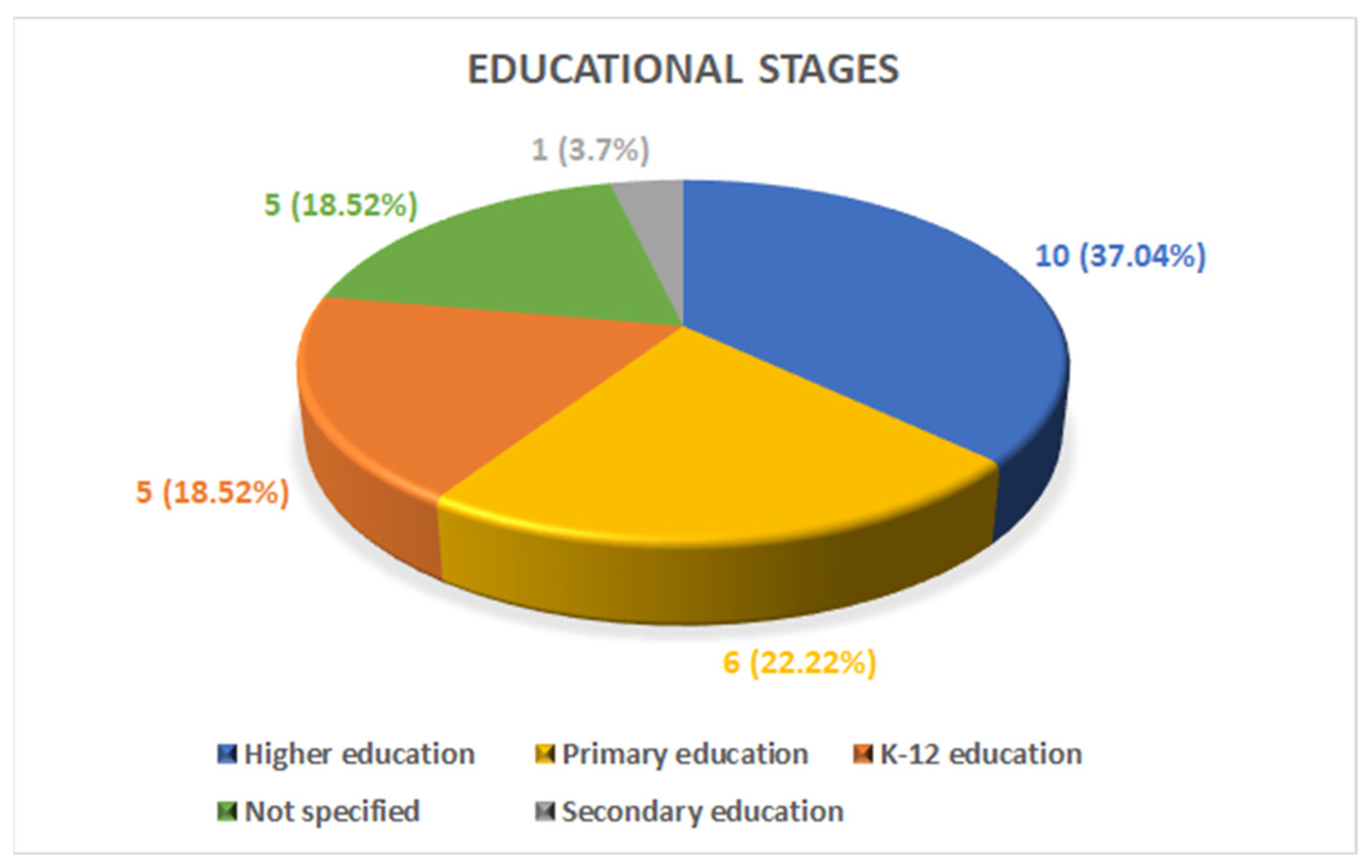
| Ref. | Country | Educ. Stages | Focus Area | Develop. Category | Sample | Aims |
|---|---|---|---|---|---|---|
| [81] | Canada | Higher education | Language learning (French) | Cognitive | 11 first-year higher school students | To assess the potential of a mobile application that uses augmented reality and gamification to bridge the gap between education and gaming. |
| [137] | Spain | n/a | Music | Cognitive | 5 teachers and 13 students from a musical school | To break the initial curve of learning music by motivating students and facilitating the learning process through an augmented reality application. |
| [138] | Indonesia | Primary education | Art | Cognitive | n/a | To create an augmented reality application to introduce batik design as a form of cultural art to primary school students. |
| [139] | Indonesia | Primary education | Culture | Cognitive | Primary school students and teachers | To develop an application that uses augmented reality and gamification and to analyze its impact on primary school students’ knowledge of Indonesian culture learning. |
| [140] | Malaysia | Primary education | Science | Cognitive | 9 primary school students and 1 teacher | To design and develop an augmented reality application that utilizes gamification elements to improve primary school students’ knowledge of microorganisms. |
| [141] | Peru | Primary education | Mathematics | Cognitive | 21 sixth-grade primary school students | To assess the impact of gamification and augmented reality on motivating primary school students to learn mathematics. |
| [142] | Brazil | Primary education | Association of images with words | Cognitive | 2 students | To gamify a crucial clinic activity for children on the autistic spectrum, namely the correlation of words with images. |
| [143] | Romania | Higher education | Medical education | Cognitive | 9 university medical students | To promote self-learning, increase the learning desire, and facilitate the identification of skin-related medical conditions. |
| [144] | Spain | Primary education | Emotion detection | Cognitive and social–emotional | 38 fifth-grade primary school students | To compare the impact that competitive and collaborative gameplay styles have on students’ communication and motivation. |
| [145] | Taiwan | Secondary education | Health education | Cognitive and social–emotional | 52 senior high school students | To design an educational augmented reality board game that capitalizes on card games, slides, and learning sheets to promote health education and compare its influence on students’ different emotions. |
| [146] | Hong Kong | Higher education | History and culture | Cognitive | 35 university students | To present preliminary results regarding the use of an augmented reality application with gamification elements to improve students’ educational experiences when learning history and culture during field trips. |
| [147] | Korea | Higher education | Language learning (English) | Cognitive | 40 college students | To look into the way technology facilitates language learning and how students use the physical properties and context of a digital learning environment. |
| [148] | Taiwan | Secondary education | Health education | Cognitive | 52 high school students | To discuss the effectiveness of integrating augmented reality into board games to increase learning motivation and acceptance. |
| [149] | Portugal | Higher education | Culinary | Cognitive | n/a | To present the benefits of using gamification and immersive technologies in the learning process to motivate self-learning and continuous improvement. |
| [150] | Malaysia | Primary education | Science | Cognitive | 20 public primary school students | To investigate the impact of utilizing augmented reality on students’ learning of the solar system. |
| [151] | Canada | Higher education | Language learning (French) | Cognitive | 58 university students | To analyze students’ viewpoints regarding their learning experiences and their collaboration in immersive learning environments. |
| [152] | Greece | Primary education | Language learning (English) | Cognitive | 20 first-grade primary school students | To investigate how augmented reality and gamified activities can enrich students’ vocabulary in foreign language learning. |
| [153] | Brazil | Secondary education | Entomology | Cognitive | 21 middle school students | To examine how gamified augmented reality experiences impact students’ comprehension of entomological nomenclature and concepts and the development of skills that make them more focused on details. |
| [154] | Spain | Primary education | Mathematics | Cognitive | 37 primary school students | To showcase that gamified augmented reality applications can make multiplication table learning more enjoyable and less monotonous for primary school students. |
| [155] | Japan | Higher education | Language learning (Japanese) | Cognitive | 18 university students | To examine how using gamification and augmented reality can affect beginner language learners of Japanese and assist them in preparing for disastrous encounters. |
| [156] | Hong Kong | Higher education | Chemistry | Cognitive | 46 university students with 37 valid responses | Showcase the potential of using augmented reality along with gamification to support Chemistry learning in flipped classrooms. |
| [157] | Greece | Primary education | Language learning (Greek) | Cognitive | Primary school teachers and students | To utilize a game-based learning and augmented reality approach to raise students’ awareness regarding recycling and COVID-19 and simultaneously enhance their related to the topic vocabulary. |
| [158] | Greece | Primary education | Computer science (Programming) | Cognitive | 15 primary school students | To examine whether primary school students could understand the concept of intelligent environments and their programmable features through a gamified augmented reality application. |
| [159] | Spain | Higher education | Computer science (Distributed architectures) | Cognitive | University students | To create a fun and playful experience to motivate students to review their acquired knowledge on given subjects through an augmented reality serious game. |
| [160] | Sri Lanka | Higher education | Biology | n/a | n/a | To introduce an augmented reality application that utilizes real-time image processing and recognition to support Biology learning. |
| [161] | China | Higher education | Language learning (English) | Cognitive | 50 vocational college students | To study how gamified augmented reality learning experiences can affect students’ learning motivation and collaboration in English courses. |
| [162] | United Kingdom | Secondary education | Geometry | Cognitive | 120 middle school students | To analyze the motivational effects that various gamification elements have on educational augmented reality applications. |
| [163] | Germany | K-12 education | Culture and language learning | n/a | n/a | To showcase how augmented reality combined with gamification and machine learning can create immersive and interactive learning experiences for K-12 students. |
| [164] | Brazil | Higher education | Anatomy | Cognitive | 6 participants (university students and/or professionals) | To present and evaluate an augmented reality application that uses game concepts to facilitate bone anatomy learning. |
| [165] | Australia | Higher education | Computer science (Cybersecurity) | Cognitive | 91 university students (41 Bachelor, 34 Master, 16 Ph.D.) | To develop and present a game design that uses an augmented reality application to motivate students to be more aware and cautious of cybersecurity attacks. |
| [166] | China | Higher education | Language learning (English) | Cognitive | 5 college students, 5 English teachers, and 5 technicians | To assess students’ acceptance levels of integrating an augmented reality application that uses gamification elements in English language learning. |
| [167] | Germany | Higher education | Environmental engineering | Cognitive | 19 university students | To assess the impact of a location-based augmented reality application, which uses game mechanisms on university students’ learning about environmental engineering. |
| [168] | Greece | Primary education | Computer science (Programming) | Cognitive | primary school students | To examine whether primary school students find gamified augmented reality applications enjoyable and if they help them create rules to overcome learning problems. |
| [169] | Spain | Higher education | Chemical Engineering | Cognitive | 179 university students throughout a period of 4 years | To showcase how the use of gamification elements and augmented reality can support and improve students’ learning and comprehension of diverse topics while also increasing their academic results. |
| [170] | Spain | K-12 education | Computer science (Programming) | Cognitive | 12 primary school students | To present an easy-to-use gamified augmented reality application that supports students’ knowledge acquisition while increasing their computational thinking and motivation. |
| [171,172] | Portugal | Higher education | General knowledge | Cognitive | 212 university professors (80 from S. Europe, 61 from S. America, and 71 from Asia) | To investigate how higher education professors in southern Europe, South America, and Asia view the use of mobile technologies and particularly the use of augmented reality and gamification applications within education. |
| [173] | Taiwan | Secondary education | ATM skills | Cognitive | 3 junior high school students | To increase ATM skills in students with intellectual disabilities. |
| [174] | Portugal | Primary education | Astronomy | Cognitive | 90 primary school students and teachers | To showcase an educational augmented reality game, which aims at raising students’ awareness of astronomy concepts and promoting their learning regarding the planetary systems in formal and informal learning environments. |
| [175] | Greece | Primary education | Computational thinking | Cognitive | 26 primary school students | To showcase a collaborative mobile augmented reality application that implements game elements to assist primary school students in developing their critical thinking skills. |
| [176] | Taiwan | Secondary education | Language learning (English) | Cognitive | 65 junior high school students | To examine how iMap-enhanced and AR-enhanced learning within a gamified language learning context affects low achievers’ learning attitudes and performance. |
| [177] | Thailand | Higher education | Digital literacy | Cognitive | 197 university students (1st experiment) and 80 university students (2nd experiment) | To create interactive augmented reality experiences using gamification elements to influence learners’ digital literacy skills, learning achievements, and satisfaction, and to compare their results with those that follow conventional teaching methods. |
| [178] | Malaysia | Primary education | Language learning (Tajweed) | Cognitive and social–emotional | 198 primary school students | To compare the impact of using gamification and augmented reality in Tajweed learning with other novel approaches. |
| [179] | New Zealand | Higher education | Music | Cognitive | 23 university students | To analyze the potential of implementing gamified augmented reality applications in music education. |
| [180] | China | Higher education | Environmental education | Cognitive | 98 first-year university students | To assess the influence of leveraging mobile augmented reality and gamification in environmental education and comprehend what university students think of this approach. |
| [181] | Thailand | Higher education | STEAM | Social–emotional | 138 first-year university students | To enhance students’ grit using an augmented reality application and compare their grit scores with their learning achievements to comprehend their relationship. |
| [182] | Taiwan | K-12 education | STEM | Social–emotional | 177 students | To analyze and comprehend the behavioral intentions of users that utilize the GAR-STEM teaching application. |
| [183] | China | Higher education | Language learning (Chinese) | Cognitive | 76 sophomore university students | To describe how a mobile-augmented reality sandbox game can affect learning students’ Chinese characters learning. |
| [184] | United States | Higher education | Spatial ability | Cognitive | 56 freshman university students | To evaluate the impact of an augmented reality application on students’ performance and compare the results with those of students who followed conventional educational processes. |
| [185] | Colombia | Primary education | Language learning (English) | Cognitive | 163 primary school students | To present how integrating augmented reality through gamification into education can offer better learning results. |
| [186] | United Arab Emirates | Primary education | Learning to write | Cognitive | Primary school students | To suggest an augmented reality system that facilitates students’ learning by allowing them to learn at their own pace, encouraging the involvement of their parents in it, and presenting instantaneous feedback. |
| [187] | Portugal | Primary education | Astronomy | Cognitive | Four groups of primary school students | To showcase the results of a preliminary study involving a mobile augmented reality astronomy game that takes place in an informal learning context and supports students’ knowledge acquisition. |
| [188] | Italy | Secondary education | Astronomy | Cognitive | 14 secondary school students | To present a tool and methodology for creating augmented reality geo-localized learning activities and evaluate its effectiveness based on students’ viewpoints. |
| [189] | Malaysia | Higher education | Language learning | Cognitive | 66 university students | To comprehend students’ viewpoints regarding the use of augmented reality and gamification in creating exciting learning experiences that promote active and collaborative learning. |
| [190] | United Kingdom | Primary education | Asthma care education | Cognitive | 18 primary school students | To propose a mobile augmented reality application that uses game elements to assist students’ self-management in asthma education. |
| [191] | Germany | n/a | Language learning (Japanese kanji) | Cognitive | 13 students | To train students in all aspects of Kanji by capitalizing on the concept of flow to immerse students in a rich Japanese mythology game, which takes place in an augmented reality environment. |
| [192] | Malaysia | Higher education | Architecture | Cognitive | 87 university students | To investigate how instructional design can assist in developing mobile augmented reality applications that create enjoyable learning environments, which promote students’ active participation. |
| [193] | Argentina | n/a | General knowledge | Cognitive | 50 secondary and higher education students | To propose a framework for designing augmented reality applications and validating it by creating and assessing an application using the specific framework on a goose board game to reinforce the learning of concepts presented in a traditional classroom. |
| [194] | United Arab Emirates | Primary education | Learning to write | Cognitive | Primary school students | To propose an augmented reality application that supports students by enabling them to learn at their own pace and to actively involve their parents. |
| [195] | Ukraine | Secondary education | Physics and English | Cognitive | Four groups of secondary school students | To showcase the potential of using gaming elements and augmented reality to support the conduct of binary lessons, such as Physics and English, in secondary education. |
| [196] | Portugal | K-12 education | Interdisciplinary themes | Cognitive | 24 K-12 education students and 46 higher education ones | To analyze students’ perception of the gamified augmented reality application regarding its usability and learning values, and to comprehend their viewpoints. |
| [197] | China | Higher education | Computer science (Web design) | Cognitive | 221 university students | To present the benefits of using gamification and augmented reality to create personalized learning experiences in a classroom. |
| [198] | Thailand | Higher education | Teamwork | n/a | 5 specialists selected by purposive sampling | To create an augmented reality application that promotes and increases students’ teamwork and to evaluate its effectiveness. |
| [199] | Egypt | K-12 education | Mathematics | Cognitive | 18 diagnosed Down syndrome teenagers | To present an interactive AR-based game as an instructional means for Down syndrome teenagers. |
| [200] | Indonesia | Secondary education | Language learning (French) | Cognitive | 60 secondary school students | To create a gamified mobile learning system using augmented reality to improve French language learning. |
| [201] | Portugal | Higher education | Teaching and learning process | n/a | 37 university professors | To examine university professors’ viewpoints regarding the use of mobile learning when combined with augmented reality and gamification to improve students’ learning motivation. |
| [202] | Portugal | K-12 education | Interdisciplinary themes | Cognitive | 74 primary and secondary school students | To design, develop, and evaluate an augmented reality game to promote students’ learning in smart urban parks. |
| [203] | United States | Higher education | Language learning (English) | Cognitive | 3 university students | To improve students’ cultural understanding, language development, and communication skills through an augmented reality mobile game. |
| [204] | United States | Secondary education | Engineering | Cognitive | 20 high school students | To present the design process of an augmented reality gamified learning experience and assess its impact on creating sustainable learning opportunities by increasing university students’ sensory capacities. |
| [205] | United States | K-12 education | Mathematics | Cognitive | 5 primary school teachers | To find and showcase the benefits and challenges of personalized gamified augmented reality experiences in K-12 education. |
| [206] | Cyprus | Higher education | General knowledge | n/a | 97 undergraduate university students | To examine the impact of augmented reality in learning in a classroom based on students’ perceptions. |
| [207] | Taiwan | Secondary education | Chemistry | Cognitive | 152 high school students | To investigate the impact of different augmented reality types and guiding strategies on high school students’ learning performance and motivation when studying electrochemistry concepts. |
| [208] | Malaysia | n/a | General knowledge | Cognitive | 150 participants | To investigate the potential of using augmented reality games to support the development of learning through games. |
| Ref. | Research Method | Main Variables | Measurement Tools—Research Tools |
|---|---|---|---|
| [81] | Mixed | Participants’ assessments, learning experience, and evaluation of the application playability | Ad hoc pre-questionnaire and post-questionnaire, focus groups interviews, audio and video recordings, and data and statistics collection through the ARIS engine |
| [137] | Quantitative | Students’ and teachers’ viewpoints regarding the perceived ease of use, levels of agreement, and usefulness | Ad hoc Likert scale survey following the Technology Acceptance Model (TAM) [209] |
| [138] | Quantitative | Media validation | Ad hoc survey |
| [139] | Quantitative | Systems usability and students’ knowledge acquisition | Black box tests, ad hoc questionnaire regarding teachers’ judgment and students’ usability assessment |
| [140] | Quantitative | Usability and effectiveness | 10-item questionnaire presented in [210] |
| [141] | Quantitative | Students’ comprehension of spatial geometry | Pre-test and post-test questions regarding spatial geometry |
| [142] | Quantitative | Students’ ability to link words with images | Ad hoc questionnaire |
| [143] | Quantitative | Students’ viewpoints | Ad hoc Likert scale survey |
| [144] | Quantitative | Students’ viewpoints and observers’ assessment | Ad hoc questionnaire, 7 items regarding game mode evaluation, 5 items about observations, and 9 items regarding communication and collaboration |
| [145] | Quantitative | Students’ learning effectiveness, emotions, and flow experience | 3 questionnaires, a 56-item ad hoc questionnaire with pre- and post-learning performance scale, the Achievement Emotions Questionnaire (AEQ) [211], and the Flow Experience Questionnaire designed by [212], as well as the Chinese version designed by [213] |
| [146] | Qualitative | Students’ perspectives | Open-ended questions |
| [147] | Qualitative | How the application promotes meaningful language learning and how students use place mechanisms within it | Students’ learning outcomes assessment, post-surveys, and reflections, as well as qualitative data regarding application logs and open-ended questions |
| [148] | Quantitative | Students’ acceptance level and learning motivation | The Instructional Material Motivation Survey (IMMS) [214] and the Technology Acceptance Model (TAM) [215] |
| [149] | Quantitative | Control, sensory, distraction, and realism factors of the overall experience | The Presence Questionnaire [216] |
| [150] | Quantitative | Students’ pre-test and post-test scores | 3 ad hoc pre-test and post-test quizzes, one for each class |
| [151] | Mixed | Time on task, engagement, and collaborative learning | Pre-play and post-play questionnaires, interviews, and video recordings |
| [152] | Mixed | Retention rate, communication and interaction, learners’ attitudes, and overall effect on the educational process | Post-test, teachers’/researchers’ journals, and semi-structured interviews |
| [153] | Quantitative | Students’ knowledge of entomological terms and concepts | Multiple-choice learning tests adapted from the History Word Association Test (HWAT) [217] |
| [154] | Quantitative | Learning effectiveness and usability | Ad hoc pre-test and post-test questionnaires |
| [155] | Quantitative | The impact of gamified augmented reality application on beginner language learners | Ad hoc survey with open-ended questions |
| [156] | Quantitative | Students’ attitudes | 26-item questionnaire [64] |
| [157] | Qualitative | Vocabulary development, students’ active participation, and topic awareness | Interviews with open-ended questions and observations |
| [158] | Mixed | Students’ comprehension of intelligent environments | Open-ended questions, pre-test, post-test, and observations |
| [159] | Quantitative | Students’ viewpoints | Ad hoc questionnaire |
| [160] | Quantitative | Image detection model accuracy | Cross-validation |
| [161] | Qualitative | The impact of gamified augmented reality on learning motivation and collaboration | Interviews |
| [162] | Quantitative | Effects of different gamification mechanisms on learning experiences in augmented reality learning applications | Ad hoc 3-item questionnaire, measuring interest, confidence, and intention |
| [163] | Quantitative | Deep learning model performance | 3-part questionnaire, including demographic information, user experience, and information comprehension |
| [164] | Quantitative | System usability and learning aspects | Two ad hoc questionnaires regarding the systems interface, interactions, and learning aspects |
| [165] | Quantitative | Students’ viewpoints | 7-item ad hoc questionnaire |
| [166] | Quantitative | Users’ acceptance and application performance | Ad hoc questionnaire to evaluate the performance and acceptance of the application following the suggestions made by [218] |
| [167] | Qualitative | Students’ viewpoints, motivation, attitudes, and learning-related outcomes | Ad hoc questionnaire, observations, protocols, and guided interviews |
| [168] | Qualitative | Students’ errors made, interactions and hints used for each task | Observations |
| [169] | Quantitative | 4-year academic results in the form of grades and overall module completion rate | Academic performance assessment |
| [170] | Mixed | Students’ motivation and interest in programming and their perceptions regarding the usefulness, intention, and usability of the augmented reality application | Ad hoc questionnaire inspired by the Technology Acceptance Model (TAM) [209] and open-ended questions |
| [171,172] | Quantitative | Professors’ viewpoints | 41-item online ad hoc questionnaire about students’ demographic information, prior knowledge, engagement, use of mobile devices in the classroom, and self-efficacy |
| [173] | Mixed | Number of independently completed tasks when using the ATM | Datasheets, observations, and video recordings |
| [174] | Mixed | Students’ and teachers’ viewpoints | Ad hoc questionnaire, open-ended questions, and observations |
| [175] | Mixed | Overall collaboration, enjoyment, interactivity, and comprehensibility | Ad hoc 4-item questionnaire, think-aloud feedback, observations, and performance recordings |
| [176] | Quantitative | Students’ learning performance and attitude | Ad hoc questionnaire regarding students’ attitudes as well as an achievement test |
| [177] | Quantitative | Students’ learning achievements, digital literacy skills development, and satisfaction | Ad hoc 20-item subjective test, rubric scoring based on the Likert scale [219] |
| [178] | Quantitative | Students’ emotional engagement and learning performance | Pre-test and post-test during design sessions and ad hoc questionnaire adopted from [220,221] |
| [179] | Mixed | Students’ viewpoints and system usability | Recorded comments and feedback and the System Usability Scale (SUS) [222] |
| [180] | Mixed | Students’ perceived usefulness, ease of use, attitudes, and behavioral intentions | Observations, interviews, and ad hoc survey with questions adopted from [215,223,224] |
| [181] | Quantitative | Students’ learning grit | Self-evaluation pre-tests and post-tests regarding students’ grit using scoring rubrics |
| [182] | Quantitative | Media interactivity, entertainment, practicability, attitude, and behavioral intention | Ad hoc questionnaire |
| [183] | Quantitative | Students’ learning style, learning interest, interactivity, and immersion | Ad hoc questionnaire |
| [184] | Mixed | Factors that affect students’ spatial reasoning performance when using the augmented reality application | Pre-test and post-test, data collection through the application, and ad hoc survey based on Intrinsic Motivation Inventory (IMI) [225] |
| [185] | Quantitative | Students’ ability to learn the numbers in English | Diagnosis and final verbal tests following a traditional grading system |
| [186] | Quantitative | Students’ ability to write the English letters | Ad hoc survey |
| [187] | Qualitative | Students’ viewpoints | Ad hoc survey |
| [188] | Qualitative | Students’ viewpoints regarding the support that the tool provides in learning activities | Ad hoc questionnaire |
| [189] | Qualitative | Students’ perceptions | Ad hoc online survey and open-ended questions |
| [190] | Quantitative | Students’ knowledge | Ad hoc multiple-choice quiz |
| [191] | Quantitative | Students’ knowledge of Japanese language | Pre-test and post-test ad hoc questionnaire |
| [192] | Mixed | Students’ viewpoints and insights | Ad hoc questionnaire |
| [193] | Quantitative | Students’ knowledge retention | 20 question quiz |
| [194] | Quantitative | Students’ ability to write the English letters | Ad hoc survey |
| [195] | Qualitative | Students’ evaluation of the use of gamified augmented reality in binary lessons | Observations |
| [196] | Mixed | Learning value and usability | System Usability Scale (SUS) [222], interviews, and usage data of the application |
| [197] | Quantitative | Students’ engagement, learning outcomes, task completion rate, and final grade | Collection of quantitative data from the final grade and the overall learning path during the experiment |
| [198] | Qualitative | Specialists’ inputs and opinions | Observations and scoring rubric |
| [199] | Quantitative | Learning gains, outcomes, control and joy | 9-item questionnaire adopted from [226] |
| [200] | Quantitative | Students’ motivation and learning results | Pre-test and post-test ad hoc questionnaires |
| [201] | Quantitative | Higher education professors’ viewpoints | Ad hoc questionnaire regarding students’ demographic information, prior knowledge, engagement, and use of mobile devices within the classroom |
| [202] | Qualitative | Students’ viewpoints and perception of joy | Observation reports and transcripts |
| [203] | Qualitative | Students’ viewpoints | Video recordings and interviews |
| [204] | Mixed | Learners’ engagement and the application functionality and features | Game analytics, video recordings, and photographs of learners, artifacts, and pre- and post-assessment |
| [205] | Qualitative | Teachers’ viewpoints | Interviews |
| [206] | Quantitative | Students’ opinions | 16-item ad hoc questionnaire |
| [207] | Quantitative | The effect of different augmented reality and guiding strategy types on learning performance and motivation | Prior knowledge test, performance test, and ad hoc questionnaire adapted from the Motivated Strategies for Learning Questionnaire (MSLQ) [227] |
| [208] | Quantitative | Main factors that motivate participants to play and urge them to continue playing | Ad hoc survey |
| Ref. | Application Name | Development Tools | Operating System | Device | Gamification Elements |
|---|---|---|---|---|---|
| [81] | Explorez | ARIS | iOS | Mobile devices | Game-like features, badges, and quests |
| [137] | HoloMusic XP | Vuforia | Windows Holographic OS | Microsoft HoloLens | Scores and points |
| [138] | BATIK-AR | ASSEMBLR Studio | Android | Mobile devices | Points and badges |
| [139] | n/a | n/a | n/a | Mobile devices | Game-like features |
| [140] | Microorganisms | Unity, Autodesk 3Ds Max, Vuforia and Firebase | Android | Mobile devices | Quiz questions, timer, and scores |
| [141] | Voluminis | ARCore, Unity, Firebase and Blender | Android | Mobile devices | Points and leaderboards |
| [142] | AssociAR | Unity and Vuforia | Android | Mobile devices | Game-like features |
| [143] | n/a | OpenCV and Unity | Android | Mobile devices | Points and leaderboards |
| [146] | n/a | Aurasma | Android and iOS | Mobile devices | Virtual rewards |
| [144] | EmoFindAR | Unity, Photon Unity Networking and Placenote SDK | Android | Mobile devices | Competitive and collaborative game modes, points, and quiz questions |
| [145] | n/a | n/a | n/a | Mobile devices | Board game, game-like features, quiz questions, points, cards, slides, and learning sheets |
| [147] | n/a | n/a | n/a | Mobile devices | Digital stories |
| [148] | Get ahead in medical knowledge | RAVVAR app | iOS | Mobile devices | Cards, slides, and learning sheets |
| [149] | n/a | ARFoundation library and Unity | Android | Mobile devices | Points, levels, badges, and achievements |
| [150] | SoLAR Kid | n/a | Android | Mobile devices | Achievements and points |
| [151] | Explorez and VdeUVic | ARIS | iOS | Mobile devices | Levels and quests |
| [152] | n/a | n/a | n/a | Mobile devices | n/a |
| [153] | n/a | n/a | n/a | Mobile devices | Objectives, levels, points, timer, virtual rewards, collaboration, feedback, challenges, and progression |
| [154] | n/a | Unity and Vuforia | Android and iOS | Mobile devices | Mini games and game-like features |
| [155] | n/a | ARIS | iOS | Mobile devices | n/a |
| [156] | n/a | Unity and Vuforia | Android and iOS | Mobile devices | Game-like features |
| [157] | n/a | ARFoundation, Unity and ARCore | Android | Mobile devices | Game-like features |
| [158] | n/a | n/a | n/a | Mobile devices | Points and game-like features |
| [159] | vAnswer | Unity and Vuforia | Android | Mobile devices | Quiz questions and points |
| [160] | Amazon Biology | Unity and Android Studio | Android | Mobile devices | Quiz questions and puzzles |
| [161] | n/a | n/a | n/a | Mobile devices | Game-like features, quests and points |
| [162] | n/a | Unity, Vuforia and Autodesk Maya | Android | Mobile devices | Quiz questions, timer, badges, and points |
| [163] | Arsinoë | Android Studio and TensorFlow | Android | Mobile devices | Quiz questions and points |
| [164] | BN Anatomy | ARFoundation, ARCore, Unity and Manomotion | Android | Mobile devices | Quiz questions, scores, timer, virtual rewards, progression, feedback, and competition |
| [165] | CybAR | Unity and Vuforia | Android | Mobile devices | Quiz questions and points |
| [166] | GARMA | Unity and Alibaba Cloud Elastic Compute Service | Android | Mobile devices | Game-like features, scores, and leaderboards |
| [167] | PlayVisit | n/a | n/a | Mobile devices | Points and virtual rewards |
| [168] | MagiPlay | Unity and ARKit | iOS | Mobile devices | Points and levels |
| [169] | n/a | n/a | n/a | n/a | Game-like features, tasks, and role-playelements |
| [170] | RoboTIC | Unity | Windows Holographic OS | Microsoft HoloLens | Game-like features, badges, and achievements |
| [171,172] | n/a | n/a | n/a | n/a | n/a |
| [173] | n/a | HP Reveal | Android and iOS | Mobile devices | Game-like features |
| [174] | PlanetarySystemGO | Unity and Vuforia | Android | Mobile devices | Game-like features, quiz questions, and points |
| [175] | ARQuest | Unity and Vuforia | Android | Mobile devices | Virtual tokens, digital stories, and challenges |
| [176] | n/a | n/a | n/a | Mobile devices | Virtual rewards and points |
| [177] | n/a | n/a | n/a | Mobile devices | Game-like features, quiz questions, and scores |
| [178] | TARGaLM | n/a | n/a | Mobile devices | Points, badges, and leaderboards |
| [179] | MRPT | Unity | Android | HTC Vive Pro HMD | Game-like features, scores, and feedback |
| [180] | n/a | n/a | n/a | Mobile devices | Game-like features |
| [181] | STEAM-GAAR | n/a | n/a | Mobile devices | Points, leaderboards, and virtual rewards |
| [182] | GARSTEM | n/a | n/a | n/a | n/a |
| [183] | n/a | n/a | n/a | Mobile devices | Game-like features, feedback, points, and virtual rewards |
| [184] | n/a | n/a | n/a | Mobile devices | Scores and mini games |
| [185] | n/a | n/a | n/a | Leap Motion Controller | Levels, tasks, and virtual rewards |
| [186] | n/a | OpenCV | n/a | Mobile devices | Game-like features |
| [187] | SolarSystemGO | n/a | n/a | Mobile devices | Game-like features, quiz questions, points, and virtual rewards |
| [188] | Hunting Game Generator | n/a | n/a | Mobile devices | Game-like features and quiz questions |
| [189] | Xplorerafe+ | n/a | n/a | Mobile devices | Game-like features and quests |
| [190] | MySpira | Univty, Vuforia, ARKit and ARCore | Android | Mobile devices | Game-like features, quiz questions, and points |
| [191] | Dragon Tale | n/a | n/a | Mobile devices | Game-like features, mini games, quiz questions, points, and puzzles |
| [192] | n/a | n/a | n/a | Mobile devices | Quiz questions and points |
| [193] | n/a | Unity and Vuforia | Android | Mobile devices | Quiz questions and board games |
| [194] | n/a | OpenCV | n/a | Mobile devices | Game-like features |
| [195] | n/a | n/a | n/a | Mobile devices | Quests, puzzles, and levels |
| [196] | EduPARK | Unity and Vuforia | Android | Mobile devices | Quiz questions, points, and tasks |
| [197] | n/a | n/a | n/a | Mobile devices and SmartBands | Game-like features and tasks |
| [198] | AAR Book Model | n/a | n/a | n/a | n/a |
| [199] | Galaxy Shop | Unity | n/a | Touchizer [228] | Game-like features, quiz questions, scores, feedback, and levels |
| [200] | GaMbAR | Node.js, MySQL and HTML5 | n/a | Mobile devices and web-based environment | Game-like features, mini games, and levels |
| [201] | n/a | n/a | n/a | n/a | n/a |
| [202] | EduPARK | Unity and Vuforia | Android | Mobile devices | Quiz questions, points, and tasks |
| [203] | Guardians of the Mo’ o | ARIS | iOS | Mobile devices | Game-like features, levels and tasks |
| [204] | GreenDesigners | n/a | n/a | Mobile devices | Progression, challenges, virtual rewards, badges, role-play elements, collective intelligence responses, and scene settings |
| [205] | n/a | n/a | n/a | Mobile devices | Quiz questions and levels |
| [206] | n/a | n/a | n/a | n/a | n/a |
| [207] | n/a | Unity and Vuforia | Android | Mobile devices | Game-like features and objectives |
| [208] | Ingress (Niantic) | n/a | Android and iOS | Mobile devices | Game-like features, badges, points, and tasks |
| Ref. | Main Findings |
|---|---|
| [81] | Students found their augmented reality learning experience engaging, relevant, useful, and fun and regarded the quest completion and collaborative activities as highly motivating. |
| [137] | The overall experience was viewed as useful, motivating, and satisfactory by students. A friendly competition was created between students and teachers to see who would obtain the highest score. |
| [138] | By promoting exploratory behaviors, the augmented reality application provided students with learning benefits, who in turn developed positive attitudes and found the application absorbing and enjoyable. |
| [139] | Increased learning outcomes were observed for students who used the augmented reality game. |
| [140] | Students found the learning experience engaging and satisfactory; thus, the augmented reality application was characterized as a helpful learning tool. |
| [141] | Students’ learning motivation increased and the teaching process was more enjoyable. |
| [142] | Although the application might not have the same outcomes in all contexts, positive learning results were observed in students with ASD. |
| [143] | Based on the survey responses, the augmented reality application promoted self-learning, deepened students’ knowledge, and increased their desire to learn. |
| [144] | The experience was intrinsically satisfactory with students showcasing positive emotions, which improved their mood and increased their involvement. Students who participated in the collaborative game demonstrated greater emotional affection, interest, and social interactions. |
| [145] | Significant differences were found between the control and experimental groups. Students who used the augmented reality application were deeply immersed in the experience and, hence, showcased improved learning outcomes, decreased negative emotions, and better flow state. |
| [146] | Students showcased a positive attitude toward using augmented reality in learning contexts as it positively impacted their engagement and motivation. Although the novelty of the activity attracts students, the challenge of designing and implementing augmented reality in the educational process effectively still remains. |
| [147] | The results indicated that the augmented reality application supported students’ language learning in the affective, social, and cognitive domains, and contributed to their learning outcomes. The application was regarded as satisfactory, motivational, and enjoyable. |
| [148] | Students found the learning experience motivating and demonstrated a high acceptance level. |
| [149] | By incorporating audiovisual elements in real time, the augmented reality application helped students gain new experiences, acquire new knowledge, and hone their skills. |
| [150] | Students who used the augmented reality application showcased improved scores during post-tests while simultaneously the number of low performers decreased. |
| [151] | Students spent most of their time carrying out learning tasks and demonstrated higher interactivity and engagement in co-regulation activities. Opportunities to promote and increase collaborative learning were also showcased. |
| [152] | Students found the application motivating and easy to use, appreciated the fact that they could learn at their own pace, and developed a positive attitude toward language learning. Using multimodal material, students acquired new vocabulary in a playful manner while their vocabulary retention rate also improved. |
| [153] | Students found the overall activity entertaining and were motivated to play the augmented reality game. After using the application, students showcased improved learning outcomes and increased retention rate. |
| [154] | Students assessed the application as an enjoyable, intriguing, and attractive way to improve their skills at Mathematics. |
| [155] | Students actively participated in the learning process and found the immersion element beneficial to their learning. |
| [156] | Students found the experience satisfactory and engaging, viewed the application positively, and regarded it as an invaluable learning tool in flipped classroom contexts. A positive correlation between students’ perceptions of the augmented reality application and their learning attitude was found. |
| [157] | Students who used the augmented reality game were more creative and focused during the learning process. Their active participation and enthusiasm increased when they noticed the existence of rewards. |
| [158] | Students found the experience enjoyable and interesting and were able to comprehend the concept of intelligent environments and how to program their behavior. |
| [159] | The majority of students found the application useful as it helped them comprehend the subject taught better. They also positively valued the motivating aspects, which urged them to repeat tasks and revise the material studied. |
| [160] | Augmented reality applications can be combined with image recognition to expand their utilities, functionalities, and use cases, and to enrich the learning and teaching processes via visual objects. |
| [161] | The gamified augmented reality application improved students’ motivation and created a relaxed learning atmosphere, which fostered collaborative learning and strengthened their willingness to discuss. |
| [162] | Although major differences in terms of motivation were not observed between the gamified and non-gamified applications, students who used the gamified version demonstrated higher knowledge gain. Points were the determining gamification element that urged students to participate when compared to virtual badges and timers. |
| [163] | By providing students with interactive images and information that can easily be repeated, promising learning outcomes can be yielded. |
| [164] | Students showcased satisfactory results and enthusiasm and highlighted that the experience stood out from conventional teaching methodologies. The system was flexible, intuitive, presented clear commands, and had acceptable latency. |
| [165] | The application was regarded as useful to the students who acquired a better comprehension of cybersecurity and learned how to stay safe online. |
| [166] | The application performance was good and the participants showed good acceptance levels, found it useful and interesting, and quoted that it could be used as an effective supporting tool in the implementation of various teaching aims. |
| [167] | Students demonstrated increased learning motivation and positive attitudes toward the application. |
| [168] | Students enjoyed the overall experience while being more engaged and presenting positive emotions. |
| [169] | The results indicated higher student motivation, participation, and learning outcomes. |
| [170] | The application increased students’ motivation and interest in programming. |
| [171,172] | Most university professors are acquainted with the use of augmented reality and can perform the most trivial tasks with ease. Additionally, they believe that mobile learning using augmented reality can be incorporated into education and increase students’ engagement. Small differences between genders and continents were found. |
| [173] | Students’ task completion improved and teachers regarded the augmented reality game as helpful and useful. |
| [174] | The majority of students enjoyed the augmented reality game experience and would be more than willing to participate in similar activities. Teachers confirmed that the application fulfilled the contents and aims of the syllabus. |
| [175] | Students were really engaged and motivated during the learning activities. The size of the mobile device affected their collaboration. |
| [176] | Students who used the augmented reality application performed better, were more focused, and demonstrated more positive attitudes. Technology-enhanced contextualized learning can promote and increase students’ learning attitudes and performance. |
| [177] | Students felt a sense of satisfaction, regarded the experience as suitable for their learning needs, and achieved better learning outcomes. |
| [178] | Students found the overall approach more engaging, motivating, and interesting in comparison to traditional approaches and exhibited better learning outcomes. |
| [179] | Students felt more motivated while using the application particularly due to the positive reinforcement text and regarded it as fun, interesting, and intuitive. |
| [180] | The participants viewed the application positively as it promoted their environmental awareness and improved their language learning experience. |
| [181] | The results indicated the correlation between grit and learning achievement as well as the application positive impact on improving students’ internal factors of grit—that is hope, purpose, practice, and interest. |
| [182] | Students’ attitude toward the application, their intention of using it, as well as its practicability and entertainment aspects were the best predictors for its effective design. |
| [183] | The results indicated that the augmented reality game positively affected students’ learning interests and motivations. |
| [184] | The application helped students increase their spatial reasoning skills, helped narrow the gender gap in spatial reasoning, and was mostly helpful for students with lower prior spatial reasoning performance. |
| [185] | Students showcased great empathy with the augmented reality tool and demonstrated increased learning outcomes and better performance in comparison to traditional approaches. |
| [186] | Students displayed improved writing skills and learning outcomes. |
| [187] | The augmented reality approach managed to effectively engage students, draw their attention, and promote interdisciplinary subject matter learning. |
| [188] | Students were motivated by the augmented reality tool and regarded it as a supportive tool to traditional teaching that trigger their interest and enjoyment. |
| [189] | The augmented reality application intrigued students’ motivation and excitement and increased their collaborative learning by instilling teamwork and discussions. |
| [190] | Students who used the augmented reality application were more engaged in the learning activity and answered questions more accurately. |
| [191] | The augmented reality application improved students’ learning outcomes while creating a fun and entertaining environment and integrating mini games. |
| [192] | The application supported technology-enhanced active learning and provided students with interactive visualizations in a more exciting and gratifying way. Students were more actively and passionately involved in their activities and preferred this teaching method over traditional ones as it was more efficient and intriguing. |
| [193] | Students exhibited improved knowledge retention and learning results. Better outcomes were observed for students who played the augmented reality game more times. |
| [194] | Students who used the augmented reality tool had better learning results and honed their writing skills. |
| [195] | The use of gamification and augmented reality supports binary lessons and increases students’ cognitive ability. |
| [196] | The application promoted active learning in an enjoyable manner and it was assessed as interactive and easy to use. |
| [197] | The application offered students more personalized learning opportunities, freedom, and choices in their learning, and increased their active involvement, satisfaction, positive attitude toward learning, exercise completion rate, and grades. |
| [198] | The specialists regarded the application as a suitable solution to engage and motivate students and increase their teamwork and communication skills. |
| [199] | The results indicated that using augmented reality games instead of computer games engages students more effectively. |
| [200] | The gamified augmented reality application improved students’ motivation and satisfaction. |
| [201] | Gamified augmented reality applications meet the essential requirements to be adopted in the educational process to better engage and motivate students. |
| [202] | Students perceived the application positively while regarding it as easy to use and enjoyable. Although negative perceptions were also found, the benefits of positive game characteristics outnumbered them. |
| [203] | Gamified augmented reality affects the educational process positively as it creates new immersive learning environments. Students’ feedback regarding their overall learning experience was positive. |
| [204] | When used in conjunction with gamification, augmented reality creates new learning opportunities as it constitutes an impactful learning approach for real-world and classroom settings and it enables a preparatory transition from informal learning activities to formal design-focused ones. |
| [205] | Based on teachers’ viewpoints, personalized gamified augmented reality experiences enable students to form a deeper learning of the given subject while increasing their engagement and to improve their learning outcomes through real-time feedback. |
| [206] | Gamified augmented reality experiences were positively viewed by students as they provide them with a sense of independence in their learning, they create more enjoyable learning environments, and can be applied to numerous courses. |
| [207] | There are learning differences between static and dynamic augmented reality learning experiences. Although students are motivated in both cases, they perform better and achieve greater learning outcomes in dynamic augmented reality environments. |
| [208] | Using gamified augmented reality has the potential to yield several educational benefits due to its motivational nature. |
Publisher’s Note: MDPI stays neutral with regard to jurisdictional claims in published maps and institutional affiliations. |
© 2022 by the authors. Licensee MDPI, Basel, Switzerland. This article is an open access article distributed under the terms and conditions of the Creative Commons Attribution (CC BY) license (https://creativecommons.org/licenses/by/4.0/).
Share and Cite
Lampropoulos, G.; Keramopoulos, E.; Diamantaras, K.; Evangelidis, G. Augmented Reality and Gamification in Education: A Systematic Literature Review of Research, Applications, and Empirical Studies. Appl. Sci. 2022, 12, 6809. https://doi.org/10.3390/app12136809
Lampropoulos G, Keramopoulos E, Diamantaras K, Evangelidis G. Augmented Reality and Gamification in Education: A Systematic Literature Review of Research, Applications, and Empirical Studies. Applied Sciences. 2022; 12(13):6809. https://doi.org/10.3390/app12136809
Chicago/Turabian StyleLampropoulos, Georgios, Euclid Keramopoulos, Konstantinos Diamantaras, and Georgios Evangelidis. 2022. "Augmented Reality and Gamification in Education: A Systematic Literature Review of Research, Applications, and Empirical Studies" Applied Sciences 12, no. 13: 6809. https://doi.org/10.3390/app12136809
APA StyleLampropoulos, G., Keramopoulos, E., Diamantaras, K., & Evangelidis, G. (2022). Augmented Reality and Gamification in Education: A Systematic Literature Review of Research, Applications, and Empirical Studies. Applied Sciences, 12(13), 6809. https://doi.org/10.3390/app12136809