Analysis of the Working Performance of a Back-to-Back Geosynthetic-Reinforced Soil Wall



Abstract
1. Introduction
2. Experimental Study and Numerical Modeling
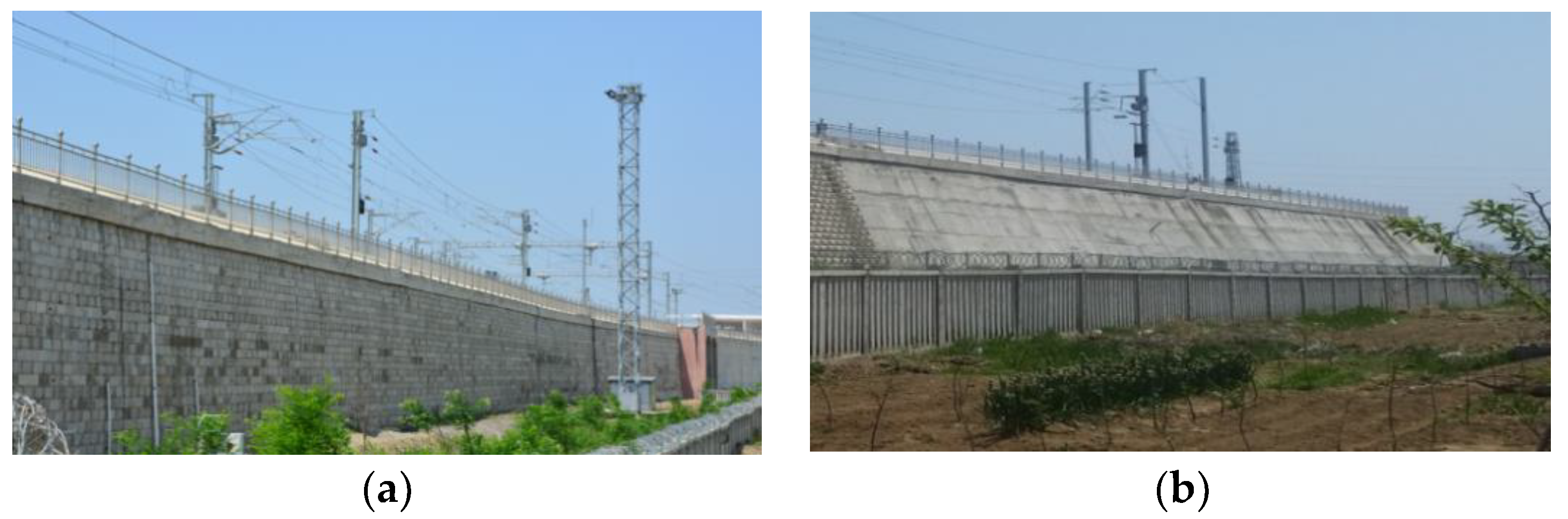
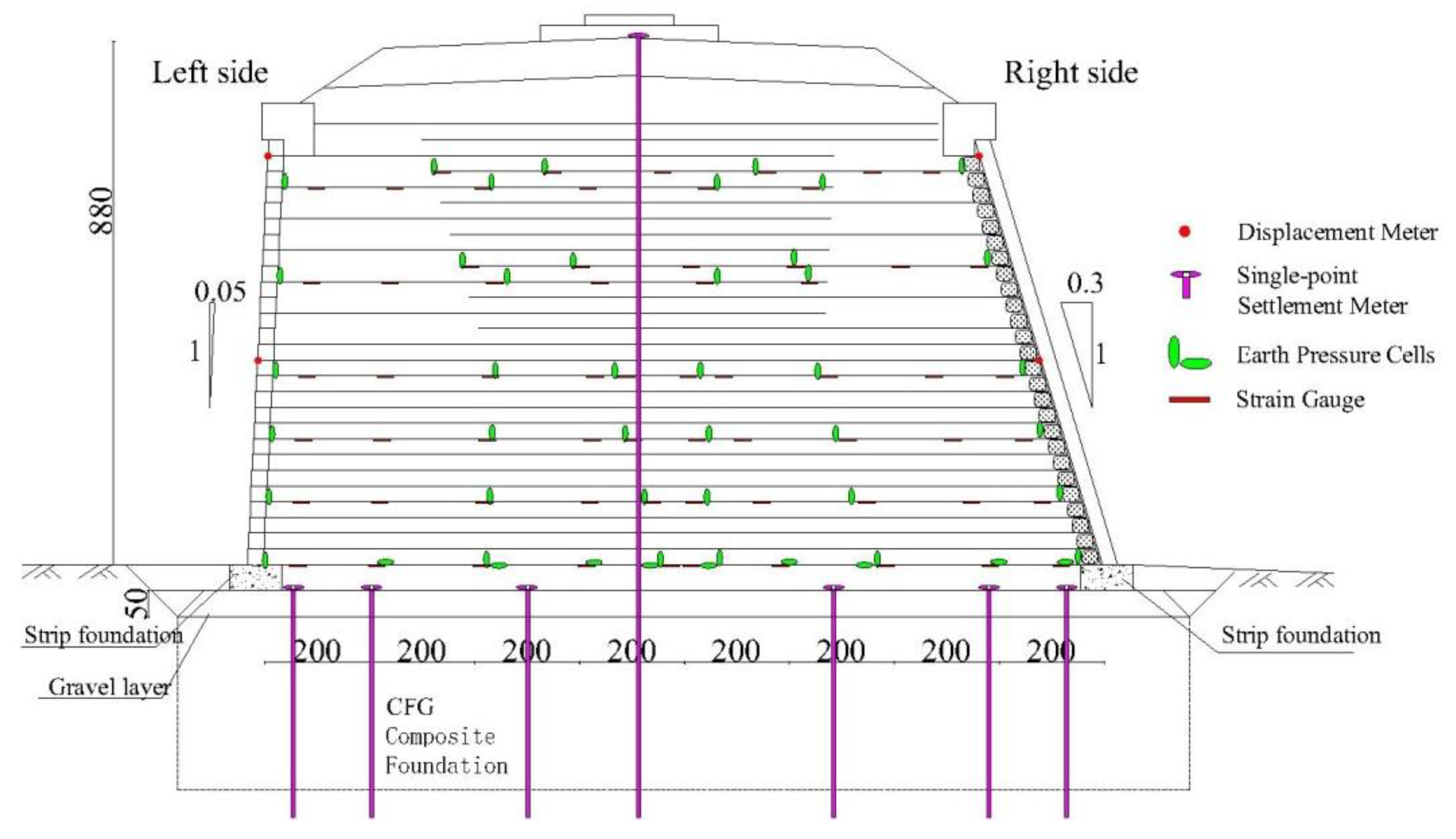
2.1. Description of the Wall
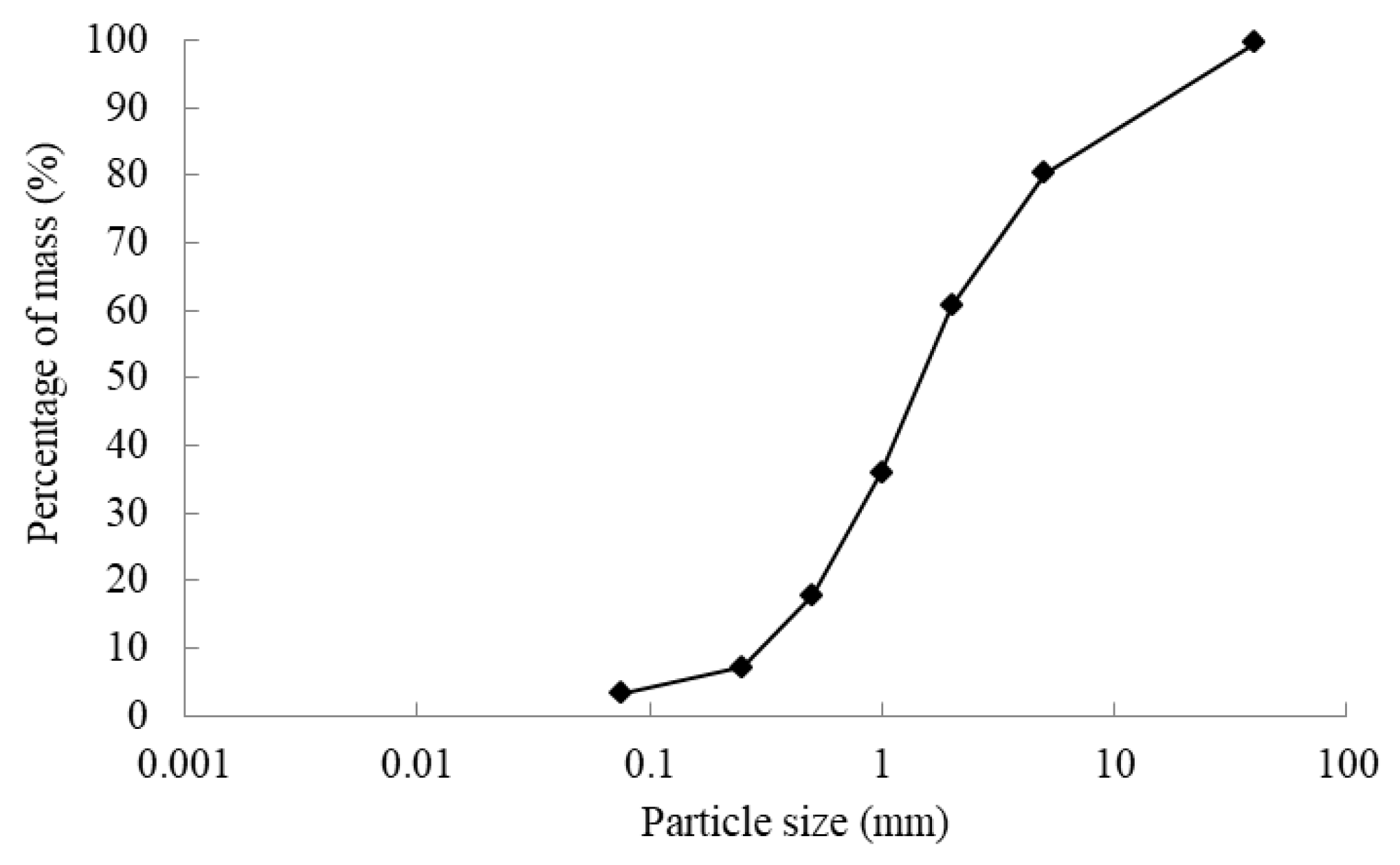
2.2. Characterization of the Materials
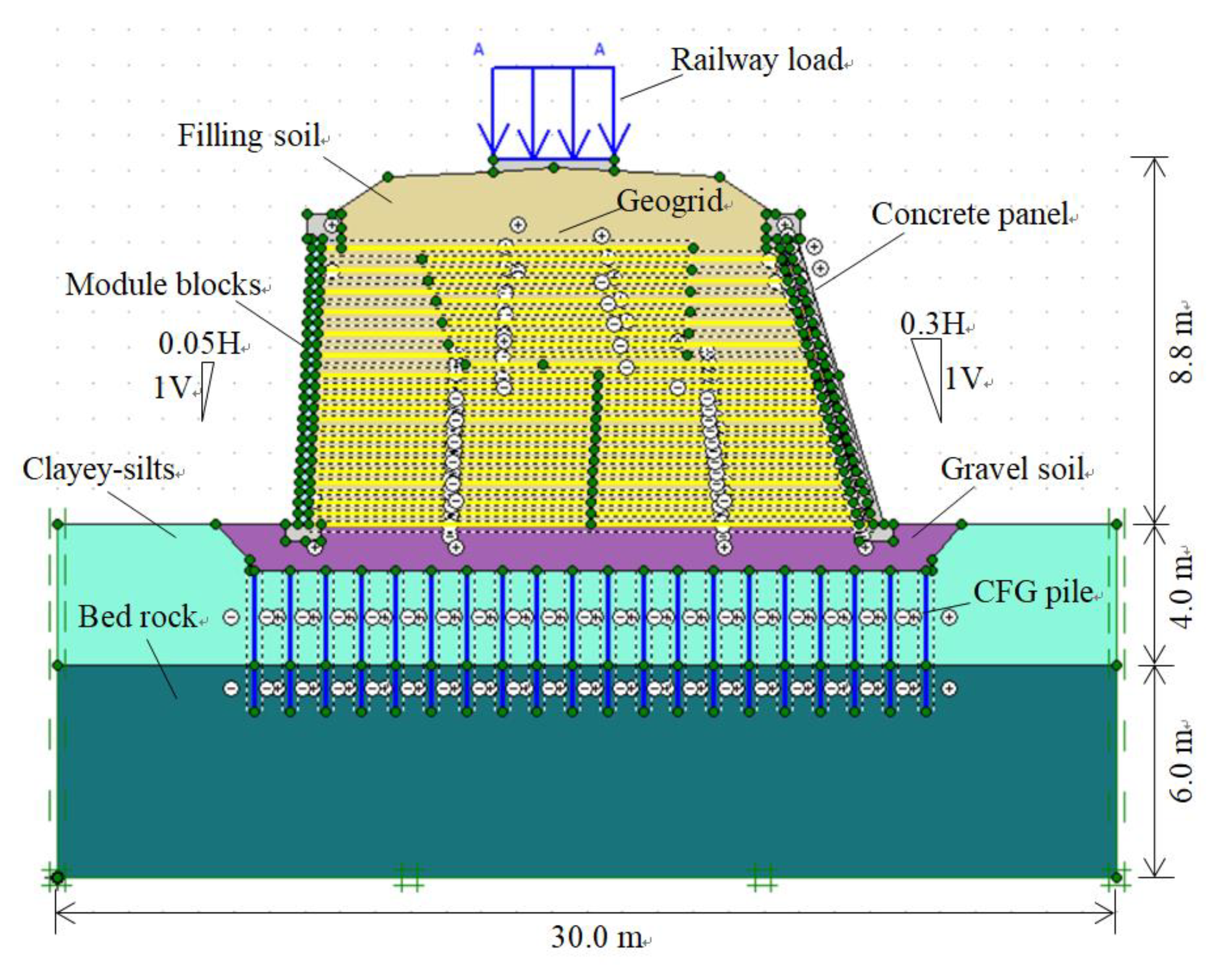
2.3. Numerical Modeling
3. Results and Discussion
3.1. Post-Construction Performance of the BBGRSW
3.1.1. Lateral Deformation of the BBGRSW
3.1.2. Strain on the Geogrid of the BBGRSW On-Site
3.2. Parametric Study on the Geogrid Length
3.2.1. Post-Construction Deformation of the Wall
3.2.2. Tension in the Reinforcement
3.3. Parametric Study on the Reinforcement Arrangement
3.3.1. Post-Construction Deformation of the Wall
3.3.2. Tension in Reinforcement
3.4. Factor of Safety of the Wall
4. Conclusions
- (1)
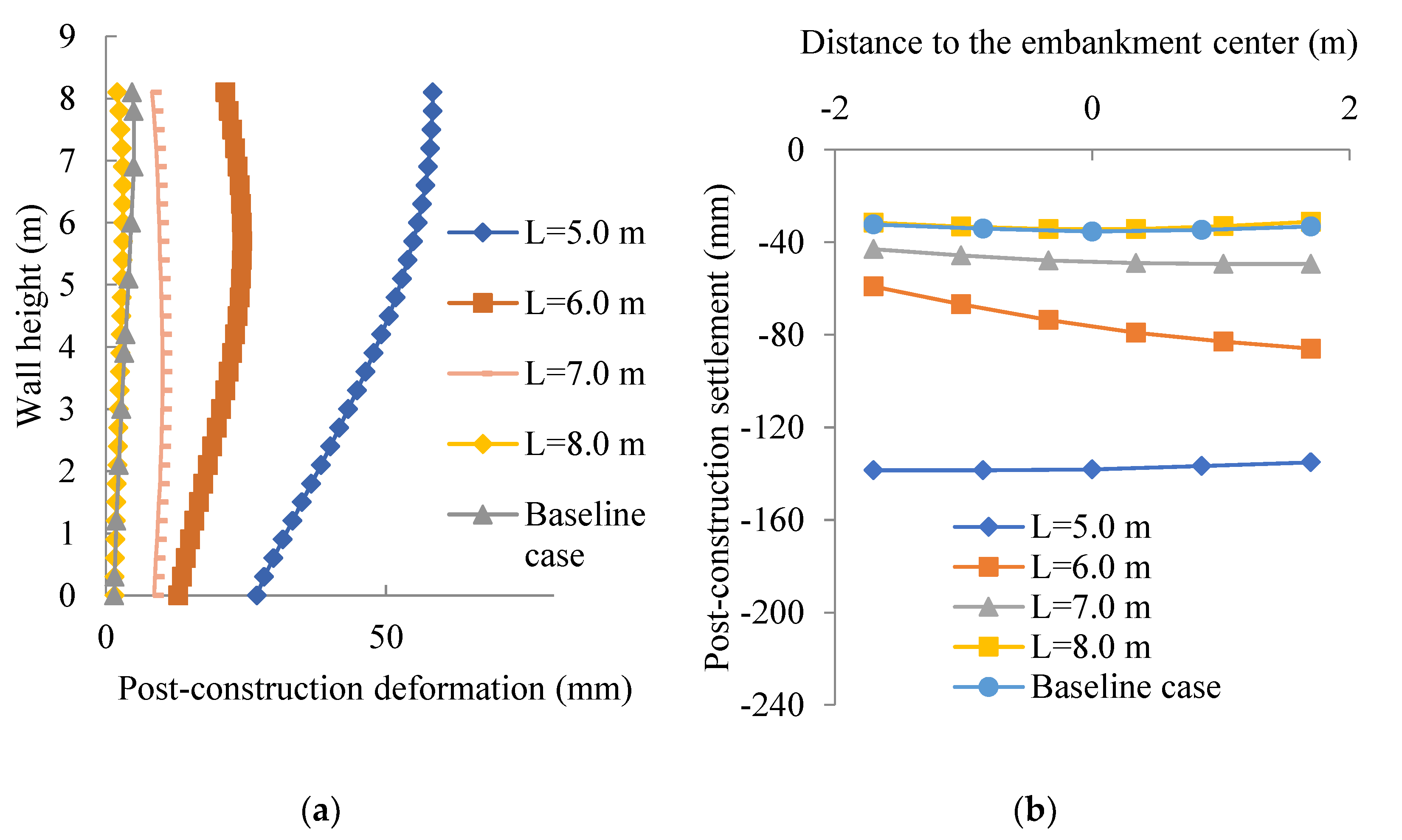
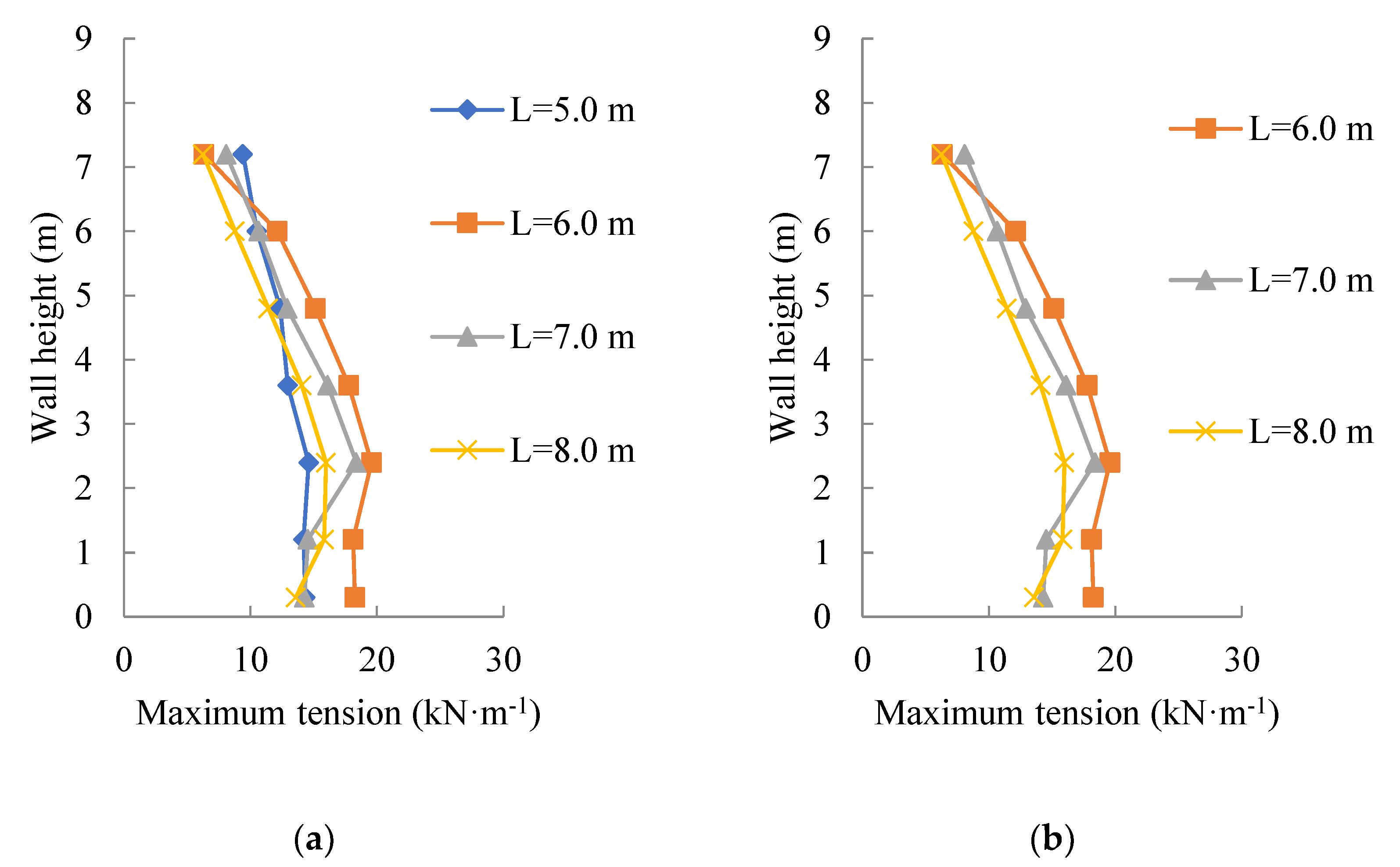
- Reinforcement length was an important parameter for the performance of a BBGRSW. The deformation and settlement showed a downward trend with the increase in the geogrid length. The post-construction lateral deformation with a 5.0 m reinforcement was approximately 58.06 mm. This indicated that the BBGRSW could be considered to be performing poorly or potentially unstable with reinforcements shorter than 0.7 H. The post-construction settlement was larger than that required by the Chinese railway department. The walls had a superior performance with longer reinforcements as the deformation with a fully covered reinforcement was only 5.2% of that with a 5.0 m long reinforcement and 24.8% of the settlement.
- (2)
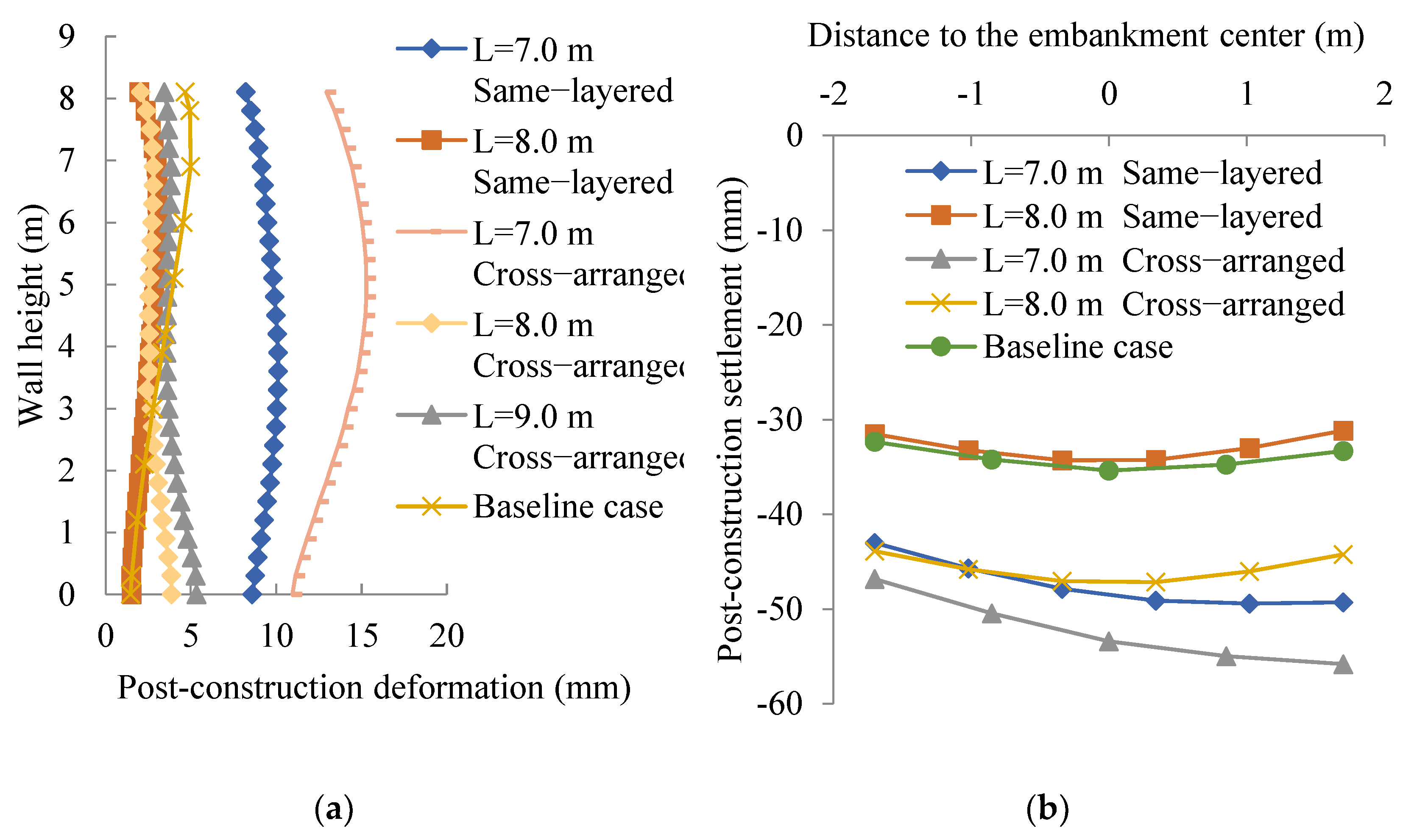
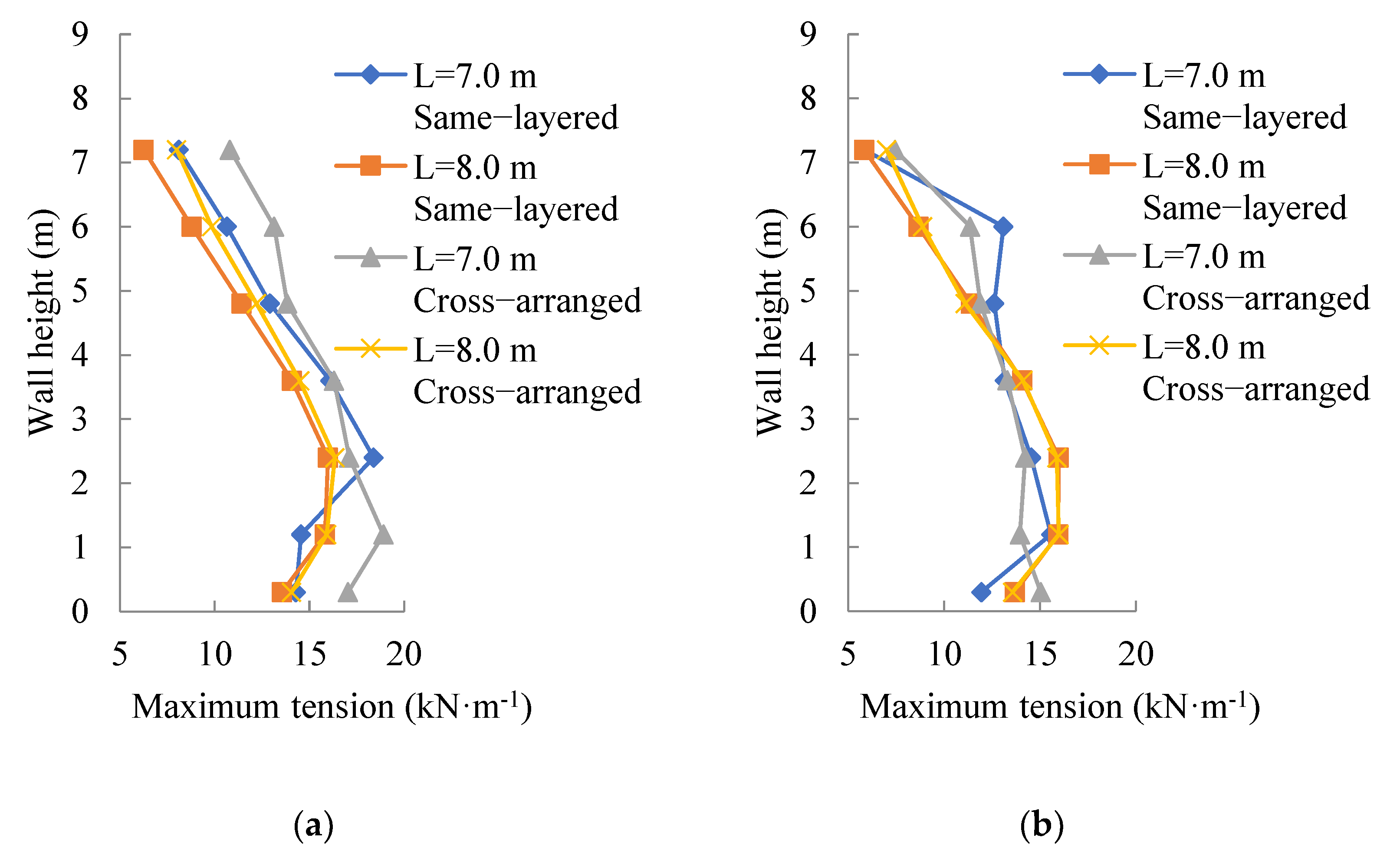
- The performance of a BBGRSW may be superior with same-layered reinforcements, especially with a fully covered reinforcement in limited spacing. For a lateral deformation with an 8.0 m long reinforcement, it was 84.2% of that with a cross-arranged reinforcement with 94.5% tension. The same-layered reinforcement was 72.7% of the cross-arranged reinforcement on the settlement.
- (3)
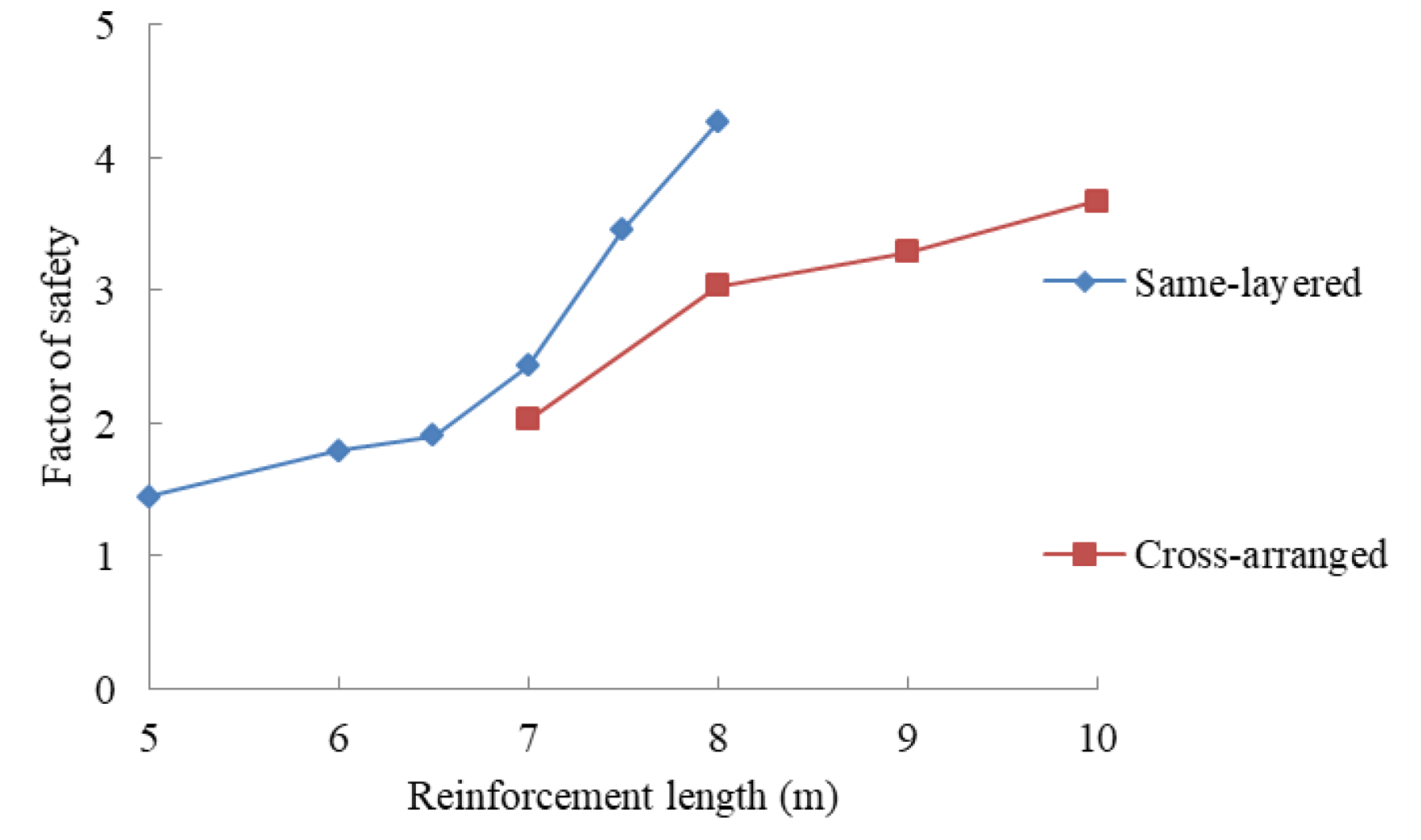
- The FOS of the BBGRSW increased with a longer reinforcement and peaked at 4.27 for an 8.0 m long same-layered reinforcement. The cross-arranged reinforcement was 3.03, which was weaker in stability compared with the same-layered reinforcement. The FOS for the cross-arranged reinforcement was smaller than the same-layered reinforcement with longer reinforcements.
Author Contributions
Funding
Institutional Review Board Statement
Informed Consent Statement
Data Availability Statement
Conflicts of Interest
References
- Yoo, C.; Kim, S. Performance of a two-tier geosynthetic reinforced segmental retaining wall under a surcharge load: Full-scale load test and 3D finite element analysis. Geotext. Geomembr. 2008, 26, 460–472. [Google Scholar] [CrossRef] [Scilit]
- Basha, B.M.; Babu, G.L.S. Seismic reliability assessment of external stability of reinforced soil walls using pseudo-dynamic method. Geosynth. Int. 2009, 16, 197–215. [Google Scholar] [CrossRef] [Scilit]
- Wu, Y.; Chou, N. Forensic Studies of Geosynthetic Reinforced Structure Failures. J. Perform. Constr. Facil. 2013, 27, 604–613. [Google Scholar] [CrossRef] [Scilit]
- Yonezawa, T.; Yamazaki, T.; Tateyama, M.; Tatsuoka, F. Design and construction of geosynthetic-reinforced soil structures for Hokkaido high-speed train line. Transp. Geotech. 2014, 1, 3–20. [Google Scholar] [CrossRef] [Scilit]
- Khosrojerdi, M.; Xiao, M.; Qiu, T.; Nicks, J. Evaluation of prediction methods for lateral deformation of GRS walls and abutments. J. Geotech. Geoenviron. Eng. 2016, 143, 06016022. [Google Scholar] [CrossRef] [Scilit]
- Yu, Y.; Bathurst, R.J.; Allen, T.M. Numerical modelling of two full-scale reinforced soil wrapped-face walls. Geotext. Geomembr. 2017, 45, 237–249. [Google Scholar] [CrossRef] [Scilit]
- Yu, Y.; Bathurst, R.J.; Allen, T.M.; Nelson, R. Physical and numerical modelling of a geogrid-reinforced incremental concrete panel retaining wall. Can. Geotech. J. 2016, 53, 1883–1901. [Google Scholar] [CrossRef] [Scilit]
- Allen, T.; Bathurst, R.; Berg, R. Global Level of Safety and Performance of Geosynthetic Walls: An Historical Perspective. Geosynth. Int. 2002, 9, 395–450. [Google Scholar] [CrossRef] [Scilit]
- Allen, T.; Bathurst, R. Observed Long-Term Performance of Geosynthetic Walls and Implications for Design. Geosynth. Int. 2002, 9, 567–606. [Google Scholar] [CrossRef] [Scilit]
- Liu, H. Long-term lateral displacement of geosynthetic-reinforced soil segmental retaining walls. Geotext. Geomembr. 2012, 32, 18–27. [Google Scholar] [CrossRef] [Scilit]
- Latha, G.M.; Manju, G.S. Seismic Response of Geocell Retaining Walls through Shaking Table Tests. Int. J. Geosynth. Ground Eng. 2016, 2, 7. [Google Scholar] [CrossRef] [Scilit]
- Zevgolis, I.E. A Finite Element Investigation on Displacements of Reinforced Soil Walls Under the Effect of Typical Traffic Loads. Transp. Infrastruct. Geotechnol. 2018, 5, 231–249. [Google Scholar] [CrossRef] [Scilit]
- Berg, R.R.; Christopher, B.R.; Samtani, N.C. FHWA-NHI-10-024. Design and Construction of Mechanically Stabilized Earth Walls and Reinforced Soil Slopes–Volume I; U.S. Department of Transportation Federal Highway Administration: Washington, DC, USA, 2009. [Google Scholar]
- Han, J.; Leshchinsky, D. Analysis of back-to-back mechanically stabilized earth walls. Geotext. Geomembr. 2010, 28, 262–267. [Google Scholar] [CrossRef] [Scilit]
- Djabri, M.; Benmebarek, S. FEM Analysis of Back-to-Back Geosynthetic-Reinforced Soil Retaining Walls. Int. J. Geosynth. Ground Eng. 2016, 2, 26. [Google Scholar] [CrossRef] [Scilit]
- Benmebarek, S.; Djabri, M. FE Analysis of Back-to-Back Mechanically Stabilized Earth Walls under Cyclic Harmonic Loading. Indian Geotech. J. 2017, 48, 498–509. [Google Scholar] [CrossRef] [Scilit]
- Tajabadi, M.; Kalantari, B. Parametric analysis of back-to-back reinforced earth retaining walls. Pamukkale Univ. Muh. Bilim. Derg. 2019, 25, 247–256. [Google Scholar] [CrossRef] [Scilit]
- Lajevardi, S.H.; Malekmohammadi, K.; Dias, D. Numerical Study of the Behavior of Back-to-Back Mechanically Stabilized EarthWalls. Geotechnics 2021, 1, 18–37. [Google Scholar] [CrossRef] [Scilit]
- Dram, A.; Balunaini, U.; Benmebarek, S.; Sravanam, S.M.; Madhav, M.R. Earthquake Response of Connected and Unconnected Back-to-Back Geosynthetic-Reinforced Soil Walls. Int. J. Geomech. 2021, 21, 04021223. [Google Scholar] [CrossRef] [Scilit]
- Sravanam, S.M.; Balunaini, U.; Madhav, M.R. Analysis of Single and Back-to-Back Reinforced Retaining Walls with Full-Length Panel Facia. Geotech. Geol. Eng. 2020, 38, 6281–6293. [Google Scholar] [CrossRef] [Scilit]
- Xu, P.; Yang, G.; Li, T.; Hatami, K. Finite element limit analysis of bearing capacity of footing on back-to-back reinforced soil retaining walls. Transp. Geotech. 2021, 30, 100596. [Google Scholar] [CrossRef] [Scilit]
- Brinkgreve, R.B.J.; Vermeer, P.A. PLAXIS: Finite Element Code for Soil and Rock Analyses, version 8; CRC Press Balkema: Leiden, Netherlands, 2002. [Google Scholar]
- AASHTO. AASHTO LRFD Bridge Design Specifications, 8th ed.; American Association of State Highway and Transportation Officials: Washington, DC, USA, 2017. [Google Scholar]
- Allen, T.M.; Bathurst, R.J. Design and Performance of 6.3-m-High, Block-Faced Geogrid Wall Designed Using K-Stiffness Method. J. Geotech. Geoenvironmental Eng. 2014, 140, 04013016. [Google Scholar] [CrossRef] [Scilit]
- Allen, T.M.; Bathurst, R.J. Performance of an 11 m high block-faced geogrid wall designed using the K-stiffness method. Can. Geotech. J. 2014, 51, 16–29. [Google Scholar] [CrossRef] [Scilit]
- El-Sherbiny, R.; Ibrahim, E.; Salem, A. Stability of back-to-back mechanically stabilized earth walls. In Geo-Congress 2013: Stability and Performance of Slopes and Embankments III; ASCE: San Digeo, CA, USA, 2013; pp. 555–565. [Google Scholar] [CrossRef] [Scilit]
- Ehrlich, M.; Mirmoradi, S. Evaluation of the effects of facing stiffness and toe resistance on the behavior of GRS walls. Geotext. Geomembr. 2013, 40, 28–36. [Google Scholar] [CrossRef] [Scilit]
- Industrial Standard of the People’s Republic of China TB10621-2014; Chinese Code for Design of High Speed Railway. China Railway Press: Beijing, China, 2014.
- Cao, J.Z.; Liu, H.B.; Fan, C. Seismic response analysis of back-to-back mechanically stabilized earth (MSE) walls. China J. Geotech. Eng. 2019, 41, 918–926. [Google Scholar]
- Leschinsky, D.; Vuloav, C. Numerical Investigation of the Effects of Geosynthetic Spacing on Failure Mechanisms of MSE Block Walls. Geosynth. Int. 2001, 8, 343–365. [Google Scholar] [CrossRef] [Scilit]







| Type | Range | Precision |
|---|---|---|
| VW earth pressure cell | 0–1 MPa | ±0.1% FS |
| Strain gauge | 0–30 mm | ±0.5% FS |
| Single point settlement meter | 0–200 mm | ±0.5% FS |
| Displacement meter | 0–50 mm | ±0.05% FS |
| Items | Indexes | ||
|---|---|---|---|
| Particle diameter (mm) | d10 | d30 | d60 |
| 0.32 | 0.84 | 1.95 | |
| Coefficient of uniformity | 6.09 | ||
| Curvature coefficient | 1.13 | ||
| Saturated unit weight (kN·m−3) | 19.2 | ||
| Cohesion (kPa) | 3.1 | ||
| Friction angle (°) | 37.3 | ||
| Moisture content (%) | 5.7 | ||
| Optimum moisture content (%) | 7.8 | ||
| Maximum dry density (g·cm–3) | 2.234 | ||
| Elasticity modulus (MPa) | 12.00 | ||
| Items | Indexes |
|---|---|
| Rib length/mm | 245 |
| Rib spacing/mm | 16 |
| Rib width/mm | 5.1 |
| Rib thickness/mm | 1.3 |
| Bar width/mm | 18.2 |
| Bar thickness/mm | 3.5 |
| Mass per unit area/(g·m–2) | 850 |
| Tensile strength/(kN·m–1) | 141.6 |
| Tensile strength at 2% strain/(kN·m–1) | 41.6 |
| Tensile strength at 5% strain/(kN·m–1) | 85.9 |
| Peak strain/% | 8.92 |
| Axial stiffness at 2% strain/(kN·m−1) | 2080 |
| Long-term stiffness/(kN·m−1) | 2200 |
| Items | Filling Soil | Clayey Silts | Gravel Soil | Bed Rock |
|---|---|---|---|---|
| Model | Hardened soil Small | Soft soil | Mohr–Coulomb | Linear elastic |
| Saturated unit weight (kN·m−3) | 19.2 | 22.4 | 20 | - |
| Peak plane strain friction angle (°) | 37.3 | 25.8 | 40.0 | - |
| Cohesion (kPa) | 3.1 | 9.2 | 0 | - |
| Angle of dilatancy (°) | 7.3 | - | - | - |
| Modified compression parameter | - | 0.27 | - | - |
| 4000 | - | - | - | |
| 5554 | - | - | - | |
| 17,000 | - | - | - | |
| m | 0.5 | - | - | - |
| G0 | 30,000 | - | - | - |
| γ0.7 | 0.0004 | - | - | - |
| Elasticity modulus (kPa) | - | - | 15,000 | 20,000,000 |
| Poisson’s ratio | - | - | 0.25 | 0.2 |
| Items | Module Block | Concrete |
|---|---|---|
| Model | Linear elastic | Linear elastic |
| Elasticity modulus (kN·m−2) | 550,000 | 2,000,000 |
| Poisson’s ratio | 0.2 | 0.2 |
Publisher’s Note: MDPI stays neutral with regard to jurisdictional claims in published maps and institutional affiliations. |
© 2022 by the authors. Licensee MDPI, Basel, Switzerland. This article is an open access article distributed under the terms and conditions of the Creative Commons Attribution (CC BY) license (https://creativecommons.org/licenses/by/4.0/).
Share and Cite
Yang, G.; Zhao, Y.; Wang, H.; Wang, Z. Analysis of the Working Performance of a Back-to-Back Geosynthetic-Reinforced Soil Wall. Appl. Sci. 2022, 12, 516. https://doi.org/10.3390/app12010516
Yang G, Zhao Y, Wang H, Wang Z. Analysis of the Working Performance of a Back-to-Back Geosynthetic-Reinforced Soil Wall. Applied Sciences. 2022; 12(1):516. https://doi.org/10.3390/app12010516
Chicago/Turabian StyleYang, Guangqing, Yunfei Zhao, He Wang, and Zhijie Wang. 2022. "Analysis of the Working Performance of a Back-to-Back Geosynthetic-Reinforced Soil Wall" Applied Sciences 12, no. 1: 516. https://doi.org/10.3390/app12010516
APA StyleYang, G., Zhao, Y., Wang, H., & Wang, Z. (2022). Analysis of the Working Performance of a Back-to-Back Geosynthetic-Reinforced Soil Wall. Applied Sciences, 12(1), 516. https://doi.org/10.3390/app12010516