Effects of the Configuration of Trailing Edge on the Flutter of an Elongated Bluff Body
Abstract
1. Introduction
2. Experiment Setup
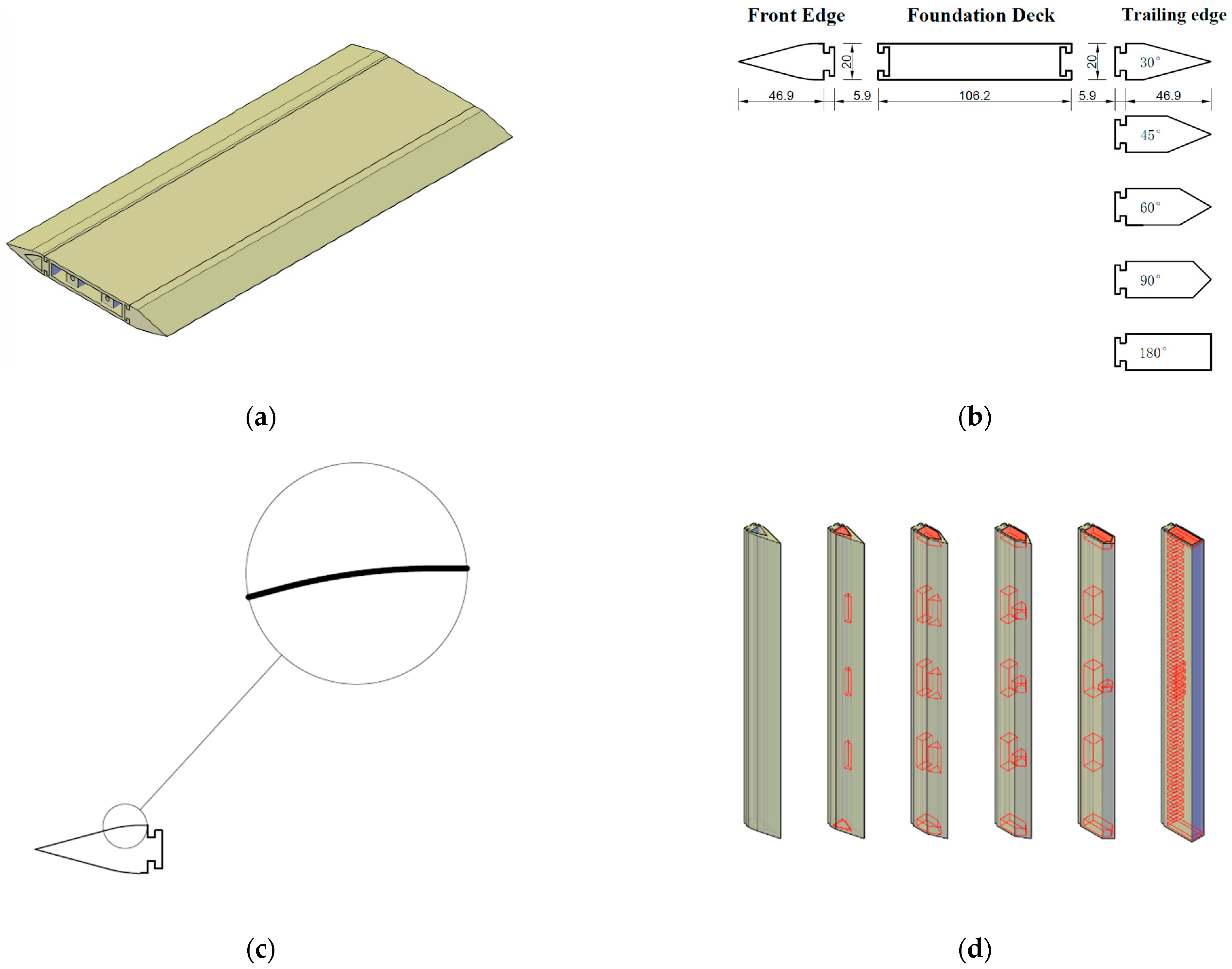
2.1. Model Details
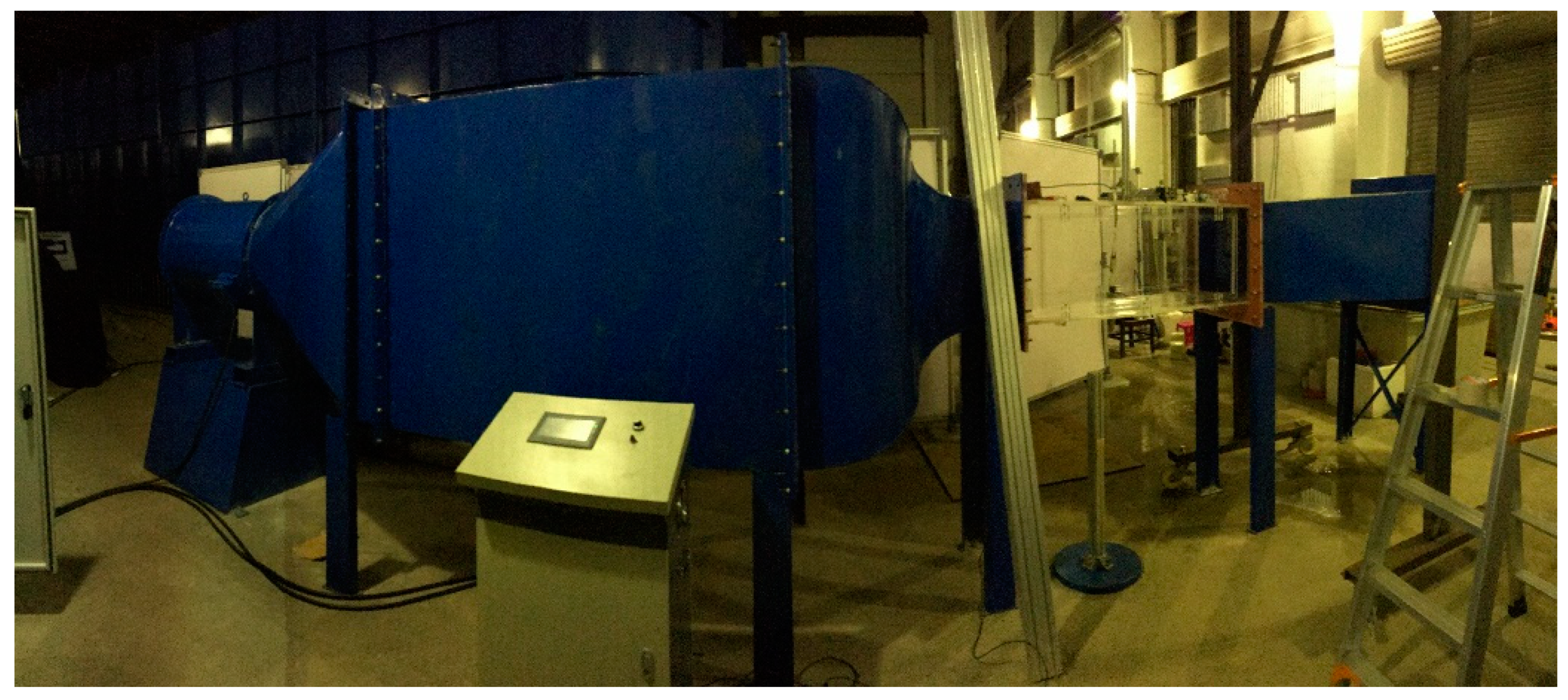
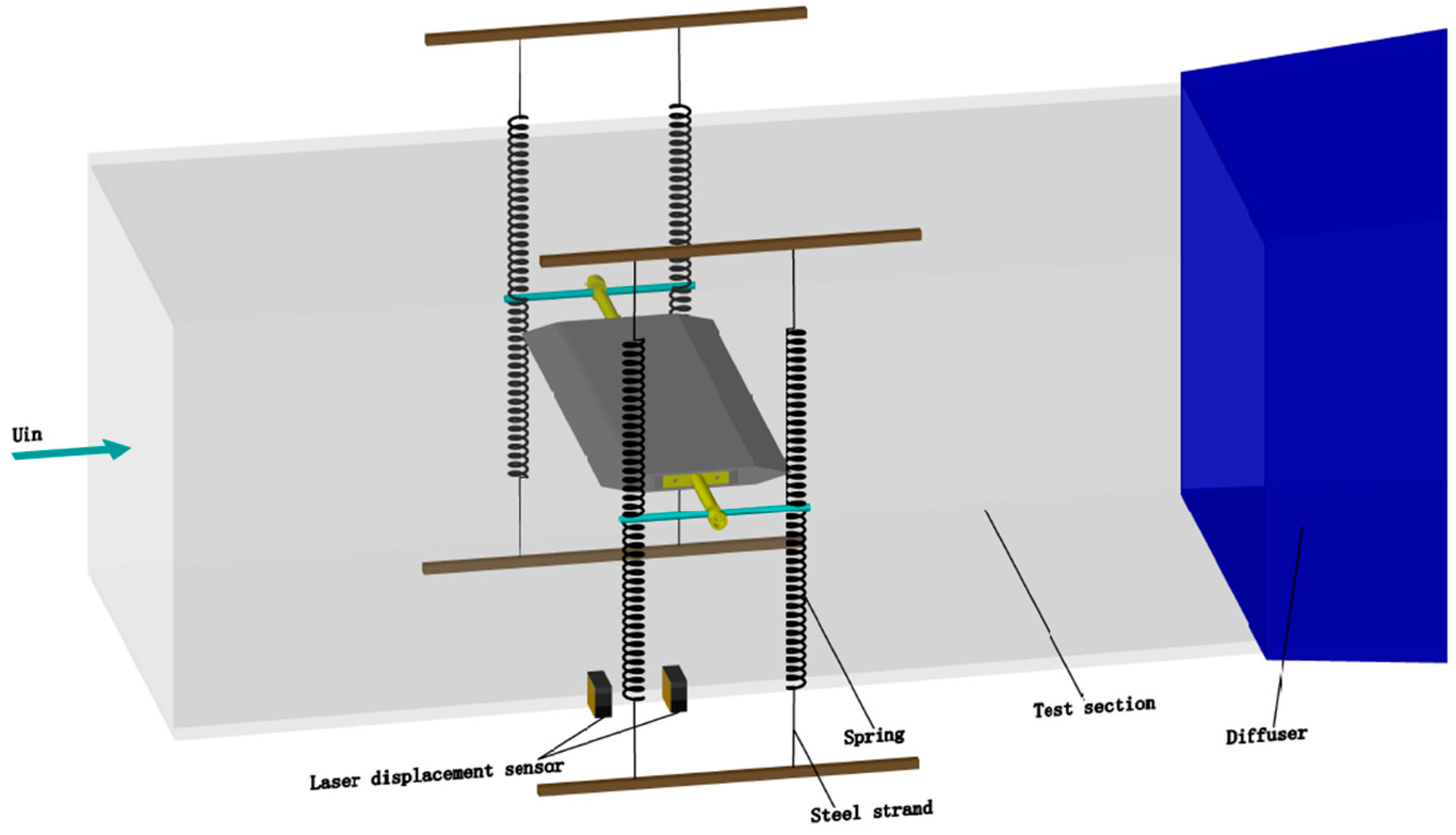
2.2. Measurement Details
3. Results and Discussions
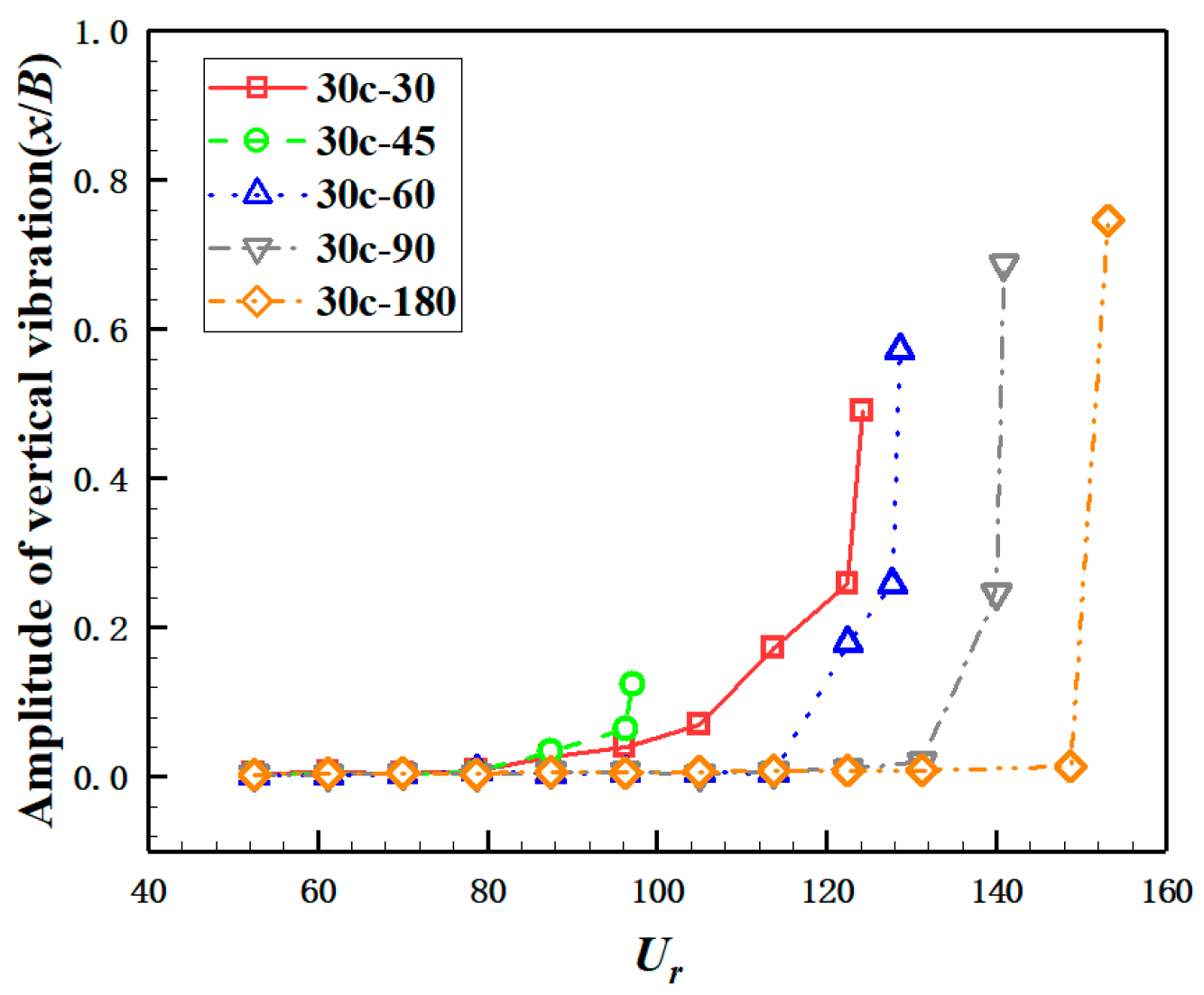
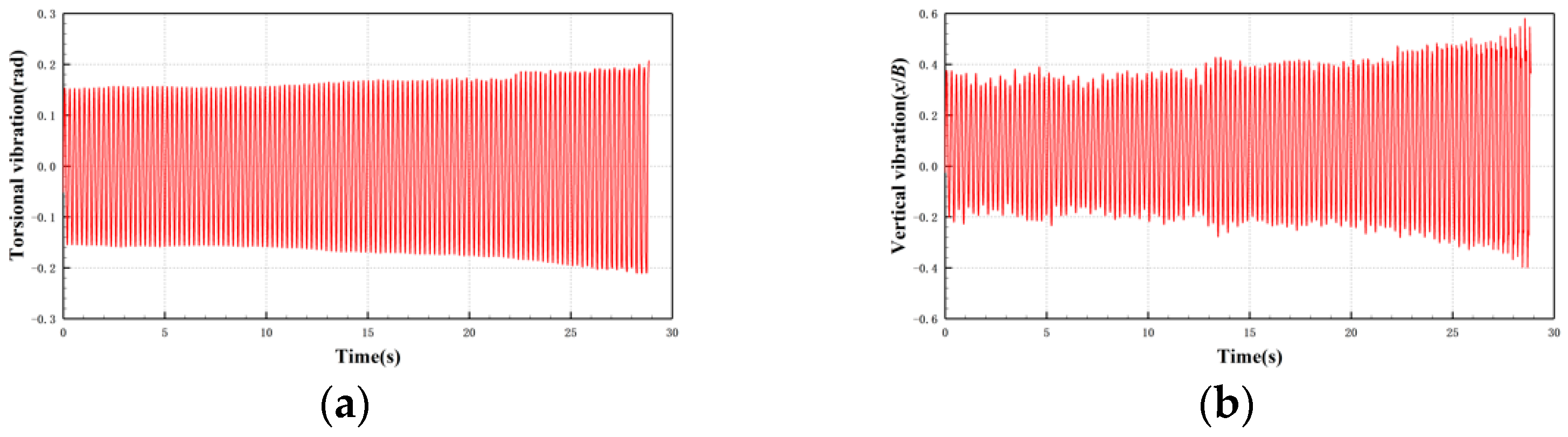
3.1. Dynamic Response of Flutter with Different Trailing Configurations
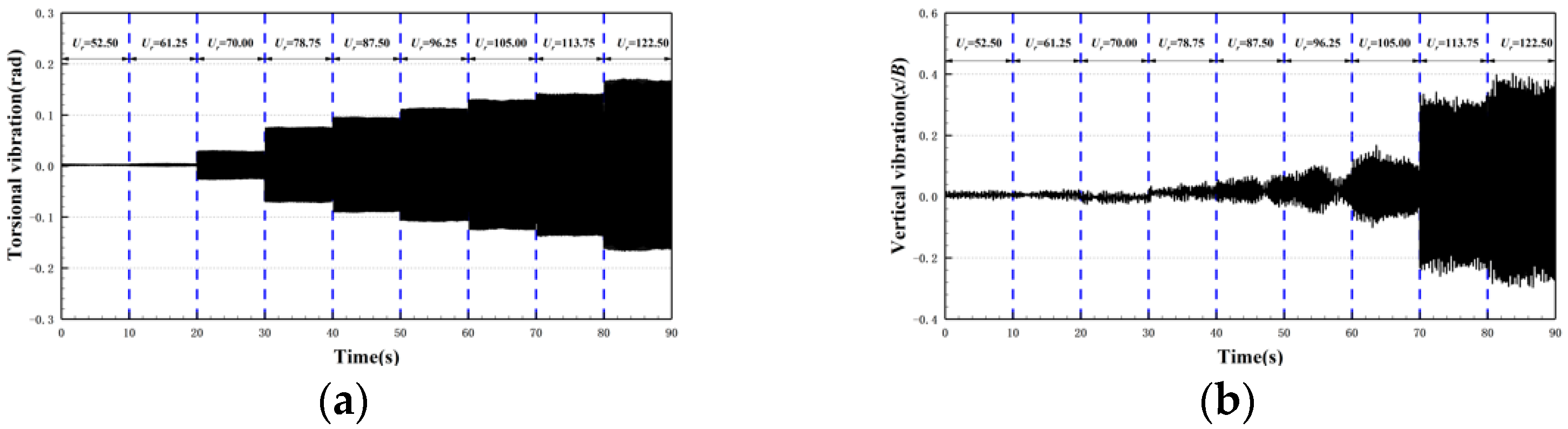
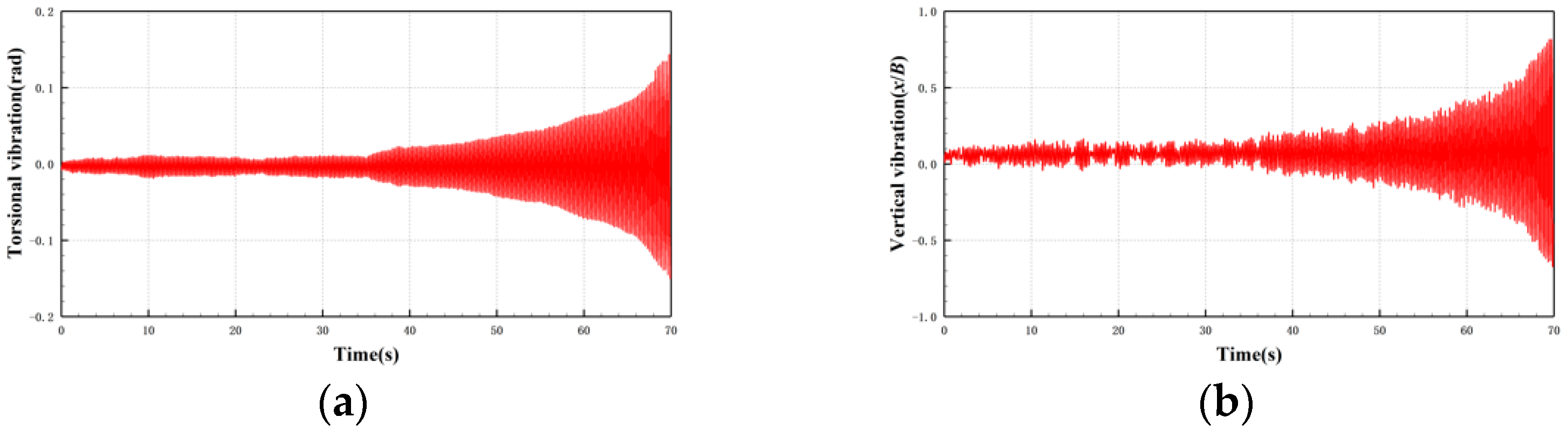
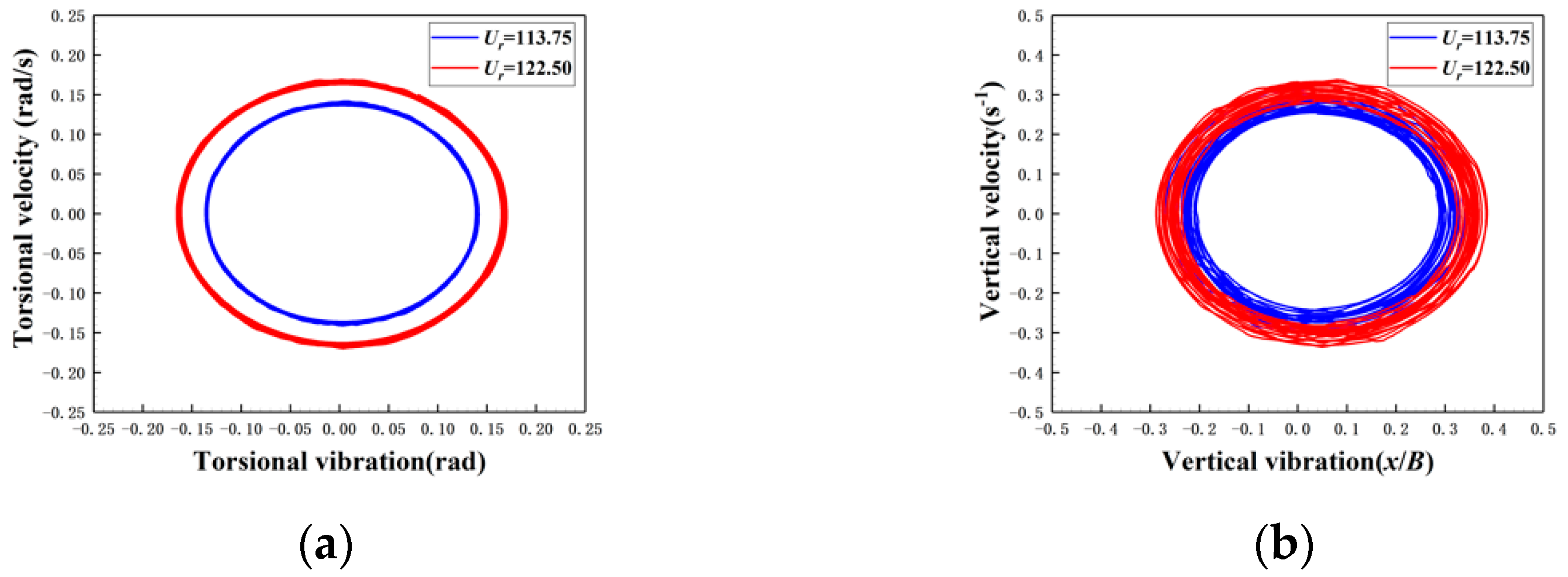
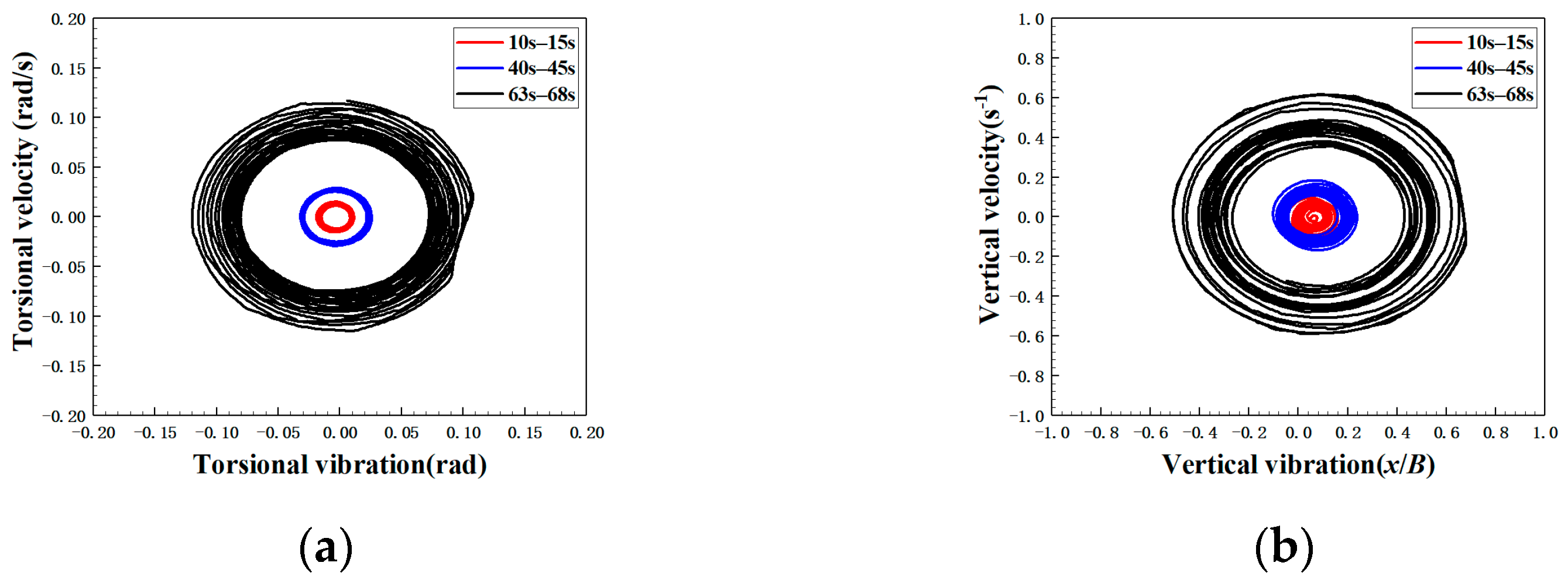
3.1.1. 30c-30 Case
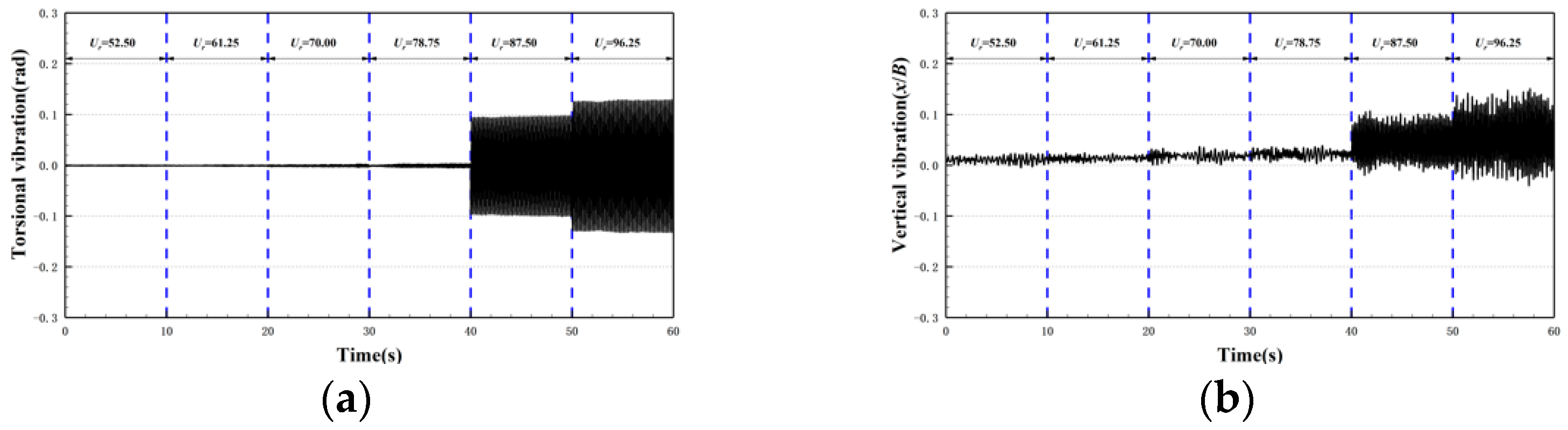
3.1.2. 30c-45 Case
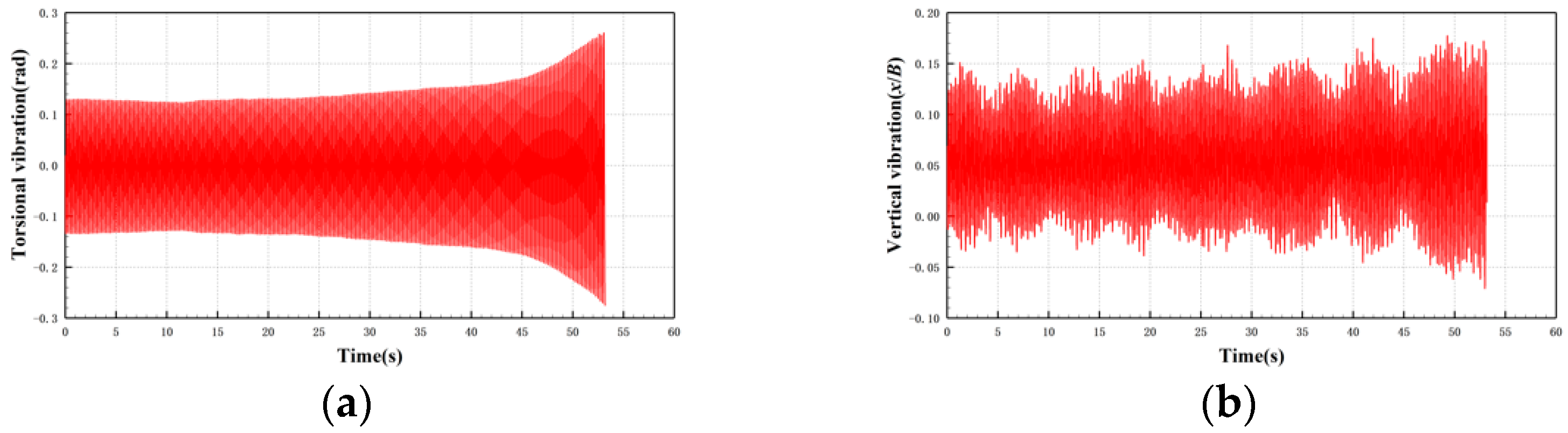
3.1.3. 30c-60 Case
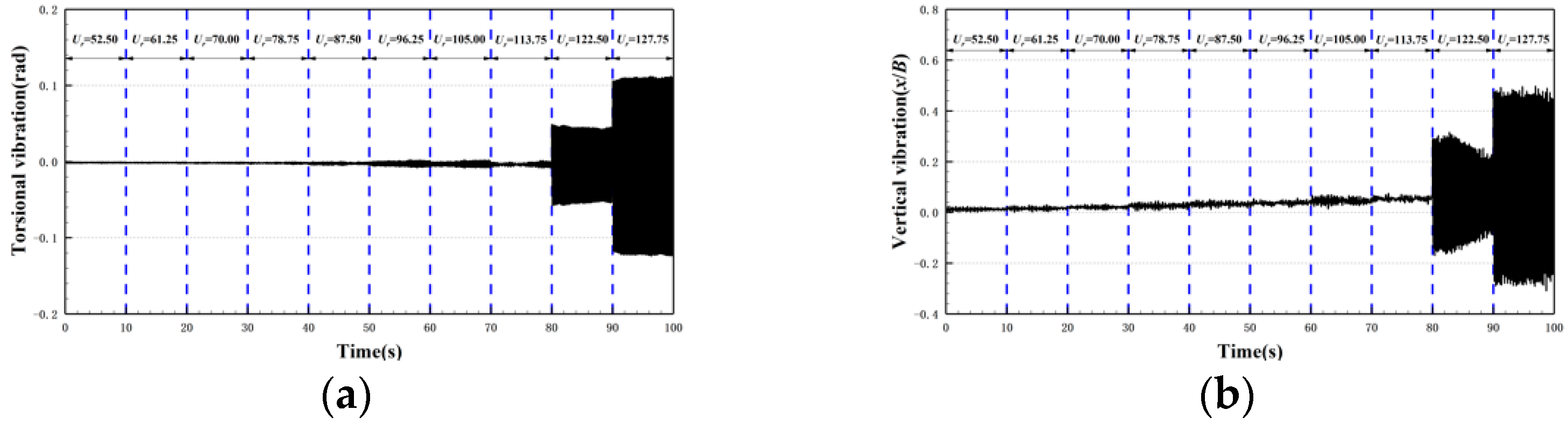
3.1.4. 30c-90 Case
3.1.5. 30c-180 Case
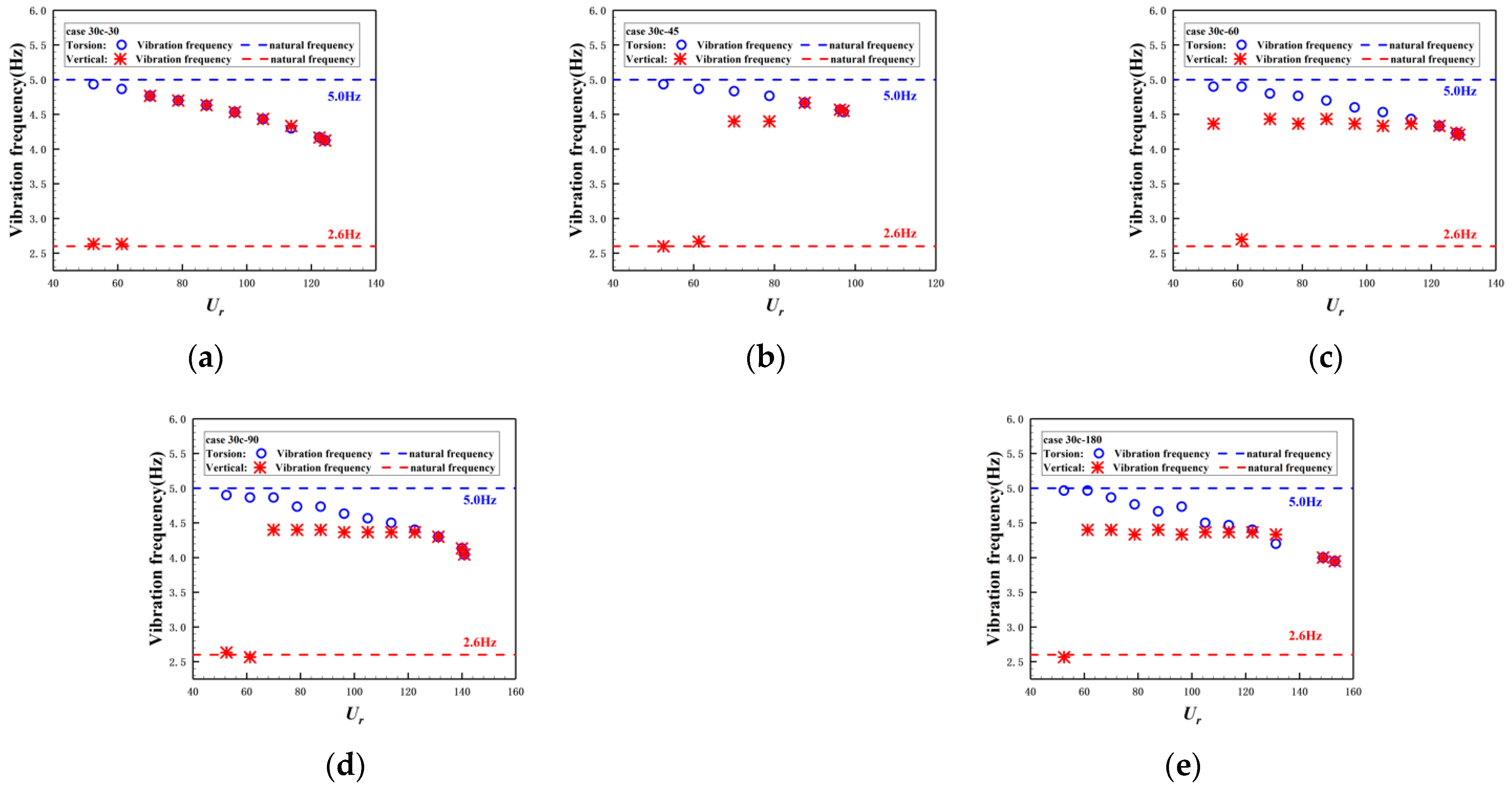
3.2. Frequency Domain Analysis
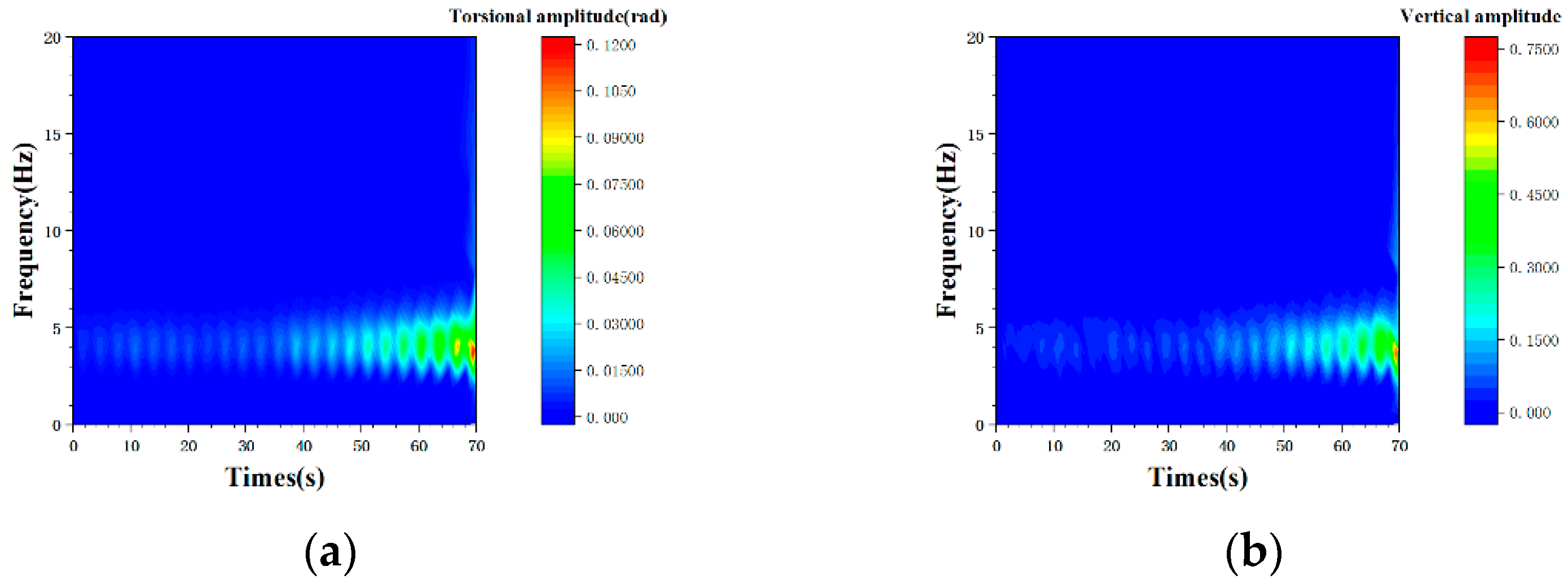
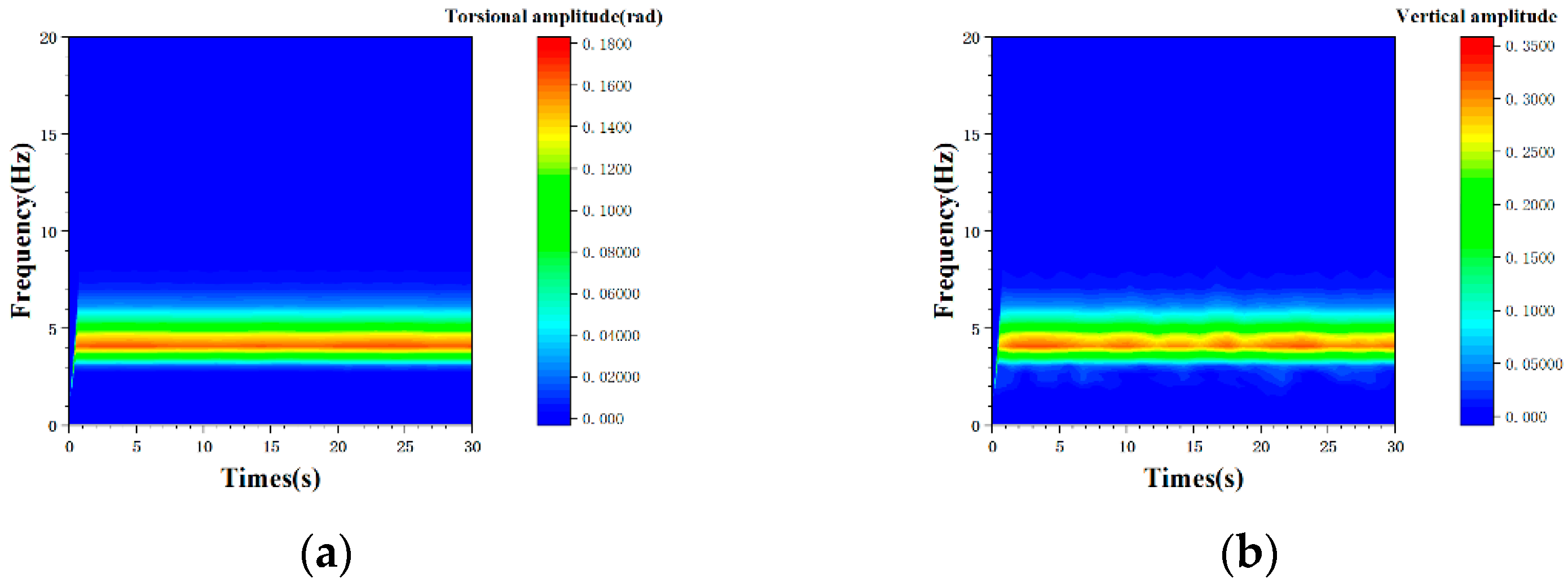
3.3. Wavelet and Hilbert Analysis
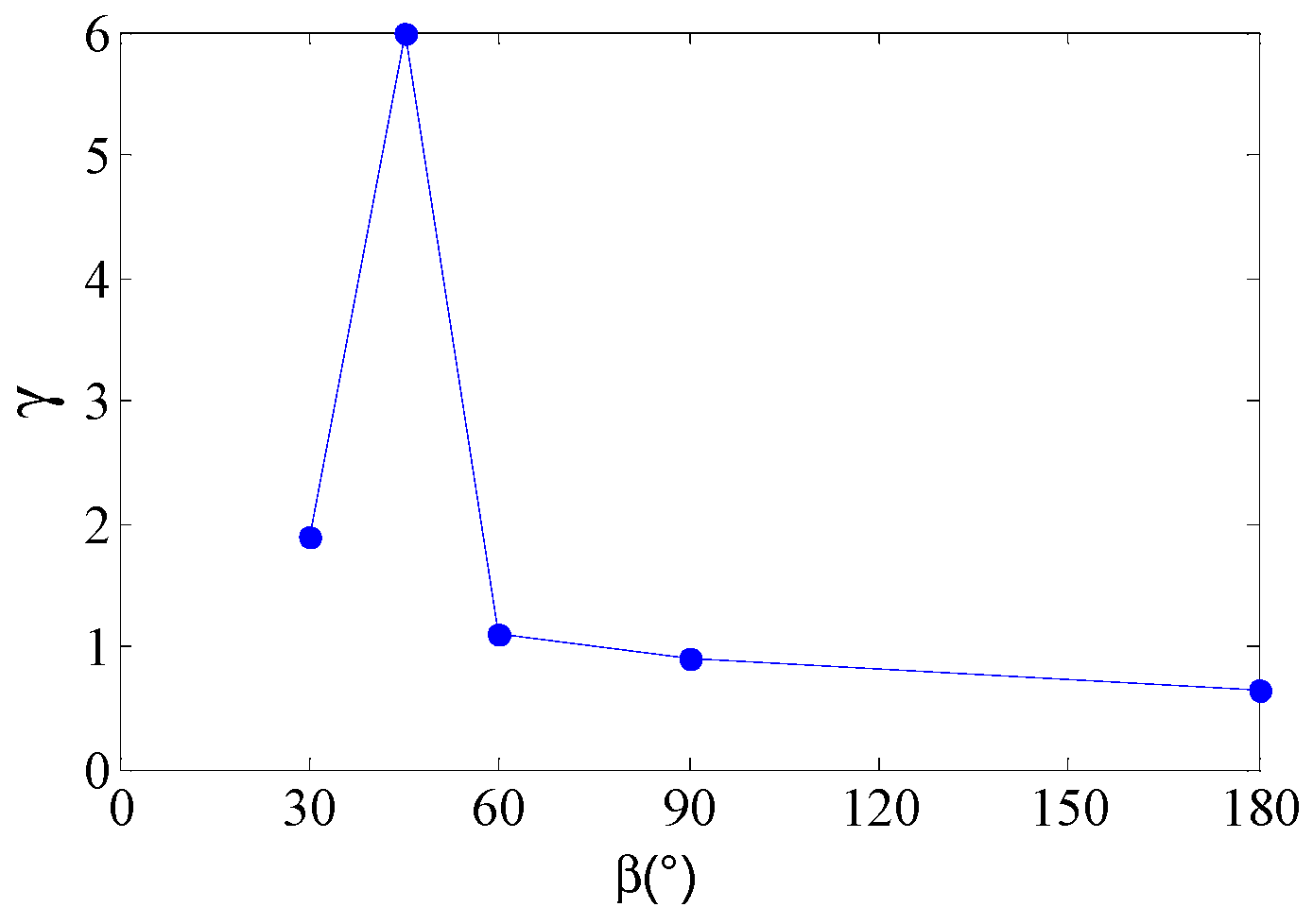
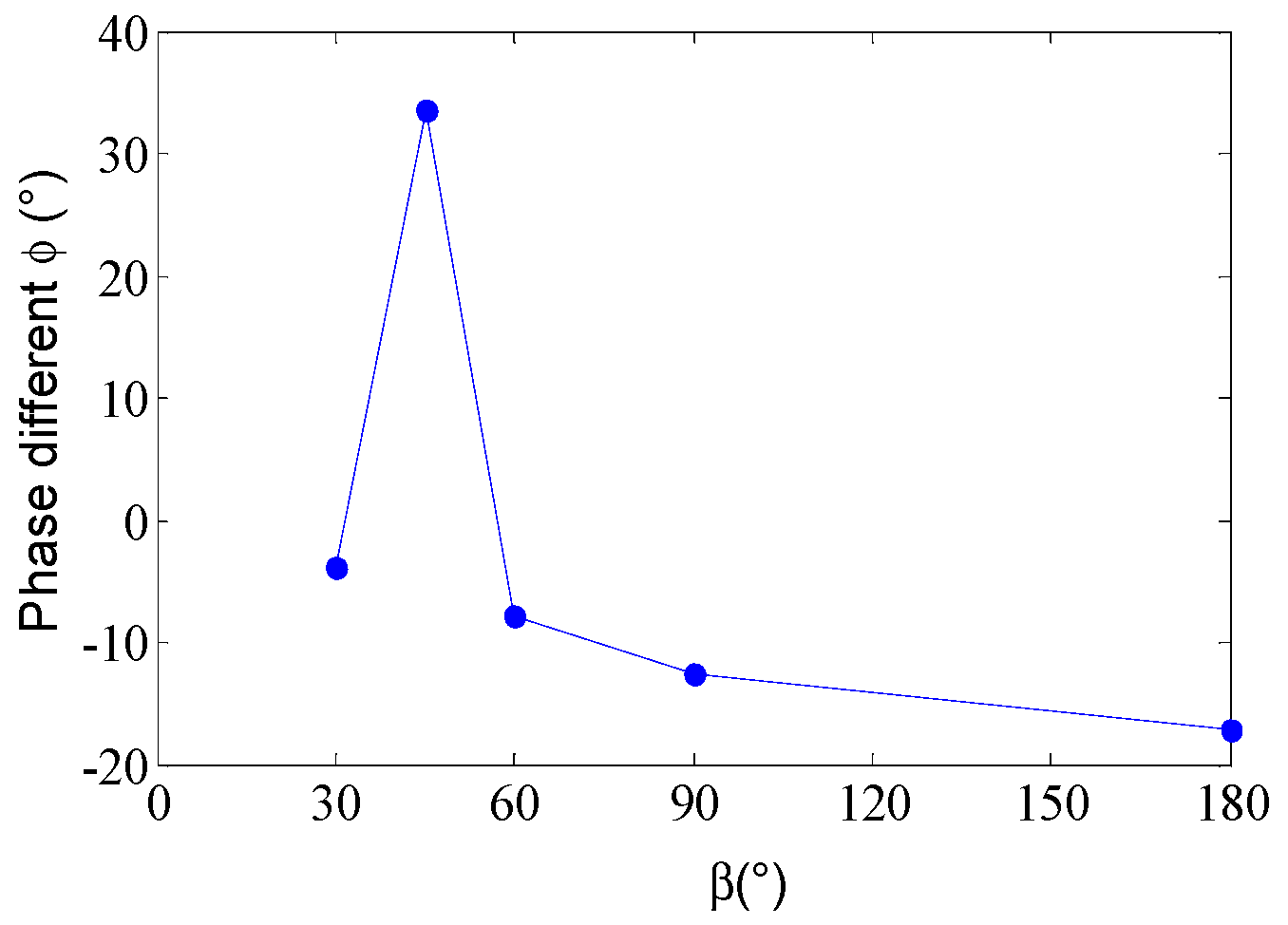
3.4. Phase Lag between Torsional and Vertcial Vibration
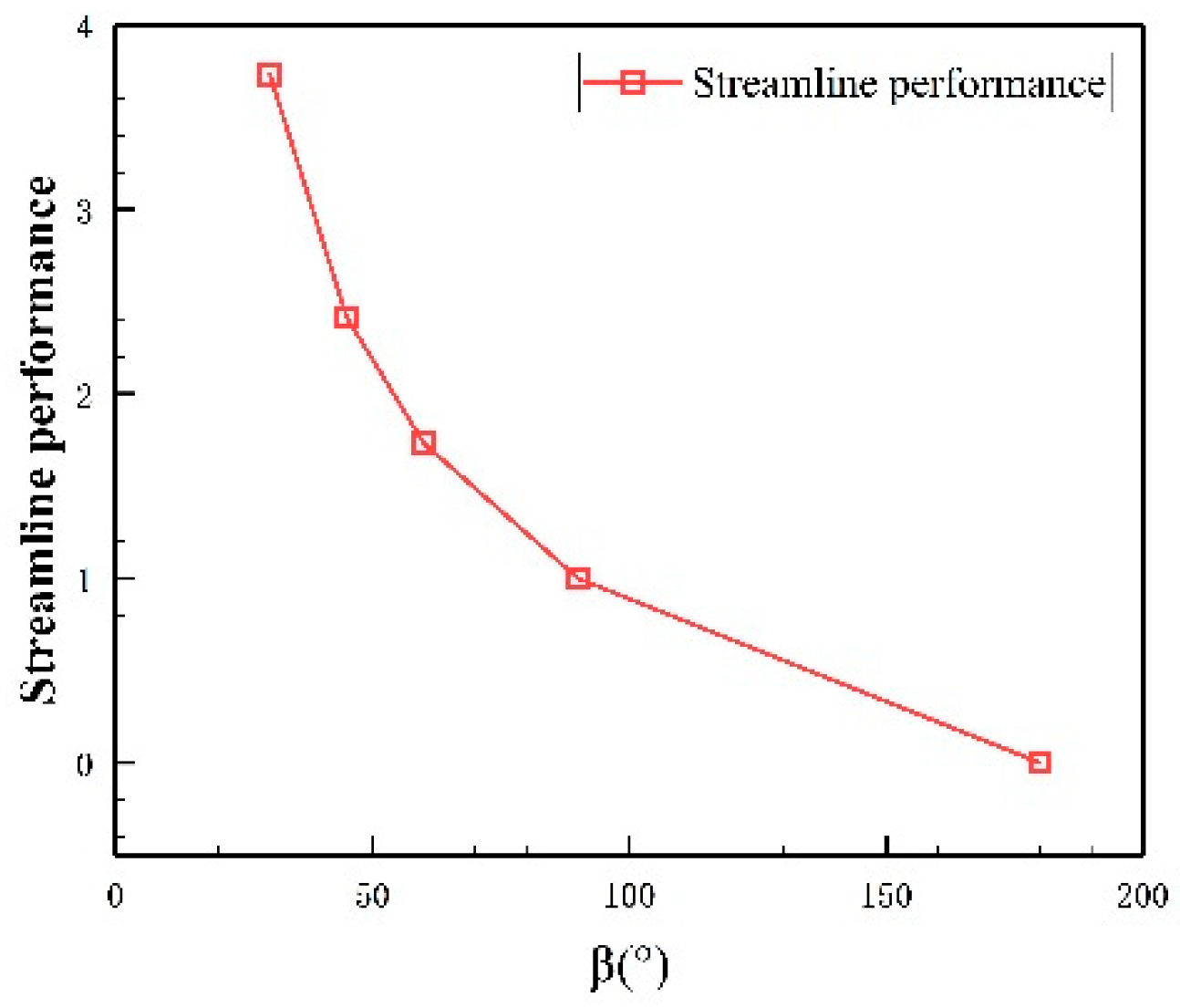
3.5. Discussion of Effect of TE
4. Conclusions
- (1)
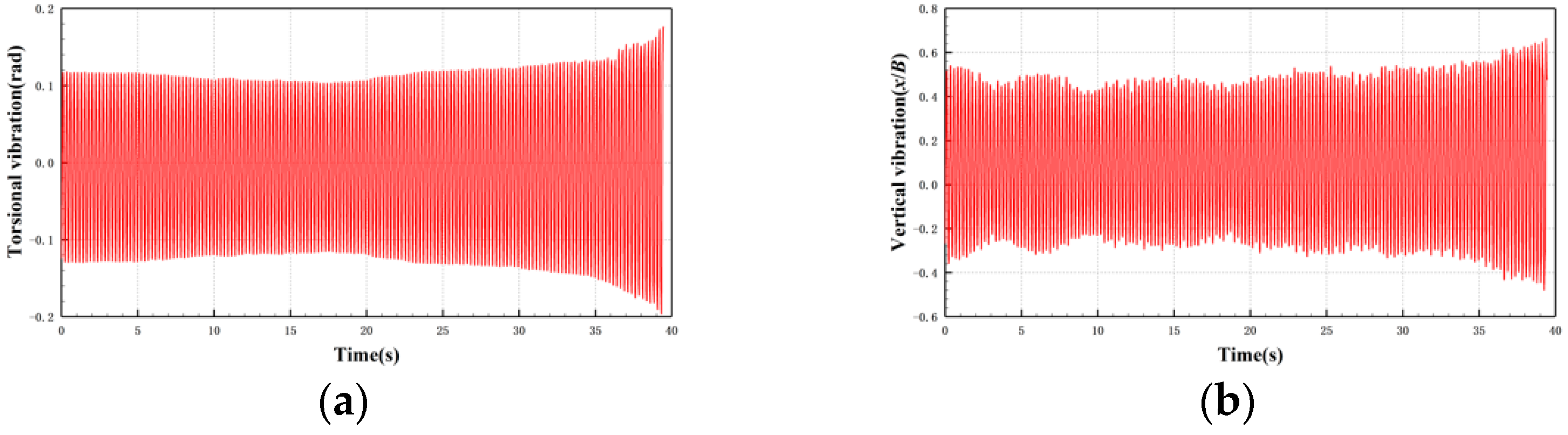
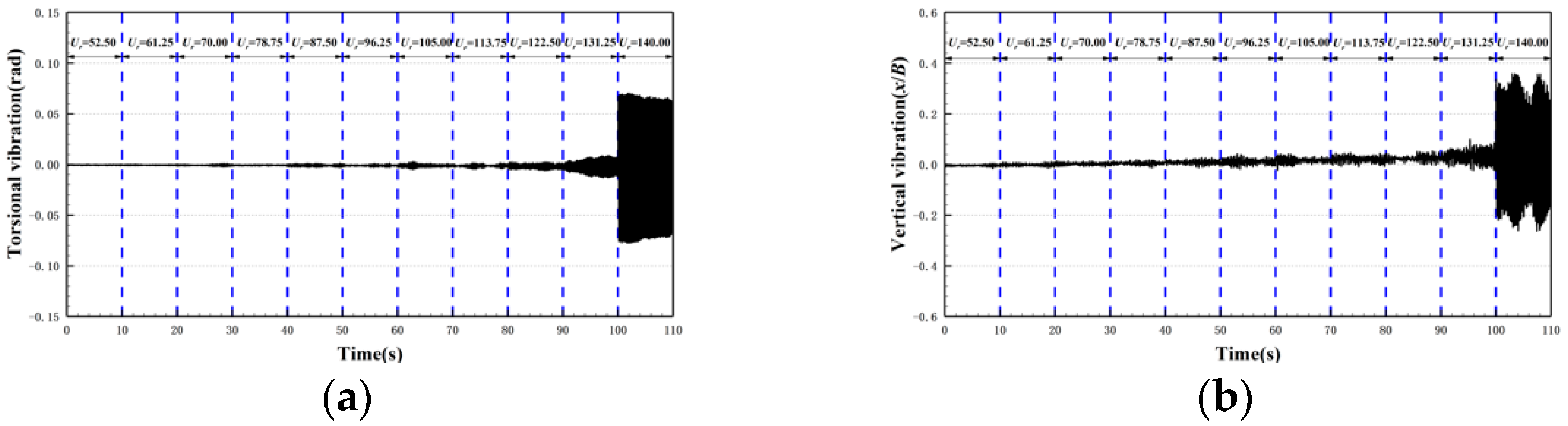
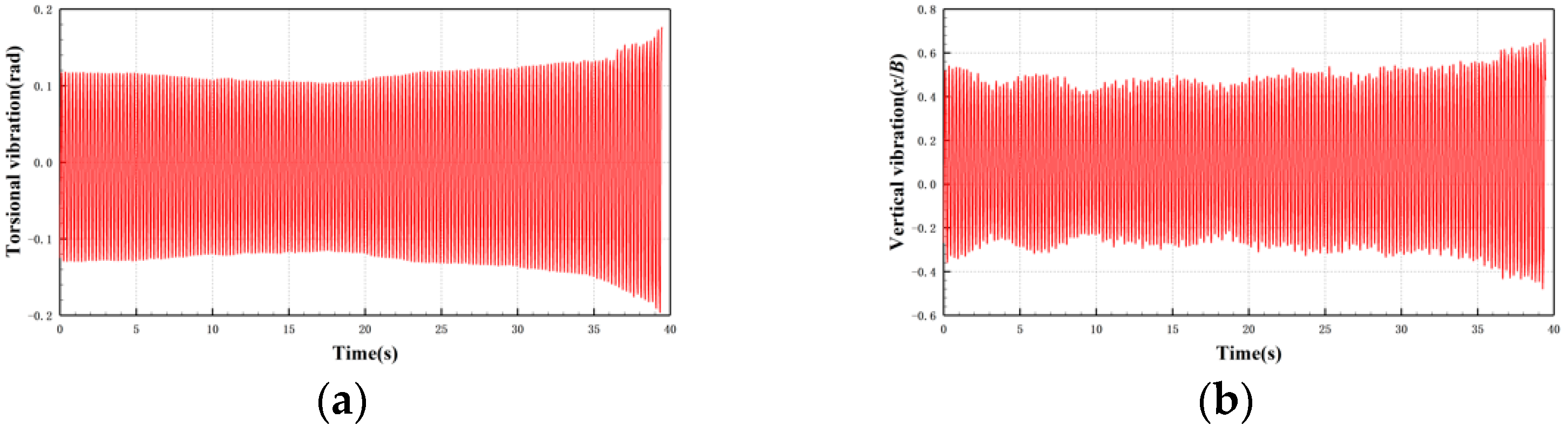
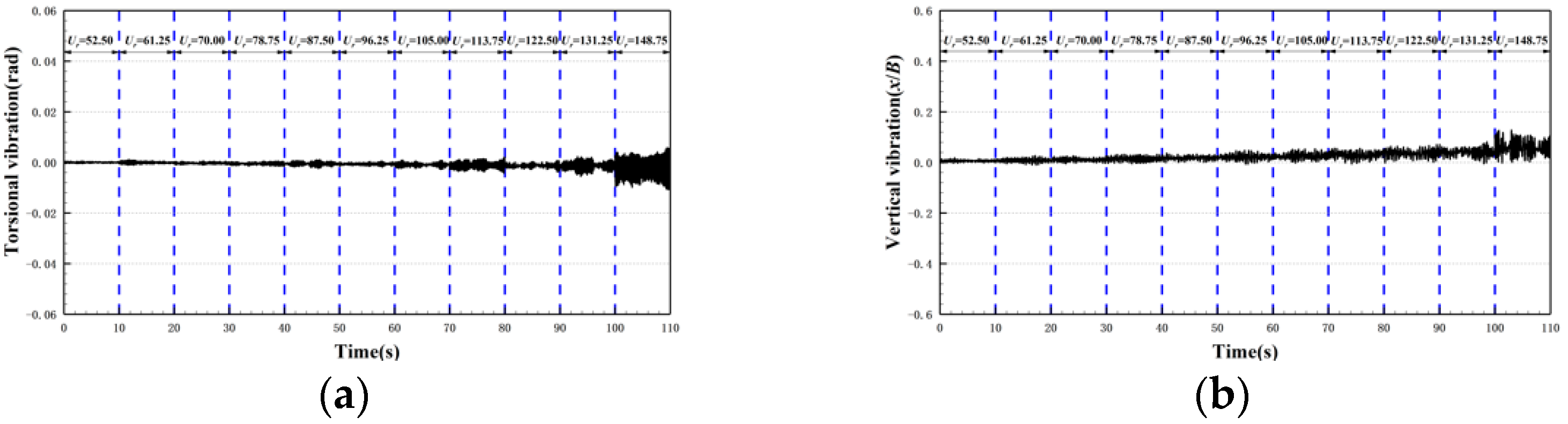
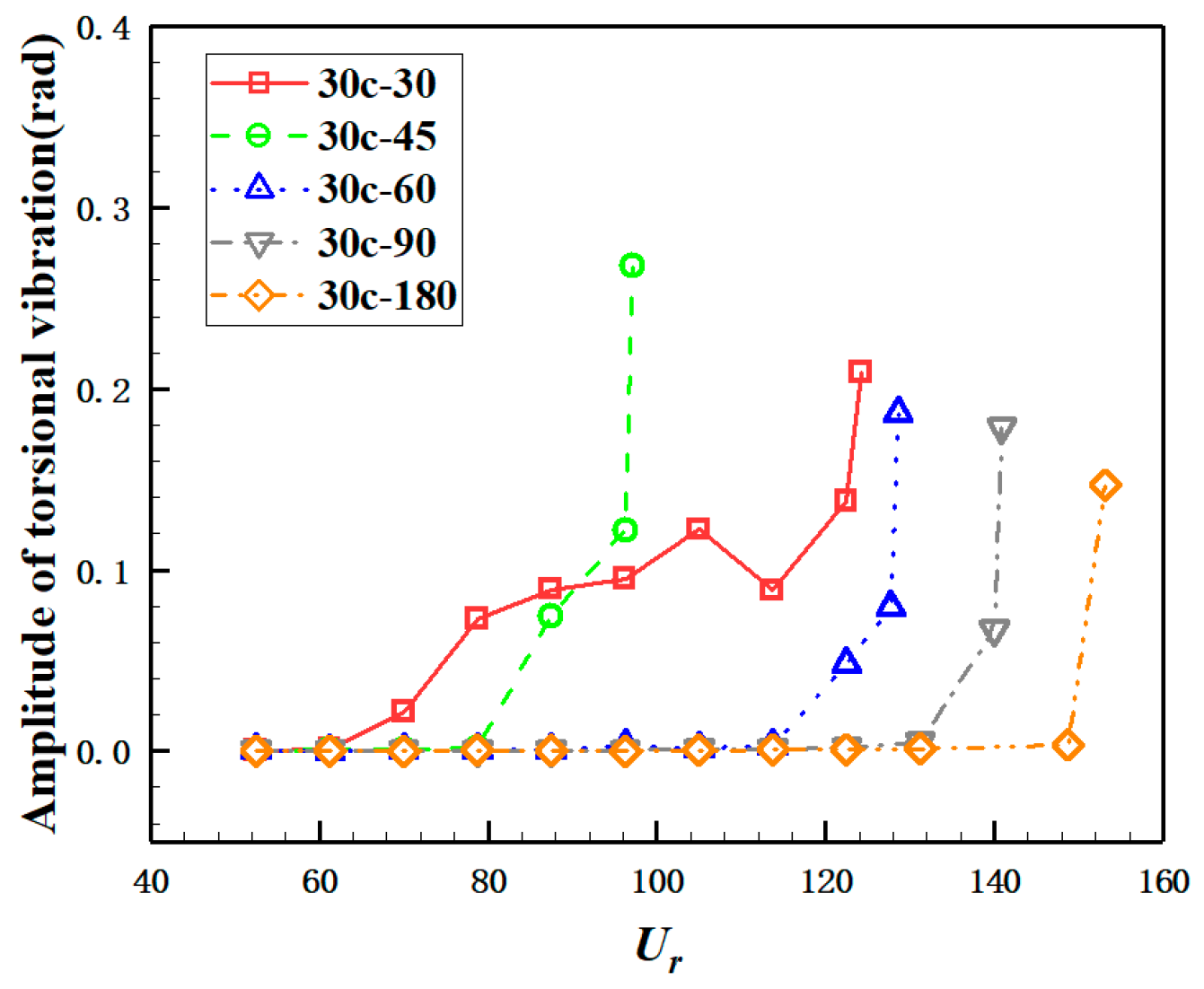
- Limit cycle flutter may still occur in the bridge section with a streamlined front edge and, in some cases, it also has a wider limit cycle flutter wind speed range.
- (2)
- When the bending-torsional coupling flutter is fully developed, the torsional degree of freedom slightly lags behind the vertical degree of freedom.
- (3)
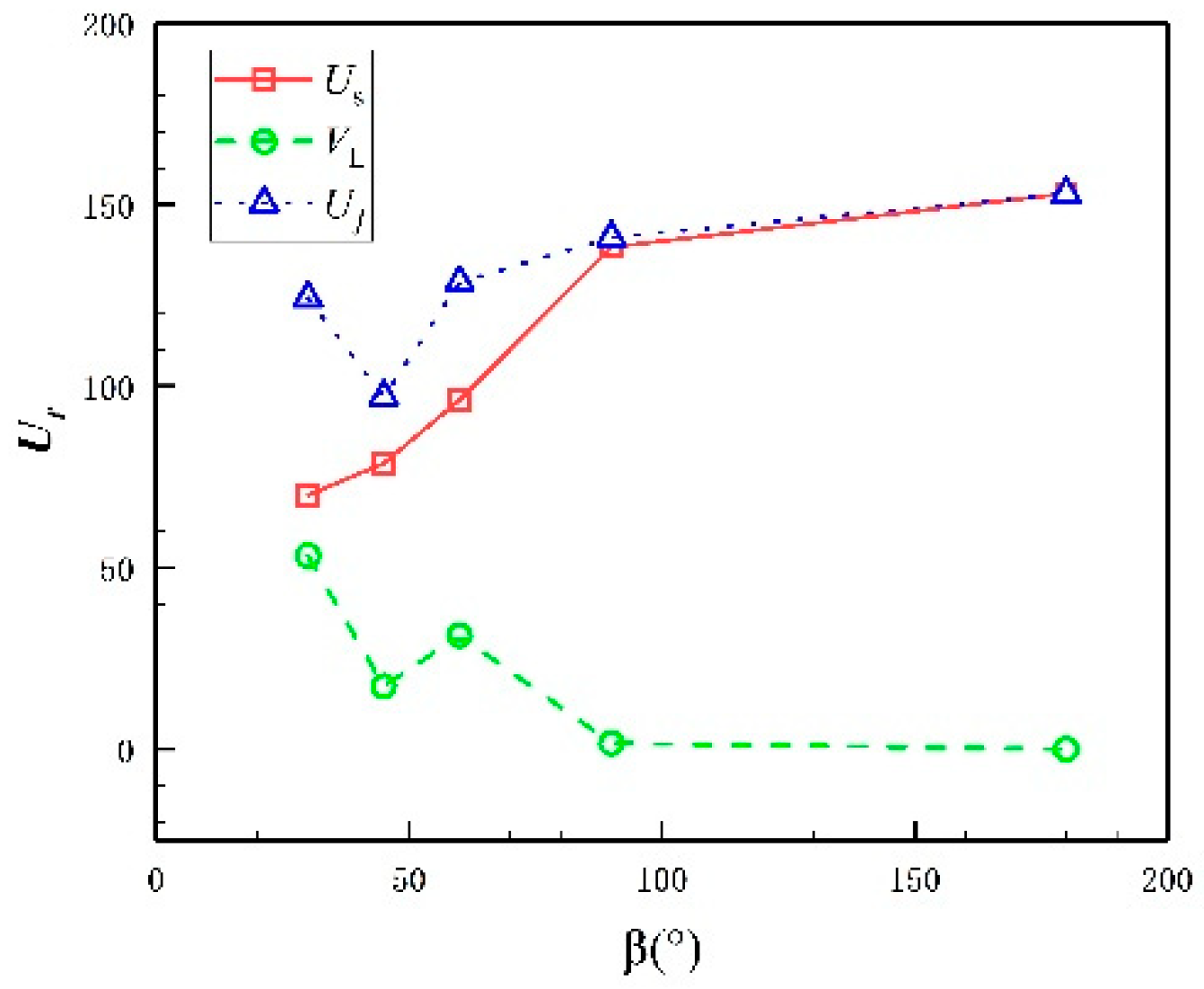
- As the trailing edge becomes more and more blunt, the critical wind speed Us gradually increases, and the flutter stability gradually increases. The wake vortex motion has a certain correlation with the flutter stability of the bridge deck.
Author Contributions
Funding
Institutional Review Board Statement
Informed Consent Statement
Data Availability Statement
Conflicts of Interest
References
- Bleich, F. Dynamic instability of truss-stiffened suspension bridges under wind action. Trans. Am. Soc. Civ. Eng. 1948, 114, 1177–1222. [Google Scholar] [CrossRef] [Scilit]
- Theodorsen, T. General Theory of Aerodynamic Instability and the Mechanism of Flutter; NACA Report No. 496; National Aeronautics and Space Administration: Washington, DC, USA, 1935; pp. 291–311.
- Kloppel, K.; Thiele, F. Modellversuche im Windkanal zur Bemessung von Brucken gegen die Gefahr winderregter Schwingungen. Stahlbau 1967, 32, 353–365. [Google Scholar]
- Scanlan, R.H.; Tomko, J.J. Airfoil and Bridge Deck Flutter Derivatives. J. Eng. Mech. Div. 1971, 97, 1717–1737. [Google Scholar] [CrossRef] [Scilit]
- Matsumoto, M.; Kobayashi, Y.; Shirato, H. The influence of aerodynamic derivatives on flutter. J. Wind Eng. Ind. Aerodyn. 1996, 60, 227–239. [Google Scholar] [CrossRef] [Scilit]
- Matsumoto, M.; Daito, Y.; Yoshizumi, F.; Ichikawa, Y. Torsional flutter of bluff bodies. J. Wind Eng. Ind. Aerodyn. 1997, 69, 871–882. [Google Scholar] [CrossRef] [Scilit]
- Matsumoto, M.; Matsumiya, H.; Fujiwara, S.; Ito, Y. New consideration on flutter properties based on step-by-step analysis. J. Wind Eng. Ind. Aerodyn. 2010, 98, 429–437. [Google Scholar] [CrossRef] [Scilit]
- Bartoli, G.; Mannini, C. A simplified approach to bridge deck flutter. J. Wind Eng. Ind. Aerodyn. 2008, 96, 229–256. [Google Scholar] [CrossRef] [Scilit]
- Lee, H.; Vu, T.; Yoo, S.; Lee, H.Y. A Simplified Evaluation in Critical Frequency and Wind Speed to Bridge Deck Flutter. Procedia Eng. 2011, 14, 1784–1790. [Google Scholar] [CrossRef] [Scilit]
- Schmid, P.J. Application of the dynamic mode decomposition to experimental data. Exp. Fluids 2011, 50, 1123–1130. [Google Scholar] [CrossRef] [Scilit]
- Wu, T.; Kareem, A.; Ge, Y. Linear and nonlinear aeroelastic analysis frameworks for cable-supported bridges. Nonlinear Dyn. 2013, 74, 487–516. [Google Scholar] [CrossRef] [Scilit]
- Amandolese, X.; Michelin, S.; Choquel, M. Low speed flutter and limit cycle oscillations of a two-degree-of-freedom flat plate in a wind tunnel. J. Fluids Struct. 2013, 43, 244–255. [Google Scholar] [CrossRef] [Scilit]
- Ying, X.; Xu, F.; Zhang, M.; Zhang, Z. Numerical explorations of the limit cycle flutter characteristics of a bridge deck. J. Wind Eng. Ind. Aerodyns. 2017, 169, 30–38. [Google Scholar] [CrossRef] [Scilit]
- Gao, G.; Zhu, L.; Han, W.; Li, J. Nonlinear post-flutter behavior and self-excited force model of a twin-side-girder bridge deck. J. Wind Eng. Ind. Aerodyn. 2018, 177, 227–241. [Google Scholar] [CrossRef] [Scilit]
- Zhang, M.; Xu, F.; Ying, X. Experimental Investigations on the Nonlinear Torsional Flutter of a Bridge Deck. J. Bridge Eng. 2017, 22, 04017048. [Google Scholar] [CrossRef] [Scilit]
- Zhang, M.; Xu, F.; Zhang, Z.; Ying, X. Energy budget analysis and engineering modeling of post-flutter limit cycle oscillation of a bridge deck. J. Wind Eng. Ind. Aerodyn. 2019, 188, 410–420. [Google Scholar] [CrossRef] [Scilit]
- Larsen, A. Aerodynamic aspects of the final design of the 1624 m suspension bridge across the great belt. J. Wind Eng. Ind. Aerodyn. 1993, 48, 261–285. [Google Scholar] [CrossRef] [Scilit]
- Bruno, L.; Mancini, G. Importance of Deck Details in Bridge Aerodynamics. Struct. Eng. Int. 2002, 12, 289–294. [Google Scholar] [CrossRef] [Scilit]
- Wilde, K.; Omenzetter, P.; Fujino, Y. Suppression of bridge flutter by active deck-flaps control system. J. Eng. Mechan. 2001, 127, 80–89. [Google Scholar] [CrossRef] [Scilit]
- Lin, Y.Y.; Cheng, C.M.; Wu, J.C.; Lan, T.L.; Wu, K.T. Effects of deck shape and oncoming turbulence on bridge aerodynamics. J. Appl. Sci. Eng. 2005, 8, 43–56. [Google Scholar]
- Zhang, X.; Sun, B. Parametric study on the aerodynamic stability of a long-span suspension bridge. J. Wind Eng. Ind. Aerodyn. 2004, 92, 431–439. [Google Scholar] [CrossRef] [Scilit]
- Mariotti, A. Axisymmetric bodies with fixed and free separation: Base-pressure and near-wake fluctuations. J. Wind Eng. Ind. Aerodyn. 2018, 176, 21–31. [Google Scholar] [CrossRef] [Scilit]
- Rocchio, B.; Mariotti, A.; Salvetti, M.V. Flow around a 5:1 rectangular cylinder: Effects of upstream-edge rounding. J. Wind Eng. Ind. Aerodyns. 2020, 204, 104237. [Google Scholar] [CrossRef] [Scilit]








| Serial Number | Fundamental Frequency (Hz) | Damping Ratio (%) | ||
|---|---|---|---|---|
| Vertical | Torsional | Vertical | Torsional | |
| 30c-30 | 2.640 | 5.066 | 0.193 | 0.141 |
| 30c-45 | 2.63 | 5.028 | 0.125 | 0.092 |
| 30c-60 | 2.625 | 5.020 | 0.104 | 0.145 |
| 30c-90 | 2.640 | 5.035 | 0.157 | 0.170 |
| 30c-180 | 2.623 | 5.005 | 0.176 | 0.126 |
Publisher’s Note: MDPI stays neutral with regard to jurisdictional claims in published maps and institutional affiliations. |
© 2021 by the authors. Licensee MDPI, Basel, Switzerland. This article is an open access article distributed under the terms and conditions of the Creative Commons Attribution (CC BY) license (https://creativecommons.org/licenses/by/4.0/).
Share and Cite
Feng, J.; Wu, B.; Laima, S. Effects of the Configuration of Trailing Edge on the Flutter of an Elongated Bluff Body. Appl. Sci. 2021, 11, 10818. https://doi.org/10.3390/app112210818
Feng J, Wu B, Laima S. Effects of the Configuration of Trailing Edge on the Flutter of an Elongated Bluff Body. Applied Sciences. 2021; 11(22):10818. https://doi.org/10.3390/app112210818
Chicago/Turabian StyleFeng, Jie, Buchen Wu, and Shujin Laima. 2021. "Effects of the Configuration of Trailing Edge on the Flutter of an Elongated Bluff Body" Applied Sciences 11, no. 22: 10818. https://doi.org/10.3390/app112210818
APA StyleFeng, J., Wu, B., & Laima, S. (2021). Effects of the Configuration of Trailing Edge on the Flutter of an Elongated Bluff Body. Applied Sciences, 11(22), 10818. https://doi.org/10.3390/app112210818