Article

Convolution-GRU Based on Independent Component Analysis for fMRI Analysis with Small and Imbalanced Samples


College of Artificial Intelligence, Nankai University, No.38 Tongyan Road, Jinnan District, Tianjin 300350, China
*
Author to whom correspondence should be addressed.
Appl. Sci. 2020, 10(21), 7465; https://doi.org/10.3390/app10217465
Submission received: 17 September 2020 / Revised: 18 October 2020 / Accepted: 19 October 2020 / Published: 23 October 2020
(This article belongs to the Special Issue Machine Learning Methods with Noisy, Incomplete or Small Datasets)

Abstract

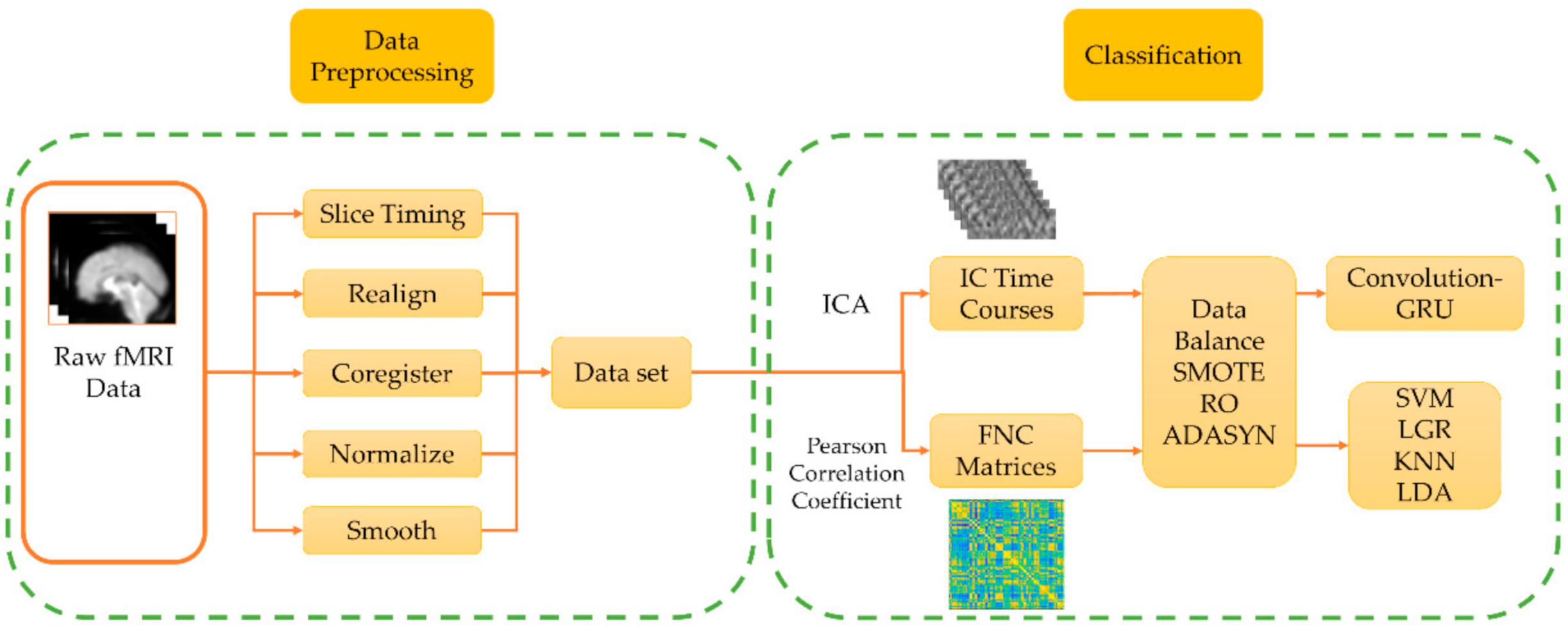
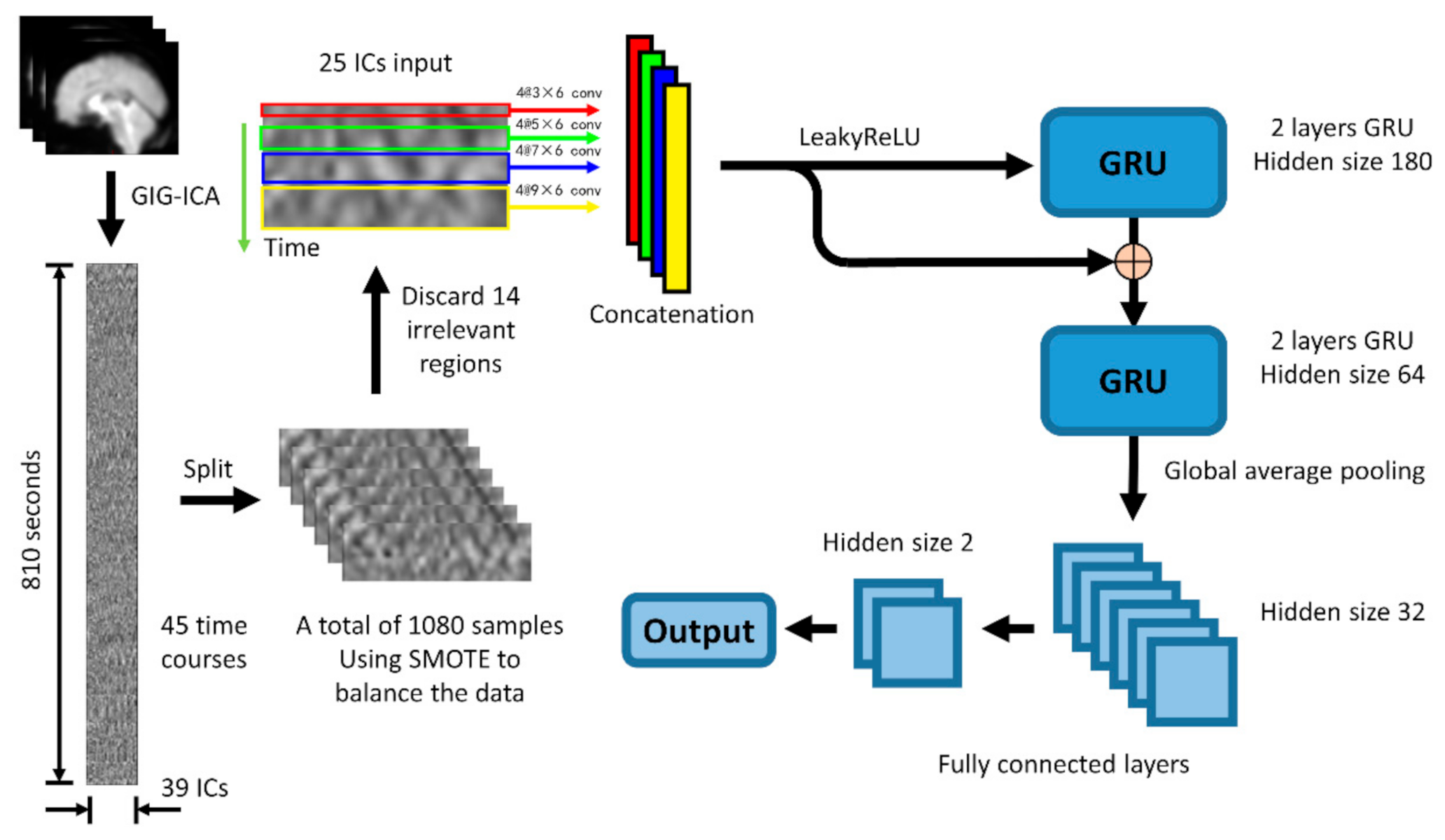
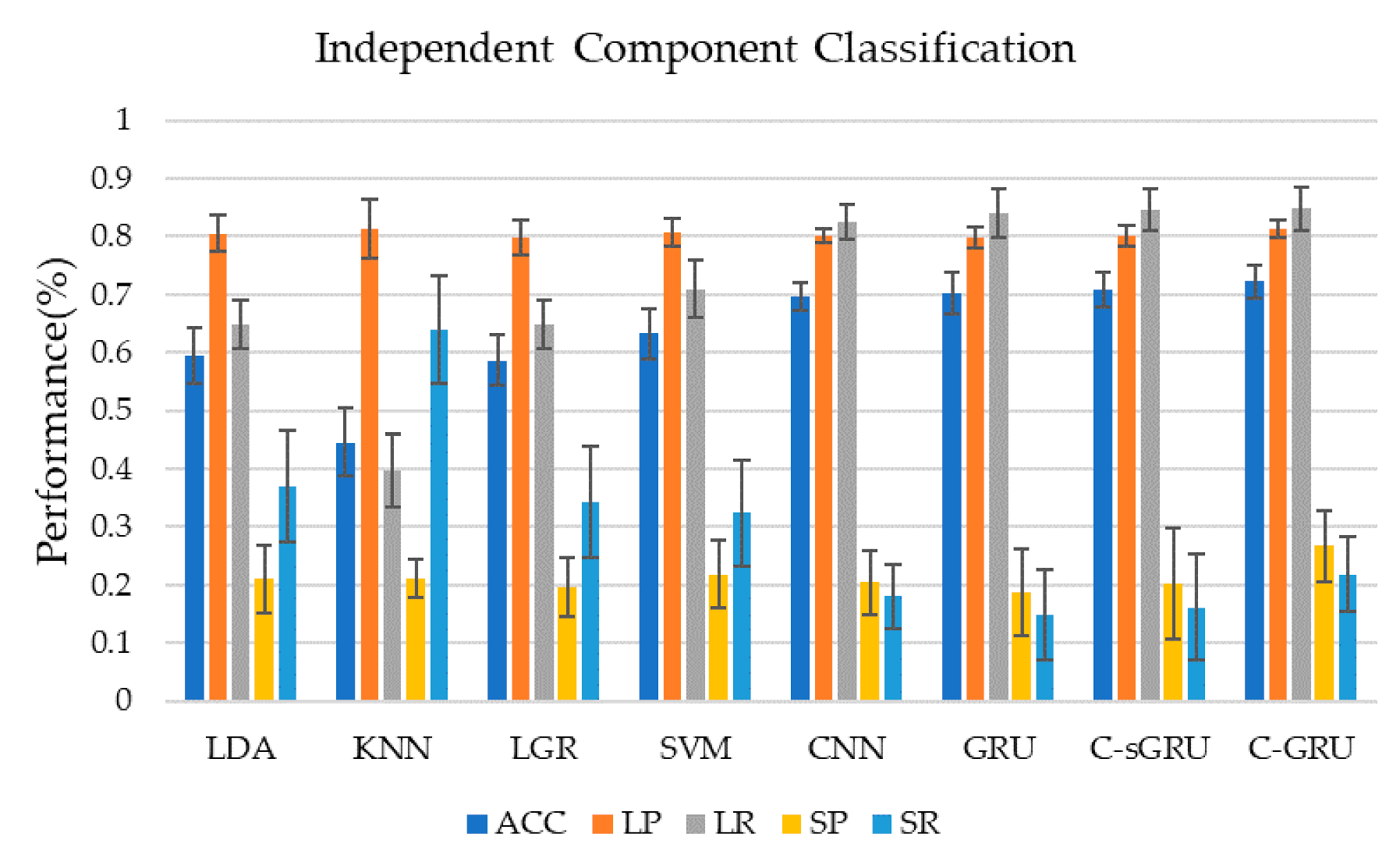
Functional magnetic resonance imaging (fMRI) is a commonly used method of brain research. However, due to the complexity and particularity of the fMRI task, it is difficult to find enough subjects, resulting in a small and, often, imbalanced dataset. A dataset with small samples causes overfitting of the learning model, and the imbalance will make the model insensitive to the minority class, which has been a problem in classification. It is of great significance to classify fMRI data with small and imbalanced samples. In the present study, we propose a 3-step method on a small and imbalanced fMRI dataset from a word-scene memory task. The steps of the method are as follows: (1) An independent component analysis is performed to reduce the dimension of data; (2) The synthetic minority oversampling technique is used to generate new samples of the minority class to balance data; (3) A convolution-Gated Recurrent Unit (GRU) network is used to classify the independent component signals, indicating whether the subjects are performing episodic memory tasks. The accuracy of the proposed method is 72.2%, which improves the classification performance compared with traditional classifiers such as support vector machines (SVM), logistic regression (LGR), linear discriminant analysis (LDA) and k-nearest neighbor (KNN), and this study gives a biomarker for evaluating the reactivation of episodic memory.
Keywords: functional magnetic resonance imaging; independent component analysis; deep learning; recurrent neural network; functional connectivity; episodic memory; small sample learning functional magnetic resonance imaging; independent component analysis; deep learning; recurrent neural network; functional connectivity; episodic memory; small sample learning