How Sport-Based Wellness Program Quality Shapes Co-Created Guest Experience, Loyalty Intentions, and Self-Reported Physical Activity Orientation in Saudi Arabian Hotels





Abstract
1. Introduction
2. Review of Literature
2.1. Theoretical Underpinnings
2.2. Guest Experience, Co-Creation, and Wellness Service Innovation
2.3. Relationship with Sustainability and SDGs
2.4. Research Hypothesis
2.4.1. The Effect of Wellness Sport Program Quality on Guest Satisfaction with the Wellness Program
2.4.2. The Influence of Wellness Sport Program Quality on Guests’ Perceived Health Benefits
2.4.3. The Impact of Wellness Sport Program Quality on Guests’ Enjoyment of the Wellness Program
2.4.4. The Role of Guests’ Perceived Health Benefits in Shaping Satisfaction with the Wellness Program
2.4.5. The Role of Guests’ Enjoyment in Shaping Satisfaction with the Wellness Program
2.4.6. The Mediating Role of Perceived Health Benefits in the Relationship Between Wellness Sport Program Quality and Guest Satisfaction
2.4.7. The Mediating Role of Enjoyment in the Relationship Between Wellness Sport Program Quality and Guest Satisfaction
2.4.8. The Effect of Guest Satisfaction with Sport-Based Wellness Programs on Loyalty Intentions Toward the Hotel
2.4.9. Guest Satisfaction with Sport-Based Wellness Programs and Its Influence on Physical Activity Orientation
2.4.10. The Moderating Role of Staff Health Communication in the Relationship Between Wellness Sport Program Quality and Perceived Health Benefits
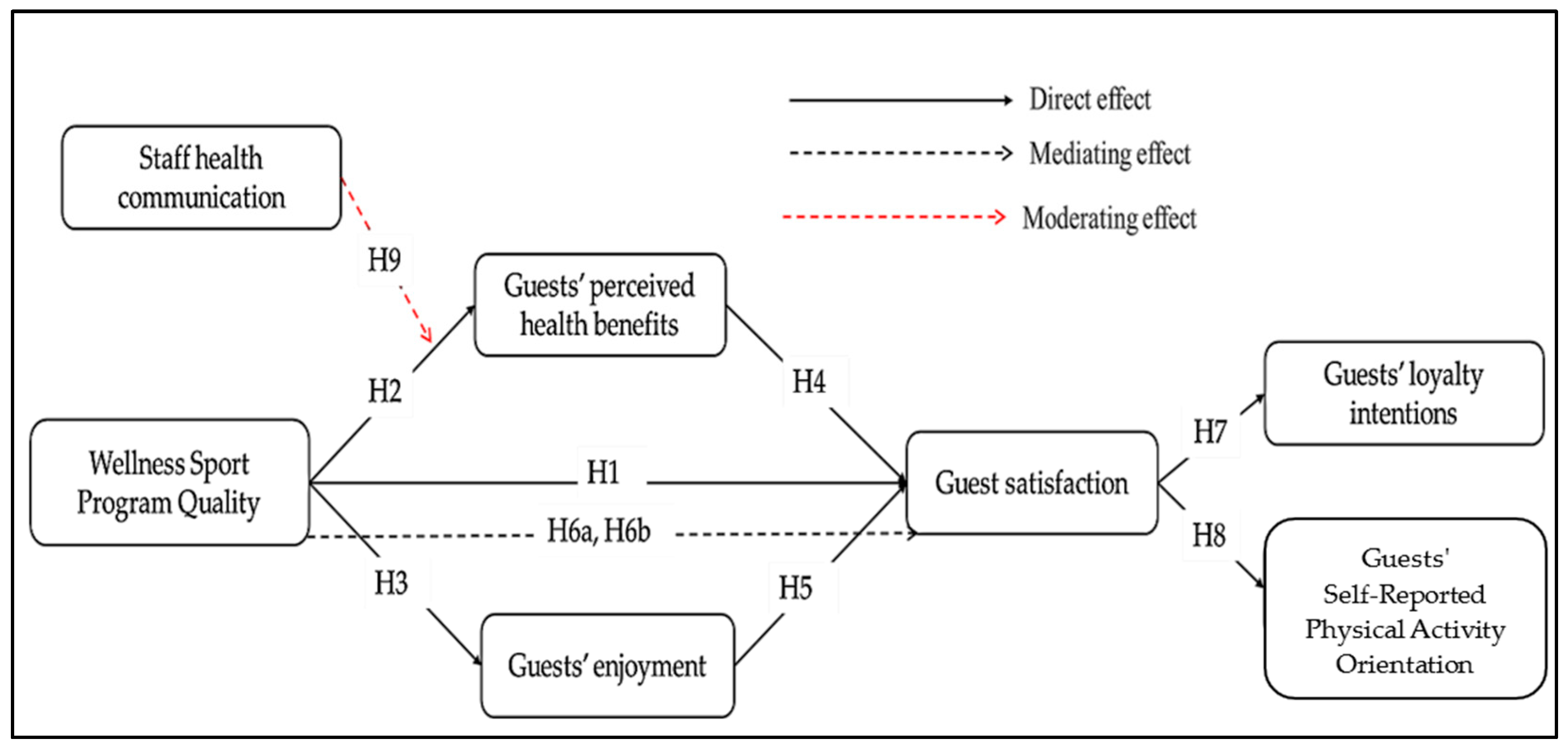
2.5. Study Framework
3. Materials and Methods
3.1. Instruments and Scales
3.2. Sampling and Participant Selection
3.3. Statistical Methods
4. Results
4.1. Construct Validity and Reliability Assessment
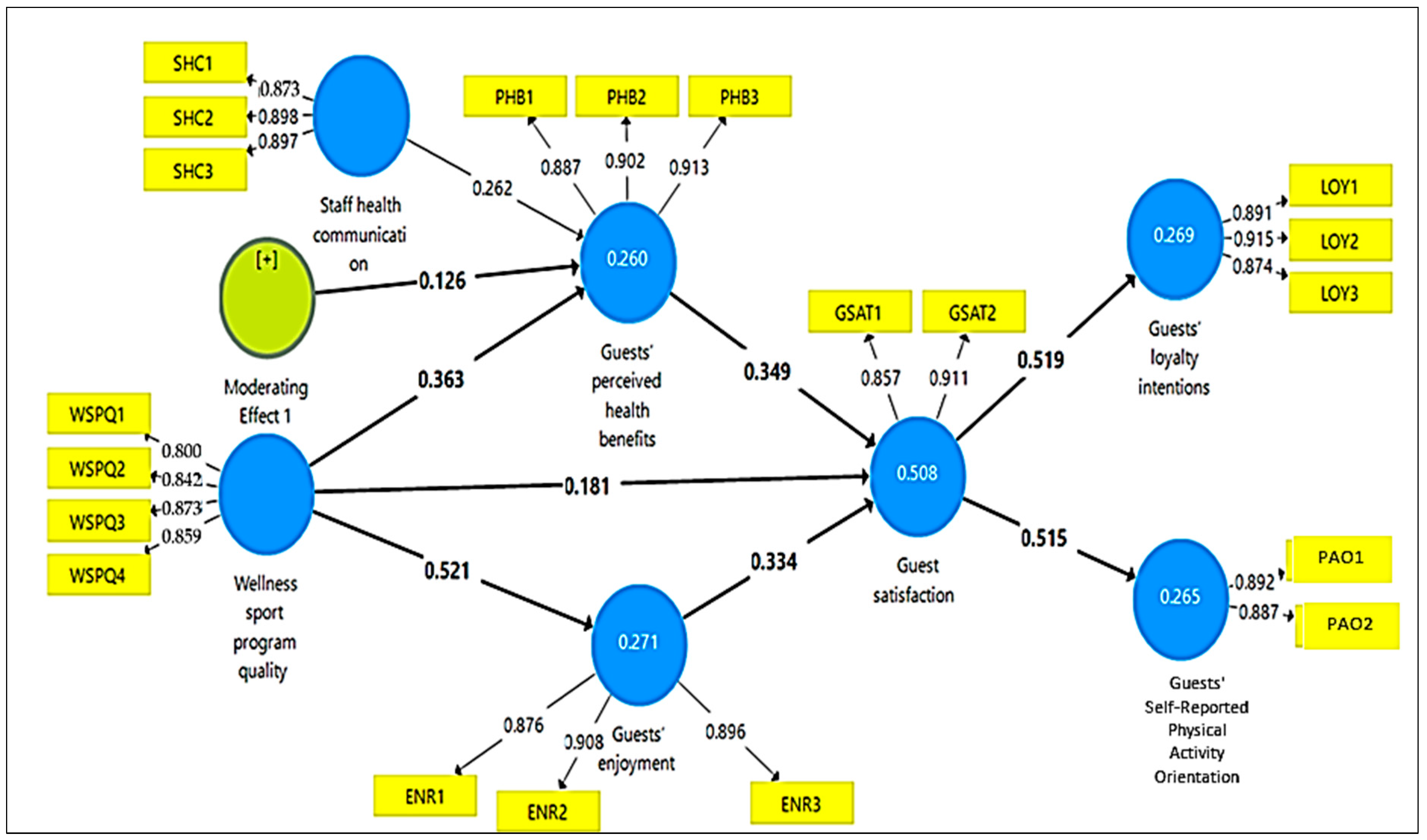
4.2. Hypotheses Testing (Inner Model)
5. Discussion
6. Study Implications
6.1. Theoretical Contributions
6.2. Practical Implications
6.3. Policy and National Vision Implications
7. Limitations and Future Research
8. Conclusions
Author Contributions
Funding
Institutional Review Board Statement
Informed Consent Statement
Data Availability Statement
Acknowledgments
Conflicts of Interest
Appendix A. Scales of the Study Variables
| Wellness Sport Program Quality (WSPQ) |
|
|
|
|
| Perceived Health Benefits (PHB) |
|
|
|
| Enjoyment/Affective Response (ENR) |
|
|
|
| Guest Satisfaction (GSAT) |
|
|
| Loyalty Intentions (LOY) |
|
|
|
| Self-Reported Physical Activity Orientation (PAO) |
|
|
| Staff Health Communication (SHC) |
|
|
|
References
- Abdelghani, A. A. A., Fayyad, S., Al-Romeedy, B. S., & Ahmed, H. A. M. (2025). Cultural and social influences on Saudi family travel decisions: A systematic-quantitative synthesis for enhancing domestic tourism competitiveness in the face of international tourism. Research Journal in Advanced Humanities, 6(2), 1–25. Available online: https://mail.royalliteglobal.com/advanced-humanities/article/view/2039/940 (accessed on 22 July 2026). [CrossRef] [Scilit]
- AbouRokbah, S., & Salam, M. A. (2023). Quality and satisfaction in female fitness centers and the moderating roles of age and income: Empirical evidence from Saudi Arabia. International Journal of Sports Marketing and Sponsorship, 24(4), 753–770. [Google Scholar] [CrossRef] [Scilit]
- Ahmed, H. A. M., Abdelghani, A. A. A., Fayyad, S., & Rashwan, K. A. (2025). From commitment to action: The mediating effect of environmental identity in green buying, with eco-conscious behavior as a moderator. Administrative Sciences, 15(8), 303. [Google Scholar] [CrossRef] [Scilit]
- Al-Hazzaa, H. M., Shubber, Z., AlMarzooqi, M., Alghannam, A. F., Alothman, S. A., AlQurashi, Y., AlAhmed, R., Hegazi, A., El-Saharty, S., Alsukait, R. F., Rakic, S., Cetinkaya, V., & Alqahtani, S. A. (2025). Stakeholder perspectives on surveillance of physical activity and monitoring and evaluation of interventions in Saudi Arabia. BMC Public Health, 25(1), 1381. [Google Scholar] [CrossRef] [Scilit] [PubMed]
- Alshuwaikhat, H., & Mohammed, I. (2017). Sustainability matters in national development visions—Evidence from Saudi Arabia’s vision for 2030. Sustainability, 9(3), 408. [Google Scholar] [CrossRef] [Scilit]
- Backman, S. J., Huang, Y.-C., Chen, C.-C., Lee, H.-Y., & Cheng, J.-S. (2023). Engaging with restorative environments in wellness tourism. Current Issues in Tourism, 26(5), 789–806. [Google Scholar] [CrossRef] [Scilit]
- Behnam, M., Sato, M., & Baker, B. J. (2021). The role of consumer engagement in behavioral loyalty through value co-creation in fitness clubs. Sport Management Review, 24(4), 567–593. [Google Scholar] [CrossRef] [Scilit]
- Ben Haobin, Y., Huiyue, Y., Peng, L., & Fong, L. H. N. (2021). The impact of hotel servicescape on customer mindfulness and brand experience: The moderating role of length of stay. Journal of Hospitality Marketing & Management, 30(5), 592–610. [Google Scholar] [CrossRef] [Scilit]
- Buhalis, D., & Sinarta, Y. (2019). Real-time co-creation and nowness service: Lessons from tourism and hospitality. Journal of Travel & Tourism Marketing, 36(5), 563–582. [Google Scholar] [CrossRef] [Scilit]
- Bull, F. C., Al-Ansari, S. S., Biddle, S., Borodulin, K., Buman, M. P., Cardon, G., Carty, C., Chaput, J.-P., Chastin, S., Chou, R., Dempsey, P. C., DiPietro, L., Ekelund, U., Firth, J., Friedenreich, C. M., Garcia, L., Gichu, M., Jago, R., Katzmarzyk, P. T., … Willumsen, J. F. (2020). World Health Organization 2020 guidelines on physical activity and sedentary behaviour. British Journal of Sports Medicine, 54(24), 1451–1462. [Google Scholar] [CrossRef] [Scilit] [PubMed]
- Campón-Cerro, A. M., Di-Clemente, E., Hernández-Mogollón, J. M., & Folgado-Fernández, J. A. (2020). Healthy water-based tourism experiences: Their contribution to quality of life, satisfaction and loyalty. International Journal of Environmental Research and Public Health, 17(6), 1961. [Google Scholar] [CrossRef] [Scilit] [PubMed]
- Chen, K.-H., Huang, L., & Ye, Y. (2023). Research on the relationship between wellness tourism experiencescape and revisit intention: A chain mediation model. International Journal of Contemporary Hospitality Management, 35(3), 893–918. [Google Scholar] [CrossRef] [Scilit]
- Chen, Y., Zhou, Y., Tan, L., Chen, S., Wu, C., Liang, Y., Sun, N., & Liu, J. (2023). Comparative analysis of transvaginal natural orifice transluminal endoscopic surgery versus laparoendoscopic single-site sacrocolpopexy for pelvic organ prolapse: A propensity score matching study. Heliyon, 9(9), e19698. [Google Scholar] [CrossRef] [Scilit] [PubMed]
- Choi, H., Jeong, Y., & Kim, S.-K. (2020). The relationship between coaching behavior and athlete burnout: Mediating effects of communication and the coach–athlete relationship. International Journal of Environmental Research and Public Health, 17(22), 8618. [Google Scholar] [CrossRef] [Scilit] [PubMed]
- Choi, J., Sohn, Y. W., & Lee, S. (2020). The effect of corporate social responsibility on employees’ organizational citizenship behavior: A moderated mediation model of grit and meaning orientation. Sustainability, 12(13), 5411. [Google Scholar] [CrossRef] [Scilit]
- Cohen, J. (2013). Statistical power analysis for the behavioral sciences. Routledge. [Google Scholar] [CrossRef] [Scilit]
- Coppola, S., D’Anna, C., Minghelli, V., & Vastola, R. (2024). Ecological dynamics approach in physical education to promote cognitive skills development. Journal of Human Sport and Exercise, 19(3), 792–802. [Google Scholar] [CrossRef] [Scilit]
- Craig, C. L., Marshall, A. L., Sjöström, M., Bauman, A. E., Booth, M. L., Ainsworth, B. E., Pratt, M., Ekelund, U., Yngve, A., Sallis, J. F., & Oja, P. (2003). International physical activity questionnaire: 12-Country reliability and validity. Medicine & Science in Sports & Exercise, 35(8), 1381–1395. [Google Scholar] [CrossRef] [Scilit] [PubMed]
- Cui, M., Cheng, L., & Shang, Y. (2024). The influence of experiencescape of home-based accommodation on tourists’ subjective well-being at cultural heritage sites: The role of value co-creation. Journal of Destination Marketing & Management, 31, 100845. [Google Scholar] [CrossRef] [Scilit]
- Dahanayake, S., Wanninayake, B., & Ranasinghe, R. (2025). Memorable wellness tourism experiences: Scale development and validation. Journal of Vacation Marketing. [Google Scholar] [CrossRef] [Scilit]
- Davies, L. E., Taylor, P., Ramchandani, G., & Christy, E. (2021). Measuring the social return on investment of community sport and leisure facilities. Managing Sport and Leisure, 26(1–2), 93–115. [Google Scholar] [CrossRef] [Scilit]
- Dimitrovski, D., Marinković, V., Djordjevic, A., & Sthapit, E. (2025). Wellness spa hotel experience: Evidence from spa hotel guests in Serbia. Tourism Review, 80(6), 1300–1319. [Google Scholar] [CrossRef] [Scilit]
- Eather, N., Wade, L., Pankowiak, A., & Eime, R. (2023). The impact of sports participation on mental health and social outcomes in adults: A systematic review and the ‘Mental Health through Sport’ conceptual model. Systematic Reviews, 12(1), 102. [Google Scholar] [CrossRef] [Scilit] [PubMed]
- Ekonomou, G., Kallioras, D., Menegaki, A. N., & Alvarez, S. (2023). Tourist preferences for revitalizing wellness products and reversing depopulation in rural destinations. Sustainability, 15(24), 16736. [Google Scholar] [CrossRef] [Scilit]
- Elahi, A., Moradi, E., & Saffari, M. (2020). Antecedents and consequences of tourists’ satisfaction in sport event: Mediating role of destination image. Journal of Convention & Event Tourism, 21(2), 123–154. [Google Scholar] [CrossRef] [Scilit]
- Erdly, M., & Kesterson-Townes, L. (2003). “Experience rules”: A scenario for the hospitality and leisure industry circa 2010 envisions transformation. Strategy & Leadership, 31(3), 12–18. [Google Scholar] [CrossRef] [Scilit]
- Fatma, M. A., & Kumar, M. (2024). Exploring the correlation between service quality and customer satisfaction in the hospitality industry. International Journal of Indian Psychology, 12, 1400–1410. [Google Scholar]
- Filimonau, V. (2015). Carbon management in tourism: Mitigating the impacts on climate change. Tourism Management, 46, 62–63. [Google Scholar] [CrossRef] [Scilit]
- Fornell, C., & Larcker, D. F. (1981a). Evaluating structural equation models with unobservable variables and measurement error. Journal of Marketing Research, 18(1), 39–50. [Google Scholar] [CrossRef] [Scilit]
- Fornell, C., & Larcker, D. F. (1981b). Structural equation models with unobservable variables and measurement error: Algebra and statistics. Journal of Marketing Research, 18(3), 382–388. [Google Scholar] [CrossRef] [Scilit]
- García-Pascual, F., Pérez-Campos, C., García Sánchez, J., Soto-Rubio, A., & Aguado Berenguer, S. (2021). Models of sports management in fitness centres. Influence of sex, age and sport frequency. Linear models vs. qualitative comparative analysis. Sustainability, 13(16), 8995. [Google Scholar] [CrossRef] [Scilit]
- Gálvez-Ruiz, P., Calabuig, F., Grimaldi-Puyana, M., González-Serrano, M. H., & García-Fernández, J. (2023). The effect of perceived quality and customer engagement on the loyalty of users of Spanish fitness centres. Academia Revista Latinoamericana de Administración, 36(4), 445–462. [Google Scholar] [CrossRef] [Scilit]
- Greco, G. (2024). Special issue “Health and performance through sports at all ages 2.0”. Journal of Functional Morphology and Kinesiology, 9(1), 36. [Google Scholar] [CrossRef] [Scilit] [PubMed]
- Hair, J., & Alamer, A. (2022). Partial least squares structural equation modeling (PLS-SEM) in second language and education research: Guidelines using an applied example. Research Methods in Applied Linguistics, 1(3), 100027. [Google Scholar] [CrossRef] [Scilit]
- Hair, J. F., Risher, J. J., Sarstedt, M., & Ringle, C. M. (2019). When to use and how to report the results of PLS-SEM. European Business Review, 31(1), 2–24. [Google Scholar] [CrossRef] [Scilit]
- He, M., Liu, B., & Li, Y. (2023). Tourist inspiration: How the wellness tourism experience inspires tourist engagement. Journal of Hospitality & Tourism Research, 47(7), 1115–1135. [Google Scholar] [CrossRef] [Scilit]
- Henseler, J., Ringle, C. M., & Sarstedt, M. (2015). A new criterion for assessing discriminant validity in variance-based structural equation modeling. Journal of the Academy of Marketing Science, 43(1), 115–135. [Google Scholar] [CrossRef] [Scilit]
- Hu, L., Aw, E. C., Cham, T., & Nilashi, M. (2025). How do memorable experiences influence wellness tourist satisfaction? Insights from user-generated content and machine learning. International Journal of Tourism Research, 27(4). [Google Scholar] [CrossRef] [Scilit]
- Insuwanno, P., & Thongklieng, S. (2025). Measuring the impact of subjective and objective quality attributes on spa-goer satisfaction and loyalty in wellness spas. International Journal of Spa and Wellness, 8(3), 512–531. [Google Scholar] [CrossRef] [Scilit]
- Kandampully, J., Zhang, T., & Jaakkola, E. (2018). Customer experience management in hospitality. International Journal of Contemporary Hospitality Management, 30(1), 21–56. [Google Scholar] [CrossRef] [Scilit]
- Karagianni, V., Kalantonis, P., Tsartas, P., & Sdrali, D. (2025). Wellness tourism experiences and tourists’ satisfaction: A multicriteria analysis approach. Tourism and Hospitality, 6(4), 179. [Google Scholar] [CrossRef] [Scilit]
- Katsoni, V., & van Zyl, C. (2021). Culture and tourism in a smart, globalized, and sustainable world. Springer International Publishing. [Google Scholar]
- Kendzierski, D., & DeCarlo, K. J. (1991). Physical activity enjoyment scale: Two validation studies. Journal of Sport and Exercise Psychology, 13(1), 50–64. [Google Scholar] [CrossRef] [Scilit]
- Kim, H.-D., & Cruz, A. B. (2022). Transformational leadership and psychological well-being of service-oriented staff: Hybrid data synthesis technique. International Journal of Environmental Research and Public Health, 19(13), 8189. [Google Scholar] [CrossRef] [Scilit] [PubMed]
- Kim, M., An, Y., & Kwon, W. (2021). A case study on service quality perceptions and member retention towards Taekwondo participants in North America. International Journal of Applied Sports Sciences, 33(2), 248–262. [Google Scholar] [CrossRef] [Scilit]
- Kock, N., & Hadaya, P. (2018). Minimum sample size estimation in PLS-SEM: The inverse square root and gamma-exponential methods. Information Systems Journal, 28(1), 227–261. [Google Scholar] [CrossRef] [Scilit]
- Kohl, H. W., Craig, C. L., Lambert, E. V., Inoue, S., Alkandari, J. R., Leetongin, G., & Kahlmeier, S. (2012). The pandemic of physical inactivity: Global action for public health. The Lancet, 380(9838), 294–305. [Google Scholar] [CrossRef] [Scilit] [PubMed]
- Kongtaveesawas, N., Prasarnphanich, P., Sinthupinyo, S., & Ashton, A. S. (2022). Attribute framework validation for wellness tourism within the context of Thailand. Sustainability, 14(10), 5953. [Google Scholar] [CrossRef] [Scilit]
- Kurniawan, R., Srijaroon, A., & Mousavi, S. H. (2024). Exploring the benefits of recreational sports: Promoting health, wellness, and community engagement. Journal Evaluation in Education, 3(4), 135–140. [Google Scholar] [CrossRef] [Scilit]
- Lee, I.-M., Shiroma, E. J., Lobelo, F., Puska, P., Blair, S. N., & Katzmarzyk, P. T. (2012). Effect of physical inactivity on major non-communicable diseases worldwide: An analysis of burden of disease and life expectancy. The Lancet, 380(9838), 219–229. [Google Scholar] [CrossRef] [Scilit] [PubMed]
- Lee, S., Jeong, E., & Qu, K. (2020). Exploring theme park visitors’ experience on satisfaction and revisit intention: A utilization of experience economy model. Journal of Quality Assurance in Hospitality & Tourism, 21(4), 474–497. [Google Scholar] [CrossRef] [Scilit]
- Lee, Y., & Queenie Li, J.-Y. (2020). The value of internal communication in enhancing employees’ health information disclosure intentions in the workplace. Public Relations Review, 46(1), 101872. [Google Scholar] [CrossRef] [Scilit]
- Liu, A. X., Wang, Y., & Zhang, J. (2023). The effects of linguistic coordination on perceived quality of consumer reviews: A dual process perspective. Journal of Interactive Marketing, 58(4), 361–379. [Google Scholar] [CrossRef] [Scilit]
- Liu, L., Zhou, Y., & Sun, X. (2023). The impact of the wellness tourism experience on tourist well-being: The mediating role of tourist satisfaction. Sustainability, 15(3), 1872. [Google Scholar] [CrossRef] [Scilit]
- Malm, C., Jakobsson, J., & Isaksson, A. (2019). Physical activity and sports—Real health benefits: A review with insight into the public health of Sweden. Sports, 7(5), 127. [Google Scholar] [CrossRef] [Scilit] [PubMed]
- Mamo, Y., Agyemang, K. J. A., & Andrew, D. P. S. (2021). Types of CSR initiatives and fans’ social outcomes: The case of professional sport organizations. Sport Marketing Quarterly, 30(2), 146–160. [Google Scholar] [CrossRef] [Scilit]
- Manhas, P. S., Sharma, P., & Quintela, J. A. (2025). Wellness tourism in the Himalayas: A structural analysis of motivation, experience, and satisfaction in spa resorts. Tourism and Hospitality, 6(2), 118. [Google Scholar] [CrossRef] [Scilit]
- Michie, S., Richardson, M., Johnston, M., Abraham, C., Francis, J., Hardeman, W., Eccles, M. P., Cane, J., & Wood, C. E. (2013). The behavior change technique taxonomy (v1) of 93 hierarchically clustered techniques: Building an international consensus for the reporting of behavior change interventions. Annals of Behavioral Medicine, 46(1), 81–95. [Google Scholar] [CrossRef] [Scilit] [PubMed]
- Mikulić, J., Šerić, M., & Krešić, D. (2024). Asymmetric effects of wellness destination and wellness facility attributes on tourist satisfaction. Tourism Review, 79(4), 969–980. [Google Scholar] [CrossRef] [Scilit]
- Moradi, E., & Hejazi, P. (2025). Bridging visitor expectations and destination performance: Evaluating sport tourism competitiveness in island destinations. International Journal of Hospitality & Tourism Administration, 1–31. [Google Scholar] [CrossRef] [Scilit]
- Nunnally, J. C. (1994). Psychometric theory 3E. McGraw-Hill. [Google Scholar]
- Nunnally, J. C., & Bernstein, I. H. (1994). Psychometric theory (3rd ed.). American Psychological Association. [Google Scholar]
- Oliver, R. L. (1980). A cognitive model of the antecedents and consequences of satisfaction decisions. Journal of Marketing Research, 17(4), 460–469. [Google Scholar] [CrossRef] [Scilit]
- Oliver, R. L. (1999). Whence consumer loyalty? Journal of Marketing, 63, 33–44. [Google Scholar] [CrossRef] [Scilit]
- Ordiñana-Bellver, D., González-García, R. J., Pérez-Campos, C., & Crespo-Hervás, J. (2026). Sport tourism as a driver of sustainable rural development: Community perceptions and strategic implications. Geojournal of Tourism and Geosites, 64(1), 198–205. [Google Scholar] [CrossRef] [Scilit]
- Parasuraman, A., Zeithaml, V. A., & Berry, L. L. (1988). SERVQUAL: A multiple item scale for measuring consumer perceptions of service quality. Journal of Retailing, 64(1), 12–37. [Google Scholar]
- Park, H., Lee, M., & Back, K.-J. (2021). Exploring the roles of hotel wellness attributes in customer satisfaction and dissatisfaction: Application of Kano model through mixed methods. International Journal of Contemporary Hospitality Management, 33(1), 263–285. [Google Scholar] [CrossRef] [Scilit]
- Pine, B. J., & Gilmore, J. H. (1999). The experience economy: Work is theatre & every business a stage. Harvard Business School Press. [Google Scholar]
- Pizzo, A. D., Baker, B. J., Jones, G. J., & Funk, D. C. (2021). Sport experience design: Wearable fitness technology in the health and fitness industry. Journal of Sport Management, 35(2), 130–143. [Google Scholar] [CrossRef] [Scilit]
- Podsakoff, P. M., MacKenzie, S. B., Lee, J.-Y., & Podsakoff, N. P. (2003). Common method biases in behavioral research: A critical review of the literature and recommended remedies. Journal of Applied Psychology, 88(5), 879–903. [Google Scholar] [CrossRef] [Scilit] [PubMed]
- Podsakoff, P. M., MacKenzie, S. B., & Podsakoff, N. P. (2012). Sources of method bias in social science research and recommendations on how to control it. Annual Review of Psychology, 63(1), 539–569. [Google Scholar] [CrossRef] [Scilit] [PubMed]
- Pradeep, S., Vadakepat, V., & Rajasenan, D. (2020). The effect of service quality on customer satisfaction in fitness firms. Management Science Letters, 10(9), 2011–2020. [Google Scholar] [CrossRef] [Scilit]
- Pratiwi, A., & Muslikhati, S. (2024). Implementation of Saudi Vision 2030 towards Saudi Arabia’s internationally open tourism industry. Jurnal Indonesia Sosial Sains, 5(1), 85–102. [Google Scholar] [CrossRef] [Scilit]
- Pratminingsih, S. A., Munawar, F., & Rudatin, C. L. (2025). Creative tourism experience: Exploring the influence of novelty-seeking, perceived coolness and servicescape on behavioral intention. Cogent Business & Management, 12(1), 1–17. [Google Scholar] [CrossRef] [Scilit]
- Prince, S. A., Adamo, K. B., Hamel, M., Hardt, J., Connor Gorber, S., & Tremblay, M. (2008). A comparison of direct versus self-report measures for assessing physical activity in adults: A systematic review. International Journal of Behavioral Nutrition and Physical Activity, 5(1), 56. [Google Scholar] [CrossRef] [Scilit] [PubMed]
- Qasem Saeed, M. M., Xizheng, Z., & Abdulwase, R. (2021). Measuring the relationship between service quality and customer satisfaction in the hotel industry. International Journal of Scientific and Research Publications, 11(8), 336–347. [Google Scholar] [CrossRef] [Scilit]
- Qin, C., Mazo, P. N. A., & Paulino, E. P. (2024). The role of destination image and sociability in boosting service quality for wellness tourism: Insights from hot spring resorts. European Journal of Business and Management, 16(10), 141–148. [Google Scholar] [CrossRef] [Scilit]
- Ristova, C., Magdinceva Sopova, M., & Stojanovska-Stefanova, A. (2025). The impact of recreational activities in hotels on the mental health of guests. Research in Kinesiology, 53(1), 11–18. [Google Scholar]
- Rodrigues, H., Brochado, A., Troilo, M., & Mohsin, A. (2022). Wellness comes in salty water: Thalassotherapy spas and service level of satisfaction. International Journal of Spa and Wellness, 5(1), 71–90. [Google Scholar] [CrossRef] [Scilit]
- Rosenstock, I. M. (1974). Historical origins of the health belief model. Health Education Monographs, 2(4), 328–335. [Google Scholar] [CrossRef] [Scilit]
- Sallis, J. F., & Saelens, B. E. (2000). Assessment of physical activity by self-report: Status, limitations, and future directions. Research Quarterly for Exercise and Sport, 71(sup2), 1–14. [Google Scholar] [CrossRef] [Scilit] [PubMed]
- Saudi Arabia Vision 2030. (2024). Saudi green initiative. Available online: https://www.vision2030.gov.sa/en/explore/projects/saudi-green-initiative (accessed on 12 April 2026).
- Schuberth, F., Rademaker, M. E., & Henseler, J. (2023). Assessing the overall fit of composite models estimated by partial least squares path modeling. European Journal of Marketing, 57(6), 1678–1702. [Google Scholar] [CrossRef] [Scilit]
- Seow, A. N., Foroughi, B., & Choong, Y. O. (2024). Tourists’ satisfaction, experience, and revisit intention for wellness tourism: E word-of-mouth as the mediator. Sage Open, 14(3), 1–12. [Google Scholar] [CrossRef] [Scilit]
- Sevilmiş, A., Özdemir, İ., García-Fernández, J., & Zhang, J. J. (2022). Examining the relationships among perceived quality, perceived value, customer satisfaction, and behavioral intention in Turkish fitness centers. Physical Culture and Sport. Studies and Research, 96(1), 40–54. [Google Scholar] [CrossRef] [Scilit]
- Singh, R. (2009). Does my structural model represent the real phenomenon?: A review of the appropriate use of structural equation modelling (SEM) model fit indices. The Marketing Review, 9(3), 199–212. [Google Scholar] [CrossRef] [Scilit]
- Spector, P. E., & Brannick, M. T. (2011). Methodological urban legends: The misuse of statistical control variables. Organizational Research Methods, 14(2), 287–305. [Google Scholar] [CrossRef] [Scilit]
- Sthapit, E., Ji, C., Li, M., Garrod, B., Ibrahim, B., & Björk, P. (2025). Memorable wellness tourism experiences: Antecedents that lead to enjoyable outcomes. International Journal of Spa and Wellness, 8(2), 155–181. [Google Scholar] [CrossRef] [Scilit]
- Suban, S. A. (2024). Spa tourism: Understanding the relationship of tourist’s emotional experience, destination image, satisfaction, and intention to recommend using an integrated model. International Journal of Spa and Wellness, 7(1), 1–22. [Google Scholar] [CrossRef] [Scilit]
- Suban, S. A. (2025). Visitor’s emotional experience in predicting destination image, satisfaction and intention to revisit: A spa tourism perspective. International Hospitality Review, 39(2), 355–376. [Google Scholar] [CrossRef] [Scilit]
- Štumpf, P., & Kubalová, T. (2024). Tangible or intangible satisfiers? Comparative study of visitor satisfaction in a nature-based tourism destination in the pre- and during-COVID pandemic. Journal of Outdoor Recreation and Tourism, 46, 100777. [Google Scholar] [CrossRef] [Scilit]
- Taheri, B., Lee, L. W., & Thompson, J. (2025). An investigation of affect transfer of social responsibility in ski events among tourists and employees. International Journal of Tourism Research, 27(3), 1–16. [Google Scholar] [CrossRef] [Scilit]
- Tiwari, R., & Hashmi, H. (2022). Integrating concepts of destination image, travel motivations, expectation, and future behavior to create a model of wellness travel intentions. International Journal of Spa and Wellness, 5(2), 185–206. [Google Scholar] [CrossRef] [Scilit]
- United Nations. (2021). On artificial intelligence strategies: Resource guide on AI for sustainable development. UN Department of Global Communications. [Google Scholar]
- Valente-Mosqueda, F., Thakur, P., Calero-Sanz, J., & Orea-Giner, A. (2025). The inspired wellness: Unveiling the connection between mental health and wellness tourism. Tourism Recreation Research, 51(3), 895–911. [Google Scholar] [CrossRef] [Scilit]
- Verhoef, P. C., Lemon, K. N., Parasuraman, A., Roggeveen, A., Tsiros, M., & Schlesinger, L. A. (2009). Customer experience creation: Determinants, dynamics and management strategies. Journal of Retailing, 85(1), 31–41. [Google Scholar] [CrossRef] [Scilit]
- Vidal-Matzanke, A., Sánchez-Sanz, V., & Vidal-González, P. (2025). Social media: Allies or enemies? Qualitative analysis of visitor ratings of small accommodation businesses in the mountains of Valencia, Spain. Journal of Sport & Tourism, 29(3), 185–199. [Google Scholar] [CrossRef] [Scilit]
- Vilar, L., Araújo, D., Davids, K., & Button, C. (2012). The role of ecological dynamics in analysing performance in team sports. Sports Medicine, 42(1), 1–10. [Google Scholar] [CrossRef] [Scilit] [PubMed]
- Vrondou, O. P. (2023). Sport venues as sport tourism destinations: Examining a dynamic multilinked leisure proposal. In Sport and tourism (pp. 211–227). Emerald Publishing Limited. [Google Scholar] [CrossRef] [Scilit]
- Xia, L., Lee, T. J., & Kim, D. (2024). Relationships between motivation, service quality, tourist satisfaction, quality of life, and spa and wellness tourism. International Journal of Tourism Research, 26(1), 1–10. [Google Scholar] [CrossRef] [Scilit]
- Xie, C., Lai, F., Huang, R., & Shen, S. (2025). Why recommend? Unlocking the factors and configurations influencing word-of-mouth intentions in continuing care retirement communities. International Journal of Hospitality Management, 125, 104012. [Google Scholar] [CrossRef] [Scilit]
- Xu, K. K., Chen, K. K., Kim, E., García-Fernández, J., Nauright, J., & Zhang, J. J. (2021). Dimensions of service quality in health-fitness clubs in China. International Journal of Environmental Research and Public Health, 18(20), 10567. [Google Scholar] [CrossRef] [Scilit] [PubMed]
- Yang, P., Xu, R., & Le, Y. (2024). Factors influencing sports performance: A multi-dimensional analysis of coaching quality, athlete well-being, training intensity, and nutrition with self-efficacy mediation and cultural values moderation. Heliyon, 10(17), e36646. [Google Scholar] [CrossRef] [Scilit] [PubMed]
- Yayla, O., Aytekin, A., Uslu, F., Ergun, G. S., Keles, H., & Guven, Y. (2023). How does the experience quality of recreational activities organized within the scope of public health affect perceived value, satisfaction and behavioral intentions of individuals? International Journal of Environmental Research and Public Health, 20(6), 5142. [Google Scholar] [CrossRef] [Scilit] [PubMed]
- Yfantidou, G., Spiliakos, C., Vrondou, O., Gargalianos, D., Kalafatzi, A., & Mami, E. (2021). Sport tourism: An analysis of possible developmental factors in sport and recreation centers. In V. Katsoni, & C. van Zyl (Eds.), Culture and tourism in a smart, globalized, and sustainable world. Springer proceedings in business and economics. Springer. [Google Scholar] [CrossRef] [Scilit]
- Yıldız, K., Yumuk, E. D., Ekim, N., & García-Fernández, J. (2021). “Because I choose to”: Reasons for women to choose boutique fitness centers. Podium Sport Leisure and Tourism Review, 10(1), 141–162. [Google Scholar] [CrossRef] [Scilit]
- Zaki, K., Abdelghani, A. A. A., Ahmed, H. A. M., Abdelfadel, T., Abusalim, E., Ahmed, K., Abuzaid, A. E., & Elnagar, A. K. (2025). Work decently: AI-driven marketing strategies for a competitive edge in tourism. Research Journal in Advanced Humanities, 6(1), 1–16. Available online: https://royalliteglobal.com/advanced-humanities/article/view/1970/894. [CrossRef] [Scilit]
- Zhou, M., & Wang, X. (2024). An analysis of the relationship linking immersive tourism experiencescape and emotional experience to tourists’ behavioral intentions. Sustainability, 16(17), 7598. [Google Scholar] [CrossRef] [Scilit]
- Zhou, Q., Pu, Y., & Su, C. (2023). The mediating roles of memorable tourism experiences and destination image in the correlation between cultural heritage rejuvenation experience quality and revisiting intention. Asia Pacific Journal of Marketing and Logistics, 35(6), 1313–1329. [Google Scholar] [CrossRef] [Scilit]



| Dimensions and Variables | λ | [VIF] | [μ] | [σ] | [SK] | [KU] |
|---|---|---|---|---|---|---|
| Wellness Sport Program Quality (WSPQ) (α = 0.860, CR = 0.905, AVE = 0.705) | ||||||
| WSPQ1 | 0.800 | 1.745 | 3.467 | 1.386 | −0.311 | −1.194 |
| WSPQ2 | 0.824 | 1.970 | 3.512 | 1.354 | −0.446 | −0.946 |
| WSPQ3 | 0.873 | 2.318 | 3.633 | 1.325 | −0.523 | −0.894 |
| WSPQ4 | 0.859 | 2.186 | 3.671 | 1.268 | −0.588 | −0.656 |
| Guests’ perceived health benefits (PHB) (α = 0.884, CR = 0.928, AVE = 0.811) | ||||||
| PHB1 | 0.887 | 2.350 | 3.631 | 1.358 | −0.622 | −0.829 |
| PHB2 | 0.902 | 2.610 | 3.769 | 1.291 | −0.769 | −0.440 |
| PHB3 | 0.913 | 2.566 | 3.748 | 1.373 | −0.831 | −0.552 |
| Guests’ enjoyment (ENR) (α = 0.874, CR = 0.922, AVE = 0.798) | ||||||
| ENR1 | 0.876 | 2.116 | 3.645 | 1.416 | −0.632 | −0.951 |
| ENR2 | 0.908 | 2.603 | 3.764 | 1.289 | −0.687 | −0.624 |
| ENR3 | 0.896 | 2.457 | 3.762 | 1.300 | −0.733 | −0.575 |
| Guest satisfaction (GSAT) (α = 0.725, CR = 0.878, AVE = 0.782) | ||||||
| GSAT1 | 0.857 | 1.478 | 3.472 | 1.354 | −0.430 | −0.930 |
| GSAT2 | 0.911 | 1.479 | 3.799 | 1.279 | −0.793 | −0.506 |
| Guests’ loyalty intentions (LOY) (α = 0.874, CR = 0.922, AVE = 0.799) | ||||||
| LOY1 | 0.891 | 2.161 | 3.818 | 1.396 | −0.788 | −0.780 |
| LOY2 | 0.915 | 2.856 | 3.776 | 1.310 | −0.786 | −0.501 |
| LOY3 | 0.874 | 2.351 | 3.907 | 1.293 | −0.863 | −0.444 |
| Guests’ Self-Reported Physical Activity Orientation (PAO) (α = 0.736, CR = 0.883, AVE = 0.791) | ||||||
| PAO1 | 0.892 | 1.512 | 3.713 | 1.298 | −0.545 | −0.960 |
| PAO2 | 0.887 | 1.512 | 3.696 | 1.304 | −0.517 | −0.967 |
| Staff health communication (SHC) (α = 0.869, CR = 0.919, AVE = 0.791) | ||||||
| SHC1 | 0.873 | 2.223 | 3.731 | 1.329 | −0.695 | −0.746 |
| SHC2 | 0.898 | 2.581 | 3.776 | 1.310 | −0.710 | −0.681 |
| SHC3 | 0.897 | 2.157 | 3.680 | 1.339 | −0.601 | −0.869 |
| 1 | 2 | 3 | 4 | 5 | 6 | 7 | |
|---|---|---|---|---|---|---|---|
| 0.885 | ||||||
| 0.611 | 0.894 | |||||
| 0.515 | 0.472 | 0.889 | ||||
| 0.519 | 0.409 | 0.666 | 0.894 | |||
| 0.605 | 0.524 | 0.439 | 0.385 | 0.901 | ||
| 0.451 | 0.482 | 0.539 | 0.538 | 0.419 | 0.889 | |
| 0.511 | 0.521 | 0.618 | 0.720 | 0.445 | 0.547 | 0.840 |
| 1 | 2 | 3 | 4 | 5 | 6 | 7 | |
|---|---|---|---|---|---|---|---|
| |||||||
| 0.761 | ||||||
| 0.694 | 0.589 | |||||
| 0.637 | 0.465 | 0.833 | ||||
| 0.753 | 0.595 | 0.543 | 0.435 | |||
| 0.557 | 0.551 | 0.669 | 0.614 | 0.469 | ||
| 0.637 | 0.601 | 0.777 | 0.829 | 0.509 | 0.627 |
| Hypothesis | β | t | p | F2 | Remark | |
|---|---|---|---|---|---|---|
| Direct effect | ||||||
| H1. WSPQ → GSAT | 0.181 | 3.804 | 0.000 | 0.046 | ✔ | |
| H2. WSPQ → PHB | 0.363 | 6.518 | 0.000 | 0.112 | ✔ | |
| H3. WSPQ → ENR | 0.521 | 14.076 | 0.000 | 0.372 | ✔ | |
| H4. PHB → GSAT | 0.349 | 7.677 | 0.000 | 0.170 | ✔ | |
| H5. ENR → GSAT | 0.334 | 6.289 | 0.000 | 0.141 | ✔ | |
| H7. GSAT → LOY | 0.519 | 11.624 | 0.000 | 0.368 | ✔ | |
| H8. GSAT → PAO | 0.515 | 12.599 | 0.000 | 0.361 | ✔ | |
| Indirect mediating effect | Confidence intervals | |||||
| H6a. WSPQ → PHB → GSAT | 0.127 | 4.697 | 0.000 | 0.078 | 0.181 | ✔ |
| H6b. WSPQ → ENR → GSAT | 0.174 | 5.333 | 0.000 | 0.117 | 0.239 | ✔ |
| Moderating effects | ||||||
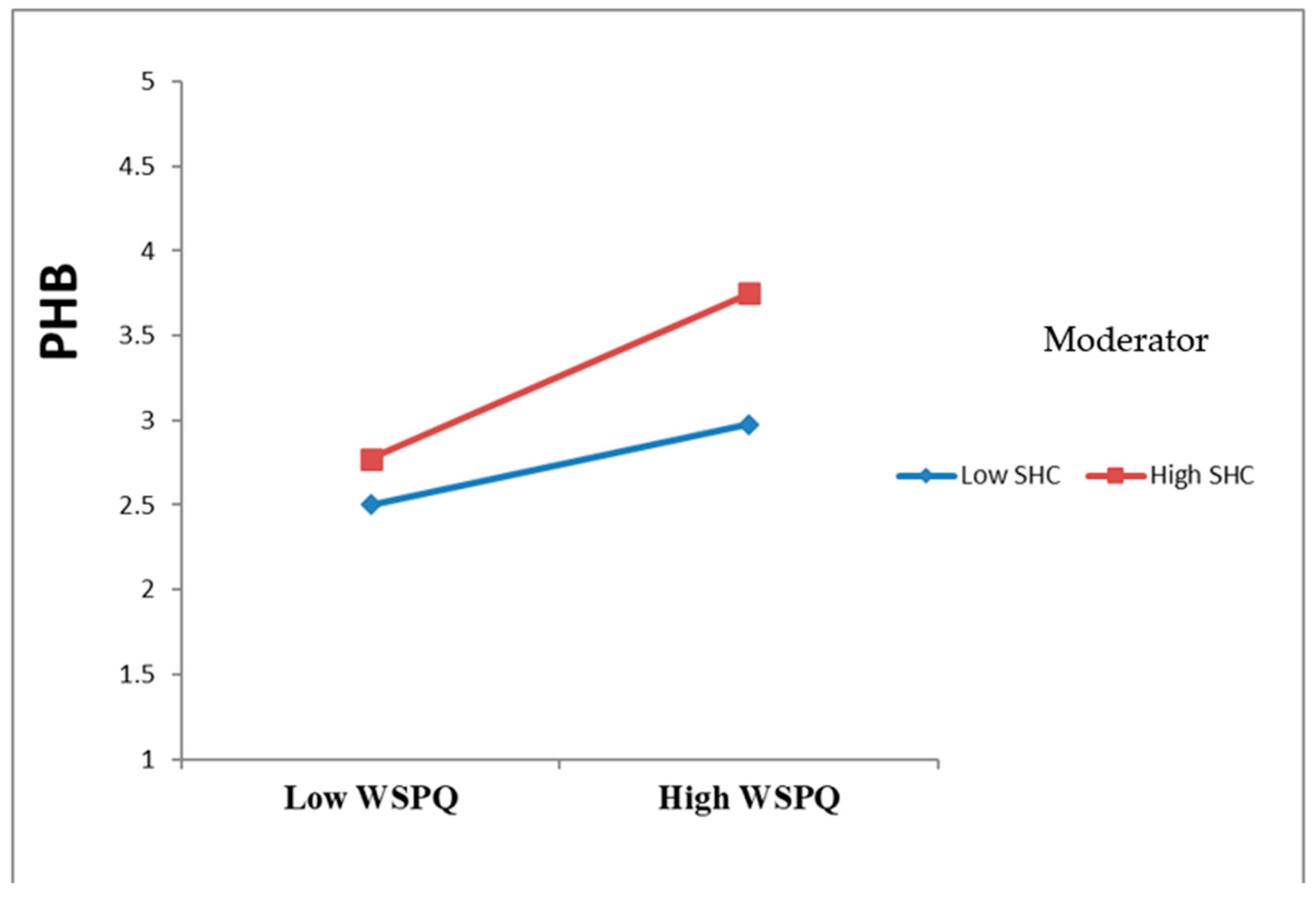
| H9: WSPQ × SHC → PHB | 0.126 | 2.537 | 0.011 | ✔ | ||
| Guest satisfaction | R2 | 0.508 | Q2 | 0.375 | ||
| Guests’ enjoyment | R2 | 0.271 | Q2 | 0.204 | ||
| Guests’ Self-Reported Physical Activity Orientation | R2 | 0.265 | Q2 | 0.200 | ||
| Guests’ loyalty intentions | R2 | 0.269 | Q2 | 0.201 | ||
| Guests’ perceived health benefits | R2 | 0.260 | Q2 | 0.195 | ||
Disclaimer/Publisher’s Note: The statements, opinions and data contained in all publications are solely those of the individual author(s) and contributor(s) and not of MDPI and/or the editor(s). MDPI and/or the editor(s) disclaim responsibility for any injury to people or property resulting from any ideas, methods, instructions or products referred to in the content. |
© 2026 by the authors. Licensee MDPI, Basel, Switzerland. This article is an open access article distributed under the terms and conditions of the Creative Commons Attribution (CC BY) license.
Share and Cite
Zamil, A.M.; Abdelghani, A.A.A.; Ahmed, H.A.M.; Fayyad, S. How Sport-Based Wellness Program Quality Shapes Co-Created Guest Experience, Loyalty Intentions, and Self-Reported Physical Activity Orientation in Saudi Arabian Hotels. Adm. Sci. 2026, 16, 367. https://doi.org/10.3390/admsci16080367
Zamil AM, Abdelghani AAA, Ahmed HAM, Fayyad S. How Sport-Based Wellness Program Quality Shapes Co-Created Guest Experience, Loyalty Intentions, and Self-Reported Physical Activity Orientation in Saudi Arabian Hotels. Administrative Sciences. 2026; 16(8):367. https://doi.org/10.3390/admsci16080367
Chicago/Turabian StyleZamil, Ahmad M., Abdelrahman A. A. Abdelghani, Hebatallah A. M. Ahmed, and Sameh Fayyad. 2026. "How Sport-Based Wellness Program Quality Shapes Co-Created Guest Experience, Loyalty Intentions, and Self-Reported Physical Activity Orientation in Saudi Arabian Hotels" Administrative Sciences 16, no. 8: 367. https://doi.org/10.3390/admsci16080367
APA StyleZamil, A. M., Abdelghani, A. A. A., Ahmed, H. A. M., & Fayyad, S. (2026). How Sport-Based Wellness Program Quality Shapes Co-Created Guest Experience, Loyalty Intentions, and Self-Reported Physical Activity Orientation in Saudi Arabian Hotels. Administrative Sciences, 16(8), 367. https://doi.org/10.3390/admsci16080367