Green Office Practices from a Sustainable Organizational Management Perspective: A Systematic Review of Environmental Management, Green HRM and Employee Pro-Environmental Behaviour


Abstract
1. Introduction
- RQ1: How are green office practices conceptualized and implemented as part of sustainable organizational management?
- RQ2: Which organizational mechanisms support or constrain green office implementation, including environmental management, Green HRM, leadership, organizational culture, workplace conditions and managerial support?
- RQ3: How does employee pro-environmental behaviour contribute to the enactment and effectiveness of green office practices in organizational and workplace settings?
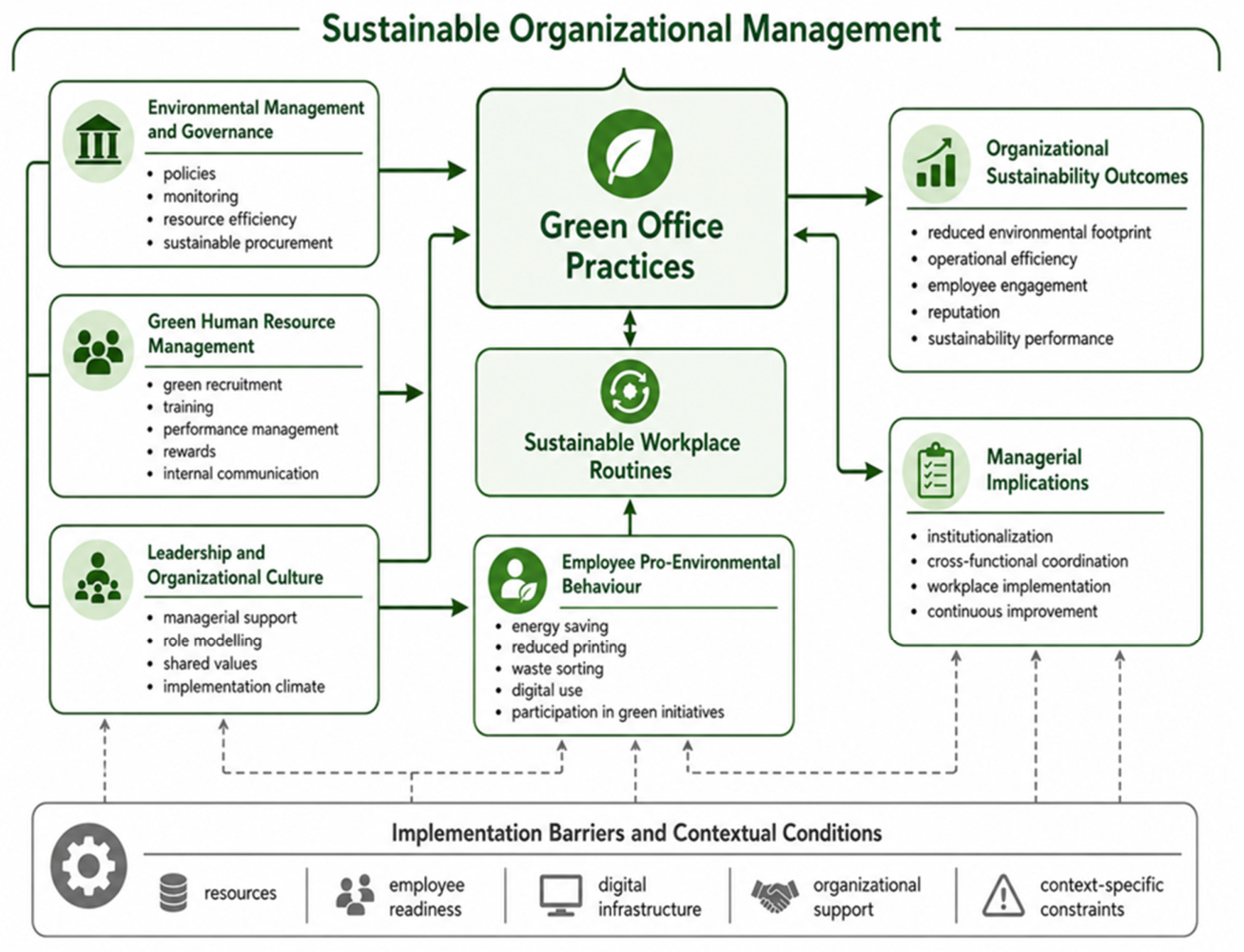
- RQ4: How can green office practices be understood as an integrated socio-organizational system connecting environmental management, people-management practices, workplace routines, employee behaviour and sustainability-related outcomes?
2. Theoretical Framework
2.1. Sustainable Organizational Management
2.2. Environmental Management in Organizations
2.3. Green Office Practices
2.4. Green Human Resource Management
2.5. Employee Pro-Environmental Behaviour
3. Materials and Methods
3.1. Research Design
3.2. Search Strategy
3.3. Inclusion and Exclusion Criteria
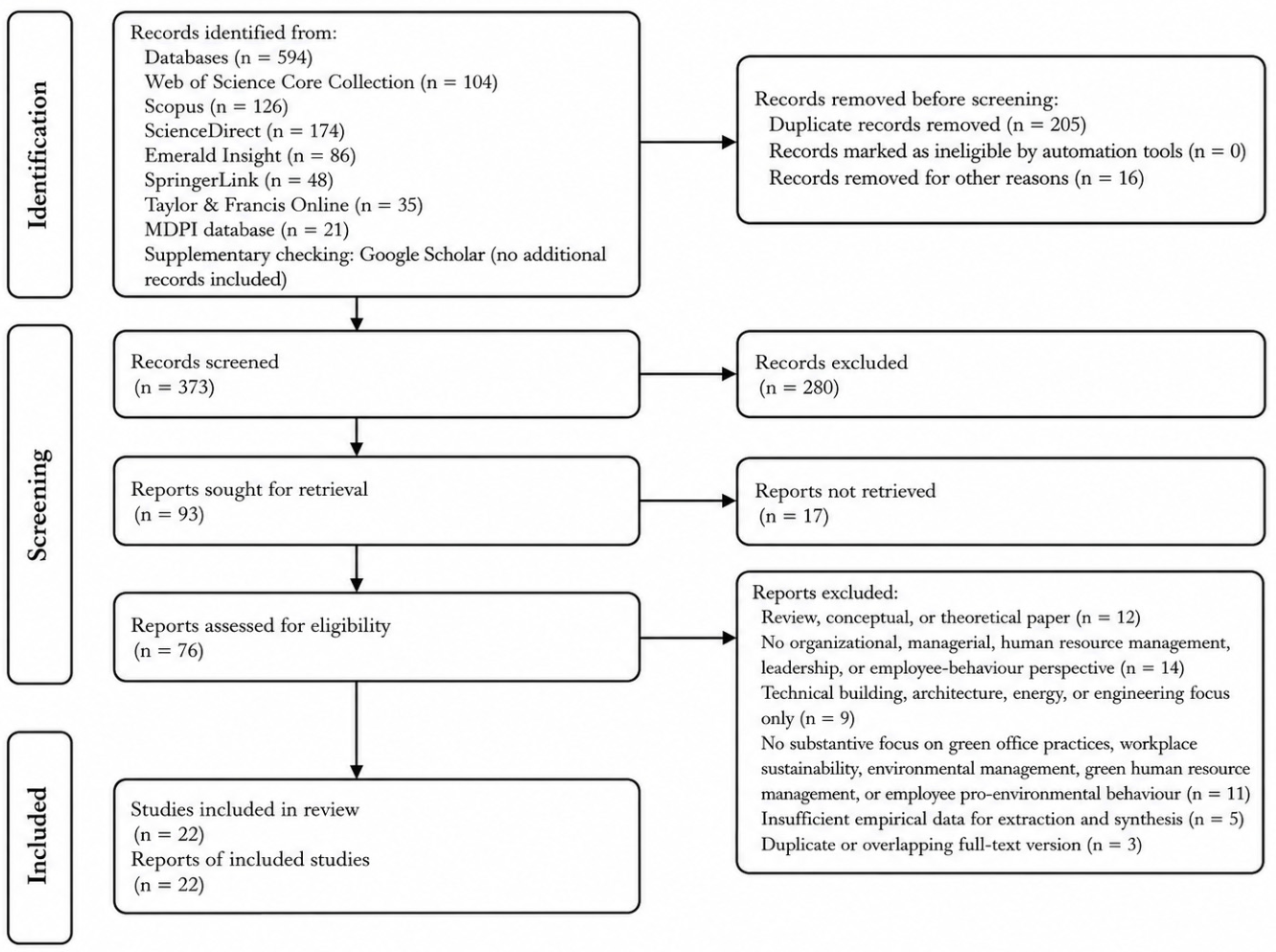
3.4. Data Selection and Extraction
3.5. Study Selection
3.6. Quality Appraisal
3.7. Data Synthesis
4. Results
4.1. Study Selection Results
4.2. Characteristics of Studies
4.3. Thematic Categories and Coding Framework
5. Discussion
5.1. Green Office Practices as a Socio-Organizational Component of Sustainable Organizational Management
5.2. Environmental Management, Green HRM and Leadership as Institutional Mechanisms
5.3. Employee Pro-Environmental Behaviour as the Behavioural Pathway of Green Office Implementation
5.4. Organizational Culture, Employee Engagement and Workplace Conditions as Enabling Factors
5.5. Theoretical Contribution
5.6. Practical Implications for Organizational Management
5.7. Limitations and Future Research Directions
6. Conclusions
Funding
Institutional Review Board Statement
Informed Consent Statement
Data Availability Statement
Acknowledgments
Conflicts of Interest
References
- Ababneh, O. M. A. (2021). How do green HRM practices affect employees’ green behaviors? The role of employee engagement and personality attributes. Journal of Environmental Planning and Management, 64(7), 1204–1226. [Google Scholar] [CrossRef] [Scilit]
- Aboramadan, M. (2022). The effect of green HRM on employee green behaviors in higher education: The mediating mechanism of green work engagement. International Journal of Organizational Analysis, 30(1), 7–23. [Google Scholar] [CrossRef] [Scilit]
- Adomßent, M., Grahl, A., & Spira, F. (2019). Putting sustainable campuses into force. International Journal of Sustainability in Higher Education, 20(3), 470–481. [Google Scholar] [CrossRef] [Scilit]
- Afsar, B., Badir, Y., & Kiani, U. S. (2016). Linking spiritual leadership and employee pro-environmental behavior: The influence of workplace spirituality, intrinsic motivation, and environmental passion. Journal of Environmental Psychology, 45, 79–88. [Google Scholar] [CrossRef] [Scilit]
- Afsar, B., Cheema, S., & Javed, F. (2018). Activating employee’s pro-environmental behaviors: The role of CSR, organizational identification, and environmentally specific servant leadership. Corporate Social Responsibility and Environmental Management, 25(5), 904–911. [Google Scholar] [CrossRef] [Scilit]
- Ahmad, J., Al Mamun, A., Masukujjaman, M., Makhbul, Z. K. M., & Ali, K. A. M. (2023). Modeling the workplace pro-environmental behavior through green human resource management and organizational culture: Evidence from an emerging economy. Heliyon, 9(9), e19134. [Google Scholar] [CrossRef] [Scilit] [PubMed]
- Al Doghan, M. A., Abdelwahed, N. A. A., Soomro, B. A., & Alayis, M. M. H. A. (2022). Organizational environmental culture, environmental sustainability and performance: The mediating role of green HRM and green innovation. Sustainability, 14(12), 7510. [Google Scholar] [CrossRef] [Scilit]
- Alherimi, N., Marva, Z., Hamarsheh, K., & Alzaatreh, A. (2024). Employees’ pro-environmental behavior in an organization: A case study in the UAE. Scientific Reports, 14(1), 15371. [Google Scholar] [CrossRef] [Scilit] [PubMed]
- Ali, S. M., Belal, H. M., Roy, S., Rahman, T., & Raihan, A. S. (2025). Examining the role of soft dimensions on the implementation of ISO 14000 environmental management systems: A graph-theoretic approach. Annals of Operations Research, 348(3), 2049–2074. [Google Scholar] [CrossRef] [Scilit] [PubMed]
- Amrutha, V., & Geetha, S. (2020). A systematic review on green human resource management: Implications for social sustainability. Journal of Cleaner Production, 247, 119131. [Google Scholar] [CrossRef] [Scilit]
- Bangwal, D., Chaudhary, A., Kumar, R., Oberoi, S. S., & Kumar, V. (2025). Green HRM, employee pro-environmental behavior, and environmental commitment. Acta Psychologica, 258, 105153. [Google Scholar] [CrossRef] [Scilit] [PubMed]
- Blok, V., Wesselink, R., Studynka, O., & Kemp, R. (2015). Encouraging sustainability in the workplace: A survey on the pro-environmental behaviour of university employees. Journal of Cleaner Production, 106, 55–67. [Google Scholar] [CrossRef] [Scilit]
- Boiral, O., Guillaumie, L., Heras-Saizarbitoria, I., & Tene, C. V. T. (2018). Adoption and outcomes of ISO 14001: A systematic review. International Journal of Management Reviews, 20(2), 411–432. [Google Scholar] [CrossRef] [Scilit]
- Brazdauskas, M., & Žirnelė, L. (2020). Creating sustainable offices: Employee engagement perspective. Journal of Creativity and Business Innovation, 6, 60–77. [Google Scholar]
- Bulińska-Stangrecka, H., & Bagieńska, A. (2021). Culture-based green workplace practices as a means of conserving energy and other natural resources in the manufacturing sector. Energies, 14(19), 6305. [Google Scholar] [CrossRef] [Scilit]
- Carbone, E., Feraco, T., Innocenti, I., Musicanti, M., Volpe, P., & Meneghetti, C. (2024). Green workplace behaviors: Can employees make the difference? Sustainability, 16(24), 11188. [Google Scholar] [CrossRef] [Scilit]
- Charisi, V., Zafeiroudi, A., Trigonis, I., Tsartsapakis, I., & Kouthouris, C. (2025). The impact of green spaces on workplace creativity: A systematic review of nature-based activities and employee well-being. Sustainability, 17(2), 390. [Google Scholar] [CrossRef] [Scilit]
- Chen, T., & Wu, Z. (2022). How to facilitate employees’ green behavior? The joint role of green human resource management practice and green transformational leadership. Frontiers in Psychology, 13, 906869. [Google Scholar] [CrossRef] [Scilit] [PubMed]
- Chreif, M., & Farmanesh, P. (2022). Applying green human resource practices toward sustainable workplace: A moderated mediation analysis. Sustainability, 14(15), 9250. [Google Scholar] [CrossRef] [Scilit]
- Dumont, J., Shen, J., & Deng, X. (2017). Effects of green HRM practices on employee workplace green behavior: The role of psychological green climate and employee green values. Human Resource Management, 56(4), 613–627. [Google Scholar] [CrossRef] [Scilit]
- Fawehinmi, O., Yusliza, M. Y., Kasim, W. Z. W., Mohamad, Z., & Halim, M. A. S. A. (2020). Exploring the interplay of green human resource management, employee green behavior, and personal moral norms. Sage Open, 10(4), 2158244020982292. [Google Scholar] [CrossRef] [Scilit]
- Ferrón-Vílchez, V. (2016). Does symbolism benefit environmental and business performance in the adoption of ISO 14001? Journal of Environmental Management, 183, 882–894. [Google Scholar] [CrossRef] [Scilit] [PubMed]
- Francoeur, V., Paillé, P., Yuriev, A., & Boiral, O. (2021). The measurement of green workplace behaviors: A systematic review. Organization & Environment, 34(1), 18–42. [Google Scholar] [CrossRef] [Scilit]
- Hong, Q. N., Pluye, P., Fàbregues, S., Bartlett, G., Boardman, F., Cargo, M., Dagenais, P., Gagnon, M.-P., Griffiths, F., Nicolau, B., O’Cathain, A., Rousseau, M.-C., & Vedel, I. (2018). Mixed methods appraisal tool (MMAT), version 2018. Registration of Copyright (#1148552). Canadian Intellectual Property Office, Industry Canada.
- Hooi, L. W., Liu, M., & Lin, J. J. (2022). Green human resource management and green organizational citizenship behavior: Do green culture and green values matter? International Journal of Manpower, 43(3), 763–785. [Google Scholar] [CrossRef] [Scilit]
- ISO. (2026). Environmental management systems—Requirements with guidance for use. ISO Standard No. 14001:2026. International Organization for Standardization. [Google Scholar]
- Joy-Camacho, W., & Thornhill, I. (2024). Opportunities and limitations to environmental management system (EMS) implementation in UK small and medium enterprises (SMEs)—A systematic review. Journal of Environmental Management, 367, 121749. [Google Scholar] [CrossRef] [Scilit] [PubMed]
- Katz, I. M., Rauvola, R. S., Rudolph, C. W., & Zacher, H. (2022). Employee green behavior: A meta-analysis. Corporate Social Responsibility and Environmental Management, 29(5), 1146–1157. [Google Scholar] [CrossRef] [Scilit]
- Khan, N. U., Cheng, J., Yasir, M., Saufi, R. A., Nawi, N. C., & Bazkiaei, H. A. (2022). Antecedents of employee green behavior in the hospitality industry. Frontiers in Psychology, 13, 836109. [Google Scholar] [CrossRef] [Scilit] [PubMed]
- Kim, S., Kim, M., Han, H., & Holland, S. (2016). The determinants of hospitality employees’ pro-environmental behaviors: The moderating role of generational differences. International Journal of Hospitality Management, 52, 56–67. [Google Scholar] [CrossRef] [Scilit]
- Legese, M. A., Zhou, S., Tiruneh, W. A., & Ying, H. (2026). How green HRM enhances sustainable organizational performance: A capability-building explanation through green innovation and organizational culture. Sustainability, 18(2), 764. [Google Scholar] [CrossRef] [Scilit]
- Li, W., Abdalla, A. A., Mohammad, T., Khassawneh, O., & Parveen, M. (2023). Towards examining the link between green HRM practices and employee green in-role behavior: Spiritual leadership as a moderator. Psychology Research and Behavior Management, 16, 383–396. [Google Scholar] [CrossRef] [Scilit] [PubMed]
- Malik, S. Y., Cao, Y., Mughal, Y. H., Kundi, G. M., Mughal, M. H., & Ramayah, T. (2020). Pathways towards sustainability in organizations: Empirical evidence on the role of green human resource management practices and green intellectual capital. Sustainability, 12(8), 3228. [Google Scholar] [CrossRef] [Scilit]
- Mansoor, A., Farrukh, M., Lee, J., & Jahan, S. (2021). Stimulation of employees’ green creativity through green transformational leadership and management initiatives. Sustainability, 13(14), 7844. [Google Scholar] [CrossRef] [Scilit]
- Martín-de Castro, G., Amores-Salvadó, J., & Navas-López, J. E. (2016). Environmental management systems and firm performance: Improving firm environmental policy through stakeholder engagement. Corporate Social Responsibility and Environmental Management, 23(4), 243–256. [Google Scholar] [CrossRef] [Scilit]
- Mohd Razali, M., Bashirun, S. N., & Jislan, F. (2022). Green office concept: Study among employees in government organizations. Advances in Business Research International Journal, 8(2), 49–56. [Google Scholar] [CrossRef] [Scilit]
- Mousa, S. K., & Othman, M. (2020). The impact of green human resource management practices on sustainable performance in healthcare organisations: A conceptual framework. Journal of Cleaner Production, 243, 118595. [Google Scholar] [CrossRef] [Scilit]
- Nieuwenhuis, M., Knight, C., Postmes, T., & Haslam, S. A. (2014). The relative benefits of green versus lean office space: Three field experiments. Journal of Experimental Psychology: Applied, 20(3), 199–214. [Google Scholar] [CrossRef] [Scilit] [PubMed]
- Norton, T. A., Zacher, H., Parker, S. L., & Ashkanasy, N. M. (2017). Bridging the gap between green behavioral intentions and employee green behavior: The role of green psychological climate. Journal of Organizational Behavior, 38(7), 996–1015. [Google Scholar] [CrossRef] [Scilit]
- Omarova, L., & Jo, S. (2022). Employee pro-environmental behavior: The impact of environmental transformational leadership and GHRM. Sustainability, 14(4), 2046. [Google Scholar] [CrossRef] [Scilit]
- Opoku-Dakwa, A., Chen, C. C., & Rupp, D. E. (2018). CSR initiative characteristics and employee engagement: An impact-based perspective. Journal of Organizational Behavior, 39(5), 580–593. [Google Scholar] [CrossRef] [Scilit]
- Page, M. J., McKenzie, J. E., Bossuyt, P. M., Boutron, I., Hoffmann, T. C., Mulrow, C. D., Shamseer, L., Tetzlaff, J. M., Akl, E. A., Brennan, S. E., Chou, R., Glanville, J., Grimshaw, J. M., Hróbjartsson, A., Lalu, M. M., Li, T., Loder, E. W., Mayo-Wilson, E., McDonald, S., … Moher, D. (2021). The PRISMA 2020 statement: An updated guideline for reporting systematic reviews. BMJ, 372, n71. [Google Scholar] [CrossRef] [Scilit] [PubMed]
- Paillé, P., Valéau, P., & Renwick, D. W. (2020). Leveraging green human resource practices to achieve environmental sustainability. Journal of Cleaner Production, 260, 121137. [Google Scholar] [CrossRef] [Scilit]
- Parida, S., Ananthram, S., Chan, C., & Brown, K. (2021). Green office buildings and sustainability: Does green human resource management elicit green behaviors? Journal of Cleaner Production, 329, 129764. [Google Scholar] [CrossRef] [Scilit]
- Pasharibu, Y., Sugiarto, A., Ariarsanti, T., & Wijayanto, P. (2019). Dimensions of green office evidence from regency/city government offices in central java, Indonesia. Business: Theory and Practice, 20, 391–402. [Google Scholar] [CrossRef] [Scilit]
- Pellegrini, C., Rizzi, F., & Frey, M. (2018). The role of sustainable human resource practices in influencing employee behavior for corporate sustainability. Business Strategy and the Environment, 27(8), 1221–1232. [Google Scholar] [CrossRef] [Scilit]
- Pillai, B. B., & Joseph, R. P. (2026). The effect of perceived corporate sustainability on pro-environmental behavior and innovation in sustainability: Examining the role of employee engagement. Strategy & Leadership, 54, 1–33. [Google Scholar] [CrossRef] [Scilit]
- Rasheed, E. O., & Rotimi, J. O. B. (2024). The green office environment: New Zealand workers’ perception of IEQ. Smart and Sustainable Built Environment, 13(5), 1240–1259. [Google Scholar] [CrossRef] [Scilit]
- Ribeiro, N., Gomes, D. R., Ortega, E., Gomes, G. P., & Semedo, A. S. (2022). The impact of green HRM on employees’ eco-friendly behavior: The mediator role of organizational identification. Sustainability, 14(5), 2897. [Google Scholar] [CrossRef] [Scilit]
- Roscoe, S., Subramanian, N., Jabbour, C. J., & Chong, T. (2019). Green human resource management and the enablers of green organisational culture: Enhancing a firm’s environmental performance for sustainable development. Business Strategy and the Environment, 28(5), 737–749. [Google Scholar] [CrossRef] [Scilit]
- Saifulina, N., Carballo-Penela, A., & Ruzo-Sanmartín, E. (2020). Sustainable HRM and green HRM: The role of green HRM in influencing employee pro-environmental behavior at work. Journal of Sustainability Research, 2(3), e200026. [Google Scholar] [CrossRef] [Scilit]
- Srikolchan, A., Monprapussorn, S., & Sitthi, A. (2025). Factors influencing participation and engagement in green office operation at faculty of social sciences, Srinakharinwirot University. Frontiers in Sustainability, 6, 1613162. [Google Scholar] [CrossRef] [Scilit]
- Tandon, A., Dhir, A., Madan, P., Srivastava, S., & Nicolau, J. L. (2023). Green and non-green outcomes of green human resource management (GHRM) in the tourism context. Tourism Management, 98, 104765. [Google Scholar] [CrossRef] [Scilit]
- Tang, G., Chen, Y., Jiang, Y., Paillé, P., & Jia, J. (2018). Green human resource management practices: Scale development and validity. Asia Pacific Journal of Human Resources, 56(1), 31–55. [Google Scholar] [CrossRef] [Scilit]
- Tang, G., Ren, S., Wang, M., Li, Y., & Zhang, S. (2023). Employee green behaviour: A review and recommendations for future research. International Journal of Management Reviews, 25(2), 297–317. [Google Scholar] [CrossRef] [Scilit]
- Tanova, C., & Bayighomog, S. W. (2022). Green human resource management in service industries: The construct, antecedents, consequences, and outlook. The Service Industries Journal, 42(5-6), 412–452. [Google Scholar] [CrossRef] [Scilit]
- Tian, Q., & Robertson, J. L. (2019). How and when does perceived CSR affect employees’ engagement in voluntary pro-environmental behavior? Journal of Business Ethics, 155(2), 399–412. [Google Scholar] [CrossRef] [Scilit]
- Unsworth, K. L., Davis, M. C., Russell, S. V., & Bretter, C. (2021). Employee green behaviour: How organizations can help the environment. Current Opinion in Psychology, 42, 1–6. [Google Scholar] [CrossRef] [Scilit] [PubMed]
- Wesselink, R., Blok, V., & Ringersma, J. (2017). Pro-environmental behaviour in the workplace and the role of managers and organisation. Journal of Cleaner Production, 168, 1679–1687. [Google Scholar] [CrossRef] [Scilit]
- Xiao, J., Mao, J., Huang, S., & Qing, T. (2020). Employee-organization fit and voluntary green behavior: A cross-level model examining the role of perceived insider status and green organizational climate. International Journal of Environmental Research and Public Health, 17(7), 2193. [Google Scholar] [CrossRef] [Scilit] [PubMed]
- Yong, J. Y., Yusliza, M., Ramayah, T., Jabbour, C. J. C., Sehnem, S., & Mani, V. (2020). Pathways towards sustainability in manufacturing organizations: Empirical evidence on the role of green human resource management. Business Strategy and the Environment, 29(1), 212–228. [Google Scholar] [CrossRef] [Scilit]
- Yuan, B., & Li, J. (2022). Understanding the impact of environmentally specific servant leadership on employees’ pro-environmental behaviors in the workplace: Based on the proactive motivation model. International Journal of Environmental Research and Public Health, 20(1), 567. [Google Scholar] [CrossRef] [Scilit] [PubMed]
- Yuriev, A., Dahmen, M., Paillé, P., Boiral, O., & Guillaumie, L. (2020). Pro-environmental behaviors through the lens of the theory of planned behavior: A scoping review. Resources, Conservation and Recycling, 155, 104660. [Google Scholar] [CrossRef] [Scilit]
- Zacher, H., Rudolph, C. W., & Katz, I. M. (2023). Employee green behavior as the core of environmentally sustainable organizations. Annual Review of Organizational Psychology and Organizational Behavior, 10(1), 465–494. [Google Scholar] [CrossRef] [Scilit]
- Zafar, H., & Suseno, Y. (2024). Examining the effects of green human resource management practices, green psychological climate, and organizational pride on employees’ voluntary pro-environmental behavior. Organization & Environment, 37(4), 581–609. [Google Scholar] [CrossRef] [Scilit]
- Zhang, X., Panatik, S. A., & Zhang, N. (2024). Employee green behavior: Bibliometric-content analysis. Heliyon, 10(10), e31045. [Google Scholar] [CrossRef] [Scilit] [PubMed]
- Zhu, J., Tang, W., Wang, H., & Chen, Y. (2021). The influence of green human resource management on employee green behavior—A study on the mediating effect of environmental belief and green organizational identity. Sustainability, 13(8), 4544. [Google Scholar] [CrossRef] [Scilit]



| Study | Research Question(s) Addressed | Contribution to the Research Questions |
|---|---|---|
| Nieuwenhuis et al. (2014) | RQ1, RQ2, RQ4 | Provides field-experimental evidence that green office space can influence satisfaction, perceived air quality and productivity, supporting the interpretation of green offices as workplace environments with organizational and behavioural relevance. |
| Blok et al. (2015) | RQ2, RQ3, RQ4 | Shows that workplace pro-environmental behaviour among university employees is shaped by both individual motivation and organizational conditions, contributing to the behavioural and contextual dimensions of the synthesis. |
| Pasharibu et al. (2019) | RQ1, RQ2 | Identifies dimensions of green office implementation in government offices and highlights organizational support as a condition for translating green office concepts into public-sector practice. |
| Fawehinmi et al. (2020) | RQ2, RQ3, RQ4 | Examines the relationship between green human resource management, personal moral norms and employee green behaviour, contributing evidence on how people-management practices shape workplace environmental behaviour. |
| Saifulina et al. (2020) | RQ2, RQ3, RQ4 | Links sustainable and green human resource management with employee pro-environmental behaviour at work, supporting the role of human resource management as an organizational mechanism for environmental practice. |
| Xiao et al. (2020) | RQ2, RQ3, RQ4 | Shows that employee–organization fit, perceived insider status and green organizational climate influence voluntary green behaviour, contributing to the cultural and climate-related explanation of employee behaviour. |
| Parida et al. (2021) | RQ1, RQ2, RQ4 | Connects green office buildings with green human resource management and green behaviours, providing evidence that physical workplace conditions and human resource systems should be interpreted together. |
| Zhu et al. (2021) | RQ2, RQ3, RQ4 | Demonstrates that green human resource management influences employee green behaviour through environmental belief and green organizational identity, strengthening the explanatory role of identity and belief mechanisms. |
| Mansoor et al. (2021) | RQ2, RQ3, RQ4 | Shows that green transformational leadership and management initiatives stimulate employees’ green creativity, contributing to the leadership and managerial-support dimension of green workplace practices. |
| Ribeiro et al. (2022) | RQ2, RQ3, RQ4 | Shows that green human resource management promotes employees’ eco-friendly behaviour through organizational identification, supporting the role of identification as a behavioural mechanism. |
| Omarova and Jo (2022) | RQ2, RQ3, RQ4 | Examines the impact of environmental transformational leadership and green human resource management on employee pro-environmental behaviour, contributing evidence on the combined influence of leadership and human resource practices. |
| Chen and Wu (2022) | RQ2, RQ3, RQ4 | Shows that green human resource management and green transformational leadership jointly facilitate employee green behaviour, supporting the integrated leadership–human resource management interpretation. |
| Khan et al. (2022) | RQ2, RQ3 | Identifies antecedents of employee green behaviour in the hospitality sector, contributing evidence on individual and organizational predictors of workplace environmental behaviour. |
| Mohd Razali et al. (2022) | RQ1, RQ2 | Examines the green office concept among employees in government organizations and shows the importance of employee awareness and acceptance for implementation. |
| Li et al. (2023) | RQ2, RQ3, RQ4 | Examines the relationship between green human resource management practices and employee green in-role behaviour, with spiritual leadership as a moderator, strengthening the leadership and human resource management perspective. |
| Ahmad et al. (2023) | RQ2, RQ3, RQ4 | Models workplace pro-environmental behaviour through green human resource management and organizational culture, contributing directly to the organizational-culture and behavioural mechanisms of the review. |
| Tandon et al. (2023) | RQ2, RQ4 | Examines green and non-green outcomes of green human resource management in tourism, contributing evidence on broader organizational outcomes and sectoral conditions. |
| Rasheed and Rotimi (2024) | RQ1, RQ2, RQ4 | Examines workers’ perceptions of indoor environmental quality in green office environments, supporting the inclusion of workplace conditions in the interpretation of green office practices. |
| Alherimi et al. (2024) | RQ2, RQ3 | Provides case-based evidence on employee pro-environmental behaviour in an organizational context, contributing to the analysis of behavioural drivers and contextual conditions. |
| Carbone et al. (2024) | RQ2, RQ3, RQ4 | Explores green workplace behaviours and the role employees can play in sustainability, contributing to the interpretation of employees as active agents of green workplace practice. |
| Bangwal et al. (2025) | RQ2, RQ3, RQ4 | Examines green human resource management, employee pro-environmental behaviour and environmental commitment, contributing evidence on commitment as a mechanism linking human resource practices and behaviour. |
| Srikolchan et al. (2025) | RQ1, RQ2, RQ4 | Examines factors influencing participation and engagement in green office operation, emphasizing training, communication, collaboration and recognition as implementation mechanisms. |
| PRISMA-Related Element | Operational Description Included in the Main Manuscript |
|---|---|
| Eligibility criteria | The main text specifies that eligible studies had to be peer-reviewed original empirical articles, published in English between 2014 and 2026, available in full text and relevant to at least one central review domain. Organizational or workplace relevance was required and is operationalized in Section 3.3 through indicators such as office-based, administrative, service-oriented, public-sector, private-sector, higher-education or broader work-related context; managerial, HRM, leadership, organizational-culture or employee-behaviour perspective; and empirical evidence on workplace-level environmental practices or sustainable organizational management. |
| Databases and supplementary sources | The main searches were conducted in Web of Science Core Collection and Scopus. Supplementary searches were conducted in ScienceDirect, Emerald Insight, SpringerLink, Taylor & Francis Online and the MDPI database. Google Scholar was used only as a supplementary checking source. All sources were screened against the same eligibility criteria, and the database-specific strings are presented in Table 3. |
| Boolean search logic | The main text includes the Boolean logic used across databases: green office or green workplace terms were combined with environmental management, Green HRM, leadership, organizational culture and employee green behaviour or employee pro-environmental behaviour terms, together with organizational, workplace, office-based, administrative and employee-related terms. The exact syntax was adapted to each database, while the conceptual search structure remained consistent. |
| Screening and deduplication | All retrieved records were entered into a structured screening table. Duplicate records were removed before screening by comparing titles, authors, publication years, journal names and DOIs. Title and abstract screening then removed clearly irrelevant records, while potentially relevant, ambiguous or borderline records were retained for full-text eligibility assessment to reduce the risk of premature exclusion. |
| Full-text eligibility and exclusions | Full-text reports were assessed against operational criteria covering original empirical design, English-language publication, publication period, full-text availability, organizational or workplace relevance, methodological transparency and substantive relevance to the review questions. The exclusion categories used in the review were: review, conceptual or theoretical paper; no organizational, managerial, HRM, leadership or employee-behaviour perspective; technical building, architecture, energy or engineering focus only; no substantive focus on the review topic; insufficient empirical data for extraction and synthesis; and duplicate or overlapping full-text version. |
| Data extraction | The main text specifies the data-extraction fields: author(s), year of publication, country or region, methodology, sample or data source, organizational or workplace context, research focus, key constructs, key findings and relevance to the review questions. These fields were used to create the study-characteristics table and to support the thematic synthesis. |
| Quality appraisal | The main text reports the six-criterion, MMAT-informed quality-appraisal framework. Each study was assessed for clarity of research aim, appropriateness of empirical methodology, description of sample or data source, explanation of data-collection and data-analysis procedures, clarity of findings, and thematic relevance. Ratings distinguished between adequate, partially adequate and insufficient reporting. |
| Synthesis | Because the included studies were methodologically and conceptually heterogeneous, findings were synthesized qualitatively through structured extraction, deductive and inductive coding, thematic grouping and interpretive comparison. The main text explains that the review did not use statistical pooling or meta-analysis and that risk of bias was addressed through appraisal of methodological transparency, reporting quality, design heterogeneity and cautious interpretation of findings. |
| Database | Search Formula |
|---|---|
| Web of Science Core Collection | Topic field: (“green office” OR “green office practices” OR “green workplace” OR “sustainable workplace” OR “workplace sustainability”) AND (“environmental management” OR “organizational sustainability” OR “sustainable organizational management”) AND (“green human resource management” OR “employee green behaviour” OR “employee green behavior” OR “employee pro-environmental behaviour” OR “employee pro-environmental behavior” OR “green leadership” OR “green organizational culture”) |
| Scopus | Title, abstract and keywords: (“green office” OR “green office practices” OR “green workplace” OR “sustainable workplace” OR “workplace sustainability”) AND (“environmental management” OR “organizational sustainability” OR “sustainable organizational management”) AND (“green human resource management” OR “employee green behaviour” OR “employee green behavior” OR “employee pro-environmental behaviour” OR “employee pro-environmental behavior” OR “green leadership” OR “green organizational culture”) |
| ScienceDirect | Title, abstract or keywords: (“green office” OR “green office practices” OR “green workplace” OR “sustainable workplace” OR “workplace sustainability”) AND (“environmental management” OR “organizational sustainability” OR “sustainable organizational management”) AND (“green human resource management” OR “employee green behaviour” OR “employee green behavior” OR “employee pro-environmental behaviour” OR “employee pro-environmental behavior” OR “green leadership” OR “green organizational culture”) |
| Emerald Insight | Advanced search, all fields: (“green office” OR “green office practices” OR “green workplace” OR “sustainable workplace” OR “workplace sustainability”) AND (“environmental management” OR “organizational sustainability” OR “sustainable organizational management”) AND (“green human resource management” OR “employee green behaviour” OR “employee green behavior” OR “employee pro-environmental behaviour” OR “employee pro-environmental behavior” OR “green leadership” OR “green organizational culture”) |
| SpringerLink | Advanced search: (“green office” OR “green office practices” OR “green workplace” OR “sustainable workplace” OR “workplace sustainability”) AND (“environmental management” OR “organizational sustainability” OR “sustainable organizational management”) AND (“green human resource management” OR “employee green behaviour” OR “employee green behavior” OR “employee pro-environmental behaviour” OR “employee pro-environmental behavior” OR “green leadership” OR “green organizational culture”) |
| Taylor and Francis Online | Advanced search: (“green office” OR “green office practices” OR “green workplace” OR “sustainable workplace” OR “workplace sustainability”) AND (“environmental management” OR “organizational sustainability” OR “sustainable organizational management”) AND (“green human resource management” OR “employee green behaviour” OR “employee green behavior” OR “employee pro-environmental behaviour” OR “employee pro-environmental behavior” OR “green leadership” OR “green organizational culture”) |
| MDPI database | Title, abstract and keywords: (“green office” OR “green office practices” OR “green workplace” OR “sustainable workplace” OR “workplace sustainability”) AND (“environmental management” OR “organizational sustainability” OR “sustainable organizational management”) AND (“green human resource management” OR “employee green behaviour” OR “employee green behavior” OR “employee pro-environmental behaviour” OR “employee pro-environmental behavior” OR “green leadership” OR “green organizational culture”) |
| Inclusion Criteria | Exclusion Criteria |
|---|---|
| Peer-reviewed original scientific articles. | Review articles, systematic reviews, scoping reviews, meta-analyses, editorials, commentaries, opinion papers, books, book chapters, conference papers, protocols, reports, theses, dissertations and non-peer-reviewed publications. |
| Quantitative, qualitative or mixed-method empirical studies with a clearly described aim, methodology, sample or data source and reported findings. | Purely theoretical, conceptual, argumentative or descriptive papers without original empirical data. |
| Full text published in English. | Full text published in languages other than English. |
| Studies published from 2014 to 2026. | Studies published before 2014 or after 2026. |
| Full-text articles publicly available through open access, publisher websites, institutional repositories or other publicly accessible academic sources. | Articles without publicly accessible full text. |
| Studies addressing green office practices, green workplace practices, sustainable office environments, workplace sustainability or sustainable workplace practices. | Studies with no substantive focus on green office practices, green workplace practices, sustainable office environments, workplace sustainability or sustainable workplace practices. |
| Studies examining environmental management, environmental performance, organizational environmental management, corporate sustainability or sustainable organizational management in organizational or workplace settings. | Studies addressing environmental policy, national sustainability, macroeconomic sustainability, urban sustainability or industry-level sustainability without a clear organizational or workplace-level focus. |
| Studies examining green human resource management, sustainable human resource management, green training, employee involvement, green leadership, environmental leadership, organizational culture, managerial support or employee engagement in relation to environmental sustainability. | Studies addressing human resource management, leadership, organizational culture, managerial support or employee engagement without a clear environmental or sustainability-related dimension. |
| Studies examining employee green behaviour, employee pro-environmental behaviour, workplace pro-environmental behaviour, environmental citizenship behaviour, employee environmental awareness or employee participation in green workplace initiatives. | Studies focusing only on consumers, households, students as a general population, citizens or the general public without an organizational or workplace context. |
| Studies situated in office-based, administrative, service-oriented, public-sector, private-sector, higher-education or broader organizational workplace contexts. | Studies focusing exclusively on architecture, construction, building technology, energy efficiency, indoor environmental quality or engineering solutions without a clear organizational, managerial, workplace or employee-related dimension. |
| Studies not explicitly using the term green office but providing empirically relevant evidence on green workplace practices, employee environmental behaviour, green human resource management, leadership, organizational culture or organizational sustainability. | Records with insufficient methodological or substantive information to allow data extraction and thematic synthesis. |
| Where duplicate versions of the same study were identified, the most complete and methodologically informative version was retained. | Duplicate or overlapping records; where duplicate versions existed, less complete versions were excluded. |
| Study | Region | Year | Method | Sample/Data Source | Key Variables/Research Focus | Key Findings |
|---|---|---|---|---|---|---|
| Nieuwenhuis et al. | United Kingdom/The Netherlands | 2014 | Three field experiments | Office workers in real workplace settings | Green versus lean office space; plants; productivity; satisfaction | Green office space was associated with higher workplace satisfaction, perceived air quality, and productivity. |
| Blok et al. | The Netherlands | 2015 | Survey research | University employees | Workplace sustainability; pro-environmental behaviour; organizational context | Employee pro-environmental behaviour was shaped by individual motivation and workplace conditions. |
| Pasharibu et al. | Indonesia | 2019 | Quantitative survey | Employees in regency/city government offices | Green office dimensions; public offices; organizational implementation | Green office implementation depended on relevant dimensions of practice and organizational support. |
| Fawehinmi et al. | Malaysia | 2020 | Quantitative survey; structural equation modelling | Employees in Malaysian organizations | Green human resource management; employee green behaviour; personal moral norms | Green human resource management and personal moral norms were associated with employee green behaviour. |
| Saifulina et al. | Spain | 2020 | Empirical quantitative study | Employees in organizational settings | Sustainable human resource management; green human resource management; pro-environmental behaviour | Green human resource management influenced workplace pro-environmental behaviour. |
| Xiao et al. | China | 2020 | Cross-level quantitative model | Employees and organizational units | Employee–organization fit; voluntary green behaviour; green organizational climate | Green organizational climate strengthened the relationship between fit and voluntary green behaviour. |
| Parida et al. | India | 2021 | Empirical quantitative study | Green office building context | Green office buildings; green human resource management; employee outcomes; sustainability | Green office buildings and green human resource management were linked to employee-related sustainability outcomes. |
| Zhu et al. | China | 2021 | Quantitative survey; structural equation modelling | Employees in Chinese organizations | Green human resource management; employee green behaviour; environmental belief; green organizational identity | Green human resource management influenced employee green behaviour through environmental belief and green organizational identity. |
| Mansoor et al. | Pakistan/organizational context | 2021 | Quantitative empirical study | Employees in organizations | Green transformational leadership; management initiatives; green creativity | Leadership and management initiatives stimulated green creativity and supported environmental performance. |
| Ribeiro et al. | Portugal | 2022 | Quantitative survey; mediation analysis | Employees in organizational settings | Green human resource management; eco-friendly behaviour; organizational identification | Green human resource management promoted eco-friendly behaviour through organizational identification. |
| Omarova and Jo | Kazakhstan | 2022 | Cross-sectional online survey; structural equation modelling | Employees from private and public organizations | Environmental transformational leadership; green human resource management; employee pro-environmental behaviour | Environmental transformational leadership affected employee pro-environmental behaviour; green human resource management acted as an organizational mechanism. |
| Chen and Wu | China | 2022 | Quantitative survey; structural equation modelling | Employees in organizations | Green human resource management; green transformational leadership; employee green behaviour | Green human resource management and green transformational leadership jointly facilitated employee green behaviour. |
| Khan et al. | Hospitality sector | 2022 | Quantitative empirical study | Hospitality employees | Antecedents of employee green behaviour; organizational support; environmental values | Organizational and individual antecedents predicted employee green behaviour. |
| Mohd Razali et al. | Malaysia | 2022 | Survey study | Employees in government organizations | Green office concept; employee awareness; government organizations | Employee awareness and acceptance were important for implementing the green office concept. |
| Li et al. | China | 2023 | Quantitative survey; moderation model | Employees after the COVID-19 pandemic | Green human resource management; in-role green behaviour; spiritual leadership | Green human resource management was linked to in-role green behaviour, with leadership strengthening the relationship. |
| Ahmad et al. | Organizational workplace context | 2023 | Quantitative empirical modelling | Employees in organizations | Workplace pro-environmental behaviour; green human resource management; organizational support | Green human resource management and organizational support contributed to workplace pro-environmental behaviour. |
| Tandon et al. | Tourism context | 2023 | Empirical quantitative study | Tourism-sector employees/organizations | Green human resource management; green and non-green outcomes | Green human resource management influenced environmental and broader organizational outcomes. |
| Rasheed and Rotimi | New Zealand | 2024 | Empirical perception study | Workers in green office environments | Green office environment; indoor environmental quality; worker perception | Indoor environmental quality emerged as an important component of worker perception in green office environments. |
| Alherimi et al. | United Arab Emirates | 2024 | Case study; quantitative empirical research | Employees in an organization | Employee pro-environmental behaviour; organizational context | Organizational context was relevant for understanding employee pro-environmental behaviour. |
| Carbone et al. | Italy | 2024 | Empirical quantitative study | Employees in workplace settings | Green workplace behaviours; employee contribution; organizational antecedents | Employees contributed to green workplace behaviours when organizational conditions supported such practices. |
| Bangwal et al. | India | 2025 | Quantitative empirical study | Employees in organizational settings | Green human resource management; employee pro-environmental behaviour; environmental commitment | Green human resource management and environmental commitment were associated with employee pro-environmental behaviour. |
| Srikolchan et al. | Thailand | 2026 | Quantitative survey | Faculty members, operational staff, and students | Participation and engagement in green office operation | Training, communication, collaboration, and recognition influenced participation and engagement in green office operation. |
| No. | Thematic Category | Coding Focus | Codes and Subcodes Identified in the Analysis | Descriptive Role in the Synthesis |
|---|---|---|---|---|
| 1 | Sustainable organizational management and environmental governance | Formal organizational systems and managerial processes through which environmental goals are embedded in organizational strategy and everyday work. | Environmental management systems; corporate environmental policy; sustainable organizational management; environmental governance; environmental performance monitoring; accountability; resource efficiency; sustainability-oriented work routines; strategic alignment; policy-to-practice translation (n = 10). | This category positions green office practices within the broader field of administrative and organizational sciences. It shows how environmental intentions become part of management systems, governance routines and organizational decision-making rather than remaining isolated ecological measures. |
| 2 | Green office practices and workplace sustainability | Concrete office-level practices and operational routines that reduce the environmental footprint of everyday work. | Green office implementation; paper reduction and digitalization; energy saving; waste separation and recycling; sustainable procurement; sustainable office environment; green workplace routines; green office operation; office resource use; employee participation in office practices (n = 10). | This category captures the practical expression of sustainable organizational management in office-based and administrative work settings. It explains how sustainability is translated into visible, repeated and manageable workplace practices. |
| 3 | Green human resource management | People-management practices that support environmental goals, employee competencies and participation in green workplace behaviour. | Green recruitment and selection; green training and development; green performance management; green rewards and recognition; employee involvement; environmental competencies; internal communication; green human resource management systems; sustainable human resource management; human resource support for environmental practices (n = 10). | This category connects environmental management with human resource management. It is central for interpreting green office practices as a managerial and behavioural issue, because human resource systems can institutionalize environmental expectations, skills and motivation among employees. |
| 4 | Green leadership, managerial support and organizational culture | Leadership, supervisory support and cultural conditions that enable or constrain employee engagement in workplace sustainability. | Green transformational leadership; environmental leadership; sustainable leadership; supervisory support; managerial initiatives; role modelling; green organizational climate; green organizational identity; green organizational culture; recognition; coworker advocacy; trust and commitment (n = 12). | This category reflects the relevance of leadership, organizational behaviour and managerial processes to Administrative Sciences. It shows that green office practices require visible leadership, supportive culture and credible managerial communication to become stable organizational routines. |
| 5 | Employee green behaviour and pro-environmental workplace behaviour | Individual and collective employee behaviours through which environmental policies are enacted in daily work. | Employee green behaviour; employee pro-environmental behaviour; in-role green behaviour; extra-role or voluntary green behaviour; environmental citizenship behaviour; eco-friendly behaviour; behavioural intention; environmental awareness; personal moral norms; environmental beliefs; organizational identification; employee engagement (n = 12). | This category explains employees as active agents of organizational sustainability. It provides the behavioural mechanism through which formal environmental management, green human resource management and leadership are converted into everyday sustainable workplace action. |
| 6 | Workplace design, green buildings and indoor environmental quality | Physical and environmental characteristics of the workplace that shape employee experience, perceptions and sustainability-related behaviour. | Green office buildings; indoor environmental quality; green versus lean office space; plants; perceived air quality; lighting; ventilation; workplace comfort; employee well-being; workplace health; productivity; cognitive function; worker perceptions (n = 13). | This category prevents a purely behavioural or policy-based interpretation by showing that green office practices are also embedded in the physical work environment. For the synthesis, it clarifies how workspace design interacts with management, employee well-being and organizational performance. |
| 7 | Implementation drivers and barriers | Organizational conditions that facilitate or hinder the adoption, continuity and effectiveness of green office practices. | Training; communication; collaboration; recognition; participation opportunities; employee awareness; institutional support; leadership continuity; resource limitations; unclear responsibilities; sectoral differences; measurement inconsistency; fragmented evidence; implementation consistency (n = 14). | This category supports a critical interpretation of the evidence. It explains why green office practices may not produce uniform outcomes across organizations and why implementation depends on managerial capacity, employee involvement, organizational context and evaluation mechanisms. |
| 8 | Organizational sustainability outcomes and strategic value | Environmental, social and organizational outcomes associated with green office practices and employee-oriented sustainability mechanisms. | Environmental performance; resource reduction; green creativity; employee well-being; productivity; organizational reputation; sustainability culture; competitive advantage; stakeholder legitimacy; contribution to sustainability goals; long-term sustainable management (n = 11). | This category links the review findings to the strategic contribution expected in Administrative Sciences. It shows that green office practices have value beyond operational resource saving because they can support organizational legitimacy, employee engagement, performance and sustainable management. |
Disclaimer/Publisher’s Note: The statements, opinions and data contained in all publications are solely those of the individual author(s) and contributor(s) and not of MDPI and/or the editor(s). MDPI and/or the editor(s) disclaim responsibility for any injury to people or property resulting from any ideas, methods, instructions or products referred to in the content. |
© 2026 by the author. Licensee MDPI, Basel, Switzerland. This article is an open access article distributed under the terms and conditions of the Creative Commons Attribution (CC BY) license.
Share and Cite
Starc, J. Green Office Practices from a Sustainable Organizational Management Perspective: A Systematic Review of Environmental Management, Green HRM and Employee Pro-Environmental Behaviour. Adm. Sci. 2026, 16, 355. https://doi.org/10.3390/admsci16080355
Starc J. Green Office Practices from a Sustainable Organizational Management Perspective: A Systematic Review of Environmental Management, Green HRM and Employee Pro-Environmental Behaviour. Administrative Sciences. 2026; 16(8):355. https://doi.org/10.3390/admsci16080355
Chicago/Turabian StyleStarc, Jasmina. 2026. "Green Office Practices from a Sustainable Organizational Management Perspective: A Systematic Review of Environmental Management, Green HRM and Employee Pro-Environmental Behaviour" Administrative Sciences 16, no. 8: 355. https://doi.org/10.3390/admsci16080355
APA StyleStarc, J. (2026). Green Office Practices from a Sustainable Organizational Management Perspective: A Systematic Review of Environmental Management, Green HRM and Employee Pro-Environmental Behaviour. Administrative Sciences, 16(8), 355. https://doi.org/10.3390/admsci16080355