1. Introduction
Contemporary public administration is shifting from traditional administrative models toward governance approaches that anticipate problems and rely on the intensive use of data for decision-making (
Chen et al., 2025;
Fischer et al., 2024;
Hassani et al., 2021;
Kim et al., 2022;
Velasco, 2020). The goal is to challenge the ideals of “invisible government” and “zero bureaucracy”: artificial intelligence (AI) not only replaces routine tasks, but also enables the government to anticipate events and act proactively by offering services tailored to the life events of citizens (
Chen et al., 2025;
Kozyar & Talapina, 2025;
Talapina & Kozyar, 2023;
Uandykova et al., 2025;
Vandercruysse et al., 2023).
The scientific literature also shows that the strategic integration of AI has been shown to have measurable effects on operational efficiency. Various studies indicate that the use of deep learning models, such as LSTM networks and artificial neural networks (ANNs), has led to greater accuracy in forecasting critical enablers and classifying events, resulting in lower errors in budget forecasts (
Drăgulin et al., 2025;
Kumar & Prakash, 2025;
Mlambo et al., 2022;
Munawar et al., 2021;
Muñoz et al., 2021;
Wan et al., 2024;
J. Zhao et al., 2025). Furthermore, the adoption of algorithms has made it possible to streamline audit and control processes, resulting in millions in cost savings and a drastic reduction in response times (
Alkurdi et al., 2024;
Bitencourt & Martins, 2023;
Ramírez et al., 2023;
Wanckel, 2022). However, the effectiveness of these tools varies; the literature emphasizes that technical performance is secondary to contextual factors such as institutional trust and the relevance of the public issue being addressed (
Schiff et al., 2025;
Wenzelburger et al., 2024).
While there have been improvements made in the area of algorithmic governance, there are still many structural barriers preventing this transition from happening. Government agencies and organizations do not have sufficient technical skills or data capabilities to allow for innovation due to the disconnect between expectations for innovation and what actually exists (
Aristovnik et al., 2025;
Mittal & Gautam, 2023;
Shakhshina et al., 2025;
S. Zhao et al., 2022). Factors such as public servants’ emotional intelligence, leadership commitment, and organizational agility are more decisive than digital infrastructure alone. In addition, the phenomenon of “artificing” is emerging, in which frontline bureaucrats combine their professional judgment with AI recommendations, filtering algorithmic results based on their own criteria and prior experience (
Selten et al., 2023;
Snow, 2021).
Within the ethical and legal environment, critical challenges have been identified concerning algorithmic transparency and the protection of fundamental rights such as equal treatment and due process (
Anastasopoulou, 2025;
Dragomir et al., 2025;
Rahman et al., 2025). A growing tension exists between the use of artificial intelligence to generate proposals for administrative decisions and its capacity to justify them under legal standards, particularly in high-risk systems such as predictive policing or criminal justice. While proactivity enhances efficiency, it also demands a reassessment of the boundaries of privacy and citizens’ informational self-determination (
Barkane, 2022).
Recent review efforts have begun to map the impact of these issues, predominantly through bibliometric approaches aimed at identifying growth trends (
Praharaj, 2026) or through the technical prospection of Artificial General Intelligence in relation to sustainable development goals (
Raman et al., 2025); however, a holistic understanding of the phenomenon has yet to be achieved, as these studies underrepresent the human, cultural, and institutional dimensions of technology adoption (
Praharaj, 2026) and overlook the systemic relationship between the selection of specific technical architectures and the emergence of ethical and legal barriers that condition democratic legitimacy. The literature nonetheless lacks an integrative synthesis that functionally categorizes AI models applied to proactive governance and systematically links them to the ethical and legal challenges their implementation generates in practice. Prior reviews tend to underrepresent the institutional dimension of technology adoption (
Margaryan et al., 2026), leaving a gap with respect to how governance frameworks and accountability mechanisms condition the viability of these systems beyond their mere technical performance. Accordingly, there remains a need for a study that maps the current state of the field, identifying how the transition toward anticipatory public management reconfigures the relationship between the technical capacity of the state and the democratic safeguards required for responsible deployment.
Based on these considerations, this SLR is structured around the following objectives: to analyze the evolution over time and the networks of scientific collaboration; to classify the types of AI and their specific applications in decision-making; to identify and analyze the critical challenges reported, with a special emphasis on algorithmic transparency; and to propose a research agenda for anticipatory governance.
2. Theoretical Framework
The integration of artificial intelligence in contemporary governance requires a holistic understanding of how technological mechanisms interact with democratic institutions. The public sector combines human judgment with adaptive models to achieve more agile management (
Kim et al., 2022). Its central goal is to establish a seamless administration with zero bureaucracy, shifting from application-based models to state-driven benefit schemes (
Kozyar & Talapina, 2025). Its importance lies in its role as a guardian of democratic values and equity, striking a balance between technological innovation and the protection of citizens’ rights (
Aldemir & Uçma, 2025;
Alrawahna et al., 2025). The impact of this transformation is reflected in improved oversight mechanisms, a significant reduction in administrative burdens, and a positive correlation with GDP growth (
Aoki, 2025;
Tonieva et al., 2025).
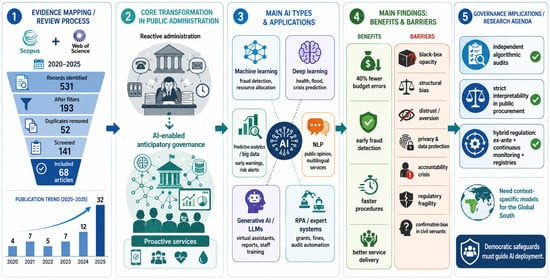
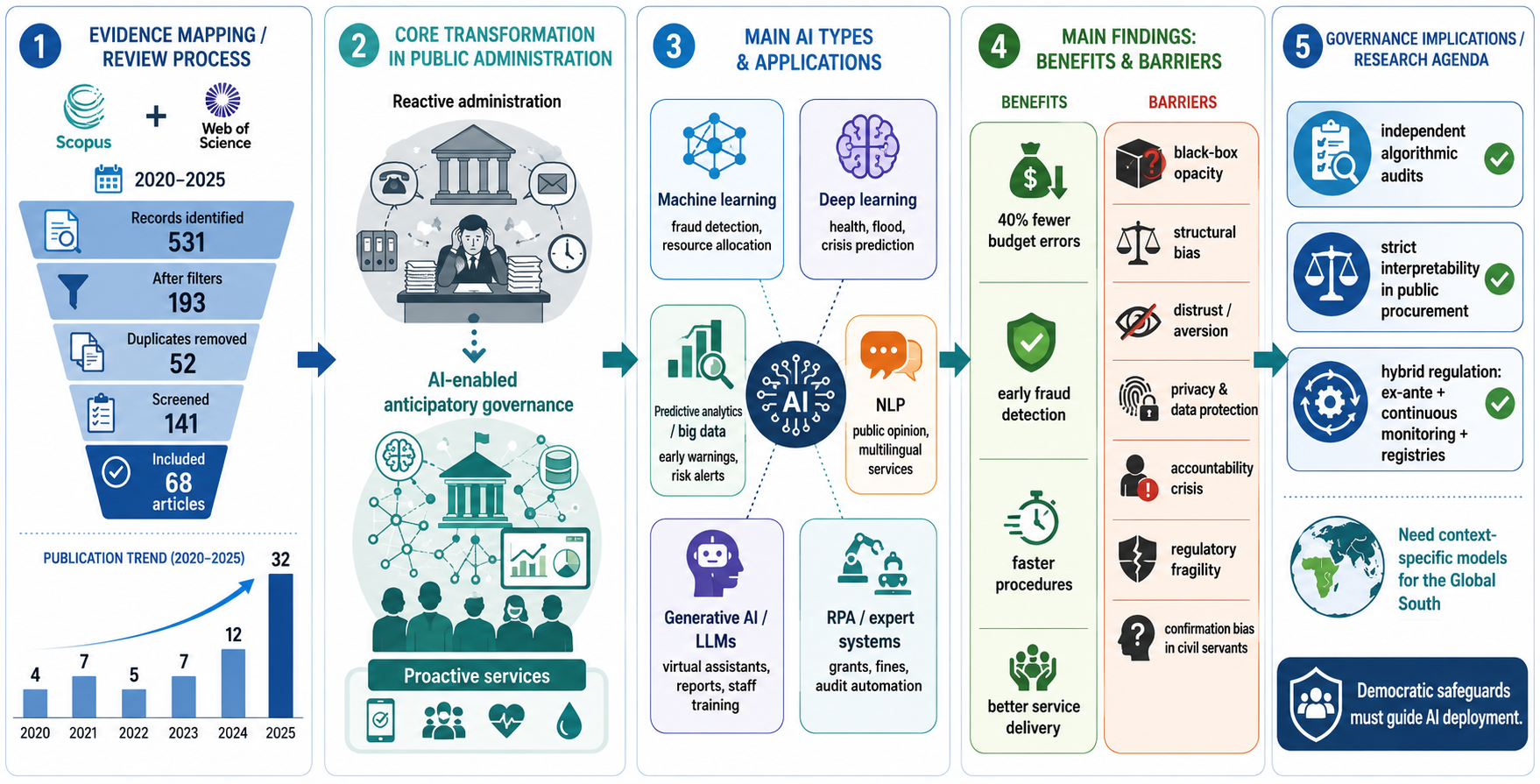
Within this institutional ecosystem, anticipatory governance emerges as the operational mechanism, involving a definitive shift toward smart management, in which the reactive model is replaced by proactive services based on life events (
Talapina & Kozyar, 2023). Through an algorithmic bureaucracy framework, this transition organizes public action by reducing uncertainty and guaranteeing rights before citizens even request them (
Kim et al., 2022;
Lorenz et al., 2020). In terms of its purpose, it aims to move toward a predictive model that optimizes resources, reduces transaction costs, and strengthens democratic legitimacy through timely, evidence-based public responses (
Velasco, 2020). Its importance is reflected in concrete improvements, such as a 40% reduction in budgetary errors and a 32% increase in procedural efficiency. Furthermore, its impact extends beyond technical matters by establishing a “back-office administration” and early-warning systems in health, procurement, and disaster management (
Aoki, 2025;
Munawar et al., 2021).
However, the successful implementation of this proactive model is strictly conditioned by ethical constraints; this integration of AI requires strict oversight. Transparency in the use of automated systems within the government is essential for a democracy, and it ultimately aims to strengthen accountability through a digital transformation that preserves the human dimension of democratic processes (
Shin, 2025). But for this to exist, simply publishing information is not enough: it will also be necessary to understand how and why these systems make decisions. From the design stage onward, it must be possible to trace the system’s decision-making process, and, as a result, present the results in a straightforward manner (
Lora, 2025). This enables people to understand the decisions that affect their lives and, at the same time, helps institutions take responsibility for their actions (
Nieuwenhuizen et al., 2025). Furthermore, transparency builds trust in public institutions, facilitates independent oversight, and protects citizens’ rights by preventing unfair decisions and ensuring that technology respects human dignity (
Tirso, 2025).
3. Materials and Methods
The research was conducted through a systematic literature review (SLR) guided by the PRISMA (Preferred Reporting Items for Systematic Reviews and Meta-Analyses) protocol, ensuring methodological transparency and reproducibility (
Page et al., 2021). This approach was complemented by a descriptive bibliometric analysis designed to map publication trends, thematic co-occurrence networks, and theoretical clusters within the retrieved literature, as well as to track advances in government predictive models.
3.1. Search Strategy and Eligibility Criteria
The systematic literature search was executed on 18 March 2026, across two of the most influential academic databases in the fields of public administration, digital government, and computer science: Scopus and Web of Science (WoS).
The search strategy employed a core Boolean equation, adapting the specific field tags to each database’s syntax (TITLE-ABS-KEY for Scopus and TS for WoS) to target titles, abstracts, and keywords: (“Artificial Intelligence” OR “AI” OR “Machine Learning” OR “Deep Learning” OR “Algorithm” OR “Big Data”) AND (“Public Govern*” OR “Public Admin*” OR “Public Sector” OR “Digital Government” OR “e-government” OR “Smart Govern*”) AND (“Anticipatory” OR “Proactive” OR “Predictive” OR “Foresight” OR “Early Warning” OR “Future-oriented” OR “Policy Simulat*”) The asterisk was used as a truncation operator to retrieve variations of the search terms.
Following the initial retrieval, automated database filters were applied to isolate open-access articles published within the target timeframe. The resulting records were then subjected to a rigorous screening process based on the following specific eligibility criteria.
3.1.1. Inclusion Criteria
Peer-reviewed scientific articles: To ensure methodological rigor and theoretical validity.
Published between 2020 and 2025: To capture the post-pandemic digital acceleration and the global rise of advanced predictive models in public governance.
Open-access publications: To ensure findings are freely accessible to policymakers and public administration practitioners, facilitating the direct transfer of academic knowledge into real-world management.
Thematic focus: Studies explicitly addressing strategies, models, or applications of artificial intelligence geared toward anticipatory, proactive, or predictive governance in the public sector. To ensure a holistic understanding of the phenomenon, this criterion deliberately includes studies focused on the socio-technical prerequisites necessary for anticipatory models to function, such as data infrastructure readiness, institutional trust, and ethical–legal barriers.
3.1.2. Exclusion Criteria
Non-article formats: Conference proceedings, book chapters, editorials, and notes.
Purely technical studies: Papers focusing exclusively on the mathematical or computational optimization of AI algorithms without discussing their implementation, impact, or ethical implications within public administration.
Studies that did not meet the minimum quality threshold established by the 2018 version of the Mixed Methods Appraisal Tool (MMAT) were excluded. Specifically, articles with a score below 80% were excluded; that is, those that met fewer than four of the five methodological criteria included in the MMAT checklist.
3.2. Screening Procedure
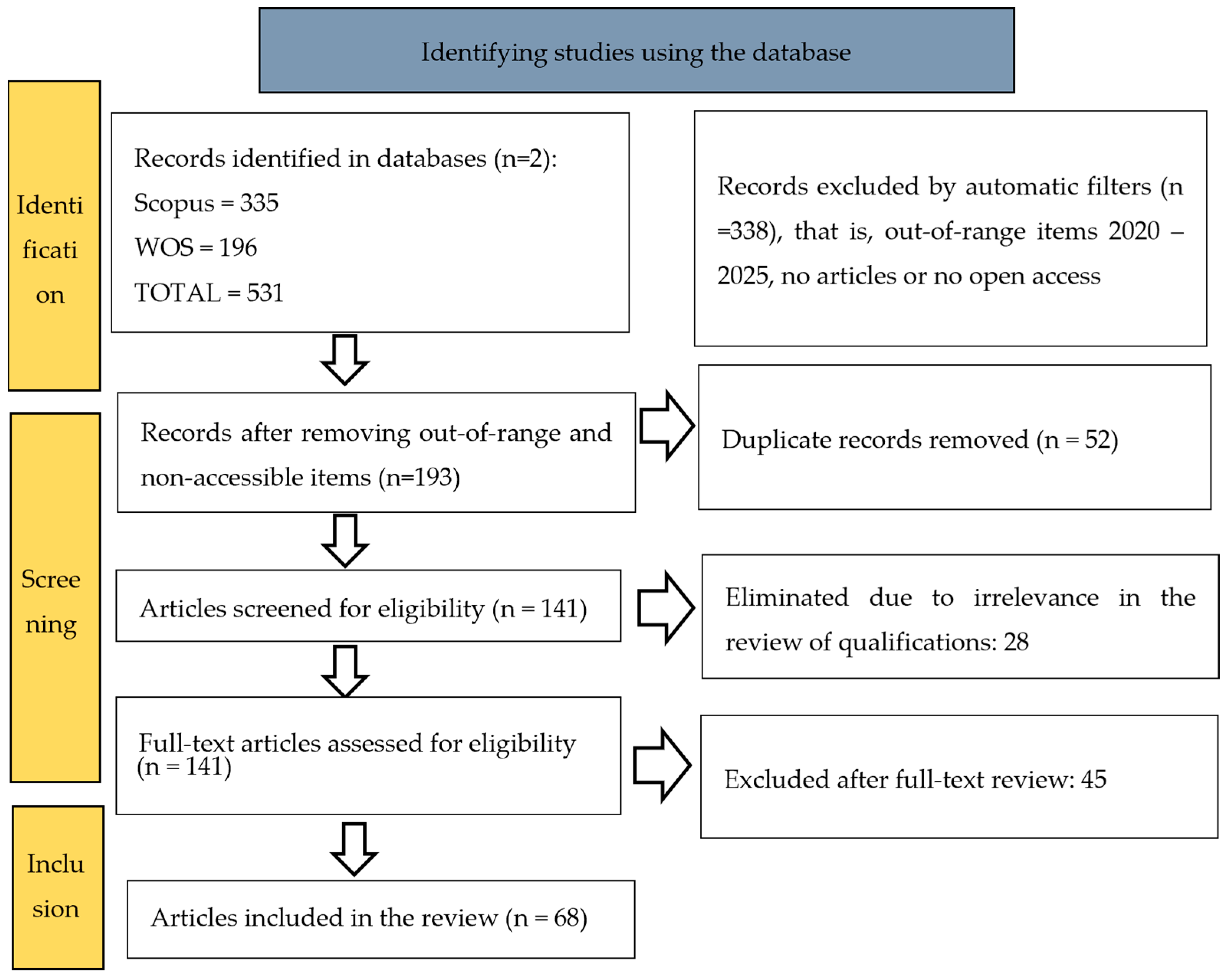
The search returned 531 records (335 from Scopus and 196 from Web of Science). Database filters aligned with the eligibility criteria—publication window 2020–2025, document type restricted to articles, and open-access availability—removed 338 records, reducing the set to 193. These were imported into Mendeley, where 52 duplicates were identified and removed, leaving 141 unique documents.
To reduce selection bias, two independent author teams screened the remaining records. Title screening excluded 28 articles that fell outside the thematic scope defined in the inclusion criteria, as they did not address strategies, models, or applications of artificial intelligence oriented toward anticipatory, proactive, or predictive governance in the public sector. The remaining 113 articles underwent full-text assessment against the exclusion criteria, which led to the removal of 45 additional studies: the majority were works confined to the mathematical or computational optimization of AI algorithms, with no discussion of implementation, impact, or ethical implications in public administration; the remainder were excluded for low methodological quality after applying the MMAT checklist. Disagreements between teams were resolved by consensus. The final corpus comprises 68 articles (
Figure 1), and its thematic diversity reflects the transversal nature of anticipatory governance. Studies applied to specific domains were retained in the final selection, as they share a common methodological and institutional core: the operationalization of artificial intelligence as a mechanism for transitioning from reactive administrative models toward a proactive, data-driven delivery of public services.
Data extraction was conducted systematically using a standardized Microsoft Excel matrix, capturing specific variables organized into columns: publication year, country of origin, AI types, and identified ethical or legal barriers. Reference management and bibliographic organization were handled using Mendeley. Methodological quality and risk of bias were evaluated independently by the reviewers during the full-text screening phase. As this study constitutes a systematic mapping and qualitative review, statistical effect measures, meta-analysis techniques, and quantitative assessments of reporting bias were not applicable. Instead, data synthesis combined a descriptive bibliometric analysis performed with the Bibliometrix R-package v5.3.0 (
Aria & Cuccurullo, 2017) to map temporal and geographic trends, with a qualitative thematic synthesis conducted under the three-stage framework proposed by
Thomas and Harden (
2008)—line-by-line coding of findings, development of descriptive themes, and generation of analytical themes (see
Supplementary Material, Tables S1 and S2)—to categorize AI applications and anticipatory governance challenges in the public sector.
4. Results
4.1. Analysis of Trends over Time and Scientific Collaboration Networks
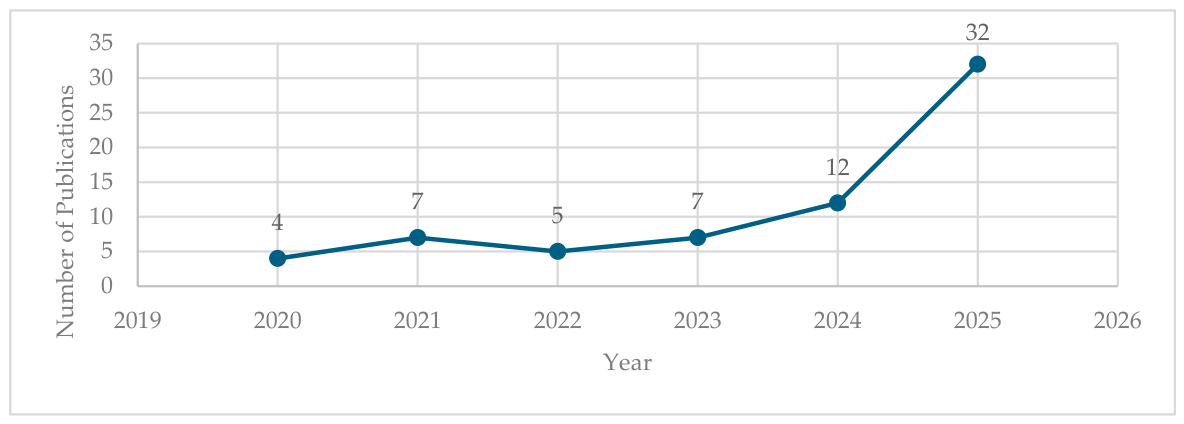
The temporal distribution of scientific output (
Figure 2) reveals a transition from an exploratory phase toward a period of consolidation in the literature. Between 2020 and 2023, publication volume remained limited and fluctuating, with an average of fewer than six articles per year. This initial stage may have been focused on theoretical conceptualization and early testing of predictive algorithms in isolated public sector environments. However, an inflection point is identified from 2024 onwards (12 publications), which intensifies sharply in 2025, reaching 32 publications.
This accelerated growth may represent a qualitative shift in the research agenda. The increase from 2024 onwards can be analytically attributed to the global maturation and democratization of foundational models and generative AI. Furthermore, this period closely aligns with the emergence of fundamental norms and debates, such as the Artificial Intelligence Act of the European Union, shifting the academic focus from purely technical feasibility toward complex discussions on the efficient and ethical integration of this new technology.
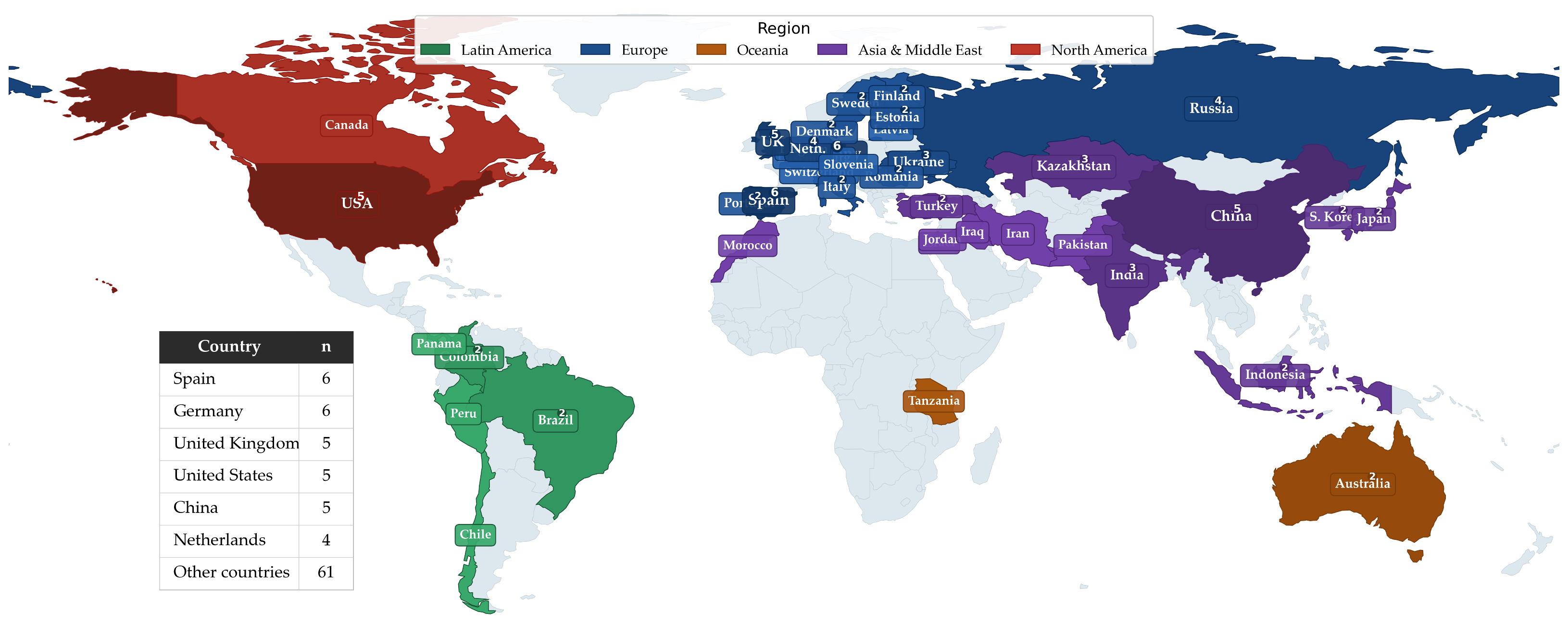
The geographical distribution of scientific production (
Figure 3) reveals a pronounced concentration in the Global North. European nations lead output—Spain and Germany (6 publications each), the United Kingdom (5), and the Netherlands (4)—alongside the United States and China (5 each). This clustering suggests that theoretical frameworks and empirical testing are occurring primarily within highly digitized institutional environments with mature infrastructures and regulatory ecosystems.
Latin America—with limited participation from Brazil, Peru, Chile, and Panama—and Africa remain peripheral in the corpus. This geographical gap signals a structural research void regarding how these AI models perform in developing nations, raising concerns that predictive systems trained on Global North data may be implemented in the Global South without adequate adaptation to local socio-institutional constraints.
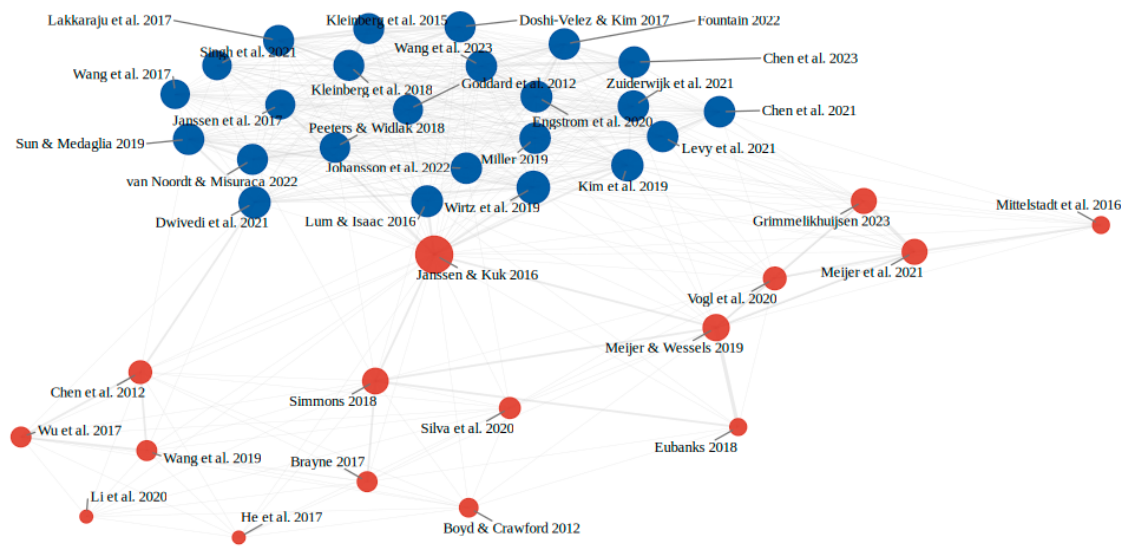
To map the intellectual structure of the field, a document co-citation network (
Figure 4) was generated using the Bibliometrix R-package. The analysis was restricted to the top 35 most cited documents, distributed spatially using the Fruchterman–Reingold layout algorithm. The Louvain algorithm was applied for community detection.
The structural analysis reveals a bifurcated intellectual landscape, divided into two distinct theoretical paradigms:
Socio-technical critique (Red Cluster): Anchored by foundational works (
Boyd & Crawford, 2012;
Eubanks, 2018;
Mittelstadt et al., 2016), this paradigm evaluates the non-neutral impact of public artificial intelligence. It prioritizes algorithmic transparency, data privacy, and the mitigation of automated inequalities over computational optimization, treating democratic legitimacy as the core metric of success.
Techno-managerial adoption (Blue Cluster): Characterized by high internal cohesion and led by adoption framework scholars (
Dwivedi et al., 2021;
Wirtz et al., 2019), this subgroup focuses on smart government architectures. It demonstrates substantial consensus on the capacity of machine learning to optimize resource allocation, reduce bureaucracy, and operationalize early-warning systems.
Specific nodes, such as
Grimmelikhuijsen (
2023), emerge as structural bridges between the ethical-political (red) and technical-operational (blue) perspectives. This positioning indicates that the effective implementation of anticipatory governance inherently depends on combining robust technical performance with institutional trust and transparent human oversight.
4.2. Types of Artificial Intelligence and Their Applications
The literature demonstrates that public administrations deploy various artificial intelligence models to operationalize the shift from reactive management to anticipatory governance. An analysis of these models (
Table 1) reveals two dominant functional streams within the public sector.
First, foundational models such as Machine Learning and Expert Systems are predominantly utilized for institutional control mechanisms, particularly to strengthen internal auditing and enable early fraud detection. Concurrently, high-complexity predictive frameworks, notably Deep Learning, function as critical enablers for crisis management, facilitating the early identification of vulnerabilities in public health and environmental sectors.
Second, citizen-facing interfaces are increasingly mediated by operational tools such as Robotic Process Automation (RPA), Generative AI, and Natural Language Processing (NLP). These technologies extend beyond merely mitigating bureaucratic friction; they enable real-time public sentiment analysis, modernizing traditional service delivery into responsive, multilingual administrative frameworks.
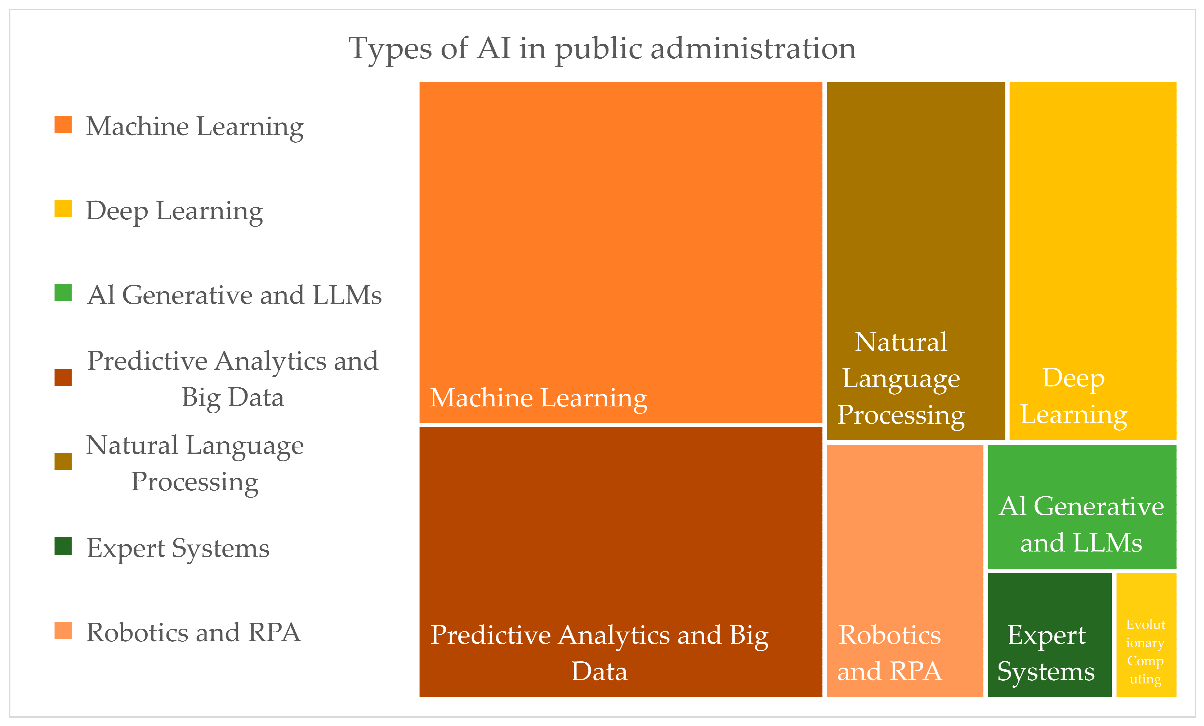
To complement this functional categorization, a hierarchical mapping of AI adoption (
Figure 5) illustrates the current technological maturity and research focus within the public sector. The visual distribution confirms a structural reliance on Machine Learning and Predictive Analytics, which collectively dominate the research landscape. This concentration is theoretically consistent, as both fields constitute the computational core necessary to process historical data for anticipatory governance. Secondary areas, specifically NLP and Deep Learning, reflect an increasing administrative imperative to process unstructured public data, including legal regulations and citizen feedback. Conversely, despite a substantial technological boom in the private sector, Generative AI, Large Language Models (LLMs), and RPA occupy a comparatively marginal conceptual space. This discrepancy indicates that the integration of generative models in public governance remains in an exploratory phase, whereas specialized approaches like evolutionary computing are currently restricted to niche policy simulation applications.
4.3. Ethical and Legal Barriers That Limit Algorithmic Governance
The synthesis of the selected literature reveals a direct correlation between the specific types of AI models deployed (
Table 1) and the ethical–legal barriers encountered in public administration (
Table 2). Regarding ethical dimensions, the studies consistently associate the implementation of high-complexity predictive architectures, specifically Deep Learning, with the emergence of “black box” opacity. Furthermore, the literature links the reliance on Machine Learning and Predictive Analytics—models highly dependent on historical training data—to the reproduction and amplification of structural biases and discrimination. In the legal and regulatory dimension, the document corpus highlights a recurrent pattern: the deployment of Big Data infrastructures is frequently reported to clash with existing privacy and data protection frameworks. Concurrently, the rapid emergence of Generative AI and automated decision-making systems is fundamentally associated in the literature with an accountability crisis and regulatory fragility, due to the lack of mechanisms to assign legal liability when these specific systems fail.
5. Discussion
This review makes a noteworthy theoretical contribution by proposing a new lens for understanding anticipatory governance, shifting the dominant paradigm from a strictly technical-managerial approach toward a techno-democratic framework. From this perspective, algorithmic transparency, audits, and institutional trust are no longer treated as regulatory constraints or mere compliance requirements; rather, they become fundamental conditions for the legitimacy of predictive public administration. In doing so, the review seeks to extend existing theory on anticipatory governance by demonstrating that the successful operationalization of AI depends not only on infrastructure readiness, but also on institutional capacity to subordinate technological complexity to democratic safeguards.
5.1. The Tension Between Precision and Clarity in Anticipatory Environments
The transition toward anticipatory governance exposes a fundamental trade-off between predictive accuracy and algorithmic clarity. Although large AI models demonstrate superior predictive accuracy in resource allocation and budget forecasting (
Al-Inizi, 2025;
Drăgulin et al., 2025), their inherently opaque nature challenges the fundamental administrative principle of accountability (
Al-Inizi, 2025;
Alrawahna et al., 2025;
Rico, 2025). In the public sector, algorithmic transparency is a democratic imperative that requires explanation to ensure that citizens understand administrative decisions. Consequently, the evidence suggests that simpler rule-based systems—such as Decision Trees and Linear Regression—are often prioritized over deep learning frameworks when institutional transparency (
Al-Inizi, 2025) is the primary objective.
This technical tension compels a theoretical reassessment of this algorithmic bureaucracy. Standard machine learning methods often fail to capture the sociopolitical complexities of the public sector (
Fischer et al., 2024). To preserve legal certainty and human dignity, the literature holds that AI deployment should be legally limited to preparatory acts, risk stratification, and early-warning systems (
Gallego et al., 2021;
Lora, 2025;
Mlambo et al., 2022;
Shin, 2025), rather than being used to justify final administrative decisions that require a human margin of appreciation. Therefore, AI must act as a set of support tools that complements, rather than replaces, human deliberation and the professional judgment of experts.
Furthermore, this tension between accuracy and clarity is structurally conditioned by geographic and socioeconomic disparities. The debate on AI model optimization is concentrated in leading digital transformation institutions, according to global technological readiness indices (
Mittal & Gautam, 2023). In contrast, in regions with developing digital infrastructures, such as Latin America and Africa, the discourse on anticipatory governance is severely constrained by the lack of data capacities and technical skills. (
Nyamawe, 2025) This structural weakness in data governance not only conditions algorithmic performance but also forces developing countries to adopt patterns of digital dependency. As mentioned above, when predictive models are employed but trained on Global North realities without significant local adaptation, governments risk implementing technically sophisticated yet administratively ineffective tools, generating digital exclusion and deepening inequalities by transferring decontextualized solutions.
5.2. Ethical, Political, and Legal Conflicts in AI Integration
The integration of artificial intelligence into public administration introduces serious ethical and legal conflicts, characterized primarily by the tension between algorithmic opacity and the administrative duty of reasoning. In public law, the legitimacy of state action is fundamentally grounded in the explicit and logical justification of decisions (
Lora, 2025;
Rico, 2025). However, predictive models currently operate as black boxes, (
Al-Inizi, 2025;
Anastasopoulou, 2025) often protected by private providers who invoke intellectual property and trade secrets, as demonstrated by the BOSCO case (
Rico, 2025). This opacity creates an accountability crisis. When algorithms are used to justify final administrative decisions without full transparency, they structurally violate the citizen’s right to due process and, as
Anastasopoulou (
2025) weaken the rule of law.
This normative conflict extends to the proactive use of Big Data. Anticipatory governance relies on the massive aggregation of historical records to predict citizens’ needs (
Ratner & Thylstrup, 2025;
Rico, 2025), a data maximization paradigm that enters into structural conflict with fundamental privacy rights. Consequently, contemporary public administration theory has reintroduced the principle of “informational self-determination” as a juridical-political limit on the predictive power of the State (
Talapina & Kozyar, 2023). Citizens must retain the sovereign right to control and limit the State’s access to their personal data. Without this legal limit, the uncritical deployment of predictive analytics risks transforming proactive service delivery into a mechanism of state surveillance that, far from being neutral, reproduces and consolidates pre-existing structural asymmetries under the appearance of technical efficiency.
Furthermore, the ethical integration of AI is deeply complicated by human behavioral factors at the implementation level. The evidence challenges the theoretical assumption of objective automation, revealing that public officials perform artificiation (
Taeihagh, 2025) by subjecting algorithmic recommendations to their own intuitive heuristic filters. Crucially, bureaucrats display a marked confirmation bias: they tend to trust and defer to AI only when its outputs align with their pre-existing professional judgments (
Rahman et al., 2025). Consequently, rather than operating as an external corrector of human judgment, algorithmic tools end up functioning as an institutional mirror: they amplify and formalize pre-existing biases, endowing them with the appearance of technical objectivity that renders them more resistant to questioning and reform.
The identified threats imply that passive technology adoption is fundamentally incompatible with democratic governance, demanding an institutional repositioning toward active oversight as a guiding principle. Along these lines, state procurement can no longer shelter behind traditional intellectual property protections—such as trade secrets applied to source code—without compromising the administrative duty of transparency. Consequently, the findings suggest that existing public policies require the institutionalization of mandatory and independent algorithmic audits (
Nieuwenhuizen et al., 2025;
Tonieva et al., 2025). Rather than limiting themselves to evaluating technical performance, these integrated policy mechanisms must be formulated to continuously assess systems for disparate social impacts and legal compliance, ensuring that the legal architecture firmly subordinates technological innovation to the protection of fundamental human rights.
5.3. A Research Agenda for Anticipatory Governance
The systematic mapping and geographic disparity analyzed in previous sections establish the foundation for a research agenda that must transcend the reporting of technological adoption toward a critical and prospective focus. To overcome the limitations identified in the corpus of 68 articles, future research is recommended to be structured around three fundamental axes:
Research questions and contextualization gaps: AI models applied in Global South countries are trained on data from institutionally distinct contexts, generating misalignments with the regulatory and infrastructural realities of Latin America. Future research must examine how this normative transposition occurs and what mechanisms bureaucrats adopt to legitimize, reinterpret, or evade systems that collide with local regulatory frameworks. The questions that merit rigorous investigation are: (a) What local adaptation processes modify or neutralize the biases encoded in AI systems originating from other institutional contexts? and (b) In what way does the discordance between predictive models and regulatory architectures influence the quality of anticipatory decisions? Building contextualized AI models specifically designed for the Global South can break the pattern of replicating technological dependencies and enable a self-centered anticipatory governance.
Methodological and transitional needs: The predominance of cross-sectional case studies limits the discipline’s capacity to observe phenomena such as the semantic drift of models in the face of changes in administrative terminology or the evolution of institutional trust over time. The adoption of longitudinal designs, with their implications in terms of resources and inter-institutional coordination, emerges as a methodologically pertinent avenue for overcoming static assessments of institutional readiness, although its viability will depend largely on the organizational context and available funding. Likewise, the integration of mixed methods combining quantitative precision metrics with ethnographic approaches could provide higher-resolution information on the processes of reconfiguration of professional judgment in the face of AI systems; however, the soundness of this approach will be contingent on its rigor in design and the comparability of the data obtained.
Regulatory innovation and effective transparency: The regulatory framework for AI in this context, as mentioned, faces the tension between the protection of citizens’ rights and the preservation of trade secrets, which typically shields the design of private algorithmic systems. Ex-ante risk assessment frameworks such as the European Union AI Act (
Parliament European & Council of the European Union, 2024), prove insufficient to account for the continuous evolution of these technologies. In response, future research should be oriented in three concrete directions: first, comparatively analyzing hybrid regulatory models that integrate ex-ante assessment with continuous post-deployment monitoring mechanisms; second, developing conceptual frameworks for independent algorithmic audits that articulate legal and technical criteria, with the capacity for updating in response to changes in the audited systems; and third, examining the institutional and legislative conditions under which the establishment of public algorithmic registries is feasible in different administrative contexts. This research program seeks to ensure that algorithmic transparency transcends normative statement and translates into real mechanisms of verification, accountability, and sanction in the event of non-compliance.
6. Conclusions
A review of these 68 studies shows that the use of data-analysis systems is enabling the government to move beyond simply responding when citizens request a service and instead begin offering services in a more proactive and automated manner. This technology is particularly useful for agencies responsible for safeguarding public resources, as it helps detect budget errors and potential fraud early on—before they cause significant harm—through tools that provide advance risk alerts.
However, this progress is hindered by two main factors: the lack of clear guidelines and the difficulty in understanding how these systems make decisions, since they often do not visibly explain how they arrive at a result. The attitude of public employees also plays a role; they do not automatically accept what the system indicates but rather compare it with their own experience. The problem arises when they only trust technology if it confirms what they already thought, because that makes it difficult to correct human errors and unfair practices that already exist.
Furthermore, although interest in this topic has grown considerably since 2024, a significant disparity persists, as most research is conducted in developed countries while contributions from regions such as Latin America remain scarce. Future studies should therefore address this geographical gap by examining how predictive models can be adapted to the specific regulatory and infrastructural realities of the Global South, moving away from technological dependency.
It is imperative that public institutions adopt concrete and verifiable measures. First, administrative bodies should establish mandatory, independent algorithmic audits to continuously evaluate both the technical performance and the unequal social impact of predictive models. Second, public procurement frameworks must enforce strict interpretability standards, requiring that any AI system deployed in public services provide clear and traceable explanations, thereby prohibiting black-box models in decisions that demand administrative justification. Finally, institutions should adopt hybrid regulatory frameworks combining ex ante risk assessments with continuous post-deployment monitoring and algorithmic registries. These measures seek to operationalize the principles of algorithmic governance into tangible institutional mechanisms, with direct effects on the quality of public services and the legitimacy of administrative decision-making.
Regarding methodological limitations, the search was restricted to the Scopus and Web of Science databases and limited to open-access articles published between 2020 and 2025. Consequently, relevant literature in other languages, works indexed in databases beyond those consulted, and grey literature—including governmental reports and public policy documents—fall outside the scope of this review, which may constrain the comprehensiveness of the bibliographic mapping.
Supplementary Materials
The following supporting information can be downloaded at:
https://www.mdpi.com/article/10.3390/admsci16070326/s1, Table S1: Illustration of the thematic development process for AI types and their decision-making applications; Table S2: Illustration of the thematic development process for ethical and legal barriers in anticipatory governance; Table S3: Authors—Co-citation Network.
Author Contributions
Conceptualization, G.L.P.P., M.F.M. and A.A.J.R.; methodology, G.L.P.P., M.F.M. and E.E.G.P.; software, E.E.G.P. and A.Z.V.; validation, G.L.P.P., M.F.M., E.E.G.P. and A.A.J.R.; formal analysis, G.L.P.P., E.E.G.P. and J.H.C.V.; investigation, G.L.P.P., M.F.M., M.C.d.C. and J.H.C.V.; resources, A.Z.V., M.C.d.C. and J.F.G.V.; data curation, E.E.G.P., A.Z.V. and J.H.C.V.; writing—original draft preparation, G.L.P.P. and M.F.M.; writing—review and editing, all authors; visualization, E.E.G.P. and A.Z.V.; supervision, A.A.J.R. and J.F.G.V.; project administration, G.L.P.P. and A.A.J.R.; funding acquisition, A.A.J.R. All authors have read and agreed to the published version of the manuscript.
Funding
This research received no external funding.
Institutional Review Board Statement
Not applicable.
Informed Consent Statement
Not applicable.
Data Availability Statement
The original contributions presented in this study are included in the article/
supplementary material. Further inquiries can be directed to the corresponding author.
Conflicts of Interest
The authors declare no conflict of interest.
References
- Aldemir, C., & Uçma, T. (2025). Artificial intelligence for financial accountability and governance in the public sector: Strategic opportunities and challenges. Administrative Sciences, 15(2), 58. [Google Scholar] [CrossRef]
- Al-Inizi, M. S. M. (2025). Enhancing governmental decision-making through predictive analytics with machine learning-based data-driven framework. Babylonian Journal of Machine Learning, 2025, 86–96. [Google Scholar] [CrossRef] [PubMed]
- Alkurdi, A. H., Asaad, R., Almufti, R. M., & Ahmed, N. S. (2024). Avaliando o impacto da seleção de recursos baseada na correlação ponto-bisserial em classificadores de aprendizado de máquina: Um estudo de caso de detecção de fraude em cartão de crédito. Journal of Management & Technology, 24, 166–196. [Google Scholar] [CrossRef]
- Alrawahna, A. S., Alzghoul, A., & Awad, H. (2025). The impact of artificial intelligence on public sector decision-making: Benefits, challenges, and policy implications. International Review of Management and Marketing, 15(5), 125–138. [Google Scholar] [CrossRef]
- Amirova, A. (2025). Advancing citizen-centered public services in Kazakhstan: Legal, institutional, and digital governance perspectives. Frontiers in Political Science, 7, 1679601. [Google Scholar] [CrossRef]
- Anastasopoulou, M. (2025). Exploring algorithmic governance: The AI Act and new realities for criminal justice, and fundamental rights. New Journal of European Criminal Law, 16(2), 176–196. [Google Scholar] [CrossRef]
- Aoki, N. (2025). En route to “zero bureaucracy and invisible government”: A conjoint analysis of the effects of transforming the state-citizen interface on the favourability of public administration in the digital era. Asia Pacific Journal of Public Administration, 47(3), 216–240. [Google Scholar] [CrossRef]
- Araujo, V., Araujo, J. J., & Albuquerque, L. (2023). Policiamento preditivo na era da vigilância: A busca de um modelo constitucional e democrático. Revista Quaestio Iuris, 16(1), 313–337. [Google Scholar] [CrossRef]
- Aria, M., & Cuccurullo, C. (2017). bibliometrix: An R-tool for comprehensive science mapping analysis. Journal of Informetrics, 11(4), 959–975. [Google Scholar] [CrossRef]
- Aristovnik, A., Murko, E., Kristl, N., & Ravšelj, D. (2025). Disruptive technology capabilities in local governments: An empirical study. Information Polity, 30(1), 14–33. [Google Scholar] [CrossRef]
- Arriagada, A., & Cotoras, D. (2025). Introducing a predictive experiment: Ethics, data and public defence in Chile. Big Data and Society, 12(4), 20539517251407984. [Google Scholar] [CrossRef]
- Barkane, I. (2022). Questioning the EU proposal for an Artificial Intelligence Act: The need for prohibitions and a stricter approach to biometric surveillance. Information Polity, 27(2), 147–162. [Google Scholar] [CrossRef]
- Bitencourt, C. M., & Martins, L. H. N. (2023). Artificial intelligence in the constitutional accounting control bodies of Brazilian public administration. Revista de Investigacoes Constitucionais, 10(3), e253. [Google Scholar] [CrossRef]
- Boyd, d., & Crawford, K. (2012). Critical questions for big data: Provocations for a cultural, technological, and scholarly phenomenon. Information, Communication & Society, 15(5), 662–679. [Google Scholar] [CrossRef]
- Caputo, F., Palazzo, G., & Ligorio, L. (2026). Business intelligence in supply chain management: Insights for performance and sustainability. Corporate Social Responsibility and Environmental Management, 33(1), 1446–1464. [Google Scholar] [CrossRef]
- Chen, Y., Liu, L., Wu, Q., & Yang, C. F. (2025). Proactive and adaptive elderly-centered governance framework through synergistic integration of the internet of things and multi-agent systems. Sensors and Materials, 37(6), 2431–2446. [Google Scholar] [CrossRef]
- Dragomir, F., Beldiman, C., & Zlati, M. (2025). Informational approaches in modelling social and economic relations: Study on migration and access to services in the European Union. Systems, 13(6), 469. [Google Scholar] [CrossRef]
- Drăgulin, B., Ștefan, V., Tăbîrcă, A. I., Șcheau, M. C., Radu, V., & Munteanu, V. (2025). AI-driven models for forecasting public expenditures in the digital era. Electronics, 14(20), 4047. [Google Scholar] [CrossRef]
- Duarte, A. F., Soares, A., Pereira, M. J., Peralta-Santos, A., Leite, P. P., & Azevedo, L. (2024). A stochastic model of an early warning system for detecting anomalous incidence values of COVID-19. Mathematical Geosciences, 56(1), 41–54. [Google Scholar] [CrossRef]
- Dwivedi, Y. K., Hughes, L., Ismagilova, E., Aarts, G., Coombs, C., Crick, T., Duan, Y., Dwivedi, R., Edwards, J., Eirug, A., Galanos, V., Ilavarasan, P. V., Janssen, M., Jones, P., Kar, A. K., Kizgin, H., Kronemann, B., Lal, B., Lucini, B., … Williams, M. D. (2021). Artificial Intelligence (AI): Multidisciplinary perspectives on emerging challenges, opportunities, and agenda for research, practice and policy. International Journal of Information Management, 57, 101994. [Google Scholar] [CrossRef]
- Esperança, M., Freitas, D., Paixão, P. V., Marcos, T. A., Martins, R. A., & Ferreira, J. C. (2025). Proactive complaint management in public sector informatics using AI: A semantic pattern recognition framework. Applied Sciences, 15(12), 6673. [Google Scholar] [CrossRef]
- Eubanks, V. (2018). Automating inequality: How high-tech tools profile, police, and punish the poor. St. Martin’s Press. [Google Scholar]
- Fischer, U., Kern, C., Barda, N., & Kreuter, F. (2024). Bridging the gap: Towards an expanded toolkit for AI-driven decision-making in the public sector. Government Information Quarterly, 41(4), 101976. [Google Scholar] [CrossRef]
- Gallego, J., Rivero, G., & Martínez, J. (2021). Preventing rather than punishing: An early warning model of malfeasance in public procurement. International Journal of Forecasting, 37(1), 360–377. [Google Scholar] [CrossRef] [PubMed]
- Grimmelikhuijsen, S. (2023). Explaining why the computer says no: Algorithmic transparency affects the perceived trustworthiness of automated decision-making. Public Administration Review, 83(2), 241–262. [Google Scholar] [CrossRef]
- Hassani, H., Huang, X., Macfeely, S., & Entezarian, M. R. (2021). Big data and the united nations sustainable development goals (UN SDGs) at a glance. Big Data and Cognitive Computing, 5(3), 28. [Google Scholar] [CrossRef]
- Kim, S., Andersen, K. N., & Lee, J. (2022). Platform government in the era of smart technology. Public Administration Review, 82(2), 362–368. [Google Scholar] [CrossRef]
- Kozyar, D. Y., & Talapina, E. V. (2025). Implementation and evolution of proactive government services a methodological approach. Public Administration Issues, (2), 7–29. [Google Scholar] [CrossRef]
- Kumar, P., & Prakash, G. (2025). Evaluating SC 5.0 preparedness through human-AI collaboration and digital maturity in Indian capital-intensive PSUS. Brazilian Journal of Operations and Production Management, 22(4). [Google Scholar] [CrossRef]
- Lora, A. H. (2025). Artificial intelligence and public administrations: For what and how. Teoria y Derecho, (37), 40–69. [Google Scholar] [CrossRef]
- Lorenz, L., Meijer, A., & Schuppan, T. (2020). The algocracy as a new ideal type for government organizations: Predictive policing in Berlin as an empirical case. Information Polity, 26(1), 71–86. [Google Scholar] [CrossRef]
- Margaryan, M., Harutyunyan, A., Petrosyan, S., Gevorgyan, A., & Sahakyan, H. (2026). Foucauldian biopolitics and homo virtualis in the context of anticipatory governance, algorithms, and transhumanism. Philosophies, 11(2), 54. [Google Scholar] [CrossRef]
- Masso, A., Kasapoglu, T., Kaun, A., & Galis, V. (2024). Citizens’ perspectives on platformisation of police work: A scenario and story-based exploration in Estonia and Sweden. Information Communication and Society, 27(13), 2400–2418. [Google Scholar] [CrossRef]
- Meijer, A., Lorenz, L., & Wessels, M. (2021). Algorithmization of bureaucratic organizations: Using a practice lens to study how context shapes predictive policing systems. Public Administration Review, 81(5), 837–846. [Google Scholar] [CrossRef]
- Mittal, P., & Gautam, S. (2023). Logistic regression and predictive analysis in public services of AI strategies. TEM Journal, 12(2), 751–756. [Google Scholar] [CrossRef]
- Mittelstadt, B. D., Allo, P., Taddeo, M., Wachter, S., & Floridi, L. (2016). The ethics of algorithms: Mapping the debate. Big Data & Society, 3(2), 1–21. [Google Scholar] [CrossRef]
- Mlambo, F., Chironda, C., & George, J. (2022). Risk stratification of COVID-19 using routine laboratory tests: A machine learning approach. Infectious Disease Reports, 14(6), 900–931. [Google Scholar] [CrossRef] [PubMed]
- Munawar, H. S., Ullah, F., Qayyum, S., Khan, S. I., & Mojtahedi, M. (2021). Uavs in disaster management: Application of integrated aerial imagery and convolutional neural network for flood detection. Sustainability, 13(14), 7547. [Google Scholar] [CrossRef]
- Muñoz, L., Villarreal, V., Nielsen, M., Caballero, Y., Sittón-Candanedo, I., & Corchado, J. M. (2021). Artificial intelligence models and techniques applied to COVID-19: A review. Electronics, 10(23), 2901. [Google Scholar] [CrossRef]
- Nieuwenhuizen, E. N., Trehan, V., & Porumbescu, G. (2025). Does institutional transparency affect citizen trust in predictive policing? Evidence from a survey-experiment in The Netherlands. Public Administration. [Google Scholar] [CrossRef]
- Nyamawe, A. S. (2025). Is the public sector Africa’s hidden force for AI-driven healthcare transformation? In Telematics and informatics reports (Vol. 20). Elsevier B.V. [Google Scholar] [CrossRef]
- Otia, J., & Bracci, E. (2022). Digital transformation and the public sector auditing: The SAI’s perspective. Financial Accountability and Management, 38(2), 252–280. [Google Scholar] [CrossRef]
- Page, M. J., McKenzie, J. E., Bossuyt, P. M., Boutron, I., Hoffmann, T. C., Mulrow, C. D., Shamseer, L., Tetzlaff, J. M., Akl, E. A., Brennan, S. E., Chou, R., Glanville, J., Grimshaw, J. M., Hróbjartsson, A., Lalu, M. M., Li, T., Loder, E. W., Mayo-Wilson, E., McDonald, S., … Moher, D. (2021). The PRISMA 2020 statement: An updated guideline for reporting systematic reviews. BMJ, 372, n71. [Google Scholar] [CrossRef] [PubMed]
- Parliament European & Council of the European Union. (2024). Regulation (EU) 2024/1689 of the european parliament and of the council of 13 June 2024 laying down harmonised rules on artificial intelligence and amending certain union legislative acts (Artificial Intelligence Act). European Union. [Google Scholar]
- Praharaj, S. (2026). Combining AI with urban resilience planning: A bibliometric analysis of literature. In City and environment interactions (Vol. 30). Elsevier B.V. [Google Scholar] [CrossRef]
- Rahman, M. H., Usmani, N. G., Chandra, P., Manna, R. M., Ahmed, A., Shomik, M. S., El Arifeen, S., Hossain, A. T., & Rahman, A. E. (2025). Mobile apps to prevent violence against women and girls (VAWG): Systematic app research and content analysis. JMIR Formative Research, 9, e66247. [Google Scholar] [CrossRef] [PubMed]
- Raman, R., Iyer, A., & Nedungadi, P. (2025). Forecasting artificial general intelligence for sustainable development goals: A data-driven analysis of research trends. Sustainability, 17(16), 7347. [Google Scholar] [CrossRef]
- Ramírez, N. A., Gómez, E., & Vacca, H. (2023). Automatic learning model to predict transparency indicators for effective management of public resources. Ingenieria Solidaria, 19, 1–21. [Google Scholar] [CrossRef]
- Ratner, H. F., & Thylstrup, N. B. (2025). Citizens’ data afterlives: Practices of dataset inclusion in machine learning for public welfare. AI and Society, 40(3), 1183–1193. [Google Scholar] [CrossRef]
- Rico, C. I. V. (2025). Algorithmic transparency in the public sector: Beyond the Bosco case. Revista Catalana de Dret Public, 71, 25–47. [Google Scholar] [CrossRef]
- Rojas, H., Renteria, R., Duran, V. M., Gutiérrez, Y. T., Ibarra Cabrera, M. J., & Aminuddin, A. (2025). Mapping the evolution and future directions of ISO/IEC 25010: A bibliometric and thematic analysis. Engineering, Technology and Applied Science Research, 15(5), 27530–27541. [Google Scholar] [CrossRef]
- Saida, I. (2025). Synergy between artificial intelligence and good governance: Deciphering predictive dynamics for optimal public performance in Morocco. International Review of Management and Marketing, 15(4), 143–152. [Google Scholar] [CrossRef]
- Schiff, K. J., Schiff, D. S., Adams, I. T., McCrain, J., & Mourtgos, S. M. (2025). Institutional factors driving citizen perceptions of AI in government: Evidence from a survey experiment on policing. Public Administration Review, 85(2), 451–467. [Google Scholar] [CrossRef]
- Selten, F., Robeer, M., & Grimmelikhuijsen, S. (2023). ‘Just like I thought’: Street-level bureaucrats trust AI recommendations if they confirm their professional judgment. Public Administration Review, 83(2), 263–278. [Google Scholar] [CrossRef]
- Serhiichuk, L. (2025). Artificial intelligence in the Ukrainian public administration system: Legal development and implementation risks. Bratislava Law Review, 9(2), 243–260. [Google Scholar] [CrossRef]
- Shakhshina, A., Bugubayeva, R., & Stavbunik, Y. (2025). Application of artificial intelligence in human capital management of the civil service: Predicting career trajectories and personalized personnel development. Original Research, 13(4), 859–872. [Google Scholar] [CrossRef]
- Shin, B. (2025). Exploring the potential of machine learning to reduce administrative burden in participatory budgeting: A case study of Seoul. Journal of Public Budgeting, Accounting and Financial Management, 38(1), 237–264. [Google Scholar] [CrossRef]
- Sirait, E., Zuiderwijk, A., & Janssen, M. (2025). Factors influencing the perceived readiness of government organizations for implementing predictive artificial intelligence. International Journal of Electronic Government Research, 21(1), 1–20. [Google Scholar] [CrossRef]
- Snow, T. (2021). From satisficing to artificing: The evolution of administrative decision-making in the age of the algorithm. Data and Policy, 3(2), e3. [Google Scholar] [CrossRef]
- Taeihagh, A. (2025). Governance of generative AI. Policy and Society, 44(1), 1–22. [Google Scholar] [CrossRef]
- Talapina, E. V., & Kozyar, D. Y. (2023). Proactive public services: On the way to algorithmization. Public Administration Issues, (2), 7–32. [Google Scholar] [CrossRef]
- Thomas, J., & Harden, A. (2008). Methods for the thematic synthesis of qualitative research in systematic reviews. BMC Medical Research Methodology, 8, 45. [Google Scholar] [CrossRef] [PubMed]
- Tirso, A. (2025). Artificial intelligence in justice. Challenges and opportunities in judicial decision-making. Anales de La Catedra Francisco Suarez, 59, 317–340. [Google Scholar] [CrossRef]
- Tonieva, K., Andriichuk, I., Ivanov, S., Semchuk, Z., & Lopatka, S. (2025). The impact of artificial intelligence on the strategic planning of economic development of countries. Original Research, 13(2), 489–502. [Google Scholar] [CrossRef]
- Uandykova, M., Mirkassimova, T., Mukhamejanova, G., Yeleukulova, A., Baikhojayev, A., & Astaubayeva, G. (2025). Digital model for monitoring national programs: The Kazakhstan experience. Frontiers in Artificial Intelligence, 8, 1656329. [Google Scholar] [CrossRef] [PubMed]
- Vandercruysse, L., D’Hauwers, R., & Bourgeus, A. (2023). Citizen-centric personal data storage in the public sector: An exploration of opportunities, challenges, and preconditions. Journal of Innovation Management, 11(3), 30–53. [Google Scholar] [CrossRef]
- Velasco, C. (2020). Personalización, proactividad e inteligencia artificial. ¿Un nuevo paradigma para la prestación electrónica de servicios públicos? Manuel Ángel De las Heras García. Available online: www.uoc.edu/idp (accessed on 23 March 2026).
- Vesolovska, M., Karkovska, V., & Duma, O. (2025). Artificial intelligence in public administration: How the emotional intelligence of civil servants influences its effective implementation. Administratie Si Management Public, 2025(45), 27–45. [Google Scholar] [CrossRef]
- Vogl, T. M., Seidelin, C., Ganesh, B., & Bright, J. (2020). Smart technology and the emergence of algorithmic bureaucracy: Artificial intelligence in UK local authorities. Public Administration Review, 80(6), 946–961. [Google Scholar] [CrossRef]
- Wan, L., Cheng, W., & Yang, J. (2024). Optimizing metro passenger flow prediction: Integrating machine learning and time-series analysis with multimodal data fusion. IET Circuits, Devices and Systems, 2024, 5259452. [Google Scholar] [CrossRef]
- Wanckel, C. (2022). An ounce of prevention is worth a pound of cure—Building capacities for the use of big data algorithm systems (BDAS) in early crisis detection. Government Information Quarterly, 39(4), 101705. [Google Scholar] [CrossRef]
- Webber, R. (2020). COVID-19 and race: Protecting data or saving lives? International Journal of Market Research, 62(5), 528–537. [Google Scholar] [CrossRef]
- Wenzelburger, G., König, P. D., Felfeli, J., & Achtziger, A. (2024). Algorithms in the public sector. Why context matters. Public Administration, 102(1), 40–60. [Google Scholar] [CrossRef]
- Wirtz, B. W., Weyerer, J. C., & Geyer, C. (2019). Artificial intelligence and the public sector—Applications and challenges. International Journal of Public Administration, 42(7), 596–615. [Google Scholar] [CrossRef]
- Yashin, S., Yashina, N., Koshelev, E., Kashina, O., & Pronchatova-Rubtsova, N. (2020). Foresight of volga federal district innovation system development using a multi-objective genetic algorithm. International Journal of Technology, 11(6), 1171–1180. [Google Scholar] [CrossRef]
- Zhao, J., Hu, C., Li, Z., Zhang, M., Fan, H., Li, K., & Yuan, R. (2025). Investigating the quantitative impact of the vegetation indices on the urban thermal comfort based on machine learning: A case study of the Qinhuai River Basin, China. Sustainable Cities and Society, 125, 106357. [Google Scholar] [CrossRef]
- Zhao, S., Wang, L., & Cai, D. (2022). Research on the impact and utility of rural revitalization big data service on farmers based on integrated technology acceptance model. Mathematical Problems in Engineering, 2022, 6705610. [Google Scholar] [CrossRef]
| Disclaimer/Publisher’s Note: The statements, opinions and data contained in all publications are solely those of the individual author(s) and contributor(s) and not of MDPI and/or the editor(s). MDPI and/or the editor(s) disclaim responsibility for any injury to people or property resulting from any ideas, methods, instructions or products referred to in the content. |



 and
and