1. Introduction
Artificial intelligence (AI) is increasingly transforming the structure, governance, and relational dynamics of contemporary workplaces (
Acemoglu & Restrepo, 2020;
Arslan et al., 2022;
Budhwar et al., 2022;
Ammirato et al., 2023;
Del Giudice et al., 2023;
S. Kim et al., 2021;
Tambe et al., 2019). Organizations now use AI-supported systems in recruitment, workforce analytics, performance evaluation, employee engagement monitoring, communication analysis, and decision support. These systems may improve efficiency, consistency, and data-informed decision-making (
Bag et al., 2021;
Brougham & Haar, 2017;
Chen et al., 2022;
Huang & Rust, 2018;
S. Kim et al., 2021). However, they also introduce new forms of organizational tension because decisions that were previously made through visible human judgment are increasingly influenced by opaque algorithmic processes.
In AI-mediated workplaces, employees may experience algorithmic systems not merely as technical tools but as organizational actors that influence access to opportunities, evaluations, discipline, recognition, and voice. This changes the nature of workplace conflict. Conflict may no longer arise only between employees, managers, or teams; it may also emerge between employees and algorithmic systems, between human judgment and machine-generated recommendations, or between organizational governance promises and employee perceptions of fairness.
This paper argues that AI-enabled workplace conflict should be understood as a socio-technical justice problem (
Arslan et al., 2022;
S. Kim et al., 2021;
Raghavan et al., 2020;
Zhou et al., 2023). From a socio-technical systems perspective, conflict emerges when technological systems, organizational structures, and human expectations become misaligned. For example, an AI system may produce a recommendation that is technically consistent with available data but perceived by employees as unfair, intrusive, or insufficiently explainable. From an organizational justice perspective, such perceptions matter because employees evaluate AI-supported decisions through questions of procedural fairness, outcome fairness, and respectful treatment.
AI-enabled conflict is therefore not caused only by algorithmic error. It may also arise from weak governance, unclear accountability, insufficient transparency, limited rights to challenge automated outputs, and poor employee understanding of how AI systems operate. A technically accurate system may still generate conflict if employees cannot understand, contest, or trust its outputs. Conversely, AI tools may support conflict prevention when they are embedded in transparent policies, human oversight structures, and capability-building programs.
Existing HR conflict-management frameworks remain largely designed for human-to-human disagreement (
S. Kim et al., 2021;
Petani & Mengis, 2023;
Yan et al., 2024). They typically focus on mediation, grievance procedures, communication failures, interpersonal disputes, and managerial intervention. These approaches are necessary but insufficient for AI-mediated environments because they do not fully address algorithmic opacity, data-driven surveillance, automated recommendations, or human–AI decision misalignment. As organizations adopt AI-enabled HR systems, they require governance models capable of integrating technical accountability with employee rights, fairness perceptions, and conflict-resolution practices.
This study develops a conceptual framework for integrating AI into workplace conflict management. It focuses on three interrelated domains: HR policy design, ethical AI governance, and workforce capability development. These domains are brought together in the Hybrid Conflict Governance Model (HCGM), which explains how governance mechanisms shape workplace conflict outcomes through procedural justice, trust, contestability, and human oversight pathways.
The paper makes three contributions. First, it reframes AI-enabled workplace conflict as a socio-technical justice problem rather than a purely technological or HR issue. This extends socio-technical systems theory by showing how algorithmic systems interact with organizational structures and employee fairness expectations to shape conflict dynamics.
Second, the paper develops the HCGM as a conceptual model linking AI system characteristics, governance quality, human capabilities, and conflict outcomes. Unlike frameworks that treat transparency, auditing, human oversight, and training as separate governance tools, the HCGM integrates them into a mechanism-based model of workplace conflict management.
Third, the paper extends organizational justice and AI governance literature by explaining how procedural justice, distributive justice, interactional justice, trust, and contestability operate in AI-mediated conflict contexts. In particular, it shows how lack of transparency may weaken procedural justice, how perceived bias may undermine distributive justice, and how poor communication about AI decisions may damage interactional justice.
The HCGM extends existing AI governance literature by conceptualizing workplace conflict as an emergent socio-technical justice outcome rather than a downstream operational problem.
The remainder of the paper is structured as follows.
Section 2 develops the theoretical foundation.
Section 3 explains the conceptual theory-building approach.
Section 4 examines major AI-enabled conflict dynamics.
Section 5 presents illustrative organizational insights that contextualize the conceptual model.
Section 6,
Section 7 and
Section 8 develop the HR policy, ethical governance, and capability-building components of the framework.
Section 9 presents the HCGM and its causal architecture. The final sections discuss theoretical implications, practical implications, future research directions, limitations, and conclusions.
Unlike prior studies that examine AI governance, workplace conflict, organizational justice, or HRM separately, this study integrates these streams into a unified socio-technical justice framework. The proposed Hybrid Conflict Governance Model (HCGM) explains how AI system characteristics influence workplace conflict outcomes through governance quality, procedural justice, distributive justice, interactional justice, trust, contestability, and human oversight mechanisms. By integrating these constructs into a single explanatory framework, the study extends both AI governance and workplace conflict literature.
2. Background and Theoretical Context
2.1. Artificial Intelligence in Human Resource Management
AI is increasingly used across human resource management functions, including recruitment screening, employee performance analytics, workforce planning, engagement monitoring, learning recommendations, and communication analysis (
Budhwar et al., 2022;
Chamorro-Premuzic et al., 2017;
Del Giudice et al., 2023;
Dutta et al., 2023;
Gowrishankkar et al., 2025;
Graetz & Michaels, 2018;
Chen et al., 2022;
S. Kim et al., 2021;
Tambe et al., 2019;
Maddikunta et al., 2022). These applications may support faster decision making and more consistent information processing, but they also introduce new risks because employment-related decisions affect identity, opportunity, status, and trust (
Brougham & Haar, 2020;
B. J. Kim & Kim, 2024;
Kong et al., 2021;
Makridis & Han, 2021).
In HRM contexts, AI systems are rarely neutral technical instruments. They are embedded within organizational structures, managerial practices, data histories, and institutional power relationships (
Brougham & Haar, 2020;
Budhwar et al., 2022). As a result, their effects depend not only on technical accuracy but also on how employees perceive their purpose, fairness, transparency, and accountability. An algorithmic recommendation may be accepted when employees understand its role and believe that human oversight remains meaningful. The same recommendation may trigger resistance when employees perceive it as opaque, biased, or imposed without recourse.
AI in HRM therefore creates a new conflict environment in which disputes may arise from the interaction between technical outputs and social interpretation (
Brougham & Haar, 2020;
Kellogg et al., 2020;
B. J. Kim & Kim, 2024). Employees may challenge whether an algorithmic recommendation is fair, whether monitoring is proportionate, whether data use is legitimate, or whether human managers remain accountable for decisions. These tensions show why AI-enabled workplace conflict requires a theoretical lens that connects technology, organizational structures, and employee justice perceptions.
2.2. Socio-Technical Systems Theory
Socio-technical systems theory provides the first theoretical foundation for this study (
Arslan et al., 2022;
S. Kim et al., 2021;
Tambe et al., 2019). The theory argues that organizational outcomes emerge through the interaction between technical systems and social systems. Technical systems include tools, data infrastructures, algorithms, workflows, and automation processes. Social systems include roles, norms, power relationships, communication patterns, employee expectations, and governance structures.
Applied to AI-enabled workplaces, socio-technical systems theory suggests that conflict does not arise only when AI systems malfunction. Conflict can also emerge when there is misalignment between algorithmic outputs and organizational expectations (
Arslan et al., 2022;
Malhotra, 2021;
S. Kim et al., 2021). For example, a communication-monitoring tool may technically identify emotional intensity in messages, but employees may interpret this monitoring as intrusive surveillance. A performance algorithm may generate a ranking based on available data, but managers and employees may dispute whether the data adequately capture real contribution.
This socio-technical misalignment is central to AI-enabled conflict. AI tools may produce outputs that are technically defensible but socially contested. When organizations fail to explain how systems work, define how outputs should be used, or provide mechanisms for challenge and review, employees may interpret AI systems as unfair or illegitimate. The governance challenge is therefore not only to improve algorithmic performance, but to align AI systems with organizational norms, employee rights, and conflict-resolution processes.
2.3. Organizational Justice Theory
Procedural justice refers to the perceived fairness of decision-making processes. In AI-supported HR decisions, procedural justice is affected by whether employees understand how decisions are made, whether criteria are consistent, whether errors can be corrected, and whether employees have a right to contest outcomes.
Distributive justice refers to the perceived fairness of outcomes. In AI-enabled workplaces, distributive justice concerns arise when algorithmic systems influence hiring, promotion, performance evaluation, disciplinary action, workload allocation, or access to opportunities. If employees believe that AI systems produce unequal or biased outcomes, conflict may intensify.
Interactional justice refers to the perceived fairness and respectfulness of communication and interpersonal treatment. Even when AI-supported decisions are technically justified, conflict may arise if employees receive poor explanations, feel dehumanized, or believe that managers are hiding behind algorithmic authority.
These justice dimensions provide the mechanism through which AI governance affects workplace conflict. Transparency may strengthen procedural justice by making decision processes understandable (
Chowdhury et al., 2023b;
Raghavan et al., 2020;
Zhou et al., 2023). Bias audits may support distributive justice by reducing unequal outcomes. Human explanation and respectful communication may strengthen interactional justice by ensuring employees feel heard and recognized. When these justice perceptions are weak, trust declines and conflict risk increases.
2.4. AI-Enabled Workplace Conflict as a Socio-Technical Justice Problem
Integrating socio-technical systems theory and organizational justice theory allows AI-enabled workplace conflict to be conceptualized as a socio-technical justice problem. This means that conflict emerges through the interaction of AI system characteristics, organizational governance structures, human interpretation, and fairness perceptions.
For example, lack of transparency may create procedural uncertainty. Procedural uncertainty may reduce trust in HR decisions. Reduced trust may increase the likelihood that employees interpret AI-supported decisions as unfair or hostile. Similarly, algorithmic bias may create unequal outcomes, which may weaken distributive justice perceptions and produce grievances or resistance. AI-supported monitoring may affect interactional justice if employees feel treated as data objects rather than trusted organizational members.
This integrated theoretical lens supports the development of the HCGM (
Arslan et al., 2022;
S. Kim et al., 2021;
Rodgers et al., 2023). The model is built on the assumption that AI-enabled conflict can be reduced when organizations improve socio-technical alignment and strengthen justice perceptions through transparent policies, accountable governance, human oversight, contestability mechanisms, and workforce capability development. Existing AI governance frameworks primarily focus on fairness, transparency, accountability, and compliance, whereas workplace conflict literature traditionally emphasizes interpersonal disputes, mediation, and communication processes. Few studies explicitly examine how AI governance mechanisms interact with employee justice perceptions to influence workplace conflict outcomes. This theoretical gap motivates development of the HCGM.
3. Conceptual Theory-Building Approach
This study adopts a conceptual theory-building approach based on interdisciplinary literature synthesis. The primary objective is to develop a structured explanatory framework for understanding AI-enabled workplace conflict and the governance mechanisms that may influence conflict outcomes.
The study integrates literature from human resource management, socio-technical systems theory, organizational justice theory, AI governance, digital work, and workplace conflict research (
Dabić et al., 2023;
S. Kim et al., 2021;
Rodgers et al., 2023;
Santana & Cobo, 2020;
Tambe et al., 2019). This problem-driven conceptual approach is appropriate for emerging interdisciplinary domains where theoretical integration remains underdeveloped and empirical evidence remains fragmented (
Dabić et al., 2023;
Donthu et al., 2021;
Santana & Cobo, 2020).
The conceptual development followed four stages. First, the literature was reviewed to identify AI system characteristics associated with workplace conflict, including algorithmic bias, opacity, surveillance, digital communication challenges, and human–AI decision misalignment (
Bamel et al., 2022;
Kellogg et al., 2020;
Langer & König, 2023;
Raghavan et al., 2020). Second, organizational justice theory was used to explain how employees may interpret these characteristics through procedural, distributive, and interactional justice perceptions (
Chowdhury et al., 2023b;
Petani & Mengis, 2023;
Raghavan et al., 2020). Third, AI governance and HRM literature were examined to identify governance mechanisms that may influence these perceptions, including transparency, accountability, contestability, human oversight, privacy safeguards, and capability development (
Chowdhury et al., 2023b;
Li et al., 2023;
Rodgers et al., 2023). Finally, these constructs were integrated into the Hybrid Conflict Governance Model (HCGM) to explain how AI system characteristics interact with governance structures and contextual factors to influence workplace conflict outcomes (
Arslan et al., 2022;
S. Kim et al., 2021;
Rodgers et al., 2023).
Accordingly, this study should be understood as a conceptual theory-building contribution. It does not present empirical findings, case-study evidence, interview-based analysis, or qualitative generalization. Rather, it develops a theoretical framework intended to guide future empirical investigation of AI-enabled workplace conflict and governance.
4. AI-Enabled Conflict Dynamics in Digitally Mediated Workplaces
AI-enabled workplace conflict emerges through interaction between technological systems, organizational governance structures, and employee interpretations.
Table 1 summarizes the major sources of AI-enabled workplace conflict, linking system characteristics to organizational outcomes. Conflict therefore develops not only from technical malfunction, but also from socio-technical misalignment and perceived injustice (
Arslan et al., 2022;
S. Kim et al., 2021;
Raghavan et al., 2020).
4.1. Algorithmic Surveillance and Trust Erosion
AI-supported monitoring systems may analyse employee productivity, communication behaviour, workflow activity, and engagement patterns (
Kellogg et al., 2020;
Van den Broek et al., 2021). Although organizations may adopt such systems to improve operational visibility and efficiency, employees may interpret continuous monitoring as intrusive surveillance.
This creates a socio-technical tension between organizational control objectives and employee autonomy expectations. Perceived over-monitoring may weaken interactional justice because employees may feel distrusted, excessively scrutinized, or reduced to behavioural data points rather than recognized as organizational contributors (
Kellogg et al., 2020;
Van den Broek et al., 2021;
Zhou et al., 2023). Reduced interactional justice may subsequently lower trust and increase conflict sensitivity within teams.
The conflict mechanism therefore operates through:
AI monitoring intensity → reduced autonomy perceptions → weakened interactional justice → trust erosion → increased workplace tension.
4.2. Algorithmic Bias and Perceived Injustice
Algorithmic bias remains one of the most significant governance concerns in AI-enabled HRM (
Raghavan et al., 2020;
Vassilopoulou et al., 2024). AI systems trained on historical organizational data may reproduce or amplify existing patterns of discrimination related to hiring, promotion, performance evaluation, or disciplinary action.
Employees who perceive AI-supported decisions as biased may experience reduced distributive justice because outcomes appear unequal or unfairly determined. Procedural justice may also weaken when employees cannot understand how algorithmic decisions were generated or reviewed.
The resulting mechanism may be understood as:
biased training data → unequal algorithmic outcomes → weakened distributive and procedural justice → reduced organizational trust → grievance escalation and workplace conflict.
4.3. Human–AI Decision Misalignment
Conflict may also emerge when AI-generated recommendations differ from human judgment (
Choudhary et al., 2023;
Li et al., 2023). Managers may disagree with algorithmic outputs, while employees may question whether decisions reflect managerial reasoning or machine-generated classifications.
This misalignment creates uncertainty regarding accountability and decision legitimacy. Employees may become unsure whether managers retain meaningful authority or whether algorithmic systems effectively determine outcomes.
Where human oversight is weak or poorly communicated, procedural justice perceptions may decline because employees may perceive decisions as incontestable or overly automated.
4.4. AI-Supported Conflict Detection Systems
Organizations increasingly use AI-supported systems to identify conflict risks through sentiment analysis, communication monitoring, behavioural analytics, or escalation detection (
Malik et al., 2023;
Yan et al., 2024). These systems may support early intervention by identifying patterns associated with stress, hostility, or communication breakdown.
However, such systems may also create procedural and interactional justice concerns if employees believe that normal workplace communication is being excessively analysed or misinterpreted. Employees may alter communication behaviour defensively, reducing openness and psychological safety.
The governance challenge is therefore to balance proactive conflict detection with transparency, proportionality, and employee trust.
4.5. Distinguishing AI Conflict Constructs
It is important to distinguish between algorithmic surveillance systems and AI-supported conflict detection systems. Algorithmic surveillance focuses primarily on behavioural oversight, productivity tracking, and managerial control (
Kellogg et al., 2020;
Van den Broek et al., 2021). By contrast, AI-supported conflict detection systems are intended to identify emerging communication strain, emotional escalation, or relational tension in order to support early intervention (
Li et al., 2023;
Malik et al., 2023).
Although both rely on data analysis, employees may interpret them differently depending on organizational purpose, governance quality, transparency, and perceived fairness. Surveillance-oriented systems are more strongly associated with trust erosion and autonomy concerns, whereas supportive conflict-management tools may improve workplace coordination when governance safeguards and human oversight are clearly established (
Raghavan et al., 2020;
Zhou et al., 2023).
The conflict mechanisms discussed above collectively illustrate the causal pathways through which AI system characteristics influence workplace outcomes. Algorithmic bias primarily affects distributive justice, opacity affects procedural justice, and surveillance influences interactional justice and trust. Human–AI decision misalignment further affects accountability and contestability. Together, these mechanisms explain how technological characteristics become translated into workplace conflict outcomes through employee perceptions of fairness, legitimacy, and trust (
Raghavan et al., 2020;
Petani & Mengis, 2023;
Rodgers et al., 2023).
5. Analytical Integration of AI-Enabled Conflict Mechanisms
AI-enabled workplace conflict emerges through interactions between technological characteristics, governance structures, employee perceptions, and organizational justice mechanisms. Conflict is not generated solely by algorithmic error but by employee interpretation of AI-supported processes. Perceived bias may weaken distributive justice, opacity may weaken procedural justice, and surveillance may weaken interactional justice and trust (
Kellogg et al., 2020;
Petani & Mengis, 2023;
Raghavan et al., 2020).
These perceptions influence conflict escalation or conflict reduction depending on governance quality. Transparency mechanisms may strengthen procedural justice by enabling employees to understand and challenge AI-supported decisions. Human oversight may reinforce accountability, while contestability mechanisms may provide employees with opportunities to seek review of AI-supported outcomes (
Chowdhury et al., 2023b;
Li et al., 2023;
Rodgers et al., 2023).
Accordingly, AI-enabled workplace conflict should be understood as a socio-technical justice process in which governance quality shapes employee trust, acceptance, and responses to AI-supported decisions.
6. HR Policy Framework for AI Integration in Conflict Management
6.1. Transparency and Explainability Policies
Transparency policies may strengthen procedural justice by allowing employees to understand how AI-supported decisions are generated, reviewed, and challenged (
Chowdhury et al., 2023b;
Langer & König, 2023). Clear communication regarding data usage, algorithmic logic, and decision pathways may reduce uncertainty and increase trust.
6.2. Employee Data Rights and Consent
Policies addressing employee data rights may reduce conflict risk by clarifying how personal information is collected, analysed, stored, and used within AI-supported systems (
Manroop et al., 2024;
Petani & Mengis, 2023). Employees may be more likely to accept AI-enabled processes when organizational data practices are transparent and proportionate.
6.3. Algorithmic Bias Mitigation
Bias mitigation policies may strengthen distributive justice by reducing the likelihood of unequal algorithmic outcomes (
Raghavan et al., 2020;
Vassilopoulou et al., 2024). Governance mechanisms such as fairness audits, diverse training datasets, and human review procedures may improve perceived legitimacy of AI-supported decisions.
6.4. AI Governance Structures
Formal governance structures such as AI ethics committees, accountability boards, and review mechanisms may reduce procedural uncertainty by clarifying oversight responsibilities and escalation pathways (
Rodgers et al., 2023;
Singh & Pandey, 2024;
Jobin et al., 2019;
Tabassi, 2023). These structures may also reinforce trust by demonstrating that organizations retain human accountability for high-impact decisions.
Table 2 outlines the key HR policy domains necessary for responsible AI integration.
7. Ethical Governance Model for AI-Supported Conflict Management
The effectiveness of AI-supported workplace conflict management depends not only on technical performance but also on the quality of the governance structures surrounding its use (
Robinson et al., 2020;
Rodgers et al., 2023;
Zhou et al., 2023). AI-enabled conflict systems operate in organizational contexts involving employee dignity, fairness perceptions, privacy, accountability, and power relationships. When AI is used to monitor communication, identify behavioural risk, support disciplinary assessment, or guide mediation processes, governance failures may weaken trust and intensify workplace conflict rather than reduce it (
Kellogg et al., 2020;
Robinson et al., 2020;
Zhou et al., 2023).
This study conceptualizes ethical governance as a socio-technical mechanism that shapes how employees interpret AI-supported decisions and organizational intent. Governance structures influence conflict outcomes because they affect procedural justice, contestability, transparency, and perceptions of organizational accountability (
Chowdhury et al., 2023b;
Raghavan et al., 2020;
Zhou et al., 2023). Weak governance may increase perceptions of opacity, surveillance, and arbitrariness, whereas transparent and reviewable governance mechanisms may strengthen trust and reduce conflict escalation.
The proposed ethical governance framework operates across three interconnected dimensions:
These dimensions are interdependent rather than sequential. Organizational governance establishes institutional accountability, technological governance shapes operational integrity and explainability, and human-centered governance protects employee rights, psychological safety, and procedural fairness (
Arslan et al., 2022;
S. Kim et al., 2021;
Rodgers et al., 2023).
7.1. Organizational-Level Governance
At the organizational level, governance concerns the structures, policies, and oversight mechanisms that determine how AI systems are introduced, evaluated, monitored, and revised (
S. Kim et al., 2021;
Yang et al., 2024). AI adoption in conflict-sensitive HR environments cannot be treated solely as a technical implementation exercise because AI systems directly influence employee experience, managerial legitimacy, and organizational justice perceptions (
S. Kim et al., 2021;
Tambe et al., 2019).
7.1.1. AI Ethics Committees
Formal AI ethics committees may strengthen governance legitimacy by incorporating multidisciplinary oversight into AI-supported HR and conflict-management systems (
Oswald et al., 2017;
Rodgers et al., 2023). Existing research suggests that governance processes are more likely to be perceived as fair and accountable when multiple stakeholder perspectives are included in decision-making structures (
Pfeffer, 2018;
Zhou et al., 2023).
These committees may include representatives from HR, data science, legal compliance, organizational leadership, and employee representation functions. Cross-functional oversight may reduce the risk that governance decisions become overly technical, operationally narrow, or disconnected from employee concerns.
From a socio-technical perspective, ethics committees function as governance mediators between technical system design and organizational fairness expectations. Their role is particularly important where AI systems influence promotion decisions, behavioural assessment, communication monitoring, or conflict escalation processes.
7.1.2. AI Impact Assessments
AI impact assessments may reduce conflict risk by identifying governance weaknesses before deployment (
Radonjić et al., 2024;
Raghavan et al., 2020). In AI-mediated conflict environments, governance failures may have cumulative effects because employees often experience algorithmic assessments as ongoing rather than isolated organizational events.
Impact assessments may therefore strengthen procedural justice by clarifying:
How bias may emerge;
How decisions may be challenged;
What forms of human oversight exist;
And how employee rights are protected.
This is particularly important because flawed AI classifications may alter long-term managerial perceptions of employees and increase future conflict sensitivity (
Singh & Pandey, 2024;
Yan et al., 2024).
7.1.3. Data Protection and Privacy Governance
Privacy governance is central to conflict-related AI systems because many tools rely on communication analysis, metadata, behavioural monitoring, or sentiment detection (
Chowdhury et al., 2023b;
Dutta et al., 2023;
Petani & Mengis, 2023). Research on algorithmic oversight suggests that excessive monitoring may weaken trust, reduce psychological safety, and increase defensive workplace behaviour (
Kellogg et al., 2020;
Van den Broek et al., 2021).
Governance mechanisms addressing data minimization, access control, purpose limitation, and disclosure transparency may therefore strengthen interactional trust and reduce surveillance-related conflict perceptions (
Manroop et al., 2024;
Zhou et al., 2023).
Importantly, employees may interpret secondary use of behavioural data as procedurally unfair when data collected for communication support are later repurposed for disciplinary evaluation or performance ranking. Such repurposing may intensify perceptions of organizational overreach and reduce trust in governance systems (
Manroop et al., 2024;
Zhou et al., 2023).
7.2. Technological-Level Governance
7.2.1. Explainability Standards
AI systems used in workplace conflict management should provide a meaningful level of explainability to support transparency and procedural fairness (
Chowdhury et al., 2023b;
Langer & König, 2023;
Malin et al., 2024). Employees and managers need to understand why a system identified a communication risk, flagged a behavioural pattern, or recommended a particular intervention. Explainability does not require disclosure of proprietary algorithms or highly technical system architecture; rather, it requires accessible and decision-relevant explanations that users can reasonably interpret.
Research indicates that low explainability is associated with reduced trust and weaker acceptance of algorithmic systems in HR environments (
Raghavan et al., 2020;
Zhou et al., 2023). In conflict-related settings, opacity may intensify uncertainty because workplace disputes already involve emotion, interpretation, and contested perspectives. Where AI-supported decisions cannot be meaningfully explained, employees may perceive organizational processes as arbitrary or procedurally unjust.
From a governance perspective, explainability functions as a trust-mediating mechanism linking AI transparency to procedural justice perceptions (
Chowdhury et al., 2023b;
Raghavan et al., 2020). Accordingly, AI-supported conflict systems should provide human-readable rationales, clear documentation of system limitations, and clarification regarding whether outputs are predictive, descriptive, or advisory in nature.
7.2.2. Continuous Algorithmic Auditing
Algorithmic governance requires continuous auditing because AI models may evolve over time as organizational behaviour, communication patterns, and workforce dynamics change (
Rodgers et al., 2023;
Singh & Pandey, 2024). A system that initially appears balanced may later generate unintended disparities, inconsistent classifications, or biased outputs.
Continuous auditing may strengthen governance legitimacy by identifying false-positive rates, demographic disparities, classification inconsistencies, and model instability before these issues intensify workplace conflict. In digitally mediated work environments, governance reviews should also examine whether communication styles, linguistic variation, or cultural expression patterns are disproportionately interpreted as hostile, inappropriate, or high risk.
Existing literature on algorithmic fairness identifies continuous auditing as a central governance safeguard against discriminatory or distorted AI outcomes (
Pfeffer, 2018;
Raghavan et al., 2020). From a socio-technical perspective, auditing functions as a corrective feedback mechanism that supports organizational accountability and procedural reliability.
Where repeated disparities or governance failures are identified, organizations may need to modify, restrict, or withdraw conflict-related AI systems to maintain fairness and employee trust.
7.2.3. Human Oversight and Override Controls
Human oversight remains a central principle of ethical AI governance because accountability for consequential organizational decisions should not be fully delegated to automated systems (
Li et al., 2023;
Singh & Pandey, 2024). In workplace conflict contexts, AI-generated outputs may influence disciplinary review, managerial perception, promotion pathways, or team relationships. Consequently, AI systems should function as decision-support mechanisms rather than autonomous decision-makers.
Human oversight mechanisms may include second-level review processes, override controls, escalation pathways, and documentation of how human decision-makers interpreted algorithmic recommendations. These mechanisms are important not only operationally but also symbolically because they reinforce the principle that AI outputs remain contestable and subject to human judgment.
Research on human–AI collaboration suggests that organizational outcomes improve when managers remain capable of critically evaluating and, where necessary, rejecting algorithmic recommendations rather than passively accepting them (
Choudhary et al., 2023;
Doshi et al., 2025;
Krakowski et al., 2023). In conflict-management settings, effective governance therefore depends on maintaining meaningful human accountability alongside technological support.
7.3. Human-Centred Governance
Human-centred governance ensures that AI-supported conflict management remains aligned with employee dignity, procedural fairness, and psychological safety (
Petani & Mengis, 2023;
Zhou et al., 2023). Even technically accurate systems may generate resistance or conflict if employees perceive them as intrusive, incontestable, or dehumanizing.
7.3.1. Right to Contest AI-Related Outcomes
Employees should be able to challenge AI-supported classifications, recommendations, or behavioural assessments that affect workplace outcomes (
Chowdhury et al., 2023b;
Sutarto et al., 2022). Contestability is closely linked to procedural justice because it provides employees with an opportunity to explain contextual factors that algorithmic systems may not fully capture.
For example, AI-supported sentiment analysis may identify emotional escalation in written communication without recognizing contextual pressures, established interpersonal dynamics, or informal communication norms. Where employees cannot question or clarify such interpretations, organizational processes may be perceived as arbitrary or unfair.
Contestability mechanisms therefore function as governance safeguards that reinforce transparency, accountability, and employee voice. Effective review processes should include accessible escalation pathways, human review authority, explanation of original outputs, and documented decision outcomes.
7.3.2. Psychological Safety Protections
AI-enabled monitoring and conflict-detection systems may unintentionally reduce psychological safety if employees believe their communication and behaviour are under constant evaluation (
Petani & Mengis, 2023;
Van den Broek et al., 2021). Psychological safety is important because constructive disagreement, collaboration, and conflict resolution depend on employee willingness to communicate openly without fear of humiliation or retaliation (
Petani & Mengis, 2023;
Zhou et al., 2023).
Poorly governed AI monitoring systems may encourage defensive communication, self-censorship, or reduced employee engagement. Such outcomes may weaken trust and intensify workplace tension rather than support healthy conflict management.
Governance mechanisms addressing monitoring limitations, transparency, proportionality, and due process may therefore help preserve employee trust and reduce perceptions of intrusive surveillance.
7.3.3. Human–AI Collaboration Norms
Organizations should establish clear norms governing how employees and managers interact with AI-supported systems (
Arslan et al., 2022;
Choudhary et al., 2023). Without defined collaboration expectations, AI may create ambiguity regarding responsibility, authority, and decision legitimacy.
Human–AI collaboration norms should clarify that algorithmic outputs are advisory unless explicitly designated otherwise and that human decision-makers retain responsibility for final organizational actions. These norms are particularly important in managerial contexts because leadership behaviour strongly influences whether employees perceive AI systems as supportive governance tools or mechanisms of organizational control.
Clear collaboration norms may therefore strengthen accountability, reduce uncertainty, and support more balanced integration of human judgment and AI-supported decision making.
8. Training and Leadership Development for Hybrid Conflict Resolution
Training and capability development play a central role in determining how employees and managers interpret AI-supported systems and respond to conflict in digitally mediated workplaces (
Aggarwal & Stanley, 2025;
Chowdhury et al., 2023a;
Kraus et al., 2023,
del Val Núñez et al., 2024). Within the Hybrid Conflict Governance Model (HCGM), capability-building functions as a moderating mechanism that influences trust, procedural fairness perceptions, and human–AI collaboration quality.
As AI systems become increasingly integrated into communication monitoring, decision-support processes, and workplace governance structures, organizations require capabilities that extend beyond technical proficiency alone. Effective capability development therefore includes AI literacy, digital communication competence, ethical judgment, and human–AI collaboration skills (
Del Giudice et al., 2023;
S. Kim et al., 2021).
8.1. Workforce Training Programs
8.1.1. AI Literacy for Employees
AI literacy is foundational to responsible human–AI interaction because employees require a functional understanding of how AI systems operate, what data they use, and where algorithmic limitations may arise (
Chowdhury et al., 2023a;
Huang et al., 2019;
Kraus et al., 2023). Limited AI understanding may contribute to exaggerated distrust, overreliance, or unrealistic expectations regarding system accuracy and objectivity.
Training programs may therefore improve organizational adaptation by helping employees understand concepts such as machine learning, probabilistic prediction, algorithmic bias, data quality limitations, and the distinction between automated recommendations and human judgment. Employees also benefit from understanding how AI systems are specifically applied within their organizational environment, including their role in communication analysis, conflict detection, or managerial decision support.
Research suggests that stronger AI literacy may reduce uncertainty, improve acceptance of governance processes, and support more balanced interpretation of AI-supported decisions (
Chowdhury et al., 2023a;
Kraus et al., 2023). In conflict-management contexts, improved understanding may reduce assumptions that AI systems are either entirely objective or intentionally harmful.
8.1.2. Training on Digital Conflict Dynamics
Conflict in digitally mediated workplaces differs from traditional face-to-face interaction because written communication lacks non-verbal cues, asynchronous communication may intensify uncertainty, and platform structures may alter communication behaviour (
Graf & Antoni, 2021;
Song & Wu, 2021). These conditions increase the likelihood of misunderstanding, escalation, and misinterpretation.
Training programs addressing digital conflict dynamics may therefore strengthen communication quality and reduce conflict escalation risks. Employees may benefit from learning how to clarify intent in written exchanges, recognize escalation patterns, and critically interpret AI-generated communication alerts or sentiment classifications.
This capability is particularly important because overreliance on automated emotional analysis may encourage employees or managers to interpret disagreement as hostility where contextual understanding is limited. Training may therefore strengthen contextual judgment and communication repair strategies within hybrid work environments.
8.1.3. Human–AI Collaboration Skills
As AI systems become embedded within organizational workflows, employees increasingly require skills that support effective human–AI collaboration without diminishing human judgment (
Choudhary et al., 2023;
Macke & Genari, 2019;
Shao et al., 2024). These capabilities include critically evaluating algorithmic outputs, identifying potential false positives, questioning unsupported recommendations, and integrating automated insights with contextual knowledge.
For example, where AI systems classify interactions as “high conflict risk,” employees and managers should be able to evaluate the contextual basis of the classification rather than treating algorithmic outputs as automatically valid (
Song & Wu, 2021). Such capability development reinforces the principle that AI systems function as decision-support tools rather than replacements for relational understanding or managerial accountability.
8.2. Leadership Development Programs
Leadership behaviour strongly influences whether AI-supported workplace governance is perceived as fair, legitimate, and trustworthy (
Glikson & Woolley, 2020;
Rodgers et al., 2023). Even technically reliable systems may lose credibility if leaders apply them opaquely, inconsistently, or without critical oversight.
8.2.1. Ethical AI Leadership
Ethical AI leadership involves the responsible use of AI-supported systems alongside transparent communication and human accountability (
Glikson & Woolley, 2020;
Rodgers et al., 2023). Leaders play an important role in shaping employee perceptions of procedural justice because employees often interpret managerial use of AI as representative of broader organizational intent.
Where leaders treat algorithmic outputs as unquestionable authority, employees may perceive AI-supported governance as rigid, depersonalized, or procedurally unfair. Conversely, leaders who communicate system limitations, explain decision rationale, and apply human judgment alongside AI-supported recommendations may strengthen trust and organizational legitimacy.
8.2.2. Conflict Management in Hybrid Teams
Hybrid and digitally intensive work environments create new forms of workplace conflict associated with communication fragmentation, unequal visibility, workflow automation, and disagreement regarding AI-supported recommendations (
Trocin et al., 2021;
Yan et al., 2024).
Leadership capability development should therefore include conflict-management approaches tailored to digitally mediated environments. Leaders may require skills enabling them to recognize how platform structures influence communication behaviour, how monitoring technologies affect morale, and how algorithmic recommendations may generate tension within teams.
Effective leadership in hybrid environments also requires the ability to facilitate dialogue when employees challenge AI-supported decisions or question algorithmic fairness.
8.2.3. Managing AI-Related Power Asymmetries
AI-supported systems may amplify organizational power asymmetries by increasing managerial visibility, centralizing performance metrics, and normalizing workplace surveillance (
S. Kim et al., 2021;
Zhou et al., 2023). Leaders therefore require capabilities that help mitigate perceptions of excessive control and procedural imbalance.
This may include encouraging employee voice, supporting transparent governance discussions, and ensuring that AI-supported systems do not disproportionately disadvantage vulnerable employee groups. Leadership awareness of algorithmic power dynamics may strengthen fairness perceptions and reduce resistance within conflict-sensitive organizational environments.
8.3. Simulation-Based Learning
Simulation-based learning may support hybrid conflict capability development by allowing employees and managers to engage with realistic AI-mediated workplace scenarios in controlled learning environments (
Jaiswal et al., 2022;
Xu et al., 2020).Simulations help participants develop technical judgment, ethical reasoning, and communication competence without creating actual organizational harm.
8.3.1. AI Conflict Simulation Labs
Organizations may benefit from simulation exercises involving AI-supported workplace conflict scenarios such as biased behavioural flags, incorrect misconduct alerts, communication-risk classifications, or disagreement between managerial judgment and algorithmic recommendations.
Research on experiential learning suggests that realistic simulations improve preparedness for complex and uncertain decision environments (
Jaiswal et al., 2022;
Xu et al., 2020). In AI-mediated workplaces, simulation exercises may strengthen both human judgment and governance awareness.
8.3.2. Scenario-Based Organizational Learning
Scenario-based learning may help organizations move beyond compliance-focused training toward broader socio-technical learning. Different scenario categories may include:
Human–human conflict misclassified by AI;
Direct human–AI disagreement;
Or team conflict intensified by automated monitoring systems.
These scenarios may help organizations identify weaknesses in governance processes, leadership practices, communication structures, and AI-supported decision systems before such weaknesses contribute to actual workplace disputes.
8.3.3. Debriefing and Continuous Learning Cycles
The effectiveness of simulation-based learning depends heavily on structured reflection and debriefing (
Jaiswal et al., 2022;
Xu et al., 2020). Participants should evaluate how AI systems interpreted situations, what contextual information may have been missed, and how human judgment influenced final outcomes.
Debriefing processes create organizational learning feedback loops that support continuous improvement in governance practices, employee capability, and system design. This is particularly important because AI technologies, organizational communication norms, and workplace governance expectations continue to evolve rapidly (
Ferràs-Hernández, 2017;
Trocin et al., 2021).
Within the HCGM, these capability-building mechanisms function as moderating variables that influence how individuals interpret AI-supported outputs, respond to workplace conflict, and engage with organizational governance systems.
Table 3. summarizes the key workforce capabilities required for hybrid conflict management.
9. Proposed Hybrid Conflict Governance Model
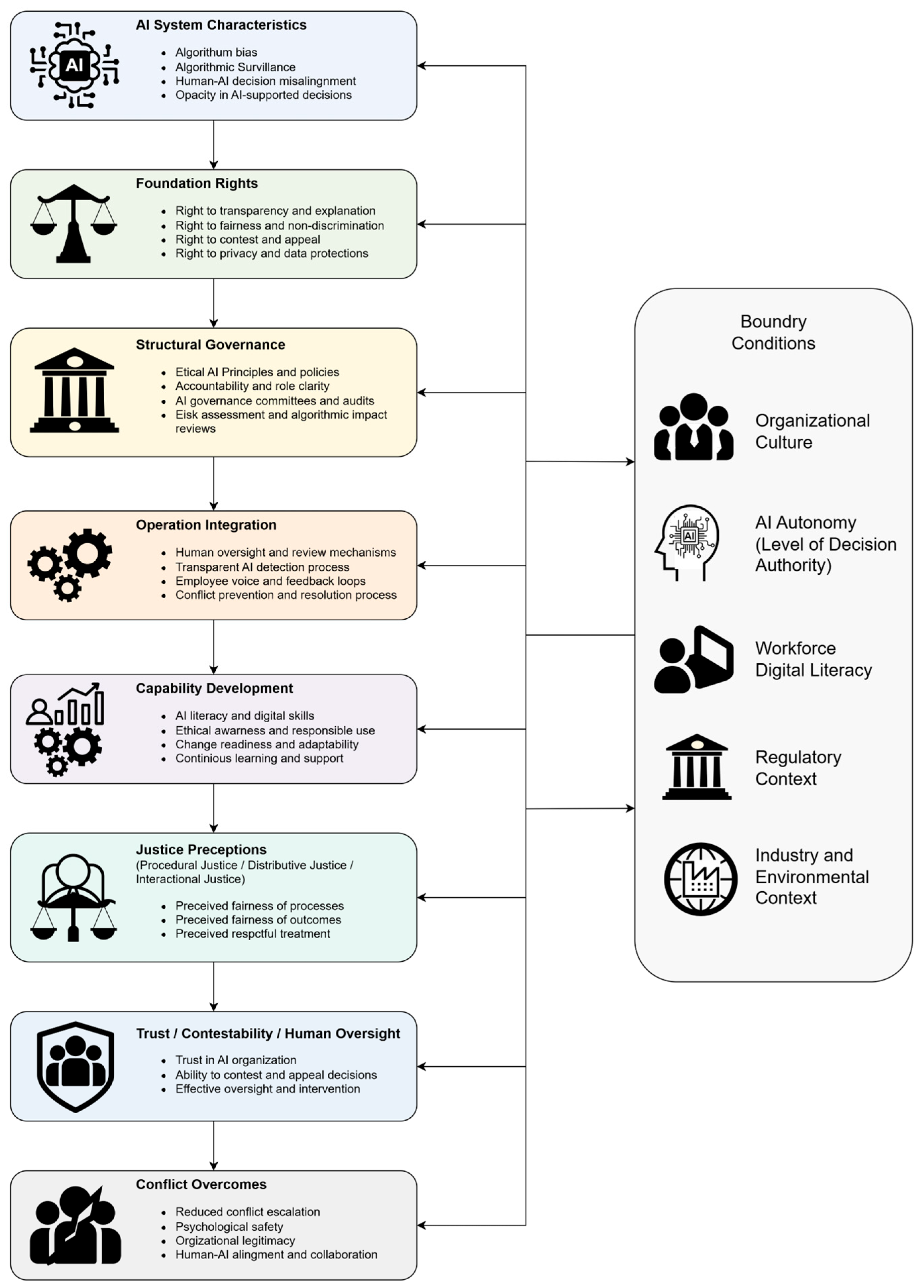
The Hybrid Conflict Governance Model (HCGM) conceptualizes AI-enabled workplace conflict as a socio-technical justice process. AI system characteristics such as bias, opacity, surveillance, and human–AI decision misalignment influence governance mechanisms, which subsequently shape employee justice perceptions. These perceptions affect trust, contestability, and acceptance of AI-supported decisions, ultimately influencing workplace conflict outcomes.
The model therefore follows the causal pathway:
AI Characteristics → Governance Mechanisms → Justice Perceptions → Trust and Contestability → Conflict Outcomes
Figure 1 illustrates the structure of the Hybrid Conflict Governance Model (HCGM) and the relationships between AI system characteristics, governance mechanisms, employee justice perceptions, trust, contestability, and workplace conflict outcomes. The model highlights how governance quality and capability development influence the translation of AI-supported decisions into organizational outcomes.
The HCGM is structured across four interdependent layers:
Foundational Rights
Structural Governance
Operational Integration
Capability Development
Unlike existing governance frameworks that often examine these elements independently, the HCGM proposes causal and reciprocal relationships between governance quality, employee interpretation, and conflict outcomes (
Rodgers et al., 2023;
Singh & Pandey, 2024).
The foundational rights layer influences legitimacy by shaping employee perceptions of procedural fairness, transparency, and trust in AI-supported organizational systems (
Chowdhury et al., 2023b;
Raghavan et al., 2020;
Zhou et al., 2023). The structural governance layer determines how AI systems are monitored, reviewed, and institutionally controlled through mechanisms such as ethics committees, audits, accountability structures, and grievance pathways (
Pfeffer, 2018;
Rodgers et al., 2023;
Singh & Pandey, 2024). The operational integration layer shapes how AI outputs are interpreted and applied in workplace conflict situations, particularly where disagreement may emerge between algorithmic recommendations and human judgment (
Choudhary et al., 2023;
Li et al., 2023). Finally, the capability-development layer moderates organizational outcomes by influencing AI literacy, digital communication competence, and human–AI collaboration quality (
Chowdhury et al., 2023a;
Kraus et al., 2023).
These layers operate interactively rather than sequentially. Governance failures may weaken trust, which subsequently alters how employees interpret AI-supported decisions and increases the likelihood of workplace conflict (
Chowdhury et al., 2023b;
Raghavan et al., 2020). Conversely, transparent governance, meaningful oversight, and effective capability development may strengthen fairness perceptions and reduce conflict escalation.
Accordingly, the HCGM proposes that workplace conflict outcomes are shaped through interaction between:
The novelty of the HCGM lies in integrating AI governance mechanisms, organizational justice dimensions, and workplace conflict outcomes within a single socio-technical explanatory framework. Existing AI governance models primarily emphasize compliance, fairness, transparency, and accountability, whereas conflict-management frameworks focus on interpersonal dispute resolution. The HCGM bridges these studies by explaining the mechanisms through which governance quality influences justice perceptions, trust, contestability, and workplace conflict outcomes.
9.1. Mechanisms and Boundary Conditions
The effectiveness of the HCGM depends on several mediating mechanisms and contextual conditions.
One important mechanism is transparency, which may strengthen procedural justice and organizational trust by helping employees understand how AI-supported decisions are generated (
Chowdhury et al., 2023b;
Langer & König, 2023). Improved transparency may reduce uncertainty and lower conflict escalation risk by increasing acceptance of algorithmic systems.
Human oversight functions as another important governance mechanism because review and override processes may reinforce accountability and reduce perceptions of procedural unfairness associated with automated decision making (
Li et al., 2023;
Rodgers et al., 2023;
Singh & Pandey, 2024).
AI literacy also moderates organizational outcomes by improving employee understanding of algorithmic limitations and decision-support processes (
Chowdhury et al., 2023a;
Kraus et al., 2023). Greater understanding may reduce human–AI misalignment and support more balanced interpretation of AI-supported recommendations.
Several boundary conditions may further influence whether AI functions as a conflict-amplifying or conflict-mitigating mechanism, including:
organizational culture and trust climate;
degree of AI autonomy;
workforce digital literacy;
and regulatory or institutional governance environments.
9.2. Foundational Rights Layer
The first layer establishes employee rights and the normative boundaries of AI use. It includes transparency regarding data collection and algorithmic logic, employee consent where appropriate, rights to explanation, rights to contest outcomes, and privacy protections. This layer is essential because conflict management cannot be legitimate if employees do not know how AI affects them (
Chowdhury et al., 2023b;
Langer & König, 2023;
Petani & Mengis, 2023).
9.3. Structural Governance Layer
The second layer consists of formal governance institutions and oversight mechanisms. These include AI ethics committees, impact assessments, algorithm audits, grievance pathways, and reporting structures. This layer ensures that responsible AI use is not dependent on informal goodwill but embedded in organizational procedure (
Pfeffer, 2018;
Rodgers et al., 2023;
Singh & Pandey, 2024).
9.4. Operational Integration Layer
The third layer focuses on how AI is actually incorporated into conflict workflows. It includes human–AI collaboration protocols, role definitions, decision escalation pathways, fail-safe controls, and documentation standards. This layer translates ethical intentions into daily practice. It also clarifies when AI may assist detection, when humans must review outputs, and how leadership decisions are made in sensitive cases (
Choudhary et al., 2023;
Li et al., 2023).
9.5. Capability-Building Layer
The fourth layer addresses the human competencies required to make the model function. It includes employee AI literacy, digital communication competence, leader development, and simulation-based learning. Without this layer, even well-designed governance systems may fail because users misinterpret, over trust, or misuse AI outputs (
Chowdhury et al., 2023a;
Gowrishankkar et al., 2025;
del Val Núñez et al., 2024;
Kraus et al., 2023;
Shao et al., 2024).
9.6. Anticipated Outcomes of the Model
If implemented effectively, the HCGM can generate several organizational benefits. First, it may reduce conflict escalation by identifying risks early while preserving human judgment. Second, it may strengthen perceptions of fairness by making AI-related decisions more transparent and contestable. Third, it may improve trust by demonstrating that the organization is not delegating sensitive human issues entirely to machines. Finally, it may support more sustainable digital transformation by aligning innovation with employee dignity and organizational justice (
Deng et al., 2024;
Rodgers et al., 2023;
Zhou et al., 2023).
10. Practical Implications
The findings of this study provide several practical implications for organizations implementing AI-supported workplace governance systems.
Table 4 provides the practical implementation roadmap for AI-Enabled Workplace Conflict Management.
HR Practitioners: HR practitioners may benefit from implementing structured grievance and review pathways that allow employees to challenge AI-supported decisions. Clearly defined escalation mechanisms and documentation procedures may strengthen procedural justice perceptions and improve organizational trust (
Raghavan et al., 2020;
Zhou et al., 2023).
Organizational Leaders: Organizational leaders may strengthen accountability by introducing second-level review mechanisms for high-impact AI-supported decisions. Transparent documentation of override decisions may further reduce concerns associated with algorithmic bias and procedural opacity (
Li et al., 2023;
Pfeffer, 2018;
Rodgers et al., 2023;
Singh & Pandey, 2024).
Employees: Organizations may also benefit from targeted AI literacy initiatives that help employees understand how AI-supported systems function, how algorithmic outputs should be interpreted, and how decisions may be challenged where appropriate (
Chowdhury et al., 2023a;
Kraus et al., 2023). Such initiatives may improve human–AI collaboration quality and reduce workplace misalignment.
11. Future Research Directions
Although this study provides a conceptual governance framework, substantial empirical investigation remains necessary. Future research should examine how AI-mediated workplace conflict varies across sectors, organizational cultures, and employment environments (
S. Kim et al., 2021;
Yan et al., 2024).
Further research is also needed regarding the psychological effects of AI-supported conflict classification and behavioural risk assessment. For example, future studies may examine how being labelled as a “conflict risk” influences employee identity, managerial relationships, or long-term workplace trust.
Another important direction concerns AI systems designed to support mediation and dialogue rather than merely monitoring employee behaviour. Future studies should empirically validate the HCGM using qualitative, quantitative, and mixed-methods designs across diverse organizational, sectoral, and cultural contexts (
Castillo et al., 2020;
Malik et al., 2023). Existing literature focuses heavily on monitoring and predictive governance mechanisms, while less attention has been given to AI-supported collaborative conflict-resolution approaches.
Future studies should empirically validate the HCGM using qualitative, quantitative, and mixed-methods research designs across diverse organizational and cultural contexts.
Finally, future empirical studies should test the HCGM directly through longitudinal, comparative, or mixed-methods research examining relationships between governance quality, employee justice perceptions, trust, and conflict outcomes.
12. Limitations
This study is conceptual in nature and does not provide empirical validation of the proposed Hybrid Conflict Governance Model (HCGM). The framework was developed through interdisciplinary literature synthesis and theoretical integration rather than qualitative or quantitative data collection. Consequently, the model should be viewed as a theoretical foundation that requires empirical examination across different organizational contexts.
First, the proposed framework has not been tested using longitudinal, survey-based, experimental, or case-study methodologies. Therefore, the causal relationships proposed between AI system characteristics, governance mechanisms, organizational justice perceptions, trust, and conflict outcomes remain theoretical and require empirical validation.
Second, although the framework integrates literature from human resource management, organizational justice, socio-technical systems theory, workplace conflict, and AI governance, the synthesis reflects the current state of published literature, which continues to evolve rapidly. Emerging technologies, regulatory developments, and organizational practices may introduce additional mechanisms or boundary conditions not captured in the present model.
Third, the model does not explicitly account for sector-specific differences. AI-enabled workplace conflict may manifest differently across healthcare, manufacturing, public sector, financial services, and knowledge-intensive organizations because these environments vary in regulatory requirements, risk profiles, workforce characteristics, and levels of AI maturity. Consequently, the transferability of the framework across sectors should be examined cautiously.
Fourth, the effectiveness of the proposed governance mechanisms is likely to be influenced by contextual factors such as organizational culture, leadership style, trust climate, workforce digital literacy, national regulatory environments, and the degree of AI autonomy. These contextual variables may moderate the relationships proposed within the model and lead to different conflict outcomes across organizations.
Finally, this study focuses primarily on governance and conflict management perspectives and does not examine technical aspects of AI system design, model architecture, explainability techniques, or computational performance. Future interdisciplinary research combining organizational, behavioural, legal, and technical perspectives would provide a more comprehensive understanding of AI-mediated workplace conflict.
Future studies should empirically validate the Hybrid Conflict Governance Model using qualitative, quantitative, and mixed-methods approaches across diverse organizational, sectoral, and cultural settings. Such research would help refine the model, test its explanatory mechanisms, and evaluate its practical applicability in increasingly AI-mediated workplaces.
13. Conclusions
AI is increasingly transforming workplace conflict management by introducing algorithmic systems into communication monitoring, behavioural analysis, performance evaluation, and decision-support processes (
Robinson et al., 2020;
Van den Broek et al., 2021;
Zhou et al., 2023). These developments create opportunities for earlier intervention, structured conflict detection, and data-informed organizational decision making. At the same time, they introduce significant risks related to transparency, surveillance, procedural fairness, and accountability.
This study argues that effective AI-supported conflict management requires more than technical implementation alone. Sustainable integration depends on governance structures capable of balancing technological capability with employee dignity, organizational justice, and meaningful human oversight.
The proposed Hybrid Conflict Governance Model contributes to this discussion by integrating foundational rights, governance mechanisms, operational controls, and capability-development processes into a unified socio-technical framework. The model explains how governance quality, human interpretation, and organizational capability collectively shape conflict outcomes within AI-mediated workplaces.
This study developed the Hybrid Conflict Governance Model (HCGM) to explain how AI-enabled workplace conflict emerges through interactions among technological characteristics, governance structures, employee justice perceptions, trust, contestability, and human oversight. By integrating socio-technical systems theory and organizational justice theory, the model provides a unified framework for understanding and governing AI-mediated workplace conflict.
The HCGM contributes to AI governance, human resource management, and workplace conflict literature by demonstrating how governance quality influences employee perceptions of fairness and organizational legitimacy. As AI adoption continues to expand across workplaces, organizations must ensure that technological innovation is accompanied by transparent governance, meaningful human oversight, and capability development to maintain trust, fairness, and sustainable organizational performance.



 ,
,