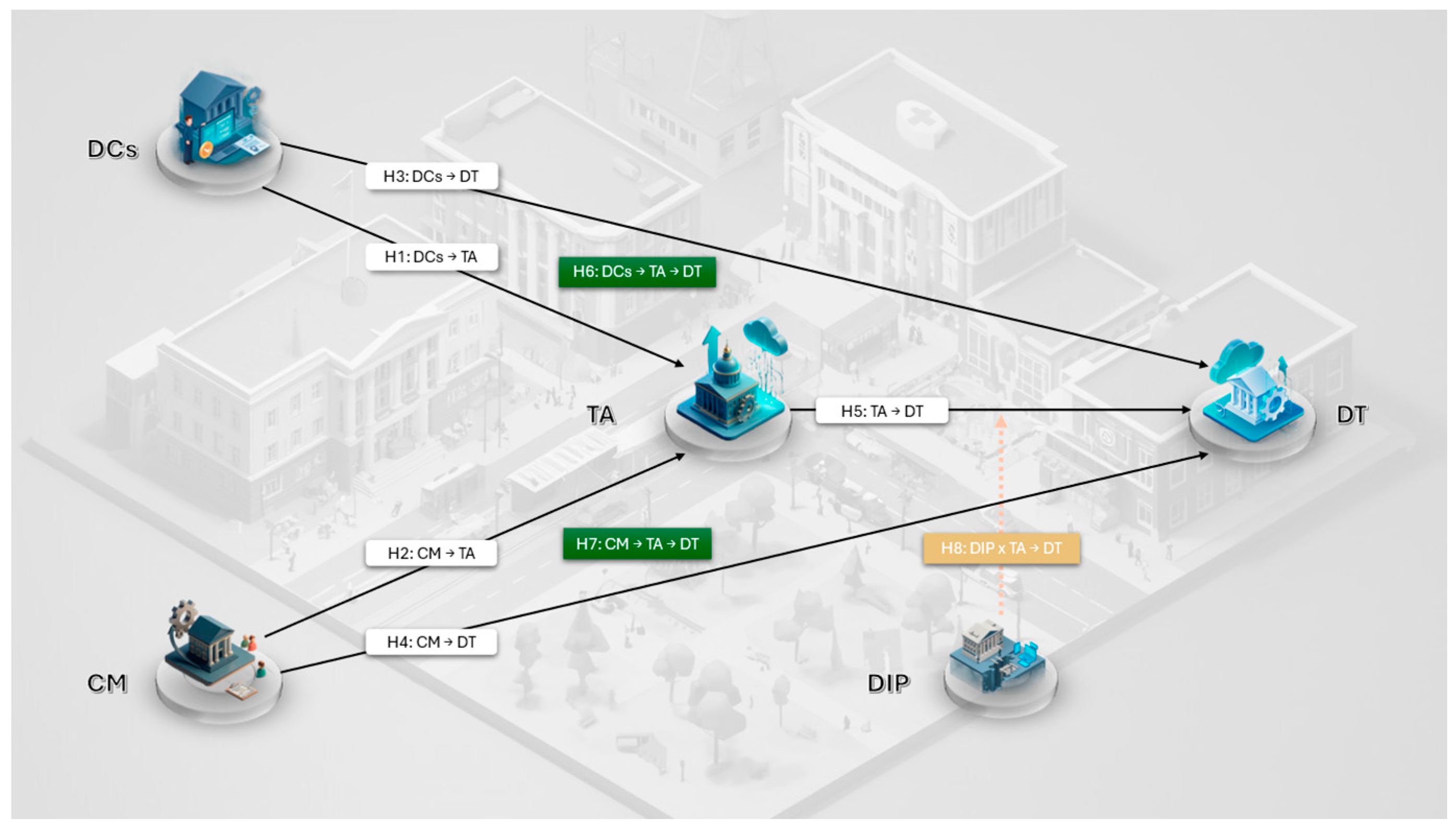
1. Introduction
Digital transformation has consolidated itself as one of the central pillars of state modernization in the 21st century. Governments face increasing pressure to improve administrative efficiency, strengthen transparency, and optimize the delivery of public services through the strategic use of digital technologies. In this context, digitalization not only implies incorporating technological tools, but also redefining processes, structures, and organizational dynamics to generate public value and respond to environments characterized by high uncertainty and changing citizen demands (
Norling, 2025;
Tinjan, 2025). Digital transformation thus becomes a strategic governance process that impacts both internal management and the relationship between the State and society. In this sense, digital transformation has become a central element of the contemporary public administration agenda, as it redefines how government institutions design, manage, and deliver public services.
However, recent evidence indicates that the mere incorporation of technologies does not guarantee effective processes of institutional transformation. Various studies show that the outcomes of digitalization largely depend on the human and organizational capabilities that sustain these processes (
Aristovnik et al., 2025;
Santos, 2024). In the public sector, factors such as civil servants’ digital competencies, organizational change management, and the willingness to adopt new technologies emerge as key conditions for digitalization to translate into structural and sustainable improvements (
Adewumi & Abasilim, 2024;
Barodi et al., 2024). In this way, digital transformation should not be understood as a purely technological phenomenon, but as a process that integrates individual, organizational, and strategic dimensions.
In Latin America, the challenges are even more complex due to structural inequalities and institutional limitations that characterize many administrative systems. Although digital government initiatives have been developed in the region, significant gaps persist in digital capabilities, institutional coordination, and change management (
Espina-Romero, 2025). In urban contexts such as Lima, Peru, public administration modernization faces tensions derived from traditional bureaucratic structures and heterogeneous levels of digital readiness. Added to this is the need for stronger digital inclusion practices, understood as institutional actions aimed at reducing inequalities in access, use, and effective benefit from digital technologies. These practices may support the scope and inclusiveness of digital transformation policies (
Singh & Chobotaru, 2022;
Tran Pham & Le Hoang Thuy To Nguyen, 2024).
Peru is a relevant setting for this study because digital transformation in public administration is supported by a formal national governance framework. The Digital Government Law establishes the governance framework for digital identity, digital services, interoperability, digital security, and data management across public administration entities at the three levels of government. Likewise, Emergency Decree No. 006-2020 created the National Digital Transformation System, which organizes public administration activities and promotes coordination with the private sector, civil society, academia, and citizens (
Presidencia del Consejo de Ministros, 2020). The National Digital Transformation Policy to 2030 further frames digital transformation as a continuous, strategic, and cultural change process aimed at generating public value through digital technologies and data (
Presidencia del Consejo de Ministros, 2018).
Lima is especially relevant within this framework because it is Peru’s capital and main administrative center, concentrating ministries, national agencies, regional administrative units, and municipal governments. It also represents the country’s largest urban area, with more than 10.4 million inhabitants and approximately 30.4% of the national population (
Instituto Nacional de Estadística e Informática, 2025). However, these institutions do not share the same mandates, resources, technological infrastructure, or implementation capacity. For this reason, Lima offers a useful empirical setting for analyzing how digital competencies, change management, technology adoption, and digital inclusion practices operate within public administration institutions exposed to the same national digital transformation agenda but marked by heterogeneous levels of institutional readiness.
At the theoretical level, the literature has partially addressed these dimensions through approaches such as the Technology Acceptance Model (TAM) and the Unified Theory of Acceptance and Use of Technology (UTAUT), which explain technology adoption based on individual perceptions (
Aranyossy, 2022;
Aristovnik et al., 2025). Likewise, dynamic capabilities theory has been adapted to the public sector to analyze how organizations develop competencies that allow them to respond to changing environments (
Santos, 2024). However, gaps still exist in integrating these frameworks within structural models that articulate digital competencies, change management, and technology adoption as explanatory mechanisms of digital transformation in the Latin American public sector. In addition, the literature has paid less attention to the role of digital inclusion practices as institutional mechanisms that may condition the relationship between technology adoption and digital transformation.
Although previous studies have examined the relationships between digital skills, technology adoption, change management, and digital transformation, these relationships have often been analyzed as separate explanatory factors (
Verhoef et al., 2021;
Vial, 2019). This limits the theoretical understanding of how public institutions transform digital resources into broader modernization outcomes. The present study addresses this limitation by framing these relationships as part of a Digital Governance Capacity mechanism. In line with prior research, DCs provide the human capability required to effectively use and adapt digital technologies (
van Laar et al., 2017), while CM provides the organizational support needed to reduce resistance and facilitate the implementation of new digital practices.
TA operates as the mechanism through which digital tools become embedded in administrative routines and organizational processes (
Davis, 1989;
Venkatesh et al., 2003), and DIP represents the inclusion-oriented dimension that seeks to ensure equitable participation in digital environments and the generation of public value. Therefore, the theoretical novelty of this study does not lie in proposing isolated direct effects, but in explaining how these constructs operate together as an integrated institutional capacity for DT in public administration.
In this study, digital governance capacity is understood as the institutional ability to align human skills, organizational change processes, and technology adoption mechanisms to produce meaningful digital transformation in public administration. This perspective goes beyond a technocentric view of digitalization. It assumes that public organizations do not transform only because technologies are available, but because they develop the capacity to mobilize digital competencies, manage organizational change, and embed digital tools into administrative routines. In this sense, the proposed framework contributes to the literature by explaining how digital competencies, change management, and technology adoption operate together as complementary mechanisms of public administration transformation.
In this scenario, it is necessary to advance toward integrated analytical models that allow understanding how individual capabilities, organizational practices, and contextual factors interact in state digital transformation processes. Analyzing these relationships from a structural perspective contributes to strengthening the debate on strategic digital governance and institutional modernization in emerging economies. Likewise, it makes it possible to generate empirical evidence that supports the design of public policies aimed at consolidating sustainable innovation processes in the public sector.
Therefore, the present study aims to examine the structural relationships among digital competencies, change management, technology adoption, and digital transformation in the public administration institutions in Lima, Peru, incorporating digital inclusion practices as a moderating variable. By integrating human, organizational, operational, and contextual dimensions into a single explanatory model, this research contributes to the literature on digital governance and public administration transformation.
The main theoretical contribution of this study is to conceptualize and empirically test digital governance capacity as an integrative framework for explaining digital transformation in public administration in an emerging economy context. While the individual relationships among digital competencies, change management, technology adoption, and digital transformation have been examined in prior research, this study reframes these relationships as part of an integrated institutional capacity mechanism. In this framework, digital competencies represent the human foundation, change management represents the organizational condition, technology adoption functions as the operational mechanism, and digital inclusion practices represent the inclusion-oriented dimension of digital governance.
This contribution is developed in three ways. First, the study integrates digital competencies, change management, technology adoption, and digital inclusion practices as complementary dimensions of institutional capacity rather than as isolated predictors. Second, it identifies technology adoption as the mechanism through which human capabilities and organizational change practices are translated into digital transformation outcomes. Third, it adapts the digital governance capacity perspective to the context of Lima, Peru, where public administration institutions operate under a common national digital transformation framework but differ in resources, mandates, and implementation capacity. In this way, the study contributes to digital governance theory by explaining digital transformation as an institutionally mediated process shaped by the alignment of human, organizational, technological, and inclusion-oriented conditions.
The remainder of this paper is structured as follows.
Section 2 presents the theoretical framework of the study.
Section 3 develops the research hypotheses.
Section 4 describes the materials and methods applied in the research.
Section 5 reports the empirical results.
Section 6 discusses the findings and their implications for public administration and digital governance. Finally,
Section 7 presents the main conclusions of the study.
2. Theoretical Framework
In the context of administrative modernization, digital transformation in the public sector has been widely recognized as a key mechanism for improving institutional efficiency and strengthening the relationship between the State and citizens. In this context, variables such as public servants’ digital competencies, organizational change management, and technology adoption emerge as critical factors that shape the effectiveness of digital initiatives. However, these dynamics are not uniform, as they are influenced by institutional efforts to promote digital inclusion, especially through training, equitable access strategies, awareness campaigns, and the adaptation of digital tools to users with different skill levels (
Espina-Romero, 2025;
Peixoto Rodriguez, 2025).
Although the literature converges in recognizing the importance of these variables, it still lacks integrative approaches that explain how they interact within public sector environments characterized by institutional rigidity and inequality. This fragmentation limits the explanatory capacity of existing models and justifies the need for more comprehensive approaches that integrate human, organizational, and contextual dimensions.
2.1. Digital Governance Capacity and Organizational Capacity in Public Administration Transformation
Digital governance capacity refers to the ability of public organizations to use digital technologies in a coordinated, strategic, and institutionally embedded manner. In public administration, this capacity is not limited to technological infrastructure. It also depends on civil servants’ skills, leadership support, change management practices, internal coordination, and the effective integration of technologies into administrative processes. Previous studies in the manuscript show that digital transformation requires more than technological investment, because bureaucratic inertia, limited readiness, and fragmented implementation can reduce the impact of digital initiatives (
Norling, 2025;
Santos, 2024;
Tinjan, 2025).
From this perspective, organizational capacity is central to public administration transformation. Digital competencies represent the human capability required to work in digital environments. Change management represents the organizational capability to guide transition, reduce resistance, and support implementation. Technology adoption represents the practical mechanism through which digital tools become part of institutional routines. Digital transformation represents the institutional outcome of this alignment. Digital inclusion practices, in turn, reflect institutional efforts to address equity-related conditions that may affect the reach of digital governance. Therefore, the proposed framework explains digital transformation as the result of an integrated governance capacity rather than as the isolated effect of technology or individual skills.
2.2. Key Definitions and Conceptual Delimitation
- (1)
Digital competencies (DCs): They are understood as the set of knowledge, skills, and attitudes necessary to effectively use digital technologies in the workplace. Recent studies highlight that DCs encompass from basic literacy to advanced skills in data management, cybersecurity, and digital collaboration (
Cardoso & Gomes, 2025;
Espina-Romero et al., 2024a,
2024b;
Lopes et al., 2023;
Medina, 2025). While
Cardoso and Gomes (
2025) and
Lopes et al. (
2023) emphasize the role of DCs as a direct enabler of digital performance,
Medina (
2025) suggests that their impact depends on their effective integration into organizational processes. This comparison indicates that DCs, although necessary, may not be sufficient to drive DT without complementary organizational mechanisms.
- (2)
Change management (CM): It refers to the set of processes, strategies, and practices that facilitate organizational transition in response to the introduction of new technologies. The literature emphasizes the importance of organizational culture, internal communication, and leadership in overcoming resistance (
Abawari et al., 2024;
Barodi et al., 2024;
Noroño Sánchez, 2025). While
Abawari et al. (
2024) and
Barodi et al. (
2024) focus on structural and cultural conditions for change,
Noroño Sánchez (
2025) highlights the role of leadership in aligning stakeholders. Taken together, these perspectives position CM not only as a support process but as a strategic capability that enables DT.
- (3)
Technology adoption (TA): It involves the acceptance, use, and integration of digital tools into institutional processes. In the public sector, TA has been extensively explained through TAM and UTAUT, where performance expectancy, ease of use, and institutional trust are central determinants (
Aristovnik et al., 2025;
Sukma & Yamnill, 2025). While
Aristovnik et al. (
2025) emphasize behavioral intention,
Sukma and Yamnill (
2025) highlight contextual and institutional factors. This suggests that TA should be understood not only as an individual-level outcome but also as a process embedded in organizational dynamics.
- (4)
Digital transformation (DT): Beyond the digitalization of processes, DT involves structural and cultural changes that redesign services and generate public value (
Canonico et al., 2025;
Ly, 2025;
Santos, 2024). While
Canonico et al. (
2025) and
Ly (
2025) emphasize service redesign and digitalization,
Santos (
2024) frames DT as a capability reconfiguration process. This distinction reinforces the idea that DT is not merely technological but strategic and organizational.
- (5)
Digital inclusion practices (DIP): These refer to institutional actions, strategies, and support mechanisms aimed at promoting equitable access to digital services, strengthening digital skills, raising awareness about digitalization, and adapting digital tools to users with different levels of technological readiness. Previous studies show that digital exclusion is associated with inequalities in access, skills, age, income, territory, and effective use of digital technologies (
Cui et al., 2025;
Espina, 2025;
Singh & Chobotaru, 2022). In this study, DIP does not measure the digital divide itself, but rather institutional practices intended to reduce exclusion risks and support more inclusive digital transformation.
Taken together, these constructs form an integrated framework of digital governance capacity. DCs explain the individual readiness of public servants. CM explains the institutional support required to guide digital change. TA explains the actual integration of digital tools into public administration routines. DT captures the broader modernization of processes, services, and decision-making. DIP introduces the institutional inclusion dimension of digital governance. This integrated view clarifies that the contribution of the model lies not only in testing separate relationships, but in explaining how human, organizational, operational, and contextual conditions interact in public sector DT.
2.3. Review of Background and Previous Findings
Empirical evidence shows that DCs strengthen the public sector’s capacity to implement digital services, although significant gaps among public servants persist (
Adewumi & Abasilim, 2024;
Bilan et al., 2023). While
Adewumi and Abasilim (
2024) highlight improvements in service delivery,
Bilan et al. (
2023) point to persistent competency deficits, suggesting that the impact of DCs is uneven and context-dependent.
Regarding TA, studies conducted in Europe, Asia, and Latin America converge in highlighting perceived usefulness, ease of use, and institutional trust as key determinants (
Aranyossy, 2022;
Crăciun et al., 2025). However, while
Aranyossy (
2022) emphasizes user perceptions,
Crăciun et al. (
2025) incorporate institutional dimensions, suggesting that TA is influenced by both individual and systemic factors.
DT has demonstrated positive effects on efficiency and service quality, but these outcomes are not guaranteed (
Norling, 2025;
Tinjan, 2025). While
Norling (
2025) highlights improvements in governance performance,
Tinjan (
2025) emphasizes the persistence of bureaucratic inertia. This divergence suggests that DT success depends on organizational alignment.
Finally, DIP emerges as a cross-cutting institutional response to digital exclusion risks. Studies in Canada, Hong Kong, and Vietnam show that socioeconomic, age, and gender disparities limit equitable access to digital services (
Singh & Chobotaru, 2022;
Tran Pham & Le Hoang Thuy To Nguyen, 2024;
Wong & Ho, 2022). While
Singh and Chobotaru (
2022) focus on inequality,
Tran Pham and Le Hoang Thuy To Nguyen (
2024) highlight access gaps, and
Wong and Ho (
2022) emphasize demographic barriers. Together, these findings indicate that digital inclusion practices are important for improving the reach, equity, and social effectiveness of DT policies.
2.4. Gaps and Knowledge Voids
Despite the growing body of literature, important gaps remain. Most studies analyze DCs, CM, TA, and DT in isolation, limiting the development of integrative models. In addition, the mediating role of TA between DCs, CM, and DT has been insufficiently explored in Latin America. Furthermore, although digital inclusion is widely recognized as a policy priority, the moderating role of institutional digital inclusion practices has not been consistently tested in internal public administration models. This fragmentation reduces the explanatory capacity of existing approaches and limits the development of evidence-based digital governance strategies in public sector contexts.
2.5. Reference Models and Theories
This study is grounded in TAM and UTAUT to explain TA (
Aristovnik et al., 2025;
Sukma & Yamnill, 2025), and in Dynamic Capabilities Theory to explain DT (
Santos, 2024). While TAM and UTAUT focus on individual acceptance, Dynamic Capabilities Theory emphasizes organizational adaptation, providing complementary perspectives. Additionally, CM is supported by the ADKAR model, which conceptualizes change as a sequence of awareness, desire, knowledge, ability, and reinforcement (
Al-Alawi et al., 2019).
These theoretical perspectives are complementary. TAM and UTAUT explain why public servants and institutions accept and use digital technologies. ADKAR explains how public organizations can guide employees through digital change by creating awareness, desire, knowledge, ability, and reinforcement. Dynamic Capabilities Theory explains how public organizations reconfigure resources, routines, and capabilities to respond to changing environments. When combined, these perspectives support the idea that DT in public administration depends on both adoption behavior and organizational capacity. This theoretical integration strengthens the proposed framework by linking individual acceptance, change management, and capability reconfiguration within a digital governance approach.
2.6. Digital Transformation and Strategic Governance in the Public Administration
DT should be understood as a governance phenomenon that redefines interactions between the State and society (
Norling, 2025;
Tinjan, 2025). While
Norling (
2025) emphasizes performance improvements,
Tinjan (
2025) highlights structural limitations, indicating that DT requires more than technological investment. From a strategic perspective, digital governance integrates leadership, CM, and organizational capabilities.
Aristovnik et al. (
2025) show that structured adoption improves performance, while
Santos (
2024) emphasizes capability reconfiguration. This suggests that TA functions as a mechanism that connects capabilities with transformation outcomes.
Furthermore, the interaction between DCs, CM, and TA represents a shift toward more adaptive public administration models in Latin America. In contexts such as Lima, these factors are critical to overcoming institutional rigidity. Finally, incorporating DIP introduces an equity dimension.
Singh and Chobotaru (
2022) warn about inequality risks, while
Tran Pham and Le Hoang Thuy To Nguyen (
2024) highlight access limitations. This confirms that DT has social and political implications beyond organizational performance.
Therefore, the proposed model should be understood as a digital governance capacity framework. It explains how public institutions convert individual digital skills and organized change practices into transformation outcomes through the effective adoption of technologies. This approach is especially relevant in emerging public administrations, where digital reforms often face institutional rigidity, uneven readiness, and social inequality. The framework also helps clarify why DT requires the alignment of human competencies, organizational support, technology use, and inclusive governance conditions.
2.7. Relationship with the Research Hypotheses
2.8. Final Synthesis
In summary, DT in the public sector results from the interaction between DCs, CM, TA, and DIP. DCs provide the human foundation for digital work. CM creates the organizational conditions for transition. TA operates as the mechanism that converts capabilities and support into concrete use of technologies. DIP represents a contextual condition related to equity and inclusion. This framework contributes to public administration literature by explaining DT as an institutionally mediated process. It also extends digital governance research by showing that transformation depends on the capacity of public organizations to align people, processes, technologies, and contextual conditions.
4. Materials and Methods
4.1. Research Design
This study followed a quantitative, non-experimental, cross-sectional design. The objective was to examine the structural relationships among DCs, CM, TA, DT, and the moderating role of DIP in public administration institutions in Lima, Peru. A cross-sectional design is appropriate when the goal is to analyze relationships among variables at a single point in time (
Creswell & Creswell, 2018). Because the study does not manipulate variables but rather examines naturally occurring organizational perceptions, it is classified as non-experimental (
Kerlinger & Howard, 2002).
The analytical approach was based on Partial Least Squares Structural Equation Modeling (PLS-SEM), which is recommended when the research aims to predict key constructs and assess complex mediation and moderation relationships (
Hair et al., 2021;
Henseler et al., 2015). PLS-SEM is particularly suitable for exploratory and prediction-oriented models in social sciences and public administration contexts.
4.2. Population and Sample
The population consisted of public sector employees working in public administration institutions located in Lima, Peru. For the purposes of this study, three levels of government were considered. The national level refers to employees working in ministries, national agencies, and autonomous public bodies whose headquarters or administrative offices are located in Lima. The regional level refers to employees working in regional government units or related administrative bodies with jurisdiction in the Lima region. The local level refers to employees working in municipal governments, including provincial and district municipalities located in Metropolitan Lima and the broader Lima region.
Therefore, the empirical scope of this study is limited to public administration institutions located in Lima, Peru. The study does not include broader public-sector entities such as state-owned enterprises, public universities, public hospitals, or other publicly funded organizations. In this study, the term public servants is used as an umbrella category to refer to individuals who perform administrative, professional, technical, or managerial functions within public administration institutions. This category included career civil servants, appointed personnel, and contractual staff working in public organizations at the time of data collection.
Temporary workers and external consultants were not intentionally targeted unless they performed formal institutional duties within the participating public organizations. However, employment modality was not used as a stratification criterion, and the survey did not collect sufficiently detailed information to compare respondents by type of employment contract. Therefore, the results should be interpreted as reflecting the perceptions of public sector employees broadly, rather than the perceptions of a specific employment category.
Data were collected through an online questionnaire distributed to public servants across ministries, autonomous agencies, municipalities, and regional government units. A total of 358 valid responses were obtained. This sample size exceeds the minimum requirements suggested for PLS-SEM analysis. According to
Hair et al. (
2021), the minimum sample size should satisfy the “10-times rule” or preferably be determined based on statistical power analysis. With multiple predictors in the model, the sample size of 358 provides adequate statistical power for detecting medium and small effects (
Cohen, 2013).
The demographic profile of respondents is presented in
Table 1. The sample included participants from national (58.4%), regional (17.0%), and local government (24.6%) levels, with balanced gender distribution and diverse educational attainment.
4.3. Measurement Instrument
The measurement instrument was adapted from the validated multivariable model developed by (
Espina-Romero, 2025), which originally included 11 constructs. For the present study, five constructs were selected based on theoretical alignment with digital governance and public administration transformation. Each construct was measured using four reflective indicators, resulting in a total of 20 items. All items were assessed using a five-point Likert scale ranging from 1 (strongly disagree) to 5 (strongly agree), consistent with standard measurement practices in organizational research (
Joshi et al., 2015).
The construct measurement was reviewed to ensure stronger alignment with the public administration literature. Each construct was operationalized according to its role in public sector digital governance. DCs were measured as civil servants’ ability to use digital tools, communicate through digital platforms, participate in digital training, and work with collaboration systems. CM was measured through institutional training, planning, internal communication, and employee support during technological change. TA was measured through institutional promotion of technologies, employee openness, usability, and improvement of administrative processes. DT was measured through efficiency, user interaction, decision-making optimization, and document digitization. DIP was measured through training for vulnerable groups, equitable access strategies, awareness campaigns, and adaptation of digital tools to different skill levels.
The full list of questionnaire items is presented in
Table 2 of the manuscript.
These indicators were selected because they reflect key dimensions of public administration. The DCs items capture the digital readiness of civil servants. The CM items capture institutional mechanisms used to manage reform and reduce resistance during digital change. The TA items capture the organizational use and acceptance of technologies in administrative routines. The DT items capture concrete modernization outcomes related to efficiency, service interaction, decision-making, and paperless administration. The DIP items capture the inclusive dimension of digital governance by focusing on access, training, awareness, and adaptation for users with different digital skill levels. Therefore, the measurement model is grounded not only in general organizational research, but also in the specific requirements of digital transformation in public administration.
Because the instrument had been previously validated, construct operationalization followed established procedures. However, reliability and validity were re-evaluated in the present sample to ensure measurement robustness in the public sector context (
Hair et al., 2021).
4.4. Data Collection Procedure
Data were collected through a structured online survey administered to public servants between January and May 2025. The questionnaire was distributed online to employees working in ministries, autonomous agencies, municipalities, and regional government units located in Lima, Peru. Participation was voluntary, and confidentiality was guaranteed. Respondents were informed about the academic purpose of the study. Cross-sectional survey data are appropriate for examining perceptions and organizational attitudes in public administration contexts. To reduce common method bias, items were clearly worded, constructs were conceptually separated, and anonymity was ensured (
Podsakoff et al., 2003).
4.5. Data Analysis Strategy
The data analysis followed a two-step approach consistent with PLS-SEM guidelines (
Hair et al., 2021):
4.5.1. Step 1: Assessment of the Measurement Model
The reflective measurement model was evaluated using:
- (a)
Indicator loadings (≥0.70 recommended).
- (b)
Internal consistency reliability (Cronbach’s Alpha, Composite Reliability).
- (c)
Convergent validity (Average Variance Extracted ≥ 0.50).
- (d)
Discriminant validity (Fornell–Larcker criterion and HTMT ratio).
4.5.2. Step 2: Assessment of the Structural Model
The structural model was evaluated using:
- (a)
Path coefficients (β).
- (b)
Bootstrapping with resampling to test statistical significance.
- (c)
Confidence intervals (95%).
- (d)
Coefficient of determination (R2).
- (e)
Effect sizes (f2).
- (f)
Mediation analysis using Variance Accounted For (VAF).
- (g)
Moderation analysis using product-indicator interaction.
4.6. Ethical Considerations
This study followed the ethical principles outlined in the Declaration of Helsinki (1975, revised 2013). Participation was voluntary, anonymous, and based on informed consent. No sensitive personal data were collected. Given the minimal risk nature of the study and its non-interventional design, formal ethical approval was not required.
4.7. Declaration on the Use of AI-Assisted Technologies
During the development and processing of this study, various technological tools were employed as support instruments. These included Microsoft Word (Microsoft 365 version) for grammar and stylistic revision, Microsoft Excel (Microsoft 365 version) for statistical data analysis, ChatGPT (GPT-5.3) and DeepL (web version) for translation verification and enhancement of textual clarity, and Google Scholar (web version) for the identification and validation of academic sources. It is important to note that the use of these tools did not substitute the authors’ analytical reasoning or scientific judgment. The following section presents the empirical results obtained from the PLS-SEM analysis, including the evaluation of the measurement model and the structural relationships proposed in the research framework.
6. Discussion
6.1. Main Findings
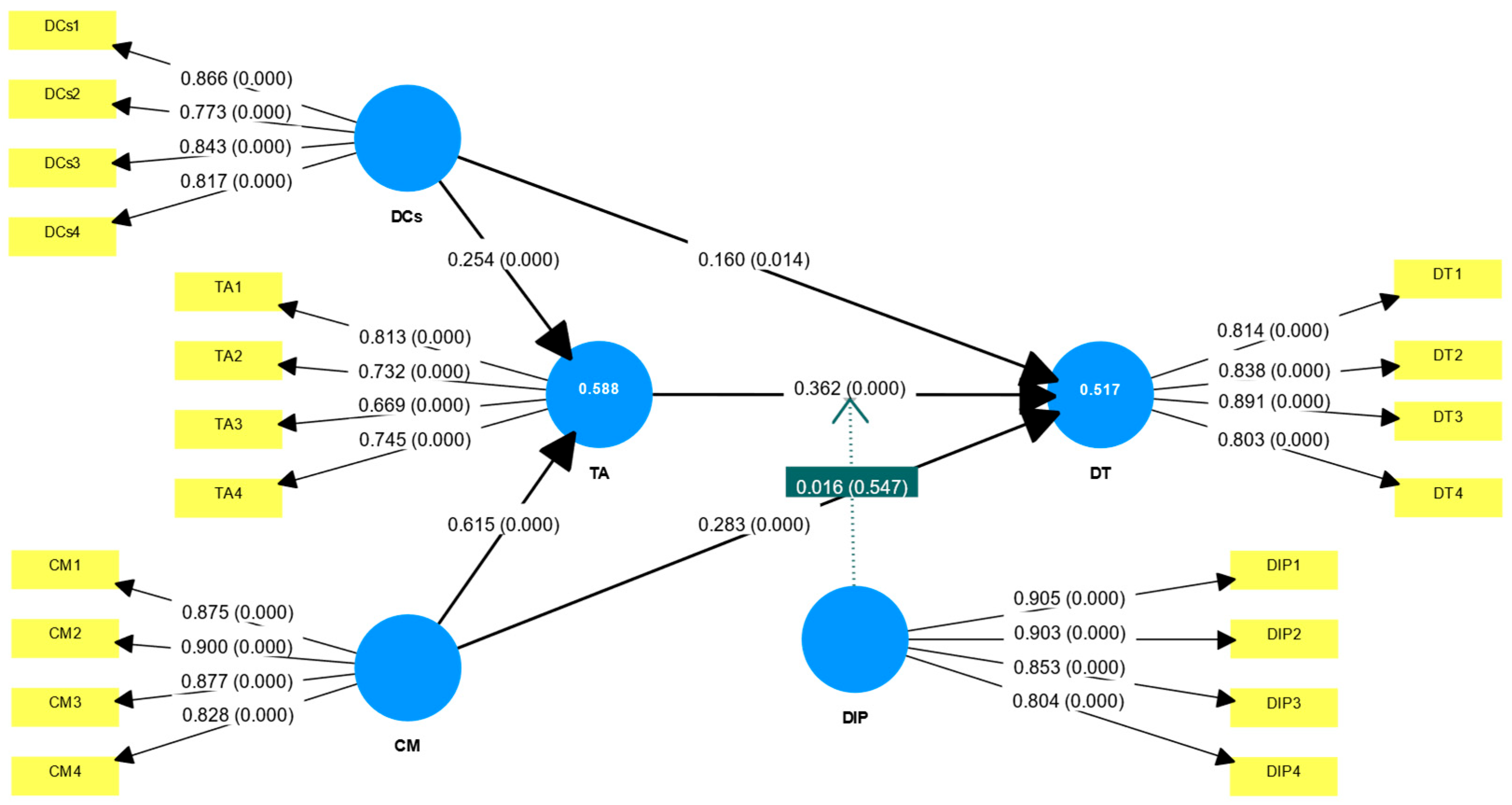
This study examined the structural relationships among DCs, CM, TA, DT, and DIP in public administration institutions in Lima. Because the research design was cross-sectional and perception-based, the findings should be interpreted as structural associations rather than causal effects. The results show that DCs and CM are positively associated with TA. CM and TA also show significant positive relationships with DT. In addition, TA mediates the relationships between DCs and DT, and between CM and DT. However, DIP did not significantly strengthen the relationship between TA and DT.
The interpretation of H3 requires specific attention. The relationship between DCs and DT was statistically significant (β = 0.160, p = 0.014), so H3 was supported. However, the effect size was small (f2 = 0.036). This means that DCs are associated with DT, but their explanatory relevance is limited when they are considered alone. This result suggests that digital skills become more relevant when they are connected to institutional support, organizational routines, and TA processes.
The strongest relationship in the model was observed between TA and DT. This finding suggests that the institutional use of technologies may be a central mechanism associated with DT in public administration. Individual skills are important, but they do not appear to be sufficient by themselves. They gain greater relevance when they are translated into concrete adoption processes and embedded in administrative routines (
Aristovnik et al., 2025;
Santos, 2024).
6.2. Theoretical Discussion and Comparison with Prior Studies
The findings of this study contribute to the theoretical discussion in three main ways. First, they extend technology adoption theories by showing that TA in public administration should not be interpreted only as an individual acceptance process. TAM and UTAUT explain technology adoption mainly through user perceptions, behavioral intention, usefulness, ease of use, and facilitating conditions. However, in public administration institutions, TA is also shaped by institutional conditions, organizational routines, and the capacity of public organizations to support employees during digital change. In this sense, the results are consistent with
Aristovnik et al. (
2025) and
Sukma and Yamnill (
2025), who emphasize the relevance of technology acceptance and use for the modernization of public administration. However, this study extends that discussion by showing that TA becomes more theoretically meaningful when it is examined together with DCs and CM. Therefore, TA should not be viewed only as the acceptance of digital tools, but as the operational mechanism through which public administration institutions embed technologies into administrative routines.
Second, the findings refine the role of DCs in DT in public administration. Previous studies have emphasized that digital skills among civil servants are important for improving digital readiness, service delivery, and administrative performance (
Adewumi & Abasilim, 2024;
Bilan et al., 2023;
Cardoso & Gomes, 2025;
Lopes et al., 2023). The present study does not contradict this view. However, it suggests that DCs should not be interpreted as an isolated driver of DT. Although DCs are positively associated with DT, their explanatory relevance is stronger when they are connected to TA and supported by CM. This finding refines the digital competencies literature by showing that digital skills become more relevant when they are institutionally mobilized, translated into actual technology use, and connected to organizational transformation processes within public administration institutions.
Third, the findings refine Dynamic Capabilities Theory in the public administration context. From this perspective, DT does not depend only on the possession of resources, but on the capacity of institutions to mobilize, organize, and reconfigure those resources in response to changing demands. This interpretation is consistent with
Santos (
2024), who argues that dynamic capabilities are relevant for understanding DT in public administration. In the proposed model, DCs represent the human capability base, CM represents the organizational condition that supports transition, and TA represents the operational mechanism that connects internal capabilities with DT. Therefore, the study contributes to Dynamic Capabilities Theory by showing that public administration institutions need more than digital resources or skilled employees. They also need mechanisms that convert those resources into new administrative routines and modernization outcomes.
The findings related to CM also strengthen this interpretation. Prior studies have shown that leadership, communication, training, participation, and organizational culture are critical for change processes in public administration (
Abawari et al., 2024;
Barodi et al., 2024;
Rehouma et al., 2020;
Semenets-Orlova et al., 2023). The present study supports this perspective, but it also adds that CM is not only a support activity for digital reform. It is part of Digital Governance Capacity because it creates the organizational conditions that allow technologies to be accepted, used, and integrated into institutional processes. In bureaucratic public administration institutions, where routines, hierarchy, and resistance may slow down digital initiatives, CM becomes a necessary condition for connecting digital strategies with actual transformation.
The non-significant moderating role of DIP provides an additional theoretical nuance. Prior studies have shown that digital inequality can affect access to online government services, citizen engagement, and the public value generated by e-government initiatives (
Singh & Chobotaru, 2022;
Tran Pham & Le Hoang Thuy To Nguyen, 2024;
Wong & Ho, 2022). However, those studies mainly emphasize citizen-facing relationships. In contrast, the present study focuses on internal public administration processes among public servants. This difference may explain why DIP did not significantly moderate the relationship between TA and DT. The finding does not imply that DIP is irrelevant. Rather, it suggests that DIP may operate more strongly in models focused on citizens, service users, public value, or digital access, while internal DT in public administration may depend more directly on CM, DCs, and TA.
Overall, these findings clarify the theoretical contribution of the study. The model does not claim that the individual relationships among DCs, CM, TA, DT, and DIP are entirely new. Instead, its contribution lies in reframing these relationships as part of an integrated Digital Governance Capacity mechanism. This framework explains DT as an institutionally mediated process in which human capabilities, organizational support, technology use, and inclusion-oriented practices interact within public administration. Therefore, the study extends technology adoption theory, refines Dynamic Capabilities Theory in the public administration context, and clarifies the possible level of operation of DIP in internal digital transformation models.
6.3. Theoretical Contribution: Digital Governance Capacity as an Integrative Framework
The main theoretical contribution of this study lies in conceptualizing and empirically testing Digital Governance Capacity as an integrative framework for explaining DT in public administration. This study does not claim that DCs, CM, TA, DT, or DIP are new constructs by themselves. These constructs have already been examined in previous studies on digital transformation, technology adoption, digital competencies, change management, and digital inclusion. Rather, the contribution of this study lies in the way these constructs are theoretically articulated as complementary components of an institutional capacity mechanism.
In this framework, Digital Governance Capacity is understood as the institutional ability to align human capabilities, organizational change conditions, technology-use mechanisms, and inclusion-oriented practices to support DT. DCs represent the human foundation of this capacity because public servants need digital skills to understand, use, and adapt digital tools in their daily work. This interpretation is consistent with
Adewumi and Abasilim (
2024),
Bilan et al. (
2023),
Cardoso and Gomes (
2025), and
Lopes et al. (
2023), who highlight the relevance of digital skills for the digitalization of public administration. However, the present study refines this view by showing that DCs should not be understood as an isolated driver of DT. Their theoretical relevance increases when they are connected to CM and translated into actual TA.
CM represents the organizational condition of Digital Governance Capacity. In public administration, digital transformation requires more than individual skills or technological infrastructure. It also requires leadership, communication, planning, participation, support, and resistance management. This argument is consistent with
Abawari et al. (
2024),
Barodi et al. (
2024),
Rehouma et al. (
2020), and
Semenets-Orlova et al. (
2023), who emphasize the role of change management in public administration reform. The present study extends this perspective by positioning CM not only as a managerial support practice, but as a core component of digital governance capacity. In bureaucratic public administration institutions, CM helps convert digital reform from a formal institutional agenda into concrete organizational practices.
TA represents the operational mechanism of Digital Governance Capacity. Technology adoption theories, especially TAM and UTAUT, explain how users accept and use digital technologies based on usefulness, ease of use, behavioral intention, facilitating conditions, and institutional support (
Davis, 1989;
Venkatesh et al., 2003). Previous studies have also emphasized the importance of TA in the modernization of public administration and digital government development (
Aristovnik et al., 2025;
Sukma & Yamnill, 2025). This study contributes to that literature by showing that TA operates as the mechanism through which DCs and CM become associated with DT. In other words, public administration institutions may have digitally competent employees and change-oriented practices, but these resources generate stronger transformation value when they are embedded in administrative routines through actual technology use.
This interpretation also strengthens the connection between the proposed model and Dynamic Capabilities Theory. From this theoretical perspective, organizations do not transform only because they possess resources. They transform when they are able to mobilize, integrate, and reconfigure those resources in response to changing demands (
Teece, 2018;
Teece et al., 1997). In the public administration context,
Santos (
2024) argues that dynamic capabilities are relevant for understanding DT because public administration institutions must adapt routines, coordinate actors, and improve service delivery in changing environments. The present study extends this argument by identifying DCs, CM, and TA as complementary elements of that reconfiguration process. DCs provide the human resource base, CM provides the organizational support structure, and TA provides the operational channel through which resources are converted into digital transformation outcomes.
The study also contributes to digital governance theory by framing DT as an institutionally mediated process rather than a purely technological outcome. Prior studies have shown that DT in public administration is shaped by institutional inertia, bureaucratic culture, social construction processes, and organizational readiness (
Norling, 2025;
Tinjan, 2025). The present study supports this view and adds that DT depends on the alignment of people, processes, technologies, and institutional support. Therefore, Digital Governance Capacity helps explain why the availability of digital technologies does not automatically produce transformation. Technologies need to be accepted, used, organized, and embedded within public administration routines.
Another theoretical contribution concerns the role of DIP. Previous studies have shown that digital inequality affects access to online government services, citizen engagement, and the public value of e-government (
Singh & Chobotaru, 2022;
Tran Pham & Le Hoang Thuy To Nguyen, 2024;
Wong & Ho, 2022). In this study, DIP was included as the inclusion-oriented dimension of Digital Governance Capacity. Although the moderating effect of DIP was not statistically significant, this result provides a useful theoretical clarification. It suggests that DIP may operate more strongly in citizen-facing models than in internal organizational models focused on public servants. Thus, DIP remains conceptually relevant, but its effect may depend on the level of analysis. In internal public administration processes, DT appears to be more directly associated with CM and TA. In citizen-facing digital government models, DIP may become more relevant for explaining access, inclusion, engagement, and public value creation.
The Lima-based context also strengthens the theoretical contribution of the study. Public administration institutions in Lima operate under a common national digital transformation framework, but they differ in mandates, resources, technological infrastructure, and implementation capacity. This context allows the study to examine Digital Governance Capacity in an emerging economy where digital reform is institutionally promoted, but unevenly implemented. Therefore, the study contributes to the literature by adapting digital governance and dynamic capabilities perspectives to a Latin American public administration setting characterized by institutional heterogeneity, bureaucratic routines, and unequal levels of digital readiness.
Overall, the contribution of this study is not the proposal of isolated relationships among known variables. Its contribution is the theoretical integration of these variables into a Digital Governance Capacity framework. This framework explains DT as the result of an institutional alignment process in which DCs provide the human foundation, CM creates the organizational conditions, TA operates as the implementation mechanism, and DIP represents the inclusion-oriented dimension of digital governance. In this way, the study extends technology adoption theory, refines Dynamic Capabilities Theory in the public administration context, and contributes to digital governance literature by explaining how public administration institutions in emerging economies convert digital capabilities and change practices into digital transformation outcomes.
6.4. Policy and Managerial Implications
The policy and managerial implications of this study should be interpreted with caution because the research design is cross-sectional and non-experimental. Even so, the observed relationships offer useful guidance for public managers and policymakers. DT strategies should not focus only on technology acquisition. They should also include structured CM, continuous training, internal communication, and support mechanisms that help civil servants use digital tools in daily administrative routines.
From a managerial perspective, digital skills development should not be treated as an isolated training activity. Therefore, the results should not be interpreted as suggesting that training alone is sufficient to drive digital transformation. Rather, training becomes effective when it is embedded within broader organizational and governance capabilities, including change management, leadership support, technology adoption, and process redesign. The results suggest that DCs are more useful when they are connected to implementation plans, leadership support, and opportunities to use digital tools in real work processes. Public managers should link digital training with process redesign, system use, and service delivery improvement.
Public institutions should also prioritize the quality of TA. This includes selecting user-oriented platforms, promoting interoperability, supporting employees during implementation, and monitoring whether digital tools are actually incorporated into administrative routines. It is not enough to introduce technology symbolically. Institutions should promote actual use, continuity, and integration into daily work.
CM should be included as a formal component of digital reform strategies. Public institutions should develop communication plans, internal leadership support, participation mechanisms, implementation guidance, and resistance management strategies. These actions are especially important in bureaucratic environments, where rigid structures can slow down or weaken digital initiatives (
Norling, 2025;
Tinjan, 2025).
From a policy perspective, DT strategies should follow an integrated approach. Policies should simultaneously develop DCs, strengthen CM, and promote effective TA. Isolated interventions may be less useful for supporting meaningful digital modernization. This integrated approach is relevant in emerging public administrations, where institutional fragmentation and uneven digital readiness may limit the sustainability of digital reform (
Espina-Romero, 2025).
Although DIP did not moderate the central relationship, it remains relevant for policy. The absence of a significant moderating effect does not mean that institutional digital inclusion practices are unimportant. Rather, it suggests that, in this internal public administration model, DIP may not directly alter how TA translates into DT. Even so, digital inclusion practices remain important for inclusive governance, equitable service delivery, and the long-term sustainability of public digitalization (
Singh & Chobotaru, 2022;
Tran Pham & Le Hoang Thuy To Nguyen, 2024).
6.5. International and Contextual Relevance
This study contributes empirical evidence from Lima, Peru, to international debates on DT in public administration. Although the findings should not be generalized to all Latin American public administrations, they provide evidence from an emerging economy context where public institutions face digital reform pressures, heterogeneous capacities, and bureaucratic constraints.
The results suggest that DT in emerging contexts is associated not only with digital skills, but also with the institutional capacity to organize those skills through CM and TA. This broadens the comparative discussion between developed and developing contexts. It also highlights the importance of analyzing DT as a process shaped by organizational readiness, public administration capabilities, and institutional constraints.
The Lima context is relevant because public institutions operate under the same national digital transformation framework but differ in resources, mandates, and implementation capacity. In this setting, digital governance capacity becomes a useful concept for interpreting how public organizations align people, processes, technologies, and inclusion-oriented practices in institutional modernization.
The study also supports a more realistic view of DT in emerging public administrations. Institutional transformation does not appear to depend on a single factor. Rather, it is linked to the alignment of DCs, CM, TA, and contextual conditions. This interpretation connects the findings with broader debates on public administration, digital governance, and state modernization.
6.6. Limitations and Future Research
This study has several limitations. First, the methodological design is cross-sectional and non-experimental. Therefore, the results should be interpreted as structural associations rather than causal relationships. Future research could use longitudinal designs to examine how the relationships among DCs, CM, TA, DT, and DIP evolve over time.
Second, the study used a perception-based survey. This approach is appropriate for examining public servants’ views, but it does not capture objective indicators of digital transformation, institutional performance, or service quality. Future studies could combine survey data with administrative records, digital service indicators, interviews, or case studies to provide deeper analytical evidence.
Third, the research focused on public servants in Lima. This may limit the generalization of the findings to other institutional, territorial, or national contexts. Public organizations may differ in administrative culture, technological infrastructure, leadership practices, and digital readiness. Future studies could replicate the model in other regions of Peru or in other emerging economy contexts.
Fourth, the model focused on five constructs: DCs, CM, TA, DT, and DIP. These constructs are relevant for examining digital governance capacity, but other factors may also matter. Future research could include strategic leadership, organizational culture, institutional capabilities, public value creation, data governance, or citizen trust.
Finally, future studies could examine DIP in citizen-facing models. The non-significant moderating role of DIP in this study suggests that DIP may not operate strongly within internal organizational processes. However, prior literature indicates that DIP may be more relevant in relationships between e-government use, citizen engagement, and public value (
Singh & Chobotaru, 2022;
Tran Pham & Le Hoang Thuy To Nguyen, 2024). This opens a useful path for future comparative research.
Future research should also further test the Digital Governance Capacity framework using longitudinal, comparative, and multilevel designs. Longitudinal studies would help examine how DCs, CM, TA, DT, and DIP evolve over time and how institutional capabilities are developed during different stages of digital reform. Comparative studies across regions, countries, or types of public administration institutions would allow researchers to identify whether the proposed framework operates similarly in different institutional and socioeconomic contexts. Multilevel studies could also distinguish between individual-level factors, such as civil servants’ DCs, organizational-level factors, such as CM and TA, and broader institutional or citizen-facing factors, such as DIP. These approaches would strengthen the theoretical development of Digital Governance Capacity and provide a more precise understanding of how public institutions convert digital capabilities and change practices into sustainable digital transformation outcomes.
7. Conclusions
This study examined the structural relationships among DCs, CM, TA, DT, and DIP in the public administration of Lima. The results show that DCs and CM are positively associated with TA, while CM and TA show significant positive relationships with DT. TA also mediates the relationships between DCs and DT, and between CM and DT. No significant moderating relationship was found for DIP in the association between TA and DT. These findings should be interpreted as structural associations, not as causal effects, because the study used a cross-sectional and perception-based design.
A relevant finding is that DCs show a direct and statistically significant relationship with DT (β = 0.160, p = 0.014), confirming H3. However, the small effect size suggests that DCs have limited explanatory relevance when considered alone. This finding indicates that digital skills are important, but they are not sufficient by themselves to explain DT in public administration.
The study contributes to the literature by framing DT as an institutionally mediated process linked to digital governance capacity. The findings suggest that public administration transformation is better understood through the alignment of DCs, CM, and TA, rather than through the isolated presence of digital skills or technologies. This contribution is relevant because it shows how human capabilities, organizational support, and technology use can be interpreted as interconnected dimensions of institutional modernization.
The strongest relationship observed in the model was between TA and DT. This suggests that the effective implementation and institutional use of technologies may be a central mechanism associated with DT in public administration. Overall, the findings indicate that DT is an integrated process linked to human capabilities, organizational mechanisms, effective technology use, and institutional efforts to promote digital inclusion.
DIP remains important as an institutional inclusion-oriented condition, even though its moderating role was not statistically significant in this internal organizational model. This result suggests that DIP may not directly strengthen the relationship between TA and DT within public administration institutions. However, digital inclusion practices remain relevant for inclusive governance, equitable service delivery, and the sustainability of public digitalization.
From a practical and policy perspective, DT initiatives should be designed in an integrated manner. Public institutions should combine the development of DCs, the strengthening of CM, support for TA, and the promotion of digital inclusion practices such as training, equitable access strategies, awareness campaigns, and the adaptation of digital tools to users with different levels of technological readiness. This alignment may contribute to more sustainable and inclusive outcomes in digital governance.



 ,
,