1. Introduction
Teleworking refers to flexible work arrangements in which employees perform organizational tasks remotely from traditional office locations while relying on digital communication and collaboration technologies (
B. Wang et al., 2021). Contemporary teleworking environments are increasingly characterized as digitally mediated, knowledge-intensive, and hybridized organizational systems that rely on formal coordination mechanisms, platform-based collaboration, and technology-enabled accountability structures (
Eurofound and the International Labour Offic, 2017;
B. Wang et al., 2021). Although the underlying work is often knowledge-intensive in character (
Alvesson, 2004), these environments are also commonly embedded within highly regulated organizational contexts—including public-sector, unionized, and policy-constrained settings—where teleworking and performance management practices are shaped by formal accountability requirements, labor regulations, and institutional governance structures that distinguish them from less regulated private-sector environments (
Boyne, 2002;
Mergel et al., 2019). While often associated with remote work, teleworking is conceptually broader and includes hybrid and digitally mediated work arrangements that rely on organizational connectivity rather than physical co-location. Despite its strategic advantages, teleworking is interpreted variably across research and practice, with related concepts including telecommuting, hoteling, flexi-places, and virtual workplaces (
Bailey & Kurland, 2002;
De Vries et al., 2019;
Brynjolfsson et al., 2020), reflecting the conceptual diversity of remote work arrangements but collectively pointing to a broader shift in how work is organized through digital means.
Importantly, teleworking is not treated in this study as an isolated organizational practice, but as one of the most visible manifestations of digital transformation. Digital transformation refers to the strategic integration of digital technologies into organizational processes, structures, communication systems, and decision-making practices. In this sense, teleworking represents a structural shift from physically co-located work to digitally mediated coordination, where organizational outcomes are increasingly achieved through technology-enabled interaction rather than physical proximity. By enabling employees to fulfill professional responsibilities beyond traditional office settings, teleworking has transformed organizational structures, reduced geographical constraints, and improved flexibility and work–life balance (
Dutta & Mishra, 2025). Initially adopted selectively, teleworking became widespread during the COVID-19 pandemic, demonstrating its viability as a long-term organizational strategy. In today’s digital economy, teleworking is therefore both enabled by and constitutive of digital transformation, reshaping workforce management, operational efficiency, and organizational culture (
Baki et al., 2023).
Despite its strategic benefits, teleworking presents substantial challenges for organizations, particularly in performance management, which requires sustained employee engagement, fair evaluation, and effective oversight. In the post-COVID era, teleworking has encountered political and cultural pushback as well (
Braesemann et al., 2022). Performance management is a systematic process where organizations set expectations, monitor progress, evaluate outcomes, and support employee development. Traditional performance management systems were largely designed for co-located environments, where performance visibility, direct supervision, and informal interaction were readily available. However, in teleworking environments, these assumptions no longer hold. Reduced visibility, asynchronous communication, and the absence of physical oversight weaken traditional mechanisms of evaluation and feedback (
Bernstein et al., 2020;
Ouchi, 1979). As a result, organizations face increasing difficulty in assessing performance without relying on direct observation.
In response to these challenges, many organizations have adopted digital monitoring and algorithmic tools to restore visibility in remote work settings. However, such approaches often introduce unintended consequences, including increased surveillance, reduced psychological safety, and diminished trust between employees and managers. This creates a fundamental tension between visibility and autonomy in remote work environments.
Based on the literature, several alternative approaches have emerged that reflect a broader shift in organizational theory toward autonomy, intrinsic motivation, and outcome-based evaluation. Trust-based management models reduce reliance on surveillance and hierarchical control in favor of relational accountability, professional norms, and managerial discretion, particularly in high-trust organizational contexts (
Hu et al., 2023). Rather than eliminating control, these models reconfigure it around clearly defined goals, mutual expectations, and interpretive managerial judgment, which become especially important in teleworking environments where direct oversight is limited.
Closely related is the Results-Only Work Environment (ROWE) approach, which evaluates employees based on outputs rather than time or physical presence. ROWE represents a more radical form of outcome-based management in which employees are granted autonomy over when, where, and how work is performed, provided that agreed-upon results are achieved. Research suggests that such models can enhance autonomy, motivation, and work–life integration by decoupling performance from temporal and spatial constraints (
Kniffin et al., 2021). However, evidence also shows that ROWE does not eliminate control but redistributes it through peer accountability, self-regulation, and continuous alignment with organizational goals. This creates an autonomy–control paradox in which increased flexibility is accompanied by heightened expectations for responsiveness, coordination, and performance delivery. In practice, employees often engage in additional invisible work such as availability management, productivity signaling, and coordination effort. Moreover, the effectiveness of ROWE depends heavily on the measurability of outputs, which is particularly challenging in knowledge-intensive and public-sector roles where performance is multidimensional. Consequently, organizations often supplement ROWE with formal metrics, coordination routines, and managerial oversight mechanisms.
These dynamics are reflected in broader teleworking performance frameworks, which extend beyond simple output measurement to incorporate a more multidimensional understanding of performance. Recent research emphasizes that effective telework performance systems should integrate not only productivity indicators, but also dimensions such as communication quality, collaboration effectiveness, employee well-being, and adaptability in digitally mediated environments (
B. Wang et al., 2021). In this perspective, performance is not treated as a static outcome but as an emergent property of ongoing interactions among individuals, teams, and digital infrastructures. This interpretation is further supported by research on social influence and network dynamics, which suggests that behavior and performance in digitally mediated environments are shaped not only by individual effort but also by interaction patterns within communication networks, where peer effects and information flows can amplify or constrain collective outcomes (
Salganik, 2018).
Accordingly, teleworking frameworks increasingly rely on continuous feedback mechanisms, digitally mediated coordination practices, and adaptive goal-setting processes to sustain alignment over time. At the same time, these frameworks highlight the critical role of organizational support structures, including leadership practices, access to digital tools, and clear communication protocols, in shaping performance outcomes. Without such structures, high levels of autonomy may lead to fragmentation, reduced visibility, and coordination breakdowns. Furthermore, telework performance is influenced by contextual and individual factors such as home working conditions, digital competencies, and role characteristics, introducing variability that traditional performance systems are often not designed to accommodate.
As a result, contemporary teleworking performance frameworks aim to balance flexibility with structured accountability, combining outcome-based evaluation with mechanisms that ensure transparency, consistency, and fairness across distributed teams (
Kniffin et al., 2021;
Jarrahi et al., 2021;
Kellogg et al., 2020). When implemented in supportive organizational contexts with strong leadership alignment, these approaches can improve engagement, reduce turnover intentions, and enhance perceived fairness. However, they also highlight a central challenge: the need for systems that sustain performance visibility, coordination, and equity at scale without reverting to intrusive monitoring or undermining trust-based relationships.
Despite these advances, empirical evidence highlights persistent implementation barriers. Large and complex organizations, particularly those operating in regulated, unionized, or policy-constrained environments, face structural constraints that limit full adoption. These include difficulties in standardizing outcome metrics across heterogeneous roles, maintaining equity in performance evaluation, and ensuring auditability and compliance in decision-making processes. As a result, these approaches are often implemented in hybrid forms, with organizations reverting to layered control mechanisms or supplementary evaluation criteria to preserve comparability and accountability, thereby diluting intended autonomy gains. Overall, existing teleworking and performance management approaches can be grouped into three broad categories: surveillance-based systems that prioritize visibility and control, trust-based and outcome-oriented models that emphasize autonomy, and hybrid frameworks that attempt to balance both. While surveillance-based approaches provide high levels of monitoring, they often undermine trust and employee well-being. Trust-based models improve autonomy and engagement but struggle with measurement, comparability, and accountability in complex organizational settings. Hybrid approaches attempt to reconcile these tensions but frequently reintroduce layered control mechanisms that dilute autonomy gains. Collectively, these approaches reveal a persistent gap: the absence of a coherent framework that enables performance visibility, fairness, and coordination without relying on intrusive monitoring or overly abstract outcome measures.
This underscores a persistent gap between normative models and operational realities. This gap is further reflected in public-sector governance frameworks that formalize teleworking as a structured and conditional arrangement rather than an open-ended flexibility option. For example, the Government of Canada’s telework policy specifies that telework arrangements are subject to managerial approval and must remain aligned with operational requirements, performance expectations, and service delivery needs, with continuation dependent on ongoing assessment of employee performance and organizational fit (
Treasury Board of Canada Secretariat, 2019). This reflects broader institutional pressures shaping organizational practices, whereby formal rules and governance frameworks exert coercive influence that structures how teleworking arrangements are designed and evaluated, contributing to increasing similarity across organizations operating under comparable regulatory environments (
DiMaggio & Powell, 1983). Even in highly flexible telework systems, performance management therefore remains embedded within formal accountability structures that emphasize oversight, equity, and managerial discretion. Importantly, while this study draws on the Canadian public service context, this setting is not treated as unique. Instead, it is used as an analytically rich example of a highly structured, policy-driven teleworking environment that reflects broader global patterns in public-sector and regulated organizational contexts.
Many current approaches to performance management rely either on intrusive surveillance—such as keystroke logging or continuous webcam monitoring, which erodes trust and increases stress—or on infrequent and vague metrics that provide limited actionable insights (
Kőszegi & Rabin, 2006;
Aguinis & Burgi-Tian, 2021;
Kulkarni et al., 2024;
Mabaso & Manuel, 2024;
Mkhize & Lourens, 2025). As a result, scholars and practitioners advocate for trust-centered, outcome-focused approaches that emphasize employee autonomy, engagement, and overall well-being (
Ball, 2010;
Deloitte, 2023). This creates a fundamental tension between visibility and trust, revealing a critical gap in existing performance management systems: a lack of approaches that can generate meaningful, data-informed insights without reverting to surveillance-based control.
As teleworking becomes institutionalized, this challenge extends beyond operational concerns to broader organizational and policy implications. Ensuring fair evaluation, sustained engagement, and effective support in distributed environments is not only an operational issue but also a strategic and societal one—particularly in public-sector contexts where accountability, transparency, and equity are paramount.
Emerging solutions highlight AI-driven performance management as a viable approach for addressing these challenges. AI-driven analytics have the capacity to identify performance trends, deliver personalized feedback in real time, foster skill development, and align employees’ efforts with organizational goals, while simultaneously protecting privacy and supporting psychological well-being (
Kalischko & Riedl, 2021;
Deloitte, 2023). Recent advances in AI-enabled performance management further illustrate both the potential and complexity of data-driven evaluation systems. Emerging research shows that AI can shift performance assessment from periodic and subjective evaluations toward continuous, multi-source, and data-driven insights, improving decision accuracy and responsiveness in organizational contexts (
Nayak & Jagadeeswari, 2025). At the same time, these systems do not eliminate managerial judgment but reconfigure it, requiring new forms of human–AI collaboration and raising important concerns regarding transparency and perceived fairness (
Nayak & Jagadeeswari, 2025). Complementary evidence from AI-enabled HRM studies indicates that capabilities such as intelligent feedback, predictive analytics, and personalized performance support can enhance employee engagement and organizational outcomes, but only when supported by trust, organizational legitimacy, and clear governance structures (
Jangbahadur et al., 2025). In parallel, research on AI-driven management in digital work environments highlights the role of these systems in enabling real-time coordination, adaptive goal-setting, and continuous performance optimization in remote and hybrid teams, while also introducing risks related to algorithmic control, work intensification, and employee surveillance (
Dinh, 2026). Taken together, this emerging body of research suggests that AI-enabled performance management systems offer significant advantages for distributed work environments but must be carefully designed to balance efficiency, transparency, autonomy, and employee well-being.
Importantly, AI is not positioned here as a replacement for existing management approaches, but as an enabling layer that can augment trust-based and outcome-oriented frameworks. However, the existing literature does not clearly explain how AI capabilities can be systematically aligned with empirically observed workplace challenges and established behavioral theories. Unlike traditional oversight tools, AI can focus on outcomes rather than surveillance, monitor collaboration dynamics, and recognize qualitative contributions such as problem-solving, creativity, and teamwork.
In response to this gap, this study addresses the following research question: How can AI-driven performance management systems be designed to support employee well-being, productivity, and fairness in teleworking environments, rather than simply monitoring activity? This reframes performance management from a control-oriented perspective (“What are employees doing?”) to a support-oriented perspective (“How are employees doing?”).
This paper introduces an AI-driven, socio-technical performance management framework designed for teleworking environments. Methodologically, the study adopts a socio-technical design approach informed by a sequential mixed-methods research design. What distinguishes this contribution from purely conceptual treatments is its empirical grounding: the framework’s design requirements are derived from a sequential mixed-methods study of teleworking in the Canadian public service (
Wafa, 2024), comprising machine learning analysis of over 205,000 tweets, document analysis of federal and provincial government teleworking policies, an online survey of 176 public servants, and semi-structured interviews with Government of Canada employees. These empirical findings establish what teleworkers, and their managers, actually experience, struggle with, and need—providing the evidentiary base from which the proposed AI-driven framework is built. While the empirical analysis is situated within the Canadian public service, this case is used as a theoretically informative and analytically generalizable context, rather than as a basis for statistical generalization. Accordingly, the findings should be interpreted as contextually grounded insights that inform the development of a broader socio-technical framework. At the same time, this approach has important limitations that shape the scope and applicability of the proposed framework. The empirical evidence is drawn from a single national and institutional context; the public-sector setting may differ substantially from private-sector or less regulated environments; and organizational, cultural, and policy-specific factors may influence teleworking experiences in ways that are not directly transferable. Consequently, the framework’s applicability to other organizational and national contexts should be understood as provisional and subject to further empirical validation across diverse settings.
While the proposed framework is analytically grounded in empirical findings, behavioral theory, and AI capabilities identified in the literature, the present study does not constitute a full technical implementation or longitudinal evaluation. Rather than claiming validated organizational effectiveness, the framework should be understood as a theoretically and empirically informed socio-technical design artifact intended to guide future development and implementation efforts. Accordingly, its practical effectiveness in addressing issues related to employee well-being, productivity, fairness, and non-intrusive performance visibility requires future pilot testing, comparative evaluation, and longitudinal validation across diverse teleworking contexts.
This study makes three key contributions. First, it advances theoretical understanding by integrating socio-technical theory and the Theory of Planned Behavior with supporting insights from SDT and JD-R to explain both system design and adoption dynamics. Second, it provides a practical contribution by proposing a structured AI-driven performance management framework tailored to teleworking environments. The framework is intended as a design-oriented and exploratory contribution rather than a fully validated operational model, thereby establishing a foundation for future implementation and evaluation research. Third, it offers a methodological contribution by demonstrating how empirical evidence, theory, and AI capabilities can be systematically integrated into artifact design.
The Canadian public-sector context is used in this study as a representative example of a highly regulated, knowledge-intensive, and hybridized teleworking environment. Similar characteristics have been identified across contemporary teleworking environments in advanced economies, where remote work arrangements increasingly depend on digital coordination, knowledge-based tasks, and formal accountability structures (
Eurofound and the International Labour Office, 2017;
B. Wang et al., 2021). In this sense, the Canadian public service reflects broader organizational trends associated with digitally mediated and policy-driven work environments. At the same time, the Canadian context is distinguished by particularly formalized public-sector governance structures, strong accountability requirements, and institutionalized telework policies that shape how performance management systems are designed and implemented (
Treasury Board of Canada Secretariat, 2019). These characteristics provide analytically rich insight into how teleworking and performance management interact under structured institutional conditions. This duality allows the findings to inform a broader, transferable socio-technical framework while remaining grounded in a real-world empirical setting used to derive generalizable design principles for AI-enabled teleworking performance management systems.
The logic of the paper can be expressed as follows: we present what the evidence tells us about the real challenges and success factors for remote performance management; what the literature tells us AI can do; and how a socio-technical framework could integrate those AI capabilities to address the empirically documented needs. By combining a comprehensive literature review on AI capabilities with empirical evidence from the Canadian public service, and by integrating socio-technical theory with the Theory of Planned Behavior, this paper offers a framework that is speculative in its forward-looking design but grounded in real-world evidence. The remainder of the paper is structured as follows.
Section 2 reviews the literature on teleworking, performance management, and AI-enabled systems.
Section 3 presents the theoretical framework.
Section 4 outlines the empirical foundation.
Section 5 introduces the proposed framework.
Section 6 discusses the findings and implications, and
Section 7 concludes the paper.
2. Literature Review
Across the literature, three persistent gaps remain in relation to teleworking and performance management. First, concepts such as productivity, engagement, and employee well-being are inconsistently defined and measured across teleworking studies, limiting conceptual clarity and comparability of findings (
Aguinis & Burgi-Tian, 2021;
B. Wang et al., 2021). Second, existing research often focuses on teleworking outcomes such as satisfaction and productivity without clearly identifying the mechanisms that support effective performance management in distributed environments (
Kniffin et al., 2021). Third, there is limited integration between behavioral theory, organizational design principles, and technological capabilities, particularly in AI-enabled performance management systems (
Jarrahi et al., 2021;
Kellogg et al., 2020). As teleworking becomes increasingly institutionalized across industries, organizations face growing challenges in sustaining productivity, accountability, coordination, and employee well-being in digitally mediated work environments characterized by autonomy, flexibility, spatial separation, and asynchronous communication. These conditions create a structural misalignment between traditional performance management systems based on physical visibility and emerging teleworking environments that require more adaptive, trust-centered, and outcome-oriented approaches.
Artificial intelligence (AI) is increasingly positioned as a potential enabler of performance management in teleworking environments. AI systems can support performance evaluation through real-time analytics, adaptive feedback, workload monitoring, collaboration analysis, and behavioral pattern detection. However, the literature does not yet clearly explain how these technological capabilities can be systematically aligned with empirically observed workplace challenges and broader organizational requirements related to fairness, transparency, employee autonomy, and well-being. This creates an important disconnect between organizational practice, behavioral theory, and technological system design in AI-enabled performance management research.
2.1. Teleworking and Digital Transformation
As defined above, teleworking refers to flexible work arrangements in which employees operate remotely from traditional office locations while leveraging digital communication and collaboration technologies (
B. Wang et al., 2021). Despite its strategic advantages, teleworking is interpreted variably across research and practice, with related concepts including telecommuting, hoteling, flexi-places, and virtual workplaces (
Bailey & Kurland, 2002;
De Vries et al., 2019;
Brynjolfsson et al., 2020), reflect the conceptual diversity of telework arrangements, but collectively point to the same underlying shift: the digital transformation of work organization and coordination.
Although teleworking has existed for decades, its adoption accelerated significantly during the COVID-19 pandemic, which forced organizations to implement telework at an unprecedented scale. Teleworking models combining remote and on-site work have since become dominant, particularly among large organizations (
GitLab, 2021;
Microsoft, 2021;
Statistics Canada, 2021). Evidence from the literature consistently suggests that teleworking can generate positive organizational and employee outcomes. For example, meta-analytic evidence indicates that teleworking is associated with higher job satisfaction, improved work–life balance, reduced stress, and lower turnover intentions, although excessive telework may weaken interpersonal relationships and increase feelings of isolation (
Gajendran & Harrison, 2007). Complementing this broader evidence base, experimental research provides causal support for these effects. A randomized field experiment conducted in a large service organization found that employees assigned to work from home experienced significant productivity gains, driven by both increased working time and improved efficiency, alongside higher job satisfaction and reduced turnover rates (
Bloom et al., 2015). However, the study also highlighted that some employees chose to return to the office due to reduced social interaction, underscoring the importance of balancing flexibility with social and organizational connection. This shift exposed limitations in traditional performance management approaches, particularly in maintaining performance visibility, coordination, fairness, and employee well-being without direct supervision in distributed environments.
In this sense, teleworking should be understood as one of the most visible and organizationally significant expressions of digital transformation, rather than as an isolated work arrangement. Digital transformation is defined as the strategic integration of digital technologies across organizational processes and structures that enables teleworking by providing the technological infrastructure necessary for coordination, communication, and performance management in distributed environments. Tools such as cloud computing, workflow automation, and AI-driven analytics allow organizations to coordinate work, provide continuous feedback, and evaluate performance in ways that do not depend on physical presence (
Madanchian et al., 2024). However, the effectiveness of these technologies depends not only on availability but also on how they are embedded within organizational structures, cultures, and management practices. In this sense, digital transformation is not purely technical but socio-organizational. Beyond technology, successful digital transformation requires trust-based organizational cultures and adaptive leadership that balance performance expectations with employee autonomy and well-being (
Hossain et al., 2025).
Rather than operating independently, teleworking and digital transformation are mutually reinforcing. Telework drives organizations to invest in scalable infrastructure, adopt collaborative platforms like Microsoft Teams, Slack, and Zoom, and integrate AI-powered analytics for workflow optimization and decision-making (
Mancl & Fraser, 2023;
Microsoft, 2025a,
2025b,
2025c). However, this shift also introduces new dependencies, visibility asymmetries, and coordination challenges, indicating that digital transformation is not a neutral enabler but a structural force reshaping control, communication, and work organization. These developments highlight the broader shift from office-centric structures to digitally mediated, flexible workplaces.
These developments have direct implications for performance management. Traditional approaches based on physical presence and direct oversight are increasingly inadequate for assessing productivity, sustaining collaboration, and supporting employee well-being in remote environments. This creates a growing need for performance management systems aligned with digital workflows and human-centered principles. AI-enabled performance management has emerged as a response, offering outcome-oriented, adaptive, and data-driven approaches. However, this shift has also exposed important limitations in traditional performance management systems, which were largely designed for co-located work and rely heavily on physical visibility, direct supervision, and synchronous interaction. In distributed digital environments, these assumptions no longer hold, creating challenges related to performance visibility, coordination, fairness, and employee well-being. Addressing these challenges therefore requires not only new management practices but also a deeper reconfiguration of how digital tools are embedded within organizational systems. As a result, AI can enhance transparency, fairness, and organizational responsiveness when combined with socio-technical principles, although its effectiveness depends on careful design and governance.
Importantly, much of the existing research on telework and digital transformation is based on Western, private-sector contexts. This reflects a broader WEIRD (Western, Educated, Industrialized, Rich, Democratic) bias in organizational research (
Henrich et al., 2010), where empirical evidence is disproportionately drawn from highly developed, market-oriented environments and then implicitly treated as universally applicable. As
Henrich et al. (
2010) demonstrate, such samples are often outliers rather than representatives of global populations, raising fundamental concerns about the external validity of widely accepted theories and practices.
In the context of AI-enabled management, this bias is particularly consequential. Much of the literature is grounded in private-sector, platform-based, or technology-driven organizations, where performance is more readily quantifiable, competitive pressures are pronounced, and managerial discretion is relatively flexible. These conditions shape both the design of AI systems and the assumptions embedded within them—such as the prioritization of efficiency, optimization, and measurable outputs. As a result, widely cited best practices may not fully capture the institutional and regulatory complexities characteristic of public-sector settings.
Public-sector organizations operate under distinct logics, including formalized accountability structures, transparency requirements, equity considerations, and policy-driven mandates that extend beyond efficiency alone. Performance is often multidimensional, involving service quality, public value, and adherence to procedural fairness, which are not easily reducible to standardized metrics. In the context of the Canadian public service, institutional constraints, policy frameworks, and accountability requirements may therefore shape teleworking practices—and the feasibility of AI-driven performance management—in ways that differ substantially from those observed in private-sector environments.
This misalignment has important implications. First, it suggests that AI tools and management practices developed in WEIRD, private-sector contexts may embed assumptions that do not translate effectively to public-sector settings. Second, it highlights the risk of uncritically importing models that prioritize efficiency over accountability or standardization over contextual judgment. Third, it underscores the need for empirically grounded, context-sensitive approaches that account for institutional variation rather than assuming cross-context equivalence. Accordingly, this study does not treat existing AI-in-management literature as universally generalizable, but instead engages with it critically, using the Canadian public sector as a context through which to examine how these assumptions hold, where they break down, and how they may need to be adapted.
Comparative international research further highlights these contextual differences. For example,
Eurofound and the International Labour Office (
2017) on telework and ICT-based mobile work demonstrates that teleworking is not a uniform organizational phenomenon, but one that varies substantially across countries in terms of prevalence, regulation, intensity, and employee experience. Across European contexts, differences in labor market structures, institutional protections, and organizational practices shape not only who engages in telework, but also how it is experienced in terms of autonomy, workload, and work–life boundaries.
Importantly, Eurofound’s findings show that telework outcomes are strongly mediated by national policy frameworks and organizational governance structures, rather than being determined solely by technological infrastructure or managerial intent. For instance, regulatory environments that provide stronger worker protections and clearer boundaries around working time tend to mitigate some of the negative effects associated with telework, such as overwork and boundary erosion.
This suggests that teleworking outcomes are shaped as much by policy and governance structures as by technological capabilities, reinforcing the need for context-sensitive performance management approaches. In other words, the effectiveness of remote performance management systems—including emerging AI-driven approaches—cannot be separated from the institutional environments in which they are deployed.
From this perspective, Eurofound’s evidence complements concerns raised in this study regarding the transferability of AI-enabled performance management models across contexts. It reinforces the argument that performance management systems developed in highly digitalized, private-sector environments may not directly translate to public-sector settings, where regulatory oversight, accountability requirements, and public service mandates fundamentally reshape both managerial practices and employee expectations.
In summary, the literature underscores that the future of performance management in teleworking environments is not defined solely by physical location but by the integration of technology, organizational culture, and human-centered management. Rather than presenting a linear progression toward more effective digital work systems, the literature points to an evolving set of trade-offs and tensions that organizations must navigate. AI-driven, socio-technical frameworks provide a conceptual foundation for developing performance management systems that are ethical, inclusive, and effective in digitally mediated work environments, but their effectiveness ultimately depends on how these competing demands are balanced in practice.
2.2. Challenges in Performance Management for Telework
Performance management is conventionally framed as an iterative cycle comprising goal-setting, ongoing monitoring, periodic evaluation, and feedback or development conversations (
Aguinis, 2009;
Pulakos et al., 2015). Each stage rests on assumptions that hold most easily when employees and managers share a workspace, and each is altered—but not equally—when work moves to a distributed setting. Goal-setting in co-located environments relies on visible workflows and informal calibration of expectations. In teleworking, this must be made explicit, written, and outcome-defined, because the contextual cues that previously absorbed ambiguity are no longer available. Monitoring traditionally draws on direct observation and ambient awareness of who is doing what. These cues disappear in distributed settings, however, leaving managers to choose between intrusive digital surveillance, infrequent check-ins, or trust-based supervision (
Bailey & Kurland, 2002;
Mkhize & Lourens, 2025). Evaluation typically combines observed behavior, self-report, and peer input; in teleworking, observed behavior is reduced to digital traces that may privilege visibility over substance and disadvantage employees whose contributions are less easily captured in metadata (
Aguinis & Burgi-Tian, 2021;
Gibbs et al., 2023). Feedback and development, finally, depend on regular relational contact that sustains trust and shared interpretation; mediated communication tends to compress these exchanges into transactional updates, weakening their developmental function (
Buckingham & Goodall, 2015). The recurring challenges discussed in the literature on remote performance management (e.g., lack of direct oversight, micromanagement, communication barriers, and isolation and well-being concerns) can therefore be read not as a single undifferentiated “telework problem” but as failures concentrated at specific points in this cycle, where the assumptions that previously made each step work no longer hold.
Being physically apart limits managers’ ability to gauge engagement, monitor task progress, and understand team dynamics through direct observation or informal interactions (
Mkhize & Lourens, 2025). This can result in insufficient oversight, risking misalignment and underperformance, or excessive scrutiny, manifesting as micromanagement that undermines trust and autonomy. Transparent expectations and adaptive management practices are therefore essential to maintain alignment while supporting employee autonomy and engagement (
Aguinis & Burgi-Tian, 2021;
Gibbs et al., 2023).
Lack of Direct Oversight. Physical separation reduces managers’ ability to assess engagement, task progress, and team dynamics through observation and informal cues (
Mkhize & Lourens, 2025). This can lead to insufficient oversight, risking misalignment and underperformance, or excessive scrutiny, manifesting as micromanagement that erodes trust and autonomy (
Mkhize & Lourens, 2025).
Micromanagement Risks. Telework can exacerbate tendencies toward micromanagement. Managers, facing limited visibility, may overcompensate by closely scrutinizing tasks, undermining employee morale, engagement, and psychological safety (
Bailey & Kurland, 2002;
Mkhize & Lourens, 2025). Balancing oversight with autonomy is critical to sustaining trust and motivation in distributed teams. A related structural response to these challenges is the adoption of outcome-based performance management, which shifts evaluation from activity monitoring to outputs and goal attainment. While this reduces reliance on continuous supervision, it does not eliminate evaluation challenges; instead, it redefines what is measured and valued within performance systems. Overreliance on output indicators may still overlook important qualitative dimensions of work, including collaboration, creativity, and discretionary effort.
Communication Barriers. Digitally mediated communication introduces structural constraints. Asynchronous messaging, absence of non-verbal cues, and limited spontaneous interactions can reduce clarity, slow decision-making, and hinder trust-building (
Bailey & Kurland, 2002;
Mkhize & Lourens, 2025). Informal knowledge sharing and team cohesion, essential for problem-solving and innovation, are harder to maintain in remote contexts.
Employee Isolation and Well-being. Teleworking can lead to social isolation, reduced belonging, and detachment from organizational culture, negatively affecting engagement, motivation, and performance (
Bailey & Kurland, 2002;
Mkhize & Lourens, 2025). Prolonged isolation increases stress and burnout risk, highlighting the importance of strategies to maintain connection and support employee well-being.
Taken together, these challenges show that shifting from input-based to output-based evaluation does not resolve the core problem of performance management in telework but rather reconfigures it. Output-based systems still require careful design to ensure that important qualitative dimensions—such as collaboration, creativity, and discretionary effort—are not overlooked. Therefore, transparent expectations and adaptive management practices remain essential to balance accountability with autonomy and engagement (
Aguinis & Burgi-Tian, 2021;
Gibbs et al., 2023).
These challenges can be further interpreted through the lenses of Job Demands–Resources (JD-R) model, which suggests that telework can increase job demands—such as communication complexity and role ambiguity while simultaneously altering access to key resources like managerial support and social interaction (
Bakker & Demerouti, 2007). From this perspective, performance difficulties arise not only from monitoring constraints but also from shifts in the balance between demands and resources. Similarly, Self-Determination Theory (SDT) helps explain how excessive monitoring or poorly designed performance systems may undermine autonomy and relatedness, reducing intrinsic motivation and engagement (
Ryan & Deci, 2000). Taken together, these frameworks highlight that effective performance management in telework requires balancing control mechanisms with support for autonomy, connection, and well-being rather than prioritizing any single dimension.
2.3. AI-Driven Performance Management: Capabilities, Solutions, and Limitations
Building on the challenges identified above, AI-driven performance management offers targeted capabilities to address the unique constraints of teleworking environments. However, these capabilities must be understood within the broader context of algorithmic management, which introduces inherent tensions between control, coordination, and worker autonomy (
Kellogg et al., 2020). As
Kellogg et al. (
2020) argue, algorithmic management systems do not simply support managerial decision-making; they actively reconfigure the mechanisms through which control is exercised in organizations by embedding evaluation, monitoring, and coordination into digital infrastructures.
From this perspective, AI-driven performance management can be understood as part of a broader shift toward “digitally mediated control systems,” where managerial oversight is increasingly exercised through data infrastructures rather than direct supervision. This shift alters not only how work is monitored, but also how it is defined, evaluated, and experienced by employees.
By providing continuous, data-informed evaluation, adaptive feedback, and ethical oversight, AI enhances managerial capacity while supporting employee autonomy, engagement, and well-being. While AI enables continuous, data-informed evaluation and adaptive feedback, thereby enhancing managerial capacity, it simultaneously raises concerns regarding surveillance, autonomy, and the redistribution of control. In line with
Kellogg et al. (
2020), these tensions reflect a central feature of algorithmic management: the simultaneous expansion of managerial visibility and the potential erosion of worker discretion, as performance becomes increasingly legible through digital traces.
At the same time, these AI systems have inherent limitations and require careful ethical and organizational governance. As
Kellogg et al. (
2020) emphasize, algorithmic systems embed organizational priorities and power relations into their design, shaping what is measured, what is excluded, and how work is ultimately valued. This makes governance and design choices central to determining whether AI supports or constrains fair and effective performance management. The following subsections present solutions aligned with the five key dimensions identified in the literature: automated productivity tracking, sentiment analysis and employee well-being, adaptive goal-setting and personalized feedback, enhancing fairness and reducing bias, and ethical considerations and employee trust.
2.3.1. Automated Productivity Tracking
Reduced direct oversight and the risk of micromanagement, central challenges in telework, are addressed by AI-powered analytics that aggregate task completion, workflow patterns, and team interactions. These AI-driven systems offer managers real-time, comprehensive insights into both individual and team performance, allowing for timely, proactive interventions without resorting to intrusive supervision (
J. Wang & Panesar, 2022;
Microsoft, 2025a,
2025b,
2025c;
Asana, 2025a,
2025b,
2025c;
Culture Amp, 2025;
BambooHR, 2025). However, this shift from direct supervision to data-driven visibility does not eliminate control; rather, it reconfigures it into more continuous and less transparent forms. By moving the focus away from continuous oversight toward data-informed decision-making, AI fosters accountability while maintaining employee autonomy (
Mkhize & Lourens, 2025), yet this balance depends on how such systems are perceived and implemented in practice.
AI can also help capture aspects of qualitative performance that traditional metrics often miss. Natural language processing (NLP) can analyze project updates, emails, and collaborative documents to highlight contributions to problem-solving, knowledge sharing, and collaborative engagement (
Tausczik & Pennebaker, 2010;
Mäntylä et al., 2018). Organizational network analysis (ONA) identifies patterns of interaction and collaboration, providing indirect insights into teamwork quality and information flow (
Goodings et al., 2024;
Humanyze, 2025). Nevertheless, these approaches rely on indirect indicators and thus remain limited in their ability to directly assess qualitative contributions, as they can only infer aspects of performance through available data proxies. Complex attributes such as creativity, strategic thinking, and nuanced problem-solving cannot be directly measured and are instead inferred through proxies, raising questions about the validity and completeness of AI-based evaluations. Human judgment remains indispensable for interpreting AI-generated insights and integrating them into comprehensive and context-sensitive performance evaluations.
2.3.2. Sentiment Analysis and Employee Well-Being
Communication barriers, social isolation, and well-being concerns in telework are mitigated through AI-enabled sentiment analysis and well-being monitoring. NLP systems analyze textual data from emails, messaging platforms, and collaboration tools to detect emotional cues, enabling managers to identify stress, disengagement, or burnout early (
Mäntylä et al., 2018;
Kulkarni et al., 2024). AI-driven mental health tools, including conversational agents like Woebot and Wysa, as well as platforms such as Spring Health, Lyra Health, and Headspace Care, deliver evidence-based interventions grounded in cognitive behavioral therapy, mindfulness, and personalized recommendations (
Fitzpatrick et al., 2017;
Inkster et al., 2018;
Callahan et al., 2024;
Lee et al., 2025).
While these tools expand organizational capacity to monitor and support well-being, they also blur the boundary between support and surveillance. Scheduling and productivity tools, including Microsoft Viva Insights, Clockwise, and Reclaim.ai, optimize workloads, protect focus time, and reduce burnout risk (
Clockwise, 2023;
Microsoft, 2025a,
2025b,
2025c;
Reclaim.ai, 2025), yet their effectiveness depends on employee trust and voluntary engagement. If perceived as intrusive, such systems may undermine psychological safety rather than enhance it. As a result, AI-based well-being interventions must be transparent, ethically designed, and ideally opt-in. Human-centered leadership and organizational culture remain critical to reinforce genuine support, trust, and social connection (
Ashdown, 2018).
2.3.3. Adaptive Goal-Setting and Personalized Feedback
AI enables dynamic, adaptive goal-setting and continuous personalized feedback, addressing challenges in alignment, performance clarity, and managerial oversight. By analyzing individual progress, peer performance, and workload distribution, AI systems recalibrate goals to enhance motivation, prevent overload, and support engagement (
Rockmann & Pratt, 2015;
Davenport & Beier, 2020;
Jarrahi et al., 2021). Continuous, context-sensitive feedback replaces static, infrequent reviews, providing actionable insights that facilitate learning and skill development (
Pulakos et al., 2015;
Cosa & Torelli, 2024).
However, the increased automation of feedback processes introduces risks of depersonalization. Overreliance on algorithmic outputs may diminish opportunities for meaningful dialog, thereby weakening empathy, relational judgment, and contextual interpretation. This creates a tension between efficiency and relational quality in performance management. Sustained human oversight is therefore essential to ensure that performance assessments remain balanced, fair, and sensitive to individual circumstances (
Buckingham & Goodall, 2015;
Dastin, 2018;
Leicht-Deobald et al., 2019).
2.3.4. Enhancing Fairness and Reducing Bias
AI has the potential to mitigate human evaluation biases and support equitable performance management. AI can minimize biases such as favoritism, halo effects, or recency bias by employing consistent, data-driven evaluation criteria (
Raisch & Krakowski, 2021). Platforms like Workday, BetterUp, and Eightfold AI enable consistent evaluations across employees, while algorithmic audits help uncover systemic inequities in promotions, recognition, or compensation (
BetterUp, 2025a,
2025b;
Binns et al., 2018;
Raghavan et al., 2020).
At the same time, the assumption of algorithmic objectivity is increasingly contested. Biases can persist through unrepresentative training data or flawed algorithm design. As a result, AI does not eliminate bias but redistributes it in less visible forms. This underscores the need for human oversight and critical evaluation to ensure fairness, contextual interpretation, and procedural legitimacy (
Glikson & Woolley, 2020;
Langer et al., 2021;
Mehrabi et al., 2021).
2.3.5. Ethical Considerations and Employee Trust
The use of AI in performance management raises critical ethical considerations, particularly regarding privacy, consent, data security, and algorithmic accountability. Maintaining trust requires transparency about what data are collected, how they are analyzed, and how outputs inform decisions (
Binns et al., 2018;
Cowgill, 2018;
Yanamala, 2023).
However, transparency alone may not be sufficient. Employees must have opportunities to participate in AI system selection, customization, and evaluation to reduce power asymmetries and reinforce procedural fairness (
Shrestha et al., 2019). Human oversight is essential to ensure that AI complements managerial judgment rather than replacing relational and ethical decision-making. Without such safeguards, AI systems risk undermining trust even when designed to enhance fairness and efficiency. AI systems must operate within ethical and governance frameworks that uphold organizational values, protect autonomy, and sustain legitimacy (
Floridi et al., 2018;
European Commission, 2019;
John et al., 2022).
Across these applications, a consistent tension emerges: while AI can enhance efficiency, consistency, and scalability, it may also introduce risks related to depersonalization, opacity, and over-standardization. This underscores the importance of socio-technical approaches that integrate technological capabilities with human judgment, organizational context, and ethical governance, particularly in domains where performance cannot be fully reduced to quantifiable outputs.
Despite AI advances, AI systems remain fundamentally constrained by their reliance on observable data proxies. As such, they cannot directly measure complex human qualities such as creativity, contextual judgment, ethical reasoning, or nuanced problem-solving. These limitations are not merely technical but epistemological, reflecting the difficulty of translating rich, context-dependent human behaviors into quantifiable indicators. In practice, this means that AI systems do not evaluate performance itself, but rather representations of performance constructed from available data, which may only partially capture the underlying reality.
This reliance on proxies introduces several important risks. First, it may privilege what is easily measurable over what is meaningful, leading to an overemphasis on quantifiable outputs at the expense of less visible but equally critical contributions, such as mentoring, informal coordination, or creative insight. Second, it may encourage behavioral adaptation, where employees optimize for what is measured rather than what is organizationally valuable, potentially distorting performance outcomes. Third, it may obscure contextual factors—such as task complexity, team dynamics, or organizational constraints—that shape performance but are difficult to encode in data-driven systems.
These limitations are particularly consequential in knowledge-intensive and public-sector contexts, where performance often involves ambiguity, discretion, and value-based judgment rather than standardized outputs. In such settings, the risk is not only incomplete measurement but misrepresentation, where algorithmic evaluations may systematically overlook or misinterpret critical dimensions of work. This reinforces the need for human interpretation and highlights the risks of over-reliance on algorithmic evaluation.
The AI capabilities reviewed here represent a range of possibilities whose real-world value depends on whether they address documented, demonstrated needs—not merely theoretical gaps. At the same time, the literature reveals important limitations, contextual biases, and unresolved tensions that constrain the direct application of AI-driven management approaches. Taken together, these insights suggest that the challenge is not simply to improve measurement accuracy, but to critically assess what should be measured, how it is represented, and how algorithmic outputs are interpreted within organizational decision-making processes. This reinforces that AI should not be viewed as a standalone solution, but as part of a broader socio-technical system requiring careful alignment with organizational context and employee needs. The empirical evidence presented below in
Section 4 provides exactly this grounding, establishing what teleworkers actually experience and what the data reveal about the conditions under which AI-driven performance management could make a meaningful difference.
3. Theoretical Framework
This section establishes the conceptual foundation used to design the AI-driven performance management framework proposed in this study. Its purpose is not to provide an exhaustive review of theories, but to explain how selected theoretical lenses are combined to structure (i) the system design logic of AI-enabled performance management and (ii) the behavioral mechanisms that determine its adoption and sustained use in telework environments. In this sense, the theoretical framework serves as a bridge between the empirical gaps identified in the literature review and the development of the proposed framework.
The increasing integration of AI into organizational management systems has intensified the need for theoretical approaches capable of explaining both technological design and human interaction within digitally mediated work environments (
Kellogg et al., 2020;
Jarrahi et al., 2021). Existing research suggests that AI-enabled management systems cannot be understood solely as technical tools, but rather as socio-organizational systems shaped by organizational structures, employee perceptions, managerial practices, and governance mechanisms (
Bostrom & Heinen, 1977;
Trist, 1993).
To achieve this, the study integrates two complementary theoretical perspectives: socio-technical theory and the Theory of Planned Behavior (TPB). Socio-technical theory argues that organizational effectiveness emerges through the joint optimization of technological and social systems rather than through technological efficiency alone (
Bostrom & Heinen, 1977;
Trist, 1993). Socio-technical theory provides the system-level design logic for aligning technological, organizational, and environmental components in AI-enabled performance management systems. Complementing this organizational perspective, TPB explains how attitudes, subjective norms, and perceived behavioral control influence behavioral intentions and system adoption (
Ajzen, 1991). TPB complements this by explaining how individual attitudes, perceived social norms, and perceived behavioral control shape employees’ and managers’ willingness to adopt and engage with such systems. Together, these theories enable a multi-level understanding of both system design and human response.
Supporting perspectives from Self-Determination Theory (SDT) and the Job Demands–Resources (JD-R) model are also used throughout the analysis to explain how autonomy, competence, social connection, workload demands, and organizational resources influence employee motivation, engagement, strain, and well-being in digitally mediated work environments (
Ryan & Deci, 2000;
Bakker & Demerouti, 2007). While these supporting theories do not directly structure the framework architecture, they provide additional explanatory insight into the motivational and well-being dynamics associated with AI-enabled performance management systems.
Importantly, AI-enabled performance management systems are not neutral tools but embedded socio-technical arrangements that can reshape how performance is defined, measured, and governed. Research on algorithmic management suggests that digital evaluation systems may redistribute authority, increase visibility, and embed organizational priorities into technological infrastructures that shape managerial control and employee experience (
Kellogg et al., 2020;
Raisch & Krakowski, 2021). From a critical management perspective, they may also redistribute authority by shifting evaluative discretion from human judgment toward algorithmically generated metrics. This introduces important implications for control, accountability, and managerial discretion in digitally mediated work environments. Rather than treating this as a separate theoretical stream, Critical Management Studies (CMS) is used here as an interpretive lens to critically examine these implications, particularly in relation to power and resistance.
3.1. Socio-Technical Theory
This study uses socio-technical theory as the primary system-level foundation for designing the proposed AI-driven performance management framework. The purpose of applying this theory is not to provide a general description of organizational systems, but to specify how technological, organizational, human, and environmental elements must be aligned to ensure effective performance management in teleworking contexts.
Socio-technical theory conceptualizes organizations as interdependent systems in which social and technical components jointly shape performance outcomes (
Trist, 1993). In the context of AI-enabled performance management, this is particularly relevant because performance is no longer determined solely through managerial observation, but through digitally mediated systems such as productivity analytics, adaptive feedback mechanisms, and sentiment analysis tools. However, these technical capabilities only generate value when embedded within appropriate organizational structures and human practices, including trust, motivation, engagement, and coordination mechanisms.
Accordingly, this study applies socio-technical theory to structure AI-enabled performance management systems across four interdependent subsystems. The technical subsystem refers to AI-driven tools and digital infrastructures, including automated productivity tracking, adaptive feedback systems, sentiment analysis, and fairness-supporting algorithms. The personnel subsystem captures human factors such as employee skills, motivation, trust, and attitudes toward AI-based evaluation systems. The organizational subsystem includes governance structures, performance management policies, feedback mechanisms, and decision-making processes that determine how AI outputs are interpreted and used. The environmental subsystem reflects external institutional conditions, including regulatory requirements, cultural expectations, and ethical standards governing the use of AI in workplace monitoring and evaluation (
Bélanger et al., 2013;
European Commission, 2019;
Zuboff, 2023).
Within this structure, socio-technical theory emphasizes that effective AI-driven performance management depends on alignment across all four subsystems rather than optimization of individual technologies. Misalignment between these elements may result in reduced trust, resistance to system use, or unintended consequences such as over-monitoring or distorted performance signals. This is particularly important in telework environments, where reduced physical interaction increases reliance on digital representations of work.
At a structural level, socio-technical theory also clarifies how AI systems reshape organizational control mechanisms by embedding evaluation and decision-making processes within technological infrastructures. This shifts performance management from direct supervisory judgment toward data-driven representations of work, thereby altering how performance is defined, monitored, and acted upon in organizations.
From this perspective, resistance to AI adoption should not be interpreted solely as a behavioral issue, but as an outcome of misalignment between socio-technical subsystems. To further interpret these dynamics, Critical Management Studies (CMS) is used as a complementary lens to highlight how AI-enabled performance systems may reconfigure power relations within organizations. In particular, algorithmic performance systems can increase visibility and standardization in evaluation processes, which may reduce managerial discretion and shift interpretive authority toward algorithmic outputs.
As a result, changes introduced by AI systems may be experienced differently by organizational actors. Managers may perceive a reduction in discretionary judgment over performance evaluation, while employees may interpret increased data visibility as intensified monitoring. Consequently, resistance to AI-enabled performance management may reflect not only cultural or technical misalignment, but also tensions arising from shifting authority, accountability, and control structures embedded within digital performance systems.
3.2. Theory of Planned Behavior as a Complementary Lens
The Theory of Planned Behavior (TPB) is used in this study as a complementary behavioral lens to explain the conditions under which AI-driven performance management systems are likely to be accepted and used in practice. Its purpose in this research is not to re-explain telework behavior in general, but to provide an explanatory mechanism for adoption and sustained engagement with AI-enabled performance management systems within teleworking contexts.
TPB posits that behavioral intention is shaped by three key constructs: attitudes toward the behavior, subjective norms (perceived social pressure), and perceived behavioral control (perceived ability to perform the behavior) (
Ajzen, 1991). In the context of this study, these constructs are used to explain variation in employees’ and managers’ willingness to engage with AI-driven performance management systems (
Venkatesh et al., 2003).
TPB complements socio-technical theory by addressing a limitation of system design perspectives alone: even well-designed socio-technical systems may fail if users do not accept, trust, or meaningfully engage with them (
Davis, 1989;
Jangbahadur et al., 2025). While socio-technical theory explains how AI-enabled performance management systems should be structured, TPB explains whether and why actors choose to use them in practice.
In this study, TPB constructs are analytically aligned with the socio-technical subsystems through multi-level mapping. At the individual level, attitudes toward AI-driven performance management and perceived behavioral control correspond to the personnel subsystem, reflecting perceptions of usefulness, trust, digital competence, and self-efficacy (
Venkatesh et al., 2012). At the team level, subjective norms reflect shared expectations, peer influence, and coordination pressures that shape collective engagement with AI-based performance systems. At the organizational level, these norms are reinforced through managerial practices, performance culture, and formal evaluation routines that define acceptable behavior. At the environmental level, subjective norms are shaped by broader institutional conditions, including public-sector accountability requirements, regulatory frameworks, and societal expectations regarding transparency and fairness in workplace monitoring.
This mapping clarifies how behavioral and system-level perspectives are integrated in this study. Socio-technical theory defines how AI-driven performance management systems are structurally embedded within organizational contexts, while TPB explains how individuals and groups respond to these systems in terms of acceptance, resistance, or sustained use. Together, they provide a coherent multi-level explanation of both system design requirements and behavioral adoption dynamics in AI-enabled performance management (
Nayak & Jagadeeswari, 2025;
Dinh, 2026).
3.3. Integrating the Two Frameworks
The integration of socio-technical theory and the Theory of Planned Behavior (TPB) provides a dual analytical lens for this study. Socio-technical theory defines the design architecture of the AI-driven performance management framework by specifying how technical, organizational, personnel, and environmental subsystems must be aligned. TPB complements this by explaining the behavioral conditions under which these systems are likely to be accepted, used, and sustained, based on attitudes, subjective norms, and perceived behavioral control.
Importantly, this integration highlights that adoption of AI-driven performance management systems is not a purely technical or rational process, but one shaped by organizational context, institutional constraints, and social dynamics across system levels. Even well-designed systems may face resistance if they conflict with established norms, reduce perceived autonomy, or disrupt existing performance evaluation practices.
From a Critical Management Studies (CMS) perspective, such resistance can also be understood as reflecting deeper tensions related to control, visibility, and legitimacy in digitally mediated work environments. AI-enabled performance systems do not only support evaluation; they also contribute to defining what counts as performance by translating work activities into data-driven representations (
Kellogg et al., 2020;
Zuboff, 2023;
Lee et al., 2025). This shift can alter established authority structures by increasing reliance on algorithmically generated metrics rather than managerial judgment.
In this context, resistance may emerge as a response to perceived changes in power and discretion. Managers may experience reduced autonomy in evaluation as performance becomes more standardized and continuously visible through digital systems. Employees, in turn, may interpret these systems as increasing surveillance or reducing interpretive fairness, even when they are designed to improve transparency and consistency. As a result, resistance is better understood not simply as behavioral reluctance, but as a response to shifts in autonomy, accountability, and control embedded in algorithmic management systems.
The empirical findings further reinforce the importance of this integration. While attitudes toward teleworking and subjective norms strongly shape behavioral intentions, perceived behavioral control (e.g., digital skills and access to technology) does not show a significant independent effect. This suggests that adoption of AI-enabled performance management systems is driven more by cultural, normative, and attitudinal conditions than by technical capability alone.
Taken together, these insights have direct implications for framework design. The proposed AI-driven performance management framework must therefore extend beyond technical system capabilities to address the social, organizational, and institutional conditions that shape acceptance, legitimacy, and sustained use.
5. Toward a Socio-Technical, AI-Driven Performance Management Framework
Building on the empirical evidence from
Section 4 and the AI capabilities reviewed in
Section 2.3, this section proposes an integrated framework for AI-driven performance management in teleworking environments. This framework is developed as a design-oriented synthesis that translates empirical findings and theoretical constructs into actionable requirements for performance management system design in teleworking contexts. Each element of the framework is explicitly tied to documented challenges and evidence-based design requirements. The framework is explicitly derived from empirically identified challenges including performance visibility, employee well-being, perceived inequities, and the central role of organizational culture and translates these into design requirements that are both organizationally actionable and grounded in currently available or near-term AI capabilities (e.g., dashboard analytics, natural language processing, and rule-based decision-support systems), rather than speculative or fully autonomous technologies.
Importantly, in this study, performance management is understood as a socio-technical process involving the setting of expectations, monitoring of work progress, evaluation of outcomes, and feedback provision in digitally mediated teleworking environments. Teleworking refers to work conducted outside traditional office settings through digital communication and collaboration technologies. This positioning ensures that the proposed framework reflects realistic implementation conditions within contemporary public-sector environments, while remaining consistent with a socio-technical perspective on system design.
More specifically, the framework serves as a bridge between (i) empirical evidence on how teleworking is experienced and evaluated in practice, and (ii) theoretical explanations (socio-technical theory and Theory of Planned Behavior) of how performance systems must be designed and accepted to function effectively. To clarify the relationships among the empirical challenges in teleworking performance management, theoretical foundations, AI-enabled capabilities, governance mechanisms, and intended organizational outcomes,
Figure 1 presents an integrated AI-driven socio-technical performance management framework.
The proposed framework operates through an integrated process in which empirically identified teleworking challenges are translated into AI-enabled performance management capabilities informed by organizational and behavioral theories, including socio-technical theory, the Theory of Planned Behavior (TPB), and supporting perspectives from Self-Determination Theory (SDT) and the Job Demands–Resources (JD-R) model. As illustrated in
Figure 1, the framework connects empirical evidence from the Canadian public service with these theoretical foundations to guide the design of AI-enabled mechanisms such as adaptive feedback, collaboration analytics, well-being monitoring, and fairness auditing. These capabilities are embedded within governance and human oversight structures intended to ensure transparency, ethical accountability, privacy protection, and trust-centered management. Rather than positioning AI as a standalone replacement for managerial judgment, the framework conceptualizes AI as an enabling layer that augments human decision-making and supports organizational outcomes related to employee well-being, productivity, fairness, engagement, and non-intrusive performance visibility in teleworking environments.
While the proposed framework has not yet undergone full organizational implementation or longitudinal testing, several forms of analytical and theoretical verification were incorporated into the study to strengthen its rigor and alignment with the research question. First, the framework was empirically grounded in a sequential mixed-methods analysis of teleworking experiences within the Canadian public service, including large-scale social media analysis of over 205,000 tweets, document analysis, survey findings, and semi-structured interviews. This ensured that the framework’s design requirements were derived from documented workplace challenges rather than hypothetical assumptions. Second, the framework was theoretically verified through alignment with socio-technical theory, the Theory of Planned Behavior (TPB), Self-Determination Theory (SDT), and the Job Demands–Resources (JD-R) model, which collectively explain the organizational, behavioral, motivational, and well-being dynamics associated with teleworking and AI-enabled management systems. Third, the proposed AI-enabled mechanisms were systematically mapped to specific teleworking challenges identified in the literature and empirical findings. For example, adaptive feedback mechanisms address communication and alignment challenges; collaboration analytics support coordination and performance visibility; well-being monitoring responds to stress and isolation concerns; and fairness auditing mechanisms address risks related to bias and inconsistent evaluation. Finally, governance and human oversight structures were incorporated to mitigate risks associated with surveillance, opacity, and excessive algorithmic control. Accordingly, the framework should be understood as a theoretically and empirically informed socio-technical design artifact that demonstrates conceptual and analytical coherence, while recognizing that future pilot implementation, comparative evaluation, and longitudinal testing remain necessary to establish practical effectiveness across diverse organizational contexts.
5.1. Framework Architecture
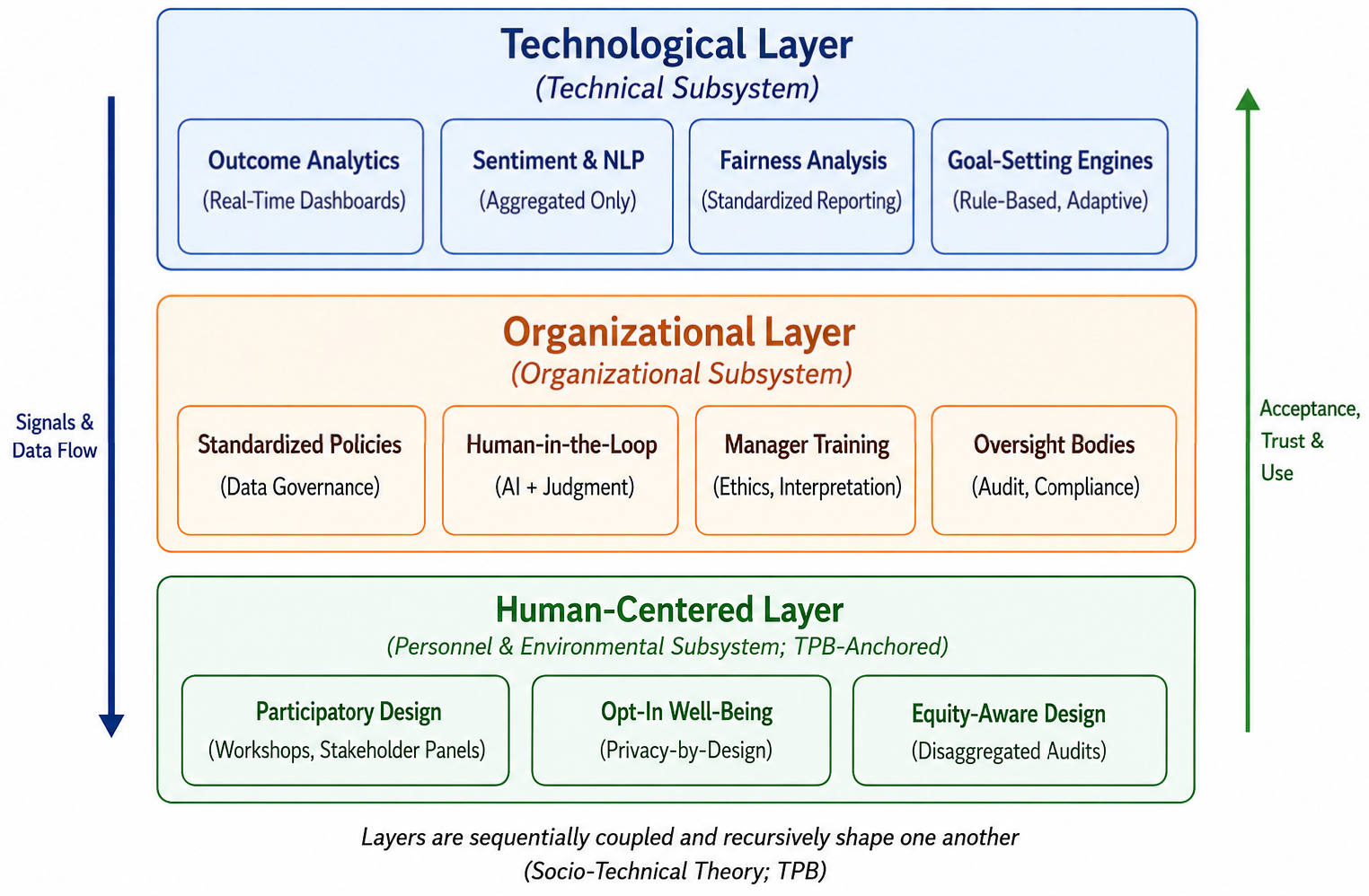
The framework integrates three interdependent layers, mapped onto the socio-technical subsystems: technological, organizational, and human-centered governance. Importantly, the proposed architecture is conceptualized as a decision-support and augmentation system rather than an autonomous AI decision-making regime, relying on established and currently deployable technologies such as dashboard analytics, natural language processing (NLP), and rule-based decision-support systems. This design choice reflects both the empirical findings of this study and the practical constraints of public-sector implementation, where fully autonomous or experimental AI applications remain limited. Importantly, these layers are not independent components but function as a coupled system in which technological outputs, organizational rules, and human behavioral responses continuously shape one another.
The relationship between layers is therefore sequential and recursive: technological systems generate performance and engagement signals, organizational structures interpret and regulate these signals, and human actors (influenced by attitudes, subjective norms, and perceived behavioral control as defined in the Theory of Planned Behavior) determine the degree of acceptance, trust, and use of the system.
Technological Layer (Technical Subsystem). This layer encompasses the AI-driven tools that form the analytical foundation of the framework, with a clear emphasis on augmenting—rather than replacing—human managerial judgment. Outcome-focused AI analytics respond to the performance visibility problem documented in
Section 4.2.1, providing managers with real-time dashboards that aggregate task completion, workflow patterns, and collaboration metrics using data generated through routine digital work systems —without keystroke logging or webcam monitoring.
NLP-based sentiment and engagement monitoring is applied in a limited and aggregated manner, responding to the isolation and well-being evidence from
Section 4.2.2 and
Section 4.2.4, detecting team-level disengagement trends (e.g., tone, frequency) rather than inferring individual psychological states. Fairness-related analysis is operationalized through standardized reporting and comparison mechanisms, respond to the equity gaps documented in
Section 4.2.3, applying standardized evaluation criteria across departments and geographies without relying on fully automated decision-making.
Adaptive goal-setting engines is implemented through rule-based or semi-automated systems, respond to the work–life balance complexity from
Section 4.2.4, recalibrating individual goals based on workload, team capacity, and contextual circumstances, rather than fully autonomous optimization.
These technological outputs do not directly determine performance decisions; instead, they function as inputs into organizational governance processes where interpretation and contextualization occur.
Organizational Layer (Organizational Subsystem). This layer provides the governance and process infrastructure that determines whether the technological tools produce equitable outcomes. Standardized, transparent performance management policies across departments respond to the fairness and consistency findings from
Section 4.2.3, where inter-departmental competition and policy inconsistency created perceived inequity. These policies are further extended to include formal data governance protocols, specifying what types of employee data may be collected, how such data can be used, and clear restrictions prohibiting secondary or unauthorized uses (e.g., disciplinary actions based on well-being or engagement indicators).
Feedback loops integrating AI insights with human judgment (rather than automated decision-making) respond to the nuanced performance evidence from
Section 4.2.1, where managers who combined outcome data with relational engagement were most effective. Importantly, these processes are governed by explicit “human-in-the-loop” requirements, ensuring that all consequential decisions—particularly those related to performance evaluation, promotion, or workload allocation—remain subject to managerial review and contextual interpretation.
Manager training and support infrastructure responds to the documented need for new leadership approaches, recognizing that the survey’s strongest predictor was organizational support (odds ratio ≈ 6.8), not monitoring capability. This includes training managers in the interpretation, limitation, and appropriate use of AI-supported dashboards and analytics, ensuring that technological outputs are used as decision-support tools rather than as deterministic evaluation instruments. Training programs also incorporate data ethics and privacy awareness components, equipping managers to understand data boundaries, respect employee consent conditions, and avoid inappropriate inference or overreliance on algorithmically generated insights.
In addition, organizational governance structures include designated oversight mechanisms (e.g., data governance committees or AI oversight boards) responsible for monitoring compliance with privacy standards, reviewing system outputs, and coordinating with audit processes. These structures ensure that data use remains aligned with organizational policy, legal requirements, and employee trust expectations.
Human-Centered Layer (Personnel and Environmental Subsystems). This layer directly reflects Theory of Planned Behavior constructs (attitudes, subjective norms, perceived behavioral control) and ensures that the framework’s design and governance reflect the documented primacy of attitudes, norms, and culture in determining telework outcomes. Participatory design processes involving employees in AI system selection and governance respond to the attitudes and norms findings from
Section 4.2.5, where these constructs overwhelmed perceived behavioral control. This participatory approach is operationalized through structured consultation mechanisms (e.g., workshops, surveys, and stakeholder review panels) rather than algorithmic co-design systems.
Opt-in well-being support with clear privacy safeguards responds to the “always-on” problem from
Section 4.2.4, where employees described complex and context-dependent well-being dynamics. These safeguards are grounded in a privacy-by-design approach, including data minimization (collection of only work-relevant indicators), aggregation at the team level, and strict limitations on data use. In particular, well-being analytics are explicitly separated from performance evaluation processes, and no content-level monitoring, behavioral profiling, or individual psychological inference is conducted. These mechanisms are therefore limited to voluntary participation and non-identifiable, aggregated indicators, ensuring that no individual-level behavioral surveillance is undertaken and that employee autonomy and informational boundaries are preserved.
Equity-aware design addressing documented demographic disparities responds to the gender and marital status findings from
Section 4.2.3, ensuring that the framework does not reproduce existing inequities. This is operationalized through periodic equity audits and disaggregated reporting of outcomes rather than automated fairness enforcement algorithms, thereby maintaining transparency while avoiding reliance on opaque or fully automated decision-making systems.
5.2. Speculative Possibilities: How the Framework Could Operate
For each AI capability area, this section describes how it could function within the proposed framework, grounding each speculation in the empirical evidence. Importantly, the term “speculative” is used here in a bounded and implementation-oriented sense, referring to feasible extensions of existing decision-support and analytics systems rather than autonomous AI functionality.
Outcome-Focused AI Analytics in Practice. AI systems could rely on existing enterprise reporting and dashboard technologies to aggregate task completion, workflow patterns, and collaboration metrics to give managers real-time performance dashboards—without keystroke logging or webcam monitoring. The empirical evidence supports this: the interviews showed that managers who shifted to outcome-based evaluation were more effective, and the survey found that organizational support (not monitoring) was the strongest predictor of better telework arrangements. Ethical guardrails would include transparency about what data is collected, employee access to their own analytics, and prohibition of punitive use of well-being data.
Proactive Well-being Monitoring. NLP analysis of communication patterns (not content) could detect team-level disengagement trends; opt-in chatbot-based check-ins could support individual well-being assessment. Well-being support functions would be limited to aggregated, anonymised, and opt-in indicators derived from communication metadata patterns (e.g., frequency and responsiveness trends), rather than content-level or psychological inference-based analysis. This ensures alignment with both technical feasibility and privacy constraints. The empirical evidence supports this: isolation was a documented risk factor (odds ratio = 0.871), socialization was protective (odds ratio = 3.973), and interviewees described mental health tradeoffs in nuanced terms that a crude survey would miss. Guardrails would include opt-in participation only, aggregate reporting at the team level rather than individual surveillance, and clear separation between well-being support and performance evaluation.
Fairness-Enhancing AI. Standardized evaluation criteria could be applied consistently across departments and geographies through standardized reporting dashboards and comparative analytics across units; algorithmic audits could flag disparities in recognition, promotion, or workload distribution. These tools would support the identification of disparities in outcomes such as recognition, workload distribution, and evaluation consistency. The empirical evidence supports this: inter-departmental competition via differential telework policies was documented, gender-based disparities were identified, and the disconnect between government rhetoric (97–99% positive) and employee experience highlights a fairness gap that standardized tools could help close. Guardrails would include regular bias audits with diverse oversight, human review of all consequential decisions, and representation of affected groups in system governance.
Adaptive Goal-Setting. Rule-based performance management AI systems embedded within existing HR and workflow platforms could recalibrate individual goals based on workload, team capacity, and personal circumstances—recognizing that teleworking parents, single employees, and employees in different time zones face different constraints. The survey showed that education, marital status, and work–life balance all influenced teleworking quality; the interviews documented how personal circumstances shaped the experience in ways that one-size-fits-all goal-setting cannot accommodate. Guardrails would include employee agency in goal negotiation, safeguards against algorithmic bias in workload distribution, and transparency in how personal circumstances inform adaptations. Importantly, adaptations would remain managerially mediated rather than algorithmically determined, ensuring that contextual information informs decision-making without introducing automated bias into performance evaluation.
5.3. What This Framework Does Not—And Cannot—Do
An honest assessment of limitations, informed by the empirical evidence, is essential to appropriately situate the scope and applicability of the proposed framework.
First, the survey finding that digital skills showed no independent effect on teleworking quality (despite bivariate correlations) suggests that technology alone does not determine outcomes—organizational and cultural factors dominate. No AI framework can substitute for genuine organizational commitment to supporting teleworkers.
Second, the interviews revealed that political pressure—downtown business impacts, citizen perceptions, union dynamics—drove return-to-office mandates more than performance evidence. No AI framework can override political decision-making, however robust its data.
Third, the documented disconnect between government policy rhetoric (overwhelmingly positive) and employee experience (mixed and complex) suggests that framework adoption requires genuine organizational commitment, not performative endorsement. AI tools deployed in an organizationally hostile environment will not produce the outcomes described here.
Fourth, AI tools cannot substitute for the hallway conversations, spontaneous encounters, and serendipitous idea exchange that some interviewees valued. The framework augments human connection—it does not replace it.
Fifth, and critically, the framework should entail privacy and data governance considerations associated with the use of aggregated workforce analytics. Although the system is explicitly designed to avoid individual-level surveillance, the collection of workplace interaction metadata (e.g., communication frequency, workflow patterns, and task completion signals) introduces legitimate concerns regarding data protection, consent, and the boundaries of acceptable organizational data use. Consistent with the ethical AI literature in public administration, these concerns are not treated as technical side constraints but as socio-technical and governance challenges that emerge through the interaction of institutional practices, organizational infrastructures, and system design choices (
Morley et al., 2021,
2020;
Mergel et al., 2019;
Floridi et al., 2018).
In this respect, the framework does not claim to empirically evaluate or validate privacy outcomes; rather, it articulates normative and design-oriented guidance informed by established responsible AI and algorithmic governance scholarship (e.g.,
Raji et al., 2020;
Jobin et al., 2019). To address these concerns, the framework adopts privacy-by-design principles, including data minimization, aggregation at team level, strict separation between well-being analytics and performance evaluation, and prohibition of content-level monitoring or behavioral profiling. These safeguards are conceptualized as governance principles that must be enacted through organizational routines, rather than as automatically enforceable technical guarantees.
However, consistent with prior research on the implementation gap in ethical AI, the effectiveness of such safeguards is contingent upon organizational capacity, institutional enforcement, and regulatory context, rather than being guaranteed by system design alone (
Kroll, 2021;
Mergel et al., 2019). This reflects the broader socio-technical understanding that ethical outcomes in AI systems are not embedded in technology itself, but are continuously produced and negotiated through practice, governance, and use.
5.4. Phased Implementation Roadmap, KPIs, and Evaluation Strategy
It is important to recognize that no single implementation roadmap can be universally applied across organizational contexts. Variations in institutional mandates, governance structures, levels of digital maturity, and regulatory constraints require that AI-enabled performance management systems be adapted to the specific conditions within which they are deployed. Consistent with socio-technical systems theory, effective implementation depends not only on technological infrastructure, but also on alignment with organizational processes, cultural norms, and accountability structures.
Accordingly, the roadmap proposed here is not intended as a prescriptive or one-size-fits-all model, but rather as a context-sensitive implementation framework grounded in the empirical findings of this study. In particular, the design reflects the demonstrated importance of attitudes, social norms, and organizational support in shaping telework outcomes, while also incorporating insights from emerging research on algorithmic accountability, which emphasizes the need for structured oversight, documentation, and continuous evaluation across the system lifecycle (
Raji et al., 2020).
To ensure feasibility within the public-sector context examined in this research, a streamlined three-phase implementation approach, spanning approximately 12 to 18 months, is proposed, with each phase incorporating explicit governance, documentation, and evaluation mechanisms.
The first phase, pilot and socio-technical alignment (0–4 months), focuses on limited-scale deployment combined with early-stage governance design. Rather than prioritizing technical sophistication, this phase emphasizes trust-building, transparency, and participatory engagement. AI-supported performance dashboards are introduced within a small number of pilot teams, with a focus on validating outcome-based performance metrics as an alternative to activity-based monitoring. In line with audit-based accountability approaches, this phase also includes the development of baseline documentation practices, including clear articulation of system purpose, data inputs, and intended use cases. Co-design workshops involving employees and managers are used to align system functionality with organizational norms, while initial governance protocols establish responsibilities for data stewardship, system oversight, and acceptable use. Evaluation at this stage focuses on user acceptance, perceived usefulness, employee trust, perceived fairness, and the interpretability and reliability of system outputs.
The second phase, controlled expansion and governance integration (4–10 months), involves scaling the system across organizational units while formalizing accountability structures and oversight processes. Consistent with the finding that organizational support is a key predictor of telework effectiveness, this phase prioritizes managerial capability and institutional alignment. Implementation is extended to departments with comparable work structures, accompanied by the standardization of outcome-based performance indicators. At the same time, governance mechanisms are strengthened through the formal assignment of roles and responsibilities for system monitoring, audit processes, and decision oversight. Human-in-the-loop decision-making is institutionalized to ensure that algorithmic outputs are interpreted within their organizational context, and documentation practices are expanded to include model performance tracking and decision rationales. Performance is evaluated through reductions in ambiguity in performance expectations, increased consistency in evaluations, improvements in perceived organizational support, and the degree of alignment between AI-generated insights and managerial decisions.
The third phase, institutionalization and continuous evaluation (10–18 months), focuses on embedding the framework within routine organizational practices and establishing ongoing audit and accountability processes. At this stage, the emphasis shifts from implementation to sustained monitoring, evaluation, and iterative refinement. AI-supported processes are integrated into formal performance management systems, and continuous monitoring mechanisms are used to detect performance drift, unintended consequences, or emerging inequities. In line with lifecycle governance models, periodic reviews are conducted to assess system impacts on fairness, workload distribution, and employee outcomes, supported by systematic documentation and reporting practices. Cross-unit benchmarking enables organizational learning, while governance bodies retain authority to modify or recalibrate system components as needed. Evaluation in this phase centers on broader organizational outcomes, including employee engagement and retention, stability of telework performance, reduction in equity gaps, and compliance with governance and accountability standards.
Taken together, this phased approach aligns implementation with both socio-technical principles and emerging best practices in algorithmic accountability, ensuring that system deployment is accompanied by structured oversight, transparent documentation, and continuous evaluation rather than treated as a purely technical exercise.
5.5. Algorithmic Accountability and Audit Mechanism
To address concerns related to bias, transparency, accountability, and the governance of sensitive employee data, the proposed framework incorporates a structured algorithmic auditing and governance mechanism grounded in the lifecycle accountability model advanced by
Raji et al. (
2020). In contrast to approaches that treat auditing as a one-time technical validation, this framework conceptualizes accountability as an ongoing, socio-technical process that is embedded across all stages of system design, deployment, and use, including continuous verification of compliance with data protection and privacy requirements.
Central to this approach is the institutionalization of auditability as an organizational capability, rather than a purely technical feature. This involves establishing clear lines of responsibility for AI system oversight, formalizing documentation practices, and integrating continuous evaluation mechanisms into routine organizational processes. It also includes the formalization of data governance standards specifying permissible data inputs, access controls, retention policies, and boundaries on the use of employee-related data. In line with
Raji et al. (
2020), the framework emphasizes that effective accountability requires not only technical testing, but also governance structures capable of interpreting, contesting, and acting upon algorithmic outputs, while ensuring that data use remains consistent with privacy-by-design principles and organizational policy constraints.
Operationally, the auditing mechanism is structured across three interrelated stages. First, pre-deployment evaluation focuses on validating data integrity, assessing potential sources of bias, and ensuring that system objectives are aligned with organizational policies and normative expectations. This stage explicitly includes privacy impact assessments, verification of data minimization practices, and confirmation that no sensitive or non-work-related data (e.g., personal communications content or behavioral surveillance data) are incorporated into system inputs. Documentation of model assumptions, data provenance, and intended use cases creates an auditable record of design decisions and data boundaries.
Second, continuous monitoring during deployment tracks system performance over time, including the detection of model drift, inconsistencies in outputs, and emergent unintended consequences. This monitoring also includes ongoing checks for inappropriate data use, scope creep in data collection, and any unintended linkage between well-being indicators and performance evaluation processes. This aligns with the notion of ongoing “post-deployment auditing” highlighted by
Raji et al. (
2020), recognizing that many risks—particularly those related to privacy and fairness—only become visible in real-world use.
Third, periodic impact assessments evaluate the broader organizational effects of the system, including implications for fairness, workload distribution, and the integrity of performance evaluation processes across different employee groups. These assessments also examine employee perceptions of data use, trust in the system, and potential privacy concerns, ensuring that the framework remains socially and ethically acceptable in practice.
Importantly, the framework embeds human oversight at all stages of the audit process, reflecting the socio-technical premise that accountability cannot be fully automated. Managers and designated oversight bodies are responsible for interpreting algorithmic outputs, particularly in high-stakes or context-dependent decisions, and for ensuring that system recommendations are not applied in a mechanistic or decontextualized manner. This “human-in-the-loop” approach is complemented by formal governance structures that define roles, escalation pathways, and decision rights in cases where algorithmic outputs are contested or produce adverse outcomes, including cases involving potential breaches of data privacy or inappropriate data interpretation.
To ensure institutional accountability, audit findings are systematically reviewed by a designated governance entity (e.g., an AI oversight or ethics committee) with the authority to intervene when necessary. Such interventions may include recalibrating models, restricting system use in specific contexts, or suspending components that fail to meet established fairness, transparency, or data protection thresholds. In addition, the framework supports the maintenance of audit trails and documentation repositories to enable traceability, reproducibility, and external scrutiny where required, including documentation of data handling practices and audit decisions related to privacy compliance.
By embedding auditing within a broader governance architecture, this approach moves beyond compliance-oriented models toward a more robust form of continuous, practice-based accountability, in which technical evaluation, organizational oversight, and ethical considerations are jointly integrated. This design directly addresses the “AI accountability gap” identified by
Raji et al. (
2020) by ensuring that responsibility for system behavior—and the handling of sensitive data—remains visible, distributed, and actionable throughout the lifecycle of the framework.
5.6. Framework Verification and Illustrative Validation
The proposed AI-driven socio-technical performance management framework was first verified through alignment between empirically identified teleworking challenges, AI-enabled performance management mechanisms, and supporting theoretical foundations. Empirical verification was established by mapping framework components to findings derived from the Canadian public-service dataset, including machine learning and big data analysis, document analysis, survey findings, and semi-structured interviews. The framework was also theoretically verified through integration with socio-technical theory, the Theory of Planned Behavior (TPB), Self-Determination Theory (SDT), and the Job Demands–Resources (JD-R) model, ensuring conceptual consistency between organizational challenges, behavioral mechanisms, and technological design principles. In addition, internal logical coherence was established through explicit traceability between identified teleworking challenges, corresponding AI-enabled capabilities, governance mechanisms, and intended organizational outcomes related to employee well-being, productivity, fairness, engagement, and non-intrusive performance visibility.
However, verification alone does not establish whether the proposed framework can plausibly operate within realistic teleworking environments. To provide an initial form of artifact validation, the framework is therefore illustrated through the following hypothetical teleworking scenario. While this does not constitute full organizational implementation or longitudinal testing, it demonstrates the framework’s intended operational logic and practical applicability within a realistic organizational setting.
Consider a hypothetical Canadian public-sector department—for illustrative purposes, a policy analysis branch of approximately 25 employees distributed across three regional offices, transitioning to a 60/40 hybrid arrangement after operating fully remotely during the pandemic—operating within a hybrid teleworking environment involving knowledge-intensive administrative and policy-related work. Managers report increasing difficulty maintaining performance visibility, ensuring fairness in evaluations, supporting employee well-being, and sustaining collaboration across geographically dispersed teams. Employees simultaneously report communication fragmentation, unclear performance expectations, reduced feedback quality, concerns about excessive monitoring, and growing feelings of isolation and burnout. These challenges reflect the broader tensions identified in both the literature and the empirical findings of this study.
Within the proposed framework, AI-enabled productivity and collaboration analytics are used to identify workflow bottlenecks, coordination gaps, and uneven workload distribution without relying on intrusive surveillance mechanisms such as keystroke logging or continuous webcam monitoring. Adaptive feedback systems continuously align employee goals with organizational objectives while providing personalized developmental recommendations based on workload patterns and task progress. Sentiment analysis and well-being monitoring mechanisms identify indicators of stress, disengagement, or burnout risk through aggregated communication patterns and self-reported well-being indicators, allowing managers to intervene proactively through supportive organizational measures rather than punitive control mechanisms. At the same time, fairness auditing mechanisms evaluate performance assessment patterns across teams to identify potential inconsistencies or biases in evaluation processes. In concrete terms, the productivity dashboard might reveal that one regional team consistently completes briefing notes more quickly than its peers, but with substantially higher subsequent revision rates—prompting a managerial conversation about workload calibration and review processes rather than an automatic comparative ranking. The well-being monitoring layer might flag a sustained six-week decline in aggregated communication tone and response latency within a particular sub-team, triggering an opt-in check-in and a review of workload distribution rather than a performance flag against individual employees. The fairness auditing layer might surface that high-visibility assignments have been disproportionately allocated to staff in the headquarters office relative to regional offices, prompting a review of assignment-allocation practices. In each case, AI-generated signals are routed through governance structures and managerial interpretation, with action taken by the manager in light of contextual information rather than by the algorithm itself.
Importantly, these AI-enabled mechanisms operate within governance and human oversight structures informed by socio-technical theory and the Theory of Planned Behavior (TPB). Human managerial judgment remains central to interpretation and decision-making, while governance safeguards ensure transparency, privacy protection, explainability, and employee participation in system use. Supporting perspectives from Self-Determination Theory (SDT) and the Job Demands–Resources (JD-R) model further inform the framework’s emphasis on balancing accountability with autonomy, organizational support, workload management, and employee well-being.
Through this illustrative application, the framework demonstrates how AI-enabled performance management could support organizational outcomes related to employee well-being, productivity, fairness, engagement, and non-intrusive performance visibility in teleworking environments. Rather than optimizing surveillance or maximizing algorithmic control, the framework prioritizes socio-technical alignment between technological capabilities, organizational governance, and human-centered management practices. In this sense, the scenario-based application demonstrates how the framework is designed to support employee well-being, productivity, and fairness through supportive and adaptive performance management practices rather than through surveillance-oriented activity monitoring alone. Accordingly, the illustrative scenario should be understood as an initial operational demonstration of framework applicability rather than definitive empirical proof of organizational effectiveness. While future pilot implementation, comparative evaluation, and longitudinal testing remain necessary to establish practical effectiveness across diverse organizational contexts, this scenario-based validation demonstrates the framework’s operational logic and its potential capacity to address the core challenges identified in the research question.
7. Conclusions
This paper has argued that AI-driven performance management for teleworkers must be grounded in evidence about what teleworkers actually experience and need—not merely in what technology makes possible. By integrating a comprehensive literature review on AI capabilities with empirical evidence from a mixed-methods study of the Canadian public service, and by combining socio-technical theory with the Theory of Planned Behavior, the paper has proposed a framework in which each design element responds to documented challenges: the performance visibility problem, isolation and communication barriers, fairness and equity gaps, well-being complexity, and the primacy of attitudes and norms. Rather than claiming universal applicability, the framework is intended as a contextually grounded and theoretically informed design proposition that requires further empirical validation.
The empirical evidence offers a clear message. Organizational support matters more than monitoring (odds ratio ≈ 6.8). Socialization protects while isolation harms (odds ratios = 3.973 and 0.871, respectively). Attitudes and social norms overwhelm technical skills in predicting telework outcomes (TPB equation: β = 6.293 for attitudes, β = 56.008 for norms, β = 0 for perceived behavioral control). However, these relationships should be interpreted cautiously: the association between perceived organizational support and performance outcomes may reflect reverse causality or self-selection effects, whereby more motivated or higher-performing employees are also more likely to perceive higher levels of support. Government rhetoric runs far ahead of employee experience (97–99% positive policy sentiment versus mixed lived reality). And political dynamics constrain what any framework can achieve.
The proposed framework takes these findings as contextually bounded design inputs rather than universal prescriptions. It envisions AI not as a surveillance mechanism but as a support system—one that provides performance visibility without intrusion, detects well-being risks without violating privacy, standardizes evaluation without erasing context, and adapts to individual circumstances without reinforcing inequity. In particular, the framework integrates equity as a core design requirement, recognizing that telework experiences and performance outcomes are shaped by structurally unequal conditions, including the disproportionate domestic burdens observed among women. Drawing on intersectional perspectives (
Crenshaw, 1991) and AI fairness scholarship, including empirical evidence showing that algorithmic systems can reproduce bias in real-world applications (
Buolamwini & Gebru, 2018) as well as broader critiques of fairness as shaped by social and institutional power relations (e.g., AI Now reports on bias, opacity, and accountability gaps), the key implication is that fairness cannot be treated as a purely technical problem that can be solved by adjusting algorithms alone. Instead, fairness must be understood as something that emerges from both technology and organizational context. This means that performance management systems must go beyond technical fixes and include disaggregated analysis of outcomes across groups, context-sensitive evaluation of performance, and continuous equity auditing over time to identify and address unequal impacts as they arise during system use. In practical terms, this shifts fairness from a one-time technical validation of the model to an ongoing governance process, where fairness is continuously monitored, interpreted, and corrected throughout system design, deployment, and organizational use.
At the same time, the framework’s scope is deliberately constrained. The findings do not establish causal relationships, nor do they generalize beyond the institutional and cultural conditions of the Canadian public sector. More broadly, the analysis reinforces that technology alone cannot solve problems that are fundamentally organizational, cultural, and political. These limitations are not peripheral but central to the interpretation of the findings, underscoring that the framework should be understood as a theoretically informed and empirically grounded starting point rather than a validated solution.
The fundamental question underlying this paper, asking “how are your employees doing?” rather than “what are your employees doing?”, is not merely rhetorical. It captures a fundamental reorientation in performance management philosophy, from control to care, from surveillance to support, from compliance to development. However, the extent to which AI-enabled systems can meaningfully contribute to this shift remains an open empirical question. Future research should therefore prioritize (a) longitudinal validation of the framework in organizational settings, (b) cross-sectoral comparisons between public and private organizations, and (c) comparative international studies to assess how institutional context shapes both adoption and outcomes. AI-driven tools, thoughtfully designed within a socio-technical framework and grounded in empirical evidence, can help organizations make this transition. But this can only occur if the humans who design, deploy, and govern these tools commit to the same reorientation. Future research should focus on pilot implementation, user acceptance testing, and longitudinal evaluation of the proposed framework across organizational contexts to assess its practical effectiveness, unintended consequences, and scalability.