Article

Employee Perceptions of Their Company’s Employee Retention Strategy: A Case Study of a Manufacturing Company


Industrial and Organisational Psychology, University of South Africa, Pretoria 0002, South Africa
*
Author to whom correspondence should be addressed.
Adm. Sci. 2026, 16(6), 271; https://doi.org/10.3390/admsci16060271 (registering DOI)
Submission received: 27 February 2026 / Revised: 25 May 2026 / Accepted: 26 May 2026 / Published: 6 June 2026

Abstract

The global and national skills shortages, shifting employee work attitudes post-COVID pandemic, and the presence of a multigenerational workforce with diverse needs and preferences have sparked interest in employee retention. Traditional one-size-fits-all retention strategies are becoming less effective, and contemporary organisations are focusing on tailored retention strategies. The effectiveness of the tailored retention strategy does not only rely on its design but also on how it is perceived and experienced by employees. However, few studies have explored employees’ perceptions of their organisation’s employee retention strategy in the South African context. Hence, the objective of this study is to explore professional engineers’ perceptions of their organisation’s employee retention strategy and how these perceptions influence their intention to stay or leave the organisation. A qualitative research approach underpinned by the constructivism paradigm was employed in this study. A single case study was adopted, and data were collected through semi-structured interviews with 12 professional engineers working at a manufacturing organisation participating in the study. Thematic analysis was used to analyse the data. The findings indicated that the professional engineers were unaware of, and did not fully understand, their organisation’s employee retention strategy, and they felt that their organisation was not adequately implementing a robust, dynamic one, which resulted in high turnover. They indicated that the retention strategy seemed to lack provisions for career growth opportunities and formal mentorship programs and failed to embrace technological advancement, which influenced engineers to leave the organisation. They perceived that their organisation provided competitive compensation, onboarding, and offboarding, as well as training and development, though implementation gaps existed. This study suggests that organisations should develop a robust, dynamic employee retention strategy and widely communicate it to their workforce. A robust, well-communicated employee retention strategy is likely to positively influence employee perceptions and enhance the organisation’s employer brand, thereby facilitating retention.

1. Introduction

The manufacturing sector is the backbone of South Africa’s economy, contributing approximately 13% to gross domestic product (GDP) and employing more than 1.6 million people (Maisiri & van Dyk, 2021; Price Waterhouse Coopers (PwC), 2024). The sector is key to South Africa’s innovation, infrastructure development, and economic growth. The South African industry, including the manufacturing sector, faces significant challenges, including high turnover rates and a critical shortage of engineering skills (Mogorosi & Emwanu, 2025; Sibisi et al., 2026). This is substantiated by the Engineering Council of South Africa (ECSA) 2024–2025 report and the South African Institute of Civil Engineers (SAICE, 2022) report, which indicate a critical shortage of engineering talent that has impacted South Africa’s infrastructure delivery, service delivery, and economic growth. The skills shortage has intensified competition for scarce, critical skills in the labour market, positioning employee retention as a strategic pillar of organisational success (Thusi & Chauke, 2023; Van der Walt et al., 2016). Employee retention refers to keeping valuable employees that the organisation needs to drive organisational productivity and success and not lose them to competitors” (Browell, 2003). Retention should focus on retaining critical organisational talent and high performers who add value and contribute to the organisation’s success and sustainability. The challenge of retaining key organisational talent is exacerbated by the fact that the workforce currently encompasses different generations, and therefore retention strategies and policies need to be responsive to the needs and preferences of these generations (Kostanek & Khoreva, 2018; Poisat et al., 2018; Salvadorinho et al., 2025). Given that the workforce has changed dramatically with the existence of a multigenerational workforce (Baby boomers, Generation X, Millennials/Generation Y, and Generation Z), organisations must develop retention strategies that address the needs and preferences of different generations (Hamilton & Baird, 2024; Salvadorinho et al., 2025). This is also amplified by Macpherson (2024), who noted that employee retention strategies need to be dynamic and robust, and that a “one size fits all” approach will not retain the multigenerational talent in Industry 4.0. Therefore, organisations are called upon to develop robust, dynamic retention strategies that address the diverse needs and preferences of the multigenerational workforce (Shrand et al., 2020).
However, the effectiveness of employee retention strategies in contemporary organisations will not only depend on whether they are robust and dynamic, but also on how employees perceive and experience their implementation. Employee retention strategy transmits salient messages regarding the ‘what’ (captures what the organisation is willing to offer or to do to retain its competent and experienced employees) and the ‘how’ (captures employees’ views regarding the consistency, fairness, and uniformity in the implementation) (Y. Wang et al., 2020). Human Resource retention strategy and policies can send social information, cues, and signals that convey the organisation’s commitment to providing career development opportunities, competitive remuneration, flexibility, work-life balance, and support for employees’ mental and physical well-being. Social information, cues, and signals from the social context shape employees’ perceptions of the organisation, which, in turn, influence their intention to leave or stay (De Simone et al., 2021).
A growing body of evidence suggests that it is not only the design or implementation of retention strategies that matters, but also how employees perceive, interpret, and evaluate them. (Ansari, 2011; Begbie et al., 2011; S. Li et al., 2019; Oh, 2020; Pombo & Gomes, 2019). The study by Begbie et al. (2011) indicated that the implementation and employees’ perceptions of an incentive scheme intended to motivate and retain critical staff were more important than having the scheme alone. It has been argued that the best HR strategies, practices, and policies can yield or fail to yield intended results because of how employees perceive the intention, the implementation, and their experiences (Baluch, 2017; Frenkel et al., 2013 Nishii et al., 2008). This is also corroborated by Y. Wang et al. (2020, p. 146), who noted that “even a well-intentioned HR system may not produce its best possible outcomes if employees fail to make sense of it in a coherent, consistent, and unified way”. Therefore, it is not only the retention strategy, HR policies, or HR practices that are important, but also how employees perceive their implementation and experience their effects. Hence, this study will explore engineering employees’ perceptions of their organisation’s retention strategy and assess how these perceptions influence their intention to stay or leave the organisation.
Although employee perceptions are very important, few studies have examined how employees perceive their organisation’s retention strategy and how such perceptions shape their intention to stay or leave their organisation. Previous research has largely focused on the retention factors, HR practices, and HR strategy (Alajlani & Yesufu, 2022; Thomas et al., 2018; Marozva et al., 2024; Schaap & Olckers, 2020; Barkhuizen & Makhuzeni, 2015; Potgieter & Mokomane, 2020). For example, Barkhuizen and Makhuzeni (2015) explored the effects of total rewards strategy on teacher retention, while Potgieter and Mokomane (2020) investigated the implementation of HRM strategy in manufacturing companies. The few studies that have explored employee perceptions of retention include Macpherson’s (2024) study, which examined employee perspectives on talent retention strategies among automotive organisations. Thus, this study supplemented the scarce literature on employees’ perceptions of their organisation’s employee retention strategy, especially in light of the post-pandemic shift in employees’ working patterns, compensation preferences, and workplace needs and preferences (Delbosc & Kent, 2024; Gocer et al., 2025; Mabaso, 2026). In addition, previous research on professional engineers’ retention across different sectors (including the manufacturing sector) has been largely quantitative (Mangisa et al., 2020; Mogorosi & Emwanu, 2025; Ntseke et al., 2022; Nyakala et al., 2023). Hence, this study makes a methodological contribution by using a qualitative study underpinned by a constructivist paradigm and interpretivism, which can provide contextual meaning, subjective experiences, thus respond to “recent calls to conduct more context sensitive research” (Bausch et al., 2024; Homer & Lim, 2024) that have been underexplored in quantitative studies. Johns (2017, p. 1577) further noted that the “impact of context has been underappreciated in management research”. Thus, the objective of this study is to explore professional engineers’ perceptions of their manufacturing organisation’s employee retention strategy and how these perceptions influence their intention to stay or leave the company. This study also extends the existing literature on employee retention by incorporating employee perceptions into the discussion of employee retention and the strategies organisations implement to retain their critical, skilled, and experienced workforce. Cafferkey et al. (2019, p. 3026) highlight the merit of research on employee perceptions, noting that it “brings workers back into the debate by exploring employees’ opinions of, and subsequent reaction to, HRM initiatives.”

2. Literature Review

2.1. Employee Retention Challenges

Global and national skills shortages, shifting post-COVID employee work attitudes, and a multigenerational workforce with diverse needs and preferences are presenting significant challenges to retaining critical, highly skilled employees. The Resource Company Inc. (2026) reported a high manufacturing employee turnover that averaged 28% annually, while the Great Resignation is reported to be rampant among professional engineers amid a critical shortage of engineers (Atherton & Fasano, 2023). On the other hand, the multigenerational workforce presents challenges for organisation because these generations have differing work values, attitudes, norms, expectations, and preferences, which makes developing a retention strategy that appeals to all generations challenging (Huyler et al., 2025; Sousa et al., 2025). These differences across the five generations (Traditionalists, Baby Boomers, Generation X, Generation Y, and Generation Z) currently in the workplace have rendered the one-size-fits-all employee retention strategy redundant, leaving organisations struggling to retain their highly skilled and valuable employees. This is substantiated by previous research, which has found that organisations are struggling to develop retention strategies that mitigate employee turnover (Ali et al., 2024; Macpherson, 2024; Phaladi, 2023). Phaladi (2023) found that state-owned enterprises experienced high turnover due to a lack of knowledge-driven retention strategies, while Mitonga-Monga et al. (2024) found that a construction company’s retention strategy was not entirely effective in retaining critical and skilled employees. Furthermore, a study by Mafefe et al. (2025, p. 97) found that “engineering human capital retention strategies related to work-life balance, autonomy, and innovation and technology were found to be inadequately executed within the energy organisations” in South Africa. Given the employee retention challenge faced by organisations, some have adopted tailored recruitment and retention strategies to enhance their effectiveness in retaining their most critical, valuable employees (Sousa et al., 2025).

2.2. Retention Strategies and Employee Perceptions

Engagement and retention strategies are a pillar of organisational success and sustainable performance (Pombo & Gomes, 2019). This is supported by research that has found that the implementation of HR strategies influences desirable individual and organisational outcomes, such as employee satisfaction, commitment, reduced turnover, team cohesion, team communication, team productivity, organisational effectiveness, and performance (Coetzee et al., 2014; Kalia et al., 2023; Keong et al., 2025; Nyakala et al., 2023; Wanyama et al., 2025). However, Pombo and Gomes (2019) noted that the influence of HR strategies is mediated by employees’ perceptions of the strategies and their implementation. The literature indicates that implementing HR strategies, practices, or policies is not the only factor influencing employee attitudes and behaviours; employees’ perceptions of the strategy and its implementation are also important. (S. Li et al., 2019; Oh, 2020; Pombo & Gomes, 2019). In a study by Ansari (2011), employee perceptions of the effectiveness of the human resources management practices were the most significant predictor of employee commitment. Similarly, positive employee perceptions of the HR practices implemented during organisational change were instrumental in increasing employee commitment and reducing resistance to change (Maheshwari & Vohra, 2015). On the other hand, Thasi and van der Walt (2020) indicated that negative employee perceptions of the implementation of a remuneration and fringe benefits policy led to increased work stress. These studies are valuable because they illuminate the importance of employee perceptions in influencing individual and organisational outcomes. Hence, this study focuses on professional engineers’ perceptions regarding their organisation’s retention strategy.
When employee retention initiatives and policies are not understood or positively embraced by employees, there is a high likelihood that an organisation’s employee retention strategy will not yield the desired outcome (Punia & Garg, 2015; Y. Wang et al., 2020). However, when employees positively embrace the organisation’s employee retention initiatives and policies, the initiatives and policies become an important internal enabler of retaining highly skilled talent (Aggarwal & D’Souza, 2012; Shikweni et al., 2019). If employees perceive commitment from the organisation to retain them through a retention strategy that offers a beneficial exchange relationship between the employees and the organisation, they are more likely to become committed and embedded in the organisation, which will increase their intention to stay longer with their current employer (Ansari, 2011).

2.3. Importance of Employee Retention and Outcomes of Employee Turnover

The retention of critical and highly experienced engineers has been found to have a positive impact on the organisation, which includes production efficiency, operational continuity, preservation of institutional knowledge and memory, as well as an increase in morale and commitment, which culminates in higher revenue generation and organisational success (Gilchrist-Saunders, 2024; D. Singh, 2019). On the other hand, turnover of critical employees has been found to have negative consequences. This is substantiated by Phaladi’s (2023) study, which found that state-owned companies (SOCs) lacked a knowledge-driven retention strategy, making them more susceptible to high turnover and leading to knowledge loss and critical skills that threaten organisational performance and economic sustainability. Also, in a study by Sun et al. (2019), job hopping negatively affected employees’ skill development and increased employers’ labour costs. Stanz (2009) further noted that the cost of high employee turnover can range from one to seven times an employee’s annual salary. These studies corroborate previous research findings that have found that high turnover leads to increased cost of recruitment, work overload, work stress, and loss of tacit knowledge, skills loss, lower morale, productivity, and performance (Assaad & El-adaway, 2021; Ndatshe et al., 2024; Memon et al., 2021; Stanz, 2009; Thasi & van der Walt, 2020). Therefore, given the negative outcomes of high employee turnover, organisations must develop retention strategies to mitigate turnover among critical knowledge workers, such as professional engineers (Bussin, 2018).

2.4. Social Information Processing Theory

The social information processing theory (Salancik & Pfeffer, 1978) is a relevant theoretical framework for this study, as it explains how employees’ perceptions are formed. The social information theory posits that the social context provides social cues and signals that influence an individual’s beliefs, attitudes, and behaviour (Salancik & Pfeffer, 1978). The social context is brimming with social information and cues that significantly shape employees’ perceptions and attitudes towards organisational initiatives and practices. Given the rise of protean career, where the employee is in charge of managing their career and not their organisation (D. T. Hall, 2004), social information or cues related to career development opportunities, compensation, flexibility, and work-life balance are likely to become very salient to employees. Thus, an employee retention strategy underpinned by a competitive employee value proposition that is well communicated, embraced by employees, and reinforced by management is likely to provide social information or cues that signal the organisation’s willingness to offer good benefits and take care of its employees, which is likely to positively shape employee perceptions and attitudes towards their organisations. On the other hand, a robust and dynamic retention strategy that is poorly communicated, poorly received by employees, and misaligned with management behaviour and organisational practices is likely to negatively shape employee’s perceptions and attitudes towards their organisation. Therefore, social information and cues in the employee social context shape employees’ perceptions and attitudes, which, in turn, influence their intention to stay or leave (Kelemen et al., 2026; De Simone et al., 2021).

2.5. Social Exchange Theory

Social exchange theory (Blau, 1964; Cropanzano & Mitchell, 2005) is another relevant theoretical framework for this study, explaining how social exchange relationship embedded in the company’s retention strategy can influence their behaviour and intentions to leave or stay. In the context of this study, the engineers and the employer are involved in an exchange relationship. Using the social exchange theory (Blau, 1964; Cropanzano & Mitchell, 2005), the employee retention strategy that offers a competitive employee value proposition can be perceived as an organisational inducement that benefits the employees, and this might trigger a feeling of obligation to reciprocate by demonstrating higher levels of commitment and staying with the organisation for longer. A retention strategy that is perceived as communicating that the organisation cares about engineers and is willing to support their career growth and well-being, as well as providing competitive salaries and work-life balance, is likely to facilitate the development of positive organisational perceptions and attitudes, which, in turn, stimulate an obligation to reciprocate with positive, desirable behaviours that promote the organisation’s success. On the other hand, negative perceptions of the company’s retention strategy may be interpreted as a failure to deliver the expected mutual benefits in the exchange relationship, thereby constituting a breach of the psychological contract. In this case, the employee will perceive that the employer is not fulfilling the mutual obligations of the exchange relationship, constituting a breach of the psychological contract (Rousseau, 1989). Perceptions of this psychological breach of contract, whether valid or not, influence undesirable behaviours, such as withholding knowledge (Wen et al., 2021), selfish and retaliatory motives of silence (Jahanzeb et al., 2024), withdrawal behaviours (Bhattarai & Budhathoki, 2023), and intention to quit (Clinton & Guest, 2014). Therefore, organisations must influence positive perceptions of employees relating to their retention strategy and mitigate negative perceptions that have detrimental effects.
The integration of social information process theory and social exchange theory provides a complementary pathway that explains how social information and cues from the employee’s social context influence employees’ perceptions and how these perceptions are used to evaluate their social exchange relationship with their organisation. Social information processing theory posits that employee perceptions and attitudes toward an organisation’s retention strategy are socially constructed through social information and cues acquired through interaction with coworkers, managers, and the broader organisational context. The socially constructed perceptions then feed into the cost-benefit analysis of the social exchanges between the employee and the organisation. The socially constructed perceptions of the organisation via the social information processing mechanism serve as a precursor of how employees evaluate the social exchange relationship with their organisation, which, in turn, influences the decision to stay or leave the organisation (De Simone et al., 2021). Thus, the integration of social information processing theory and social exchange theory focuses on how professional engineers socially construct their perceptions of their organisation’s retention strategy in a “unique organisational setting which yields insights that are deeply contextual” (Homer & Lim, 2024, p. 128). On the other hand, evaluation of the social exchange relationship between employees and their organisation does not occur independently but is influenced by perceptions socially constructed through social information and cues from coworkers, managers, and the organisational context. Therefore, integrating social information processing theory and social exchange theory aligns with calls to conduct more context-sensitive research (Bausch et al., 2024; Homer & Lim, 2024).

3. Research Design

This research utilised the interpretivism approach. Interpretivism posits that people and their own interpretations, meanings, and understandings are a key source of data; the individual’s perspective is the main reference point (Saunders et al., 2017). It seeks to understand the numerous realities that employees socially construct and to gain a meaningful interpretation of them (Willis, 2007). Interpretivism is a person-centred approach suitable for uncovering rich data and contextual meaning, emphasising subjective experiences and understanding (Aguzzoli et al., 2024; Wiesner, 2022). This aligns with this study, which focuses on engineers’ perceptions. Thus, the interpretivist approach was well-suited to this study because it enabled the researchers to explore engineers’ subjective experiences and perceptions of their company’s retention strategy.

3.1. Research Strategy

To explore professional engineers’ perceptions of their organisation’s retention strategy, a single case study of a manufacturing organisation based in Pietermaritzburg was used. A case study is “a very detailed research inquiry into a single example of a social process, organisation or collective seen as a social unit in its own right and as a holistic entity” (Payne & Payne, 2004, p. 31). The manufacturing organisation that serves as a case in the study employed approximately 60 qualified professional engineers, excluding student engineers and artisans, and regards them as critical and scarce skills that form the backbone of the organisation’s production.

3.2. Research Setting

South African industry has been experiencing a perennial skills shortage, particularly in engineering, which has negatively impacted economic growth and infrastructure development (Maisiri & van Dyk, 2021; Mogorosi & Emwanu, 2025; Sibisi et al., 2026). Furthermore, the manufacturing sector in South Africa has faced significant challenges emanating from an underperforming economy, escalating production costs, and logistics disruptions (Price Waterhouse Coopers (PwC), 2024). This study was conducted at a manufacturing organisation that is a leading manufacturer of aluminium products and supplies a range of high-value, niche-rolled products, aluminium containers, and complex extrusions. The manufacturing organisation is based in Pietermaritzburg, South Africa, and has been operating in over 50 countries worldwide. The manufacturing organisation employs approximately 60 qualified professional engineers, and this talent pool is considered a critical resource for the organisation’s success and sustainability. The organisation has invested in attracting and developing graduate engineers, thereby retaining its experienced, competent engineers. However, due to a shortage of skilled workers, competitors’ poaching of skilled workers, and their willingness to pay a premium for talent, the organisation has sometimes been forced to use counteroffers to retain critical engineering talent. Therefore, this organisation provided a strong case for evaluating professional engineers’ perceptions of its retention strategy.

3.3. Sampling

Sampling generally refers to the process of selecting research participants from the research population, thereby creating a subset that is more practical than selecting the whole population (Bordens & Abbott, 2021; Wotela, 2017). In this study purposive sampling method was used. Purposive sampling refers to “a data collection methodology that relies on the researcher’s judgment when choosing population members to participate in their study” (Aguinis, 2025, p. 487). In the current study, 15 participants were initially targeted, but 12 participants (see Table 1) were sufficient to reach data saturation (i.e., no new themes emerged after interviewing 12 participants), demonstrating sampling adequacy for this qualitative study (Vasileiou et al., 2018). Qualitative data is a small-sample research approach compared to quantitative research, and seeks to obtain rich, detailed, and in-depth information. Data saturation is typically observed between 7 and 17 interviews (Hennink & Kaiser, 2022), while others have reported data saturation with 12 interviews (Guest et al., 2006), confirming that 12 participants are adequate in qualitative research. Also, previous studies have used 12 participants, indicating that this study is within range (Y. Cai & Mohamed Zainal, 2026; Dhanpat et al., 2022; Gutierrez-Gonzalez et al., 2025). Therefore, our study is consistent with previous research and literature showing that 12–15 participants are sufficient for qualitative research and interviews ranging from 30–60 min yield rich, detailed, and in-depth information (Zavattaro & Gille, 2026). Furthermore, the respondents in this study were purposefully selected to reflect the multigenerational workforce with varied demographic characteristics, ensuring that the perceptions of the professional engineers represented the four generations currently in the workplace. As seen in Table 1 below.
As depicted in Table 1, 3 participants belonged to Baby Boomers (born between 1946–1964), 4 participants belonged to Generation X (born between 1965–1980), 2 participants belonged to Generation Y-millennials (born between 1981–1996), and 3 participants belonged to Generation Z (born between 1997–2012) (Zarczyńska-Dobiesz & Boniecka, 2022). In terms of race, 7 participants were African, 2 were white, and 1 was coloured; in terms of gender, 8 participants were male, and 4 were female. The average years of experience was 15.6 years.

3.4. Data Collection

In qualitative research, in-depth interviews are regarded as the primary method of data collection (De Vos et al., 2012). The researchers used a semi-structured interview to explore professional engineers’ perceptions and views on the retention strategy and practices implemented in their organisation, intended to prevent them from leaving. The use of a semi-structured interview worked very well in this study because it allowed the researchers to explore participants’ personal experiences, perceptions, and subjective viewpoints (Flick, 2023). The researchers used the following interview guide:
(1)
What do you know about your organisation’s retention strategy for engineering professionals?
(2)
What do you know about your organisation’s retention policy?
(3)
What are your views and perceptions regarding the retention policy used by your organisation?
(4)
Are there any tools that your organisation uses to determine the reasons why engineering professionals leave your organisation?
(5)
What strategies do you think the organisation should put in place to retain engineering professionals?
The first author conducted the interviews and used an interview guide. The researchers sought to ensure they received clarity on participants’ responses and to elicit more in-depth responses. All interviews were conducted face-to-face, and each interview lasted between 30 min and an hour. Data collection and analysis were conducted concurrently. After each interview, the transcript was prepared, and field notes and observations were incorporated before analysis. Interviews were conducted over a two-month period, from mid-February to April 2024.

3.5. Data Analysis

Thematic analysis was used to analyse the data and identify patterns, codes, and themes that emerged from the collected qualitative data (Braun & Clarke, 2006). Manual coding was used in this study. Although software such as NVivo and ATLAS.ti has become very popular and is widely used in qualitative data analysis, early researchers conducting small studies with low volumes of qualitative data are encouraged to utilise the manual approach (Basit, 2003; Cypress, 2019). The use of manual coding in this study fostered a meticulous, detailed review of the qualitative data, ensuring that the researchers were deeply immersed in the data. Manual coding was performed individually by the first and second authors, and any discrepancies were discussed and resolved by consensus. Inductive coding was primarily used to generate codes and themes derived from the raw data (Braun & Clarke, 2006), after which the relevant literature was consulted to refine and interpret the themes (Linneberg & Korsgaard, 2019; Pearson et al., 2025). Initial codes were generated from the raw data and subjected to another round of coding that involved clustering similar codes (Braun & Clarke, 2006; Chandra & Shang, 2019). The initial codes were grouped and reduced to fewer codes to reduce redundancy and ensure uniqueness (King et al., 2019; Linneberg & Korsgaard, 2019). After grouping the initial codes, the development of subthemes and themes was conducted, and these were reviewed to ensure they reflected participants’ shared views (King et al., 2019). After this, the relevant literature was consulted to refine and interpret subthemes and themes (Linneberg & Korsgaard, 2019).

3.6. Strategies Employed to Ensure the Quality of Data

The quality and rigour of qualitative research are enhanced when a qualitative study demonstrates credibility, dependability, transferability, and confirmability (Nowell et al., 2017). To enhance the reliability of this study, the research process, decisions, and activities were well documented (Creswell, 2014). This audit trail documented all of the steps followed, the research design, the decision about participant selection, and how participants were interviewed, and data were transcribed and analysed, thereby increasing the transparency and credibility of the research process (Moser & Korstjens, 2018; Tracy, 2010). The researchers articulated how data in this study were collected, analysed, and interpreted, which are the prerequisites for establishing the conformability of a study. Also, the first author engaged in member checking through “taking findings back to the field and determining whether the participants recognise them as true or accurate” (Lindlof & Taylor, 2002, p. 242). This process helped corroborate findings with participants, enhancing the study’s confirmability. Furthermore, the researchers engaged in reflexivity, reflecting on their subjective values and biases. In particular, the first author kept a reflexive journal in which she recorded her thoughts, observations, and reflections during and after the interview, as well as during the data analysis phase, thereby enhancing transparency.
Also, the researchers endeavoured to increase the transferability of the results of this study. Transferability refers to the extent to which the research results can be generalised and transferred to another setting or context, and this is achieved “when readers feel as though the story of the research overlaps with their own situation” (Tracy, 2010, p. 845). Hence, transferability was enhanced by providing thick descriptions of the data, which would assist the readers in assessing whether the findings are transferable to their situation and context. Furthermore, the quality of the study was enhanced through engaging in peer debriefing and researcher triangulation. The researchers conducted independent analyses of the raw data, compared their themes and subthemes, and resolved any differences through consensus.

4. Results

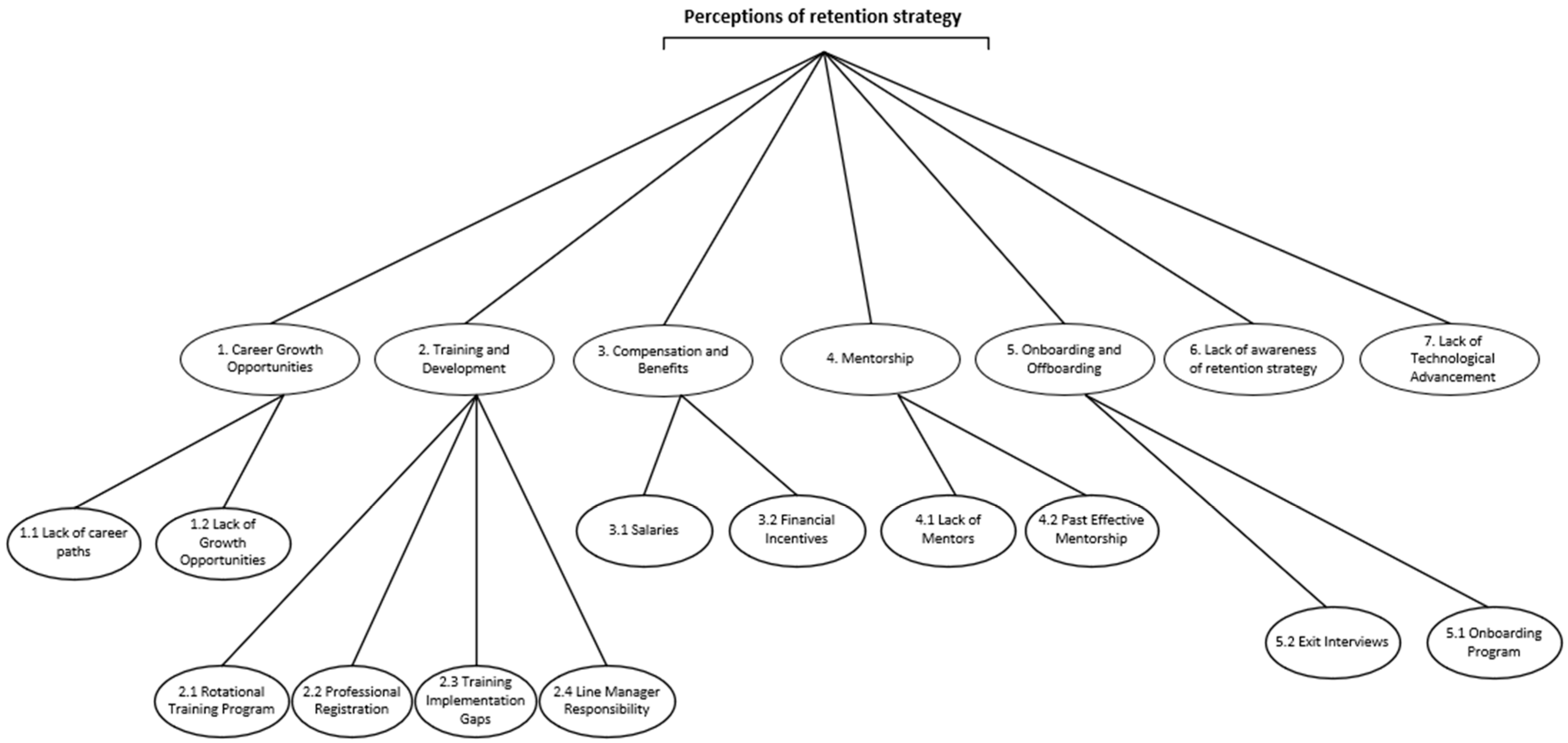
The results of this study are depicted in Figure 1, which shows the themes and sub-themes that emerged from the thematic analysis.
Figure 1 shows that seven themes emerged from the data analysis: career growth opportunities, training and development, compensation and benefits, mentorship, onboarding and offboarding, lack of awareness of the retention strategy, and lack of technological advancement. These themes and sub-themes are discussed in detail below:

4.1. Career Growth Opportunities

Career growth opportunities emerged as an overarching theme in the data, with two sub-themes: a lack of career paths and a lack of growth opportunities. The participants perceived the provision of career growth opportunities as an important employee retention initiative that was appealing to them and would influence them to stay. Participants indicated that some of their colleagues had left the organisation due to perceived lack of growth opportunities. The participant perceived the retention strategy that provides career growth opportunities as important in keeping them with the organisation, as it encourages them to remain committed and not resign.

4.1.1. Lack of Career Paths

Most participants raised concerns about the lack of clearly defined career paths, which was negatively affecting the company’s ability to retain professional engineers. Participants indicated that the lack of career paths was frustrating for some, prompting them to consider leaving the organisation in search of growth opportunities. The respondents indicated that there were no clearly defined personal development plans (PDPs) that would facilitate their advancement to the next role, which frustrated most professional engineers. The lack of clear career paths was identified as the salient trigger for professional engineers to consider leaving the organisations.
“It is about understanding where they want to go. Most people will want to write GCC and things like that, which is part of the career path, their development, and what they are being exposed to in terms of our development is not making us grow faster, and we are confined to one area. I think that is why we are finding our base somewhere else” (Participant 3, Generation Z African male).
“I think there needs to be a clear plan from the time you arrive to say you are coming, for example, as a maintenance engineer; this is your growth path, and these are the things you need to do to actually get there”. (Participant 4, Generation X, African Male).
“The much younger ones, they prefer clear communication and a clear path, so when they join the organisation, it is that I am joining as an engineer; so in order for me to qualify, and they want to know what is my next level, first of all. So, they want a clear plan—when I arrive, this is where I am going to be, and this is the next level. In order for me to get to this level, they also need clear targets to say, “this is what I need to do, this is what I need to be able to do, this is what I need to be able to achieve to qualify for the role”, and if we say [the] timeline is five years, after five years they are expecting that. It needs to happen; if that transition does not happen, for them it creates a problem, and then they go” (Participant 5, Generation Y, Indian Male).
“I think sometimes we take it for granted because we are nearly at the top, so I think if I came in as a new person, and there was a very clear path in terms of if I am here, I am likely to end up at that level, there is that motivation line. But it must also be clear from that career path that I am not the only one, so the expectation now, when you see the path … but after three, four, five years, you do not see movement, what does it mean about the path?” (Participant 9, Baby Boomer, White male).

4.1.2. Lack of Growth Opportunities

Furthermore, participants expressed concerns about the lack of growth opportunities as a reason engineering professionals may consider leaving their organisation. Growth opportunities emerged as a key retention factor for almost all participants, and they indicated they were frustrated by their lack. The participants perceived the organisation’s retention strategy as failing to address growth opportunities and indicated that other engineers have left the organisation due to this perceived lack.
“None that I am aware of, just word of mouth that you hear and things that you see, and most people, like if they talk to you on a personal level, they will share that there is no room for growth. I would say because of lack of growth opportunities” (Participant 7, Baby Boomer, White Male).
“Yes, there is that, so people go out to look for growth, I would say, and they really have. The people that I have spoken to or still keep in contact with have really gone far [there] outside than they would have here” (Participant 6, Baby Boomer, African Male).
“In most cases, the first reason [they leave] would be for growth. It is growth.” (Participant 5, Generation Y, Indian Male).
However, one participant indicated that the organisation met his expectations for growth, and he remained with the organisation. This underscores why other engineers were frustrated by the lack of growth opportunities and suggests that the lack of such opportunities can be a trigger for an engineer to leave the organisation.
“But fortunately in my case, I think the company managed to meet [the] expectations that I had, which was growth and that is what has kept me here” (Participant 4, Generation X, African Male).

4.2. Training and Development

Training and development was a major theme that emerged from the data analysis, with sub-themes, including a rotational training program, professional registration, training implementation gaps, and line manager responsibility.

4.2.1. Rotational Training Program

The training rotational program was described as a structured program in which the trainee rotates through different departments to acquire knowledge, gain experience, and develop diverse technical skills required by the organisation. Hence, participants indicated that the rotational program is expected to ensure that an engineer is aware of all the machines and work in other departments, even though the rotation system is not strictly followed, and some employees may end up stuck in one department.
“They have the EIT Programme that I am aware of, where the engineer is supposed to be circulating in different departments just to get exposure to all the equipment that we have. I do not think we are very strict in that, because what seems to happen is that when the engineer gets into a particular department, for example, they want to keep that person, because there is always justification from the area manager. They are working on this project, or there is a vacancy, whatever the story might be, so people, what is on plan on paper and what is actually happening is different” (Participant 3, Generation Z, African Male).
“Firstly, I will start with a proper EIT problem, or even the same thing can happen, or it is a vicious TIT problem; but a structured EAC programme where the engineers ….—I do not think they should actually report to the area. …. in that rotation where they are getting exposed to the business and also giving them training” (Participant 10, Generation X, African Female).
“But I think it is the Structured Engineering EAC program where guys can rotate to different departments and get exposure, and then they also need to go to professional development courses, internal courses, but it needs to be structured for each discipline with a mentor. But I think the problem is that that thing [is] it does not exist; and then what tends to happen, as that engineer comes in, he gets sucked in as an EIT, gets sucked into the day to day and then he might remain in that department for 18 months to two years” (Participant 4, Generation X, African Male).

4.2.2. Professional Registration

Some participants indicated that, through training and development initiatives, their organisation supported graduate engineers in obtaining professional registration and a government certificate of competency (GCC), which is valued and appreciated by the participants. Registration with the Engineering Council of South Africa and the GCC is considered an important professional development milestone that enhances participants’ career development and can influence professional engineers’ intention to stay.
“Looking at candidate engineers, the organisation does offer their EIT Programme, Engineer and Training Programme, which, from my understanding, is a two-year programme, on a primary level. It is to assist an engineer to get up to speed and eventually be able to register as a professional engineer” (Participant 1, Generation X, African Male).
“As part of the programme, the company, well, then explained the different avenues that an engineer can take. For example, you can go the professional registration route, where basically you then follow the candidate engineer programme: you get a professional engineer who will mentor you, and you do the relevant work to go that route, or you can go, for example, the GCC route, where you then write the exams and then you become a GCC certificated engineer” (Participant 4, Generation X, African Male).
“There is an extra registration that the Engineering Council of South Africa has; there was a programme that was being run to get people to be registered. At least that is one way of supporting engineers in that sense.” (Participant 9; Baby Boomer, White Male).

4.2.3. Training Implementation Gaps

Some participants indicated that there is a gap in the organisation’s training and development initiatives, which form the core of its retention strategy. Participants indicated that much needs to be done to enhance the effectiveness of training and development as a retention tool for engineers in organisations. Some participants also indicated that they do not have opportunities to attend and complete training programmes due to operational requirements, which negatively affects their development and growth and intensifies their dissatisfaction.
“There is a gap in training and development as well. Almost a year now, well more than a year, when we did our skills analysis” (Participant 2; Generation Z, African Female).
“I think one of the biggest strategies is to strengthen our training and development, and maybe look at [it], I mean, as big as we are, we spoke about earlier when we were discussing the other topic” (Participant 12, Generation Z, African Male).
“But I think the problem is that thing [is] it does not exist; and then what tends to happen, as that engineer comes in, he gets sucked in as an EIT, gets sucked into the day to day and then he might remain in that department for 18 months to two years, and then at some point then they will look for a way to make him permanent. By the time the person gets permanent, he does not have exposure to how the business works; and then maybe if he tends to compare himself with peers from whom the sale went to XXX or YYY or the companies which have that, then sometimes they do feel left behind, and then they start maybe shopping around looking for opportunities elsewhere.” (Participant 10, Generation X, African Female).

4.2.4. Line Manager’s Responsibility

Participants also indicated the key role line managers play in ensuring that their direct reports attend relevant training and development interventions aligned to their development. One participant indicated that they were not impressed that the responsibility for driving the training and development of engineers rests with line managers and that this is not centralised within the organisation. Another participant indicated that managers are reluctant to release engineers for training and development initiatives due to operational requirements. This was further highlighted by another participant, who indicated that the ideal training and development program for candidate engineers involves rotating throughout the plant and across different departments; however, line managers do not allow engineers to rotate, leaving them feeling stuck in one department, which can cause frustration and dissatisfaction. However, other participants indicated that some line managers were really driving the training and development process for engineers, which increased their satisfaction and commitment to the organisation.
“I was not really impressed with the fact that it is left to the manager. Not centrally driven to say these are the gaps we are seeing overall as an organisation, and this is where we need to develop, but you are asked as a manager, and that creates silos in your own space” (Participant 2, Generation Z, African Female).
“Then the area manager ends up maybe getting to a point where he does not even want to live without that guy, being gone for two or three days to go and develop themselves. And then a year or two years will pass, by [when] they are busy with these day-to-day things. Especially, that is the thing, the big issue in the plant, because if you do not have a big pool of skilled people, you end up having key man risks, where you have got this key guy who is experienced, then you do not even want that guy to be gone to Johannesburg for two days or three days, because you want them to be in the plant all the time.” (Participant 10, Generation X, African Female).
“So, I used to be worried about that one, but for now, with my new manager, she is trying to drive growth [in…] and encouraging that we pursue our studies. So, I do not know in terms of the organisation as a whole” (Participant 8, Generation Z, African Male).
“Yes, very much on my side now that I have a new manager. … I can see that I am given a platform to do those like capex projects, I do budgeting; I used to not do those things, and it is not just, it is giving me an opportunity to, when I want to be technical; for example, when a technical manager position comes [up], I can go that route, or if an area manager position comes [up], I think I would be able to go that route based on what I am being exposed [to] on my side” (Participant 11, Generation X, Indian Female).

4.3. Compensation and Benefits

Compensation and benefits are another major theme that emerged from the data analysis, with two sub-themes: salaries and financial incentives. Most participants considered compensation and benefits important in their decision to stay or leave the organisation, even though they were not the only factors. Participants indicated that compensation is competitive and that financial incentives are offered.

4.3.1. Salaries

Participants indicated that the organisation was paying them competitive salaries, even though they believed salaries should be periodically reviewed to ensure engineers remain satisfied and stay with the organisation. Some participants indicated that, as part of the retention strategy, the organisation should use competitive salaries, but it is not the only important factor and should be complemented by other retention factors.
“I think, to be honest, the organisation pays competitively, but I think they need to leverage on those factors I mentioned. “ (Participant 7, Baby Boomer, White Male).
“I think also salary-wise, it also like needs to wait until someone complains about their packages. Probably you can review that. Periodically, instead of waiting for someone to say, “look, I am concerned about my package, I would like to be moved”, so periodically it could help a person to feel like there is a consideration of his studying graces (Participant 12, Generation Z, African Male).
Also, to review the remuneration, to say maybe after a certain period you will be promoted to a certain grade or salary, provided the performance matches. I think that will go a long way to make sure people stay (Participant 4, Generation X, African Male).

4.3.2. Financial Incentives

Participants indicated that financial incentives were important to their retention and that the organisation should use them to attract and retain engineers. Some participants indicated that the organisation used financial incentives, such as share schemes, sign-on and retention bonuses, to retain engineers. One participant highlighted that the organisation needed to offer competitive financial incentives to attract and retain engineers and mitigate the company’s non-prime location. Another participant also highlighted that, in some cases, when engineers resigned, the organisation would make a counteroffer to try to retain them.
“Financial incentives have to be good for us to attract and keep [us], because if I think of coming to Pietermaritzburg, it must be worth my while, because the quality of life goes down, so something must go up. So, I would rather earn money when knowing that my quality of life is low, so financial incentives would be a big plus for us to retain people” (Participant 9, Baby Boomer, White Male).
“No, I am not aware of the policy per se, but maybe some of the things that I know, like they are using a share scheme, giving share incentives to employees, [are] part of the retention strategy (Participant 3, Generation Z, African Male).
“I am not aware [of any], but I know they counteroffer when someone has resigned (Participant 2, Generation A, African Female).

4.4. Mentorship

Mentoring emerged as the major theme, with past effective mentorship and lack of mentors as sub-themes. Engineers indicated that mentoring was important to their development and growth. However, the participants indicated an inconsistency in its implementation, with some reporting they received mentoring while others reported not receiving any.

4.4.1. Past Effective Mentorship

Participants who reported receiving effective mentoring referenced past mentorship programs and noted that the mentoring was effective and helped them in their development and professional growth. The participants indicated that mentorship was formal and properly structured in the past, which made it effective; however, it seems the mentorship is no longer structured or properly implemented, which is reducing its effectiveness.
“Now, no, but in 2012 when I arrived, I know XXX was running it because I also attended one of the interview sessions. There was a booklet I was looking for at home. There was a structured booklet that told you which department you needed to go to and what the accounts for that department, and what you expected to gain; and I think he was acting like a mentor at that time, XXX, when he was like an engineering manager. The mentorship programme was effective” (Participant 10, Generation X, African Female).
“It was there, but I think it was there two years back, where we had an EIT and another programme called TIT. I think that was a proper mentorship of engineers where they go out, they are given tasks, they come and present, so that for me was quite a good mentorship programme. It was effective because it is a platform for engineers to also ask questions, a platform to get help as well if there are any challenges, but now [with] the guys that are here, it is quite difficult” (Participant 12; Generation Z, African Male).
“There was a programme that I was put on about Durban Automotive Cluster, I think it is also a Graduate Development Programme, where you link up with other engineers around KZN, like Gomali Bear. Some, I think, were even from Toyota, if I remember correctly; it was some time ago, but the mentor there, I think it is Andrew Taylor or something like that, he was always encouraging participants in that programme to register with EGSA, but apart from that encouragement, I think there was nothing else” (Participant 6, Baby Boomer, African Male).

4.4.2. Lack of Mentors

Some participants indicated that, unlike in the past when they joined the organisation, there was no structured mentorship program and a lack of mentors. One participant indicated that when he joined the organisation, he was never assigned a mentor, and there were no suitable mentors in the department. In this regard, another participant suggested that mentoring young engineers should be part of every senior engineer’s KPIs and formalised so that senior engineers are held accountable and encouraged to mentor junior and candidate engineers. Another participant indicated that he had to take the initiative to find suitable mentors and build relationships with them, which has supported his development and growth. In this regard, it seems that mentorship is initiated by the individual, who must find their own mentors, rather than being centrally driven by the organisation.
“I am an industrial engineer, right, so when I initially joined the company, there were no professional industrial engineers in the company; so there was, by design, no one to mentor me from their requirements about EGSA. I would say there is none” (Participant 3, Generation Z, African Male).
“I did not get a mentor, but I sought one. I found mentors myself, and I looked for people who were in my profession, and I built relationships with them, and they have assisted me since then. So I think on the mentorship side, I would not say it is company driven, [but] it is individual driven” (Participant 1, Generation X, African Male).
“No, not really. Wait, newly qualified, no, I did not get a mentor; yes, I was not assigned a mentor when I came” (Participant 11, Generation X, Indian Female).

4.5. Onboarding and Offboarding

Onboarding and offboarding were major themes that emerged from the data, with two sub-themes: the onboarding process and exit interviews.

4.5.1. Onboarding

Some participants perceived onboarding as part of the strategies organisations use to retain new engineers. Onboarding is used to assimilate new employees into the organisation and ensure they are effectively socialised, can integrate, and belong. Some participants perceived the onboarding process as an organisational retention initiative.
“Yes, so the organisation started off with the Talent Onboarding Programme to help assist a new employee to get traction and hit the ground running once put into his or her department” (Participant 1, Generation X, African Male).
“I expected to come into a system that is fully mature in terms of managing some of the aspects that you mentioned there, like the onboarding of employees” (Participant 4, Generation X, African Male).
“Yes, recently I heard of HTOP (onboarding programme). I believe there is an aspect of retention that is included in the HTOP Programme” (Participant 2, Generation Z, African Female).

4.5.2. Exit Interviews

Most participants indicated that their companies use exit interviews to gather data on the reasons engineers leave. The participants were also unaware of the benefits of exit interviews and of any actions that might arise from them. They also believed that if exit interviews were compulsory and the data collected were used appropriately, they could help retain engineers.
“I will think that they should be doing exit interviews; that is what we know is being used here”. (Participant 3, Generation Z, African Male).
“I am aware of [an] exit Interview that they used to use to gather the data about why a person is leaving the business, but l have never seen how the information is used.” (Participant 12, Generation Z, African Male).
“Possibly the exit interview and a survey from the individual who has resigned or [is] exiting the organisation”. (Participant 1, Generation X, African Male).
However, one participant indicated that when he resigned, no exit interview was conducted, suggesting that exit interviews may be conducted inconsistently.
“I am not sure. When I did resign, I did not do an exit interview. Yes, it was just an exit medical, but the exit interview did not happen” (Participant 6, Baby Boomer, African Male).

4.6. Lack of Awareness of the Retention Strategy

The lack of awareness of the company’s retention strategy was a major theme that emerged from the data analysis. The responses showed that the professional engineers lacked an adequate understanding of their organisation’s retention strategy. Only three participants mentioned initiatives they were aware of that might fall into the category of retention strategies, but the majority indicated they were not aware of the company’s retention strategy. This indicates that the retention strategy, retention policies, and initiatives that are implemented to retain professional engineers are not widely communicated. From the participants’ responses, it is unclear whether the organisation has a retention strategy in place. One participant stated that he does not believe the organisation has a retention strategy, while another stated it is a grey area. Another participant indicated that, given the organisation’s location, it needs a strong retention strategy to prevent engineers from leaving for more preferred locations, while another participant indicated that the organisation needs to strengthen its training and development initiatives to retain engineers.
“There is no retention strategy that I am aware of in this company. We need to make sure that we retain people, whatever retention strategy, salaries, benefits, incentives, and we need to make sure that we have the right capability. It is not only about retaining them, because if they do not have the right capability, they feel like they are not growing”. (Participant 3, Generation Z, African Male).
“I am not sure of that (the retention strategy). I think it is a grey area, it is, yes”. (Participant 5, Generation Y, Indian Male).
“You cannot change the location, so our retention strategies have to be very good. I think in a place like this, you need to have good retention strategies” (Participant 7, Baby Boomer, White Male).

4.7. Lack of Technological Advancement

Participants in this study indicated that their organisation did not embrace rapid technological advancement and innovation, and expressed a desire to see it adopt the latest technologies. The participants indicated that the organisation lacked integration and the embrace of technological advancement and innovation, which weakened its efforts to retain them. The participants perceived their organisation as lagging behind competitors in embracing advanced technologies and innovation. Some participants suggested that the organisation must benchmark against industry standards and catch up in embracing advanced technologies and innovation to attract and retain young engineers.
“We are quite an old organisation that has not done much to catch up with the advancing technology and digitalisation”. (Participant 2, Generation Z, African Female).
“And, yes, I feel like there is a lot that we need to do, there are a lot of gaps, a lot of catching-up, in terms of keeping us with what is now industry standard out there. I think we [are] still stuck in our old ways” (Participant 12 Generation Z, African Male).
“We are fixated on doing [it] a certain way, it is like that, and I do not think we do enough benchmarking, and we are sort of a world-class [organisation] because we are operating or competing in the international space. But, at the same time, we are almost like in our little corner when it comes to keeping up with technology; we are not as fast-paced, so we are always the later doers” (Participant 5, Generation Y, Indian Male).

5. Discussion

This study explored professional engineers’ perceptions of their organisation’s employee retention strategy and how these perceptions influence their decision to stay or leave their organisation. The study found that professional engineers lacked an understanding of their company’s retention strategy, which limited its effectiveness in retaining engineers. The study also found that professional engineers perceived that their organisation’s retention strategy did not provide career growth opportunities and clear career paths, which seemed to weaken the perceived social exchange relationship and tended to trigger their intention to leave. The engineers indicated that some of their colleagues have left the organisation due to perceived lack of career growth opportunities, and that provision of career growth opportunities and clear career paths are important in influencing their decision to stay or leave their organisation. Furthermore, participants indicated a lack of robust mentoring and coaching due to the loss of experienced engineers and a lack of technological advancement, both of which also influence their intention to stay or leave the organisation. On the other hand, some of the participants perceived that the organisation’s retention strategy provided competitive compensation, onboarding, and off-boarding, as well as training and development, even though there were gaps in implementation of training and development.

5.1. Career Growth Opportunities

The professional engineers recognised career growth opportunities as an important retention factor that should be part of the organisation’s retention strategy, as they influence them to stay with the organisation. This aligns with previous research showing that career growth opportunities facilitate employee retention (Marozva et al., 2024; Ohunakin et al., 2018; L. Wang & Abu Hasan, 2024). In line with social exchange theory, employee perceptions of their organisation providing career growth opportunities is likely to trigger the obligation to reciprocate by staying longer in the organisation. Hence, provision of career growth opportunities has been negatively associated with turnover intention (L. Wang & Abu Hasan, 2024) and positively associated with thriving and career commitment (Huo, 2021). Therefore, the results of this study support social exchange theory and corroborate previous research by showing that when career growth opportunities are perceived as an organisational inducement in the exchange relationship, they positively influence the employee’s intention to remain in the organisation.

5.2. Training and Development

The professional engineers indicated that effective training and development are also important in their retention. Training and development activities have been found to foster positive employee attitudes and behaviours (Tien Than & Thu Ha, 2024). Employee perceptions of provision of training and developmental opportunities are important in the exchange relationship and play a significant role in the employee’s decision to stay or leave the organisation (Dhanpat et al., 2018; Dietz & Zwick, 2021; Thomas & Letchmiah, 2017). Training and development provided to employees fosters motivation, engagement, and satisfaction (Tien Than & Thu Ha, 2024), which, in turn, may trigger a sense of obligation to reciprocate by exhibiting commitment and staying with the organisation, as predicted by the social exchange theory. Previous research has indicated that training and development enhance job satisfaction, which, in turn, positively influences employee retention (Mampuru et al., 2024). Participants’ perceptions that effective training and development are important for their retention dovetail with this research. Furthermore, a study by Nouri and Parker (2013) found that the effectiveness of training and development enhanced employees’ perceptions and beliefs about the organisation’s growth opportunities; hence, the professional engineers in this study perceived effective training and development as an essential initiative for their retention. They indicated that training and development appear to be part of the organisation’s retention strategy, although implementation gaps remain.

5.3. Mentorship

Mentoring was also recognised by the professional engineers as important in influencing them to stay with the organisation. Mentoring is perceived as a positive organisational inducement, likely seen as a sign of the organisation’s commitment to developing its employees. Hence, employees who receive formal mentoring are more likely to be satisfied with their jobs, career development, and professional development, and they may be more likely to stay with the organisation (Burke et al., 2006; Chun et al., 2012; Joo & Cruz, 2023). Positive mentoring experiences are likely to positively influence job satisfaction and organisational commitment, which are important antecedents of employee retention (Calisir et al., 2011; M. Hall & Smith, 2009; Chun et al., 2012). Therefore, the results of this study relating to the importance of mentorship as an element of the retention strategy for engineers are supported by previous studies. Furthermore, mentoring provides the mentee with continuous learning and support for role development, which contributes to career development and therefore is likely to influence the employee to stay with the organisation (Z. Cai et al., 2020; Chun et al., 2012). Hence, organisations should strengthen their mentorship programs as they play a key role in ensuring that employees do not leave their organisation in search of mentoring and better developmental opportunities.

5.4. Compensation and Benefits

The professional engineers in this study also indicated that their organisation offered competitive salaries and financial incentives; however, employers are willing to pay a premium for critical, scarce skills in the labour market, hence the participants reported that the organisation makes counteroffers to retain some engineers. Compensation has been found to strongly influence their intention to leave (Dhanpat et al., 2018), and poor rewards have been found to trigger intention to quit (Barkhuizen & Makhuzeni, 2015); hence, organisations that do not offer competitive remuneration are likely to lose critical and highly experienced employees. The finding in this study that professional engineers perceived that the retention strategy of their organisation provides competitive compensation and financial incentives complements previous studies that have found that employees who are satisfied with their compensation are likely to stay with the organisation (Banje et al., 2015; X. Li et al., 2024; P. Singh & Loncar, 2010). Thus, organisations need to address employee perceptions regarding satisfaction with compensation since perceptions of dissatisfaction and inequality in compensation, regardless of whether they are real or not, play a significant role in the employee’s decision to stay or leave the organisation (Shields et al., 2012; Treuren & Franklin, 2014).

5.5. Company Retention Strategy and Policies

The participants lacked a clear understanding of their organisation’s retention strategy or policies. This finding is supported by researchers who have noted that employees may not be aware of their organisation’s HR practices or retention strategies and may not perceive them as the organisation intended (Bos-Nehles & Veenendaal, 2019; Y. Wang et al., 2020). This is corroborated by previous research indicating that employees are unaware of, or lack understanding of, their organisation’s retention strategy or retention interventions (Begbie et al., 2011; Mohlala et al., 2012). It is therefore important that employee retention initiatives are communicated widely since internal communication plays an important role in the effective implementation of HR strategies and practices and in influencing employee perceptions (García-Carbonell et al., 2015). García-Carbonell et al. (2015, p. 277) substantiate further by noting that “high-level communicational capabilities to transmit HRM strategy could facilitate clearer transmission of HR content, avoiding discrepancies between HRM agents’ decisions and managers’ and employees’ perceptions”. More recently, Kgarimetsa and Naidoo (2024) found a mismatch between talent retention strategies in the mining industry and the workplace preferences of Gen Z employees in South Africa. This emphasises that employers should be proactive in understanding employees’ needs and preferences, given that these have changed and shifted in recent years (Delbosc & Kent, 2024; Gocer et al., 2025; Mabaso, 2026).

5.6. Lack of Technological Advancement

Knowledge workers, such as engineers, perceive their jobs as creative, and organisations that embrace advanced technologies facilitate employee creativity and innovation while fostering the advancement of technological skills, which is a driver of employee retention (Ek Styvén et al., 2022). Emerging technologies, such as artificial intelligence, machine learning, and robotics, are significantly influencing how work is done (Le Blanc et al., 2024; Parry & Battista, 2019). Thus, for knowledge workers such as engineers, technological skills and competencies have become critical to adapt to rapid technological advancements revolutionising the manufacturing process. Hence, engineers in this study are likely to stay longer if their organisation provides reskilling and upskilling aligned with emerging technological advancements (Kannan & Garad, 2021; L. Li, 2022). Hence, in this study, the participants indicated that the integration and adoption of technological advancements were lacking in their organisation, which weakened the organisation’s efforts to retain them.

Theoretical Implications

This study contributes by integrating social information processing theory and social exchange theory to demonstrate the micro-level process by which employee perceptions are socially constructed and subsequently fed into the social exchange mechanism, which, in turn, influences the employee’s decision to stay or leave. Providing a micro perspective on employee perceptions and attitudes and how they influence the decision to stay or leave the organisation directly responds to calls for context-sensitive research (Bausch et al., 2024; Homer & Lim, 2024), thereby offering a more nuanced understanding of employee perceptions and intentions to stay or leave. As noted by Homer and Lim (2024, p. 128), the micro perspective explores “phenomena in their unique settings, often resulting in insights that are deeply contextual” (Homer & Lim, 2024, p. 128). The integration of social information processing theory and social exchange theory provides a micro perspective of understanding how social information and cues from the social context facilitate the formation of perceptions and attitudes that are socially constructed and evaluated in the social exchange mechanism, resulting in an individual’s decision to stay or leave the organisation. This study links employee perception formation through the processing of social information and cues from coworkers, managers, and the organisational context (Salancik & Pfeffer, 1978) and the evaluation process of the cost-benefit analysis of the social exchange mechanism. Through integrating the two theories, this study demonstrated that the formation of employee perceptions about the company’s retention initiatives and how such perceptions influence employee’s decision to stay or leave the organisation is shaped by the dynamic, socially embedded employee evaluation processes. Hence, retention practices may not elicit a similar response from employees, but the responses are influenced by the socially embedded cues and signals that facilitate perception formation, which are subsequently fed into the social exchange evaluation process, which results in employee’s decision of staying or leaving the organisation. Furthermore, this study shifted the research on employee retention strategies in South Africa by focusing on engineers’ perceptions, offering valuable insights into how they perceive their organisational retention strategy and their organisation’s psychological contract. It is important to understand employees’ needs and preferences, as they have changed and shifted in recent years (Delbosc & Kent, 2024; Gocer et al., 2025; Mabaso, 2026).

6. Practical Implications

The findings of this study yielded a micro-level and context-specific understanding of the perceptions of professional engineers regarding their company’s retention strategy and how such perceptions influenced their decision to stay or leave the organisation. The context-specific nature of the findings may limit the transferability of the practical implications derived from this study. The findings of the study seem to suggest that contemporary organisations should seriously consider how employees perceive their retention strategy and how they experience its implementation. While organisations can develop robust, dynamic, and tailored retention strategies, their success also depends on how employees perceive and experience their implementation, which may significantly shape the employee’s decision of staying or leaving an organisation. Furthermore, contemporary organisations may reap the benefits of developing robust, dynamic, and tailored retention strategies; however, their potential effectiveness may depend on reinforcement from management and the quality of implementation, as these factors can shape employee perceptions, which, in turn, may influence employees’ decisions to stay or leave the organisation (Ybema et al., 2020). This is substantiated by Basnyat and Clarence Lao (2020), who noted that effective HR policies and practices are necessary but, in themselves, not sufficient to thwart turnover intentions. The study by Ybema et al. (2020) noted that the effectiveness of HR practices in motivating and retaining employees increased when organisations reported implementing more HR practices, when employees reported higher usage of these practices, and when employees participated in their implementation. Thus, organisations may also benefit from monitoring how HR practices are implemented and perceived, as employees’ perceptions may influence turnover.
Furthermore, this study also highlights the importance of effective communication of the organisation’s employee retention strategy as a practical implication. Organisation may benefit from using their internal communication platforms to make their workforce aware of the economic and non-economic benefits the organisation is willing to offer to retain their valuable employees. Such internal communication may have a positive impact on influencing employee perception and enhancing the employer brand status in the eyes of the employees (García-Carbonell et al., 2015; Špoljarić & Tkalac Verčič, 2022), which, in turn, facilitates employee retention. This is supported by previous research showing that when employees perceive their organisation as a strong employer brand, they are more likely to remain with the organisation longer (Bussin & Mouton, 2019; Chopra et al., 2024; Tanwar & Prasad, 2016). Therefore, it is suggested that organisations should use internal communication to sell their retention strategy and promote its implementation, thereby positively influencing employee perceptions and building a strong employer brand among their workforce.

7. Limitations and Suggestions for Future Research

This study was qualitative in nature and used a small sample of professional engineers from a single case, meaning one manufacturing organisation, which limits the generalisation of the findings to other organisations in different contexts and industrial sectors. Multiple cases (different organisations) could have enabled researchers to compare similarities and differences (Heale & Twycross, 2018). Hence, future studies can utilise multiple cases from different industry sectors to enable comparisons.
Although this study made a methodological contribution through using a qualitative study underpinned by a constructivist paradigm and interpretivism that provided contextual meaning and subjective experiences of engineers that have been underexplored by the commonly used quantitative research in the topic, the context-specific nature of the study provided a limitation because the study findings cannot be generalised to other similar organisations or to the broader organisations. However, as noted by Mohlala et al. (2012), HR issues are highly context-specific and best suited to inquiries that focus on that context. In this regard, employee perceptions of the organisation’s retention strategy can vary across organisational contexts (Hinkin & Tracey, 2010), making it difficult to replicate or generalise the findings of this study.
Also, the interpretivism paradigm is underpinned by the view that reality is subjective and socially constructed, and there are multiple subjective realities (Denzin & Lincoln, 2005). Thus, it focuses on understanding subjective experiences and contextual meanings. The researchers have the responsibility of interpreting the ‘existing meaning systems shared by the actors’ (Orlikowski & Baroudi, 1991, p. 15), which brings forth the researcher’s subjectivity and bias in the interpretation. In this way, there is a reliance on the researcher who becomes a research instrument through which the research is undertaken (Lofland et al., 2006). This presents a limitation because the results can be tainted by the researcher’s subjectivity and bias, which may not be mitigated by the reflexivity process the researchers engaged in. Therefore, the use of constructivism-interpretivism in this study may be affected by the potential for misrepresentation and bias influenced by the researcher’s beliefs, experiences, and interpretation biases.
Furthermore, the researchers targeted professional engineers and did not include all employees in the organisation, which may limit generalisability to the whole organisation. The results capture only the perceptions of the purposively selected sample of professional engineers and do not reflect those of all engineering and non-engineering employees in the organisations. Furthermore, the study’s results capture only the perceptions of professional engineers and do not include the employer’s voice or company documentation. Future studies include employer perceptions and organisational data, such as exit interview data and engagement surveys, to increase the data triangulation.

8. Conclusions

Organisations need to be more proactive and develop robust, dynamic employee retention strategies to retain critical employees. A one-size-fits-all retention strategy will no longer work in a multigenerational workforce with diverse needs and preferences. More importantly, organisations should involve employees in the design and implementation of the retention strategy, as employee involvement increases its effectiveness. Also, organisations should ensure they widely communicate their retention strategy to the workforce so they can positively influence employees’ perceptions, because employee perceptions play a major role in whether employees stay or leave the organisation.

Author Contributions

Z.P.N., C.T. and S.S. conceptualisation of the editing of the manuscript. Z.P.N. collected, analysed the data, and discussed the results. Z.P.N. wrote the manuscript for an academic degree culminating from the primary data collection, while C.T. provided supervision during this process, while S.S. wrote the article. All authors have read and agreed to the published version of the manuscript.

Funding

This research received no specific grant from any funding agency in the public, commercial, or not-for-profit sectors.

Institutional Review Board Statement

The study was approved by the Research Ethics Review Committee for the College of Economic and Management Sciences, Industrial and Organisational Psychology (Ref #. 1770 dated on 2 February 2024).

Informed Consent Statement

Informed consent was obtained from all subjects involved in the study.

Data Availability Statement

The data that support the findings of this study are available from the corresponding author, C.T., upon reasonable request.

Acknowledgments

Grammarly was used to edit the manuscript.

Conflicts of Interest

The authors declare that the research was conducted without any commercial or financial relationships that could potentially create conflicts of interest.

References

  1. Aggarwal, U., & D’Souza, K. C. (2012). Transformational leadership: The link between P-O fit, psychological contract & signature experiences. Indian Journal of Industrial Relations, 47(3), 485–497. [Google Scholar]
  2. Aguinis, H. (2025). Research methodology: Best practices for rigorous, credible, and impactful research. Sage. [Google Scholar]
  3. Aguzzoli, R., Lengler, J., Miller, S. R., & Chidlow, A. (2024). Paradigms in qualitative IB research: Trends, analysis and recommendations. Management International Review: Journal of International Business, 64(2), 165–198. [Google Scholar] [CrossRef]
  4. Alajlani, S., & Yesufu, L. O. (2022). The impact of human resource practices on employee retention: A study of three private higher educational institutions in the United Arab Emirates. SA Journal of Human Resource Management, 20(0), e1–e10. [Google Scholar] [CrossRef]
  5. Ali, M., Niu, X., & Rubel, M. R. B. (2024). The influence of transformational and transactional leadership on employee retention: Mediating role of employee engagement. Management Matters, 21(2), 164–190. [Google Scholar] [CrossRef]
  6. Ansari, N. G. (2011). Employee perception of HRM practices: Impact on commitment to the organization. South Asian Journal of Management, 18(3), 122–149. [Google Scholar]
  7. Assaad, R., & El-adaway, I. H. (2021). Impact of dynamic workforce and workplace variables on the productivity of the construction industry: New gross construction productivity indicator. Journal of Management in Engineering, 37(1). [Google Scholar] [CrossRef]
  8. Atherton, P. C., & Fasano, A. (2023). 3rd annual—Present and future of work in engineering and architecture. Actions Prove & Engineering Management Institute. Available online: https://engineeringmanagementinstitute.org/wp-content/uploads/2023/04/AEC-Present-and-Future-of-Work-2023-O.pdf (accessed on 15 May 2026).
  9. Baluch, A. M. (2017). Employee perceptions of HRM and well-being in nonprofit organizations: Unpacking the unintended. International Journal of Human Resource Management, 28(14), 1912–1937. [Google Scholar] [CrossRef]
  10. Banje, Y. M., Ngbea, K. M., Ucho, A., & Sunday, O. A. (2015). Worker-supervisor relationship and pay satisfaction: Influence on turnover intention among primary school teachers in Ado, Nigeria. IFE PsychologIA: An International Journal, 23(2), 119–124. [Google Scholar]
  11. Barkhuizen, E. N., & Makhuzeni, B. (2015). The effect of a total rewards strategy on school teachers’ retention: Original research. SA Journal of Human Resource Management, 13(1), 1–10. [Google Scholar]
  12. Basit, T. (2003). Manual or electronic? The role of coding in qualitative data analysis. Educational Research, 45(2), 143–154. [Google Scholar] [CrossRef]
  13. Basnyat, S., & Clarence Lao, C. S. (2020). Employees’ perceptions of the relationship between human resource management practices and employee turnover. Employee Relations: The International Journal, 42(2), 453–470. [Google Scholar] [CrossRef]
  14. Bausch, M., Barmeyer, C., & Guttormsen, D. S. A. (2024). An outsider’s insights from the inside: Implications of emic concepts on qualitative international management research. Qualitative Research in Organizations and Management: An International Journal, 19(4), 256–281. [Google Scholar] [CrossRef]
  15. Begbie, C., Bussin, M., & Schurink, W. (2011). A food manufacturing manager’s experiences and perceptions of the implementation of an incentive scheme. SA Journal of Human Resource Management, 9(1), 1–13. [Google Scholar] [CrossRef]
  16. Bhattarai, G., & Budhathoki, P. B. (2023). Psychological contract breach and withdrawal behavior: Mediating role of psychological ownership of job and organization in Nepal. Problems and Perspectives in Management, 21(2), 531–541. [Google Scholar] [CrossRef]
  17. Blau, P. M. (1964). Justice in social exchange. Sociological Inquiry, 34(2), 193–206. [Google Scholar] [CrossRef]
  18. Bordens, K. S., & Abbott, B. B. (2021). Research design and methods: A process approach (11th ed.). International student edition. McGraw-Hill. [Google Scholar]
  19. Bos-Nehles, A. C., & Veenendaal, A. A. R. (2019). Perceptions of HR practices and innovative work behavior: The moderating effect of an innovative climate. The International Journal of Human Resource Management, 30(18), 2661–2683. [Google Scholar] [CrossRef]
  20. Braun, V., & Clarke, V. (2006). Using thematic analysis in psychology. Qualitative Research in Psychology, 3(2), 77–101. [Google Scholar] [CrossRef]
  21. Browell, S. (2003). Staff retention in a week (2nd ed.). Hodder & Stoughton. Available online: https://archive.org/details/staffretentionin0000brow (accessed on 25 May 2026).
  22. Burke, R. J., Burgess, Z., & Fallon, B. (2006). Benefits of mentoring to Australian early-career women managers and professionals. Equal Opportunities International, 25(1), 71–79. [Google Scholar] [CrossRef]
  23. Bussin, M. (2018). Retention strategies: The key to attracting and retaining excellent employees. KR Publishing. Available online: https://search.ebscohost.com/login.aspx?direct=true&scope=site&db=nlebk&db=nlabk&AN=1944997 (accessed on 25 May 2026).
  24. Bussin, M., & Mouton, H. (2019). Effectiveness of employer branding on staff retention and compensation expectations. South African Journal of Economic and Management Sciences, 22(1), 1–8. [Google Scholar] [CrossRef]
  25. Cafferkey, K., Heffernan, M., Harney, B., Dundon, T., & Townsend, K. (2019). Perceptions of HRM system strength and affective commitment: The role of human relations and internal process climate. The International Journal of Human Resource Management, 30(21), 3026–3048. [Google Scholar] [CrossRef]
  26. Cai, Y., & Mohamed Zainal, S. R. (2026). Bridging the strategy–execution gap in digital process transformation: An organizational development process model from a Chinese brewery case. Administrative Sciences, 16(4), 184. [Google Scholar] [CrossRef]
  27. Cai, Z., Wu, D., Xin, Y., Chen, Y., & Wu, H. (2020). Formal mentoring support, person–environment fit and newcomer’s intention to leave. Does newcomer’s uncertainty avoidance orientation matter? Personnel Review, 49(8), 1749–1767. [Google Scholar] [CrossRef]
  28. Calisir, F., Gumussoy, C. A., & Iskin, I. (2011). Factors affecting intention to quit among IT professionals in Turkey. Personnel Review, 40(4), 514–533. [Google Scholar] [CrossRef]
  29. Chandra, Y., & Shang, L. (2019). Inductive coding. In Qualitative research using R: A systematic approach. Springer. [Google Scholar] [CrossRef]
  30. Chopra, A., Sahoo, C. K., & Patel, G. (2024). Exploring the relationship between employer branding and talent retention: The mediation effect of employee engagement. International Journal of Organizational Analysis, 32(4), 702–720. [Google Scholar] [CrossRef]
  31. Chun, J. U., Sosik, J. J., & Yun, N. Y. (2012). A longitudinal study of mentor and protégé outcomes in formal mentoring relationships. Journal of Organizational Behavior, 33(8), 1071–1094. [Google Scholar] [CrossRef]
  32. Clinton, M. E., & Guest, D. E. (2014). Psychological contract breach and voluntary turnover: Testing a multiple mediation model. Journal of Occupational and Organizational Psychology, 87(1), 200–207. [Google Scholar] [CrossRef]
  33. Coetzee, M., Mitonga-Monga, J., & Benita Swart, B. (2014). Human resource practices as predictors of engineering staff’s organisational commitment. SA Journal of Human Resource Management, 12(1), e1–e12. [Google Scholar] [CrossRef]
  34. Creswell, J. W. (2014). Research design: Qualitative, quantitative, and mixed methods approaches. Sage. [Google Scholar]
  35. Cropanzano, R., & Mitchell, M. S. (2005). Social exchange theory: An interdisciplinary review. Journal of Management, 31(6), 874–900. [Google Scholar] [CrossRef]
  36. Cypress, B. S. (2019). Data analysis software in qualitative research: Preconceptions, expectations, and adoption. Dimensions of Critical Care Nursing, 38(4), 213–220. [Google Scholar] [CrossRef] [PubMed]
  37. Delbosc, A., & Kent, J. (2024). Employee intentions and employer expectations: A mixed-methods systematic review of “post-COVID” intentions to work from home. Transport Reviews, 44(2), 248–271. [Google Scholar] [CrossRef]
  38. Denzin, N. K., & Lincoln, Y. S. (2005). The sage handbook of qualitative research (3rd ed.). Sage. [Google Scholar]
  39. De Simone, S., Cicotto, G., Cenciotti, R., & Borgogni, L. (2021). Perceptions of social context and intention to quit: The mediating role of work engagement and interpersonal strain. Sustainability, 13(14), 7554. [Google Scholar] [CrossRef]
  40. De Vos, A. S. (2012). Research at the grassroots: For the social sciences and human service professions (4th ed.). Van Schaik. [Google Scholar]
  41. Dhanpat, N., Makgamatha, K., Monageng, R., & Sigawuki, K. (2022). COVID-19: Employee experience and adjustment at a state owned company in South Africa. Sage Open, 12(2), 1–13. [Google Scholar] [CrossRef]
  42. Dhanpat, N., Modau, F. D., Lugisani, P., Mabojane, R., & Phiri, M. (2018). Exploring employee retention and intention to leave within a call centre. SA Journal of Human Resource Management, 16(0), a905. [Google Scholar] [CrossRef]
  43. Dietz, D., & Zwick, T. (2021). The retention effect of training: Portability, visibility, and credibility. The International Journal of Human Resource Management, 33(4), 710–741. [Google Scholar] [CrossRef]
  44. Ek Styvén, M., Näppä, A., Mariani, M., & Nataraajan, R. (2022). Employee perceptions of employers’ creativity and innovation: Implications for employer attractiveness and branding in tourism and hospitality. Journal of Business Research, 141, 290–298. [Google Scholar] [CrossRef]
  45. Flick, U. (2023). An introduction to qualitative research (7th ed.). SAGE. [Google Scholar]
  46. Frenkel, S., Sanders, K., & Bednall, T. (2013). Employee perceptions of management relations as influences on job satisfaction and quit intentions. Asia Pacific Journal of Management, 30(1), 7–29. [Google Scholar] [CrossRef]
  47. García-Carbonell, N., Martín-Alcázar, F., & Sánchez-Gardey, G. (2015). Is double fit a sufficient condition for SHRM success? The missing link between intended and implemented HRM strategy. International Journal of Organizational Analysis, 23(2), 264–284. [Google Scholar] [CrossRef]
  48. Gilchrist-Saunders, K. (2024). Strategies small business leaders use to retain employees to reduce turnover costs [Doctoral dissertation, Walden University]. Available online: https://search.proquest.com/openview/8a7a462562d9ceca50931a2a0362d679/1?pqorigsite=gscholar&cbl=18750&diss=y (accessed on 20 February 2026).
  49. Gocer, O., Ergöz Karahan, E., Parkinson, T., Gocer, K., & de Dear, R. (2025). Shifting work patterns and workplace perceptions post-COVID-19. Architectural Science Review, 69(2), 240–252. [Google Scholar] [CrossRef]
  50. Guest, G., Bunce, A., & Johnson, L. (2006). How many interviews are enough?: An experiment with data saturation and variability. Field Methods, 18(1), 59–82. [Google Scholar] [CrossRef]
  51. Gutierrez-Gonzalez, L., Monroy, E., Johnson Morgan, M., & Wiesner, R. (2025). Understanding HR attributions and creativity of SMEs employees in Colombia: A qualitative study. Journal of Innovation and Entrepreneurship: A Systems View across Time and Space, 14(1), 1–24. [Google Scholar] [CrossRef]
  52. Hall, D. T. (2004). The protean career: A quarter-century journey. Journal of Vocational Behavior, 65(1), 1–13. [Google Scholar] [CrossRef]
  53. Hall, M., & Smith, D. (2009). Mentoring and turnover intentions in public accounting firms: A research note. Accounting, Organizations and Society, 34(6–7), 695–704. [Google Scholar] [CrossRef]
  54. Hamilton, M., & Baird, M. (2024). Introducing the multigenerational workforce and workplace. In M. Baird, M. Hamilton, & A. Williams (Eds.), The multigenerational workforce. Palgrave Macmillan. [Google Scholar] [CrossRef]
  55. Heale, R., & Twycross, A. (2018). What is a case study? Evidence-Based Nursing, 20(1), 1–2. [Google Scholar] [CrossRef]
  56. Hennink, M., & Kaiser, B. N. (2022). Sample sizes for saturation in qualitative research: A systematic review of empirical tests. Social Science & Medicine, 292, 114523. [Google Scholar] [CrossRef]
  57. Hinkin, T. R., & Tracey, J. B. (2010). What makes it so great? An analysis of human resources practices among fortune’s best companies to work for. Cornell Hospitality Quarterly, 51(2), 158–170. [Google Scholar] [CrossRef]
  58. Homer, S. T., & Lim, W. M. (2024). Theory development in a globalized world: Bridging “doing as the romans do” with “understanding why the romans do it”. Global Business and Organizational Excellence, 43(3), 127–138. [Google Scholar] [CrossRef]
  59. Huo, M.-L. (2021). Career growth opportunities, thriving at work and career outcomes: Can COVID-19 anxiety make a difference? Journal of Hospitality and Tourism Management, 48, 174–181. [Google Scholar] [CrossRef]
  60. Huyler, D., Gomez, L., Rocco, T. S., & Plakhotnik, M. S. (2025). Leading different generational cohorts in the workplace: Focus on situational and inclusive leadership. New Horizons in Adult Education and Human Resource Development, 37(1), 6–19. [Google Scholar] [CrossRef]
  61. Jahanzeb, S., Bouckenooghe, D., Fatima, T., & Akram, M. (2024). Opportunistic silence: Ignited by psychological contract breach, instigated by hostile attribution bias. Personnel Review, 53(7), 1768–1786. [Google Scholar] [CrossRef]
  62. Johns, G. (2017). Reflections on the 2016 decade award: Incorporating context in organizational research. Academy of Management Review, 42(4), 577–595. [Google Scholar] [CrossRef]
  63. Joo, M.-K., & Cruz, K. S. (2023). Formal mentoring and protégés’ leadership development: The roles of protégés’ informal mentoring networks, political skill, and gender. Group & Organization Management, 49. [Google Scholar] [CrossRef]
  64. Kalia, P., Singla, M., & Kaushal, R. (2023). Human resource management practices and employee retention in the Indian textile industry. International Journal of Productivity and Performance Management, 73(11), 96–121. [Google Scholar] [CrossRef]
  65. Kannan, K. S. P. N., & Garad, A. (2021). Competencies of quality professionals in the era of industry 4.0: A case study of electronics manufacturer from Malaysia. International Journal of Quality & Reliability Management, 38(3), 839–871. [Google Scholar]
  66. Kelemen, T. K., Matthews, M. J., Whitney, J. M., & Matthews, S. H. (2026). A return to the foundations of social information processing theory. Academy of Management Annals, 20(1), 259–284. [Google Scholar] [CrossRef]
  67. Keong, L. M., Vui, C. N., & Ling, L. S. (2025). HR strategies for enhancing team cohesion and communication in remote work environments. In I. Qasem (Ed.), Data-Driven decision making for sustainable business growth. Studies in systems, decision and control (vol. 607). Springer. [Google Scholar] [CrossRef]
  68. Kgarimetsa, T. S., & Naidoo, C. (2024). Effect of employee recognition and flexible working arrangement on Generation Z retention. SA Journal of Human Resource Management, 22(0), e1–e11. [Google Scholar] [CrossRef]
  69. King, N., Horrocks, C., & Brooks, J. M. (2019). Interviews in qualitative research (2nd ed.). SAGE. [Google Scholar]
  70. Kostanek, E., & Khoreva, V. (2018). Multi-generational workforce and its implications for talent retention strategies. In M. Coetzee, I. Potgieter, & N. Ferreira (Eds.), Psychology of retention. Springer. [Google Scholar] [CrossRef]
  71. Le Blanc, P., Ulfert, A.-S., Peeters, M., Rispens, S., & Scherer, S. (2024). How emerging technologies shape the future of work. European Journal of Work and Organizational Psychology, 33(2), 115–119. [Google Scholar] [CrossRef]
  72. Li, L. (2022). Reskilling and upskilling the future-ready workforce for industry 4.0 and beyond. Information Systems Frontiers: A Journal of Research and Innovation, 26(5), 1697–1712. [Google Scholar] [CrossRef]
  73. Li, S., Rees, C. J., & Branine, M. (2019). Employees’ perceptions of human resource management practices and employee outcomes: Empirical evidence from small and medium-sized enterprises in China. Employee Relations: The International Journal. ahead-of-print. [CrossRef]
  74. Li, X., Yuan, Y., & He, X. (2024). The role of job satisfaction and organizational culture match in the relationship between pay satisfaction and turnover intention: A moderated mediation model. International Social Work, 67(6), 1377–1391. [Google Scholar] [CrossRef]
  75. Lindlof, T. R., & Taylor, B. C. (2002). Qualitative communication research methods. Sage. [Google Scholar]
  76. Linneberg, S. M., & Korsgaard, S. (2019). Coding qualitative data: A synthesis guiding the novice. Qualitative Research Journal, 19(3), 259–270. [Google Scholar] [CrossRef]
  77. Lofland, J., Snow, D., Anderson, L., & Lofland, L. (2006). Analyzing social settings: A guide to qualitative observation and analysis (4th ed.). Wadsworth. [Google Scholar]
  78. Mabaso, C. (2026). Beyond pay: Rethinking millennial reward expectations in the post-COVID workplace. SA Journal of Human Resource Management, 24(0), a3400. [Google Scholar] [CrossRef]
  79. Macpherson, W. E. (2024). The adoption of talent retention strategies in Industry 4.0 automotive organisations: Employees’ perspective. SA Journal of Human Resource Management, 22(0), e1–e12. [Google Scholar] [CrossRef]
  80. Mafefe, M. L., Makhanya, B., & Pretorius, J. H. C. (2025, November 25–27). Engineering human capital retention strategies in South African energy organizations [Conference session]. Fourth Australian International Conference on Industrial Engineering and Operations Management, Melbourne, Australia. [Google Scholar] [CrossRef]
  81. Maheshwari, S., & Vohra, V. (2015). Identifying critical HR practices impacting employee perception and commitment during organizational change. Journal of Organizational Change Management, 28(5), 872–894. [Google Scholar] [CrossRef]
  82. Maisiri, W., & van Dyk, L. (2021). Industry 4.0 skills: A perspective of the South African manufacturing industry. SA Journal of Human Resource Management, 19(0), 1–9. [Google Scholar] [CrossRef]
  83. Mampuru, M. P., Mokoena, B. A., & Isabirye, A. K. (2024). Training and development impact on job satisfaction, loyalty, and retention among academics. SA Journal of Human Resource Management, 22(1), 1–10. [Google Scholar] [CrossRef]
  84. Mangisa, C. A., Schultz, C. M., & van Hoek, L. (2020). An analysis of transformational leadership, talent acquisition, and talent retention of engineers at an energy provider in South Africa. SA Journal of Human Resource Management, 18(0), e1–e12. [Google Scholar] [CrossRef]
  85. Marozva, R. R., Barkhuizen, E. N., & Mageza-Mokhethi, M. E. (2024). Factors affecting the retention of millennial academics. SA Journal of Human Resource Management, 22(0), e1–e12. [Google Scholar] [CrossRef]
  86. Memon, M. A., Salleh, R., Mirza, M. Z., Cheah, J.-H., Ting, H., Ahmad, M. S., & Tariq, A. (2021). Satisfaction matters: The relationships between HRM practices, work engagement, and turnover intention. International Journal of Manpower, 42(1), 21–50. [Google Scholar] [CrossRef]
  87. Mitonga-Monga, J., Moeng, M., Mapira, N., & Joseph, R. (2024). Employee retention strategies: Views of senior black South African managers. Expert Journal of Business and Management, 12(1), 11–21. [Google Scholar]
  88. Mogorosi, K., & Emwanu, B. (2025). Retention of young skilled graduates in manufacturing industries in South Africa. South African Journal of Industrial Engineering, 36(3), 83–94. [Google Scholar] [CrossRef]
  89. Mohlala, J., Goldman, G. A., & Goosen, X. (2012). Employee retention within the Information Technology Division of a South African Bank. SA Journal of Human Resource Management, 10(2), e1–e11. [Google Scholar] [CrossRef]
  90. Moser, A., & Korstjens, I. (2018). Series: Practical guidance to qualitative research. Part 3: Sampling, data collection, and analysis. European Journal of General Practice, 24(1), 9–18. [Google Scholar] [CrossRef]
  91. Ndatshe, Y., Mokhele, M. O., & Jakoet-Salie, A. (2024). The effects of employee turnover on the loss of organisational knowledge in South African municipalities: Balancing rhetoric with actual practice. International Journal of Research in Business and Social Science (2147-4478), 13(7), 204–221. [Google Scholar] [CrossRef]
  92. Nishii, L. H., Lepak, D. P., & Schneider, B. (2008). Employee attributions of the “why” of hr practices: Their effects on employee attitudes and behaviours, and customer satisfaction. Personnel Psychology, 61(3), 503–545. [Google Scholar] [CrossRef]
  93. Nouri, H., & Parker, R. J. (2013). Career growth opportunities and employee turnover intentions in public accounting firms. The British Accounting Review, 45(2), 138–148. [Google Scholar] [CrossRef]
  94. Nowell, L. S., Norris, J. M., White, D. E., & Moules, N. J. (2017). Thematic analysis: Striving to meet the trustworthiness criteria. International Journal of Qualitative Methods, 16(1), 1–13. [Google Scholar] [CrossRef]
  95. Ntseke, T., Mitonga-Monga, J., & Hoole, C. (2022). Transformational leadership influences on work engagement and turnover intention in an engineering organisation. SA Journal of Human Resource Management, 20(0), e1–e11. [Google Scholar] [CrossRef]
  96. Nyakala, K. S., Moore, M. Y., & Ramdass, K. R. (2023). A dynamic approach to improving the productivity of a south african foundry industry. South African Journal of Industrial Engineering, 34(1), 116–130. [Google Scholar] [CrossRef]
  97. Oh, J. (2020). Employee perceptions of HRM practices and their turnover intentions: Evidence from South Korea. Evidence-Based HRM: A Global Forum for Empirical Scholarship, 8(2), 145–160. [Google Scholar] [CrossRef]
  98. Ohunakin, F., Adeniji, A., & Oludayo, O. (2018). Perception of frontline employees towards career growth opportunities: Implications on turnover intention. Business: Theory and Practice, 19, 278–287. [Google Scholar] [CrossRef]
  99. Orlikowski, W. J., & Baroudi, J. J. (1991). Studying information technology in organizations: Research approaches and assumptions. Information Systems Research, 2(1), 1–28. [Google Scholar] [CrossRef]
  100. Parry, E., & Battista, V. (2019). The impact of emerging technologies on work: A review of the evidence and implications for the human resource function. Emerald Open Research, 1, 5. [Google Scholar] [CrossRef]
  101. Payne, G., & Payne, J. (2004). Key concepts in social research. Sage Publication. [Google Scholar]
  102. Pearson, H., Myall, M., Darlington, A.-S., & Gibson, F. (2025). The approach and application of analysing inductive and deductive datasets: A worked example using reflexive thematic analysis. Qualitative Research in Psychology, 22(4), 842–886. [Google Scholar] [CrossRef]
  103. Phaladi, M. P. (2023). Developing knowledge protective capacity through retention practices in South African state-owned companies. SA Journal of Information Management, 25(1), 1–10. [Google Scholar] [CrossRef]
  104. Poisat, P., Mey, M. R., & Sharp, G. (2018). Do talent management strategies influence the psychological contract within a diverse environment? SA Journal of Human Resource Management/SA Tydskrif vir Menslikehulpbronbestuur, 16(0), a1044. [Google Scholar] [CrossRef]
  105. Pombo, G., & Gomes, J. (2019). Employees’ perceptions and the relationship between human resource management and organizational performance: A conceptual view. Knowledge and Performance Management, 3(1), 46–63. [Google Scholar] [CrossRef] [PubMed]
  106. Potgieter, I. L., & Mokomane, S. E. (2020). Implementation of human resource management functions in selected small manufacturing companies in Ga-Rankuwa industrial area, Gauteng, South Africa. SA Journal of Human Resource Management, 18(0), e1–e11. [Google Scholar] [CrossRef]
  107. Price Waterhouse Coopers (PwC). (2024). South Africa’s manufacturing analysis 2024. PwC. Available online: https://www.pwc.co.za/en/press-room/manufacturing-analysis.html (accessed on 15 May 2026).
  108. Punia, B. K., & Garg, D. N. (2015). High performance work practices: A study of variations based on personal characteristics. SSRN. [Google Scholar] [CrossRef]
  109. Rousseau, D. M. (1989). Psychological and implied contracts in organisations. Employee Responsibilities and Rights Journal, 2(2), 121–139. [Google Scholar] [CrossRef]
  110. Salancik, G. R., & Pfeffer, J. (1978). A social information processing approach to job attitudes and task design. Administrative Science Quarterly, 23(2), 224–253. [Google Scholar] [CrossRef]
  111. Salvadorinho, J., Ferreira, C., & Teixeira, L. (2025). Engagement strategies in a digital multigenerational world: Insights from multinational companies on unlocking the potential of human capital 4.0. Journal of Intellectual Capital, 26(1), 174–204. [Google Scholar] [CrossRef]
  112. Saunders, B., Sim, J., Kingstone, T., Baker, S., Waterfield, J., Bartlam, B., Burroughs, H., & Jinks, C. (2017). Saturation in qualitative research: Exploring conceptualization and operationalization. Quality & Quantity, 52(4), 1893–1907. [Google Scholar] [CrossRef] [PubMed]
  113. Schaap, P., & Olckers, C. (2020). Relationships between employee retention factors and attitudinal antecedents of voluntary turnover: An extended structural equation modelling approach. SA Journal of Human Resource Management, 18(0), e1–e15. [Google Scholar] [CrossRef]
  114. Shields, J., Scott, D., Bishop, J. W., & Goelzer, P. (2012). Pay perceptions and their relationships with cooperation, commitment, and intent to quit a field study. International Studies of Management & Organization, 42(1), 68–86. [Google Scholar]
  115. Shikweni, S., Van Wyk, R., & Schurink, W. (2019). Talent management in the South African construction industry. SA Journal of Human Resource Management, 17(1), 1–12. [Google Scholar] [CrossRef]
  116. Shrand, B. C., Blersch, C. L., & Ronnie, L. (2020). Factors that keep engineers committed to their organisations: A study of South African knowledge workers. Journal of the South African Institution of Civil Engineering, 62(1), 42–52. [Google Scholar] [CrossRef]
  117. Sibisi, N. T., Lehlohonolo Lefalatsa, L., Jokazi, S., Mamabolo, J. K., Dienga, M. A., & Nkhumise, B. (2026). Building a sustainable engineering pipeline: ECSA-academic collaboration on reducing attrition. Cogent Education, 13(1), 1–17. [Google Scholar] [CrossRef]
  118. Singh, D. (2019). A literature review on employee retention with a focus on recent trends. International Journal of Scientific Research in Science and Technology, 6(1), 425, 431. [Google Scholar] [CrossRef]
  119. Singh, P., & Loncar, N. (2010). Pay satisfaction, job satisfaction, and turnover intent. Relations Industrielles/Industrial Relations, 65(3), 470–490. [Google Scholar] [CrossRef]
  120. Sousa, J. P., Oliveira, C. M., & Rodrigues, N. J. P. (2025). Challenges in human resource management for millennial and generation Z cohorts: Difficulties in talent recruitment and retention—Application to the tourism and hospitality sector. Tourism and Hospitality, 7(1), 2. [Google Scholar] [CrossRef]
  121. South African Institute of Civil Engineers (SAICE). (2022). SAICE launches its fourth infrastructure report card. Civil Engineering = Siviele Ingenieurswese, 30(11), 8–13. [Google Scholar]
  122. Stanz, K. (2009). Factors affecting employee retention: What do engineers think? Management Today, 25(8), 17–19. [Google Scholar]
  123. Sun, J., Zheng, M., Skitmore, M., Xia, B., & Wang, X. (2019). Industry effect of job hopping: An agent-based simulation of Chinese construction workers. Frontiers of Engineering Management, 6(2), 249–261. [Google Scholar] [CrossRef]
  124. Špoljarić, A., & Tkalac Verčič, A. (2022). Internal communication satisfaction and employee engagement as determinants of the employer brand. Journal of Communication Management, 26(1), 130–148. [Google Scholar] [CrossRef]
  125. Tanwar, K., & Prasad, A. (2016). Exploring the relationship between employer branding and employee retention. Global Business Review, 17, 186S–206S. [Google Scholar] [CrossRef]
  126. Thasi, M., & van der Walt, F. (2020). Work stress of employees affected by skills shortages in the South African mining industry. The Southern African Institute of Mining and Metallurgy. [Google Scholar] [CrossRef]
  127. The Resource Company Inc. (2026, March 11). 85+ manufacturing employee turnover statistics for 2025–2026: Quit rates, retention costs & industry benchmarks. Manufacturing Lead Generation. Available online: https://manufacturingleadgeneration.com/manufacturing-employee-turnover-statistics/ (accessed on 15 May 2026).
  128. Thomas, A., Chrysler-Fox, P., & Uitzinger, D. (2018). Perceptions of human resource professionals of challenges to and strategies for retaining managers. Acta Commercii, 18(1), 1–10. [Google Scholar] [CrossRef]
  129. Thomas, A., & Letchmiah, L. (2017). Retention of high-potential employees in a development finance company. SA Journal of Human Resource Management, 15(1), 1–9. [Google Scholar]
  130. Thusi, X., & Chauke, R. (2023). Strategies For Retaining Scarce Skills and Reducing Turnover in The South African Public Sector. International Journal of Management, Entrepreneurship, Social Science and Humanities, 6(1), 120–134. [Google Scholar] [CrossRef]
  131. Tien Than, P., & Thu Ha, N. (2024). Linking training and development to employees’ attitudes and behaviours: The mediating role of engagement. European Journal of Training and Development, 48(3/4), 357–374. [Google Scholar] [CrossRef]
  132. Tracy, S. J. (2010). Qualitative quality: Eight “big-tent” criteria for excellent qualitative research. Qualitative Inquiry, 16(10), 837–851. [Google Scholar] [CrossRef]
  133. Treuren, G. J., & Franklin, E. (2014). The impact of pay understanding on pay satisfaction and retention: Salary sacrifice understanding in the not-for-profit sector. Journal of Industrial Relations, 56(1), 103–122. [Google Scholar] [CrossRef]
  134. Van der Walt, F., Thasi, M. E., Chipunza, C., & Jonck, P. (2016). Skills shortages and job satisfaction - insights from the gold-mining sector of South Africa. African Journal of Business and Economic Research, 11(1), 143–183. [Google Scholar]
  135. Vasileiou, K., Barnett, J., Thorpe, S., & Young, T. (2018). Characterising and justifying sample size sufficiency in interview-based studies: Systematic analysis of qualitative health research over a 15-year period. BMC Medical Research Methodology, 18(1), 148. [Google Scholar] [CrossRef]
  136. Wang, L., & Abu Hasan, N. (2024). Exploring organizational career growth: A systematic literature review and future research directions. Cogent Business & Management, 11(1), 1–15. [Google Scholar] [CrossRef]
  137. Wang, Y., Kim, S., Rafferty, A., & Sanders, K. (2020). Employee perceptions of HR practices: A critical review and future directions. The International Journal of Human Resource Management, 31(1), 128–173. [Google Scholar] [CrossRef]
  138. Wanyama, S. B., McQuaid, R. W., & Kittler, M. G. (2025). Employee retention strategies and turnover intentions: The role of perceived supervisor and organizational support. Employee Relations: The International Journal, 47(3–4), 427–449. [Google Scholar] [CrossRef]
  139. Wen, J., Zheng, J., & Ma, R. (2021). Impact of knowledge hiding behaviors on workplace invincibility: Mediating role of psychological contract breach. Frontiers in Psychology, 12, 809683. [Google Scholar] [CrossRef]
  140. Wiesner, C. (2022). Doing qualitative and interpretative research: Reflecting principles and principled challenges. Political Research Exchange, 4(1), 1–21. [Google Scholar] [CrossRef]
  141. Willis, J. W. (2007). World views, paradigms, and the practice of social science research. In World views, paradigms, and the practice of social science research (pp. 1–26). SAGE Publications, Inc. [Google Scholar]
  142. Wotela, K. (2017, June). Conceptualising conceptual frameworks in public and business management research. In European conference on research methodology for business and management studies (pp. 370–379). Academic Conferences International Limited. [Google Scholar]
  143. Ybema, J. F., van Vuuren, T., & van Dam, K. (2020). HR practices for enhancing sustainable employability: Implementation, use, and outcomes. The International Journal of Human Resource Management, 31(7), 886–907. [Google Scholar] [CrossRef]
  144. Zarczyńska-Dobiesz, A., & Boniecka, K. (2022). Diversity at work place: Building the commitment of four generations. European Research Studies Journal, XXV(2), 19–30. [Google Scholar] [CrossRef]
  145. Zavattaro, F., & Gille, F. (2026). The 30-minute interview methods guide: Lessons from over 100 interviews in the Health Policy domain. International Journal of Qualitative Methods, 25, 1–8. [Google Scholar] [CrossRef]
Figure 1. Themes and subthemes.
Admsci 16 00271 g001
Table 1. Biographical Information of the Research Participants.
ParticipantGenerationRaceGenderYears of Service
1Generation XAfricanMale20
2Generation ZAfricanFemale3
3Generation ZAfricanMale2
4Generation XAfricanMale15
5Generation YIndianMale3
6Baby BoomersAfricanMale35
7Baby BoomersWhiteMale40
8Generation YColouredFemale5
9Baby BoomersWhiteMale40
10Generation XAfricanFemale19
11Generation XIndianFemale2
12Generation ZAfricanMale1, 5
Disclaimer/Publisher’s Note: The statements, opinions and data contained in all publications are solely those of the individual author(s) and contributor(s) and not of MDPI and/or the editor(s). MDPI and/or the editor(s) disclaim responsibility for any injury to people or property resulting from any ideas, methods, instructions or products referred to in the content.