Article

Customer Incivility Spillover into Kitchen Staff Deviance and Withdrawal in Multigenerational Workplaces: The Moderating Function of Moral Disengagement


by
Ahmed K. Elnagar
1,2,*,
Karam Zaki
3,4,
Wagih M. E. Salama
5,* and
Mohamed Ahmed Suliman
5
1
Administrative and Financial Sciences, Applied College, Taibah University, Madinah 41461, Saudi Arabia
2
Department of Hotel Management, Faculty of Tourism and Hotels, Suez Canal University, Ismailia 41522, Egypt
3
Department of Business Administration, College of Science and Humanities, Shaqra University, Dawadmi 17452, Saudi Arabia
4
Department of Hotel Studies, Faculty of Tourism and Hotels, Fayoum University, Fayoum 63514, Egypt
5
Department of Social Studies, College of Arts, King Faisal University, Al-Ahsa 31982, Saudi Arabia
*
Authors to whom correspondence should be addressed.
Adm. Sci. 2026, 16(6), 253; https://doi.org/10.3390/admsci16060253

Submission received: 21 April 2026 / Revised: 22 May 2026 / Accepted: 23 May 2026 / Published: 27 May 2026

Abstract

The study aimed to examine how customer incivility (CI) spills over into workplace deviance (WD) and turnover intentions (TI) among Egyptian hotel kitchen staff through the mediating mechanism of emotional exhaustion (EE), while also assessing the moderating role of moral disengagement (MD). Specifically, the study sought to (1) investigate the impact of CI on EE; (2) examine whether EE mediates the relationships between CI and both WD and TI; and (3) test whether MD strengthens the effects of EE on WD and TI. The study’s theoretical foundations were anchored in the conservation of resources (COR) theory and social cognitive theory (SCT). We developed a moderated mediation model and tested it using the partial least squares structural equation modeling (PLS-SEM) technique based on data collected from 300 kitchen staff at four- and five-star hotels in Hurghada, Egypt. Findings demonstrated that CI had a positive effect on EE, and that further EE affects WD and TI. EE partially mediates the relationships between CI and these two model outcomes (WD and TI). Furthermore, MD moderates the relationships between EE and both WD and TI, such that these positive effects are amplified among employees with higher levels of MD. Multi-group analysis further indicates that the moderating effect of MD on the EE–deviance relationship is stronger for long-tenure employees. These findings extend COR theory to back-of-house hospitality populations and integrate SCT’s moral detachment framework to explain heterogeneous employee responses to emotional depletion. Theoretical contributions, practical implications for hotel management, and directions for future research are discussed.

1. Introduction

The hotel industry operates in an intensely competitive, people-oriented environment where service excellence depends on the well-being and conduct of every employee, including those working behind the scenes in kitchen departments (Rout et al., 2025). Despite growing recognition that workplace incivility is a pervasive organizational stressor, scholarly attention has been overwhelmingly directed at frontline, customer-facing employees, leaving the back-of-house kitchen workforce—a group exposed to indirect but equally potent stressors—relatively unexplored (J. S. Kim, 2021; Roh et al., 2024). This lack of attention is especially crucial because kitchen employees are fundamental to hospitality organizations’ service standards, and their improper behavior and intentions to quit are damaging and costly from both financial and reputational prespectives. Customer incivility (CI) refers to behavior exhibited by guests—rude, discourteous and inconsiderate acts—toward service employees in violation of the social norm of mutual respect in the workplace (Torres et al., 2017). Although kitchen employees often do not have direct face-to-face contact with customers, they frequently face unreasonable demands from guests, encounter complains passed along from front-of-house employees, and work in challenging environments characterized by physical hardship and heavy emotional stress that expose them to customer rudeness and incivility in a downstream context (Kılıç et al., 2016; Roh et al., 2024). The literature highlights CI as a major stressor facing hotel staff. This type of behavior exhausts employees’ psychological and emotional resources, leading to a cascade of deleterious outcomes including emotional exhaustion (EE), reduced performance, workplace deviance (WD), and intentions to leave the organization (Arvan et al., 2019; Wu et al., 2023).
To explain the underlying psychological mechanism through which customer incivility generates harmful workplace outcomes, this study draws upon conservation of resources (COR) theory and social cognitive theory (SCT). COR theory posits that individuals strive to acquire, protect, and preserve valuable personal resources, and psychological strain emerges when these resources are threatened or depleted (Khanam & Tarab, 2025; Tarab, 2025; X. Wang & Wang, 2017). Within hospitality workplaces, repeated exposure to customer incivility can gradually drain employees’ emotional and psychological resources, resulting in EE, which represents a chronic state of emotional depletion. Consequently, emotionally exhausted employees may become more likely to engage in workplace deviance or develop intentions to leave the organization (Inc & Kim, 2023; Parray et al., 2023; Pu et al., 2021; Shahzad et al., 2023). A plethora of studies from various service industries, like retail, hotels, restaurants, and health care, have confirmed EE’s role as a psychological channel that transmits the damaging effects of workplace incivility into employees’ undesirable workplace behaviors and withdrawal cognitions (Parray et al., 2023; Pu et al., 2021; Shahzad et al., 2023). However, COR theory alone may not sufficiently explain why emotionally exhausted employees respond differently under similar stressful conditions. Therefore, this study further incorporates SCT to explain the cognitive self-regulatory processes that influence employees’ behavioral reactions. Rooted in SCT, moral disengagement (MD) refers to a set of cognitive mechanisms through which individuals rationalize unethical or harmful behaviors while minimizing feelings of guilt or self-condemnation (Hessick, 2023; Ogunfowora et al., 2022). In the context of hospitality workplaces, employees with higher levels of MD may become more likely to justify deviant conduct or withdrawal tendencies when emotionally exhausted. Accordingly, MD is proposed as a moderating mechanism that strengthens the effects of EE on workplace deviance and turnover intentions (TI). While the use of MD in organizational misconduct and turnover behavior has been increasingly understood in recent research, there has been no effort to understand its moderating effect on EE–deviance and EE–turnover intention relationships in the hotel context. The Egyptian hotel industry offers one viable context to test the proposed hypotheses, being a crucial driver of tourism and employment for Egypt (Al-Romeedy & El-Sisi, 2024; Touni & Hussien, 2023). Several researchers have investigated its negative impact on employees’ engagement and overall organization in view of the incivility and toxicity culture in many of the hotels (Touni & Hussien, 2023). Despite the growing body of hospitality research on customer incivility, limited scholarly attention has been directed toward understanding how CI spills over into behavioral and withdrawal-related outcomes among back-of-house hotel employees, particularly kitchen staff. Moreover, prior studies have rarely examined the psychological mechanism through which CI contributes to workplace deviance and turnover intentions, nor have they sufficiently considered the boundary conditions that may intensify these relationships. Accordingly, the primary aim of the present study is to investigate the spillover effects of customer incivility on workplace deviance and turnover intentions among hotel kitchen employees through emotional exhaustion, while assessing the moderating role of moral disengagement. To achieve this aim, the study pursues three specific objectives: (1) to examine the effect of customer incivility on emotional exhaustion, (2) to investigate the mediating role of emotional exhaustion in the relationships between customer incivility and both workplace deviance and turnover intentions, and (3) to test whether moral disengagement amplifies the effects of emotional exhaustion on workplace deviance and turnover intentions within the Egyptian hotel context.
This study offers several important contributions. First, it extends COR theory by investigating a back-of-house hospitality employee population—kitchen staff—that has been systematically neglected in CI scholarship. Second, it integrates SCT’s moral disengagement framework as a moderating mechanism to explain why emotionally exhausted employees vary in their propensity to engage in deviance or to contemplate turnover. Third, it situates the inquiry in the Egyptian hotel industry, contributing to the emerging body of knowledge on CI and its consequences in non-Western, emerging-market hospitality contexts. Fourth, it develops a moderated mediation model that simultaneously captures the mediation of EE and the boundary-conditioning role of MD, offering a more nuanced and integrative understanding of CI’s organizational consequences than single-mechanism studies.

2. Literature Review

2.1. Framework and Hypothesis

The study employs a dual theoretical framework: conservation of resources (COR) theory and social cognitive theory (SCT). Hobfoll (1989) introduced the conservation of resources theory, which has been widely used in the organizational literature and argues that individuals work to gain, maintain and protect objects, conditions, personal characteristics and energy that they value (Tarab, 2025; X. Wang & Wang, 2017). When an individual’s resources are under threat or lost, or when their investment does not pay off, they feel a sense of strain and stress (Hobfoll, 1989; Tarab, 2025; X. Wang & Wang, 2017). In the present study, CI is viewed as an external environmental stressor that affects kitchen employees’ physical energy and psychological resources, since rude customer behavior can either be experienced or relayed by front-line servers, threatening employees’ personal safety, feelings of control, and dignity (Rout et al., 2025). As such, this resource drain mostly appears as EE, one of the three dimensions of burnout: a sense of being totally exhausted and drained by the work itself (Khanam & Tarab, 2025; Shahzad et al., 2023). According to the loss spiral principle in COR theory, employees who are emotionally exhausted and unable to regain their resources tend to turn to counterproductive coping behaviors, such as withdrawing and deviant acts, to cope with the strain of losing resources and to vent against the unfair situation they face (Chi et al., 2018; Song et al., 2021). Therefore, COR theory reasonablyexplains how CI leads to EE, which then leads to WD and TI, whereby EE becomes a resource drain mechanism transferring customer aggression into behavioral and psychological outcomes for employees (Parray et al., 2023). COR theory is the prevailing and successful application theory in hospitality (e.g., hotel, restaurant) studies to explain why CI influences hotel employees’ functioning and well-being so profoundly and persistently (Lee & Madera, 2019; Rout et al., 2025).
The second model pillar relates to social cognitive theory (SCT), as elaborated by Bandura (1986, 1999),which provides the theoretical lens for understanding MD boundary-conditioning function in the proposed model (Bussey, 2020; Ogunfowora et al., 2020). SCT emphasizes the role of self-regulatory mechanisms in governing human behavior: Individuals possess internalized moral standards that normally act as a brake on harmful conduct by inducing anticipatory self-censure—feelings of guilt, shame, and discomfort—that dissuade wrongdoing (Hessick, 2023). MD refers to a set of cognitive restructuring mechanisms—including moral justification, euphemistic labeling, advantageous comparison, displacement of responsibility, diffusion of responsibility, distortion of consequences, dehumanization, and attribution of blame—that selectively disengage these internal moral standards, thereby allowing individuals to engage in harmful behaviors without the usual experience of self-condemnation (J. Huang et al., 2016; Ogunfowora et al., 2020). In the workplace, MD has been empirically linked to a broad spectrum of misconduct, including interpersonal deviance, organizational deviance, and TI, and its effects are robust across diverse occupational and cultural contexts (Ogunfowora et al., 2022). The hospitality industry, with its unique stressors of emotional labor, volatile customer interactions, and high-pressure production environments, constitutes a particularly fertile setting for MD processes to unfold (Al-Atwi et al., 2024; Raza et al., 2024). When kitchen staff are emotionally exhausted, the moral self-regulatory system is already under strain; high levels of MD further erode the cognitive barriers against deviant behavior and organizational withdrawal by enabling employees to rationalize their actions, minimize perceived harm, or attribute responsibility to external agents (J. Huang et al., 2016; Q. Wang et al., 2024; Yıldız et al., 2015). This study thus presents a theoretically grounded and empirically testable moderated mediation model whereby COR’s resource loss perspective is interwoven with SCT’s moral disengagement framework to argue that CI consumes emotional resources (with EE as a mediator) and that whether emotional exhaustion manifests as deviance and withdrawal is moderated by an employee’s level of moral disengagement (Guo et al., 2022; Y.-S. Huang et al., 2019).
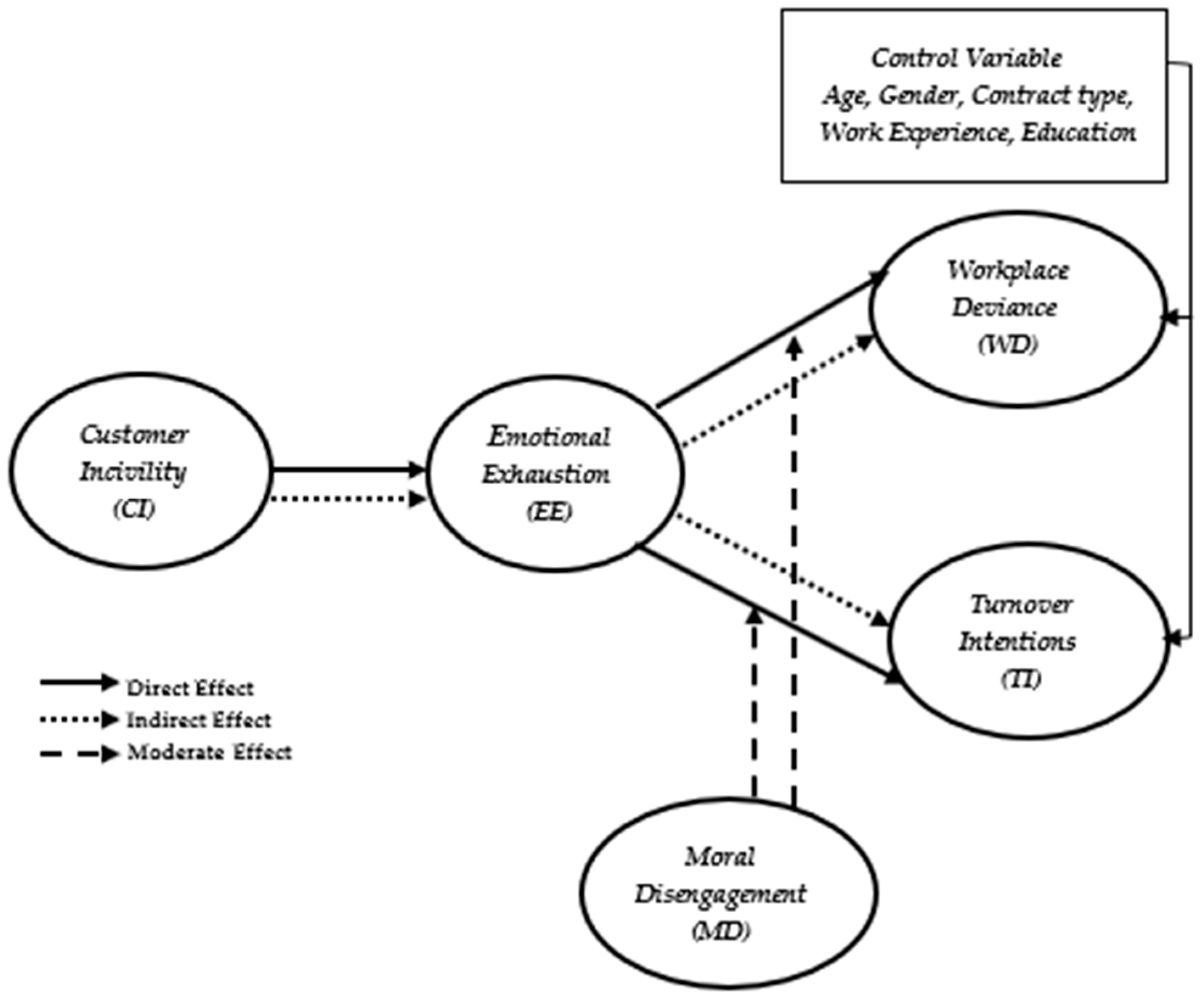
As suggested by the path diagram in Figure 1, the proposed moderated mediation model incorporates the following pathways. First, CI affects kitchen employees by negatively impacting their emotional exhaustion, which in turn positively influences both withdrawal and turnover intention. In other words, EE explains how CI influences both withdrawal behaviors and attitudes toward turnover. Second, moral disengagement moderates the link between emotional exhaustion and withdrawal behavior and turnover intention. Specifically, it is posited that when kitchen employees have higher levels of moral disengagement, their emotional exhaustion has stronger adverse effects on withdrawal and turnover intention. Overall, the theoretical model elucidates how external customer incivility flows within an organization, drains employees’ emotional resources, and ultimately gives rise to counterproductive work behavior and attitudes depending on individual employees’ moral characteristics.

2.2. Customer Incivility and Emotional Exhaustion

Rudeness and CI can include patronizing, offensive, and verbal assaults, ignorance of proper norms, or outrageous demands that go against workplace norms of reciprocal civility (Rout et al., 2025; Torres et al., 2017). When staff, including kitchen staff, receive such rudeness, or rudeness is relayed from order taking through pressure, staff suffer from depleted cognitive, emotional, and psychological resources (Charalampos et al., 2025; Roh et al., 2024). Following COR theory, such experiences of threatening resources will deplete staff resources, and the closest evidence is EE (Gustiawan et al., 2023; Khanam & Tarab, 2025). In this paper, EE is conceptualized as the chronic state of feeling overwhelmed and overextended emotionally, personally and physically, by the people or demands related to one’s work role (Hur et al., 2015; Shahzad et al., 2023). This hypothesis comes after much empirical work in the hospitality and service sector has shown a significant positive relationship between CI and EE. For example, (J. S. Kim, 2021) demonstrated for a luxury hotel sample that CI was positively related to employees’ EE. Rudeness experienced from customers consumed emotional resources, and hotels cannot supply enough emotional resources within the confines of a hotel to allow for high job demands. Following this, research on employees at Pakistani hotels demonstrated that customer rudeness increased employees’ EE, leading to an increase in their turnover intention (Shahzad et al., 2023). Other evidence supporting this link includes that from Hur et al., 2015, who demonstrated that rudeness in customer behavior increased surface acting that was associated with higher levels of emotional exhaustion on the part of Korean department store employees. Given that hotels are considered as having demanding environments due to high temperatures, constant time pressure, and hierarchical interpersonal communication, kitchen employees might be more sensitive to CI if the added pressure of customer rudeness further drains their limited resources beyond physical and psychological exhaustion. Thus, the study proposes that:
H1. 
CI positively affects EE.

2.3. Emotional Exhaustion and Model Outcomes

Emotional exhaustion has been demonstrated as a primary antecedent to a wide range of negative employee behavior and withdrawal cognition in workplace research (Parray et al., 2023; Rahim & Cosby, 2016). As such, with their emotional resources depleted, staff can not summon the energy and self-regulatory capacity to stop themselves from committing deviant behaviors and withdrawing their involvement with the organization (Song et al., 2021; X. Wang & Wang, 2017). WD includes behavior that is voluntary and contrary to significant expectations in the workplace for the benefit of the individual employees at the detriment of the organization or other members of the organization. The concept broadly covers various behaviors such as interpersonal aggression, service sabotage, property deviance or production deviance (Shamsudin, 2020; Yıldız et al., 2015). It has consistently been established that individuals suffering from EE are more likely to engage in WD as they have depleted the necessary self-regulation to manage it (Inc & Kim, 2023; Madan et al., 2026; Wu et al., 2023).
Several empirical studies in hospitality contexts specifically corroborate the EE–WD relationship. Jo and Yoon (2023) found in a Korean deluxe hotel restaurant that EE significantly predicted perpetrated incivility and service sabotage. H. Kim and Qu (2019) reported that burnout of which EE is the core dimension positively predicted employee incivility toward both customers and coworkers among full-service restaurant employees in the United State. In the airline context, Cho et al. (2016) established that EE served as a positive predictor of flight attendant deviant behavior, with the EE–deviance link being empirically robust. Madan et al. (2026) confirmed that EE mediates the relationship between supervisor incivility and workplace deviant behavior, highlighting EE as a potent precursor of deviance across different incivility sources. Thus, kitchen staff who experience elevated EE are expected to exhibit greater WD as a maladaptive response to resource depletion. Regarding TI, the EE–TI link is among the most extensively documented relationships in the organizational and hospitality literature (Hur et al., 2015; Namin et al., 2021). Maslach and Leiter’s foundational burnout framework (1996) identifies disengagement and exit intentions as characteristic sequelae of EE, and this proposition has been replicated across hospitality contexts ranging from hotels to restaurants and airlines (Alola et al., 2021; J. S. Kim, 2021; Rahim & Cosby, 2016). J. S. Kim (2021) found that employees suffering from EE showed higher intentions of leaving the luxury hotel because emotionally depleted employees had a loss of motivation and identification with the hotel. Further, Parray et al. (2023) found that EE mediates the link between workplace incivility and TI. To be specific, data gathered from two separate waves of higher education employees demonstrated that EI acts as an intermediate psychological link, making the stress from workplace incivilities lead to TI. In addition, Hur et al. (2015) showed that EE had a positive effect on employees’ intention to leave, even amongst retail bank employees. Hence, considering the demanding work conditions of a hotel, EE has been found to cause employees to commit deviant behaviors and wish to leave their jobs. Therefore, the follwing hypotheses are propsed:
H2. 
EE positively affects WD.
H3. 
EE further positively affects (TI).

2.4. The Mediating Role of Emotional Exhaustion

Using H1 to assert the links between CI and EE, as well as H2 between EE and WD as well as TI, this study posits that CI influences negative attitudes and behaviors of restaurant servers through EE (Inc & Kim, 2023; Shahzad et al., 2023). COR theory’s definition states a resource loss spiral: The employee suffers resource loss from their experience of customer incivility, resulting in EE. In turn, the resources lost by emotionally depleted servers result in less self-control, less organization commitment and a greater willingness to leave the company (Song et al., 2021; X. Wang & Wang, 2017). Thus, the depletion sequence hypothesizes EE not as an isolated result of customer incivility, but as a pathway by which the negativity of CI spreads, increasing negative organizational impacts. Several empirical studies supported this pathway across various hospitality and service sectors. Shahzad et al. (2023) found that EE partially mediated the relationship between CI and turnover intention among Pakistani hotel employees. Thus, emotional depletion plays a role in harming employees’ commitment to retaining their roles. Yu et al. (2020), after gathering data from 500 Chinese employees, found that the mediating role of EE in CI and turnover intentions was larger than all other proposed mediating effects combined, highlighting EE as a central psychological pathway. H. Kim and Qu (2019) showed that employees reported higher levels of emotional demands and burnout following exposure to CI and that this combination eventually contributed to employee incivility toward both customers and coworkers. Likewise, the Korean study by Cho et al. (2016) on Korean flight attendants affirmed that EE mediated the relationship between customer incivility and employee deviance. Finally, Song et al. (2021) highlighted the evidence supporting EE’s mediated relationship to customer-directed deviant behavior among different service contexts, reaffirming EE as a central psychological pathway to connect stressors related to customers and resulting negative behaviors. Therefore, this mediation is anticipated to be especially relevant in an Egyptian hotel kitchen context where employees’ indirect CI, coupled with the intrinsic high level of mental as well as physical demands in food preparation, amplifies the psychological burden of the employees. The fourth argument is that
H4. 
EE mediates CI and (a) WD, (b) TI.

2.5. The Moderating Role of Moral Disengagement

Although the preceding theories confirm the role of EE as a pathway linking CI to deviant workplace behaviors (J. Huang et al., 2016; Madan et al., 2026), they fail to account for why employees who are emotionally depleted behave differently, as only some of them will withdraw from their jobs or even leave the company. Therefore, individual differences in the extent of internal self-censure on matters of morality can moderate boundary conditions, playing a critical role in identifying when employees will engage in deviant behavior or withdraw from their organization when emotionally exhausted (Hessick, 2023; Ogunfowora et al., 2020). Within the framework of Bandura (1986) SCT, MD is a theoretically relevant moderator in these processes (Bussey, 2020; Ogunfowora et al., 2020). MD comprises a cluster of cognitive functions that assist individuals in disabling their morality-based constraints so that they can perform ethically harmful acts (moral justification, euphemistic labeling, displacement of responsibility, distortion of consequences and dehumanization) (Hessick, 2023). By activating such mechanisms, individuals are freed from guilt, shame, or self-reproach that might deter them from behaving in unethical ways (Ogunfowora et al., 2020, 2022).
In fact, Ogunfowora et al. (2022) found that MD is positively related to workplace misconduct and TI and negatively associated with organizational citizenship behaviors and task performance, thereby demonstrating its widespread salience for employee behaviors across various organizational sectors. We hypothesize that, in EE’s impact on withdrawal, MD operates as an amplifiying moderator, meaning that kitchen employees who are emotionally depleted and who simultaneously score high on MD will more readily turn off their moral self-regulatory inhibitions, enabling themselves to easily justify sabotage against services, abusive behavior toward coworkers or property deviance when they feel mistreated, as such deviant behaviors carry no personal moral stigma (Y.-S. Huang et al., 2019; Raza et al., 2024). In contrast, employees scoring low on MD have stronger moral self-regulatory inhibitions, which can restrain them from engaging in deviant behavior when feeling emotionally depleted (Yıldız et al., 2015). In a hazing and deviance study in the Pakistani hospitality sector, Raza et al. (2024) found that MD mediated the association between hazing and organizational deviance, thereby supporting MD’s key mediating role in hospitality settings. Y.-S. Huang et al. (2019) demonstrated that the diminished value of a target activated by customer mistreatment facilitates customer sabotage, as customers may no longer be seen as deserving ethical consideration. Lastly, in their study on workplace ostracism and deviance, L. Wang et al. (2025) validated the moderating effect of MD between exhaustion-related processes and deviant behavior, providing evidence for the proposed moderating model. Therefore,
H5a. 
MD moderates the relationship between EE and WD.
Theoretically and empirically, MD applies equally to EE’s relationship with TI. Though a cognitive outcome of withdrawal, TI decision-making also holds implications concerning organizational loyalty and commitment to an organization (Kacmar et al., 2019; Ogunfowora et al., 2020). Employees who are emotionally depleted and simultaneously prone to MD may be more likely to disengage cognitively and attitudinally from their organization by rationalizing their exit as a justified response to organizational failings, minimizing their sense of obligation or loyalty, or attributing blame for their distress entirely to external agents such as customers or management (Y.-S. Huang et al., 2019; Ogunfowora et al., 2022). In turn, moral disengagement helps convert employee exhaustion into intentions to quit, because it weakens the sense of guilt, commitment to one’s values and sense of loyalty to the organization when leaving (Ogunfowora et al., 2020, 2022). J. Huang et al. (2016) identified the mediating role of moral disengagement in the association between job insecurity and employees’ intention to leave the organization, establishing an empirical nexus between moral disengagement and exit-cognitions. Ogunfowora et al. (2022) discovered a robust positive relationship between moral disengagement and intention to leave across different settings in their meta-analysis, which supports our moderating hypothesis. Kitchen staff who are chronically morally disengaged in high-stress cooking work environments are more likely to convert EE to intentions to leave. Thus,
H5b. 
MD moderates the relationship between EE and TI.

3. Methods

3.1. Research Rationale and Participants

The study examines the spillover effect of CI on the WD and TI behaviors of kitchen staff in Egyptian hotels and the role of EE as a mediator and MD as a moderator. Kitchen departments offer an interesting research context because, although staff in kitchens may experience relatively less indirect or immediate contact with customers, customer aggression can reach them through customer-facing employees. Egyptian hotels in Hurghada, which is one of the largest Red Sea tourism hubs in Egypt, were selected given their nature as a hospitality cluster, the diversity of their customer mix and the widespread presence of customer mistreatment in resorts in this area (Elnagar et al., 2025; Herzallah et al., 2025; Salama et al., 2022; Zaki et al., 2025). We adopted a purposive sampling strategy to select kitchen employees working in four- and five-star hotels in Hurghada, including cooks, assistant cooks, chefs de partie, commis chefs and stewarding staff with at least 6 months of working experience, who were most likely to be exposed to customer-linked services. In total, 400 questionnaires were distributed to staff members, and 300 valid questionnaires were gathered and filtered, which means that we achieved an efficient response rate of 75%. In terms of age, gender, job level, tenure, and employment status, our respondents spanned a wide range.
As it is received from three hundred kitchen staff working in five- and four-star restaurants and kitchens in Hurghada (Table 1), the staff comprise 82% males. These males’ positions were Commis Chefs (44%), Chef de Partie (28%), line cook/chef de cuisine (13%), sous chefs (9%), junior/assistant manager (6%), and head chefs/Executive Chef (2%). Young staff (aged 26–35) comprise 47% of the staff population. Just over one quarter of the staff were young (aged 18–25) with 22% between 36 and 45 years old and only one third (8%) above this age. Thirty-five percent have had employment for between four and seven years while 30% have been in their current role for over seven years. Over three quarters of the staff (85%) had full-time contracts. Vocational certificates were awarded to 44% of the staff, with 28% holding vocational diplomas while 16% have degrees. Overall, the Egyptian kitchen staff were mainly males 26–35, with 4–7 years of professional experience, working full-time on a vocational or diploma qualification.

3.2. Measurements and Procedure

All constructs were developed using reliable and previously established scales. The CI was measured using a seven-item scale adapted from (Van Jaarsveld et al., 2010; Wilson & Holmvall, 2013). EE was measured with a seven-item subscale from (Knox et al., 2018). WD was measured using an eight-item scale from (Bennett & Robinson, 2000). MD was measured with an eight-item scale adapted from (Moore et al., 2012). Finally, TI were measured with a six-item scale from (Alola et al., 2021; Salama et al., 2022). All scales were measured on a five-point Likert scale (1:5, strongly disagree to strongly agree). A back-translation procedure in Arabic was conducted to ensure conceptual equivalence and ensure that all aspects of the original items are retained in the translated version. A pilot test with 20 kitchen staff volunteers supported the validity of the scale, that the items were clear, reliable and relevant to the context. Participation was voluntary, all responses were kept anonymous and ethical procedures were maintained throughout the research process.

3.3. Data Collection Process

Data collection occurred in the first two months of 2026 using a mixed-mode approach. Hotel HR departments were asked to hand out hard copies during pre/post shifts. Hotel HR employees were asked to contact hotel employees and send out links to a digital version of the same questionnaire for those who may have less time during work hours. The researchers gave the hotel HR department clear guidelines and gave the employees instructions that their responses are anonymous so that social bias would be decreased. The completed questionnaires in hard copy format were collected in a sealed envelope, whereas the digitally submitted responses were collected in a secure link to keep respondents anonymous. Common method bias was reduced by randomizing item order in the entire questionnaire, creating psychological separation between the independent and dependent variables by placing other variables in between them, informing employees that there are no right or wrong answers, reverse-wording two scale items for some scale endpoints where appropriate.

3.4. Analytics Strategy

The data were analyzed using PLS-SEM through ADANCO 2.4. This particular technique is well-suited for prediction-oriented research with latent variables and a complex structural model including mediational and moderational paths and with data that do not follow normality assumptions. A two-step procedure is typically undertaken with the measurement model being evaluated in the first step before testing the structural relationships in the second step.

3.5. Measurement Model Evaluation

Measurement model reliability and validity were assessed using Cronbach’s alpha and composite reliability. Both metrics showed strong internal consistency for each construct. Convergent validity was assessed using the AVE, all values being greater than the recommended 0.50. Discriminant validity was ensured through the Fornell–Larcker criterion and the HTMT ratio. An inspection of the indicator loadings and cross-loadings also validated discriminant validity.
Consistent with prior PLS-SEM guidelines, the reflective measurement model was evaluated through four sequential steps: indicator reliability, internal consistency reliability, convergent validity, and discriminant validity (Ahmed et al., 2025; Hair et al., 2021; Herzallah et al., 2025; Sarstedt et al., 2022). First, all outer loadings exceeded the recommended threshold of 0.70, ranging from 0.78 to 0.96, indicating satisfactory indicator reliability. Second, Cronbach’s alpha (α) and composite reliability (CR) values ranged from 0.85 to 0.97 and from 0.95 to 0.96, respectively, confirming strong internal consistency reliability across all constructs. Third, convergent validity was established as all average variance extracted (AVE) values exceeded the recommended threshold of 0.50, ranging between 0.74 and 0.82. Finally, discriminant validity was assessed using the Heterotrait–Monotrait Ratio (HTMT). All HTMT values remained below the recommended threshold of 0.90, with the highest observed value being 0.86, thereby confirming adequate discriminant validity among the study constructs. Detailed results of the measurement model assessment are presented in Table 2 and Table 3.
Following the validation of the measurement model, the structural model was analyzed to evaluate the hypothesized direct effects (H1, H2, H3, indirect effects (H4a, H4b) and moderated effects (H5a, H5b). An indirect bootstrapping procedure using 5000 resamples was executed to evaluate the structural path significances. Model strength was evaluated based on effect size (f2), explained variance (R2) and predictive relevance (Q2). We carried out the PLSpredict method in ADANCO in order to evaluate the accuracy of the model’s predictions in comparison to a linear benchmark model. This was done in order to demonstrate that the model is valid for use outside of the sample. The rigorous reporting of reliability, path diagrams, and confidence intervals for each structural path that ADANCO provided made it possible for us to conduct detailed research. As a result, our comprehensive evaluation of the model’s performance was improved.

4. Results

At first, we addressed potential “Common Method Variance (CMV)” in three main ways: anonymous responses, protecting participant anonymity and confidentiality in the survey itself (e.g., dependent survey items must be responded to before independent ones) and better survey awareness from a pre-test conducted with representative target employees. Using Harman’s single factor analysis, we found one factor accounted for 35.7% of the total variance, a value well below the commonly referenced 50% threshold, indicating CMV did not have a significant impact (Podsakoff et al., 2012). Table 2 results expose collinearity values of VIF which extend between 1.2 and 2.8, indicating the absence of common variance bias or multicollinearity (Herzallah et al., 2025; Kock, 2015; Zaki & Elnagar, 2025).

4.1. Measurement Model Assessment

The measurement model demonstrated satisfactory psychometric properties, confirming the adequacy of the constructs for subsequent structural model assessment. As shown in Table 2 and Table 3, all constructs achieved acceptable levels of reliability, convergent validity, and discriminant validity, thereby supporting the robustness of the measurement model.

4.2. Structural Model Assessment

After assessing measurement model validation, we moved on to testing structural models with hypotheses formulated concerning the linkages between variables. To assess if collinearity will impact structural analysis findings, VIF value is commonly calculated. Using a PLS-SEM model requires checking if potential collinearity of predictors in model specification issues would affect outcomes, which is typically carried out using variance inflation factors (Hair et al., 2019; Kock, 2015). All variables resulted in VIF scores below the 3.3 threshold set in this PLS-SEM to diagnose potential collinearity problems. With all values under this limit, the VIF scores assure us that multicollinearity should not be a method limitation that affects the results, that predictors represent a separate domain, and that the identified path estimates can be trusted for interpretation. The model achieves robustness due to the absence of collinearity issues, confirming that all hypothesized paths are evaluated without a statistical twist (Sarstedt et al., 2022).

4.3. Path Coefficients and Hypothesis Testing

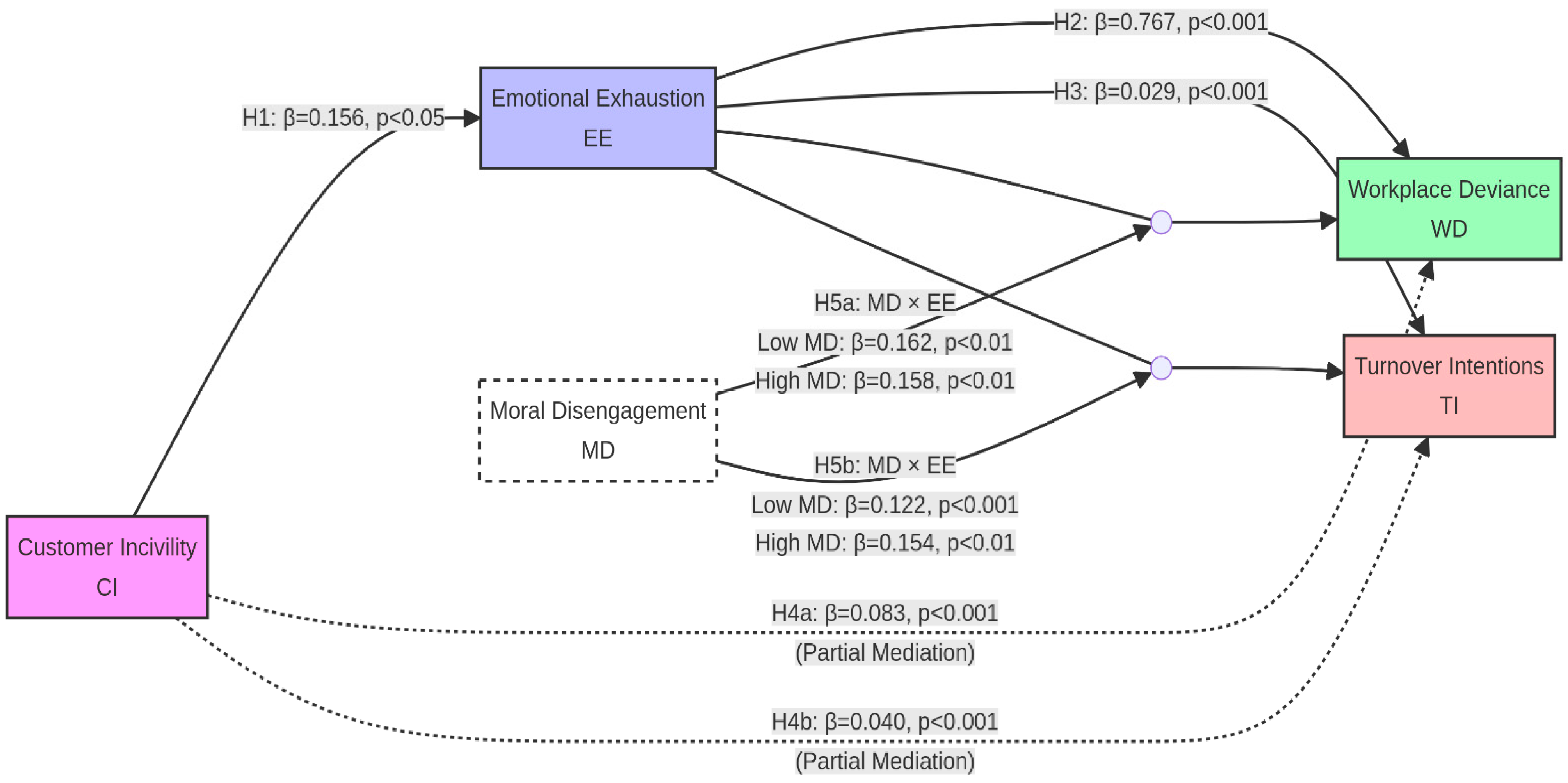
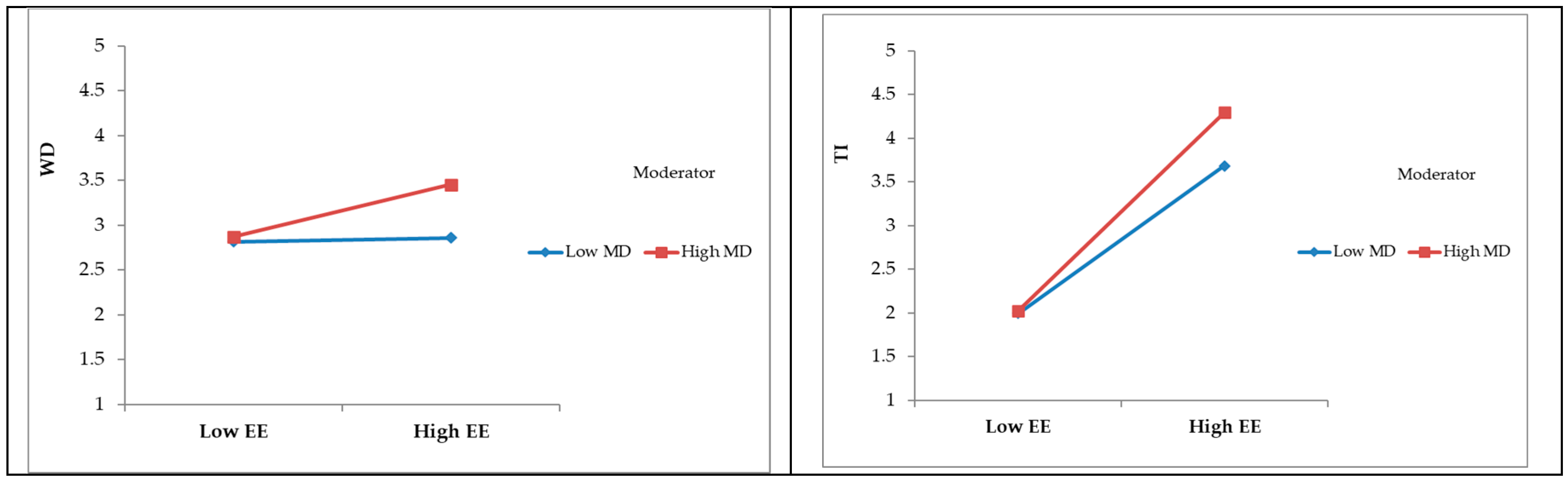
The significance of the hypothesized relationships was evaluated using bootstrapping with 10,000 resamples. The assessment of the structural model (Table 4) provided strong empirical support for the hypothesized relationships across the study’s three core dimensions: CI, EE, WD, MD, and TI. All paths in the hypothesized model (see Table 4) were statistically significant at p < 0.001. Figure 2 shows the hypothesized and supported structural model of customer incivility (CI), emotional exhaustion (EE), workplace deviance (WD), turnover intentions (TI) and moral disengagement (MD) as a moderator. The SEM was conducted using partial least squares structural equation modeling (PLS-SEM). The model explanation and predictive relevance for endogenous constructs were high (EE: R2 = 0.366, Q2 = 0.346, WD: R2 = 0.493, Q2 = 0.421, TI: R2 = 0.598, Q2 = 0.492). Concerning the direct effects, the analysis confirmed the following direct effects: (a) CI positively influenced EE (β = 0.156, p < 0.05), indicating rude customer behavior causes employees to become emotionally exhausted, (b) EE positively influenced WD (β = 0.767, p < 0.001) and TI (β = 0.029, p < 0.001). (c) CI negatively influenced WD (β = −0.042, p < 0.001) and TI (β = −0.002, p < 0.05). Regarding the indirect effects (mediation), the study found that EE mediated the relationship between CI and WD (CI → EE → WD, β = 0.083, p < 0.001) and between CI and TI (CI → EE → TI, β = 0.040, p < 0.001). Moreover, the study revealed that MD moderated the relationship between EE and WD (MD × EE → WD). The moderated path was significant for both low MD (β = 0.162, p < 0.01) and high MD groups (β = 0.158, p < 0.01), although high MD group leads to more deviant behaviors when employees are exhausted. Also, MD moderated the relationship between EE and TI (MD × EE → TI). High MD group had more TI effects from EE than low MD group (high MD: β = 0.154, p < 0.01, low MD: β = 0.122, p < 0.001). Figure 3 confirms that the moderation scenario happens in two paths, where the positive relationship between EE and WD in one hand is enhanced by MD and between EE and TI on the other hand also increases. The structural model illustrates how incivility spills over emotional exhaustion to lead to workplace deviance and turnover. The study’s implications could encourage the development of effective solutions in organizational settings.

4.4. Robustness Tests and Multi-Group Analysis (MGA)

To more thoroughly determine how widely applicable our structural model is and what its limitations might be, we carried out a suite of rigorous tests. One key method was multi-group analysis (MGA). This technique lets us check for any differences in path coefficients between different subgroups within our overall sample, giving us a more nuanced understanding of the model’s consistency and how it might vary depending on the context. It is especially important for figuring out if the relationships we are seeing apply equally across various demographic or experiential categories or if certain connections are notably stronger or weaker for specific sets of individuals. For this particular investigation, we divided our participants based on two significant demographic factors: gender (separating males from females) and length of service or work experience (distinguishing between those with less than five years of tenure and those with five or more years). We chose these divisions because existing research indicates that both gender and how long someone has been with an organization can impact on how people emotionally react, how they cope with challenges and what behaviors they exhibit at work. We opted for a permutation-based MGA method to compare the path coefficients between these distinct groups and to evaluate the statistical significance of any disparities we found. The findings from this MGA are detailed in Table 5.
The MGA results reveal several noteworthy findings regarding the heterogeneity of relationships within our model. First, gender differences in CI → EE: A significant difference was observed in the path from CI to EE across genders (path difference = 0.08, p = 0.032). This indicates that the impact of CI on EE is significantly stronger for female employees compared to their male counterparts. This finding aligns with prior research suggesting that women may experience and process interpersonal stressors, such as incivility, with greater emotional intensity. Second, the differences in EE compared to TI were shown to be significantly stronger for employees with shorter tenure (path difference = 0.10, p = 0.015). This was confirmed by the fact that the association between EE and TI proved to be much stronger. When employees are emotionally exhausted, it is more likely that they may acquire intents to leave the organization. This is especially true for employees who have recently been hired or who have less experience. One possible explanation for this is that there is a lack of established organizational embeddedness, fewer internal resources for coping, or a lower psychological contract fulfillment in comparison to employees who have been with the company for a longer period of time. Third, the factors that influence the link between MD and EE and WD are tenure differences. It is worth noting that the moderating effect of MD on the relationship between EE and WD was considerably stronger for employees who had longer tenure (path difference = 0.07, p = 0.045). It can be deduced from this that whereas MD tends to strengthen the connection between EE and WD, the extent to which this strengthening occurs is more pronounced among workers who have been employed by the organization for a much longer period of time. This could be the result of a more deeply entrenched sense of entitlement or a deeper acquaintance with organizational loopholes that promote deviant activities when moral self-sanctions are disengaged. Both of these factors could be responsible for this phenomenon.
On the other hand, this study did not uncover any statistically significant differences between the sexes in terms of the progression from EE to WD or the moderating influence of MD on the link between EE and TI at any point in time. The fact that these findings were not statistically significant suggests that the associations in question are reasonably stable and do not fluctuate significantly based on the characteristics of the groups that were investigated. In order to properly evaluate the intricate dynamics that are contained within the structural model, it is essential to take into account both individual and contextual aspects, as demonstrated by these MGA measurements. They provide useful insights for targeted interventions, suggesting that attempts to alleviate the negative repercussions of emotional depletion may need to be customized to certain employee subgroups in order to be effective.

5. Discussion

The findings demonstrate that customer incivility functions as a significant indirect stressor that depletes the emotional resources of hotel kitchen employees, leading to emotional exhaustion and, subsequently, higher workplace deviance and turnover intentions. These results indicate that even employees with limited direct customer interaction remain psychologically vulnerable to customer-related stressors due to the spillover nature of hospitality work environments. In Egyptian hotel kitchens, where employees already operate under intense physical pressure, time constraints, and emotionally demanding conditions, repeated exposure to transferred customer complaints and uncivil interactions may gradually weaken employees’ emotional resilience and increase withdrawal-related reactions and counterproductive workplace behaviors.
The mediating role of emotional exhaustion further suggests that emotional resource depletion represents the central mechanism through which customer incivility translates into harmful organizational outcomes. This finding reinforces the view that emotional exhaustion is not limited to frontline service contexts, but also affects back-of-house employees who indirectly experience customer-related tensions through operational and interpersonal workplace dynamics. The results also reveal that moral disengagement intensifies the effects of emotional exhaustion on workplace deviance and turnover intentions. Employees with higher levels of moral disengagement appear more likely to rationalize harmful workplace behaviors or psychologically justify withdrawal tendencies when emotionally exhausted. In contrast, employees with lower moral disengagement levels may retain stronger internal moral restraints despite experiencing emotional depletion. This finding suggests that emotional exhaustion alone may not inevitably lead to deviant or withdrawal-related outcomes; rather, employees’ cognitive moral self-regulation plays an important role in determining how they respond to emotional strain.
Moreover, the stronger moderating effect observed among long-tenure employees may indicate that prolonged exposure to stressful hospitality environments gradually weakens employees’ resistance to negative coping behaviors over time. Employees with longer organizational tenure may become increasingly desensitized to workplace stressors or more capable of cognitively normalizing deviant reactions as acceptable responses to ongoing emotional pressure. Overall, the findings highlight the importance of simultaneously addressing emotional resource depletion and ethical self-regulation processes when attempting to reduce negative employee outcomes within hotel kitchen environments.

6. Theoretical and Practical Implications

6.1. Theoretical Implications

This study contributes to hospitality research by integrating conservation of resources (COR) theory and social cognitive theory (SCT) into a unified moderated mediation framework that explains how customer incivility translates into employee behavioral outcomes through emotional and cognitive mechanisms. The findings provide distinct theoretical extensions to both COR theory and SCT.
First, from a conservation of resources (COR) theory perspective, the findings demonstrate that customer incivility operates as a significant resource-depleting stressor for back-of-house kitchen staff, a group that has been largely overlooked in prior incivility research (Roh et al., 2024; Rout et al., 2025). This extends COR theory beyond frontline employees and confirms that resource depletion processes also occur among indirect service employees who are exposed to customer-related stressors through organizational spillover mechanisms. The mediating role of emotional exhaustion further extends COR theory by demonstrating that resource loss spirals are not confined to direct customer contact roles, but also emerge in indirect service contexts through spillover mechanisms within organizational systems (Gustiawan et al., 2023; Khanam & Tarab, 2025). This is particularly important in hospitality settings, where kitchen employees experience high physical and emotional demands despite being structurally separated from direct guest interactions (Charalampos et al., 2025; Kılıç et al., 2016). Furthermore, by situating the study in the Egyptian hotel industry, this research extends COR theory to a non-Western, high-service-intensity context characterized by culturally diverse customer interactions, thereby demonstrating that resource loss processes are shaped by contextual and cultural work environments (Al-Romeedy & El-Sisi, 2024; Touni & Hussien, 2023; Zaki, 2025). Second, from a social cognitive theory (SCT) perspective, the findings provide empirical evidence that moral disengagement (MD) functions as a key cognitive boundary condition that strengthens the effect of emotional exhaustion on workplace deviance and turnover intentions. This addresses a key gap in SCT-based incivility research by explaining why emotionally exhausted employees do not respond uniformly. Specifically, employees with higher moral disengagement are more likely to cognitively reconstruct harmful behaviors as justified, acceptable, or externally caused, thereby weakening internal self-regulatory and self-sanctioning mechanisms (Hessick, 2023; Y.-S. Huang et al., 2019; Ogunfowora et al., 2022). By integrating COR theory and SCT, this study provides a more comprehensive explanation of customer incivility effects than single-mechanism approaches, combining resource depletion processes with cognitive moral self-regulation mechanisms (Raza et al., 2024; L. Wang et al., 2025). Moreover, the multi-group analysis indicates that the moderating role of moral disengagement is stronger among long-tenure employees, providing theoretical insight into how sustained exposure to workplace stressors may gradually weaken moral self-regulation over time (Madan et al., 2026; Yıldız et al., 2015). These theoretical advances are particularly relevant for hospitality contexts, where emotional labor demands, volatile customer interactions, and high-pressure operational environments create conditions that intensify both resource depletion (COR theory) and moral disengagement processes (SCT) (Al-Atwi et al., 2024; Guo et al., 2022; Ogunfowora et al., 2020).

6.2. Practical Implications

In terms of the practical implications for hotel management and HR practitioners involved in the service industry, this research offers three key insights to address the negative effects of CI experienced by kitchen employees. First, since the current results strongly confirmed that CI exerts positive effects on EE among kitchen employees in the hospitality industry, hotel organizations should build mechanisms to protect kitchen employees against the effects of CI spillover. That is, hotel organizations should install a process that enables front-of-house departments to properly manage and relay customer issues to back-of-house chefs. In particular, hotels should develop a protocol for filtering uncivil complaints and providing only constructively phrased comments related to specific incidents in a nonconfrontational manner; this protects kitchen staff from the spillover effects of customer uncivility (Roh et al., 2024; Rout et al., 2025). Hotel managers need to specify the procedures to deal with unreasonable guest demands and empower their frontline staff to negotiate reasonable expectations without shifting the blame onto kitchen employees. Also, hoteliers ought to examine regularly EE screenings in kitchen departments, when busy seasons begin due to high volumes of guests and their behaviors. Hotel departments need to conduct periodic reviews of kitchen work conditions, removing or minimizing sources that trigger persistent resource depleted such as overtime, inadequate break and understaffing. If so, the risk employees become EE could be further reduced (Charalampos et al., 2025; Gustiawan et al., 2023).
Second, findings suggest that there are differences among employees about their level of MD. Thus, hoteliers ought to consider differentiating hotel service interventions tailored to the employees based on their moral development profiles. That is, hotel organizations should pay particular attention to employees who are prone to MD and suffer from more negative outcomes like WD and TI and, hence, provide extensive training to build their ethical awareness along with frequent check-ups by supervisors and department heads. HR professionals should assess MD in their development program as a tool to identify such employees who may be more inclined to translate the negative emotions from CI to deviant behaviors; the potential to cause counterproductive behaviors could be predicted by their high tendency to engage in MD (Ogunfowora et al., 2022; Raza et al., 2024). Besides this, hotel organizations should promote moral engagement through leadership ethics training to supervisors in kitchens or chefs de parties. This also ensures ethical role modeling and promotes self-regulation and hotel organizations should apply zero tolerance for unethical activities and create psychologically safe conditions for employees to express mistreatment to each other, thus avoiding fear of retaliation (Al-Atwi et al., 2024; Y.-S. Huang et al., 2019). Department heads ought to bring kitchen teams into reflective sessions where they collaboratively deal with their negative experiences and emotions after customer uncivility in a safe environment, then individual employees resorting to MD as a method to manage them (Al-Romeedy & El-Sisi, 2024; Guo et al., 2022).
Third, since the mediating effect of EE translocating CI into deviance and turnover outcomes was strong, hotels should place their efforts at solving the issues concerning EE as their intervention. Hoteliers can carry out resource management mechanisms like work rotational schemes, ensuring employees prevent chronic fatigue. Also, on-site psychological support for employees or the implementation of peer support systems can be useful for reducing the levels of negative emotion in kitchen employees (Khanam & Tarab, 2025; Madan et al., 2026). Besides improving psychological safety in the team meetings at hotel organizations, reward systems could be implemented to encourage employees’ positive contributions in regulating emotional regulation and managing conflicts constructive and ethically.
The division heads should create environments where seeking support for EE is normalized and where efficient task completion depends on collective well-being rather than individual overextension (Salama et al., 2022; Zaki, 2025). Fourth, given the importance of departmental context revealed by our multi-group analysis showing that the moderating effect of MD is stronger for long-tenure employees, hotel organizations should tailor their interventions to specific employee segments. While this study focused on kitchen staff, the findings suggest that divisions with high emotional labor demands and indirect customer exposure might benefit from similar interventions. Targeted retention strategies for long-tenure employees, including MD awareness training and periodic ethical refresher courses, could help prevent the gradual erosion of moral inhibitions over time (L. Wang et al., 2025; Yıldız et al., 2015). Lastly, hotel organizations should implement regular monitoring of employee emotional exhaustion through confidential surveys, paying particular attention to signs of WD and TI. This monitoring should be more frequent in kitchen departments where high stress levels, physical demands, and indirect customer stresses create collective resource exhaustion threats (Touni & Hussien, 2023; Wu et al., 2023).

6.3. Limitations and Future Research

Although our multi-wave data collection and rigorous analytical procedures helped minimize common-method bias, the cross-sectional nature of this study limits causal inference. Future research should employ longitudinal designs to examine how CI evolves into EE and subsequent WD and TI over time, revealing whether these relationships fluctuate in response to seasonal hotel demands, occupancy rates, or changing work conditions. In addition, while we focused on kitchen employees in four- and five-star hotels in Hurghada, future studies should examine whether these relationships hold across different hotel classifications, geographic regions, and cultural contexts. The dynamics between CI, EE, MD, and behavioral outcomes might differ in budget hotels where resources and service expectations vary. Similarly, comparing these relationships across front-office and back-office departments could reveal how departmental characteristics, such as frequency of direct customer contact, moderate these effects. Finally, future research should explore additional boundary conditions, including administrative justice, governance styles, and worker resilience, that may buffer the deleterious effects of CI on back-of-house employees.

6.4. Conclusions

This study examined the spillover effects of customer incivility on workplace deviance and turnover intentions among hotel kitchen staff in Egypt by investigating the mediating role of emotional exhaustion and the moderating role of moral disengagement. The findings confirmed that customer incivility significantly increases emotional exhaustion among kitchen employees, which subsequently contributes to higher levels of workplace deviance and turnover intentions. Emotional exhaustion was also found to partially mediate the relationships between customer incivility and both negative employee outcomes, confirming its central role as the psychological mechanism underlying the spillover process. Furthermore, the results demonstrated that moral disengagement strengthens the effects of emotional exhaustion on workplace deviance and turnover intentions, particularly among long-tenure employees.
The study successfully accomplished its main research aim and supporting objectives by providing empirical evidence that customer incivility indirectly affects back-of-house employees through emotional resource depletion and by clarifying how cognitive moral mechanisms shape employees’ behavioral responses to emotional exhaustion. These findings highlight that the harmful consequences of customer incivility are not restricted to frontline service employees, but also extend to kitchen staff who experience indirect customer-related stressors within high-pressure hospitality environments.
From a managerial perspective, the findings emphasize the importance of implementing organizational practices that reduce emotional exhaustion, strengthen ethical awareness, and create psychologically supportive work environments within hotel kitchen departments. Hotel organizations should therefore develop proactive intervention strategies aimed at minimizing customer incivility spillover, supporting employees’ emotional well-being, and reducing the risk of deviant workplace behaviors and employee turnover.
Despite these contributions, several limitations should be acknowledged. First, the cross-sectional nature of the study limits the ability to establish causal relationships among the study variables. Second, the study focused exclusively on kitchen employees in four- and five-star hotels in Hurghada, which may limit the generalizability of the findings to other hospitality settings or cultural contexts. Future research is therefore encouraged to employ longitudinal research designs, investigate additional hospitality sectors and geographic regions, and examine alternative moderating and mediating mechanisms that may further explain employees’ responses to customer incivility.
Overall, this study contributes to the hospitality management literature by offering a more comprehensive understanding of how customer incivility spills over into back-of-house employee outcomes and by demonstrating the critical role of emotional exhaustion and moral disengagement in shaping these workplace dynamics.

Author Contributions

Conceptualization, K.Z., W.M.E.S., and A.K.E.; methodology, A.K.E., W.M.E.S., and K.Z.; software, K.Z. and A.K.E.; validation, M.A.S. and W.M.E.S.; formal analysis, K.Z. and A.K.E.; investigation, A.K.E. and W.M.E.S.; resources, M.A.S. and W.M.E.S.; data curation, K.Z.; writing—original draft preparation, A.K.E. and K.Z.; writing—review and editing, K.Z., W.M.E.S., and A.K.E.; visualization. W.M.E.S.; supervision, K.Z.; project administration, A.K.E.; funding acquisition, W.M.E.S. All authors have read and agreed to the published version of the manuscript.

Funding

This research was funded by the Deanship of Scientific Research, Vice Presidency for Graduate Studies and Scientific Research, King Faisal University, Saudi Arabia, grant number (KFU261732).

Institutional Review Board Statement

The study was conducted in accordance with the Declaration of Helsinki, and approved by the Ethic Committee of Taibah University, Sharqa University and King Faisal University (protocol code KFU261732, approval date 6 April 2026).

Informed Consent Statement

Informed consent was obtained from all subjects involved in this study.

Data Availability Statement

The information provided in this research can be obtained by contacting the corresponding authors.

Conflicts of Interest

The authors declare no conflicts of interest.

Abbreviations

The following abbreviations are used in this manuscript:
CICustomer incivility
WDWorkplace deviance
TITurnover intentions
EEEmotional exhaustion
SCTConservation of resources
MDMoral disengagement
SCTSocial cognitive theory
PLS-SEMPartial least squares structural equation modeling
MGAMulti-group analysis

References

  1. Ahmed, H. A. M., Zaki, K., Abdelghani, A. A. A., Abdelfadel, T. A., Abusalim, E., & Elnagar, A. K. (2025). Leveraging corporate social responsibility for sustainable performance: The mediating roles of green organizational culture and employee engagement under regulatory pressure. Geojournal of Tourism and Geosites, 62(4), 1950–1970. [Google Scholar] [CrossRef]
  2. Al-Atwi, A., Gong, T., & Bakir, A. (2024). Fostering customer-oriented constructive deviance: The influence of moral emotions and moral disengagement. International Journal of Contemporary Hospitality Management, 36(9), 2977–2998. [Google Scholar] [CrossRef]
  3. Alola, U. V., Avcı, T., & Öztüren, A. (2021). The nexus of workplace incivility and emotional exhaustion in hotel industry. Journal of Public Affairs, 21(3), e2236. [Google Scholar] [CrossRef]
  4. Al-Romeedy, B. S., & El-Sisi, S. (2024). Does workplace incivility affect travel agency performance through innovation, organizational citizenship behaviors, and organizational commitment? Tourism Review, 79(8), 1474–1491. [Google Scholar] [CrossRef]
  5. Arvan, M. L., Dreibelbis, R. C., & Spector, P. E. (2019). Customer service stress: A meta-analysis of customer mistreatment. In P. L. Perrewé, & P. D. Harms (Eds.), Examining the role of well-being in the marketing discipline (pp. 117–136). Emerald Publishing Limited. [Google Scholar] [CrossRef]
  6. Bandura, A. (1986). Social foundations of thought and action. Prentice Hall. [Google Scholar]
  7. Bandura, A. (1999). Moral disengagement in the perpetration of inhumanities. Personality and Social Psychology Review, 3(3), 193–209. [Google Scholar] [CrossRef] [PubMed]
  8. Bennett, R. J., & Robinson, S. L. (2000). Development of a measure of workplace deviance. Journal of Applied Psychology, 85(3), 349–360. [Google Scholar] [CrossRef]
  9. Bussey, K. (2020). Development of moral disengagement: Learning to make wrong right. In K. Bussey (Ed.), The Oxford handbook of moral development (pp. 305–326). Oxford University Press. [Google Scholar] [CrossRef]
  10. Charalampos, G., Evangelia, M., & Emmanouil, P. (2025). Emotional exhaustion stressors and coping strategies in London’s fine dining restaurants. Bournemouth University Research. Available online: https://eprints.bournemouth.ac.uk/40842/1/CHME25_EE%20Paper.pdf (accessed on 9 January 2026).
  11. Chi, N.-W., Yang, J., & Lin, C.-Y. (2018). Service workers’ chain reactions to daily customer mistreatment: Behavioral linkages, mechanisms, and boundary conditions. Journal of Occupational Health Psychology, 23(1), 58–70. [Google Scholar] [CrossRef] [PubMed]
  12. Cho, M., Bonn, M. A., Han, S. J., & Lee, K. H. (2016). Workplace incivility and its effect upon restaurant frontline service employee emotions and service performance. International Journal of Contemporary Hospitality Management, 28(12), 2888–2912. [Google Scholar] [CrossRef]
  13. Elnagar, A. K., Khalifa, G. S. A., Herzallah, A., Derbali, A. M., Elgabrony, S. A., & Iriqat, R. A. (2025). Exploring the link between Self-leadership and innovative work behaviours in luxury hotels: Validating a moderated mediation model. African Journal of Hospitality, Tourism and Leisure, 14(1), 63–73. [Google Scholar]
  14. Guo, G., Cheng, B., Tian, J., Ma, J., & Gong, C. (2022). Effects of negative workplace gossip on unethical work behavior in the hospitality industry: The roles of moral disengagement and self-construal. Journal of Hospitality Marketing & Management, 31(3), 290–310. [Google Scholar] [CrossRef]
  15. Gustiawan, D., Noermijati, Aisjah, S., & Indrawati, N. K. (2023). Customer incivility, employee emotional exhaustion, and job embeddedness relationship in the Indonesian hospitality sector: The socio-economic status perspective. Cogent Social Sciences, 9(1), 2178613. [Google Scholar] [CrossRef]
  16. Hair, J. F., Black, W. C., Babin, B. Y., & Anderson, R. E. (2019). Multivariate data analysis (8th ed.). Springer International Publishing. [Google Scholar]
  17. Hair, J. F., Hult, G. T. M., Ringle, C. M., Sarstedt, M., Danks, N. P., & Ray, S. (2021). An introduction to structural equation modeling. In J. F. Hair, G. T. M. Hult, C. M. Ringle, M. Sarstedt, N. P. Danks, & S. Ray (Eds.), Partial least squares structural equation modeling (PLS-SEM) using R (pp. 1–29). Springer International Publishing. [Google Scholar] [CrossRef]
  18. Herzallah, A. M., Iriqat, R. A. M., Hamed, M. H., Zaki, K., & Elnagar, A. K. (2025). Green synergy in hospitality: Unveiling the nexus between environmentally sustainable practices and hotel green performance. International Journal of Hospitality Management, 131, 104301. [Google Scholar] [CrossRef]
  19. Hessick, C. (Ed.). (2023). Moral disengagement and organizations. In Oxford research encyclopedia of business and management. Oxford University Press. [Google Scholar] [CrossRef]
  20. Hobfoll, S. E. (1989). Conservation of resources: A new attempt at conceptualizing stress. American Psychologist, 44(3), 513–524. [Google Scholar] [CrossRef]
  21. Huang, J., Li, W., Qiu, C., Yim, F. H., & Wan, J. (2016). The impact of CEO servant leadership on firm performance in the hospitality industry. International Journal of Contemporary Hospitality Management, 28(5), 945–968. [Google Scholar] [CrossRef]
  22. Huang, Y.-S., Greenbaum, R. L., Bonner, J. M., & Wang, C. S. (2019). Why sabotage customers who mistreat you? Activated hostility and subsequent devaluation of targets as a moral disengagement mechanism. Journal of Applied Psychology, 104(4), 495–510. [Google Scholar] [CrossRef]
  23. Hur, W.-M., Moon, T. W., & Han, S.-J. (2015). The effect of customer incivility on service employees’ customer orientation through double-mediation of surface acting and emotional exhaustion. Journal of Service Theory and Practice, 25(4), 394–413. [Google Scholar] [CrossRef]
  24. Inc, & Kim, G.-J. (2023). The effect of experienced customer incivility on emotional exhaustion and counterproductive work behavior. Korean Academy of International Commerce, 38(4), 267–283. [Google Scholar] [CrossRef]
  25. Jo, Y. J., & Yoon, H. H. (2023). Effects of workplace incivility on emotional exhaustion, perpetrated incivility, service sabotage and work-family conflict: Focus on employees of a restaurant in a deluxe hotel. Journal of the East Asian Society of Dietary Life, 33(2), 137–148. [Google Scholar] [CrossRef]
  26. Kacmar, K. M., Carlson, D. S., Thompson, M., & Zivnuska, S. (2019). But I still feel guilt: A test of a moral disengagement propensity model. Human Performance, 32(3–4), 165–180. [Google Scholar] [CrossRef]
  27. Khanam, A., & Tarab, S. (2025). Customer incivility and frontline employee job performance: A moderated mediation analysis of PsyCap and emotional exhaustion. Journal of Hospitality and Tourism Insights, 8(2), 513–531. [Google Scholar] [CrossRef]
  28. Kim, H., & Qu, H. (2019). The effects of experienced customer incivility on employees’ behavior toward customers and coworkers. Journal of Hospitality & Tourism Research, 43(1), 58–77. [Google Scholar] [CrossRef]
  29. Kim, J. S. (2021). The effects of customer incivility on hotel employees’ emotional exhaustion, organizational commitment, and turnover intention. Journal of Tourism and Leisure Research, 33(4), 173–189. [Google Scholar] [CrossRef]
  30. Kılıç, R., Boz, H., & Koç, E. (2016). Depressıon and turnover intention among hotel employees. Yönetim ve Ekonomi Araştırmaları Dergisi, 14(1), 318–331. [Google Scholar] [CrossRef]
  31. Knox, M., Willard-Grace, R., Huang, B., & Grumbach, K. (2018). Maslach burnout inventory and a self-defined, single-item burnout measure produce different clinician and staff burnout estimates. Journal of General Internal Medicine, 33(8), 1344–1351. [Google Scholar] [CrossRef]
  32. Kock, N. (2015). Common method bias in PLS-SEM: A full collinearity assessment approach. International Journal of E-Collaboration (IJEC), 11(4), 1–10. [Google Scholar] [CrossRef]
  33. Lee, L., & Madera, J. M. (2019). A systematic literature review of emotional labor research from the hospitality and tourism literature. International Journal of Contemporary Hospitality Management, 31(7), 2808–2826. [Google Scholar] [CrossRef]
  34. Madan, P., Srivastava, S., & Gupta, B. (2026). Pathways from supervisor incivility to workplace deviance: The mediating role of emotional exhaustion and supervisor-targeted aggression. Journal of Organizational Effectiveness: People and Performance, 13(1), 20–45. [Google Scholar] [CrossRef]
  35. Moore, C., Detert, J. R., Klebe Treviño, L., Baker, V. L., & Mayer, D. M. (2012). Why employees do bad things: Moral disengagement and unethical organizational behavior. Personnel Psychology, 65(1), 1–48. [Google Scholar] [CrossRef]
  36. Namin, B. H., Øgaard, T., & Røislien, J. (2021). Workplace incivility and turnover intention in organizations: A meta-analytic review. International Journal of Environmental Research and Public Health, 19(1), 25. [Google Scholar] [CrossRef]
  37. Ogunfowora, B., Lee, C., Nguyen, V. Q., Babalola, M., & Ren, S. (2020). Do moral disengagers feel guilt and shame? moral self-condemnation following immoral work behaviors. Academy of Management Proceedings, 2020(1), 18590. [Google Scholar] [CrossRef]
  38. Ogunfowora, B., Nguyen, V. Q., Steel, P., & Hwang, C. C. (2022). A meta-analytic investigation of the antecedents, theoretical correlates, and consequences of moral disengagement at work. Journal of Applied Psychology, 107(5), 746–775. [Google Scholar] [CrossRef]
  39. Parray, Z. A., Islam, S. U., & Shah, T. A. (2023). Exploring the effect of workplace incivility on job outcomes: Testing the mediating effect of emotional exhaustion. Journal of Organizational Effectiveness: People and Performance, 10(2), 161–179. [Google Scholar] [CrossRef]
  40. Podsakoff, P. M., MacKenzie, S. B., & Podsakoff, N. P. (2012). Sources of method bias in social science research and recommendations on how to control it. Annual Review of Psychology, 63(1), 539–569. [Google Scholar] [CrossRef]
  41. Pu, B., Ji, S., & Sang, W. (2021). Customer incivility and employees’ turnover intention in China’s hotel: A chain Mediating model. In Review. [Google Scholar] [CrossRef]
  42. Rahim, A., & Cosby, D. M. (2016). A model of workplace incivility, job burnout, turnover intentions, and job performance. Journal of Management Development, 35(10), 1255–1265. [Google Scholar] [CrossRef]
  43. Raza, A., Ishaq, M. I., Jamali, D. R., Zia, H., & Haj-Salem, N. (2024). Testing workplace hazing, moral disengagement and deviant behaviors in hospitality industry. International Journal of Contemporary Hospitality Management, 36(3), 743–768. [Google Scholar] [CrossRef]
  44. Roh, T., Yang, Y. S., Xiao, S., & Park, B. I. (2024). What makes consumers trust and adopt fintech? An empirical investigation in China. Electronic Commerce Research, 24(1), 3–35. [Google Scholar] [CrossRef]
  45. Rout, A., Piramanayagam, S., & Mallya, J. (2025). Customer incivility in hospitality: Insights from existing literature and pathways for future research. Cogent Business & Management, 12(1), 2513627. [Google Scholar] [CrossRef]
  46. Salama, W., Nor El Deen, M., Albakhit, A., & Zaki, K. (2022). Understanding the connection between sustainable human resource management and the hotel business outcomes: Evidence from the green-certified hotels of Egypt. Sustainability, 14(9), 5647. [Google Scholar] [CrossRef]
  47. Sarstedt, M., Hair, J. F., Pick, M., Liengaard, B. D., Radomir, L., & Ringle, C. M. (2022). Progress in partial least squares structural equation modeling use in marketing research in the last decade. Psychology & Marketing, 39(5), 1035–1064. [Google Scholar] [CrossRef]
  48. Shahzad, F., Ali, S., Hussain, I., Sun, L., Wang, C., & Ahmad, F. (2023). The impact of customer incivility and its consequences on hotel employees: Mediating role of employees’ emotional exhaustion. Sustainability, 15(21), 15211. [Google Scholar] [CrossRef]
  49. Shamsudin, F. (2020). Workplace deviance among hotel employees: An exploratory survey. Malaysian Management Journal, 7, 17–33. [Google Scholar] [CrossRef]
  50. Song, Y. H., Skarlicki, D. P., Shao, R., & Park, J. (2021). Reducing customer-directed deviant behavior: The Roles of psychological detachment and supervisory unfairness. Journal of Management, 47(8), 2008–2036. [Google Scholar] [CrossRef]
  51. Tarab, S. (2025). Linking workplace incivility and emotional exhaustion: A moderated mediation examination. South Asian Journal of Human Resources Management, 12(1), 83–98. [Google Scholar] [CrossRef]
  52. Torres, E. N., Van Niekerk, M., & Orlowski, M. (2017). Customer and employee incivility and its causal effects in the hospitality industry. Journal of Hospitality Marketing & Management, 26(1), 48–66. [Google Scholar] [CrossRef]
  53. Touni, R., & Hussien, H. (2023). The Influence of toxic workplace climate behaviors on innovative work behavior and employee engagement in hotels. Minia Journal of Tourism and Hospitality Research MJTHR, 15(1), 109–130. [Google Scholar] [CrossRef]
  54. Van Jaarsveld, D. D., Walker, D. D., & Skarlicki, D. P. (2010). The role of job demands and emotional exhaustion in the relationship between customer and employee incivility. Journal of Management, 36(6), 1486–1504. [Google Scholar] [CrossRef]
  55. Wang, L., Zhu, L., & Jin, X. (2025). Exploring the process of workplace ostracism leads to workplace deviance: The moderated mediation effect of coworker incivility. Acta Psychologica, 259, 105342. [Google Scholar] [CrossRef]
  56. Wang, Q., Li, Y., & Li, R. (2024). Rethinking the environmental Kuznets curve hypothesis across 214 countries: The impacts of 12 economic, institutional, technological, resource, and social factors. Humanities and Social Sciences Communications, 11(1), 292. [Google Scholar] [CrossRef]
  57. Wang, X., & Wang, H. (2017). How to survive mistreatment by customers: Employees’ work withdrawal and their coping resources. International Journal of Conflict Management, 28(4), 464–482. [Google Scholar] [CrossRef]
  58. Wilson, N. L., & Holmvall, C. M. (2013). The development and validation of the Incivility from Customers Scale. Journal of Occupational Health Psychology, 18(3), 310–326. [Google Scholar] [CrossRef]
  59. Wu, Y., Groth, M., Zhang, K., & Minbashian, A. (2023). A meta-analysis of the impact of customer mistreatment on service employees’ affective, attitudinal and behavioral outcomes. Journal of Service Management, 34(5), 896–940. [Google Scholar] [CrossRef]
  60. Yıldız, B., Alpkan, L., Sezen, B., & Yıldız, H. (2015). A proposed conceptual model of destructive deviance: The mediator role of moral disengagement. Procedia—Social and Behavioral Sciences, 207, 414–423. [Google Scholar] [CrossRef]
  61. Yu, Y., Kim, H., & Qu, H. (2020). A deep acting perspective generation Y hotel employees’ workplace deviance. International Journal of Contemporary Hospitality Management, 32(2), 835–852. [Google Scholar] [CrossRef]
  62. Zaki, K. (2025). Enabling hotel circularity via Industry 4.0 innovations for enhanced hotel performance: Insights from Saudi Arabia and Egypt. Journal of Hospitality and Tourism Insights, 8(3), 915–936. [Google Scholar] [CrossRef]
  63. Zaki, K., Alhomaid, A., Ghareb, A., Shared, H., Raslan, A., Khalifa, G. S. A., & Elnagar, A. K. (2025). Digital synergy and strategic vision: Unlocking sustainability-oriented innovation in Saudi SMEs. Administrative Sciences, 15(2), 59. [Google Scholar] [CrossRef]
  64. Zaki, K., & Elnagar, A. K. (2025). Unpacking talent management: A moderated mediation analysis of team dynamics and competitive performance in luxury hotels. Employee Relations: The International Journal, 47(1), 48–77. [Google Scholar] [CrossRef]
Figure 1. Research model.
Admsci 16 00253 g001
Figure 2. Structure model paths.
Admsci 16 00253 g002
Figure 3. The buffering MD’s moderation effects.
Admsci 16 00253 g003
Table 1. Demographics.
CharacteristicCategoryFrequency (n)Percentage (%)
GenderMale24682.0%
Female5418.0%
Age18 to 25 years7324.0%
26 to 35 years13747.0%
36 to 45 years6622.0%
Above 45 years248.0%
Work ExperienceLess than 1 year217.0%
1–3 years8428.0%
4–7 years10535.0%
More than 7 years9030.0%
Contract TypeFull-time25585.0%
Part-time279.0%
Seasonal/Temporary186.0%
Education LevelHigh school or equivalent11137.0%
Technical/vocational diploma13244.0%
Bachelor’s degree4816.0%
Table 2. Measurement model statistics.
DimensionsCodeQuestionnaire ItemEstimateαAVECRVIF
CI
(Van Jaarsveld et al., 2010; Wilson & Holmvall, 2013)
CI1Customers disparaged my efforts.0.800.960.7420.9531.200
CI2Customers have spoken to me in an unprofessional or condescending tone.0.81
CI3Customers were impatient or rude when I was trying to help them.0.90
CI4Customers have ignored me or been dismissive of me.0.88
CI5Customers have yelled at or verbally abused me.0.80
CI6Customers have questioned my competence or the quality of my work in a disrespectful manner.0.91
CI7Customers have behaved aggressively or threatened me during service delivery.0.92
EE
(Knox et al., 2018)
EE1I feel exhausted from my job.0.810.930.7770.9612.810
EE2I have no energy left after exertion.0.92
EE3I wake up completely drained and dread starting work0.87
EE4Constant social interaction is very exhausting. 0.95
EE5I’m overwhelmed by my current workload.0.79
EE6I feel unfulfilled in my current role0.91
EE7I am overextended at the moment0.91
WD
(Bennett & Robinson, 2000)
WD1I have taken stuff without prior notice from this hotel.0.780.970.7420.9582.421
WD2I’ve been lost in my own world today.0.92
WD3I have made fun of someone at occupation.0.84
WD4I have cursed somebody at job.0.86
WD5I have acted rudely toward somebody at job.0.81
WD6I have deliberately worked slowly or less carefully than I could have.0.87
WD7My work was perfunctory0.88
WD8I have told people outside the hotel negative things about my workplace.0.92
TI
(Alola et al., 2021; Salama et al., 2022)
TI1Leaving this job at this hotel is always in my mind.0.930.930.8200.9651.199
TI2I am actively looking for a job at another hotel or organization.0.90
TI3I intend to leave this hotel within the next twelve months.0.96
TI4I have seriously considered leaving my job in the past few months.0.88
TI5Immediately upon finding a better job, I will leave.0.87
TI6Looking for a new job in the next year is my need.0.89
MD
(Moore et al., 2012)
MD1I’d do anything to protect the ones I care0.880.850.7680.9642.821
MD2Those who get badly treated have mostly done a bit to relate it on their own.0.85
MD3Taking something from a rich organization is not as bad as stealing from a person.0.94
MD4Spread rumors to defend my favorite guys is normal for me.0.79
MD5Considering the way people cheat, it is not a big deal if I do it too.0.81
MD6If people are careless enough to leave their belongings lying around, they deserve to have them taken.0.92
MD7Taking minor things from this hotel is not really that wrong, compared to illegal matters.0.88
MD8It is okay to lie to prevent people from finding out about the mistakes of a colleague.0.93
Table 3. Heterotrait–Monotrait Ratio (HTMT).
ConstructMean ± SD12345
1. CI4.66 ± 1.1000
2. EE4.89 ± 0.99510.79
3. WD4.70 ± 1.10050.600.76
4. TI4.96 ± 1.10090.790.810.77
5. MD4.69 ± 1.10140.800.770.760.86
Table 4. Structure model statistics.
Control VariablesModel Pathβp-Valuet-Valuef2Decision
Age → TI0.0120.6110.3020.011×
Gender → TI0.0200.9200.2050.021×
Work experience → TI 0.0600.8180.2200.061×
Contract type → TI0.0600.7910.2100.062×
Education → TI−0.0400.6810.6610.051×
Direct effectsβp-valuet-valuef2Decision
H1CI → EE0.1560.0162.3710.054
H2EE → WD0.7670.0013.3081.160
H3EE → TI0.0290.0004.2090.023
Indirect effects βp-valuet-valuef2Decision
H4aCI → EE > WD0.0830.0005.2590.051Partial mediation
H4bCI → EE > TI0.0400.0005.2690.043Partial mediation
Moderation effect
H5aMD × EE → WD Strengthened
Low MD0.1620.0026.102
High MD0.1580.0035.956
H5bMD × EE → TI Strengthened
Low MD0.1220.0004.101
High MD0.1540.0013.953
Quality indices
R2 of EE0.366 Q2 of EE0.346
R2 of WD0.493 Q2 of WD0.421
R2 of TI0.598 Q2 of TI0.492
Note: p < 0.001 is significant.
Table 5. Multi-group analysis (MGA) results.
Hypothesized PathGroup ComparisonPath Differencep-ValueSignificanceInterpretation
CI → EEGender (Male vs. Female)0.080.032SignificantStronger for Females
EE → WDGender (Male vs. Female)−0.050.120Not SignificantNo significant difference
EE → TITenure (Short vs. Long)0.100.015SignificantStronger for Short Tenure
MD × EE → WDTenure (Short vs. Long)0.070.045SignificantStronger for Long Tenure
MD × EE → TIGender (Male vs. Female)−0.030.210Not SignificantNo significant difference
Note: p < 0.05 shows significant cluster variations (non-parametric MGA criteria).
Disclaimer/Publisher’s Note: The statements, opinions and data contained in all publications are solely those of the individual author(s) and contributor(s) and not of MDPI and/or the editor(s). MDPI and/or the editor(s) disclaim responsibility for any injury to people or property resulting from any ideas, methods, instructions or products referred to in the content.