Constructing an AI-Driven Meta-Theory of SME Resilience and Strategic Agility: A Computational Synthesis of Global Research

Abstract
1. Introduction
2. Previous Studies
- Resource-Based Approach (RBV): Describes how SMEs with limited resources integrate their financial, human, and technological capital into sustainable firm performance (Musah et al., 2026; Nasution et al., 2026).
- Dynamic Capabilities Theory (DCT): Argues that digital capabilities empower businesses to sensing, seizing, and transforming opportunities during times of technological disruption (Alqam et al., 2025; Durman et al., 2025).
- Institutional Theory: It is used to make sense of external environmental factors such as regulatory pressures, financial access barriers, and market entry challenges that SMEs are exposed to in their global expansion and adoption of digital platforms (Nahar & Alam, 2026) A review of the literature shows that SLRs and bibliometric analyses on the digitalization of SMEs are conducted extensively (Tsakalerou et al., 2025).
3. Methodology
3.1. Data Collection
3.2. Data Cleaning
3.3. Theoretical Framework for Analysis and Determination of Management Theories
3.4. TF-IDF and SciBERT-Based Ranking of Management Theories
3.5. LLM-Based Thematic Analysis and Classification
3.6. Model Comparison and Definite Theory Assignment
4. Results
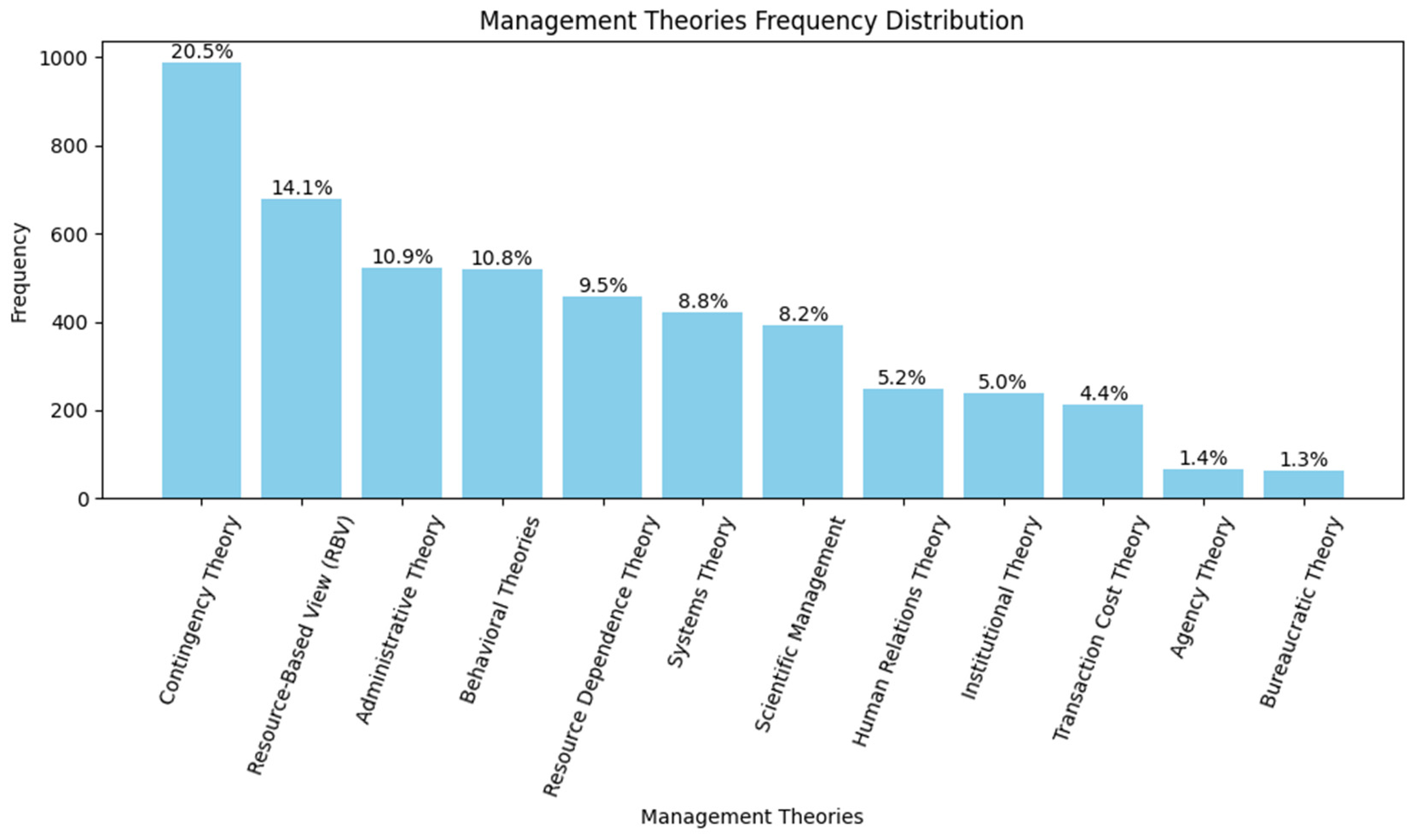
4.1. Theoretical Distribution of Management Literature
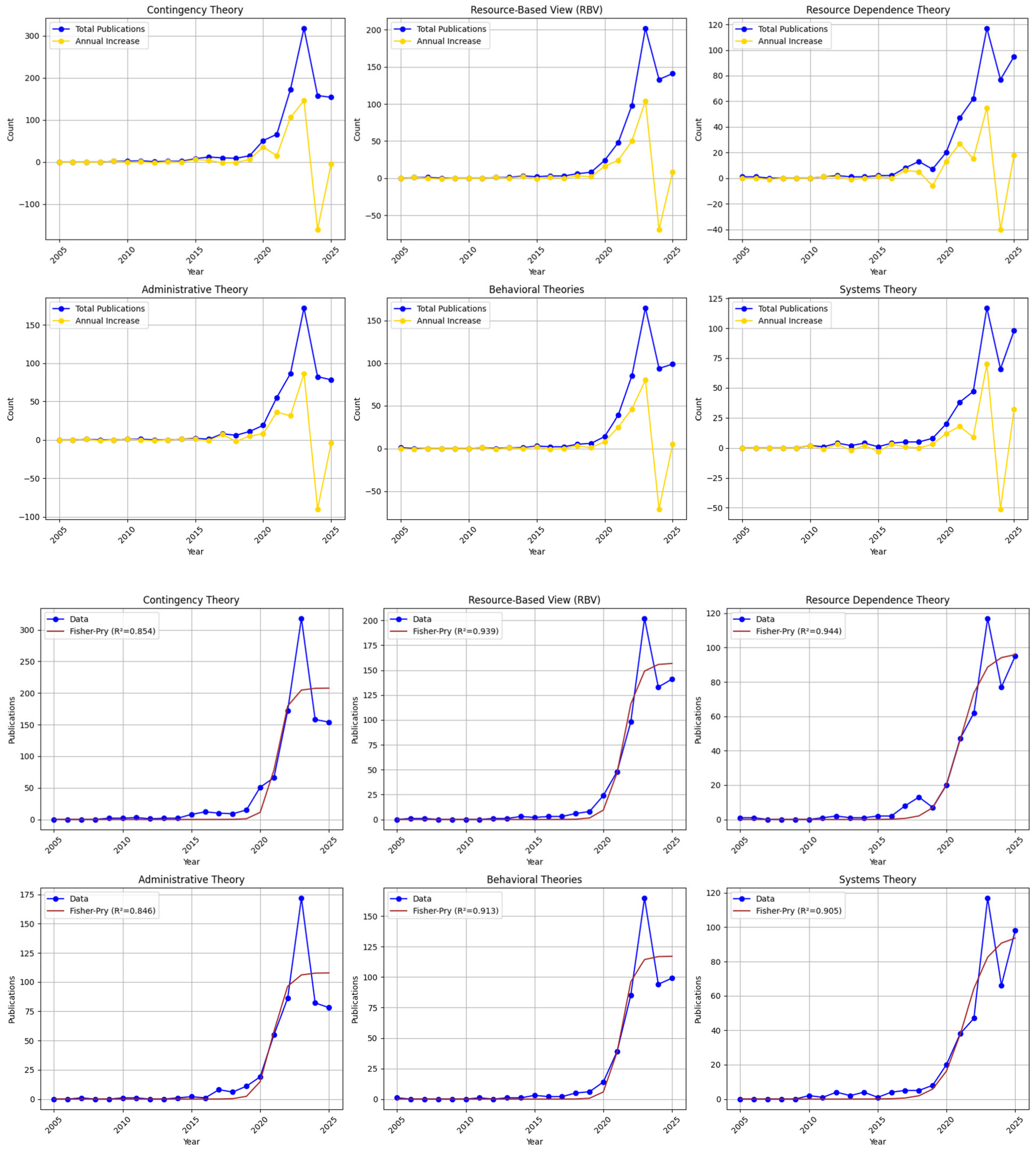
4.2. Temporal Evolution of Dominant Theoretical Foundations
4.2.1. Structural Stability Before 2018
4.2.2. Rapid Theoretical Expansion After 2018
4.2.3. Dominance of Environmental Adaptation
4.2.4. Resource-Focused Perspectives
4.2.5. Organizational and Behavioral Perspectives
4.2.6. Systematic Perspectives as Complementary Explanations
4.2.7. Evidence of Theoretical Convergence
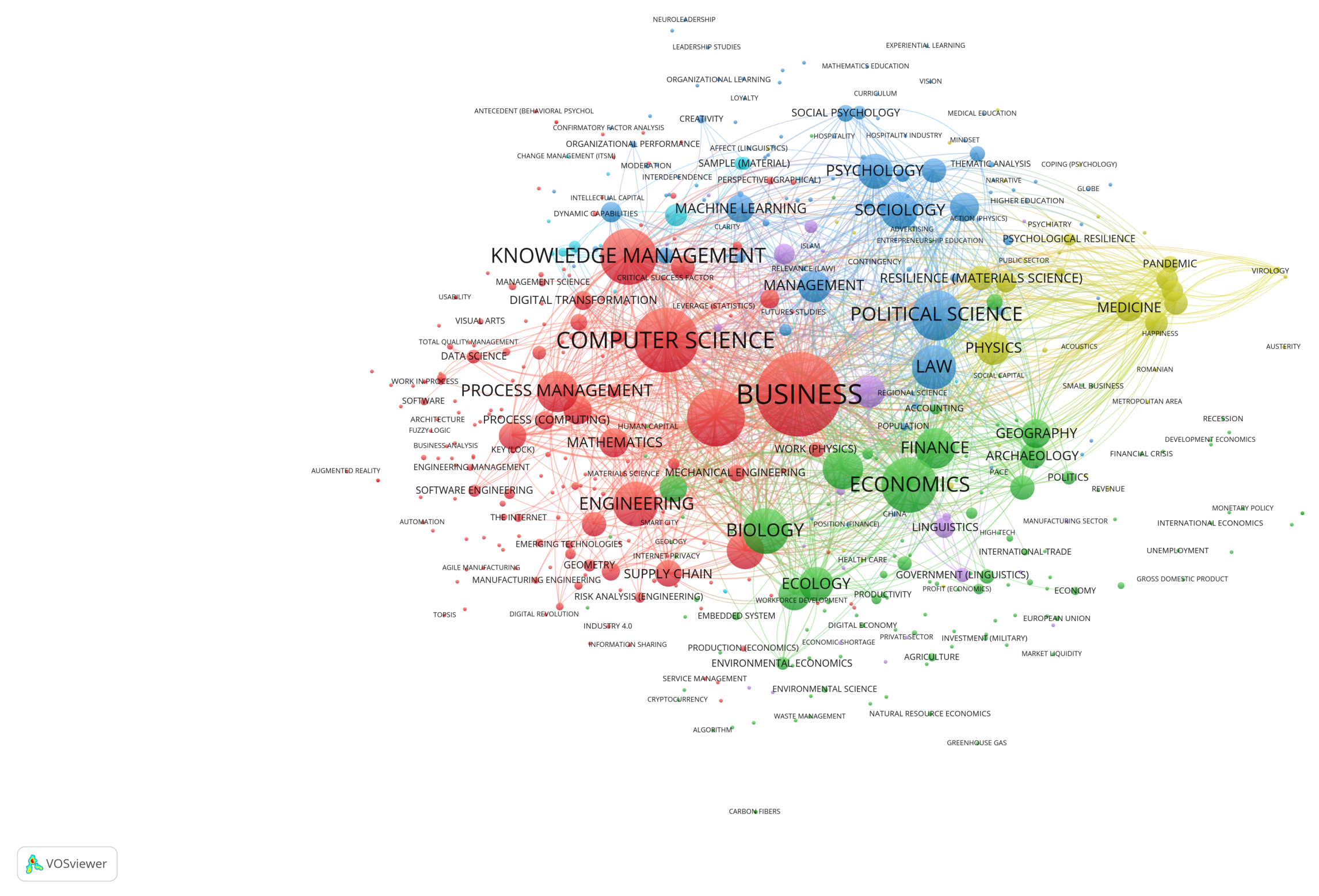
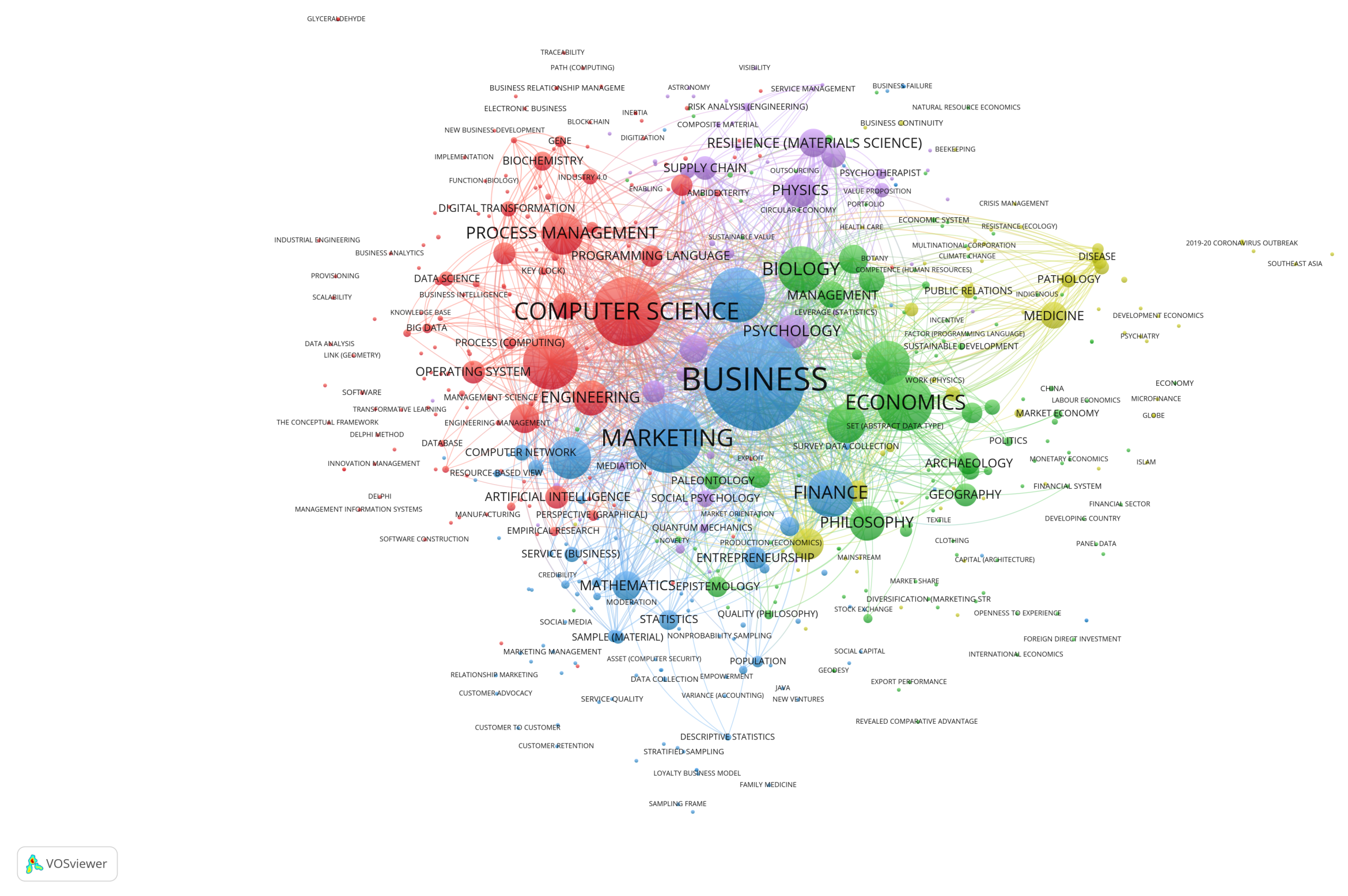
4.3. Knowledge Network Structure and Disciplinary Connectivity
4.3.1. The Core: Understanding Degree Centrality as Stability
4.3.2. The Bridges: Identifying Betweenness as Strategic Flow
4.3.3. The Frontiers: Mapping Constraint as Innovation Potential
4.4. Shared Structural Patterns Across Theoretical Perspectives
4.4.1. The Triadic Disciplinary Anchor
4.4.2. Operational Brokerage and Knowledge Mediation
4.4.3. Innovation Frontiers and Emerging Interfaces
4.4.4. Structural Hybridity in Knowledge Production
4.5. Contingency Theory: Regulatory–Technical Brokerage
4.5.1. The Compliance–Engineering Nexus
4.5.2. Cybersecurity as a Contingent Survival Factor
4.5.3. Operational and Perceptual Mediation
4.5.4. The Scaling Phenomenon in SME Growth
4.6. Resource-Based View (RBV): Cohesive Consolidation
4.6.1. The Digital–Biological Convergence
4.6.2. Resilience as Material Science and Thermodynamics
4.6.3. Exploiting the Fintech and Market Intelligence Interface
4.6.4. From Corporate Philosophy to Asset Security
4.7. Resource Dependence Theory: Boundary-Spanning Externalization
4.7.1. The Supply Chain as a Strategic Anchor
4.7.2. Sanctions and Global Vulnerability (The New Normal)
4.7.3. Financial Hybridity: Working Capital and Futures Contracts
4.7.4. Green Innovation and Digital Analytics as Power Balancers
4.8. Administrative Theory: Techno-Administrative Hybridization
4.8.1. The Digital Foundation of Governance
4.8.2. Financial Risk and Investment Management as Control Mechanisms
4.8.3. The Ethical and Global Expansion: Sharia, Islam, and Climate Change
4.8.4. Human-Centric Hybridity: Skills and Change Management
4.9. Behavioral Theories: Distributed Cognitive Integration
4.9.1. The Psychology–Political Science Nexus
4.9.2. Cognition and Mindfulness as Internal Shock Absorbers
4.9.3. Digital Behavior: Customer Engagement and Social Responsibility
4.9.4. The SME Mindset
4.10. Systems Theory: Meta-Integrative Architecture
4.10.1. The Digital Nervous System (World Wide Web & Computer Security)
4.10.2. Quantum Frontiers and Future-Proofing (Quantum Cryptography)
4.10.3. Human–Machine Symbiosis: Wearable Technology and Virtual Actors
4.10.4. Sovereignty and Public Health: The Global Macro-System
4.11. Conclusion of the SNA
5. Ontological and Epistemological Status of the Meta-Theory
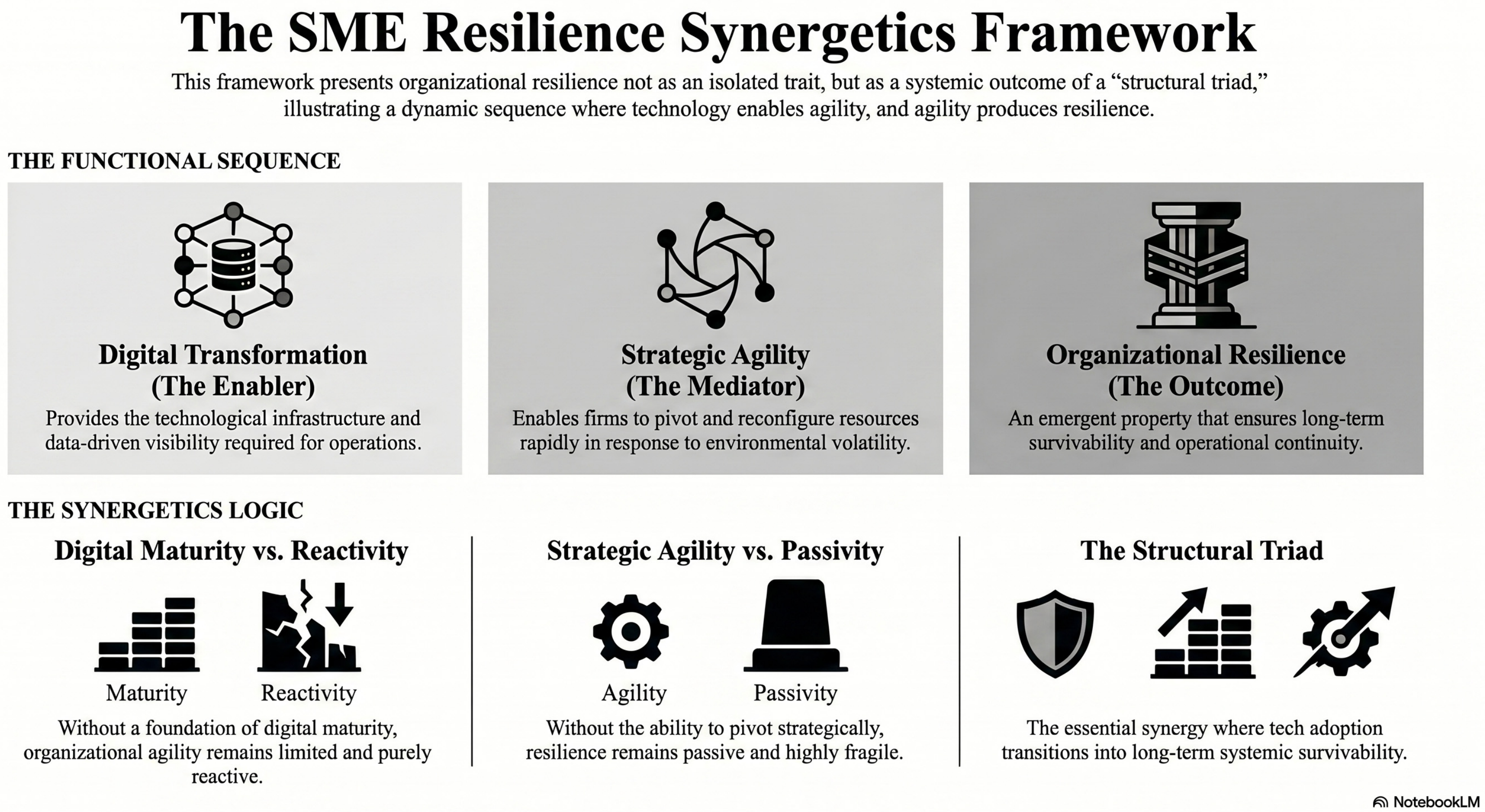
5.1. Conceptual Triad: The Structural Integration of DT, SA, and OR
5.2. From Descriptive Mapping to Formal Meta-Theoretical Propositions
- Proposition 1 (Cross-Layer Functional Resonance): SME Resilience is a function of cross-layer functional resonance. The intensity of Organizational Resilience (OR) is positively moderated by the fidelity of information transfer from technical safeguards (Layer 1) to cognitive-administrative routines (Layer 2 & 3). This implies that digital transformation does not produce resilience through sheer presence, but through the seamless alignment of its technical, cognitive, and structural logics. In the digital era, this resonance reflects the ‘Digital Options’ theory, where IT assets create a platform for future agility and resilience (Venkatraman, 1989; Sambamurthy et al., 2003).
- Proposition 2 (The Agility-Resilience Duality): Strategic Agility (SA) and Organizational Resilience (OR) function as a complementary duality where SA serves as the ‘external-facing sensing engine’ and OR acts as the ‘internal-facing stabilizing anchor.’ The meta-theory proposes that structural fragility occurs as a non-linear function of the imbalance between the rate of strategic pivoting (SA) and the firm’s capacity for systemic resource reconfiguration. For SMEs, this balance is a critical survival mechanism against ‘competency traps’ during rapid digital transitions (O’Reilly & Tushman, 2013; Levinthal & March, 1993).
- Proposition 3 (The Mediation of Digital Mindset): The conversion of external digital capabilities (Resource Dependence) into internal competitive advantage (Resource-Based View) is significantly mediated by the SME Digital Mindset. We propose that a firm’s Absorptive Capacity functions as the rate-limiting step in the transition speed at which technical signals are institutionalized into rare, inimitable, and valuable (VRIN) systemic assets. This distributed autonomy is consistent with the ‘Loose Coupling’ theory, which suggests that decentralized structures prevent systemic collapse when one part of the organization fails (Weick, 1976).
- Proposition 4 (The Principle of Systemic Sovereignty): Long-term survivability in a post-normal digital ecosystem is a function of Systemic Sovereignty maintained through ‘Strategic Decoupling.’ The meta-theory posits that optimal resilience is achieved when an SME functions as a self-regulating, autonomous node, where the degree of operational continuity is inversely proportional to the firm’s non-redundant dependence on centralized global infrastructures. This evolutionary trajectory ensures that SMEs remain ‘antifragile,’ gaining strength from stressors through cumulative knowledge absorption (Teece, 2007; Bolisani & Bratianu, 2018).
5.3. Boundary Conditions
5.4. From Formal Meta-Theoretical Propositions to Meta-Theoretical Layers
- Layer 1: The Adaptive Periphery (Sensing and Alignment): The mechanism initiates at the boundary between the firm and its environment. Here, Contingency Theory and Systems Theory operate in tandem as the radar of the enterprise. While Contingency logic ensures that the SME aligns its internal structures with rigid legal and technical standards (Regulatory–Technical Brokerage), Systems Theory facilitates the firm’s connectivity as an open node within the global digital ocean. Resilience in this layer is not about internal strength, but about Environmental Fit and Systemic Integration, ensuring the firm remains synchronized with macro-economic and technological shifts.
- Layer 2: The Cognitive Engine (Processing and Governance): Once external signals are captured, they are processed through the firm’s nervous system, where Behavioral Theories and Administrative Theory converge. This is the core integrative stage: raw environmental data is filtered through Organizational Mindfulness and Psychological Safety (Behavioral logic), preventing knee-jerk reactions to digital disruption. Simultaneously, Administrative Theory provides the digitally encoded governance—the techno-administrative backbone—that institutionalizes these cognitive insights into repeatable operational routines. At this stage, strategic agility is transformed into Decisional Intelligence.
- Layer 3: The Resilient Core (Fortification and Power Dynamics): The final stage of the mechanism involves the solidification of insights into sustainable assets. The Resource-Based View (RBV) acts as the internal fortress, where temporary agile responses are codified into rare, inimitable, and valuable (VRIN) digital capabilities. However, this fortification is balanced by Resource Dependence Theory (RDT), which manages the power dynamics of the firm’s external vulnerabilities. SMEs achieve true resilience when they can leverage their internal resources (RBV) to reduce predatory dependencies on external providers (RDT), effectively turning dependency into strategic autonomy.
6. Discussion
7. Limitations
Author Contributions
Funding
Institutional Review Board Statement
Informed Consent Statement
Data Availability Statement
Conflicts of Interest
Appendix A
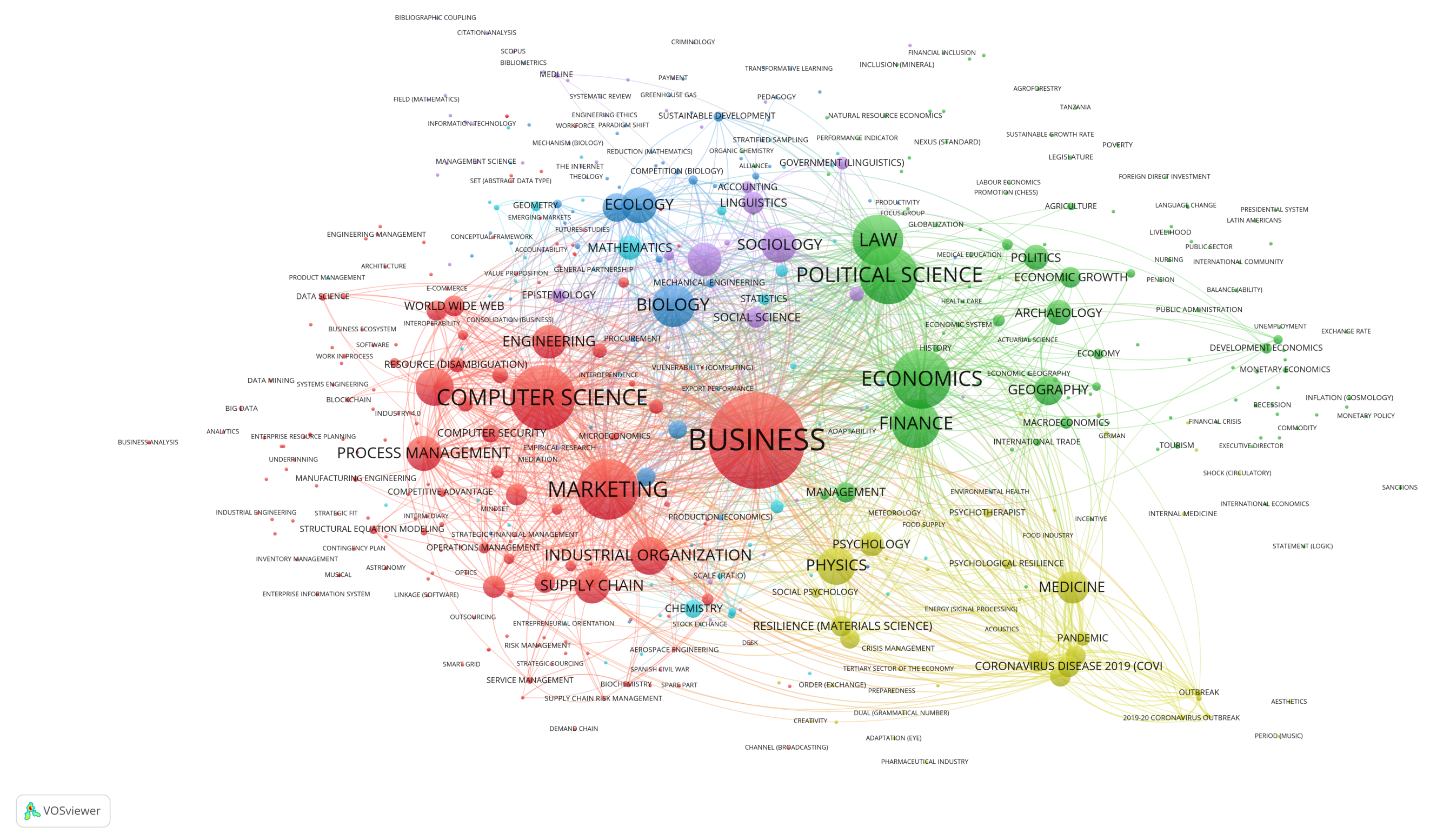
| All Degree | Betweenness Centrality | High Aggregate Constraints | Low Aggregate Constraints |
|---|---|---|---|
| BUSINESS | BUSINESS | BUSINESS | SCALING |
| COMPUTER SCIENCE | COMPUTER SCIENCE | COMPUTER SCIENCE | CYBER THREATS |
| MARKETING | MARKETING | ECONOMICS | ACTUARIAL SCIENCE |
| KNOWLEDGE MANAGEMENT | KNOWLEDGE MANAGEMENT | MARKETING | SUSTAINABILITY REPORTING |
| ECONOMICS | ECONOMICS | POLITICAL SCIENCE | TRAINING AND DEVELOPMENT |
| POLITICAL SCIENCE | POLITICAL SCIENCE | BIOLOGY | FOOD INDUSTRY |
| BIOLOGY | BIOLOGY | KNOWLEDGE MANAGEMENT | CLOUD COMPUTING SECURITY |
| LAW | ENGINEERING | LAW | CYBERWARFARE |
| ENGINEERING | LAW | ENGINEERING | METAVERSE |
| PROCESS MANAGEMENT | PROCESS MANAGEMENT | FINANCE | BUILDING INFORMATION MODELING |
| FINANCE | FINANCE | CONTEXT (ARCHAEOLOGY) | SHARED LEADERSHIP |
| CONTEXT (ARCHAEOLOGY) | CONTEXT (ARCHAEOLOGY) | PROCESS MANAGEMENT | VIRTUAL REALITY |
| SOCIOLOGY | SOCIOLOGY | SOCIOLOGY | CORE (OPTICAL FIBER) |
| INDUSTRIAL ORGANIZATION | INDUSTRIAL ORGANIZATION | ECOLOGY | LEGISLATION |
| PSYCHOLOGY | PSYCHOLOGY | PSYCHOLOGY | LOYALTY |
| ECOLOGY | ECOLOGY | INDUSTRIAL ORGANIZATION | CURRICULUM |
| MANAGEMENT | PHYSICS | PHILOSOPHY | VOLATILITY (FINANCE) |
| PHILOSOPHY | PHILOSOPHY | MANAGEMENT | ARCHITECTURAL ENGINEERING |
| SUSTAINABILITY | SUSTAINABILITY | PHYSICS | TRANSPORT ENGINEERING |
| PHYSICS | MANAGEMENT | SUSTAINABILITY | MARKETING MIX |
| WORLD WIDE WEB | PUBLIC RELATIONS | MACHINE LEARNING | PUBLIC ADMINISTRATION |
| PUBLIC RELATIONS | GEOGRAPHY | PALEONTOLOGY | COMPOSITE NUMBER |
| MEDICINE | MATHEMATICS | MEDICINE | CARBON FIBERS |
| MACHINE LEARNING | WORLD WIDE WEB | GEOGRAPHY | EXTANT TAXON |
| MATHEMATICS | MACHINE LEARNING | MATHEMATICS | INFORMATION SECURITY |
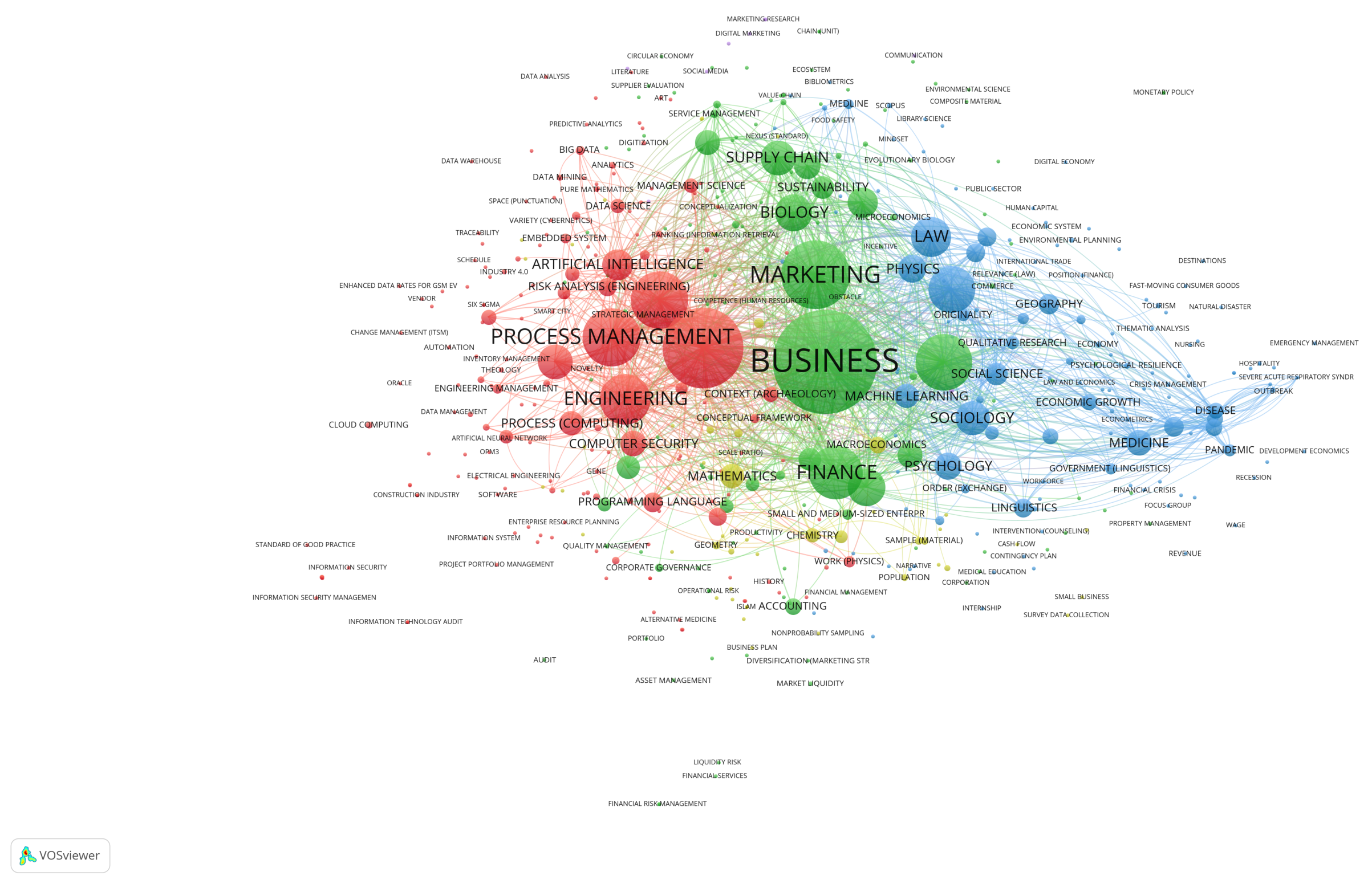
| All Degree | Betweenness Centrality | High Aggregate Constraints | Low Aggregate Constraints |
|---|---|---|---|
| BUSINESS | BUSINESS | BUSINESS | MICROBIOLOGY |
| MARKETING | COMPUTER SCIENCE | COMPUTER SCIENCE | GLYCERALDEHYDE 3-PHOSPHATE DEHYDROGENASE |
| COMPUTER SCIENCE | MARKETING | MARKETING | GLYCERALDEHYDE |
| KNOWLEDGE MANAGEMENT | ECONOMICS | ECONOMICS | MANUFACTURING SECTOR |
| INDUSTRIAL ORGANIZATION | KNOWLEDGE MANAGEMENT | INDUSTRIAL ORGANIZATION | NEW VENTURES |
| ECONOMICS | INDUSTRIAL ORGANIZATION | KNOWLEDGE MANAGEMENT | MATHEMATICS EDUCATION |
| FINANCE | FINANCE | FINANCE | FINTECH |
| PROCESS MANAGEMENT | BIOLOGY | POLITICAL SCIENCE | LINK (GEOMETRY) |
| POLITICAL SCIENCE | POLITICAL SCIENCE | BIOLOGY | MARKET INTELLIGENCE |
| COMPETITIVE ADVANTAGE | PROCESS MANAGEMENT | PROCESS MANAGEMENT | PERFECT COMPETITION |
| BIOLOGY | COMPETITIVE ADVANTAGE | LAW | INTERNAL FINANCING |
| LAW | LAW | COMPETITIVE ADVANTAGE | INFORMATION ASYMMETRY |
| PHILOSOPHY | PHILOSOPHY | PHILOSOPHY | MARKETING RESEARCH |
| SOCIOLOGY | ENGINEERING | PHYSICS | ANCIENT HISTORY |
| PSYCHOLOGY | PSYCHOLOGY | ENGINEERING | ASSET (COMPUTER SECURITY) |
| PHYSICS | PHYSICS | PSYCHOLOGY | PROBIT MODEL |
| ENGINEERING | SOCIOLOGY | SOCIOLOGY | LAW AND ECONOMICS |
| ECOLOGY | MATHEMATICS | ECOLOGY | FINANCIAL SERVICES |
| MACHINE LEARNING | CHEMISTRY | MACHINE LEARNING | RENEWABLE ENERGY |
| MATHEMATICS | ECOLOGY | MATHEMATICS | ADVANCED MANUFACTURING |
| RESILIENCE (MATERIALS SCIENCE) | MACHINE LEARNING | RESILIENCE (MATERIALS SCIENCE) | ANTECEDENT (BEHAVIORAL PSYCHOLOGY) |
| DYNAMIC CAPABILITIES | RESILIENCE (MATERIALS SCIENCE) | MANAGEMENT | FINANCIAL SECTOR |
| MANAGEMENT | MANAGEMENT | THERMODYNAMICS | PHARMACOLOGY |
| SUSTAINABILITY | MEDICINE | DYNAMIC CAPABILITIES | AGROFORESTRY |
| THERMODYNAMICS | SUSTAINABILITY | SUSTAINABILITY | MULTIMEDIA |
| All Degree | Betweenness Centrality | High Aggregate Constraints | Low Aggregate Constraints |
|---|---|---|---|
| BUSINESS | BUSINESS | BUSINESS | NEW NORMAL |
| COMPUTER SCIENCE | COMPUTER SCIENCE | COMPUTER SCIENCE | ZERO (LINGUISTICS) |
| MARKETING | MARKETING | MARKETING | SANCTIONS |
| ECONOMICS | ECONOMICS | ECONOMICS | ECONOMIC SANCTIONS |
| POLITICAL SCIENCE | POLITICAL SCIENCE | POLITICAL SCIENCE | BIBLIOGRAPHIC COUPLING |
| LAW | LAW | LAW | WORKING CAPITAL |
| FINANCE | FINANCE | FINANCE | FINANCIAL MANAGEMENT |
| BIOLOGY | BIOLOGY | BIOLOGY | FUTURES CONTRACT |
| INDUSTRIAL ORGANIZATION | INDUSTRIAL ORGANIZATION | ECOLOGY | BUSINESS ANALYTICS |
| KNOWLEDGE MANAGEMENT | KNOWLEDGE MANAGEMENT | KNOWLEDGE MANAGEMENT | GREEN INNOVATION |
| ECOLOGY | PHYSICS | PHYSICS | BUSINESS ANALYSIS |
| PHYSICS | ECOLOGY | SOCIOLOGY | AESTHETICS |
| PROCESS MANAGEMENT | SUPPLY CHAIN | INDUSTRIAL ORGANIZATION | POLITICAL ECONOMY |
| SOCIOLOGY | SOCIOLOGY | SUPPLY CHAIN | SMART GRID |
| SUPPLY CHAIN | PROCESS MANAGEMENT | PROCESS MANAGEMENT | HANDICRAFT |
| ENGINEERING | ENGINEERING | ENGINEERING | PUBLIC HEALTH |
| MEDICINE | PHILOSOPHY | PHILOSOPHY | INVENTORY MANAGEMENT |
| PHILOSOPHY | MEDICINE | MEDICINE | NURSING |
| SUSTAINABILITY | GEOGRAPHY | SUSTAINABILITY | PREDICTIVE ANALYTICS |
| GEOGRAPHY | SUSTAINABILITY | GEOGRAPHY | PHYSICAL MEDICINE AND REHABILITATION |
| MATHEMATICS | ARCHAEOLOGY | MATHEMATICS | PERIOD (MUSIC) |
| POLITICS | POLITICS | POLITICS | BALANCE (ABILITY) |
| PSYCHOLOGY | MATHEMATICS | ARCHAEOLOGY | PLAN (ARCHAEOLOGY) |
| SUPPLY CHAIN MANAGEMENT | PSYCHOLOGY | PSYCHOLOGY | DIVERSITY (POLITICS) |
| PATHOLOGY | LINGUISTICS | PATHOLOGY | INDUSTRIAL ENGINEERING |
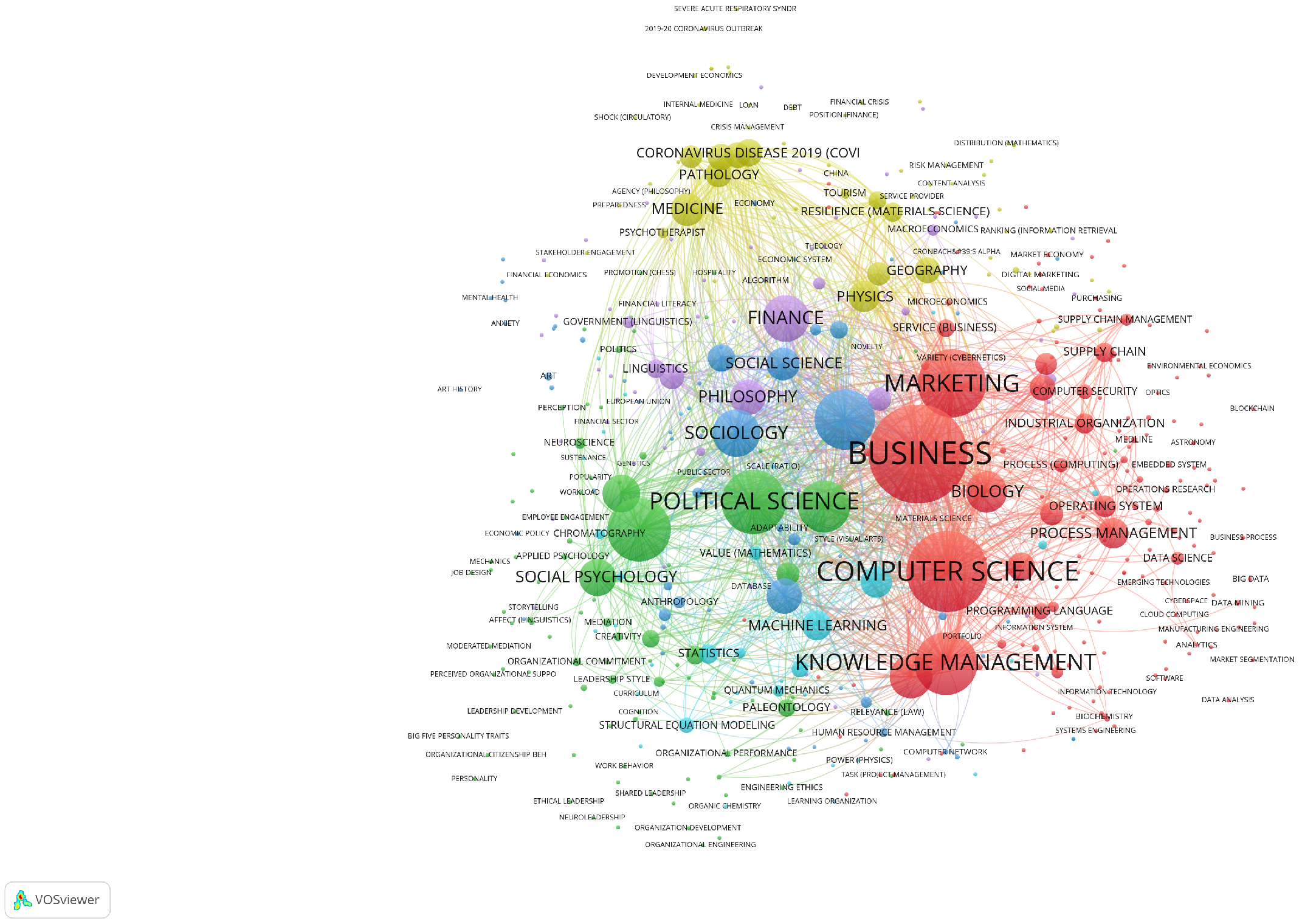
| All Degree | Betweenness Centrality | High Aggregate Constraints | Low Aggregate Constraints |
|---|---|---|---|
| BUSINESS | BUSINESS | BUSINESS | MONETARY POLICY |
| COMPUTER SCIENCE | COMPUTER SCIENCE | COMPUTER SCIENCE | MONETARY ECONOMICS |
| MARKETING | MARKETING | MARKETING | CRIMINOLOGY |
| PROCESS MANAGEMENT | PROCESS MANAGEMENT | PROCESS MANAGEMENT | ENHANCED DATA RATES FOR GSM EVOLUTION |
| KNOWLEDGE MANAGEMENT | KNOWLEDGE MANAGEMENT | KNOWLEDGE MANAGEMENT | INVENTORY MANAGEMENT |
| ECONOMICS | ECONOMICS | ECONOMICS | INVESTMENT MANAGEMENT |
| FINANCE | FINANCE | ENGINEERING | BUSINESS ENTERPRISE |
| ENGINEERING | ENGINEERING | FINANCE | FINANCIAL RISK MANAGEMENT |
| POLITICAL SCIENCE | POLITICAL SCIENCE | POLITICAL SCIENCE | MANAGEMENT ACCOUNTING |
| LAW | LAW | BIOLOGY | CLIMATE CHANGE |
| BIOLOGY | PHILOSOPHY | LAW | LAW AND ECONOMICS |
| PHILOSOPHY | BIOLOGY | PHILOSOPHY | NANOTECHNOLOGY |
| SOCIOLOGY | OPERATING SYSTEM | OPERATING SYSTEM | SKILLS MANAGEMENT |
| OPERATING SYSTEM | SUPPLY CHAIN | SOCIOLOGY | FORGING |
| SUPPLY CHAIN | SOCIOLOGY | SUPPLY CHAIN | ACCOUNTING INFORMATION SYSTEM |
| ARTIFICIAL INTELLIGENCE | ARTIFICIAL INTELLIGENCE | ARTIFICIAL INTELLIGENCE | BUSINESS MANAGEMENT |
| INDUSTRIAL ORGANIZATION | INDUSTRIAL ORGANIZATION | PHYSICS | STRATEGIC LEADERSHIP |
| PHYSICS | PHYSICS | ECOLOGY | PHARMACOLOGY |
| PSYCHOLOGY | PSYCHOLOGY | INDUSTRIAL ORGANIZATION | CHANGE MANAGEMENT (ITSM) |
| ECOLOGY | ECOLOGY | PSYCHOLOGY | CORE (OPTICAL FIBER) |
| MEDICINE | MEDICINE | MANAGEMENT | SHARIA |
| MACHINE LEARNING | COMPUTER SECURITY | MEDICINE | ISLAM |
| COMPUTER SECURITY | MANAGEMENT | MACHINE LEARNING | LIQUIDITY RISK |
| SUPPLY CHAIN MANAGEMENT | SUPPLY CHAIN MANAGEMENT | SOCIAL SCIENCE | FINANCIAL SERVICES |
| MATHEMATICS | MATHEMATICS | MATHEMATICS | MARKETING STRATEGY |
| All Degree | Betweenness Centrality | High Aggregate Constraints | Low Aggregate Constraints |
|---|---|---|---|
| BUSINESS | BUSINESS | BUSINESS | FINANCIAL ANALYSIS |
| COMPUTER SCIENCE | COMPUTER SCIENCE | COMPUTER SCIENCE | MECHANICS |
| MARKETING | MARKETING | POLITICAL SCIENCE | FINANCIAL INSTITUTION |
| PSYCHOLOGY | POLITICAL SCIENCE | MARKETING | TURBULENCE |
| KNOWLEDGE MANAGEMENT | PSYCHOLOGY | ECONOMICS | FINANCIAL INCLUSION |
| POLITICAL SCIENCE | KNOWLEDGE MANAGEMENT | PSYCHOLOGY | WORK IN PROCESS |
| ECONOMICS | ECONOMICS | KNOWLEDGE MANAGEMENT | PHENOMENOLOGY (PHILOSOPHY) |
| LAW | LAW | LAW | COGNITION |
| FINANCE | SOCIOLOGY | SOCIOLOGY | BUSINESS PROCESS |
| SOCIOLOGY | FINANCE | FINANCE | TRAINING (METEOROLOGY) |
| BIOLOGY | ENGINEERING | BIOLOGY | CORE (OPTICAL FIBER) |
| ENGINEERING | BIOLOGY | ENGINEERING | CRIMINOLOGY |
| SOCIAL PSYCHOLOGY | PUBLIC RELATIONS | PHILOSOPHY | ENERGY (SIGNAL PROCESSING) |
| PUBLIC RELATIONS | SOCIAL PSYCHOLOGY | SOCIAL PSYCHOLOGY | KNOWLEDGE CREATION |
| PHILOSOPHY | PHILOSOPHY | MANAGEMENT | ORGANIC CHEMISTRY |
| MEDICINE | MANAGEMENT | PUBLIC RELATIONS | EQUITY (LAW) |
| MANAGEMENT | MEDICINE | MEDICINE | MARKET SEGMENTATION |
| SOCIAL SCIENCE | SOCIAL SCIENCE | SOCIAL SCIENCE | ABSORPTIVE CAPACITY |
| MATHEMATICS | MATHEMATICS | MATHEMATICS | MINDFULNESS |
| PHYSICS | PHYSICS | PHYSICS | CUSTOMER ENGAGEMENT |
| CORONAVIRUS DISEASE 2019 (COVID-19) | PROCESS MANAGEMENT | MACHINE LEARNING | SOCIAL RESPONSIBILITY |
| MACHINE LEARNING | MACHINE LEARNING | ECONOMIC GROWTH | MARKET LIQUIDITY |
| PROCESS MANAGEMENT | ARTIFICIAL INTELLIGENCE | DISEASE | MINDSET |
| ARTIFICIAL INTELLIGENCE | ECONOMIC GROWTH | PATHOLOGY | TRANSPARENCY (BEHAVIOR) |
| DISEASE | CORONAVIRUS DISEASE 2019 (COVID-19) | INFECTIOUS DISEASE (MEDICAL SPECIALTY) | CYBERSPACE |
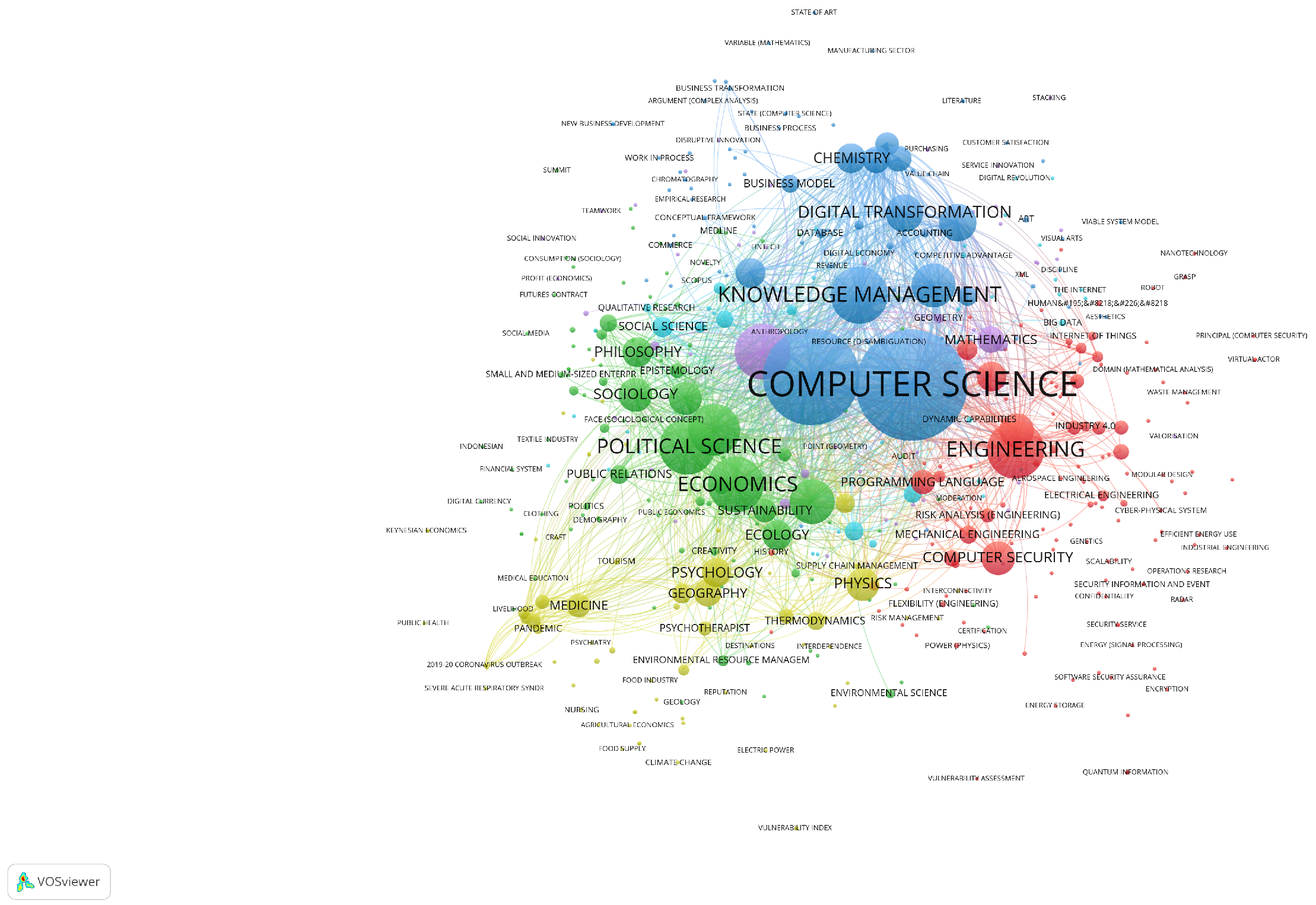
| All Degree | Betweenness Centrality | High Aggregate Constraints | Low Aggregate Constraints |
|---|---|---|---|
| COMPUTER SCIENCE | COMPUTER SCIENCE | COMPUTER SCIENCE | PUBLIC HEALTH |
| BUSINESS | BUSINESS | BUSINESS | HUMANITIES |
| KNOWLEDGE MANAGEMENT | ENGINEERING | MARKETING | STACKING |
| MARKETING | KNOWLEDGE MANAGEMENT | POLITICAL SCIENCE | VIETNAMESE |
| POLITICAL SCIENCE | POLITICAL SCIENCE | ECONOMICS | SOUND (GEOGRAPHY) |
| ECONOMICS | MARKETING | LAW | CURRENT ACCOUNT |
| LAW | ECONOMICS | ENGINEERING | EXCHANGE RATE |
| ENGINEERING | LAW | KNOWLEDGE MANAGEMENT | WEARABLE COMPUTER |
| BIOLOGY | BIOLOGY | BIOLOGY | WEARABLE TECHNOLOGY |
| PROCESS MANAGEMENT | PROCESS MANAGEMENT | PROCESS MANAGEMENT | QUANTUM INFORMATION |
| DIGITAL TRANSFORMATION | DIGITAL TRANSFORMATION | DIGITAL TRANSFORMATION | PUBLIC-KEY CRYPTOGRAPHY |
| WORLD WIDE WEB | WORLD WIDE WEB | WORLD WIDE WEB | QUANTUM CRYPTOGRAPHY |
| FINANCE | OPERATING SYSTEM | FINANCE | PRINCIPAL (COMPUTER SECURITY) |
| SOCIOLOGY | COMPUTER SECURITY | OPERATING SYSTEM | RELIABILITY ENGINEERING |
| ECOLOGY | SOCIOLOGY | ECOLOGY | XML |
| OPERATING SYSTEM | FINANCE | SOCIOLOGY | VIRTUAL ACTOR |
| CHEMISTRY | PHYSICS | PHYSICS | ENCRYPTION |
| PHYSICS | ECOLOGY | CHEMISTRY | VIRTUAL REALITY |
| COMPUTER SECURITY | CHEMISTRY | INDUSTRIAL ORGANIZATION | YORUBA |
| BIOCHEMISTRY | ARTIFICIAL INTELLIGENCE | BIOCHEMISTRY | VULNERABILITY MANAGEMENT |
| INDUSTRIAL ORGANIZATION | INDUSTRIAL ORGANIZATION | PHILOSOPHY | RADAR |
| PSYCHOLOGY | PHILOSOPHY | GENE | SOVEREIGNTY |
| GENE | PSYCHOLOGY | ARTIFICIAL INTELLIGENCE | VALORISATION |
| ARTIFICIAL INTELLIGENCE | GEOGRAPHY | PSYCHOLOGY | TEXTILE INDUSTRY |
| PHILOSOPHY | MATHEMATICS | COMPUTER SECURITY | AESTHETICS |
Appendix B. The System Prompt and Decision Logic
- Output the theory identifier. * If the textual content does not align sufficiently with the conceptual boundaries of the candidate theories, output 0 or Invalid (The “No Match” safety exit).
| Abstract | LLM Choices | Final Decision (Rate %) and LLM Reasoning |
|---|---|---|
| This study aims to develop prepositions about the resilience of entrepreneurs in small and medium enterprises (SMEs) in the digital transformation era in Industry 4.0, by looking at the role of agile leaders and learning orientation through a theoretical study of human resource development. Qualitative research method with literature study to obtain a research model that explains the role of agile leadership and learning orientation as a factor influencing SMEs performance. The results of the study provide proposed indicators on leadership agility and learning orientation in supporting the resilience of SMEs in the era digital transformation. Keywords: Leadership agility, learning orientation, resilience, smes. | deepseek-r1_8b: Behavioral Theories gemma3_12b: Behavioral Theories llama3_8b: Behavioral Theories mixtral_8×7b: Behavioral Theories qwen3_8b: Behavioral Theories | Behavioral Theories (100%) Reasoning: The classification was assigned to Behavioral Theories because the abstract explicitly focuses on “leadership agility,” “learning orientation,” and the “resilience of entrepreneurs” as behavioral and cognitive drivers of SME performance. The emphasis on “agile leaders and learning orientation as a factor influencing SMEs performance” indicates an interest in adaptive managerial actions, organizational learning, and decision-making processes rather than external environmental pressures or firm resources. |
| Small and medium-sized enterprises (SMEs) are pivotal to economic growth, yet many struggle to navigate the ongoing wave of digital transformation. This paper provides an analytical overview of management strategies that enable SMEs to thrive in the digital era. The authors outline the opportunities digital technologies offer to SMEs such as operational efficiencies, access to new markets, and resilience gain alongside the challenges these firms face, including limited resources, skill gaps, and resistance to change. Drawing on recent literature (2019–2024), the authors identify critical factors for successful SME digital transformation and propose a structured approach for managers. Key strategies include developing a clear digital transformation roadmap aligned with business goals, investing in employee digital skills and a pro-innovation culture, leveraging external support (partnerships, platforms, and government initiatives), and fostering agility through continuous improvement and adaptation. This structured approach, grounded in dynamic capabilities theory, helps SMEs overcome resource constraints and uncertainty to achieve sustainable competitive advantage in the digital age. The findings offer practical guidance for SME managers and contribute to the academic discourse on how small businesses can effectively manage digital transformation in an ever-evolving technological landscape. | deepseek-r1_8b: Resource-Based View (RBV) gemma3_12b: Resource-Based View (RBV) llama3_8b: Resource-Based View (RBV) mixtral_8×7b: Resource-Based View (RBV) qwen3_8b: Resource-Based View (RBV) | Resource-Based View (RBV) (100%) Reasoning: The study was classified under Resource-Based View (RBV) because it emphasizes the development and deployment of internal organizational capabilities to achieve “sustainable competitive advantage in the digital age.” The abstract explicitly refers to “dynamic capabilities theory” and highlights strategic resources such as “employee digital skills,” “a pro-innovation culture,” and organizational agility as key enablers of SME performance. The focus on overcoming “resource constraints” through capability building and internal competence development strongly aligns with the RBV perspective. |
| Organizational development is an intrinsic and continuous process that significantly influences the efficiency and effectiveness of job performance within administrative organizations. At the core of successful transformation efforts are the human and organizational dimensions, which are particularly critical in the context of human resource management. This study examines the impact of strategic organizational challenges on managing human resources within Jordanian SME logistics companies, providing a focused lens on how these challenges shape HR practices. The findings, derived from data collected from 189 respondents across Jordanian SMEs, reveal that strategic organizational challenges have a significant influence on human resource planning. By employing multiple regression analysis, the study highlights the complex interplay between these challenges and HR planning, demonstrating the need for organizations to adopt adaptive and strategic approaches. This insight underscores the importance of HRM as a dynamic component of organizational development, capable of responding to and mitigating the pressures posed by external and internal challenges. The findings reveal that all three challenges significantly influence HR planning, underscoring the urgency for innovative and adaptive strategies. Entrepreneurship emerges as a critical moderating variable, enabling SMEs to navigate these complexities and capitalize on emerging opportunities. | deepseek-r1_8b: Resource-Based View (RBV) gemma3_12b: Behavioral Theories llama3_8b: Behavioral Theories mixtral_8×7b: Behavioral Theories qwen3_8b: Behavioral Theories | Behavioral Theories (80%) Reasoning: The classification aligns with Behavioral Theories because the study focuses on organizational adaptation, human resource planning, and managerial responses to “strategic organizational challenges.” The emphasis on “adaptive and strategic approaches,” the “dynamic component of organizational development,” and entrepreneurship as a mechanism enabling SMEs to “navigate these complexities” reflects a behavioral perspective centered on organizational decision-making, managerial action, and adaptive processes rather than purely structural or resource-based explanations. |
| Organizational resilience and digital maturity both explain how some organizations are better able to cope with unexpected disruptions. However, research exploring the relationship between these two concepts, and their role in addressing exogenous shocks, remains sparse. This study first aimed to compare digitally mature SME retailers organizational resilience with that of digitally less mature SME retailers and then investigate further how their digital maturity impacted their response to the COVID-19 pandemic. Design/methodology/approach The authors adopt an explanatory two-phase mixed-method research design, with online surveys from 79 SME retailers in South Africa, followed by interviews. Findings Digitally mature SMEs exhibited higher levels of organizational resilience, specifically with respect to situational awareness, management of keystone vulnerabilities and adaptive capacity. The authors also demonstrate that digital leadership is a greater driver of organizational resilience than digital capabilities. Practical implications The authors suggest ways for SME retailers to develop their digital maturity, particularly their digital leadership, to increase their organizational resilience. Originality/value This paper makes a case for SME retailers to focus on building their digital maturity to better cope with and learn from unexpected events. In particular, digital maturity is positively associated with SME retailers innovation and creativity and their devolved and responsive decision-making. | deepseek-r1_8b: Contingency Theory gemma3_12b: Contingency Theory llama3_8b: Contingency Theory mixtral_8×7b: Contingency Theory qwen3_8b: Contingency Theory | Contingency Theory (100%) Reasoning: The study was classified under Contingency Theory because it examines how SME retailers adapt their organizational responses under varying environmental conditions, particularly during the “COVID-19 pandemic” as an external shock. The emphasis on “situational awareness,” “adaptive capacity,” and “responsive decision-making” reflects the contingency perspective that organizational effectiveness depends on aligning managerial practices and digital maturity with changing environmental demands. The finding that “digital leadership is a greater driver of organizational resilience than digital capabilities” further supports a context-dependent and adaptive interpretation consistent with Contingency Theory. |
| The aim of this research is to examine the impact of supply chain management through social media on competitiveness of the private hospitals in Jordan. The population of the study includes managers in various administrative disciplines. Therefore, the complete census method was used in this research to collect the primary data, where the total responses were 438 responses were used for analysis. The questionnaire was used as a basic instrument in the current research, as it was designed electronically through Google Forms and sent to the research sample via email. AMOS software was used to test the research hypotheses. The results showed that all dimensions of supply chain management through social media had a positive impact on competitiveness; the greatest effect was for strategic relations with suppliers. Based on the study results; managers at the examined companies should enhance their usage of social media with suppliers, according to the report, in order to support strategic connections with them. | deepseek-r1_8b: Resource Dependence Theory gemma3_12b: Resource Dependence Theory llama3_8b: Administrative Theory mixtral_8×7b: Resource Dependence Theory qwen3_8b: Resource Dependence Theory | Resource Dependence Theory (80%) Reasoning: The study aligns with Resource Dependence Theory because the study focuses on how organizations manage external relationships to enhance competitiveness. The abstract emphasizes “strategic relations with suppliers” and the use of “social media with suppliers” as mechanisms for strengthening inter-organizational connections and access to critical resources. This focus on dependency management and external coordination reflects the core assumptions of Resource Dependence Theory regarding firms’ reliance on external actors for strategic advantage. |
| The convergence of Industry 4.0 technologies with supply chain operations and sustainability initiatives has sparked interest in integrating supply chain quality management with these advancements, termed SCQM 4.0. A comprehensive literature review spanning 1998 to 2023, analyzing 232 papers, unveiled key trends, identified research gaps, and outlined a future research agenda for SCQM 4.0. The review culminated in the development of a comprehensive theoretical framework for SCQM 4.0 geared towards fostering sustainability within a circular economy framework, encompassing economic, social, and environmental dimensions. Notably, the study implies a rising enthusiasm for leveraging Industry 4.0 tools such as the internet of things, blockchain, traceability systems, and smart packaging to enhance quality management within circular supply chain operations. Additionally, it proposes SCQM 4.0 strategies aimed at achieving holistic sustainability objectives in circular economies, underscoring implications for further scholarly inquiry in this dynamic field. To promote supply chain quality management digitalization, supply chain stakeholders should analyze research gaps and develop practical implementation plans using the SCQM 4.0 framework. Additionally, exploratory qualitative investigations among organizations and industries should be conducted to identify essential components in sustainable SCQM 4.0. | deepseek-r1_8b: Systems Theory gemma3_12b: Systems Theory llama3_8b: Systems Theory mixtral_8×7b: Systems Theory qwen3_8b: Systems Theory | Systems Theory (100%) Reasoning: The study was classified under Systems Theory because it conceptualizes supply chain quality management as an interconnected and integrated system involving “industry 4.0 technologies,” “circular supply chain operations,” and “economic, social, and environmental dimensions.” The proposed “comprehensive theoretical framework for SCQM 4.0” emphasizes the interaction among multiple technological, organizational, and sustainability components, reflecting a holistic systems-oriented perspective. The integration of tools such as “internet of things, blockchain, traceability systems, and smart packaging” further supports the view of organizations and supply chains as complex, interdependent systems. |
| Digital transformation (DT) has been a key way for pharmaceutical companies to enhance innovation and R&D capabilities, improve product quality, reduce costs, and create competitive advantages. The external environment factors and the internal conditions’ factors are the main factors affecting the DT of pharmaceutical companies. This research aimed to probe the effects of the external environment factors, the internal conditions’ factors, firm size, and control variables on the DT of pharmaceutical companies based on synergetics. Purposive sampling and snowball sampling were used in this research. In addition, this research collected 395 valid data from Chinese pharmaceutical companies through online questionnaires. This research used quantitative analysis, and SPSS and Amos software were applied to data processing analysis. The results of structural equation modeling (SEM) and regression analysis showed that the external environment factors and the internal conditions’ factors had a significantly positive correlation with the DT of pharmaceutical companies, and the effects of the internal conditions on the DT of pharmaceutical companies were greater than that of the external environment. In addition, firm size positively moderated the relationship between the external environment, internal conditions, and the DT of pharmaceutical companies. The results of this research not only can provide theoretical reference for scholars but also put forward implementation suggestions of DT for Chinese pharmaceutical company managers. | deepseek-r1_8b: Contingency Theory gemma3_12b: Contingency Theory llama3_8b: Contingency Theory mixtral_8×7b: Invalid (No match) qwen3_8b: Contingency Theory | Contingency Theory (80%) Reasoning: The study was classified under Contingency Theory because it examines how the effectiveness of digital transformation depends on the interaction between “external environment factors,” “internal conditions’ factors,” and “firm size.” The finding that firm size “positively moderated the relationship between the external environment, internal conditions, and the DT of pharmaceutical companies” reflects a core contingency assumption: organizational outcomes are shaped by the fit between contextual conditions and organizational characteristics. The comparative emphasis on adapting to both external and internal factors further reinforces the contingency-oriented interpretation. |
| This research looks into whether focusing on financial resilience liquidity management, cost management and risk planning helps organizations handle the problems that come with economic downturns. For this reason, the research combines the statistics from 300 surveys and the insights from 15 interviews with executives in various sectors: manufacturing, technology, retail, services and healthcare. Research results show that liquidity management was most closely related to having steady revenue (r = 0.56, p < 0.01), after which came risk planning (r = 0.54) and cost management (r = 0.49). Multiple regression analysis showed that these strategies were strong predictors of financial resilience and liquidity management (Î2 = 0.38, p = 0.001) had the biggest impact. Sector comparisons revealed healthcare and technology sectors implement strategic liquidity and risk frameworks more than others. Four themes were observed from qualitative data: staying liquid, focusing on the cost of operations, managing risks systematically and making new strategic plans after the crisis. The study shows that financial planning and long-term strategy are essential for an organization to be resilient. It gives advice to businesses on how to make cash flow forecasting a habit, promote awareness of costs and involve risk governance in key strategic decisions. The framework pays attention to purpose-built strategies and using modern digital tools for immediate financial analysis. The research supports existing literature on company resilience and supplies steps that experts and officials can apply to manage financial uncertainty. | deepseek-r1_8b: Administrative Theory gemma3_12b: Transaction Cost Theory llama3_8b: Administrative Theory mixtral_8×7b: Invalid (No match) qwen3_8b: Administrative Theory | Administrative Theory (60%) Reasoning: Administrative Theory is supported by the study’s emphasis on formal organizational planning and managerial control mechanisms aimed at improving financial resilience. The focus on “liquidity management, cost management and risk planning” as structured administrative processes highlights rational, rule-based decision-making within organizations. The findings that “financial planning and long-term strategy are essential for an organization to be resilient” further reflect an administrative perspective centered on efficiency, coordination, and systematic governance of resources during economic downturns. |
| This project examines the opportunities and challenges for emerging fashion graduates in the context off a rapidly changing workplace. Industry experts such as Sylvia Walsh and Ian Griffiths are concerned that we are educating too many designers and that there are not enough jobs, and yet the enrolments continue to rise. Specialist jobs, especially of a technical nature have multiplied within the sector not only through increased digitisation over the last few decades according to the Green Report, but also as a result of broader industrial and cultural changes due to the dramatic effects of globalization. Questions of how these changes have impacted the career trajectories of the several hundred students that graduate nationally every year in Australia have not been addressed. My research aims to identify how prevailing perceptions of the figure of the fashion designer and career aspirations of graduating students align or misalign with current job opportunities. | deepseek-r1_8b: Contingency Theory gemma3_12b: Contingency Theory llama3_8b: Human Relations Theory mixtral_8×7b: Contingency Theory qwen3_8b: Contingency Theory | Contingency Theory (80%) Reasoning: The study fits Contingency Theory because the study examines how external structural changes in the fashion industry shape graduate career outcomes and expectations. The abstract highlights a “rapidly changing workplace,” “broader industrial and cultural changes due to the dramatic effects of globalization,” and increased “digitization” as key contextual forces influencing job availability. The misalignment between “prevailing perceptions of the figure of the fashion designer” and “current job opportunities” further reflects a contingency perspective in which outcomes depend on the fit between environmental conditions and individual or educational preparation. |
| This study aims to analyze the impact of Incoterm and relational resources on the competitive advantage of Indonesian Freight forwarders. The measurement methodology uses structural equation model (SEM) analysis with SmartPLS software to analyze the impact of Incoterms and relational resources on competitive advantage. Through social media, online questionnaires were sent to gather research data. The Likert scale of 5 was used to create the questionnaire. Companies that provide freight forwarding services were the respondents in this study, chosen by simple random sampling. Online questionnaires were distributed to 75 companies to answer questions submitted. The data analysis step is validity tests, reliability tests, significance tests, and hypothesis tests. Based on the data processing results, it is found that Incoterm and relational resources positively affect competitive advantages. The novelty of this study is a model of the relationship between the effect of Incoterm and relational resources on the competitive advantage of freight forwarding companies. The research’s theoretical implication is that Freight forwarder companies’ management should select appropriate incoterms and implement relational resource policies to encourage increased competitive advantage. One of the limitations of this study is that the sample size used is only a small number of companies engaged in international Freight Forwarder services, only 75 companies. | deepseek-r1_8b: Resource-Based View (RBV) gemma3_12b: Resource-Based View (RBV) llama3_8b: Resource-Based View (RBV) mixtral_8×7b: Resource-Based View (RBV) qwen3_8b: Resource-Based View (RBV) | Resource-Based View (RBV) (100%) Reasoning: The study aligns with Resource-Based View (RBV) because the study emphasizes internal and relational assets as key sources of competitive advantage. The abstract explicitly highlights “relational resources” and their “positive effect on competitive advantage,” indicating that firm-specific resources and capabilities are central to performance differences. The focus on how freight forwarder companies should “implement relational resource policies to encourage increased competitive advantage” further reflects the RBV logic that sustainable advantage stems from valuable, rare, and well-managed internal and relational resources rather than external market positioning alone. |
References
- Alam, M. M. D., Razzak, M. R., Khreis, S. H. A., Al Balushi, M. K., & Al Lawati, H. (2025). Digital leadership orientation and organizational resilience: Strategic foresight, agility, and flexibility. Management Decision, 1–31. [Google Scholar] [CrossRef]
- Al Omoush, K., Lassala, C., & Ribeiro-Navarrete, S. (2025). The role of digital business transformation in frugal innovation and SMEs’ resilience in emerging markets. International Journal of Emerging Markets, 20(1), 366–386. [Google Scholar] [CrossRef]
- Alqam, H. S., Razzak, M. R., & Bachkirov, A. A. (2025). Driving SME success through digital readiness and dynamic capabilities in propelling business process digitalization and performance. Journal of Entrepreneurship in Emerging Economies, 17(6), 1699–1722. [Google Scholar] [CrossRef]
- Antons, D., Breidbach, C. F., Joshi, A. M., & Salge, T. O. (2023). Computational literature reviews: Method, algorithms, and roadmap. Organizational Research Methods, 26(1), 107–138. [Google Scholar] [CrossRef]
- Barney, J. (1991). Firm resources and sustained competitive advantage. Journal of Management, 17(1), 99–120. [Google Scholar] [CrossRef]
- Bolisani, E., & Bratianu, C. (2018). Emergent knowledge strategies: Strategic thinking in knowledge management. Springer International Publishing. [Google Scholar] [CrossRef]
- Borgatti, S. P., Mehra, A., Brass, D. J., & Labianca, G. (2009). Network analysis in the social sciences. Science, 323(5916), 892–895. [Google Scholar] [CrossRef] [PubMed]
- Burnard, K., & Bhamra, R. (2011). Organisational resilience: Development of a conceptual framework for organisational responses. International Journal of Production Research, 49(18), 5581–5599. [Google Scholar] [CrossRef]
- Cohen, J. (1960). A coefficient of agreement for nominal scales. Educational and Psychological Measurement, 20(1), 37–46. [Google Scholar] [CrossRef]
- DiMaggio, P. J., & Powell, W. W. (1983). The iron cage revisited: Institutional isomorphism and collective rationality in organizational fields. American Sociological Review, 48(2), 147–160. [Google Scholar] [CrossRef]
- Donthu, N., Kumar, S., Mukherjee, D., Pandey, N., & Lim, W. M. (2021). How to conduct a bibliometric analysis: An overview and guidelines. Journal of Business Research, 133, 285–296. [Google Scholar] [CrossRef]
- Duchek, S. (2020). Organizational resilience: A capability-based conceptualization. Business Research, 13(1), 215–246. [Google Scholar] [CrossRef]
- Durman, S., Iyiola, K., Alzubi, A. B., & Aljuhmani, H. Y. (2025). Dynamic capabilities in action: Digital capability, business model innovation and absorptive capacity. Management Decision. Ahead of print. [Google Scholar] [CrossRef]
- Forchino, M. V., & Torres-Salinas, D. (2026). The OpenAlex database in review: Evaluating its applications, capabilities, and limitations. Journal of Informetrics, 20(2), 101800. [Google Scholar] [CrossRef]
- Formal, T., Piwowarski, B., & Clinchant, S. (2021). SPLADE: Sparse lexical and expansion model for first stage ranking. In Proceedings of the 44th international ACM SIGIR conference on research and development in information retrieval (pp. 2288–2292). Association for Computing Machinery. [Google Scholar] [CrossRef]
- Ganaie, M. A., Hu, M., Malik, A. K., Tanveer, M., & Suganthan, P. N. (2021). Ensemble deep learning: A review. arXiv, arXiv:2104.02395. [Google Scholar] [CrossRef]
- Grullon-Polanco, L. (2026). LLM-assisted genre analysis: The effect of sampling temperature on reliability. Results in Applied Machine Learning, 5(2), 100314. [Google Scholar] [CrossRef]
- Hillman, A. J., Withers, M. C., & Collins, B. J. (2009). Resource dependence theory: A review. Journal of Management, 35(6), 1404–1427. [Google Scholar] [CrossRef]
- Ji, Z., Lee, N., Frieske, R., Yu, T., Su, D., Xu, Y., Ishii, E., Bang, Y. J., Madotto, A., & Fung, P. (2023). Survey of hallucination in natural language generation. ACM Computing Surveys, 55(12), 248. [Google Scholar] [CrossRef]
- Karpukhin, V., Oguz, B., Min, S., Lewis, P., Wu, L., Edunov, S., Chen, D., & Yih, W. T. (2020). Dense passage retrieval for open-domain question answering. In Proceedings of the 2020 conference on empirical methods in natural language processing (EMNLP) (pp. 6769–6781). Association for Computational Linguistics. [Google Scholar] [CrossRef]
- Keskin, H., Yalcin, H., & Esen, E. (2026). Bridging the readability gap: Corporate disclosure trends. Management Decision. Ahead of print. [Google Scholar] [CrossRef]
- Khurana, D., Koli, A., Khatter, K., & Singh, S. (2023). Natural language processing: State of the art, current trends and challenges. Multimedia Tools and Applications, 82(1), 3713–3744. [Google Scholar] [CrossRef]
- Korber, S., & McNaughton, R. B. (2017). Resilience and entrepreneurship: A systematic literature review. International Journal of Entrepreneurial Behavior & Research, 24(7), 1129–1154. [Google Scholar] [CrossRef]
- Lawrence, P. R., & Lorsch, J. W. (1967). Differentiation and integration in complex organizations. Administrative Science Quarterly, 12(1), 1–47. [Google Scholar] [CrossRef]
- Lengnick-Hall, C. A., Beck, T. E., & Lengnick-Hall, M. L. (2011). Developing a capacity for organizational resilience through strategic human resource management. Human Resource Management Review, 21(3), 243–255. [Google Scholar] [CrossRef]
- Levinthal, D. A., & March, J. G. (1993). The myopia of learning. Strategic Management Journal, 14(S2), 95–112. [Google Scholar] [CrossRef]
- Levy, M., & Powell, P. (2002). SME transformation: Modelling progressions. In ECIS 2002 proceedings (p. 90). European Conference on Information System. [Google Scholar]
- Li, L., Su, F., Zhang, W., & Mao, J. Y. (2018). Digital transformation by SME entrepreneurs: A capability perspective. Information Systems Journal, 28(6), 1129–1157. [Google Scholar] [CrossRef]
- Lin, S., Hilton, J., & Evans, O. (2022). Teaching models to express their uncertainty in words. arXiv, arXiv:2205.14334. [Google Scholar] [CrossRef]
- Luan, Y., Eisenstein, J., Toutanova, K., & Chang, M. W. (2021). Sparse, dense, and attentional representations for text retrieval. Transactions of the Association for Computational Linguistics, 9, 329–345. [Google Scholar] [CrossRef]
- Malik, F. S., & Terzidis, O. (2025a). A hybrid framework for creating artificial intelligence-augmented systematic literature reviews. Management Review Quarterly. Ahead of print. [Google Scholar] [CrossRef]
- Malik, F. S., & Terzidis, O. (2025b). Scaffolding artifact in entrepreneurship: A design science approach. Journal of Business Venturing Design, 5, 100035. [Google Scholar] [CrossRef]
- Malik, F. S., & Terzidis, O. (2026). The metamorphosis of organizational resilience: A strategic roadmap for SMEs in the digital age. Review of Managerial Science. Ahead of print. [Google Scholar] [CrossRef]
- McHugh, M. L. (2012). Interrater reliability: The kappa statistic. Biochemia Medica, 22(3), 276–282. [Google Scholar] [CrossRef] [PubMed]
- Mou, A. J., Hossain, M. S., & Siddiqui, N. A. (2022). Digital transformation in marketing: Evaluating the impact of web analytics and SEO on SME growth. American Journal of Interdisciplinary Studies, 3(4), 61–90. [Google Scholar] [CrossRef]
- Musah, A., Adenutsi, D. E., & Okyere, B. (2026). The moderating role of entrepreneurial orientation in the relationship between digital transformation, corporate tax reputation, and tax compliance among SME. Sustainable Futures, 11, 101641. [Google Scholar] [CrossRef]
- Nahar, S., & Alam, M. (2026). Technology-enabled cross-border entrepreneurship: The role of digital platforms in SME expansion through the lens of institutional theory. Thunderbird International Business Review. Ahead of print. [Google Scholar] [CrossRef]
- Nasution, M. D. T. P., Rossanty, Y., Harahap, R., Tanjung, A. R., & Nasution, T. A. M. (2026). Technology-driven resource utilization and integration to enhance firm performance. APTISI Transactions on Technopreneurship, 8(1), 268–283. [Google Scholar] [CrossRef]
- Ojonugwa, B. M., Ikponmwoba, S. O., Chima, O. K., Ezeilo, O. J., Adesuyi, M. O., & Ochefu, A. (2021). Building digital maturity frameworks for SME transformation in data-driven business environments. International Journal of Multidisciplinary Research and Growth Evaluation, 2(2), 368–373. [Google Scholar] [CrossRef]
- O’Reilly, C. A., III, & Tushman, M. L. (2013). Organizational ambidexterity: Past, present, and future. Academy of Management Perspectives, 27(4), 324–338. [Google Scholar] [CrossRef]
- Pan, S., Luo, L., Wang, Y., Chen, C., Wang, J., & Wu, X. (2024). Unifying large language models and knowledge graphs: A roadmap. IEEE Transactions on Knowledge and Data Engineering, 36, 3580–3599. [Google Scholar] [CrossRef]
- Putri, A. N. A., Hermawan, P., Mirzanti, I. R., Meadows, M., & Sadraei, R. (2025). Exploring green growth in SMEs: Global trends, challenges, and future directions. Foresight and STI Governance, 19(1), 16–31. [Google Scholar] [CrossRef]
- Sagala, G. H., & Ori, D. (2025). Exploring digital transformation strategy to achieve SMEs resilience and antifragility: A systematic literature review. Journal of Small Business and Entrepreneurship, 37(3), 495–524. [Google Scholar] [CrossRef]
- Sambamurthy, V., Bharadwaj, A., & Grover, V. (2003). Shaping agility through digital options: Reconceptualizing the role of information technology in contemporary firms. MIS Quarterly, 27(2), 237–263. [Google Scholar] [CrossRef]
- Setiawan, B., Pamungkas, B., Mekaniwati, A., & Kusuma, P. M. (2025). The strategic role of digital transformation, dynamic and agile capabilities for the performance of micro, small, and medium enterprises (MSMEs). Bottom Line, 38(2), 130–153. [Google Scholar] [CrossRef]
- Sinha, K. K., Raby, S., & Salari, T. (2025). Exploring the scope and depth of digitalisation in times of crisis: Implications for SME resilience. International Small Business Journal: Researching Entrepreneurship, 43(3), 219–245. [Google Scholar] [CrossRef]
- Sirmon, D. G., Hitt, M. A., Ireland, R. D., & Gilbert, B. A. (2011). Resource orchestration to create competitive advantage: Breadth, depth, and life cycle effects. Journal of Management, 37(5), 1390–1412. [Google Scholar] [CrossRef]
- Suddaby, R. (2010). Construct clarity in theories of management and organization: Editor’s comments. Academy of Management Review, 35(3), 346–357. [Google Scholar]
- Surahman, S., Shee, H., Fitrian, Z., Adi, A. S., & Yudaruddin, R. (2023). The effect of digital transformation and innovation on SMEs’ performance in times of COVID-19. Problems and Perspectives in Management, 21(4), 84–100. [Google Scholar] [CrossRef]
- Tang, L., Zhao, P., Pan, Z., Duan, X., & Pardalos, P. M. (2024). A two-stage denoising framework for zero-shot learning with noisy labels. Information Sciences, 654, 119852. [Google Scholar] [CrossRef]
- Teece, D. J. (2007). Explicating dynamic capabilities: The nature and microfoundations of (sustainable) enterprise performance. Strategic Management Journal, 28(13), 1319–1350. [Google Scholar] [CrossRef]
- Teece, D. J. (2014a). A dynamic capabilities-based entrepreneurial theory of the multinational enterprise. Journal of International Business Studies, 45(1), 8–37. [Google Scholar] [CrossRef]
- Teece, D. J. (2014b). The foundations of enterprise performance: Dynamic and ordinary capabilities in an (economic) theory of firms. Academy of Management Perspectives, 28(4), 328–352. [Google Scholar] [CrossRef]
- Thakur, B., Dubey, P., Benitez, J., Torres, J. P., Reddy, S., Shokar, N., Aung, K., Mukherjee, D., & Dwivedi, A. K. (2021). A systematic review and meta-analysis of geographic differences in comorbidities and associated severity and mortality among individuals with COVID-19. Scientific Reports, 11(1), 8562. [Google Scholar] [CrossRef] [PubMed]
- Tsakalerou, M., Abil, A., Ribière, V., Lukhmanov, Y., & Tynybayeva, N. (2025). The innovation capability equation: A systematic review of global determinants of SME’s success. Journal of Innovation and Knowledge, 10(4), 100757. [Google Scholar] [CrossRef]
- Venkatraman, N. (1989). The concept of fit in strategy research: Toward verbal and statistical correspondence. Academy of Management Review, 14(3), 423–444. [Google Scholar] [CrossRef]
- Vial, G. (2019). Understanding digital transformation: A review and a research agenda. The Journal of Strategic Information Systems, 28(2), 118–144. [Google Scholar] [CrossRef]
- Wang, W., Yan, Z., & Zhang, J. (2026). The impact of digital infrastructure on ambidextrous innovation: Evidence from specialized, sophisticated, distinctive, and innovative enterprises in China. International Journal of Innovation Studies, 10(1), 106–121. [Google Scholar] [CrossRef]
- Weick, K. E. (1976). Educational organizations as loosely coupled systems. Administrative Science Quarterly, 21(1), 1–19. Available online: https://www.jstor.org/stable/2391875 (accessed on 7 April 2026). [CrossRef]
- Wimalasuriya, D. C., & Dou, D. (2010). Ontology-based information extraction: An introduction and a survey of current approaches. Journal of Information Science, 36(3), 306–323. [Google Scholar] [CrossRef]
- Wulandari, S. S., Maula, F. I., Pahlevi, T., Hakim, L., Handayani, S., Rahmawati, F., Muhlisin, & Zulkifli, M. F. B. (2026). Determinants of digitalized MSME competitiveness in improving export capacity to achieve sustainable development goals (SDGs). Cogent Business & Management, 13(1), 2598929. [Google Scholar] [CrossRef]
- Yalcin, H., Demirhan, D., Aracioglu, B., Daim, T. U., Xing, Z., & Meissner, D. (2025). FinTech and the green transition: Exploring pathways to ignite innovation for carbon neutrality in global supply chains. Technology in Society, 84, 103094. [Google Scholar] [CrossRef]
- Zalluhoğlu, A. E., Günay, G. N., Aracıoğlu, B., & Yalçın, H. (2025). Sustainable logistics: Innovative orientations and global trends in scientific research. Foresight, 27(5), 1011–1027. [Google Scholar] [CrossRef]
- Zamani, S. Z. (2022). Small and medium enterprises (SMEs) facing an evolving technological era: A systematic literature review on the adoption of technologies in SMEs. European Journal of Innovation Management, 25(6), 735–757. [Google Scholar] [CrossRef]
- Zeba, G., Dabić, M., Čičak, M., Daim, T., & Yalcin, H. (2021). Technology mining: Artificial intelligence in manufacturing. Technological Forecasting and Social Change, 171, 120971. [Google Scholar] [CrossRef]
- Zhang, W., Zhang, W., Daim, T., & Yalçın, H. (2025). AI challenges conventional knowledge management: Light the way for reframing SECI model and Ba theory. Journal of Knowledge Management, 29(5), 1618–1654. [Google Scholar] [CrossRef]


| Model | Developer | Architecture Category | Architectural Features | Key Feature |
|---|---|---|---|---|
| Qwen 3 (8B) | Alibaba | Dense Transformer | Multi-Head GQA, Instruction-Tuned | Demonstrates generalized context modeling within dense attention, highlighting how instruction tuning shapes classification boundaries |
| Gemma 3 (12B) | Hybrid/Logic-Enhanced Attention | Hybrid Attention + DeepMind Logic Blocks | Combines attention with structured logic modules to examine how explicit reasoning components influence classification decisions | |
| LLaMA 3 (8B) | Meta | Dense Transformer | Dense + Optimized GQA | Serves as a baseline architecture, enabling isolation of performance changes caused by architectural variations |
| Mixtral (8×7B) | Mistral AI | Sparse MoE (Mixture of Experts) | Sparse parameter activation, expert routing | Represents feature-space partitioning via expert specialization, showing how sparse activation impacts class separability |
| DeepSeek-R1 (8B) | DeepSeek | Reasoning-Optimized Transformer | CoT + RL-focused training | Explores step-wise decision boundary formation through reasoning traces in complex classification tasks |
Disclaimer/Publisher’s Note: The statements, opinions and data contained in all publications are solely those of the individual author(s) and contributor(s) and not of MDPI and/or the editor(s). MDPI and/or the editor(s) disclaim responsibility for any injury to people or property resulting from any ideas, methods, instructions or products referred to in the content. |
© 2026 by the authors. Licensee MDPI, Basel, Switzerland. This article is an open access article distributed under the terms and conditions of the Creative Commons Attribution (CC BY) license.
Share and Cite
Kaya, E.Ç.; Yalçın, H. Constructing an AI-Driven Meta-Theory of SME Resilience and Strategic Agility: A Computational Synthesis of Global Research. Adm. Sci. 2026, 16, 236. https://doi.org/10.3390/admsci16050236
Kaya EÇ, Yalçın H. Constructing an AI-Driven Meta-Theory of SME Resilience and Strategic Agility: A Computational Synthesis of Global Research. Administrative Sciences. 2026; 16(5):236. https://doi.org/10.3390/admsci16050236
Chicago/Turabian StyleKaya, Efecan Çağdaş, and Haydar Yalçın. 2026. "Constructing an AI-Driven Meta-Theory of SME Resilience and Strategic Agility: A Computational Synthesis of Global Research" Administrative Sciences 16, no. 5: 236. https://doi.org/10.3390/admsci16050236
APA StyleKaya, E. Ç., & Yalçın, H. (2026). Constructing an AI-Driven Meta-Theory of SME Resilience and Strategic Agility: A Computational Synthesis of Global Research. Administrative Sciences, 16(5), 236. https://doi.org/10.3390/admsci16050236