1. Introduction: The Future Is VUCA and Wicked
Organizations have always faced uncertainty, which is the reason why managers and management systems are needed (
Thompson, 1967;
Lawrence & Lorsch, 1967). Recent decades, however, mark a qualitative shift in the nature of uncertainty. Today’s disruptive forces are global, societal, and existential in implication, and are encountered with increasing frequency (
Camillus et al., 2021). Pandemics reshape work and supply chains; climate change alters physical and regulatory infrastructures; gene editing challenges notions of human capability; artificial intelligence raises questions of autonomy and consciousness; and political revolutions destabilize institutions and markets. Certain forces—the inevitability of globalization, the imperative of innovation, and the importance of ESG considerations—interact with and reinforce one another, producing uncertainty that reflects “perfect storm” dynamics. Furthermore, certain disruptions are analogous to tectonic shifts, earthquakes that engender tsunamis of uncertainty and change.
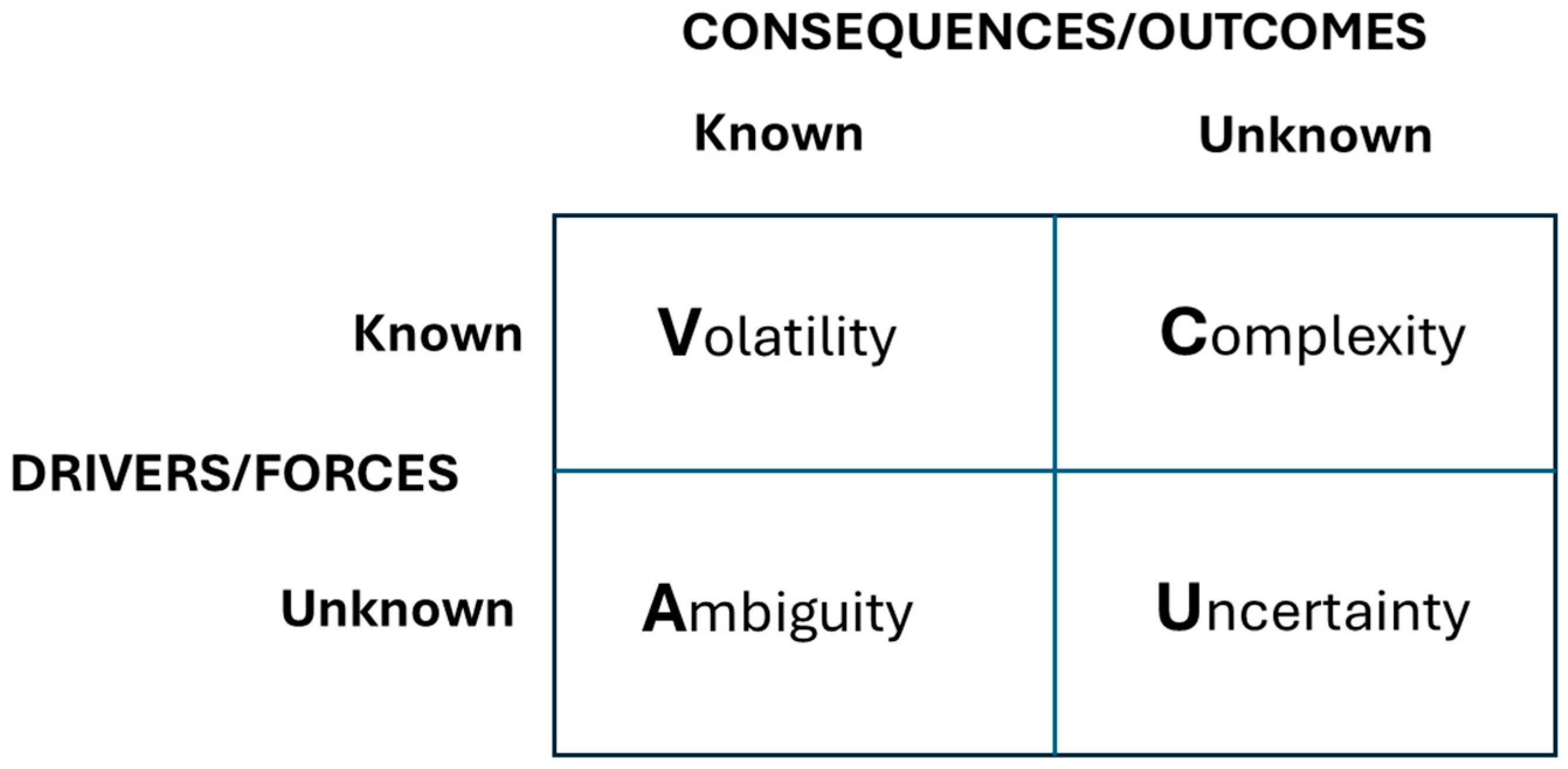
In such contexts, managerial reliance on prediction becomes problematic. The future is not merely uncertain—it is often unknowable in practical terms. Traditional strategic management tools assume predictability and some degree of stability; they seek to reduce uncertainty through analysis. However, in volatile, uncertain, complex, and ambiguous (VUCA) contexts, analysis often yields competing interpretations rather than decisive clarity.
A useful, clarifying perspective on what VUCA means can perhaps be gained by deconstructing the term, employing a matrix that categorizes the future in terms of whether the forces and drivers that create the future and their consequences are “known” or “unknown” (
Figure 1).
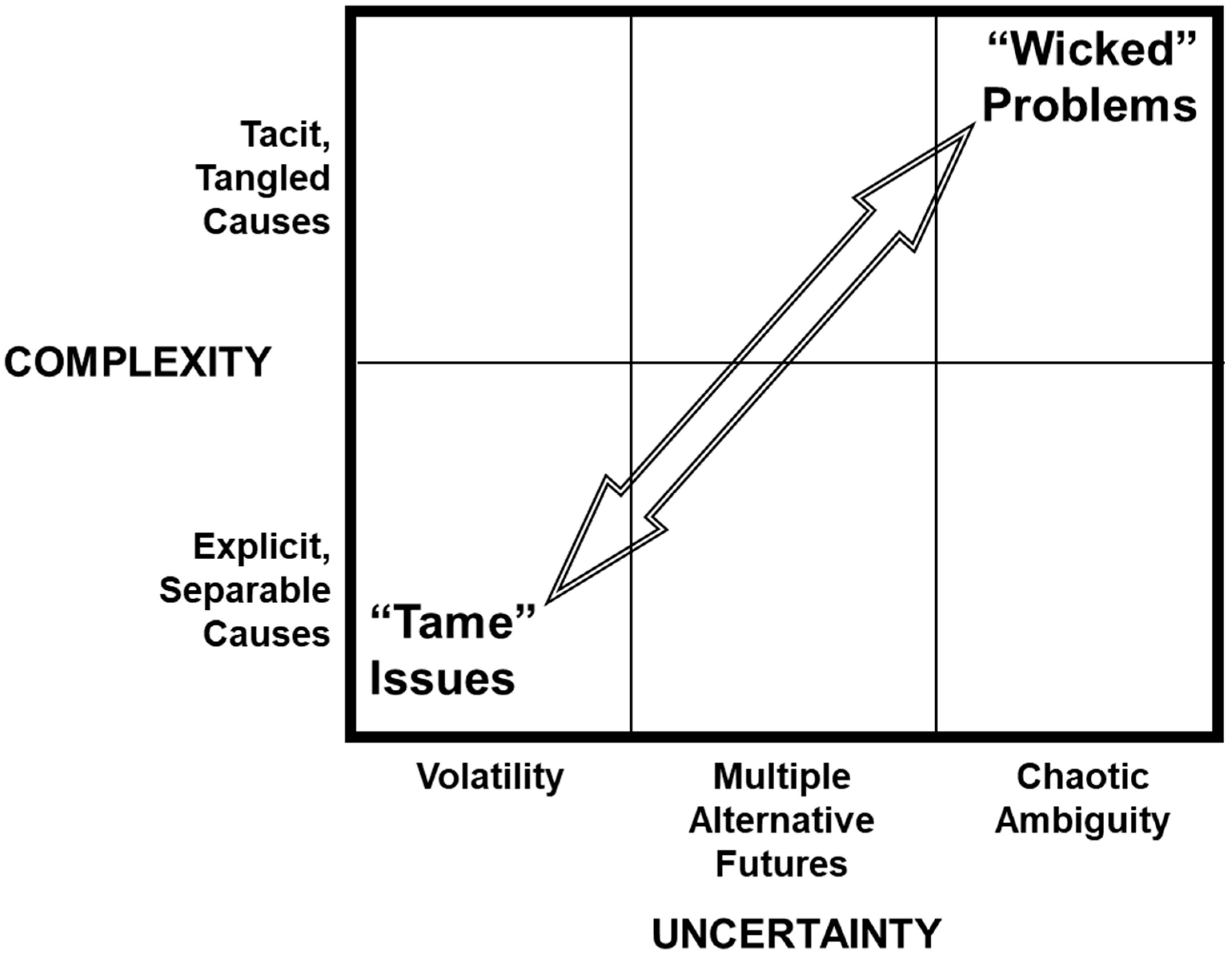
In VUCA contexts, strategic issues and problems tend, metaphorically, to mutate into a wholly different species. Extreme complexity, where the causes are tacit and inextricably tangled, and extreme uncertainty resulting from disruptions interact to create problems and issues that are described and labeled “wicked” by
Rittel and Webber (
1973) (
Figure 2).
Wicked problems differ fundamentally from “tame” problems (
Rittel & Webber, 1973). They are difficult to define, have multiple stakeholders (
Freeman et al., 2007) with conflicting values, possess tangled causes, lack definitive solutions, and evolve as solutions are attempted.
Camillus (
2008) argues that strategy itself becomes wicked because strategic issues in a VUCA environment share the defining characteristics of wicked problems. This implies that classical analytic problem solving—define the problem, identify root causes, generate alternatives, select a best solution—often fails.
Three approaches are recommended for organizations to tame wickedness. First, it is recommended that organizations define themselves in terms that describe what is core to them, what is enduring about them, and what makes them distinctive. These characteristics are intrinsic to the construct of “Identity.” Identity is critically important in the context of organizational resilience and will be considered in more detail later in this article.
The second approach to taming wicked problems is the implementation of
flexible or modular organizational structures (
Mills, 1991). The third approach is to employ
feedforward systems, which “learn from the future” (
Fahey & Randall, 1997;
Veliyath, 2025).
Fahey and Randall (
1997) describe powerful scenario building techniques. These include Transformational Scenarios that help visualize a desired future and identify the enablers that can bring about the desired future. A second powerful scenario building technique is Possibility Scenarios that identify Robust Actions that work in a wide range of alternative futures and enable a Real Options approach to strategy implementation.
The conclusion to be drawn is that, in wicked contexts, leaders must shift from solving to taming—structuring processes and architectures that enable continuous adaptation, stakeholder engagement, and iterative reframing. VUCA environments and wicked problems require strategic management thinking, concepts, processes, and techniques that are viable and value generating in a world of unknown unknowns.
2. The Instability of Conventional Organizational Definitions in a VUCA Environment
First, structure is no longer enduring. Structures once treated as durable choices are now viewed as variables to be redesigned in pursuit of performance (
APQC, 1999). Flexible designs emphasize reconfigurability (
Mills, 1991).
Second, missions and concepts of business evolve rapidly. The empirical record of firms such as IBM and PPG illustrates the instability of mission-based definitions in periods of discontinuous change. The concept of business (
Abell, 1980), the domain in which businesses operate, is neither singular nor constant.
Third, organizational boundaries blur in networks and ecosystems. As work becomes distributed across alliances, platforms, and joint teams, managers may struggle to identify where one organization ends and another begins.
It is clear that organizations require a more enduring basis for definition—one that remains meaningful even as structure, mission, and boundaries change.
3. Strategy as Harmonizing Organization and Environment
A foundational view of strategy defines it as the construct that harmonizes the organization and the environment (
Andrews, 1971). This implies two simultaneous design tasks: (1) shaping the organization (capabilities, structures, systems, culture), and (2) getting a grasp on a turbulent, amorphous, and ambiguous environment that is perceived and understood differently depending on the observer’s values and priorities, and then modifying the environment (through alliances, platforms, institutional engagement, and ecosystem shaping) to bring about the desired harmony.
In stable contexts, this harmonization can be pursued through incremental, calendar-triggered planning cycles, industry analysis, and performance controls. In VUCA contexts, both “organization” and “environment” become moving targets. Strategic issues do not arise at predetermined intervals. Organizational boundaries blur through ecosystems and embedded teams; business environments shift often unpredictably and significantly due to regulatory, technological, and societal change.
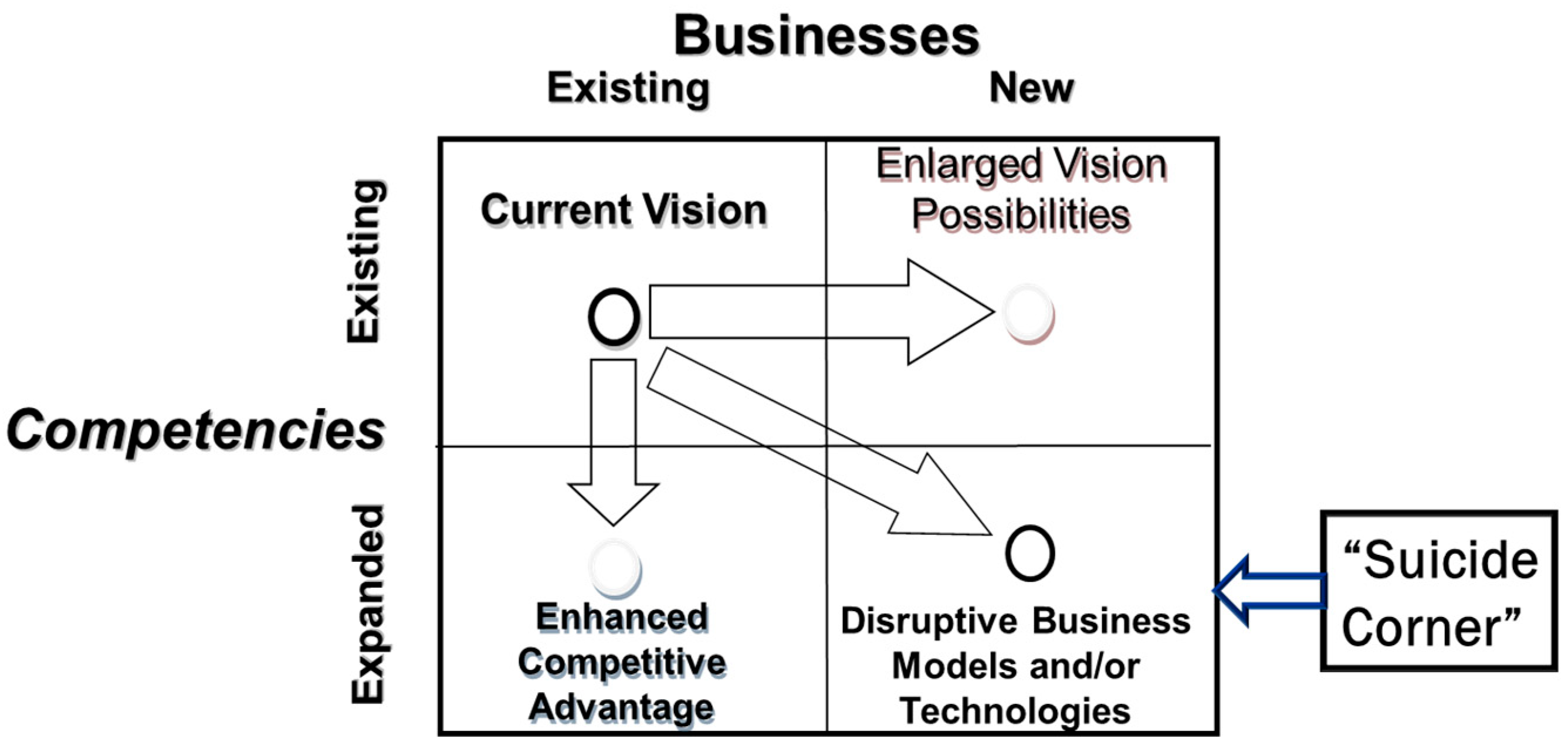
When organizations are in flux and the environment is volatile, the traditional approach of strategic advancement through adjacencies alone is likely to be inadequate. A traditional approach is to enhance competencies in order to retain or grow competitive advantage, or alternatively to employ existing competencies to enter new businesses. While identifying and exploiting adjacencies continues to be important, an organization in flux operating in a VUCA environment may very well find itself having to operate in what is evocatively termed the “suicide corner” (
Figure 3)—engaging in new businesses that require new competencies that the business does not possess.
If strategy requires harmonizing two entities that are both unstable, what provides viability, continuity, strategic alignment, and enduring value? What enables organizations to be resilient to survive, let alone flourish in the suicide corner?
This article argues that the central challenge is not simply to plan more rigorously or more often, but to reconceptualize what strategy is and how resilience is built. The core contribution is to position organizational identity, based on humanity, as an enduring construct that connects organization and environment in a VUCA context where, as we explain below, missions, strategies, structures, and even organizational boundaries become fluid and ephemeral.
4. Organizational Identity as the Strategic Connection in a VUCA World
While the challenge of defining strategy certainly is daunting, there are strategy axioms that hold regardless of whether the organization is stable or engaged in transformation, or whether the environment is stable or VUCA. These apodictic axioms are:
Axiom 1: “Vision”/“Purpose” is vital. Vision or purpose is the source of the organization’s “value proposition.” It is the foundation of the organization’s sustainability along all three dimensions—environmental, social, and economic. An aspirational vision or grand purpose takes on the character of a Big, Hairy, Audacious Goal (BHAG) (
Collins & Porras, 1996), which motivates creativity and innovation.
Axiom 2: Competencies are key. Competencies are the basis of competitive advantage. They drive strategy and are the determinant of a business’s profitability.
Corollary: It follows from these two axioms that the role of the CEO, board, and the C-suite, and the responsibility of strategic leadership is to:
Define an inspirational vision that is symbiotic with purpose and serves as a BHAG;
Identify the organization’s distinctive competencies, and to nurture and grow them;
Focus on developing human resources, because competencies that are distinctive, enduring and appropriable reside and grow in the intellect, not so much in physical facilities or technological superiority.
These strategy axioms and their corollary shines light on a construct—Organizational Identity—that promises to guide strategy and to endure through disruptions. Organizational identity has been conceptualized as what is central, distinctive, and enduring (
Albert & Whetten, 1985). This article advances the proposition that identity provides the most robust foundation for strategy in turbulent environments because it offers continuity amid transformation.
Identity is constituted by three enduring elements which align perfectly with the strategy axioms and corollary: (1) values (the organization’s guiding logic and stakeholder commitments), (2) competencies (the distinctive capabilities that ground advantage), and (3) aspirations (the stretch goals that drive search and innovation) (
Barney, 1991;
Cyert & March, 1963;
Prahalad & Hamel, 1990).
As environmental dynamism increases (
D’Aveni, 1994), complexity grows (
Camillus, 2008), and uncertainty expands (
Courtney et al., 1997), identity serves four strategic functions: sensemaking, decision coherence, stakeholder alignment, and transformation guidance. In this way, identity becomes the strategic connection linking organizational definition, managerial perceptions of the business environment, and the focus of strategic decision-making.
5. Resilience as Organizational Architecture
Resilience is commonly treated, in various disciplines, as the ability to recover from shocks (
Duchek, 2020;
Holling, 1973;
Weick & Sutcliffe, 2015;
Wildavsky, 1988). Recent work in finance similarly characterizes resilience as the ability of a system to recover from disturbances and restore functioning after adverse events (
Brunnermeier, 2024). Here, resilience is defined more strongly: the capacity to thrive
through disruption—both by recovering beyond the shock and by benefiting because of it.
This requires a logic, an architecture that integrates identity with systems for transformation, alliance-building, and learning. One such resilience logic is the “Business of Humanity” proposed by
Camillus et al. (
2017). The Business of Humanity integrates the two meanings of “humanity”: humankind (expanding the opportunity set by engaging underserved markets and stakeholder communities) and humaneness (evaluating strategies through values such as integrity, safety, quality, diversity, gender equity, environmental sustainability, and empathy).
In the age of AI the human touch becomes even more important. As
Naisbitt and Philips (
2001) argue, the higher the tech content the higher the need for the human touch. The greater the impact of AI, the greater the need for human considerations—both in terms of uniquely human capabilities (judgment, tacit knowledge, moral imagination) and humane orientation (dignity, fairness, care, particularly for vulnerable stakeholders). AI is non-human, but it is inescapably embedded in human systems: it reflects our data, enacts our incentives, and amplifies our choices. This is precisely why
hybrid intelligence is important and why humanity should be foregrounded as a core condition for resilient organizational architectures in an AI-intensive world.
The framework positions humanity as a generator of innovation, trust, and legitimacy. Identity-driven strategies that incorporate humaneness can strengthen resilience by reducing stakeholder conflict and improving legitimacy. Disruptions often increase inequality (
Piketty, 2014) expanding needs and wants at the base of the pyramid; strategies engaging underserved markets generate innovation and resilience (
Hart & Christensen, 2002;
Prahalad, 2006;
Prahalad & Hammond, 2002).
6. The Holy Trinity of Strategy and the Business of Humanity
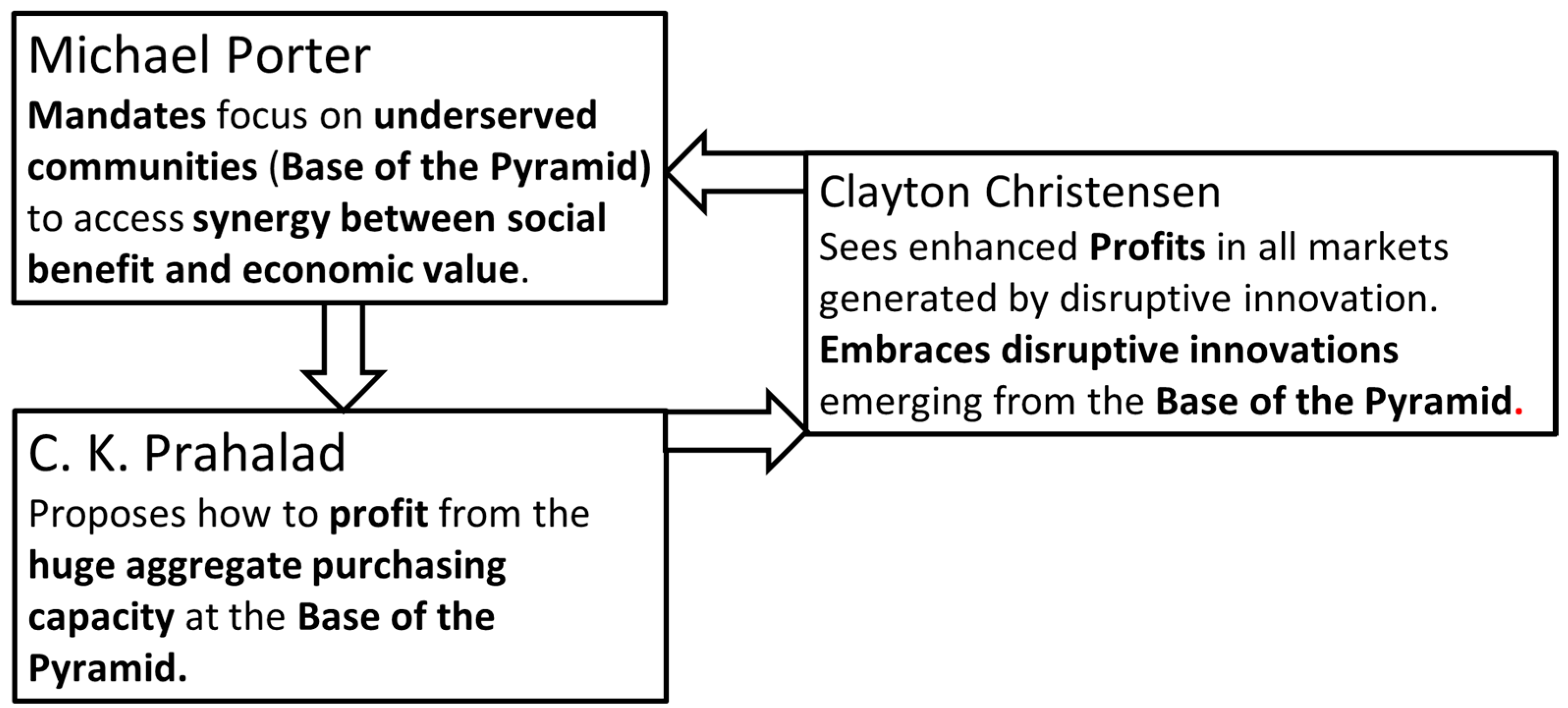
Business of Humanity strategies derive from the proposition that economic value and social benefit are synergistic goals. This proposition has independent support in the broader literature of strategic management. Affirmation of the proposition emerges when the arguments of three of the most influential thinkers in modern strategy, Michael Porter, C. K. Prahalad and Clayton Christensen, are synthesized. Taken together, their work forms a mutually reinforcing model linking societal benefit, innovation, and competitive advantage. Working independently and from quite different starting points, they arrived at conclusions that converge on the proposition. A synthesis of their relevant work constitutes what we might call the “holy trinity” of contemporary strategy thought, and the convergence of their three positions provides authoritative third-party validation for the argument that economic value and social benefit are synergistic rather than opposed.
Porter and Kramer (
2011) have argued through the past fifteen years that the strategic position of the firm is no longer separable from its engagement with the social conditions of the communities and environments in which it operates. Their formulation of creating shared value holds that corporations must address social needs not as peripheral philanthropy but as integral to competitive positioning. The implication, developed at length in their 2011
Harvard Business Review article, is that engagement with the social and environmental conditions surrounding the firm becomes a strategic necessity for sustained competitive advantage. The firm that ignores those conditions is not preserving margin; it is forgoing the redefinition of products, markets, and value chains that creates the next generation of competitive position. This is, in our terms, the Porter argument that humaneness scales into strategy.
Prahalad (
2006) demonstrated that an enormous aggregate purchasing power exists at what he called the base of the pyramid—the four billion people whose individual incomes are too small to interest conventional business analysis but whose collective economic activity, if products and services can be designed for their conditions, constitutes one of the largest market opportunities of the twenty-first century. Firms willing to innovate in affordability, access, and business model design can unlock multi-trillion-dollar markets while simultaneously improving the conditions of life for the populations they serve. This is the Prahalad argument that humankind is itself the largest opportunity space.
Hart and Christensen (
2002) developed a third leg of the argument. The demanding constraints of emerging and low-income markets—constraints of price, of infrastructure, of distribution, of regulatory environment—stimulate the creation of disruptive innovations. Products and processes designed for the base of the pyramid often outperform, on cost and on functional adequacy, the established solutions of advanced economies. When such innovations migrate upmarket, as Christensen had earlier shown they regularly do, they reshape competition in ways the incumbents had not anticipated. GE’s ultrasound and EKG machines developed in China and India, mobile-banking platforms developed in Kenya, telemedicine architectures developed for rural India illustrate how innovations born of base-of-pyramid constraints have created competitive advantage in up-scale markets.
Combine the three arguments (
Figure 4) and a single conclusion emerges. Porter says that engagement with social need is strategically necessary. Prahalad says that the largest market opportunities lie precisely in the underserved space where social need is most acute. Hart and Christensen say that the constraints of that space generate disruptive innovations that reshape competitive position upmarket. Engagement with the underserved is, in this synthesis, simultaneously a strategic imperative (Porter), a market opportunity (Prahalad), and a source of capability development (Hart and Christensen). It is not merely socially desirable. It is strategically advantageous. Engagement produces learning, capability, legitimacy, and technological breakthroughs that reshape competition in directions the firm could not have produced from inside its existing market position.
Porter, Prahalad, and Christensen together offer a strategy for transforming the “Suicide Corner” (see
Figure 3) into what might be appropriately labeled an “Opportunity Quadrant.”
This synthesis reaffirms the Business of Humanity thesis. Addressing humankind—the unmet need, the underserved space, the base of the pyramid—expands the firm’s opportunity horizon. Practicing humaneness—the empathic and ethical quality of relationships with the people the firm’s operations affect—strengthens the trust and the institutional support on which sustained engagement depends. Together, the two dimensions create a resilient competitive advantage of the kind the three thinkers, independently, have each described. The Holy Trinity of contemporary strategy, in other words, provides independent and authoritative validation that humanity and profitability are complements rather than tradeoffs.
The so-called holy trinity of contemporary strategy, in other words, provides independent and authoritative validation that humanity and profitability are complements rather than tradeoffs.
7. From Performance to Transformation: Managing the Tension
Organizations face a persistent tension between performance demands (efficiency, execution, single-loop learning) and transformation demands (innovation, reinvention, double-loop learning) (
Argyris, 1992). Identity helps resolve this tension by providing stable values and enduring aspirations that guide transformation even when competencies and domains must change (
Table 1).
8. Elements of Organizational Resilience
Drawing from the preceding discussion and from the literature and reports on alliances (
Kanter, 1994); design thinking (
Chowdhury, 2024); financial risk management (
Jorion, 1996); the Business of Humanity (
Camillus et al., 2017); feedforward systems (
Veliyath, 2025); innovation (
Olaleye et al., 2024;
Govindarajan & Trimble, 2012); power and hegemony (
Bates, 1975;
Nye, 2009); supply chain resilience (
Nikookar & Yanadori, 2022); human resources (
Georgescu et al., 2024); sustainability and ESG (
Wei, 2025;
Yang et al., 2026); and wicked problems (
Camillus, 2008), we identified logically connected elements that are important to organizational resilience. These elements are:
- ⮚
Explicit articulation of IDENTITY
- ⮚
Vision expressed as a BIG HAIRY AUDACIOUS GOAL (BHAG)
- ⮚
Planning as a DESIGN THINKING Process
- ⮚
MODULAR/AMBIDEXTROUS STRUCTURE
- ⮚
TRANSFORMATIONAL SCENARIOS
- ⮚
Application of SMART POWER
Ideational;
Bargaining;
Material.
- ⮚
ALIGNMENT with partners
Strategic;
Tactical;
Operational;
Interpersonal;
Cultural.
- ⮚
RISK MITIGATION
Supply chain;
Capital structure;
Technology;
Contingency plans.
- ⮚
PUBLIC PRIVATE PARTNERSHIPS
- ⮚
APPLICATION OF AN ESG Lens
- ⮚
Hybrid Innovation INTELLIGENCE ECOSYSTEM (Operations and Strategy)
- ⮚
Frugal INNOVATION
- ⮚
Evolving ARRAY OF INTERRELATED COMPETENCIES
Management development;
Upskilling;
Cross training;
Job Rotation across:
- ▪
SBUs;
- ▪
New ventures;
- ▪
Functional areas;
- ▪
Territories.
9. Key Result Areas and Design Vectors of Resilience
The identified elements were further analyzed to derive 22 Key Result Area (KRAs). The KRAs were employed to create a diagnostic tool that can be applied to organizations to determine where improvements can and need to be made to enhance organizational resilience. This Resilient Organizational Architecture Diagnostic (ROAD) tool is available at
https://pi.tt/ROAD (accessed on 9 May 2026). ROAD translates resilience architecture into assessable dimensions. By profiling strengths and gaps across the KRAs, ROAD supports executive prioritization and targeted interventions.
Over 300 respondents from organizations across different industries have completed the ROAD questionnaire, providing significant evidence of the utility of the tool. An LLM has been trained to conduct detailed and powerful ROAD analyses of organizations based on publicly available sources.
The logic underlying the KRAs form the basis for clustering them into three “vectors” that act on the organizational architecture (
Table 2). These three actionable vectors illuminate the foundations of organizational resilience that we have identified. The three vectors are:
Inspirational Transformative Ambition, which operationalizes identity into purpose and stretch aspirations that motivate disruptive innovation and coherence.
Innovative Value Networks, which acquire and coordinate capabilities through alliances and ecosystems, expanding the competency base required to function in new domains.
Hybrid Intelligence Ecosystems integrate human judgment with AI-driven capabilities, enabling scale and speed, mitigating risk, and enhancing interpretive capacity in wicked contexts.
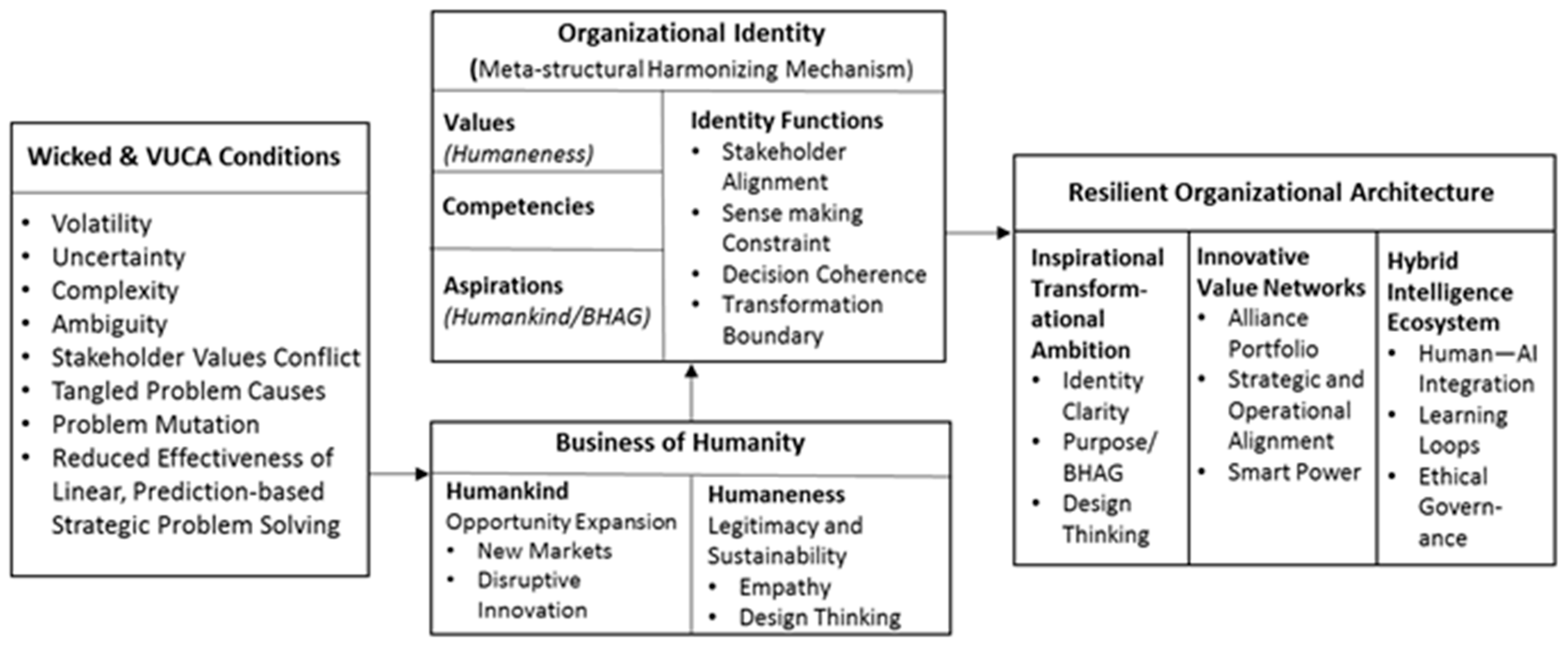
The logic sequence of our argument is that a
Wicked and VUCA Environment necessitates a response aligned with the
Business of Humanity, which finds expression in the construct of
Organizational Identity, which then shapes and informs the three vectors or pillars of
Resilient Organizational Architecture—Inspirational Transformative Ambition, Innovative Value Networks, and Hybrid Intelligence Ecosystems
Figure 5.
10. Implications for Research
This framework for resilience that can enable organizations to thrive through disruptions suggests several streams of research, including: (1) identity dynamics under disruption; (2) identity–environment coevolution; (3) improved resilience diagnostics; (4) resilience and performance relationship; (5) alliance governance and ideational alignment; and (6) conditions under which humaneness yields added resilience and profitability.
11. Conclusions
When disruptions cause missions, structures, and boundaries to become fluid and ambiguous, Identity serves as an anchor (values), a beacon (aspirations/BHAG), and a compass (competencies). In wicked VUCA conditions, strategy cannot be solved; it must be continually framed, tamed, and enacted through architectures that integrate transformative ambition, innovation ecosystems, and hybrid intelligence. The Business of Humanity and the combination of the dicta and insights of Michael Porter, C.K. Prahalad, and Clayton Christensen provide a unifying resilience logic: it expands opportunity (humankind) while strengthening legitimacy and trust (humaneness). Together, identity-based decisions and humanity-based strategy form a resilient response to the defining disruptions of our era.
Author Contributions
Conceptualization, J.C., K.A., C.G., A.L., R.M. and P.M.; Investigation, J.C., K.A., B.B., K.B., C.G., A.L. and P.M.; Data curation, C.G. and K.B.; Writing—original draft, J.C.; Writing—review & editing, J.C., K.A., B.B., K.B., C.G., A.L., R.M. and P.M.; Visualization, J.C., B.B. and P.M.; Project administration, K.B. and C.G. All authors have read and agreed to the published version of the manuscript.
Funding
This research received no external funding.
Institutional Review Board Statement
Not applicable.
Informed Consent Statement
Not applicable.
Data Availability Statement
No new data were created or analyzed in this study. Data sharing is not applicable to this article.
Conflicts of Interest
The authors declare no conflict of interest.
References
- Abell, D. (1980). Defining the business: The starting point of strategic planning. Prentice-Hall. [Google Scholar]
- Albert, S., & Whetten, D. (1985). Organisational identity. Research in Organisational Behavior, 7, 263–295. [Google Scholar]
- Andrews, K. (1971). The concept of corporate strategy. Dow Jones-Irwin. [Google Scholar]
- APQC. (1999). Turning strategy into action: Tools and techniques for implementing strategic plans. APQC. [Google Scholar]
- Argyris, C. (1992). On organizational learning. Blackwell. [Google Scholar]
- Barney, J. (1991). Firm resources and sustained competitive advantage. Journal of Management, 17(1), 99–120. [Google Scholar] [CrossRef]
- Bates, T. R. (1975). Gramsci and the theory of hegemony. Journal of the History of Ideas, 36(2), 351–366. [Google Scholar] [CrossRef]
- Brunnermeier, M. K. (2024). Presidential address: Macrofinance and resilience. The Journal of Finance, 79(6), 3683–3728. [Google Scholar] [CrossRef]
- Camillus, J. C. (2008). Strategy as a wicked problem. Harvard Business Review, 86(5), 98–106. [Google Scholar]
- Camillus, J. C., Bidanda, B., & Mohan, N. C. (2017). The business of humanity: Strategic management in the era of globalization, innovation, and shared value. Routledge. [Google Scholar]
- Camillus, J. C., Ramanadhan, S., & Ganapathy, K. (2021). Strategy in the time of pandemics, climate change and the Kurzweil Singularity. Journal of Strategy and Management, 14(3), 300–314. [Google Scholar] [CrossRef]
- Chandler, A. D. (1962). Strategy and structure. MIT Press. [Google Scholar]
- Chowdhury, A. (2024). Design thinking for resilience of human existence and disaster management. International Journal of Design and Allied Sciences, 3(2), 1–5. [Google Scholar] [CrossRef]
- Coase, R. H. (1937). The nature of the firm. Economica, 4(16), 386–405. [Google Scholar] [CrossRef]
- Collins, J. C., & Porras, J. I. (1996). Building your company’s vision. Harvard Business Review, 74(5), 65–77. [Google Scholar]
- Courtney, H., Kirkland, J., & Viguerie, P. (1997). Strategy under uncertainty. Harvard Business Review, 75(6), 67–79. [Google Scholar]
- Cyert, R., & March, J. G. (1963). A behavioral theory of the firm. Prentice-Hall. [Google Scholar]
- D’Aveni, R. (1994). Hypercompetition. Free Press. [Google Scholar]
- Duchek, S. (2020). Organizational resilience: A capability-based conceptualization. Business Research, 13, 215–246. [Google Scholar] [CrossRef]
- Fahey, L., & Randall, R. M. (Eds.). (1997). Learning from the future: Competitive foresight scenarios. Wiley. [Google Scholar]
- Freeman, R. E., Harrison, J. S., & Wicks, A. C. (2007). Managing for stakeholders. Yale University Press. [Google Scholar]
- Georgescu, I., Bocean, C. G., Vărzaru, A. A., Rotea, C. C., Mangra, M. G., & Mangra, G. I. (2024). Enhancing organizational resilience: The transformative influence of strategic human resource management practices and organizational culture. Sustainability, 16(10), 4315. [Google Scholar] [CrossRef]
- Govindarajan, V., & Trimble, C. (2012). Reverse innovation: Create far from home, win everywhere. Harvard Business Review Press. [Google Scholar]
- Hart, S. L., & Christensen, C. M. (2002). The great leap: Driving innovation from the base of the pyramid. MIT Sloan Management Review. [Google Scholar]
- Holling, C. S. (1973). Resilience and stability of ecological systems. Annual Review of Ecology and Systematics, 4, 1–23. [Google Scholar] [CrossRef]
- Jorion, P. (1996). Risk2: Measuring the risk in value at risk. Financial Analysts Journal, 52(6), 47–56. [Google Scholar] [CrossRef]
- Kanter, R. M. (1994). Collaborative advantage: The art of alliances. Harvard Business Review, 72(4), 96–108. [Google Scholar]
- Lawrence, P. R., & Lorsch, J. W. (1967). Organization and environment. Harvard Business School, Division of Research. [Google Scholar]
- Mills, D. Q. (1991). Rebirth of the corporation. Wiley. [Google Scholar]
- Naisbitt, J., & Philips, D. (2001). High tech high touch: Technology and our accelerated search for meaning. Nicholas Brealey Publishing. [Google Scholar]
- Nikookar, E., & Yanadori, Y. (2022). Preparing supply chain for the next disruption beyond COVID-19: Managerial antecedents of supply chain resilience. International Journal of Operations & Production Management, 42(1), 59–90. [Google Scholar]
- Nye, J. S. (2009). Get smart: Combining hard and soft power. Foreign Affairs, 88(4), 160–163. [Google Scholar]
- Olaleye, B. R., Lekunze, J. N., Sekhampu, T. J., Khumalo, N., & Ayeni, A. A. W. (2024). Leveraging innovation capability and organizational resilience for business sustainability among small and medium enterprises: A PLS-SEM approach. Sustainability, 16(21), 9201. [Google Scholar] [CrossRef]
- Piketty, T. (2014). Capital in the twenty-first century (A. Goldhammer, Trans.). Belknap Press. [Google Scholar]
- Porter, M. E., & Kramer, M. R. (2011). Creating shared value. Harvard Business Review. [Google Scholar]
- Prahalad, C. K. (2006). The fortune at the bottom of the pyramid. Wharton School Publishing. [Google Scholar]
- Prahalad, C. K., & Hamel, G. (1990). The core competence of the corporation. Harvard Business Review, 68(3), 79–91. [Google Scholar]
- Prahalad, C. K., & Hammond, A. (2002). Serving the world’s poor, profitably. Harvard Business Review, 80(9), 48–57. [Google Scholar]
- Rittel, H. W. J., & Webber, M. M. (1973). Dilemmas in a general theory of planning. Policy Sciences, 4(2), 155–169. [Google Scholar] [CrossRef]
- Rumelt, R. (1974). Strategy, structure and economic performance. Harvard University. [Google Scholar]
- Thompson, J. D. (1967). Organizations in action. McGraw-Hill. [Google Scholar]
- Veliyath, R. (2025). Does a feedforward orientation provide competitive advantages under disruptive conditions? A review of control literature with an illustrative case. Administrative Sciences, 15(1), 13. [Google Scholar] [CrossRef]
- Wei, Y.-M. (2025). A framework for sustainability-aligned business development across sectors: A design science approach. World, 6(4), 153. [Google Scholar] [CrossRef]
- Weick, K. E., & Sutcliffe, K. M. (2015). Managing the unexpected. Wiley. [Google Scholar]
- Wildavsky, A. (1988). Searching for safety. Routledge. [Google Scholar]
- Williamson, O. E. (1981). The economics of organization: The transaction cost approach. American Journal of Sociology, 87(3), 548–577. [Google Scholar] [CrossRef] [PubMed]
- Yang, J., Wang, J., & Wang, J. (2026). ESG performance, innovation capability and organizational resilience under environmental uncertainty: Evidence from China. Sustainability, 18(6), 2806. [Google Scholar] [CrossRef]
| Disclaimer/Publisher’s Note: The statements, opinions and data contained in all publications are solely those of the individual author(s) and contributor(s) and not of MDPI and/or the editor(s). MDPI and/or the editor(s) disclaim responsibility for any injury to people or property resulting from any ideas, methods, instructions or products referred to in the content. |



 ,
,