When AI Fairness Shapes Creativity: The Mediating Role of Attitudes Toward AI Across Gender

Abstract
1. Introduction
2. Theoretical Framework
2.1. Fairness and Creativity in AI Contexts
2.2. Perceived AI Fairness, Gender and Attitudes Toward AI
2.3. Attitudes Toward AI and Creativity
2.4. The Mediating of Attitudes Toward AI
3. Materials and Methods
3.1. Procedure and Data Collection
3.2. Ethical Considerations
3.3. Measures
3.4. Analysis Method
4. Results
4.1. Measurement Assessment
4.2. Hypotheses Testing
5. Discussion
5.1. Theoretical Implications
5.2. Managerial Implications
5.3. Limitations and Future Directions
6. Conclusions
Funding
Institutional Review Board Statement
Informed Consent Statement
Data Availability Statement
Conflicts of Interest
Abbreviations
| PLS-SEM | Partial Least Squares Structural Equation Modeling |
| SET | Social Exchange Theory |
| TAM | Technology Acceptance Model |
| AAI | Attitudes toward AI |
| PAF | Perceived AI Fairness |
| CR | Creativity |
| 1 | Item 3 from PAF; item 5 from AAI and item 7 from creativity constructs. |
References
- Adams, J. S. (1963). Towards an understanding of inequity. The Journal of Abnormal and Social Psychology, 67(5), 422–436. [Google Scholar] [CrossRef] [Scilit]
- Amabile, T. M. (1996). Creativity in context. Westview Press. [Google Scholar]
- Amabile, T. M., & Pratt, M. G. (2016). The dynamic componential model of creativity and innovation in organizations: Making progress, making meaning. Research in Organizational Behavior, 36, 157–183. [Google Scholar] [CrossRef] [Scilit]
- Amari, A. (2023). Which kind of perceived organisational support fosters self-initiated expatriate engineers’ creativity in high-adversity contexts? The moderating role of cross-cultural resilience. Cogent Business & Management, 10(3), 2259150. [Google Scholar]
- Amari, A. (2024). Expatriate academics’ positive affectivity and its influence on creativity in the workforce indigenization context: Revealing the role of perceived fairness. Administrative Sciences, 14(5), 92. [Google Scholar] [CrossRef] [Scilit]
- Amari, A., Berraies, S., Alshahrani, S. T., Hofaidhllaoui, M., & Choukir, J. (2024). Does the overall justice climate enhance self-initiated expatriates’ creativity during uncertain times? The mediating role of cross-cultural psychological capital. Journal of Global Mobility, 12(1), 147–166. [Google Scholar] [CrossRef] [Scilit]
- Amari, A., Berraies, S., & Hofaidhllaoui, M. (2026). Does expatriates’ cross-cultural psychological capital mediate the link between ethical organisational climate and turnover intention? A generational cohort comparison. European Journal of International Management, 29(1), 22–47. [Google Scholar] [CrossRef] [Scilit]
- Ambrose, M. L., & Schminke, M. (2009). The role of overall justice judgments in organizational research: A test of mediation. Journal of Applied Psychology, 94(2), 491–500. [Google Scholar] [CrossRef] [Scilit] [PubMed]
- Bankins, S., Ocampo, A. C., Marrone, M., Restubog, S. L. D., & Woo, S. E. (2024). A multilevel review of artificial intelligence in organizations: Implications for organizational behavior research and practice. Journal of Organizational Behavior, 45(2), 159–182. [Google Scholar] [CrossRef] [Scilit]
- Boussioux, L., Lane, J. N., Zhang, M., Jacimovic, V., & Lakhani, K. R. (2024). The crowdless future? Generative AI and creative problem solving. Organization Science, 35(5), 1589–1607. [Google Scholar] [CrossRef] [Scilit]
- Brem, A., & Hörauf, D. (2025). ‘Artificial creativity?’ AI’s short- and long-term impact on creativity. Research Technology Management, 68(2), 54–58. [Google Scholar] [CrossRef] [Scilit]
- Cascio, J. (2020). Facing the age of chaos: The BANI framework. Available online: https://medium.com/@cascio/facing-the-age-of-chaos-b00687b1f51d (accessed on 26 January 2026).
- Colquitt, J. A., Conlon, D. E., Wesson, M. J., Porter, C. O., & Ng, K. Y. (2001). Justice at the millennium: A meta-analytic review of 25 years of organizational justice research. Journal of Applied Psychology, 86(3), 425–445. [Google Scholar] [CrossRef] [Scilit]
- Colquitt, J. A., Hill, E. T., & De Cremer, D. (2023). Forever focused on fairness: 75 years of organizational justice in Personnel Psychology. Personnel Psychology, 76, 413–435. [Google Scholar] [CrossRef] [Scilit]
- Colquitt, J. A., Scott, B. A., Rodell, J. B., Long, D. M., Zapata, C. P., Conlon, D. E., & Wesson, M. J. (2013). Justice at the millennium, a decade later: A meta-analytic test of social exchange and affect-based perspectives. Journal of Applied Psychology, 98(2), 199–236. [Google Scholar] [CrossRef] [Scilit]
- Cropanzano, R., Anthony, E. L., Daniels, S. R., & Hall, A. V. (2017). Social exchange theory: A critical review with theoretical remedies. The Academy of Management Annals, 11, 479–516. [Google Scholar] [CrossRef] [Scilit]
- Cropanzano, R., Bowen, D. E., & Gilliland, S. W. (2007). The management of organizational justice. Academy of Management Perspectives, 21(4), 34–48. [Google Scholar] [CrossRef] [Scilit]
- Cropanzano, R., & Mitchell, M. S. (2005). Social exchange theory: An interdisciplinary review. Journal of Management, 31(6), 874–900. [Google Scholar] [CrossRef] [Scilit]
- Daly, S. J., Wiewiora, A., & Hearn, G. (2025). Shifting attitudes and trust in AI: Influences on organizational AI adoption. Technological Forecasting & Social Change, 215, 124108. [Google Scholar]
- Davis, F. D. (1989). Perceived usefulness, perceived ease of use, and user acceptance of information technology. MIS Quarterly, 13(3), 319–340. [Google Scholar] [CrossRef] [Scilit]
- DiClaudio, M. (2019). People analytics and the rise of HR: How data, analytics and emerging technology can transform human resources (HR) into a profit center. Strategic HR Review, 18(2), 42–46. [Google Scholar] [CrossRef] [Scilit]
- Dong, X., Tian, Y., He, M., & Wang, T. (2025). When knowledge workers meet AI? The double-edged sword effects of AI adoption on innovative work behavior. Journal of Knowledge Management, 29(1), 113–147. [Google Scholar] [CrossRef] [Scilit]
- Doshi, A. R., & Hauser, O. P. (2024). Generative AI enhances individual creativity but reduces the collective diversity of novel content. Science Advances, 10(28), eadn5290. [Google Scholar] [CrossRef] [Scilit]
- Eapen, T. T., Finkenstadt, D. J., Folk, J., & Venkataswamy, L. (2023). How generative AI can augment human creativity. Harvard Business Review, 101, 56–64. [Google Scholar] [CrossRef] [Scilit]
- Edmondson, A. C. (1999). Psychological safety and learning behavior in work teams. Administrative Science Quarterly, 44(2), 350–383. [Google Scholar] [CrossRef] [Scilit]
- El Achi, S., Aoun, D., Lahad, W., & Jabbour Al Maalouf, N. (2026). Employee comfort with AI-driven algorithmic decision-making: Evidence from the GCC and Lebanon. Administrative Sciences, 16(1), 49. [Google Scholar] [CrossRef] [Scilit]
- Fornell, C., & Larcker, D. F. (1981). Evaluating structural equation models with unobservable variables and measurement error. Journal of Marketing Research, 18(1), 39–50. [Google Scholar] [CrossRef] [Scilit]
- Gallup Survey. (2025). Frequent AI use in the workplace continues to climb in Q4 2025. Available online: https://www.gallup.com (accessed on 11 January 2026).
- Grilli, L., & Pedota, M. (2024). Creativity and artificial intelligence: A multilevel perspective. Creativity and Innovation Management, 33(2), 234–247. [Google Scholar] [CrossRef] [Scilit]
- Hair, J., Howard, M. C., & Nitzl, C. (2020). Assessing measurement model quality in PLS-SEM using confirmatory composite analysis. Journal of Business Research, 109, 101–110. [Google Scholar] [CrossRef] [Scilit]
- Hair, J. F., Hult, G. T. M., Ringle, C., & Sarstedt, M. (2017). A primer on partial least squares structural equation modeling (PLS-SEM) (2nd ed.). Sage. [Google Scholar]
- Hechler, F. C., Tuomainen, O., & Caruana, N. (2025). Autistic traits, gender and age interact to influence attitudes towards artificial intelligence. Computers in Human Behavior Reports, 20, 100847. [Google Scholar] [CrossRef] [Scilit]
- Henseler, J., Ringle, C. M., & Sarstedt, M. (2015). A new criterion for assessing discriminant validity in variance-based structural equation modeling. Journal of the Academy of Marketing Science, 43(1), 115–135. [Google Scholar] [CrossRef] [Scilit]
- Hofstede, G., Hofstede, G. J., & Minkov, M. (2010). Cultures and organizations: Software of the mind (3rd ed.). McGraw-Hill. [Google Scholar]
- Ivcevic, Z., & Grandinetti, M. (2024). Artificial intelligence as a tool for creativity. Journal of Creativity, 34, 100079. [Google Scholar] [CrossRef] [Scilit]
- Jecker, N. S., & Nakazawa, E. (2022). Bridging east–west differences in ethics guidance for AI and robotics. AI, 3(3), 764–777. [Google Scholar] [CrossRef] [Scilit]
- Khoso, A. K., Honggang, W., & Darazi, M. A. (2026). Trust and attitude towards AI as pathways to creativity: A TAM model study of EFL students’ digital literacy and AI acceptance. Humanities and Social Sciences Communications, 13, 69. [Google Scholar] [CrossRef] [Scilit]
- Koenig, P. D. (2025). Attitudes toward artificial intelligence: Combining three theoretical perspectives on technology acceptance. AI & Society, 40, 1333–1345. [Google Scholar]
- Köchling, A., Wehner, M. C., & Ruhle, S. A. (2025). This (AI)n’t fair? Employee reactions to artificial intelligence (AI) in career development systems. Review of Managerial Science, 19(4), 1195–1228. [Google Scholar] [CrossRef] [Scilit]
- Lichtenthaler, U. (2020). Extending the technology acceptance model to explain the acceptance of artificial intelligence. Journal of Business Research, 124, 197–207. [Google Scholar]
- Ma, L., Ge, L., Li, Y., & Wang, Y. (2026). When employees meet generative AI: The double-edged effects of AI attitude on creativity. Technovation, 152, 103495. [Google Scholar] [CrossRef] [Scilit]
- Marocco, A., Dupont, L., & Singh, R. (2025). Attitudes toward artificial intelligence: Trends, predictors, and implications. Journal of Artificial Intelligence Research, 58(2), 123–145. [Google Scholar]
- Papagiannidis, E., Enholm, I. M., Dremel, C., Mikalef, P., & Krogstie, J. (2023). Toward AI governance: Identifying best practices and potential barriers and outcomes. Information Systems Frontiers, 25(1), 123–141. [Google Scholar] [CrossRef] [Scilit]
- Park, J., Woo, S. E., & Kim, J. (2024). Attitudes towards artificial intelligence at work: Scale development and validation. Journal of Occupational and Organizational Psychology, 97, 920–951. [Google Scholar] [CrossRef] [Scilit]
- Podsakoff, P. M., MacKenzie, S. B., & Podsakoff, N. P. (2012). Sources of method bias in social science research and recommendations on how to control it. Annual Review of Psychology, 63, 539–569. [Google Scholar] [CrossRef] [Scilit]
- Raisch, S., & Krakowski, S. (2021). Artificial intelligence and management: The automation–augmentation paradox. Academy of Management Review, 46(1), 192–210. [Google Scholar] [CrossRef] [Scilit]
- Rodríguez Espíndola, O., Chowdhury, S., Dey, P. K., Albores, P., & Emrouznejad, A. (2022). Analysis of the adoption of emergent technologies for risk management in the era of digital manufacturing. Technological Forecasting & Social Change, 178, 21562. [Google Scholar]
- Runco, M. A. (2023). AI can only produce artificial creativity. The Journal of Creative Behavior, 33(3), 100063. [Google Scholar] [CrossRef] [Scilit]
- Savall, H., & Zardet, V. (1995). Maîtriser les coûts et les performances cachés: Le contrat d’activité périodiquement négociable. Economica. [Google Scholar]
- Savolainen, I., Ylinen, L., Grönroos, R., & Oksanen, A. (2026). AI transformation in working life: A systematic review of usage and attitudes towards AI among workers. Digital Business, 6(1), 100162. [Google Scholar] [CrossRef] [Scilit]
- Schepman, A., & Rodway, P. (2020). Initial validation of the General Attitudes towards Artificial Intelligence Scale. Computers in Human Behavior Reports, 1, 100014. [Google Scholar] [CrossRef] [Scilit]
- Schepman, A., & Rodway, P. (2023). The general attitudes towards artificial intelligence scale (GAAIS): Confirmatory validation and associations with personality, corporate distrust, and general trust. International Journal of Human-Computer Interaction, 39, 2724–2741. [Google Scholar] [CrossRef] [Scilit]
- Sun, S., Li, Z. A., Foo, M. D., Zhou, J., & Lu, J. G. (2025). How and for whom using generative AI affects creativity: A field experiment. Journal of Applied Psychology, 110(12), 1561–1573. [Google Scholar] [CrossRef] [Scilit]
- Tambe, P., Cappelli, P., & Yakubovich, V. (2019). Artificial intelligence in human resources management: Challenges and a path forward. California Management Review, 61(4), 15–42. [Google Scholar] [CrossRef] [Scilit]
- Tong, H., Yu, J., & Shou, M. (2025). Mitigating the effect of AI anxiety on employees’ creativity: A social cognitive perspective. Journal of Digital Management, 1, 7. [Google Scholar] [CrossRef] [Scilit]
- Tran Pham, T. K. (2023). Organization justice, knowledge sharing and employees’ innovative behavior: Evidence from the knowledge-intensive industry. Employee Relations: The International Journal, 45(6), 1492–1510. [Google Scholar] [CrossRef] [Scilit]
- Wang, R., Zhang, Z., Zhao, W., Li, S. B., & Pan, Y. (2025). Exploring the relationship between generative AI usage and employee creativity: A dual-pathway mediation model. European Journal of Innovation Management, 29, 799–823. [Google Scholar] [CrossRef] [Scilit]
- West, S. M., Whittaker, M., & Crawford, K. (2019). Discriminating systems: Gender, race and power in AI. AI Now Institute, New York University. [Google Scholar]
- World Economic Forum. (2024). Annual report 2023–2024. Available online: https://www.weforum.org/publications/annual-report-2023-2024 (accessed on 25 March 2026).
- Yoo, J. (2025). Employee intention and resistance to AI policies: Perceived injustice, moral outrage, and social influence from an activity theory perspective. Behaviour & Information Technology, 1–27. [Google Scholar] [CrossRef] [Scilit]
- Zhang, X., & Bartol, K. M. (2010). Linking empowering leadership and employee creativity: The influence of psychological empowerment, intrinsic motivation, and creative process engagement. Academy of Management Journal, 53(1), 107–128. [Google Scholar] [CrossRef] [Scilit]
- Zhou, J., & George, J. M. (2001). When job dissatisfaction leads to creativity: Encouraging the expression of voice. Academy of Management Journal, 44(4), 682–696. [Google Scholar]
- Zhou, Y., Yusof, R., Thurasamy, R., Li, X., Zhang, P., & Ling, S. (2026). How organizational justice shapes innovative work behavior: Work engagement as mediator and authentic leadership as moderator in China’s ICT sector. Acta Psychologica, 245, 104180. [Google Scholar]



| Characteristics | Frequency (N = 214) | Percentage |
|---|---|---|
| Gender | ||
| Men | 103 | 48.1% |
| Women | 111 | 51.9% |
| Age | ||
| Less than 29 | 27 | 12.6% |
| Between 30–44 | 117 | 54.7% |
| Between 45–60 | 66 | 30.8% |
| More than 60 | 4 | 1.9% |
| Marital Status | ||
| Married | 154 | 72% |
| Single | 50 | 23.4% |
| Divorced | 9 | 4.2% |
| Other | 1 | 0.5% |
| Education | ||
| Undergraduate | 12 | 5.6% |
| Graduate | 74 | 34.6% |
| Master and above | 128 | 59.8% |
| Nationalities | ||
| North Africa | 101 | 47.1% |
| Middle East | 84 | 39.2% |
| Asia | 17 | 8% |
| Europe | 10 | 4.7% |
| North America | 2 | 1% |
| Occupation field | ||
| Education | 81 | 37.9% |
| Engineering | 52 | 24.3% |
| Business | 38 | 17.8% |
| Healthcare | 12 | 5.6% |
| Hospitality | 11 | 5.1% |
| Other | 20 | 9.3% |
| Constructs | Number of Items Retained | Range of Loadings | AVE | ||
|---|---|---|---|---|---|
| AAI | 7 | 0.719–0.834 | 0.773 | 0.732 | 0.611 |
| CR | 6 | 0.796–0.85 | 0.907 | 0.914 | 0.683 |
| PAF | 5 | 0.820–0.925 | 0.808 | 0.924 | 0.545 |
| AAI | CR | PAF | Square Root of AVE | |
|---|---|---|---|---|
| AAI | 1 | 0.781 | ||
| CR | 0.386 | 1 | 0.826 | |
| PAF | 0.290 | 0.224 | 1 | 0.738 |
| AAI | CR | |
|---|---|---|
| R2 | 0.109 | 0.143 |
| Paths coefficients (CR) | ||
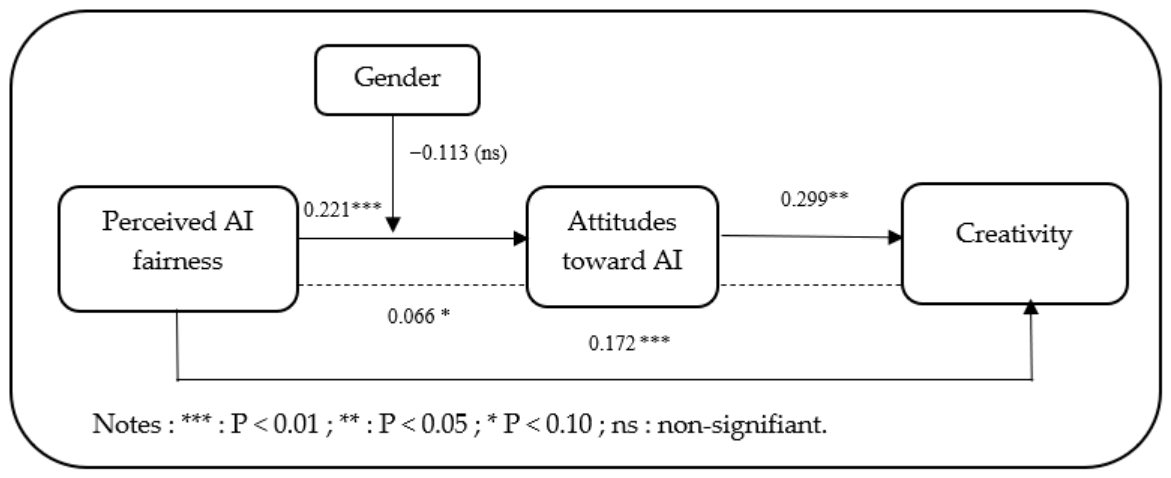
| PAF | 0.221 (2.535) | 0.172 (2.012) |
| AAI | - | 0.299 (4.084) |
| Gender × PAF | −0.113 (1.395) | - |
| From | To | Effects | Effects (Bootstrap) | Lower Bound (95%) | Upper Bound (95%) | |
|---|---|---|---|---|---|---|
| Specific indirect effects | PAF | CR | 0.066 | 0.078 | 0.011 | 0.116 |
Disclaimer/Publisher’s Note: The statements, opinions and data contained in all publications are solely those of the individual author(s) and contributor(s) and not of MDPI and/or the editor(s). MDPI and/or the editor(s) disclaim responsibility for any injury to people or property resulting from any ideas, methods, instructions or products referred to in the content. |
© 2026 by the author. Licensee MDPI, Basel, Switzerland. This article is an open access article distributed under the terms and conditions of the Creative Commons Attribution (CC BY) license.
Share and Cite
Amari, A. When AI Fairness Shapes Creativity: The Mediating Role of Attitudes Toward AI Across Gender. Adm. Sci. 2026, 16, 234. https://doi.org/10.3390/admsci16050234
Amari A. When AI Fairness Shapes Creativity: The Mediating Role of Attitudes Toward AI Across Gender. Administrative Sciences. 2026; 16(5):234. https://doi.org/10.3390/admsci16050234
Chicago/Turabian StyleAmari, Amina. 2026. "When AI Fairness Shapes Creativity: The Mediating Role of Attitudes Toward AI Across Gender" Administrative Sciences 16, no. 5: 234. https://doi.org/10.3390/admsci16050234
APA StyleAmari, A. (2026). When AI Fairness Shapes Creativity: The Mediating Role of Attitudes Toward AI Across Gender. Administrative Sciences, 16(5), 234. https://doi.org/10.3390/admsci16050234