Article

Financial Education and Micro-Business Performance: Mediating Role of Financial Inclusion in the Digital Age of Micro-Business in the Capital of Peru

by
Jorge Lozano-Taricuarima
1,
Elizabeth Emperatriz García-Salirrosas
2,
Dany Yudet Millones-Liza
3 and
Miluska Villar-Guevara
4,*
1
Unidad de Posgrado de Ciencias Empresariales, Escuela de Posgrado, Universidad Peruana Unión, Lima 15102, Peru
2
Faculty of Management Science, Universidad Autónoma del Perú, Lima 15842, Peru
3
Universidad Tecnológica del Perú, Lima 15487, Peru
4
Escuela Profesional de Administración, Facultad de Ciencias Empresariales, Universidad Peruana Unión, Juliaca 21100, Peru
*
Author to whom correspondence should be addressed.
Adm. Sci. 2026, 16(5), 231; https://doi.org/10.3390/admsci16050231

Submission received: 5 March 2026 / Revised: 28 April 2026 / Accepted: 30 April 2026 / Published: 15 May 2026

Abstract

Economic challenges are a latent reality in emerging economies such as Peru, and the growth capacity of entrepreneurs depends largely on certain factors, such as education and financial inclusion. To delve deeper into these factors, this study aims to analyze the association between micro-business performance, education, and financial inclusion, as well as to evaluate the mediating role of financial inclusion in the association between financial education and micro-business performance. The study was of an explanatory design. The research focused on owners, business owners, general managers, and other administrators of micro-businesses who could provide information on the performance of the companies. The results showed a statistically significant positive association between micro-business performance, education, and financial inclusion. It was also proven that financial inclusion is positively associated with micro-business performance, and it was also proven that financial inclusion has a mediating role in the association between financial education and micro-business performance. While these relationships are meaningful, the moderate explanatory power of the model (R2 = 0.370–0.488) suggests that financial education and financial inclusion are important but partial contributors to business outcomes in this context. In conclusion, entrepreneurs with stronger financial knowledge appear to be better positioned to navigate business challenges and leverage financial systems, which may contribute to improved micro-business performance indicators.

1. Introduction

The evolution, implementation, and development of financial education have been topics of interest in the scientific community and among illustrious professionals in the sector, and there have been several changes and developments over time. Initially, financial education focused on conveying information about basic financial products (Tang & Baker, 2016). However, as it has evolved, there has been a shift towards a focus more on empowering individuals to make informed financial decisions (Hasan et al., 2023). The importance of developing practical financial skills that enable people to manage their finances effectively throughout their lives is recognized (Méndez-Prado et al., 2023).
Technology has played a significant role in the evolution of financial education. The scientific literature highlights how online platforms, mobile applications, and other technological tools have been used to make financial education more accessible and engaging (Cruz et al., 2026; Villar-Guevara et al., 2025). Gamification and the use of virtual simulators are examples of technological approaches that have been implemented to enhance engagement and learning (Rahayu & Rahmawati, 2022). In that sense, initiatives have been developed at the international level to address global financial issues and improve financial education in different parts of the world (T. Q. Long et al., 2023).
Financial education, financial inclusion, and micro-business performance are interrelated in several ways, and their association can have a significant impact on business, welfare, and the overall economy (Sajuyigbe et al., 2020; Shihadeh, 2020; Tumba et al., 2022). Financial education at the personal level can contribute to the financial stability of individuals, which, in turn, can have a positive impact on micro-business performance. Recent studies confirm that employees who manage their personal finances well may be more productive and less prone to distractions related to financial problems (Rani & Sundaram, 2023).
Micro-businesses for the Peruvian economy have played an important role in the socioeconomic development of the country (Fernandez & Schroeder, 2023; Lucas-Alvarado et al., 2025). Among their main characteristics are size and structure, flexibility and adaptability, sector of activity, financing, technology and training, and contribution to the economy (Hong, 2023). On the other hand, an emerging economy is a country that is transitioning to a higher level of economic development and industrialization, showing rapid economic growth and improving living standards, while still facing significant structural and social challenges (Goggin & Villanueva-Mansilla, 2024; Hong, 2023). As such, when describing an emerging economy, Peru continues to take a significant place given that it has taken advantage of its natural resources and implemented sound macroeconomic policies to drive its development (Fernandez & Schroeder, 2023; Murrieta-Oquendo & De la Vega, 2023). However, to ensure sustained and equitable growth, it will be crucial to address the country’s challenges and foster greater economic diversification (Heredia et al., 2019). In this regard, the “Ministerio de Economía y Finanzas” reported that Peru closed 2021 as one of the strongest economies among emerging countries and one of the best in the region (MEF, 2021).
At the macroeconomic level, financial inclusion contributes to economic stability by enabling more people and businesses to actively participate in the economy. This can lead to more equitable and sustainable economic growth. As such, financial education and financial inclusion are directly related to micro-business performance at the individual level and contribute to overall economic development. By improving financial skills at the personal and business level, a healthier and more sustainable business environment can be fostered. In addition, financial inclusion broadens access to financial resources, benefiting businesses of all sizes (Lontchi et al., 2022; Shapoval et al., 2021). In this sense, this study supports the importance of recent efforts to deepen the literature on emerging economies, as suggested by some scientific reports (Auclert et al., 2021; Oskolkov, 2023; Villalvazo, 2024; Zhou, 2022).
While there is significant academic interest in exploring the variables under study, research has been predominantly conducted in countries with African, Asian, and European economies (Anthanasius Fomum & Opperman, 2023; Febriansyah et al., 2024; Lestari et al., 2025), leaving Latin American contexts, specifically Peru, unexplored. Studies conducted in other contexts have examined these constructs in isolation in other demographic groups, such as women entrepreneurs (Lestari et al., 2025), and in settings such as microenterprises in slums (Ghosh & Guha, 2014) and microenterprises in the municipality of Ghana (Tia et al., 2023), without modeling the role of financial inclusion in the relationship between financial literacy and micro-business performance.
For example, Febriansyah et al. (2024) demonstrated that the variance in business performance is not explained by financial inclusion in isolation, while Batee et al. (2025) confirmed the mediating role of financial access without considering financial education as a prerequisite in Latin American contexts. This difference defines an explanation of reality in diverse environments, demonstrating that the dynamics between financial education, financial inclusion, and business performance respond to particular institutional, cultural, and economic conditions that cannot be generalized. Therefore, this reality may vary in scenarios where there are markets with high informality, such as Peru, where micro-business predominate with limited access to digital financial services, constituting a theoretical and empirical gap that the present study seeks to address, proposing as a study objective to analyze the association between micro-business performance, education and financial inclusion, as well as to evaluate the mediating role of financial inclusion in the association between financial education and micro-business performance.

2. Theoretical Framework and Hypothesis Development

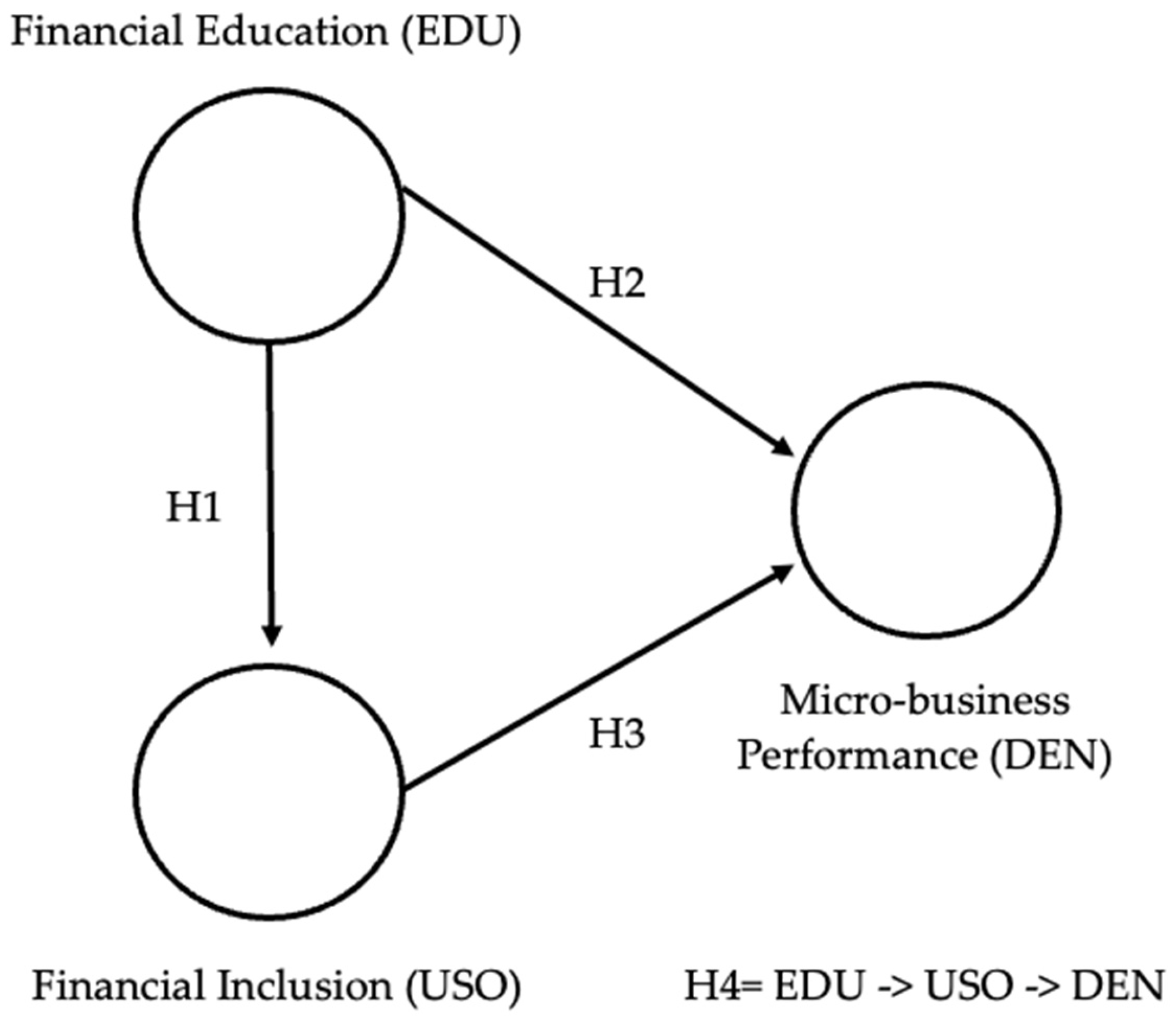
The dynamics of this study are supported by the integration of human capital theory, which posits that financial education enables the development of cognitive and practical skills in entrepreneurs (H1, H2); intermediation theory, which explains how financial intermediaries, including banks and cooperatives, reduce barriers to accessing financial services and promote financial inclusion (H3, H4); and stakeholder theory, which broadens the understanding of business performance based on its economic and social environment (H3, H4). These three theories are fundamental to the dynamics of the variables and the development of hypotheses presented in this section.

2.1. Financial Education

Financial education is considered an essential skill needed to thrive in today’s business and society (Fachrurazi et al., 2023; Hasan et al., 2023). This is a process in which individuals acquire the skills and abilities to operate in the financial market, enabling them to gain various benefits, including access to financial products, a renewed understanding of the economy, and access to better investment opportunities (C. Long & Lin, 2018). Also considered is the capacity and ability to apply knowledge and understanding of financial concepts to make good business decisions in diverse financial environments (Callis et al., 2023; Hogarth & Hilgert, 2002). It is often considered a form of human capital. Financially literate people learn to organize their finances better and manage day-to-day expenses more effectively, maintain sufficient reserves or savings to cover emergencies or contingencies, set aside a certain percentage of their income for education, and stay healthy and enjoy the years off after a stressful retirement (Choudhary & Jain, 2023; Suparno et al., 2023).

2.2. Financial Inclusion

Financial inclusion refers to equitable access to and participation in financial services for all population groups (Mukherjee & Sood, 2020), enabling individuals and businesses to use a broad range of financial products, such as savings, payments, insurance, and credit, under fair and non-discriminatory conditions (Khan et al., 2022; Shihadeh, 2020). This concept is essential for fostering economic participation, expanding opportunities, and improving financial well-being across societies (Cardona et al., 2018; Hewa et al., 2021; Mohamud & Mohamed, 2023), as limited access to financial services constrains individuals’ capacity to save, invest, and manage risks effectively (Mukherjee & Sood, 2020). Moreover, recent evidence highlights the pivotal role of financial education in promoting financial inclusion, acting both as a predictor and as a moderating and mediating factor of financial behavior (Garz et al., 2021). In this context, financial inclusion contributes to poverty reduction, sustainable economic development, and social equity. In contrast, policy interventions, such as fintech promotion, financial education, process simplification, and equitable access, are crucial for its advancement and measurement (Fachrurazi et al., 2023; Garz et al., 2021; Hasan et al., 2023). Financial inclusion maintains a theoretical foundation in Financial Intermediation Theory (Diamond, 1984) which focuses on the role assumed by financial intermediaries such as banks, cooperatives and FinTech platforms as agents that allow access to financial services, becoming a systemic mechanism that allows connecting micro-entrepreneurs with a broad economic opportunity that improves market efficiency, promotes greater economic stability by allocating resources appropriately and facilitates investment and consumption (Chatterjee et al., 2024; Wanniarachchige et al., 2017).

2.3. Micro-Business Performance

Micro-business performance responds to how the business is operating, what results it has obtained, and how the overall performance has been over a period of time (Aisjah et al., 2023; Iramani et al., 2018). Meanwhile, a good entrepreneurial attitude builds a more competitive business (Iramani et al., 2018); in other words, entrepreneurs cannot achieve these standards without a vision that creates opportunities for improvement and growth (Teruel-Sánchez et al., 2021). This is a process rather than something that is quickly or easily achieved (Feng & Goli, 2023; Reijonen, 2008; Wijaya & Rahmayanti, 2023). On the other hand, micro-business performance can be measured using basic approaches: financial and non-financial approaches. Non-financial metrics include customer satisfaction, employee turnover, and productivity. Meanwhile, financial metrics include sales and pre-tax earnings (Chidau et al., 2022; Owolabi et al., 2021; Roslan et al., 2018). Micro-business performance has a strong affinity with stakeholder theory, which states that economic agents are concentrated in interest groups. This theoretical position supports the connection between companies and their (internal and environmental) communities (Aisjah et al., 2023; Desiyanti & Kassim, 2020). Recent research provides relevant complementary evidence on the topics addressed in this study. Faced with scenarios of financial vulnerability in Small and Medium-sized Enterprises (SMEs), significant structural challenges have been documented that require strategic alternatives to avoid financial fragility (Serrano, 2025). Thus, the literature maintains that education is part of the skills needed to make sound decisions that support business development (Meza et al., 2026); in this sense, integrating technological resources and participating in digital transformation could also support the proper functioning of companies (Betancourt, 2025). In terms of financial inclusion, the need for inclusive policies in emerging economies is emphasized (Viteri et al., 2025). These findings reinforce the theoretical framework of this study and highlight the importance of financial education and inclusion as key factors for the performance of microenterprises in emerging economies, leading to the hypotheses presented below (Figure 1).

2.4. Financial Education and Financial Inclusion

Based on Human Capital Theory, financial education promotes the development of cognitive and practical skills that support the understanding and access to financial services for micro-entrepreneurs (D. Baker, 2025). Financial education is a key factor in promoting financial inclusion, protecting consumers, and promoting financial stability and capacity (Hasan et al., 2023). A study on financial inclusion in Ethiopia found that age, financial education, and use of transaction currency were positively related to financial inclusion (Mohamud & Mohamed, 2023). It is also known that financial inclusion may vary across countries because low-income and developing countries have different levels of financial market regulation, financial education, and prevailing social customs (Hewa et al., 2021). A number of Latin American nations, including Brazil and Costa Rica, have implemented policies to support financial inclusion and education. Its success can be seen in government-funded social support programs through the formal financial system and financial citizenship programs that combine three elements: financial inclusion, financial education, and financial protection (Mukherjee & Sood, 2020). In this regard, financial education is essential for encouraging people to become financially included. One party can influence the other in various ways, such as knowledge of financial products, development of financial skills, savings, access to financial services, reduction in irresponsible debt, and digital inclusion (Hewa et al., 2021; Wirdiyanti et al., 2023). Finally, financial education provides individuals with the necessary skills and knowledge to make informed financial decisions and effectively access financial services, which contribute significantly to financial inclusion and improve the financial health of society (Danladi et al., 2023; Fachrurazi et al., 2023). Based on the above, the following study hypothesis is proposed:
H1. 
Financial education is associated with financial inclusion.

2.5. Financial Education and Micro-Business Performance

Stakeholder Theory argues that organizational success, beyond depending on profits for shareholders, adequately manages relationships with stakeholders; in this sense, this theory explains that the performance of a company is the result of the quality of relationships and how it establishes its economic environment, which also includes financial entities (Córdova-Aguirre & Ramón-Jerónimo, 2024); in this way, micro-business performance shows growth and development as a reflection of efficient and effective organizational management (Aisjah et al., 2023). This can be measured through the goals a business achieves and the degree to which it is able to cope with changing environmental factors such as profit, productivity, employee satisfaction, social responsibility, and business survival (Cho & Lee, 2018). A study investigated the impact of financial education and micro-business performance in Kenya, and the results showed that financial education has a significant impact on the performance of SMEs (Iramani et al., 2018). In this regard, financial education is believed to have a direct impact on micro-business performance by providing owners, managers, and employees with the skills and knowledge needed to make informed financial decisions. It is also useful in budget management (Sajuyigbe et al., 2020), long-term financial planning, cash flow management, negotiation and corporate finance, risk assessment, and employee motivation (Castañón et al., 2023; Li & Qian, 2019). Ultimately, financial education is a valuable tool for improving micro-business performance, enabling managers and employees to make smarter decisions, manage resources effectively, and be better equipped to face potential financial challenges (Sajuyigbe et al., 2020; Usama & Fauziah, 2020). Based on the above, the following study hypothesis is put forward:
H2. 
Financial education is associated with micro-business performance.

2.6. Financial Inclusion and Micro-Business Performance

Based on the Theory of Financial Intermediation (Diamond, 1984), financial inclusion allows for the reduction in barriers to credit and financial services, representing an opportunity for microenterprises to generate the necessary resources to optimize their performance; thus, previous studies indicate that the goal of financial inclusion is to ensure that everyone has an equal opportunity to use formal financial services to create wealth (Mukherjee & Sood, 2020). Empirical evidence indicates that financial inclusion, together with financial technology and financial education, significantly influences micro-business performance, both directly and as a moderating factor in the relationship between social capital, financial education, and performance outcomes (Gunawan et al., 2023; Irman et al., 2021). Moreover, financial education and financial inclusion jointly and independently contribute to improved business outcomes, despite the persistent exclusion of many small business owners from formal financial systems such as microfinance, insurance, and commercial credit (Sajuyigbe et al., 2020). In this context, financial inclusion enhances micro-business performance by expanding access to financial services, increasing transaction efficiency, reducing risk, fostering innovation, strengthening long-term relationships, and developing human capital, thereby contributing to sustainable economic development and broader community opportunities (Anthanasius Fomum & Opperman, 2023; Irman et al., 2021; Wirdiyanti et al., 2023). Based on the above, the following study hypothesis is proposed:
H3. 
Financial inclusion is associated with micro-business performance.

2.7. Financial Inclusion Has a Mediating Role Between Financial Education and Micro-Business Performance

The theories referred to in the previous paragraphs integrate the Human Capital Theory (González-Prida et al., 2025) and the Financial Intermediation Theory (Diamond, 1984). Together, they suggest that financial education builds the necessary capabilities to take advantage of available financial services, which translates into a significant improvement in business performance. The dynamic between these three components can be understood as a positive cycle in which each component contributes to and enhances the other (Irman et al., 2021; Khan et al., 2022; Lontchi et al., 2022; Sajuyigbe et al., 2020). Several factors are involved, such as financial education as a foundation, financial inclusion as a facilitator of access, practical application of financial education, improved micro-business performance, the link between virtuous circles, and the impact on society and the economy (L. Baker, 2021; Konou, 2023). This means that strong and financially stable businesses help grow local economies, create jobs, strengthen financial infrastructure (Sajuyigbe et al., 2020), and create a more stable business environment (Tia et al., 2023). Financial inclusion, financial education, and micro-business performance create a virtuous circle that converts financial knowledge into action through a wider range of financial services; the resulting success contributes to economic growth and continuous improvement of financial education and inclusion (Msweli & Mawela, 2021). This is an important synergy for building economically stable and sustainable communities. Based on the above, the following study hypothesis is put forward:
H4. 
Financial inclusion mediates the relationship between financial education and micro-business performance.

3. Materials and Methods

3.1. Studio Design

The objective of this study was to analyze the association between micro-business performance, education, and financial inclusion, as well as to evaluate the mediating role of financial inclusion in the association between financial education and micro-business performance. The study was of explanatory design (Ato et al., 2013).

3.2. Sample, Procedure, and Ethical Considerations of the Study

For the data collection of this research, a non-probabilistic convenience sampling was applied (J. Hair et al., 2010). For this purpose, an online survey was conducted through a Google form, whose link was shared through electronic means such as e-mails, the WhatsApp application, and social networks such as Facebook. The survey was conducted between 23 May and 15 November 2023, in Lima, the capital of Peru. It is one of the country’s most densely populated cities, home to more than 30% of the total population (INEI, 2025). The research focused on individuals who identified themselves as business owners, general managers, accountants, administrative assistants, or holding other positions in a microenterprise located in Lima, Peru. These representatives had to be over 18 years of age and could be male or female. The only requirement was that each person be willing to participate in the study; therefore, to participate in the survey, they were asked for their informed consent, which was provided at the beginning of the online questionnaire.
Each participant was informed beforehand that their participation was entirely voluntary, that the data collected would be analyzed anonymously, and that it would only be used for academic and research purposes. It should be noted that this study was approved by the ethics committee Ethics Committee of the Graduate School of the Peruvian Union University (protocol code 2022-CE-EPG-0000208 and approval date: 11 November 2022) and was conducted in accordance with the ethical principles of the Declaration of Helsinki. In this regard, after the potential participants were fully informed, approximately 480 representatives residing in the city of Lima were invited to participate in the study. However, only 174 fully completed questionnaires were obtained, which were considered legitimate for the purposes of the statistical analysis in this document. Sample details can be found in Table 1.

3.3. Measuring Instruments and Cultural Adaptation Process

The adaptation of the instruments followed a structured three-stage process to ensure cultural validity. In the first stage, two independent bilingual experts (English–Spanish) performed a forward and back translation to verify conceptual equivalence (Brislin, 1986; Harkness et al., 2010). In the second stage, a pilot test was conducted with a subsample of 30 entrepreneurs to assess the comprehensibility of the items and the consistency of the responses, which led to minor adjustments in the wording. In the third stage, a panel of five experts in entrepreneurship and financial education evaluated the content validity of the adapted items, confirming their representativeness for the Peruvian context.
To assess financial education and micro-business performance, we adapted the construct created by Tumba et al. (2022), and to assess financial inclusion, we adapted the construct of Lontchi et al. (2022). The questionnaire of the present research was composed of a total of 15 items, distributed to assess financial education (EDU, 4 items), financial inclusion (USO, 5 items), and micro-business performance (DEN, 6 items). All items were evaluated using a Likert-type scale, ranging from 1 to 5 points, where 1 means “Strongly Disagree” and 5 means “Strongly Agree”. The digital questionnaire was divided into three sections. The first section contained the instructions for completing the questionnaire and the abbreviated consent form. The second section presented the 15 items already mentioned, and the third section contained questions to collect sociodemographic data from the participants, such as age, sex, position in the company, and educational level.

3.4. Data Analysis

To perform the statistical analysis of the data, Partial Least Squares–Structural Equation Model (PLS–SEM) was used to test the hypotheses. PLS–SEM is a comprehensive multivariate statistical analysis approach that includes structural and measurement components to simultaneously examine the relationships between each of the variables in a conceptual model, which has the characteristic of multivariate analysis, i.e., it involves a number of variables equal to or greater than three (J. Hair et al., 2010). In addition, PLS–SEM was used in this study because it facilitates the construction of theories (J. F. Hair et al., 2011). SmartPLS (Version 4.0) was used to perform the PLS–SEM analysis.

4. Results

To evaluate with the PLS–SEM, two stages were taken: (1) Evaluation of the measurement model and (2) evaluation of the structural model. The first stage involves assessing the validity and reliability of the measurement model. This step evaluates the relationships between each construct with its associated items, and the second stage evaluates the structural model, which addresses the relationships between constructs (Chin, 2010; J. F. Hair et al., 2014).

4.1. Evaluation of the Measurement Model

To evaluate the internal consistency of the measurement model, it was necessary to assess convergent validity and construct reliability. Convergent validity is acceptable if the loading of each indicator is greater than 0.70 (J. F. Hair et al., 2011). Likewise, the composite reliability (CR) should be above 0.70 and the Average Variance Extracted (AVE) above 0.5 (Chin, 2010; J. F. Hair et al., 2014). Cronbach’s alpha coefficient was also considered for reliability assessment, as CR and alpha values tend to be similar when using factor-based algorithms (Kock, 2015).
Table 2 shows that most loadings of the 15 items exceeded the 0.70 threshold; however, four items—EDU1 (λ = 0.629), USO2, USO5, and DEN1 (λ = 0.530)—fell below this conventional cut-off. Their retention in the model was based on three complementary methodological criteria established in the PLS-SEM literature. First, J. F. Hair et al. (2014) explicitly indicate that indicators with loadings between 0.40 and 0.70 should not be automatically eliminated; rather, the decision to retain or remove them should be guided by whether their exclusion meaningfully improves the construct’s AVE or CR above the established thresholds (AVE > 0.50; CR > 0.70). In the present model, the removal of any of these four items did not produce a substantive gain in either AVE or CR; both criteria were already satisfied for all three constructs, and their deletion would have reduced construct coverage without a compensating improvement in measurement quality. Second, these items were judged to make a substantive contribution to the content validity of their respective constructs: EDU1 captures a foundational dimension of financial knowledge that, if omitted, would leave an under-represented facet of the financial education construct; DEN1 reflects a distinct dimension of financial service density in the microenterprise context that is theoretically irreplaceable. Eliminating these items on purely statistical grounds risks construct under-representation, a concern recognized as potentially more damaging than slightly suboptimal loadings (Hulland, 1999). Third, the reliability and convergent validity indicators at the construct level, which are the primary criteria for measurement quality in PLS-SEM, confirm that all constructs satisfy accepted standards: Cronbach’s α > 0.70, CR > 0.70, and AVE > 0.50. These construct-level results indicate that the overall measurement model is adequate and that the presence of a small number of indicators with moderate loadings does not compromise the validity of the conclusions drawn from the structural model.
To assess discriminant validity, the Fornell–Larker criterion was used; thus, the square root of the AVE of each construct was calculated, which had to be greater than the highest correlation between the construct and other constructs in the model (Chin, 2010; J. F. Hair et al., 2014). Table 3 shows that all values in the bold diagonal are greater than the correlations. Additionally, in this study, we took into account the Heterotrait–Monotrait (HTMT) criterion (Henseler et al., 2015). It is determined that there is discriminant validity between two reflective constructs if the HTMT value is less than 0.90. In this sense, Table 3 shows that all values are below 0.838. With the analyses carried out, discriminant validity is fulfilled in this study, which allows us to continue with the process to evaluate the structural model and contrast the hypotheses.

4.2. Evaluation of the Structural Model

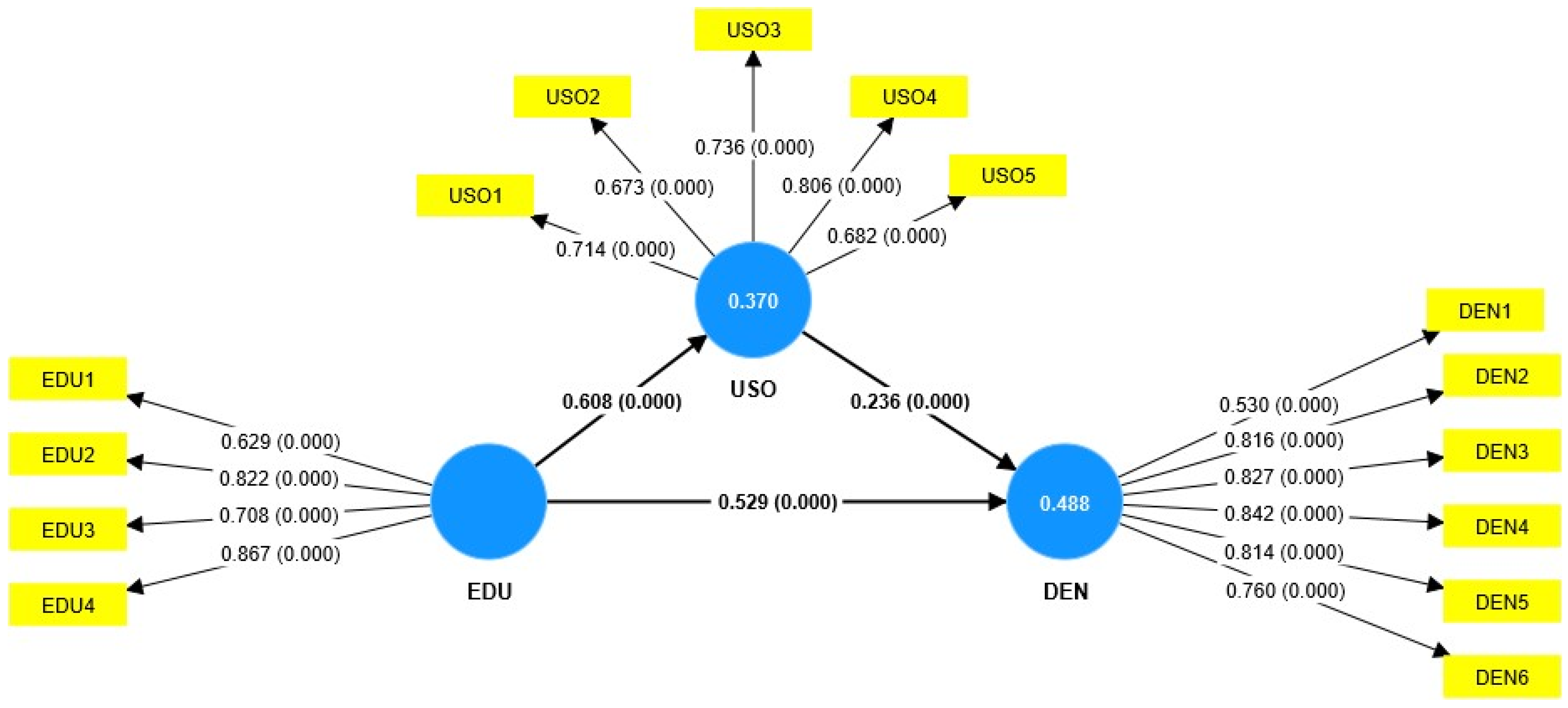
The significance of the path coefficients and the value of the R2 coefficient for the endogenous constructs were the two criteria used to assess the structural model. The path coefficients and matching p-values for every relationship were determined in order to assess the structural model. The value of the R2 coefficient depends on the field of investigation. Chin (1998) suggests values of 0.67, 0.33, and 0.19 as substantial, moderate, and weak measures of R, respectively. In behavioral studies, a value of 0.2 for R2 is considered acceptable (J. F. Hair et al., 2014; Kock, 2013). In the present work, the R2 coefficients for financial inclusion and micro-business performance were 0.370 and 0.488, respectively. That is, the two R2 values not only exceed this minimum threshold but position the model at substantively meaningful levels of explanatory power. The R2 of 0.370 for financial inclusion falls within Chin’s moderate range, indicating that financial education explains 37% of the variance in this mediating construct. While statistically acceptable, this figure also suggests that a considerable share of variation in financial inclusion remains attributable to factors not captured by the model, such as institutional access barriers, digital infrastructure disparities, or socioeconomic segmentation characteristic of Lima’s micro-enterprise ecosystem. By contrast, the R2 of 0.488 for micro-business performance approaches the substantial threshold of 0.67, indicating that the combined explanatory contribution of financial education and financial inclusion accounts for nearly half of the variance in business outcomes. This is a theoretically significant result: it confirms that the model captures a central explanatory mechanism for micro-business performance in an emerging economy context, while the remaining unexplained variance points to additional moderating factors, such as sectoral conditions, managerial capabilities, or market access, that warrant investigation in future research (see Figure 2).

4.3. Hypothesis Testing

The hypotheses presented in Figure 2 and Table 4 were accepted using the path coefficient values, p-value, and t-statistics. The path coefficient values provide an examination of the strength of the relationship between the variables. Values of the path coefficient close to +1 indicate a strong relationship and vice versa (Leguina, 2015). The p-values and t-statistics indicate the accepted and rejected hypotheses. The conceptual model in this study includes four hypotheses. Table 4 provides an overview of the tested hypotheses’ outcomes. H1, which proposed that financial education is associated with financial inclusion of Peruvian entrepreneurs, was accepted (β = 0.615, p < 0.000, t = 11.539); H2, which proposed that financial education is associated with micro-business performance of Peruvian entrepreneurs, was accepted (β = 0.531, p < 0.000, t = 9.942); H3, which proposed that financial inclusion is associated with micro-business performance of Peruvian entrepreneurs, was accepted (β = 0.236, p < 0.000, t = 3.618). Finally, H4, which proposes that financial inclusion has a mediating role in the association between financial education and micro-business performance of Peruvian entrepreneurs, was also accepted (β = 0.144, p < 0.000, t = 3.571).
Critically, the simultaneous significance of both H2 and H4 confirms that financial inclusion operates as a partial mediator rather than a full mediator: financial education exerts an association with micro-business performance through two concurrent channels, a direct cognitive pathway (H2) and an indirect access-mediated pathway (H4). To assess the relative weight of the indirect channel, the Variance Accounted For (VAF) was computed: VAF = βindirect/(βdirect + βindirect) = 0.144/(0.531 + 0.144) = 21.3%. This figure falls within the partial mediation range (20–80%) established by J. F. Hair et al. (2014), but proximity to the lower bound indicates that financial inclusion functions as a complementary, rather than dominant, mediating mechanism. The total effect of financial education on micro-business performance, combining the direct path (β = 0.531) with the indirect path through financial inclusion (β = 0.615 × 0.236 = 0.145), amounts to β = 0.676, positioning financial education as the primary structural driver in the model. The relative weakness of H3 compared to H2 (β = 0.236 vs. β = 0.531) is noteworthy: it suggests that mere access to financial services, without the underlying knowledge to leverage them, yields comparatively modest gains in performance.
This asymmetry has practical implications, as it cautions against financial inclusion policies that prioritize account ownership or credit access in isolation from financial literacy development. Thus, the findings indicate that entrepreneurial financial knowledge operates as a more proximal and potent driver of micro-business performance than financial inclusion per se. At the same time, the latter nonetheless plays a statistically significant and theoretically meaningful complementary role in the model (Figure 2 and Table 4).

5. Discussion

5.1. Discussion of the Results

Peru is ranked as the second most solid emerging country, whose strategy has so far enabled a robust financial system that has optimally faced liquidity crises. One of the protagonists of this achievement is those small businesses that are born with diverse entrepreneurial ideas and develop as drivers of innovation and competitiveness that, beyond contributing to sustainable economic development, contribute to reducing poverty through the expansion of their businesses. In this environment, the background establishes that financial education is crucial for business expansion; this fact is of significant relevance, as this study has provided empirical evidence supporting the positive association between financial education and financial inclusion of Peruvian entrepreneurs. This finding is statistically significant, though the moderate R2 (0.370) indicates that this relationship, while meaningful, is partial and embedded in a broader set of contextual determinants.
In this environment, the background establishes that financial education is crucial for business expansion; this fact is of significant relevance, as this study has confirmed that financial education is positively associated with financial inclusion of Peruvian entrepreneurs. However, the possibility that the entrepreneur’s educational level enhances this effect cannot be ruled out since it is known that a high level of education generates the identification of opportunities to take advantage of financial services better (González-Prida et al., 2025; Koffi & Kouadio, 2024), which suggests that financial education does not operate in isolation; on the contrary, it can be enhanced by the educational capital generated by the entrepreneur (Katjiteo, 2024).
This implies that the likelihood of an entrepreneur engaging with the financial system increases with their level of financial education; in this context, there is research that supports this finding by sustaining that individuals with lack of knowledge, lack of confidence and little experience with financial products are not a focus of interest for financial institutions and therefore end up being excluded from those opportunities provided by the financial systems (Daher et al., 2022). Therefore, it is once again important to promote financial education for those entrepreneurs who seek to invest in a business through the financial system (Birochi & Pozzebon, 2016). Another study that recognizes financial education as a fundamental tool that influences in favor of financial inclusion is mentioned by Ribaj et al. (2020) determining it as a benefit for society that mitigates the risk of exclusion and encourages consumers to be responsible in the use of their financial resources; meanwhile, Birochi and Pozzebon (2016) state that there are many ways to increase financial inclusion, one of them being financial education, and that every time financial knowledge and skills are strengthened, they exert a positive and lasting influence on financial inclusion. One possible explanation for the identified association is the differentiated access to the internet in Lima, a geographical area designated as the capital of Peru that has extensive digital coverage and connectivity, which promotes broad exposure to formal financial platforms and FinTech services. This reality suggests that the effect of financial education on financial inclusion could be increased in digitally connected entrepreneurs compared to those operating in environments with limited technological infrastructure (Adel, 2024; Konou, 2023; Salaheldeen, 2026).
This study has also provided evidence that financial education is positively associated with micro-business performance. The relationship, while statistically significant and theoretically coherent, should be interpreted in light of the model’s moderate explanatory power: the R2 of 0.488 for micro-business performance, though approaching Chin’s substantial threshold, signals that approximately half of the variance in business outcomes remains attributable to factors beyond those captured in this model. This does not diminish the relevance of the finding, but it does caution against deterministic claims about the sufficiency of financial education alone as a driver of performance. What the data more precisely indicate is that entrepreneurs with stronger financial knowledge tend to make more informed decisions, which has a significant impact on micro-business performance (Tumba et al., 2022).
In addition, a precedent that supports the results of this research argues that the critical and informed thinking of the entrepreneur allows him/her to search for new ideas, which are consolidated assertively until the idea becomes a reality that generates positive results (Esquivel et al., 2023). This means that as long as an entrepreneur has a solid financial education, they can use this knowledge as a key element that, beyond evaluating a financial situation, can look for growth opportunities. In this regard, Tia et al. (2023) state that financial education has become one of the crucial catalysts that opens the way to the growth and development of many businesses so that not being well informed or having little financial education could jeopardize the performance of a business, Kamarudin and Khan (2023) establish the high importance of the role that financial education assumes towards business activities, the same that generate adequate profitability. Furthermore, within the Peruvian context, the same result obtained in this research has also been proven since it is believed that the entrepreneur is part of those who contribute to the economic growth of a country; therefore, by giving entrepreneurs the opportunity to stay financially informed, they awaken extraordinary skills in the work and characteristics that allow them to choose the most appropriate alternatives in order to grow their business (Alderete et al., 2023; Bravo et al., 2021)—making it clear that this reality could present variations due to the sectoral differences between commerce, manufacturing and services, which represents an important nuance in the interpretation of the findings, given that each sector maintains different cost structures, liquidity cycles and financial needs that define the influence of financial education on the performance of microenterprises (Liedholm, 2019; Zambrano et al., 2022).
Another result of this study supports the affirmation that financial inclusion is positively associated, though comparatively modest (β = 0.236), with the micro-business performance of Peruvian entrepreneurs. This coefficient, the weakest direct path in the model, warrants a nuanced reading. While participation in the financial system does appear to correlate with improved business outcomes, the magnitude suggests that access to financial services is a necessary but not sufficient condition for high performance. Supporting evidence reveals that when entrepreneurs participate actively in financial systems, improved performance tends to follow because they gain access to resources that can support better resource management (Wirdiyanti et al., 2023).
Also, the results of this research coincide with the emergence of financial inclusion in the year 2000, which is considered an access to develop the social and economic potential of entrepreneurs. It has been demonstrated that financial inclusion generates economic prosperity, since the action of generating equal access generates adequate environments that encourage the entrepreneur to make more assertive decisions (Anthanasius Fomum & Opperman, 2023). Thus, we recommend making financial inclusion a fundamental strategy to support innovation, competition, and quality within the business sector; everything referred to in this paragraph responds to one of the sustainable development objectives, which consists of taking appropriate initiatives to offer support to the vulnerable population (Danladi et al., 2023). Under this context of financial inclusion, there are those who argue that Fintech is considered the engine that aims to support financial inclusion (Arner et al., 2020). Therefore, it is essential to adopt Fintech solutions in order to close those economic gaps that prevent a good micro-business performance. However, the impact of financial inclusion on performance may not be homogeneous among all Peruvian micro-entrepreneurs, since factors such as the level of business formalization, the economic sector, and the capacity for technological adoption can condition the extent to which FinTech solutions effectively translate into improvements in business performance (Chauvet & Jacolin, 2017; Posti et al., 2025).
Finally, evidence has also been found that financial inclusion plays a mediating role in the influence of financial education on micro-business performance; this assertion is supported by Konou (2023) when referring that there is a business risk to which entrepreneurs are exposed so that the knowledge and skills they have influence micro-business performance, where financial inclusion also emerges as a fundamental factor that provides optimal support for better performance; in this same instance, Su et al. (2023) state that financial inclusion plays an important role in the growth and development of a business, which goes hand in hand with financial education. On the other hand, to deepen the findings demonstrated in this study, Yin et al. (2019) demonstrate that inclusive finance alleviates financial constraints, thus improving entrepreneurial innovation and micro-business performance; under the same context, it is recorded that good performance and quality of businesses, together with financial skills and knowledge on the part of entrepreneurs are very well associated (Liao et al., 2022). Thus, it is that the findings of this study are also supported by Mohamud and Mohamed (2023), who mention that the durability of a business has a certain level of dependence on financial inclusion; that is, financial education, referring to a lot of knowledge and understanding of financial matters, will not always be enough to influence the performance of a business, but to strengthen performance, the intervention of financial inclusion is necessary as a mediator in the influence referred to above. It should be noted that the mediating role of financial inclusion could be amplified by the general educational level of the entrepreneur, since those with greater academic knowledge and skills may have a greater orientation regarding financial systems and translate financial inclusion into concrete business results, which suggests that the observed mediation does not operate uniformly across all educational profiles (Lestari et al., 2025; Tia et al., 2023).
Considering the findings, government entities should take actions to strengthen financial education; in addition, these organizations ought to motivate financial institutions to establish a supportive atmosphere that promotes financial inclusion. Moreover, every effort to promote financial inclusion should be monitored in order to guarantee its effectiveness and equity.
Taken together, the data support the four hypotheses; however, a critical reading of the model’s aggregate explanatory power is warranted. The R2 values of 0.370 and 0.488 fall in the moderate range, indicating that while financial education and financial inclusion are meaningful predictors of the studied outcomes, the model leaves a substantial portion of variance unexplained. This is not a methodological shortcoming per se; PLS-SEM studies in behavioral and entrepreneurship research frequently operate within this range, but it does mean that the practical implications of these findings should be stated with appropriate epistemic caution. Specifically, financial education and financial inclusion should be understood as important, yet partial, contributors to micro-business performance, operating alongside other factors such as market access, sectoral dynamics, managerial experience, social capital, and institutional environment that are not accounted for in the present model. The results, therefore, constitute a foundation for, rather than a comprehensive explanation of, micro-business performance in the Peruvian context, and underscore the need for future multi-variable and longitudinal research to delineate the boundaries of these effects better.
While avoiding irresponsible consumption and burdening families with unaffordable loans is a complex task, when it comes to business loans, educational institutions must be part of promoting better financial education, since from that academic stage students can prepare for sustainable entrepreneurship, an entrepreneurship that manages to keep the country with an emerging economy, with high probabilities of solidity despite the political situations it is going through; in this scenario, education assumes an important role that becomes a key tool for making informed and responsible decisions, and strengthening financial education represents having that base for economic resilience and stability.

5.2. Implications for Business Management

In terms of business practice, this study underscores the need to improve financial education, which serves as a tool to prepare individuals to manage economic risks and uncertainties effectively, thereby increasing their adaptability to fluctuating markets, economic crises, and market instability. In this context, government entities are urged to educate the population to strengthen their basic financial literacy, which, according to studies cited in this work, could enhance the sustainability and performance of micro-businesses.
Regarding financial inclusion, its function involves providing access to opportunities for entrepreneurs seeking to start or expand their businesses. Therefore, access to credit and/or financial products is a key factor. In this scenario, various banking institutions should expand their credit offerings with preferential rates for this population seeking opportunities for growth and innovation, thus contributing to the reduction in inequalities. In a country with an emerging economy, financial inclusion could become a driver of job creation, competitiveness, and economic development that benefits the nation’s economy.
Furthermore, given that a large portion of Peru’s population lives in rural areas, and that there is a high rate of informal employment and a significant lack of digital access, both local and national governments, in collaboration with financial institutions operating in the country, can implement various structural measures to facilitate entrepreneurs’ access to the financial system. Some of these initiatives, such as expanding digital banking and financial services through mobile devices, promoting banking intermediaries and financial agents, and reducing the requirements for opening bank accounts, could help overcome several of the most significant barriers to achieving financial inclusion in these developing countries.
Similarly, micro-entrepreneurs in Peru have the opportunity to benefit from the FinTech sector, given the favorable environment for creating FinTech solutions that promote the financial inclusion of this crucial economic group. FinTech facilitates access to low-cost microloans, insurance, and digital payments. Furthermore, local and national government agencies could establish regulations that benefit FinTech, create regulatory testing environments, and integrate these systems into national payment networks. Finally, the various institutions that support entrepreneurship in Latin America should incorporate elements that strengthen financial and credit skills into their training and technical assistance programs.

5.3. Limitations and Future Recommendations

This study enriches the scientific literature by identifying the connection between the three variables studied; however, some limitations are acknowledged that could prevent the generalizability of the results. First, this research did not identify the level of financial literacy based on the participants’ academic or technical background. Therefore, it is proposed that future studies could include this distinction in order to identify some of the causes of various financial, managerial, and operational behaviors that could be used for analysis in specific scenarios.
Second, while this study supports the fundamental role of financial inclusion, it did not identify information on those who had participated in any financial inclusion program, nor did it measure the participants’ commitment to putting what they learned into practice. This lack of information constitutes a research bias that limits a complete understanding of what other factors may be involved in financial inclusion or the performance of microenterprises, such as the lack of measurement of digital effects, among other factors not measured in this study. Therefore, it is recommended to conduct quasi-experimental studies where micro-entrepreneurs are instructed on financial inclusion, in order to observe and evaluate the impact on other variables, such as financial sustainability, financial technology (Fintech), AI strategies, and strategic communication.
Third, another important limitation lies in the non-probability convenience sampling strategy, which limits external validity. Participants may exhibit heterogeneity in terms of the characteristics of their business environments, banking accessibility, and entrepreneurial ecosystems, restricting the direct generalizability of the findings to other contexts. Furthermore, the present study may be biased, given its focus on business owners, general managers, accountants, administrative assistants, or participants holding other positions in microenterprises located in Lima, the capital of Peru. Additionally, the sample is skewed towards young people between 18 and 29 years old (51.7%) with a high level of education. Therefore, the sample may not be considered representative of the Peruvian population or other emerging economies. In this regard, future research could broaden the geographic and sectoral diversity of the sample to strengthen the external validity of the findings and offer a more comprehensive understanding of the role of micro-business performance, education, and financial inclusion, and employ stratified probability sampling.
Fourth, given that the questionnaire used was self-reported, there is a possibility of introducing biases such as social desirability bias, inaccurate self-assessment, experiencing work-related stress, or experiencing psychosocial problems that hinder concentration, among others. Therefore, it is recommended that future studies incorporate more complex and objective methods, including interviews or on-site observations. This could help mitigate this limitation. Furthermore, since the questionnaire was distributed online, entrepreneurs without internet access were likely excluded, which could represent a bias in the study, as this demographic group, which could have contributed to the research, was not surveyed.
A further limitation of the study concerns the measurement model. Four indicators (EDU1, USO2, USO5, and DEN1) presented outer loadings below the conventional 0.70 threshold (with DEN1 = 0.530 and EDU1 = 0.629 being the most notable cases). Although their retention was justified on content validity grounds and by the absence of meaningful improvement in construct-level criteria (AVE and CR) upon their removal, following the guidelines established by J. F. Hair et al. (2014) and Hulland (1999), future research should seek to refine or replace these items with indicators capable of achieving stronger psychometric performance. In particular, revised operationalizations of the financial inclusion density construct (DEN) and the financial education construct (EDU) that achieve loadings above 0.70 would strengthen the reliability and precision of the measurement model in replication studies.
Finally, all participants in the study reported working directly in a micro-business; however, the researchers do not know the type of business they were running. This lack of information also prevents the generalizability of the results to different types of businesses. These limitations and the findings presented suggest that future research should analyze entrepreneurial culture in order to better understand the financial practices of their micro-businesses.

6. Conclusions

This study addresses part of the dynamics of microenterprises in an emerging economy, providing a precise understanding of financial education, which, to some extent, can empower the population to make financial decisions that contribute to the micro-business performance. It has been shown that knowledge is not the only factor driving the micro-business performance; financial inclusion also plays a fundamental role in mediating the association between financial education and micro-business performance.
In this context, it is necessary that all actions employed to promote financial education go beyond the transmission of knowledge and also include an analysis of the barriers that prevent individuals from participating in the financial system. Therefore, it can be stated that entrepreneurs with stronger financial knowledge tend to have a meaningful advantage in navigating business challenges, which may contribute to improved micro-business performance indicators. However, this relationship is conditioned by the broader ecosystem of financial inclusion and other contextual factors not fully captured by the present model. Furthermore, in this digital age, it is crucial that entrepreneurs strengthen their financial and digital skills, and that the government contribute by creating an enabling environment that fosters financial inclusion to achieve a solid and sustainable business ecosystem.

Author Contributions

Conceptualization, J.L.-T. and E.E.G.-S.; methodology, E.E.G.-S.; software, E.E.G.-S.; validation, D.Y.M.-L. and M.V.-G.; formal analysis, E.E.G.-S.; investigation, E.E.G.-S., D.Y.M.-L. and M.V.-G.; resources, J.L.-T.; data curation, D.Y.M.-L. and M.V.-G.; writing—original draft preparation, J.L.-T., E.E.G.-S., D.Y.M.-L. and M.V.-G.; writing—review and editing, J.L.-T., E.E.G.-S., D.Y.M.-L. and M.V.-G.; visualization, M.V.-G.; supervision, E.E.G.-S. and M.V.-G.; project administration, J.L.-T. and E.E.G.-S.; funding acquisition, E.E.G.-S., D.Y.M.-L. and M.V.-G. All authors have read and agreed to the published version of the manuscript.

Funding

This research received no external funding.

Institutional Review Board Statement

The study was conducted in accordance with the Declaration of Helsinki and approved by the ethics committee of the Graduate School of the Universidad Peruana Unión (protocol code 2022-CE-EPG-0000208 and approval date: 11 November 2022).

Informed Consent Statement

Informed consent was obtained from all subjects involved in the study.

Data Availability Statement

Data availability can be requested by writing to the corresponding author of this publication.

Conflicts of Interest

The authors declare no conflicts of interest.

Abbreviations

The following abbreviations are used in this manuscript:
DENMicro-business performance
EDUFinancial education
USOFinancial inclusion
SMEsSmall- and Medium-sized Enterprises
AVEAverage Variance Extracted
CRComposite Reliability
PLS–SEMPartial Least Squares–Structural Equation Model
HTMTHeterotrait–Monotrait

References

  1. Adel, N. (2024). The impact of digital literacy and technology adoption on financial inclusion in Africa, Asia, and Latin America. Heliyon, 10(24), e40951. [Google Scholar] [CrossRef]
  2. Aisjah, S., Arsawan, W., & Suhartanto, D. (2023). Predicting SME’s business performance: Integrating stakeholder theory and performance based innovation model. Journal of Open Innovation: Technology, Market, and Complexity, 9(3), 100122. [Google Scholar] [CrossRef]
  3. Alderete, K. J., Rosas-Prado, J. J., & Urbina, C. (2023). Emprendimiento peruano: Factores e intervenciones que facilitan su desarrollo. Revista de Ciencias Sociales, 29(2), 483–495. [Google Scholar]
  4. Anthanasius Fomum, T., & Opperman, P. (2023). Financial inclusion and performance of MSMEs in Eswatini. International Journal of Social Economics, 50(11), 1551–1567. [Google Scholar] [CrossRef]
  5. Arner, D. W., Buckley, R. P., Zetzsche, D. A., & Veidt, R. (2020). Sustainability, fintech and financial inclusion. European Business Organization Law Review, 21(1), 7–35. [Google Scholar] [CrossRef]
  6. Ato, M., López, J. J., & Benavente, A. (2013). A classification system for research designs in psychology. Anales de Psicología, 29(3), 1038–1059. [Google Scholar] [CrossRef]
  7. Auclert, A., Bardóczy, B., Rognlie, M., & Straub, L. (2021). Using the sequence-space Jacobian to solve and estimate heterogeneous-agent models. Econometrica, 89(5), 2375–2408. [Google Scholar] [CrossRef]
  8. Baker, D. (2025). Human capital theory and the global education revolution. In Elgar encyclopedia of global social theory (pp. 252–256). Edward Elgar Publishing. [Google Scholar] [CrossRef]
  9. Baker, L. (2021). Everyday experiences of digital financial inclusion in India’s ‘micro-entrepreneur’ paratransit services. Environment and Planning A, 53(7), 1810–1827. [Google Scholar] [CrossRef]
  10. Batee, M., Fachrudin, K., Syahyunan, S., & Silalahi, A. (2025). A multivariate framework for MSME financial performance: Financial and strategic determinants in developing island economies. Theoretical and Practical Research in Economic Fields, 16, 731–745. [Google Scholar]
  11. Betancourt, V. A. (2025). Transformación digital y contabilidad gerencial: Desafíos y oportunidades para la toma de decisiones estratégicas. Revista Enfoques, 9(36), 369–382. [Google Scholar] [CrossRef]
  12. Birochi, R., & Pozzebon, M. (2016). Improving financial inclusion: Towards a critical financial education framework. RAE Revista de Administracao de Empresas, 56(3), 266–287. [Google Scholar] [CrossRef]
  13. Bravo, I., Bravo, M., Preciado, J., & Mendoza, M. (2021). Educación para el emprendimiento y la intención de emprender. Revista Economía y Política, 33, 139–155. [Google Scholar] [CrossRef]
  14. Brislin, R. W. (1986). The wording and translation of research instruments. In W. J. Lonner, & J. W. Berry (Eds.), Field methods in cross-cultural research (pp. 137–164). Sage Publications, Inc. [Google Scholar]
  15. Callis, Z., Gerrans, P., Walker, D. L., & Gignac, G. E. (2023). The association between intelligence and financial literacy: A conceptual and meta-analytic review. Intelligence, 100, 101781. [Google Scholar] [CrossRef]
  16. Cardona, D. E., Hoyos, M. C., & Saavedra-Caballero, F. (2018). Género e inclusión financiera en Colombia. Ecos de Economía, 22(46), 60–90. [Google Scholar] [CrossRef]
  17. Castañón, J. C., Baca, J. R., & Villanueva, V. (2023). Innovation and business performance: Bibliometric study. Revista Venezolana de Gerencia, 28(102), 812–831. [Google Scholar] [CrossRef]
  18. Chatterjee, U., French, J. J., Gurdgiev, C., & Borochin, P. (2024). Financial intermediation and informational efficiency: Predicting business cycles. International Review of Economics & Finance, 96, 103607. [Google Scholar] [CrossRef]
  19. Chauvet, L., & Jacolin, L. (2017). Financial inclusion, bank concentration, and firm performance. World Development, 97, 1–13. [Google Scholar] [CrossRef]
  20. Chidau, T., Khosa, R. M., & Phillips, M. (2022). Effects of successful business practices on business performance: Evidence from immigrant entrepreneurs in Ekurhuleni, South Africa. Southern African Journal of Entrepreneurship and Small Business Management, 14, 490. [Google Scholar] [CrossRef]
  21. Chin, W. W. (1998). The partial least squares approach to structural formula modeling. Advances in Hospitality and Leisure, 8(2), 295–336. [Google Scholar]
  22. Chin, W. W. (2010). How to write up and report PLS analyses. In Handbook of partial least squares (pp. 655–690). Springer. [Google Scholar] [CrossRef]
  23. Cho, Y. H., & Lee, J.-H. (2018). Entrepreneurial orientation, entrepreneurial education and performance. Asia Pacific Journal of Innovation and Entrepreneurship, 12(2), 124–134. [Google Scholar] [CrossRef]
  24. Choudhary, H., & Jain, H. (2023). Addressing financial exclusion through financial literacy training programs: A systematic literature review. Empirical Research in Vocational Education and Training, 15(8), 8. [Google Scholar] [CrossRef]
  25. Córdova-Aguirre, L. J., & Ramón-Jerónimo, J. M. (2024). Designing a sustainability assessment framework for Peruvian manufacturing small and medium enterprises applying the stakeholder theory approach. Sustainability, 16(5), 1853. [Google Scholar] [CrossRef]
  26. Cruz, G., Fernández, Y., Villar-Guevara, M., Perez-Salluca, M., & Fernández-Mallma, I. (2026). Assessing the contribution of corporate social responsibility to the dynamics of sustainable markets: The role of corporate image, satisfaction, and customer loyalty. Frontiers in Sustainability, 7, 1694085. [Google Scholar] [CrossRef]
  27. Daher, M., Rosati, A., & Jaramillo, A. (2022). Saving as a path for female empowerment and entrepreneurship in rural Peru. Progress in Development Studies, 22(1), 32–55. [Google Scholar] [CrossRef]
  28. Danladi, S., Prasad, M. S. V., Modibbo, U. M., Ahmadi, S. A., & Ghasemi, P. (2023). Attaining sustainable development goals through financial inclusion: Exploring collaborative approaches to fintech adoption in developing economies. Sustainability, 15(17), 13039. [Google Scholar] [CrossRef]
  29. Desiyanti, R., & Kassim, A. A. M. (2020). Financial literacy on business performance: The moderating effect of religiosity among SMEs in Sumatera, Indonesia. International Journal of Academic Research in Accounting, Finance and Management Sciences, 10(2), 87–99. [Google Scholar] [CrossRef] [PubMed]
  30. Diamond, D. W. (1984). Financial intermediation and delegated monitoring. The Review of Economic Studies, 51(3), 393. [Google Scholar] [CrossRef]
  31. Esquivel, F. A., García Sandoval, J. R., & Aldape Ballesteros, L. A. (2023). Universidades emprendedoras en América Latina. Revista Venezolana de Gerencia, 28(104), 1685–1700. [Google Scholar] [CrossRef]
  32. Fachrurazi, Rukmana, A. Y., Sutrisno, & Efendi. (2023). Achieving access to external finance among Indonesian entrepreneurs through financial literacy, financial inclusion, availability of collateral, and government policy: A study on large industrial entrepreneurs in West Java. The ES Accounting And Finance, 1(02), 61–71. [Google Scholar] [CrossRef]
  33. Febriansyah, A., Syafei, M. Y., Narimawati, U., Chochole, T., & Stakic, A. J. (2024). How important is financial inclusion for the performance of MSMEs? Australasian Accounting, Business and Finance Journal, 18(5), 53–65. [Google Scholar] [CrossRef]
  34. Feng, X., & Goli, A. (2023). Enhancing business performance through circular economy: A comprehensive mathematical model and statistical analysis. Sustainability, 15(16), 12631. [Google Scholar] [CrossRef]
  35. Fernandez, T., & Schroeder, S. (2023). GIS for sustainable urban transformation in countries with emerging economies: The case of Piura in Peru. International Journal of E-Planning Research, 12(1), 1–20. [Google Scholar] [CrossRef]
  36. Garz, S., Giné, X., Karlan, D., Mazer, R., Sanford, C., & Zinman, J. (2021). Consumer protection for financial inclusion in low- and middle-income countries: Bridging regulator and academic perspectives. Annual Review of Financial Economics, 13, 219–246. [Google Scholar] [CrossRef]
  37. Ghosh, C., & Guha, S. (2014). Do micro enterprises choose microfinance institutions to meet their financial needs? Evidence from Mumbai slums. Journal of Developmental Entrepreneurship, 19(3), 1450020. [Google Scholar] [CrossRef]
  38. Goggin, G., & Villanueva-Mansilla, E. (2024). 5G common threads and challenges in emerging economies: The cases of Indonesia and Peru. Media International Australia, 190(1), 39–53. [Google Scholar] [CrossRef]
  39. González-Prida, V., Pariona-Amaya, D., Sánchez-Soto, J. M., Barzola-Inga, S. L., Aguado-Riveros, U., Moreno-Menéndez, F. M., & Villar-Aranda, M. D. (2025). Exploring the effects of financial knowledge on better decision-making in SMEs. Administrative Sciences, 15(1), 24. [Google Scholar] [CrossRef]
  40. Gunawan, A., Jufrizen, J., & Pulungan, D. R. (2023). Improving MSME performance through financial literacy, financial technology, and financial inclusion. International Journal of Applied Economics, Finance and Accounting, 15(1), 39–52. [Google Scholar] [CrossRef]
  41. Hair, J., Anderson, R., Babin, B., & Black, W. (2010). Multivariate data analysis (7th ed.). Pearson Prentice Hall. [Google Scholar]
  42. Hair, J. F., Ringle, C. M., & Sarstedt, M. (2011). PLS-SEM: Indeed a silver bullet. Journal of Marketing Theory and Practice, 19(2), 139–152. [Google Scholar] [CrossRef]
  43. Hair, J. F., Sarstedt, M., Hopkins, L., & Kuppelwieser, V. G. (2014). Partial least squares structural equation modeling (PLS-SEM): An emerging tool in business research. European Business Review, 26(2), 106–121. [Google Scholar] [CrossRef]
  44. Harkness, J. A., Villar, A., & Edwards, B. (2010). Translation, adaptation, and design. In J. A. Harkness, M. Braun, B. Edwards, T. P. Johnson, L. Lyberg, P. P. Mohler, B.-E. Pennell, & T. W. Smith (Eds.), Survey methods in multinational, multiregional, and multicultural contexts (Chapter 7). John Wiley & Sons. [Google Scholar] [CrossRef]
  45. Hasan, R., Ashfaq, M., Parveen, T., & Gunardi, A. (2023). Financial inclusion-does digital financial literacy matter for women entrepreneurs? International Journal of Social Economics, 50(8), 1085–1104. [Google Scholar] [CrossRef]
  46. Henseler, J., Ringle, C. M., & Sarstedt, M. (2015). A new criterion for assessing discriminant validity in variance-based structural equation modeling. Journal of the Academy of Marketing Science, 43(1), 115–135. [Google Scholar] [CrossRef]
  47. Heredia, J. A., Geldes, C., Kunc, M. H., & Flores, A. (2019). New approach to the innovation process in emerging economies: The manufacturing sector case in Chile and Peru. Technovation, 79, 35–55. [Google Scholar] [CrossRef]
  48. Hewa, N., Hunjra, A. I., Manita, R., & Locke, S. M. (2021). Information communication technology and financial inclusion of innovative entrepreneurs. Technological Forecasting and Social Change, 163, 120416. [Google Scholar] [CrossRef]
  49. Hogarth, J., & Hilgert, M. (2002). Financial knowledge, experience and learning preferences: Preliminary results from a new survey on financial literacy. Consumer Interest Annual, 48(1), 1–7. [Google Scholar]
  50. Hong, S. (2023). MPCs in an emerging economy: Evidence from Peru. Journal of International Economics, 140, 103712. [Google Scholar] [CrossRef]
  51. Hulland, J. (1999). Use of partial least squares (PLS) in strategic management research: A review of four recent studies. Strategic Management Journal, 20, 195–204. [Google Scholar] [CrossRef]
  52. INEI. (2025, January 17). Lima supera los 10 millones 400 mil habitantes. Instituto Nacional de Estadística e Informática. Available online: https://www.gob.pe/institucion/inei/noticias/1092367-lima-supera-los-10-millones-400-mil-habitantes (accessed on 22 August 2024).
  53. Iramani, Fauzi, A. A., Wulandari, D. A., & Lutfi. (2018). Financial literacy and business performances improvement of micro, small, medium-sized enterprises in East Java Province, Indonesia. International Journal of Education Economics and Development, 9(4), 303–323. [Google Scholar] [CrossRef]
  54. Irman, M., Budiyanto, B., & Suwitho, S. (2021). Financial inclusion as mediator in the relationship of social capital and financial literacy towards business performance of the trade sector SMEs in Pekanbaru, Indonesia. Economic Annals-XX, 194(11–12), 21–28. [Google Scholar] [CrossRef]
  55. Kamarudin, Z., & Khan, N. H. A. L. (2023). The importance of financial literacy towards entrepreneurship intention among university students: A conceptual paper. In Finance, accounting and law in the digital age: The impact of technology and innovation in the financial services sector (pp. 763–768). Springer International Publishing. [Google Scholar] [CrossRef]
  56. Katjiteo, A. (2024). Education and entrepreneurship: Cultivating innovators for tomorrow’s economy. In Entrepreneurship innovation and education for performance improvement (pp. 376–414). IGI Global Scientific Publishing. [Google Scholar] [CrossRef]
  57. Khan, F., Siddiqui, M. A., & Imtiaz, S. (2022). Role of financial literacy in achieving financial inclusion: A review, synthesis and research agenda. Cogent Business and Management, 9(1), 2034236. [Google Scholar] [CrossRef]
  58. Kock, N. (2013). WarpPLS 4.0 user manual. ScriptWarp Systems. [Google Scholar]
  59. Kock, N. (2015). A note on how to conduct a factor-based PLS-SEM analysis. International Journal of E-Collaboration, 11(3), 1–9. [Google Scholar] [CrossRef]
  60. Koffi, M., & Kouadio, K. (2024). Level of education and financial inclusion in western economic and monetary union (WAEMU) zone. Pakistan Journal of Life and Social Sciences (PJLSS), 22(2), 2402–2410. [Google Scholar] [CrossRef]
  61. Konou, C. (2023). Entrepreneurial risk and digital financial inclusion: A cross-country analysis. Economic Papers: A Journal of Applied Economics and Policy, 42(3), 267–281. [Google Scholar] [CrossRef]
  62. Leguina, A. (2015). A primer on partial least squares structural equation modeling (PLS-SEM). International Journal of Research & Method in Education, 38(2), 220–221. [Google Scholar] [CrossRef]
  63. Lestari, E. D., Kurniasari, F., Pratiwi, P. Y., Thilaga, S., & Ooi, B. W. (2025). Empowering women entrepreneurs: The role of financial literacy, inclusion, and access in enhancing MSE’s performance and sustainability via women development program in Indonesia. Cogent Business and Management, 12(1), 2593078. [Google Scholar] [CrossRef]
  64. Li, R., & Qian, Y. (2019). Entrepreneurial participation and performance: The role of financial literacy. Management Decision, 58(3), 583–599. [Google Scholar] [CrossRef]
  65. Liao, H., Wang, D., Zhu, L., & Zhao, J. (2022). Equity reform and high-quality development of state-owned enterprises: Evidence from China in the new era. Frontiers in Psychology, 13, 913672. [Google Scholar] [CrossRef] [PubMed]
  66. Liedholm, C. (2019). Small-scale enterprise dynamics and the evolving role of informal finance. In Informal finance in low-income countries (pp. 265–280). Routledge. [Google Scholar] [CrossRef]
  67. Long, C., & Lin, J. (2018). The impact of corporate environmental responsibility strategy on brand sustainability: An empirical study based on Chinese listed companies. Nankai Business Review International, 9(3), 366–394. [Google Scholar] [CrossRef]
  68. Long, T. Q., Morgan, P., & Yoshino, N. (2023). Financial literacy, behavioral traits, and ePayment adoption and usage in Japan. Financial Innovation, 9(1), 101. [Google Scholar] [CrossRef] [PubMed]
  69. Lontchi, C. B., Yang, B., & Su, Y. (2022). The mediating effect of financial literacy and the moderating role of social capital in the relationship between financial inclusion and sustainable development in Cameroon. Sustainability, 14(15093), 15093. [Google Scholar] [CrossRef]
  70. Lucas-Alvarado, D. A., Millones-Liza, D. Y., García-Salirrosas, E. E., & Villar-Guevara, M. (2025). Job insecurity and its influence on burnout: Mediating role of financial well-being in the Peruvian population. Revista Argentina de Ciencias Del Comportamiento, 17(3), 126–138. [Google Scholar] [CrossRef]
  71. MEF. (2021, December 28). Economía peruana se posiciona como una de las más sólidas entre los países emergentes y de la región. Ministerio de Economía y Finanzas. Available online: https://www.mef.gob.pe/es/?option=com_content&language=es-ES&Itemid=101108&view=article&catid=100&id=7244&lang=es-ES (accessed on 1 July 2024).
  72. Meza, B. I., Valenzuela, A., Zúñiga, E., & Ibarra, L. E. (2026). Factores que determinan la intención emprendedora en estudiantes de una universidad pública en Sonora. Revista Enfoques, 10(38), 1–17. [Google Scholar] [CrossRef]
  73. Méndez-Prado, S. M., Rodriguez, V., Peralta-Rizzo, K., Everaert, P., & Valcke, M. (2023). An assessment tool to identify the financial literacy level of financial education programs participants’ executed by Ecuadorian financial institutions. Sustainability, 15(2), 996. [Google Scholar] [CrossRef]
  74. Mohamud, F. A. S., & Mohamed, A. A. (2023). Determinants of financial inclusion of female entrepreneurs in Somalia. Global Social Welfare, 1–20. [Google Scholar] [CrossRef]
  75. Msweli, N. T., & Mawela, T. (2021). Financial inclusion of the elderly: Exploring the role of mobile banking adoption. Acta Informatica Pragensia, 10(1), 1–21. [Google Scholar] [CrossRef]
  76. Mukherjee, S., & Sood, K. (2020). Triggers and barriers of financial inclusion: A country-wise analysis. Asian Economic and Financial Review, 10(9), 970–988. [Google Scholar] [CrossRef]
  77. Murrieta-Oquendo, M. E., & De la Vega, I. M. (2023). State and dynamics of the innovative performance of medium and large firms in the manufacturing sector in emerging economies: The cases of Peru and Ecuador. Sustainability, 15(1), 670. [Google Scholar] [CrossRef]
  78. Oskolkov, A. (2023). Exchange rate policy and heterogeneity in small open economies. Journal of International Economics, 142, 103750. [Google Scholar] [CrossRef]
  79. Owolabi, F., Ajibolade, S., & Uwuigbe, U. (2021). The design and use of performance measurement innovations and organizational outcomes in Nigerian listed companies. Problems and Perspectives in Management, 19(2), 91–103. [Google Scholar] [CrossRef]
  80. Posti, L., Kholiya, M., & Posti, A. K. (2025). Returns on informal and formal finance for Indian informal firms: A pseudo panel data analysis. Empirica, 52(3), 591–611. [Google Scholar] [CrossRef]
  81. Rahayu, C. W. E., & Rahmawati, C. H. T. (2022). Financial management of MSME in culinary industry according to demographics and financial literacy. Journal of Management and Business Environment (JMBE), 4(1), 82–99. [Google Scholar] [CrossRef]
  82. Rani, V. S., & Sundaram, N. (2023). Impact of financial inclusion on women entrepreneurs in India: An empirical study. Journal of Law and Sustainable Development, 11(7), e1308. [Google Scholar] [CrossRef]
  83. Reijonen, H. (2008). Understanding the small business owner: What they really aim at and how this relates to firm performance: A case study in North Karelia, Eastern Finland. Management Research News, 31(8), 616–629. [Google Scholar] [CrossRef]
  84. Ribaj, A., Meçe, M., Cinaj, V., & Kadrimi, I. (2020). Issues related to financial education of youth in a developing country (The case of Albanian youth). WSEAS Transactions on Business and Economics, 17, 140–152. [Google Scholar] [CrossRef]
  85. Roslan, N., Pauzi, N. F. M., Ahmad, K., Shamsudin, A., Karim, M. S., & Ibrahim, S. N. S. (2018). Preliminary investigation: Accounting literacy among small business owners. International Journal of Academic Research in Business and Social Sciences, 8(10), 32–47. [Google Scholar] [CrossRef] [PubMed]
  86. Sajuyigbe, A. S., Odetayo, T. A., & Adeyemi, A. Z. (2020). Financial literacy and financial inclusion as tools to enhance small scale businesses’ performance in southwest, Nigeria. Finance & Economics Review, 2(3), 1–13. [Google Scholar] [CrossRef]
  87. Salaheldeen, M. (2026). Financial inclusion through digital entrepreneurship in developing nations. In International encyclopedia of business management (pp. 221–225). Elsevier. [Google Scholar] [CrossRef]
  88. Serrano, G. L. (2025). Alternativas de las PYMES para evitar la vulnerabilidad financiera. Revista Enfoques, 9(35), 173–197. [Google Scholar] [CrossRef]
  89. Shapoval, Y., Shkliar, A., Shpanel-Yukhta, O., & Gruber, K. (2021). The level of financial inclusion in Ukraine: Measuring access, quality, and usage of financial products and services. Banks and Bank Systems, 16(2), 59–67. [Google Scholar] [CrossRef]
  90. Shihadeh, F. (2020). The influence of financial inclusion on banks’ performance and risk: New evidence from MENAP. Banks and Bank Systems, 15(1), 59–71. [Google Scholar] [CrossRef]
  91. Su, R., Zheng, T., Zhong, Y., & Zhong, W. (2023). Role of digital inclusive finance for high-quality business development: A study of China’s “five development concept” policy. Sustainability, 15(15), 12078. [Google Scholar] [CrossRef]
  92. Suparno, D., Tjahjawulan, I., Martodiryo, S., Anshary, A. H., Mulyono, M., Badrian, B., Indrariani, E. A., & Suwondo, T. (2023). The influence of financial literacy, digital literacy, digital marketing, brand image and word of mouth on the z generation’s interest in Islamic banks. International Journal of Data and Network Science, 7(4), 1975–1982. [Google Scholar] [CrossRef]
  93. Tang, N., & Baker, A. (2016). Self-esteem, financial knowledge and financial behavior. Journal of Economic Psychology, 54, 164–176. [Google Scholar] [CrossRef]
  94. Teruel-Sánchez, R., Briones-Peñalver, A. J., Bernal-Conesa, J. A., & de Nieves-Nieto, C. (2021). Influence of the entrepreneur’s capacity in business performance. Business Strategy and the Environment, 30(5), 2453–2467. [Google Scholar] [CrossRef]
  95. Tia, J., Kuunibe, N., & Nkegbe, P. K. (2023). Drivers of financial inclusion in Ghana: Evidence from microentrepreneurs in the WA municipality of the upper west region. Cogent Economics and Finance, 11(2), 2267854. [Google Scholar] [CrossRef]
  96. Tumba, N. J., Onodugo, V. A., Akpan, E. E., & Babarinde, G. F. (2022). Financial literacy and business performance among female micro-entrepreneurs. Investment Management and Financial Innovations, 19(1), 156–167. [Google Scholar] [CrossRef]
  97. Usama, K. M., & Fauziah, W. (2020, March 10–12). A preliminary study on the relationship between financial literacy and business performance among entrepreneurs in Bauchi Metropolis, Nigeria. International Conference on Industrial Engineering and Operations Management (pp. 2854–2861), Dubai, United Arab Emirates. [Google Scholar]
  98. Villalvazo, S. (2024). Inequality and asset prices during sudden stops (International Finance Discussion Paper, pp. 1–58). Board of Governors of the Federal Reserve System. [Google Scholar] [CrossRef]
  99. Villar-Guevara, M., García-Salirrosas, E. E., Gómez-Bayona, L., Villar, D., Pari-Apaza, M., & Fernández-Mallma, I. (2025). Changes in the digital world: An explanatory analysis of the key factors linked to virtual interactivity. Administrative Sciences, 15(7), 276. [Google Scholar] [CrossRef]
  100. Viteri, L. Y., Balladares, G. G., Jara, J. J., & Guerra, O. L. (2025). Inclusión financiera en Ecuador, barreras, avances y efectos socioeconómicos: Una revisión sistemática. Revista Enfoques, 9(36), 37–54. [Google Scholar] [CrossRef]
  101. Wanniarachchige, M. K., Miah, M. D., & Suzuki, Y. (2017). Banks as financial intermediaries and their roles in economic development. In Banking and economic rent in Asia (pp. 26–37). Routledge. [Google Scholar] [CrossRef]
  102. Wijaya, N. S., & Rahmayanti, P. (2023). The role of innovation capability in mediation of COVID-19 risk perception and entrepreneurship orientation to business performance. Uncertain Supply Chain Management, 11(1), 227–236. [Google Scholar] [CrossRef]
  103. Wirdiyanti, R., Yusgiantoro, I., Sugiarto, A., Harjanti, A. D., Mambea, I. Y., Soekarno, S., & Damayanti, S. M. (2023). How does e-commerce adoption impact micro, small, and medium enterprises’ performance and financial inclusion? Evidence from Indonesia. Electronic Commerce Research, 23(4), 2485–2515. [Google Scholar] [CrossRef]
  104. Yin, Z., Gong, X., Guo, P., & Wu, T. (2019). What drives entrepreneurship in digital economy? Evidence from China. Economic Modelling, 82, 66–73. [Google Scholar] [CrossRef]
  105. Zambrano, F., Sánchez, M., Martínez, R., & Guarnizo, C. (2022). Determinantesde la rentabilidad financiera de las microempresas: Un estudio transversal para el sector comercio. Revista Universidady Sociedad, 14(S6), 625–632. [Google Scholar]
  106. Zhou, H. (2022). Open economy, redistribution, and the aggregate impact of external shocks. SSRN Electronic Journal, 1–67. [Google Scholar] [CrossRef]
Figure 1. Theoretical model and hypothesis of the study.
Admsci 16 00231 g001
Figure 2. Structural equation modeling that reflects the links between financial inclusion (USO), financial education (EDU), and micro-business performance (DEN).
Admsci 16 00231 g002
Table 1. Sociodemographic data of 174 participants.
CharacteristicCategoryFrequency%
SexMale9856.3
Female7643.7
Age range18–299051.7
30–394425.3
40–492011.5
50–622011.5
Educational levelPostgraduate105.7
Secondary2816.1
University13678.2
Position held in the companyAdministrator3218.4
Administrative Assistant4023.0
Counter1810.3
Owner of the company3218.4
General Manager3821.8
He prefers not to say148.0
Approximate monthly sales16 to 30 minimum salaries148.0
30 to 50 minimum salaries21.2
6 to 15 minimum salaries4425.3
More than 50 minimum salaries84.6
Less than 5 minimum salaries10660.9
Table 2. Reliability and construct validity: general description.
VariableCodeLoadingsαCRAVE
Micro-business performance (DEN)DEN10.5300.8580.8640.597
DEN20.816
DEN30.827
DEN40.842
DEN50.814
DEN60.760
Financial education (EDU)EDU10.6290.7530.7700.581
EDU20.822
EDU30.708
EDU40.867
Financial inclusion (USO)USO10.7140.7830.7950.524
USO20.673
USO30.736
USO40.806
USO50.682
Note. The model meets accepted construct-level validity criteria: Cronbach’s alpha (α) > 0.70, CR > 0.70, and AVE > 0.50 for all constructs. Four items (EDU1, USO2, USO5, DEN1) presented loadings below 0.70 and were retained on content validity grounds and the absence of meaningful improvement in construct level criteria upon their removal (J. F. Hair et al., 2014).
Table 3. Discriminant validation.
Fornell–Larcker CriterionHeterotrait–Monotrait Ratio (HTMT)
VariableDENEDUUSOCorrelationRatio
DEN0.772 EDU <-> DEN0.838
EDU0.673 ***0.762 USO <-> DEN0.653
USO0.558 ***0.608 ***0.724USO <-> EDU0.721
Discriminant validity. The square root of AVEs is shown diagonally in bold, *** p < 0.001 (significance level).
Table 4. Hypothesis Testing.
HHypothesisCoefficientt Statisticsp ValuesDecision
H1EDU -> USO0.61511.5390.000Accepted
H2EDU -> DEN0.5319.9420.000Accepted
H3USO -> DEN0.2363.6180.000Accepted
H4EDU -> USO -> DEN0.1443.5710.000Accepted
Disclaimer/Publisher’s Note: The statements, opinions and data contained in all publications are solely those of the individual author(s) and contributor(s) and not of MDPI and/or the editor(s). MDPI and/or the editor(s) disclaim responsibility for any injury to people or property resulting from any ideas, methods, instructions or products referred to in the content.