1. Introduction
The development of public–private partnership (PPP) has contributed to improved public service delivery and value for money, yet the dynamic long-term contractual relationship and hybrid governance arrangements within this model continue to provoke concerns regarding transparency and public accountability (
Azarian et al., 2023b;
Davis, 1986;
Sheppard & Beck, 2022;
Valverde & Moore, 2019). Transparency in the public administration realm has been long recognized as a cornerstone of good governance and a means to strengthen trust and reduce corruption risks (
Cucciniello et al., 2016). Similarly in PPPs, transparency is treated as a public value and governance pillar, which is closely associated with accountability, responsiveness, and responsibility (
Chen & Man, 2020;
Reynaers, 2014). Sustaining transparency in PPPs, however, remains challenging due to the complex contractual structures, long-term financial arrangements, and shifting responsibilities (
Bloomfield, 2006;
Hodge, 2004;
Mayer & Yusuf, 2022;
Papadopoulos, 2007;
Reynaers, 2014).
Transparency concerns in PPP are often approached by theoretical anchoring on information availability, along with the interpretability and usability of information as essential qualities (
Jaeger & Bertot, 2010;
Janssen, 2012;
Reynaers & Grimmelikhuijsen, 2015). The PPP literature operationalizes these conceptual components through the dichotomy of internal and external transparency which refers to transparency among internal stakeholders vis-à-vis being transparent to external stakeholders (
Reynaers & Grimmelikhuijsen, 2015). Research in this area highlights that internal transparency establishes the conditions and prospects for external transparency (
Reig et al., 2021). Consequently, addressing the persistent transparency challenges in PPP settings, such as information asymmetry and confidentiality, becomes remarkably contingent on how project partners manage their relationship and coordinate to share information across phases, which equivalently reflects internal transparency (
Hodge & Greve, 2007;
Jooste & Scott, 2012).
Collaboration sits at the center of internal transparency, and it is often described as a process through which actors develop shared goals and coordinate actions, supported by communication, trust, and commitment (
Bratman, 1992;
Searle, 1990). Collaborative governance models recognize collaboration as a function of time, which is framed by a formal process founded on dynamic and interdependent drivers that evolve with context and experience (
Ansell & Gash, 2008;
Emerson et al., 2011). The PPP literature often associates collaboration with day-to-day communication, mutuality, and relational interaction between partners, which in turn fosters transparency and mutual accountability (
Brinkerhoff, 2002;
Sheppard & Beck, 2022). In this vein, several definitional positionings of PPP describe it as a “cooperation between public and private actors” or a “cooperative arrangement”, thereby implying an embedded degree of collaborative dimension in this model (
Commission of The European Communities, 2004;
Greve, 2003;
Rybnicek et al., 2020;
Wang et al., 2018). This framing suggests that the institutional design of PPPs proportionally facilitates collaborative actions and that relational dynamics are as consequential as formal structures. However, PPPs exhibit features that undermine collaboration, including asymmetric expertise and resources, contractual complexity, confidentiality constraints, and role shifts across project phases (
Hodge & Greve, 2007;
Reig et al., 2021;
Roehrich et al., 2014). Nevertheless, collaboration is frequently treated as an inherent characteristic of PPP rather than as a distinct governance dimension requiring systematic conceptualization.
Although the explained gap remains an avenue with limited exploration in the PPP literature, a research strand has addressed this concern through the approach of collaborative governance theory practiced in public administration. However, the evidence and inferences highlighted in these studies have majorly focused on macro-level frameworks, or legitimacy and community engagement (
Ashade & Mutereko, 2020,
2022;
Ojiako et al., 2015;
Sudiyono et al., 2017;
Tomo et al., 2020). In fact, limited attention has been paid to the micro-level drivers that shape collaboration between internal stakeholders. Additionally, prior scholarly work in this domain has seldom addressed the consequential role of collaboration in internal transparency. Hence, the primary objective of this study is to explore the role of PPP characteristics in shaping a systematic and lifecycle approach to collaboration and, subsequently, to highlight the contribution of collaborative elements to greater internal transparency as a governance outcome.
In response to the identified gap concerning PPP-tailored guidance for collaboration, the proposed research objective is articulated by the following research questions: (1) How can PPP projects leverage collaboration across the project lifecycle? (2) What are the implications of collaboration for internal transparency in PPP? The first research question shapes the underlying contribution of this study. To that end, this study draws on collaborative governance theory in public administration (
Ansell & Gash, 2008;
Emerson et al., 2011) and conceptualizes collaboration in the PPP context through four focal collaborative elements (FCEs): organizational capacity asymmetries, commitment to process, effective communication, and trust building. These elements are then formulated by PPP-specific characteristics to contextualize them within PPP settings, which accordingly supports the development of four hypotheses. Within this framework, PPP characteristics are treated as mechanisms that shape collaboration within each FCE. To examine these mechanisms empirically, they are embedded in an expert survey instrument that supports a description of how PPP characteristics affect collaboration across the project lifecycle. Consequently, the patterns obtained from the survey results provide insights into internal stakeholder interactions and subsequent impacts on information exchange throughout the long-term relational structure of PPPs. This analysis addresses the concern raised by the second question and bases the grounds for discussing the implications for internal transparency as a governance outcome influenced by collaboration.
The remainder of this paper is structured as follows.
Section 2 presents the theoretical background on collaborative governance in PPP, the consequential role of internal transparency, and outlines the literature gap.
Section 3 describes the conceptual framework developed for identifying the collaborative elements in PPP.
Section 4 explains the development and adoption of the survey instrument.
Section 5 solely focuses on reporting the numerical results of the survey and highlighting the statistical measures.
Section 6 primarily discusses the results achieved according to the developed conceptual framework and, secondly, sheds light on the practical implications for lifecycle collaboration in PPP and internal transparency. Research limitations and future research avenues are also explained in this section.
Section 7 concludes the paper.
2. Theoretical Background
2.1. Collaborative Governance and PPP
The concept of ‘collaboration’ has been philosophically interpreted as a means through which individuals express collective intentionality, enabling them to form shared goals and engage in coordinated actions (
Bratman, 1992;
Searle, 1990).
Ansell and Gash (
2008) refer to collaboration as “a collective decision-making process that is formal, consensus-oriented, and deliberative”, stressing a structured and institutionalized approach that relies on joint efforts, shared frameworks, and common resources (
Padiila & Daigle, 1998;
Walter & Petr, 2000). Such collaboration is developed over time and largely depends on cultivating mutual trust and commitment through direct and face-to-face interactions (
Ansell & Gash, 2008).
Collaboration is a process founded on upfront investment and it is gradually developed by fostering interdependence as a key mechanism for overcoming obstacles, disputes, and challenges throughout its implementation.
Emerson et al. (
2011) incorporate such characteristics into a more inclusive framework, denoted as the collaborative governance regime (CGR). This perception at its core emphasizes that collaboration is constructed upon dynamic elements that are adapted based on collaborative outcomes. This understanding implies that the actions, outcomes, and impacts of collaboration are distinct from collaborative dynamics. Additionally, the CGR highlights the system context—projecting the notion of regime—to demonstrate the influence of the specific mode of system or public decision-making on collaboration. Hence, collaboration is underpinned by dynamic operational drivers which are influenced by external conditions.
From a theoretical perspective, PPP projects establish a long-term contractual and relational relationship that equivalently provides partners with an arena for sustained joint activities, making collaboration a central component of this model. This is echoed by the several definitions of PPP which convergently hinge on “a form of cooperation—or cooperative arrangement—between public authorities and private sector” (
Commission of The European Communities, 2004;
Greve, 2003;
Rybnicek et al., 2020;
Wang et al., 2018). This definitional construction of PPP implicates an implicit assumption that collaboration is inherently embedded in the PPP. This specific characteristic is observable in several practical dimensions of PPP. For instance, the innovative procurement approaches used in PPP, e.g., competitive dialogue (CD), provide an opportunity to foster better relationship, communication, and understanding through early-stage dialogue and collaboration (
Shiferaw et al., 2023). In a similar vein and from a lifecycle perspective, the subsequent PPP phases encourage consistent collaboration, which is equally significant to partnership success, e.g., daily communication, participation in decision-making, and mutual accountability, even though the administration of these phases is context-specific and varies across jurisdictions (
Brinkerhoff, 2002;
Sheppard & Beck, 2022).
Further empirical works on PPP governance and inter-organizational collaboration signify that PPP embraces relational features apart from contractual relationship, which further underscores lifecycle collaboration. Studies in this regard emphasize how evolving responsibilities and monitoring demands during PPP implementation turn sustained coordination routines and cooperative behavior into particularly consequential agenda (
Hodge & Greve, 2007;
Roehrich et al., 2014;
Warsen et al., 2018). In such an evolving environment, further mechanisms investigated by relational governance studies highlight that institutional trust and the trust–control nexus shape willingness to share information, reduce defensiveness, and sustain joint problem solving in long-term PPP arrangements (
Abdullah & Khadaroo, 2020;
Benítez-Ávila et al., 2018;
Zheng et al., 2008). Complementary evidence indicates that contractual functions and information transparency contribute to trust between PPP partners and support coordination by clarifying expectations and strengthening the reliability of information exchange (
Cheng et al., 2021). Under such circumstances, relationship dynamics and individual interdependence between partners also play a vital role. For instance,
Abdullah and Khadaroo (
2020) showcased that building and maintaining trust during the PPP operation phase is difficult and contingent on consistent collaboration between the
same group of people.
Collaboration in PPP should also be viewed as embedded in a broader administrative context rather than as a process unfolding in an institutionally neutral environment. Administrative traditions differ across jurisdictions in terms of state structure, procedural formality, reform trajectories, and patterns of interaction between public and private actors. Such differences may shape how collaborative arrangements are initiated, coordinated, and sustained in practice. Studies on administrative styles and administrative reform have shown that institutional arrangements influence administrative behavior and that Southern European administrative settings, for example, may display distinctive features such as legalism, politicization, and weaker reform continuity compared to other contexts (
Howlett, 2004;
Kickert, 2007). In this regard, while the present study focuses on PPP-specific collaborative mechanisms, the operation of these mechanisms may still be conditioned by the administrative context in which PPP actors interact.
Collectively, the long-term engagement of public and private sectors in PPP projects embraces varied phases, novel technical properties, and complex procurement, financial and contractual structures, combined with relational properties. Beyond contractual concerns, these characteristics play a substantial role in partnership success, which situates collaboration at the core of PPP. However, a systematic and structured approach towards collaboration in the PPP lifecycle remains an avenue in the PPP literature with limited exploration. In fact, the reviewed studies reinforce the need to adopt a lifecycle perspective and examine the drivers through which PPP-specific characteristics shape collaboration between internal stakeholders across phases, and this concern is addressed in this study.
2.2. Internal Transparency in PPP
The evolution of PPP has been coupled with adversarial societal perspectives accusing this model of serving as a privatization lever, turning transparency and public accountability into critical concerns (
Sheppard & Beck, 2022;
Valverde & Moore, 2019). In line with public administration, the PPP literature acknowledges transparency as a crucial component for achieving a greater degree of trust and less corruption (
Cucciniello et al., 2016). In this context, the literature refers to transparency as a public value (
Reynaers, 2014), or as a governance pillar (
Ayhan & Üstüner, 2022) which is practically hinged on information availability (
Cucciniello et al., 2016), such as public service costs, agreements, performance, and information disclosure on partner commitment (
Acar & Robertson, 2004;
Reynaers, 2014;
United Nations Economic Commission for Europe [UNECE], 2018). It is worth noting that along with the central significance of information availability or visibility, the usability and interpretability of information are essential qualities in order to satisfy transparency concerns (
Reynaers & Grimmelikhuijsen, 2015).
Nevertheless, the complexity of PPP, the long-term and complicated financial agreements, and the diversity of roles and responsibilities of partners engender a gray area between public and private sectors and challenges for transparency (
Bloomfield, 2006;
Hodge, 2004;
Mayer & Yusuf, 2022;
Papadopoulos, 2007;
Reynaers, 2014). From a governance standpoint, PPP arrangements create mutual dependency by which transparency turns into not only a public governance obligation, but also a relational and process-driven phenomenon shaped by how actors share information, negotiate responsibilities, and coordinate decisions. This comprehension indicates that cooperation and communication between internal stakeholders offer a promising pathway to address transparency challenges in PPP, e.g., information asymmetry, contractual complexity, confidentiality, etc. (
Hodge & Greve, 2007;
Jooste & Scott, 2012). From an operational perspective, this is explained by the dichotomy of internal and external transparency which refers to transparency among internal stakeholders vis-à-vis being transparent to external stakeholders (
Reig et al., 2021). In this regard, empirical evidence emphasizes the leading influence of internal transparency, acknowledging that limited internal transparency equivalently diminishes the endeavor for satisfying external transparency (
Viana et al., 2022a). Consequently, improved collaboration between PPP partners is not only key for successful partnership, but more importantly, it ensures that the partnership settings function transparently (
Bryson et al., 2015;
Emerson et al., 2011).
In corollary, internal transparency emerges when information is openly shared, the reasoning behind decisions is visible, and the actors interpret each other’s behaviors as cooperative rather than strategic or defensive (
Rousseau et al., 1998;
Zaheer et al., 1998). Processes that enable collaboration simultaneously reduce opacity by combating information exchange barriers, facilitating constructive dialogues, and enabling reciprocal accountability (
Bryson et al., 2015;
Emerson et al., 2011). Empirical evidence in this regard indicates that collaboration, along with a shared understanding of public values, contributes to a greater degree of trust and transparency, solidifying the chances for partnership success (
Mayer & Yusuf, 2022). Hence, internal transparency becomes the observable consequence of collaboration across the project lifecycle such that collaboration is the
processual means, and transparency is one of its
normative governance outcomes.
2.3. Literature Gap and Scientific Contribution
According to the available opportunities for more deliberate communication in PPP,
Ojiako et al. (
2015) studied collaborative governance in Greek infrastructure projects based on inclusiveness, forums, and process transparency. This study reveals that inequality between partners and lengthy decision-making processes hinder effective collaboration, especially in underdeveloped jurisdictions. Another study in Indonesia demonstrated that value creation sits at the frontier of PPP objectives, which necessitates a well-functioning governance model to protect collaboration from endemic conflict and tensions (
Sudiyono et al., 2017). These findings indicate the importance of system context and external conditions for collaboration in PPP (
Emerson et al., 2011).
The PPP literature has also started incorporating the collaborative governance model developed by
Ansell and Gash (
2008) into this partnership setting.
Ashade and Mutereko (
2020) analyzed community engagement in PPP in order to shift the focus to citizen participation and local legitimacy and, thus, mitigate unfavorable policy outcomes.
Tomo et al. (
2020) traced how collaborative governance arrangements between public and private sectors could become effective by considering the influence of outcomes of collaboration on the initial trust level. In recent research,
Liu et al. (
2024) developed a collaborative governance framework in pursuit of the operational sustainability of PPPs and mapped impeding factors and their transmission mechanisms. Their study, however, treated collaboration at an aggregate level and hinged on institutional environment, government leadership, starting conditions, and collaborative process, rather than on operational drivers, such as power asymmetry and organizational capacity.
It is observed that collaborative governance within the PPP context has been approached from a holistic standpoint, focusing on either community engagement and social legitimacy (
Ashade & Mutereko, 2020,
2022) or high-level governance frameworks (
Liu et al., 2024). In fact, PPP scholarship falls short in addressing micro-level dynamics across project phases. Furthermore, these studies seldom pay attention to internal transparency as an outcome that is shaped by collaborative dynamics such as power balance, communication regimes, and so forth. Thus, this study aims to fill this gap by identifying and assessing the operational drivers contributing to collaboration between internal stakeholders in PPP projects. Achieving this goal primarily leads to producing a practical roadmap towards structured collaboration within PPP arrangements and equally facilitates a greater degree of internal transparency.
3. Conceptual Framework
To support the purpose of identifying the collaborative elements, we refer to the recommendations of
Ansell and Gash (
2008) along with
Emerson et al. (
2011). The collaborative governance models developed in these studies are foundational for public administration research, and this section delves into the alignment of these models with PPP settings. This theoretical alignment leads to identifying four elements for collaboration in PPP, denoted as four focal collaborative elements (FCEs), and giving rise to the development of four exclusive hypotheses founded on the characteristics of PPP. Articulation of the FCEs based upon PPP-specific characteristics enables our survey instrument at a subsequent stage to examine these hypotheses.
3.1. Concept Development
The collaborative governance model developed by
Ansell and Gash (
2008) is constructed upon four underlying components, also referred to as broad variables by the authors: starting conditions, facilitative leadership, institutional design, and collaborative process. Equivalently, each component represents a major dimension of collaboration which is disaggregated into more fine-grained variables. For instance, collaborative process—which sits at the heart of this model—is composed of trust building, commitment to process, shared understanding, face-to-face dialogue, and intermediate outcomes. In such a hierarchy, the disaggregated variables demonstrate the practical features and the function of maintaining collaborative interactions between stakeholders, and in this respect, these variables are treated as the operational drivers for collaboration in the scope of this study. Accordingly, this study draws on these insights and focuses on four operational drivers, hereafter referred to as four focal collaborative elements (FCEs):
Organizational capacity asymmetries: This is induced by power, knowledge, and resource asymmetries, which are in turn indices of starting conditions.
Commitment to process: This is an index of collaborative processes.
Effective communication: This is inspired by face-to-face dialogue, which is indexed by collaborative process.
Trust building: This is an index of collaborative processes.
The foundational theoretical premise for selection of the outlined FCEs was their salient practice and characteristics within the dynamic PPP context. In fact, the long-term partnership, the complex procurement and contractual arrangements, the novelty of the project, and varying phases within the PPP lifecycle (
Azarian et al., 2023b), just to name a few, encourage a sustained collaborative relationship between PPP partners that is mediated by trust. Not to mention that PPPs are often characterized by complexities that demand the inclusive contribution of the private sector (
Azarian et al., 2023a;
Davis, 1986), which theoretically trigger asymmetries. Hence, the aforementioned FCEs demonstrate strong correspondence to PPP and provide a promising opportunity to further shape collaboration in the dynamic and interweaving PPP settings. It is worth mentioning that this study does not position the other existing drivers—or fine-grained variables—such as a prehistory of cooperation or conflict that falls under starting conditions (
Ansell & Gash, 2008)—as irrelevant for collaboration in the PPP context. However, the methodological scope of this study encourages selection of a limited number of drivers to facilitate more profound interpretations and also to avoid increasing the response burden for participating in the survey.
According to the focus of this study on micro-level operational drivers, we draw further insights on the CGR developed by
Emerson et al. (
2011), which underscores that flexibility and adaptability are the required features in response to context diversity. This model elaborates on the dynamics between operational drivers of collaboration and, thus, assists in further recognition of operational drivers within the scope of individual FCEs. Principled engagement, shared motivation, and the capacity for joint action constitute the underlying dynamics of collaboration within the CGR, which are exclusively driven by subordinate elements and ultimately lead to collaborative actions. In line with the flexibility agenda, this model depicts that these dynamics exist in an interweaving relationship which are adaptable based on the results of collaboration. In the context of this research, the primary goal and the drivers of these dynamics demonstrate an alignment with the FCEs (see
Table 1). This alignment has two major advantages. It primarily elucidates the interactive and iterative relationship between FCEs. Secondly, it provides more operational knowledge to understand the factors that drive FCEs and evaluate them for PPP practice.
Inspired by the collaborative governance models described above (
Ansell & Gash, 2008;
Emerson et al., 2011), this conceptual framing proposes the elements that interactively and interweavingly contribute to shaping collaboration throughout the long lifecycle of PPP projects. The proposed elements, which are referred to as FCEs, represent pragmatic properties that turn them into relevant dimensions of collaborative governance in PPP settings from a micro-level standpoint. This conceptual approach, however, requires theoretical and empirical assessment before being applied to the PPP context. This implies that specific PPP characteristics that are essentially influential for the FCEs must be identified and empirically evaluated. To that end, this study primarily sheds light on the relevant PPP characteristics that are salient within the cognitive scope of each FCE. This approach relies on research pertaining to both public administration and PPP, and provides a theoretical understanding of PPP characteristics, treated as mechanisms, that contribute to shaping a lifecycle of collaboration on the basis of the identified FCEs. In effect, this theoretical understanding leads to the development of four hypotheses that exclusively reflect the anticipated pattern of the FCEs in accordance with the PPP context; these hypotheses are presented below. It is worthwhile noting that this conceptual framing is examined by the survey instrument which assists in empirical assessment of the PPP mechanisms and paving the way for deriving collaborative governance implications.
Hypothesis 1. Organizational capacity asymmetries in PPP negatively impact collaboration.
Hypothesis 2. PPP characteristics limit the possibilities for commitment to the collaboration process.
Hypothesis 3. PPP characteristics compromise the means for effective communication.
Hypothesis 4. PPP characteristics both enable and constrain trust building over the project lifecycle.
3.2. Four Focal Collaborative Elements (FCEs)
This section elaborates on the FCEs and their structural drivers based upon the described collaborative governance models. More importantly, the relevant characteristics of PPP are articulated to illustrate the association of the studied mechanisms with FCEs, and also their contribution to internal transparency.
3.2.1. Organizational Capacity Asymmetries
Asymmetries in knowledge and resource shape the incentives, the interaction quality, and the likelihood of constructive collaboration (
Ansell & Gash, 2008). Superior resources and expertise in one party engender an imbalance that increases the risk of skewed negotiation and process ownership, and causes centralization and reduced collaboration effectiveness (
Gray, 1989;
Provan & Kenis, 2008). Interorganizational collaboration studies also indicate that imbalance expertise, resource control, and legitimate authority translate into collaboration challenges (
Gray et al., 2022;
Hardy et al., 2003). Such evidence highlights the need for effective organizational capacity to devote time, energy, and liberty and to get involved in time-intensive collaboration processes; otherwise, collaboration is prone to manipulation by stakeholders with higher organizational capacity (
Ansell & Gash, 2008;
Yaffee & Wondolleck, 2003).
Although PPP scholarship underlines the public sector’s organizational capacity for successful governance, collaboration, and warranting value for money (
European PPP Expertise Centre [EPEC], 2015;
Osei-Kyei & Chan, 2015), the dominant role of the private sector throughout varied project phases often creates asymmetries (
Besley & Ghatak, 2008;
Chen & Hubbard, 2012). Evidence indicates that limited public capacity in PPPs undermines communication with the private consortia, and this condition often intensifies in the construction and operation phases where monitoring, data interpretation, and contract enforcement dominate (
Hodge & Greve, 2007). Further reviews of PPPs highlight that private dominance in this model often leads to challenges for collaborative balance and increased governance expenses (
Hodge & Greve, 2007;
Roehrich et al., 2014). These asymmetries in PPP settings have adverse implications for transparency. Previous studies emphasize the pivotal role of knowledge and resource asymmetries for developing and implanting transparency in PPP (
Reig et al., 2021;
Viana et al., 2022b).
3.2.2. Commitment to Process
Successful collaboration largely relies on members’ commitment (
Margerum, 2001), which, along with trust, serves as a key mediator of cooperative behavior (
Morgan & Hunt, 1994). Commitment to the collaboration process evolves throughout time as role and governance arrangements shift in long-term relationships (
Bryson et al., 2015;
Emerson et al., 2011;
Ring & Van de Ven, 1994). Thus, it is vital to sustain the incentives for commitment. To that end, stakeholders primarily need to observe tangible results gained through collaboration and realize that their contribution is a key factor rather than ceremonial participation (
Ansell & Gash, 2008;
Brown, 2002;
Futrell, 2003). Moreover, stakeholders must share ownership of the decision-making processes by sharing the responsibilities (
Ansell & Gash, 2008;
El Ansari, 2003;
Geoghegan & Renard, 2002;
Weech-Maldonado & Merrill, 2000).
In PPP settings, the commitment of public and private sectors to the collaboration process is substantial, helping protect it from the communication strain stemming from PPP longevity. However, the changing evolution of the public sector’s role throughout PPP phases introduces challenges for commitment. In fact, PPP contractual and institutional design throughout construction and operation phases leads to the public sector confronting a diminishing role that engenders an authoritative imbalance regardless of the organizational capacity (
Hodge & Greve, 2007). Therefore, a clear definition of the roles and responsibilities of partners is essential to maintain commitment and effectively protect collaborative activities (
Alexander et al., 1998;
Gray, 1989), even though contractual longevity encourages commitment and stability (
Roehrich et al., 2014). Equivalently, meticulous role specification in distinct phases of PPP ensures goal congruence throughout the project lifecycle and contributes to greater transparency (
Mayer & Yusuf, 2022). Further studies in this context signify that reduced transparency, limited information availability, and distrust emerge as the consequences of inadequate coordination between the public and private sectors, which emanates from a lack of commitment and poor communication (
Liu et al., 2024;
Zhang & Tariq, 2020).
3.2.3. Effective Communication
Effective communication between stakeholders is an essential component of collaboration (
Shiferaw, 2024). The fundamental purpose is combating communication barriers, e.g., dissolving the stereotypes, and also paving the way for trust building, shared understanding, and continuous communication (
Ansell & Gash, 2008;
Bentrup, 2001). In practice, direct interaction, including face-to-face and virtual communication, is necessary to reduce defensiveness, clarify expectations, and create a safe environment for open and constructive negotiation.
Emerson et al. (
2011) describe effective communication as the processual heart of collaborative engagement which is fulfilled gradually over time and underpinned by unlocking shared interests, establishing a common understanding of objectives, and conflict resolution. Thus, within the context of this study, effective communication refers to communication that is timely, continuous, and sufficiently open to support coordination, clarification of expectations, mutual understanding, and the exchange of relevant information across PPP phases.
Effective communication in PPP confronts complications stemming from project longevity (
Aaltonen & Kujala, 2010), as well as other dynamics such as distinct phases, a change of roles, and contractual complexity. These varying features, along with the existence of multiple organizations, introduce logistics barriers for joint activities and co-presence (
Aaltonen & Kujala, 2010;
Olander & Landin, 2005). Experience with PPP shows that inadequate communication between stakeholders and a lack of attention to the relevant means, such as consistent and timely conversations and meetings, have remained unresolved issues (
Liu et al., 2024;
Zhang & Tariq, 2020). Effective communication is also consequential for transparency, such that sustained communication between individuals primarily contributes to trust building, as well as optimized information exchange and access to underlying records (
Abdullah & Khadaroo, 2020).
3.2.4. Trust Building
Trust plays a major role in enabling information sharing and reducing defensive behavior, and supports joint problem solving (
Ansell & Gash, 2008). It triggers shared motivation which is an intermediate outcome of effective communication (
Emerson et al., 2011). Trust evolves through frequent communication and credible commitments (
Ring & Van de Ven, 1994;
Rousseau et al., 1998), turning it into both an interpersonal and interorganizational construct that improves performance and lowers negotiation/monitoring costs (
Zaheer et al., 1998). Addressing the dynamics of negotiations, flexibility in sharing responsibilities, supporting the shared ownership of decisions, generating shared understanding, and unlocking the barriers to collaboration commitment are only a few of the many positive outcomes which are guaranteed once trust building initiates in the early stages (
Ansell & Gash, 2008;
Emerson et al., 2011).
Given the extent of flexibility, PPP success is largely contingent on trust-based collaboration seeking to solve problems rather than focusing on the contractual terms (
Hodge et al., 2017;
Parker & Hartley, 2003). From a holistic standpoint, PPP longevity paves the way for consistent communication and trust building. Nevertheless, this agenda is under the influence of various dynamics, i.e., maintaining the same group of individuals in the communication loop (
Abdullah & Khadaroo, 2020;
Uddin et al., 2019), and sufficient technical expertise which overshadows other qualities such as sincerity (
Ezezika & Oh, 2012). The lifecycle perspective on PPP signifies that trust building begins during the procurement stage by having roots in individuals skills, denoted as competence trust, and shifts toward good-will trust during the subsequent phases which is determined by the actual performance (
Abdullah & Khadaroo, 2020). In effect, good-will trust leads to self-monitoring (
Edwards et al., 2004) and thus enhances transparency. However, complex contractual design in PPPs complicates trust building and transparency, highlighting the essence of careful relationship management and solidifying the contract details to ensure joint ownership of decision-making processes (
Abdullah & Khadaroo, 2020;
Cheng et al., 2021;
Gray, 1989;
Roehrich et al., 2014;
Ter Bogt & Tillema, 2016). Scholars also point out the adverse effects of confidentiality and commercial sensitivity on trust building and transparency in PPP (
Hodge et al., 2017;
Reig et al., 2021;
Sheppard & Beck, 2023). In this regard, the
United Nations Economic Commission for Europe [UNECE] (
2008) advises meticulous identification of confidential information in the early stages to minimize adversarial effects of confidentiality.
4. Methodology
This study employs a survey to examine the practical functioning of the FCEs and explore the barriers and enablers for collaboration in PPP. To develop the survey instrument, the primary focus was placed on studying the characteristics of PPP in relation to FCEs. As articulated in
Section 3, this approach resulted in a cognitive foundation for practicing FCEs in the PPP environment based on a set of key factors that represent the genuine structure and behavior of PPP in pursuit of improved collaboration in this arrangement. The survey design was also inspired by the separate research work of authors on transparency in the PPP realm, for which a semi-structured interview was conducted with senior PPP project managers in Norway. The data collected in this study revealed the recurring themes of imbalanced powers and communication structures, trust asymmetry and confidentialit
y, and communication issues related to distinct phases of PPP; such evidence proportionally provided insights for the formulation of survey statements. This information provided a grounded understanding of the behavioral and institutional issues related to collaboration and ensured that the survey instrument reflects empirically observed dynamics rather than purely theoretical assumptions (
Tashakkori & Teddlie, 2010).
The survey includes 21 questions. Three demographic questions capture the experience and background of the respondents in PPP projects; the main body of the survey includes 18 Likert-type statements grouped into four sections representing the FCEs. The survey used a 5-point response scale, ranging from strongly disagree (1) to strongly agree (5), which is consistent with evidence that Likert-type scales with 5–7 points provide adequate reliability and measurement effectiveness while limiting respondent burden (
Krosnick & Fabrigar, 1997;
Taherdoost, 2019). Each statement is formulated as a PPP-specific mechanism that links a PPP characteristic, e.g., expertise or resource asymmetry, contractual complexity, phase transition, etc., to an FCE. In effect, statements capture how PPP practitioners perceive the impact of individual PPP characteristics on collaboration with regards to the corresponding FCE. The nine underlying PPP characteristics embedded in the mechanism statements and their mapping to the FCEs are summarized in
Table 2.
The main characteristic of the sample in this survey experiment lies in the industrial background of the respondents. Specifically, the respondents are supposed to have at least one PPP experience within either a public or a private sector. This policy helps to acquire a pragmatic observation of the studied mechanisms, and it was made possible through purposive sampling (
Palinkas et al., 2015). Thus, participants were primarily identified according to their reviewed background in PPP projects, aiming to collect informed judgments from individuals who possess relevant specialized experience. To expand the list of respondents, the process of identification was complemented by snowball sampling, asking participants to suggest additional individuals with PPP experience (
Noy, 2008). Further effort was made to reach more individuals with the help of contacted respondents who distributed the survey among the PPP experts within their network.
The survey was designed on the digital platform of nettskjema.no (
University of Oslo, n.d.), which is a Norwegian web-based tool for creating and managing online forms and surveys, including secure data collection. The survey was conducted anonymously. This implies that no personal data or identifiers were collected, i.e., name, emails, IP addresses, or any form of traceable information, and thus, responses cannot be linked back to individuals. This policy contributes to more honest responses and higher data quality (
Dodou & de Winter, 2014;
Durant et al., 2002;
Gnambs & Kaspar, 2015), which is particularly important when the respondents are prompted to provide their opinion against a negative statement and behavior (
Ong & Weiss, 2000). Prior to distribution, the survey was reviewed for clarity and validity, for which a pilot test was conducted. This test involved a PPP practitioner and a researcher within this realm; this researcher was not involved in this study and had organizational affiliation different from that of the authors. This process contributed to refinements on the wording to improve the interpretability of statements.
Analysis of the collected data was in pursuit of exploring the effect of PPP-specific characteristics rather than measuring further latent constructs. Thus, the empirical strategy emphasized item-level descriptive analysis and ranking within FCEs to assess the perceived salience of the mechanisms (
Jarvis et al., 2003;
Sullivan & Artino, 2013). The primary step for operationalizing this approach is the calculation of the mean score pertaining to each statement. This metric assists in sorting the mechanisms and thus identifying the salient PPP characteristics in relation to each FCE. This assessment was complemented by agreement dispersion which demonstrates the responses’ distribution associated with each statement based on the proportions of disagreement (1–2), neutral (3), and agreement (4–5). This approach particularly assists in evaluation of the mean scores close to the neutral point. In corollary, the assessment approach uses the explained numerical and analytical metrics to observe the overall endorsement of each mechanism with respect to the individual FCEs, and the agreement proportions provide a complementary indicator of salience to increase the resolution of assessments. Finally, Cronbach’s alpha was calculated within each FCE as a coherence check of response patterns across statements addressing the same collaborative element (
Tavakol & Dennick, 2011). It is worth noting that analytical assessments were accomplished using Microsoft Excel and Jamovi (Ver 2.6) statistical software.
5. Survey Results
A total of 34 responses were received. Respondents were PPP practitioners recruited through professional networks, including the World Association of PPP (WAPPP), and project contacts. According to the geographical presence of individuals, respondents were from Norway, the Netherlands, and the United Stated of America. However, accurate navigation of the geographical context of projects or jurisdictional comparison is not possible for two major reasons. Initially, the survey was conducted anonymously, and respondents were not prompted to provide geographical identifiers. Secondly, there have been respondents who have been involved in several PPP projects beyond one jurisdiction. In this regard, the attempt to distinguish jurisdictional context not only complicates the data collection design, but also increases the burden of evaluating the statements. As summarized in
Table 3, the sample covers public sector, private sector, and mixed backgrounds in terms of sector affiliation based on PPP experience. The number of PPP projects each respondent has participated in ranges from one to more than five.
The results indicate that some mechanisms were perceived as highly salient while some appear as less significant (see
Table 4). This particularly corresponds to the mechanisms with multilateral links to the FCEs. For instance, a long duration of PPP stands out with a mean value of 4.44, indicating its strong impact on effective communication, while it has been rated as the least important mechanism among others in relation to commitment to process, with a mean score of 3.06. Not least, trust building observes a mid-range influence on PPP longevity, with a mean score of 4.12. In fact, exclusive PPP characteristics affect collaboration differently in relation to the identified FCEs.
The remainder of this section elaborates on the results achieved based on the survey design. This quantitative report presents a statistical account of the experimented mechanisms which were embedded in 18 survey statements. Accordingly,
Table 5 presents an overview of the statistical results pertaining to each statement and sheds light on each mechanism and its expected effect on the corresponding FCE. Accordingly, the statistical results include the disagreement/agreement rates and the calculated mean values of the received scores. For consistency and better readership, the numerical results are reported in an ordered pair representing the mean score and agreement rate (Mean, Agree%). The survey statements are available in
Appendix A.
Organizational Capacity Asymmetries. The most strongly endorsed mechanism was the increased resource asymmetry during construction and operation (implementation) phases, which was perceived to tighten the opportunities for collaborative activities (4.21, 94%) and give rise to the logistics challenges of collaboration (3.71, 68%). Respondents also regarded expertise asymmetry as significant, contributing to communication imbalance (3.79, 74%) and reduced motivation for collaboration (3.71, 65%). In contrast, the institutional structure of the public sector to sustain collaboration received relatively even scores (2.85, 29%), highlighting that it does not exert as strong an influence as the other two mechanisms.
Commitment to Process. The reduced authority and responsibility of the public sector during implementation was perceived as an effective mechanism, tightening the opportunities for collaboration (4.00, 74%). Complex contractual design follows as the second most-endorsed mechanism leading to ambiguity in roles and responsibilities for supporting collaborative activities (3.94, 74%). The long duration of PPP was not perceived uniformly as a barrier to maintaining motivation for collaboration over time (3.06, 38%).
Effective Communication. The long duration of PPP was endorsed noticeably, indicating the negative effects of unpredictable staff changes, such as retirement (4.44, 94%). The transition between PPP phases follows as the second-most endorsed mechanism, signaling an increased risk of information (4.41, 100%) and communication loss (3.79, 71%), as well as challenges in restoring the same quality of communication as in the prior phases (3.94, 74%). By contrast, the existence of numerous individuals involved in PPPs (2.97, 29%) and the reduced authority and responsibility of the public sector during the implementation phase (2.76, 12%) were perceived as less influential.
Trust Building. Commercial incentives in long-term successful business were perceived as strong encouragement for trust building (4.18, 91%). At the same time, the long duration of PPPs appeared as a strong challenge due to goals drifting over the course of the project lifecycle (4.32, 88%). However, PPP longevity was simultaneously viewed as advantageous, as it provides opportunities for frequent communication, which can strengthen trust (3.91, 74%). The complex contractual design was also perceived as significant, causing rigidity and protective behavior (3.82, 68%).
6. Discussion
This study aimed to assess the effect of nine exclusive characteristics of PPP, among many others, on collaboration during the project lifecycle. The survey instrument treated these characteristics as mechanisms influencing FCEs differently, and the results revealed the prominent role of these characteristics in shaping a lifecycle approach for collaboration in this long-term partnership model. From a holistic perspective, the results suggest that the longevity of PPP, along with the specific contractual and institutional structures within this model, serve as the fundamental aspects that introduce challenges and opportunities for lifecycle collaboration.
In specific terms, the longevity of PPP serves as an influential and bilateral characteristic. On the one hand, the long-term communication between partners facilitates a nurturing relationship and trust, as well as tackling barriers and stereotypes, as suggested in the literature (
Ansell & Gash, 2008;
Bentrup, 2001). On the other hand, project longevity acts as a hard dynamic constraint, even though it is a scalable measure depending on the project’s context (
Azarian et al., 2023a). The results indicate that communicational erosion appears during a long PPP lifecycle, which is reinforced by the low commitment to generative collaborative activities. Further evidence collected through the survey corroborates this issue: “The commitment by the principals in the public organizations over time is very important”, commented a respondent once prompted to provide further opinions regarding the topic. This condition equivalently results in a decremental flow of information exchange between internal stakeholders and has adverse effects on internal transparency.
In light of PPP longevity, the collaboration challenges are echoed upon phase transitions. The respondents have perceived the gaps between PPP phases as a time frame that partially undermines the established interpersonal relationships and subsequently reduces information integrity both at an individual and interorganizational level. Under such circumstances, not only is re-establishing communication and sustaining collaborative activities less feasible or effective, but also internal transparency is damaged by information asymmetries, which are in turn exacerbated under increased authority of the private sector during implementation, as also highlighted in the literature (
Besley & Ghatak, 2008;
Chen & Hubbard, 2012). This condition proportionally goes hand in hand with the generic contractual design of PPP projects, by which the public sector’s role and authority become less significant once the project moves into the construction and operation phases.
Therefore, the systematic administration of PPP during the project lifecycle is essential to warrant sustained collaboration and information exchange. This was also elucidated by a participant: “It is important to note that the real hard works start during the implementation of project. This area is often ignored.” In fact, the institutional design of the public sector within PPP projects must comply with the specific settings and dynamics of PPPs and it serves as a vital factor for protecting collaboration and optimizing the mediating role of the public sector during the implementation phase. In practice, the institutional design of the public sector needs to maintain collaboration during the long lifecycle of PPPs and ensure that collaborative activities contribute to better project accomplishment. Under this chapeau, the feasibility of addressing the expertise and resource asymmetries between public and private sectors during the implementation phase is improved.
The inferences highlighted above indicate that collaboration in PPP demands a multifaceted and lifecycle effort, which turns this agenda into a more challenging task compared to the conventional means of project delivery. This is primarily due to the longevity of PPP and novel organizational structures needed to support collaboration in this long-term partnership. The results also corroborated the positioning of internal transparency as a normative governance outcome of collaboration, as was put forward in this study. In this regard, several challenges that were revealed by the results, such as information loss between PPP phases, reduced communication between partners during the implementation phase, and increased asymmetries during the implementation phase, have direct consequences for information flow and information exchange between partners during the project lifecycle. These challenges have immediate effects on conditions for satisfying the internal transparency concerns, given the central role of information availability in this context (
Reynaers & Grimmelikhuijsen, 2015). Thus, as also reinforced in the literature (
Warsen et al., 2018;
Zheng et al., 2008), the findings suggest that improved lifecycle collaboration in PPP not only protects partnership success in such long-term and dynamic settings, but also leads to greater internal transparency as a normative governance outcome.
To obtain a meticulous account of the studied mechanisms,
Section 6.1 delves into the perceived opinions regarding the effect of PPP characteristics on shaping lifecycle collaboration in PPP and consequently discusses the developed hypotheses. It is worth noting that survey statements were formulated around PPP-specific characteristics, and thus, this discussion emphasizes prominent patterns within each FCE rather than latent-variable modeling. This discussion is followed by highlighting the practical implications for governing collaboration and internal transparency in PPP, which are presented in
Section 6.2. Lastly,
Section 6.3 articulates the research limitations and future agendas that need to be considered for interpreting the results and inferences of this study.
6.1. Evaluation of Hypotheses
Hypothesis 1. The findings align with H1, indicating that organizational capacity asymmetries are perceived to have adverse impacts on collaboration in PPP. In particular, respondents perceived resource asymmetry during the implementation phase as a primary constraint. This may reflect that resource mobilization within the public sector tends to be concentrated during procurement, while resource allocation and operational intensity diverge across subsequent phases. Therefore, the feasibility of sustained collaborative practices such as co-location and frequent joint interaction is reduced (
Aaltonen & Kujala, 2010;
Olander & Landin, 2005). When resource intensity and staffing capacity become uneven, maintaining day-to-day collaborative routines becomes more difficult.
Another noticeable mechanism concerns expertise asymmetry. Consistent with interorganizational collaboration research, collaboration benefits from more balanced expertise and the capacity to engage in joint problem solving (
Gray et al., 2022;
Hardy et al., 2003). The results suggest that expertise gaps are perceived to weaken motivation for collaboration and to reduce the likelihood of achieving meaningful collaborative outcomes. While expertise asymmetry is partly inherent to PPPs due to novelty and the private sector’s role in developing and operationalizing solutions (
Azarian et al., 2023b), the findings indicate that unmanaged expertise imbalance reduces the quality of interaction and the collaborative capacity of the partnership.
In contrast, institutional structure (public sector institutional design for maintaining collaboration during implementation) appears to be more context-based. The distribution of responses suggests that this mechanism varies across jurisdictions and organizational routines, implying that public sector structures may support collaboration in some settings but constrain it in others.
Hypothesis 2. The results provide support for H2, indicating that several PPP characteristics are perceived to constrain commitment to the collaboration process across the project lifecycle. A prominent mechanism in this regard is the reduced authority and responsibility of the public sector during implementation, which respondents perceived as limiting opportunities and incentives for sustained process commitment. While partnership success—
not project success—depends on maintaining collaborative engagement (
Warsen et al., 2018;
Zheng et al., 2008), the reliance on the private sector’s technical and financial inputs intensify during the implementation, phase which can shrink the public partner’s active role and reduce shared ownership of collaborative processes.
The results also suggest that respondents perceived contractual complexity as hindering commitment to collaboration by making it difficult to define roles and responsibilities clearly over time. This aligns with established concerns that contractual complexity and blurred boundaries create gray areas between partners (
Alexander et al., 1998;
Gray, 1989;
Hodge, 2004;
Mayer & Yusuf, 2022;
Papadopoulos, 2007;
Reynaers, 2014). When responsibilities are not clearly anticipated or communicated, commitment to joint processes becomes harder to sustain and may be replaced by protective or compliance-oriented behaviors.
By contrast, the long duration of PPPs appears less uniformly salient and more dependent on contract length and context. The balance of agreement and disagreement suggests that longevity is perceived as constraining commitment primarily when partnership duration becomes excessively long, creating cumulative coordination burdens and shifting incentives over time.
Hypothesis 3. The results provide partial descriptive support for H3. Two mechanisms are perceived as strongly influential, while two appear context-dependent or low-salience. Primarily, respondents perceived staff status changes over the long PPP lifecycle, e.g., retirement, job change, etc., as a major barrier to effective communication. This finding aligns with evidence that stable interpersonal interaction among the same individuals supports collaboration (
Abdullah & Khadaroo, 2020). When key individuals change, communication routines may weaken, relational continuity declines, and previously developed shared understandings become harder to sustain.
Although the transition of phases is inevitable, the respondents perceived it as a critical mechanism compromising communication effectiveness. Phase transitions entail interorganizational and interpersonal changes that increase the risk of information loss and disrupt communication integrity. Respondents also perceived that restoring the same level of communication quality in subsequent phases is challenging, indicating that phase discontinuity produces lasting coordination effects.
In contrast, the mechanism concerning a large number of individuals involved in PPPs appears to be context-dependent. The distribution of responses suggests that coordination, quality and administrative structure may matter more than the number of participants. Finally, the reduced public sector authority during implementation was not perceived as a major barrier to communication logistics in terms of co-location. While co-location may support collaboration in many project settings (
Aaltonen & Kujala, 2010;
Olander & Landin, 2005), respondents did not perceive authority shift alone as determinative of co-location feasibility.
Hypothesis 4. The results align with H4, indicating that trust in PPP settings is perceived as simultaneously supported and constrained by different PPP characteristics. On the enabling side, respondents perceived frequent and long-term communication as supportive of trust building, consistent with evidence that repeated interaction among stable actors strengthens trust (
Abdullah & Khadaroo, 2020;
Uddin et al., 2019). Respondents also perceived that the incentive to sustain a successful long-term partnership can encourage trust, given that trust enhances cooperation and supports future partnerships.
On the constraining side, respondents perceived that goal drift over long project lifecycles makes trust more difficult to maintain. This reflects the reality that business priorities and public value expectations can shift over time, especially in long-term contracts. In addition, respondents perceived contractual complexity and rigidity as encouraging protective behavior that undermines trust and reduces flexibility in joint action—suggesting a need for more adaptive approaches such as relational contracting (
Hodge et al., 2017;
Parker & Hartley, 2003).
6.2. Lessons Learnt and Implications
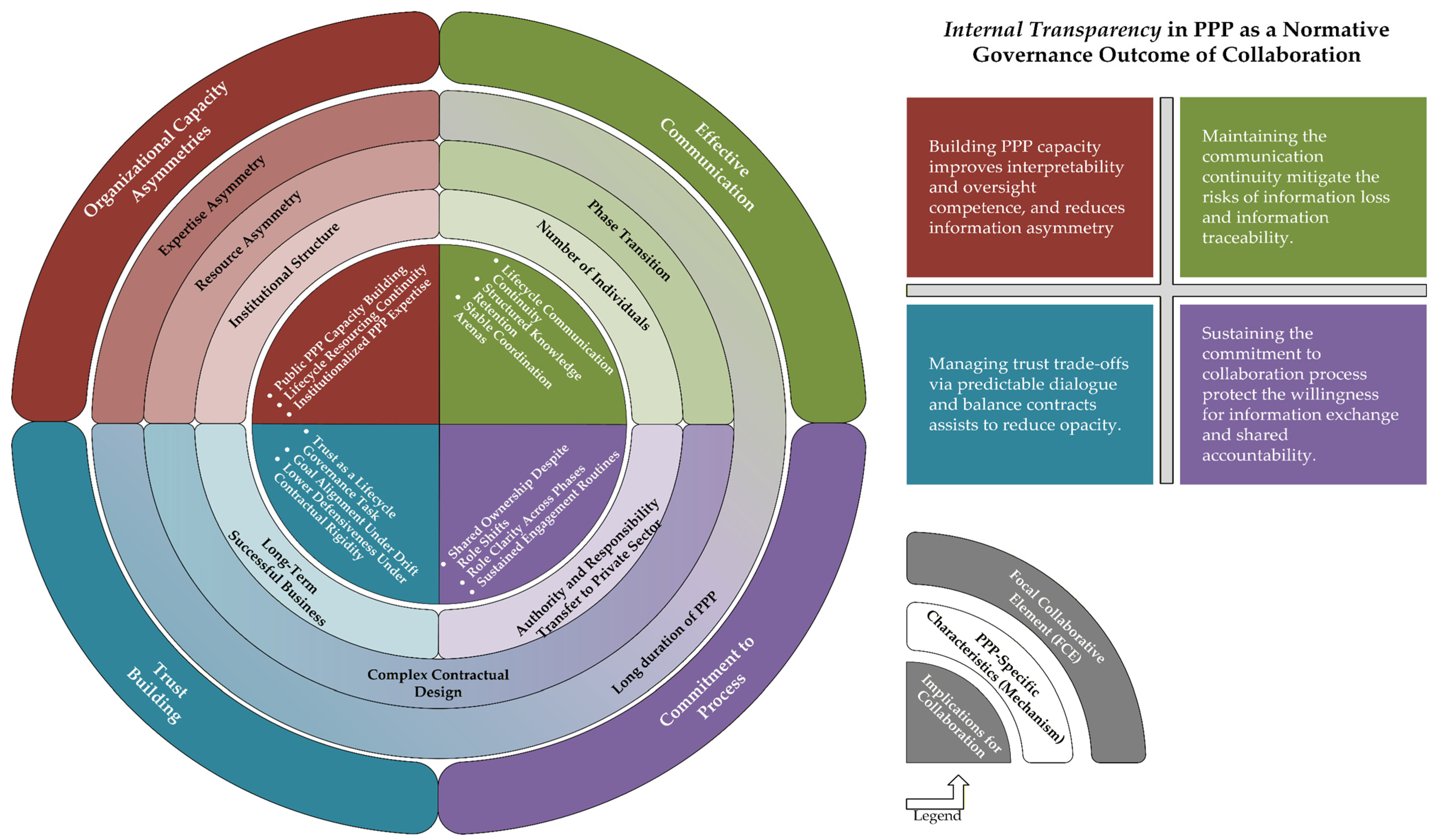
The findings suggest that four governance areas play a major role in PPP collaboration: (1) sustaining capacity and expertise within the public sector, (2) preserving shared ownership and commitment to process despite role shifts and contract complexity, (3) protecting communication continuity and knowledge retention across the long contractual period, phase transitions and personnel changes, and (4) managing trust trade-offs created by goal drift and contractual rigidity. This section translates these patterns into governance implications for strengthening collaboration in PPP. Additionally, whereas internal transparency in PPP is shaped by how internal stakeholders share information, interpret decisions, and coordinate responsibilities, the collaboration mechanisms identified in this study also provide practical insights on this end. These implications are briefly illustrated in
Figure 1.
6.2.1. Implications for Collaboration
This section explains the major implications for collaboration in PPP based on the identified FCEs and their associated PPP-specific mechanisms:
Maintaining PPP-oriented expertise and resourcing within the public sector beyond the procurement phase is substantial. Public capacity should be institutionalized rather than concentrated in a few individuals, since individual turnover creates knowledge loss and disrupts collaborative routines. This supports collaboration by enabling the public partner to participate meaningfully in technical deliberations and ongoing oversight. It also reduces risks of becoming dependent on private sector interpretations of performance, compliance, and quality.
Sustained commitment requires governance arrangements and contractual considerations to preserve shared ownership of collaborative practices across phases. PPPs should not rely on early-stage collaboration alone; rather, commitment needs reinforcement during the implementation phase through clear collaborative routines, agreed decision follow-up procedures, and explicit role distribution that does not unintentionally marginalize the public partner. Contractual complexity should be managed through clear role articulation and practical routines for collaborative problem solving, so that collaboration remains a living process rather than a procurement-stage event.
Communication effectiveness in PPP depends remarkably on continuity. Governance routines should explicitly address lifecycle transitions and staff changes by institutionalizing structured intellectual handover practices, documentation norms, continuity roles, and mechanisms for preserving tacit knowledge. Where co-location is feasible, it can support communication, but the more essential lesson is that effective communication is not guaranteed by proximity alone and it depends on stable communication routines and accountability for information continuity across phases.
Trust should be actively managed as a lifecycle agenda. Long-term engagement enables trust, but governance structures must mitigate trust erosion caused by goal drift and contractual rigidity. A practical implication is to protect trust by establishing predictable arenas for dialogue, clarifying expectations for information exchange, and designing contractual arrangements that reduce unnecessary defensiveness while preserving accountability. Trust-supportive routines can help partners move from compliance-driven interaction toward joint problem solving when uncertainties arise.
6.2.2. Implications for Internal Transparency
This study emphasizes internal transparency as a normative governance outcome of collaboration, which can be strengthened by improving collaboration mechanisms that shape information exchange among internal stakeholders. The observed patterns indicate that internal transparency is most vulnerable when lifecycle dynamics create information discontinuity, asymmetry in interpretive competence, and defensive behavior. Further implications of collaboration for internal transparency in PPP are elaborated as follows:
Capacity asymmetry can reduce internal transparency by limiting the public partner’s ability to interpret performance information and sustain oversight competence across phases. Hence, strengthening PPP-oriented capacity supports internal transparency by improving interpretability and reducing information asymmetry.
Commitment constraints can weaken internal transparency by reducing the willingness to share information proactively and by undermining shared accountability. When commitment becomes episodic, transparency practices may become minimal and compliance-oriented rather than collaborative and explanatory.
Communication discontinuity, especially caused by phase transitions and staff changes, undermines internal transparency by increasing information loss, weakening the traceability of decisions, and reducing the continuity of records. Thus, governance routines that preserve continuity, e.g., documentation standards, stable communication arenas, etc., contribute to internal transparency.
Trust ambivalence shapes transparency practices because trust influences whether information is shared openly or strategically. Managing trust trade-offs through predictable dialogue and balanced contractual arrangements can reduce opacity and defensive communication.
In general, the findings corroborate the theoretical premise regarding internal transparency in PPP as not only a disclosure obligation to external stakeholders, but also a governance outcome shaped by collaboration dynamics. Strengthening collaboration across the lifecycle thus provides a practical pathway for enhancing internal transparency.
6.3. Limitations and Future Research
This study has been carried out under the influence of limitations, and the inferences made must be interpreted in light of such conditions. This section highlights the main limitations and, in this regard, also sheds light on future research directions.
Initially, the empirical assessments were based on patterns observed in the survey results. In fact, the data collected represent only a portion of the PPP market, reflecting the expert opinions of 34 PPP practitioners, although the sample size remains informative for an exploratory expert-based assessment. This implies that the findings and conclusions are not exhaustive and inclusive. Secondly, the authors could reach out to PPP practitioners in only three jurisdictions, which equivalently limits the opportunity to generalize the inferences. In this regard, the results do not reflect the jurisdictional context either. This is mainly due to the fact that the scope of this research suggested a more holistic approach to obtain an operational approach for lifecycle collaboration rather than performing contextual comparisons. It is also worth noting that some participants have experience with several PPP projects in varied jurisdictions, and this condition not only introduces a hurdle for data collection but, more importantly, increases the possibility of obtaining biased opinions that do not reflect a generic account for the survey statements. Nevertheless, the responses capture perceptions at a point in time and may reflect contextual conditions such as jurisdictional practices, project types, and respondents’ roles.
This circumstance helps to cultivate the avenues for future research. Primarily, with a larger and more balanced sample, future research could apply inferential and multivariate techniques, including subgroup comparison or structural modeling, to examine whether the patterns observed remain stable across respondent categories and jurisdictional settings. Moreover, it is a beneficial scholarly effort to triangulate the survey perceptions with case studies. Such studies provide the opportunity to meticulously investigate the functioning of PPP mechanisms across FCEs, which in turn help in identifying more dynamics for protecting lifecycle collaboration and further explaining how collaboration practices yield greater internal transparency across the PPP lifecycle. Furthermore, it is acknowledged that cultural variations and jurisdictional contextual differences are highly influential on collaboration practices. In this regard, it is of substantial benefit to carry out research on jurisdictional comparisons and investigate the contextual dynamics that stem from contextual variations, e.g., the Scandinavian Region, Mediterranean Countries, etc. Lastly, this study identified FCEs based on prior research on collaborative governance models in the public administration realm (
Ansell & Gash, 2008;
Emerson et al., 2011), and the studied collaborative elements did not represent the total elements proposed by these models. Although the selected elements are salient within the PPP context, it is advantageous to conduct further research and investigate the practice of other collaborative elements in the PPP context to expand the framework for operationalizing collaboration in the PPP lifecycle.
7. Conclusions
This study aimed to address two interconnected gaps in the PPP literature. First, while collaborative governance has been widely discussed in public administration, PPP scholarship has continued to place greater emphasis on macro governance structures than on the micro-level collaborative drivers operating between internal partners throughout the PPP lifecycle. Second, although transparency is widely recognized as a governance concern in PPP, internal transparency has received limited attention as an outcome shaped by systematic collaboration between project partners. In response to these gaps, this study examined how collaboration in PPP can be leveraged across the project lifecycle through four focal collaborative elements (FCEs)—organizational capacity asymmetries, commitment to process, effective communication, and trust building—and how the functioning of these elements may carry implications for internal transparency.
In response to the first research question, the findings show that collaboration in PPP is not merely a contractual or structural condition, but a lifecycle governance process shaped by specific operational mechanisms. The results indicate that organizational capacity asymmetry becomes particularly consequential when expertise and resource imbalances intensify after procurement, thereby weakening the public partner’s ability to sustain meaningful collaborative engagement. Commitment to process is challenged when contractual complexity and shifts in authority and responsibility reduce the continuity of shared ownership across phases. Effective communication appears especially vulnerable to staff changes and phase transitions, which increase the risk of information loss and make it difficult to preserve communication quality over time. Trust building, in turn, is shown to be ambivalent in PPP settings: it may be supported by long-term partnership incentives and repeated interaction, yet constrained by goal drift and contractual rigidity. Overall, these findings suggest that collaboration in PPP should be approached through a more structured and lifecycle-oriented governance agenda that explicitly addresses the practical mechanisms shaping collaboration across phases.
In response to the second research question, this study indicates that collaboration has important implications for internal transparency in PPP. The findings suggest that internal transparency is not solely a matter of formal disclosure or information availability, but is also shaped by the quality of interaction between internal stakeholders. In particular, asymmetries in competence may reduce the interpretability of information, episodic commitment may weaken proactive information sharing and shared accountability, communication discontinuity may undermine traceability and knowledge retention, and trust deficits may encourage opacity and defensive behavior. In this regard, this study positions internal transparency as a governance outcome that is closely linked to how collaboration is practiced and sustained across the PPP lifecycle.
From a practical perspective, the findings provide several implications for policymakers and public managers involved in PPP arrangements. Strengthening collaboration in PPP requires more than designing formal partnership structures at the procurement stage. It requires preserving public sector capacity beyond procurement, maintaining collaborative ownership despite role shifts, institutionalizing communication continuity across long project durations and phase transitions, and actively managing trust under contractual uncertainty. In practical terms, this means that governance arrangements in PPP should incorporate mechanisms for capacity retention, clearer cross-phase role articulation, structured communication and handover routines, and predictable arenas for dialogue that reduce defensiveness and support joint problem solving. As a result, public actors can create better conditions not only for collaboration itself, but also for stronger internal transparency throughout the lifecycle of PPP projects.
In corollary, this study contributes to the PPP and collaborative governance literature by shifting attention from macro-level partnership design toward the micro-level collaborative mechanisms that shape internal working relationships over time. It also contributes by positioning internal transparency as an outcome of collaborative practice rather than merely a formal governance requirement. Although the findings should be interpreted in light of the study’s limitations, this study offers a structured basis for understanding how collaboration may be strengthened in PPP and how such improvement may support greater internal transparency across the project lifecycle.
Author Contributions
Conceptualization, M.A., A.T.S. and T.K.S.; methodology, M.A. and A.T.S.; software, M.A.; validation, M.A. and A.T.S.; formal analysis, M.A.; investigation, M.A. and A.T.S.; resources, M.A.; data curation, M.A.; writing—original draft preparation, M.A.; writing—review and editing, M.A. and A.T.S.; visualization, M.A.; supervision, A.T.S. and T.K.S.; project administration, M.A.; funding acquisition, M.A., A.T.S. and T.K.S. All authors have read and agreed to the published version of the manuscript.
Funding
Open access funding is provided by the NMBU Norwegian University of Life Sciences.
Institutional Review Board Statement
Ethical review and approval were waived for this study because the survey was conducted anonymously. No personal information was collected, and the survey results were only analyzed and reported in an aggregated form that cannot be linked to individual identities.
Informed Consent Statement
Informed consent was obtained from all subjects involved in the study.
Data Availability Statement
The original contributions presented in this study are included in the article.
Conflicts of Interest
The authors declare no conflicts of interest.
Appendix A. Survey Guide
Expertise differences between the public and private sectors reduce the effectiveness of collaboration.
Expertise differences between the public and private sectors reduce the motivation for collaboration.
Increased resource differences between the public and private sectors during the construction/operation phase make collaboration more challenging.
Increased resource differences between the public and private sectors during the construction/operation phase make it difficult to co-locate their representatives in shared spaces.
The public sector’s institutional design is not structured to maintain collaboration during the construction/operation phase.
The long duration of PPPs reduces motivation to maintain collaboration across the project lifecycle.
Reduced public sector authority and responsibility during the construction/operation phase limit opportunities for collaboration.
Contractual complexity in PPP makes it difficult to clearly define the partners’ roles and responsibilities across PPP phases, which reduces the commitment to collaboration.
The large number of individuals involved in PPPs makes communication less effective.
Changes in staff status across a long PPP lifecycle reduce communication effectiveness.
* Status Change: retirement, job change, and so forth.
- 11.
The transition of phases in PPP disrupts communication effectiveness.
* Phase Transition: procurement ↦ construction | construction ↦ operation
- 12.
The transition of phases in PPP increases the risk of information loss.
- 13.
The transition of phases in PPP makes it difficult to restore the same level of communication as in the previous phase.
- 14.
Reduced public sector authority and responsibility during the construction/operation phase limit opportunities to co-locate with private sector representatives in shared spaces.
- 15.
Frequent and long-term communications in PPPs help partners build trust.
- 16.
In PPPs, having a successful long-term partnership encourages the partners to build trust.
- 17.
Changes in the partners’ goals over the long-term PPP lifecycle make it difficult to maintain trust.
- 18.
Contractual complexity in PPPs creates rigidity and protective behavior, which makes trust building more difficult.
References
- Aaltonen, K., & Kujala, J. (2010). A project lifecycle perspective on stakeholder influence strategies in global projects. Scandinavian Journal of Management, 26(4), 381–397. [Google Scholar] [CrossRef]
- Abdullah, A., & Khadaroo, I. (2020). The trust-control nexus in Public Private Partnership (PPP) contracts. Journal of Accounting and Public Policy, 39(6), 106768. [Google Scholar] [CrossRef]
- Acar, M., & Robertson, P. J. (2004). Accountability challenges in networks and partnerships: Evidence from educational partnerships in the United States. International Review of Administrative Sciences, 70(2), 331–344. [Google Scholar] [CrossRef]
- Alexander, J. A., Comfort, M. E., & Weiner, B. J. (1998). Governance in public-private community health partnerships: A survey of the community care network SM demonstration sites. Nonprofit Management and Leadership, 8(4), 311–332. [Google Scholar] [CrossRef]
- Ansell, C., & Gash, A. (2008). Collaborative governance in theory and practice. Journal of Public Administration Research and Theory, 18(4), 543–571. [Google Scholar] [CrossRef]
- Ashade, O. A., & Mutereko, S. (2020). Infrastructural governance in lagos state: Analysing community engagement in the PPP implementation policy framework. International Journal of Social Sciences and Humanity Studies, 12(2), 561–577. [Google Scholar]
- Ashade, O. A., & Mutereko, S. (2022). Collaborative governance and project community stakeholding in developing countries’ infrastructural governance: Lessons from Nigeria’s experiential knowledge. African Journal of Governance and Development, 11(1.2), 233–255. [Google Scholar] [CrossRef]
- Ayhan, B., & Üstüner, Y. (2022). Turkey’s public-private partnership experience: A political economy perspective. Southeast European and Black Sea Studies, 23(1), 115–138. [Google Scholar] [CrossRef]
- Azarian, M., Shiferaw, A. T., Lædre, O., Wondimu, P. A., & Stevik, T. K. (2023a). Project ownership in Public-Private Partnership (PPP) projects of Norway. Procedia Computer Science, 219, 1838–1846. [Google Scholar] [CrossRef]
- Azarian, M., Shiferaw, A. T., Stevik, T. K., Lædre, O., & Wondimu, P. A. (2023b). Public-Private Partnership: A bibliometric analysis and historical evolution. Buildings, 13(8), 2035. [Google Scholar] [CrossRef]
- Benítez-Ávila, C., Hartmann, A., Dewulf, G., & Henseler, J. (2018). Interplay of relational and contractual governance in Public-Private Partnerships: The mediating role of relational norms, trust and partners’ contribution. International Journal of Project Management, 36(3), 429–443. [Google Scholar] [CrossRef]
- Bentrup, G. (2001). Evaluation of a collaborative model: A case study analysis of watershed planning in the intermountain west. Environmental Management, 27, 739–748. [Google Scholar] [CrossRef]
- Besley, T., & Ghatak, M. (2008). Provision of public services by non-state actors. Revue D’économie Du Développement, 16(4), 89–108. [Google Scholar] [CrossRef]
- Bloomfield, P. (2006). The challenging business of long-term Public-Private Partnerships: Reflections on local experience. Public Administration Review, 66(3), 400–411. [Google Scholar] [CrossRef]
- Bratman, M. E. (1992). Shared cooperative activity. The Philosophical Review, 101(2), 327–341. [Google Scholar] [CrossRef]
- Brinkerhoff, J. M. (2002). Government–nonprofit partnership: A defining framework. Public Administration and Development, 22(1), 19–30. [Google Scholar] [CrossRef]
- Brown, A. J. (2002). Collaborative governance versus constitutional politics: Decision rules for sustainability from Australia’s South East Queensland forest agreement. Environmental Science & Policy, 5(1), 19–32. [Google Scholar] [CrossRef]
- Bryson, J. M., Crosby, B. C., & Stone, M. M. (2015). Designing and implementing cross-sector collaborations: Needed and challenging. Public Administration Review, 75(5), 647–663. [Google Scholar] [CrossRef]
- Chen, C., & Hubbard, M. (2012). Power relations and risk allocation in the governance of Public Private Partnerships: A case study from China. Policy and Society, 31(1), 39–49. [Google Scholar] [CrossRef]
- Chen, C., & Man, C. (2020). Are good governance principles institutionalised with policy transfer? An examination of Public-Private Partnerships policy promotion in China. Australian Journal of Social Issues, 55(2), 162–181. [Google Scholar] [CrossRef]
- Cheng, M., Liu, G., Xu, Y., & Chi, M. (2021). Enhancing trust between PPP partners: The role of contractual functions and information transparency. Sage Open, 11(3), 21582440211038245. [Google Scholar] [CrossRef]
- Commission of The European Communities. (2004). Green paper on Public-Private Partnerships and community law on public contracts and concessions. Commission of The European Communities. [Google Scholar]
- Cucciniello, M., Porumbescu, G. A., & Grimmelikhuijsen, S. (2016). 25 years of transparency research: Evidence and future directions. Public Administration Review, 77(1), 32–44. [Google Scholar] [CrossRef]
- Davis, P. (1986). Why partnerships? Why now? Proceedings of the Academy of Political Science. [Google Scholar]
- Dodou, D., & de Winter, J. C. (2014). Social desirability is the same in offline, online, and paper surveys: A meta-analysis. Computers in Human Behavior, 36, 487–495. [Google Scholar] [CrossRef]
- Durant, L. E., Carey, M. P., & Schroder, K. E. (2002). Effects of anonymity, gender, and erotophilia on the quality of data obtained from self-reports of socially sensitive behaviors. Journal of Behavioral Medicine, 25(5), 439–467. [Google Scholar] [CrossRef]
- Edwards, P., Shaoul, J., Stafford, A., & Arblaster, L. (2004). Evaluating the operation of PFI in roads and hospitals. In Certified accountants educational trust (Vol. 84). The Association of Chartered Certified Accountants. [Google Scholar]
- El Ansari, W. (2003). Educational partnerships for public health: Do stakeholders perceive similar outcomes? Journal of Public Health Management and Practice, 9(2), 136–156. [Google Scholar] [CrossRef]
- Emerson, K., Nabatchi, T., & Balogh, S. (2011). An integrative framework for collaborative governance. Journal of Public Administration Research and Theory, 22(1), 1–29. [Google Scholar] [CrossRef]
- European PPP Expertise Centre (EPEC). (2015). PPP motivations and challenges for the public sector: Why (not) and how. European PPP Expertise Centre (EPEC). [Google Scholar]
- Ezezika, O. C., & Oh, J. (2012). What is trust?: Perspectives from farmers and other experts in the field of agriculture in Africa. Agriculture & Food Security, 1, S1. [Google Scholar] [CrossRef][Green Version]
- Futrell, R. (2003). Technical adversarialism and participatory collaboration in the U.S. chemical weapons disposal program. Science, Technology, & Human Values, 28(4), 451–482. [Google Scholar] [CrossRef]
- Geoghegan, T., & Renard, Y. (2002). Beyond community involvement: Lessons from the insular caribbean. Parks, 12(2), 16–27. [Google Scholar]
- Gnambs, T., & Kaspar, K. (2015). Disclosure of sensitive behaviors across self-administered survey modes: A meta-analysis. Behavior Research Methods, 47(4), 1237–1259. [Google Scholar] [CrossRef] [PubMed]
- Gray, B. (1989). Collaborating: Finding common ground for multiparty problems. Jossey Bass. [Google Scholar]
- Gray, B., Purdy, J., & Ansari, S. (2022). Confronting power asymmetries in partnerships to address grand challenges. Organization Theory, 3(2), 26317877221098765. [Google Scholar] [CrossRef]
- Greve, C. (2003). Public-private partnerships in Scandinavia. International Public Management Review, 4(2), 59–69. Available online: https://ipmr.net/index.php/ipmr/article/view/216 (accessed on 30 April 2026).
- Hardy, C., Phillips, N., & Lawrence, T. B. (2003). Resources, knowledge and influence: The organizational effects of interorganizational collaboration. Journal of Management Studies, 40(2), 321–347. [Google Scholar] [CrossRef]
- Hodge, G. (2004). The risky business of Public-Private Partnerships. Australian Journal of Public Administration, 63(4), 37–49. [Google Scholar] [CrossRef]
- Hodge, G., & Greve, C. (2007). Public-Private Partnerships: An international performance review. Public Administration Review, 67(3), 545–558. [Google Scholar] [CrossRef]
- Hodge, G., Greve, C., & Boardman, A. (2017). Public-Private Partnerships: The way they were and what they can become. Australian Journal of Public Administration, 76(3), 273–282. [Google Scholar] [CrossRef]
- Howlett, M. (2004). Administrative styles and regulatory reform: Institutional arrangements and their effects on administrative behavior. International Public Management Review, 5(2), 13–35. Available online: https://ipmr.net/index.php/ipmr/article/view/148 (accessed on 30 April 2026).
- Jaeger, P. T., & Bertot, J. C. (2010). Transparency and technological change: Ensuring equal and sustained public access to government information. Government Information Quarterly, 27(4), 371–376. [Google Scholar] [CrossRef]
- Janssen, K. (2012). Open government data and the right to information: Opportunities and obstacles. The Journal of Community Informatics, 8(2). [Google Scholar] [CrossRef]
- Jarvis, C. B., MacKenzie, S. B., & Podsakoff, P. M. (2003). A critical review of construct indicators and measurement model misspecification in marketing and consumer research. Journal of Consumer Research, 30(2), 199–218. [Google Scholar] [CrossRef] [PubMed]
- Jooste, S. F., & Scott, W. R. (2012). The Public-Private Partnership enabling field: Evidence from three cases. Administration & Society, 44(2), 149–182. [Google Scholar] [CrossRef]
- Kickert, W. (2007). Distinctive characteristics of state and administrative reform in Southern Europe. Modernizing Government in Europe. [Google Scholar]
- Krosnick, J. A., & Fabrigar, L. R. (1997). Designing Rating scales for effective measurement in surveys. In L. Lyberg, P. Biemer, M. Collins, E. De Leeuw, C. Dippo, N. Schwarz, & D. Trewin (Eds.), Survey measurement and process quality (pp. 141–164). John Willey & Sons. [Google Scholar]
- Liu, B., Li, J., Wang, D., Liu, H., Wu, G., & Yuan, J. (2024). Public-Private Partnerships: A collaborative framework for ensuring project sustainable operations. Engineering, Construction and Architectural Management, 31(1), 264–289. [Google Scholar] [CrossRef]
- Margerum, R. D. (2001). Organizational commitment to integrated and collaborative management: Matching strategies to constraints. Environmental Management, 28(4), 421–431. [Google Scholar] [CrossRef]
- Mayer, M., & Yusuf, J.-E. (2022). Structuring Public-Private Partnerships for public value: Analysis of two transportation infrastructure case studies. Public Works Management & Policy, 27(3), 295–314. [Google Scholar] [CrossRef]
- Morgan, R. M., & Hunt, S. D. (1994). The commitment-trust theory of relationship marketing. Journal of Marketing, 58(3), 20–38. [Google Scholar] [CrossRef]
- Noy, C. (2008). Sampling knowledge: The hermeneutics of snowball sampling in qualitative research. International Journal of Social Research Methodology, 11(4), 327–344. [Google Scholar] [CrossRef]
- Ojiako, U., Papadopoulos, T., Stamati, T., Anagnostopoulos, D., & Marshall, A. (2015). Collaborative governance in Greek infrastructure projects. Proceedings of the Institution of Civil Engineers-Management, Procurement and Law, 168(3), 135–145. [Google Scholar] [CrossRef]
- Olander, S., & Landin, A. (2005). Evaluation of stakeholder influence in the implementation of construction projects. International Journal of Project Management, 23(4), 321–328. [Google Scholar] [CrossRef]
- Ong, A. D., & Weiss, D. J. (2000). The impact of anonymity on responses to sensitive questions. Journal of Applied Social Psychology, 30(8), 1691–1708. [Google Scholar] [CrossRef]
- Osei-Kyei, R., & Chan, A. P. (2015). Review of studies on the critical success factors for Public-Private Partnership (PPP) projects from 1990 to 2013. International Journal of Project Management, 33(6), 1335–1346. [Google Scholar] [CrossRef]
- Padiila, Y. C., & Daigle, L. E. (1998). Inter-agency collaboration in an international setting. Administration in Social Work, 22(1), 65–81. [Google Scholar] [CrossRef]
- Palinkas, L. A., Horwitz, S. M., Green, C. A., Wisdom, J. P., Duan, N., & Hoagwood, K. (2015). Purposeful sampling for qualitative data collection and analysis in mixed method implementation research. Administration and Policy in Mental Health and Mental Health Services Research, 42(5), 533–544. [Google Scholar] [CrossRef]
- Papadopoulos, Y. (2007). Problems of democratic accountability in network and multilevel governance. European Law Journal, 13(4), 469–486. [Google Scholar] [CrossRef]
- Parker, D., & Hartley, K. (2003). Transaction costs, relational contracting and Public Private Partnerships: A case study of UK defence. Journal of Purchasing and Supply Management, 9(3), 97–108. [Google Scholar] [CrossRef]
- Provan, K. G., & Kenis, P. (2008). Modes of network governance: Structure, management, and effectiveness. Journal of Public Administration Research and Theory, 18(2), 229–252. [Google Scholar] [CrossRef]
- Reig, M., Gasco-Hernandez, M., & Esteve, M. (2021). Internal and external transparency in Public-Private Partnerships—The case of Barcelona’s water provision. Sustainability, 13(4), 1777. [Google Scholar] [CrossRef]
- Reynaers, A. M. (2014). Public values in Public-Private Partnerships. Public Administration Review, 74(1), 41–50. [Google Scholar] [CrossRef]
- Reynaers, A. M., & Grimmelikhuijsen, S. (2015). Transparency in Public-Private Partnerships: Not so bad after all? Public Administration, 93(3), 609–626. [Google Scholar] [CrossRef]
- Ring, P. S., & Van de Ven, A. H. (1994). Developmental processes of cooperative interorganizational relationships. Academy of Management Review, 19(1), 90–118. [Google Scholar] [CrossRef] [PubMed]
- Roehrich, J. K., Lewis, M. A., & George, G. (2014). Are Public-Private Partnerships a healthy option? A systematic literature review. Social Science & Medicine, 113, 110–119. [Google Scholar] [CrossRef]
- Rousseau, D. M., Sitkin, S. B., Burt, R. S., & Camerer, C. (1998). Not so different after all: A cross-discipline view of trust. Academy of Management Review, 23(3), 393–404. [Google Scholar] [CrossRef]
- Rybnicek, R., Plakolm, J., & Baumgartner, L. (2020). Risks in Public-Private Partnerships: A systematic literature review of risk factors, their impact and risk mitigation strategies. Public Performance & Management Review, 43(5), 1174–1208. [Google Scholar] [CrossRef]
- Searle, J. R. (1990). Collective intentions and actions. In P. R. Cohen, J. Morgan, & M. E. Pollack (Eds.), Intentions in communication. The MIT Press. [Google Scholar]
- Sheppard, G., & Beck, M. (2022). Stakeholder engagement and the future of Irish Public-Private Partnerships. International Review of Administrative Sciences, 88(3), 843–861. [Google Scholar] [CrossRef]
- Sheppard, G., & Beck, M. (2023). Transparency trade-offs in the operation of national Public Private Partnership units: The case of ireland’s national development finance agency. Journal of Accounting and Public Policy, 42(4), 107111. [Google Scholar] [CrossRef]
- Shiferaw, A. T. (2024, September 28–29). Unlocking project success: The crucial role of interpersonal skills in project management. IOP Conference Series: Earth and Environmental Science, Surabaya, Indonesia. [Google Scholar]
- Shiferaw, A. T., Wondimu, P. A., & Stevik, T. K. (2023). Room for maneuver: Practicing competitive dialogue in infrastructure projects in Norway. Journal of Public Procurement, 23(2), 200–220. [Google Scholar] [CrossRef]
- Sudiyono, K. A., Mursitama, T., Simatupang, B., & Hamsal, M. (2017, November 1–3). The governance of public-private ties model: How to govern the PPPs infrastructure project effectively (an indonesia case). International Conference on Business and Management Research (ICBMR 2017), Padang, Indonesia. [Google Scholar][Green Version]
- Sullivan, G. M., & Artino, A. R., Jr. (2013). Analyzing and interpreting data from likert-type scales. Journal of Graduate Medical Education, 5(4), 541–542. [Google Scholar] [CrossRef] [PubMed]
- Taherdoost, H. (2019). What is the best response scale for survey and questionnaire design; review of different lengths of rating scale/attitude scale/likert scale. International Journal of Academic Research in Management (IJARM), 8(1), 1–10. Available online: https://hal.science/hal-02557308v1 (accessed on 30 April 2026).
- Tashakkori, A., & Teddlie, C. (2010). SAGE handbook of mixed methods in social & behavioral research (2nd ed.). SAGE Publications. [Google Scholar]
- Tavakol, M., & Dennick, R. (2011). Making sense of Cronbach’s alpha. International Journal of Medical Education, 2, 53–55. [Google Scholar] [CrossRef]
- Ter Bogt, H., & Tillema, S. (2016). Accounting for trust and control: Public sector partnerships in the arts. Critical Perspectives on Accounting, 37, 5–23. [Google Scholar] [CrossRef]
- Tomo, A., Mangia, G., Hinna, A., & Pellegrini, M. M. (2020). Making collaborative governance effective: A case study on the pathway to successful Public-Private Interactions. International Journal of Public Sector Performance Management, 6(1), 36–55. [Google Scholar] [CrossRef]
- Uddin, S., Mori, Y., & Adhikari, P. (2019). Participatory budgeting in a local government in a vertical society: A Japanese story. International Review of Administrative Sciences, 85(3), 490–505. [Google Scholar] [CrossRef]
- United Nations Economic Commission for Europe (UNECE). (2008). Guidebook on promoting good governance in Public-Private Partnerships. United Nations Publication. [Google Scholar]
- United Nations Economic Commission for Europe (UNECE). (2018). Guiding principles on People-First Public-Private Partnerships in support of the United Nations sustainable development goals (p. 37). United Nations Publication. [Google Scholar]
- University of Oslo. (n.d.). Available online: https://nettskjema.no (accessed on 1 October 2025).
- Valverde, M., & Moore, A. (2019). The performance of transparency in public-private infrastructure project governance: The politics of documentary practices. Urban Studies, 56(4), 689–704. [Google Scholar] [CrossRef]
- Viana, L. C., Moreira, J. A., & Alves, P. (2022a). Disclosure of information and transparency in Public-private Partnerships: A comparative study between Portugal and the UK. Accounting in Europe, 20(1), 66–92. [Google Scholar] [CrossRef]
- Viana, L. C., Moreira, J. A., & Alves, P. (2022b). State audit of Public-Private Partnerships: Effects on transparency, auditor’s roles, and impact on auditee’s reactions. Financial Accountability & Management, 38(4), 633–660. [Google Scholar] [CrossRef]
- Walter, U. M., & Petr, C. G. (2000). A template for family-centered interagency collaboration. Families in Society, 81(5), 494–503. [Google Scholar] [CrossRef]
- Wang, H., Xiong, W., Wu, G., & Zhu, D. (2018). Public-Private Partnership in public administration discipline: A literature review. Public Management Review, 20(2), 293–316. [Google Scholar] [CrossRef]
- Warsen, R., Nederhand, J., Klijn, E. H., Grotenbreg, S., & Koppenjan, J. (2018). What makes Public-Private Partnerships work? Survey research into the outcomes and the quality of cooperation in PPPs. Public Management Review, 20(8), 1165–1185. [Google Scholar] [CrossRef]
- Weech-Maldonado, R., & Merrill, S. B. (2000). Building partnerships with the community: Lessons from the camden health improvement learning collaborative. Journal of Healthcare Management, 45(3), 189–205. [Google Scholar] [CrossRef]
- Yaffee, S. L., & Wondolleck, J. M. (2003). Collaborative ecosystem planning processes in the United States: Evolution and challenges. Environments, 31(2), 59–72. [Google Scholar]
- Zaheer, A., McEvily, B., & Perrone, V. (1998). Does trust matter? Exploring the effects of interorganizational and interpersonal trust on performance. Organization Science, 9(2), 141–159. [Google Scholar] [CrossRef]
- Zhang, X., & Tariq, S. (2020). Failure mechanisms in international water PPP projects: A public sector perspective. Journal of Construction Engineering and Management, 146(6), 04020055. [Google Scholar] [CrossRef]
- Zheng, J., Roehrich, J. K., & Lewis, M. A. (2008). The dynamics of contractual and relational governance: Evidence from long-term public-private procurement arrangements. Journal of Purchasing and Supply Management, 14(1), 43–54. [Google Scholar] [CrossRef]
| Disclaimer/Publisher’s Note: The statements, opinions and data contained in all publications are solely those of the individual author(s) and contributor(s) and not of MDPI and/or the editor(s). MDPI and/or the editor(s) disclaim responsibility for any injury to people or property resulting from any ideas, methods, instructions or products referred to in the content. |