Use of Knowledge Management to Enhance International Research Collaboration


Abstract
1. Introduction
1.1. International Research Collaboration
1.2. Knowledge Management
1.3. Knowledge Management in International Research Collaboration
1.4. Problem Statement, Research Aim, and Research Objectives
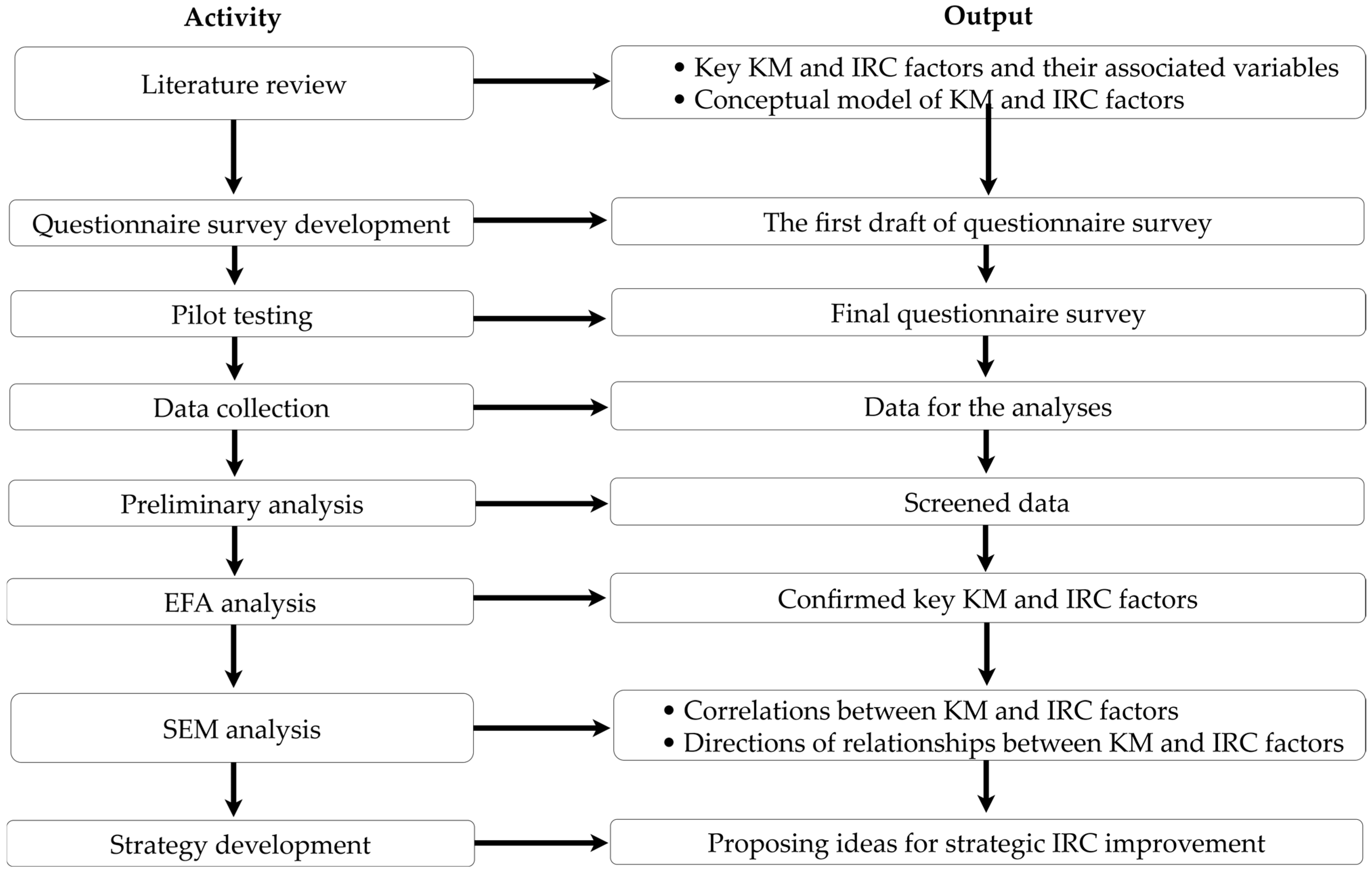
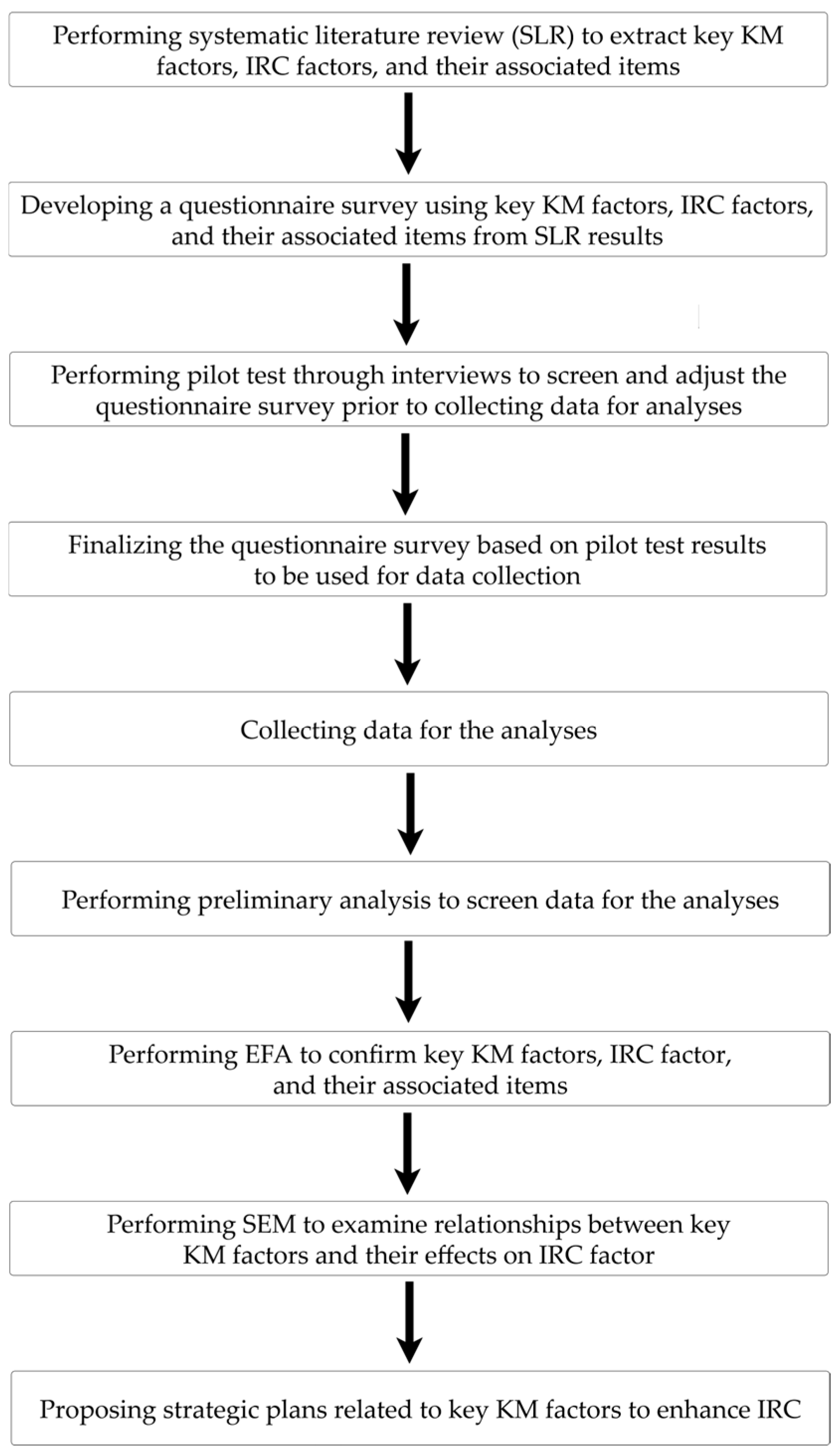
- Performing a systematic literature review (SLR) to extract key KM factors, IRC factors, and their associated items;
- Developing a questionnaire survey using key KM factors, IRC factors, and their associated items from SLR results;
- Performing a pilot test through interviews to screen and adjust the questionnaire survey prior to collecting data for analyses;
- Finalizing the questionnaire survey based on pilot test results to be used for data collection;
- Collecting data for the analyses;
- Performing preliminary analysis to screen data for the analyses;
- Performing EFA to confirm key KM factors, IRC factors, and their associated items;
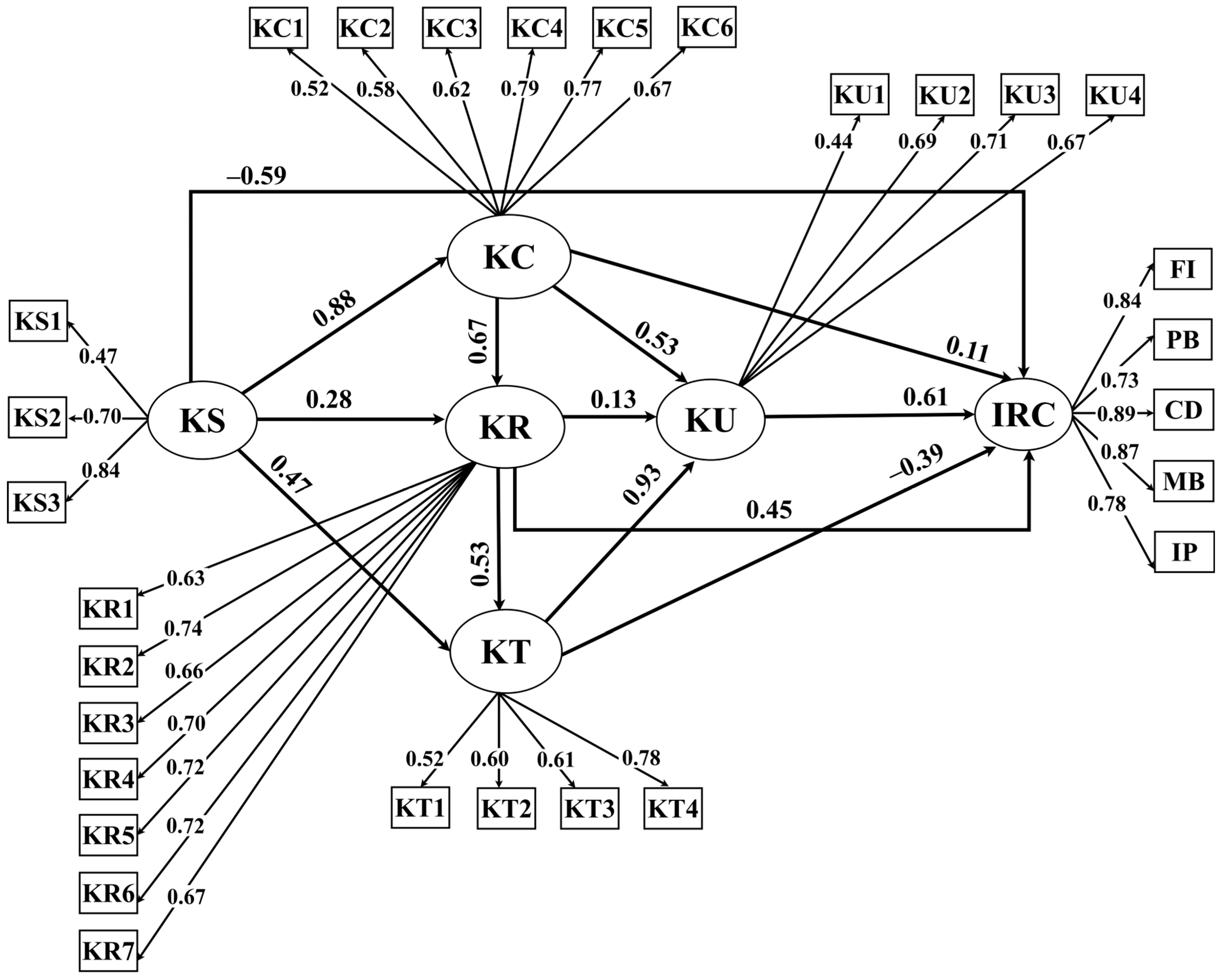
- Performing SEM to examine relationships between key KM factors and their effects on the IRC factor;
- Proposing strategic plans related to key KM factors to enhance IRC.
2. Theoretical Framework
2.1. KM Factors and Their Associated Items
2.1.1. Knowledge Sharing (KS) Factor
- Competency (KS1): The interpersonal skill that identifies issues and shares relevant knowledge to initiate and promote collaborations (Kamasak & Bulutlar, 2010). Having staff with suitable backgrounds and competencies ensures a sustainable IRC.
- Networking (KS2): The interaction among people within and beyond the same organization to exchange expertise and knowledge (Castaneda & Cuellar, 2020). Activities like consortia and mobility programs may be initiated to expand networking between organizations and their international partners (Puljak & Vari, 2014).
- Organizational culture (KS3): A culture where personnel share knowledge to achieve organizational goals (Castaneda & Cuellar, 2020).
2.1.2. Knowledge Creation (KC) Factor
- Common knowledge (KC1): The shared understanding and experiences that foster collaboration and decision-making (Castaneda & Cuellar, 2020).
- Feedback (KC2): The delivery process that includes insights to refine actions and improve strategic decisions based on past outcomes (Ibrahim & Al-Shara, 2007). Strategies like after-action review may be implemented to retrieve positive and negative feedback for further improvement (Shuffler et al., 2018).
- Organization structure (KC3): The structure that accommodates knowledge flows and collaboration dynamics (Castaneda & Cuellar, 2020).
- Teamwork (KC4): Teamwork is required to achieve goals and create new knowledge (Castaneda & Cuellar, 2020).
- Training and education (KC5): Skill development to support ongoing organizational learning and innovation (Ibrahim & Al-Shara, 2007).
- Trust (KC6): The willingness to embrace vulnerability and differences among collaborators to create new knowledge effectively (Mayer et al., 1995; Ford, 2004).
2.1.3. Knowledge Storage (KT) Factor
- Documentation (KT1): Structured information and documentation are required in KM practices for future learning and collaboration (Egeland, 2017).
- Mutual benefits (KT2): The gained understanding that benefits individuals and organizations by preserving IRC knowledge (Wikström et al., 2018).
- Shared resources (KT3): Data and workforce should be shared between IRC parties to prevent knowledge loss (Tung-Ching et al., 2016).
- Supporting policies (KT4): KM-related policies are required to store knowledge effectively (Ford, 2004).
2.1.4. Knowledge Retention (KR) Factor
- Funding (KR1): Adequate budget for KR initiatives is required to ensure knowledge continuity (Egeland, 2017).
- Human resource management (KR2): The planned workforce policy to support IRC and prevent knowledge loss (Papa et al., 2020).
- Incentives (KR3): Incentives like financial and recognition programs boost employee engagement in KM implementation (Egeland, 2017).
- IT support (KR4): Technological infrastructure and digital tools for knowledge preservation, such as management databases, activity logs, and data pools, may be used to effectively store, retain, and utilize knowledge (Ibrahim & Al-Shara, 2007).
- Management commitment (KR5): Management plays a crucial role in retaining KM-related activities (Egeland, 2017).
- Measurement (KR6): Quantitative and qualitative indicators used to assess the effectiveness of KR strategies and guide continuous improvement (Tung-Ching et al., 2016). Tools, such as balanced scorecard and key performance indicators, may be used to measure IRC activities (Kaplan et al., 2010).
- Shared risks (KR7): Shared responsibility among personnel to minimize knowledge loss and ensure continuity during personnel changes (Egeland, 2017).
2.1.5. Knowledge Utilization (KU) Factor
- Career path (KU1): Successful IRC should be used as an indicator for a career path (Lazarova & Taylor, 2009).
- Competitiveness environment (KU2): Utilization of knowledge enables organizations to sustain and strengthen their competitiveness (Zaim et al., 2018).
- Leadership (KU3): Effective knowledge utilization requires leaders who promote, share, guide, and foster IRC activities (Egeland, 2017).
- Strategy and purpose (KU4): KM initiatives should be clearly listed in the organization’s strategic plans (Egeland, 2017). Junior researchers may utilize strategies like a community of practices (CoP) to exchange viewpoints, and the successes and challenges of IRC activities (Pyrko et al., 2017).
2.2. IRC Factor and Its Associated Items
- Publication (PB): Effective IRC produces publications collaborating with multiple authors from different institutions and countries (World Intellectual Property Organization, 2024).
- Financial indicator (FI): In a good IRC environment, internal and external funding fosters innovation and technological advancement and transforms academic findings into marketable products (World Intellectual Property Organization, 2024).
- Intellectual property (IP): This IRC indicator refers to the amount of jointly owned patents by organizations and companies, universities, and research institutions (World Intellectual Property Organization, 2024).
- Mobility (MB): The number of international visitors visiting researchers/interns at the host organizations and counting participation in international collaborative activities (World Intellectual Property Organization, 2024).
- Collaborated documents (CD): The number of proposals for international grants, signed R&D contracts, memoranda of understanding (MOUs), and memoranda of agreement (MOAs) with international partners (World Intellectual Property Organization, 2024; National Science and Technology Development Agency, 2023).
3. Materials and Methods
3.1. Systematic Literature Review
3.2. Data Collection Method
3.3. Pilot Test
- Provide the definitions of KM and IRC factors at the beginning of the survey to enhance the understanding of the statements.
- Incorporate questions about formal and informal meeting statements in the KS2 variable. This aligns with Nishimoto and Matsuda (2007), who stated that crucial information can be gathered through face-to-face interactions and formal meetings.
- Add an open-ended question at the end of the survey to gather insights from the respondents.
3.4. Preliminary Analyses
3.5. Exploratory Factor Analysis
3.6. Structural Equation Modeling
4. Results
4.1. Data Collection and Preliminary Analysis Results
4.2. Exploratory Factor Analysis Results
4.3. Structural Equation Modeling Results
4.3.1. Measurement Model Results
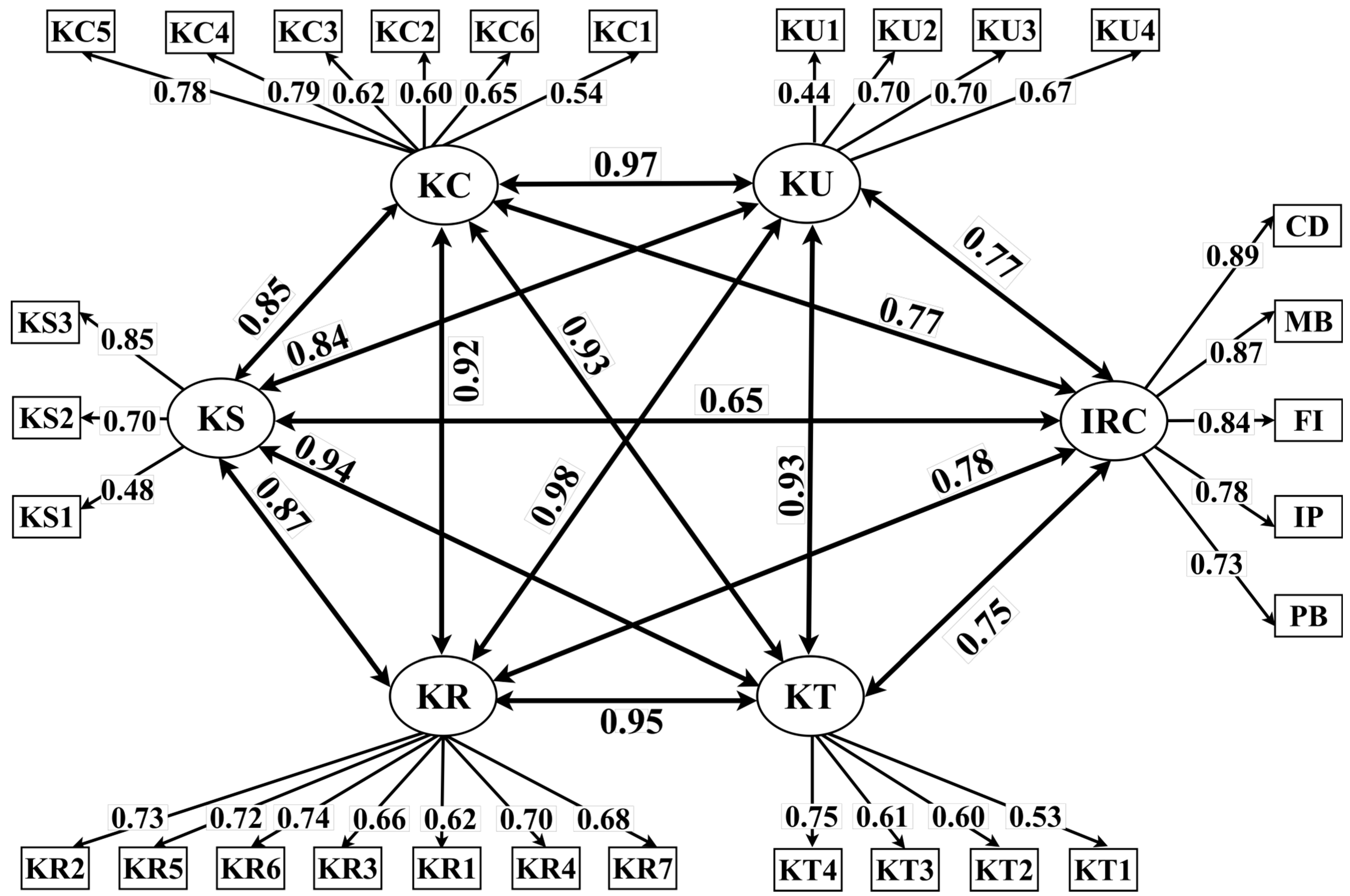
- H1 (KS ↔ KC): Knowledge sharing has a relationship with knowledge creation.
- H2 (KS ↔ KT): Knowledge sharing has a relationship with knowledge storage.
- H3 (KS ↔ KR): Knowledge sharing has a relationship with knowledge retention.
- H4 (KS ↔ KU): Knowledge sharing has a relationship with knowledge utilization.
- H5 (KC ↔ KT): Knowledge creation has a relationship with knowledge storage.
- H6 (KC ↔ KR): Knowledge creation has a relationship with knowledge retention.
- H7 (KC ↔ KU): Knowledge creation has a relationship with knowledge utilization.
- H8 (KT ↔ KR): Knowledge storage has a relationship with knowledge retention.
- H9 (KT ↔ KU): Knowledge storage has a relationship with knowledge utilization.
- H10 (KR ↔ KU): Knowledge retention has a relationship with knowledge utilization.
- H11 (KS ↔ IRC): Knowledge sharing has a relationship with international research collaboration.
- H12 (KC ↔ IRC): Knowledge creation has a relationship with international research collaboration.
- H13 (KT ↔ IRC): Knowledge storage has a relationship with international research collaboration.
- H14 (KR ↔ IRC): Knowledge retention has a relationship with international research collaboration.
- H15 (KU ↔ IRC): Knowledge utilization has a relationship with international research collaboration.
4.3.2. Structural Model Results
- H16 (KS → KC): Knowledge sharing influences knowledge creation. KS plays a pivotal role in facilitating KC across diverse organizational contexts. Chan et al. (2024) concluded that KS stimulates innovation and creates new knowledge among Southern Anhui entrepreneurs. Simukonda (2024) added that KS and resource pooling within clusters significantly enhance SMEs’ capacity for KC and innovation.
- H17 (KS → KR): Knowledge sharing influences knowledge retention through structured communication and documentation practices. Shared knowledge becomes embedded within organizational memory systems, ensuring its persistence beyond individual contributors (Sumbal et al., 2017).
- H18 (KS → KU): Knowledge sharing influences knowledge utilization when researchers openly exchange knowledge. It facilitates the adaptation and integration of knowledge into future studies, enhancing the practical utilities of scientific findings (Rahimli, 2012). KS mechanisms, such as workshops, shared databases, and collaborative publications, help to translate raw data and theoretical insights into actionable knowledge (Donate & Sánchez de Pablo, 2015).
- H19 (KS → IRC): Knowledge sharing influences international research collaboration because it enables ideas and expertise across borders and enhances trust, communication, and mutual understanding among international partners, creating a sustainable IRC (S. Wang & Raymond, 2010).
- H20 (KC → KR): Knowledge creation enhances knowledge retention by systematically generating new insights for the institutional memory that spread through collaborative processes, such as co-authorships, research workshops, and shared experimentation, reducing knowledge loss risks (Awan & Khalid, 2015).
- H21 (KC → IRC): Knowledge creation supports international research collaboration because it encourages researchers from diverse backgrounds to engage in collaborative ventures (Gui et al., 2019).
- H22 (KR → KU): Knowledge retention serves as a foundation upon which new research is built, streamlining processes and supporting knowledge utilization across a collaborative environment (Sumbal et al., 2017).
- H23 (KR → KT): Effective knowledge retention strategies influence robust knowledge storage infrastructure to prevent knowledge loss. It drives institutions to develop formal storage mechanisms, such as digital libraries, databases, and institutional repositories, for research continuity (Durst & Zieba, 2019).
- H24 (KR → IRC): Knowledge retention supports international research collaboration by preserving strategic, operational, and cultural insights for future collaboration. The prior collaboration protocols, partner preferences, and legal frameworks can be reused to streamline new collaborations and avoid pitfalls (Lucas, 2006).
- H25 (KT → IRC): Knowledge storage significantly enhances international research collaboration by providing centralized knowledge access, retrieval, and codification platforms. It allows research teams to navigate time zones and language barriers more effectively and support intellectual properties (S. Wang & Raymond, 2010; Iatridis & Schroeder, 2016).
- H26 (KU → IRC): Knowledge utilization supports international research collaboration activities when knowledge is embedded into career progression systems, such as promotion criteria, international mobility programs, and performance metrics. With this practice, researchers are incentivized to utilize collaborative knowledge (Jonkers & Tijssen, 2008).
- H27 (KS → KT): Repeated knowledge sharing helps to validate and refine knowledge before it is stored, thus improving quality. Knowledge sharing across teams helps organizations to build collective memory, so knowledge is not lost when staff leave (Alavi & Leidner, 2001; Antunes & Pinheiro, 2020).
- H28 (KT → KS): In R&D operations, knowledge storage helps to store new knowledge, making it available for further knowledge sharing through publications and staff mentoring (Xiao et al., 2021).
- H29 (KC → KT): Knowledge creation can support knowledge storage by providing insight and criteria for new knowledge to be properly stored and reducing loss when projects end (Versiani et al., 2024).
- H30 (KT → KC): Cheng et al. (2023) stated that knowledge storage supports accessible, well-structured formats of knowledge and assists research teams to effectively create new findings.
- H31 (KC → KU): Jacobi et al. (2022) commented that transdisciplinary knowledge co-creation increases knowledge utilization, leading to sustainable transformation.
- H32 (KU → KC): Knowledge utilization in university–industry collaboration in lower-income countries accumulates knowledge creation and new findings, such as using practice-based knowledge and lessons learned from industries to generate new research topics (García-Hurtado et al., 2022).
- H33 (KT → KU): Dei et al. (2024) mentioned that effective knowledge storage is needed for utilizing knowledge in learning organizations. If storage is not usability, KM practices cannot be fully utilized.
- H34 (KU → KT): Collaboration between universities and industries leads to the utilization of existing knowledge to create new knowledge through joint projects, which must be systematically stored for future use (Abu Sa’a & Yström, 2025).
5. Discussion
5.1. Strategic Plans Related to the Knowledge Utilization Factor
- Assigning personnel with IRC experience as mentors to facilitate IRC activities (i.e., KU3 item with the highest loading value of 0.71, see Figure 5). Researchers who have been awarded with IRC grants or who have participated in IRC projects may be selected as mentors for new recruits and junior researchers to provide comments on grant searching, proposal development, and how to get international partners. This will encourage team members to strategically navigate through the intercultural environment and mingle ideas with regional and global issues. The sessions should be scheduled regularly to capture new ideas and brainstorm for better IRC activities (Knight, 2025; Villarente & Durante, 2025). This mentoring program may lead to better IRC in terms of publications, IPs, and research proposals (i.e., PB, IP, and CD items under the IRC factor).
- Setting up a CoP (i.e., KU4 item) to generate insights and deep expertise of participants, resulting in crucial material to create action plans. The sessions should be scheduled regularly to capture new ideas and brainstorm for better IRC activities (Pyrko et al., 2017). For example, NSTDA deployed a CoP as an objective-oriented space to exchange specific information, e.g., international grants, international proposal submission, and international project management. Grants like Horizon Europe, the EU’s key funding program for research and innovation, which has complex regulations and high fail rates, are explained in the CoP to share tips, tricks, and hints to raise possible success rates (i.e., CD and MB items under the IRC factor). This CoP helps to elaborate the complexities of the international collaborative grant environment that may be driven by various networks from different cultures. Lessons learnt from successful IRC projects (e.g., matching the right partners and adjusting to different work cultures) may be discussed with those achieved from unsuccessful IRC projects (which may come from ineffective communication between different languages and complexities of grant protocols) to minimize failure points and increase success rates.
- Integrating IRC activities as a complement to the personnel’s career path (i.e., KU1 item) (Nguyen & Tran, 2025). For example, one IRC project proposal submission may be counted as twenty points compared with ten points of a domestic project proposal submission, and one co-authorship publication with at least two international partners may earn double points compared with a single-authorship publication. The points received may be included in the annual performance report and considered for promotion rankings. This will encourage researchers and support teams to search for more IRC projects.
5.2. Strategic Plans Related to the Knowledge Creation, Knowledge Retention, and Knowledge Storage Factors
- Launching IRC policy as part of organizational policies (i.e., KT4 item with the highest factor loading of 0.78). The policy must be co-developed and regularly updated with international partners to reflect evolving ethical, technological, and geopolitical realities and access new research opportunities and grants (i.e., FI item under the IRC factor) (Ford, 2004). The NSTDA has initiated international research committees as a part of the IRC policy to supervise and review IRC activities, thus lowering potential failures.
- Engaging senior management (i.e., research department director and above) in IRC activities to ensure effective decision-making that aligns with organizational policy and reduces possible conflicts (i.e., KR5 item with factor loading of 0.72) (Van Rensburg et al., 2014). Senior management typically has extensive experience and a network that can guide directions for researchers in IRC projects.
- Setting up the IRC task force, including researchers and supporting teams, to enhance and explore IRC projects and activities (i.e., KC4 and KC3 items, with KC4 being the item with the highest loading of 0.79). The task force members must have specific job functions related to IRC activities. They must work constantly with their international counterparts to share useful information and create common knowledge about regulations, cross-cultural customs, and research trends that align with collaborative goals and expectations (i.e., MB and PB items under the IRC factor) (Al-Husseini & Elbeltagi, 2018). Knowledge learnt must be stored in tangible forms (e.g., written documents, digital files, audio, and video clips) for future reference (Coakes, 2006).
- Updating statuses of IRC activities to teams, such as the amount of grants, progress of projects, allowances for visiting and working abroad, and risks of legal and financial clauses in collaboration agreements (i.e., KR6, KR4, and KR7 items) (Setyanto et al., 2025). A performance management tool, i.e., Microsoft Project and a balanced scorecard, may be applied to measure and follow-up IRC activities (Kaplan et al., 2010). AI-driven collaboration platforms, such as Microsoft Teams, Google Meet, Zoom Workplace, and Slack, may be considered as communication channels for a quick discussion and problem solving (Reclaim, 2025).
- Improving organizational infrastructures, such as laboratories, offices, supplies, and databases (i.e., KR4 and KT3 items). Supplies should be freely accessible to drive engagement. Databases should be regularly updated, and confidential information, such as personal information, should be securely stored. The databases should have specific functions to track the progress of IRC activities, measure outputs, and record personnel commitment for incentives and annual promotions (Singh & Pradhan, 2024). Some AI tools, like cloud-based systems (e.g., Google Cloud, Microsoft Azure, and IBM Cloud), Notion AI, Dropbox, and Google Workspace, may be applied to enhance accessibility to previous data (onsite and offsites), minimize information technology costs, and assist in real-time updating (Reclaim, 2025). Having an effective organizational infrastructure may lead to a systematic documenting system and future collaboration (i.e., CD item under the IRC factor).
- Implementing the after-action review to collect and analyze feedback from successful and unsuccessful IRC activities to decrease failures and increase the success rate of future IRC (i.e., KC2 item) (Shuffler et al., 2018). AAR is a human-resource tool used for performance improvement by capturing lessons learnt and tacit knowledge from staff. It involves four processes: plan, outcome, root cause, and improvement action identification (UNICEF, 2015). This feedback analysis helps to reduce inter-institutional misunderstandings, enhance transparency, and minimize workflow bottlenecks (Kezar, 2006; Gibson et al., 2019).
5.3. Strategic Plans Related to the Knowledge Sharing Factor
- Transforming a non-learning organization culture to a learning organization culture (i.e., KS3 item with the highest factor loading of 0.84). This process could be achieved using regular communication about the importance of the learning organization values (Lindqvist et al., 2023). Though cultural transformation takes time and effort, it will strengthen the organizational knowledge-sharing system (Mohiuddin et al., 2022; Lee & Han, 2024). For example, the NSTDA has established a co-working space, encouraging researchers from different departments to share knowledge and expertise in a friendly environment, enhancing a learning culture in the organization.
- Organizing consortia, mobility programs, and digital communities of practices through existing regional and international bodies, such as the Association of Southeast Asian Nations (ASEAN), Asia-Pacific Economic Cooperation (APEC), Asia-Pacific Tele-community (APT) (i.e., KS2 item). These may assist in locating new potential collaborators and updating global trends (i.e., MB, PB, and FI items under the IRC factor) (Puljak & Vari, 2014).
- Recruiting new talent with backgrounds in international relations, international business, and international research projects to ensure effective communication and effectiveness of IRC (i.e., KS1 item) (Reis da Silva et al., 2024).
6. Conclusions
- Five key KM factors (i.e., KS, KC, KT, KR, and KU) are crucial for IRC enhancement;
- There are direct and indirect relationships between KM and IRC factors;
- KM strategic plans are proposed to achieve sustainable IRC.
- This study utilizes EFA and SEM techniques to systematically capture interrelationships between KM and IRC factors, enhancing understanding and assisting in developing implementation plans;
- The study results guide KM implementation in assisting organizations in planning their resources to achieve IRC targets.
Supplementary Materials
Author Contributions
Funding
Institutional Review Board Statement
Informed Consent Statement
Data Availability Statement
Acknowledgments
Conflicts of Interest
References
- Abdul Rauf, U. A., Jabar, J., & Mansor, N. (2020). An exploratory factor analysis for measuring knowledge management component construct in malaysian public higher education. PalArch’s Journal of Archaeology of Egypt/Egyptology, 17(7), 4523–4534. [Google Scholar]
- Abu Sa’a, E., & Yström, A. (2025). Shaping knowledge ecosystems through university–industry collaboration: Exploring the ‘second-order’ impact of knowledge sharing. Industry and Innovation. Advanced online publication. [CrossRef]
- Ahn, J. W., Choi, H., & Oh, D. (2019). Leveraging bridging universities to access international knowledge: Korean universities’ R&D internationalization. Scientometrics, 120(2), 519–537. [Google Scholar] [CrossRef]
- Aksnes, D. W., & Sivertsen, G. (2023). Global trends in international research collaboration, 1980–2021. Journal of Data and Information Science, 8(2), 26–42. [Google Scholar] [CrossRef]
- Alavi, M., & Leidner, D. E. (2001). Review: Knowledge management and knowledge management systems: Conceptual foundations and research issues. MIS Quarterly, 25(1), 107–136. [Google Scholar] [CrossRef]
- Al-Husseini, S., & Elbeltagi, I. (2018). The role of knowledge sharing in enhancing innovation: A comparative study of public and private higher education institutions in Iraq. Innovation in Education and Teaching International, 55(1), 23–33. [Google Scholar] [CrossRef]
- Ali, M., Ali, I., Albort-Morant, G., & Leal-Rodríguez, A. L. (2021). How do job insecurity and perceived well-being affect expatriate employees’ willingness to share or hide knowledge? International Entrepreneurship and Management Journal, 17, 185–210. [Google Scholar] [CrossRef]
- Amaechi, C. V., Reda, A., Beddu, S. B., Mohamed, D. B., Syamsir, A., Jae, I. A., Ullah, S., Deng, X., Huang, B., Wang, C., & Ju, X. (2025). A systematic literature review on knowledge management for project risk management in construction. Journal of Building Engineering, 114, 114261. [Google Scholar] [CrossRef]
- Amoako-Gyampah, K., & Meredith, J. (2018). Using a social capital lens to identify the mechanisms of top management commitment: A case study of a technology project. Project Management Journal, 49(1), 5–21. [Google Scholar] [CrossRef]
- Antunes, H. D. J. G., & Pinheiro, P. G. (2020). Linking knowledge management, organizational learning and memory. Journal of Innovation & Knowledge, 5(2), 140–149. [Google Scholar] [CrossRef]
- Awan, A. G., & Khalid, M. I. (2015). Impact of knowledge management on organizational performance: A case study of selected universities in Southern Punjab-Pakistan. Information and Knowledge Management, 5(6), 59–67. [Google Scholar]
- Brace, I. (2018). Questionnaire design: How to plan, structure and write survey material for effective market research (4th ed.). Kogan Page Publishers. [Google Scholar]
- Bujang, M. A., Omar, E. D., Foo, D. H. P., & Hon, Y. K. (2024). Sample size determination for conducting a pilot study to assess reliability of a questionnaire. Restorative Dentistry & Endodontics, 49(1), e3. [Google Scholar] [CrossRef]
- Bump, J. B., Friberg, P., & Harper, D. R. (2021). International collaboration and COVID-19: What are we doing and where are we going? BMJ, 372, n180. [Google Scholar] [CrossRef] [PubMed]
- Byberg, E., & Crimi, M. (2025). Preparing hospitals and health organizations for AI: Practical guidelines for the required infrastructure. Frontiers in Digital Health, 7, 1605006. [Google Scholar] [CrossRef]
- Byrne, B. M. (2016). Structural equation modeling with AMOS: Basic concepts, applications, and programming (2nd ed.). Routledge. [Google Scholar]
- Castaneda, D. I., & Cuellar, S. (2020). Knowledge sharing and innovation: A systematic review. Knowledge and Process Management, 27(3), 159–173. [Google Scholar] [CrossRef]
- Castaneda, D. I., & Ramírez, C. A. (2021). Cultural values and knowledge sharing in the context of sustainable organizations. Sustainability, 13(14), 7819. [Google Scholar] [CrossRef]
- Chan, J., Ma, C., Piterou, A., Teng, F., Zhang, X., & Zhang, Y. (2024, November 6–7). Entrepreneurship in a cultural heritage site: The entrepreneurial ecosystem of the tourist cultural cluster in the ancient villages of southern Anhui [Conference presentation]. ISBE 2024, Sheffield, UK. [Google Scholar]
- Chatzifoti, N., Kitsios, F., & Manolopoulos, D. (2025). A DEMATEL based approach for evaluating critical success factors for knowledge management implementation: Evidence from the tourism accommodation sector. Knowledge, 5(1), 2. [Google Scholar] [CrossRef]
- Cheng, Q., Liu, Y., Peng, C., He, X., Qu, Z., & Dong, Q. (2023). Knowledge digitization: Characteristics, knowledge advantage and innovation performance. Journal of Business Research, 163, 113915. [Google Scholar] [CrossRef]
- Chinda, T., & Chinda, R. (2025). Systematic literature analysis of carbon neutrality implementation methods in major carbon-intensive industries in Thailand. International Journal of Environmental Science and Development, 16(6), 426–436. [Google Scholar] [CrossRef]
- Coakes, E. (2006). Storing and sharing knowledge: Supporting the management of knowledge made explicit in transnational organisations. The Learning Organization, 13(6), 579–593. [Google Scholar] [CrossRef]
- Corbí, M., Pons, A. A., Gallardo-Pino, C., Del Líbano, M., Rodriguez-Diaz, C. E., & Arroyo-Acevedo, H. (2025). Editorial: Health promotion in the universities and other educational settings. Frontiers in Psychology, 16, 1662700. [Google Scholar] [CrossRef]
- Costa, V., & Monteiro, S. (2016). Key knowledge management processes for innovation: A systematic literature review. VINE Journal of Information and Knowledge Management Systems, 46(3), 386–410. [Google Scholar] [CrossRef]
- Cristache, N., Croitoru, G., & Florea, N. V. (2025). The influence of knowledge management on innovation and organizational performance. Journal of Innovation & Knowledge, 10(5), 100793. [Google Scholar] [CrossRef]
- Cruthaka, C. (2019). The Factor Analysis of Knowledge Management Process for Public University Lecturers in Bangkok. Asian Journal of Education and Training, 5, 403–407. [Google Scholar] [CrossRef]
- Danko, L., & Crhová, Z. (2025). Rethinking the role of knowledge sharing on organizational performance in knowledge-intensive business services. Journal of the Knowledge Economy, 16(4), 13873–13893. [Google Scholar] [CrossRef]
- Dei, D. J., Kankam, P. K., Anane-Donkor, L., Puttick, C. P., & Peasah, T. (2024). Knowledge repositories for managing knowledge in learning organizations. The Electronic Journal of Knowledge Management, 22(1), 1–13. [Google Scholar] [CrossRef]
- De Moortel, K., & Crispeels, T. (2024). Blurring boundaries: Knowledge dynamics in organizations, collaborations, and innovation ecosystems. The Journal of Technology Transfer. Advanced online publication. [CrossRef]
- Donate, M. J., & Sánchez de Pablo, J. D. (2015). The role of knowledge-oriented leadership in knowledge management practices and innovation. Journal of Business Research, 68(2), 360–370. [Google Scholar] [CrossRef]
- Dumitra, E., Puiu, A., & Neguțoiu, M. (2025). Using digital technologies for motivating and enhancing team performance. Proceedings of the International Conference on Business Excellence, 19(1), 3377–3387. [Google Scholar] [CrossRef]
- Durst, S., & Wilhelm, S. (2012). Knowledge management and succession planning in SMEs. Journal of Knowledge Management, 16(4), 637–649. [Google Scholar] [CrossRef]
- Durst, S., & Zieba, M. (2019). Mapping knowledge risks: Towards a better understanding of knowledge management. Knowledge Management Research & Practice, 17(1), 1–13. [Google Scholar] [CrossRef]
- Egeland, I. (2017). Knowledge retention in organizations: A literature review and case study exploring how organizations can transfer and retain knowledge to mitigate knowledge loss when older employees retire [Master’s thesis, University of Stavanger]. University of Stavanger’s Repository. [Google Scholar]
- Ehido, A., Awang, Z., Halim, B. A., & Ibeabuchi, C. (2020). Establishing valid and reliable measures for organizational commitment and job performance: An exploratory factor analysis. International Journal of Social Sciences Perspectives, 7, 58–70. [Google Scholar] [CrossRef]
- Esterhuizen, D., Schutte, C. S. L., & Du Toit, A. S. A. (2012). Knowledge creation processes as critical enablers for innovation. International Journal of Information Management, 32(4), 354–364. [Google Scholar] [CrossRef]
- Etikan, I., Musa, A. S., & Alkassim, S. R. (2016). Comparison of convenience sampling and purposive sampling. American Journal of Theoretical and Applied Statistics, 5(1), 1–4. [Google Scholar] [CrossRef]
- Evans, J. M., Hendron, M. G., & Oldroyd, J. B. (2015). Withholding the ace: The individual- and unit-level performance effects of self-reported and perceived knowledge hoarding. Organization Science, 26(2), 494–510. [Google Scholar] [CrossRef]
- Farand, P., Arzate, A., Vézina, K., & Tavares, J. R. (2025, June 17–21). A knowledge-base for engineering—Benefits and lessons learned using a concept inventory. Canadian Engineering Education Association (CEEA), Montreal, QC, Canada. [Google Scholar] [CrossRef]
- Finch, W. H. (2024). Comparison of methods for addressing outliers in exploratory factor analysis and impact on accuracy of determining the number of factors. Stats, 7(3), 842–862. [Google Scholar] [CrossRef]
- Finseth, T., Lubold, N., Goel, D., Alcañiz, M., & Lohre, R. (2025). Adult acquisition, development, or maintenance of cognitive and emotional skills through virtual reality. Frontiers in Virtual Reality, 6, 1642586. [Google Scholar] [CrossRef]
- Ford, D. P. (2004). Trust and knowledge management: The seeds of success. In C. W. Holsapple (Ed.), Handbook on knowledge management 1 (pp. 553–575). Springer. [Google Scholar] [CrossRef]
- Garcia, A. J., & Mollaoglu, S. (2020). Individuals’ capacities to apply transferred knowledge in AEC project teams. Journal of Construction Engineering and Management, 146(4), 04020016. [Google Scholar] [CrossRef]
- García-Hurtado, D., Devece, C., & Hoffmann, V. E. (2022). University-industry collaboration and absorption capacity in knowledge creation in Latin America. International Journal of Services Operations and Informatics, 12(1), 58–69. [Google Scholar] [CrossRef]
- Gibson, C. B., Dunlop, P. D., & Cordery, J. L. (2019). Managing formalization to increase global team effectiveness and meaningfulness of work in multinational organizations. Journal of International Business Studies, 50, 1021–1052. [Google Scholar] [CrossRef]
- Girard, J., & Girard, J. (2015). Defining knowledge management: Toward an applied compendium. Online Journal of Applied Knowledge Management, 3(1), 1–20. [Google Scholar]
- Goffin, K., Koners, U., Baxter, D., & van der Hoven, C. (2011). Managing lessons learned and tacit knowledge in new product development. Research-Technology Management, 53(4), 39–51. [Google Scholar] [CrossRef]
- Grant, R. M. (1996). Toward a knowledge-based theory of the firm. Strategic Management Journal, 17(S2), 109–122. [Google Scholar] [CrossRef]
- Gui, Q., Liu, C., & Du, D. (2019). Globalization of science and international scientific collaboration: A network perspective. Geoforum, 105, 1–12. [Google Scholar] [CrossRef]
- Haaland, J. I., & Kind, H. J. (2008). R&D policies, trade and process innovation. Journal of International Economics, 74(1), 170–187. [Google Scholar] [CrossRef]
- Hair, J. F., Jr., Hult, G. T. M., Ringle, C. M., & Sarstedt, M. (2017). A primer on partial least squares structural equation modeling (PLS-SEM) (2nd ed.). Sage. [Google Scholar]
- Hartono, B., Sulistyo, S. R., Chai, K. H., & Indarti, N. (2017, December 10–13). Effective knowledge management strategy and firm’s size: Evidence from indonesia construction firms. 2017 IEEE International Conference on Industrial Engineering and Engineering Management (IEEM) (pp. 681–685), Singapore. [Google Scholar] [CrossRef]
- Hawamdeh, N. A., & Qatamin, A. A. (2021). The effect of cultural dimensions on knowledge-sharing intentions: Evidence from higher education institutions in Jordan. Journal of Asian Finance, Economics, and Business, 8(5), 1079–1089. [Google Scholar]
- Hosking, J. R. M. (1990). L-moments: Analysis and estimation of distributions using linear combinations of order statistics. Journal of Royal Statistical Society: Serie B (Methodological), 52(1), 105–124. [Google Scholar] [CrossRef]
- Hückstädt, M., & Leisten, L. M. (2024). Internal factors promoting research collaboration problems: An input-process-output analysis. Scientometrics, 129(4), 2007–2035. [Google Scholar] [CrossRef]
- Iatridis, K., & Schroeder, D. (2016). Responsible research and innovation in industry: The case for corporate responsibilities tools. Springer. [Google Scholar] [CrossRef]
- Ibrahim, M., & Al-Shara, O. (2007). Impact of interactive learning on knowledge retention. In M. J. Smith, & G. Salvendy (Eds.), Lecture notes in computer science: Vol. 4558. Human interface and the management of information: Interacting in information environments (pp. 347–355). Springer. [Google Scholar] [CrossRef]
- Igbinovia, M. O., & Ikenwe, I. J. (2018). Knowledge management: Processes and systems. Information Impact: Journal Information and Knowledge, 8(3), 26–38. [Google Scholar] [CrossRef]
- Jackson, D. L. (2003). Revisiting sample size and number of parameter estimates: Some support for the N:q hypothesis. Structural Equation Modeling: A Multidisciplinary Journal, 10(1), 128–141. [Google Scholar] [CrossRef] [PubMed]
- Jacobi, J., Llanque, A., Mukhovi, S. M., Birachi, E., von Groote, P., Eschen, R., Hilber-Schöb, I., Kiba, D. I., Frossard, E., & Robledo-Abad, C. (2022). Transdisciplinary co-creation increases the utilization of knowledge from sustainable development research. Environmental Science & Policy, 129, 107–115. [Google Scholar] [CrossRef]
- Jakobsen, M., & Jensen, R. (2015). Common method bias in public management studies. International Public Management Journal, 18(1), 3–30. [Google Scholar] [CrossRef]
- Jin, C. (2012). The effect of long-term orientation on knowledge sharing—A mediate model. In Proceedings of the 2012 international symposium on management of technology (ISMOT) (pp. 382–384). IEEE. [Google Scholar] [CrossRef]
- Jonkers, K., & Tijssen, R. (2008). Chinese researchers returning home: Impacts of international mobility on research collaboration and scientific productivity. Scientometrics, 77, 309–333. [Google Scholar] [CrossRef]
- Kamasak, R., & Bulutlar, F. (2010). The influence of knowledge sharing on innovation. European Business Review, 22(3), 306–317. [Google Scholar] [CrossRef]
- Kaplan, R. S., Norton, D. P., & Rugelsjoen, B. (2010). Managing alliances with the balanced scorecard. Harvard Business Review, 88(1/2), 114–120. [Google Scholar]
- Kezar, A. (2006). Redesigning for collaboration in learning initiatives: An examination of four highly collaborative campuses. The Journal of Higher Education, 77(5), 804–838. [Google Scholar] [CrossRef]
- Khoddami, S., Balaghi, S., & Abbaspoor, N. (2025). Investigating the Impact of gamification on customer citizenship behavior based on the MDA framework. New Marketing Research Journal, 15(2), 57. [Google Scholar] [CrossRef]
- Kilar, V., Prašnikar, P., & Petrovčič, S. (2025). Linking education and research through interdisciplinary project-based learning: Aggregating historical construction data for seismic risk assessment. In Proceedings of the international conference on education and new Learning technologies, Palma, Spain (Vol. 17, pp. 9119–9126). IATED. [Google Scholar] [CrossRef]
- Kim, K.-W. (2006). Measuring international research collaboration of peripheral countries: Taking the context into consideration. Scientometrics, 66(2), 231–240. [Google Scholar] [CrossRef]
- Knight, J. (2025). Issues, challenges, and opportunities: Looking to the future of international collaborative universities. In J. Knight (Ed.), Regional universities and international joint universities (pp. 189–203). Springer. [Google Scholar] [CrossRef]
- Kohnová, L., Papula, J., & Salajová, N. (2019). Internal factors supporting business and technological transformation in the context of Industry 4.0. Business: Theory and Practice, 20, 137–145. [Google Scholar] [CrossRef]
- Larkan, F., Uduma, O., Lawal, S. A., & van Bavel, B. (2016). Developing a framework for successful research partnerships in global health. Global Health, 12(1), 17. [Google Scholar] [CrossRef]
- Lazarova, M., & Taylor, S. (2009). Boundaryless careers, social capital, and knowledge management: Implications for organizational performance. Journal of Organizational Behavior, 30(1), 119–139. [Google Scholar] [CrossRef]
- Lee, S., & Han, S.-H. (2024). Learning organization culture and knowledge sharing: The mediating role of social capital. Journal of Workplace Learning, 36(22), 770–787. [Google Scholar] [CrossRef]
- Li-Hua, R. (2007). Knowledge transfer in international educational collaboration programme: The China perspective. Journal of Technology Management in China, 2(1), 84–97. [Google Scholar] [CrossRef]
- Lindqvist, M. H., Mozelius, P., Jaldemark, J., & Cleveland-Innes, M. (2023). Higher education transformation towards lifelong learning in a digital era: A scoping literature review. International Journal of Lifelong Education, 43(1), 24–38. [Google Scholar] [CrossRef]
- Ling, C. T. L. (2011). Knowledge management acceptance: Success factors amongst small and medium-size enterprises. American Journal of Economics and Business Administration, 3(1), 73–80. [Google Scholar] [CrossRef]
- Lucas, L. M. (2006). The role of culture on knowledge transfer: The case of the multinational corporation. The Learning Organization: An International Journal, 13(3), 257–275. [Google Scholar] [CrossRef]
- Mahdieh, O., Saeidi, M., & Mansory, A. (2024). Investigating the impact of brand loyalty based on satisfaction, trust and commitment in Iranian clothing brands. Journal of New Approaches in Management and Marketing, 3(2), 29–51. [Google Scholar] [CrossRef]
- Marsh, S. J., & Stock, G. N. (2006). Creating dynamic capability: The role of intertemporal integration, knowledge retention, and interpretation. Journal of Product Innovation Management, 23(5), 422–436. [Google Scholar] [CrossRef]
- Martelo-Landroguez, S., & Cepeda-Carrión, G. (2016). How knowledge management processes can create and capture value for firms? Knowledge Management Research & Practice, 14(4), 423–433. [Google Scholar] [CrossRef]
- Martynova, E., West, S. G., & Liu, Y. (2018). Review of principles and practice of structural equation modeling. Structural Equation Modeling: A Multidisciplinary Journal, 25(2), 325–329. [Google Scholar] [CrossRef]
- Mas-Machuca, M., & Costa, C. M. (2012). Exploring critical success factors of knowledge management projects in the consulting sector. Total Quality Management & Business Excellence, 23(11–12), 1297–1313. [Google Scholar] [CrossRef]
- Mayer, R. C., Davis, J. H., & Schoorman, F. D. (1995). An integrative model of organizational trust. Academy of Management Review, 20(3), 709–734. [Google Scholar] [CrossRef]
- Memon, M. A. B., & Shahid, H. (2024). Understanding knowledge sharing and hiding through Hofstede’s cultural taxonomy. Leadership and Organizational Behavior Journal, 4(1), 1–20. [Google Scholar]
- Merx-Chermin, M., & Nijhof, W. J. (2005). Factors influencing knowledge creation and innovation in an organisation. European Journal of Training and Development, 29(2), 135–147. [Google Scholar] [CrossRef]
- Mohiuddin, M., Matei, M., Al-Azad, S., & Su, Z. (2022). ICTs in knowledge sharing and organization culture. International Journal of Knowledge Management, 18(1), 1–19. [Google Scholar] [CrossRef]
- Moradi, R., Zargham-Boroujeni, A., & Soleymani, M. R. (2020). Factors related to the international research collaboration in the health area: A qualitative study. Journal of Education and Health Promotion, 9(1), 267. [Google Scholar] [CrossRef]
- National Science and Technology Development Agency. (2023). รายงานประจำปี 2566 [Annual report 2023]. Available online: https://www.nstda.or.th/home/nstda_post/annual-report-2566 (accessed on 5 May 2024).
- Nguyen, T.-V., & Tran, V.-N. (2025). Researching creativity in education from ASEAN countries: Bibliometric analysis. International Journal of Evaluation and Research in Education, 14, 2593–2604. [Google Scholar] [CrossRef]
- Nguyen-Viet, H., Mehrabi, Z., Murray, M., Njuki, J., Oyhantçabal, W., Richards, M., Springmann, M., Vervoort, J., Waage, J., & Weitz, N. (2025). One health & food systems research from CGIAR. One Health, 20, 100783. [Google Scholar] [CrossRef]
- Nishimoto, K., & Matsuda, K. (2007). Informal communication support media for encouraging knowledge-sharing and creation in a community. International Journal of Information Technology & Decision Making, 6, 411–426. [Google Scholar] [CrossRef]
- Nonaka, I., & von Krogh, G. (2016). Tacit knowledge and knowledge conversion: Controversy and advancement in organizational knowledge creation theory. Organization Science, 20(3), 481–683. [Google Scholar] [CrossRef]
- Numprasertchai, S., & Barbara, I. (2005). Managing knowledge through collaboration: Multiple case studies of managing research in university laboratories in Thailand. Technovation, 25(10), 1173–1182. [Google Scholar] [CrossRef]
- Olivera, F. (2000). Memory systems in organizations: An empirical investigation of mechanisms for knowledge collection, storage and access. Journal of Management Studies, 37(6), 811–832. [Google Scholar] [CrossRef]
- Omigie, C. A., Ikenwe, I. J., & Idhalama, O. U. (2019). The role of knowledge management for education in Nigeria. International Multidisciplinary Research Journal, 9, 20–23. [Google Scholar] [CrossRef]
- Palinkas, L. A., Horwitz, S. M., Green, C. A., Wisdom, J. P., Duan, N., & Hoagwood, K. (2015). Purposeful sampling for qualitative data collection and analysis in mixed method implementation research. Administration and Policy in Mental Health and Mental Health Services Research, 42(5), 533–544. [Google Scholar] [CrossRef]
- Papa, A., Dezi, L., Gregori, G. L., Mueller, J., & Miglietta, N. (2020). Improving innovation performance through knowledge acquisition: The moderating role of employee retention and human resource management practices. Journal of Knowledge Management, 24(3), 589–605. [Google Scholar] [CrossRef]
- Papadaki, K., & Polemi, D. (2008). Collaboration and knowledge sharing platform for supporting a risk management network of practice. In Proceedings of third international conference on internet and web applications and services, Athens, Greece (pp. 239–244). IEEE. [Google Scholar] [CrossRef]
- Pei, Y., Li, J., Zhou, M., & Sincak, P. (2025, October 5–8). Humanized crowd computing [Conference Presentation]. 2025 IEEE International Conference on Systems, Man, and Cybernetics (SMC), Vienna, Austria. Available online: https://www.ieeesmc2025.org/files/content/program/SMC25-SpecialSession-HMS03.pdf (accessed on 15 March 2026).
- Puljak, L., & Vari, S. G. (2014). Significance of research networking for enhancing collaboration and research productivity. Croatian Medical Journal, 55(3), 181–183. [Google Scholar] [CrossRef]
- Pyrko, I., Dörfler, V., & Eden, C. (2017). Thinking together: What makes communities of practice work? Human Relations, 70(4), 389–409. [Google Scholar] [CrossRef]
- Rahimli, A. (2012). Knowledge management and competitive advantage. Information and Knowledge Management, 2(7), 37–43. [Google Scholar]
- Rashno, H., & Syahmansouri, A. (2025). The structural equation modeling of nomophobia based on secure attachment style and adaptive cognitive emotion regulation strategies with mediator role of loneliness. Clinical Psychology and Personality, 23(1), 93–110. [Google Scholar] [CrossRef]
- Raykov, T. (1997). Estimation of composite reliability for congeneric measures. Applied Psychological Measurement, 21(2), 173–184. [Google Scholar] [CrossRef]
- Reagans, R., Miron-Spektor, E., & Argote, L. (2016). Knowledge utilization, coordination, and team performance. Organization Science, 27(5), 1065–1341. [Google Scholar] [CrossRef]
- Reclaim. (2025). 12 Best online collaboration platforms—2026 team apps (reviewed). Available online: https://reclaim.ai/blog/collaboration-platforms#:~:text=We’ve%20tried%20to%20be,Why%20we%20like%20it (accessed on 23 April 2026).
- Reis da Silva, T. M. H., Hammett, R., & Low, G. (2024). Emotional intelligence in business: Enhancing leadership, collaboration, and performance. In A. Sedky (Ed.), Building business knowledge for complex modern business environments (pp. 149–178). IGI Global Scientific Publishing. [Google Scholar] [CrossRef]
- Rezaei, G. R. (2024). Studying the effects of perceived organizational justice in the management control system on unethical behaviors in budgeting, considering the role of organizational silence. Public Management Research, 17(65), 311–346. [Google Scholar] [CrossRef]
- Ringle, C. M., Sarstedt, M., Mitchell, R., & Gudergan, S. P. (2020). Partial least squares structural equation modeling in HRM research. The International Journal of Human Resource Management, 31(12), 1617–1643. [Google Scholar] [CrossRef]
- Ritala, P., Husted, K., Olander, H., & Michailova, S. (2018). External knowledge sharing and radical innovation: The downsides of uncontrolled openness. Journal of Knowledge Management, 22(5), 1104–1123. [Google Scholar] [CrossRef]
- Rodríguez, A., Nieto, M. J., & Santamaría, L. (2018). International collaboration and innovation in professional and technological knowledge-intensive services. Industry and Innovation, 25(4), 408–431. [Google Scholar] [CrossRef]
- Rogers, P. (2022). Best practices for your exploratory factor analysis: A factor tutorial. Revista de Administração Contemporânea, 26(6), e210085. [Google Scholar] [CrossRef]
- Rowley, J. (2014). Designing and using research questionnaires. Management Research Review, 37(3), 308–330. [Google Scholar] [CrossRef]
- Rönkkö, M., & Cho, E. (2022). An updated guideline for assessing discriminant validity. Organizational Research Methods, 25(1), 6–14. [Google Scholar] [CrossRef]
- Sanderson, J., Esfahbodi, A., & Lonsdale, C. (2022). The effect of team-member knowledge, skills and abilities (KSAs) and a common learning experience on sourcing teamwork effectiveness. International Journal of Physical Distribution & Logistics Management, 52(5–6), 393–413. [Google Scholar] [CrossRef]
- Setyanto, Y., Dida, S., & Novianti, E. (2025). Public relations as managerial function in university management. Jurnal Komunikasi, 17(1), 221–231. [Google Scholar] [CrossRef]
- Sharma, M. K., & Kaur, M. (2016). Knowledge management in higher education institutions. IRA-International Journal of Management & Social Sciences, 4(3), 548–555. [Google Scholar] [CrossRef][Green Version]
- Shuffler, M. L., DiazGranados, D., Maynard, M. T., & Salas, E. (2018). Developing, sustaining, and maximizing team effectiveness: An integrative, dynamic perspective of team development interventions. Academy of Management Annals, 12(2), 688–724. [Google Scholar] [CrossRef]
- Simukonda, C. C. (2024). The impact of cluster development on SMEs’ productivity and competitiveness in the light manufacturing sector in Zambia [Master’s thesis, University of Johannesburg]. University of Johannesburg Institutional Repository (UJ IR). Available online: https://hdl.handle.net/10210/511218 (accessed on 14 December 2025).
- Singh, N., & Pradhan, S. (2024). Evaluating the success factors for knowledge management in the financial sector: An AHP-DEMATEL approach. International Journal of the Analytic Hierarchy Process, 16(1), 1–25. [Google Scholar] [CrossRef]
- Singhal, M., & Rastogi, M. (2025, April 25–26). The impact of technology-driven HR practices on performance management in the IT industry. International Conference on Sustainable Development Goals: Challenges, Issues and Practices (ICSDG-CIP) 2025 (pp. 1–19), Moradabad, India. [Google Scholar]
- Smith, E. A. (2001). The role of tacit and explicit knowledge in the workplace. Journal of Knowledge Management, 5(4), 311–321. [Google Scholar] [CrossRef]
- Soltani, Z., Goodarzi, M., & Mosavi, S. (2025). Analysis of the role of rural women’s entrepreneurship in sustainable agricultural development with an Emphasis on Food Products (Case Study: Ramhormoz County). Village & Space Sustainable Development, 6, 123–146. [Google Scholar] [CrossRef]
- Stoian, M.-C., Tardios, J. A., & Samdanis, M. (2024). The knowledge-based view in international business: A systematic review of the literature and future research directions. International Business Review, 33(2), 102239. [Google Scholar] [CrossRef]
- Sumbal, M. S., Tsui, E., See-to, E., & Barendrecht, A. (2017). Knowledge retention and aging workforce in the oil and gas industry: A multi perspective study. Journal of Knowledge Management, 21(4), 907–924. [Google Scholar] [CrossRef]
- Szalma, S., Koka, V., Khasanova, T., & Perakslis, E. D. (2010). Effective knowledge management in translational medicine. Journal of Translational Medicine, 8, 68. [Google Scholar] [CrossRef] [PubMed]
- Taherdoost, H. (2016). How to design and create an effective survey/questionnaire: A step by step guide. International Journal of Academic Research in Management, 5(4), 37–41. [Google Scholar]
- Tang, Y., & Marinova, D. (2020). When less is more: The downside of customer knowledge sharing in new product development teams. Journal of the Academy of Marketing Science, 48, 288–307. [Google Scholar] [CrossRef]
- Thomas, A. (2025). The dynamics of knowledge behaviors: Exploring drivers, triggers, and paradoxes in knowledge sharing, hiding, hoarding, and sabotage. Journal of Knowledge Management, 29(11), 117–144. [Google Scholar] [CrossRef]
- Tung-Ching, L., Lin, C. L., & Tsai, W. C. (2016). The influences of knowledge loss and knowledge retention mechanisms on the absorptive capacity and performance of a MIS department. Management Decision, 54(7), 1757–1787. [Google Scholar] [CrossRef]
- Ul Haq, I., Rehman, S. U., Al-Kadri, H. M., & Farooq, R. K. (2020). Research productivity in the health sciences in Saudi Arabia: 2008–2017. Annals of Saudi Medicine, 40(2), 147–154. [Google Scholar] [CrossRef]
- UNICEF. (2015). After action review. Available online: https://knowledge.unicef.org/ (accessed on 15 March 2026).
- Van Rensburg, M. J., Davis, A., & Venter, P. (2014). Making strategy work: The role of the middle manager. Journal of Management and Organization, 20(2), 165–186. [Google Scholar] [CrossRef]
- Vasantham, S. T., & Aithal, P. S. (2022). A systematic review on importance of employee turnover with special reference to turnover strategies. Irish Interdisciplinary Journal of Science & Research, 6(4), 28–42. [Google Scholar] [CrossRef]
- Versiani, A. F., Abade, P. D. S., De Carvalho, R. B., & De Muÿlder, C. F. (2024). How project knowledge management develops volatile organizational memory. Innovation & Management Review, 21(3), 212–226. [Google Scholar] [CrossRef]
- Villarente, S. V. D., & Durante, V. M. N. (2025). The role of school leadership in inclusive education: A policy framework towards academic success. In Proceedings of the international conference on special education, Sarawak, Malaysia (vol. 6, pp. 267–277). SEAMEO Regional Centre. [Google Scholar] [CrossRef]
- Villena, V. H., Revilla, E., & Choi, T. Y. (2011). The dark side of buyer–supplier relationships: A social capital perspective. Journal of Operations Management, 29(6), 561–576. [Google Scholar] [CrossRef]
- Vitharana, V. H. P., & Chinda, T. (2019). Structural equation modelling of lower back pain due to whole-body vibration exposure in the construction industry. International Journal of Occupational Safety and Ergonomics, 25(2), 257–267. [Google Scholar] [CrossRef] [PubMed]
- Wang, S., & Raymond, A. N. (2010). Knowledge sharing: A review and directions for future research. Human Resources Management Review, 20(2), 115–131. [Google Scholar] [CrossRef]
- Wang, Y., Hu, D., Li, W., Li, Y., & Li, Q. (2015). Collaboration strategies and effects on university research: Evidence from Chinese universities. Scientometrics, 103, 725–749. [Google Scholar] [CrossRef]
- Watkins, M. W. (2018). Exploratory factor analysis: A guide to best practice. Journal of Black Psychology, 44(3), 219–246. [Google Scholar] [CrossRef]
- Weston, R., & Gore, P. A. (2006). A brief guide to structural equation modeling. The Counseling Psychologist, 34(5), 719–751. [Google Scholar] [CrossRef]
- Wheeler, C. H., Hinkel, N. R., & Banzatti, A. (2024). Database design for SpExoDisks: A database and web portal for spectra of exoplanet-forming disks. Publications of the Astronomical Society of the Pacific, 136, 113002. [Google Scholar] [CrossRef]
- Wikström, E., Eriksson, E., Karamehmedovic, L., & Liff, R. (2018). Knowledge retention and age management–senior employees’ experiences in a Swedish multinational company. Journal of Knowledge Management, 22(7), 1510–1526. [Google Scholar] [CrossRef]
- World Bank. (2024). Research and development expenditure [data file]. Data360. Available online: https://data.worldbank.org/indicator/GB.XPD.RSDV.GD.ZS (accessed on 10 December 2025).
- World Intellectual Property Organization. (2024). Global innovation index 2024: Unlocking the promise of social entrepreneurship. WIPO. [Google Scholar] [CrossRef]
- Xiao, J., Bao, Y., Wang, J., Yu, H., Ma, Z., & Jing, L. (2021). Knowledge sharing in R&D teams: An evolutionary game model. Sustainability, 13(12), 6664. [Google Scholar] [CrossRef]
- Yeşil, S., Koska, A., & Buyukbeşe, T. (2013). Knowledge sharing process, innovation capability, and innovation performance: An empirical study. Procedia—Social and Behavioral Science, 75, 217–225. [Google Scholar] [CrossRef]
- Zaim, H., Keceli, Y., Jaradat, A., & Kastrati, S. (2018). The effects of knowledge management processes on human resource management: Mediating role of knowledge utilization. Journal of Science and Technology Policy Management, 9(3), 310–328. [Google Scholar] [CrossRef]
- Zaim, H., Muhammed, S., & Tarim, M. (2019). Relationship between knowledge management processes and performance: The critical role of knowledge utilization. Knowledge Management Research and Practice, 17(1), 24–38. [Google Scholar] [CrossRef]
- Zamiri, M., Marcelino-Jesus, E., Calado, J., Sarraipa, J., & Gonçalves, R. J. (2019, September 25–27). Knowledge management in research collaboration networks. IEEE 2019 International Conference on Industrial Engineering and Systems Management (IESM) (pp. 1–6), Shanghai, China. [Google Scholar] [CrossRef]
- Zhang, J., Li, J., Yan, Y., & Xie, Z. (2026). Concentration in cross-border research collaborations and MNCS’ knowledge creation in a host country. Strategic Management Journal, 47(2), 555–582. [Google Scholar] [CrossRef]
- Żemojtel-Piotrowska, M., & Piotrowski, J. (2023). Hofstede’s cultural dimensions theory. Encyclopedia of sexual psychology and behavior. Springer Nature. [Google Scholar]




| Key KM Factor | Number of Articles | Frequency (%) | Cumulative (%) |
|---|---|---|---|
| Knowledge sharing (KS) | 121 | 20.30 | 20.30 |
| Knowledge creation (KC) | 116 | 19.46 | 39.76 |
| Knowledge storage (KT) | 108 | 18.12 | 57.88 |
| Knowledge retention (KR) | 97 | 16.28 | 74.16 |
| Knowledge utilization (KU) | 95 | 15.94 | 90.10 |
| Knowledge acquisition | 24 | 4.03 | 94.13 |
| Knowledge capture | 16 | 2.68 | 96.81 |
| Knowledge retrieval | 11 | 1.85 | 98.66 |
| Knowledge distribution | 8 | 1.34 | 100.00 |
| IRC Factor | Number of Articles | Frequency (%) | Cumulative (%) |
|---|---|---|---|
| Publication (PB) | 134 | 27.35 | 27.35 |
| Financial indicator (FI) | 112 | 22.86 | 50.21 |
| Intellectual property (IP) | 88 | 17.96 | 68.17 |
| Mobility (MT) | 75 | 15.31 | 83.48 |
| Collaborative document (CD) | 50 | 10.20 | 93.68 |
| International visibility | 31 | 6.33 | 100.00 |
| No. | Statement | Scale | ||||
|---|---|---|---|---|---|---|
| 1. | Being able to communicate fluently in English or the languages of international partners supports IRC. | 1 | 2 | 3 | 4 | 5 |
| 2. | Quickly adapting to different cultures of international partners supports IRC. | 1 | 2 | 3 | 4 | 5 |
| 3. | Offering a clear career path to an upper managerial level position supports IRC. | 1 | 2 | 3 | 4 | 5 |
| 4. | Knowing the regulations of international collaborative programs supports IRC. | 1 | 2 | 3 | 4 | 5 |
| 5. | Knowing competitors’ strategies supports IRC. | 1 | 2 | 3 | 4 | 5 |
| Item | Factor Extracted | |||||
|---|---|---|---|---|---|---|
| (1) KS | (2) KC | (3) KT | (4) KR | (5) KU | (6) IRC | |
| KS3 | 0.85 | |||||
| KS2 | 0.84 | |||||
| KS1 | 0.68 | |||||
| KC5 | 0.83 | |||||
| KC4 | 0.82 | |||||
| KC3 | 0.71 | |||||
| KC2 | 0.68 | |||||
| KC6 | 0.68 | |||||
| KC1 | 0.63 | |||||
| KT4 | 0.84 | |||||
| KT3 | 0.74 | |||||
| KT2 | 0.69 | |||||
| KT1 | 0.64 | |||||
| KR2 | 0.80 | |||||
| KR5 | 0.78 | |||||
| KR6 | 0.77 | |||||
| KR3 | 0.75 | |||||
| KR1 | 0.75 | |||||
| KR4 | 0.72 | |||||
| KR7 | 0.68 | |||||
| KU1 | 0.81 | |||||
| KU2 | 0.78 | |||||
| KU3 | 0.75 | |||||
| KU4 | 0.63 | |||||
| CD | 0.90 | |||||
| MT | 0.90 | |||||
| FI | 0.86 | |||||
| IP | 0.84 | |||||
| PB | 0.79 | |||||
| Factor | Cronbach’s Alpha | CR | AVE |
|---|---|---|---|
| KS | 0.70 | 0.84 | 0.63 |
| KC | 0.82 | 0.87 | 0.53 |
| KT | 0.70 | 0.82 | 0.53 |
| KR | 0.87 | 0.90 | 0.56 |
| KU | 0.72 | 0.83 | 0.56 |
| IRC | 0.91 | 0.93 | 0.74 |
| Factor | KS | KC | KT | KR | KU | IRC |
|---|---|---|---|---|---|---|
| KS | - | |||||
| KC | 0.44 | - | ||||
| KT | 0.40 | 0.40 | - | |||
| KR | 0.46 | 0.46 | 0.43 | - | ||
| KU | 0.42 | 0.42 | 0.34 | 0.44 | - | |
| IRC | 0.54 | 0.54 | 0.50 | 0.57 | 0.52 | - |
| Fit Index | Acceptable Value | Baseline Model | Best-Fit Measurement | Best-Fit Structural |
|---|---|---|---|---|
| CMIN/DF | ≤3.0 | 3.16 | 2.50 | 2.23 |
| CFI | ≥0.90 | 0.85 | 0.90 | 0.92 |
| RMSEA | ≤0.08 | 0.08 | 0.07 | 0.06 |
| Suggested Correlation | MI Value |
|---|---|
| KR5 ↔ KU3 | 48.80 |
| KS1 ↔ KU2 | 36.56 |
| KC1 ↔ KU2 | 32.90 |
| KT4 ↔ KU4 | 31.08 |
| KC1 ↔ KS1 | 29.32 |
| KR3 ↔ KR1 | 23.30 |
| Hypothesis | Detail | Result | Correlation Coefficient |
|---|---|---|---|
| H1 | KS ↔ KC | Supported | 0.85 |
| H2 | KS ↔ KT | Supported | 0.94 |
| H3 | KS ↔ KR | Supported | 0.87 |
| H4 | KS ↔ KU | Supported | 0.84 |
| H5 | KC ↔ KT | Supported | 0.93 |
| H6 | KC ↔ KR | Supported | 0.92 |
| H7 | KC ↔ KU | Supported | 0.97 |
| H8 | KT ↔ KR | Supported | 0.95 |
| H9 | KT ↔ KU | Supported | 0.93 |
| H10 | KR ↔ KU | Supported | 0.98 |
| H11 | KS ↔ IRC | Supported | 0.65 |
| H12 | KC ↔ IRC | Supported | 0.77 |
| H13 | KT ↔ IRC | Supported | 0.75 |
| H14 | KR ↔ IRC | Supported | 0.78 |
| H15 | KU ↔ IRC | Supported | 0.77 |
| Hypothesis | Detail | Result | Path Coefficient (Standardized) |
|---|---|---|---|
| H16 | KS → KC | Supported | 0.88 |
| H17 | KS → KR | Supported | 0.28 |
| H18 | KS → KU | Not supported | - |
| H19 | KS → IRC | Supported | −0.59 |
| H20 | KC → KR | Supported | 0.67 |
| H21 | KC → IRC | Supported | 0.11 |
| H22 | KR → KU | Supported | 0.13 |
| H23 | KR → KT | Supported | 0.53 |
| H24 | KR → IRC | Not supported | - |
| H25 | KT → IRC | Supported | −0.39 |
| H26 | KU → IRC | Supported | 0.61 |
| H27 | KS → KT | Supported | 0.47 |
| H28 | KT → KS | Not supported | - |
| H29 | KC → KT | Not supported | - |
| H30 | KT → KC | Not supported | - |
| H31 | KC → KU | Supported | 0.53 |
| H32 | KU → KC | Not supported | - |
| H33 | KT → KU | Supported | 0.93 |
| H34 | KU → KT | Not supported | - |
| Direct Relationship | Direct Effect | Indirect Relationship | Indirect Effect | Total Effect |
|---|---|---|---|---|
| KS → KC | 0.88 | - | - | 0.88 |
| KS → KR | 0.28 | KS → KC → KR | 0.59 | 0.87 |
| (0.88 × 0.67) | ||||
| KS → KT | 0.47 | KS → KC → KR → KT (0.88 × 0.67 × 0.53) | 0.31 | 0.93 |
| KS → KR → KT (0.28 × 0.53) | 0.15 | |||
| KS → KU | - | KS → KC → KU (0.88 × 0.53) | 0.47 | 1.05 |
| KS → KR → KT → KU (0.28 × 0.53 × 0.93) | 0.14 | |||
| KS → KT → KU (0.47 × 0.93) | 0.44 | |||
| KS → IRC | −0.59 | KS → KC → KU → IRC (0.88 × 0.53 × 0.61) | 0.28 | 0.34 |
| KS → KC → IRC (0.88 × 0.11) | 0.10 | |||
| KS → KC → KR → IRC (0.88 × 0.67 × 0.45) | 0.27 | |||
| KS → KC → KR → KT → KU → IRC (0.88 × 0.67 × 0.53 × 0.93 × 0.61) | 0.18 | |||
| KS → KC → KR → KT → IRC (0.88 × 0.67 × 0.53 × −0.39) | −0.12 | |||
| KS → KR → IRC (0.28 × 0.45) | 0.13 | |||
| KS → KT → KU → IRC (0.47 × 0.93 × 0.61) | 0.27 | |||
| KS → KT → IRC (0.47 × −0.39) | −0.18 | |||
| KC → KR | 0.67 | - | - | 0.67 |
| KC → KT | - | KC → KR → KT (0.67 × 0.53) | 0.36 | 0.36 |
| KC → KU | 0.53 | KC → KR → KT → KU (0.67 × 0.53 × 0.93) | 0.33 | 0.86 |
| KC → IRC | 0.11 | KC → KR → KT → KU → IRC (0.67 × 0.53 × 0.93 × 0.61) | 0.20 | 0.47 |
| KC → KR → KT → IRC (0.67 × 0.53 × −0.39) | −0.14 | |||
| KC → KR → IRC (0.67 × 0.45) | 0.30 | |||
| KR → KU | 0.13 | KR → KT → KU (0.53 × 0.93) | 0.49 | 0.62 |
| KR → KT | 0.53 | - | - | 0.53 |
| KR → IRC | 0.45 | KR → KT → IRC (0.53 × −0.39) | −0.21 | 0.54 |
| KR → KT → KU →IRC (0.53 × 0.93 × 0.61) | 0.30 | |||
| KT → KU | 0.93 | - | - | 0.93 |
| KT → IRC | −0.39 | KT → KU →IRC (0.93 × 0.61) | 0.57 | 0.18 |
| KU → IRC | 0.61 | - | - | 0.61 |
Disclaimer/Publisher’s Note: The statements, opinions and data contained in all publications are solely those of the individual author(s) and contributor(s) and not of MDPI and/or the editor(s). MDPI and/or the editor(s) disclaim responsibility for any injury to people or property resulting from any ideas, methods, instructions or products referred to in the content. |
© 2026 by the authors. Licensee MDPI, Basel, Switzerland. This article is an open access article distributed under the terms and conditions of the Creative Commons Attribution (CC BY) license.
Share and Cite
Umarin, S.-o.; Chinda, T.; Hashimoto, T. Use of Knowledge Management to Enhance International Research Collaboration. Adm. Sci. 2026, 16, 219. https://doi.org/10.3390/admsci16050219
Umarin S-o, Chinda T, Hashimoto T. Use of Knowledge Management to Enhance International Research Collaboration. Administrative Sciences. 2026; 16(5):219. https://doi.org/10.3390/admsci16050219
Chicago/Turabian StyleUmarin, Siri-on, Thanwadee Chinda, and Takashi Hashimoto. 2026. "Use of Knowledge Management to Enhance International Research Collaboration" Administrative Sciences 16, no. 5: 219. https://doi.org/10.3390/admsci16050219
APA StyleUmarin, S.-o., Chinda, T., & Hashimoto, T. (2026). Use of Knowledge Management to Enhance International Research Collaboration. Administrative Sciences, 16(5), 219. https://doi.org/10.3390/admsci16050219