1. Introduction
Corporate social responsibility (CSR) has increasingly become a strategic and governance-relevant domain that shapes how organizations create value while responding to stakeholder expectations and environmental constraints. Contemporary CSR debates increasingly emphasize integration—how CSR connects business strategy, stakeholder relationships, and broader sustainability challenges—rather than isolated philanthropic initiatives (
Aguinis & Glavas, 2012). A related tension is whether CSR becomes a substantive practice or remains largely symbolic signaling, because the same rhetoric may either reshape organizational routines or merely signal conformity to external expectations. From a governance perspective, stakeholder-oriented approaches argue that firms are embedded in a constellation of legitimate interests and obligations that extend beyond shareholders, implying that strategic decisions must be evaluated through a multi-stakeholder lens (
Donaldson & Preston, 1995). This shift raises a practical question that is still under-explored in many contexts: what individual-level capabilities are required to enact CSR strategies that are credible, innovative, and stakeholder-attentive? Accordingly, this study positions leadership-driven competence development as an internal prerequisite for CSR strategies that integrate business priorities with stakeholder and environmental constraints.
A growing body of research suggests that CSR outcomes cannot be fully understood only at the organizational level; they also depend on “microfoundations”—the perceptions, motives, values, and behaviors of individuals who translate CSR intentions into daily decisions (
Aguinis & Glavas, 2012;
Gond et al., 2017). Leadership is central within this microfoundational view because it shapes norms, sensemaking, and the willingness to pursue change under uncertainty. In particular, the concept of responsible leadership frames leadership as a relational practice oriented toward building and sustaining ethically grounded relationships with multiple stakeholders (
Maak & Pless, 2006). This perspective is highly compatible with CSR’s stakeholder and environmental concerns: if CSR is partly a leadership-and-relationships problem, then understanding which leadership capacities support CSR-relevant action becomes a priority. Within higher education, this matters because CSR-related values are not necessarily transmitted by generic business instruction; explicit ethics and CSR teaching can strengthen students’ orientation toward CSR and responsible leadership (
Rodríguez-Gómez et al., 2022).
At the same time, CSR increasingly requires an entrepreneurial logic. Implementing CSR in non-trivial ways often involves opportunity recognition, innovation, stakeholder engagement, and the redesign of processes or business models—activities that resemble entrepreneurial action inside and outside established organizations, including the capacity to map stakeholder impacts, negotiate trade-offs, and sustain legitimacy under scrutiny. The sustainable entrepreneurship literature makes this point explicitly: entrepreneurship can be a mechanism for developing innovations that contribute to environmental and social goals while maintaining economic viability (
Schaltegger & Wagner, 2011). Yet there is a persistent tension in the field: entrepreneurship is frequently portrayed as growth-driven and potentially unsustainable, while sustainability requires constraint awareness, longer time horizons, and stakeholder-sensitive trade-offs. Bridging these two logics, therefore, depends on developing competencies that enable individuals to integrate entrepreneurial action with sustainability-oriented judgment (
Lans et al., 2014).
This brings higher education into the discussion. Universities—especially business-related programs—are training grounds for future managers, intrapreneurs, and entrepreneurs who will shape CSR practices and stakeholder relationships. A competence-based approach is particularly relevant here because it focuses on what individuals can actually do in complex, real-world settings. Entrepreneurial competencies have been conceptualized as multidimensional capabilities that support effective entrepreneurial action, including opportunity-related, relational, conceptual, organizing, and commitment competencies (
Man et al., 2002). Reviews in entrepreneurship education continue to emphasize competence development, mindset, self-efficacy, and ecosystem support as central themes in HEI research (
Anubhav et al., 2024). In Latin America, evidence from five universities in Colombia, Ecuador, Mexico, and Peru suggests that entrepreneurship education does not translate mechanically into entrepreneurial intention, underscoring the need to examine complementary developmental mechanisms (
Montes et al., 2023). Recent Peruvian studies likewise show that curriculum relevance, teaching-team competence, problem solving, entrepreneurial self-efficacy, and institutional support are salient antecedents of entrepreneurial mindset and entrepreneurial culture among university students (
De la Gala-Velásquez et al., 2024;
Vera et al., 2024). However, there remains limited empirical clarity—especially in emerging-economy contexts—about how leadership-related capacities among students relate to the development of entrepreneurial competencies that are relevant for CSR-related strategies (
Gómez Vallejo & Satizábal Parra, 2011).
Transformational leadership provides a promising, but not unproblematic, lens for examining this relationship. Transformational leadership is typically associated with inspiring a shared vision, stimulating new ways of thinking, and supporting individual development—features that plausibly foster initiative, creativity, and collaborative behavior. Evidence from large-scale research shows that transformational leadership tends to be positively related to a wide range of performance-relevant outcomes (
Judge & Piccolo, 2004), and integrative reviews position it as a central leadership approach in contemporary organizational scholarship (
Avolio et al., 2009). Importantly for CSR, empirical work has linked transformational leadership to CSR-related organizational processes and outcomes, including innovation pathways in which CSR plays a mediating role (
Khan et al., 2018), as well as sustainability-related behaviors in environmental domains (
Li et al., 2020). Recent student-centered evidence from Mexico likewise suggests that transformational teacher leadership can foster intrapreneurial competencies, although available studies remain context-specific and methodologically heterogeneous (
Santamaria-Velasco et al., 2024). These streams suggest a plausible mechanism: transformational leadership capacities may help individuals develop entrepreneurial competencies that support CSR implementation, stakeholder engagement, and sustainability-oriented innovation.
Still, there are conceptual and empirical reasons to be cautious. First, CSR is contested in both theory and practice: it may reflect substantive stakeholder value creation, but it can also become symbolic, compliance-driven, or decoupled from core decisions (
Aguinis & Glavas, 2012). Second, entrepreneurship and sustainability do not automatically align; developing entrepreneurial competencies without explicit responsibility and stakeholder orientation could, in principle, reinforce purely growth-centric or short-term behaviors (
Lans et al., 2014;
Schaltegger & Wagner, 2011). Third, leadership–competence relationships are often studied using cross-sectional self-report designs, which can inflate associations and cannot establish causal direction. For these reasons, empirical evidence should be framed carefully as associational, while still offering practical value as a first step toward building stronger explanatory models and longitudinal tests.
Against this backdrop, the present study examines the relationship between transformational leadership and entrepreneurial competencies in a higher-education setting within an emerging Latin American economy. Using a quantitative, non-experimental, cross-sectional, correlational design, we analyze survey data from 207 senior undergraduate students enrolled in business-related programs. Entrepreneurial competencies are operationalized across eight dimensions (network building, problem solving, achievement orientation, risk taking, teamwork, creativity, autonomy, and initiative), reflecting a competence-based view relevant to both entrepreneurship education and CSR-related action. The results indicate a strong positive association between transformational leadership and overall entrepreneurial competencies (Spearman’s rho = 0.822, p < 0.001), with statistically significant positive relationships across all competency dimensions. These findings contribute to CSR scholarship by providing micro-level evidence consistent with the view that leadership capacities are part of the capability base through which CSR-related strategies may be supported, particularly in contexts where institutions face resource constraints and stakeholder demands are complex. The article is therefore positioned as exploratory first-order evidence rather than as a confirmatory test of a validated structural model or of TL’s unique net effect once rival antecedents are controlled. The paper proceeds as follows: the next section develops the theoretical rationale and hypotheses; subsequent sections describe methods, present results, and discuss implications for CSR-relevant competence development in higher education and for future research.
5. Discussion
5.1. Summary and Interpretation of the Main Findings
This study examined the association between students’ self-reported transformational leadership and entrepreneurial competencies within a higher-education context in an emerging economy. The results show (i) predominantly mid-level perceptions in both constructs and (ii) a strong, positive, statistically significant relationship between transformational leadership and overall entrepreneurial competencies. Dimension-level analyses indicate that transformational leadership is positively and significantly associated with each entrepreneurial competency domain (e.g., networking, problem solving, achievement orientation, risk taking, teamwork, creativity, autonomy, and initiative), suggesting a consistent pattern rather than an isolated effect. A cautious interpretation is that students who report stronger transformational leadership behaviors—such as articulating a motivating vision, stimulating new ways of thinking, and attending to individual development—also tend to report stronger entrepreneurial competencies. Importantly, this pattern does not establish causality or developmental influence; it supports only the plausibility of a shared capability set (or mutually reinforcing perception pattern) linking leadership and entrepreneurship-related competencies.
5.2. Contribution to Leadership and Entrepreneurship Competency Research
From a leadership perspective, the findings align with the core premise of transformational leadership theory: by shaping meaning, motivation, and cognitive framing, transformational leadership can enable adaptive and proactive behaviors (
Bass & Riggio, 2006;
Avolio et al., 2009). From an entrepreneurship-competency perspective, the results are also consistent with the view that entrepreneurial competencies involve integrated behavioral repertoires—problem solving, opportunity-oriented initiative, networking, and goal commitment—rather than a single trait (
Man et al., 2002;
Mitchelmore & Rowley, 2010). One plausible mechanism is that transformational leadership behaviors—particularly inspirational motivation and intellectual stimulation—are naturally compatible with entrepreneurial action. Vision-oriented leadership may reinforce achievement orientation and persistence; intellectual stimulation may foster creativity and problem reframing; individualized consideration may support autonomy development through feedback and mentoring-like behaviors. The strong and broadly consistent associations across competency dimensions support this “capability alignment” explanation rather than a narrow, dimension-specific link. Recent higher-education research in Peru and Mexico similarly suggests that curriculum design, teaching-team competence, institutional support, and transformational teacher leadership can shape entrepreneurship-related outcomes among university students (
De la Gala-Velásquez et al., 2024;
Santamaria-Velasco et al., 2024;
Vera et al., 2024). Our results are compatible with this broader pattern, but they do not imply that TL is the only or unique driver of EC. That said, an informed skeptic will immediately raise a measurement concern: when both constructs are measured via self-report at the same time, correlations can be inflated by common method variance, social desirability, or a general positive self-view (
Podsakoff et al., 2003). Another issue is conceptual overlap: some items in leadership and entrepreneurial competency scales may indirectly tap similar underlying dispositions (e.g., proactivity, confidence, agency). Conceptually, TL refers to perceived leadership behaviors, whereas EC refers to self-perceived capability bundles; nevertheless, discriminant validity remains to be established empirically. Therefore, a key theoretical implication is not merely that “transformational leadership matters,” but that future work should more rigorously establish discriminant validity and test alternative explanations (e.g., a third variable such as self-efficacy, proactive personality, or learning orientation).
5.3. Relevance for CSR: Developing “Responsible” Entrepreneurial Capacity
These results provide capability-level evidence consistent with micro-CSR arguments: leadership development is systematically associated with competence bundles that are often required when organizations attempt to implement CSR strategies under stakeholder complexity. Entrepreneurial competencies (e.g., problem solving, networking, and initiative) can be enabling conditions for CSR-oriented innovation—especially when organizations face complex stakeholder expectations and sustainability trade-offs (
Aguinis & Glavas, 2012;
Schaltegger & Wagner, 2011). However, a critical caveat is necessary: entrepreneurial competence alone does not guarantee responsible outcomes. Therefore, this research is positioned at the capability-input level: we provide evidence on human-capital conditions that may enable future CSR strategies, while acknowledging that CSR strategy design and CSR communication outcomes were not directly measured in this study. Entrepreneurship can be used to create value or to externalize costs more efficiently. Therefore, the CSR contribution of this study is not the claim that transformational leadership “creates CSR,” but rather that the leadership–competency linkage observed here may be leveraged by higher-education institutions to strengthen the human-capital foundations that CSR strategies require—provided that entrepreneurship education explicitly integrates stakeholder reasoning, ethical decision-making, and sustainability constraints. In other words, the practical question for CSR is: how do institutions cultivate graduates who can both perform (entrepreneurial competence) and choose responsibly (stakeholder and sustainability orientation)? The present findings support targeting leadership development as one lever—yet future models should directly incorporate CSR-related values and stakeholder logic as mediators/moderators rather than assuming them.
5.4. Practical Implications for Universities and Business Schools
If the goal is to increase students’ readiness to design and implement socially responsible initiatives—within firms, public organizations, or new ventures—then leadership development should be treated as more than a “soft skill add-on.” Based on the observed associations, universities could implement integrated interventions that build transformational leadership behaviors alongside entrepreneurial competency practice, for example:
Challenge-based team projects with real stakeholders (public agencies, SMEs, NGOs, or cooperatives), where students must articulate a vision, manage collaboration, and deliver assessable outcomes such as a market-access plan, a waste-reduction proposal, or a stakeholder map for a local microenterprise.
Structured reflection and feedback loops (peer and instructor feedback) to strengthen individualized consideration and learning from failure—particularly relevant to risk taking and problem solving in contexts of resource scarcity and uncertainty.
CSR-embedded entrepreneurship modules, where opportunity recognition is constrained by environmental and social criteria (e.g., stakeholder impact mapping and sustainability constraints), making “responsible innovation” explicit rather than optional; in emerging-economy settings, these can include family-business formalization clinics, local supply-chain inclusion projects, or social-innovation sprints with municipalities and NGOs.
Because most students in the sample are not at extreme levels, there is substantial “developmental headroom.” In practical terms, that is good news: institutional interventions are more likely to show measurable improvement when baseline levels are moderate rather than already high.
5.5. Limitations and Robustness Considerations
Several limitations temper interpretation. First, the design is cross-sectional and correlational; causal direction cannot be inferred. It is plausible that entrepreneurial competence builds leadership confidence, that leadership behaviors foster entrepreneurial competencies, or that both develop together due to a third factor (e.g., self-efficacy, prior work experience, socioeconomic context, or educational quality). Second, the study relies on self-reported measures collected at a single time point, which may inflate relationships through common method variance and social desirability (
Podsakoff et al., 2003). The overall coefficient (ρ = 0.822) is unusually high for self-report psychological constructs and may reflect not only substantive alignment between TL and EC but also shared response patterns or conceptual proximity. No post hoc statistical CMV diagnostic (e.g., Harman’s single-factor test or marker-variable approach) was performed, so this threat cannot be ruled out. Third, the context is institutionally specific; external validity to other universities, disciplines, or countries requires replication. More specifically, because the original study was not designed as a covariate-rich or psychometric-validation exercise, it does not provide adjusted regression/SEM estimates, subgroup robustness checks, CFA-based factorial validation, or statistical CMV diagnostics. These omissions do not negate the descriptive association reported here, but they substantially narrow the strength of permissible inference. In addition, alternative explanations cannot be ruled out. Variables such as entrepreneurial self-efficacy, prior work or entrepreneurial experience, proactive personality, academic performance, socioeconomic background, or exposure to entrepreneurship education may partially account for the observed associations. Because these potential confounders were not explicitly incorporated into the original analytical plan, no regression-based or structural tests of the unique contribution of transformational leadership were estimated. Finally, very high internal consistency values—while reassuring—can sometimes indicate item redundancy or overly homogeneous item content. Future work should complement reliability with stronger evidence of construct validity (e.g., confirmatory factor analysis, discriminant validity tests, and measurement invariance across subgroups).
5.6. Directions for Future Research
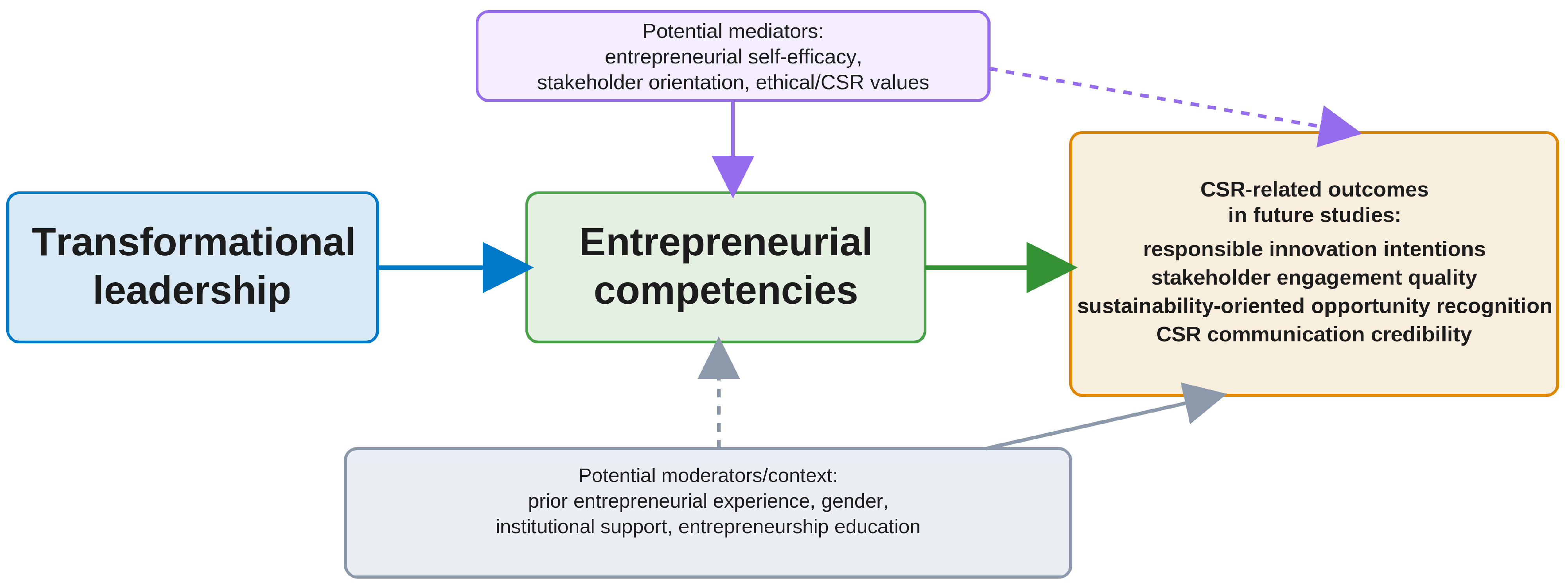
Future studies can strengthen both rigor and CSR relevance in at least five ways. First, separate measurement validation from theory testing: the EC scale should be examined through EFA/CFA, discriminant validity tests, and, where possible, multi-sample validation before being embedded in explanatory models. Second, adopt longitudinal designs to test developmental sequencing (does leadership precede competence growth or vice versa?). Third, collect and model theoretically relevant covariates—such as gender, academic performance, work experience, institutional support, and exposure to entrepreneurship education—and estimate adjusted regression or SEM models. Fourth, use multi-source measurement (peer/instructor ratings, behavioral tasks, project outcomes) and explicit CMV diagnostics to reduce self-report bias. Fifth, explicitly integrate CSR-related outcomes (e.g., responsible innovation intentions, stakeholder engagement quality, sustainability-oriented opportunity recognition, or the credibility of CSR communication) to move from “capability correlation” to “CSR-relevant capability pathways”.
Figure 1 summarizes a parsimonious agenda for future work: transformational leadership may relate to entrepreneurial competencies directly, but also indirectly through self-efficacy and stakeholder/ethical orientation, while contextual variables shape whether these competencies translate into CSR-related outcomes. A necessary preliminary step, however, is to validate the measurement structure and construct distinctiveness of TL and EC in HEI samples before moving to confirmatory multivariate or SEM tests. Taken together, the study provides initial evidence that transformational leadership is associated with a broad set of entrepreneurial competencies in a higher-education setting. For the future of CSR, the actionable insight is that leadership development may be a scalable educational lever—yet its CSR value depends on explicitly embedding responsible, stakeholder-informed decision-making into entrepreneurship training rather than assuming that competence will automatically translate into responsible practice.
6. Conclusions
From a theoretical standpoint, the findings are consistent with the view that leadership styles oriented toward inspiration, intellectual stimulation, and individualized development are aligned with competence bundles that support entrepreneurial action. In the context of CSR, the key implication is not that transformational leadership causes CSR, but that leadership-related capabilities may form part of the microfoundational conditions through which organizations build the human capital needed to support future-facing CSR-related strategies—strategies that connect business priorities with stakeholder expectations and environmental constraints. Entrepreneurial competencies may contribute to CSR implementation by enabling proactive problem solving, stakeholder engagement, and responsible innovation, provided that these competencies are explicitly integrated with ethical reasoning and stakeholder-oriented decision-making. Practically, the results suggest that universities and business schools may benefit from treating leadership development as a capability-building lever rather than a purely interpersonal soft skill. Educational interventions that combine leadership practice (vision articulation, team mobilization, individualized feedback) with entrepreneurship training embedded in CSR constraints (stakeholder impact mapping, sustainability criteria, and responsible opportunity recognition) are likely to be more effective than entrepreneurship education that focuses narrowly on venture creation. Because most participants reported moderate levels in both constructs, there appears to be substantial scope for structured development initiatives with measurable improvement potential. At the same time, the evidence remains exploratory: the study is based on a cross-sectional single-source design, no control-based multivariate models or statistical CMV diagnostics were incorporated, and no direct CSR outcomes were measured. The article should therefore be read as first-order associational evidence rather than as a confirmatory test of unique effects or of a validated structural model. In conclusion, the study contributes capability-level evidence relevant to how CSR-related strategies may be supported by leadership-driven human capital development, while future research should use stronger measurement validation, multi-source designs, covariate-rich models, and CSR-specific outcomes to test whether these capability alignments translate into stakeholder-valued implementation.



 ,
,