


Abstract
Inclusive leadership and collective teacher efficacy are key dimensions for understanding school improvement processes in Latin America. To synthesize recent developments in the field, this systematic review—conducted in accordance with the PRISMA protocol—aimed to: (1) compile the quantitative and qualitative evidence on inclusive leadership and collective teacher efficacy from empirical studies carried out in Latin America between 2015 and 2025, and (2) identify current trends and main gaps in the scientific literature, considering the educational reality of the region. Searches conducted in Web of Science, Scopus, and ERIC resulted in the selection of ten studies that met the established methodological criteria. The findings indicate that inclusive leadership promotes structures for participation, professional collaboration, and the creation of positive school climates, while collective teacher efficacy emerges as a shared perception influenced by organizational support, staff cohesion, and opportunities for collaborative work. The reviewed studies primarily focus on teachers working at the primary and secondary education levels. Overall, the evidence outlines a field in consolidation that offers valuable insights into the development of school leadership policies and the strengthening of inclusive educational cultures in Latin America in the future.
1. Introduction
Inclusive education is conceived as an international commitment aimed at guaranteeing the presence, participation, and learning of all students, without exclusion and with a strong emphasis on social justice (Sandoval & Waitoller, 2022; Macedo, 2023). This approach is situated within internationally recognized frameworks, such as the Salamanca Statement, whose enduring influence reaffirms that all learners matter and are equally entitled to equitable educational opportunities (Ainscow, 2024). From this perspective, inclusion entails transforming school structures, pedagogical practices, and institutional cultures to address diversity in its broadest sense and advance educational equity (Ainscow, 2020; Hurtado & Cornejos, 2024). Recent studies underscore that such transformation becomes sustainable when educational institutions cultivate collaborative capacities, establish shared goals, and strengthen educational communities capable of sustaining inclusive processes over time (Manghi et al., 2022; Vassallo, 2024).
This systematic review seeks to compile studies related to two emerging theoretical constructions, namely, inclusive leadership and teacher collective efficacy. Accordingly, it is pertinent to begin by defining both constructs as part of the theoretical introduction. To this end, three initial subsections are included to contextualize and clarify the meaning of each construct, thereby providing readers with the necessary conceptual foundation to understand the articulation between both dimensions and their relevance to school improvement processes. This organization facilitates the interpretation of the review findings and enhances understanding of how the study of these notions has evolved within the Latin American context during the period under analysis.
1.1. Inclusive Leadership
Inclusive leadership, particularly within primary and secondary school contexts, is characterized as a rational, collaborative, and distributed form of leadership that replaces traditional hierarchical structures with shared decision-making processes and collective responsibility (Gómez-Hurtado et al., 2023; López-López et al., 2021). This perspective aligns with distributed leadership frameworks, which understand leadership as a school-based practice grounded in shared authority, professional collaboration, and collective responsibility (Spillane, 2006; Harris, 2013). Moreover, recent contributions indicate that inclusive leadership requires the creation of conditions that enable teachers to participate in the design of strategic orientations, foster school cultures open to diversity and implement practices that promote context-sensitive responses to students’ needs (Rojas et al., 2023; Valdés & Urra, 2025).
From an inclusive leadership perspective, the scientific literature characterizes this approach as one that replaces traditional hierarchical, top-down models (Codding & Goldberg, 2023; Mercadal, 2021) with collaborative dynamics grounded in institutional co-responsibility, thereby promoting horizontal and participatory structures in school governance that are particularly in primary and secondary education, where coordination among teachers constitutes a central component of pedagogical work (López-López et al., 2021). Regarding its impact within the professional sphere, inclusive leadership promotes occupational well-being, a sense of belonging, and organizational commitment; strengthens self-esteem and perceived support (Liu et al., 2025; Mohase et al., 2025); and incorporates critical perspectives that call for actions capable of transforming institutional structures and cultures (Veli Korkmaz et al., 2022). In Latin American primary and secondary schools, these effects are closely linked to leadership practices that foster participation, recognition of diversity, and collaborative professional environments (Herrera et al., 2022; Rojas et al., 2023).
Taken together, the empirical studies by Castillo-Acobo et al. (2022), Rojas et al. (2023), Valdés and Jiménez (2025), Valdés and Urra (2025) indicate that inclusive leadership in Latin American primary and secondary school organizations, constitutes a dynamic process that requires the development of a shared institutional vision, the strengthening of participation among families and educational communities, and the consolidation of collaborative structures capable of transforming school culture. Within these contexts, leadership must be capable of challenging institutional logics, fostering dialogic working conditions, and sustaining pedagogical practices that respond effectively to the needs of each educational community, particularly in contexts characterized by structural inequality and heterogeneous student populations (Castillo-Acobo et al., 2022; Rojas et al., 2023; Valdés & Jiménez, 2025; Valdés & Urra, 2025). These dimensions are projected as critical levers for advancing toward more democratic, collaborative, and inclusive schools in primary and secondary education systems.
1.2. Teacher Collective Efficacy
Teacher collective efficacy, within primary and secondary education contexts, refers to the shared perception among teachers within an educational institution regarding their collective capability to make a meaningful difference in student outcomes, beyond the influence of family and community contexts (Giovanetti Álvarez & Sepúlveda López, 2024; R. D. Goddard et al., 2000; Herrera et al., 2022; Tschannen-Moran & Barr, 2004). This construct is grounded in social cognitive theory Bandura and Wessels (1997), which identifies efficacy beliefs as key determinants of human agency, operating not only at the individual level but also as collective properties that shape group functioning within organizational contexts; this perspective has been reaffirmed in recent empirical studies (Heikonen et al., 2024; Herrera et al., 2022; Karakose et al., 2024). In school environments, especially across primary and secondary levels, collaborative practices among teachers are structurally embedded; these shared beliefs enable schools to compensate for or overcome adverse contextual conditions, demonstrating that teachers’ collective perceptions exert a decisive influence on student outcomes even in the presence of inequalities associated with students’ family or community backgrounds (Giovanetti Álvarez & Sepúlveda López, 2024). In Latin America, this pattern has been documented in Chile, where collective efficacy has been linked to teachers’ subjective well-being and organizational justice, and in Argentina, where primary-level teachers reported that job resources and transformational leadership were associated with collective teacher self-efficacy (Herrera et al., 2022; Sánchez-Rosas et al., 2022).
Among its principal contributions, Teacher Collective Efficacy (TCE) has been associated with significant educational outcomes (Çoğaltay & Boz, 2023; Donohoo, 2018; Sahli Lozano et al., 2025). Across these educational stages, it influences teachers’ professional commitment (Çoğaltay & Boz, 2023; Yurt, 2022), fosters the implementation of pedagogical practices, and contributes to academic achievement (Donohoo, 2018; Liu et al., 2025); it also fosters school environments conducive to teaching and activates institutional improvement processes (R. Goddard et al., 2015; Karakose et al., 2024). Regional evidence further suggests that, in Latin American schools, these effects are closely tied to collaborative work, professional interaction, and institutional trust, all of which help sustain shared beliefs about what teaching teams can accomplish together (López Alfaro et al., 2022; Herrera et al., 2022). Collectively, these studies position it as a strategic variable for effective school-level development.
In sum, Teacher Collective Efficacy (TCE) constitutes a multidimensional construct that integrates shared beliefs, institutional conditions, and collaborative dynamics; together, these dimensions make it possible to understand how the teaching staff, within these educational settings, appraise their capacity to act collaboratively and in a coordinated manner in response to educational challenges. These characteristics position Teacher Collective Efficacy as a key variable in school improvement processes and in the construction of inclusive and cohesive educational communities (López Alfaro et al., 2022; Valdés & Urra, 2025).
1.3. Links Between Inclusive Leadership and Teacher Collective Efficacy: The Latin American Experience
Studies conducted in Latin American schools report a positive association between satisfaction with the educational institution and social well-being within the school context (Herrera et al., 2022). Likewise, links have been identified with collaborative organizational climates, professional interaction processes, and teacher cohesion (López Alfaro et al., 2022). These relationships suggest that collective efficacy reflects not only perceptions of professional competence but also assessments of the quality of institutional processes, as experienced by teachers working in primary and secondary education contexts. In the region, this pattern is reinforced by evidence showing that collaborative work and stakeholder participation are linked to stronger efficacy beliefs at the school level (Herrera et al., 2022; López Alfaro et al., 2022)
With regard to Latin America, particularly in comparable contexts, recent studies conducted in Chile highlight the role of middle leaders—such as coordinators, inclusion support professionals, and other support agents—as key actors in promoting inclusive practices and generating organizational conditions that foster collaborative work and the development of shared beliefs regarding teachers’ collective capacity (Donohoo, 2018; Oñate et al., 2025). Complementarily, comparative studies conducted in Peru and Canada show that Inclusive Leadership (IL) incorporates elements such as reflective learning, engagement with the community, and the active promotion of teacher participation; these factors enable the construction of shared visions and collaborative practices that nurture Teacher Collective Efficacy (Rojas et al., 2023). These findings converge with regional evidence underscoring the capacity of Inclusive Leadership (IL) to mediate between institutional policies and pedagogical practices, thereby generating supportive environments that enhance teachers’ collective action (Castillo-Acobo et al., 2022).
In sum, Latin American studies suggest that inclusive leadership functions as an organizational lever that strengthens Teacher Collective Efficacy by creating structural and cultural conditions conducive to collaboration, co-responsibility, and professional dialogue. This convergence indicates that, in contexts characterized by inequality and sociocultural diversity, the integration of leadership and collective efficacy constitutes a strategic core for school improvement, capable of fostering more coherent, participatory, and equity-oriented pedagogical practices.
However, empirical evidence on both dimensions in Latin America remains fragmented, and studies that address both constructs jointly within a single analytical framework are still scarce. For this reason, describing the current state of research on Inclusive Leadership (IL) and Teacher Collective Efficacy (TCE) based on empirical studies constitutes a novel contribution that will make visible insights often relegated to the background and may open new perspectives for future educational practice and research. This gap is especially visible in Latin American school settings, where the literature more often examines leadership, collaboration, or efficacy than as a combined explanatory framework (López Alfaro et al., 2022).
At this juncture, the state of the scientific literature outlined throughout this theoretical justification leads to the formulation of the following objectives for this systematic review: (1) to compile existing knowledge on Inclusive Leadership and Teacher Collective Efficacy from both quantitative and qualitative perspectives, based on empirical research conducted in Latin America; and (2) to determine the principal trends and gaps in the current scientific landscape, using the Latin American educational context as a reference framework.
2. Materials and Methods
2.1. Search Strategy
This review was conducted in accordance with the guidelines established by the PRISMA (Preferred Reporting Items for Systematic Reviews and Meta-Analyses) protocol (Barrios Serna et al., 2021; Sánchez-Serrano et al., 2022). The searches were conducted in the Web of Science, Scopus, and ERIC databases, given their recognition as among the most prestigious and comprehensive sources within the contemporary academic landscape (Gómez-López & Sánchez-Cabrero, 2023; Sánchez-Cabrero, 2024). Combined keywords were used, including leadership, teacher collective efficacy, effective teaching practices, inclusion, inclusive education, inclusive practices, collective self-efficacy, and inclusive leadership. Likewise, the search was directed toward empirical studies conducted wholly or partially in Latin America, since the purpose was to characterize the available regional evidence concerning both constructs.
The search strategy involved the use of Boolean operators and relevant truncation symbols to optimize the retrieval of pertinent articles across the selected databases. This approach was tailored to the specific requirements of each database consulted and included the following combinations of search terms: (“collective teacher efficacy” OR “collective efficacy” OR “eficacia colectiva docente” OR “eficácia do ensino coletivo” OR “autoeficacia colectiva docente” OR “collective teacher self-efficacy” OR “autoeficácia coletiva dos professores”) AND (“inclusive leadership” OR “liderazgo inclusivo” OR “liderança inclusiva” OR “educación inclusiva” OR “educação inclusiva” OR “inclusive education”).
The criteria applied for the inclusion and exclusion of the reviewed sources are presented below.
2.2. Review Criteria
The studies were selected according to the following inclusion criteria:
- (a)
- Only open-access articles published between 2015 and 2025 were considered, in order to identify the most recent conceptual and methodological trends regarding Inclusive Leadership and Teacher Collective Efficacy within Latin American educational systems.
- (b)
- Articles and studies published in Spanish, English, and Portuguese were included, as these represent the most prevalent languages in the Latin American academic landscape. Spanish and Portuguese constitute the dominant languages in the region—Spanish as the official language in most Latin American countries and Portuguese as the majority language in Brazil. The inclusion of these languages ensures coverage of the most representative scientific production and reduces potential linguistic bias in the analysis of Latin American academic literature.
- (c)
- Quantitative, qualitative, and mixed-methods studies that explicitly addressed Inclusive Leadership, Teacher Collective Efficacy, or the relationship between both constructs.
- (d)
- Empirical research conducted in Latin American countries and developed within educational settings.
- (e)
- Studies that employed clear and explicit procedures to measure Inclusive Leadership, Teacher Collective Efficacy, or the relationship between both constructs.
The following were excluded:
- (a)
- Studies such as essays, narrative reviews, book chapters, technical reports, and theses.
- (b)
- Articles conducted in non-educational contexts or whose samples were drawn from work environments unrelated to the school system.
- (c)
- Finally, duplicate records and publications with restricted access were excluded.
2.3. Study Selection Process
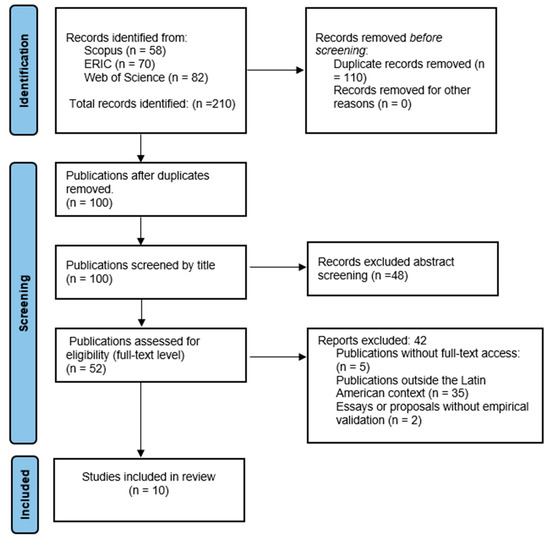
The studies retrieved through the search were screened by examining their titles, abstracts, and methodological sections, in accordance with the established inclusion criteria. The initial search yielded a total of 210 total records identified (Scopus: 58; ERIC: 70; Web of Science: 82). After removing 110 duplicate records, 100 articles remained after duplicates were removed. These 100 publications were screened by title, and 48 records were subsequently excluded after abstract screening. Consequently, 52 articles were assessed for eligibility at the full-text level.
Subsequently, 42 articles were excluded for various reasons, including lack of full-text access (n = 5), studies conducted outside the Latin American context (n = 35), and publications classified as essays or proposals without empirical validation (n = 2). Ultimately, (n = 10) studies met the established inclusion criteria and were subjected to in-depth analysis in this systematic review.
Figure 1 presents the flow diagram of the studies included and excluded throughout the review process.
Figure 1.
PRISMA Flow diagram.
2.4. Description of the Included Articles
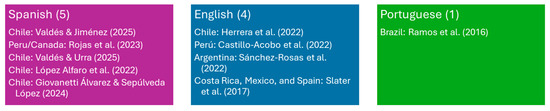
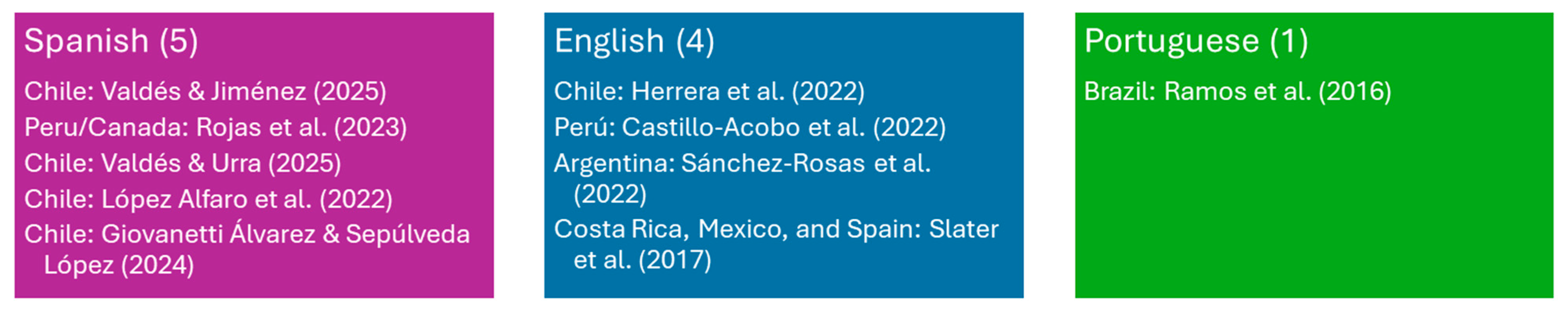
As can be seen in Figure 2, five of the ten documents included in the study are published in Spanish, four in English, and one in Portuguese. Regarding the countries in which the studies were conducted, five were carried out in Chile, two in Peru, one in Costa Rica and Mexico, one in Argentina, and one in Brazil.
Figure 2.
Distribution of publications by country and language (Valdés & Jiménez, 2025; Rojas et al., 2023; Valdés & Urra, 2025; López Alfaro et al., 2022; Giovanetti Álvarez & Sepúlveda López, 2024; Herrera et al., 2022; Castillo-Acobo et al., 2022; Sánchez-Rosas et al., 2022; Slater et al., 2017; Ramos et al., 2016).
More detailed descriptive information on the studies included can be found in Table 1.
Table 1.
Identifying and bibliometric data of empirical studies on Inclusive Leadership and its relationship with Teacher Collective Efficacy published between 2015 and 2025 and indexed in Web of Science, Scopus, and ERIC.
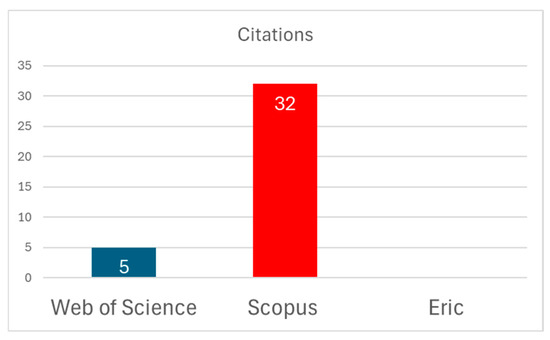
The compendium of identified articles shows a significant presence in high-impact databases, particularly in Scopus, where nearly all of the analyzed studies are indexed, and to a lesser extent in Web of Science (WoS). Most of the included articles report citation counts. For example, Studies 1 and 3 register Scopus (n = 0); Study 2 registers Scopus (n = 2); Study 4 registers Scopus (n = 4) and WoS (n = 3); Study 5 registers Scopus (n = 5) and WoS (n = 0); Study 6 registers Scopus (n = 4) and WoS (n = 1); Study 7 appears with WoS (n = 1); Study 9 registers Scopus (n = 12); and Study 10 registers Scopus (n = 5). Taken together, these data suggest that, although the literature on Inclusive Leadership (IL) and Teacher Collective Efficacy (TCE) in Latin America remains incipient, it is beginning to gain visibility within highly recognized academic contexts, reflecting a field in the process of consolidation. This distribution is illustrated in Figure 3.
Figure 3.
Citations by source.
Figure 3 presents the distribution of citation counts across Scopus, Web of Science and Eric, allowing for a clearer visualization of the visibility of the selected studies within high-impact databases.
3. Results
The results of this study are presented in two main sections. The first outlines the most relevant methodological features of the studies conducted in Latin America during the 2015–2025 period. The second provides a review of the contributions these studies make to the current state of knowledge on the topic.
3.1. General Methodological Features of Studies on Teacher Collective Efficacy and Inclusive Leadership (2015–2025)
To characterize recent scholarly production on Teacher Collective Efficacy (TCE) and Inclusive Leadership (IL), the methodological features identified in the studies included in the review were analyzed. This examination makes it possible to determine how both constructions have been approached within the selected body of research.
Table 2 below presents the most salient methodological characteristics of each study (research design, sample, instruments, variables, and analytical procedures applied to the results).
Table 2.
Design, Samples, Instruments, Variables, and Data Analysis Procedures.
From a methodological perspective, Table 2 shows that the ten studies analyzed display a relatively balanced distribution of approaches, without a clearly dominant trend. Thirty percent of the analyzed studies (n = 3) correspond to mixed-methods designs, 20% (n = 2) adopt qualitative approaches—mainly narrative and descriptive in nature—and 50% (n = 5) are classified as non-experimental quantitative studies, predominantly cross-sectional and explanatory. This distribution reveals a clear predominance of quantitative approaches, particularly those oriented toward explanatory and correlational analyses, alongside a growing use of multivariate techniques, psychometric validations, and structural models.
Regarding sample typology, a high degree of heterogeneity is observed in terms of participants, educational levels, and coverage, with no single dominant typology. Fifty percent of the studies focused on teachers as the primary unit of analysis, whereas the remaining 50% incorporated multilevel or multi-actor samples, including families, school leaders, and students. In geographical terms, Chile predominates (n = 5), concentrating the largest proportion of the studies. This is complemented by one binational study conducted in Peru and Canada (n = 1), as well as research carried out in Costa Rica–Mexico–Spain (n = 1), Peru (n = 1), Argentina (n = 1), and Brazil (n = 1). In sum, although the diversity of samples prevents the identification of a single dominant trend, an emerging pattern combines broader samples—typically large groups of teachers—with more focused qualitative layers involving school leaders, families, and students, enabling the triangulation of findings and the capture of multiple levels within the educational system.
With regard to the tools and instruments employed, the use of internationally validated questionnaires predominates. Four of the studies apply the LEI-Q or adaptations of the LEI-Q, which reflects the recurrence and consolidation of inclusive leadership as a central construct in recent educational research. Likewise, the most robust quantitative studies employ well-established psychometric scales—such as the Collective Teacher Efficacy Scale, the Distributed Leadership Inventory, the Maslach Burnout Inventory, and various well-being scales. Added to this set are the Collective Teacher Self-Efficacy Scale, in its adapted version by Sánchez-Rosas et al. (2022), the Escala de Crença Coletiva Escolar, and the questionnaire “Pensamentos sobre Ensino e Escola” (Lent et al., 2011), which broaden the scope of assessment toward dimensions of self-efficacy, collective beliefs, and job satisfaction within the framework of the social cognitive model. This pattern indicates a preference for instruments with previously established psychometric guarantees of validity and reliability. The recurrent presence of LEI-Q, together with scales measuring collective efficacy and teacher collaboration, reinforces the thematic and conceptual consistency across the reviewed studies.
Among the variables included in the studies, the ten investigations present a diverse methodological landscape, yet with a clear thematic convergence around school leadership, inclusive education, collective efficacy, and teaching–learning processes. Two of the mixed-methods studies (1 and 2) share the application of the LEI-Q, differentiating dimensions according to teachers and families, which indicates an effort to capture multilevel perceptions of inclusive leadership. The qualitative study (3), in contrast, does not operate with variables in the statistical sense but rather with analytical constructs, namely inclusive education and school leadership. In contrast, studies (4, 5, 6, and 7) employ latent variables and well-established scales, including collective efficacy, well-being, distributed leadership (DL), burnout, teaching policies and resources, inclusive leadership, and innovative teacher behavior. In turn, study (8) focuses its analysis on teacher collective self-efficacy as the main variable; study (9) addresses analytical constructs rather than statistical variables, exploring emerging dimensions linked to inclusive leadership and social justice; and study (10) employs a robust set of quantitative variables based on the Social Cognitive Model of Job Satisfaction (MSCST). Complementarily, the qualitative phase identifies emerging variables related to teachers’ work experiences. The ten studies reveal a predominance of organizational, attitudinal, and pedagogical variables, with particular emphasis on leadership, inclusion, collective efficacy, and teaching conditions that influence teachers’ work, professional well-being, and pedagogical practices across different educational levels.
Finally, regarding the analyses applied to the results obtained, all the studies analyzed (n = 10) display considerable analytical diversity. Studies (1, 2, and 3) do not employ advanced inferential tests; two rely solely on descriptive analyses and one combines Chi-square tests with mean comparisons, whereas the qualitative study is based exclusively on thematic analysis using Atlas.ti (Version 25). Study (4) integrates descriptive analyses, correlations, and factor analyses (EFA and CFA). Study (5) includes CFA and a structural equation model (SEM); study (6) employs PLS-SEM; study (7) applies ANOVA; study (8) uses factor analysis through Exploratory Structural Equation Modeling (ESEM); study (9) conducts a narrative/thematic analysis based on the inductive coding of transcripts and the identification of patterns and emerging categories; and finally, study (10) applies factor analysis, Pearson correlations, and simple linear regression using SPSS-20. Taken together, these findings indicate an increasing use of factorial and structural models, reflecting a gradual rise in statistical rigor and analytical complexity in recent research.
3.2. Contributions to the State of the Art of Studies on Inclusive Leadership and Its Relationship with Collective Teaching Effectiveness: Systematic Review (PRISMA) of Studies in Latin America (2015–2025)
Following the order of presentation, the first empirical study on inclusive school leadership in Chilean schools, Valdés and Jiménez (2025), reveals that inclusive leadership is not limited to individual leadership practices but rather constitutes a process shaped by external structural factors, educational policies, and contexts of social vulnerability. Likewise, the study indicates that inclusion advances not solely through curricular innovations or instructional adjustments but also requires the cultivation of collaborative professional cultures, the strengthening of solid community ties, and the transformation of institutional structures that tend to reinforce pressures toward standardization. The study highlights the need to explore forms of leadership grounded in community participation, the co-construction of meaning, and social justice, particularly in contexts where structural inequalities create persistent barriers to the achievement of full inclusion.
In turn, Rojas et al. (2023) provide comparative evidence between two countries (Peru and Canada). The findings allow the identification of structural gaps, facilitating factors, and systemic obstacles that shape the implementation of inclusive leadership, as well as the conditions that enable its impact on educational development. The study further demonstrates that differences exist in the perception of inclusive leadership between the two countries: 90% of Canadian families consider this form of leadership to be substantially or fully implemented, whereas 79% of Peruvian families report that such leadership is not present in their educational institutions. This difference indicates that inclusive leadership does not depend solely on the individual commitment of the school principal, but rather on the educational ecosystem sustained by policies, school culture, and institutional resources. Furthermore, Rojas et al. (2023) propose a model of inclusive competencies and offer a deeper understanding of the tensions and opportunities faced by school leadership in the region, outlining viable operational strategies such as interinstitutional partnerships, teacher professional development with an inclusive focus, and the participatory restructuring of school governance.
In a parallel study, Valdés and Urra (2025) provide a key contribution by demonstrating how students and families understand and experience inclusion in schools oriented toward inclusive education, which they interpret primarily through two dimensions: participation and respect for diversity, and attention to disability, thereby revealing the coexistence of broader perspectives alongside others centered specifically on special educational needs. They also highlight the relevance of middle leaders—such as coordinators, school climate officers, and inspectors—who are perceived as key articulators of inclusive practices in everyday school life, at times surpassing formal leadership roles, whose limited visibility may constitute a barrier to the consolidation of a strong and sustained inclusive culture. The study further emphasizes that inclusive leadership is collectively constructed and requires the development of a shared language, the strengthening of participation, and the promotion of shared responsibilities. In doing so, the study advances the current state of knowledge by showing that authentic inclusion depends on distributed forms of leadership and on the effective incorporation of student and family voices.
For their part, Herrera et al. (2022) contribute to the field through the psychometric validation of the Collective Efficacy Scale Short Form (CES-SF) in a large sample of Chilean teachers, demonstrating that Teacher Collective Efficacy (TCE) is particularly sensitive to organizational contextual conditions—such as the availability of collaboration and institutional support—rather than to individual dimensions of teacher well-being. Within this framework, the relationship between self-efficacy and technological competence is also highlighted, indicating that although teachers may address digital challenges at the individual level, collective confidence depends on genuine opportunities for collaborative work, as well as on the institutional conditions that sustain cooperation in both virtual and face-to-face contexts.
Continuing with the contributions of the analyzed studies, López Alfaro et al. (2022) provide empirical evidence regarding the relationship between Distributed Leadership (DL), Teacher Collective Efficacy (TCE), and Burnout syndrome among teachers in educational institutions in Chile. The findings reveal that Teacher Collective Efficacy (TCE) functions as a mediating variable between Distributed Leadership (DL) and burnout syndrome. In other words, leadership practices that foster participation in decision-making, promote teamwork, and cultivate a positive school climate not only strengthen teachers’ collective beliefs regarding their capacity to teach effectively but also mitigate emotional exhaustion, depersonalization, and diminished professional accomplishment. In sum, the study not only provides empirical evidence of the importance of Distributed Leadership (DL) for teacher well-being and professional performance but also offers guidance to school leadership teams toward management practices that strengthen professional participation, the coordination of efforts, and collective trust—factors that are essential for building healthy, effective, and sustainable schools over time.
The study by Castillo-Acobo et al. (2022) show that inclusive leadership operates as a key mechanism for translating the availability of resources and the regulatory framework into concrete practices of pedagogical innovation. Moreover, it extends previous explanatory models by demonstrating that teacher innovation does not depend solely on structural conditions but also on the articulating role of inclusive leadership, which promotes participation, collaboration, and the adoption of emerging pedagogical approaches. The study also offers significant practical implications, emphasizing the need to strengthen clear policies, ensure adequate resources, and promote leadership practices that encourage teachers to adopt innovative approaches aligned with the contemporary demands of the educational system and to enhance educational quality in Latin American contexts.
Deepening the analysis of the role of institutional conditions in teachers’ work, Giovanetti Álvarez and Sepúlveda López (2024) provide evidence regarding Teacher Collective Efficacy (TCE), self-efficacy, and collaborative practices within the context of secondary education. Their findings indicate that, although individual self-efficacy may be sustained even in contexts characterized by high technological demands, collective efficacy depends crucially on concrete opportunities for collaborative work, organizational support, and conditions that enable professional collaboration.
Added to these findings are those reported by Sánchez-Rosas et al. (2022), whose factorial analysis shows that collective self-efficacy is not configured solely through individual perceptions but rather depends on organizational climate, the establishment of shared goals, and structured opportunities for collaboration. This result reinforces the argument that inclusive leadership generates the organizational conditions—such as a shared professional culture and clarity in pedagogical objectives—that enable the strengthening of teacher collective efficacy, which in turn positively influences student learning and the professional well-being of the school staff.
For their part, Slater et al. (2017) show that practices such as building connections with families and communities, managing diversity in a responsive manner, mobilizing local resources, and fostering climates of trust not only shape more just and participatory forms of leadership but also contribute to creating organizational environments that strengthen collective self-efficacy, particularly in contexts marked by social inequalities or structural constraints. Consequently, collective efficacy becomes reinforced when leadership operates through an inclusive, situated, and ethical logic, capable of articulating pedagogical responses that are coherent with the challenges faced within school communities.
Finally, the study by Ramos et al. (2016) show how institutional conditions, organizational support, and teachers’ emotional experiences shape teachers’ job satisfaction both directly and indirectly, a dimension that is closely associated with teacher collective efficacy.
Taken together, the analyzed studies show that the two constructs examined—inclusive leadership and teacher collective efficacy—although not addressed in an integrated manner, display convergent conceptual correspondences and offer complementary contributions for understanding school improvement processes in Latin America. Both constructs are situated within approaches that prioritize organizational transformation, professional participation, and educational justice as structural pillars of educational change. From this perspective, the convergent contributions indicate that inclusive leadership is consolidated through practices such as curricular flexibility, personal trajectories marked by resilience, an ethic of care, engagement with families, the management of diversity in vulnerable contexts, community linkage, and the strategic promotion of inclusion (Studies 1, 2, 3, 7, and 9).
Furthermore, the reviewed literature indicates that its consolidation is reflected in the capacity to mobilize processes of participation, collaboration, and transformative practices, whether through structural elements such as critical flexibility and community engagement (Rojas et al., 2023), through the everyday actions of middle leaders in the management of inclusive practices (Valdés & Urra, 2025), or through its direct and mediating influence on pedagogical innovation (Castillo-Acobo et al., 2022). On the other hand, studies focused on teacher collective efficacy and related conceptual constructs show that teacher collaboration, job satisfaction, organizational support, positive affect, the strengthening of professional self-efficacy, and the development of school climates characterized by higher levels of occupational well-being are associated with lower levels of emotional exhaustion (burnout) and with a greater openness among teachers to adopt innovative pedagogical practices and collaborative professional learning communities, as evidenced in studies (4, 5, 6, 8, and 10).
Although it has not been empirically examined, the reviewed literature suggests a plausible conceptual relationship: inclusive leadership shapes the organizational conditions that enable Teacher Collective Efficacy, while the latter may represent an expected outcome in schools whose management promotes and fosters collaborative and inclusive cultures.
4. Discussion
The studies analyzed in this review make it possible to delineate the current state of knowledge regarding Inclusive Leadership and Teacher Collective Efficacy, showing that both constructs are conceptualized as oriented toward school transformation and educational improvement (Castillo-Acobo et al., 2022; Herrera et al., 2022; Rojas et al., 2023). These constructs are expressed through practices that integrate curricular decision-making, teacher collaboration, and engagement with the educational community (Castillo-Acobo et al., 2022; Rojas et al., 2023). This conceptual correlation makes it possible to understand both approaches as complementary dimensions of broader educational processes, since each relies on organizational dynamics that either enable or constrain the implementation of inclusive pedagogical strategies (Adams et al., 2025; Spina et al., 2025; Valdés Morales, 2018).
However, the evidence suggests that these effects do not occur automatically or uniformly; rather, they are mediated by contextual, structural, and organizational factors that may either foster or constrain their impact. In particular, the reviewed studies indicate that in contexts characterized by rigid regulatory frameworks, limited institutional autonomy, and high workload demands, both inclusive leadership and teacher collective efficacy tend to manifest primarily at a discursive or perceptual level, without necessarily leading to sustained pedagogical transformations (Herrera et al., 2022; Valdés & Urra, 2025; Sánchez-Cabrero et al., 2025). This observation allows for the introduction of a critical reading that tempers the explanatory scope of normative or prescriptive approaches.
From this perspective, teacher collaboration and Teacher Collective Efficacy should be understood as socially constructed processes that depend on leadership and school climate, rather than as inherent characteristics of educational institutions (Adams et al., 2025; Çoğaltay & Boz, 2023; Wang et al., 2025). The analyzed evidence indicates that, in the absence of mechanisms for critical reflection, technical support, and effective leadership, collaborative actions may devolve into superficial practices that merely replicate traditional models, thereby limiting their innovative potential (Rojas et al., 2023). Consequently, the findings highlight the need to advance toward more complex analytical models that integrate contextual variables, longitudinal designs, and mixed methodological strategies to identify the mechanisms through which Inclusive Leadership and Teacher Collective Efficacy effectively influence educational practice.
Despite the conceptual and organizational convergences identified, the review reveals that the relationship between Inclusive Leadership and Teacher Collective Efficacy has not been systematically addressed in the empirical studies analyzed. Both constructs are generally treated independently or linked only indirectly, either through inclusive leadership understood as an organizational condition that fosters teacher collaboration, or through collective efficacy conceived as a perceptual outcome associated with school climate and professional well-being (Adams et al., 2025; Wang et al., 2025). This absence of integrated analysis reveals a significant gap in current research and reinforces the need to develop studies that explicitly examine relationships, mediating processes, and mechanisms linking Inclusive Leadership with the development of Teacher Collective Efficacy in educational contexts.
5. Conclusions
The systematic analysis makes it possible to identify trends related to organizational strategies aimed at inclusion and the improvement of educational quality in Latin American contexts, which show a gradual shift from traditional and normative approaches toward empirical perspectives that prioritize the analysis of organizational practices, engagement with families, ethical management of diversity, pedagogical mediations, and contextual conditions of implementation. On the one hand, the emerging trend points toward the consolidation of inclusive leadership as an operational construct, expressed through practices oriented toward critical reflection, engagement with the educational community, and the development of participatory school cultures, while also incorporating voices that are often absent, such as those of students and families.
Complementarily, recent studies show growing interest in teacher collective efficacy as a mediating dimension between organizational conditions and changes in teachers’ pedagogical practice. Furthermore, associations are observed between professional collaboration, shared perceptions of competence, and openness to methodological innovations, as well as inverse relationships with teachers’ emotional exhaustion. Another emerging, though less developed, trend concerns the growing attention to middle leadership and the everyday management dynamics of inclusion. This line of research provides evidence on administrative and pedagogical mediations that make it possible to translate institutional orientations into concrete teaching practices, highlighting the importance of situated and technically informed leadership in reducing the gap between educational policy and classroom practice.
Nevertheless, the review shows that both Inclusive Leadership and Teacher Collective Efficacy tend to exhibit limited effects in contexts characterized by strong regulatory pressures, resource scarcity, and heavy workloads, which reinforces the need for contextualized and non-prescriptive approaches. Likewise, teacher collaboration becomes problematic when it is not accompanied by systematic processes of pedagogical reflection, as this may lead to superficial coordination and the reproduction of traditional practices.
However, empirical attention to the relationship between both constructs remains limited. This relationship often appears only implicitly or in a mediated form, either through leadership understood as an organizational condition that enables teacher collaboration, or through collective efficacy conceived as a perceptual outcome associated with school climate, professional well-being, or pedagogical innovation, without constituting the central focus of analysis. These trends suggest that current research is moving toward a more integrated understanding and highlights the need to advance toward integrated approaches that enable the systematic examination of the mechanisms through which inclusive leadership may contribute to the development of Teacher Collective Efficacy in specific educational contexts.
From a practical standpoint, these findings offer relevant implications for educational systems in Latin America. They point to the need to strengthen school leadership practices that promote structured opportunities for teacher participation, collaborative decision-making, and sustained professional interaction. At the institutional level, the evidence underscores the importance of creating organizational conditions that support collective work, including time for joint reflection, coordination mechanisms, and trust-based professional environments. These elements are especially significant in contexts marked by structural inequalities, where leadership practices can contribute to reducing gaps between policy design and pedagogical implementation. In addition, the results provide guidance for the design of leadership training programs and educational policies oriented toward fostering inclusive and collaborative school cultures, thereby supporting more context-sensitive and sustainable school improvement processes.
6. Limitations of This Review
The review reveals a few limitations that should be considered when interpreting the findings and their scope. First, the number of studies included was limited, as only ten articles were analyzed, which restricts the possibility of generalizing the results and constrains the robustness of the conclusions derived. This situation does not stem from an arbitrary selection but rather from the limited availability of studies addressing both constructions in recent years.
In addition, a noticeable lack of research at the regional level was identified, which constitutes one of the main gaps in the literature analyzed. Most of the reviewed studies were conducted in international contexts with sociocultural, educational, and organizational realities that differ from those of the region, which limits the extrapolation of the findings to the regional context. The absence of local empirical evidence prevents the verification of whether the relationships observed between the dimensions behave in a similar manner or exhibit significant variations depending on the context.
Finally, the limited scientific production that examines both dimensions in an integrated manner reveals a theoretical and empirical gap in the current literature. This scarcity constrains the development of more consistent explanatory models and underscores the need for future research that deepens the joint analysis of these dimensions, particularly through longitudinal designs and with a specific focus on Latin American contexts. Taken together, these limitations do not invalidate the contributions of the present review, but they do delimit its scope and reinforce the importance of continuing to strengthen research in this line of inquiry, with the aim of expanding and consolidating the body of knowledge on the subject.
Author Contributions
Conceptualization, M.-E.M.-d.-R.; methodology, M.-E.M.-d.-R. and R.S.-C.; validation, R.S.-C. and M.S.-M.; formal analysis, M.-E.M.-d.-R.; investigation, M.-E.M.-d.-R.; resources, M.-E.M.-d.-R.; writing—original draft preparation, M.-E.M.-d.-R., R.S.-C. and M.S.-M.; writing—review and editing, M.-E.M.-d.-R., R.S.-C. and M.S.-M.; supervision, R.S.-C. and M.S.-M. All authors have read and agreed to the published version of the manuscript.
Funding
This research is part of project PID2022-137000OB-I00 funded by MCIN/AEI/10.13039/5011000110337, entitled “Shared Teaching for Inclusion: Cultures, Policies and Practices for Educational Transformation” coordinated by Marta Sandoval-Mena.
Institutional Review Board Statement
Not applicable.
Informed Consent Statement
Not applicable.
Data Availability Statement
The data presented in this study are available on request from the corresponding author.
Acknowledgments
Generative artificial intelligence (GenAI) was used solely as a support tool for linguistic revision and improvement of the manuscript’s writing (clarity, coherence, and style). It was not used for generating original scientific content, data analysis, or interpretation of results. All ideas, methodological approaches, and conclusions are the full responsibility of the authors, who reviewed and validated the final content.
Conflicts of Interest
The authors declare no conflict of interest.
Abbreviations
| AVE | Average Variance Extracted |
| CES-SF | Collective Efficacy Scale—Short Form |
| CFA | Confirmatory Factor Analysis |
| CFI | Comparative Fit Index |
| CR | Composite Reliability |
| DL | Distributed leadership |
| EFA | Exploratory Factor Analysis |
| ESEM | Exploratory Structural Equation Modeling |
| HTMT | Heterotrait–Monotrait Ratio |
| IL | Inclusive Leadership |
| ISLDN | International School Leadership Development Network |
| ITB | Innovative Teaching Behavior |
| LEI-Q | Inclusive Leadership Scale |
| MSCST | Multidimensional Scale of Coping and Satisfaction with Teaching |
| PLS-SEM | Partial Least Squares Structural Equation Modeling |
| PWIA | Personal Wellbeing Index—Adult |
| RMSEA | Root Mean Square Error of Approximation |
| SEM | Structural Equation Modeling |
| SPSS | Statistical Package for the Social Sciences |
| SRMR | Standardized Root Mean Square Residual |
| SWS | Social well-being at school |
| TCE | Teacher Collective Efficacy |
| TP | Teaching Policy |
| TR | Teaching Resources |
| WLSMV | Weighted Least Squares Mean and Variance adjusted |
References
- Adams, D., Mohamed, A., Moosa, V., Shareefa, M., & Tan, K. L. (2025). Toward effective inclusive practices: Dynamics among school leadership, academic optimism, and teacher collaboration. International Journal of Developmental Disabilities, 71(6), 867–878. [Google Scholar] [CrossRef] [Scilit]
- Ainscow, M. (2020). Promoting inclusion and equity in education: Lessons from international experiences. Nordic Journal of Studies in Educational Policy, 6(1), 7–16. [Google Scholar] [CrossRef] [Scilit]
- Ainscow, M. (2024). Todas y todos los educandos cuentan, y cuentan por igual: Haciendo que la educación sea inclusiva. Available online: https://unesdoc.unesco.org/ark:/48223/pf0000388991_spa (accessed on 16 February 2026).
- Bandura, A., & Wessels, S. (1997). Self-efficacy (Vol. 10). Cambridge University Press. [Google Scholar]
- Barrios Serna, K. V., Orozco Núñez, D. M., Pérez Navas, E. C., & Conde Cardona, G. (2021). Nuevas recomendaciones de la versión PRISMA 2020 para revisiones sistemáticas y metaanálisis. Acta Neurológica Colombiana, 37(2), 105–106. [Google Scholar] [CrossRef] [Scilit]
- Castillo-Acobo, R. Y., Ramírez, A. A. V., Teves, R. M. V., Orellana, M. G., Quiñones-Negrete, M., Sernaqué, M. A. C., Valdivieso, V. P., Chávez, C. M. R., Gonzáles, J. L. A., Carranza, P. M., & Aponte, M. B. H. (2022). Mediating role of inclusive leadership in innovative teaching behavior. Eurasian Journal of Educational Research, 100, 18–34. [Google Scholar] [CrossRef]
- Chou, C. M., Shen, C. H., Hsiao, H. C., & Shen, T. C. (2019). Factors influencing teachers’ innovative teaching behaviour with information and communication technology (ICT): The mediator role of organisational innovation climate. Educational Psychology, 39(1), 65–85. [Google Scholar] [CrossRef] [Scilit]
- Codding, D., & Goldberg, B. (2023). The clash of academic hierarchy and inclusive leadership: Evolution of leadership in a nationwide diversity, equity, and inclusion initiative. bioRxiv. [Google Scholar] [CrossRef] [Scilit]
- Creswell, J. W., & Creswell, J. D. (2018). Research design: Qualitative, quantitative, and mixed methods approaches (5th ed.). SAGE. [Google Scholar]
- Çoğaltay, N., & Boz, A. (2023). Influence of school leadership on collective teacher efficacy: A cross-cultural meta-analysis. Asia Pacific Education Review, 24(3), 331–351. [Google Scholar] [CrossRef] [Scilit]
- Donohoo, J. (2018). Collective teacher efficacy research: Productive patterns of behaviour and other positive consequences. Journal of Educational Change, 19(3), 323–345. [Google Scholar] [CrossRef] [Scilit]
- Dyment, J. E., Davis, J. M., Nailon, D., Emery, S., Getenet, S., McCrea, N., & Hill, A. (2014). The impact of professional development on early childhood educators’ confidence, understanding and knowledge of education for sustainability. Environmental Education Research, 20(5), 660–679. [Google Scholar] [CrossRef] [Scilit]
- Giovanetti Álvarez, B. A. G., & Sepúlveda López, F. (2024). Eficacia colectiva, autoeficacia y prácticas de colaboración de docentes de educación media en el contexto de enseñanza en línea. Perspectiva Educacional, 63(2), 105–131. [Google Scholar] [CrossRef] [Scilit]
- Goddard, R. (2002). A theoretical and empirical analysis of the measurement of collective efficacy: The development of a short form. Educational and Psychological Measurement, 62(1), 97–110. [Google Scholar] [CrossRef] [Scilit]
- Goddard, R., Goddard, Y., Kim, E. S., & Miller, R. (2015). A theoretical and empirical analysis of the roles of instructional leadership, teacher collaboration, and collective efficacy beliefs in support of student learning. American Journal of Education, 121(4), 501–530. [Google Scholar] [CrossRef] [Scilit]
- Goddard, R. D., Hoy, W. K., & Hoy, A. W. (2000). Collective teacher efficacy: Its meaning, measure, and impact on student achievement. American Educational Research Journal, 37(2), 479–507. [Google Scholar] [CrossRef] [Scilit]
- Gómez-Hurtado, I., García-Rodríguez, M. P., González-Falcón, I., & Coronel-Llamas, J. M. (2023). ¿Liderazgo inclusivo? La mirada de las familias hacia las prácticas de los directores escolares. Revista Latinoamericana de Educación Inclusiva, 17(2), 37–54. [Google Scholar] [CrossRef] [Scilit]
- Gómez-López, B., & Sánchez-Cabrero, R. (2023). Current trends in music performance anxiety intervention. Behavioral Sciences, 13(9), 720. [Google Scholar] [CrossRef] [Scilit]
- Harris, A. (2013). Distributed leadership: Friend or foe? Educational Management Administration & Leadership, 41(5), 545–554. [Google Scholar] [CrossRef] [Scilit]
- Heikonen, L., Ahtiainen, R., Hotulainen, R., Oinas, S., Rimpelä, A., & Koivuhovi, S. (2024). Collective teacher efficacy, perceived preparedness for future school closures and work-related stress in the teacher community during the COVID-19 pandemic. Teaching and Teacher Education, 137, 104399. [Google Scholar] [CrossRef] [Scilit]
- Herrera, C., Torres-Vallejos, J., & Martínez-Libano, J. (2022). Psychometric properties of the collective efficacy scale short-form in Chilean teachers. Frontiers in Psychology, 13, 935578. [Google Scholar] [CrossRef] [Scilit] [PubMed]
- Hulpia, H., Devos, G., & Rosseel, Y. (2009). Development and validation of scores on the distributed leadership inventory. Educational and Psychological Measurement, 69(6), 1013–1034. [Google Scholar] [CrossRef] [Scilit]
- Hurtado, R. F., & Cornejos, F. O. (2024). Inclusión y exclusión en la escuela: Análisis de los calificativos usados por docentes para evaluar la cualidad de inclusión de sus estudiantes. Perfiles Educativos, 46(186), 8–24. [Google Scholar] [CrossRef] [Scilit]
- Ivanov, O. A., Ivanova, V. V., & Saltan, A. A. (2018). Likert-scale questionnaires as an educational tool in teaching discrete mathematics. International Journal of Mathematical Education in Science and Technology, 49(7), 1110–1118. [Google Scholar] [CrossRef] [Scilit]
- Karakose, T., Kardas, A., Kanadlı, S., Tülübaş, T., & Yildirim, B. (2024). How collective efficacy mediates the association between principal instructional leadership and teacher self-efficacy: Findings from a meta-analytic structural equation modeling study. Behavioral Sciences, 14(2), 85. [Google Scholar] [CrossRef] [Scilit]
- Lent, R. W., Nota, L., Soresi, S., Ginevra, M. C., Duffy, R. D., & Brown, S. D. (2011). Predicting the job and life satisfaction of Italian teachers: Test of a social cognitive model. Journal of Vocational Behavior, 79(1), 91–97. [Google Scholar] [CrossRef] [Scilit]
- Liu, S., Wang, Y., & Yin, H. (2025). A meta-analysis of the correlation between professional learning communities and teachers’ efficacy beliefs. Educational Research Review, 46, 100660. [Google Scholar] [CrossRef] [Scilit]
- López Alfaro, P. A., Araya, V. M. G., & Cabrera, Ó. M. (2022). Liderazgo distribuido y eficacia colectiva docente, factores preventivos del síndrome de burnout: Un estudio en el profesorado de escuelas primarias en Chile. Revista Complutense de Educación, 33(3), 531–541. [Google Scholar] [CrossRef] [Scilit]
- López-López, M. C., Guerrero, M. J. L., & Crisol-Moya, E. (2021). Inclusive leadership of school management from the view of families: Construction and validation of LEI-Q. Education Sciences, 11(9), 511. [Google Scholar] [CrossRef] [Scilit]
- Macedo, B. (2023). Una mirada sobre la educación inclusiva. Available online: https://unesdoc.unesco.org/ark:/48223/pf0000385847 (accessed on 27 February 2026).
- Manghi, D., Valdés, R., Godoy, G., López, T., Melo-Letelier, G., Aranda, I., & Carrasco, P. (2022). Repensando la escuela inclusiva desde la perspectiva de los/as estudiantes. Calidad en la Educación, 57, 231–260. [Google Scholar]
- Maslach, C., & Jackson, S. (1981). The maslach burnout inventory. Consulting Psychologists Press. [Google Scholar]
- Mercadal, T. M. (2021). Hierarchical organizational structure. Available online: https://www.ebsco.com (accessed on 6 February 2026).
- Mohase, K., Donald, F., & Israel, N. (2025). Inclusive leadership, psychological safety, and employee voice in remote and hybrid work. South African Journal of Psychology, 55(3), 432–446. [Google Scholar] [CrossRef] [Scilit]
- Oñate, S. G., Gallardo-Nieto, E., & Mayayo, J. L. (2025). Liderazgo en las redes de colaboración para el éxito educativo y la inclusión social. Profesorado. Revista de Currículum y Formación del Profesorado, 29(1), 25–47. [Google Scholar] [CrossRef] [Scilit]
- Ramos, M. F. H., Fernandez, A. P. D. O., Furtado, K. C. N., Ramos, E. M. L. S., Silva, S. S. D. C., & Pontes, F. A. R. (2016). Satisfação no trabalho docente: Uma análise a partir do modelo social cognitivo de satisfação no trabalho e da eficácia coletiva docente. Estudos de Psicologia (Natal), 21, 179–191. [Google Scholar] [CrossRef] [Scilit]
- Rojas, C. R. R., Aguila, O. E. P., Ccanto, F. H., & Gavilán, J. C. O. (2023). Liderazgo inclusivo como elemento clave del desarrollo educativo. Revista Venezolana de Gerencia, 28(9), 114–129. [Google Scholar] [CrossRef] [Scilit]
- Sahli Lozano, C., Wicki, M., Wüthrich, S., & Setz, F. (2025). A systematic review and meta-analysis of collective teacher efficacy’s relationships with outcomes in the Job Demands-Resources model. Teaching and Teacher Education, 159, 105006. [Google Scholar] [CrossRef] [Scilit]
- Sandoval, M., & Waitoller, F. (2022). Ampliando el concepto de participación en la educación inclusiva: Un enfoque de justicia social. Revista Española de Discapacidad, 10(2), 7–20. [Google Scholar] [CrossRef] [Scilit]
- Sánchez-Cabrero, R. (2024). Connections in the new educational methodologies of lore as an educational resource. Educación y Humanismo, 26(46), 126–153. [Google Scholar] [CrossRef] [Scilit]
- Sánchez-Cabrero, R., Galarraga-Arrizabalaga, H., & Álvarez-Couto, M. (2025). La persistencia de un modelo sin cambio: La mirada del profesorado español sobre la formación inicial docente a partir de TALIS 2024. Revista Española de Educación Comparada, 49(2026), 470–498. [Google Scholar] [CrossRef] [Scilit]
- Sánchez-Rosas, J., Dyzenchauz, M., Dominguez-Lara, S., & Hayes, A. (2022). Collective teacher self-efficacy scale for elementary school teachers. International Journal of Instruction, 15(1), 985–1002. [Google Scholar] [CrossRef] [Scilit]
- Sánchez-Serrano, S., Navarro, I. P., & González, M. D. (2022). ¿Cómo hacer una revisión sistemática siguiendo el protocolo PRISMA? Bordón. Revista de Pedagogía, 74(3), 51–66. [Google Scholar] [CrossRef] [Scilit]
- Sánchez-Sordo, J. M. (2020). Intervención en línea para el aumento de la autoeficacia en habilidades docentes por internet ante la contingencia del COVID-19. Enseñanza & Teaching, 38, 125–145. [Google Scholar] [CrossRef] [Scilit]
- Slater, C. L., Gorosave, G. L., Silva, P., Torres, N., Romero, A., & Antúnez, S. (2017). Women becoming social justice leaders with an inclusive viewin Costa Rica, Mexico, and Spain. Research in Educational Administration and Leadership, 2(1), 78–104. [Google Scholar]
- Spillane, J. P. (2006). Distributed leadership. Jossey-Bass. [Google Scholar]
- Spina, N., Spooner-Lane, R., & Carrington, S. (2025). Leading collective efficacy for inclusion. In Second international handbook of educational leadership and social (in)justice (pp. 1–28). Springer. [Google Scholar] [CrossRef] [Scilit]
- Tschannen-Moran, M., & Barr, M. (2004). Fostering student learning: The relationship of collective teacher efficacy and student achievement. Leadership and Policy in Schools, 3(3), 189–209. [Google Scholar] [CrossRef] [Scilit]
- Valdés, R., & Jiménez, F. (2025). Liderazgo escolar inclusivo en escuelas chilenas: Un estudio con enfoque mixto. Educação & Sociedade, 46, e293607. [Google Scholar] [CrossRef] [Scilit]
- Valdés, R., & Urra, S. (2025). El liderazgo y la educación inclusiva desde la perspectiva de estudiantes y familias. Educar, 61(2), 527–542. [Google Scholar] [CrossRef] [Scilit]
- Valdés Morales, R. A. (2018). Liderazgo inclusivo: La importancia de los equipos directivos en el desarrollo de una cultura de la inclusión. IE Revista de Investigación Educativa de la REDIECH, 9(16), 51–66. [Google Scholar] [CrossRef] [Scilit]
- Vassallo, B. (2024). The role of the school leader in the inclusion of migrant families and students. Educational Management Administration & Leadership, 52(1), 171–188. [Google Scholar] [CrossRef] [Scilit]
- Veli Korkmaz, A., van Engen, M. L., Knappert, L., & Schalk, R. (2022). About and beyond singularity and belonging in leadership: A systematic review of inclusive leadership research. Human Resource Management Review, 32(4), 100894. [Google Scholar] [CrossRef] [Scilit]
- Wang, T., Deng, M., & Tian, G. (2025). Facilitating teachers’ inclusive education intentions: The roles of transformational leadership, school climate, and teacher efficacy. Humanities and Social Sciences Communications, 12(1), 636. [Google Scholar] [CrossRef] [Scilit]
- Yurt, E. (2022). Examining the effect of collective teacher efficacy on organizational commitment. In A. Ben Attou, M. L. Ciddi, & M. Unal (Eds.), Proceedings of ICSES 2022—International conference on studies in education and social sciences, Antalya, Türkiye, November 10–13 (pp. 224–232). ISTES Organization. [Google Scholar]

Disclaimer/Publisher’s Note: The statements, opinions and data contained in all publications are solely those of the individual author(s) and contributor(s) and not of MDPI and/or the editor(s). MDPI and/or the editor(s) disclaim responsibility for any injury to people or property resulting from any ideas, methods, instructions or products referred to in the content. |
© 2026 by the authors. Licensee MDPI, Basel, Switzerland. This article is an open access article distributed under the terms and conditions of the Creative Commons Attribution (CC BY) license.