2.1. Cultural Imprint and OFDI
Confucianism is widely accepted as the most important cultural norms. It contains the five core virtues, namely benevolence (ren), righteousness (yi), propriety (li), wisdom (zhi), and trustworthiness (xin), which stress moral values such as self-discipline, a sense of responsibility, and a long-term perspective (
M. C. Wang et al., 2024;
Yuan et al., 2023). Over time, these concepts have been internalized into people’s behaviors within China’s society, and they profoundly influence the decision-making and behavior of individuals and organizations (
M. C. Wang et al., 2024;
X. Q. Du, 2015a;
Y. D. Li & Yao, 2025).
Confucian culture, as an informal institution, has also influenced corporate practices such as corporate governance and organizational management. Naturally, it has impacts on decision-making and economic outcomes within the companies. A number of studies have documented these effects. For instance, Confucian values help reduce tensions between owners and managers, and also keep companies from pouring too much money into unnecessary projects—both of which lead to smarter use of resources (
L. Chen et al., 2019). These values also motivate companies to uphold higher ethical standards, making their environmental reports more credible (
Y. D. Li & Yao, 2025). At the same time, employees in such environments tend to adapt more easily, stay more loyal, and feel more committed to their organizations (
Tsai & Tsai, 2022). In addition, existing research shows that interpersonal relationships in Confucian culture can influence corporate governance, financing behavior, and organizational ethics (
Hwang et al., 2009;
W. L. Li et al., 2020;
Lin, 2011).
Furthermore, as firms are embedded in local cultural environments, managers tend to be closely connected to the regions where firms operate. This makes them more likely to internalize local cultural norms (
Marquis & Tilcsik, 2013). Drawing on the upper echelons perspective (
Hambrick & Mason, 1984), managerial values and cognition act as key conduits through which external cultural influences are translated into strategic decisions. Consequently, regional Confucian cultural norms can shape firm behavior by influencing managerial values, organizational norms, and legitimacy considerations.
OFDI decisions are determined by various factors, including host-country institutional quality, institutional distance, political risk, geographic distance, and cultural and historical ties (
Paul & Benito, 2018). Among those, culture as an informal institution has emerged as a critical yet often implicit dimension in the business field. Foundational frameworks such as Hofstede’s cultural dimensions and the GLOBE project offer tools for analyzing how cultural differences influence OFDI decisions, entry modes, and performance (
Beugelsdijk et al., 2018;
House et al., 2004). Scholars have examined how both home- and host-country cultures affect firms’ market selection, governance structures, alliance stability, and operational outcomes through managerial mindsets and strategic orientations (
Cui et al., 2011;
Gaffney et al., 2014;
Malik & Zhao, 2013). Some recent studies further explain the role of sub-national cultural variation in shaping firms’ decisions of risk control and internationalization directions (
Feng et al., 2025;
Huang et al., 2026;
Liu et al., 2023). However, Confucian culture has been examined primarily at the macro level, focusing on overseas networks, guanxi, and Confucius Institutes as channels facilitating OFDI (
Si et al., 2024;
H. Wang et al., 2021). Therefore, there is a lack of research on how the Confucian cultural imprint operates at the firm level to influence OFDI decision-making.
Based on existing research and theories, this study argues that Confucian culture promotes corporate OFDI through three primary dimensions: strengthening managers’ long-term values, enhancing corporate trust and legitimacy, and mitigating overseas risks in host-country environments through relationship networks. First, institutional theory (
Helmke & Levitsky, 2004;
Williamson, 2000) and upper echelons theory (
Hambrick & Mason, 1984) suggest that Confucian culture, as an informal institution, with its concepts of self-discipline, adherence to propriety, balancing righteousness and profit, and respect for tradition and long-term continuity, can strengthen the long-term value orientation of corporate managers. These values emphasize restraint in short-term behavior and a focus on long-term accumulation, thereby enabling managers to be more patient and strategically steadfast when facing highly uncertain decisions.
OFDI is a strategic choice with long-term benefits yet accompanied by short-term risks (
Z. H. Cheng & Su, 2024;
Sun et al., 2019), thereby requiring companies to continuously invest resources to adapt to the host country’s market and environment. Therefore, whether a company has a long-term orientation is an important prerequisite for its ability to sustain OFDI activities. Managers of firms deeply influenced by Confucian culture are more inclined to create long-term value and recognize the enduring benefits of internationalization. For example, OFDI can enhance competitiveness by acquiring experience and technology, and can diversify risk through market diversification (
Sun et al., 2019;
T. Wang et al., 2022;
Wiersema & Bowen, 2008). Based on this, these managers possess stronger strategic resolve and exhibit a greater willingness to bear the initial risks and uncertainties of overseas investment. Therefore, such firms will regard OFDI as a pathway for long-term development, actively carry out global layout and continuously make international investments.
Second, according to legitimacy theory (
Dowling & Pfeffer, 1975;
J. W. Meyer & Rowan, 1977), the emphasis within Confucian culture on integrity, social responsibility, and moral legitimacy assists firms in building a good reputation and image, thereby gaining legitimacy in their business operations in host countries. This culture-based legitimacy advantage helps firms gain acceptance in unfamiliar institutional environments. In the process of OFDI, firms generally face information asymmetry and liabilities of foreignness (
Feng et al., 2025;
Michailova & Hutchings, 2006;
Zaheer, 1995). This problem is particularly pronounced in host-country markets characterized by significant institutional differences or underdeveloped formal rules. However, when firms are strongly influenced by Confucian culture, they are more likely to accumulate reputational assets through integrity and ethical conduct. This fosters a responsible corporate image and trust among host-country stakeholders (
Cui & Jiang, 2012;
M. H. Li et al., 2014;
H. J. Zhao & Ding, 2022), thereby enhancing social legitimacy and increasing the likelihood of successful OFDI.
Third, drawing on network theory (
Johanson & Vahlne, 2009), Confucian culture’s focus on building up relationships and forming collective identity may help firms build trust within overseas communities and integrate quickly into local settings (
Si et al., 2024;
Yi et al., 2022;
X. Y. Zhao et al., 2023). Relationship-oriented approaches make firms more inclined to enter overseas markets through long-term interactions rather than through one-off transactions. In this case, relationship networks enhance the feasibility of OFDI. Furthermore, relationship-based trust mechanisms can foster stable cooperation between firms and host-country stakeholders. This makes it easier for firms to obtain institutional support and resource coordination when entering new markets, thereby further reducing operational risks during overseas investment. Some research findings indicate that culturally embedded relational norms may reduce cross-border coordination costs and then increase firms’ propensity to engage in OFDI. For example,
C. Li et al. (
2023) demonstrate that the cultural exchange can strengthen bilateral investment by enhancing trust and reducing informational barriers.
In summary, Confucian culture provides crucial intrinsic motivation and institutional support for firms to conduct OFDI by influencing managers’ long-term value orientations, enhancing firm legitimacy in host countries, and mitigating uncertainties inherent in transnational operations through relationship networks.
2.2. Green Development Pressure and Responsible Internationalization
Internationalization has gradually shifted from a mainly efficiency-oriented corporate behavior to a legitimacy-sensitive and sustainability-embedded decision (
K. E. Meyer et al., 2011;
Witt & Lewin, 2007). In particular, foreign direct investment (FDI) encompasses both inward and outward cross-border investments. OFDI, in turn, refers to firms’ outward expansion into foreign markets. FDI is widely regarded as a strategic instrument for advancing the Sustainable Development Goals in the increasingly complex global governance environment. Two conflicting environmental consequences have been indicated by current research. On the one hand, the Pollution Haven Hypothesis suggests that FDI can contribute to environmental deterioration as firms shift pollution-intensive production to countries with relatively lax regulations (
Y. Dong et al., 2022). On the other hand, the Pollution Halo Hypothesis highlights the potential of FDI to enhance environmental quality through the transfer of cleaner technologies, superior managerial expertise, and environmentally friendly innovations (
Pata et al., 2025). Therefore, MNEs have to take environmental responsibility and attend to the social impact which is beyond the ownership advantages, resource-seeking motives, and market expansion logic of OFDI (
Dunning, 1988). This transformation is particularly salient for EMNEs. Compared with firms from advanced economies, EMNEs often encounter greater legitimacy challenges in host countries due to perceived institutional distance and governance differences (
Cuervo-Cazurra & Ramamurti, 2014). In this context, OFDI for EMNEs represents not only a strategy for asset acquisition and market access but also a process of legitimacy construction and institutional adaptation.
In the view of stakeholder theory (
Freeman, 1984) and legitimacy theory (
Dowling & Pfeffer, 1975), firms interact with diverse stakeholders and operate within broader social contracts. Under such conditions, responsible internationalization refers to a way for firms to expand across borders while also taking into account sustainability norms and stakeholder expectations. In particular, responsible internationalization integrates long-term value generation, environmental management, and relational accountability into overseas investment decisions (
de Wit & Glass, 2024;
Shih, 2025). In fact, the actions of responsible internationalization are shaped not only by external institutional pressures but also by normative orientations. According to institutional theory, informal institutions, as internalized norms and values, provide cognitive bases and durable behavioral templates for explaining opportunities and risks (
Helmke & Levitsky, 2004;
North, 1990;
Scott, 2013).
Furthermore, institutional theory suggests that environmental expectations and regulatory changes can activate underlying organizational logics (
Greenwood et al., 2011). Although environmental regulation typically increases compliance costs for firms, it may also promote innovation and strategic upgrading (
Ambec et al., 2013;
Fabrizi et al., 2024;
Porter & Vanderlinde, 1995). Additionally, empirical evidence from
Y. Dong et al. (
2022) further indicates that stricter environmental regulations significantly increase Chinese firms’ OFDI, suggesting that regulatory pressure can stimulate outward expansion.
However, regulatory pressure does not operate uniformly across firms, as firms may differ in whether they respond proactively or defensively. The strategic consequences of such pressure depend upon the normative orientation of firms. For firms influenced by the Confucian cultural imprint, environmental regulation reinforces deeply internalized moral commitments to responsible conduct and to maintaining harmony between human activity and the natural environment. Rather than perceiving regulation purely as a coercive constraint, such firms may interpret environmental pressure as being normatively aligned with their internalized values. This cognitive congruence strengthens strategic adaptation rather than defensive avoidance. For example,
Guo and Wei (
2025) demonstrate that the Confucian cultural imprint enhances environmental protection investment under regulatory pressure. This interaction suggests that the Confucian imprint amplifies firms’ proactive response to sustainability governance by reinforcing a stronger sense of responsibility and ethical commitment. When this mechanism is translated to the context of internationalization, it can be argued that environmental pressure strengthens the Confucian imprint–OFDI relationship by activating the long-term and moral dimensions embedded in cultural norms.
Importantly, institutional activation is expected to influence not only the scale but also the direction of internationalization. In line with the Pollution Halo Hypothesis, firms facing intense environmental scrutiny and green development pressure may seek destinations that provide opportunities for reputational upgrading and capability acquisition. Under high environmental pressure, firms with a Confucian imprint are more likely to allocate greater OFDI toward environmentally stringent host countries. In other words, such investment flows may be directed toward destinations that enable firms to acquire advanced green technologies and to signal compliance credibility to stakeholders in both home and host markets.
2.3. Managerial Discretion and Cross-Level Effect
According to upper echelons theory, executives’ values shape organizational outcomes when their discretion is high (
Hambrick & Mason, 1984). Therefore, although cultural imprint and institutional pressure create motivational drivers, their translation into strategic outcomes depends to some extent on managerial discretion (
Sun et al., 2019;
Wiersema & Bowen, 2008).
Based on this, CEO power increases managerial discretion and allows executives to exert greater influence over strategic decisions (
Hambrick & Mason, 1984;
Z. Xu, 2023). It is typically defined by four main dimensions, including structural power, ownership power, expertise power, and prestige power (
Finkelstein, 1992). On top of that, some research findings demonstrate that greater CEO power is associated with more pronounced strategic actions, such as higher acquisition intensity and premium payments (
Malmendier & Tate, 2008), reduced board monitoring effectiveness (
Bebchuk et al., 2011), and more extreme corporate policies, including risk-taking and leverage decisions (
Adams et al., 2005). CEO power also allows executives to exercise greater autonomy in shaping corporate strategies, particularly when governance constraints are weak (
Quigley & Hambrick, 2015).
With green development becoming increasingly important, recent research further indicates that CEO power influences how firms’ respond to environmental and institutional pressures, thereby affecting their ESG engagement, innovation investment, and international expansion strategies (
Abdullah et al., 2024;
Al-Shaer et al., 2023;
Bai et al., 2025;
Pucheta-Martínez & Gallego-Alvarez, 2024). Especially when CEO power is high in the organizations, strategic decisions are more strongly shaped by managerial preferences and judgments rather than by institutional norms. As a result, despite environmental pressures, executives may place relatively less emphasis on external legitimacy considerations and culturally embedded expectations. Therefore, although the Confucian cultural imprint tends to promote long-term orientation and moral legitimacy in international investment decisions, strong CEO power may reduce the extent to which these cultural norms constrain firms’ strategic behavior. For instance, powerful CEOs may rely more on personal judgment than on culturally embedded norms when making international expansion decisions (
Bai et al., 2025;
Z. Xu, 2023;
Y. Zhou et al., 2021).
To some extent, the interaction between external environmental pressure and internal CEO power reflects a cross-level governance mechanism. Specifically, the environmental pressure fosters normative expectations for responsible internationalization, while CEO power influences how managers interpret and respond to these expectations. More recent studies show that CEO power systematically shapes corporate policies, with outcomes depending on governance constraints and competitive contexts (
Brahma & Economou, 2024). For example, the interaction between CEO power and ethical or citizenship-oriented governance influences capital-structure choices and financing outcomes (
Ampofo & Barkhi, 2024). And CEO power intensity has also been connected to stronger green-technology innovation performance, especially when patient capital supports longer-horizon investments (
Ding et al., 2025). Most importantly, complementary studies further link CEO attributes that proxy discretion and capability (e.g., environmental or industry expertise) to strategic sustainability choices, such as ESG performance and green-oriented investments. And these findings suggest that powerful CEOs can accelerate strategic reorientation when their expertise aligns with the focal domain (
Lai et al., 2025;
L. C. Wang et al., 2026), which emphasize the importance of professional background of executives.
However, when CEO power is high, corporate strategies are more likely to reflect managerial discretion rather than institutional or cultural constraints. Consequently, the influence of the Confucian cultural imprint on firm international investment behavior is attenuated. In particular, strong CEO power may reduce the extent to which Confucian values shape firm OFDI intensity and their allocation of OFDI toward environmentally stringent host countries, given that executives rely more heavily on personal strategic judgments than on culturally embedded norms.
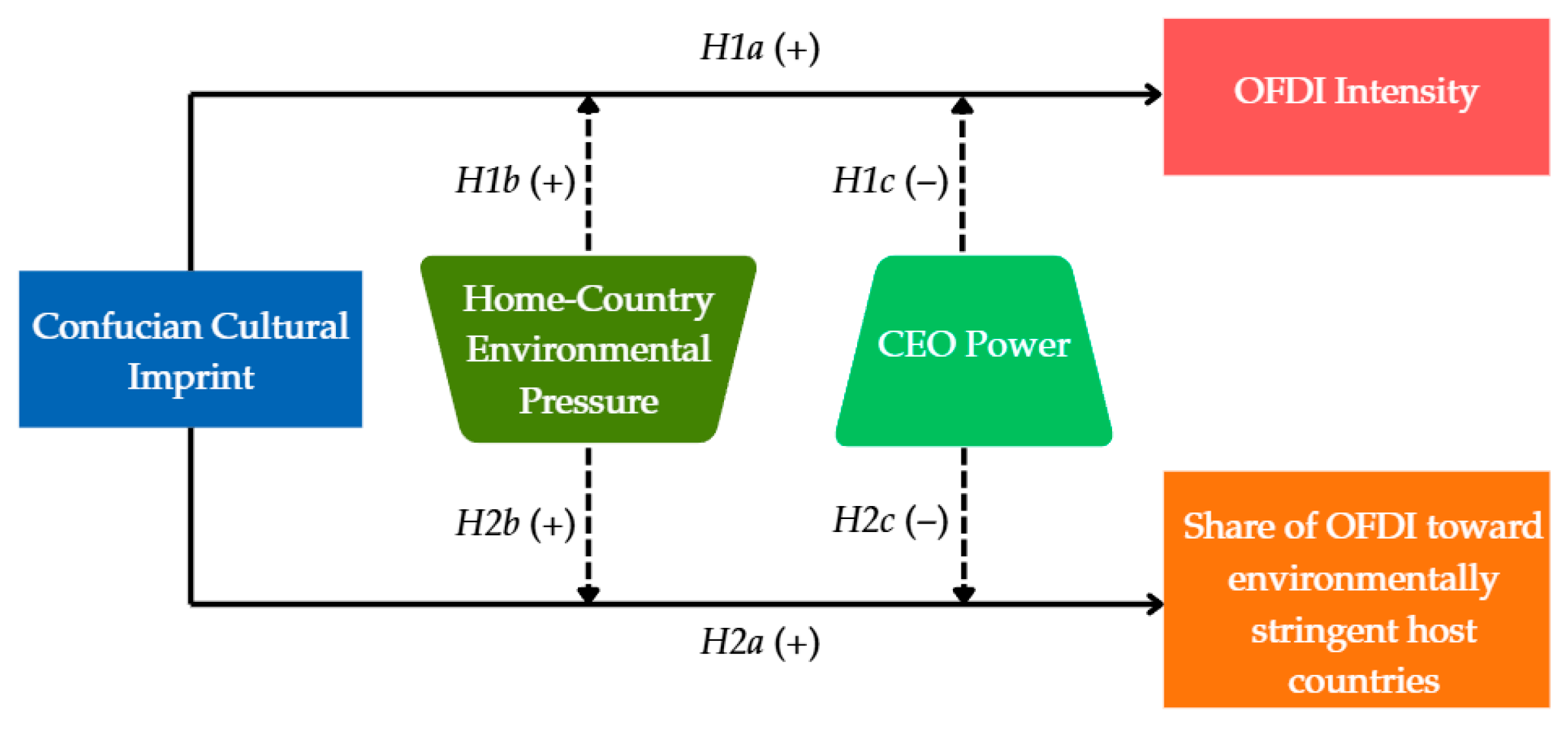
In summary, this study proposes the following hypotheses based on the above analysis:
H1a. Confucian cultural imprint is positively associated with OFDI intensity.
H1b. Home-country environmental pressure strengthens the Confucian imprint–OFDI intensity relationship.
H1c. CEO power weakens the Confucian imprint–OFDI intensity relationship.
H2a. Confucian cultural imprint is positively associated with share of OFDI toward environmentally stringent host countries.
H2b. Under higher home-country environmental pressure, Confucian-imprinted firms allocate a greater share of OFDI toward environmentally stringent host countries.
H2c. CEO power weakens the Confucian imprint—share of OFDI toward environmentally stringent host countries relationship.
Figure 1 summarizes and illustrates the conceptual framework of this study. Solid lines represent the direct relationships, while dashed lines indicate moderating effects.