Bridging the Green Purchasing Gap: Drivers of Willingness to Pay for Green Cosmetics Across Consumer Groups



Abstract
1. Introduction
2. Literature Review and Hypothesis
2.1. Willingness to Pay Premium
2.2. Consumer Purchase Intention
2.3. Environmental Concern
2.4. Health Consciousness
2.5. Consumer Innovativeness
2.6. The Mediating Role of Purchase Intention
2.7. The Moderating Role of Demographic Characteristics
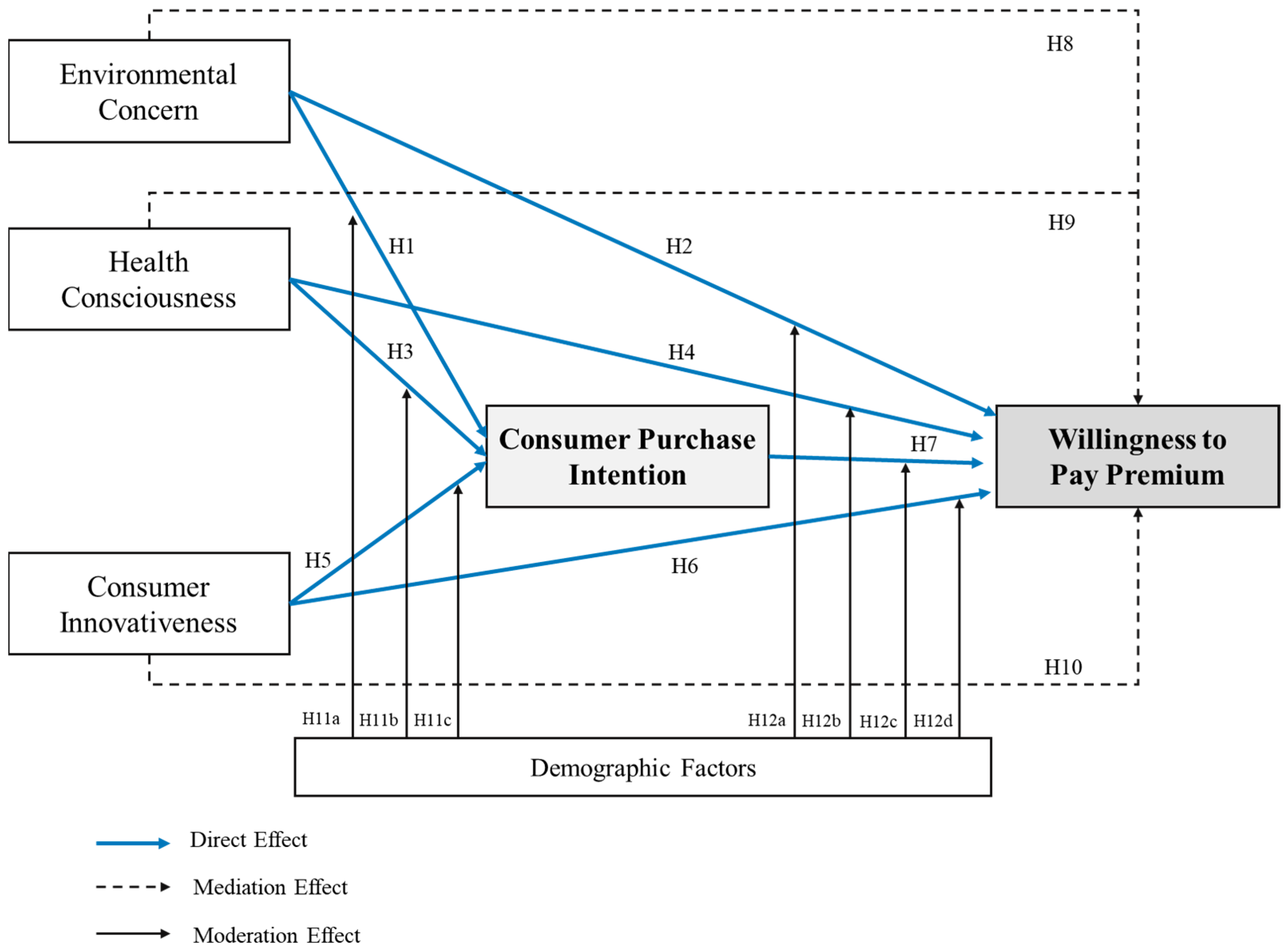
2.8. Hypothesis Development Framework
3. Materials and Methods
4. Results
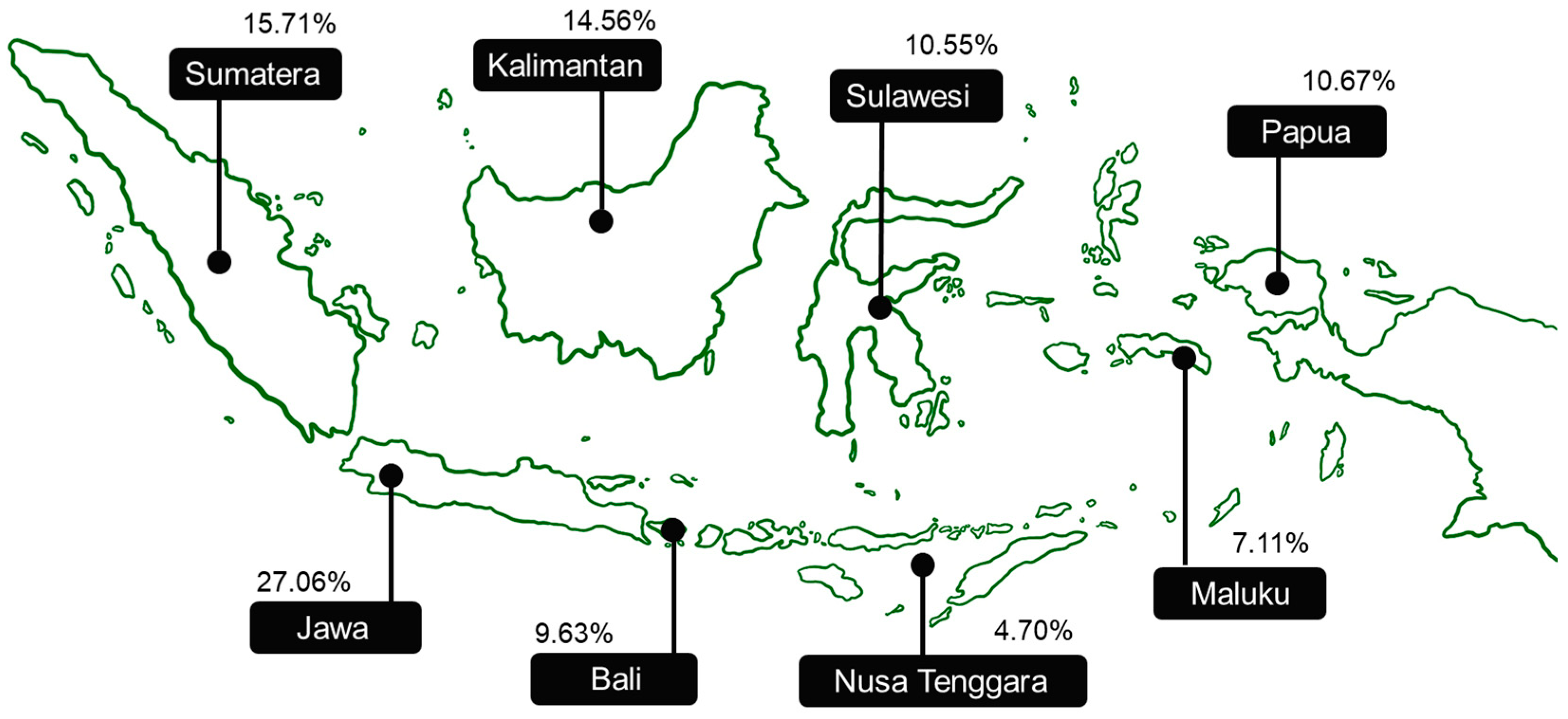
4.1. Descriptive Statistics and Respondent Characteristics
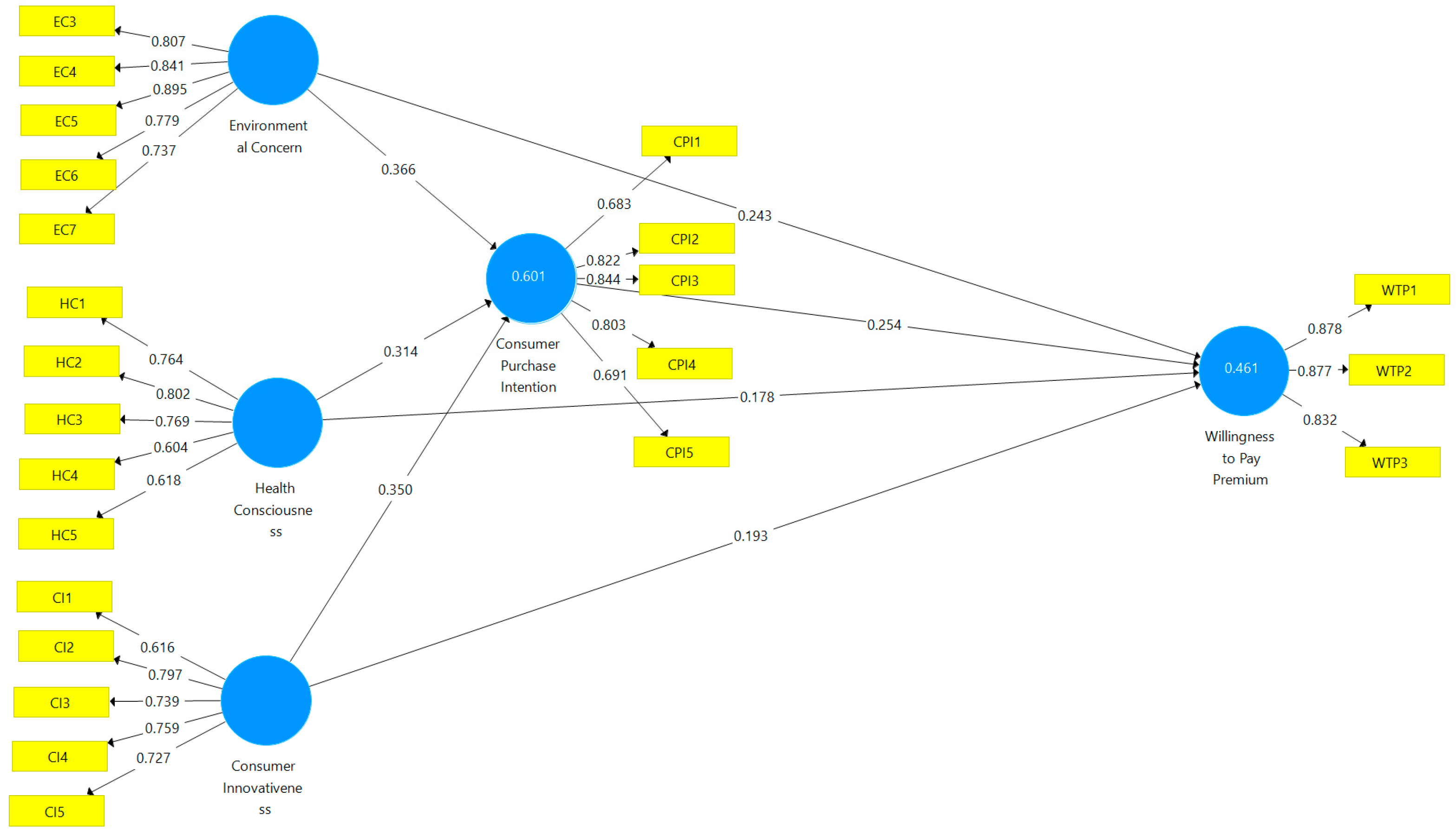
4.2. Measurement Model Evaluation
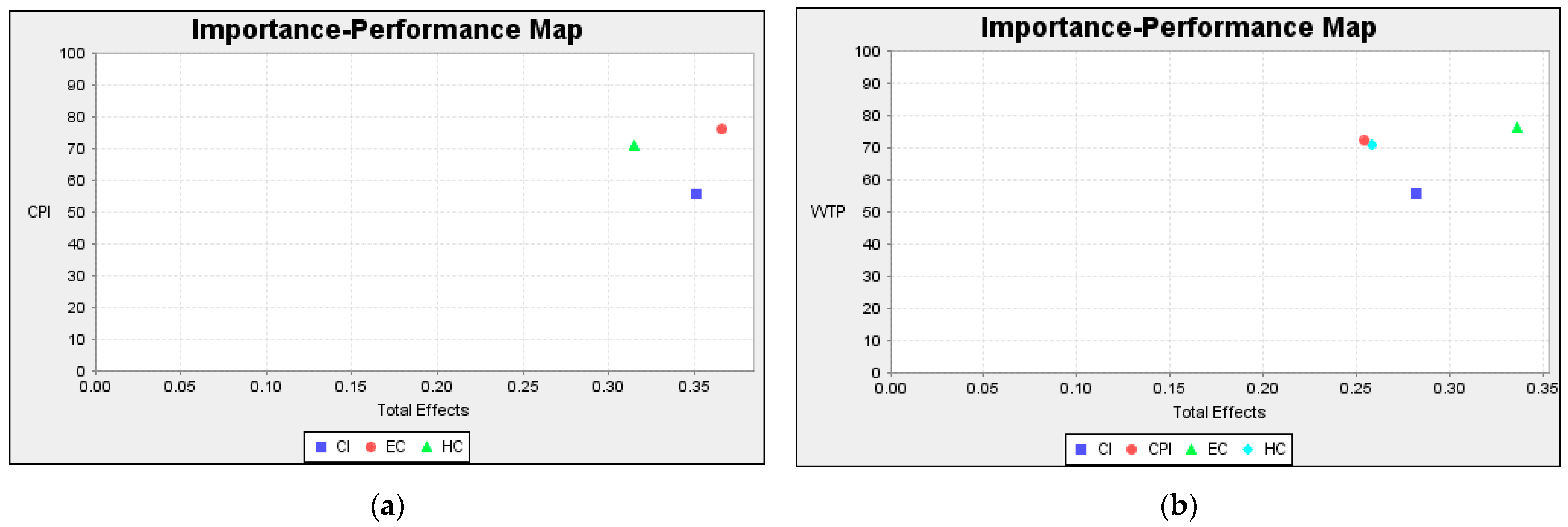
4.3. Structural Model Evaluation and Direct Effect Testing
4.4. Mediation Analysis
4.5. Moderation Analysis: Multi-Group Analysis (MGA)
5. Discussion
6. Conclusions
Author Contributions
Funding
Institutional Review Board Statement
Informed Consent Statement
Data Availability Statement
Conflicts of Interest
References
- Abdulsahib, J. S., Eneizan, B., & Alabboodi, A. S. (2019). Environmental concern, health consciousness and purchase intention of green products: An application of extended theory of planned behavior. The Journal of Social Sciences Research, 5(54), 1203–1215. [Google Scholar] [CrossRef] [Scilit]
- Ajzen, I. (1991). The theory of planned behavior. Organizational Behavior and Human Decision Processes, 50(2), 179–211. [Google Scholar] [CrossRef] [Scilit]
- Akhondan, H., Johnson-Carroll, K., & Rabolt, N. (2015). Health consciousness and organic food consumption. Journal of Family & Consumer Sciences, 107(3), 27–32. [Google Scholar]
- Albayrak, T., Aksoy, Ş., & Caber, M. (2013). The effect of environmental concern and scepticism on green purchase behaviour. Marketing Intelligence and Planning, 31(1), 27–39. [Google Scholar] [CrossRef] [Scilit]
- Alsubhi, M., Blake, M., Nguyen, T., Majmudar, I., Moodie, M., & Ananthapavan, J. (2023). Consumer willingness to pay for healthier food products: A systematic review. Obesity Reviews, 24(1), e13525. [Google Scholar] [CrossRef] [Scilit]
- Amberg, N., & Fogarassy, C. (2019). Green consumer behavior in the cosmetics market. Resources, 8(3), 137. [Google Scholar] [CrossRef] [Scilit]
- Amerigo, M., Aragonés, J. I., & García, J. A. (2012). Exploring the dimensions of environmental concern. An integrative proposal. PsyEcology, 3(3), 353–365. [Google Scholar] [CrossRef] [Scilit]
- Anggraeni, R., & Susilowati, C. (2022). To pay through the nose? The reasons for millennials willingness to pay premium for green products. In B. S. Sergi, & D. Sulistiawan (Eds.), Modeling economic growth in contemporary indonesia (pp. 135–150). Emerald Publishing Limited. [Google Scholar] [CrossRef] [Scilit]
- Ayub, A. H., Naziman, Y. H. N. M., & Samat, M. F. (2018). Factors influencing young consumers’ purchase intention of organic food product. Advances in Business Research International Journal, 4(1), 17–26. [Google Scholar] [CrossRef] [Scilit]
- Bazhan, M., Shafiei Sabet, F., & Borumandnia, N. (2024). Factors affecting purchase intention of organic food products: Evidence from a developing nation context. Food Science & Nutrition, 12(5), 3469–3482. [Google Scholar] [CrossRef] [Scilit]
- Casado-Díaz, A. B., Sellers-Rubio, R., Rodriguez-Sanchez, C., & Sancho-Esper, F. (2020). Predictors of willingness to pay a price premium for hotels’ water-saving initiatives. Journal of Travel & Tourism Marketing, 37(7), 773–784. [Google Scholar] [CrossRef] [Scilit]
- Chekima, B., Chekima, S., Syed Khalid Wafa, S. A. W., Igau, O. A., & Sondoh, S. L., Jr. (2016). Sustainable consumption: The effects of knowledge, cultural values, environmental advertising, and demographics. International Journal of Sustainable Development & World Ecology, 23(2), 210–220. [Google Scholar] [CrossRef] [Scilit]
- Chen, M., & Zhang, W.-H. (2021). Purchase intention for hydrogen automobile among Chinese citizens: The influence of environmental concern and perceived social value. International Journal of Hydrogen Energy, 46(34), 18000–18010. [Google Scholar] [CrossRef] [Scilit]
- Chen-Yu, J. H., & Yang, J.-H. (2020). Consumer characteristics as predictors of purchase intentions and willingness to pay a premium for men’s mass-customized apparel. Journal of Global Fashion Marketing, 11(2), 154–170. [Google Scholar] [CrossRef] [Scilit]
- Dangelico, R. M., & Vocalelli, D. (2017). “Green marketing”: An analysis of definitions, strategy steps, and tools through a systematic review of the literature. Journal of Cleaner Production, 165, 1263–1279. [Google Scholar] [CrossRef] [Scilit]
- De Canio, F. (2023). Consumer willingness to pay more for pro-environmental packages: The moderating role of familiarity. Journal of Environmental Management, 339, 117828. [Google Scholar] [CrossRef] [Scilit]
- Duong, C. D. (2023). Environmental corporate social responsibility initiatives and the attitude-intention-behavior gap in green consumption. Social Responsibility Journal, 20(2), 305–325. [Google Scholar] [CrossRef] [Scilit]
- Duong, C. D., Doan, X. H., Vu, D. M., Ha, N. T., & Dam, K. V. (2022). The role of perceived environmental responsibility and environmental concern on shaping green purchase intention. Vision, 30, 63–77. [Google Scholar] [CrossRef]
- Dwivedi, S., Gupta, A., & Sayal, A. (2025). Evolution of consumer perceptions and intentions in the green cosmetics market: A thematic and trend analysis. Frontiers in Sustainability, 6, 1617779. [Google Scholar] [CrossRef] [Scilit]
- Fan, Y., Chen, R., & Fan, Z. (2019). Worth it or not: Effects of price premium on purchase intent of products with environmental benefits. Journal of Marketing Development and Competitiveness, 13(3), 38–52. [Google Scholar] [CrossRef] [Scilit]
- Farzin, M., Shababi, H., Shirchi Sasi, G., Sadeghi, M., & Makvandi, R. (2023). The determinants of eco-fashion purchase intention and willingness to pay. Spanish Journal of Marketing—ESIC, 27(3), 348–366. [Google Scholar] [CrossRef] [Scilit]
- Frank, B., Enkawa, T., Schvaneveldt, S. J., & Herbas Torrico, B. (2015). Antecedents and consequences of innate willingness to pay for innovations: Understanding motivations and consumer preferences of prospective early adopters. Technological Forecasting and Social Change, 99, 252–266. [Google Scholar] [CrossRef] [Scilit]
- Ghazanfari, S., Firoozzare, A., Covino, D., Boccia, F., & Palmieri, N. (2024). Exploring factors influencing consumers’ willingness to pay healthy-labeled foods at a premium price. Sustainability, 16(16), 6895. [Google Scholar] [CrossRef] [Scilit]
- González-Rodríguez, M. R., Díaz-Fernández, M. C., & Font, X. (2020). Factors influencing willingness of customers of environmentally friendly hotels to pay a price premium. International Journal of Contemporary Hospitality Management, 32(1), 60–80. [Google Scholar] [CrossRef] [Scilit]
- Gow, J., Rana, R. H., Moscovici, D., Ugaglia, A. A., Valenzuela, L., Mihailescu, R., & Coelli, R. (2022). Australian consumers and environmental characteristics of wine: Price premium indications. International Journal of Wine Business Research, 34(4), 542–566. [Google Scholar] [CrossRef] [Scilit]
- Hair, J. F., Risher, J. J., Sarstedt, M., & Ringle, C. M. (2019). When to use and how to report the results of PLS-SEM. European Business Review, 31(1), 2–24. [Google Scholar] [CrossRef] [Scilit]
- Hansen, T., Sørensen, M. I., & Eriksen, M.-L. R. (2018). How the interplay between consumer motivations and values influences organic food identity and behavior. Food Policy, 74, 39–52. [Google Scholar] [CrossRef] [Scilit]
- Hantoro, I., Löhr, A. J., Van Belleghem, F. G. A. J., Widianarko, B., & Ragas, A. M. J. (2024). Characteristics of microplastics pollution in important commercial coastal seafood of Central Java, Indonesia. Environmental Advances, 17, 100574. [Google Scholar] [CrossRef] [Scilit]
- Hasudungan, A., & Saragih, H. S. (2024). Green consumption: The role of perceived symbolic value and personal innovativeness. Journal of Responsible Production and Consumption, 1(1), 159–176. [Google Scholar] [CrossRef] [Scilit]
- He, X., Zhan, W., & Hu, Y. (2018). Consumer purchase intention of electric vehicles in China: The roles of perception and personality. Journal of Cleaner Production, 204, 1060–1069. [Google Scholar] [CrossRef] [Scilit]
- Homer, P. M., & Kahle, L. R. (1988). A structural equation test of the value-attitude-behavior hierarchy. Journal of Personality and Social Psychology, 54(4), 638–646. [Google Scholar] [CrossRef]
- Hong, Y., Hu, J., Chen, M., & Tang, S. (2023). Motives and antecedents affecting green purchase intention: Implications for green economic recovery. Economic Analysis and Policy, 77, 523–538. [Google Scholar] [CrossRef] [Scilit]
- Hsu, S.-Y., Chang, C.-C., & Lin, T. T. (2016). An analysis of purchase intentions toward organic food on health consciousness and food safety with/under structural equation modeling. British Food Journal, 118(1), 200–216. [Google Scholar] [CrossRef] [Scilit]
- Huang, M.-Y. (2023). Effects of consumer perception, attitude, and purchase intention on the willingness to pay for green building housing products. Journal of Housing and the Built Environment, 38(3), 1559–1583. [Google Scholar] [CrossRef] [Scilit]
- Iqbal, J., Yu, D., Zubair, M., Rasheed, M. I., Khizar, H. M. U., & Imran, M. (2021). Health consciousness, food safety concern, and consumer purchase intentions toward organic food: The role of consumer involvement and ecological motives. Sage Open, 11(2), 21582440211015730. [Google Scholar] [CrossRef] [Scilit]
- Jambeck, J. R., Geyer, R., Wilcox, C., Siegler, T. R., Perryman, M., Andrady, A., Narayan, R., & Law, K. L. (2015). Plastic waste inputs from land into the ocean. Science, 347(6223), 764–768. [Google Scholar] [CrossRef] [Scilit]
- Kamboj, S., & Matharu, M. (2021). Modelling the predictors of consumers’ willingness to pay premium price for sustainable products. Journal of Asia Business Studies, 15(4), 559–583. [Google Scholar] [CrossRef] [Scilit]
- Kasilingam, D., & Krishna, R. (2022). Understanding the adoption and willingness to pay for internet of things services. International Journal of Consumer Studies, 46(1), 102–131. [Google Scholar] [CrossRef] [Scilit]
- Kato, K. (2019). Gender and sustainability—Exploring ways of knowing—An ecohumanities perspective. Journal of Sustainable Tourism, 27(7), 939–956. [Google Scholar] [CrossRef] [Scilit]
- Kaushik, A. K., & Rahman, Z. (2014). Perspectives and dimensions of consumer innovativeness: A literature review and future agenda. Journal of International Consumer Marketing, 26(3), 239–263. [Google Scholar] [CrossRef] [Scilit]
- Kementerian Kesehatan RI. (2018). Laporan hasil riset kesehatan dasar (riskesdas) Indonesia tahun 2018. Riset Kesehatan Dasar 2018. Available online: https://repository.kemkes.go.id/book/1323 (accessed on 5 March 2025).
- Kim, N., & Lee, K. (2023). Environmental consciousness, purchase intention, and actual purchase behavior of eco-friendly products: The moderating impact of situational context. International Journal of Environmental Research and Public Health, 20(7), 5312. [Google Scholar] [CrossRef] [Scilit]
- Kishore, S. V. K., Kiran, P., Banerjee, J., & Vasudevan, M. (2022). Moderation of income and age on customer purchase intention of green cosmetics in bangalore. In A. Chandani, R. Divekar, & J. K. Nayak (Eds.), Achieving $5 trillion economy of India (pp. 187–213). Springer Nature. [Google Scholar]
- Klein, F., Emberger-Klein, A., Menrad, K., Möhring, W., & Blesin, J.-M. (2019). Influencing factors for the purchase intention of consumers choosing bioplastic products in Germany. Sustainable Production and Consumption, 19, 33–43. [Google Scholar] [CrossRef] [Scilit]
- Kock, N., & Lynn, G. (2012). Lateral collinearity and misleading results in variance-based SEM: An illustration and recommendations. Journal of the Association for Information Systems, 13(7), 546–580. [Google Scholar] [CrossRef] [Scilit]
- Konuk, F. A. (2018). Antecedents of pregnant women’s purchase intentions and willingness to pay a premium for organic food. British Food Journal, 120(7), 1561–1573. [Google Scholar] [CrossRef] [Scilit]
- Konuk, F. A. (2019). Consumers’ willingness to buy and willingness to pay for fair trade food: The influence of consciousness for fair consumption, environmental concern, trust and innovativeness. Food Research International, 120, 141–147. [Google Scholar] [CrossRef] [Scilit]
- Kumar, A., Prakash, G., & Kumar, G. (2021). Does environmentally responsible purchase intention matter for consumers? A predictive sustainable model developed through an empirical study. Journal of Retailing and Consumer Services, 58, 102270. [Google Scholar] [CrossRef] [Scilit]
- Kumar, J., Rani, V., Rani, G., & Rani, M. (2024). Understanding purchase behaviour towards green housing among millennials: The mediating role of purchase intention. International Journal of Housing Markets and Analysis, 18(4), 987–1004. [Google Scholar] [CrossRef] [Scilit]
- Lee, H., & Cheon, H. (2018). Exploring Korean consumers’ attitudes toward ethical consumption behavior in the light of affect and cognition. Journal of International Consumer Marketing, 30(2), 98–114. [Google Scholar] [CrossRef] [Scilit]
- Le Gall-Ely, M. (2009). Definition, measurement and determinants of the consumer’s willingness to pay: A critical synthesis and avenues for further research. Recherche et Applications En Marketing (English Edition), 24(2), 91–112. [Google Scholar] [CrossRef] [Scilit]
- Leong, C.-M., She, L., Lim, T.-Y., & Wong, N. M. (2024). To buy or not to buy? Green packaging, gender differences and the intention to purchase. International Journal of Social Economics, 51(11), 1353–1369. [Google Scholar] [CrossRef] [Scilit]
- Li, G., Yang, L., Zhang, B., Li, X., & Chen, F. (2021). How do environmental values impact green product purchase intention? The moderating role of green trust. Environmental Science and Pollution Research, 28(33), 46020–46034. [Google Scholar] [CrossRef] [Scilit] [PubMed]
- Li, L., Wang, Z., Li, Y., & Liao, A. (2021). Impacts of consumer innovativeness on the intention to purchase sustainable products. Sustainable Production and Consumption, 27, 774–786. [Google Scholar] [CrossRef] [Scilit]
- Li, Y., & Shan, B. (2025). Exploring the role of health consciousness and environmental awareness in purchase intentions for green-packaged organic foods: An extended TPB model. Frontiers in Nutrition, 12, 1528016. [Google Scholar] [CrossRef] [Scilit] [PubMed]
- Liang, H., Wu, Z., & Du, S. (2024). Study on the impact of environmental awareness, health consciousness, and individual basic conditions on the consumption intention of green furniture. Sustainable Futures, 8, 100245. [Google Scholar] [CrossRef] [Scilit]
- Lorek, S., & Spangenberg, J. H. (2014). Sustainable consumption within a sustainable economy—Beyond green growth and green economies. Journal of Cleaner Production, 63, 33–44. [Google Scholar] [CrossRef] [Scilit]
- Lupindo, M., Madinga, N. W., & Dlamini, S. (2024). Green beauty: Examining factors shaping millennials’ attitudes toward organic personal care products in South Africa. European Journal of Management Studies, 29(3), 271–291. [Google Scholar] [CrossRef] [Scilit]
- Midgley, D. F. (2014). Innovation and new product marketing (RLE marketing). Routledge. [Google Scholar]
- Molinillo, S., Vidal-Branco, M., & Japutra, A. (2019). Understanding the drivers of organic foods purchasing of millennials: Evidence from Brazil and Spain. Journal of Retailing and Consumer Services, 52, 101926. [Google Scholar] [CrossRef] [Scilit]
- Narayanan, S., & Singh, G. A. (2023). Consumers’ willingness to pay for corporate social responsibility: Theory and evidence. International Journal of Consumer Studies, 47(6), 2212–2244. [Google Scholar] [CrossRef] [Scilit]
- Newton, J. D., Tsarenko, Y., Ferraro, C., & Sands, S. (2015). Environmental concern and environmental purchase intentions: The mediating role of learning strategy. Journal of Business Research, 68(9), 1974–1981. [Google Scholar] [CrossRef] [Scilit]
- Nguyen, P.-H., Nguyen, D. N., & Nguyen, L. A. T. (2023). Quantitative insights into green purchase intentions: The interplay of health consciousness, altruism, and sustainability. Cogent Business & Management, 10(3), 2253616. [Google Scholar] [CrossRef] [Scilit]
- Nguyen, T. N., Phan, T. T. H., Cao, T. K., & Nguyen, H. V. (2017). Green purchase behavior: Mitigating barriers in developing countries. Strategic Direction, 33(8), 4–6. [Google Scholar] [CrossRef] [Scilit]
- Nicolau, J. L., Guix, M., Hernandez-Maskivker, G., & Molenkamp, N. (2020). Millennials’ willingness to pay for green restaurants. International Journal of Hospitality Management, 90, 102601. [Google Scholar] [CrossRef] [Scilit]
- Nowak, K., Markiewicz, D., Gawraczyński, J., & Mazurkiewicz, P. (2016). Cross-country comparisons of environmental concern. Problemy Zarządzania, 14(60), 83–101. [Google Scholar] [CrossRef] [Scilit]
- Paparoidamis, N. G., & Tran, H. T. T. (2019). Making the world a better place by making better products: Eco-friendly consumer innovativeness and the adoption of eco-innovations. European Journal of Marketing, 53(8), 1546–1584. [Google Scholar] [CrossRef] [Scilit]
- Parashar, S., Singh, S., & Sood, G. (2023). Examining the role of health consciousness, environmental awareness and intention on purchase of organic food: A moderated model of attitude. Journal of Cleaner Production, 386, 135553. [Google Scholar] [CrossRef] [Scilit]
- Paul, J., Modi, A., & Patel, J. (2016). Predicting green product consumption using theory of planned behavior and reasoned action. Journal of Retailing and Consumer Services, 29, 123–134. [Google Scholar] [CrossRef] [Scilit]
- Persaud, A., & Schillo, S. R. (2017). Purchasing organic products: Role of social context and consumer innovativeness. Marketing Intelligence & Planning, 35(1), 130–146. [Google Scholar] [CrossRef] [Scilit]
- Peter, J. P., & Olson, J. C. (2010). Consumer behavior & marketing. McGraw-Hill Irwin. [Google Scholar]
- Pooley, J. A., & O’Connor, M. (2000). Environmental education and attitudes: Emotions and beliefs are what is needed. Environment and Behavior, 32(5), 711–723. [Google Scholar] [CrossRef]
- Prakash, G., Singh, P. K., & Yadav, R. (2018). Application of consumer style inventory (CSI) to predict young Indian consumer’s intention to purchase organic food products. Food Quality and Preference, 68, 90–97. [Google Scholar] [CrossRef] [Scilit]
- Quoquab, F., Jaini, A., & Mohammad, J. (2020). Does it matter who exhibits more green purchase behavior of cosmetic products in asian culture? A multi-group analysis approach. International Journal of Environmental Research and Public Health, 17(14), 5258. [Google Scholar] [CrossRef] [Scilit] [PubMed]
- Rausch, T. M., & Kopplin, C. S. (2021). Bridge the gap: Consumers’ purchase intention and behavior regarding sustainable clothing. Journal of Cleaner Production, 278, 123882. [Google Scholar] [CrossRef] [Scilit]
- Rezai, G., Kit Teng, P., Mohamed, Z., & Shamsudin, M. N. (2013). Consumer willingness to pay for green food in Malaysia. Journal of International Food & Agribusiness Marketing, 25(Suppl. S1), 1–18. [Google Scholar] [CrossRef] [Scilit]
- Rogers, E. M. (2010). Diffusion of innovations (4th ed.). Free Press. Available online: https://books.google.co.id/books?id=v1ii4QsB7jIC (accessed on 15 March 2025).
- Sadik-Rozsnyai, O., & Bertrandias, L. (2019). New technological attributes and willingness to pay: The role of social innovativeness. European Journal of Marketing, 53(6), 1099–1124. [Google Scholar] [CrossRef] [Scilit]
- Saleki, R., Quoquab, F., & Mohammad, J. (2019). What drives Malaysian consumers’ organic food purchase intention? The role of moral norm, self-identity, environmental concern and price consciousness. Journal of Agribusiness in Developing and Emerging Economies, 9(5), 584–603. [Google Scholar] [CrossRef] [Scilit]
- Schaffrin, A. (2011). No measure without concept. A critical review on the conceptualization and measurement of environmental concern. International Review of Social Research, 1(3), 11–18. [Google Scholar] [CrossRef] [Scilit]
- Schniederjans, D. G., & Starkey, C. M. (2014). Intention and willingness to pay for green freight transportation: An empirical examination. Transportation Research Part D: Transport and Environment, 31, 116–125. [Google Scholar] [CrossRef] [Scilit]
- Schwartz, S. H. (1992). Universals in the content and structure of values: Theoretical advances and empirical tests in 20 countries. In Advances in experimental social psychology (Vol. 25, pp. 1–65). Academic Press. [Google Scholar] [CrossRef] [Scilit]
- Shah, P., & Yang, J. Z. (2022). Consumer willingness to pay for sustainable products. Environmental Communication, 16(8), 1077–1093. [Google Scholar] [CrossRef] [Scilit]
- Shao, C. (2024). Distinct effects of consumer innovativeness on willingness to pay a green premium when framing social norms information. Kybernetes, 55(2), 986–1014. [Google Scholar] [CrossRef] [Scilit]
- Shimoda, A., Hayashi, H., Sussman, D., Nansai, K., Fukuba, I., Kawachi, I., & Kondo, N. (2020). Our health, our planet: A cross-sectional analysis on the association between health consciousness and pro-environmental behavior among health professionals. International Journal of Environmental Health Research, 30(1), 63–74. [Google Scholar] [CrossRef] [Scilit] [PubMed]
- Shin, Y. H., Im, J., Jung, S. E., & Severt, K. (2019). Motivations behind consumers’ organic menu choices: The role of environmental concern, social value, and health consciousness. Journal of Quality Assurance in Hospitality and Tourism, 20(1), 107–122. [Google Scholar] [CrossRef] [Scilit]
- Simanjuntak, M., Nafila, N. L., Yuliati, L. N., Johan, I. R., Najib, M., & Sabri, M. F. (2023). Environmental care attitudes and intention to purchase green products: Impact of environmental knowledge, word of mouth, and green marketing. Sustainability, 15(6), 5445. [Google Scholar] [CrossRef] [Scilit]
- Sriwaranun, Y., Gan, C., Lee, M., & Cohen, D. A. (2015). Consumers’ willingness to pay for organic products in Thailand. International Journal of Social Economics, 42(5), 480–510. [Google Scholar] [CrossRef] [Scilit]
- Sun, M., Gao, X., Jing, X., & Cheng, F. (2023). The influence of internal and external factors on the purchase intention of carbon-labeled products. Journal of Cleaner Production, 419, 138272. [Google Scholar] [CrossRef] [Scilit]
- Sun, Y., Weng, C., & Liao, Z. (2019). Product innovation and sustainable marketing: Effects on consumer innovativeness. Technology Analysis & Strategic Management, 31(7), 765–775. [Google Scholar] [CrossRef] [Scilit]
- Suphasomboon, T., & Vassanadumrongdee, S. (2022). Toward sustainable consumption of green cosmetics and personal care products: The role of perceived value and ethical concern. Sustainable Production and Consumption, 33, 230–243. [Google Scholar] [CrossRef] [Scilit]
- Tan, W. L., & Goh, Y. N. (2018). The role of psychological factors in influencing consumer purchase intention towards green residential building. International Journal of Housing Markets and Analysis, 11(5), 788–807. [Google Scholar] [CrossRef] [Scilit]
- Taufique, K. M. R. (2022). Integrating environmental values and emotion in green marketing communications inducing sustainable consumer behaviour. Journal of Marketing Communications, 28(3), 272–290. [Google Scholar] [CrossRef] [Scilit]
- Tellis, G., Yin, E., & Bell, S. (2009). Global consumer innovativeness: Cross-country differences and demographic commonalities. SSRN Electronic Journal. [Google Scholar] [CrossRef] [Scilit]
- Tengli, A., & Srinivasan, S. H. (2022). An exploratory study to identify the gender-based purchase behavior of consumers of natural cosmetics. Cosmetics, 9(5), 101. [Google Scholar] [CrossRef] [Scilit]
- Toklu, I. T., & Kucuk, H. O. (2017). The impact of brand crisis on consumers’ green purchase intention and willingness to pay more. International Business Research, 10(1), 22–33. [Google Scholar] [CrossRef] [Scilit]
- Van Phuong, N., Mergenthaler, M., & Quynh, P. N. H. (2025). Consumer transition: Analyzing the impact of environmental and health consciousness on green food choices in Vietnam. Discover Sustainability, 6(1), 415. [Google Scholar] [CrossRef] [Scilit]
- Vironika, P., & Maulida, M. (2025). Green purchase behavior in indonesia: Examining the role of knowledge, trust and marketing. Challenges, 16(3), 41. [Google Scholar] [CrossRef] [Scilit]
- Watanabe, E. A. d. M., Alfinito, S., Castelo Branco, T. V., Felix Raposo, C., & Athayde Barros, M. (2023). The consumption of fresh organic food: Premium pricing and the predictors of willingness to pay. Journal of Food Products Marketing, 29(2–3), 41–55. [Google Scholar] [CrossRef] [Scilit]
- Widodo, A., Rubiyanti, N., & Madiawati, P. N. (2025). Investigating the influence of eco-labels on consumer behavior in Indonesia’s developing green market. Management & Sustainability: An Arab Review. [Google Scholar] [CrossRef] [Scilit]
- Widyastuti, S., Abidin, A. S., Hikmaturrohmi, H., Ilhami, B. T., Kurniawan, N. S., Jupri, A., Candri, D. A., Frediansyah, A., & Prasedya, E. S. (2023). Microplastic contamination in different marine species of bintaro fish market, Indonesia. Sustainability, 15(12), 9836. [Google Scholar] [CrossRef] [Scilit]
- Witek, L. (2019). Attitude-behaviour gap among polish consumers regarding green purchases. Visegrad Journal on Bioeconomy and Sustainable Development, 8(1), 31–36. [Google Scholar] [CrossRef] [Scilit]
- Xu, M., & Lin, B. (2021). Leveraging carbon label to achieve low-carbon economy: Evidence from a survey in Chinese first-tier cities. Journal of Environmental Management, 286, 112201. [Google Scholar] [CrossRef] [Scilit]
- Xu, X., Wang, S., & Yu, Y. (2020). Consumer’s intention to purchase green furniture: Do health consciousness and environmental awareness matter? Science of the Total Environment, 704, 135275. [Google Scholar] [CrossRef] [Scilit]
- Yadav, R., & Pathak, G. S. (2016). Intention to purchase organic food among young consumers: Evidences from a developing nation. Appetite, 96, 122–128. [Google Scholar] [CrossRef] [Scilit]
- Yang, M., Chen, H., Long, R., Wang, Y., Hou, C., & Liu, B. (2021). Will the public pay for green products? Based on analysis of the influencing factors for Chinese’s public willingness to pay a price premium for green products. Environmental Science and Pollution Research, 28(43), 61408–61422. [Google Scholar] [CrossRef] [Scilit] [PubMed]
- Yen, N. T. H., & Hoang, D. P. (2023). The formation of attitudes and intention towards green purchase: An analysis of internal and external mechanisms. Cogent Business & Management, 10(1), 2192844. [Google Scholar] [CrossRef] [Scilit]
- Zameer, H., & Yasmeen, H. (2022). Green innovation and environmental awareness driven green purchase intentions. Marketing Intelligence & Planning, 40(5), 624–638. [Google Scholar] [CrossRef] [Scilit]
- Zaremohzzabieh, Z., Ismail, N., Ahrari, S., & Abu Samah, A. (2021). The effects of consumer attitude on green purchase intention: A meta-analytic path analysis. Journal of Business Research, 132, 732–743. [Google Scholar] [CrossRef] [Scilit]
- Zhang, B., Fu, Z., Huang, J., Wang, J., Xu, S., & Zhang, L. (2018). Consumers’ perceptions, purchase intention, and willingness to pay a premium price for safe vegetables: A case study of Beijing, China. Journal of Cleaner Production, 197, 1498–1507. [Google Scholar] [CrossRef] [Scilit]
- Zhao, G., Shao, W., Maseeh, H. I., Lei, X., Lin, O., & Yuan, Y. (2025). The innovation paradox: Why consumers buy green products for novelty, not the planet. Journal of Environmental Management, 393, 127176. [Google Scholar] [CrossRef] [Scilit] [PubMed]
- Zhao, R., Geng, Y., Liu, Y., Tao, X., & Xue, B. (2018). Consumers’ perception, purchase intention, and willingness to pay for carbon-labeled products: A case study of Chengdu in China. Journal of Cleaner Production, 171, 1664–1671. [Google Scholar] [CrossRef] [Scilit]
- Zhuang, W., Luo, X., & Riaz, M. U. (2021). On the factors influencing green purchase intention: A meta-analysis approach. Frontiers in Psychology, 12, 644020. [Google Scholar] [CrossRef] [Scilit]



| Variable | Number of Indicators | Source |
|---|---|---|
| Environmental concern | 7 | Albayrak et al. (2013) |
| Health consciousness | 5 | Sriwaranun et al. (2015) |
| Consumer innovativeness | 5 | Konuk (2018) |
| Consumer purchase intention | 5 | Paul et al. (2016) |
| Willingness to pay premium | 3 | Molinillo et al. (2019) |
| Characteristics | Category | Frequency | Percentage |
|---|---|---|---|
| Gender | Men | 188 | 21.56% |
| Women | 684 | 78.44% | |
| Age | 17–25 years old | 271 | 31.08% |
| 26–35 years old | 234 | 26.83% | |
| 36–45 years old | 299 | 34.29% | |
| >45 years old | 68 | 7.80% | |
| Employment | Student | 216 | 24.77% |
| Civil Servant | 176 | 20.18% | |
| Private Employee | 225 | 25.80% | |
| Entrepreneur | 118 | 13.53% | |
| Housewife | 79 | 9.06% | |
| Other | 58 | 6.65% | |
| Field of Science | Technological and Natural Science | 389 | 44.61% |
| Humanities and Social Sciences | 483 | 55.39% |
| Variable | Indicator | Loading | AVE | CR | CA |
|---|---|---|---|---|---|
| Environmental Concern | EC1. Protecting the environment will threaten the jobs of people like me (r). | Not valid | 0.662 | 0.907 | 0.871 |
| EC2. Laws to protect the environment limit my choices and personal freedom (r). | Not valid | ||||
| EC3. The effects of pollution on public health are worse than we realize. | 0.807 | ||||
| EC4. Environmental protection will help people have a better quality of life. | 0.841 | ||||
| EC5. Environmental protection benefits everyone. | 0.895 | ||||
| EC6. Modern development threatens wildlife. | 0.779 | ||||
| EC7. Over the next several decades, thousands of plant and animal species will become extinct. | 0.737 | ||||
| Health Consciousness | HC1. Often use cosmetics/personal care that are safe for the skin/health | 0.764 | 0.513 | 0.838 | 0.758 |
| HC2. Balance work and family/life well | 0.802 | ||||
| HC3. Often read/check quality labels before buying the latest cosmetic/personal care products | 0.769 | ||||
| HC4. Exercise regularly | 0.604 | ||||
| HC5. Avoid buying cosmetics/personal care that use artificial (synthetic) additives | 0.618 | ||||
| Consumer Innovativeness | CI1. In general, I am the first person in my circle of friends to know about the latest cosmetic/personal care products. | 0.616 | 0.533 | 0.850 | 0.779 |
| CI2. In general, I am the first person in my circle of friends to intend to buy the latest cosmetic/personal care products when they appear | 0.797 | ||||
| CI3. I would be quite interested in buying the latest cosmetic/ personal care products available in stores | 0.739 | ||||
| CI4. I would buy the latest cosmetic/personal care products, even if I have never tried them | 0.759 | ||||
| CI5. I feel the need to buy cosmetic/personal care products before anyone else does | 0.727 | ||||
| Consumer Purchase Intention | CPI1. Will consider purchasing green cosmetics and personal care products because they are less polluting in the future | 0.683 | 0.595 | 0.879 | 0.827 |
| CPI2. Will consider switching to green cosmetics and personal care products for ecological reasons | 0.822 | ||||
| CPI3. Plan to spend more on green cosmetics and personal care products than regular cosmetics | 0.844 | ||||
| CPI4. Expect to purchase green cosmetics and personal care products in the future because of their positive environmental contribution | 0.803 | ||||
| CPI5. Definitely intend to purchase green cosmetics and personal care products in the near future | 0.691 | ||||
| Willingness to Pay Premium | WTP1. Willing to pay more for green cosmetics and personal care products because of their higher production costs | 0.878 | 0.744 | 0.897 | 0.828 |
| WTP2. Paying 10 percent more for cosmetics and personal care products that are produced, processed, and packaged in an environmentally friendly way is acceptable. | 0.877 | ||||
| WTP3. Willing to spend extra money a week to buy green cosmetics and personal care products. | 0.832 |
| Construct | 1 | 2 | 3 | 4 | 5 |
|---|---|---|---|---|---|
| 1. Consumer Innovativeness | |||||
| 2. Consumer Purchase Intention | 0.705 | ||||
| 3. Environmental Concern | 0.339 | 0.689 | |||
| 4. Health Consciousness | 0.483 | 0.733 | 0.471 | ||
| 5. Willingness to Pay Premium | 0.571 | 0.731 | 0.606 | 0.632 |
| Construct | VIF |
|---|---|
| Environmental Concern → Consumer Purchase Intention | 1.242 |
| Environmental Concern → Willingness to Pay Premium | 1.608 |
| Health Consciousness → Consumer Purchase Intention | 1.329 |
| Health Consciousness → Willingness to Pay Premium | 1.561 |
| Consumer Innovativeness → Consumer Purchase Intention | 1.188 |
| Consumer Innovativeness → Willingness to Pay Premium | 1.498 |
| Consumer Purchase Intention → Willingness to Pay Premium | 2.542 |
| Variable | R-Square | R-Square Adjusted | Q-Square |
|---|---|---|---|
| Consumer purchase intention | 0.601 | 0.600 | 0.350 |
| Willingness to pay premium | 0.461 | 0.459 | 0.333 |
| Hypothesis | Path Coefficient | t-Value | p-Value | f-Square (Effect Size) | Result |
|---|---|---|---|---|---|
| H1. Environmental Concern → Consumer Purchase Intention | 0.366 | 14.650 | 0.000 | 0.275 (medium) | Supported |
| H2. Environmental Concern → Willingness to Pay Premium | 0.243 | 7.493 | 0.000 | 0.070 (small) | Supported |
| H3. Health Consciousness → Consumer Purchase Intention | 0.314 | 11.371 | 0.000 | 0.189 (medium) | Supported |
| H4. Health Consciousness → Willingness to Pay Premium | 0.178 | 4.790 | 0.000 | 0.038 (small) | Supported |
| H5. Consumer Innovativeness → Consumer Purchase Intention | 0.350 | 17.372 | 0.000 | 0.259 (medium) | Supported |
| H6. Consumer Innovativeness → Willingness to Pay Premium | 0.193 | 6.462 | 0.000 | 0.046 (small) | Supported |
| H7. Consumer Purchase Intention → Willingness to Pay Premium | 0.254 | 5.347 | 0.000 | 0.048 (small) | Supported |
| Construct | Consumer Purchase Intention | Willingness to Pay Premium | ||
|---|---|---|---|---|
| Importance | Performance | Importance | Performance | |
| Environmental Concern | 0.366 | 75.976 | 0.336 | 75.976 |
| Health Consciousness | 0.314 | 70.733 | 0.258 | 70.733 |
| Consumer Innovativeness | 0.350 | 55.533 | 0.282 | 55.533 |
| Consumer Purchase Intention | 0.254 | 72.164 | ||
| Hypothesis | Path Coefficient | t-Value | p-Value | Result |
|---|---|---|---|---|
| H8. Environmental Concern → Consumer Purchase Intention → Willingness to Pay Premium | 0.093 | 4.832 | 0.000 | Supported |
| H9. Health Consciousness → Consumer Purchase Intention → Willingness to Pay Premium | 0.080 | 4.797 | 0.000 | Supported |
| H10. Consumer Innovativeness → Consumer Purchase Intention → Willingness to Pay Premium | 0.089 | 4.885 | 0.000 | Supported |
| Construct | Correlation (c) | 5% Quantile | p-Value | Result |
|---|---|---|---|---|
| Age | ||||
| CI | 0.996 | 0.993 | 0.161 | Established |
| CPI | 1.000 | 0.999 | 0.853 | Established |
| EC | 0.999 | 0.999 | 0.033 | Established |
| HC | 0.997 | 0.996 | 0.071 | Established |
| WTP | 0.999 | 0.999 | 0.036 | Established |
| Gender | ||||
| CI | 0.930 | 0.990 | - | Established |
| CPI | 0.995 | 0.998 | - | Established |
| EC | 0.997 | 0.998 | 0.008 | Established |
| HC | 0.984 | 0.995 | - | Established |
| WTP | 0.999 | 0.998 | 0.219 | Established |
| Field of Study | ||||
| CI | 0.989 | 0.993 | 0.009 | Established |
| CPI | 0.999 | 0.999 | 0.021 | Established |
| EC | 0.997 | 0.999 | 0.001 | Established |
| HC | 0.994 | 0.996 | 0.005 | Established |
| WTP | 1.000 | 0.999 | 0.906 | Established |
| Path | Female | Male | Difference (Female−Male) | Interpretation |
|---|---|---|---|---|
| EC → CPI | 0.375 *** | 0.338 *** | 0.037 | No significant difference |
| EC → WTP | 0.395 *** | 0.635 *** | −0.240 * | Stronger for Male |
| HC → CPI | 0.341 *** | 0.217 ** | 0.124 | No significant difference |
| HC → WTP | 0.225 *** | 0.056 | 0.169 * | Stronger for Female |
| CI → CPI | 0.283 *** | 0.540 *** | −0.257 *** | Stronger for Male |
| CI → WTP | 0.070 ** | 0.346 *** | −0.275 *** | Stronger for Male |
| CPI → WTP | 0.256 *** | −0.061 | 0.317 ** | Stronger for Female |
| Path | Younger Age | Older Age | Difference (Younger–Older) | Interpretation |
|---|---|---|---|---|
| EC → CPI | 0.308 *** | 0.472 *** | −0.164 ** | Stronger for Older |
| EC → WTP | 0.198 *** | 0.385 *** | −0.187 ** | Stronger for Older |
| HC → CPI | 0.342 *** | 0.255 *** | 0.087 | No significant difference |
| HC → WTP | 0.159 ** | 0.191 *** | −0.032 | No significant difference |
| CI → CPI | 0.426 *** | 0.255 *** | 0.171 *** | Stronger for Younger |
| CI → WTP | 0.195 *** | 0.106 ** | 0.088 | No significant difference |
| CPI → WTP | 0.261 *** | 0.249 *** | 0.012 | No significant difference |
| Path | Humanities and Social Sciences | Technological and Natural Sciences | Difference (Field of Study) | Interpretation |
|---|---|---|---|---|
| EC → CPI | 0.402 *** | 0.319 *** | 0.082 | No significant difference |
| EC → WTP | 0.176 *** | 0.483 *** | −0.308 *** | Stronger for Technological & Natural Sciences |
| HC → CPI | 0.301 *** | 0.344 *** | −0.042 | No significant difference |
| HC → WTP | 0.153 *** | 0.108 | 0.045 | No significant difference |
| CI → CPI | 0.328 *** | 0.352 *** | −0.024 | No significant difference |
| CI → WTP | 0.126 *** | 0.185 *** | −0.059 | No significant difference |
| CPI → WTP | 0.423 *** | 0.087 | 0.336 *** | Stronger for Humanities & Social Sciences |
Disclaimer/Publisher’s Note: The statements, opinions and data contained in all publications are solely those of the individual author(s) and contributor(s) and not of MDPI and/or the editor(s). MDPI and/or the editor(s) disclaim responsibility for any injury to people or property resulting from any ideas, methods, instructions or products referred to in the content. |
© 2026 by the authors. Licensee MDPI, Basel, Switzerland. This article is an open access article distributed under the terms and conditions of the Creative Commons Attribution (CC BY) license.
Share and Cite
Uturestantix, U.; Warokka, A.; Aqmar, A.Z. Bridging the Green Purchasing Gap: Drivers of Willingness to Pay for Green Cosmetics Across Consumer Groups. Adm. Sci. 2026, 16, 213. https://doi.org/10.3390/admsci16050213
Uturestantix U, Warokka A, Aqmar AZ. Bridging the Green Purchasing Gap: Drivers of Willingness to Pay for Green Cosmetics Across Consumer Groups. Administrative Sciences. 2026; 16(5):213. https://doi.org/10.3390/admsci16050213
Chicago/Turabian StyleUturestantix, Uturestantix, Ari Warokka, and Aina Zatil Aqmar. 2026. "Bridging the Green Purchasing Gap: Drivers of Willingness to Pay for Green Cosmetics Across Consumer Groups" Administrative Sciences 16, no. 5: 213. https://doi.org/10.3390/admsci16050213
APA StyleUturestantix, U., Warokka, A., & Aqmar, A. Z. (2026). Bridging the Green Purchasing Gap: Drivers of Willingness to Pay for Green Cosmetics Across Consumer Groups. Administrative Sciences, 16(5), 213. https://doi.org/10.3390/admsci16050213