1. Introduction
Organizational commitment is linked to staff retention, to performance stability and, lastly, to team cohesion, especially in service environments where service quality depends on frontline behavior. However, organizational commitment does not emerge as an automatic reaction when satisfying working conditions exist but tends to be built gradually through more immediate psychological attitudes and evaluations of the work experience (
Aras et al., 2025). This is crucial for small and medium-sized enterprises (SMEs), where practices are often informal, person-centered and, also, unevenly accessible, in a way that the same policy can be experienced as reinforcement by some employees and injustice by others (
Fahy et al., 2025;
Kossek et al., 2023a).
Job resources research frequently highlights work–life balance, flexible work arrangements, and employee remuneration as practical levers shaping employees’ day-to-day work experience. Work–life balance practices are considered critical because they are related to the management of demands and resources and to the daily sense of work sustainability (
Barnes et al., 2023). Flexible work arrangements are promoted as a tool for autonomy, but their effectiveness is not universal, because, in many cases, flexibility does not reduce work–family conflict —and can even increase it—when it is not supported institutionally or organizationally (
Boccoli et al., 2024;
Chung, 2024). Finally, payment remains a strong evaluative indicator of fairness and recognition, but it is often approached as a simple amount rather than as a measure of perceived adequacy, fairness and transparency.
A recurring pattern in international research is that direct relationships between job attributes such as remuneration, flexibility, workload, support, autonomy and organizational commitment are heterogeneous and often depend on the specific attribute and context, while relationships with more proximal attitudes, particularly job satisfaction, are more consistently positive and robust (
Diana et al., 2022;
Fehr & Koob, 2025;
Godbersen et al., 2024;
Inegbedion, 2024a). Job satisfaction has been described as a critical factor that influences job behaviors and job performance (
Gazi et al., 2024) and can function as a mechanism that transfers the impact of employee experience to longer-term attitudes such as organizational commitment (
Lee & Kim, 2023). In other words, employees do not develop organizational commitment simply because favorable conditions exist; they are more likely to become committed when their overall job satisfaction is positive.
At the same time, work motivation is commonly cited as an important variable; its theoretical role is frequently underappreciated. Specifically, it operates as a first-stage process mechanism through which job attributes influence employee activation levels, energy investment, and work meaning-making, thereby shaping job satisfaction (
Smolarek et al., 2024). Moreover, motivation captures the process through which work experiences, including flexibility and perceived pay equity, shape employees’ positive attitudes toward their work (
Harrop et al., 2025).
The study is grounded in the Job Demands–Resources model originally proposed by
Demerouti et al. (
2001) and further developed by
Bakker and Demerouti (
2007,
2017). The Job Demands–Resources model distinguishes job demands from job resources and emphasizes a motivational process through which resources influence work-related outcomes. Accordingly, work–life balance, flexible work arrangements and employee remuneration are conceptualized as job resources expected to operate through motivation linking these resources to job satisfaction and, in turn, organizational commitment. Particularly in SMEs, where management tends to be less institutionalized, more resource-constrained, and more dependent on managerial discretion, these specific work-related conditions are often experienced directly by employees with fewer formal supports. Therefore, work–life balance, flexible work arrangements, and employee remuneration represent different but complementary aspects of employees’ experience related to manageability of work in relation to personal life, the degree of autonomy and control over work and the perceived fairness and adequacy of rewards. As such, they offer theoretically reasonable foundations for investigating the relationship between work experiences and motivation, job satisfaction, and eventually organizational commitment.
Based on the above, two important gaps can be identified. First, organizational commitment is still often treated as a direct outcome of favorable job conditions, rather than as the final attitudinal outcome of a broader process involving motivation and job satisfaction. Workplace resources are not expected to translate directly into organizational commitment in the present study. Rather, they are proposed to operate through a sequential process in which motivation serves as the first-stage mediator, while job satisfaction is the more proximal attitudinal outcome that precedes organizational commitment. Second, limited research has examined this process through integrated structural equation models that test multiple job attributes simultaneously and assess serial mediation within a single framework. Against this background, the contribution of the present study is to move beyond direct-only accounts by testing the sequential mechanism through which job attributes are translated into organizational commitment via motivation and job satisfaction. This gap is especially relevant in small and medium-sized enterprises, where work practices, including flexible work arrangements, may be informal and unevenly applied, making employees’ lived experience of these conditions especially important. In this context, motivation reflects the initial activation of employee effort, while job satisfaction represents the more immediate evaluative response that more closely precedes organizational commitment. Methodologically, the study contributes by testing this mechanism within a single integrated structural equation modelling framework that examines multiple workplace resources simultaneously and assesses their direct and indirect paths in relation to organizational commitment.
The reminder structure of the article is organized as follows. Initially, literature synthesis per construct is presented with an emphasis on mechanisms and critical evaluation, followed by the formulation of hypotheses corresponding to the paths of the model. Then the methodology and results are described, and finally the theoretical and practical implications are discussed, followed by limitations and suggestions for future research.
2. Theoretical Framework
Work–life balance cannot be simply defined as a policy or a package of benefits, but primarily it is an employee’s perception and evaluation of whether the demands of work functionally coexist with the needs and obligations of personal life (
Kerksieck et al., 2024;
Viterouli et al., 2024). At the empirical level, it is important to distinguish a conflict-based perspective from a support-based perspective, where the organization of work allows or facilitates personal life. In small and medium-sized enterprises, employees’ ability to maintain balance between work and personal life often depends less on fully formalized institutional systems and more on informal arrangements and managers’ day-to-day practices (
Czerwińska-Lubszczyk & Byrtek, 2024). Employees within the same organization may therefore report similar levels of work–life balance while experiencing it differently in practice, depending on how predictable, fair, and workable these arrangements are in everyday life (
Abdel-Rahim et al., 2025;
Eng et al., 2025). Balance between work and personal life has also been presented as an objective condition (policy-level), while in practice it functions as a subjective evaluative job attribute, a fact that makes it unclear how the existence of such policies is translated into motivational activation and attitudes (
Brega et al., 2023).
The harmonization of work and personal roles can be seen as a job resource that reduces job demands and enhances well-being and motivational activation within the Job Demands–Resources framework (
Bakker & Demerouti, 2007,
2017;
Demerouti et al., 2001). This framework explains employee strain and motivation by distinguishing between job demands that drain employees’ mental and emotional resources and job resources that support coping and activation. Nevertheless, the existence of work–life balance policies does not necessarily imply positive employee experiences and attitudes (
Casper et al., 2025). Boundary-based approaches, particularly Work Family Border Theory (
Clark, 2000), stress that work–life balance is related to the ability to control the role boundaries and the capability to minimize the spillover of work into the non-work time. Therefore, policies concerning flexibility and work–life balance might appear to be positive practices, but in the absence of proper boundary control, the same policies will only increase conflict instead of decreasing it. In fact, it may increase it when organizational and institutional support is weak (
Chung, 2024), while perceived boundary control is crucial for positive outcomes (
Boccoli et al., 2024). Even though the available frameworks, such as the Job Demands Resources model and perspectives on boundary management, explain why work–life balance can be considered as a resource, many of the existing empirical studies continue to stress the relationship between work–life balance and its outcomes without supporting any intermediate process of how these resources can be converted into motivation and subsequently influence attitudes such as job satisfaction.
Empirically, the relationship between work–life balance support and more immediate attitudes, particularly job satisfaction, appears generally positive, because when employees perceive better balance, they tend to evaluate their work more positively, especially when job resources help them manage demands (
Geraldes et al., 2024;
Inegbedion, 2024b). In contrast, when the discussion moves to more accumulated attitudes such as organizational commitment, the findings often become more heterogeneous, because contextual factors such as type of industry, size, institutional arrangements, and informal practices intervene. Furthermore, when job demands increase, work–life balance can directly affect job satisfaction and related behaviors, for example the intention to leave, while organizational commitment develops more progressively over time (
Bocean et al., 2023). This pattern suggests that work–life balance is more consistently reflected in job satisfaction, whereas the transfer to organizational commitment is not always direct, which helps explain why commitment findings can appear mixed when only direct effects are considered.
To understand this variation in commitment findings, the mechanism linking work–life balance to employee attitudes needs to be specified. When commitment appears inconsistent, the justification that commitment depends on context can be correct but insufficient, because it does not clarify the process through which work–life balance shapes such employee attitudes. Also, work–life balance is not linked to commitment as an immediate reaction, but first affects the employee’s activation or motivation. This is evident when employees experience balance; they have more resources to invest in their work, which then shapes the overall evaluation of job satisfaction and can ultimately contribute to organizational commitment. Therefore, work–life balance is more appropriately conceptualized as an antecedent of employee motivation and job satisfaction, rather than as a direct predictor of organizational commitment. This relationship therefore needs to be examined explicitly. Based on this, the following hypotheses are formed:
Hypothesis 1. Work–life balance is positively related to employee motivation.
Hypothesis 2. Work–life balance is positively related to job satisfaction.
Flexible work arrangements can be defined as a set of benefits provided by an employer that lets employees control when and where they work outside of the standard arrangement (
Čiarnienė et al., 2018). Although the concept of flexible work arrangements is quite widely analyzed by the academic community during past decades, there is limited research examining how flexible work practices influence employee motivation, job satisfaction, and, ultimately, organizational commitment in small and medium-sized enterprises. Workplace flexibility policies may involve at least two distinct dimensions, schedule autonomy and remote or location autonomy (
Abdel-Rahim et al., 2025;
Chung, 2024). The former concerns control over when work is performed (e.g., work hours, compressed schedules), while the latter concerns control over where it is performed (e.g., teleworking, hybrid arrangements) (
Azeem & Kotey, 2023). The two forms are not interchangeable, nor do they operate in the same way across industries, especially in small- and medium-sized service enterprises where physical presence, team coordination and informal availability expectations play a central role. Furthermore, flexibility is often not institutionally guaranteed but is provided on a case-by-case basis, reinforcing uncertainty and creating an uneven employee experience, which is often perceived as unfair (
Meurs et al., 2025).
Shifrin and Michel (
2022) note that very few primary studies differentiate flexible work arrangements by form and overlook that different types of flexibility may activate distinct processes and lead to inconsistent results. This distinction is significant because the impact of flexibility policies depends less on their formal availability and more on employees’ perceived autonomy and control. According to Self-Determination Theory (
Deci & Ryan, 1985), flexible work arrangements primarily function through perceived autonomy, which enhances motivation and may increase job satisfaction. In this sense, the availability of flexible work arrangements contributes to positive job satisfaction outcomes as they provide employees with greater control and predictability over their work activities (
Avgoustaki & Cañibano, 2025). Therefore, the following hypothesis is proposed:
Hypothesis 3. Flexible work arrangements are positively related to employee motivation.
The critical issue within this framework is not the formal existence of flexibility, but whether the employee experiences it as meaningful autonomy rather than as a transfer of responsibility or an increase in availability expectations. Perceived control therefore emerges as a central mechanism, because when flexibility is accompanied by clear boundaries and support, it can enhance activation and the willingness to put effort and attention into work (
Kossek et al., 2023b). Instead, when the flexibility policies are unclear or informal, they can increase pressure and reduce well-being.
Boccoli et al. (
2024) suggest that without boundary control, flexibility can lead to reduced well-being and satisfaction and highlight the autonomy–control paradox. Although the aforementioned theories explain why flexibility should activate motivation, empirical research often tests flexibility directly against outcomes, leaving the motivational mechanism under-specified. Empirical findings on the effects of flexible work arrangements on job satisfaction are also mixed, because in some contexts flexibility is associated with reduced work–life conflict and higher satisfaction (
Gašić, 2025;
Yucel & Fan, 2023), while in others the relationship is weak or even negative, especially when teleworking is accompanied by increased demands or blurred boundaries (
Baum, 2024;
Chung, 2024). These variations might depend on occupation, level of autonomy, managerial support, and degree of institutionalization. As a result, despite the widespread adoption of flexible work arrangements policies within organizations, the findings do not generalize easily and often fail to predict more stable attitudes such as organizational commitment. Therefore, the mixed evidence indicates that flexible work arrangements do not show uniform direct effects across contexts, and their impact is better understood when the underlying mechanism is modelled.
Consequently, the existing research tends to either examine forms of flexibility in isolation or to incorporate them into simple direct-effect and place flexibility, which are rarely analyzed simultaneously (
Kossek et al., 2023b), and even more rarely is it examined how these forms operate in informal practice settings, such as service SMEs in Cyprus. This creates theoretical confusion, because flexibility is sometimes presented as a universal benefit and sometimes as a risk, without a clear explanation of why. A more coherent approach is to consider flexible work arrangements as motivational inputs, understanding that they first influence motivation through perceptions of control and autonomy and can also shape job satisfaction directly when they improve perceived job manageability, such as predictability, coordination demands, and the ability to protect nonwork time. When employees enjoy flexibility in terms of real control of their work with clear boundaries, then work motivation should be strengthened. Therefore, in the current study, flexible work arrangements are treated as antecedent conditions of work motivation and job satisfaction rather than a direct predictor of organizational commitment. According to the existing research synthesis and analysis, the following hypothesis is formed:
Hypothesis 4. Flexible work arrangements are positively related to job satisfaction.
Employee compensation can be approached as a multidimensional evaluative experience rather than as an economic quantity. The broader literature views it as a multidimensional evaluative experience, with established measurement work distinguishing facets such as pay level, pay structure and administration (
Heneman & Schwab, 1985). Employee remuneration can be defined as the monetary and non-monetary rewards employees receive through the employment relationship, typically combining wages or salary with other benefits such as healthcare and other tangible provisions (
Dangaiso et al., 2024). Beyond its scope, remuneration can also be evaluated as an exchange relationship, meaning that employees respond not only to what they receive but also to whether compensation is perceived as fair, equitable, and transparently determined (
Fulmer et al., 2023). Recent work further highlights the role of pay information, transparency, and pay communication in shaping pay-related evaluations and outcomes (
de la Torre-Ruiz et al., 2024;
Schnaufer et al., 2022). These dimensions are based on the employee’s perception and not on the objective amount alone, because employees interpret pay through comparative expectations about pay standing. In SME settings, compensation practices are often implemented in an understated and inconsistent manner. Limited resources and the absence of a structured compensation system due to the lack of formal human resource departments create barriers to the adoption of formal compensation practices (
Meurs et al., 2025;
Mulolli et al., 2025). In such contexts, where wage structures are less standardized and more negotiable, employees tend to assess remuneration based on perceived fairness and by comparing their compensation with that of peers in similar roles. Despite the theoretical progress, some studies still operationalize employee remuneration through single indicators or narrow pay facets, leaving unclear how pay perceptions translate into work motivation and job satisfaction.
Classical theories offer a clear framework for understanding how employee remuneration systems might motivate an employee. Equity Theory explains how employees assess their remuneration through social benchmarks, and how a perception of fairness can form emotional and behavioral reactions (
Adams, 1963,
1965). At the same time, Social Exchange Theory, which was initially developed by
Homans (
1958) and later extended by
Blau (
1964), views reward systems as a form of organizational investment, and thus, as a means of activating the reciprocity norm. Thus, employee remuneration can serve as an evaluative signal to motivate the desired effort or investment at the workplace. This interpretation is also supported by previous empirical research on performance-based pay systems. Such remuneration systems have been shown to affect employee priorities and behavior, frequently resulting in psychological consequences that extend beyond productivity (
Dangaiso et al., 2024;
Fulmer et al., 2023).
The relationship between employee remuneration and job satisfaction seems to be one of the most consistently reported compared with other job factors. According to
Dangaiso et al. (
2024), job satisfaction is positively related to both monetary and non-monetary rewards as they serve as an important lever through which employees assess their work experience. Nevertheless, the presence of a strong relationship with job satisfaction does not automatically mean that there is a strong or consistent relationship with organizational commitment, particularly when other job-related factors or alternatives come into play. Even if a relationship is stable in research, it may not be fully explained in theory, since the move from satisfaction to commitment is not always clear.
Employee remuneration in this study was operationalized as employees’ perceived satisfaction with the compensation package, capturing fairness and equity perceptions, satisfaction with pay and benefits, performance-related rewards, and perceived transparency in how compensation is determined. Furthermore, the existing empirical research gap in this field is exacerbated in specific national contexts, such as Cyprus, where wage practices may be shaped by negotiation and limited transparency. Employee remuneration is therefore positioned as an antecedent of motivation, functioning as a job resource that can stimulate effort and activate the employee before more stable attitudes of satisfaction and commitment are formed. By extension, what remains missing is a unified process-based model that shows how employee remuneration, in combination with other job attributes, activates motivation and indirectly contributes to organizational commitment. According to this logic, the following hypothesis is proposed:
Hypothesis 5. Employee remuneration is positively related to employee motivation.
Against this background, motivation is introduced as the link between job attributes and later attitudes. According to
Pinder (
2014), work motivation is defined as a set of energetic forces that initiate work-related behavior and determine its direction, intensity, and duration. In a later study,
Latham and Pinder (
2005) describe motivation as a psychological process that focuses and drives work behavior and effort, which is a result of the interplay between the person and the work context. Motivation comes first because it expresses the immediate psychological activation of the employee toward working conditions, including the energy, willingness, and readiness to invest effort (
Latham & Pinder, 2005). In contrast, job satisfaction emerges at a second stage because it does not reflect immediate activation, but a broader evaluative judgment formed after the employee interprets and integrates work experiences (
Locke, 1976). Job attributes such as work–life balance, flexible work arrangements, and employee remuneration do not automatically produce satisfaction or commitment. Instead, they operate through motivational processes that shape effort investment before more stable job attitudes are formed (
Demerouti et al., 2001;
Ho, 2025). In this sense, motivation channels autonomy-related control and other job design experiences into a willingness to invest effort in work through positive affect and critical psychological states (
Bukth & Fatima, 2024). When motivation is operationalized in ways that overlap conceptually with job satisfaction, the distinction between activation and evaluation becomes blurred, weakening theoretical clarity (
Wang, 2024). Related evidence also indicates that when employees experience adequate resources such as organizational support, motivational processes are activated and are associated with more positive work attitudes, including job satisfaction (
Li et al., 2025). In line with this process logic, activation is expected to predict more positive job evaluations, including higher job satisfaction (
Hakanen et al., 2019;
McAnally & Hagger, 2024).
Bukth and Fatima (
2024) argue that a common weakness in many studies is that work motivation is implied as a given characteristic rather than being explicitly measured and modelled. This is challenging in SMEs because personal experiences, informal management, and daily interaction with the supervisor can raise or suppress employee activation (
Alkhalaf & Al-Tabbaa, 2024). Ignoring motivation leads to an underestimation of how job attributes operate in these contexts, because models then fail to explain why similar work conditions produce different levels of satisfaction and commitment.
In the proposed model, motivation is positioned as a common first-stage mechanism through which work–life balance, flexible work arrangements, and employee remuneration influence the work experience. It does not function as a direct antecedent of organizational commitment. Instead, it functions as an activation mechanism that supports the formation of job satisfaction, which then leads to organizational commitment. This positioning avoids theoretical overload and maintains a clear distinction between activation, represented by motivation, and evaluation, represented by job satisfaction. Therefore, work motivation is utilized as a process mechanism within a multi-attribute structural equation model, rather than as a single or secondary variable. Based on this, the following hypothesis is formed:
Hypothesis 6. Employee motivation is positively related to job satisfaction.
Job satisfaction is commonly described as an overall evaluative judgment of one’s job that includes both cognitive and affective components.
Hoppock and Spiegler (
1938) described job satisfaction as a set of psychological and environmental conditions that leads a person to genuinely report being satisfied with their job. More influentially,
Locke (
1976) defined job satisfaction as a pleasurable or positive emotional state that results from evaluating an employee’s job and job-related experiences.
Spector (
1997) further formalizes job satisfaction as a multifaceted construct by specifying nine subscales and distinguishing five extrinsic domains pay, promotion, supervision, fringe benefits, and operating conditions from four intrinsic domains, contingent rewards, co-workers, nature of work, and communication, alongside a total satisfaction score. In a recent study by
Wandycz-Mejías et al. (
2024), job satisfaction is defined as an expression of approval of the work environment and as positive feelings about one’s role. They also stress its practical relevance by noting the strong negative association that prior studies report between job satisfaction and turnover intentions.
Wiese et al. (
2025) reinforce the same idea conceptually by describing job satisfaction as an individual’s contextual well-being at work that represents an overall assessment integrating affective reactions and cognitive evaluations of work facets such as supervision, pay, promotion opportunities, relationships with coworkers, and the nature of the work itself.
Building on this view, job satisfaction can be treated as a synthetic judgment that accumulates through experience and comparison over time, rather than as a momentary reaction to a single job characteristic.
Gazi et al. (
2024) argue that many factors can influence job satisfaction, but not with the same consistency. Organizational factors, such as working conditions, resources, fairness, and management quality, generally appear to be more stable predictors than individual characteristics. A similar picture emerges in the Greek hotel sector, where employees’ job satisfaction was shaped by day-to-day work conditions, particularly role clarity and the broader experience of work design (
Belias et al., 2022). At the same time, work–life balance and employee remuneration are often associated with job satisfaction, while the results for flexibility vary depending on the context and the way these practices are implemented (
Avgoustaki & Cañibano, 2025;
Dangaiso et al., 2024).
Rather than implying that one factor universally “wins,” job satisfaction is better understood as a comparative evaluation, where employees weigh multiple job elements and integrate them into an overall attitude.
Blom et al. (
2025) provide meta-analytic evidence that many studies examine these links in a fragmented way, often focusing on a few family-friendly or workplace support policies, and examining a limited range of outcomes, rather than offering a broader integrated view of how these practices relate to job satisfaction and organizational engagement. In procedural terms, job satisfaction occupies a crucial position between motivation and organizational commitment. Motivation increases involvement and investment in work, but positive activation alone is not sufficient to produce commitment (
Diana et al., 2022;
Rudawska, 2025). Job satisfaction therefore can function as an attitudinal mediator, because it transforms activation into a stable evaluative attitude that can be linked to the organization and evolve into organizational commitment (
Ampofo, 2020). Despite the relative agreement on the importance of job satisfaction, it is not always explicitly included as a second stage of mediation in serial models that start with job characteristics and motivation. In the present context, job satisfaction functions as an evaluation hub, as the point where individual work experiences, such as resources, demands, rewards, and flexibility, acquire a unified meaning for the employee. This role makes it distinct from both motivation, which concerns activation and energy, and commitment, which concerns a more stable emotional bond with the organization.
Organizational commitment is defined as the employee’s emotional attachment, identification, and desire to remain with the organization (
Meyer & Allen, 1991).
Allen (
2016) describes organizational commitment as loyalty, a psychological bond, identification with an organization, or something that drives one to give energy to and pursue activities for the good of one’s organization. From another perspective,
Stepanek and Paul (
2023) stated that there has not been much agreement on what organizational commitment is or how it should be conceptualized and research on the topic has mostly been dispersed. The framework of the three-component model of organizational commitment, developed by
Meyer and Allen (
1991), identifies three distinct types of commitment, affective, continuance, and normative commitment. Affective commitment reflects the desire to stay at an organization out of emotional attachment, normative commitment reflects feelings of obligation to remain at an organization and continuance commitment reflects staying because of the need to stay at the organization based on analysis of the possible costs and benefits incurred from leaving. In the present study, the concept is explicitly limited to affective commitment, as proposed by Meyer and Allen’s tripartite model. This choice is not a technical detail, but a theoretical position, since affective organizational commitment concerns internalized attitudes and not cost–benefit calculations or moral obligation (
Udin et al., 2025). Particularly in SMEs, where employment alternatives and personal relationships play a strong role, affective commitment is the most substantial and sensitive outcome of the work experience. Despite the widespread use of the term organizational commitment, many studies do not clarify which dimension they examine, a practice that leads to theoretical ambiguity and inconsistent findings (
Reshma & Velmurugan, 2024;
Stepanek & Paul, 2023). Prior work has highlighted that organizational commitment is not always conceptualized and operationalized consistently, which complicates cross-study comparisons and can contribute to divergent empirical conclusions (
Andersén & Jansson, 2024). Building on this concern, the association between job satisfaction and organizational commitment is consistently observed across studies, yet its temporal ordering is not always uniform. Meta-analytic evidence indicates moderate heterogeneity in the cross-lagged effects between job satisfaction and commitment, with the estimated direction and strength varying as a function of measurement conceptualizations, time lags, and whether employees are newcomers or established staff (
Xu et al., 2023). This pattern supports the view that commitment does not directly arise from working conditions but rather from the employee’s overall evaluative response to the job. Although this pattern is well recognized, it is often not incorporated into theoretical models, which leads to conclusions being drawn without an intermediate explanation.
Motivation is conceptually linked to commitment. Employees with high activation are likely to put more effort and energy into their work. More specifically, studies by
Harrop et al. (
2025) align with the social exchange perspective. Enhanced motivation indicates a willingness to reciprocate organizational support, exerting more effort and strengthening employees’ attitudinal attachment to the organization. However, motivation remains distinct from organizational commitment. Motivation relates to short-term activation and effort intensity, while commitment signifies a more stable emotional and attitudinal bond with the organization. In the literature, motivation is not always directly modelled as a predictor of organizational commitment. However, when it is, the results appear ambiguous. A more consistent perspective suggests that motivation influences commitment indirectly, for example, by fostering job satisfaction. The failure to clearly distinguish between activation and attitude tends to overemphasize motivation in models that attempt to explain organizational commitment without considering an intermediate evaluative stage.
Consequently, organizational commitment is often treated as just another variable, when in fact it is the end of a process that begins with work experiences and passes through activation and evaluation. The lack of holistic process models leads to theoretical discontinuities, where work conditions appear to produce commitment without specifying the way in which it is formed. In the proposed model, organizational commitment is explicitly positioned as a final attitudinal outcome, not specifying direct paths from motivation or from job attributes. What is absent from the literature is comprehensive modelling that shows how employees arrive at organizational commitment through discrete stages, and this is the gap that the present research aims to address.
Most of the existing research examines predictors of job satisfaction, with far fewer studies analyzing the downstream effects of job satisfaction on organizational commitment. Consequently, commitment is often characterized as a direct reaction to work conditions, or a simple case of motivation, rather than as something likely to be predicated on employees’ job satisfaction. In the proposed structural equation model, job satisfaction, as the second-stage mediator, is explicitly placed between motivation and organizational commitment, consistent with the idea that the commitment stems from enduring assessments, and not from transient activations. The lack of sequential, comparative models that simultaneously examine motivation and job satisfaction leaves the transition from activation to commitment under-specified, a gap that the present model attempts to fill. Accordingly, the following hypothesis is proposed:
Hypothesis 7. Job satisfaction is positively related to organizational commitment.
Considering the previous theoretical and empirical synthesis, the existing research often links job attributes directly to other attitudinal outcomes like job satisfaction or organizational commitment, but the findings are not always consistent. In contrast, the paths from motivation to job satisfaction and from job satisfaction to organizational commitment seem more stable, yet they are rarely examined together in integrated models, so the overall picture remains fragmented.
This study holds significance in addressing the existing gap by examining the relationships among key job attributes. Work–life balance, flexible work arrangements, and employee remuneration do not function as outcomes of work experience, but as evaluative inputs that shape how employees perceive sustainability, fairness, and control in their work. Within this study, work motivation emerges as a first-stage process mechanism because it reflects the psychological activation and investment intention that results from the evaluation of job characteristics. Job satisfaction, in turn, functions as an evaluation hub, where activation is transformed into a stable attitude, organizational commitment. In this way, organizational commitment emerges as the final attitudinal outcome of this process and not as a direct reaction to individual conditions. Finally, this study contributes by addressing a gap that is particularly pronounced in SMEs and in contexts such as Cyprus, a small service-oriented economy, where HR practices are often informal and not experienced equally by all employees.
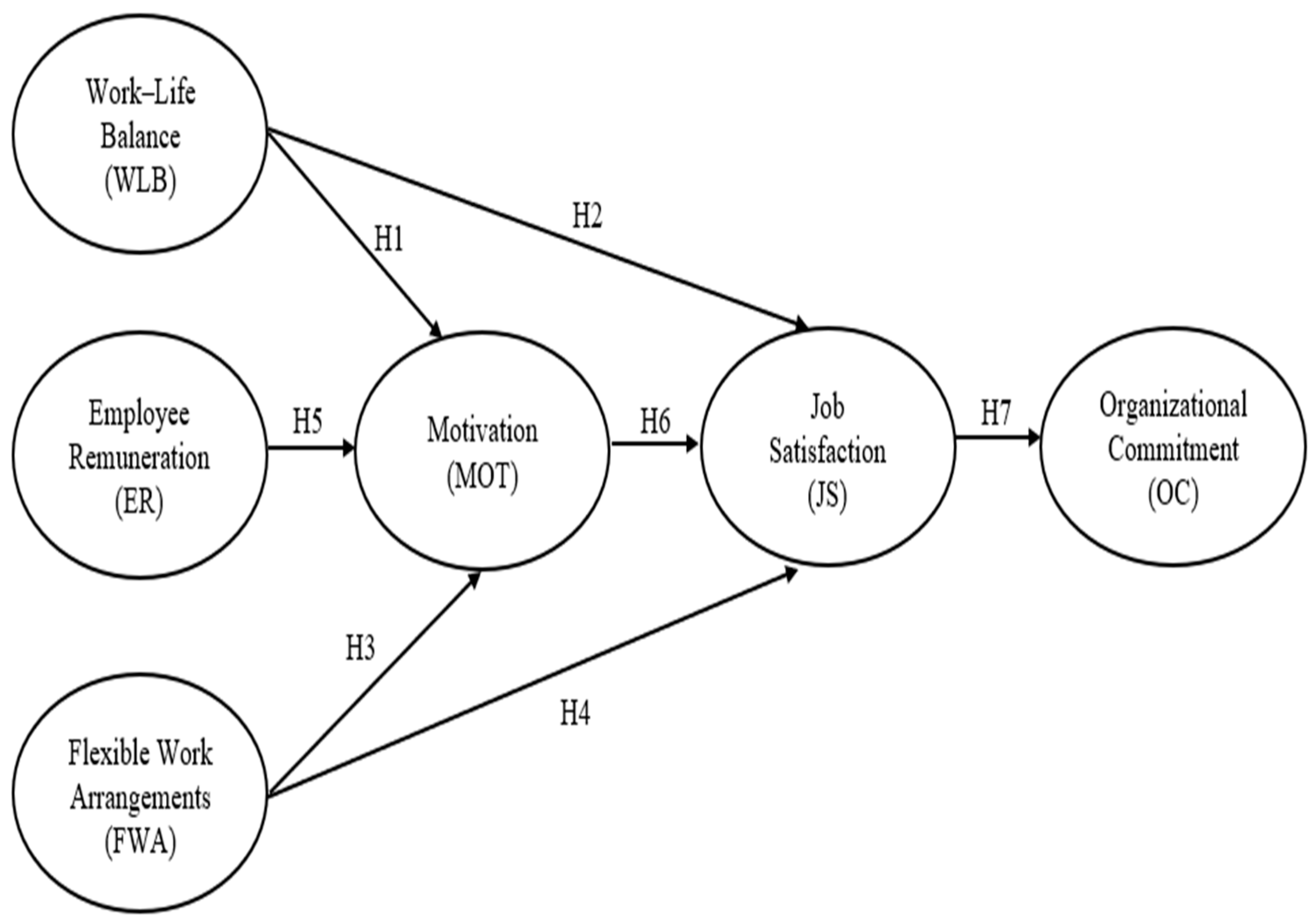
The logic of the model is summarized in
Figure 1 as follows: work–life balance, flexible work arrangements, and employee remuneration influence motivation, which influences job satisfaction, which then influences organizational commitment. This framework captures the theoretical position that employee commitment is not a direct reaction to conditions, but the result of a sequence of activation and evaluation.
2.1. Direct Hypotheses
Direct hypotheses are specified for the structural paths in the proposed structural equation model and have already been theoretically substantiated in the Theoretical Framework section.
2.2. Indirect Hypotheses
First-stage mediation to job satisfaction
Based on the theoretical position that motivation functions as a first-stage mechanism, the following indirect effect hypotheses on job satisfaction are formulated:
Hypothesis 8. Employee remuneration has a positive indirect effect on job satisfaction via employee motivation.
Hypothesis 9. Flexible work arrangements have a positive indirect effect on job satisfaction via employee motivation.
Hypothesis 10. Work–life balance has a positive indirect effect on job satisfaction via employee motivation.
According to the conceptual model, the effects of work–life balance, employee remuneration, and flexible work arrangements on job satisfaction are expected to be transmitted indirectly via employee motivation.
Process Chain to Organizational Commitment
To capture the process chain from job characteristics to organizational commitment, the following indirect effect hypotheses are formulated:
Hypothesis 11. Employee motivation has a positive indirect effect on organizational commitment via job satisfaction.
Hypothesis 12. Employee remuneration has a positive indirect effect on organizational commitment via employee motivation and job satisfaction.
Hypothesis 13. Flexible work arrangements have a positive total indirect effect on organizational commitment via job satisfaction, including the serial pathway via employee motivation.
Hypothesis 14. Work–life balance has a positive total indirect effect on organizational commitment via job satisfaction, including the serial pathway via employee motivation.
Consistent with the conceptual model, the effects of work–life balance, employee remuneration, and flexible work arrangements on organizational commitment are expected to be transmitted indirectly through job satisfaction, with employee motivation contributing as an upstream mechanism.
3. Materials and Methods
The purpose of this study was to investigate how job-related factors influence organizational commitment in small- and medium-sized enterprises (SMEs) in Cyprus. In doing this, the study adopted a quantitative research approach to examine the mediating role of motivation and job satisfaction as independent variables and organizational commitment as the dependent variable. For this research, the Structural Equation Modelling (SEM) is used to investigate the aforementioned relationships in SMEs in Cyprus. SEM is a technique that allows separate relationships for each of a set of dependent variables and provides a series of separate multiple regression equations estimated simultaneously (
Hair et al., 2014).
Data were collected from employees working in SMEs operating in the service sector in Cyprus between May and July 2025 using an online questionnaire. In line with the
European Commission (
2003) definition, SMEs are enterprises employing fewer than 250 persons. The European Commission classification distinguishes micro enterprises with fewer than 10 employees, small enterprises with 10–49 employees, and medium-sized enterprises with 50–249 employees. As no respondents were drawn from micro enterprises, firm size in the present study was reported only for small and medium-sized enterprises. Before data collection, ethical approval was obtained from the National Bioethics Committee of Cyprus. Organizations were identified through the public registry available on the open data portal and were approached via email communication through their human resources representatives to request participation in the study. Firms that agreed to participate circulated the survey link internally to their employees. Participation was voluntary and anonymous, and informed consent was obtained prior to questionnaire completion. Because participating organizations circulated the survey link internally, the exact number of employees who received the invitation could not be verified. Therefore, the employee-level response rate could not be calculated reliably. A pilot study with 51 employees was conducted to assess item clarity, completion flow, and face validity. After the pilot stage, minor wording refinements were made before launching the main data collection. After data screening, 11 responses were excluded because they were incomplete, resulting in 462 usable responses. Based on the recommendations of
Wolf et al. (
2013), this sample size was considered adequate for the conditions of the proposed model.
The instrument was designed to capture employees’ perceptions of key job attributes and work attitudes within SMEs. The Work–Life Balance construct captured employees’ positive evaluation of the balance between work and personal life, including its perceived contribution to productivity, well-being, burnout prevention, and organizational support for maintaining that balance. The Flexible Work Arrangements construct captured employees’ perceived control over their work schedules and the perceived benefits of schedule flexibility for rest, managing personal responsibilities, productivity, job satisfaction, and well-being. The Employee Remuneration construct captured employees’ perceptions of the fairness and adequacy of compensation, including satisfaction with salary and benefits, the reward system, equity across employees, and transparency in pay determination. The Motivation construct captured performance-oriented work motivation, combining reward-driven effort with motivation derived from job challenge and personal accomplishment. The Job Satisfaction construct captured employees’ satisfaction with organizational support, development opportunities, skill development, and the wider work environment, including challenge, support, and collaboration. Finally, the Organizational Commitment construct captured employees’ attachment to the organization, combining emotional connection with perceived support, recognition, and intention to remain with the organization. All constructs were measured using multi-item statements rated on a five-point Likert scale, ranging from 1 for strongly disagree to 5 for strongly agree. Reverse-coded items were recoded prior to analysis to ensure a consistent scoring direction across all measures. Given that the study used a cross-sectional design and self-reported measures, common method bias was assessed using Harman’s single-factor test.
Structural equation modelling was conducted using AMOS version 30 software to examine how work–life balance, flexible work arrangements, and employee remuneration relate to work motivation, job satisfaction and organizational commitment. Work motivation and job satisfaction were tested as mediators, first and second-stage mediators, respectively. The analysis followed the standard two-step procedure: (a) a full confirmatory factor analysis (CFA) measurement model including all constructs was estimated and (b) the structural model was estimated to test hypothesized direct and mediated effects. Model parameters were estimated using maximum likelihood, and mediation effects were evaluated using bootstrapped confidence intervals (5000 resamples). Historically, researchers often assessed mediation using the four causal-steps approach proposed by
Baron and Kenny (
1986). In more recent years, however, methodological work has pointed out several limitations of this procedure, and now the recommendations are focusing on the significance of the indirect effect, usually tested with bootstrapped confidence intervals (
Hayes, 2009;
Preacher & Hayes, 2008;
Zhao et al., 2010). In the present study, mediation was therefore assessed through the bootstrapped indirect effects and their bias-corrected confidence intervals. As an additional diagnostic check, multicollinearity among the predictors in the structural model was assessed using variance inflation factor values. VIF was examined separately for the equations predicting motivation, job satisfaction, and organizational commitment. Values below the recommended threshold indicated that collinearity was not a concern.
The full CFA supported the adequacy of the specified factor structure. Following
Hair et al. (
2014), items were evaluated against the conventional factor-loading threshold of at least 0.50, and items that did not meet this criterion were removed while preserving the conceptual coverage of the construct. Convergent validity was assessed using average variance extracted (AVE), and reliability was evaluated using Cronbach’s alpha and composite reliability (CR). Discriminant validity was assessed using both the Fornell–Larcker criterion and heterotrait–monotrait ratios (HTMT). All ratios were below 0.85, satisfying the more conservative HTMT criterion discussed by
Henseler et al. (
2015). As an additional diagnostic check, inter-construct correlations were inspected and remained below 0.85.
Model fit was assessed using multiple indices because no single statistic is sufficient to determine model adequacy (
Hu & Bentler, 1999;
Kline, 2016). Therefore, model fit was examined using absolute, incremental, and parsimonious fit indices, including the root mean square error of approximation (RMSEA), the comparative fit index (CFI), the Tucker–Lewis index (TLI), the incremental fit index (IFI), and the chi-square divided by degrees of freedom (χ
2/df). Because the chi-square statistic is sensitive to sample size, χ
2/df was interpreted alongside the other fit indices. Consistent with current methodological recommendations, the goodness-of-fit index (GFI) and the adjusted goodness-of-fit index (AGFI) were not used due to their instability in complex models and their dependence on sample size. Modification indices (MI) were inspected as diagnostics for localized misfit. Where necessary, residual covariances were added only when theoretically justifiable, in cases (for example, shared wording or content overlap) without altering the substantive structure of the model.
4. Results
The sample comprised 462 employees working in SMEs in Cyprus. The gender distribution was 54.5% male (
n = 252) and 45.5% female (
n = 210). The largest age group was 25–34 years (30.1%), followed by 35–44 years (25.5%) and 45–54 years (19.9%). In terms of work experience, 40.5% of participants reported 10+ years of experience. Regarding firm size, 58.0% worked in organizations with 10–49 employees, while 42.0% were employed in firms with 50–249 employees. All sample characteristics are summarized in
Table 1.
Descriptive statistics including means, standard deviations and correlations, are displayed in
Table 2. All mean values were located within a relatively narrow range, from 2.87 to 3.48, suggesting that the study variables did not show extreme differences in average respondent evaluations. Motivation stood out as the highest-rated construct and showed the smallest dispersion in responses (M = 3.48, SD = 0.93). This indicates that employees reported a comparatively stronger willingness to invest effort in their work and indicates the smallest dispersion in responses. By contrast, employee remuneration was the only variable with a noticeably lower mean (M = 2.87, SD = 1.01) than the rest, pointing out that remuneration was perceived less favorably compared to the other variables. All the variables displayed similar levels of variability, suggesting that no construct exhibited unusually high dispersion in responses. Since the mean pattern provides descriptive context for the structural analysis and does not by itself indicate directional effects or explanatory relationships among the variables, we also examined whether the key variables are associated with one another in the expected theoretical direction before moving to more advanced analyses.
Pearson correlations indicate that work–life balance is positively related to flexible work arrangements (r = 0.310, p < 0.01), employee remuneration (r = 0.588, p < 0.01), motivation (r = 0.492, p < 0.01), job satisfaction (r = 0.487, p < 0.01), and organizational commitment (r = 0.396, p < 0.01). In addition, flexible work arrangements variable is positively associated with employee remuneration (r = 0.210, p < 0.01), motivation (r = 0.258, p < 0.01), and job satisfaction (r = 0.285, p < 0.01), although its association with organizational commitment is weaker (r = 0.092, p < 0.05). Employee remuneration is positively related to motivation (r = 0.536, p < 0.01), job satisfaction (r = 0.449, p < 0.01), and organizational commitment (r = 0.393, p < 0.01). Finally, the attitudinal variables, job satisfaction and organizational commitment, are strongly interrelated. Motivation is positively associated with job satisfaction (r = 0.447, p < 0.01) and organizational commitment (r = 0.425, p < 0.01), and job satisfaction shows a strong positive association with organizational commitment (r = 0.666, p < 0.01).
Because the study relied on self-reported data, common method bias was assessed using Harman’s single-factor test (
Podsakoff et al., 2012). The results showed that a single factor accounted for 38.889% of the total variance, suggesting that common method bias was not a serious concern in this study.
Before estimating the structural model, multicollinearity was examined among the predictors. Tolerance values were above 0.20, ranging from 0.667 to 1.000, while variance inflation factor values were below 5, ranging from 1.000 to 1.499. These results indicated that multicollinearity was not a concern.
The final measurement model demonstrated acceptable fit to the data, χ2(453) = 1256.966, χ2/df = 2.775, CFI = 0.942, TLI = 0.936, IFI = 0.942, NFI = 0.912, RFI = 0.904, and RMSEA = 0.062 (90% CI [0.058, 0.066]). Although the chi-square test was significant (as expected with N = 462), the incremental and absolute fit indices indicated an overall acceptable model fit.
Standardized factor loadings, internal consistency (α, CR), and convergent validity (AVE) for the retained indicators are reported in
Table 3. Following the guidelines established by
Hair et al. (
2014), items are deemed reliable when their factor loadings exceed the threshold of 0.50 or higher were considered acceptable. All retained indicators showed acceptable standardized loadings, ranging from 0.627 to 0.981. The lowest loadings were observed for ER7 (0.627), MOT7 (0.635), WLB1 (0.662), and WLB6 (0.687), but all remained above the minimum acceptable threshold. The highest loadings were found for FWA6 (0.981) and FWA7 (0.979), indicating very strong relationships with the flexible work arrangements construct.
Regarding convergent validity, which evaluates the degree to which the indicators of the latent construct correlate with each other, results revealed that the AVE for all the latent constructs of the study is above 0.50, ranging from 0.577 to 0.84, indicating that a substantial portion of the variance in the indicators is explained by the underlying constructs. The Composite reliability of study variables is above 0.70, which, according to
Fornell and Larcker (
1981), indicates an acceptable level of internal consistency and reliability. In our study, composite reliability values ranged from 0.857 to 0.964, further confirming the reliability of the measurement model. Cronbach’s alpha values ranged from 0.857 to 0.967, showing satisfactory to very strong internal consistency across all constructs.
In addition, the average variance extracted, composite reliability and Cronbach’s alpha the model attains discriminant validity by applying the Heterotrait-Monotrait (HTMT) approach (
Henseler et al., 2015). All HTMT values were below the conservative threshold of 0.85, supporting discriminant validity across constructs (
Table 4). The highest HTMT value was observed between job satisfaction and organizational commitment (HTMT = 0.710).
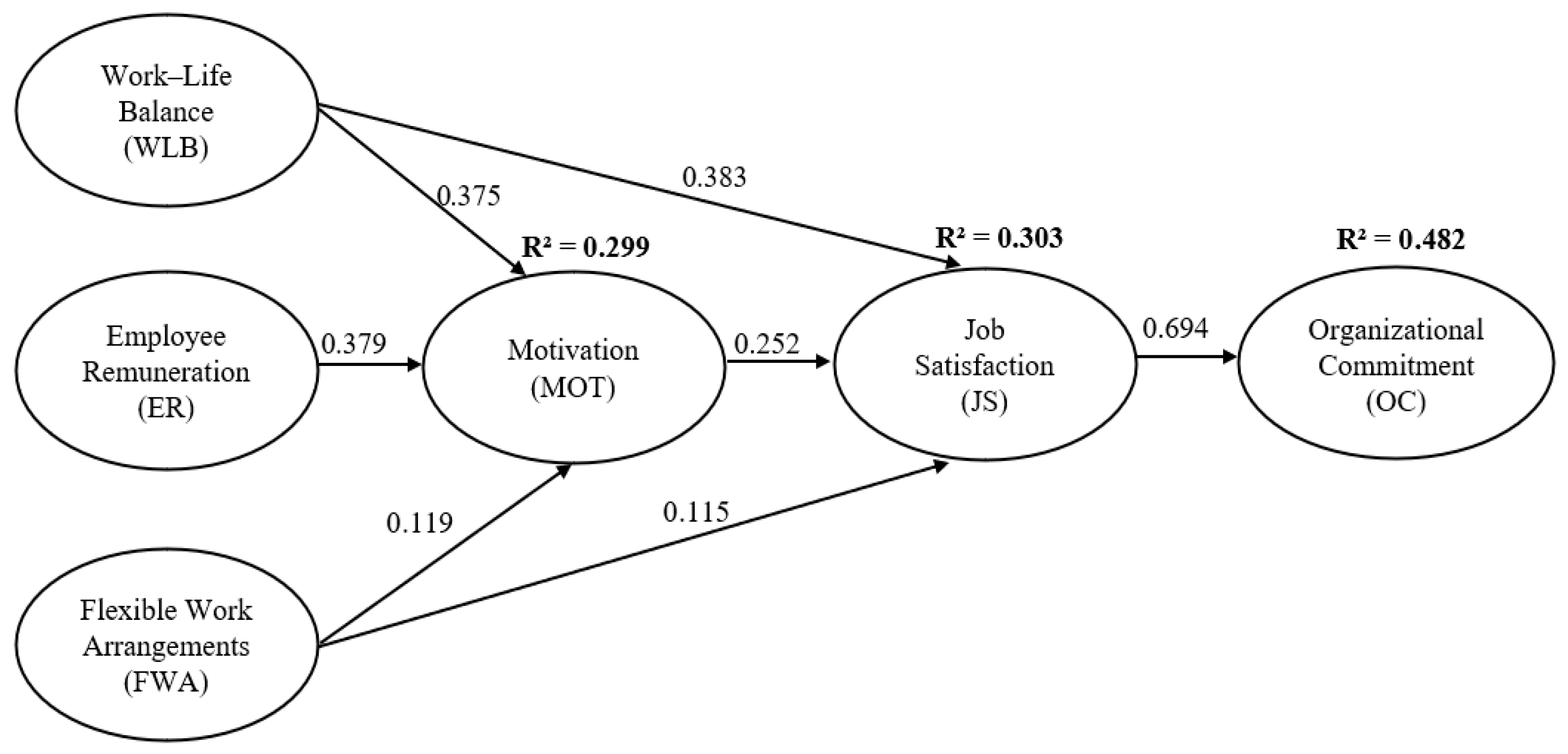
The structural model was assessed to test the study hypotheses. As presented in
Figure 2 and
Table 5, all direct paths were positive and statistically significant. Work–life balance had significant positive effects on both motivation (β = 0.375;
p < 0.001) and job satisfaction (β = 0.383;
p < 0.001). Flexible work arrangements also showed significant positive effects on motivation (β = 0.119;
p = 0.007) and job satisfaction (β = 0.115;
p = 0.006), although these effects were weaker. Employee remuneration had a significant positive effect on motivation (β = 0.379;
p < 0.001). Motivation, in turn, positively affected job satisfaction (β = 0.252;
p < 0.001), while job satisfaction showed a strong positive effect on organizational commitment (β = 0.694;
p < 0.001). All hypothesized direct effects were supported. The model explained 29.9% of the variance in motivation, 30.3% of the variance in job satisfaction, and 48.2% of the variance in organizational commitment.
The mediation analysis examined whether motivation and job satisfaction mediated the effects of the study variables on later attitudinal outcomes. As shown in
Table 6, all hypothesized indirect effects were statistically significant, indicating that the mediating mechanisms included in the model played an important role in transmitting the effects of work-related conditions to job satisfaction and organizational commitment. More specifically, employee remuneration showed a significant indirect effect on job satisfaction through motivation (Hypothesis 8: β = 0.096; 95% BC CI [0.046, 0.163]). Flexible work arrangements also had a significant indirect effect on job satisfaction via motivation (Hypothesis 9: β = 0.030; 95% BC CI [0.008, 0.065]), while work–life balance showed a similarly significant indirect effect on job satisfaction through motivation (Hypothesis 10: β = 0.095; 95% BC CI [0.049, 0.158]). Because the direct effects of work–life balance on job satisfaction (WLB → JS) and flexible work arrangements on job satisfaction (FWA → JS) remained significant in the structural model, these findings indicate partial mediation for both relationships. By contrast, the effect of employee remuneration on job satisfaction operated through motivation, indicating indirect mediation only.
Organizational commitment showed a similar pattern. Motivation had a significant indirect effect on organizational commitment through job satisfaction (Hypothesis 11: β = 0.175; 95% BC CI [0.092, 0.263]). In addition to this, hypothesis 12 was also supported (β = 0.066; 95% BC CI [0.031, 0.116]). Employee remuneration showed a significant specific sequential indirect effect on organizational commitment through motivation and job satisfaction. The findings further showed that flexible work arrangements had a significant total indirect effect on organizational commitment (Hypothesis 13: β = 0.100; 95% BC CI [0.037, 0.169]). In addition to this, hypothesis 14 (β = 0.331; 95% BC CI [0.249, 0.419]) was also supported as work–life balance demonstrated the strongest total indirect effect on organizational commitment in the model. None of the bootstrap confidence intervals included zero; therefore, all indirect effects were supported. The study findings suggest that motivation functions as an important first-stage mechanism, whereas job satisfaction serves as the more proximal pathway through which earlier work conditions are translated into organizational commitment.
Taken together, the structural model demonstrated satisfactory explanatory power, with the estimated paths and indirect effects supporting the hypothesized relationships among the study variables.
6. Conclusions
This study examined whether work–life balance, flexible work arrangements, and employee remuneration relate to organizational commitment through motivation and job satisfaction in SMEs in Cyprus. The findings showed that work–life balance and employee remuneration were stronger predictors of motivation than flexible work arrangements, while job satisfaction emerged as the strongest direct predictor of organizational commitment. Overall, the results suggest that organizational commitment is shaped less by isolated job conditions than by the process through which these conditions are translated into employee motivation and, especially, job satisfaction. The practical, theoretical, and methodological implications of these findings are presented in the following subsections.
6.1. Practical Implications
The research findings offer several managerial contributions. The findings point to a clearer managerial hierarchy to achieve organizational commitment than is often assumed by SMEs. It is evident from the results that job satisfaction was the strongest direct predictor of organizational commitment. Therefore, if the aim is to improve organizational commitment, the most useful practical starting point is to create conditions that foster job satisfaction. In practical terms, this means that managers should focus less on isolated HR practices and more on the everyday work conditions through which employees form an overall judgement about their jobs.
First, a key priority for SME managers is to develop strategies that prioritize work–life balance. Balance should not be approached as a symbolic well-being practice. It should be approached as a work design issue. Work–life balance depends on whether workloads are realistic, deadlines are manageable, and recovery time is protected. Where work regularly spills into personal time, commitment is unlikely to strengthen in a stable way, even if employees remain formally present and productive, for a limited period of time, before the negative effects become visible. For this reason, SMEs should begin by examining how daily operations are actually organized. Frequent or recurring overtime should not be seen as something normal by SMEs, but as a sign that something is not functioning properly in the way work is organized. Managers should therefore monitor overtime systematically to identify whether it is becoming a regular pattern rather than an occasional necessity. This can be achieved through better planning, more realistic workloads, and more effective task distribution. They also should clarify employees’ job roles and responsibilities, the day-to-day allocation of tasks, in order to avoid ambiguity, duplication of effort, and uneven workload pressure. In the same vein, managers should also ensure that tasks are distributed fairly across teams, so that workload is not placed disproportionately on the same employees. Deadlines should be realistic, as excessive time pressure often leads to overtime and strain. A further way to support work–life balance is to set clearer boundaries around availability so that employees do not feel expected to remain constantly accessible. Informal expectations of constant responsiveness outside working hours should therefore be avoided, including expectations of immediate responses to calls or emails. In this way, the personal time is protected and the intrusion of work into non-work life is reduced.
The second priority should be employee remuneration. The findings do not suggest that SMEs simply need to pay more. The findings suggest that the issue is not simply higher pay, but the broader way remuneration is experienced and evaluated by employees. Remuneration must be experienced as fair, understandable, and consistent. In SMEs settings, where formal systems are often limited, employees are likely to judge pay not only by amount but also by whether decisions appear justified and comparable across similar roles. For that reason, highly complex reward systems may be less useful than simple and transparent ones. Clear criteria for pay decisions, explainable bonus rules, and visible alignment between responsibility and reward are likely to support motivation more effectively than discretionary arrangements that employees cannot easily interpret. SMEs should establish clear criteria for pay decisions so that employees understand the basis on which remuneration is determined. Furthermore, in order to reduce uncertainty and perceptions of arbitrariness, bonus rules and additional reward arrangements should be explained more transparently. In this way, pay decisions should not depend on personal judgement, informal discretion, or unclear manager choice without transparent criteria. Alignment between responsibility and reward should also be considered as employees can recognize that greater contribution or role demands are meaningfully rewarded. Moreover, more attention should be given to transparency in remuneration by clearly communicating the pay process and decision criteria to employees. Work motivation could also be improved it the reward practices are consistent and easy to justify.
By contrast, flexible work arrangements should be treated with more caution than enthusiasm. The results suggest that employees may view flexible work arrangements as a positive but comparatively weaker job-related condition. This does not imply that flexibility in workplaces is not an important practice. Instead, based on our results, flexibility practices appear to be a weaker primary managerial lever. This is a critical distinction. In today’s organizations, flexibility is often presented as an easy modern solution, yet in practice it can fail when it increases ambiguity instead of control. If employees are allowed to work flexibly but remain uncertain about availability expectations, response times, or performance evaluation, flexibility may simply relocate pressure rather than reduce it. For this reason, SMEs should avoid treating flexibility as a substitute for workload management and fair managerial guidance. Instead, flexible work arrangement practices should be designed with clear expectations around availability, coordination, and performance evaluation. SMEs may benefit from assessing whether flexibility supports employees’ perceived productivity in practice, as this may also help strengthen work motivation and job satisfaction. A more effective approach may be to tailor flexibility to the needs of different roles instead of applying the same arrangement across all employees. This is more likely to help when basic conditions are sound, and employees feel protected from constant availability pressure.
Another important implication is that job satisfaction is also shaped by the wider work environment and the broader workplace conditions that shape how satisfied employees feel with their jobs. In this study, job satisfaction was closely tied to support and development-related experiences. This suggests that satisfaction should not be treated narrowly as a reaction to the financial compensation or workload alone. Instead, it also reflects broader aspects of work experience such as organizational support, recognition, and development opportunities. Even in smaller firms where career growth is less structured in a way that development opportunities may exist, but not through standardized procedures, employees are more likely to evaluate their jobs positively when they work under supportive and recognition-based conditions. If managers provide more consistent and constructive feedback based on employees’ performance, while acknowledging their contribution and effort, this may help employees evaluate their jobs more positively.
Another way to improve employee satisfaction among staff is for managers to offer more transparency around developmental pathways within the organization. Informal promotion pathways exist within organizational structures when staff demonstrate leadership capacity through skill development, the assumption of additional responsibilities, or the enrichment of their work roles. Managers can offer guidance on how employees can grow within their current roles, even if formal promotion paths are limited, by showing them how skill development, increased responsibility, or role enrichment can form part of their progress. We encourage supervisors and team leaders to acknowledge contributions more consistently by making recognition a more regular part of everyday management and not just an occasional reaction. In doing so, they can communicate their appreciation and respect for employees’ contributions by providing positive feedback frequently, recognizing effort openly, and showing that employees’ effort is noticed and valued. Creating a supportive environment for organizational teams is another important practice. A supportive team environment allows employees to receive both practical help and interpersonal support through collaboration, open communication, and mutual responsiveness in daily work. From our perspective and based on our results, what matters is not the sophistication of the system but whether employees can see that their work is supported, valued, and capable of progressing.
When considered together, the practical message is that service SMEs should not expect organizational commitment to grow from isolated policies or symbolic initiatives. Commitment appears more likely to strengthen when employees experience work as manageable, acknowledging their personal needs, remuneration as credible, and flexibility as genuinely supportive rather than administratively convenient. In that sense, the most realistic route to stronger organizational commitment is to manage the conditions under which job satisfaction can credibly grow. These implications are especially relevant for service SMEs, where limited resources (such as limited budgets, smaller teams, and less formal HR infrastructure) make it more important to focus on a smaller number of clear and well-aligned HR priorities and to avoid broad initiatives that are implemented weakly.
6.2. Theoretical Implications
The findings of this study provide several significant theoretical contributions to the field of human resource management, particularly in understanding the factors that guide organizational commitment in SMEs. By moving beyond the direct-effects approach that still characterizes much of the literature on employee attitudes, we did not conceptualize work–life balance, flexible work arrangements, and employee remuneration as isolated predictors of organizational commitment. Accordingly, the findings supported a more structured process in which these work-related conditions shaped motivation, then job satisfaction, and only then contributed to organizational commitment. In line with this, the study extended recent work that has called for the examination of additional mediating and moderating mechanisms beyond job satisfaction alone (
Aras et al., 2025). This interpretation was also broadly consistent with the JD–R framework, which suggests that resource-related job conditions influence later outcomes through motivational processes (
Demerouti et al., 2001;
Bakker & Demerouti, 2007,
2017). More specifically, the present study supported a sequence in which motivation reflected activation and willingness to invest effort, job satisfaction reflected a broader evaluative judgement of the work experience, in line with
Locke’s (
1976) view of satisfaction.
The study also contributes by showing that not all job-related conditions operate with the same strength. Work–life balance and employee remuneration showed stronger links with motivation than flexible work arrangements. In our view, this suggests that resource-related conditions should not automatically be treated as interchangeable in theory development. Although all three were positioned as positive work-related conditions, they did not carry the same explanatory force. Specific conditions that support employees’ work–life balance and shape their remuneration perceptions showed stronger motivational effects and appeared to operate as more consistent and more clearly experienced forms of support. This is broadly consistent with the JD–R framework, while also suggesting that flexibility-related conditions may depend on the broader organizational environment. This is a caution against treating flexible work arrangements as a universally positive resource in explanatory models. In the present study, flexibility mattered, but its role was weaker and therefore more conditional than that of work–life balance and employee remuneration.
The study’s findings suggest that job-related conditions in SMEs may not carry the same implications and value across organizational settings. In this way, the study responds to the call by
Aras et al. (
2025) for evidence from less frequently examined national contexts. This is theoretically important because it suggests that the effects of resource-related practices may not operate in the same way across organizational settings. In SMEs, their influence appears to depend less on whether such practices formally exist or co-exist and more on how employees experience them in everyday work. In other words, the findings suggest that, in smaller and more informal work settings, the explanatory value of job-related conditions lies less in their formal availability alone and more in how employees interpret them in everyday work.
6.3. Limitations and Future Research
This study, while providing valuable insights into workplace conditions and employee attitudes, is not without limitations. These limitations, in turn, suggest several avenues for further research.
First, this study is based on cross-sectional self-report data from employees working in SMEs in Cyprus, which only provides a snapshot of the relationships at a single point in time, which may restrict the generalizability of the findings. Future research should examine this process over time using longitudinal designs and compare alternative temporal orderings among the key constructs. Also, collecting all constructs from the same source may also have inflated associations among closely related attitudes, particularly within the motivation–job satisfaction–organizational commitment segment. In addition, the sample spans multiple service industries, and the strength of the relationships may vary across sectors and according to how consistently practices are implemented within firms. Moreover, multi-group analyses across sectors and firm-size bands could clarify whether the same process holds under different SME conditions.
A further limitation is that flexible work arrangements were captured as perceived experience and did not differentiate between formal and informal flexibility, which may partly explain why flexible work arrangements showed weaker links to more distal attitudes such as organizational commitment. It would also be useful to model flexible work arrangements more precisely by distinguishing schedule autonomy from location flexibility, or formal from informal flexibility, and by testing boundary-related conditions, such as boundary control or availability expectations, as moderators of the relationship between flexible work arrangements and motivation.