Article

Bridging the Strategy–Execution Gap in Digital Process Transformation: An Organizational Development Process Model from a Chinese Brewery Case


by
Yunlu Cai
and
Siti Rohaida Mohamed Zainal
*
School of Management, Universiti Sains Malaysia, Gelugor 11800, Penang, Malaysia
*
Author to whom correspondence should be addressed.
Adm. Sci. 2026, 16(4), 184; https://doi.org/10.3390/admsci16040184
Submission received: 13 March 2026 / Revised: 5 April 2026 / Accepted: 8 April 2026 / Published: 10 April 2026

Abstract

This study explains how strategy–execution gaps become self-reinforcing during digital process transformation in layered manufacturing organizations. Drawing on an embedded qualitative process study of a large Chinese brewery’s transformation (2020–2024), we triangulate 10 semi-structured interviews across hierarchical levels with longitudinal public disclosures to reconstruct the initiative timeline and trace mechanisms across change phases. The analysis shows that platform-based process governance can scale faster than shared meaning and dialog, producing frontline sensemaking gaps and formalistic, top-down communication. These conditions thin employee voice and weaken feedback closure, which in turn erodes the legitimacy of organizational diagnosis and fragments implementation support. As interface problems are handled through local workarounds, management intensifies visibility-based monitoring, further suppressing voice and reinforcing the execution gap. We develop an organizational development process model that centers feedback closure and diagnosis legitimacy as bridging mechanisms linking soft change dynamics (meaning, trust, voice) with hard digital governance (process standards, data infrastructures, monitoring). The model offers actionable implications for leaders to build closure and legitimate diagnosis as operational capabilities throughout transformation.

1. Introduction

Digital process transformation has become a strategic imperative for manufacturing firms confronting premiumization, channel fragmentation, and rising compliance expectations. Yet digital transformation is not simply the rollout of new systems. It reshapes process governance by standardizing workflows, unifying data definitions, redistributing decision rights, and increasing visibility through platforms, dashboards, and traceable records (Wessel et al., 2021; Verhoef et al., 2021; Vial, 2019). In layered and geographically distributed organizations, these shifts can strengthen coordination and control while also increasing the risk of cross-level misalignment when governance infrastructures scale faster than shared understanding and local problem solving (Maitlis & Christianson, 2014; Okhuysen & Bechky, 2009; Volberda et al., 2021).
This tension is especially salient in mature brewing and other consumer-goods sectors, where slower volume growth, premiumization pressures, channel proliferation, and stronger governance demands raise the need for faster and more integrated production-to-market coordination (Focal firm, 2024, 2025; National Bureau of Statistics of China, 2024). Research on European brewing contexts likewise shows that competitiveness increasingly depends on product differentiation, innovation, and more adaptive operating models in mature and fragmented beer markets (Duduć et al., 2020). More broadly, work on competitiveness and strategic resilience in Europe suggests that industrial sectors are increasingly shaped by intertwined efficiency, governance, and resilience pressures, which reinforces our theoretical positioning of digital transformation as a process-governance challenge in which coordination, visibility, and adaptive response capabilities become central to bridging strategy and execution (Ivančík & Dušek, 2026). Our focal setting is a large Chinese brewery (“BrewCo,” anonymized) whose public disclosures describe a transformation agenda combining premiumization and multi-channel redesign with digital initiatives in order fulfillment, procurement governance, logistics informatization, and group-level data integration (Focal firm, 2024, 2025). Yet interviews across hierarchical levels reveal a recurring puzzle: employees often know that change is happening without clearly understanding why particular changes are being prioritized; communication is frequent but experienced as largely top-down; and feedback is not consistently closed, weakening willingness to surface interface-level problems.
Prior research provides important foundations but leaves an important mechanism gap. Research on digital transformation shows that meaningful transformation requires process redesign and organizational reconfiguration rather than mere technology adoption (Wessel et al., 2021; Vial, 2019). Research on strategizing and execution in digital contexts shows that complex organizations struggle to translate strategic intent into coordinated routines, especially when new technologies require reconfigured routines, new narratives, and new organizational forms (Nielsen et al., 2024; Volberda et al., 2021). Research on sensemaking, employee voice, and psychological safety further indicates that employees are more likely to engage when change is intelligible, interaction is dialogic, and their input is perceived to matter (A. Edmondson, 1999; A. C. Edmondson & Bransby, 2023; Maitlis & Christianson, 2014; Morrison, 2023; Sherf et al., 2021). However, these streams are rarely integrated to explain how platform-enabled visibility, feedback practices, and diagnosis processes interact over time to produce a self-reinforcing strategy–execution gap.
Accordingly, this study addresses two research questions:
RQ1. 
How does a strategy–execution gap emerge and become self-reinforcing during digital process transformation in a layered, geographically distributed organization?
RQ2. 
How do feedback closure and diagnosis legitimacy shape that trajectory across phases of change?
To answer these questions, we conducted a single-case, embedded qualitative process study of BrewCo’s transformation over 2020–2024. We triangulated 10 semi-structured interviews across senior, middle, and frontline roles with longitudinal secondary materials—including annual reports, regulatory disclosures, and official communications—to reconstruct the initiative timeline and trace mechanisms across change phases. Consistent with qualitative process research, our aim is analytic generalization and mechanism tracing rather than statistical representativeness (Langley, 1999; Yin, 2018).
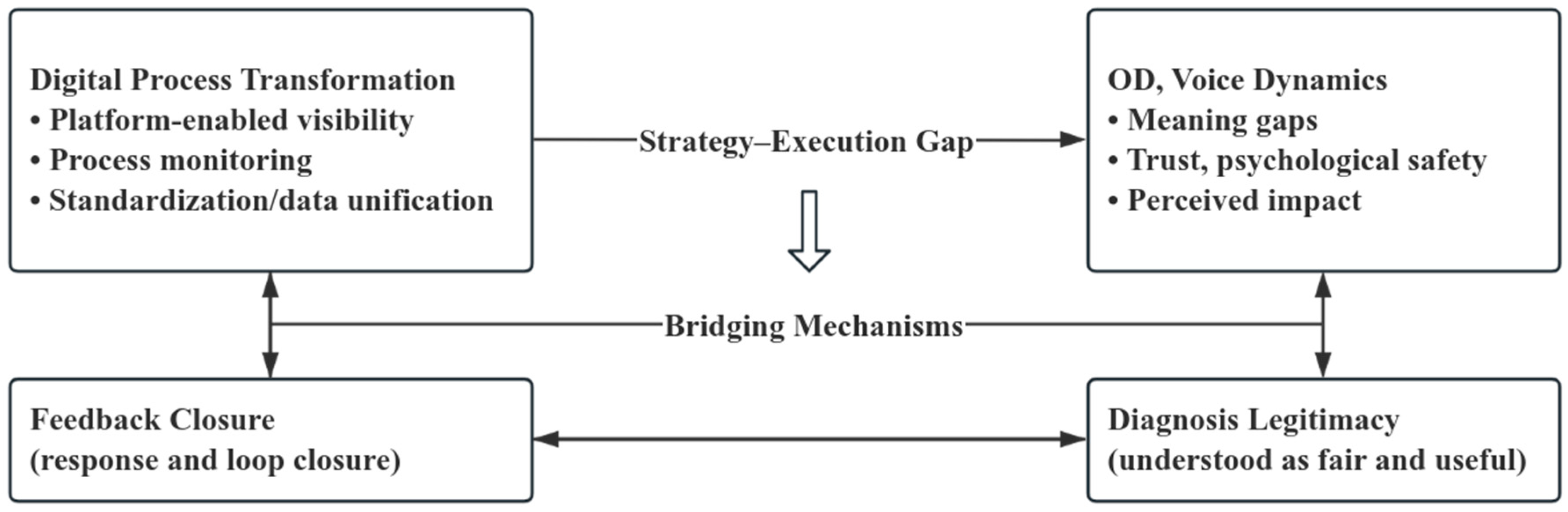
This study makes three contributions. First, it develops an organizational development process model explaining how strategy–execution gaps become self-reinforcing when coordination infrastructures scale faster than interpretive infrastructures. Second, it identifies feedback closure and diagnosis legitimacy as two bridging mechanisms that connect soft change dynamics—shared meaning, trust, psychological safety, and voice—with hard digital governance—process standards, data infrastructures, and monitoring. Third, it shows why monitoring can drift from enabling visibility to symbolic control when organizations fail to establish reliable closure and legitimate diagnosis, thereby offering actionable guidance for leaders seeking to build feedback closure and diagnosis legitimacy as operational capabilities throughout transformation. The remainder of the paper reviews the relevant literature, explains the research design and setting, presents the findings, and discusses theoretical and managerial implications.

2. Literature Review

2.1. Digital Process Transformation as Process Governance

Digital transformation is best understood as an organizational change process in which digital technologies become consequential because they are embedded in (and reshape) routines, structures, and decision rights—not because an IT system “goes live” (Wessel et al., 2021; Verhoef et al., 2021; Vial, 2019). This process lens implies that many projects framed as “digitalization” are, in fact, digital process transformations: interventions that redraw workflow boundaries (where one activity ends and another begins), make data definitions explicit, and restitch coordination mechanisms across units. Rather than digitizing existing steps, these initiatives reconfigure what counts as valid information, who has the right to decide on exceptions, and how work is synchronized across functions—often revealing previously hidden dependencies.
Seen this way, transformation is process governance rather than IT rollout. Governance redesign typically includes (a) boundary decisions (process ownership and permissible handoffs), (b) responsibility interfaces (decision rights, escalation rules, and who owns root-cause elimination), and (c) tempo (cadences for review, learning, and corrective action). Empirical work on IoT-enabled transformation shows that data capture can change work identities and practices, but only when leaders actively manage stakeholder perspectives and the observer–observed tension created by monitoring (Westergren et al., 2024). Complementarily, research on data governance in digital ecosystems theorizes governance as an adaptive control loop, emphasizing continuous adjustment rather than one-time design (Volz et al., 2025). This governance-centered view makes it natural to ask how strategic intent travels through redesigned interfaces, which motivates a process explanation of the strategy–execution gap.

2.2. Strategy–Execution Gap as a Process Problem

A process-governance lens reframes the strategy–execution gap from an “execution deficit” to a translation problem. Strategizing in digital contexts requires overcoming cognitive barriers, reconfiguring routines, and sometimes developing new organizational forms that can sustain new ways of working (Volberda et al., 2021). It also depends on ongoing narrative work that keeps direction intelligible amid delays and emergent concerns (Nielsen et al., 2024). As strategic intent travels across layers and functions, it can drift at process interfaces: local actors re-interpret priorities through their constraints, metrics, and professional logics. The resulting gap is therefore not simply low effort; it is often a process problem produced at handoffs where goals, data, and responsibilities are ambiguously defined.
Sensemaking research further clarifies why drift can persist: power shapes which interpretations become legitimate, which issues are voiced upward, and which issues remain invisible (Schildt et al., 2020). Employees experience digital transformation as multi-layered and dynamic, oscillating between aspirational narratives and everyday frictions in practice (van der Schaft et al., 2024). Measurement infrastructures (e.g., dashboards) can reduce drift by enabling interactive control and alignment, but they can also widen the gap when measures become surrogates for strategy and steer attention toward what is easy to count rather than what is strategically important (Reinking et al., 2020). This points to the need for reliable diagnosis of where and why drift occurs, which depends critically on employee voice and the closure of feedback loops.

2.3. Voice + Feedback Closure → Diagnosis Legitimacy

Employee voice—discretionary communication of concerns, suggestions, or dissent—is essential for diagnosing process breakdowns that are difficult to observe from senior vantage points (Morrison, 2023). Voice and silence are not simple opposites; they show distinct relationships with psychological safety and perceived impact (Sherf et al., 2021). In digital process transformations, voice often “thins” for three interlocking reasons. First, increased visibility can raise interpersonal risk: standardized data and traceability make issues attributable, which can heighten fear of blame. Second, psychological safety and trust become fragile during transformation because roles and evaluation criteria are shifting; when interpersonal risk is salient, people rationally limit upward communication (Dirks & de Jong, 2022; A. C. Edmondson & Bransby, 2023). Third, employees update their willingness to participate based on how transformation feels in practice—positive experiences and participation efficacy promote engagement, while repeated frustration and low perceived impact foster withdrawal (Abhari, 2025). Acceptance of transformation strategies also depends on whether employees can hold tensions such as standardization and flexibility (Klein et al., 2024).
These conditions make feedback closure pivotal. Closure is not “collecting feedback”; it is the organizational capability to acknowledge input, interpret it in a way reporters recognize, act on it (or explain why not), and communicate outcomes back to those who raised the issue. Closure matters because it converts voice into learning and because it protects voice by signaling that speaking up is worthwhile and safe. Consistent with this logic, perceived impact is a key mechanism linking speaking up to subsequent voice: when follow-through is absent, employees reduce their input or shift to safer and less diagnostic communication (Morrison, 2023; Sherf et al., 2021).
We therefore frame closure as the bridge from voice to diagnosis legitimacy. Diagnosis legitimacy refers to a shared belief that problem identification is traceable, explainable, and procedurally fair: the diagnosis can be audited (what evidence led to what conclusion), justified (why this interpretation is reasonable), and accepted (why responsibility allocations feel fair). Closure creates the visible trail that converts fragmented local observations into collectively credible diagnoses. Without closure, “listening” can become symbolic, eroding legitimacy and inviting defensive responses, including forms of resistance that endorse the change content while undermining its initiators (Bourgoin et al., 2025). This legitimacy mechanism helps explain why organizations may respond to weak diagnosis by intensifying monitoring rather than strengthening problem solving.

2.4. Visibility/Control and Symbolic Monitoring

Digital process transformation increases visibility: work becomes legible through trace logs, standardized data, and dashboards. Visibility is inherently double-edged. Visibility can improve coordination by creating shared situational awareness, accelerating exception handling, and supporting cross-unit learning. Yet research on algorithmic systems shows that visibility is also a contested terrain of control: data-driven technologies can redistribute autonomy and intensify evaluation through ranking, nudging, and automated escalation (Kellogg et al., 2020). When visibility is experienced primarily as surveillance, it can reduce psychological safety and shift attention from learning to defensiveness, directly undermining the voice and closure mechanisms needed for diagnosis.
This tension underlies symbolic monitoring—monitoring that signals managerial control without improving the underlying process. Dashboards can support strategy alignment, but they can also promote metric fixation and strategy surrogation when measures become the de facto objective (Reinking et al., 2020). Standardized systems may further trigger defensive sensemaking about surveillance and standardization, shaping employee responses to change (Weibel et al., 2025). In such conditions, actors manage appearances through selective reporting or local optimization, which makes diagnosis less traceable and fuels further monitoring. This “visibility → control → weaker voice/closure → legitimacy erosion” pattern directly supports the reinforcing dynamics embedded in our process model.

2.5. Summary

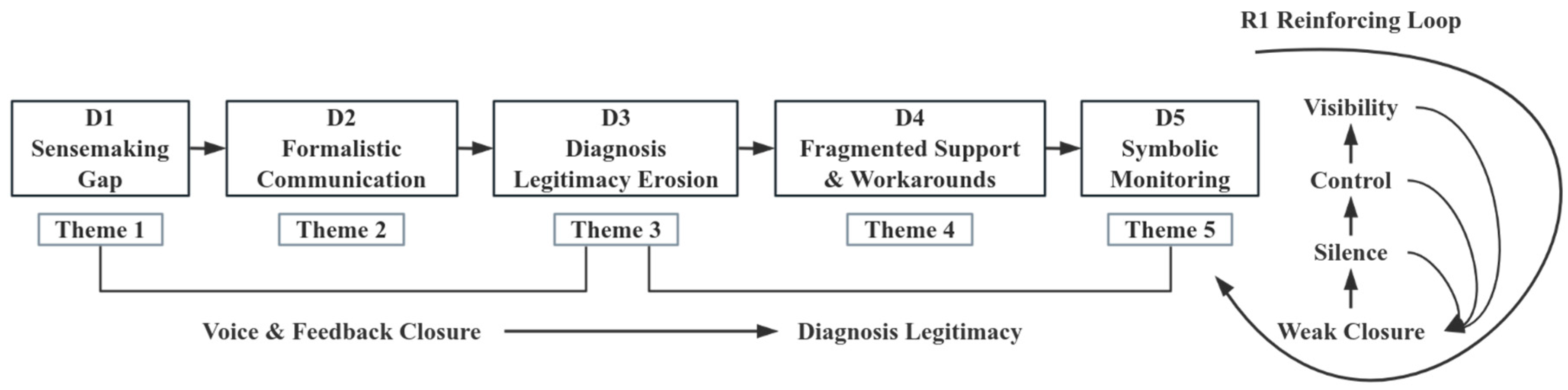
Overall, recent research supports treating digital transformation as process governance: redesigning boundaries, data definitions, accountability interfaces, and rhythms so that strategy can travel through workflows (Wessel et al., 2021; Vial, 2019). The strategy–execution gap then becomes an interface problem shaped by sensemaking and measurement (Reinking et al., 2020; Schildt et al., 2020). Voice and feedback closure provide the bridge from local insights to legitimate diagnosis, while visibility can slide into contested control and symbolic monitoring (Kellogg et al., 2020). These arguments motivate the integrated chain in Figure 1 and clarify why our analysis centers on closure and legitimacy as the key mechanisms linking digital process governance to organizational outcomes.

3. Methodology

3.1. Research Design: Single-Case, Embedded Qualitative Process Study

We adopted a single-case, embedded qualitative process design to explain how the strategy–execution gap emerges and becomes self-reinforcing during digital process transformation. Process research foregrounds temporality and mechanism by tracing event sequences, critical interfaces, and interaction patterns over time, thereby enabling theorizing about how change unfolds rather than only whether it “works” (Langley, 1999). We treated BrewCo as an information-rich change setting and traced its transformation trajectory over 2020–2024, focusing on cross-functional process interfaces and cross-level alignment dynamics. To strengthen within-case explanatory leverage, we used organizational level (headquarters, middle management, frontline) and key functional interfaces as embedded units for systematic comparison (Eisenhardt, 1989; Yin, 2018). Our aim is not statistical generalization but analytic generalization: developing a process explanation linking sensemaking gaps, trust/voice dynamics, feedback closure and diagnosis legitimacy, and institutionalization outcomes (Yin, 2018). Consistent with this qualitative process design, the study is organized around research questions and mechanism tracing rather than formal hypothesis testing.

3.2. Case Selection Rationale

Case selection followed a theory-driven, information-rich logic. We selected BrewCo because it pursued three interlocking transformation streams—market/strategy initiatives, end-to-end process digitalization, and governance/compliance agendas—and these streams visibly converged into a more systematized, platform-based push by 2024. This trajectory offers a clear empirical window for observing how strategic intent travels across levels, is enacted at interfaces, and does (or does not) close feedback loops over time (Focal firm, 2021, 2022, 2023, 2024, 2025; see Figure 2). BrewCo also exhibits a layered, geographically distributed, and functionally differentiated structure, a setting in which coordination frictions and alignment breakdowns are likely to surface during process transformation—supporting mechanism identification and process model development (Eisenhardt, 1989; Yin, 2018). To address commercial sensitivity and ethical access requirements, we anonymized firm, brand, and location identifiers while preserving theoretically relevant structural and process features (Yin, 2018). The research setting and case background are described below.

3.3. Research Setting and Case Background

3.3.1. Company Overview and Industry Context

To protect confidentiality, the focal firm is anonymized as “BrewCo,” and all product, program, and location identifiers are replaced with functionally equivalent labels. During 2020–2024, China’s beer industry increasingly resembled a mature market characterized by slowing volume growth and intensified competition for share, where profitability depended less on volume expansion and more on premiumization and structural differentiation (National Bureau of Statistics of China, 2024). At the same time, evolving consumer preferences and channel proliferation across on-premise, key accounts, nightlife, e-commerce, and community touchpoints increased the need for faster product iteration, sharper channel responsiveness, and tighter coordination across production-to-market processes (Focal firm, 2024, 2025).
BrewCo is a large brewery with a nationwide manufacturing and distribution footprint and an operating model spanning multiple sites and organizational layers. Public disclosures indicate notable profitability improvement and signs of structural upgrading during 2023–2024 (Focal firm, 2024, 2025). The firm’s transformation narrative centered on two intertwined pillars: (1) premiumization anchored by a flagship product and a multi-channel go-to-market redesign, and (2) digital process transformation across key value-chain processes, including order fulfillment, procurement governance, logistics informatization, and a group-level data platform, aimed at improving coordination efficiency and operational resilience (Focal firm, 2025). Cost pressure and compliance further strengthened the case for transformation: high exposure to input costs made procurement and energy governance consequential, while rising environmental disclosure and ESG requirements encouraged the embedding of governance considerations into the broader transformation agenda (Focal firm, 2025; Task Force on Climate-related Financial Disclosures [TCFD], 2017). Taken together, these features made BrewCo an information-rich setting for examining how digital process transformation unfolded under simultaneous market, governance, and coordination pressures. These pressures are not unique to the Chinese market. Research on European brewing contexts likewise shows that brewery competitiveness is increasingly shaped by product differentiation, innovation, market restructuring, and the search for more adaptive operating models, especially in mature and fragmented beer markets (Duduć et al., 2020). More broadly, recent work on competitiveness and strategic resilience in Europe suggests that industrial sectors are increasingly governed by intertwined efficiency, governance, and resilience pressures, which reinforces the relevance of coordination, visibility, and adaptive response capabilities in sectoral transformation (Ivančík & Dušek, 2026). While our mechanism model is not industry-specific, these studies help situate BrewCo’s transformation within a wider set of brewing- and competitiveness-related pressures.

3.3.2. Transformation Agenda and Key Initiatives Timeline (Secondary Data)

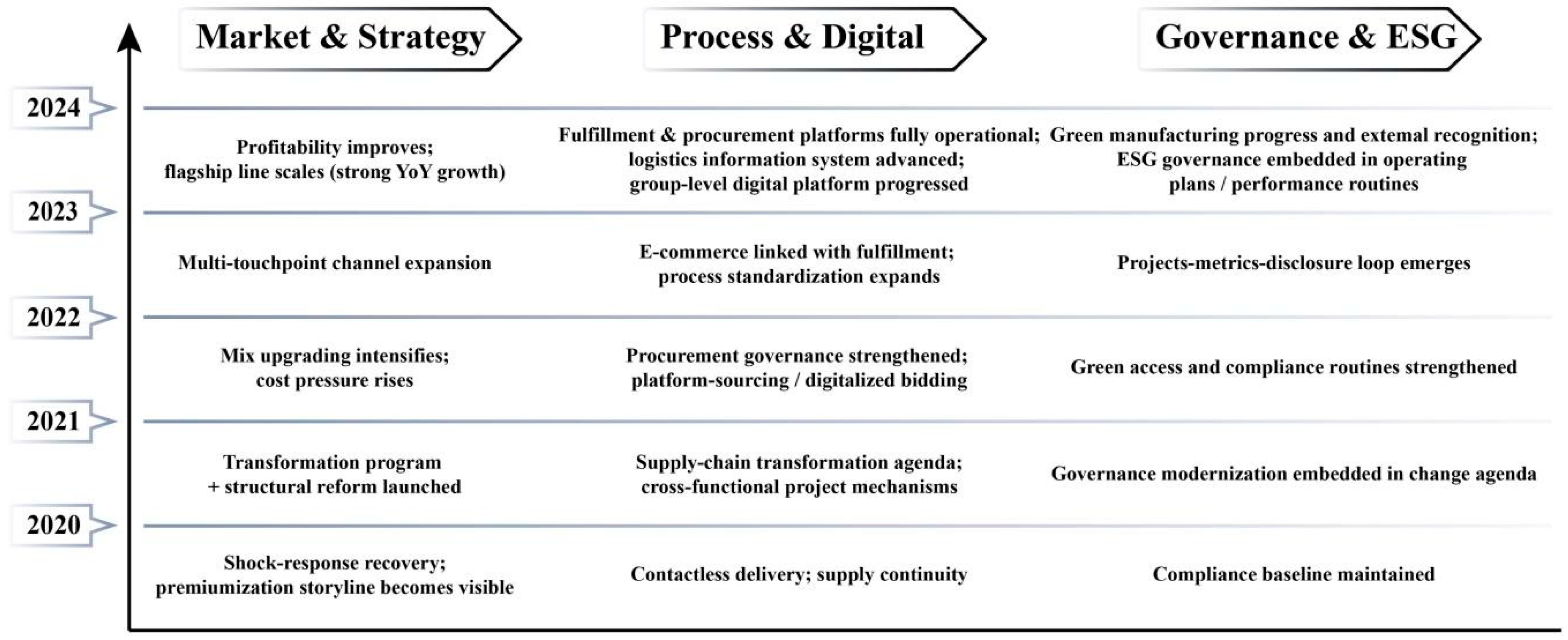
To establish temporal context for the case, we reconstructed BrewCo’s digital process transformation agenda from publicly available documents produced between 2020 and 2024, including annual reports, regulatory disclosures, and official website materials. We use the timeline as a narrative anchor to show how strategic intent progressively translated into an evolving bundle of initiatives. As summarized in Figure 2, the transformation did not unfold as a single “IT project”. Instead, it developed through three interlocking streams: a market/strategy stream oriented toward mix upgrading and channel reconfiguration; a process/digital stream aimed at end-to-end process integration and data governance; and a governance/ESG stream oriented toward compliance, risk management, and sustainability-oriented operational practices. Across 2020–2023, these streams largely advanced in parallel with intermittent coupling; by 2024, they visibly converged into a more systematized, platform-based push toward process governance.
Temporally, initiatives in 2020 were marked by a business-continuity-first logic. In the face of external shocks and demand volatility, the organization prioritized stabilizing distribution and fulfillment capabilities and re-establishing operational rhythm, thereby creating slack for subsequent structural upgrading. By 2021, public documents more explicitly referenced firm-wide transformation programs and structural reform schemes, suggesting a shift from reactive measures to a clearer medium-term change agenda. During 2022–2023, the emphasis moved from general direction-setting toward processes and interfaces: procurement governance was strengthened, platform-enabled sourcing expanded, e-commerce was linked more tightly with fulfillment, and channel expansion continued across multiple touchpoints. By 2024, the disclosures indicate a more pronounced move toward systematized advancement, with deeper application of core business systems, stronger logistics information capabilities, and progress on group-level digital platforms (Focal firm, 2021, 2022, 2023, 2024, 2025).
Compared with earlier years characterized by multiple initiatives running in parallel, the 2024 phase placed greater emphasis on integrating key links such as procurement, fulfillment, and logistics into a unified data chain and governance logic. This convergence increased interdependence across levels, functions, and sites and thereby intensified the coordination demands embedded in the case.

3.3.3. Organizational Structure

During the study period, BrewCo operated as a large, geographically distributed manufacturer characterized by a multi-layer headquarters–region–plant/subsidiary structure. Headquarters articulated strategic priorities, allocated resources, and advanced capability building through functional departments such as strategy, operations, supply chain, finance, HR, and IT, while regional units and local entities retained operational discretion to sustain market responsiveness and execution speed (Focal firm, 2025). This architecture created substantial coordination demands because interdependent tasks had to be aligned across levels, functions, and geographies.
Within this structure, digital process transformation was positioned as a medium-term agenda aimed at connecting core processes—including procurement governance, order fulfillment, logistics information, and group-level data infrastructure—under more unified process and data arrangements to improve coordination efficiency and operational resilience (Focal firm, 2025). The combination of layered hierarchy, multiple sites, and cross-functional interdependence made the case particularly suitable for examining how strategic intent traveled across organizational levels and how coordination challenges emerged at process interfaces during transformation.

3.4. Data Sources

This study draws on a multi-source qualitative dataset designed to support process theorizing about how a strategy–execution gap emerges and evolves during digital process transformation. Consistent with established case-study approaches, we combined interviews that capture insiders’ meanings and interpretations with longitudinal secondary materials that provide externally observable anchors and temporal structure (Eisenhardt, 1989; Yin, 2018). This combination is particularly appropriate for embedded process studies in which core mechanisms unfold across hierarchical levels, functions, and time, and where triangulation helps separate “what happened” (documented initiatives and milestones) from “how it was experienced and enacted” (participants’ sensemaking, trust, voice, and feedback practices) (Langley, 1999).

3.4.1. Semi-Structured Interviews (10 Participants; Q1–Q5)

We conducted semi-structured interviews with 10 organizational members selected through purposive, maximum-variation sampling (Suri, 2011). The sampling logic was theory-driven rather than statistically representative: participants were intentionally chosen because they occupied positions directly involved in, or directly affected by, the focal transformation and because, taken together, they enabled cross-level and cross-functional comparison within the embedded case. The sample spans senior management (2), middle management (2), and frontline roles (6) across corporate management, strategy, HR, operations, IT, logistics, customer service, and marketing. This composition allowed us to trace how strategic intent traveled across hierarchical layers and where interface frictions, communication breakdowns, and feedback-closure problems emerged. Participants are anonymized as P1–P10 and reported only in role- and level-bands to protect confidentiality while preserving analytic leverage on cross-level dynamics. Table 1 summarizes the interview sample.
Interviews followed a focused protocol with five core questions (Q1–Q5) aligned with the OD-relevant phases central to our theorizing: (a) how the need for change was identified and understood, (b) how communication and trust were experienced during the change, (c) whether diagnosis was inclusive and perceived as accurate, (d) how interventions affected day-to-day work, and (e) whether post-change mechanisms supported institutionalization. Because access was constrained, interviews were relatively brief (approximately 30–45 min each) and were conducted in mixed mode. We therefore used highly targeted prompts anchored to concrete episodes and critical interfaces (e.g., cross-department handoffs and system-enabled process changes). To reduce retrospective drift, we also used the transformation timeline (Figure 2) as a temporal cue, encouraging participants to locate experiences within the broader sequence of initiatives.
Sample adequacy was assessed in relation to the explanatory aim, case boundaries, and information richness of the dataset rather than in terms of statistical representativeness (Malterud et al., 2016). Four considerations support the adequacy of the 10 interviews for the present study. First, the study addresses narrowly focused research questions and traces a specific mechanism chain within a single, bounded case. Second, the participants are highly specific to the focal phenomenon, covering the principal hierarchical levels and several critical functional interfaces implicated in the transformation. Third, the analysis is theory-informed and aims at analytic generalization rather than population inference. Fourth, the interview material was triangulated with longitudinal secondary materials from 2020 to 2024 and with an explicit audit trail of coding and theme development. During iterative analysis, later interviews yielded limited novel insight regarding the focal mechanisms of sensemaking, voice, feedback closure, diagnosis legitimacy, and implementation support, indicating thematic sufficiency for the present study (Hennink & Kaiser, 2022; Malterud et al., 2016). Accordingly, we frame adequacy here in terms of information power and thematic sufficiency rather than as a mechanical numerical saturation threshold. Table 2 presents the five core semi-structured interview questions (Q1–Q5).

3.4.2. Secondary Data (Annual Reports, Disclosures, Website, etc.)

To reconstruct the transformation agenda and provide longitudinal anchors, we assembled a corpus of secondary materials spanning 2020–2024, including annual reports and public disclosures, complemented by official website materials and other public communications. These sources served three functions. First, they enabled us to build the initiatives timeline (Figure 2) and identify shifts from parallel experimentation toward more systematized platform-based advancement by 2024. Second, they supported triangulation of key factual claims (e.g., timing and scope of process systems, governance programs, and publicly stated priorities). Third, they provided context for the transformation pressures and constraints (e.g., weak-volume competition, compliance and ESG expectations), which helped situate participants’ accounts in a broader change setting.
Beyond core secondary data, we maintained a process-materials package to support rigor and transparency, including the codebook, coded response matrix, frequency and coverage outputs, and a triangulation worksheet documenting how each theme was cross-checked against candidate secondary sources. Table 3 summarizes the full dataset and how each source category was used in the paper.

3.5. Data Analysis

Our analysis followed an iterative, abductive logic that moved between empirics and theory to build a process explanation of the strategy–execution gap during digital process transformation (Langley, 1999). We first organized all materials (interviews and secondary documents) into a shared analytic repository and created an audit trail that recorded coding decisions, theme revisions, and triangulation outcomes. The interview dataset was structured into 50 question-by-participant response units (10 participants × 5 questions), which enabled systematic comparison across hierarchical levels and functions while preserving the OD-phase logic embedded in the interview protocol.

3.5.1. Hybrid Thematic Analysis (Deductive OD Template + Inductive Sub-Themes)

We employed a hybrid thematic analysis that combined a deductive template with inductive elaboration (Braun & Clarke, 2006; Fereday & Muir-Cochrane, 2006). Deductively, we used an OD-informed process template as a sensitizing structure to organize coding around five aggregate dimensions that mirror core change-process problems: (D1) change need identification & sensemaking, (D2) communication & trust in the practitioner–client relationship, (D3) diagnosis inclusion & legitimacy, (D4) intervention implementation capacity & support, and (D5) institutionalization and sustaining mechanisms. Inductively, within each dimension we developed sub-themes grounded in participants’ accounts and refined them through constant comparison across roles and levels.
This iterative cycle produced a final codebook containing 44 codes, nested within 15 s-order themes and the five aggregate dimensions. We also generated descriptive outputs (e.g., code frequency and participant–theme coverage matrices) not as statistical claims but as transparency devices to assess whether core mechanisms were supported across multiple participants and organizational levels. Throughout, we wrote analytic memos to capture emerging explanations, pursued disconfirming evidence to avoid “single-story” bias, and logged instances where themes could be supported only partially by public documents, thereby limiting overreach in inference.

3.5.2. Gioia-Style Data Structure (1st-Order Concepts → 2nd-Order Themes → Aggregate Dimensions)

To enhance transparency and align with best practices in inductive qualitative research, we rendered our coding progression in a Gioia-style data structure (Gioia et al., 2013). First-order concepts remained close to participants’ language and concrete experiences; second-order themes captured theoretically meaningful patterns (e.g., interpretive misalignment, low psychological safety, fragile diagnosis legitimacy, and broken feedback closure); and aggregate dimensions mapped these themes onto the OD process logic that underpins our conceptual framing. This structure served two purposes: it provided a clear chain of evidence from data to theorizing, and it enabled us to integrate themes temporally—linking early sensemaking gaps to later trust/voice dynamics and, ultimately, to institutionalization outcomes—thereby informing the process model developed in Section 4.

3.6. Trustworthiness and Rigor

Because qualitative process theorizing relies on the transparency and plausibility of inference rather than statistical representativeness, we adopted established criteria for qualitative trustworthiness and enacted multiple rigor-enhancing practices across the research lifecycle (Lincoln & Guba, 1985; Tracy, 2010). In line with case-study guidance, we sought to maintain a clear chain of evidence from raw materials to coding and theorizing, so that readers can evaluate how empirical claims were constructed and bounded (Yin, 2018). We report these procedures not as a “checklist,” but as an integrated set of practices tailored to our design constraints (a single embedded case, a focused interview protocol, and the need for strong anonymity).
We pursued triangulation across data sources, time, and organizational levels to strengthen credibility (Denzin, 1978). Specifically, we triangulated interview accounts (Table 1 and Table 2) with longitudinal secondary materials (Table 3) that documented publicly observable initiatives and milestones, using the case timeline (Figure 2) as a shared temporal anchor. This approach allowed us to cross-check “what happened” (e.g., the sequencing and stated intent of key initiatives) against “how it was experienced and enacted” (e.g., perceived sensemaking gaps, trust distance, and feedback closure problems). Given that interview duration was necessarily brief (30–45 min), we deliberately relied on interface- and episode-based prompts and used the timeline to reduce retrospective drift, while treating convergence across levels (senior, middle, frontline) and across source types as the primary credibility signal rather than depth within any single narrative strand (Langley, 1999; Yin, 2018).
To support dependability and confirmability, we created and maintained an audit trail that recorded successive versions of the codebook, coded excerpts, response matrices (participant × question), analytic memos, and triangulation decisions (Table 3). The analysis proceeded iteratively: initial coding applied an OD-informed template to organize data, followed by inductive elaboration of sub-themes through constant comparison across roles and levels. We documented key coding decisions—such as why a code was split, merged, or re-labeled—and linked each second-order theme to representative first-order evidence and, where possible, to corroborating secondary sources. This documentation strengthens the traceability of our Gioia-style data structure and supports readers’ evaluation of the evidentiary basis of the process model (Gioia et al., 2013; Yin, 2018).
To reduce the risk of confirmation bias and “single-story” theorizing, the research team engaged in peer debriefing throughout analysis. In these sessions, emergent themes and their supporting excerpts were challenged with two questions: (a) whether alternative interpretations could plausibly account for the same evidence, and (b) what evidence—if observed—would falsify or qualify the proposed mechanism. We also conducted purposeful searches for disconfirming instances (e.g., accounts indicating effective feedback closure or high trust) to refine boundary conditions and avoid overstating the generality of the mechanism chain. This practice aligns with big-tent qualitative quality criteria emphasizing sincerity, credibility, and resonance (Tracy, 2010) and strengthens the interpretive robustness of process explanations (Langley, 1999).
Finally, we support transferability by providing a thick description of the research setting and case background while preserving anonymity. Rather than claiming empirical generalization, we aim for analytic generalization by specifying where the proposed OD process model is most likely to apply—namely, layered and geographically distributed organizations pursuing platform-based digital process governance under heightened visibility and compliance pressures (Yin, 2018). These boundary conditions will be revisited in Section 5 when we articulate contributions and limits.

3.7. Ethics

This study was conducted as a minimal-risk, non-interventional qualitative management study based on semi-structured interviews with adult organizational professionals and the analysis of lawfully obtained public organizational documents. Before each interview, participants were informed about the purpose of the study, the intended use of the data, the voluntary nature of participation, and their right to decline participation, stop the interview, or withdraw their statements at any time without consequence. Written informed consent was obtained prior to each interview. No vulnerable populations were involved, and no clinical, biomedical, psychological, or experimental interventions were included. To protect privacy and commercially sensitive information, we de-identified all firm, brand, location, and personal identifiers (using “BrewCo” and participant codes P1–P10). Audio files, transcripts, coding files, and analytic materials were stored in encrypted form with access restricted to the research team. In line with the journal’s reporting requirements, the corresponding Institutional Review Board Statement and Informed Consent Statement are provided at the end of the manuscript.

4. Findings

To strengthen transparency, Table 4 summarizes representative interview evidence underpinning each theme and clarifies how each theme links to the two bridging mechanisms (feedback closure and diagnosis legitimacy).

4.1. Theme 1: Frontline Sensemaking Gaps

In the early stages of BrewCo’s transformation, the “why” of change did not crystallize into a shared interpretive frame across the organization. Senior leaders (P1, P2) articulated a relatively coherent rationale: a systemic mismatch between the pace of the market and the organization’s production and process response capacity, diagnosed through multi-level market feedback and data analysis. Transformation was thus framed as a proactive, organization-level decision rather than a set of local fixes. In contrast, most middle and frontline members described their understanding in fragmented, experience-near terms—recognizing symptoms such as cumbersome approvals, slowed throughput, and customer complaints, but lacking an explanatory chain that linked these symptoms to strategic intent and broader governance logic. In descriptive terms, eight of the ten interviewees (i.e., all but the two senior leaders) exhibited, to varying degrees, a sensemaking gap characterized by “knowing that change is happening” but not understanding why this configuration of change is pursued and where it is ultimately headed.
Importantly, this gap was not simply a matter of insufficient information, but reflected a discontinuity in meaning construction as intent traveled across levels. A project manager noted that many frontline actors only began to understand the rationale after post-implementation “review meetings” (P4), suggesting the organization was more effective at delivering outcomes than at making design logic intelligible in advance. A staff member captured the lived experience succinctly: “processes keep changing,” yet “no one explains why” (P7). When explanatory work is absent, frontline members are more likely to interpret transformation as additional compliance demands rather than capability upgrading, and to treat systems as control devices rather than coordination infrastructures. This pattern aligns with recent research showing that long-haul digital transformation requires sustained narrative and communicative work to translate abstract aspirations into actionable meaning cues for frontline workers; otherwise, frontline interpretations drift as implementation frictions accumulate (Nielsen et al., 2024).
Crucially, the sensemaking gap also shaped how experience was emotionally appraised, thereby influencing willingness to engage. An IT support specialist described inadequate pre-launch support, noting that employees who lacked context experienced the change as “forced” (P8). Another frontline account suggested that “process issues were discussed for years before being taken seriously” (P5), reinforcing an image of delayed governance: problems were visible, yet systematic action was perceived to occur only after pressure escalated. Prior work indicates that employees’ interpretations of digital transformation evolve over time as concrete implementation challenges reshape perceived exchange relations and expectations (van der Schaft et al., 2024). Moreover, employees’ sentiment toward digitalization experiences can cultivate (or undermine) predispositions to participate in subsequent transformation initiatives (Abhari, 2025). In BrewCo, this implies that when frontline members could not access a credible “why” early on, they were more inclined to construe transformation as externally imposed control and burden, weakening acceptance and proactive engagement—dynamics that are central to employee support for digital transformation strategies (Klein et al., 2024).
Taken together, Theme 1 does not primarily portray “resistance to change,” but a process starting point: strategic intent had not yet been translated into a shared meaning frame at the frontline, resulting in fragmented understanding, externally driven motivation, and limited participation readiness. This sensemaking gap sets the conditions for the subsequent themes: when the “why” remains unclear, communication is more likely to become formalistic (Theme 2), voice and feedback closure become harder to sustain (Theme 3), and implementation capacity and institutionalization become increasingly fragile (Themes 4–5).

4.2. Theme 2: Formalistic Communication and Trust Distance

Building on the frontline sensemaking gaps, BrewCo did not lack communication efforts; rather, it mobilized the organization’s most familiar governance language—hierarchical transmission, meeting cadence, notices, and administrative directives. Across interviews and secondary materials, the communication architecture remained predominantly top-down, relying heavily on formal orders and routine meetings, with comparatively fewer horizontal coordination and participatory channels. While such a structure can be efficient for scaling operations, in a transformation context it tends to compress communication into a “broadcast–comply” sequence, increasing the likelihood that meanings are simplified, drift across levels, or become distorted—thereby weakening cross-level sensemaking quality (Schildt et al., 2020). This is consistent with research distinguishing “informing” from “dialogic” communication as qualitatively different change interventions, especially when coordination and shared understanding are required (Hagl et al., 2024).
Crucially, communication was present but often experienced as ritualized presence: frequent and visible, yet thin in interactional content. Many participants described learning about changes passively through meeting notifications, system updates, or implementation requirements—knowing what to do without having space to clarify why it mattered or how priorities were set. A project manager captured how interaction collapses as scale increases: “the more people, it turns into a briefing session—no interaction” (P4). In such settings, communication fulfills the organization’s need for procedural visibility, but it does not provide the dialogic infrastructure necessary for shared meaning construction.
The firm also experimented with more structured interaction routines—monthly coordination meetings, cross-department feedback sessions, morning debriefings, and consultant site visits—to secure more direct frontline input and create internal convergence. Yet interview data indicate that the key constraint was not the existence of meetings but the closure of feedback. Over time, employees learned that raising issues yielded limited visible returns. As one customer-service representative put it, “after the consultant listened to our process problems…and then we didn’t see any changes, it felt futile to mention our opinions” (P5). When “being heard” is not reliably followed by “being responded to,” communication shifts from dialog to procedure and gradually erodes trust in both intent and capability.
This ritualization dynamic produced a pronounced trust distance and psychological-safety deficit. Participants repeatedly described psychological distance and trust barriers toward senior management, rooted in limited direct interaction; a production-line operator noted bluntly, “trust still needs interaction” (P6). Under heightened performance visibility and compliance pressures, communication that feels commanding and outcome-focused—rather than explanatory and supportive—makes it harder for employees to see management as a partner in collective problem solving and easier to interpret it as a controller requiring compliance. Accordingly, speaking up becomes less attractive and more risky, consistent with work positioning trust and psychological safety as enabling conditions for voice (Dirks & de Jong, 2022; A. C. Edmondson & Bransby, 2023; Morrison, 2023).
As voice thins, the organization enters a pattern of strengthened formal communication but weakened upward problem visibility. Frontline actors may not openly resist; instead, they keep concerns local, rely on workarounds, and preserve continuity through partial adaptation. An administrative assistant observed that senior leaders communicate in a more commanding manner that “pressures people,” prompting resistance (P7). An IT support specialist similarly noted that employees are asked to use tools they “don’t understand” while “no one cares about the process, they just look at results” (P8). When voice is experienced as high-cost and low-impact, the organization becomes increasingly dependent on managerial intuition and surface indicators—setting up the next theme on how broken feedback closure undermines the legitimacy of diagnosis (Sherf et al., 2021).

4.3. Theme 3: Diagnosis Legitimacy Erosion via Broken Feedback Closure

When voice thins out and feedback struggles to travel upward and be meaningfully closed, organizational diagnosis increasingly relies on managerial intuition and dashboard indicators rather than cross-level, cross-functional joint inquiry. This pattern surfaced repeatedly in our interviews: especially among frontline and enabling functions, participants responding to Q3 (whether diagnosis was conducted and perceived as accurate) described diagnosis as something they largely “received” as conclusions, not something they helped construct. In parallel, secondary disclosures emphasize platform-based traceability and comparability (Focal firm, 2025), which can narrow “what counts” as diagnosable problems to what is visible in standardized metrics and compliance-oriented process representations, rather than situated bottlenecks at process interfaces (Vial, 2019; Verhoef et al., 2021).
Critically, broken feedback closure undermines diagnosis by eroding its attributability and verifiability. In digital process transformation, breakdowns frequently occur at interfaces (handoffs across functions, contested data definitions, misfits between system configuration and actual work). Distinguishing whether problems stem from process design, system configuration, or implementation support requires sustained upward feedback and horizontal learning routines. Yet when feedback primarily travels through hierarchical reporting, ritualized meetings, or passive data entry, information is filtered and decontextualized: frontline actors observe recurring issues without clear causal explanations, middle managers experience pressure to “align definitions” without a shared diagnostic arena, and headquarters stabilizes pace through what can be quantified. Over time, diagnosis becomes harder for organizational members to understand, trace, and collectively test—not necessarily because it is entirely wrong, but because it becomes increasingly inexplicable and un-auditable in practice. Under these conditions, diagnosis legitimacy becomes fragile (Suchman, 1995).
Once diagnosis legitimacy erodes, a predictable “compliance without commitment” dynamic emerges: members comply with requirements but become more cautious in speaking up and less willing to carry feedback risks, which further weakens feedback closure (A. Edmondson, 1999; Morrison, 2011). Visibility enabled by digital tools may then be experienced as control, encouraging local workaround practices (e.g., selective recording or local absorption of problems) that make the organization appear more “data-driven” while undermining learning-oriented institutionalization (Meyer & Rowan, 1977). Thus, Theme 3 marks a pivotal process shift: when feedback is not effectively closed, diagnosis slips from joint sensemaking to metric arbitration, compressing the feasible space for subsequent interventions.

4.4. Theme 4: Fragmented Implementation Support and Local Workarounds

When diagnosis fails to produce shared priorities, implementation support becomes fragmented and uneven. In BrewCo’s setting, this fragmentation became particularly visible as the firm entered what disclosures framed as a more “systematized advancement” phase in 2024—when core business systems and management platforms were described as moving into broader operation and deeper application, and when procurement–fulfillment–logistics links were increasingly positioned within a unified data chain and governance logic (Focal firm, 2025). Yet systematized advancement did not automatically translate into systematized support. Interviewees repeatedly noted that understanding often arrived after the fact, via periodic reviews rather than through early-stage interactive preparation (P4: “Only after periodic review meetings do we gradually understand why things are being done”; P4: “Most were just briefing sessions, with little interaction”). Where support took the form of retrospective “catch-up,” frontline roles absorbed uncertainty and implementation costs in real time.
Support deficits were especially salient in everyday frictions around tool use, data definitions, and handoffs across roles. Frontline actors were not opposing digitalization per se; rather, they were expected to “use first” without sufficient explanation, demonstration, and timely responsiveness. As one participant put it, “We are forced to use tools we don’t fully understand… no one cares whether it genuinely helps our work” (P8). Under such conditions, the most viable response was rarely open resistance; instead, participants described localized adaptation and workaround practices that preserved operational continuity—systems were used and data were entered, but difficulties were not fully converted into shared learning. Prior research similarly shows that inadequate information systems can induce workaround behavior that stabilizes work in the short run while obscuring structural deficiencies over time (Wong et al., 2022).
A deeper constraint lay in fragile implementation governance. With diagnosis already perceived as weakly legitimate, cross-functional coordination tended to drift toward “projectified” collaboration—relying on temporary meetings, external advice, and episodic check-ins to sustain momentum, without stable decision-right boundaries and reliable closure routines. Participant accounts captured this experience succinctly: “He came, listened, and then nothing changed” (P5). Such perceptions signal an absence of predictable response pathways: issues circulated among IT, process owners, and business units without a shared sense of who would decide, when adjustments would be made, and how fixes would be validated back at the frontline. Change intervention research identifies training, coaching, and organization-level change support as core intervention types that enable adoption; when support is insufficient or mis-timed, implementation capacity becomes a bottleneck that shapes outcomes (Hagl et al., 2024). Thus, in BrewCo’s process narrative, implementation capacity is not a mere execution detail but a structural consequence of earlier diagnostic divergence: when support remains uneven and governance fails to close loops, the organization becomes more likely to lean on visible metrics and compliance checks to maintain order.

4.5. Theme 5: Symbolic Monitoring and Weak Feedback Culture

BrewCo increasingly relied on what could be made visible—platform-generated indicators, standardized compliance checks, and dashboard-style progress reporting—to maintain coordination and momentum. Secondary materials repeatedly emphasized traceability and comparability as virtues of platform-based process governance (Focal firm, 2025). In practice, however, heightened visibility did not automatically produce stronger learning. Instead, when feedback closure remained fragile, what traveled upward most reliably was not situated problem knowledge at process interfaces but what the system could capture and render comparable. This shift subtly redefined “what counts” as a problem: issues that were measurable became actionable, while interface frictions that required cross-unit joint inquiry were more likely to be absorbed locally.
As monitoring became more salient, participants’ accounts suggested that frontline experience tilted toward result visibility and compliance pressure rather than collaborative improvement. One IT support specialist described how the organization “just looks at results” and pays limited attention to the work process itself (P8), and another participant noted that commanding communication amplified pressure and resistance (P7). In such conditions, the most adaptive response was often not open opposition but protective local buffering—doing what was required to pass checks while keeping uncertainty, exceptions, and workarounds within the unit. Over time, monitoring can drift from an enabling infrastructure for diagnosis and coordination into a symbolic assurance that the transformation is “under control,” even when learning routines and feedback closure remain underdeveloped (Meyer & Rowan, 1977).
This dynamic also has a cultural consequence: when speaking up is repeatedly experienced as high-cost and low-impact, silence becomes normalized. Rather than treating issues as shared organizational problems, members learn to treat them as local burdens to be managed quietly, which further weakens upward visibility of underlying bottlenecks and reinforces reliance on surface indicators. Thus, Theme 5 captures how the transformation became increasingly visibility-heavy but learning-light—an endpoint that stabilizes order in the short run while entrenching a weak feedback culture and setting the stage for the integrated process model in Section 4.6 (Focal firm, 2025; Morrison, 2011).

4.6. Integrated Process Model (How Themes Connect Across OD Phases)

Synthesizing Themes 1–5, we develop an integrated OD process model explaining how a strategy–execution gap emerges and becomes self-reinforcing during digital process transformation. The model links the five themes to the OD-relevant phases captured by our analytic template (D1–D5) and centers on two bridging mechanisms: feedback closure (whether voice travels upward and is responded to) and diagnosis legitimacy (whether problem interpretations are perceived as explainable and fair across levels). In D1, the process starts with a frontline sensemaking gap: senior leaders articulate a coherent change rationale, while middle and frontline members often report “knowing change is happening” without a shared “why” (e.g., strategic framing at P1–P2 versus fragmented understanding at P7–P8). In D2, the organization compensates through formalistic communication—notices and routine meetings that convey tasks efficiently but leave limited dialogic space—creating trust distance and lowering psychological safety for voice (e.g., interaction turning into briefings at P4; “trust needs interaction” at P6).
In D3, as voice becomes thinner, feedback closure breaks down, shifting diagnosis from joint inquiry toward conclusions delivered through managerial judgment and system-visible indicators; over time, this erodes diagnosis legitimacy because employees cannot trace how priorities are set or whether feedback changes outcomes (e.g., “heard but no change, so it feels futile” at P5). In D4, legitimacy deficits and weak closure routines translate into implementation capacity constraints: support appears episodic, training and troubleshooting are uneven, and coordination relies on temporary arrangements, which fosters local buffering and workarounds rather than scalable learning (e.g., “forced to use tools we don’t fully understand” at P8; interface frictions around operations/logistics at P9). In D5, the organization increasingly relies on monitoring and KPI routines to maintain order, yet respondents describe a weak feedback culture where mechanisms exist but are experienced as symbolic or compliance-oriented, further discouraging voice (e.g., “they just look at results” at P8; cross-department mechanisms remaining formal at P10).
Taken together, the model depicts a reinforcing loop (R1): sensemaking gaps → formalistic communication → trust distance/low psychological safety → reduced voice & weak feedback closure → diagnosis legitimacy erosion → fragmented support & workarounds → heavier (often symbolic) monitoring → stronger control perceptions → further silence and interpretive drift, thereby reproducing the strategy–execution gap over time. Figure 3 presents the integrated process model of how the strategy–execution gap becomes self-reinforcing during digital process transformation.

5. Discussion

Digital process transformation in layered, geographically distributed organizations often produces a persistent strategy–execution gap that cannot be reduced to “adoption problems” or a single implementation breakdown. The integrated OD process model developed in the Findings section specifies a cross-phase mechanism chain (D1–D5) and a reinforcing loop (R1) through which platform-enabled visibility expands faster than shared meaning, voice, and closure. The discussion clarifies how the evidence addresses the research questions, articulates theoretical contributions, derives managerial implications, and delineates boundary conditions and transferability.

5.1. Answering the RQs

The evidence indicates that the strategy–execution gap is generated through a sequence of OD-relevant phases rather than at one isolated point. In D1, strategic intent does not consolidate into a shared frontline interpretive frame, producing an early sensemaking gap consistent with prior work on how meaning construction shapes change trajectories (Maitlis & Christianson, 2014). In D2, the organization sustains momentum primarily through formalistic communication routines. Such routines transmit tasks efficiently but provide limited dialogic space, increasing trust distance and lowering psychological safety for questioning and speaking up (A. Edmondson, 1999). These conditions reduce upward problem visibility even when communication volume appears high.
The second research question—why the gap persists—follows from the bridging mechanisms specified in the model. In D3, weakened voice translates into fragile feedback closure; diagnosis increasingly migrates from joint inquiry toward indicator- and judgment-driven arbitration. As priorities and interpretations become less traceable and less collectively auditable, diagnosis legitimacy erodes (Suchman, 1995). In D4, legitimacy deficits and weak closure routines translate into fragmented support and a growing reliance on local buffering and workarounds, stabilizing operations in the short run while limiting scalable learning. In D5, monitoring becomes more salient as platform-based governance expands what can be rendered visible; however, where closure and learning routines remain underdeveloped, monitoring drifts toward symbolic control and further discourages voice, consistent with institutional arguments about decoupling and symbolic structures (Meyer & Rowan, 1977).
R1 integrates these phase dynamics into a self-reinforcing process: increased visibility is experienced as control, which amplifies silence and weakens closure; weaker closure further narrows diagnosis and increases reliance on visibility, reproducing interpretive drift and sustaining the strategy–execution gap over time. This process account aligns with theorizing from process data that emphasizes temporality, coupling, and reinforcing dynamics rather than static factor lists (Langley, 1999).

5.2. Theoretical Implications and Contributions

First, the analysis advances digital transformation and change-process research by specifying an OD-based process explanation of the strategy–execution gap under platform-based process governance. Existing work has established that digital transformation entails more than technology deployment, requiring organization-wide process redesign and coordination across interdependent units (Vial, 2019; Verhoef et al., 2021). The proposed model clarifies how execution gaps can emerge when “coordination infrastructures” (systems, dashboards, standardized workflows) scale faster than “interpretive infrastructures” (shared meaning, psychologically safe voice, closure routines), thereby producing cross-level interpretive drift and uneven execution rhythms across interfaces.
Second, the model theorizes feedback closure and diagnosis legitimacy as pivotal bridging mechanisms that couple early sensemaking conditions with later implementation and institutionalization outcomes. The findings suggest a distinctive transition point: when upward voice is repeatedly not followed by visible organizational response, diagnosis increasingly migrates from joint inquiry toward indicator- and judgment-driven arbitration. This shift renders problem interpretations less traceable and less collectively auditable, weakening the perceived legitimacy of diagnosis (Suchman, 1995) and narrowing the space for learning-oriented intervention. In turn, low-impact voice and weak closure increase the likelihood that compliance coexists with low commitment, intensifying the persistence of execution gaps (A. Edmondson, 1999; Morrison, 2011).
Third, the process model elaborates a pathway through which platform-enabled visibility may become conflated with control when closure and learning routines remain underdeveloped. Rather than assuming that transparency naturally generates learning, the evidence indicates that monitoring can drift toward symbolic assurance that the transformation is “under control,” while simultaneously amplifying silence and reducing the upward visibility of interface-level bottlenecks. This mechanism helps explain how organizations may strengthen formal monitoring yet institutionalize weak feedback cultures—an outcome consistent with classic arguments about decoupling and symbolic structures in organizational life (Meyer & Rowan, 1977).
Methodologically, the study illustrates how an embedded qualitative process design can use a longitudinal secondary-data timeline as a temporal anchor to support mechanism tracing and triangulation, thereby strengthening analytic generalization in access-constrained field settings (Langley, 1999; Yin, 2018). The combination of OD-phase sensitizing structure and inductive elaboration further supports transparency in linking first-order evidence to process theorizing (Gioia et al., 2013). Although the model is developed from a single Chinese brewery case, it also speaks to transformation pressures in mature brewing sectors more broadly, where competitiveness, process resilience, and governance demands increasingly interact (Duduć et al., 2020; Ivančík & Dušek, 2026).

5.3. Managerial Implications

Managerial implications follow directly from the two bridging mechanisms. Reducing the strategy–execution gap requires designing and resourcing feedback closure and diagnosis legitimacy as operational capabilities throughout the transformation, rather than treating them as informal by-products of communication or system rollout.
In early phases (D1–D2), the priority is translational sensegiving and dialogic infrastructure. Transformation rationales require repeated translation into concrete frontline pain points and interface frictions, accompanied by interaction formats that make questioning safe. Communication effectiveness is better assessed by whether shared understanding changes and whether employees increase willingness to surface bottlenecks, not by communication frequency or meeting cadence alone (A. Edmondson, 1999; Maitlis & Christianson, 2014).
In the diagnosis phase (D3), strengthening diagnosis legitimacy requires visible closure routines that make prioritization and responses traceable. Practical mechanisms include a cross-functional issue-tracking process with named owners and deadlines, periodic “you-said–we-did” updates that make response pathways observable, and joint diagnosis workshops that surface interface-level bottlenecks beyond what dashboards capture. These routines increase auditable interpretation and procedural fairness, thereby improving diagnosis legitimacy (Suchman, 1995).
In implementation and institutionalization phases (D4–D5), the priority shifts to support capacity and learning-oriented monitoring. Clear interface ownership across functions, adequate training and on-the-job support, and explicit governance of workarounds (document, review root causes, then formalize or eliminate) reduce the need for local buffering. Monitoring should be reoriented from outcome visibility to learning and closure, for example by tracking closure cycle time, reopened issues, and workaround frequency alongside traditional performance indicators. In short, visibility is most effective when it serves to assist in coordination and learning rather than symbolic control (Meyer & Rowan, 1977).

5.4. Boundary Conditions, Limitations, and Transferability

As a single embedded case, the contribution is analytic rather than being based on statistical generalization (Yin, 2018). The proposed process model is most likely to apply where three conditions co-occur: (a) layered and geographically distributed structures, (b) high cross-functional interdependence at process interfaces, and (c) platform-based process governance that increases performance visibility and compliance pressures. In flatter organizations with mature cross-unit collaboration and robust learning routines, dialogic sensemaking and closure may be easier to sustain, weakening the reinforcing loop.
Transferability can be evaluated by examining whether a focal setting exhibits the two bridging vulnerabilities identified here: weak feedback closure and fragile diagnosis legitimacy. Where these vulnerabilities are present, the model predicts higher likelihood of workaround reliance and symbolic monitoring, and thus a more persistent strategy–execution gap. Future research can test boundary conditions through comparative cases across industries and ownership types, and by examining interventions that deliberately strengthen closure routines and diagnosis legitimacy over time, including when such interventions break (or fail to break) reinforcing dynamics (Langley, 1999).

6. Conclusions

6.1. Summary of Key Findings

Based on an embedded qualitative process study of an anonymized brewery (“BrewCo”) and triangulation of multi-level interviews with longitudinal secondary materials, we trace how a strategy–execution gap is produced and becomes self-reinforcing in digital process transformation. We show that the gap emerges when coordination infrastructures (platforms, workflows, metrics, visibility-based governance) scale faster than interpretive infrastructures (shared meaning, psychologically safe voice, and learning routines), generating interpretive drift and misalignment at cross-functional interfaces. Early sensemaking gaps and formalistic communication reduce the quality of voice, rendering feedback closure fragile; fragile closure shifts diagnosis toward what is system-visible and managerially asserted, thereby weakening diagnosis legitimacy. Under uneven support and coordination, frontline actors stabilize operations through workarounds that preserve continuity but inhibit scalable learning, while monitoring grows more salient and may drift toward symbolic assurance—creating a “visibility-heavy but learning-light” reinforcing loop that reproduces the strategy–execution gap. The implication is mechanism-specific: durable transformation requires building feedback closure and diagnosis legitimacy as operational capabilities throughout the change lifecycle, shaping whether visibility enables coordination and learning or is experienced as control that silences voice.

6.2. Limitations

As a single-case process study, the contribution is analytic generalization aimed at mechanism explanation. Interviews were access-constrained and partly retrospective, and experience-based constructs (e.g., trust and psychological safety) are not directly verifiable from public disclosures; anonymity further constrains the disclosure of fine-grained details.

6.3. Future Research

Future work can test boundary conditions and interruptibility through comparative and longitudinal intervention designs, and operationalize feedback closure and diagnosis legitimacy using mixed methods that combine surveys with digital trace data (e.g., workflow/ticket logs). It would be especially valuable to specify early indicators of the reinforcing loop identified here, such as closure cycle time, reopened issues, workaround frequency, and escalation delay, so that organizations can detect when visibility is drifting toward symbolic control. Future research should also examine whether interpretive drift is conditioned by specific features of the Chinese business environment—if such conditioning exists—or whether the mechanism generalizes across other regional business cultures and institutional settings.

Author Contributions

Conceptualization, Y.C. and S.R.M.Z.; Methodology, Y.C. and S.R.M.Z.; Formal analysis, Y.C.; Investigation, Y.C.; Data curation, Y.C.; Writing–original draft, Y.C.; Writing– review & editing, Y.C. and S.R.M.Z.; Visualization, Y.C.; Supervision, S.R.M.Z.; Project administration, Y.C. All authors have read and agreed to the published version of the manuscript.

Funding

This research received no external funding.

Institutional Review Board Statement

Ethical review and approval were waived for this study due to the study being a non-medical, non-interventional qualitative management research based on semi-structured interviews with adult organizational professionals and analysis of publicly available organizational documents; all participation was voluntary with written informed consent obtained prior to interviews, no vulnerable populations or sensitive personal data were involved, all data were anonymized and confidentially managed, and no clinical, biomedical, psychological interventions or experimental procedures were included. As a minimal-risk study using lawfully obtained public data and anonymized information, it conforms to the relevant provisions of China’s Measures for the Ethical Review of Life Science and Medical Research Involving Humans (2023) and Measures for Ethical Review of Science and Technology (Trial) (2023), and is therefore eligible for ethical exemption from formal committee review.

Informed Consent Statement

Informed consent was obtained from all subjects involved in the study.

Data Availability Statement

The data that support the findings of this study are available from the corresponding author upon reasonable request. Due to ethical considerations and the need to protect participants’ privacy and confidentiality, the data are not publicly available.

Conflicts of Interest

The authors declare no conflict of interest.

References

  1. Abhari, K. (2025). Employee participation in digital transformation: From digitalization sentiment to transformation predisposition. Information & Management, 62(8), 104212. [Google Scholar] [CrossRef]
  2. Bourgoin, A., Laszczuk, A., & Langley, A. (2025). How change recipients become rivals: Legitimacy dynamics and “cooptive rejection” in organizational change. Journal of Management Studies. Advance online publication. [Google Scholar] [CrossRef]
  3. Braun, V., & Clarke, V. (2006). Using thematic analysis in psychology. Qualitative Research in Psychology, 3(2), 77–101. [Google Scholar] [CrossRef]
  4. Denzin, N. K. (1978). The research act: A theoretical introduction to sociological methods (2nd ed.). McGraw-Hill. [Google Scholar]
  5. Dirks, K. T., & de Jong, B. (2022). Trust within the workplace: A review of two waves of research and a glimpse of the third. Annual Review of Organizational Psychology and Organizational Behavior, 9, 247–276. [Google Scholar] [CrossRef]
  6. Duduć, Z., Dudic, B., Saxunová, D., Peráček, T., & Beňová, E. (2020). Development of small breweries and innovation in the brewing industry in the Republic of Slovakia. Economic of Agriculture, 67(3), 913–924. [Google Scholar] [CrossRef]
  7. Edmondson, A. (1999). Psychological safety and learning behavior in work teams. Administrative Science Quarterly, 44(2), 350–383. [Google Scholar] [CrossRef]
  8. Edmondson, A. C., & Bransby, D. P. (2023). Psychological safety comes of age: Observed themes in an established literature. Annual Review of Organizational Psychology and Organizational Behavior, 10, 55–78. [Google Scholar] [CrossRef]
  9. Eisenhardt, K. M. (1989). Building theories from case study research. Academy of Management Review, 14(4), 532–550. [Google Scholar] [CrossRef]
  10. Fereday, J., & Muir-Cochrane, E. (2006). Demonstrating rigor using thematic analysis: A hybrid approach of inductive and deductive coding and theme development. International Journal of Qualitative Methods, 5(1), 80–92. [Google Scholar] [CrossRef]
  11. Focal firm. (2021). Annual report 2020 [Annual report]. Agency Name.
  12. Focal firm. (2022). Annual report 2021 [Annual report]. Agency Name.
  13. Focal firm. (2023). Annual report 2022 [Annual report]. Agency Name.
  14. Focal firm. (2024). Annual report 2023 [Annual report]. Agency Name.
  15. Focal firm. (2025). Annual report 2024 [Annual report]. Agency Name.
  16. Gioia, D. A., Corley, K. G., & Hamilton, A. L. (2013). Seeking qualitative rigor in inductive research: Notes on the Gioia methodology. Organizational Research Methods, 16(1), 15–31. [Google Scholar] [CrossRef]
  17. Hagl, C., Kanitz, R., Gonzalez, K., & Hoegl, M. (2024). Change management interventions: Taking stock and moving forward. Human Resource Management Review, 34(1), 101000. [Google Scholar] [CrossRef]
  18. Hennink, M., & Kaiser, B. N. (2022). Sample sizes for saturation in qualitative research: A systematic review of empirical tests. Social Science & Medicine, 292, 114523. [Google Scholar] [CrossRef]
  19. Ivančík, R., & Dušek, J. (2026). Economic security and the transformation of European Union economic governance: Industrial policy, competitiveness, and strategic resilience. Economies, 14(3), 93. [Google Scholar] [CrossRef]
  20. Kellogg, K. C., Valentine, M. A., & Christin, A. (2020). Algorithms at work: The new contested terrain of control. Academy of Management Annals, 14(1), 366–410. [Google Scholar] [CrossRef]
  21. Klein, S. P., Spieth, P., & Söllner, M. (2024). Employee acceptance of digital transformation strategies: A paradox perspective. Journal of Product Innovation Management, 41(5), 999–1021. [Google Scholar] [CrossRef]
  22. Langley, A. (1999). Strategies for theorizing from process data. Academy of Management Review, 24(4), 691–710. [Google Scholar] [CrossRef]
  23. Lincoln, Y. S., & Guba, E. G. (1985). Naturalistic inquiry. SAGE Publications. [Google Scholar]
  24. Maitlis, S., & Christianson, M. (2014). Sensemaking in organizations: Taking stock and moving forward. Academy of Management Annals, 8(1), 57–125. [Google Scholar] [CrossRef]
  25. Malterud, K., Siersma, V. D., & Guassora, A. D. (2016). Sample size in qualitative interview studies: Guided by information power. Qualitative Health Research, 26(13), 1753–1760. [Google Scholar] [CrossRef]
  26. Meyer, J. W., & Rowan, B. (1977). Institutionalized organizations: Formal structure as myth and ceremony. American Journal of Sociology, 83(2), 340–363. [Google Scholar] [CrossRef]
  27. Morrison, E. W. (2011). Employee voice behavior: Integration and directions for future research. Academy of Management Annals, 5(1), 373–412. [Google Scholar] [CrossRef]
  28. Morrison, E. W. (2023). Employee voice and silence: Taking stock a decade later. Annual Review of Organizational Psychology and Organizational Behavior, 10, 79–107. [Google Scholar] [CrossRef]
  29. National Bureau of Statistics of China. (2024). China statistical yearbook 2024. China Statistics Press. Available online: https://www.stats.gov.cn/sj/ndsj/2024/indexeh.htm (accessed on 7 April 2026).
  30. Nielsen, J. A., Elmholdt, K. T., & Noesgaard, M. S. (2024). Leading digital transformation: A narrative perspective. Public Administration Review, 84(4), 589–603. [Google Scholar] [CrossRef]
  31. Okhuysen, G. A., & Bechky, B. A. (2009). Coordination in organizations: An integrative perspective. Academy of Management Annals, 3(1), 463–502. [Google Scholar] [CrossRef]
  32. Reinking, J., Arnold, V., & Sutton, S. G. (2020). Synthesizing enterprise data through digital dashboards to strategically align performance: Why do operational managers use dashboards? International Journal of Accounting Information Systems, 37, 100452. [Google Scholar] [CrossRef]
  33. Schildt, H., Mantere, S., & Cornelissen, J. (2020). Power in sensemaking processes. Organization Studies, 41(2), 241–265. [Google Scholar] [CrossRef]
  34. Sherf, E. N., Parke, M. R., & Isaakyan, S. (2021). Distinguishing voice and silence at work: Unique relationships with perceived impact, psychological safety, and burnout. Academy of Management Journal, 64(1), 114–148. [Google Scholar] [CrossRef]
  35. Suchman, M. C. (1995). Managing legitimacy: Strategic and institutional approaches. Academy of Management Review, 20(3), 571–610. [Google Scholar] [CrossRef]
  36. Suri, H. (2011). Purposeful sampling in qualitative research synthesis. Qualitative Research Journal, 11(2), 63–75. [Google Scholar] [CrossRef]
  37. Task Force on Climate-related Financial Disclosures. (2017). Recommendations of the task force on climate-related financial disclosures: Final report. Available online: https://assets.bbhub.io/company/sites/60/2021/10/FINAL-2017-TCFD-Report.pdf (accessed on 7 April 2026).
  38. Tracy, S. J. (2010). Qualitative quality: Eight “big-tent” criteria for excellent qualitative research. Qualitative Inquiry, 16(10), 837–851. [Google Scholar] [CrossRef]
  39. van der Schaft, A. H. T., Lub, X. D., van der Heijden, B. I. J. M., & Solinger, O. N. (2024). How employees experience digital transformation: A dynamic and multi-layered sensemaking perspective. Journal of Hospitality & Tourism Research, 48(5), 803–820. [Google Scholar] [CrossRef]
  40. Verhoef, P. C., Broekhuizen, T., Bart, Y., Bhattacharya, A., Dong, J. Q., Fabian, N., & Haenlein, M. (2021). Digital transformation: A multidisciplinary reflection and research agenda. Journal of Business Research, 122, 889–901. [Google Scholar] [CrossRef]
  41. Vial, G. (2019). Understanding digital transformation: A review and a research agenda. The Journal of Strategic Information Systems, 28(2), 118–144. [Google Scholar] [CrossRef]
  42. Volberda, H. W., Khanagha, S., Baden-Fuller, C., Mihalache, O. R., & Birkinshaw, J. (2021). Strategizing in a digital world: Overcoming cognitive barriers, reconfiguring routines and introducing new organizational forms. Long Range Planning, 54(5), 102110. [Google Scholar] [CrossRef]
  43. Volz, F., Münch, C., Lohmüller, M., & Küffner, C. (2025). From data jungle to data governance in digital ecosystems: Empirical evidence from a multiple holistic case study. Journal of Business Research, 201, 115747. [Google Scholar] [CrossRef]
  44. Weibel, A., Schafheitle, S., & van der Werff, L. (2025). Smart tech is all around us—Bridging employee vulnerability with organizational active trust-building. Journal of Management Studies, 62(5), 1914–1944. [Google Scholar] [CrossRef]
  45. Wessel, L. K., Baiyere, A., Ologeanu-Taddei, R., Cha, J., & Jensen, T. B. (2021). Unpacking the difference between digital transformation and IT-enabled organizational transformation. Journal of the Association for Information Systems, 22(1), 102–129. [Google Scholar] [CrossRef]
  46. Westergren, U. H., Mähler, V., & Jadaan, T. (2024). Enabling digital transformation: Organizational implementation of the internet of things. Information & Management, 61(6), 103996. [Google Scholar] [CrossRef]
  47. Wong, L. H. M., Hurbean, L., Davison, R. M., Ou, C. X. J., & Muntean, M. (2022). Working around inadequate information systems in the workplace: An empirical study in Romania. International Journal of Information Management, 64, 102471. [Google Scholar] [CrossRef]
  48. Yin, R. K. (2018). Case study research and applications: Design and methods (6th ed.). SAGE Publications. [Google Scholar]
Figure 1. Sensitizing framework of the strategy–execution gap in digital process transformation.
Admsci 16 00184 g001
Figure 2. Key transformation initiatives timeline (anonymized), 2020–2024. Note: The timeline is synthesized from publicly available documents (e.g., BrewCo’s annual reports, regulatory disclosures, and official website materials, 2020–2024) and is used as a temporal anchor for the narrative on market-, process-, and governance-oriented initiatives. Identifying details (e.g., firm name, brands, and locations) have been withheld to protect confidentiality.
Admsci 16 00184 g002
Figure 3. Integrated process model of the strategy–execution gap in digital process transformation. Note: D1–D5 correspond to OD-relevant phases in the analytic template. Themes 1–5 summarize the empirically derived mechanisms across phases. R1 denotes a reinforcing loop in which increased visibility is experienced as control, amplifying silence and weakening feedback closure.
Admsci 16 00184 g003
Table 1. Interviewee information (anonymized).
IDPosition LevelJob TitleDepartmentNotes/Remarks
P1Senior managementGeneral managerCorporate management dept.Participates in formulating strategy and the direction of change
P2Senior managementDeputy general managerStrategy development dept.Responsible for transformation decisions and resource allocation
P3Middle managementDepartment managerHuman resources dept.Responsible for organizational communication and staff training
P4Middle managementProject managerOperations dept.Executes key tasks within transformation projects
P5Front-line staffCustomer service representativeCustomer service centerPersonnel directly affected by transformation execution
P6Front-line staffProduction line operatorManufacturing dept.Directly involved in process changes
P7Front-line staffAdministrative assistantGeneral administration dept.Assists in coordinating change-related matters
P8Front-line staffIT support specialistInformation technology dept.Involved in changes to new systems or technology usage
P9Front-line staffWarehouse administratorLogistics centerExperiences changes in material-management processes
P10Front-line staffMarketing promotion specialistMarketing dept.Interfaces with customer feedback and market-response changes
Table 2. Semi-structured interview questions (Q1–Q5).
IDInterview Question
Q1What aspect of the organization do you think most urgently needs improvement? How was this need for improvement initially identified?
Q2During the change initiative, how do you perceive the state of communication and trust between employees and management/external consultants?
Q3Before the change began, was any formal or informal problem diagnosis carried out? In your view, were these diagnoses accurate and effective?
Q4What specific measures did the organization take to address the identified problems, and what practical impact has these measures had on you?
Q5Have you observed the organization establishing any systems or mechanisms after the change to consolidate the results? Are these mechanisms working effectively?
Table 3. Data sources and analytical uses (anonymized).
Data TypeSourcesPeriodSizeUse in the Paper
PrimarySemi-structured interviews (multi-level, multi-function)Study periodN = 10 (2 senior, 2 middle, 6 frontline); 30–45 min each; mixed modeBuild first-order concepts and trace mechanisms across OD phases (sensemaking → trust/voice → diagnosis/feedback closure → institutionalization outcomes).
Secondary (core)Annual reports and public disclosures (performance, digital systems, governance/ESG)2020–2024Multiple documentsConstruct timeline (Figure 2); triangulate key facts; provide externally observable anchors for process analysis.
Secondary (industry)Official industry output statistics and policy/regulatory contextUp to 2024Key indicatorsContextualize weak-volume competition; motivate the need for digital process transformation.
Process materials (rigor)Coding book, coded excerpts, theme coverage, triangulation sheet (audit trail)Study period1 audit trail packageSupport trustworthiness: triangulation, audit trail, and peer debriefing in the Section 3.
Table 4. Evidence matrix linking themes to bridging mechanisms (representative interview quotes).
OD Phase/Aggregate DimensionEmpirical Theme (Findings)Representative Evidence (Bullet Quotes)Mechanism Link (Feedback Closure & Diagnosis Legitimacy)
D1 Change need identification & sensemakingTheme 1: Frontline sensemaking gaps“Processes keep changing, but no one explains why.” (P7)
“Only after review meetings do we gradually understand why.” (P4)
“It felt forced.” (P8)
Sensemaking gaps increase interpretive drift and reduce readiness to voice. Without a shared “why,” feedback is less diagnostic and harder to close at interfaces.
D2 Communication & trust in the practitioner–client relationshipTheme 2: Formalistic communication and trust distance“With more people, it becomes a briefing—no interaction.” (P4)
“Trust still needs interaction.” (P6)
“It pressures people.” (P7)
Broadcast-style communication widens trust distance and lowers psychological safety. Voice thins, reducing the volume and quality of inputs needed for feedback closure.
D3 Diagnosis inclusion & legitimacyTheme 3: Diagnosis legitimacy erosion via broken feedback closure“We didn’t see any changes; it felt futile to speak up.” (P5)
“He came, listened, and then nothing changed.” (P5)
“Issues were discussed for years before being taken seriously.” (P5)
When feedback is not visibly acknowledged and acted upon, closure breaks and perceived impact declines. This erodes diagnosis legitimacy (less traceable, less explainable, less procedurally fair).
D4 Intervention implementation capacity & supportTheme 4: Fragmented implementation support and local workarounds“We are forced to use tools we don’t fully understand.” (P8)
“No one cares whether it genuinely helps our work.” (P8)
“Most were briefing sessions, with little interaction.” (P4)
Uneven training/support and unclear ownership create unresolved interface problems. Workarounds stabilize continuity but weaken closure and make problem diagnosis/priority-setting feel less legitimate.
D5 Institutionalization & sustaining mechanismsTheme 5: Symbolic monitoring and weak feedback culture“No one cares about the process; they just look at results.” (P8)
“It pressures people.” (P7)
“It felt futile to mention our opinions.” (P5)
Visibility-heavy monitoring without reliable closure drifts toward symbolic control. It normalizes silence, further weakening closure and sustaining a fragile, low-learning feedback culture.
Note: P1–P10 refer to anonymized participants (see Table 1).
Disclaimer/Publisher’s Note: The statements, opinions and data contained in all publications are solely those of the individual author(s) and contributor(s) and not of MDPI and/or the editor(s). MDPI and/or the editor(s) disclaim responsibility for any injury to people or property resulting from any ideas, methods, instructions or products referred to in the content.