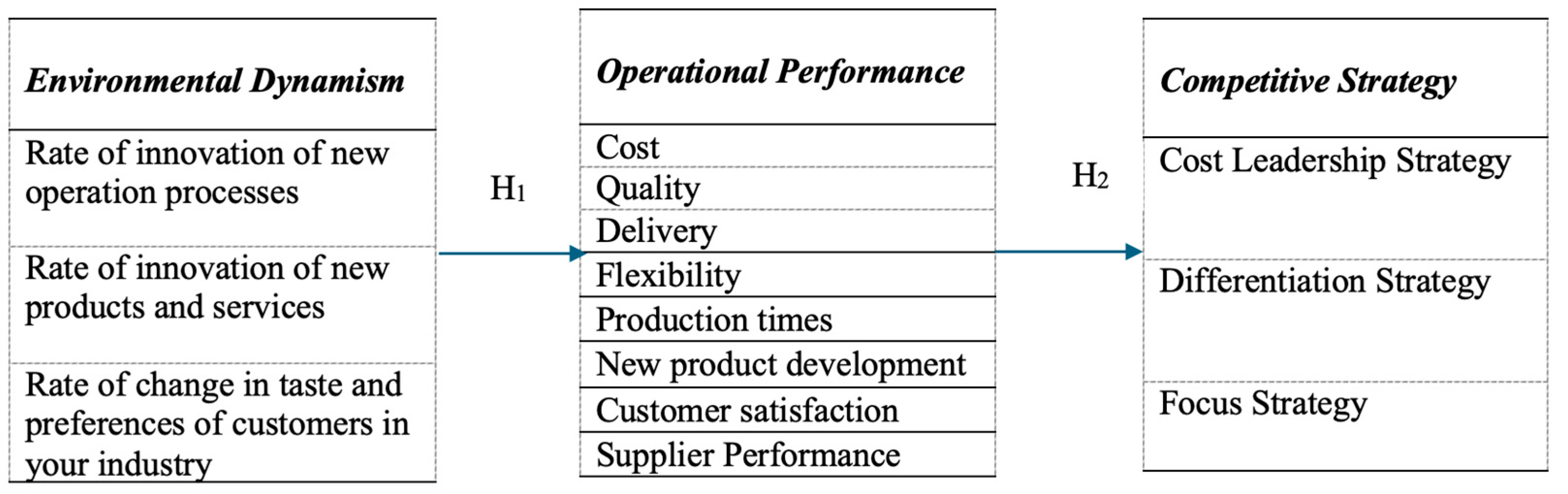
Assessing Operational Performance of Manufacturing Companies in the Context of Environmental Dynamism, and Competitive Strategy

Abstract
1. Introduction
2. Theoretical Framework
2.1. Environmental Dynamism
2.2. Operational Performance–Competitive Strategy
3. Methodology
3.1. Sample and Procedure
3.2. Measurement of Variables
4. Results and Discussion
4.1. Exploratory Factor Analysis (EFA)
4.2. Confirmatory Factor Analysis (CFA)
4.3. Assessment of Overall Model Fit
4.4. Discussion
5. Conclusions
5.1. Managerial Implications
5.2. Limitations and Future Research
Funding
Institutional Review Board Statement
Informed Consent Statement
Data Availability Statement
Conflicts of Interest
References
- Abel, C. E., Okeke, M. U. C., Kenechukwu, C. G., Ezeah, M., & Yusuf, K. O. (2025). Is the resource-based view still strategic? A critical reassessment of its strengths, limitations, and relevance in the era of digital transformation and dynamic capabilities. Preprints. [Google Scholar] [CrossRef]
- Acquaah, M., Amoako-Gyampah, K., & Jayaram, J. (2011). Resilience in family and nonfamily firms: An examination of the relationships between manufacturing strategy, competitive strategy and firm performance. International Journal of Production Research, 49(18), 5527–5544. [Google Scholar] [CrossRef]
- Adeniji, C. G., Salau, O. P., Joel, O. O., Onayemi, O. O., & Alake, O. R. (2024). Personality-traits taxonomy and operational and environmental performance: A cross-sectional analysis of small and medium scale manufacturing enterprises. Sustainability, 16(8), 3497. [Google Scholar] [CrossRef]
- Akal, Z. (1998). İşletmelerde performans ölçüm and denetimi: Çok yönlü performans göstergeleri [Performance measurement in organizations: Multi facet performance indicators]. No: 473. Milli Prodüktivite Merkezi (National Productivity Center). (In Turkish) [Google Scholar]
- Alavi, M., Visentin, D. C., Thapa, D. K., Hunt, G. E., Watson, R., & Cleary, M. (2020). Exploratory factor analysis and principal component analysis in clinical studies: Which one should you use? Journal of Advanced Nursing, 76, 1886–1889. [Google Scholar] [CrossRef] [PubMed]
- Amoako-Gyampah, K. (2003). The Relationships among selected business environment factors and manufacturing strategy: Insights from an emerging economy. Omega, 31(4), 287–301. [Google Scholar] [CrossRef]
- Amoako-Gyampah, K., & Acquaah, M. (2008). Manufacturing strategy, competitive strategy and firm performance: An empirical study in a developing economy environment. International Journal of Production Economics, 111(2), 575–592. [Google Scholar] [CrossRef]
- Amoako-Gyampah, K., & Boye, S. S. (2001). Operations strategy in an emerging economy: The case of the Ghanaian manufacturing industry. Journal of Operations Management, 19(1), 59–79. [Google Scholar]
- Anatan, L., & Radhi, F. (2007). The effect of environmental factors, manufacturing strategy and technology on operational performance: Study amongst Indonesian manufacturers. Jurnal Ekonomi & Bisnis, 1(3), 119–133. [Google Scholar]
- Antonio, K. W., Yam, R. C., & Tang, E. (2007). The impacts of product modularity on competitive capabilities and performance: An empirical study. International Journal of Production Economics, 105(1), 1–20. [Google Scholar] [CrossRef]
- Badri, M. A., Davis, D., & Davis, D. (2000). Operations strategy, environmental uncertainty and performance: A path analytic model of industries in developing countries. Omega, 28(2), 155–173. [Google Scholar] [CrossRef]
- Barney, J. B. (1991). Firm resources and sustained competitive advantage. Journal of Management, 17(1), 99–120. [Google Scholar] [CrossRef]
- Bayraktar, E., Tatoglu, E., Turkyilmaz, A., Delen, D., & Zaim, S. (2012). Measuring the efficiency of customer satisfaction and loyalty for mobile phone brands: Evidence from an emerging market. Expert Systems with Applications, 39(1), 99–106. [Google Scholar] [CrossRef]
- Boyer, K. K., & Lewis, M. W. (2002). Competitive priorities: Investigating the need for trade-offs in operations strategy. Production and Operations Management, 11(1), 9–20. [Google Scholar] [CrossRef]
- Boyer, K. K., & McDermott, C. (1999). Strategic consensus in operations strategy. Journal of Operations Management, 17(3), 289–305. [Google Scholar] [CrossRef]
- Bulbul, H., & Gules, H. K. (2004). Türk sanayi işletmelerinde ileri imalât teknolojileri kullanımı ve performansa etkisi [Implementation of advanced manufacturing technologies in the Turkish industrial companies and its effect on performance]. METU Studies in Development (ODTÜ Gelişme Dergisi), 31, 1–42. (In Turkish) [Google Scholar]
- Cai, S., & Yang, Z. (2014). On the relationship between business environment and competitive priorities: The role of performance frontiers. International Journal of Production Economics, 151, 131–145. [Google Scholar] [CrossRef]
- Cepeda, G., & Vera, D. (2007). Dynamic capabilities and operational capabilities: A knowledge management perspective. Journal of Business Research, 60(5), 426–437. [Google Scholar] [CrossRef]
- Chahal, H., Gupta, M., Bhan, N., & Cheng, T. C. E. (2020). Operations management research grounded in the resource-based view: A meta-analysis. International Journal of Production Economics, 230, 107805. [Google Scholar] [CrossRef]
- Chatha, K. A., & Butt, I. (2015). Themes of study in manufacturing strategy literature. International Journal of Operations & Production Management, 35(4), 604–698. [Google Scholar] [CrossRef]
- Chavez, R., Yu, W., Jacobs, M. A., & Feng, M. (2017). Manufacturing capability and organizational performance: The role of entrepreneurial orientation. International Journal of Production Economics, 184, 33–46. [Google Scholar] [CrossRef]
- Chen, L., & Paulraj, A. (2022). Understanding supply chain relationships: A theoretical perspective. International Journal of Operations & Production Management, 42(8), 1245–1267. [Google Scholar]
- Chin, H. G., & Saman, M. Z. M. (2004). Proposed analysis of performance measurement for a production system. Business Process Management Journal, 10(5), 570–583. [Google Scholar] [CrossRef]
- Chopra, G., Madan, P., Jaisingh, P., & Bhaskar, P. (2019). Effectiveness of e-learning portal from students’ perspective: A structural equation model (SEM) approach. Interactive Technology and Smart Education, 16(2), 94–116. [Google Scholar] [CrossRef]
- Cutillo, L. (2019). Parametric and multivariate methods. In S. Ranganathan, M. Gribskov, K. Nakai, & C. Schönbach (Eds.), Encyclopedia of bioinformatics and computational biology (pp. 738–746). Elsevier. [Google Scholar]
- Davis, R. A., & Vokurka, R. J. (2005). The effect of facility size on manufacturing structure and performance. Industrial Management & Data Systems, 105(8), 1022–1038. [Google Scholar] [CrossRef]
- Diamantopoulos, A., & Siguaw, J. A. (2000). Introducing LISREL: A guide for the uninitiated. Sage Publications. [Google Scholar]
- Dong, B. (2024). Environmental dynamism’s influence on firm growth: Transformational leadership and strategic flexibility insights. The Journal of High Technology Management Research, 35(2), 100499. [Google Scholar] [CrossRef]
- Douglas, A. (2002, May 20–22). Improving manufacturing performance. Annual Quality Congress Proceedings (pp. 725–731), Denver, CO, USA. [Google Scholar]
- Dubey, R., Gunasekaran, A., & Childe, S. J. (2019). Big data analytics capability in supply chain agility: The moderating effect of organizational flexibility. Management Decision, 57(8), 2092–2112. [Google Scholar] [CrossRef]
- Eisenhardt, K. M., & Martin, J. A. (2017). Dynamic capabilities: What are they? In The SMS Blackwell handbook of organizational capabilities (pp. 341–363). Blackwell Publishing. [Google Scholar]
- Ellitan, L. (2017). The role of environmental uncertainty, competitive strategy, and operation strategy to achieve competitive advantage: The case of east JAVA manufacturing SMEs. EPRA International Journal of Multidisciplinary Research (IJMR), 3(11), 8–23. [Google Scholar]
- Flynn, B. B., Huo, B., & Zhao, X. (2010). The impact of supply chain integration on performance: A contingency and configuration approach. Journal of operations management, 28(1), 58–71. [Google Scholar] [CrossRef]
- Forker, L. B., Vickery, S. K., & Droge, C. L. M. (1996). The contribution of quality to business performance. International Journal of Operations & Production Management, 16(8), 44–62. [Google Scholar] [CrossRef]
- Fornell, C., & Larcker, D. F. (1981). Evaluating structural equation models with unobservable variables and measurement error. Journal of Marketing Research, 18(1), 39–50. [Google Scholar] [CrossRef]
- Garg, V. K., Walters, B. A., & Priem, R. L. (2003). Chief executive scanning emphases, environmental dynamism, and manufacturing firm performance. Strategic Management Journal, 24(8), 725–744. [Google Scholar] [CrossRef]
- Hair, J. F., Anderson, R. E., Tatham, R. L., & Black, W. C. (1998). Multivariate data analysis (4th ed.). Prentice Hall. [Google Scholar]
- Hair, J. F., Black, W. C., Babin, B. J., Anderson, R. E., & Tatham, R. L. (2006). Multivariate data analysis (6th ed.). Prentice Hall. [Google Scholar]
- Hallgren, M., Olhager, J., & Schroeder, R. G. (2011). A hybrid model of competitive capabilities. International Journal of Operations & Production Management, 31(5), 511–526. [Google Scholar] [CrossRef]
- Hayes, R. H., & Wheelwright, S. G. (1984). Restoring our competitive edge: Competing through manufacturing. John Wiley & Sons, US. [Google Scholar]
- Henseler, J., Hubona, G., & Ray, P. A. (2016). Using PLS path modeling in new technology research: Updated guidelines. Industrial Management & Data Systems, 116, 2–29. [Google Scholar] [CrossRef]
- Hill, T. J. (1989). Manufacturing strategy: Text and cases (2nd ed.). Irvin. [Google Scholar]
- Hitt, M. A., Keats, B. W., & DeMarie, S. M. (1998). Navigating in the new competitive landscape: Building strategic flexibility and competitive advantage in the 21st century. Academy of Management Perspectives, 12(4), 22–42. [Google Scholar] [CrossRef]
- Huang, M. C., Yen, G. F., & Liu, T. C. (2014). Reexamining supply chain integration and the supplier’s performance relationships under uncertainty. Supply Chain Management: An International Journal, 19(1), 64–78. [Google Scholar] [CrossRef]
- Hung, S. C., Hung, S. W., & Lin, M. J. J. (2015). Are alliances a panacea for SMEs? The achievement of competitive priorities and firm performance. Total Quality Management & Business Excellence, 26(1–2), 190–202. [Google Scholar]
- Jabbour, C. J. C., Maria da Silva, E., Paiva, E. L., & Almada Santos, F. C. (2012). Environmental management in Brazil: Is it a completely competitive priority? Journal of Cleaner Production, 21(1), 11–22. [Google Scholar] [CrossRef]
- Jayaram, J., Choon Tan, K., & Laosirihongthong, T. (2014). The contingency role of business strategy on the relationship between operations practices and performance. Benchmarking: An International Journal, 21(5), 690–712. [Google Scholar] [CrossRef]
- Johannessen, J. A., & Olsen, B. (2009). Systemic knowledge processes, innovation and sustainable competitive advantages. Kybernetes, 38(3/4), 559–580. [Google Scholar] [CrossRef]
- Karatepe, O. M. (2006). Customer complaints and organizational responses: The effects of complainants’ perceptions of justice on satisfaction and loyalty. International Journal of Hospitality Management, 25(1), 69–90. [Google Scholar] [CrossRef]
- Kero, C. A., & Bogale, A. T. (2023). A systematic review of resource-based view and dynamic capabilities of firms and future research avenues. International Journal of Sustainable Development & Planning, 18(10), 3137–3154. [Google Scholar]
- Kickert, W. J. M. (1985). The magic word flexibility. International Studies of Management and Organization, 14(4), 6–31. [Google Scholar] [CrossRef]
- Kim, K., Seo, E. H., & Kim, C. Y. (2025). The relationships between environmental dynamism, absorptive capacity, organizational ambidexterity, and innovation performance from the dynamic capabilities perspective. Sustainability, 17(2), 449. [Google Scholar] [CrossRef]
- Krajewski, L. J., & Ritzman, L. P. (2005). Operations management: Processes and value chains. Prentice Hall. [Google Scholar]
- Kumar, S., & Bhatia, M. S. (2021). Environmental dynamism, industry 4.0 and performance: Mediating role of organizational and technological factors. Industrial Marketing Management, 95, 54–64. [Google Scholar] [CrossRef]
- Leong, G. K., Snyder, D. L., & Ward, P. T. (1990). Research in the process and content of operations strategy. Omega, 18(2), 109–122. [Google Scholar]
- Li, L. L. X. (2000). Manufacturing capability development in a changing business environment. Industrial Management and Data Systems, 100(6), 261–270. [Google Scholar]
- Liang, Y., Koo, J. M., & Lee, M. J. (2024). The interplay of environmental dynamism, digitalization capability, green entrepreneurial orientation, and sustainable performance. Sustainability, 16(17), 7674. [Google Scholar] [CrossRef]
- Lubis, N. W. (2022). Resource based view (RBV) in improving company strategic capacity. Research Horizon, 2(6), 587–596. [Google Scholar] [CrossRef]
- Ma, X., Chen, L., & Yu, X. (2025). Failure analysis and sme growth: The role of dynamic capabilities and environmental dynamism. Systems, 13(8), 690. [Google Scholar] [CrossRef]
- Mwaka, J., Cherono, V., & Kituku, M. G. (2025). Influence of supplier relationship on operational performance of manufacturing firms in Kajiado county. Academic Journal of Humanities and Social Sciences Research, 2(1), 1–12. [Google Scholar]
- Omar, R., Zailani, S., Sulaiman, M., & Ramayah, T. (2006). Supplier involvement, customer focus, supply chain technology and manufacturing performance: Findings from a pilot study. In 2006 IEEE international conference on management of innovation and technology (pp. 876–880). IEEE. [Google Scholar]
- Peng, D. X., Schroeder, R. G., & Shah, R. (2011). Competitive priorities, plant improvement and innovation capabilities, and operational performance: A test of two forms of fit. International Journal of Operations & Production Management, 31(5), 484–510. [Google Scholar]
- Peteraf, M. A. (1993). The cornerstones of competitive advantage: A resource-based view. Strategic Management Journal, 14(3), 179–191. [Google Scholar] [CrossRef]
- Porter, M. E. (1998). Competitive strategy: Techniques for analyzing industries and competitors. The Free Press. [Google Scholar]
- Priem, R. L., & Butler, J. E. (2001). Is the resource-based “view” a useful perspective for strategic management research? Academy of Management Review, 26(1), 22–40. [Google Scholar]
- Raduan, C. R., Jegak, U., Haslinda, A., & Alimin, I. I. (2009). Management, strategic management theories and the linkage with organizational competitive advantage from the resource-based view. European Journal of Social Sciences, 11(3), 402–418. [Google Scholar]
- Rosenzweig, E. D., & Easton, G. S. (2010). Tradeoffs in manufacturing? A meta-analysis and critique of the literature. Production and Operations Management, 19(2), 127–141. [Google Scholar] [CrossRef]
- Rosenzweig, E. D., Roth, A. V., & Dean, J. W., Jr. (2003). The influence of an integration strategy on competitive capabilities and business performance: An exploratory study of consumer products manufacturers. Journal of Operations Management, 21(4), 437–456. [Google Scholar] [CrossRef]
- Ruba, R. M., Chiloane-Tsoka, G. E., & Van der Westhuizen, T. (2023). Moderating effect of business environmental dynamism in the innovativeness—Company performance relationship of congolese manufacturing companies. Economies, 11(7), 191. [Google Scholar] [CrossRef]
- Sahoo, S. (2021). Aligning operational practices to competitive strategies to enhance the performance of Indian manufacturing firms. Benchmarking: An International Journal, 28(1), 131–165. [Google Scholar] [CrossRef]
- Salah, A., Cağlar, D., & Zoubi, K. (2023). The impact of production and operations management practices in improving organizational performance: The mediating role of supply chain integration. Sustainability, 15(20), 15140. [Google Scholar] [CrossRef]
- Samsudin, Z., & Ismail, M. D. (2019). The concept of theory of dynamic capabilities in changing environment. International Journal of Academic Research in Business and Social Sciences, 9(6), 1071–1078. [Google Scholar] [CrossRef]
- Schoenherr, T., Power, D., Narasimhan, R., & Samson, D. (2012). Competitive capabilities among manufacturing plants in developing, emerging, and industrialized countries: A comparative analysis. Decision Sciences, 43(1), 37–72. [Google Scholar] [CrossRef]
- Schroeder, R. G., & Flynn, B. B. (2001). High performance manufacturing: Global perspectives. John Wiley & Sons. [Google Scholar]
- Sharma, S., Mukherjee, S., Kumar, A., & Dillon, W. R. (2005). A simulation study to investigate the use of cutoff values for assessing model fit in covariance structure models. Journal of Business Research, 58(7), 935–943. [Google Scholar] [CrossRef]
- Shavarini, S. K., Salimian, H., Nazemi, J., & Alborzi, M. (2013). Operations strategy and business strategy alignment model (case of Iranian industries). International Journal of Operations & Production Management, 33(9), 1108–1130. [Google Scholar] [CrossRef]
- Sirmon, D. G., Hitt, M. A., & Ireland, R. D. (2007). Managing firm resources in dynamic environments to create value: Looking inside the black box. Academy of Management Review, 32(1), 273–292. [Google Scholar] [CrossRef]
- Sirmon, D. G., Hitt, M. A., Ireland, R. D., & Gilbert, B. A. (2011). Resource orchestration to create competitive advantage: Breadth, depth, and life cycle effects. Journal of Management, 37(5), 1390–1412. [Google Scholar] [CrossRef]
- Skinner, W. (1969). Manufacturing-missing link in corporate strategy. Harvard Business Review, 47(3), 136–145. [Google Scholar]
- Stevens, J. (2002). Applied multivariate statistics for the social sciences (Vol. 4). Lawrence Erlbaum Associates. [Google Scholar]
- Swamidass, P. M., & Newell, W. T. (1987). Manufacturing strategy, environmental uncertainty and performance: A path analytic model. Management Science, 33(4), 509–524. [Google Scholar] [CrossRef]
- Swink, M., & Harvey Hegarty, W. (1998). Core manufacturing capabilities and their links to product differentiation. International Journal of Operations & Production Management, 18(4), 374–396. [Google Scholar] [CrossRef]
- Škrinjar, R., Bosilj-Vukšic, V., & Indihar-Štemberger, M. (2008). The impact of business process orientation on financial and non-financial performance. Business Process Management Journal, 14(5), 738–754. [Google Scholar] [CrossRef]
- Teece, D. J. (2007). Explicating dynamic capabilities: The nature and microfoundations of (sustainable) enterprise performance. Strategic Management Journal, 28(13), 1319–1350. [Google Scholar] [CrossRef]
- Teece, D. J., Pisano, G., & Shuen, A. (1997). Dynamic capabilities and strategic management. Strategic Management Journal, 18(7), 509–533. [Google Scholar] [CrossRef]
- Tomee, S. L., Akuku, C., & Waribu, J. (2025). Cost leadership and performance of small and medium businesses in West Pokot County, Kenya. The Strategic Journal of Business & Change Management, 12(4), 879–893. [Google Scholar]
- Tracey, M., Vonderembse, M. A., & Lim, J. S. (1999). Manufacturing technology and strategy formulation: Keys to enhancing competitiveness and improving performance. Journal of Operation Management, 17, 411–428. [Google Scholar] [CrossRef]
- Upton, D., Hayes, R., Pisano, G., & Wheelwright, S. (2004). Operations, strategy and technology: Pursuing the competitive edge. John Wiley and Sons. [Google Scholar]
- Vickery, S. K., Droge, C., & Markland, R. E. (1993). Production competence and business strategy: Do they affect firm performance. Decision Sciences, 24(2), 435–455. [Google Scholar] [CrossRef]
- Vonderembse, M. A. (2002). Building supplier relations that enhance manufacturing performance. Spiro Press. [Google Scholar]
- Ward, P. T., Bickford, D. J., & Leong, G. K. (1996). Configurations of manufacturing strategy, business strategy, environment and structure. Journal of Management, 22(4), 597–626. [Google Scholar] [CrossRef]
- Ward, P. T., & Duray, R. (2000). Manufacturing strategy in context: Environment, competitive strategy and manufacturing strategy. Journal of Operations Management, 18(2), 123–138. [Google Scholar] [CrossRef]
- Ward, P. T., Duray, R., Leong, G. K., & Sum, C. (1995). Business environment, operations strategy, and performance: An empirical study of Singapore manufacturers. Journal of Operations Management, 13(2), 99–115. [Google Scholar] [CrossRef]
- Ward, P. T., McCreery, J. K., & Anand, G. (2007). Business strategies and manufacturing decisions: An empirical examination of linkages. International Journal of Operations & Production Management, 27(9), 951–973. [Google Scholar]
- Ward, P. T., McCreery, J. K., Ritzman, L. P., & Sharma, D. (1998). Competitive priorities in operations management. Decision Sciences, 29(4), 1035–1046. [Google Scholar] [CrossRef]
- Wu, L. Y. (2010). Applicability of the resource-based and dynamic-capability views under environmental volatility. Journal of Business Research, 63(1), 27–31. [Google Scholar] [CrossRef]
- Yu, W., & Ramanathan, R. (2011). Effects of firm characteristics on the link between business environment and operations strategy: Evidence from China’s retail sector. International Journal of Services and Operations Management, 9(3), 330–364. [Google Scholar]
- Zhang, Q., Vonderembse, M. A., & Lim, J. (2003). Manufacturing flexibility: Defining and analyzing relationships among competence, capability, and customer satisfaction. Journal of Operations Management, 21(2), 173–191. [Google Scholar]
- Zhang, X., Wang, Z., Luo, W., Guo, F., & Wang, P. (2025). How digital orientation affects innovation performance? Exploring the role of digital capabilities and environmental dynamism. Systems, 13(5), 346. [Google Scholar] [CrossRef]


| Competitive Manufacturing Priorities | Definition of Competitive Manufacturing Priorities |
|---|---|
| Cost | Production is a costly activity. If companies can shorten the cost, they can also shorten the price, and increase their profitability (Schroeder & Flynn, 2001; Chin & Saman, 2004). The dimension “cost” includes cost per unit, cost of labor and materials, fixed cost, and storage cost. |
| Quality | The ability of products to satisfy the requirements of the consumers, conformance to specifications, and producing free-of-error products are the most common definitions of quality, which is a precondition for today’s global and competitive markets (Li, 2000; Forker et al., 1996; Krajewski & Ritzman, 2005; Akal, 1998). |
| Delivery | Delivery is defined as a time-based capability by Li (2000). Delivery speed and delivery on time (Schroeder & Flynn, 2001; Chin & Saman, 2004) are the main expectations of today’s customers, requiring reliability as much as speed. |
| Flexibility | Flexibility refers to responding to the changing conditions in the market quickly (Amoako-Gyampah, 2003). Dimensions of flexibility could be listed as volume, product, process, machine, labor, etc. |
| Production-related times | Production-related times are vital for both the companies and the customers. Production-related times must be decreased. |
| New Product Development | Companies which can launch novel products and/or make incremental changes are defined as innovative (Chin & Saman, 2004). New product developments are measured by the R&D investment level and consistency, and the number of new products introduced per year. |
| Customer Satisfaction | To sustain their organizations, companies should satisfy their customers (Q. Zhang et al., 2003). No. of complaints, rate of returns, and unmet demand creates unsatisfaction. Customer satisfaction is ensured by providing an effective after-sales service and quick response. |
| Supplier Performance | Supplier performance refers to suppliers’ capability in satisfying the requirements of original equipment manufacturers (OEM). It means the capability of delivering the right material/part/product to the right manufacturing facility, at the right cost, at the right time, and with minimal shipping defects (Vonderembse, 2002; Omar et al., 2006). In today’s global environment, lead time of the supplier, material quality, on-time delivery rate of supplier, percentage of defective product in transportation, supply of materials whenever needed (flexibility), including the supplier in new product development processes, and integration of suppliers with quality control systems are key points that affect the manufacturing companies. |
| Frequency | Percent | |
|---|---|---|
| Sector | ||
| Metal Sector | 59 | 28.1 |
| Clothing Sector | 36 | 17.1 |
| Petrochemicals Sector | 31 | 14.8 |
| Fast-moving Consumer Goods (FMCG) Sector | 28 | 13.3 |
| Vehicle Sector | 21 | 10.0 |
| Construction Materials sector | 18 | 8.6 |
| Paper-based Sector | 8 | 3.8 |
| Wood-based Sector | 5 | 2.4 |
| Mining Sector | 2 | 1.0 |
| Electricity Sector | 2 | 1.0 |
| Firm Age (years) | ||
| Up to 10 | 19 | 9.0 |
| 10 to 20 | 39 | 18.6 |
| 20 to 30 | 41 | 19.5 |
| 30 to 40 | 48 | 22.9 |
| 40 to 50 | 28 | 12.4 |
| 50+ | 33 | 15.7 |
| Non-respondent | 4 | 1.9 |
| Company Scale | ||
| Small and Medium-Sized Companies (SMEs) | 124 | 59.0 |
| Large Companies | 85 | 40.5 |
| Non-respondent | 1 | 0.5 |
| Capital structure of the company | ||
| Domestic capital-based companies | 159 | 75.7 |
| Foreign and domestic capital-based companies | 51 | 24.3 |
| Factors | Factor Loading | % of Variance Explained | Cronbach Alpha |
|---|---|---|---|
| Environmental Dynamism | 74.77 | 0.821 | |
| Rate of product and service innovations | 0.910 | ||
| Rate of process innovations | 0.883 | ||
| Rate of change in customers’ expectations in the sector where the company operates | 0.797 | ||
| Competitive Strategy | 44.45 | 0.755 | |
| Cost Leadership | 0.980 | ||
| Focus | 0.823 | ||
| Differentiation | 0.807 | ||
| Operational Performance | 35.97 | 0.729 | |
| Customer Satisfaction | 0.706 | ||
| Quality | 0.647 | ||
| Supplier Performance | 0.646 | ||
| Production-Related Times | 0.635 | ||
| New Product Development | 0.600 | ||
| Delivery | 0.583 | ||
| Flexibility | 0.486 | ||
| Cost | 0.453 |
| Construct | Items | Item Reliability | Composite Reliability | Average Variance Extracted (AVE) |
|---|---|---|---|---|
| Recommended Value | >0.70 | >0.50 | ||
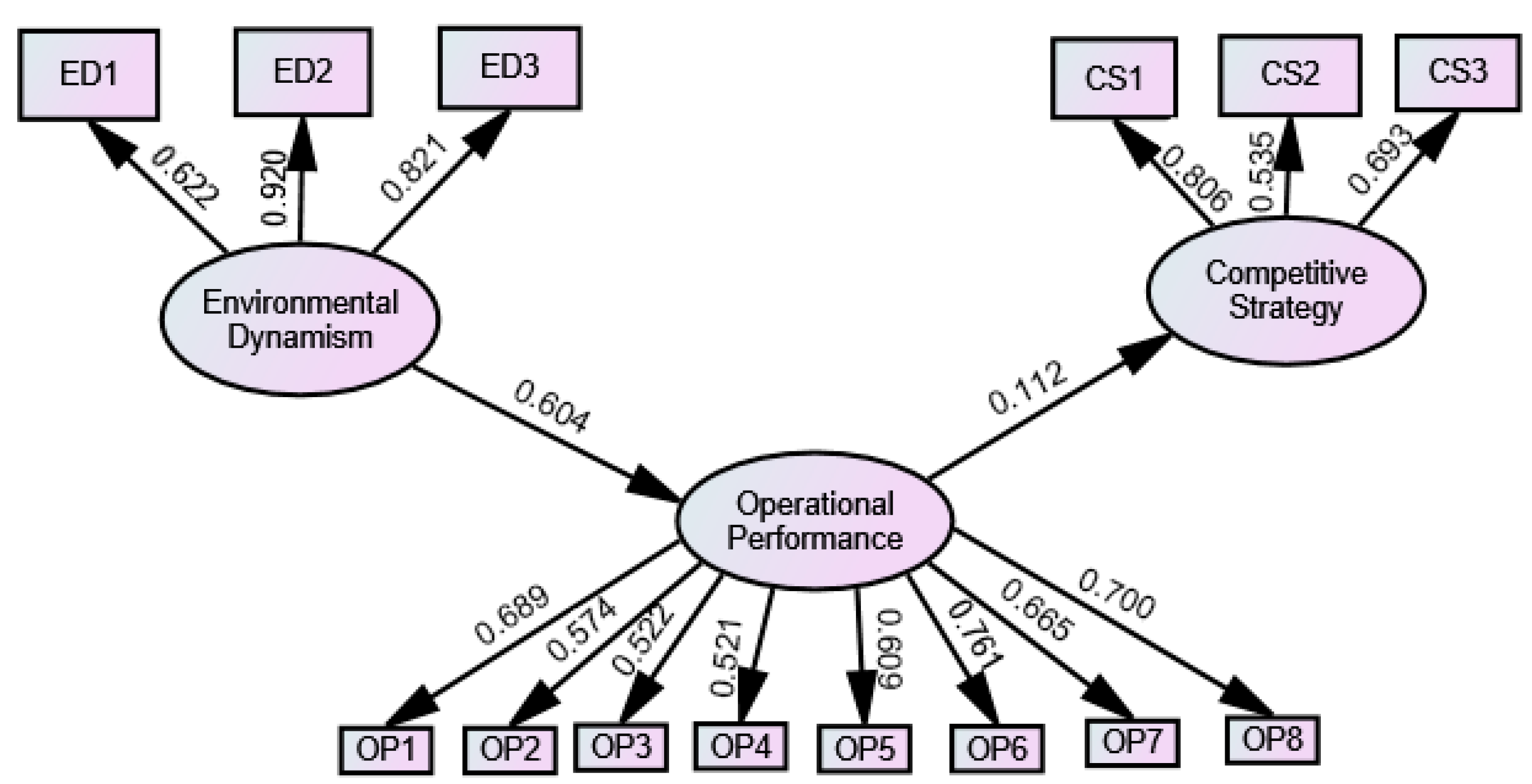
| Environmental Dynamism | 0.84 | 0.64 | ||
| Rate of change in customers’ expectations in the sector where the company operates | ED1 | 0.622 * | ||
| Rate of product and service innovations | ED2 | 0.920 * | ||
| Rate of process innovations | ED3 | 0.821 * | ||
| Competitive Strategy | 0.72 | 0.47 | ||
| Cost Leadership | CS1 | 0.806 * | ||
| Focus | CS2 | 0.535 * | ||
| Differentiation | CS3 | 0.693 * | ||
| Operational Performance | 0.84 | 0.40 | ||
| Cost | OP1 | 0.689 * | ||
| Quality | OP2 | 0.574 * | ||
| Delivery | OP3 | 0.522 * | ||
| Flexibility | OP4 | 0.521 * | ||
| Production-related times | OP5 | 0.609 * | ||
| Customer Satisfaction | OP6 | 0.761 * | ||
| New Product Development | OP7 | 0.665 * | ||
| Supplier Performance | OP8 | 0.700 * |
| Environmental Dynamism | Operational Performance | Competitive Strategy | |
|---|---|---|---|
| Environmental Dynamism (ED) | - | ||
| Operational Performance (OP) | 0.592 | - | |
| Competitive Strategy (CS) | 0.547 | 0.447 | - |
| Fit Index | Recommended Value | Proposed Model | Fit (Yes/No) |
|---|---|---|---|
| Chi-square | 156.148 | ||
| Df | 75 | ||
| p value | >0.05 | 0.000 | Yes |
| Chi-square/Df | 1.00–5.00 | 2.082 | Yes |
| RMSEA | <0.08 | 0.072 | Yes |
| NFI | >0.80 | 0.857 | Yes |
| IFI | >0.90 | 0.920 | Yes |
| TLI | >0.90 | 0.885 | No |
| CFI | 0.90 | 0.918 | Yes |
Disclaimer/Publisher’s Note: The statements, opinions and data contained in all publications are solely those of the individual author(s) and contributor(s) and not of MDPI and/or the editor(s). MDPI and/or the editor(s) disclaim responsibility for any injury to people or property resulting from any ideas, methods, instructions or products referred to in the content. |
© 2026 by the author. Licensee MDPI, Basel, Switzerland. This article is an open access article distributed under the terms and conditions of the Creative Commons Attribution (CC BY) license.
Share and Cite
Karaman Akgül, A. Assessing Operational Performance of Manufacturing Companies in the Context of Environmental Dynamism, and Competitive Strategy. Adm. Sci. 2026, 16, 179. https://doi.org/10.3390/admsci16040179
Karaman Akgül A. Assessing Operational Performance of Manufacturing Companies in the Context of Environmental Dynamism, and Competitive Strategy. Administrative Sciences. 2026; 16(4):179. https://doi.org/10.3390/admsci16040179
Chicago/Turabian StyleKaraman Akgül, Arzu. 2026. "Assessing Operational Performance of Manufacturing Companies in the Context of Environmental Dynamism, and Competitive Strategy" Administrative Sciences 16, no. 4: 179. https://doi.org/10.3390/admsci16040179
APA StyleKaraman Akgül, A. (2026). Assessing Operational Performance of Manufacturing Companies in the Context of Environmental Dynamism, and Competitive Strategy. Administrative Sciences, 16(4), 179. https://doi.org/10.3390/admsci16040179