Article

Artificial Intelligence: Accelerating Innovation in Sustainable Lean Production Systems


by
Mustapha Jebor
1,*,
Hanaa Hachimi
1,
Ikhlef Jebbor
2,
Hayet Benhamida
3 and
Zoubida Benmamoun
2
1
Laboratory of Advanced Systems Engineering, National School of Applied Sciences ENSA, Ibn Tofail University Campus, Kenitra 14000, Morocco
2
College of Engineering and Computing, Liwa University, Abu Dhabi 41009, United Arab Emirates
3
College of Business, Liwa University, Abu Dhabi 41009, United Arab Emirates
*
Author to whom correspondence should be addressed.
Adm. Sci. 2026, 16(4), 178; https://doi.org/10.3390/admsci16040178

Submission received: 29 December 2025 / Revised: 8 March 2026 / Accepted: 31 March 2026 / Published: 7 April 2026

Abstract

Lean production philosophy and sustainability approach have become a critical framework for efficiency improvement, waste reduction, and promoting sustainable manufacturing practices. In the age of artificial intelligence (AI), there is a synergy, which has now found new dimensions, data-driven decision-making, predictive analytics, and operational agility. AI technologies promise to transform industrial processes by converging lean production and sustainability principles, a synergy explored in this paper. AI APIs enable the use of AI to improve resource utilization, reduce environmental pressure, and maintain economic growth inherent to all business sectors while also fostering social accountability. In this study, a robust regression model is employed to study the role of AI in moderating the lean practices and sustainability outcomes relationship, using a sample of 528 manufacturing firms. The results show that the contribution of AI technologies to economic, ecological, and social sustainability is effectively multiplied by that of lean production. This research offers a framework to help practitioners and policymakers optimize production systems in line with Sustainable Development Goals. Finally, the study delivers actionable recommendations for navigating skill gaps and cybersecurity risks that were identified. In sum, this paper contributes to the rapidly emerging conversation by providing empirical evidence on AI’s moderating role in the lean–sustainability relationship and offering a strategic framework for practitioners.

1. Introduction

The manufacturing industry has been longing to reconcile operational performance, economic development, and environmental sustainability. The Toyota Production System has laid the lean philosophy of production that is most effective in resource utilization and minimization of waste (Womack et al., 2007). At the same time, the frameworks of sustainability focus on the combination of environmental, economic, and social aspects in industrial activities (Caldera et al., 2019). Nevertheless, empirical investigations that apply artificial intelligence (AI) as the moderating factor between lean and sustainability have been limited to date, although lean and Sustainability have been researched separately. This paper fills that gap with research on how AI can improve sustainability performance via lean production systems. Although, the novelty and dynamism of modern global supply chains call for a shift in paradigms in conjunction with the latest technology. Within these, AI has become a key enabler, able to provide never before seen characteristics of real-time monitoring, predictive decisions and process optimization (Ani et al., 2024; Zong & Guan, 2024; El Abbadi et al., 2020).
The use of lean production has been acknowledged as a superb change methodology for eradicating waste and refining operations to guarantee that aimed sources of value delivery are prioritized. Lean principles originated from the Toyota Production System and have fundamentally reformulated the way manufacturing processes work in that companies employ pull systems, just-in-time (JIT) production, and Kaizen (continuous improvement). For instance, pull systems: time schedules directly for production to match customer demand, thus avoiding overproduction and inventory excesses. Similarly, JIT production focuses on precise time timing in the disbursement of resources, minimal idle inventories, and maximum waste. As discussed by Berhe et al. (2023), Kaizen engenders a culture of continuous improvement where little and systemic changes are developed and created to eliminate inefficiency and enhance ultimate quality. However, traditional lean systems frequently adapt inadequately to emerging and fluctuating demands of global markets. Rigid process designs with poor flexibility to respond dynamically to fast-changing consumer demand, supply chain disruptions, or market shifts create these challenges. AI comes into the picture as a deconstructive enabler. With the use of lean systems leaping across the limitations of specific sectors, industries can overcome this limitation by leveraging AI technologies to integrate lean principles. AI-enabled predictive analytics, for example, helps manufacturers predict demand swings with much greater accuracy (Tian et al., 2024), ensuring resource optimization congruent with the real-time market environment. Further, IoT-enabled devices allow real-time monitoring of equipment performance, which negates the downtime incurred, and machine learning algorithms can dynamically adjust production schedule in the event of a disruption. These capabilities enable industries to supply fast responses to immediate market demands as well as improve industrial system resilience, providing a basis for sustainable competitiveness in an era of a swift industrial landscape change.
At the same time, sustainability has been fast becoming a cornerstone of industrial strategies as organizations increasingly realize the essential need to integrate economic growth with environmental stewardship and social responsibility. A comprehensive approach to assessing the long-run viability and ethical responsibility of the practice of industry is the triple-bottom-line approach, that is, the economic, environmental, and social dimensions (Svensson et al., 2018). Profitability and operational efficiency are the focus of economic sustainability, such that industries remain financially viable whilst denying the use of unnecessary resources. Environmental sustainability contemplates reducing emissions, conserving resources, and minimizing environmental degradation. A fundamental aspect of social sustainability is the provision of factors that ensure the good well-being of employees, communities, and society at large while maintaining equity, diversity, and ethical practices. A great number of mutual benefits have been found in the integration of sustainability principles with lean production. For instance, waste reduction is a basic idea of lean production that directly agrees with ecological goals, reducing the footprint of the environment in the manufacturing operation. Like resource utilization, non-properly efficient resource utilization not only contributes to improving economics but also upholds the force of keeping ecological balance. However, it is often the practical execution of sustainability initiatives at scale that proves difficult. These efforts require the use of sophisticated tools to process large volumes of data and enable real-time decision-making (Bibri, 2018). Companies are now able to easily integrate their sustainability objectives into their operational framework with the help of AI technologies that excel at solving these challenges. For instance, IoT sensors can monitor energy consumption and emissions continuously on installation and determine inefficiencies, which can be addressed at that point in real time. Supply chain sustainability metrics, environmental impact assessments, and interactions, for example, are complex datasets on which machine learning algorithms provide actionable insights by analyzing the data in ways that allow for informed decision-making. Additionally, AI-powered automation enables the scalability of sustainability practices, enabling industries to replicate their success in one location while taking it to other sites and locations. AI bridges the gap between lean production and sustainability so that industries can carry out their environmental and social objectives while not sacrificing economic performance, thereby serving as a core enabler in the new industrial ecosystem (Tortorella et al., 2024; X. Chen et al., 2023).
Industrial transformation has reached a new era with revolutionized AI technologies that accelerate the pace and enhance levels of efficiency, precision, and sustainability. Fundamental components of AI are machine learning, big data analytics, robotics, and the Internet of Things (IoT)—technology that enables the collection of, processing, and acting on large volumes of data with unprecedented accuracy. Leveraging data in real time is the new fingerprint of how data can contribute to the solution of the complexity of current industrial problems (de Oliveira et al., 2023). This trend is at the front line of machine learning—using predictive and prescriptive analytics that optimize every possible aspect of production. Machine learning systems can learn from historical data through advanced algorithms, find patterns, and predict these with awesome accuracy. For example, these systems can forecast demand variations, allowing manufacturers to adapt automatic production schedules according to demand forecasts without overproduction or shortage. Big data analytics also processes complex datasets obtained from different areas within the company’s supply chains, production lines, and customer feedback to make that decision in actionable ways (Chatterjee et al., 2023; Khlie et al., 2025). Also, part of AI is robotics, which is driving automation to new heights. Modern robotic systems are more accurate and faster than previous systems, and they also learn. This means they can obtain real-time feedback on their operations, refine with each iteration, and get better and better over time. All these advancements have revolutionized tasks performed in assembly and quality control, to name a couple, with the ability to reduce costs and improve precision (Khourshed, 2023). In addition, IoT technologies have widened the range of AI capabilities through the creation of interconnected networks of smart devices that can perform industrial process monitoring and control from a distance. Real-time data, coming from IoT sensors, on critical metrics such as energy consumption, equipment performance, and emissions provides an opportunity to take immediate corrective action to improve operations (Sharma et al., 2024).
The integration of AI technologies with lean production systems has brought about exciting possibilities in matters of operations. A prime example of this integration is where predictive maintenance has brought AI into the field. IoT-based sensors collect data that are fed to machine learning algorithms to estimate failed equipment before its occurrence. In this strategy, control is kept in the hands of management to prevent the equipment from breaking down at any one time, increase the service span of a given machine or engine, and reduce maintenance expenses. For example, the actualization of manufacturing predictive maintenance techniques helps manufacturers plan equipment downtime during non-critical times of production (Murtaza et al., 2024). However, the paper shows that AI also has a critical role in developing sustainability results alongside improving efficiency. Energy consumption and emissions visibility through such internet gadgets as the IoT system enables manufacturers to detect negative variations and fix them promptly. For example, IoT sensors can easily notice energy waste during production, and this can help output on how to adjust the settings on the machines in the production line. In the same manner, different machine learning algorithms can analyze the production schedule for efficiency in waste reduction, thus endorsing sustainable production schedules. These two gains of enhanced efficiency and minimization of environmental degradation serve the AI’s purpose of contributing to the mainstream triple-bottom-line outcomes of sustainability, which include economic, environmental, and social performance (Svensson et al., 2018). To this end, the combination of robotics and IoT intensifies such advantages. AI-operated machines can manage the materials needed for production in a better way and can cause fewer errors. For instance, robotic systems can detect faulty products during the production process and thus reduce more resource investment in the production of unwanted products. On the other hand, IoT systems offer insight into every aspect of manufacturing, from procurement to end delivery, allowing manufacturers to intervene in any way that will both increase their revenue and move towards sustainability (Majeed et al., 2021; Ren et al., 2019).
However, integrating AI into lean and sustainability frameworks has its challenges, and this paper aims at discussing them below. Of these, especially noteworthy is the lack of skilled talent within the labor force. Sophisticated AI applications demand skills in data analysis, programming, and system interfacing, EVs of which are not obtainable in most manufacturing organizations (advanced AI tools entail data science, programming, and system interface familiarity, domains in which most manufacturing personnel lack formal education; Maity (2019)). However, the integration of advanced systems based on AI attracts risk based on cybersecurity threats that need to be addressed comprehensively. Also, the high fixed costs associated with the deployment of AI solutions are especially high for SMEs, making these innovations hard to scale (Al-Sharafi et al., 2023).
The research question of interest in this paper is how AI can moderate the relationship between lean production and sustainability with the acknowledgment of the existing research gap. Recent scholars have published papers that address each of these ideas in isolation, but scant empirical research exists regarding their collective interaction in the space of industrial transformation due to AI. For that reason, this research aims to outline a holistic framework on exactly how AI technologies can be harnessed to achieve sustainable lean. In particular, it focuses on the economic, environmental, and social effects of this integration and provides suggestions depending on its adoption or rejection by policymakers and practitioners.
Although the academic relevance of lean production and sustainability is increasing as a field of study on its own, the lack of research that focuses on the interaction of these concepts as a set is particularly significant in the context of AI-based industrial transformation. In particular, the field of empirical research on the exact moderating effect of AI on improving the impacts of lean practices in all three aspects of sustainability, including economic, environmental, and social, is underprivileged.
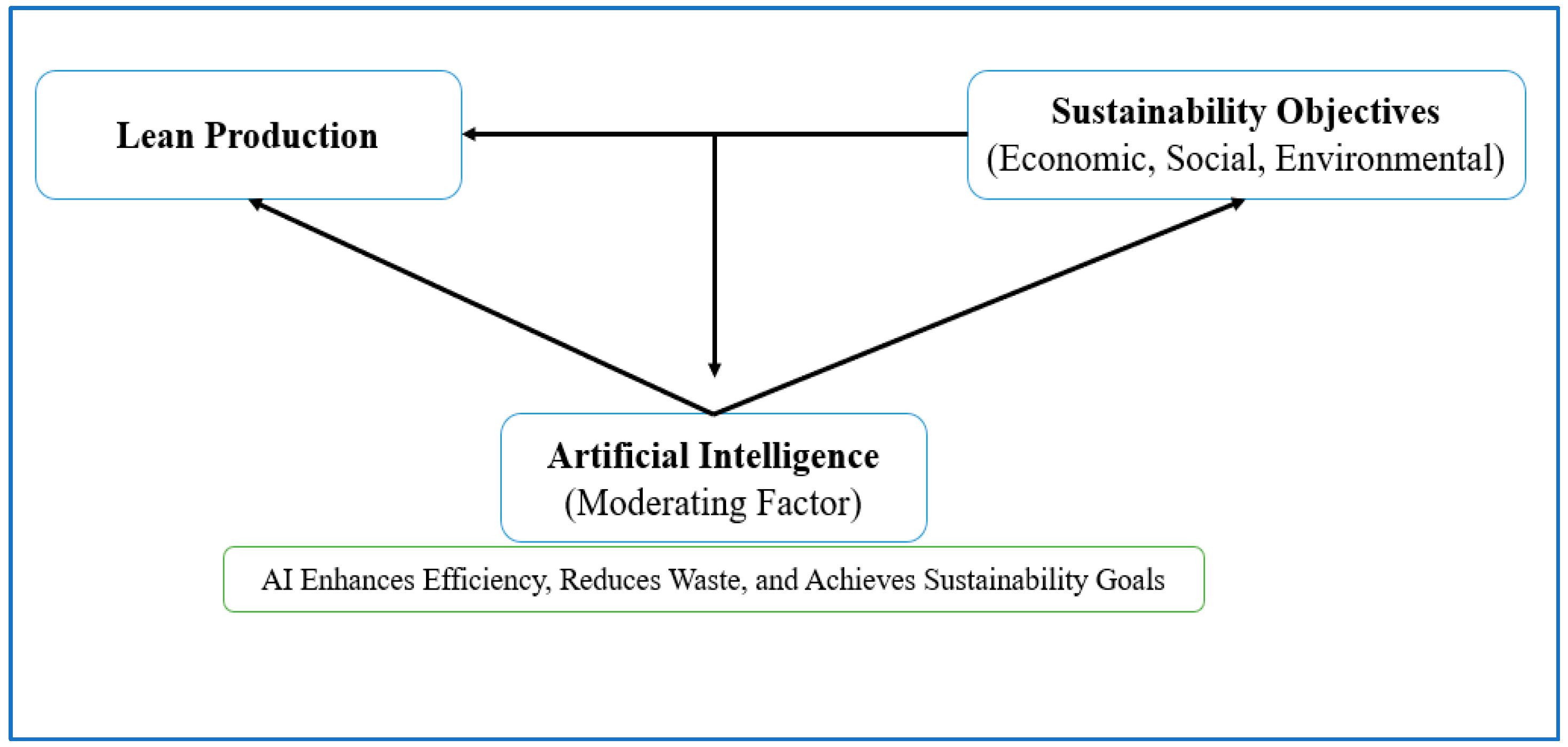
The conceptual model for this study, as shown in Figure 1, is in complete agreement that AI is a moderating variable that enhances the impacts of lean production in attaining sustainability goals. Pursuing improved real-time monitoring, predictive functionality, and adaptability, AI redefines lean from a restrictive process to a dynamic analytical model.
In this paper, three different contributions that fill these gaps are made. To begin, we present a combination of the empirical test of the nexus between lean and sustainability, which can be discussed as moderated by AI in all three dimensions of sustainability, compared to the previous studies that considered these relationships separately. Second, whereas prior research has modeled AI as a direct performance driver, we theoretically model and empirically validate AI to act as a moderator, which carries significant theoretical and practical implications because it implies that AI inherently enhances the existing performance, not substitutes it. Third, our research is the first large-scale empirical test of PLS-SEM with an empirical sample of 528 manufacturing firms to estimate these moderating effects to surpass the conceptual and case study evidence that is prevalent in this new area of research (Table 1).
This paper thus seeks to fill this gap by formulating and testing a comprehensive framework that makes AI a key moderator. It empirically explores the possibility to use AI technologies to enhance the sustainability performance of lean production systems to provide both researchers and industrial executives with some practical insights.
That is why this research aims to answer the following key research question: What is the effect of lean production practices moderated by AI technologies on the outcome of triple-bottom-line sustainability? The novelty of the present paper is that it represents the first large-scale empirical test applying the umbrella Structural Equation Modeling (PLS-SEM) technique as a moderator between lean production and overall sustainability performance in the manufacturing industry.

2. Literature Review

Lean production philosophy, which is a revolutionary concept in today’s manufacturing world, has its roots in the Toyota Production System. This focuses on waste elimination, work standardization, and customer value creation, which are the principles that still act as a cornerstone in operational management (Womack et al., 2007). Lean practices have been embraced worldwide right from the beginning, developing over time to cater to existing new manufacturing environments, more complexities, and stiffer competition (Ding et al., 2023). At its core, lean production is built upon three foundational tenets: However, the four fundamental elements of the Toyota Production System include just-in-time (JIT) production, pull systems, and Kaizen. The Japanese technique of JIT production means making only what is required, where it is needed, and at the exact time that it is needed. JIT eliminates the buildup of inventory, and synchronizes work with actual demand, making optimal use of resources and thus cutting waste (Rossini et al., 2024). In addition, there is also the pull system, where actually, the production is pulled by the customer order rather than pushing production based on forecasting, which causes overproduction and the creation of adverse inventory. Last is a Japanese term meaning continuous improvement, which encourages the employees to always look for ways to improve the process. Such an approach not only enhances performance but also increases employee involvement and creativity (Berhe, 2022). This form of production has spread from the automobile industry to other industries including health, space, and electronic industries. For example, Ciano et al. (2021) explain how lean practices help reduce sources of supply chain buckling, whereas Tortorella et al. (2020) show how lean can promote operational adaptability in high variability settings. Furthermore, lean production principles are in sync with sustainability, because the latter by its nature guides to eliminate inefficiency and waste (Caldera et al., 2019). However, the lean production philosophy is not without certain issues that system manufacturers fail to note. The existing lean systems are inflexible to change, which creates problems in changing markets, and thus require combination with modern advancements such as AI technology (Sjödin et al., 2018). Today, the push for global markets creates more lean production principles as a strong base of an organizational operational strategy concept supporting efficiency, organizational resiliency, and long-term value generation.
The theoretical bases of this study are two supplementary theoretical perspectives. Firstly, Dynamic Capabilities Theory (Teece et al., 1997) offers the overall concept to explain how firms can combine, develop, and refocus internal and external resources to deal with the changing environment at a rapid pace. AI technologies can be viewed as a dynamic capability in our case scenario, which helps companies to improve their lean processes and deliver high sustainability results. The reason why AI moderates this is theoretically sound, since it improves the capacity of a firm to feel the opportunities (e.g., detecting waste in real time), grab them (e.g., predictive maintenance scheduling), and remodel operations (e.g., adaptive production systems). Second, our perception of the interdependence of social (lean culture, employee engagement) and technical (AI tools, IoT) subsystems (Min & Kim, 2024), which should collaborate to produce the best performance, is informed by Socio-Technical Systems Theory (Trist & Bamforth, 1951). This theoretical prism explains why AI does not substitute the concept of lean but enhances it by offering the technical base within which social actors enhance their decision-making processes. This set of theories leads to the conclusion that it is appropriate to view AI as a moderator as opposed to an antecedent or outcome.
However, new research reveals several drawbacks of conventional lean systems. For instance, Caldera et al. (2017) observed that some fundamental lean processes are not very flexible within volatile contexts. Correspondingly, Cifone et al. (2021) observed that coordinating lean practices with strict supply networks that cross many geographical boundaries poses a significant challenge. These challenges made it possible to integrate AI technologies to work hand in hand with lean principles to increase work flexibility and capacity. Figure 1 presents the comparison of the old lean model and the lean model that is enabled by AI, pointing to the fact that technology makes the model more agile and enables real-time decision-making.
Today, sustainability has emerged as a major driver of industrial change owing to the critical global issues of environmental pollution, lack of social justice, and unpredicted economic hardship. As more organizations come to realize that business operations affect ecological systems, populations, and markets, sustainable development has emerged as the organizational strategy guiding international organizations (Caldera et al., 2018). Central to this shift is the triple-bottom-line framework, which evaluates industrial performance across three dimensions: economic, environmental, and social sustainability in the context of terrorism (Priyadarshini et al., 2023). This comprehensive framework makes sure that profitability is not only the objective of the company, which leads to a negative impact on the environment and society; this comprehensive framework is a perfect setup for sustainable industrial development.
Economic sustainability focuses on economic returns and optimum use of funds; on generating value with the least costs. Environmental sustainability is a concept closely related to the decrease in the industry’s impact on the natural environment and attaining improved resource usage by lowering the number of emissions and effective implementation of cleaner production techniques. On the other hand, social sustainability tends to address the relevant issues of equal employment opportunity, communities, and employee and stakeholder satisfaction. In unison, these dimensions present a strategic guide for industries to search for sustainable development without having a destructive impact on future generations’ capacity to transform current needs (Jebbor et al., 2025).
Most modern techniques have been developed based on sustainable methods, with technology insight offering the methods needed to assess and improve industrial practices. New technologies in industries using IoT sensors, big data, and AI are useful for measuring sustainability index and can impact the performance of industries producing sustainability outcomes (Costa et al., 2023). For example, carbon emissions, water consumption, and energy use sensors within the IoT can help monitor various facilities to capture the level of detail that can be used by management. According to El Jaouhari et al. (2024), incorporating IoT-enabled systems in sustainability frameworks helps industries monitor and manage environmental effects in real time, thereby empowering them to correct any imbalance that may occur as soon as possible.
In addition, conventional machine learning algorithms support sustainability processes by analyzing large and diverse datasets to determine patterns of future effects on the environment. For instance, using predictive analytics in supply chain management will help in cutting pulses on fuel, in turn cutting emissions. All these tools not only promote and reinforce environmental stewardship but also complement economic objectives that entail cost-effective approaches toward performance enhancement. Such innovations show the ability of digital technologies to integrate sustainability into standard industrial processes (Hasan et al., 2024; Javaid et al., 2022; Alsabt et al., 2024).
Lean production and sustainability have been a topic of interest in both the academic literature and industrial practice. General goals, which include waste minimization, resource utilization, and productivity enhancement, form the commonalities of both frameworks, thereby making their integration quite logical (Tiwari et al., 2020). JIT and Kaizen are fundamental to lean production, by their nature will not create excess waste or increase the use of resources beyond what is necessary, and therefore are sustainable by design.
However, to combine these frameworks, it is necessary to reconcile several dichotomies, first of all cost efficiency and sustainable ecological and social performance in the long run. For instance, while lean production focuses on obtaining quick financial returns, sustainability is most frequently achieved through the use of initial investments in renewable energy, waste, and green technologies. Such costly investments pay off in the long run because they minimize operating risk, facilitate compliance with rules and regulations, and help build a favorable corporate image (León & Calvo-Amodio, 2017).
The implementation of lean production and sustainability also entails a shift in organizational culture or orientation, thereby replacing a self-focusing measure of profits with a more holistic approach of people, the planet, and profits. On the one hand, the outlined shift can be supported by the integration of technology systems, which offer the data and analytics required to close the gap between them. For example, systems of IoT can monitor production efficiency and environmental indicators simultaneously with the further optimization that lean systems can achieve (Wang et al., 2018).
Table 2 synthesizes significant work realized to compare lean production implementation with sustainability strategies and results in terms of approach, incidences, and prospects.
The synthesis of the major works (Table 2) shows a consistent opinion about the basic compatibility of lean and sustainability objectives, specifically in terms of waste minimization (Caldera et al., 2017; Jebbor et al., 2024). Nonetheless, there is a point of difference that arises with regard to implementation issues. Although a few studies identify organizational and cultural challenges to integration (León & Calvo-Amodio, 2017), others specify technical constraints of the traditional lean systems in dynamic environments (Ciano et al., 2021; Cifone et al., 2021). Such a deviation highlights one of the feedback items, namely, the necessity of digital and AI technologies that will mediate such issues and open the collaborative potential of lean and sustainability, which is the cornerstone of our conceptual model.
The latest advancement in AI technology has transformed the functional structure of manufacturing, providing the application of real-time data analysis, prediction, automation, and the like. When AI systems are incorporated into lean and sustainability processes, industries also experience several long-standing issues, including scalability, accuracy, and flexibility. Figure 1 also depicts a moderate association of AI with lean production and sustainability goals, indicating how they are connected.
AI technologies have prominently improved industrial processes in such fields as predictive maintenance, energy optimization, and supply chain operations. Predictive maintenance utilizes AI methods to examine data from sensors and then estimate equipment failures. This approach reduces the chances of sudden breakdowns, increases the durability of machines, and avoids costly repair at opportune times (Kumar et al., 2023). Likewise, for energy optimization, sensor technology from IoTs coupled with machine learning techniques is applied in the real-time control of energy usage. These technologies identify these weaknesses and, in the process, help manufacturers minimize their effects on the environment and save costs (M. Chen et al., 2022). Similarly, the supply chain becomes streamlined using AI-related analytical tools that consider areas for improvement in the chain. This makes it possible for organizations to keep on managing their activities, cutting costs, increasing efficiency, and looking for ways of optimizing the use of natural resources, hence meeting the tenets of lean production and sustainability (Ciano et al., 2021). All these developments point to the possibility of achieving breakthroughs with the help of AI in the current complex industrial environment.
The implementation of AI into lean production and sustainable focus is a visionary innovation in current industrialization processes that provides improvement in efficiency, resource management, and real-time choice (Table 3). However, the effective use of the matter is complicated by several challenges, which makes the assistance unreachable to many learners. A few challenges include inadequate skills from human labor to tackle complex AI, deep learning, data analysis, and integrated systems (Tissir et al., 2023; Powell et al., 2024). Also, security threats are another issue to consider, which have been greatly enhanced due to the advanced AI technology systems and IoT devices connected to global industrial networks (Ciano et al., 2021). Another factor that stands in the way of pragmatic implementation is the cost of investment, especially concerning the hardware and software that supports the advent of AI (Shang et al., 2023). To meet these challenges, the intervention should be conducted in a multiple-stakeholder manner. Appropriate human capital development strategies are significant, which may include training for a specific project or targeted human capital development projects like the academic linkages that maintain and train the employees in how to work with AI systems. Moreover, well-equipped cybersecurity has to be developed, such as utilizing encryption techniques, intrusion detection systems, and cybersecurity auditing for the protection of precious industrial data (Moosavi et al., 2024). Government support through sponsoring, grants, tax credits, or any other means would help SMEs to share a major proportion of the cost, hence encouraging more take-up and promoting innovation in the use of AI technologies. AI combination with lean and sustainability frameworks is still a progressing process, and there are several promising paths for future research noted above. One of them is the need to work out more effective algorithms for making decisions in real time in a growing number of complex industrial environments. Another appealing area is the application of new technologies such as blockchain to supply chain management, where transparency and accountability for supply chain processes and activities can be improved through the use of distributed, secure, and tamper-proof records (Kusi-Sarpong et al., 2022). Blockchain has been argued to complement AI in organizations by improving the level of security and transparency of data flow in production ecosystems. Last of all, longitudinal research is crucial for assessing the overall effects that AI-enabled lean sustainability programs have on organizational performance. These studies would offer important information about how AI closures affect major performance indicators in the long run, particularly operative efficiency, financial risk, and environmental impact (Caldera et al., 2017). Configuring these research areas is crucial to moving the research forward regarding ways of leveraging AI in lean and sustainable production so that industries can optimize their search for better and efficacious production methods without compromising on sustainability.

3. Methodology

This research examines how lean production philosophy, sustainability strategies, and AI technologies are incorporated into one method as a study of Industry 4.0. The method applies surveys in conjunction with regression analysis to investigate the connections between lean principles and the goals and objectives of sustainability alongside the variable of AI. The study framework developed based on the relevant literature is presented in Figure 1 below, which captures the hypotheses between these constructs.

3.1. Study Framework

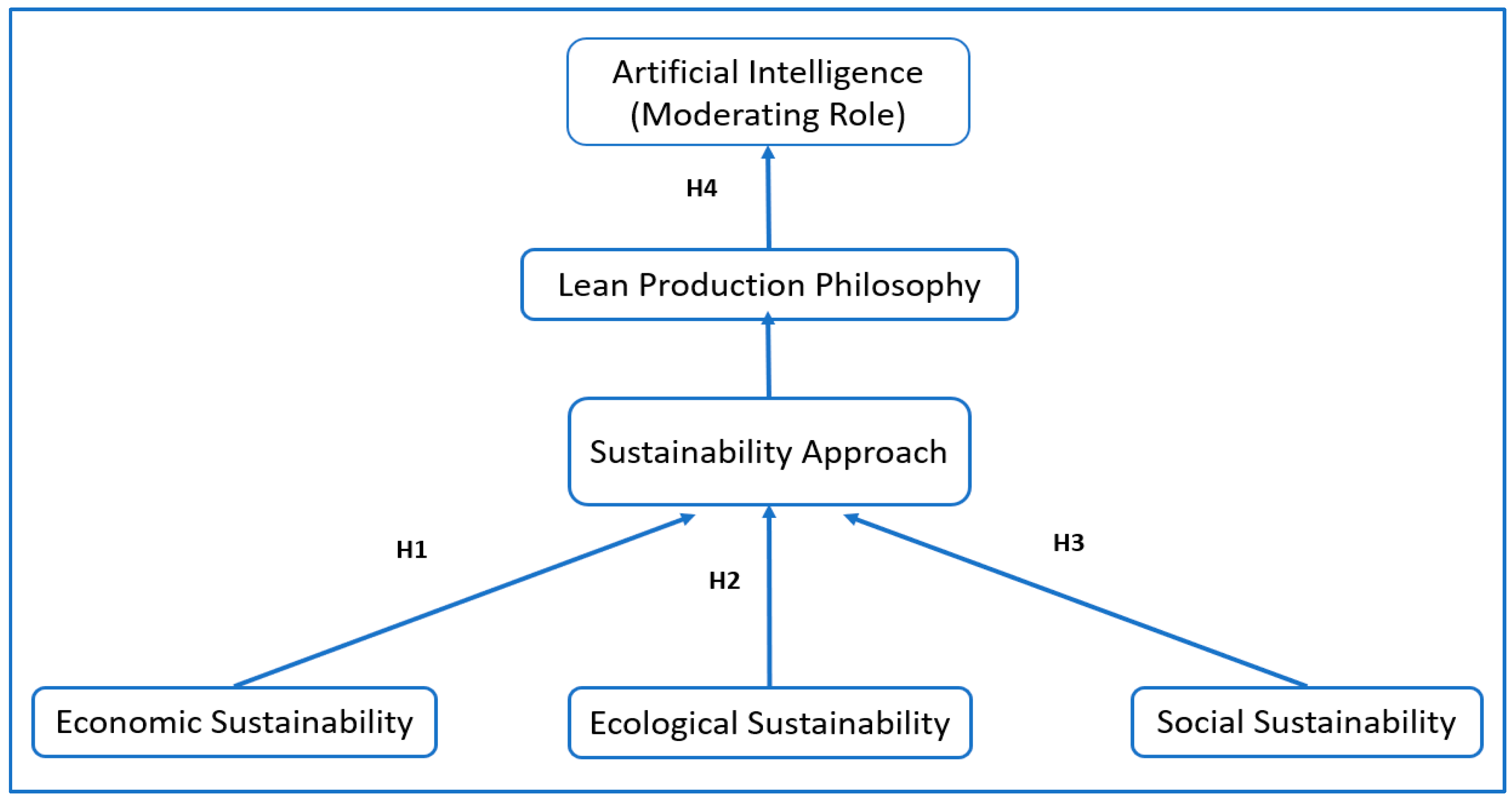
The conceptual framework for this paper is shown in Figure 2. It shows the link between lean production philosophy and sustainability goals; economic, ecological, and social. Industry 4.0 is the broader technological environment under which Industry 4.0 occurs, with AI technology as a variable that improves the application of lean principles for achieving sustainable aims.
H1: 
Ground in the principles of waste reduction and value stream optimization inherent to lean theory (Womack et al., 2007), which directly lower operational costs, we hypothesize that lean production philosophy contributes most to the economic sustainability factors.
H2: 
Based on the alignment between lean’s goal of resource efficiency and the environmental pillar of the triple-bottom-line (Elkington, 1997), we hypothesize that lean production philosophy has a great lesson to learn when it comes to ecological sustainability.
H3: 
Drawing on literature linking lean practices like Kaizen to employee empowerment and safety (Berhe et al., 2023), which aligns with social sustainability, we hypothesize that the philosophy of lean production considerably affects social sustainability.
H4: 
Given that AI enhances information processing and systemic responsiveness (de Oliveira et al., 2023), we hypothesize that Industry 4.0 involves AI, which acts as a link/moderator between lean production philosophy and sustainability outcomes.
The presence of this moderating role is theoretically justified by the fact that the ability of AI to operate in real-time data analytics and predictive modeling enables lean systems to be more dynamic and precise. To illustrate, AI can streamline a JIT schedule not only according to historical demand but also predictive and real-time market cues, which will eliminate waste and resource consumption more efficiently and directly enhance environmental and economic sustainability.

3.2. Data Collection

The data were gathered among manufacturing companies based in southern Europe (Italy, Spain, and Portugal) and in chosen areas of North Africa (Morocco and Tunisia) during the period between January and June 2024. These areas were chosen as the regions will be at various levels of adoption of Industry 4.0: the southern European countries will have moderately to highly adopted AI, and the North African countries will be at an earlier stage of adoption that will permit variability in the moderating variable. The sample consisted of firms in five manufacturing subsectors, namely automotive (32%), electronics (24%), machinery and equipment (19%), chemicals (15%), and pharmaceuticals (10%).
To be able to select the participating firms with some degree of exposure to lean practices and AI technologies, a purposive sampling strategy was used. Several sources were used in the construction of the sampling frame: (1) the membership directories of the industry associations of the countries in which the research was conducted, (2) a commercial database of manufacturing companies (Orbis Europe), and (3) the respondents of the former Industry 4.0 projects who agreed to participate in the research. Out of an original sample of about 1200 companies that could be located in the target areas, we have used the inclusion criteria of the following (see Section 2): a firm must have at least 50 employees, at least two years of documented lean usage, and self-reported the use of at least one AI technology in their production processes. The results of this screening process were 680 qualified firms. Since we have limited resources, and to meet the target sample size of about 500 responses, we requested all the 680 eligible firms to take part. The phone was used to find the most appropriate participant (operations manager, plant manager, or sustainability officer) and the email containing the survey link was sent. Such strategy aligns with other operations management survey research studies (Melnyk et al., 2018).
This research study used a quantitative approach and sought to sample only manufacturing and logistics professionals. Respondents were chosen purposively from organizations applying Industry 4.0 technologies. Seven hundred questionnaires were administered, out of which 540 questionnaires were returned, which makes the response rate 90%.
Survey Instrument: The questionnaire used statements rated using a 5-point Likert scale of the following:
  • Lean production principles: green, lean thinking comprising waste reduction, JIT, and Kaizen.
  • Sustainability objectives: global, competitive, operational, financial, natural, and socio-political.
  • AI technologies: monitoring, goals, forecast, analysis, performance, optimization, and interaction.
In order to determine whether common method bias was possible, Harman conducted the single-factor test. In the unrotated factor solution, it can be seen that the first factor explained 32.4% of the variance, which is less than 50%, implying that common method bias is not a serious threat to the validity of our results. Moreover, procedural remedies, including anonymity of respondents and counterbalancing the question sequence, were also applied in the process of designing the survey.
The inclusion criteria were the following: (1) firms had to be in the manufacturing industry, where the core of their business activities was in automotive, electronics, machinery, chemicals, or pharmaceuticals; (2) they had to have at least 50 employees to be considered complex enough; (3) the firms had to have applied AI technology in their production processes at least once over the past two years, which was verified by preliminary screening questions concerning JIT, Kaizen, or machine learning, as well as waste reduction activities; (4) the operations should be based in the target regions. These were used to make sure that the respondents had enough experience in using both lean and AI to answer meaningful questions regarding the interaction.
The survey incorporated a 5-point Likert scale (1 = Strongly Disagree to 5 = Strongly Agree). Validated scales, which were adapted based on the literature, were used as constructs:
-
Lean production principles (LPPs): This is a modified version of Rossini et al. (2024), Berhe et al. (2023) and Mirali et al. (2025). Example item: Our production is not based upon customer demand forecasts, but on the actual customer demand (Pull System/JIT).
-
Sustainability objectives (SOs): Triple-bottom-line system (Svensson et al., 2018). Examples are economic (we are cost-focused and do not compromise our long-term sustainability), environmental (we monitor and want to cut our carbon footprint), and social (we invest in workers and their well-being, as well as community growth).
-
AI: Items were designed based on the current research on Industry 4.0 (Ciano et al., 2021; de Oliveira et al., 2023; Jebbor et al., 2026; López-Solís et al., 2025) according to the level of usage. Sample question: ‘We apply predictive analytics that are based on AI to maintain or predict demand.’ Scale adaptation was performed after having gone through a stringent process of translation and back-translation (non-English setting) and was pre-tested using a sample of 15 industry professionals and scholars to achieve face and content validity.

3.3. Analytical Framework

Partial Least Squares Structural Equation Modeling (PLS-SEM) was selected for this study due to its suitability for exploratory research, its ability to handle complex models with moderating effects, and its less restrictive requirements regarding data distribution and sample size compared to covariance-based SEM (CB-SEM) (Hair et al., 2019).
  • Control Variables:
To eliminate the possible alternative explanations, we added three control variables in the structural model: (1) firm size (logarithm of number of employees), as larger corporations may be more able to afford lean implementation and AI adoption; (2) industry subsector (dummy-coded with automobile as reference), as the pressure to be sustainable and the maturity of AI solutions may vary across industries; and (3) country (dummy-coded with Italy as reference), because the regulation environment and the development of digital infrastructure may differ across countries. These variables were factored as explicit predictors of the three outcomes of sustainability.
The analytical framework consisted of two stages:

3.3.1. Measurement Model Validation

This stage ensured the reliability and validity of the constructs:
Cronbach’s Alpha: Check internal structure reliability (Cronbach, coefficient must be more than 0.7).
Composite Reliability (CR): Facilitates construct reliability (threshold is greater than 0.8).
Average Variance Extracted (AVE): Convergent validity is verified with the help of the threshold being more than 0.5.
The reliability and validity statistics of the constructs are presented in Table 4.

3.3.2. Structural Model Assessment

This stage aimed to analyze the hypotheses and relationship between the constructs using a modeling technique known as Partial Least Squares Structural Equation Modeling (PLS-SEM). Key metrics included:
-
Path Coefficients (β): Pointing out the level of relationship.
-
t-statistics: Determining practical importance (t > 1.96 for p < 0.05).
-
Variance Inflation Factor (VIF): Confirms that multicollinearity was not a problem (VIF < 3.0).

3.3.3. Statistical Analysis

The statistical analysis focused on evaluating:
-
Direct Effects: Exploration of how lean production impacted the three pillars of sustainability; economic, environmental, and social.
-
Moderating Role of AI: To what degree do AI technologies support or impact these relationships. According to the study, SmartPLS was used for structural model analysis and SPSS for the descriptive statistics. In the relationship among the constructs, some of the visualization tools used include Python and Tableau for graphical representation.
The study models all constructs as reflective and not formative. This is a decision that is made on the basis of both theory and practice. Our constructs (lean principles, sustainability objectives, and AI technologies) are theoretically defined as latent variables, which are reflected in recognizable behavior and results and is in line with the reflective measurement theory (Diamantopoulos & Winklhofer, 2001). By way of instance, a company with an implicit belief in lean production would adopt JIT, Kaizen, and waste minimization strategies; these strategies do not bring about lean production but are indicative of lean production. On the same note, sustainability orientation makes firms seek economic, environmental, and social results and not the other way round. We empirically measured the suitability of the reflective specification by (1) high inter-item correlations in each construct, (2) face validity that the items are interchangeable measures of the same underlying construct, and (3) the anticipation that the deletion of an item would not change the conceptual domain of the construct. All validity measures (Cronbach’s alpha, composite reliability, AVE) are suitable with reflective constructs and we have ensured that all of the items correspond to the ideal items on factor loadings (>0.70).

3.4. Results Validation

To ensure robustness, the study applied:
-
Bootstrapping: A resampling technique used here to estimate the coefficients using 5000 iterations.
-
Cross-Validation: This finding was compared to previous research on lean–sustainability integration to validate the emerging framework against previous research.

4. Results

In this Discussion sub-chapter, we will delve into a comprehensive analysis of the significant findings previously presented. Our aim is to expand our understanding of the implementation and significance of the research results within a broader context. Through open-mindedness and critical evaluation, we can identify patterns, trends, and potential alternative explanations that contribute to strengthening the validity of our findings. Let us embark on an exploration of diverse perspectives and generate valuable insights to advance knowledge and shape future research directions.
The findings of this research offer an understanding of the synchronization of lean production mentality, sustainability goals, and Innovative Industry 4.0 responsible for AI tools. This section discusses the results that are obtained from the statistical analysis to establish the reliability of constructs employed in the study, the testing of hypotheses formulated in the study, and the moderating impact, which has been exercised by the AI technologies.
  • Measurement Model Assessment:
Before testing the hypotheses, we tested reliability and validity of the measurement model. Factor loads of all the measurement items were well above the recommended factor loading of 0.70, and the factor loading varies between 0.71 and 0.88, with statistical significance (p = 0.001) for all. In particular, the loadings of lean production principles were between 0.73 and 0.84, economic sustainability was between 0.71 and 0.82, ecological sustainability was between 0.74 and 0.86, social sustainability was between 0.71 and 0.82, and AI technologies was between 0.77 and 0.88. These findings suggest that every item is a suitable measure of the corresponding construct. The full list of factor loadings along with t-statistics is available on request to the respective author.
  • Construct Validity and Reliability:
Reliability and validity of the measurement model were tested with values for Cronbach’s Alpha, Composite Reliability (CR), and Average Variance Extracted (AVE). As presented in Table 4, all constructs measured up to the recommended standards for internal consistency, reliability, and convergent validity.
The significant correlations established herein provide evidence in support of the reliability of the constructs, to facilitate a more accurate structural model analysis.
  • Structural Model Assessment:
The proposed relationships associated with the structural model were examined using lean production principles of sustainability and AI technologies as the moderating variable. The fitment of the recommended path model is also presented as path coefficients, t-statistic values, and p-values in Table 5 below.
The predictive accuracy and relevance of the structural model were determined. The endogenous constructs coefficient of determination (R2) was as follows: economic sustainability = 0.62, ecological sustainability = 0.54, social sustainability = 0.48, which shows that the model is substantially and moderately explanatory. All of the Stone–Geisser Q2 values (acquired through blindfolding) were positive (economic: 0.58, ecological: 0.50, social: 0.44), which validated the predictive applicability of the model. The values of all Variance Inflation Factors (VIFs) were less than 3.0, which shows that there were no severe cases of multicollinearity.
  • Model Fit Assessment:
To determine the fits of the proposed model, we have measured a number of the fit indices. The saturated model had a Standardized Root Mean Square Residual (SRMR) of 0.058 which is less than the recommended value of 0.08 (Hu & Bentler, 1999), and this indicates that the saturated model fits satisfactorily. It had a Normed Fit Index (NFI) of 0.91, which was higher than the 0.90 mark. RMS theta equaled 0.12, which is lower than the problematic result of 0.12. All these indices indicate that these measurements and structural models are able to capture the observed data structure.
  • Collinearity Assessment:
To determine whether multicollinearity influenced the estimation of parameters, we have assessed the Variance Inflation Factor (VIF) of each of the predictor constructs of the structural model. The entire VIF scores were significantly lower than the conservative value of 3.0 suggested by Hair et al. (2019). In particular, VIFs of 1.08 to 2.34 were found among the three sustainability outcomes. Lean production principles depicted VIF values of 2.34, AI technologies had 2.18, and the lean–AI interaction term was 1.56. The control variables—the size of firms, the industry subsector, and the country—produced VIF values ranging between 1.08 and 1.15. These findings suggest that multicollinearity would not be an issue in our structural model, and the estimates of the path coefficients are consistent and sound.
In addition to determining statistical significance, we also assessed the practical significance of the hypothesized relationships with f2 effect size according to Cohen and Kaplan (1988), where an f2 value of 0.02, 0.15, and 0.35 signifies a small, medium, and large effect, respectively. The immediate impact of lean production on economic sustainability showed a significant effect (f2 = 0.52), implying that lean practices elucidate a significant variance in economic results. The influence on ecological sustainability was also favorable (f2 = 0.42); the influence on social sustainability was medium-to-large (f2 = 0.35). The effect of AI technologies on the lean–sustainability relationship was average (f2 = 0.23), indicating that the amplification brought about by AI on the lean–sustainability relationship is not only statistically significant but also practically significant. These effect sizes affirm that the relationships seen are meaningful in practical value to manufacturing companies in need of improving sustainability performance with the implementation of lean and AI.
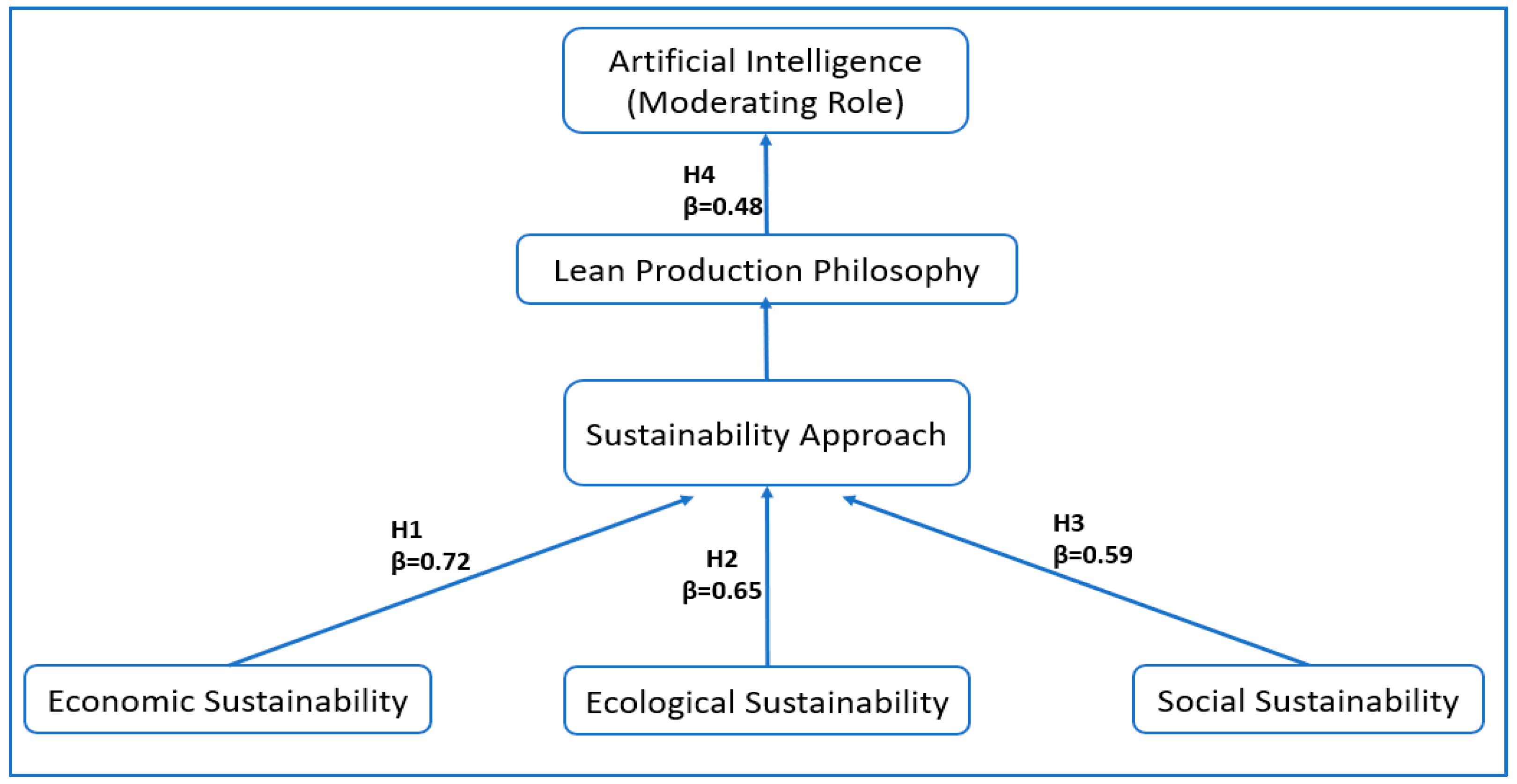
For H1: “The strong positive path coefficient (β = 0.72, p < 0.001) indicates that lean production practices explain a substantial portion of the variance in economic sustainability, underscoring their critical role in cost leadership and profitability.”
For H4: “The significant moderating effect (β = 0.48, p < 0.001) suggests that the presence of AI technologies meaningfully amplifies the positive influence of lean practices on sustainability outcomes.
  • Key Findings:
a 
Impact of Lean Production Principles on Sustainability Objectives dimensions:
-
The economic sustainability (β = 0.72, p < 0.001) is substantially and positively influenced by lean production principles, that is, waste reduction, just-in-time production, and continuous improvement to reduce costs and improve profitability.
-
In fact, as indicated by β = 0.65 and p < 0.001, the ecological sustainability is also strongly supported by lean production. In this respect, lean practices contribute to resource efficiency and a reduced environmental impact.
-
Two relationships stand out: The relationship between lean production and social sustainability (β = 0.59, p < 0.001); lean practices increase employee well-being and community engagement.
b 
Moderating Role of AI Technologies:
-
AI technologies substantially offset the extent to which lean production principles depend on sustainability objectives (β = 0.48, p < 0.001). The real-time monitoring, predictive analytics, and operational intelligence that AI provides help make lean practices work better in moving towards sustainability goals.
  • Findings of Control Variables:
Control variables did not significantly alter the hypothesized relationships. The small positive impact of firm size on economic sustainability (=0.09, p < 0.05) but not on ecological or social results was observed. The ecological sustainability was slightly higher in the sector with influence on the industry, where only the chemical sector exhibited such an effect (0.07, p < 0.10). The country effects found that the adoption levels of AI among Moroccan and Tunisian firms were relatively lower, which is in line with differences in infrastructure in the regions. Notably, the path coefficient value of H1–H4 did not decrease in significance and were of almost the same magnitude upon the addition of controls, thus supporting the strength of our results.
  • Additional Insights:
-
Economic sustainability: powering energy optimization and supply chain streamlining with AI, supported by lean production practices, reached incremental operational costs.
-
Ecological sustainability: Adding IoT-enabled sensors to lean production enables the calculation of environmental metrics, like carbon emissions and the reduction in waste.
-
Social sustainability: By reducing repetitive tasks and enhancing a collaborative work environment, AI-driven enhancements to the lean systems increased employee productivity and satisfaction.
  • Visual Representation of Results:
The validated study framework is presented in Figure 3, with path coefficients and significance levels of each hypothesized relationship.
  • Implications:
The results confirm that AI technologies for the integration of sustainability and lean production objectives yield significantly improved results. The findings show that Industry 4.0 tools have huge transformative potential to optimize operations, profitability, and sustainability.
As visualized in the validated framework (Figure 3), all direct paths from lean production to the sustainability dimensions are significant and positive. Furthermore, the model confirms the significant moderating role of AI, as indicated by the interaction effect path.
In summary, the results provide robust empirical support for all four hypotheses. Lean production practices significantly and positively influence all three pillars of sustainability. Crucially, the analysis confirms that AI acts as a significant positive moderator, meaning that its adoption strengthens the ability of lean systems to achieve superior economic, environmental, and social performance.

5. Discussion

The empirical results validate and broaden the theoretical hypotheses that operational excellence is related to sustainable development. The fact that lean production is strongly and directly related to each of the dimensions of sustainability confirms the inherent synergy between these paradigms as suggested by the triple-bottom-line paradigm. More to the point, the validated modulating role of AI represents a theoretical extension of its own: digital intelligence functions as a catalytic process through which static lean tools can become dynamic and self-optimizing systems that can adapt to the intricacy of sustainable industrial change.
Introducing lean principles has a positive effect on the economic sustainability, environmental, and social aspects of the organization. This is in line with the previous literature, since lean and sustainability can work well together because they both are concerned with efficiency, with the use of resources. Specifically, lean practices such as just-in-time (JIT) production, waste reduction, and Kaizen were found to enhance sustainability dimensions in the following ways:
-
Economically, lean production directly enhances managerial objectives of financial performance because it cuts overhead costs and resources utilized. The outcome of this study indicates (β = 0.72, p < 0.001) that waste reduction and efficiency in lean systems suit economic sustainability and hence act as an essential tool for economic resilience in uncertain markets.
-
From the environmental perspective, the study establishes that lean production minimizes resource waste and carbon footprint (β = 0.65, p < 0.001), hence supporting ecological standards. By their very nature, lean initiatives are environmentally friendly because they work to reduce the amount of waste produced in a process.
-
From the social perspective, lean production leads to increased employee welfare, safety, and community involvement (Standardized β = 0.59; p < 0.001). Best working conditions and collaboration aspects fostered by the lean principles’ culture help to achieve the aims of social sustainability.
The result presented in this context underscores the suitability of lean production and points to the limitations of optimizing the short-term cost at the expense of sustainable future outcomes. It is suggested that possibly more investments at the start and more strategic changes may be required before it is possible to acknowledge lean production as fully compatible with sustainable values.
This research therefore adds to knowledge by establishing the function of AI technologies in moderating the interconnection of lean production and sustainability. The results revealed that AI as a moderating factor has a significant positive impact on the relationships between lean practices and the realization of sustainability goals (β = 0.48, p < 0.001). AI technologies help overcome several weaknesses of lean systems by adding flexibility and procedural regularity, complementing existing analytical tools and methods to provide real-time monitoring and generate decision recommendations. For instance, you have predictive maintenance based on AI, which helps to reduce downtime, prevent equipment failures, and be consistent with the lean point of view on getting rid of waste and focusing on operations. Likewise, the optimization of the supply chain through AI brings greater efficiency as well as greater clarity; therefore, the supply chain becomes leaner and more sustainable. AI also plays toward ecological sustainability through the integration of IoT in systems that control energy usage with real-time input data.
These findings serve as evidence that AI is a powerful enabler of the lean production and sustainability agenda in industries while helping them to equip and address multifaceted and volatile problems.
Practical Implications: These findings can be used by practitioners in the following ways: (1) Prioritize AI-assisted predictive maintenance to minimize unplanned downtime and increase asset life, which is directly actionable to support lean (waste reduction) and environmental (resource efficiency) objectives. (2) Invest in IoT sensor networks and analytics dashboards in order to establish the real-time visibility of energy and material flows that would allow continuous Kaizen in line with ecological metrics. (3) Initiate specific data literacy and AI system management upskilling to narrow the talent gap outlined and enable employees to effectively use those new tools.
Theoretical Contributions: Due to the implications of the work for theoretical foundations, it can be stated that the study contributes to the fields of lean production, sustainability, and AI. Thus, adopting AI as a moderator expands on the existing theories regarding the lemma that lean and sustainability practices will be incompatible. As a result, the validated framework established in the present work will help to structure further studies and analyses of the relationships between lean principles and sustainability dimensions concerning emerging technologies.
Limitations and Future Research: Nevertheless, the present study has some methodological constraints. First, filtering types of industries to manufacturing ones reduces the ability to generalize study results for other industries. It is for these reasons that future research could focus on applying lean and sustainability in service industries or organizations drawn from the public domain. Second, the study is cross-sectional, which only examines the relationships within the studied community at a particular moment in time. More research should be conducted with systematic, rather than cross-sectional or time-limited, measures to check the long-term effects of AI-supported lean–sustainability programs. Lastly, there is a lack of proper understanding of how other new technologies, like blockchain and quantum, help to integrate lean and sustainability.

6. Conclusions

This research aims to describe the evolutional effects of applying lean production systems, sustainability, and the Industry 4.0 concepts allied with AI technologies. Analyzing the relationships of these constructs, the study reveals the co-dependencies between operation management for efficiency, environmental sustainability, and organizational sustainability. When the principles of lean production were used and implemented, in particular log-daily time (LDT) production, waste management, and constant production improvement, the economic, environmental and social sustainability performances improved dramatically. Such results provide the basis for understanding the concurrence of sustainable lean initiatives with sustainability objectives and the ability to meet modern industrial needs. The research established AI technologies as the moderating variable influencing the relationship between lean practices and sustainability. Analytics, surveillance, and IoT tools, which are powered by AI, remove the shortcomings of lean production that are not very flexible. Through improvements to the decision-making processes and resources that are employed, AI supports organizations’ proactivity toward meeting market requirements without compromising their sustainable goals. This creates a need to include AI systems as the core component in lean sustainability models that would address Industry 4.0 requirements. From an applied view, this study highlights how organizations must embrace AI technologies, enhance their workforce, and make their strategic improvements consistent with the tenets of lean production and sustainability. The kinds of investments that are made are not only beneficial to ensuring that the business is running smoothly but also defensive to counter economic uncertainty and ecologically unfavorable conditions. Theoretical contributions include enriching the lean–sustainability relationship by adding AI as a moderation variable as well as offering a framework for future empirical analysis that received adequate validity. This paper posited that as more industries evolve in line with the dynamism of Industry 4.0, lean production, sustainability, and AI technologies will persistently serve as the foundations for sustainable industrial change. To realize all these synergies, organizations need to overcome barriers like high initial costs and skill deficits to drive an enhanced innovative and sustainable future. Future research builds on this thread; researchers should follow other industries along with identical and additional subsequent consequences of the digitalization of the manufacturing industry for other sectors and organizations, together with further emerging technologies that could reshape what it means to be efficient and sustainable on an industrial level.

Author Contributions

Conceptualization, M.J.; Methodology, M.J., H.H., I.J. and Z.B.; Formal analysis, M.J. and Z.B.; Investigation, M.J., H.H., I.J. and Z.B.; Resources, M.J., I.J. and H.B.; Data curation, M.J.; Writing – original draft, M.J.; Writing – review & editing, M.J., H.H., I.J. and H.B.; Supervision, M.J., H.H., I.J., H.B. and Z.B.; Project administration, M.J., H.H., I.J., H.B. and Z.B.; Funding acquisition, M.J. and Z.B. All authors have read and agreed to the published version of the manuscript.

Funding

This research received no external funding.

Institutional Review Board Statement

The survey collected non-sensitive, anonymized data on organizational practices (lean production, sustainability objectives, and AI technologies) and did not involve: personal or identifiable human data Interventions affecting participants’ physical or psychological well-being Collection of biological samples or private health information Vulnerable populations or any form of deception. As such, under National research guidelines in Morocco and standard academic practice for non-invasive survey-based research, formal ethics committee approval was not required. The study adhered to ethical principles of voluntary participation, informed consent, and data anonymity, as outlined in the manuscript’s methodology section.

Informed Consent Statement

Informed consent was obtained from all subjects involved in the study.

Data Availability Statement

The original contributions presented in this study are included in the article. Further inquiries can be directed to the corresponding author.

Conflicts of Interest

The authors declare no conflicts of interest.

References

  1. Alsabt, R., Alkhaldi, W., Adenle, Y. A., & Alshuwaikhat, H. M. (2024). Optimizing waste management strategies through artificial intelligence and machine learning—An economic and environmental impact study. Cleaner Waste Systems, 8, 100158. [Google Scholar] [CrossRef]
  2. Al-Sharafi, M. A., Iranmanesh, M., Al-Emran, M., Alzahrani, A. I., Herzallah, F., & Jamil, N. (2023). Determinants of cloud computing integration and its impact on sustainable performance in SMEs: An empirical investigation using the SEM-ANN approach. Heliyon, 9(5), e16299. [Google Scholar] [CrossRef]
  3. Ani, E. C., Olu-lawal, K. A., Olajiga, O. K., Montero, D. J. P., & Adeleke, A. K. (2024). Intelligent monitoring systems in manufacturing: Current state and future perspectives. Engineering Science & Technology Journal, 5(3), 750–759. [Google Scholar] [CrossRef]
  4. Bag, S., Rahman, M. S., Sharma, J., Chiarini, A., Srivastava, S. K., & Gupta, S. (2024). Building digital technology and innovative lean management capabilities for enhancing operational performance: An empirical study. Production Planning & Control, 36, 1009–1028. [Google Scholar] [CrossRef]
  5. Berhe, H. H. (2022). Application of Kaizen philosophy for enhancing manufacturing industries’ performance: Exploratory study of Ethiopian chemical industries. International Journal of Quality & Reliability Management, 39(1), 204–235. [Google Scholar]
  6. Berhe, H. H., Gebremichael, H. S., & Beyene, K. T. (2023). Development, validation and verification of innovative integrated Kaizen philosophy (CI) framework and its implementation procedure for enhancing manufacturing industries sustainable competitiveness. International Journal of Quality & Reliability Management, 40(10), 2463–2518. [Google Scholar] [CrossRef]
  7. Bibri, S. E. (2018). The IoT for smart sustainable cities of the future: An analytical framework for sensor-based big data applications for environmental sustainability. Sustainable Cities and Society, 38, 230–253. [Google Scholar] [CrossRef]
  8. Biondo, D., Kai, D. A., Pinheiro de Lima, E., & Benitez, G. B. (2024). The contradictory effect of lean and Industry 4.0 synergy on firm performance: A meta-analysis. Journal of Manufacturing Technology Management, 35(3), 405–433. [Google Scholar] [CrossRef]
  9. Caldera, H. T. S., Desha, C., & Dawes, L. (2017). Exploring the role of lean thinking in sustainable business practice: A systematic literature review. Journal of Cleaner Production, 167, 1546–1565. [Google Scholar] [CrossRef]
  10. Caldera, H. T. S., Desha, C., & Dawes, L. (2018). Exploring the characteristics of sustainable business practice in small and medium-sized enterprises: Experiences from the Australian manufacturing industry. Journal of Cleaner Production, 177, 338–349. [Google Scholar] [CrossRef]
  11. Caldera, H. T. S., Desha, C., & Dawes, L. (2019). Transforming manufacturing to be ‘good for planet and people’, through enabling lean and green thinking in small and medium-sized enterprises. Sustainable Earth, 2, 1–19. [Google Scholar] [CrossRef]
  12. Chatterjee, S., Chaudhuri, R., Gupta, S., Sivarajah, U., & Bag, S. (2023). Assessing the impact of big data analytics on decision-making processes, forecasting, and performance of a firm. Technological Forecasting and Social Change, 196, 122824. [Google Scholar] [CrossRef]
  13. Chen, M., Liu, Q., Huang, S., & Dang, C. (2022). Environmental cost control system of manufacturing enterprises using artificial intelligence based on value chain of circular economy. Enterprise Information Systems, 16(8–9), 1856422. [Google Scholar] [CrossRef]
  14. Chen, X., Kurdve, M., Johansson, B., & Despeisse, M. (2023). Enabling the twin transitions: Digital technologies support environmental sustainability through lean principles. Sustainable Production and Consumption, 38, 13–27. [Google Scholar] [CrossRef]
  15. Ciano, M. P., Dallasega, P., Orzes, G., & Rossi, T. (2021). One-to-one relationships between Industry 4.0 technologies and Lean production techniques: A multiple case study. International Journal of Production Research, 59(5), 1386–1410. [Google Scholar] [CrossRef]
  16. Cifone, F. D., Hoberg, K., Holweg, M., & Staudacher, A. P. (2021). ‘Lean 4.0’: How can digital technologies support lean practices? International Journal of Production Economics, 241, 108258. [Google Scholar] [CrossRef]
  17. Cohen, A. G., & Kaplan, D. B. (1988). The exact metric about global cosmic strings. Physics Letters B, 215(1), 67–72. [Google Scholar] [CrossRef]
  18. Costa, F., Frecassetti, S., Rossini, M., & Portioli-Staudacher, A. (2023). Industry 4.0 digital technologies enhancing sustainability: Applications and barriers from the agricultural industry in an emerging economy. Journal of Cleaner Production, 408, 137208. [Google Scholar] [CrossRef]
  19. de Oliveira, R. T., Ghobakhloo, M., & Figueira, S. (2023). Industry 4.0 towards social and environmental sustainability in multinationals: Enabling circular economy, organizational social practices, and corporate purpose. Journal of Cleaner Production, 430, 139712. [Google Scholar] [CrossRef]
  20. Dey, P. K., Malesios, C., De, D., Budhwar, P., Chowdhury, S., & Cheffi, W. (2022). Circular economy to enhance sustainability of small and medium sized enterprises. In Supply Chain sustainability in small and medium sized enterprises (pp. 10–45). Routledge. [Google Scholar]
  21. Diamantopoulos, A., & Winklhofer, H. M. (2001). Index construction with formative indicators: An alternative to scale development. Journal of Marketing Research, 38(2), 269–277. [Google Scholar] [CrossRef]
  22. Ding, B., Ferras Hernandez, X., & Agell Jane, N. (2023). Combining lean and agile manufacturing competitive advantages through Industry 4.0 technologies: An integrative approach. Production Planning & Control, 34(5), 442–458. [Google Scholar]
  23. Dües, C. M., Tan, K. H., & Lim, M. (2013). Green as the new lean: How to use lean practices as a catalyst to greening your supply chain. Journal of Cleaner Production, 40, 93–100. [Google Scholar] [CrossRef]
  24. El Abbadi, L., Elrhanimi, S., & El Manti, S. (2020). A literature review on the evolution of lean manufacturing. Journal of System and Management Sciences, 10(4), 13–30. [Google Scholar]
  25. El Jaouhari, A., Arif, J., Samadhiya, A., Kumar, A., & Garza-Reyes, J. A. (2024). An environmental-based perspective framework: Integrating IoT technology into a sustainable automotive supply chain. Benchmarking: An International Journal, 31(10), 3655–3689. [Google Scholar] [CrossRef]
  26. Elkington, J. (1997). The triple bottom line. Environmental Management: Readings and Cases, 2(1997), 49–66. [Google Scholar]
  27. Florea, N. V., & Croitoru, G. (2025). The impact of artificial intelligence on communication dynamics and performance in organizational leadership. Administrative Sciences, 15(2), 33. [Google Scholar] [CrossRef]
  28. Garetti, M., & Taisch, M. (2012). Sustainable manufacturing: Trends and research challenges. Production Planning & Control, 23(2–3), 83–104. [Google Scholar]
  29. Hair, J. F., Risher, J. J., Sarstedt, M., & Ringle, C. M. (2019). When to use and how to report the results of PLS-SEM. European Business Review, 31(1), 2–24. [Google Scholar] [CrossRef]
  30. Hasan, R., Islam, Z., & Alam, M. (2024). Predictive analytics and machine learning applications in the USA for sustainable supply chain operations and carbon footprint reduction. Journal of Electrical Systems, 20(10), 463–471. [Google Scholar] [CrossRef]
  31. Hu, L. T., & Bentler, P. M. (1999). Cutoff criteria for fit indexes in covariance structure analysis: Conventional criteria versus new alternatives. Structural Equation Modeling: A Multidisciplinary Journal, 6(1), 1–55. [Google Scholar] [CrossRef]
  32. Javaid, M., Haleem, A., Singh, R. P., Suman, R., & Gonzalez, E. S. (2022). Understanding the adoption of Industry 4.0 technologies in improving environmental sustainability. Sustainable Operations and Computers, 3, 203–217. [Google Scholar] [CrossRef]
  33. Jebbor, I., Benmamoun, Z., & Hachimi, H. (2024, May 16–17). Application of manufacturing cycle efficiency to increase production efficiency: Application in automotive industry. 2024 4th International Conference on Innovative Research in Applied Science, Engineering and Technology (IRASET) (pp. 1–6), Fez, Morocco. [Google Scholar]
  34. Jebbor, I., Benmamoun, Z., & Hachimi, H. (2025). Leveraging digital twins and metaverse technologies for sustainable circular operations: A comprehensive literature review. Circular Economy and Sustainability 5, 5795–5848. [Google Scholar] [CrossRef]
  35. Jebbor, I., El-hmous, N., Benmamoun, Z., & Hachimi, H. (2026). Artificial intelligence (AI) toward streamlining lean manufacturing approaches. In H. Badir, M. Tabaa, L. Bellatreche, M. Mernik, B. Benatallah, & R. Fissoune (Eds.), New technologies, artificial intelligence and smart data. INTIS 2024. Communications in computer and information science (Vol. 2645). Springer. [Google Scholar]
  36. Kaswan, M. S., Chaudhary, R., Garza-Reyes, J. A., & Singh, A. (2024). A review of Industry 5.0: From key facets to a conceptual implementation framework. International Journal of Quality & Reliability Management, 42, 1196–1223. [Google Scholar] [CrossRef]
  37. Khlie, K., Pugalenthi, A., & Jebbor, I. (2025). Sustainable supply chains in the Industry X.0 era: Overcoming integration challenges in the UAE. Administrative Sciences, 15(11), 417. [Google Scholar] [CrossRef]
  38. Khourshed, N. F. (2023). Investigating the critical success factors for integrating Lean Six Sigma and Industry 4.0. Quality Management Journal, 30(4), 259–278. [Google Scholar] [CrossRef]
  39. Khourshed, N. F., Elbarky, S. S., & Elgamal, S. (2023). Investigating the readiness factors for Industry 4.0 implementation for manufacturing industry in Egypt. Sustainability, 15(12), 9641. [Google Scholar] [CrossRef]
  40. Kumar, R., Goomer, N., Rana, H. S., Chhabra, S., & Singh, A. (2023, December 23–24). Predictive maintenance for industrial equipments using ML & DL. 2023 International Conference on Advanced Computing & Communication Technologies (ICACCTech) (pp. 391–396), Banur, India. [Google Scholar]
  41. Kusi-Sarpong, S., Mubarik, M. S., Khan, S. A., Brown, S., & Mubarak, M. F. (2022). Intellectual capital, blockchain-driven supply chain and sustainable production: Role of supply chain mapping. Technological Forecasting and Social Change, 175, 121331. [Google Scholar] [CrossRef]
  42. León, H. C. M., & Calvo-Amodio, J. (2017). Towards lean for sustainability: Understanding the interrelationships between lean and sustainability from a systems thinking perspective. Journal of Cleaner Production, 142, 4384–4402. [Google Scholar] [CrossRef]
  43. López-Solís, O., Luzuriaga-Jaramillo, A., Bedoya-Jara, M., Naranjo-Santamaría, J., Bonilla-Jurado, D., & Acosta-Vargas, P. (2025). Effect of generative artificial intelligence on strategic decision-making in entrepreneurial business initiatives: A systematic literature review. Administrative Sciences, 15(2), 66. [Google Scholar] [CrossRef]
  44. Maity, S. (2019). Identifying opportunities for artificial intelligence in the evolution of training and development practices. Journal of Management Development, 38(8), 651–663. [Google Scholar] [CrossRef]
  45. Majeed, A., Zhang, Y., Ren, S., Lv, J., Peng, T., Waqar, S., & Yin, E. (2021). A big data-driven framework for sustainable and smart additive manufacturing. Robotics and Computer-Integrated Manufacturing, 67, 102026. [Google Scholar] [CrossRef]
  46. Martínez-Falcó, J., Sánchez-García, E., Marco-Lajara, B., & Andreu, R. (2024). Green supply chain management and sustainable performance: Exploring the role of circular economy capability and green ambidexterity innovation. British Food Journal, 126(11), 3985–4011. [Google Scholar] [CrossRef]
  47. Melnyk, S. A., Flynn, B. B., & Awaysheh, A. (2018). The best of times and the worst of times: Empirical operations and supply chain management research. International Journal of Production Research, 56(1–2), 164–192. [Google Scholar] [CrossRef]
  48. Min, S., & Kim, B. (2024). Adopting artificial intelligence technology for network operations in digital transformation. Administrative Sciences, 14(4), 70. [Google Scholar] [CrossRef]
  49. Mirali, F., Jebbor, I., Raouf, Y., Benmamoun, Z., Jizat, J. E. M., & Hachimi, H. (2025). Driving manufacturing excellence: The role of lean strategies and mediating factors in performance improvement. Management and Production Engineering Review. Advanced online publication. [Google Scholar]
  50. Moosavi, S., Farajzadeh-Zanjani, M., Razavi-Far, R., Palade, V., & Saif, M. (2024). Explainable AI in manufacturing and industrial cyber–physical systems: A survey. Electronics, 13(17), 3497. [Google Scholar] [CrossRef]
  51. Murtaza, A. A., Saher, A., Zafar, M. H., Moosavi, S. K. R., Aftab, M. F., & Sanfilippo, F. (2024). Paradigm shift for predictive maintenance and condition monitoring from Industry 4.0 to Industry 5.0: A systematic review, challenges and case study. Results in Engineering, 24, 102935. [Google Scholar] [CrossRef]
  52. Powell, D. J., Laubengaier, D. A., Tortorella, G. L., Saabye, H., Antony, J., & Cagliano, R. (2024). Digitalization in lean manufacturing firms: A cumulative capability development perspective. International Journal of Operations & Production Management, 44(6), 1249–1278. [Google Scholar] [CrossRef]
  53. Priyadarshini, J., Singh, R. K., Mishra, R., & Dora, M. (2023). Application of additive manufacturing for a sustainable healthcare sector: Mapping current research and establishing future research agenda. Technological Forecasting and Social Change, 194, 122686. [Google Scholar] [CrossRef]
  54. Ren, S., Zhang, Y., Liu, Y., Sakao, T., Huisingh, D., & Almeida, C. M. (2019). A comprehensive review of big data analytics throughout product lifecycle to support sustainable smart manufacturing: A framework, challenges and future research directions. Journal of Cleaner Production, 210, 1343–1365. [Google Scholar] [CrossRef]
  55. Rojas, T., Mula, J., & Sanchis, R. (2024). Quantitative modelling approaches for lean manufacturing under uncertainty. International Journal of Production Research, 62(16), 5989–6015. [Google Scholar] [CrossRef]
  56. Rossini, M., Ahmadi, A., & Staudacher, A. P. (2024). Integration of lean supply chain and Industry 4.0. Procedia Computer Science, 232, 1673–1682. [Google Scholar] [CrossRef]
  57. Shang, G., Low, S. P., & Lim, X. Y. V. (2023). Prospects, drivers of and barriers to artificial intelligence adoption in project management. Built Environment Project and Asset Management, 13(5), 629–645. [Google Scholar] [CrossRef]
  58. Sharma, S., Sharma, K., & Grover, S. (2024). Real-time data analysis with smart sensors. In Application of artificial intelligence in wastewater treatment (pp. 127–153). Springer Nature Switzerland. [Google Scholar]
  59. Sjödin, D. R., Parida, V., Leksell, M., & Petrovic, A. (2018). Smart factory implementation and process innovation: A preliminary maturity model for leveraging digitalization in manufacturing moving to smart factories presents specific challenges that can be addressed through a structured approach focused on people, processes, and technologies. Research-Technology Management, 61(5), 22–31. [Google Scholar]
  60. Svensson, G., Ferro, C., Høgevold, N., Padin, C., Varela, J. C. S., & Sarstedt, M. (2018). Framing the triple bottom line approach: Direct and mediation effects between economic, social and environmental elements. Journal of Cleaner Production, 197, 972–991. [Google Scholar] [CrossRef]
  61. Teece, D. J., Pisano, G., & Shuen, A. (1997). Dynamic capabilities and strategic management. Strategic Management Journal, 18(7), 509–533. [Google Scholar] [CrossRef]
  62. Tian, S., Wu, L., Ciano, M. P., Ardolino, M., & Pawar, K. S. (2024). Enhancing innovativeness and performance of the manufacturing supply chain through datafication: The role of resilience. Computers & Industrial Engineering, 188, 109841. [Google Scholar]
  63. Tissir, S., Cherrafi, A., Chiarini, A., Elfezazi, S., & Bag, S. (2023). Lean Six Sigma and Industry 4.0 combination: Scoping review and perspectives. Total Quality Management & Business Excellence, 34(3–4), 261–290. [Google Scholar]
  64. Tiwari, P., Sadeghi, J. K., & Eseonu, C. (2020). A sustainable Lean production framework with a case implementation: Practice-based view theory. Journal of Cleaner Production, 277, 123078. [Google Scholar] [CrossRef]
  65. Tortorella, G. L., Powell, D., Hines, P., Mac Cawley Vergara, A., Tlapa-Mendoza, D., & Vassolo, R. (2024). How does artificial intelligence impact employees’ engagement in lean organisations? International Journal of Production Research, 63, 1011–1027. [Google Scholar] [CrossRef]
  66. Tortorella, G. L., Pradhan, N., Macias de Anda, E., Trevino Martinez, S., Sawhney, R., & Kumar, M. (2020). Designing lean value streams in the fourth industrial revolution era: Proposition of technology-integrated guidelines. International Journal of Production Research, 58(16), 5020–5033. [Google Scholar] [CrossRef]
  67. Trist, E. L., & Bamforth, K. W. (1951). Some social and psychological consequences of the longwall method of coal-getting: An examination of the psychological situation and defenses of a work group in relation to the social structure and technological content of the work system. Human Relations, 4(1), 3–38. [Google Scholar] [CrossRef]
  68. Wang, W., Yang, H., Zhang, Y., & Xu, J. (2018). IoT-enabled real-time energy efficiency optimisation method for energy-intensive manufacturing enterprises. International Journal of Computer Integrated Manufacturing, 31(4–5), 362–379. [Google Scholar] [CrossRef]
  69. Wen, X., Cao, H., Hon, B., Chen, E., & Li, H. (2021). Energy value mapping: A novel lean method to integrate energy efficiency into production management. Energy, 217, 119353. [Google Scholar] [CrossRef]
  70. Womack, J. P., Jones, D. T., & Roos, D. (2007). The machine that changed the world: The story of lean production—Toyota’s secret weapon in the global car wars that is now revolutionizing world industry. Simon and Schuster. [Google Scholar]
  71. Zong, Z., & Guan, Y. (2024). AI-driven intelligent data analytics and predictive analysis in Industry 4.0: Transforming knowledge, innovation, and efficiency. Journal of the Knowledge Economy, 16, 864–903. [Google Scholar] [CrossRef]
Figure 1. Conceptual framework depicting artificial intelligence (AI) as a moderator between lean production and sustainability outcomes.
Admsci 16 00178 g001
Figure 2. Study framework.
Admsci 16 00178 g002
Figure 3. Validated study framework.
Admsci 16 00178 g003
Table 1. Respondent and Firm Profile (N = 528).
CharacteristicCategoryFrequencyPercentage
Respondent PositionOperations/Plant Manager21440.5%
Sustainability Manager9818.6%
Production Supervisor8716.5%
Quality Manager7614.4%
C-Level Executive5310.0%
Years of Experience<5 years8916.9%
5–10 years21741.1%
11–15 years14828.0%
>15 years7414.0%
Firm Size (employees)50–249 (Small)17633.3%
250–999 (Medium)23444.3%
1000+ (Large)11822.4%
CountryItaly15629.5%
Spain14226.9%
Portugal11822.4%
Morocco6412.1%
Tunisia489.1%
Table 2. Key Studies on Lean–Sustainability Integration.
StudyMethodologyKey FindingsImplications
Caldera et al. (2017)Systematic ReviewLean supports waste reduction in sustainability.Emphasizes compatibility of both frameworks.
Ciano et al. (2021)Case StudiesLean and sustainability face integration challenges in dynamic supply chains.Suggests the need for technology integration.
Rojas et al. (2024)Mixed Methods AnalysisDigital tools enhance sustainability outcomes when combined with lean practices.Highlights the role of data analytics.
Kaswan et al. (2024)Survey and Regression AnalysisIoT-enabled systems facilitate real-time monitoring of sustainability metrics.Demonstrates the importance of real-time data for interventions.
Tissir et al. (2023); Khourshed et al. (2023)Scoping ReviewCombining Lean Six Sigma and Industry 4.0 enhances sustainability performance.Stresses the value of advanced tools in supporting lean goals.
Garetti and Taisch (2012)Thematic AnalysisSustainable manufacturing trends align with lean efficiency objectives.Promotes alignment of lean strategies with sustainability frameworks.
Martínez-Falcó et al. (2024); Florea and Croitoru (2025)Longitudinal StudyAdoption of sustainable supply chain management improves lean compatibility.Highlights long-term benefits of sustainability integration.
Bag et al. (2024)Empirical studyBuilding digital technology and innovative lean management capabilities for enhancing operational performance.Encourages adoption of AI-driven lean methods.
Powell et al. (2024)Empirical StudyLean methods improve production efficiency but require digital augmentation for sustainability.Recommends digital tools to achieve sustainable outcomes.
Dües et al. (2013)Conceptual FrameworkLean practices can catalyze greening supply chains.Encourages integration of green initiatives with lean practices.
Wen et al. (2021)System Dynamics ModelingLean practices reduce energy intensity in production systems.Highlights the importance of energy efficiency in lean frameworks.
Biondo et al. (2024)Meta-AnalysisIntegration of lean practices and AI improves supply chain performance and sustainability.Stresses AI’s role in improving sustainability goals.
Dey et al. (2022)Mixed-Methods ResearchSustainable supply chains and lean practices reinforce circular economy goals.Encourages integration of circular economy principles.
El Jaouhari et al. (2024)Quantitative Studyintegrating IoT technology into a sustainable automotive supply chain.Highlights the need for real-time monitoring technologies.
Table 3. Key AI-Enabled Innovations in Lean and Sustainability.
InnovationApplicationBenefits
Predictive MaintenanceEquipment monitoring and failure predictionReduced downtime and resource savings
Energy OptimizationReal-time energy monitoringLower emissions and cost savings
Supply Chain OptimizationData-driven supply chain managementImproved efficiency and sustainability
Table 4. Construct Validity and Reliability.
Construct/DimensionCronbach’s αComposite Reliability (CR)Average Variance Extracted (AVE)
Lean Production Principles (overall)0.850.870.62
Sustainability Objectives (overall)0.880.890.65
- Economic Sustainability0.840.860.61
- Ecological Sustainability0.870.880.64
- Social Sustainability0.820.840.58
AI Technologies (overall)0.900.920.68
- Predictive Analytics0.860.880.65
- Real-time Monitoring0.840.860.61
- Automation/Robotics0.810.830.56
Table 5. Hypothesis Testing Results.
HypothesisPathβ (Coefficient)95% CI (Bootstrapped)t-Statisticp-ValueResult
H1Lean production → Economic sustainability0.72[0.57, 0.71]10.34<0.001Supported
H2Lean production → Ecological sustainability0.65[0.57, 0.71]8.89<0.001Supported
H3Lean production → Social sustainability0.59[0.51, 0.66]7.12<0.001Supported
H4AI (Moderating Effect)0.48[0.40, 0.55]6.45<0.001Supported
Disclaimer/Publisher’s Note: The statements, opinions and data contained in all publications are solely those of the individual author(s) and contributor(s) and not of MDPI and/or the editor(s). MDPI and/or the editor(s) disclaim responsibility for any injury to people or property resulting from any ideas, methods, instructions or products referred to in the content.