Article

Data Science Competencies as Micro-Foundations of Digital Business Capability: A Digital Dynamic Capabilities Perspective


1
Newcastle Business School, Northumbria University, Newcastle upon Tyne NE1 8ST, UK
2
Mukesh Patel School of Technology Management & Engineering, SVKM’s NMIMS University, Mumbai 400056, India
3
Escola de Ciências Sociais, CEFAGE, Universidade de Évora, 7002-554 Évora, Portugal
4
Institute of Management, Nirma University, Ahmedabad 382481, India
*
Author to whom correspondence should be addressed.
Adm. Sci. 2026, 16(3), 149; https://doi.org/10.3390/admsci16030149
Submission received: 22 December 2025 / Revised: 5 March 2026 / Accepted: 8 March 2026 / Published: 18 March 2026

Abstract

This study investigates how data science competencies, conceptualized as the micro-foundations of digital dynamic capabilities (DDCs), combine to influence the development of digital business capability (DBC). Using fuzzy-set qualitative comparative analysis (fsQCA), we examine configurations of competencies that enable DBC and identify necessary and sufficient conditions. The necessary-condition testing indicates no single competency is universally required, highlighting the configurational, micro-foundational nature of DDC development. The fsQCA uncovers three equifinal competency configurations that act as sufficient pathways to high DBC. Beyond capability building, the study demonstrates how distinct competency bundles facilitate business model renewal capabilities, translate analytics into data-enabled services, and reconfigure capabilities to embed servitized offerings into scalable architectures in the digital ecosystem business. These insights offer actionable guidance for practitioners, educators, and policymakers seeking to design data science competency systems that not only strengthen DDCs but also enable sustained business model innovation in AI, Industry 4.0, and other data-driven contexts.

1. Introduction

Data has become the new currency for twenty-first-century enterprises. The big data revolution possesses immense potential to boost organizational decision-making, offer competitive advantage, and enhance operational efficiency (Schmidt et al., 2023; Weiser et al., 2022; Klee et al., 2021). Consequently, firms increasingly utilize data science to accumulate, process, and manage vast datasets to ensure enhanced performance, faster decision-making, and the fulfillment of strategic objectives (Fernández et al., 2014; Loebbecke & Picot, 2015). While investments in IT infrastructure and digital platforms remain necessary, they no longer guarantee differentiation or value creation. Instead, contemporary firms must cultivate data science competencies as human-capital-based micro-foundations of digital dynamic capabilities (DDCs), the capabilities enabling organizations to sense digital opportunities, seize them through data-driven action, and continually reconfigure business processes and resources to sustain competitiveness (Massa et al., 2023; Zheng, 2024).
Yet many organizations struggle to identify which data science competencies are critical for supporting digital transformation and achieving robust digital business capability (DBC). DBC reflects an organization’s ability to strategically deploy digital technologies and data-driven routines to innovate, transform business models, and deliver superior value (Bughin, 2016; Wielgos et al., 2021). However, data-related competencies do not automatically translate into digital capability; their impact depends on how firms configure, integrate, and orchestrate these competencies within broader strategic and organizational architectures (Deng et al., 2023; Malodia et al., 2023). Firms operating in data-intensive sectors, such as fintech or digital advertising, create competitive differentiation through proprietary algorithms, domain-specific insights, and adaptive analytics. In more traditional industries, in contrast, effective digital transformation hinges on their ability to build organizational data maturity, engage with ecosystem partners, and leverage collaborative knowledge flows to support digital business model renewal.
Global investment in digital transformation has reached unprecedented levels. Despite this surge, digital transformation projects fail to deliver expected outcomes (Singh et al., 2025). Firms that succeed often do so because they can translate data science capabilities into digital dynamic capabilities, enabling strategic sensing of market shifts, rapid seizing through analytics-driven decision-making, and continuous organizational reconfiguration (S. V. Shet, 2025). Data science (DS) is widely regarded as a systematic process of extracting knowledge from data (Bresciani et al., 2021; Bhatti et al., 2024), a methodology (Elragal & Klischewski, 2017); a paradigm (Kelling et al., 2009; Kitchin, 2014), a phenomenon (Neff et al., 2017), or a method (Antons & Breidbach, 2018). The domain incorporates advanced digital technologies, including IoT, AI, business analytics, blockchain, deep learning, and machine learning (Dwivedi et al., 2021; Collins et al., 2021; Jiang et al., 2023), expanding beyond business decision-making toward diverse applications such as meteorology, bio-statistics, healthcare, online gaming, and agriculture (Leoni et al., 2024; Loia et al., 2025). Despite this rapid technological evolution, human capability gaps remain a major bottleneck in leveraging big data and AI for value creation (Zhang et al., 2021; Hu et al., 2021). As companies move toward Industry 4.0 and Industry 5.0, the need for highly skilled data science professionals is growing quickly across a wide range of industries (Cillo et al., 2022; Del Giudice et al., 2021).
Because data science (DS) brings together fields like social sciences, behavioural sciences, business management, behavioural economics, computer science, and information systems, professionals need advanced skills in areas such as pattern recognition, IoT integration, sensor data analysis, and algorithm design (Alter, 2021). However, ongoing gaps between what universities teach and what industry expects continue to widen the talent readiness gap. Addressing these gaps requires conceptual clarity on what constitutes the necessary and sufficient data science competencies that underpin DDCs and drive digital business capability. Thus, this research attempts to examine what configurations of data science competencies influence digital business capability, and what are their necessary and sufficient conditions? This research adopts a multimethod design, by analyzing job advertisements using text analytics to derive a competency framework for DS professionals, and employs fsQCA to examine configurational pathways that enable digital business capability. These findings help explain how employee skills and knowledge support digital capabilities, new business models, and digital services. They also show how data science skills help organizations learn from outside sources and take part in open innovation, especially when technology is changing quickly and uncertainty is high (Zhou et al., 2025).
This study builds on the dynamic capabilities theory by showing that data science skills are a key foundation of digital business capability. It explains that strong digital capabilities at the company level do not come from one technical skill alone. Instead, they develop from a combination of strategic, analytical, and technical (architectural) competencies working together. The study also expands existing research by describing data science competencies as connected building blocks that help organizations sense opportunities, seize them, and adjust their resources when needed (Zheng, 2024). In other words, these skills support how companies identify changes, respond to them, and reorganize to stay competitive. Beyond explaining how capabilities are formed, the research shows that different combinations of skills lead to different innovation paths. Some companies focus on market experiments and adapting their business models, while others invest heavily in digital services and take part in wider business ecosystems (Costa & Santos, 2017). This links employee-level competencies directly to strategic decisions and how firms position themselves in value networks. Importantly, the study finds that there is no single “best” set of competencies for building digital capability. Different combinations of competencies can lead to success. This challenges the idea that one universal model of competencies fits all companies. Instead, digital business capability develops over time based on a company’s strategy and the specific mix of data science competencies it has shaped by prior investments, digital architectural maturity, and innovation intent.

2. Theoretical Framework

2.1. Digital Dynamic Capabilities

We conceptualize data science competencies, defined as the knowledge, skills, and abilities required to work with data, analytics, algorithms, AI systems, and digital architectures, as micro-foundations of digital dynamic capabilities. Building on micro-foundations theory, firm-level dynamic capabilities do not emerge automatically from technology investments but are enacted through the patterned actions, decision routines, and interactions of individuals who possess relevant expertise (Tasheva & Nielsen, 2022; Wang et al., 2025). In this sense, data science competencies represent the human capital inputs that causally enable organizations to sense, seize, and reconfigure in digitally turbulent environments.
The causal linkage between competencies and the sensing–seizing–reconfiguring framework operates through three distinct but interrelated mechanisms. First, in the sensing dimension, technical data science competencies, such as machine learning acumen, data architectures, and digital intelligence, enhance an organization’s ability to scan, interpret, and anticipate digital opportunities and threats (S. Shet & Nair, 2023). Individuals equipped with these competencies are better able to identify weak signals in large-scale, unstructured data, detect shifts in customer behaviour, and recognize emerging technological trajectories (Dwivedi et al., 2021; Collins et al., 2021; Jiang et al., 2023). These sensing outcomes arise not merely from tool usage but from the analytical judgment and interpretive skills of data science professionals, which collectively shape organizational awareness in volatile digital contexts (Mele et al., 2023).
Second, in the seizing stage, data science competencies help organizations turn identified opportunities into real strategic actions. At this stage, managerial and hybrid competencies, such as business understanding, strategic thinking, and cross-functional communication, are especially important. These competencies translate data insights into new business models, process automation initiatives, and data-driven services (Fernández et al., 2014; Loebbecke & Picot, 2015). The key mechanism is effective coordination. Managers and senior analysts use their competencies to combine technical insights with strategic goals, allocate resources properly, and align different stakeholders (S. V. Shet & Pereira, 2021). This enables firms to act on digital opportunities rather than simply identify them. Without these competencies, analytical results are often underused and fail to create real business value.
Third, in the reconfiguring stage, advanced data science competencies help organizations continuously update and improve their processes, structures, and digital systems. Skills in areas such as data governance, algorithm design, systems integration, and new technologies like AI, blockchain, and IoT allow companies to redesign workflows, upgrade old systems, and adjust their business models when markets or technologies change (Alter, 2021; Cillo et al., 2022; Del Giudice et al., 2021). Managerial competencies strengthen this process by embedding new ways of working into the organization. They help establish new routines, improve daily operations, and build organizational agility, ensuring that digital transformation continues over time instead of remaining a one-time initiative (Loia et al., 2025).
Individual data science competencies become true organizational capabilities when they are integrated into cross-functional teams, decision-making processes, analytics-based workflows, and governance systems. As these competencies are repeatedly applied in strategic and operational activities, organizations develop shared understanding, standard practices, and collective learning. Over time, this turns individual expertise into strong firm-level digital dynamic capabilities (Teece et al., 1997; Wang et al., 2025). In this way, data science competencies act as essential building blocks that support and strengthen digital dynamic capabilities, rather than existing as isolated technical skills.

2.2. Digital Business Capability

Digital business capability (DBC) refers to a company’s ability to use digital technologies, data, and analytics to improve performance, gain a competitive advantage, and create new business opportunities (Wielgos et al., 2021). Although DBC is closely related to digital dynamic capabilities (DDCs), the two are not the same. DDCs describe a firm’s ability to adapt to digital change, how it senses new opportunities, seizes them, and reconfigures its resources. DBC, on the other hand, reflects the actual results of this adaptive ability. It can be seen in digitally enabled products, services, processes, and business models. While traditional operational capabilities focus mainly on efficiency and stability, DBC depends on how well digital tools and data are aligned with a firm’s strategy, industry conditions, and market needs. Simply adopting new technologies does not create DBC. Instead, DBC develops when digital assets and analytics are carefully coordinated to support specific strategic goals. In this way, DDCs act as the driving force that makes DBC possible.
The difference becomes clearer when looking at various industries. For example, companies operating in digital platforms such as online marketplaces or ride-sharing services show strong DBC when they combine real-time data processing, AI-based automation, and smooth customer engagement into scalable business models. In contrast, firms in regulated industries like healthcare or financial services build DBC by focusing on data protection, compliance systems, and predictive risk management to maintain trust and legitimacy. These examples show that DBC is not a single, uniform concept. It depends on how organizations combine and use their digital and data resources to meet specific industry challenges (Zheng, 2024). While DDCs support continuous adaptation and flexibility, DBC represents the company’s current ability to turn digital technologies into real business value. In this study, data science competencies are viewed as the foundation of DDCs, which then lead to the development of DBC. This distinction helps explain not only whether data science competencies matter, but also how different combinations of these competencies lead to successful digital business outcomes in different organizational contexts.

2.2.1. Configuration of Data Science Competencies and Digital Business Capability

The concept of competency has long been used to explain why certain individuals and organizations perform more effectively than others. Competencies represent a quantifiable pattern of behaviours, skills, knowledge, and abilities that enable employees to successfully execute occupational tasks and organizational functions (Ibrahim et al., 2017; S. V. Shet & Pereira, 2021). From an organizational perspective, competencies signify the knowledge and skills that individuals must adopt to perform tasks, processes, and activities in an effective and reliable manner (S. V. Shet & Bajpai, 2021; Campion et al., 2020). However, prior research also recognizes that competencies rarely develop or operate in a linear or additive fashion, as their relevance and manifestation vary across industries, roles, and organizational contexts. Consequently, competency model frameworks are increasingly used to identify and organize the bundles of knowledge and skills required for specific occupations rather than isolated abilities.
Research on data science has identified many important technical, analytical, and behavioural competencies (skills). For example, Fitzgerald (2015) points out five key skills for data science professionals: the ability to use analytics tools, strong technical knowledge, good communication, problem-solving ability, and teamwork skills for understanding descriptive, predictive, and prescriptive analytics. Similarly, Watson et al. (2013) emphasize skills such as data mining, SQL and query writing, data warehousing, data visualization, statistical knowledge, and awareness of new trends in data science. Davenport and Patil (2012) add that these skills should be supported by solid knowledge of statistics, computer science, and mathematics, especially when working with complex and unstructured data.
Beyond technical abilities, researchers also stress the importance of behavioural and contextual competencies. Factors such as knowledge and technical ability, along with motivation and attitude, influence how organizations create value through digital services (Saunila et al., 2019; Bloodgood & Chen, 2022). Domain knowledge is especially important because it helps data professionals understand business problems, correctly interpret results, and connect insights to real organizational processes (Sukumar & Ferrell, 2013). Drawing on the IT-based resources framework, Bharadwaj (2000) highlights the importance of human IT resources and domain expertise as core elements of data analysis competency. At the individual level, traits such as digital literacy and confidence in using digital technologies (self-efficacy) also support digital innovation (Mancha & Shankaranarayanan, 2021).
However, most of the existing research is descriptive and somewhat fragmented. It mainly lists important skills but does not clearly explain how these competencies work together to create stronger organizational outcomes. Although studies recognize that skills overlap and vary across roles and industries, they do not fully explore which combinations of competencies are enough to build digital business capability, or whether different combinations can lead to similar outcomes. This gap is important because digital business capability depends on how multiple competencies are combined within an organization, not on any single skill alone. Many previous studies use simple linear models that assume each competency has a separate and equal effect. This approach overlooks the possibility that different combinations of skills can produce the same result (equifinality), or that the presence and absence of certain skills may have different effects (causal asymmetry). Therefore, there is a need to move beyond identifying “important” data science skills and instead understand how different combinations of competencies together influence digital business capability. This configurational perspective motivates the use of fsQCA as a theory-driven research method and leads to our first research question: what combinations of data science competencies influence digital business capability?

2.2.2. Necessary and Sufficient Conditions of DBC

The rapid growth of digital transformation has changed the way companies compete in the digital world. Businesses now depend more than ever on data-driven decisions and digital business models. Because of this, organizations need professionals who not only understand data but can also define business problems in ways that analytics can solve (Hopkins et al., 2010). However, many studies show that there is a shortage of skilled data science professionals. This creates a gap between the growing importance of analytics and companies’ ability to use it effectively (Hopkins et al., 2010; Kiron et al., 2013; Manyika et al., 2011). The problem is not a lack of people, but a lack of the right competencies that professionals must combine with analytical expertise, business understanding and technological knowledge to meet organizational needs (Caputo et al., 2023; Raut et al., 2024).
At the same time, successful digital transformation depends on how well firms manage and coordinate key resources, especially human capital, in the current uncertain environments (Chen & Tian, 2022). When companies lack strong analytical competencies, their data initiatives often fail or lead to slow and ineffective decision-making because they cannot turn data into useful insights (Ghasemaghaei et al., 2018; Broccardo et al., 2025). In contrast, firms that successfully embed data science competencies into their organizational structures tend to build a data-driven culture and gain stronger competitive positions (Suoniemi et al., 2020; Kiron & Shockley, 2011). Despite understanding the importance of data science, many organizations struggle to develop these competencies internally. Because the data science field is highly technical, firms often outsource their early digital transformation efforts, even though they aim to build internal analytics teams for long-term strategic control (Gershkoff, 2015; Orihuela, 2015). Some companies are also hesitant to invest in big data initiatives due to limited awareness of their strategic value (Bughin, 2016). In addition, rapid technological change makes hiring and retention difficult, as firms are unsure which data science competencies will remain relevant as tools and technologies continue to evolve (Surbakti et al., 2020). Therefore, the challenge is not simply to hire more data scientists. It is to understand which combinations of data science competencies are truly necessary and sufficient for turning data resources into strong and sustainable digital business capability. This gap leads to our second research question as, what are the necessary and sufficient data science competencies for developing digital business capability?

3. Research Methodology

The primary aim of this research is to determine the specific configurations of data science competencies that have an impact on DBC. To achieve this, we employ fuzzy-set qualitative comparative analysis as an analytical procedure to determine the causality of data science competencies and DBC.

3.1. Phase 1: Establishing Data Science Competencies

We utilized the web scraping method to gather relevant data on job competencies from job portals. The data collected was then processed using natural language processing techniques. We extracted data from popular job portals such as LinkedIn, Naukri.com, and Indeed.com, focusing on job profiles in the field of data science. Specifically, LinkedIn and Naukri.com provided us with Indian and US-based job profiles, while Indeed.com was used for US-based advertisements. We employed the ‘scrape storm’ web scraping tool to extract information from the web pages. The terms ‘Data scientist,’ ‘architect,’ ‘coder,’ ‘intelligence,’ and others were used to identify various job roles in the data science domain (refer to Table 1). In total, we collected 3200 records, including 100 records from Indeed.com for US jobs and the remaining 3000 records from India-based jobs on Naukri.com. The data collection period spanned from April 2021 to June 2021. The collected data encompassed information such as Organization, Location, Job Type, Required Skills, Functional Area, and Experience. For topic modelling, we employed the Latent Dirichlet Allocation (LDA) algorithm. LDA helps identify the words associated with different topics and their distribution using the Dirichlet distribution (Eslami et al., 2025). In our analysis, the target attribute was the job designation, while the correlated attributes were the skillset and responsibilities (as shown in Table 1). Based on the data collected on managerial and technical attributes, we conducted qualitative coding to identify key data science competencies, along with their associated skill sets and attributes. Table 2 and Table 3 present examples of the coding process.
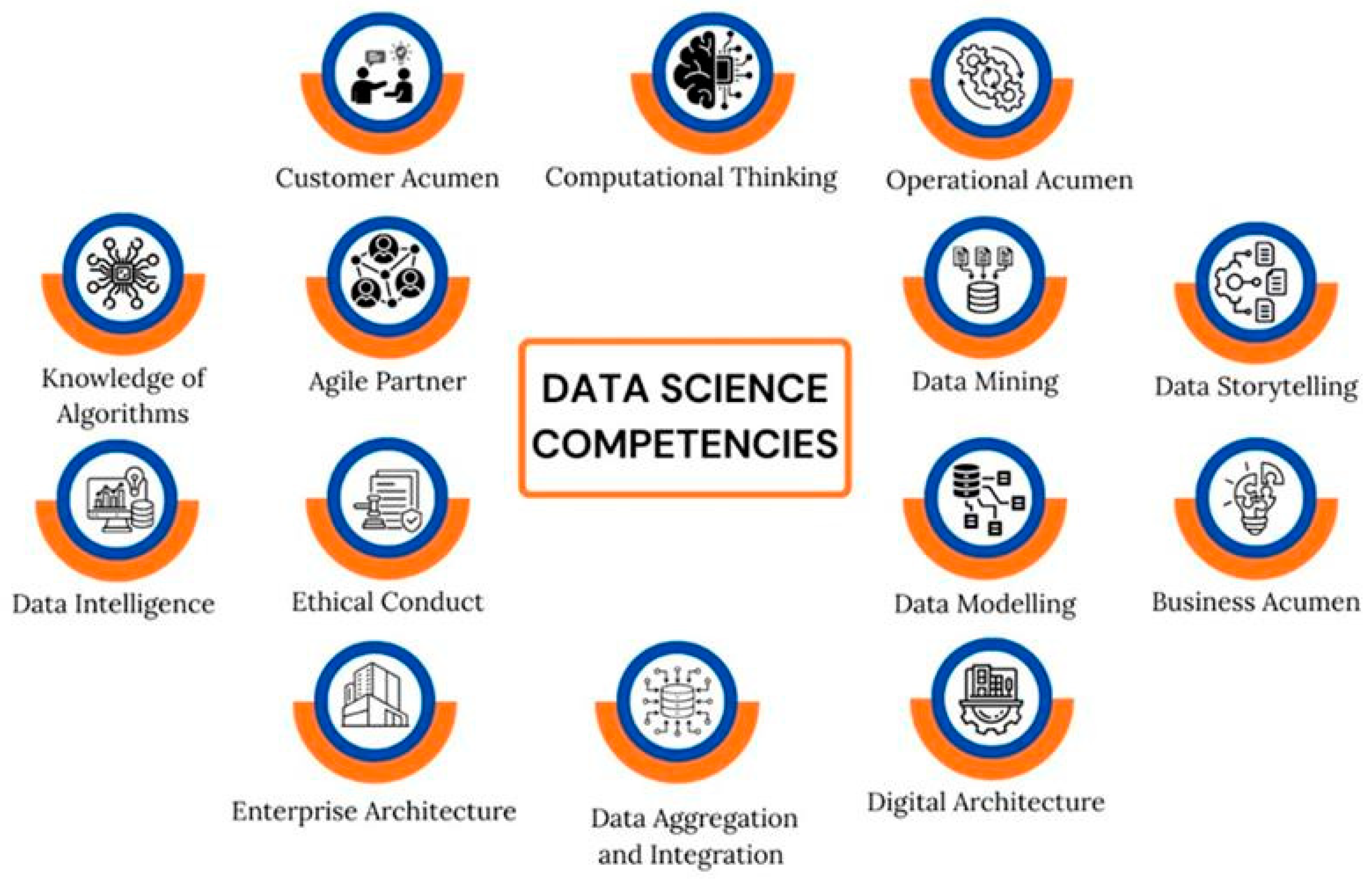
The competencies identified through the initial analysis were elaborated with clear definitions and behaviorally anchored rating scales (see Appendix A) and subsequently subjected to expert validation. Five experts from the data science domain, each with a minimum of ten years of professional experience in large, data-intensive organizations, were purposively selected. The selection criteria required experts to (a) hold senior roles such as data science lead, analytics head, or AI architect, (b) possess direct experience in deploying data science solutions at scale, and (c) be involved in strategic decision-making related to analytics, AI, or digital transformation initiatives. These criteria made sure that the experts’ evaluations reflected both strong technical knowledge and practical organizational relevance. To ensure content validity, each expert independently assessed how important each competency was, using a simple three-point scale: essential, useful but not essential, or not necessary. To measure the level of agreement among the experts, Lawshe’s Content Validity Ratio (CVR) was used (Romero Jeldres et al., 2023). According to Lawshe’s (1975) guidelines for a panel of five experts, only competencies with a CVR score of 0.75 or higher were kept. This cut-off ensured a high level of agreement and reduced the risk of subjective bias in selecting competencies. The initial list of 14 competencies shown in Figure 1 was refined to a final set of 5 core competencies through an iterative expert evaluation process: Business Acumen, Computational Thinking, Data Modeling, Data Intelligence, and Digital Architecture. This reduction shows strong agreement among experts on the most important competencies for effective data science practice and organizational impact. Such consensus among specialists enhances the reliability and validity of the final competency framework.

3.2. Phase 2—FsQCA Procedure

In phase 2, we administered the survey to collect the data-on-data science competencies and DBC. We collected data from professionals employed in various organizations having business analytics, data analytics, digital transformation, or similar roles wherein they are practicing the data science competencies. We measured five competencies (as independent variables) using a competency framework, which had a definition as an understanding of the competency, behavioural descriptors of the competency, followed by questions on digital business capability (DBC) as a dependent variable. In rating the items, a 5-point scale ranging from 5 (as significantly demonstrates these behaviours consistently) to 1(as does not demonstrate these behaviours at all), and for DBC 5 (as strongly agree) to 1 (as strongly disagree). The DBC scale has been used in previous research and hence it is considered an established scale (Wielgos et al., 2021). DBC includes variables such as digital strategy, digital integration, and digital control. Data was collected using online surveys during the first and second quarters of 2021, with 265 respondents presented in Table 4.
Table 5 presents the descriptive statistics and bivariate correlations among the study variables. The mean values indicate moderate to relatively high levels across all competencies, suggesting that respondents generally perceive themselves as possessing these data science–related capabilities. Standard deviations show acceptable variability, indicating sufficient dispersion for subsequent configurational analysis. The correlation matrix reveals several moderate positive associations, particularly between Business Acumen and Digital Integration, as well as between Digital Architecture and Digital Integration, suggesting that these competencies tend to co-occur in practice. Importantly, none of the correlations are excessively high, reducing concerns about multicollinearity and supporting the suitability of a configurational approach that allows competencies to interact in multiple, non-linear combinations rather than assuming additive or linear effects. We also assess the reliability of the constructs using Cronbach’s alpha. The obtained value for the entire set of variables was 0.782, which is significantly higher than the cut-off points of 0.70. This analysis, although not directly linked to the fsQCA approach, is essential for evaluating the dataset in terms of relationships, reliability, and validity.

4. Analytical Procedure

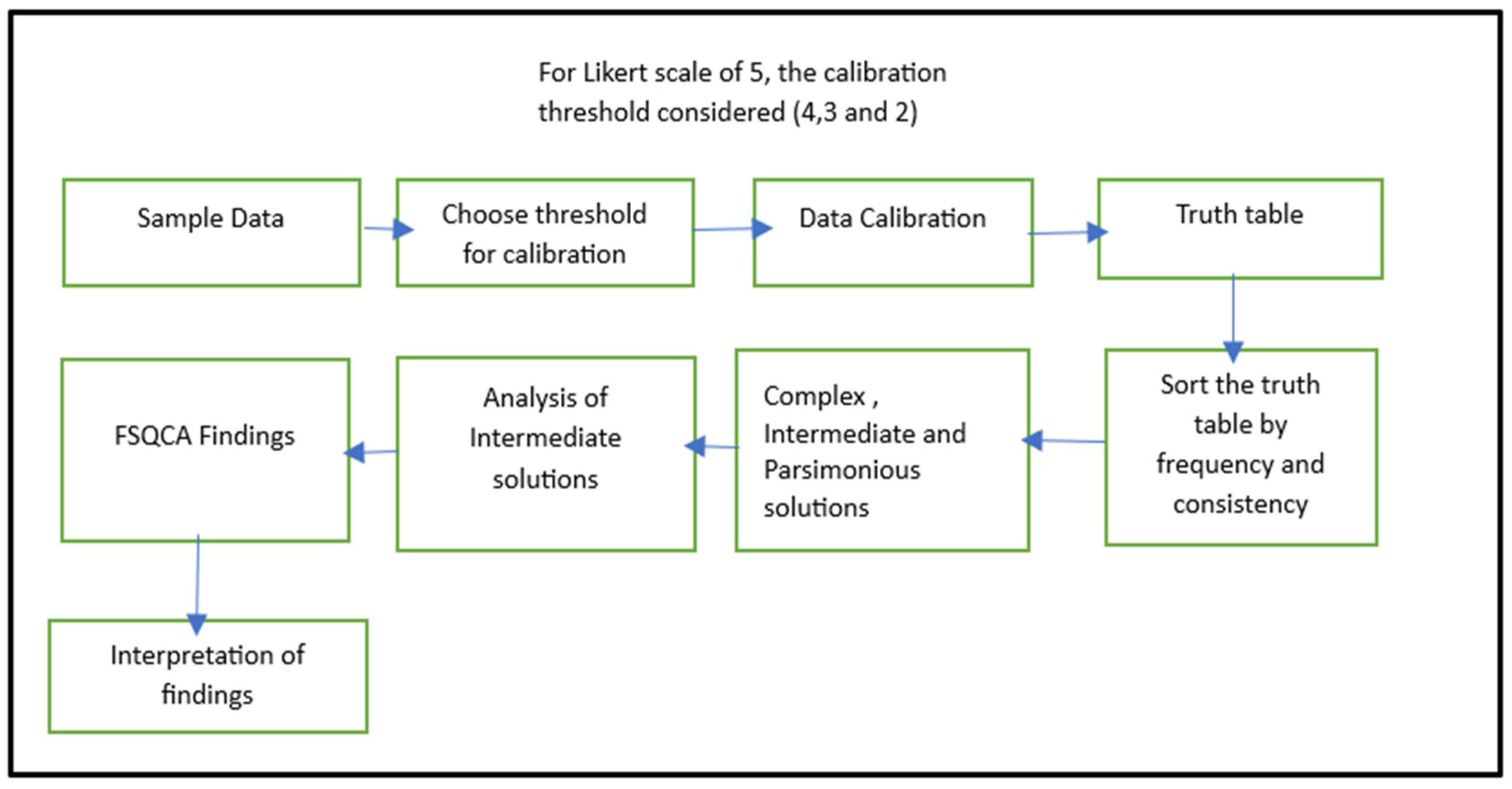
The fsQCA analytical procedure is contextual for this research as a method (Figure 2). Traditional approaches like regression analysis aim to determine the impact of a single variable on the outcome, while keeping all other variables constant. However, they fail to adequately capture conjunctural causation. In contrast, QCA helps identify the necessary and sufficient configurations for DBC. It recognizes that different configurations can lead to the same outcome, known as equifinality. To analyze these configurations, we have utilized the fsQCA method with the FSQCA software, version 3.0.

4.1. Data Treatment

Choosing thresholds for calibration: In fsQCA, it is necessary to calibrate the data before proceeding. This involves determining three anchors to establish full membership (calibrated value = 1.0), full non-membership (calibrated value = 0.0), and a crossover point (calibrated value = 0.5) that represents a fuzzy set where the data is neither fully in nor fully out (C. Ragin, 2018; Rasoolimanesh et al., 2021). The selection of these three anchors depends on the distribution of the data. For categorical variables, we follow the approach outlined by Pappas and Woodside (2021), which is based on the categories of the variables. As for continuous variables (the outcome variables), we adopt the method described by Woodside (2013), which involves setting the original values that encompass 95%, 5%, and 50% of the data values as the anchors, respectively (Table 6). Once the calibration process is complete, fsQCA generates a relation in the form of X → Y, where X can be a single antecedent or a combination of antecedents, and Y represents the outcome (De Canio et al., 2020). The next phase involves evaluating the necessary and sufficient conditions and their combined effect within the context of digital business capability.

4.2. Truth Table

After calibration, a truth table containing possible combinations of causal conditions was obtained, and the number of cases fitting each combination was determined. By specifying the minimum number of cases to consider in the analysis and the minimum acceptable level for considering a combination of reliable conditions, the truth table is reduced to simplified combinations. Therefore, the frequency value and consistency threshold must be set. In a study of a small number of cases, C. C. Ragin (2008) notes that the frequency value should be 1 or 2. Regarding the consistency threshold, the values below 0.75 reveal a significant (substantial) degree of inconsistency. Thus, following C. C. Ragin (2008), in this study, a frequency value of 1 is set, and a consistency threshold of 0.75 is selected. After applying these two thresholds recommended by C. C. Ragin (2008), fsQCA provides us with three different types of solutions: complex (or conservative), intermediate and parsimonious solutions. According to C. C. Ragin (2008), depending on whether counterfactual cases are difficult or easy, the scholar can determine which to use (Berné-Martínez et al., 2021). We have used an intermediate solution in this research. The frequency cutoff is considered as 1, and the consistency cutoff values are 0.8, which meets the minimum value selected for the analysis. The consistency values for all the solution pathways exceed the minimum threshold of 0.80 (Crilly, 2011; Fiss, 2011; Douglas et al., 2020; Nikou et al., 2022; Sukhov et al., 2023).

5. Results

A condition is necessary when it must be present for a given result to occur. Thus, our fsQCA analysis clarifies whether any of the proposed conditions, Business Acumen, Data Modelling, Data Intelligence, Computational Thinking and Digital Architecture are necessary for digital business capability. To be considered necessary, a condition has exhibited a consistency level of higher than 0.9 (C. C. Ragin, 2008; Schneider & Wagemann, 2010; Yang, 2018; Berné-Martínez et al., 2021).

5.1. fsQCA Findings: Method—Necessary Conditions

The results obtained for the analysis of the necessary condition are displayed in Table 7. No value reaches the minimum threshold required; therefore, no individual condition can be considered necessary for the DBC to be present. Nevertheless, Business Acumen is outlined in bold to achieve values between 0.8 and 0.9, indicating that this can be a necessary condition.
Business Acumen (Consistency: 0.8576, Coverage: 0.8625) emerges as a critical factor, suggesting that a strong foundational understanding of business principles is a key driver of competency success. Similarly, Computational Thinking (Consistency: 0.7956, Coverage: 0.8739) plays a crucial role, reinforcing the importance of logical problem-solving and algorithmic reasoning in competency development. Additionally, Data Intelligence (Consistency: 0.7713, Coverage: 0.8653) and Data Modelling (Consistency: 0.7439, Coverage: 0.8838) demonstrate notable contributions, though their consistency values are slightly lower. Digital Architecture (Consistency: 0.6777, Coverage: 0.8768) is also present in key configurations. Since no necessary conditions were obtained for the considered outcome, all of the proposed causal conditions are maintained for the next stage of our fsQCA (C. C. Ragin, 2008; Ott et al., 2018; Pappas & Woodside, 2021).

5.2. Finding Sufficient Conditions for Digital Business Capability

The fsQCA computes three solutions, namely the complex solution, the parsimonious solution, and the intermediate solution. In this context, a “solution” refers to a combination of configurations that is supported by a high number of cases. The complex solution encompasses all possible combinations of conditions, including configurations with multiple terms, which can complicate the interpretation. To simplify the solutions and make them more manageable, they are further categorized into parsimonious and intermediate solution sets. The parsimonious solution set is a simplified version of the complex solution and includes the most important conditions that cannot be excluded from any solution. These conditions are referred to as “core conditions”. The intermediate solution includes peripheral conditions along with core conditions to generate sufficient conditions for the high level of the outcome variable. In our study, we have chosen to focus on the intermediate solution. The analysis of sufficient configurations for the outcome condition, digital business capability, is presented in Table 8.
The aim of this phase of the analysis is to examine which causal configurations are sufficient to obtain the desired outcome. In this case, we establish the conditions that allow DBC to be present as per the competencies, Business Acumen, Data Modelling, Data Intelligence, Computational Thinking and Digital Architecture. fsQCA allows for the evaluation of adequacy relationships from coverage and consistency values provided for each configuration and from those provided for overall solutions of each result. The consistency value denotes the extent to which a condition or combination of conditions is a subset of the outcome condition, while the range of coverage value denotes the percentage of cases explained by a specific combination of conditions (C. C. Ragin, 2008).
Consistency values exceed the minimum threshold of 0.8 (Crilly, 2011; Fiss, 2011). For coverage, no minimum threshold is established, as it indicates the empirical relevance of the solution (Crilly, 2011; C. C. Ragin, 2008); nonetheless, the greater the coverage, the greater the empirical relevance of the solution obtained.
Hence, our findings indicate that the global coverage of DBC is 0.678. Thus, 67% of the cases with DBC include the three combinations of causal conditions shown in Table 8. In addition, the coverage of each of the configurations provides evidence of relative empirical importance. The causal configuration with greater coverage for DBC is (C2) includes BusinessAcumen*Data Modelling*Data Intelligence*Digital Architecture. In two of the solutions, Business Acumen, Data Modelling and Data Intelligence seem to be present with other configurations. Computational Thinking and Digital Architecture are present in one out of three solutions. In C3 only Data Modelling seems to be present, with the rest of the competencies absent. On the other hand, in C1 when Data Modelling is absent, then all other configurations are present as shown in C1: Business Acumen*~Data Modelling*Data Intelligence* Computational Thinking.
In summary, the fsQCA results indicate that Configuration 2 (C2) is the most significant for digital business capability (DBC), as it has the highest raw coverage (0.537) and unique coverage (0.368), making it the most representative pathway. However, Configuration 1 (C1) exhibits the highest consistency (0.9915), suggesting strong reliability in leading to DBC. Configuration 3 (C3), while still relevant, has comparatively lower unique coverage. In C3, Data Modelling replaces all other variables, indicating that it is the core condition in DBC. The overall solution coverage (0.678) and solution consistency (0.929) confirm that these configurations collectively form a robust explanatory model for achieving DBC.
In addressing our first research question, as to what configuration of data science competencies influences DBC, the results (Table 8) indicate the presence of three configurations leading to DBC. Similarly, in addressing the second research question, what are the necessary and sufficient conditions as data science competencies for digital business capability, the results (Table 7) indicate that there are no necessary conditions. The findings of the sufficient condition results from Table 8 show three configurations with combinations of five competencies. The three configurations are,
  • C1: Business Acumen*~Data Modeling*Data Intelligence*Computational Thinking,
  • C2: Business Acumen*Data Modeling*Data Intelligence*Digital Architecture, and
  • C3: ~Business Acumen*Data Modeling*~Data Intelligence*~Computational Thinking*
        ~Digital Architecture.

5.3. Robustness Test

As per the Fiss et al. and Zhang Mings et al. method, increasing the consistency level from 0.8 to 0.85 can be checked for robustness testing. After adjusting the consistency level threshold from 0.8 to 0.85 in fsQCA, the case frequency was still one, and the overall solution was consistent after analysis. The level of performance was the same, which still has a good explanation strength. The coverage of the overall solution is the same as before. The configuration after adjusting the consistency threshold is consistent with the configuration before the adjustment. Therefore, after increasing the adjustment consistency threshold, the result is still robust.

6. Discussions

This study examined two central questions: (1) what combinations of data science competencies lead to high digital business capability (DBC)? and (2) whether any individual competency is necessary or sufficient for achieving DBC? Drawing on the digital dynamic capabilities (DDC) framework (Warner & Wäger, 2019), we proposed that data science competencies act as micro-foundations of sensing, seizing, and reconfiguring. While prior research has established that digital business capability plays a critical role in firm and customer performance (Wielgos et al., 2021) and in shaping innovation outcomes under environmental dynamism (Ranjan, 2024), limited attention has been paid to the specific competency configurations of data science managers that underpin DBC. Existing capability frameworks have largely conceptualized digital capability at an organizational or structural level (Orji, 2019; Uhl et al., 2016; Nadeem et al., 2018), without unpacking the human competency architecture that enables such capabilities to emerge. The findings provide clear support for this theoretical framing and offer a more precise explanation of how DBC develops by addressing this micro-foundational gap.
These findings make three theoretical contributions. First, they show that no single competency is universally required, reinforcing the configurational and systemic nature of digital dynamic capabilities and aligning with configurational perspectives that emphasize interdependencies and complementarities (Park & Mithas, 2020). Second, they demonstrate that different bundles of competencies activate sensing, seizing, and reconfiguring in different ways, thereby extending prior work that has treated digital capabilities as aggregated constructs linked to performance outcomes (Wielgos et al., 2021; Samsuden et al., 2024). Third, they explain why firms can achieve similar levels of digital business capability through different developmental paths, supporting equifinality and clarifying heterogeneity in digital transformation outcomes. Overall, the study clarifies that DBC is not created by accumulating isolated digital skills, as often implied in digital capability frameworks (Uhl et al., 2016). Instead, it emerges when competencies are aligned in ways that fit the firm’s strategic context and enable the effective functioning of digital dynamic capabilities, thereby extending prior macro-level digital transformation research (Orji, 2019; Nadeem et al., 2018).
First, addressing RQ2, the results show that no single data science competency is a necessary condition for DBC. Although Business Acumen came close, it did not meet the threshold of necessity. This finding is theoretically important because much of the digital transformation literature assumes that certain core capabilities, such as advanced analytics or digital infrastructure, are universally required for value creation (Nadeem et al., 2018; Orji, 2019). Similarly, systematic reviews of digital capabilities often identify recurring capability dimensions but stop short of examining necessity or sufficiency conditions (Samsuden et al., 2024). Our results challenge this universalistic assumption. Instead, they support the core argument of DDC theory that capabilities are built through combinations of interdependent elements (Warner & Wäger, 2019). By empirically demonstrating that no individual data science competency is necessary for DBC, this study extends prior DBC research (Wielgos et al., 2021; Bellaaj, 2026) by showing that performance-relevant digital capability is configurational rather than component-driven. In other words, digital capability is an emergent outcome of how competencies work together rather than the presence of any single dominant skill. This strengthens the configurational logic of DDC and directly addresses the gap in prior research that did not examine necessity logic at the managerial competency level.
Second, in response to RQ1, we identified three distinct configurations that lead to DBC. Each configuration reflects a different way in which sensing, seizing, and reconfiguring are activated (Teece et al., 1997). The first configuration combines Business Acumen, Data Intelligence, and Computational Thinking, even without strong Data Modelling. This pathway primarily strengthens sensing. Firms with this combination are able to interpret data, understand market signals, and respond rapidly, which aligns with prior arguments that digital orientation influences innovation performance through DBC under conditions of environmental dynamism (Ranjan, 2024). However, Ranjan (2024) conceptualizes DBC as a mediating organizational capability without specifying the underlying competency bundles. By identifying a sensing-dominant pathway grounded in managerial and interpretive strengths, this study extends that work by clarifying the micro-foundations that enable DBC to function as a mediator between digital orientation and innovation outcomes. Rather than relying on complex predictive models, firms in this configuration emphasize speed and flexibility, consistent with configurational perspectives on digital strategy (Park & Mithas, 2020).
The second configuration includes Business Acumen, Data Modelling, Data Intelligence, and Digital Architecture. This pathway supports all three dimensions of DDC and reflects a fully activated capability cycle. Business Acumen and Data Intelligence enhance sensing; Data Modelling strengthens seizing through forecasting and scenario analysis; and Digital Architecture enables large-scale reconfiguration of processes and systems. Prior research has shown that DBC positively influences firm and customer performance (Wielgos et al., 2021) and shapes downstream capabilities such as social media capabilities and performance (Bellaaj, 2026). However, these studies treat DBC as a higher-order construct without explaining how it is built. Our findings extend this literature by specifying the competency configurations through which DBC is constituted and activated. Moreover, the inclusion of Digital Architecture aligns with integrated capability frameworks (Orji, 2019; Uhl et al., 2016) but advances them by empirically demonstrating how architectural competencies interact with managerial and analytical competencies to operationalize sensing, seizing, and reconfiguring. This provides a clearer micro-foundational explanation of how firms systematically renew business models and sustain competitive advantage.
The third configuration highlights Data Modelling in the absence of other competencies and contributes weakly to DBC. Although technical modelling improves analytical insight, it does not automatically translate into strategic action or organizational change. These finding challenges technology-centric assumptions in parts of the digital transformation and e-commerce literature that prioritize analytics sophistication as the primary driver of value creation (Nadeem et al., 2018). Without Business Acumen and Digital Architecture, firms struggle to seize opportunities or reconfigure operations. This is consistent with Gauthier et al. (2018), who emphasize the importance of managerial capabilities in implementing digital business models, but extend their argument by demonstrating empirically that analytical depth alone does not activate the full DDC cycle. From a DDC perspective, this configuration represents only partial activation of sensing without effective seizing and reconfiguring (Teece et al., 1997).
Collectively, these findings demonstrate that the configuration of data science competencies determines not only the strength of DDCs but also the firm’s capacity for innovation performance and adaptive renewal. Prior studies have linked DBC to innovation performance (Ranjan, 2024), customer and firm performance (Wielgos et al., 2021), and social media performance (Bellaaj, 2026), yet they have not explained the heterogeneity in these outcomes. By identifying alternative competency pathways, this study helps explain why firms with comparable digital investments experience different performance trajectories. Integrated competency bundles, particularly those combining managerial, analytical, and architectural elements, enable firms to absorb environmental shocks and translate digital orientation into sustained innovation and value generation. In contrast, standalone technical competencies provide limited adaptive value. By specifying how different competency configurations support sensing, seizing, and reconfiguring under uncertainty, this study advances understanding of how firms strategically leverage data science competencies to build DBC and, in turn, enhance innovation and competitive outcomes.

6.1. Theoretical Contributions

This study advances the dynamic capabilities theory by demonstrating why and how data science competencies operate as essential micro-foundations underpinning the development of digital business capability. While integrated digital capability frameworks have conceptualized digitization as a bundle of organizational processes and infrastructures (Orji, 2019; Uhl et al., 2016; Nadeem et al., 2018), they have not systematically theorized the specific competencies of data science managers that constitute these capabilities. In addressing RQ1, this study shows that digital dynamic capabilities arise from configurational complementarities among strategic, analytical, and architectural competencies, thereby extending DDC scholarship by embedding it within a competency-based micro-foundations perspective.
Beyond capability formation, this configurational view has important implications for innovation strategy and competitive advantage. As shown in prior research, DBC mediates the relationship between digital orientation and innovation performance (Ranjan, 2024) and enhances firm and customer performance (Wielgos et al., 2021). However, the micro-level origins of this mediating capability remained underexplored. By linking distinct competency configurations to different innovation trajectories, this study extends these works by clarifying how DBC is constructed and why its performance effects may vary across firms. Furthermore, the findings align with configurational views of digital business strategy (Park & Mithas, 2020) by demonstrating that different competency bundles correspond to different strategic logics, such as agile experimentation versus architecture-driven scalability.
In addressing RQ2, the study further contributes by clarifying that DDCs can be built through multiple, equifinal pathways, each grounded in distinct combinations of data science micro-foundations. Systematic reviews of digital capabilities (Samsuden et al., 2024) have highlighted the multidimensionality of digital capabilities but have not examined the necessity and sufficiency conditions. By applying configurational logic, this study demonstrates empirically that no single competency is universally required for DBC. Instead, DDCs emerge from patterned interactions among competencies that produce alternative yet viable routes to innovation and value creation. This insight advances DDC and DBC literature by validating equifinality and by addressing the underexplored role of data science managerial competencies in shaping digital business outcomes.
Importantly, this contribution helps explain persistent heterogeneity in digital transformation and innovation outcomes documented in prior research (Ranjan, 2024; Wielgos et al., 2021). Organizations with different competency bundles may achieve competitive advantage through different mechanisms, some through agility and rapid sensing, others through analytical depth and scalable architectures. By explicitly linking data science competency configurations to DBC and by grounding both research questions within prior DBC and digital transformation literature, this study not only confirms key arguments about the strategic importance of digital capabilities but also extends them by uncovering the micro-foundational competency architecture through which digital business capability is formed and activated.

6.2. Implications for Practice

From a digital dynamic capabilities perspective, the results underscore that organizations must develop an integrated set of data science competencies, spanning Business Acumen, Data Intelligence, Data Modelling, Computational Thinking, and Digital Architecture, to strengthen their ability to sense digital signals, seize emerging opportunities, and reconfigure operations. For managers, this means that competency development cannot be fragmented or role-specific; instead, it must be orchestrated as a coordinated capability system that aligns strategic thinking with advanced analytics and scalable digital architectures. Such integration enables managers to embed data-driven insights into core decision processes, accelerate innovation, and build agility in environments marked by volatility and technological discontinuities.
These competencies also play a central role in enabling business model innovation and digital servitization, which are central to contemporary digital transformation agendas. Strengthening sensing capabilities helps firms identify new forms of customer value; advanced modelling and architectural capabilities support the design of scalable digital services; and reconfiguration capabilities allow firms to transition from product-centric to service- and solution-oriented models. By cultivating these micro-foundations, managers create organizational conditions that support continuous business model renewal, experimentation with platform-based value creation, and the development of data-enriched service offerings. At the organizational level, the competencies identified also facilitate open innovation and knowledge absorption, particularly by improving the firm’s capacity to interpret external technological signals, integrate partner-generated data streams, and collaborate under uncertainty. Strong analytical and architectural competencies enhance the firm’s ability to co-create with ecosystem partners, engage in data-sharing collaborations, and strategically navigate emerging technologies whose trajectories remain ambiguous. This strengthens the organization’s resilience and strategic flexibility, particularly amid economic and technological instability.
At a societal level, enhancing digital dynamic capabilities contributes to broader innovation ecosystems by accelerating the diffusion of data-driven solutions in sectors such as healthcare, education, public administration, logistics, and sustainable resource management. The ability to sense and interpret complex environmental and social data can support sustainability initiatives, enable more responsible use of resources and promote environmentally conscious business models. However, the expansion of data-intensive capabilities also heightens the importance of responsible data governance. As algorithmic decision-making becomes embedded in business models and public services, organizations and policymakers must ensure transparency, fairness, privacy protection, and ethical oversight. Strengthening these competencies, therefore, not only fuels economic and technological advancement but also raises essential societal considerations about equity, accountability, and the responsible use of digital technologies

6.3. Limitations and Future Research

In this study, we limited our examination of on-job competencies from online job portals from LinkedIn, Indeed, and Naukri, while studies can be extended by acquiring the job-related information from DS professionals using qualitative or survey methods. Identified competencies may now be partially obsolete or insufficiently capture the rapid evolution of skills required in the context of AI advancements and Industry 5.0, hence future research can incorporate the newer competencies. The data collected is one-time from the job portals, while multiple sources of data can be examined simultaneously. The identified competency frameworks can be extended with new emerging perspectives. The framework can be validated with DS professionals empirically. The construct “Data science competency” can be used in various research as an antecedent, moderator and outcome in OB, HRM, IS, IT, marketing and technology areas. The identified model can be assessed for contextual relevance in AI, DL, IoT, Industry 4.0, and AR domain where DS competencies act as a base. Various studies at the academic and societal level on the capability perspective can be made to assess the industry readiness and thereby to address the gap. The studies can be in business functions such as marketing, operations, finance, or in sectors like fintech, healthcare, manufacturing, etc., to assess the capability requirements from a resource-based view perspective.

7. Conclusions

As data science increasingly shapes the advancement of emerging technologies, such as AI, Industry 4.0, cybersecurity, and robotic process automation, its organizational impact ultimately depends on the human capabilities that enable these technologies to create value. In this study, we conceptualized data science competencies as the micro-foundations of digital dynamic capabilities, demonstrating how these competencies strengthen a firm’s ability to sense digital opportunities, seize data-driven value, and reconfigure processes in support of digital transformation. By examining the configurations of data science competencies and identifying the necessary and sufficient conditions for digital business capability, the study provides a configurational understanding of how organizations can cultivate the micro-foundational capabilities required for digital business capability. These findings highlight that digital business capability does not emerge from isolated technical skills but from integrated bundles of competencies that collectively enable continuous renewal and strategic responsiveness. The ability to sense technological trajectories, leverage analytics for opportunity identification, and reconfigure digital architectures equips organizations to redesign value propositions, develop data-enabled services, and experiment with platform-based or servitized business models. Thus, strengthening these micro-foundations not only enhances operational effectiveness but also supports ongoing business model renewal in rapidly evolving digital ecosystems.

Author Contributions

Conceptualization, S.V.S.; Methodology, S.V.S., S.P., A.D. and D.P.; Validation, S.P., A.D. and D.P.; Formal analysis, S.P., A.D. and D.P.; Investigation, S.P. and A.D.; Data curation, S.V.S.; Writing—original draft, S.V.S. and S.P.; Writing—review & editing, S.V.S., S.P. and A.D.; Supervision, S.V.S.; Project administration, S.V.S. All authors have read and agreed to the published version of the manuscript.

Funding

This research received no external funding.

Institutional Review Board Statement

According to the Institutional Ethics Committee of Mukesh Patel School of Technology Management & Engineering, the study design, data collection instruments, and proposed methodology adhered to established ethical standards, ensuring respect for human dignity, voluntary participation, privacy, and confidentiality. The protocol explicitly addressed the absence of commercial influence, conflicts of interest, or inducements, and incorporated safeguards to prevent the disclosure—directly or indirectly—of the identity, location, or sensitive information of any individual or organization.

Informed Consent Statement

Informed consent was obtained from all subjects involved in the study.

Data Availability Statement

The data presented in this study are available on request from the corresponding author.

Conflicts of Interest

The authors declare no conflict of interest.

Appendix A. Data Science Competencies with Behavioural Descriptors (Author’s Own Creation)

CompetencyDefinitionBehavioural Indicators
Business AcumenAbility to demonstrate informed business judgement by interpreting data insights in light of market dynamics, financial implications, risk exposure, and strategic priorities, and translating analytics into decisions that enhance organizational performance and competitive advantage
  • Interprets analytical results in relation to strategic objectives and financial outcomes.
  • Prioritizes data initiatives based on business value and ROI.
  • Balances short-term gains with long-term strategic positioning.
  • Evaluates competitive implications of analytics-driven decisions.
  • Guides teams to frame analytical problems in business terms.
Understanding Customer RequirementsAbility to demonstrate systematic analysis of customer data by identifying patterns in needs, preferences, price sensitivity, and behavioural trends, and converting these insights into data-driven strategies that improve customer value and retention.
  • Ensures analytics projects align with customer journey insights.
  • Integrates customer segmentation insights into strategic planning.
  • Translates customer data into value propositions.
  • Oversees use of customer feedback in model refinement.
  • Aligns pricing and personalization strategies with data insights.
Understanding Operational RequirementsAbility to demonstrate alignment of analytics initiatives with operational capabilities by assessing processes, performance metrics, resource constraints, and workflow interdependencies to ensure data solutions are feasible, scalable, and performance-enhancing.
  • Aligns analytics initiatives with operational KPIs and service-level targets.
  • Assesses operational feasibility before approving data solutions.
  • Coordinates with operations leaders to embed analytics into workflows.
  • Identifies process redesign opportunities using analytical evidence.
  • Ensures performance metrics reflect both analytical and operational realities.
Data MiningAbility to demonstrate structured exploration of large and complex datasets using appropriate analytical techniques to uncover actionable patterns, anomalies, and trends that inform managerial decisions and strategic initiatives.
  • Guides teams in selecting appropriate data exploration strategies.
  • Validates the business relevance of discovered patterns.
  • Ensures mining outputs are aligned with decision-making needs.
  • Encourages exploratory analysis for innovation opportunities.
  • Evaluates risks of spurious correlations before strategic use.
Data ModellingAbility to demonstrate development and interpretation of descriptive, predictive, or causal models by selecting relevant variables, evaluating model assumptions, and using outputs to guide evidence-based decision-making.
  • Selects modelling approaches aligned with strategic objectives.
  • Reviews and challenges model assumptions and limitations.
  • Translates model outputs into managerial action plans.
  • Balances model sophistication with usability for decision-makers.
  • Oversees deployment of models into business processes.
Data Aggregation and IntegrationAbility to demonstrate consolidation and harmonization of data from multiple internal and external sources by ensuring consistency, quality, and interoperability to create reliable, unified datasets for analysis.
  • Ensures cross-functional data integration for holistic insights.
  • Establishes governance standards for data consistency and quality.
  • Aligns data architecture with enterprise reporting needs.
  • Resolves interdepartmental data ownership conflicts.
  • Plans scalable integration strategies for future growth.
Knowledge of AlgorithmsAbility to demonstrate conceptual understanding of algorithmic logic, assumptions, limitations, and performance metrics, enabling informed selection, oversight, and governance of analytics models used in decision processes.
  • Selects algorithms consistent with business problem characteristics.
  • Explains algorithmic logic and implications to senior leadership.
  • Evaluates algorithm transparency and interpretability trade-offs.
  • Oversees responsible use of automated decision systems.
  • Aligns algorithm choice with regulatory and ethical requirements.
Data IntelligenceAbility to demonstrate synthesis and contextualization of analytical outputs by transforming raw data into meaningful insights aligned with organizational objectives, stakeholder needs, and strategic direction.
  • Synthesizes complex findings into executive-level insights.
  • Prioritizes actionable insights over technical detail.
  • Aligns reporting formats with stakeholder expectations.
  • Connects analytics outputs to strategic trade-offs.
  • Facilitates evidence-based discussions in leadership meetings.
StorytellingAbility to demonstrate persuasive communication of analytical insights through clear narratives, visualizations, and data representations that enhance stakeholder understanding, engagement, and informed action.
  • Develops compelling narratives linking data to strategy.
  • Uses visual dashboards to support executive decisions.
  • Adapts communication style to technical and non-technical audiences.
  • Frames uncertainty transparently in presentations.
  • Influences strategic direction through data-driven narratives.
Understanding Digital ArchitectureAbility to demonstrate knowledge of data infrastructure, platforms, cloud environments, and data governance structures, enabling effective oversight of digital assets and alignment of analytics initiatives with technological capabilities.
  • Evaluates scalability of digital infrastructure for analytics growth.
  • Aligns data initiatives with enterprise IT roadmaps.
  • Assesses integration risks across digital platforms.
  • Guides investments in cloud, data lakes, or automation tools.
  • Ensures architectural resilience to support digital innovation.
Understanding Enterprise ArchitectureAbility to demonstrate holistic understanding of organizational systems, strategy, processes, and technology interdependencies, ensuring analytics initiatives support enterprise-wide transformation and resilience in response to disruptive forces.
  • Aligns analytics strategy with enterprise transformation initiatives.
  • Identifies cross-functional integration points for digital change.
  • Anticipates architectural implications of new data capabilities.
  • Coordinates stakeholders during digital restructuring.
  • Evaluates strategic fit of analytics within corporate vision.
Ethical ConductAbility to demonstrate responsible evaluation and governance of data and algorithmic practices by identifying bias, privacy risks, regulatory implications, and ethical dilemmas, and implementing safeguards that ensure fairness, transparency, and accountability.
  • Establishes ethical review processes for analytics projects.
  • Assesses bias, fairness, and explainability risks in models.
  • Ensures compliance with data privacy and governance regulations.
  • Promotes responsible AI principles within teams.
  • Escalates ethical concerns in strategic decision-making forums.
Agile PartnerAbility to demonstrate application of agile principles in managing analytics initiatives by facilitating iterative development, cross-functional collaboration, adaptive planning, and continuous feedback to deliver timely business value.
  • Leads analytics initiatives using sprint-based planning.
  • Encourages iterative experimentation and rapid feedback loops.
  • Aligns cross-functional teams around agile milestones.
  • Adjusts project scope in response to evolving business needs.
  • Balances agility with governance and risk management.
Computational ThinkingAbility to demonstrate structured problem-solving by applying abstraction, decomposition, pattern recognition, and logical reasoning to frame complex business challenges into analyzable components suitable for computational solutions.
  • Breaks strategic problems into analytically manageable components.
  • Identifies scalable solution patterns across business units.
  • Encourages structured problem-solving approaches within teams.
  • Designs logical workflows linking analytics to decisions.
  • Anticipates downstream system implications of analytical solutions.

References

  1. Alter, S. (2021). Understanding artificial intelligence in the context of usage: Contributions and smartness of algorithmic capabilities in work systems. International Journal of Information Management, 67, 102392. [Google Scholar] [CrossRef]
  2. Antons, D., & Breidbach, C. F. (2018). Big data, big insights? Advancing service innovation and design with machine learning. Journal of Service Research, 21(1), 17–39. [Google Scholar] [CrossRef]
  3. Bellaaj, M. (2026). How does digital business capability influence social media capabilities and social media performance? Journal of Business Strategy, 47(2), 228–245. [Google Scholar] [CrossRef]
  4. Berné-Martínez, J. M., Arnal-Pastor, M., & Llopis-Amorós, M. P. (2021). Reacting to the paradigm shift: QCA study of the factors shaping innovation in publishing, information services, advertising and market research activities in the European Union. Technological Forecasting and Social Change, 162, 120340. [Google Scholar] [CrossRef]
  5. Bharadwaj, A. S. (2000). A resource-based perspective on information technology capability and firm performance: An empirical investigation. MIS Quarterly, 24, 169–196. [Google Scholar] [CrossRef]
  6. Bhatti, S. H., Hussain, W. M. H. W., Khan, J., Sultan, S., & Ferraris, A. (2024). Exploring data-driven innovation: What’s missing in the relationship between big data analytics capabilities and supply chain innovation? Annals of Operations Research, 333(2), 799–824. [Google Scholar] [CrossRef]
  7. Bloodgood, J. M., & Chen, A. N. (2022). Preventing organizational knowledge leakage: The influence of knowledge seekers’ awareness, motivation and capability. Journal of Knowledge Management, 26(9), 2145–2176. [Google Scholar] [CrossRef]
  8. Bresciani, S., Ciampi, F., Meli, F., & Ferraris, A. (2021). Using big data for Co-innovation processes: Mapping the field of data-driven innovation, proposing theoretical developments and providing a research agenda. International Journal of Information Management, 60, 102347. [Google Scholar] [CrossRef]
  9. Broccardo, L., Ballesio, E., Yaqub, M. Z., & Mohapatra, A. K. (2025). A bridge to success: The role of management accountants’ intellectual capital in driving organizational decision-making through knowledge management. Journal of Knowledge Management, 29, 1365–1411. [Google Scholar] [CrossRef]
  10. Bughin, J. (2016). Big data: Getting a better read on performance. McKinsey Quarterly. Available online: http://www.mckinsey.com/industries/hightech/our-insights/big-data-getting-a-better-read-on-performance (accessed on 15 April 2025).
  11. Campion, M. C., Schepker, D. J., Campion, M. A., & Sanchez, J. I. (2020). Competency modeling: A theoretical and empirical examination of the strategy dissemination process. Human Resource Management, 59(3), 291–306. [Google Scholar] [CrossRef]
  12. Caputo, F., Keller, B., Möhring, M., Carrubbo, L., & Schmidt, R. (2023). Advancing beyond technicism when managing big data in companies’ decision-making. Journal of Knowledge Management, 27(10), 2797–2809. [Google Scholar] [CrossRef]
  13. Chen, H., & Tian, Z. (2022). Environmental uncertainty, resource orchestration and digital transformation: A fuzzy-set QCA approach. Journal of Business Research, 139, 184–193. [Google Scholar] [CrossRef]
  14. Cillo, V., Gregori, G. L., Daniele, L. M., Caputo, F., & Bitbol-Saba, N. (2022). Rethinking companies’ culture through knowledge management lens during Industry 5.0 transition. Journal of Knowledge Management, 26(10), 2485–2498. [Google Scholar] [CrossRef]
  15. Collins, C., Dennehy, D., Conboy, K., & Mikalef, P. (2021). Artificial intelligence in information systems research: A systematic literature review and research agenda. International Journal of Information Management, 60, 102383. [Google Scholar] [CrossRef]
  16. Costa, C., & Santos, M. Y. (2017). The data scientist profile and its representativeness in the European e-Competence framework and the skills framework for the information age. International Journal of Information Management, 37(6), 726–734. [Google Scholar] [CrossRef]
  17. Crilly, D. (2011). Predicting stakeholder orientation in the multinational enterprise: A mid-range theory. Journal of International Business Studies, 42, 694–717. [Google Scholar] [CrossRef]
  18. Davenport, T. H., & Patil, D. J. (2012). Data scientist. Harvard Business Review, 90(5), 70–76. [Google Scholar]
  19. De Canio, F., Nieto-Garcia, M., Martinelli, E., & Pellegrini, D. (2020). The motives behind consumers’ intention to use peer-to-peer accommodation: An fsQCA application. International Journal of Contemporary Hospitality Management, 32(9), 2969–2989. [Google Scholar] [CrossRef]
  20. Del Giudice, M., Scuotto, V., Papa, A., Tarba, S. Y., Bresciani, S., & Warkentin, M. (2021). A self-tuning model for smart manufacturing SMEs: Effects on digital innovation. Journal of Product Innovation Management, 38(1), 68–89. [Google Scholar] [CrossRef]
  21. Deng, H., Duan, S. X., & Wibowo, S. (2023). Digital technology driven knowledge sharing for job performance. Journal of Knowledge Management, 27(2), 404–425. [Google Scholar] [CrossRef]
  22. Douglas, E. J., Shepherd, D. A., & Prentice, C. (2020). Using fuzzy-set qualitative comparative analysis for a finer-grained understanding of entrepreneurship. Journal of Business Venturing, 35(1), 105970. [Google Scholar] [CrossRef]
  23. Dwivedi, Y. K., Hughes, L., Ismagilova, E., Aarts, G., Coombs, C., Crick, T., Duan, Y., Dwivedi, R., Edwards, J., Eirug, A., Galanos, V., Ilavarasan, P. V., Janssen, M., Jones, P., Kar, A. K., Kizgin, H., Kronemann, B., Lal, B., Lucini, B., … Williams, M. D. (2021). Artificial Intelligence (AI): Multidisciplinary perspectives on emerging challenges, opportunities, and agenda for research, practice and policy. International Journal of Information Management, 57, 101994. [Google Scholar] [CrossRef]
  24. Elragal, A., & Klischewski, R. (2017). Theory-driven or process-driven prediction? Epistemological challenges of big data analytics. Journal of Big Data, 4(1), 19. [Google Scholar] [CrossRef]
  25. Eslami, P., Shet, S. V., & Ghasemaghaei, M. (2025). Organizational traits and social badging: Text mining application. Journal of Computer Information Systems, 65(3), 280–296. [Google Scholar] [CrossRef]
  26. Fernández, A., del Río, S., López, V., Bawakid, A., del Jesus, M. J., Benítez, J. M., & Herrera, F. (2014). Big Data with Cloud Computing: An insight on the computing environment, MapReduce, and programming frameworks. Wiley Interdisciplinary Reviews: Data Mining and Knowledge Discovery, 4(5), 380–409. [Google Scholar] [CrossRef]
  27. Fiss, P. C. (2011). Building better causal theories: A fuzzy set approach to typologies in organization research. Academy of management Journal, 54(2), 393–420. [Google Scholar] [CrossRef]
  28. Fitzgerald, M. (2015). Training the next generation of business analytics professionals. MIT Sloan Management Review, 56(2). Available online: https://www.proquest.com/openview/55bc0b465996c39d26975f4f1f8664bb/1?pq-origsite=gscholar&cbl=26142 (accessed on 15 April 2025).
  29. Gauthier, C., Bastianutti, J., & Haggège, M. (2018). Managerial capabilities to address digital business models: The case of digital health. Strategic Change, 27(2), 173–180. [Google Scholar] [CrossRef]
  30. Gershkoff, A. (2015). How to stem the global shortage of data scientists. Available online: https://techcrunch.com/2015/12/31/how-to-stem-the-global-shortage-of-data-scientists (accessed on 15 April 2025).
  31. Ghasemaghaei, M., Ebrahimi, S., & Hassanein, K. (2018). Data analytics competency for improving firm decision making performance. The Journal of Strategic Information Systems, 27(1), 101–113. [Google Scholar] [CrossRef]
  32. Hopkins, M. S., Lavalle, S., & Balboni, F. (2010). 10 insights: A first look at the new intelligent enterprise survey. Available online: http://sloanreview.mit.edu/article/10-insights-a-first-look-at-the-new-intelligent-enterprise-survey/ (accessed on 24 December 2025).
  33. Hu, S., Xiong, C., Yang, M., Younes, H., Luo, W., & Zhang, L. (2021). A big-data driven approach to analyzing and modeling human mobility trend under non-pharmaceutical interventions during COVID-19 pandemic. Transportation Research Part C: Emerging Technologies, 124, 102955. [Google Scholar] [CrossRef] [PubMed]
  34. Ibrahim, R., Boerhannoeddin, A., & Bakare, K. K. (2017). The effect of soft skills and training methodology on employee performance. European Journal of Training and Development, 41(4), 388–406. [Google Scholar] [CrossRef]
  35. Jiang, P., Zhang, L., You, S., Van Fan, Y., Tan, R. R., Klemeš, J. J., & You, F. (2023). Blockchain technology applications in waste management: Overview, challenges and opportunities. Journal of Cleaner Production, 421, 138466. [Google Scholar] [CrossRef]
  36. Kelling, S., Hochachka, W. M., Fink, D., Riedewald, M., Caruana, R., Ballard, G., & Hooker, G. (2009). Data-intensive science: A new paradigm for biodiversity studies. BioScience, 59(7), 613–620. [Google Scholar] [CrossRef]
  37. Kiron, D., Ferguson, R. B., & Prentice, P. K. (2013). From value to vision: Reimagining the possible with data analytics. MIT Sloan Management Review, 54(3), 1. [Google Scholar]
  38. Kiron, D., & Shockley, R. (2011). Creating business value with analytics. MIT Sloan Management Review, 53(1), 57. [Google Scholar]
  39. Kitchin, R. (2014). Big data, new epistemologies and paradigm shifts. Big Data & Society, 1(1), 2053951714528481. [Google Scholar] [CrossRef]
  40. Klee, S., Janson, A., & Leimeister, J. M. (2021). How data analytics competencies can foster business value–A systematic review and way forward. Information Systems Management, 38(3), 200–217. [Google Scholar] [CrossRef]
  41. Lawshe, C. H. (1975). A quantitative approach to content validity. Personnel Psychology, 28(4), 563–575. [Google Scholar] [CrossRef]
  42. Leoni, L., Gueli, G., Ardolino, M., Panizzon, M., & Gupta, S. (2024). AI-empowered KM processes for decision-making: Empirical evidence from worldwide organisations. Journal of Knowledge Management, 28(11), 320–347. [Google Scholar] [CrossRef]
  43. Loebbecke, C., & Picot, A. (2015). Reflections on societal and business model transformation arising from digitization and big data analytics: A research agenda. The Journal of Strategic Information Systems, 24(3), 149–157. [Google Scholar] [CrossRef]
  44. Loia, F., Capolupo, N., & Adinolfi, P. (2025). Training me softly. Metaverse-based immersive and gamified learning through a knowledge management perspective. Journal of Knowledge Management, 29, 1465–1489. [Google Scholar] [CrossRef]
  45. Malodia, S., Mishra, M., Fait, M., Papa, A., & Dezi, L. (2023). To digit or to head? Designing digital transformation journey of SMEs among digital self-efficacy and professional leadership. Journal of Business Research, 157, 113547. [Google Scholar] [CrossRef]
  46. Mancha, R., & Shankaranarayanan, G. (2021). Making a digital innovator: Antecedents of innovativeness with digital technologies. Information Technology & People, 34, 318–335. [Google Scholar] [CrossRef]
  47. Manyika, J., Chui, M., Brown, B., Bughin, J., Dobbs, R., Roxburgh, C., & Hung Byers, A. (2011). Big data: The next frontier for innovation, competition, and productivity. McKinsey Global Institute. [Google Scholar]
  48. Massa, S., Annosi, M. C., Marchegiani, L., & Petruzzelli, A. M. (2023). Digital technologies and knowledge processes: New emerging strategies in international business. A systematic literature review. Journal of Knowledge Management, 27(11), 330–387. [Google Scholar] [CrossRef]
  49. Mele, G., Capaldo, G., Secundo, G., & Corvello, V. (2023). Revisiting the idea of knowledge-based dynamic capabilities for digital transformation. Journal of Knowledge Management, 28(2), 532–563. [Google Scholar] [CrossRef]
  50. Nadeem, A., Abedin, B., Cerpa, N., & Chew, E. (2018). Digital transformation & digital business strategy in electronic commerce-the role of organizational capabilities. Journal of Theoretical and Applied Electronic Commerce Research, 13(2), i–viii. [Google Scholar]
  51. Neff, G., Tanweer, A., Fiore-Gartland, B., & Osburn, L. (2017). Critique and contribute: A practice-based framework for improving critical data studies and data science. Big Data, 5(2), 85–97. [Google Scholar] [CrossRef]
  52. Nikou, S., Mezei, J., Liguori, E. W., & El Tarabishy, A. (2022). FsQCA in entrepreneurship research: Opportunities and best practices. Journal of Small Business Management, 62, 1531–1548. [Google Scholar] [CrossRef]
  53. Orihuela, R. (2015). Help wanted: Black belts in data. Bloomberg. Available online: http://www.bloomberg.com/news/articles/2015-06-04/help-wanted-black-belts-in-data (accessed on 24 December 2025).
  54. Orji, C. I. (2019). Digital business transformation: Towards an integrated capability framework for digitization and business value generation. Journal of Global Business and Technology, 15(1), 47–57. [Google Scholar]
  55. Ott, U. F., Sinkovics, R. R., & Hoque, S. F. (2018). Advances in qualitative comparative analysis (QCA): Application of fuzzy set in business and management research. In The SAGE handbook of qualitative business and management research methods (pp. 414–430). Sage Publications. [Google Scholar]
  56. Pappas, I. O., & Woodside, A. G. (2021). Fuzzy-set qualitative comparative analysis (fsQCA): Guidelines for research practice in information systems and marketing. International Journal of Information Management, 58, 102310. [Google Scholar] [CrossRef]
  57. Park, Y., & Mithas, S. (2020). Organized complexity of digital business strategy: A configurational perspective. MIS Quarterly, 44(1), 85–128. [Google Scholar] [CrossRef]
  58. Ragin, C. (2018). User’s guide to fuzzy-set/qualitative comparative analysis 3.0. Department of Sociology, University of California. [Google Scholar]
  59. Ragin, C. C. (2008). Redesigning social inquiry: Fuzzy sets and beyond. University of Chicago Press. [Google Scholar]
  60. Ranjan, P. (2024). Unraveling the mystery of the link between digital orientation and innovation performance: The interplay of digital business capability and environmental dynamism. Technovation, 131, 102966. [Google Scholar] [CrossRef]
  61. Rasoolimanesh, S. M., Ringle, C. M., Sarstedt, M., & Olya, H. (2021). The combined use of symmetric and asymmetric approaches: Partial least squares-structural equation modeling and fuzzy-set qualitative comparative analysis. International Journal of Contemporary Hospitality Management, 33, 1571–1592. [Google Scholar] [CrossRef]
  62. Raut, S. K., Alon, I., Rana, S., & Kathuria, S. (2024). Knowledge management and career readiness: A review and synthesis. Journal of Knowledge Management, 28(7), 1821–1866. [Google Scholar] [CrossRef]
  63. Romero Jeldres, M., Díaz Costa, E., & Faouzi Nadim, T. (2023). A review of Lawshe’s method for calculating content validity in the social sciences. Frontiers in Education, 8, 1271335. [Google Scholar] [CrossRef]
  64. Samsuden, N. S., Kohar, U. H., Khatib, S. F., & Abbas, A. F. (2024). Digital capabilities and business performance: A systematic literature review. Sustainability, 16(24), 11108. [Google Scholar] [CrossRef]
  65. Saunila, M., Ukko, J., & Rantala, T. (2019). Value co-creation through digital service capabilities: The role of human factors. Information Technology & People, 32, 627–645. [Google Scholar] [CrossRef]
  66. Schmidt, D. H., van Dierendonck, D., & Weber, U. (2023). The data-driven leader: Developing a big data analytics leadership competency framework. Journal of Management Development, 42(4), 297–326. [Google Scholar] [CrossRef]
  67. Schneider, C. Q., & Wagemann, C. (2010). Qualitative comparative analysis (QCA) and fuzzy-sets: Agenda for a research approach and a data analysis technique. Comparative Sociology, 9(3), 376–396. [Google Scholar] [CrossRef]
  68. Shet, S., & Nair, B. (2023). Quality of hire: Expanding the multi-level fit employee selection using machine learning. International Journal of Organizational Analysis, 31, 2103–2117. [Google Scholar] [CrossRef]
  69. Shet, S. V. (2025). Developing human resource analytics capability architecture in organizations. Personnel Review, 54, 2286–2310. [Google Scholar] [CrossRef]
  70. Shet, S. V., & Bajpai, A. (2021). Integrating competency modeling in talent management: Framework for implications in a disruptive environment. Thunderbird International Business Review, 65(1), 177–187. [Google Scholar] [CrossRef]
  71. Shet, S. V., & Pereira, V. (2021). Proposed managerial competencies for industry 4.0—Implications for social sustainability. Technological Forecasting and Social Change, 173, 121080. [Google Scholar] [CrossRef]
  72. Singh, P., Anand, A., Shet, S., & Cretu, O. (2025). The role of digital transformation in the internationalization process—A synthesis and way forward. International Marketing Review, 43, 124–155. [Google Scholar] [CrossRef]
  73. Sukhov, A., Friman, M., & Olsson, L. E. (2023). Unlocking potential: An integrated approach using PLS-SEM, NCA, and fsQCA for informed decision making. Journal of Retailing and Consumer Services, 74, 103424. [Google Scholar] [CrossRef]
  74. Sukumar, S. R., & Ferrell, R. K. (2013). ‘Big Data’ collaboration: Exploring, recording and sharing enterprise knowledge. Information Services & Use, 33(3–4), 257–270. [Google Scholar] [CrossRef]
  75. Suoniemi, S., Meyer-Waarden, L., Munzel, A., Zablah, A. R., & Straub, D. (2020). Big data and firm performance: The roles of market-directed capabilities and business strategy. Information & Management, 57(7), 103365. [Google Scholar] [CrossRef]
  76. Surbakti, F. P., Wang, W., Indulska, M., & Sadiq, S. (2020). Factors influencing effective use of big data: A research framework. Information & Management, 57(1), 103146. [Google Scholar] [CrossRef]
  77. Tasheva, S., & Nielsen, B. B. (2022). The role of global dynamic managerial capability in the pursuit of international strategy and superior performance. Journal of International Business Studies, 53(4), 689–708. [Google Scholar] [CrossRef]
  78. Teece, D. J., Pisano, G., & Shuen, A. (1997). Dynamic capabilities and strategic management. Strategic Management Journal, 18(7), 509–533. [Google Scholar] [CrossRef]
  79. Uhl, A., Born, M., Koschmider, A., & Janasz, T. (2016). Digital capability framework: A toolset to become a digital enterprise. In Digital enterprise transformation (pp. 27–60). Routledge. [Google Scholar]
  80. Wang, X., Liu, Z., & Lei, X. (2025). How digital orientation promotes digital process innovation from the perspectives of knowledge and capability: Evidence from China. Journal of Knowledge Management, 29(1), 259–280. [Google Scholar] [CrossRef]
  81. Warner, K. S., & Wäger, M. (2019). Building dynamic capabilities for digital transformation: An ongoing process of strategic renewal. Long Range Planning, 52(3), 326–349. [Google Scholar] [CrossRef]
  82. Watson, H. J., Wixom, B. H., & Ariyachandra, T. (2013). Insights on hiring for BI and analytics. Business Intelligence Journal, 18(2), 4–7. [Google Scholar]
  83. Weiser, O., Kalman, Y. M., Kent, C., & Ravid, G. (2022). 65 competencies: Which ones should your data analytics experts have? Communications of the ACM, 65(3), 58–66. [Google Scholar] [CrossRef]
  84. Wielgos, D. M., Homburg, C., & Kuehnl, C. (2021). Digital business capability: Its impact on firm and customer performance. Journal of the Academy of Marketing Science, 49(4), 762–789. [Google Scholar] [CrossRef]
  85. Woodside, A. G. (2013). Moving beyond multiple regression analysis to algorithms: Calling for adoption of a paradigm shift from symmetric to asymmetric thinking in data analysis and crafting theory. Journal of Business Research, 66(4), 463–472. [Google Scholar] [CrossRef]
  86. Yang, K. (2018). Causal conditions for loneliness: A set-theoretic analysis on an adult sample in the UK. Quality & Quantity, 52(2), 685–701. [Google Scholar]
  87. Zhang, Y., Zhang, M., Li, J., Liu, G., Yang, M. M., & Liu, S. (2021). A bibliometric review of a decade of research: Big data in business research—Setting a research agenda. Journal of Business Research, 131, 374–390. [Google Scholar] [CrossRef]
  88. Zheng, X. (2024). How does a firm’s digital business strategy affect its innovation performance? An investigation based on knowledge-based dynamic capability. Journal of Knowledge Management, 28(8), 2324–2356. [Google Scholar] [CrossRef]
  89. Zhou, Q., Wang, S., Wang, L., & Xu, W. (2025). Knowledge governance and innovation ambidexterity in the platform context: Exploring the role of knowledge transformation. Journal of Knowledge Management, 29, 1301–1329. [Google Scholar] [CrossRef]
Figure 1. Data Science Competencies.
Admsci 16 00149 g001
Figure 2. Analytical procedure used in fsQCA.
Admsci 16 00149 g002
Table 1. Topic modelling for job designations and skillset.
Sl. NoDesignationNumber of JobsSkillset (Technical)Responsibility (Management)
01Data Analyst156Tensor Flow, Machine Learning, Data visualization, Keras, Big Data, Machine Learning, LSTM, Python, SCALA, SASData modelling, data cleaning and processing, data interpretation, collaboration
02AI Developer Data Scientist50AI, AWS, Python, Machine LearningAlgorithm development, programming
03Data Scientist1646SQL, Python, R, Machine Learning.Data model, creating, product, metric, Communication
04Research data Scientist112Machine Learning, Neural Network, Computer Science, Keras, Python, AzureStatistical Analysis, Contribute to scientific discovery
05Senior Data Scientist1143Reinforcement, Python, OOP, Data Science, Analysis, Machine Learning, MathematicsLeadership and Project Management, Research and Innovation, Scientific discovery
06Data Architect33Python, Data Modelling, Java, Microsoft Advanced AnalyticsData, Design, Creating, business, scale, strategy, processing
07Computer Vision Data Scientist193Image, Geometry, Machine Learning, Computer VisionCollaborate with stakeholders, collecting visual data, object detection
08Testers20Selenium, TOSCA automation, Testing tools, ALM, JIRA, Postman Tool, Test management toolTest, Testing, requirement, plan, documentation, verification, validation
Table 2. Correlation of Skills and Attributes to Managerial Competencies.
Managerial Competencies
Management Skills and AttributesBusiness AcumenCustomer AcumenOperational AcumenStory TellingEthical ConductAgile
Project Management
Computational Thinking
Gaining insights from data for deriving value from the business (Job No.1-10, 28/data analyst/linkedin, Job No. 3, 47, 96, 788, 791, 830, 1104, 1148, 1585, 2051, 2060, 2135, 2443, 2693, 2721, 2765, 2870, 3010, 3036, 3165/data analyst/Naukri.com)
Understand customer specifications for a product or service (Job No.01, 22/DataScientist/Linkedin, Job No. 241, 254, 326, 336, 371, 398, 411, 498, 503, 580, 664, 666, 859, 928, 1175, 1192, 1368, 2282, 2338, 2468, 2479, 2555, 2587, 2675, 2696, 2839, 2894, 2996, 3016, 3029, 3065/Data Scientist-Customer Obsession/Naukri.com)
Ability to identify the operational capabilities, performance measures and associated requirements (Job No-21-30/Data Architect/Linkedin, Job No. 25, 26, 497, 997, 1779/Data Architect/Naukri.com, Job No. 119, 133, 1 99, 261, 307, 320, 343, 537, 554, 819, 956, 1024, 1328, 1425, 1577, 1636, 1736, 2019, 2416, 2495, 2619, 2844, 2879, 3105, 3149/Data scientist operations/Naukri.com)
Convey data into visual formats, building narrative and exhibit data in an appropriate order (Job no. 28/Data Architect/Scientist/linkedin; Job No. 710, 1378, 1395, 1726, 2060, 2685, 3009/Data scientist—Data Visualization)
Familiar in evaluating ethical issues associated with data. Handle data ethically for avoiding any negative influence on the products, business and people (Job no. 1588, 2294/Data Scientist-governance/Naukri.com)
Ability to organize data management capability of the project on consistent basis for successful project outcomes (job no. 22.29, 11-20/datascientist-project/linkedin; job no. 766, 1382, 1888, 1981, 2032, 2345, 2405, 2471/datascientist/project management)
Ability to extract, composition and pattern recognition while solving complicated issues using data driven thinking (Job no.11 to 19/Tester/linkedIn; job no. 272, 1112, 2061, 2176, 2995/DataScientist-Tester, /Naukri.com)
Table 3. Correlation of skills and attributes to technical competencies.
Technical Competencies
Data Skills and AttributesData MiningData ModellingData Aggregation and IntegrationKnowledge of Algorithmic AcumenData IntelligenceDigital Architecture AcumenEnterprise Architecture Acumen
Ability to convert raw data into useful information to understand the business insights. Ability to identify problems and acquire knowledge from the data for business opportunities.
(Job No. 04, 10, 25/DataScientist-Mining/Linkedin; Job No. 434, 436, 482, 530, 628, 632, 644, 671, 694, 774, 815, 848, 850, 908, 941, 954, 979, 999, 1059, 1067, 1138, 1143, 1227, 1309, 1321, 1330, 1380, 1550, 1639, 1718, 1806, 1939, 2087, 2093, 2113, 2308, 2328, 2563, 3100, 3166/Data Scientist-Mining, Text Mining/Naukri.com)
Ability to produce a descriptive causal diagram of relationships between different kinds of information. Identifies the entities, the key properties of each entity, and the relationships between entities. Validating the model for effective use and practice.
(Job No. 01, 23, 26, 27/DataScientist-Modelling/LinkedIn, Job No. 27, 124, 143, 184, 201, 286, 400, 491, 606, 773, 888, 902, 947, 1063, 1168, 1258, 1313, 1435, 1489, 1606, 1668, 1918, 1995, 2000, 2230, 2244, 2322, 2667, 2712/Data Scientist-Mining, Text Mining/Naukri.com)
Ability to build a data structure to aggregate data from the data source to the user end systematically. Provides the capability of forecasting future trends and helps in predictive modelling in data science. Familiar with manual integration, user interface, and application-based integration at the enterprise level. Ability to build integrated data platforms from multiple internal and external sources.
(Job No. 08, 13, 24/DataScientist-Data Integration/LinkedIn)
Ability to use algorithms from supervised, unsupervised and reinforcement learning approaches. Ability to identify appropriate algorithms for business or organizational challenges to meet the solutions in the target.
(Job No. 2, 25, 26/DataScientist-Algorithm/LinkedIn, Job No. 245, 266, 299, 346, 382, 467, 644, 661, 718, 765, 1129, 1142, 1283, 1356, 1451, 1612, 1812,
1920, 2021, 2052, 2265, 2422, 2447, 2877, 2968/Data Scientist-Algorithm/Naukri.com)
Ability to understand the business value from the data and create sense out of the available data to bring business intelligence information from the data.
(Job No. 2, 25, 26/DataScientist-Data Intelligence/LinkedIn, Job No. 27, 949, 983, 1010, 1012, 1047, 1089, 1091, 1120, 1170, 1174, 1215, 1724, 2061, 2222, 2316, 2342, 2539, 2663, 2730, 2924, 3125, 3164/Data Scientist-Algorithm/Naukri.com)
Understand the structure of the physical and logical data assets and data management resources. Bridges the gap between data technology and goals and seeks to understand and support the association between the functions, data types and technology of a specific system.
Job No. 300, 378, 667, 711, 751, 971, 1280, 1412, 1419, 1499, 1555, 1707, 1834, 1910, 1918, 1921, 1952, 2106, 2442/Data scientist-digital Innovation/Naukri.com
Ability to understand the organization’s enterprise architecture comprising ERP, web portal, chat bots, IoT, and other products, and an interface for extracting, sorting, and analyzing the big data. Understanding the existing enterprise architecture for value creation from enterprise technologies using data-driven techniques.
Job No, 10, 728, 2579, 2609, 2782, 2850, 3156/Data Scientist-Marketing Analysis
Table 4. Demographic details of respondents.
Count%
Number of observations265
Gender
Female9335.09
Male17264.91
Age
25–308532.08
30–353312.45
35–40217.92
40–453613.58
Below 259033.96
Type of company
Automobile, Automotive145.28
Information Technology7628.68
BFSI3412.83
Consulting5821.89
Sports Management, Supply chain and Logistics, Technology8331.32
Respondent level in Management
Junior Management17064.15
Middle Management3513.21
Senior Management6022.64
Country
Canada62.26
India16963.77
United States9033.96
Table 5. Descriptive statistics of the variables.
MeanSD12345
Business Acumen3.880.831.00
Data Modelling3.640.940.131.00
Digital Integration3.731.110.650.141.00
Digital Architecture3.331.060.590.370.671.00
Computational Thinking3.751.000.540.000.530.531.00
Table 6. Calibration summary.
Categorical Variables
Fully inNeither in nor outFully out
Business Acumen4 and 531 and 2
Data Modelling4 and 531 and 2
Digital Integration4 and 531 and 2
Digital Architecture4 and 531 and 2
Computational Thinking4 and 531 and 2
Table 7. Finding necessary conditions.
CompetencyConsistencyCoverage
Business Acumen0.8576320.862493
~Business Acumen0.2288140.947516
Data Modelling0.7438640.883807
~Data Modelling0.3764380.954955
Data Intelligence0.7712960.865286
~Data Intelligence0.3149930.914410
Digital Architecture0.6777310.876754
~Digital Architecture0.4247050.917579
Computational Thinking0.7956030.873984
~Computational Thinking0.3073530.944145
Note: ~ Indicates negation of the outcome.
Table 8. Analysis of sufficient conditions for the presence of DBC: intermediate solution.
DBC Competency Configurations
CompetenciesC1C2C3
Business AcumenAdmsci 16 00149 i001Admsci 16 00149 i001Admsci 16 00149 i002
Data ModellingAdmsci 16 00149 i002Admsci 16 00149 i001Admsci 16 00149 i001
Data intelligenceAdmsci 16 00149 i001Admsci 16 00149 i001Admsci 16 00149 i002
Computational ThinkingAdmsci 16 00149 i001 Admsci 16 00149 i002
Digital Architecture Admsci 16 00149 i001Admsci 16 00149 i002
Consistency0.99150.92080.9707
Raw Coverage0.2610.5370.087
Unique Coverage0.0880.3680.041
Solution Coverage0.678
Solution Consistency0.929
Note: Admsci 16 00149 i001 indicates presence of the condition and Admsci 16 00149 i002 indicates absence of the condition (Fiss, 2011).
Disclaimer/Publisher’s Note: The statements, opinions and data contained in all publications are solely those of the individual author(s) and contributor(s) and not of MDPI and/or the editor(s). MDPI and/or the editor(s) disclaim responsibility for any injury to people or property resulting from any ideas, methods, instructions or products referred to in the content.