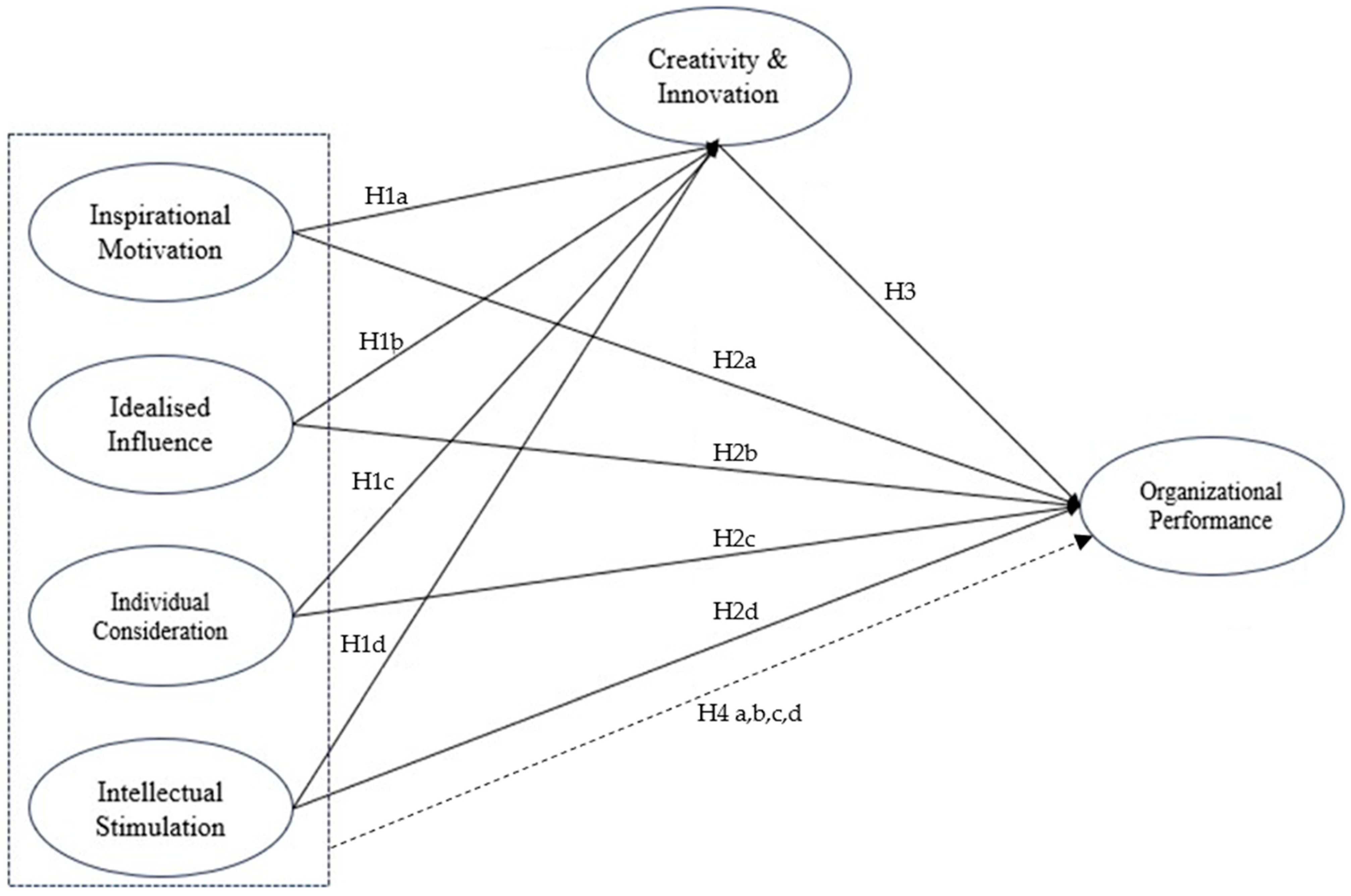
Transforming Telecoms: How Transformational Leadership, Creativity and Innovation Drive Organizational Performance

 ,
,  , and
, and
Abstract
1. Introduction
2. Literature Review
2.1. Social Exchange Theory
2.2. Organizational Performance
3. Hypotheses Development
3.1. Transformational Leadership
3.1.1. Inspirational Motivation (IM)
3.1.2. Idealized Influence (ID)
3.1.3. Individual Consideration (IC)
3.1.4. Intellectual Stimulation (IS)
3.2. Creativity and Innovation
3.3. The Mediating Role
4. Methodology
4.1. Study Design and Data Collection
4.2. Measurement Instruments
4.3. Data Analysis
5. Results
5.1. Measurement Model
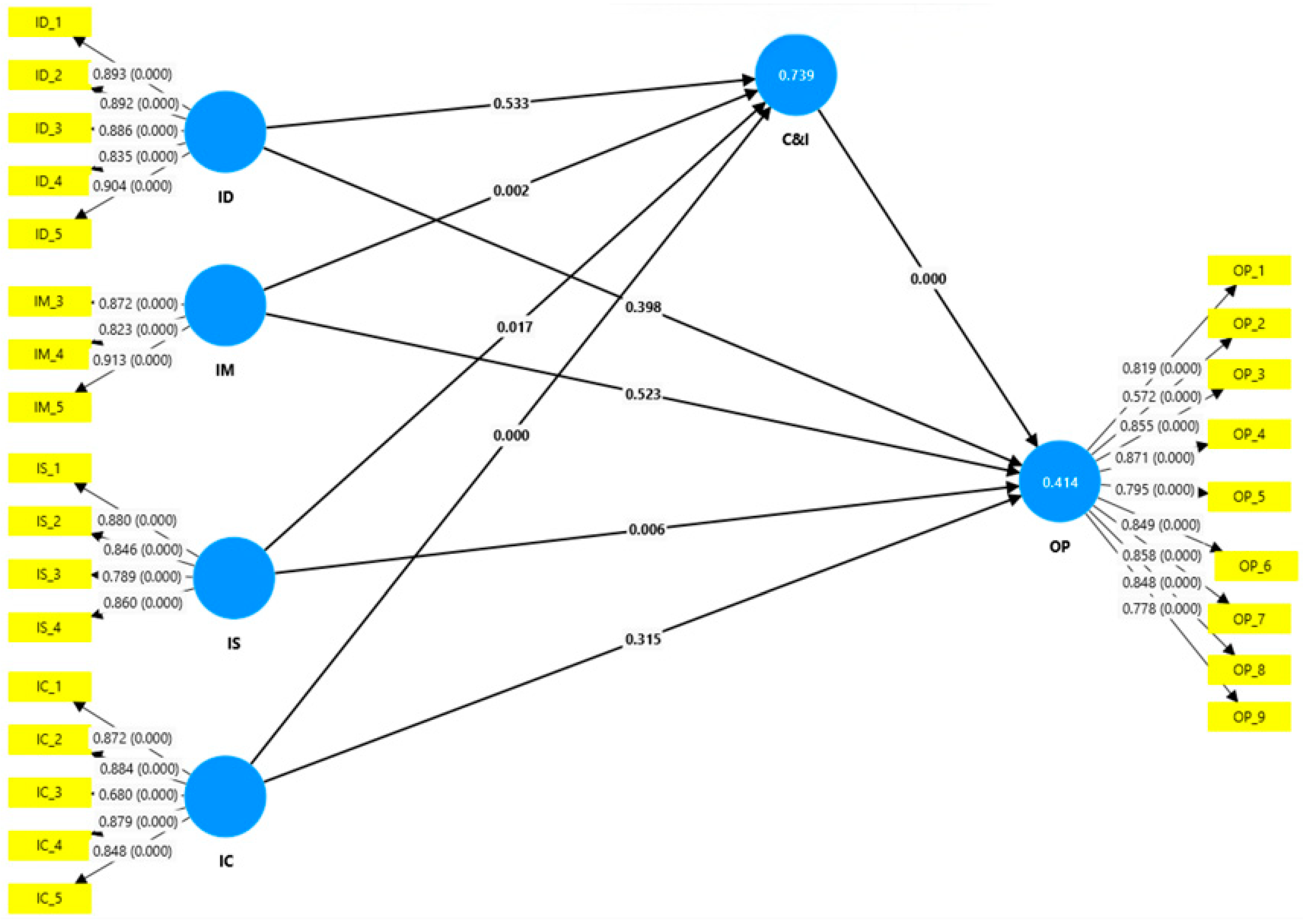
5.2. Structural Model
5.3. Mediating Effect
6. Discussion and Conclusions
7. Implications
8. Limitations and Future Research
Author Contributions
Funding
Institutional Review Board Statement
Informed Consent Statement
Data Availability Statement
Conflicts of Interest
Appendix A. Survey Questionnaire Items
Appendix A.1. Transformational Leadership (17 Items)
- Idealized Influence (ID)—5 items
- 1.
- In my organization, I feel proud to be associated with my CEO.
- 2.
- In my organization, I have complete faith in my CEO.
- 3.
- In my organization, my CEO has a sense of mission which he/she transmits to us.
- 4.
- In my organization, the CEO always expresses satisfaction when his/her expectations are met.
- 5.
- In my organization, I have a strong conviction in his/her beliefs and values.
- Inspirational Motivation (IM)—3 items
- 6.
- In my organization, the CEO develops ways to encourage us.
- 7.
- In my organization, the CEO talks optimistically about the future.
- 8.
- In my organization, I have confidence in my CEO.
- Intellectual Stimulation (IS)—4 items
- 9.
- In my organization, the CEO always shows how to look at old problems in new ways.
- 10.
- In my organization, the CEO emphasizes use of intelligence to overcome obstacles.
- 11.
- In my organization, the CEO makes us back up our opinions with good reasoning.
- 12.
- In my organization, the CEO always mobilizes a collective sense of mission.
- Individualized Consideration (IC)—5 items
- 13.
- In my organization, the CEO gives personal attention to us when we seem neglected.
- 14.
- In my organization, the CEO finds out what we want and helps us to get it.
- 15.
- In my organization, the leaders appreciate when we do a good job.
- 16.
- In my organization, the CEO spends time coaching and teaching every staff member.
- 17.
- In my organization, the CEO treats us as individuals rather than just members of the group.
Appendix A.2. Creativity and Innovation (CI)—30 Items
- 18.
- In my organization, all employees have a thorough understanding of the organization’s mission and vision.
- 19.
- In my organization, the vision and mission are focused on the future.
- 20.
- In my organization, the vision and mission are strongly market/customer oriented.
- 21.
- In my organization, developing new products and services to solve customers’ problems is a strategic priority.
- 22.
- In my organization, the gap between where we are and where we want to be is regularly analyzed and discussed.
- 23.
- In my organization, personal goals of the employees are consistent with organizational goals.
- 24.
- In my organization, quality is the main emphasis reflected in the organizational goals.
- 25.
- In my organization, organizational goals are strongly oriented towards effectiveness.
- 26.
- In my organization, there is a strong sense of purposefulness of the goals at all levels of the organization.
- 27.
- In my organization, the organizational structure is flat.
- 28.
- In my organization, the organization is composed of highly specialized functional departments.
- 29.
- In my organization, decision-making processes are formalized and standardized.
- 30.
- In my organization, employees have autonomy in organizing their work and determining their own procedures.
- 31.
- In my organization, decisions are taken at the lowest possible level.
- 32.
- In my organization, a lot of importance is attached to the development and support of teamwork.
- 33.
- In my organization, cross-functional teams are a common mode of work.
- 34.
- In my organization, work-teams are diversified in terms of members’ expertise, skills, and personalities.
- 35.
- In my organization, intrinsic rewards (e.g., increased autonomy, improved opportunities for personal growth) are a significant part of the motivation system.
- 36.
- In my organization, employees are rewarded for fault-free, efficient work.
- 37.
- In my organization, experimenting and generating ideas is appreciated.
- 38.
- In my organization, everyone has access to all the information they need.
- 39.
- In my organization, it is difficult to obtain resources for projects that involve above-average risk.
- 40.
- In my organization, promotions are awarded in recognition of exceptional creativity, initiative, and innovation.
- 41.
- In my organization, all ideas are given fair consideration.
- 42.
- In my organization, personnel are encouraged to talk and learn from one another.
- 43.
- In my organization, everyone is motivated to keep their knowledge and skills up to date.
- 44.
- In my organization, individuals are allowed to take risks as long as they do not harm the organization.
- 45.
- In my organization, conflicts are resolved through constructive discussion.
- 46.
- In my organization, we try to challenge the way things have always been done and look for a better way.
- 47.
- In my organization, the work environment is highly competitive.
Appendix A.3. Organizational Performance (OP)—9 Items
- 48.
- Compared with the industry average, we are more profitable.
- 49.
- Compared with the industry average, we have a greater market share.
- 50.
- Compared with the industry average, we are growing more rapidly.
- 51.
- In general, our organization is performing better than it did 12 months ago.
- 52.
- In general, our organization is performing better than it did five years ago.
- 53.
- Over the past 12 months, our organization has met its performance objectives.
- 54.
- Over the past 5 years, our organization has met its performance objectives.
- 55.
- In general, our organization’s customer satisfaction fulfillment is above that of our competitors.
- 56.
- In general, customer perceived quality of our product is above that of our competitors.
References
- Agazu, B. G., Kero, C. A., & Debela, K. L. (2025). Transformational leadership and firm performance: A systematic literature review. Journal of Innovation and Entrepreneurship, 14, 29. [Google Scholar] [CrossRef] [Scilit]
- Amabile, T. M. (1988). A model of creativity and innovation in organizations. In B. M. Staw, & L. L. Cummings (Eds.), Research in organizational behavior (Vol. 10, pp. 123–167). JAI Press. [Google Scholar]
- Amabile, T. M. (1996). Creativity in context. Westview. [Google Scholar]
- Amabile, T. M. (2000). A model of creativity and innovation in organizations. In B. Staw, & R. Sutton (Eds.), Research in organizational behavior (Vol. 22). Elsevier Science. [Google Scholar]
- Amabile, T. M., & Kramer, S. J. (2011). The progress principle: Using small wins to ignite joy, engagement, and creativity at work. Harvard Business School Publishing. [Google Scholar]
- Andersen, L. B., Boesen, A., & Pedersen, L. H. (2016). Performance in public organizations: Clarifying the conceptual space. Public Administration Review, 76, 852–862. [Google Scholar] [CrossRef] [Scilit]
- Anderson, N., Potočnik, K., & Zhou, J. (2014). Innovation and creativity in organizations: A state-of-the-science review, prospective commentary, and guiding framework. Journal of Management, 40, 1297–1333. [Google Scholar] [CrossRef] [Scilit]
- Anjali, K. T., & Anand, D. (2015). Intellectual stimulation and job commitment: A study of IT professionals. The IUP Journal of Organizational Behavior, 14, 28–41. [Google Scholar]
- Arendt, L. A. (2009). Transformational leadership and follower’s creativity: The moderating effect of leader humour. Review of Business Research, 9, 100–106. [Google Scholar]
- Arokiasamy, L., Fu, T., Kumar Piaralal, S., & Sarah Omar, S. (2023). A systematic review on human capital: A view from human resource development. KnE Social Sciences, 8, 57–76. [Google Scholar] [CrossRef] [Scilit]
- Arokiasamy, L., Fujikawa, T., Piaralal, S. K., & Arumugam, T. (2024). Role of HRM practices in organization performance: A survey approach. International Journal of Sociotechnology and Knowledge Development, 16, 1–32. [Google Scholar] [CrossRef] [Scilit]
- Asiamah, N., Mensah, H. K., & Oteng-Abayie, E. F. (2017). Do larger samples really lead to more precise estimates? A simulation study. American Journal of Educational Research, 5, 9–17. [Google Scholar]
- Avolio, B. J., & Bass, B. M. (2002). Developing potential across a full range of leadership: Cases on transactional and transformational leadership. Lawrence Erlbaum Associates. [Google Scholar]
- Bass, B. M. (1985). Leadership and performance beyond expectations. Free Press. [Google Scholar]
- Bass, B. M., & Avolio, B. J. (1994). Improving organizational effectiveness through transformational leadership. Sage Publications. [Google Scholar]
- Bass, B. M., & Riggio, R. E. (2006). Transformational leadership (2nd ed.). Lawrence Erlbaum Associates. [Google Scholar]
- Bass, B. M., & Steidlmeier, P. (1999). Ethics, character, and authentic transformational leadership behavior. The Leadership Quarterly, 10, 181–217. [Google Scholar] [CrossRef] [Scilit]
- Blau, P. M. (1964). Exchange and power in social life. John Wiley. [Google Scholar]
- Boerner, S., Eisenbeiss, S. A., & Griesser, D. (2007). Follower behavior and organizational performance: The impact of transformational leaders. Journal of Leadership & Organizational Studies, 13, 15–26. [Google Scholar] [CrossRef] [Scilit]
- Boga, I., & Ensari, N. (2009). The role of transformational leadership and organizational change on perceived organizational success. The Psychologist-Manager Journal, 12, 235–251. [Google Scholar] [CrossRef] [Scilit]
- Boies, K., Fiset, J., & Gill, H. (2015). Communication and trust are key: Unlocking the relationship between leadership and team performance and creativity. The Leadership Quarterly, 26, 1080–1094. [Google Scholar] [CrossRef] [Scilit]
- Bonaccio, S., Connelly, C. E., Gellatly, I. R., Jetha, A., & Martin Ginis, K. A. (2020). The participation of people with disabilities in the workplace across the employment cycle: Employer concerns and research evidence. Journal of Business and Psychology, 35, 135–158. [Google Scholar] [CrossRef] [Scilit] [PubMed]
- Bono, J. E., & Judge, T. A. (2004). Personality and transformational and transactional leadership: A meta-analysis. Journal of Applied Psychology, 89, 901–910. [Google Scholar] [CrossRef] [Scilit]
- Carvalho, V. S., Guerrero, E., Chambel, M. J., & González-Rico, P. (2016). Psychometric properties of WLEIS as a measure of emotional intelligence in the Portuguese and Spanish medical students. Evaluation and Program Planning, 58, 152–159. [Google Scholar] [CrossRef] [Scilit]
- Chen, I. J., & Paulraj, A. (2004). Towards a theory of supply chain management: The constructs and measurements. Journal of Operations Management, 22, 119–150. [Google Scholar] [CrossRef] [Scilit]
- Chen, M. Y., Lin, C. Y., Lin, H., & McDonough, E. F., III. (2012). Does transformational leadership facilitate technological innovation? The moderating roles of innovative culture and incentive compensation. Asia Pacific Journal of Management, 29, 239–264. [Google Scholar] [CrossRef] [Scilit]
- Chen, S. Y., Wu, W. C., Chang, C. S., Lin, C. T., Kung, J. Y., Weng, H. C., & Lee, S. I. (2015). Organizational justice, trust, and identification and their effects on organizational commitment in hospital nursing staff. BMC Health Services Research, 15, 636. [Google Scholar] [CrossRef] [Scilit]
- Chew, J., & Chan, C. C. A. (2008). Human resource practices, organizational commitment and intention to stay. International Journal of Manpower, 29, 503–522. [Google Scholar] [CrossRef] [Scilit]
- Chong, C. W., Chong, S. C., & Wong, K. Y. (2009). Is the Malaysian telecommunication industry ready for knowledge management implementation? Journal of Knowledge Management, 13, 69–87. [Google Scholar] [CrossRef] [Scilit]
- Chu, L., & Lai, C. (2011). A research on the influence of leadership style and job characteristics on job performance among accountants of county and city government in Taiwan. Public Personnel Management, 40, 101–118. [Google Scholar] [CrossRef] [Scilit]
- Damanpour, F. (2014). Footnotes to research on management innovation. Organization Studies, 35, 1265–1285. [Google Scholar] [CrossRef] [Scilit]
- Damanpour, F., & Evan, W. M. (1984). Organizational innovation and performance: The problem of organizational lag. Administrative Science Quarterly, 29, 392–409. [Google Scholar] [CrossRef] [Scilit]
- Danks, N. P., & Ray, S. (2018). Predictions from partial least squares models. In F. Ali, S. M. Rasoolimanesh, M. Sarstedt, & C. M. Ringle (Eds.), Applying partial least squares in tourism and hospitality research (pp. 35–52). Emerald Publishing. [Google Scholar]
- Darroch, J. (2005). Knowledge management, innovation and firm performance. Journal of Knowledge Management, 9, 101–115. [Google Scholar] [CrossRef] [Scilit]
- Demir, A., & Budur, T. (2019). Roles of leadership styles in corporate social responsibility to nongovernmental organizations (NGOs). International Journal of Social Sciences & Educational Studies, 5, 174–183. [Google Scholar]
- Demir, A., Budur, T., & Heshmati, A. (2020). Antecedents of trust, corporate image, and switching costs: A case in telecommunication services in the Kurdistan region of Iraq. International Journal of Mobile Communications, 19, 53–74. [Google Scholar] [CrossRef] [Scilit]
- Den Hartog, D. N. (1997). Inspirational leadership [Doctoral dissertation, Vrije Universiteit Amsterdam]. [Google Scholar]
- Donate, M. J., & Sánchez de Pablo, J. D. (2015). The role of knowledge-oriented leadership in knowledge management practices and innovation. Journal of Business Research, 68, 360–370. [Google Scholar] [CrossRef] [Scilit]
- Doody, O., & Doody, C. M. (2015). Conducting a pilot study: Case study of a novice researcher. British Journal of Nursing, 24, 1074–1078. [Google Scholar] [CrossRef] [Scilit]
- Ebrahim, H. A. K. (2018). Impact of leadership styles on organizational performance. Journal of Human Resources Management Research, 2018, 687849. [Google Scholar] [CrossRef] [Scilit]
- Eisenberger, R., Armeli, S., Rexwinkel, B., Lynch, P. D., & Roades, L. (2001). Reciprocation of perceived organizational support. Journal of Applied Psychology, 86, 42–51. [Google Scholar] [CrossRef] [Scilit]
- Eisenhardt, K. M., & Martin, J. A. (2000). Dynamic capabilities: What are they? Strategic Management Journal, 21, 1105–1121. [Google Scholar] [CrossRef] [Scilit]
- Etikan, I., Musa, S. A., & Allkassim, R. S. (2016). Comparison of convenience and purposive sampling. American Journal of Theoretical and Applied Statistics, 5, 1–4. [Google Scholar] [CrossRef] [Scilit]
- Gary, M., & Scott, J. S. (2000). Telecommunications and economic growth. International Journal of Social Economics, 27, 893–906. [Google Scholar] [CrossRef] [Scilit]
- Gaynard, P. (1997). Productivity through data organization. Work Study, 46, 90–98. [Google Scholar] [CrossRef] [Scilit]
- Ghaleb, M. M. S., & Piaralal, S. K. (2024). Enhancing employee creativity: Interactions between diabetic compliance, emotional support at work, and management’s approach to patient autonomy. Journal of Natural Science, Biology and Medicine, 15, 389–400. [Google Scholar] [CrossRef]
- Ghimire, S., Haron, A. J., & Bhatti, H. S. (2021). Transformational leadership and employee creativity in an information technology enterprise: Moderating role of openness to experience. Journal of Entrepreneurship and Organization Management, 10, 1–7. [Google Scholar]
- Gilmore, P. L., Hu, X., Wei, F., Tetrick, L. E., & Zaccaro, S. J. (2013). Positive affectivity neutralizes transformational leadership’s influence on creative performance and organizational citizenship behaviors. Journal of Organizational Behavior, 34, 1061–1075. [Google Scholar] [CrossRef] [Scilit]
- Gopalakrishnan, S. (2000). Unraveling the links between dimensions of innovation and organizational performance. The Journal of High Technology Management Research, 11, 137–153. [Google Scholar] [CrossRef] [Scilit]
- Gouldner, A. W. (1960). The norm of reciprocity: A preliminary statement. American Sociological Review, 25, 161–178. [Google Scholar] [CrossRef] [Scilit]
- Gumusluoglu, L., & Ilsev, A. (2009). Transformational leadership and organizational innovation: The roles of internal and external support for innovation. Journal of Product Innovation Management, 26, 264–274. [Google Scholar] [CrossRef] [Scilit]
- Hair, J. F., Ringle, C. M., & Sarstedt, M. (2011). PLS-SEM: Indeed a silver bullet. Journal of Marketing Theory and Practice, 19, 139–152. [Google Scholar] [CrossRef] [Scilit]
- Hair, J. F., Risher, J. J., Sarstedt, M., & Ringle, C. M. (2019). When to use and how to report the results of PLS-SEM. European Business Review, 31, 2–24. [Google Scholar] [CrossRef] [Scilit]
- Halim, H. A., Andalib, T. W., Ahmad, N. H., & Ramayah, T. (2023). Effect of internal barriers on innovation performance in embryonic SMEs in Malaysia. Asian Academy of Management Journal, 28, 29–60. [Google Scholar] [CrossRef] [Scilit]
- Hansen, A., Byrne, Z., & Kiersch, C. (2014). How interpersonal leadership relates to employee engagement. Journal of Managerial Psychology, 29, 953–972. [Google Scholar] [CrossRef] [Scilit]
- Harari, M. B., Reaves, A. C., & Viswesvaran, C. (2016). Creative and innovative performance: A meta-analysis of relationships with task, citizenship, and counterproductive job performance dimensions. European Journal of Work and Organizational Psychology, 25, 495–511. [Google Scholar] [CrossRef] [Scilit]
- Howell, J. M., & Higgins, C. A. (1990). Champions of technological innovation. Administrative Science Quarterly, 35, 317–341. [Google Scholar] [CrossRef] [Scilit]
- Hu, L. T., & Bentler, P. M. (1999). Cutoff criteria for fit indexes in covariance structure analysis: Conventional criteria versus new alternatives. Structural Equation Modeling: A Multidisciplinary Journal, 6, 1–55. [Google Scholar] [CrossRef] [Scilit]
- Hui, Y. L. (2022). How transformational leadership contributes to perceived service quality by customers via the mediating effect of organizational innovation within Taiwan telecommunication companies. International Journal of Organizational Innovation, 15, 1268. [Google Scholar]
- Hult, G. M., Hurley, R. F., & Knight, G. A. (2004). Innovativeness: Its antecedents and impact on business performance. Industrial Marketing Management, 33, 429–438. [Google Scholar] [CrossRef]
- James, O., Nancy, I., Chinazam, K. J., & Ogheneovie, E. (2018). Creativity and innovation culture: A prerequisite for sustaining competitive advantage in SMEs. Covenant Journal of Entrepreneurship, 2, 1–15. [Google Scholar]
- Jiang, Y., Abdullah, S. I. N. W., Lim, B. J. H., Wang, R., & Phuah, K. T. (2023). The role of marketing stimuli and attitude in determining post-COVID buying decisions toward organic food products: Evidence from retail consumers in Beijing, China. Frontiers in Sustainable Food Systems, 7, 1051696. [Google Scholar] [CrossRef] [Scilit]
- Johnson, J. D., Meyer, M. E., Berkowitz, J. M., Ethingon, C. T., & Miller, V. D. (1997). Testing two contrasting structural models of innovativeness in a contractual network. Human Communication Research, 24, 320–348. [Google Scholar] [CrossRef] [Scilit]
- Judge, T. A., & Piccolo, R. F. (2004). Transformational and transactional leadership: A meta-analytic test of their relative validity. Journal of Applied Psychology, 89, 755–768. [Google Scholar] [CrossRef] [Scilit] [PubMed]
- Jung, D. I., Chow, C., & Wu, A. (2003). The role of transformational leadership in enhancing organisational innovation: Hypotheses and some preliminary findings. The Leadership Quarterly, 14, 525–544. [Google Scholar] [CrossRef] [Scilit]
- Jung, D. I., Wu, A., & Chow, C. (2008). Towards understanding the direct and indirect effects of CEOs’ transformational leadership on firm innovation. The Leadership Quarterly, 19, 582–594. [Google Scholar] [CrossRef] [Scilit]
- Jyoti, J., & Dev, M. (2015). The impact of transformational leadership on employee creativity: The role of learning orientation. Journal of Asia Business Studies, 9, 78–98. [Google Scholar] [CrossRef] [Scilit]
- Kaczmarczyk, S., & Murtough, J. (2002). Measuring the performance of innovative workplaces. Journal of Facilities Management, 1, 163–176. [Google Scholar] [CrossRef] [Scilit]
- Kasia, Z., & John, B. (2007). Do organizational factors support creativity and innovation in Polish firms? European Journal of Innovation Management, 10, 25–40. [Google Scholar]
- Kelly, M. L. (2003). Academic advisers as transformational leaders. The Mentor, 5, 1–8. [Google Scholar]
- Khalili, A. (2016). Linking transformational leadership, creativity, innovation, and innovation-supportive climate. Management Decision, 54, 2277–2293. [Google Scholar] [CrossRef] [Scilit]
- Kim, H. (2014). Transformational leadership, organizational clan culture, organizational affective commitment, and organizational citizenship behavior: A case of South Korea’s public sector. Public Organization Review, 14, 397–417. [Google Scholar] [CrossRef] [Scilit]
- Koohang, A., Paliszkiewicz, J., & Goluchowski, J. (2017). The impact of leadership on trust, knowledge management, and organizational performance: A research model. Industrial Management & Data Systems, 117, 521–537. [Google Scholar]
- Koys, D. J. (2001). The effects of employee satisfaction, organizational citizenship behavior, and turnover on organizational effectiveness: A unit-level, longitudinal study. Personnel Psychology, 54, 101–114. [Google Scholar] [CrossRef] [Scilit]
- Lawles, E. J., & Thye, S. R. (1999). Bringing emotions into social exchange theory. Annual Review of Sociology, 25, 217–244. [Google Scholar] [CrossRef] [Scilit]
- Lee, A., Martin, R., Thomas, G., Guillaume, Y., & Maio, G. (2015). Conceptualizing leadership perceptions as attitudes: Using attitude theory to further understand the leadership process. The Leadership Quarterly, 26, 910–934. [Google Scholar] [CrossRef] [Scilit]
- Lerro, A., Santarsiero, F., Schiuma, G., & Bartuseviciene, I. (2023). Mapping knowledge assets categories for successful crowd-funding strategies. European Journal of Innovation Management, 26, 2302–2325. [Google Scholar]
- Levy, D. L., Brown, H. S., & de Jong, M. (2010). The contested politics of corporate governance: The case of the global reporting initiative. Business & Society, 49, 88–115. [Google Scholar] [CrossRef] [Scilit]
- Liu, H., Bracht, E., Zhang, X., Bradley, B., & van Dick, R. (2021). Creativity in nonroutine jobs: The role of transformational leadership and organizational identification. Creativity and Innovation Management, 30, 129–143. [Google Scholar] [CrossRef] [Scilit]
- Malaysian Communications and Multimedia Commission (MCMC). (2019). Industrial performance report 2019. Available online: www.mcmc.gov.my (accessed on 16 January 2023).
- Martins, E. C., & Terblanche, F. (2003). Building organisational culture that stimulates creativity and innovation. European Journal of Innovation Management, 6, 64–74. [Google Scholar] [CrossRef] [Scilit]
- McKinley, W., Latham, S., & Braun, M. (2014). Organizational decline and innovation: Turnarounds and downward spirals. Academy of Management Review, 39, 88–110. [Google Scholar] [CrossRef] [Scilit]
- Mehralian, G., Yusefi, A. R., Dastyar, N., & Bordbar, S. (2023). Communication competence, self-efficacy, and spiritual intelligence: Evidence from nurses. BMC Nursing, 22, 99. [Google Scholar] [CrossRef] [Scilit]
- Mendonça, S., Damásio, B., Charlita de Freitas, L., Oliveira, L., Cichy, M., & Nicita, A. (2022). The rise of 5G technologies and systems: A quantitative analysis of knowledge production. Telecommunications Policy, 46, 102327. [Google Scholar] [CrossRef] [Scilit]
- Michaelis, B., Stegmaier, R., & Sonntag, K. (2010). Shedding light on followers’ innovation implementation behaviour: The role of transformational leadership, commitment to change, and climate for initiative. Journal of Managerial Psychology, 25, 408–429. [Google Scholar] [CrossRef] [Scilit]
- Michaelis, T. L., Aladin, R., & Pollack, J. M. (2018). Innovation culture and the performance of new product launches: A global study. Journal of Business Venturing Insights, 9, 116–127. [Google Scholar] [CrossRef] [Scilit]
- Mittal, S., & Dhar, R. L. (2015). Transformational leadership and employee creativity. Management Decision, 53, 894–910. [Google Scholar] [CrossRef] [Scilit]
- Muchiri, M., & Cooksey, R. (2011). Examining the effects of substitutes for leadership on performance outcomes. Leadership & Organization Development Journal, 32, 817–836. [Google Scholar] [CrossRef] [Scilit]
- Muñoz-Pascual, L., & Galende, J. (2017). The impact of knowledge and motivation management on creativity: Employees of innovative Spanish companies. Employee Relations, 39, 732–752. [Google Scholar] [CrossRef] [Scilit]
- Ng, T. W. (2016). Transformational leadership and performance outcomes: Analyses of multiple mediation pathways. The Leadership Quarterly, 28, 227–239. [Google Scholar] [CrossRef] [Scilit]
- Ngah, R., & Ibrahim, A. R. (2010). The effect of knowledge sharing on organizational performance in small and medium enterprises. In Knowledge management: Theory, research and practice, proceedings of the 5th international conference on knowledge management (pp. 503–508). UUM College of Art & Sciences, Universiti Utara Malaysia. [Google Scholar]
- Noh, H., Kim, K., Song, Y.-K., & Lee, S. (2021). Opportunity-driven technology roadmapping: The case of 5G mobile services. Technological Forecasting and Social Change, 163, 120452. [Google Scholar] [CrossRef] [Scilit]
- Oldham, G. R., & Cummings, A. (1996). Employee creativity: Personal and contextual factors at work. Academy of Management Journal, 39, 607–655. [Google Scholar] [CrossRef] [Scilit]
- Pedro, S. A., Simona, P., & Daniel, P. M. (2015). E-Business, organizational innovation and firm performance in manufacturing SMEs: An empirical study in Spain. Journal of Small Business & Enterprise Development, 22, 885–904. [Google Scholar]
- Phipps, S. T. A., Prieto, L. C., & Verma, S. (2012). Holding the helm: Exploring the influence of transformational leadership on group creativity and the moderating role of organizational learning culture. Journal of Organizational Culture, Communications and Conflict, 16, 145–156. [Google Scholar]
- Prasad, B., & Junni, P. (2016). CEO transformational and transactional leadership and organizational innovation. Management Decision, 54, 1542–1568. [Google Scholar] [CrossRef] [Scilit]
- Ramalingam, T., Abdul Karim, J., Piaralal, S., & Singh, B. (2015). Creativity and innovation (organizational factor) influence on firm performance: An empirical study on Malaysian telecommunication mobile network operators. American Journal of Economics, 5, 194–199. [Google Scholar]
- Ramalingam, T., Piaralal, S. K., Osman, Z., & Arokiasamy, L. (2021). Effect of transformational leadership and creativity and innovation on organizational performance: A conceptual model. Electronic Journal of Business and Management, 6, 20–31. [Google Scholar] [CrossRef] [Scilit]
- Rawung, F. H., Wuryaningrat, N. F., & Elvinita, L. E. (2015). The influence of transformational and transactional leadership on knowledge sharing: An empirical study on small and medium business in Indonesia. Asian Academy of Management Journal, 20, 123–145. [Google Scholar]
- Ringle, C. M., Sarstedt, M., Mitchell, R., & Gudergan, S. P. (2020). Partial least squares structural equation modeling in HRM research. The International Journal of Human Resource Management, 31, 1617–1643. [Google Scholar] [CrossRef] [Scilit]
- Samydevan, V., Mohd Amin, M. R., & Piaralal, S. K. (2021). Determinants of entrepreneurial intention among school students in Malaysia: An empirical study. Journal of Education for Business, 96, 359–365. [Google Scholar] [CrossRef] [Scilit]
- Sarooghi, H., Libaers, D., & Burkemper, A. (2015). Examining the relationship between creativity and innovation: A meta-analysis of organizational, cultural, and environmental factors. Journal of Business Venturing, 30, 714–731. [Google Scholar] [CrossRef] [Scilit]
- Sarros, J. C., Cooper, B. K., & Benrra, J. C. (2008). Building a climate for innovation through transformational leadership and organizational culture. Journal of Leadership & Organizational Studies, 15, 145–158. [Google Scholar] [CrossRef] [Scilit]
- Saunders, M. N., Lewis, P., Thornhill, A., & Bristow, A. (2015). Understanding research philosophy and approaches to theory development. In Research methods for business students (pp. 1–34). Pearson Education. [Google Scholar]
- Sayyadi Ghasabeh, M. (2020). Transformational leadership, information technology, knowledge management, firm performance: How are they linked? The Journal of Values-Based Leadership, 13, 17. [Google Scholar]
- Schermerhorn, J. R., Jr., & McCarthy, A. (2004). Enhancing performance capacity in the workplace: A reflection on the significance of the individual. Irish Journal of Management, 25, 45. [Google Scholar]
- Sethibe, T., & Steyn, R. (2016). The impact of leadership styles and the components of leadership styles on innovative behaviour. International Journal of Innovation Management, 21, 1750015. [Google Scholar] [CrossRef] [Scilit]
- Settoon, R. P., Bennett, N., & Liden, R. C. (1996). Social exchange in organizations: Perceived organizational support, leader–member exchange, and employee reciprocity. Journal of Applied Psychology, 81, 219–227. [Google Scholar] [CrossRef]
- Shafi, M., Zoya, Lei, Z., Song, X., & Sarker, M. N. I. (2019). The effects of transformational leadership on employee creativity: Moderating role of intrinsic motivation. Asia Pacific Management Review, 25, 166–176. [Google Scholar] [CrossRef] [Scilit]
- Shahin, A., Barati, A., Dabestani, R., & Khalili, A. (2017). Determining factors influencing radical and incremental innovation with a case study in the petrochemical industry. International Journal of Business Innovation and Research, 12, 62–79. [Google Scholar] [CrossRef] [Scilit]
- Shalley, C. E., & Gilson, L. L. (2004). What leaders need to know: A review of social and contextual factors that can foster or hinder creativity. The Leadership Quarterly, 15, 33–53. [Google Scholar] [CrossRef] [Scilit]
- Shamir, B., House, R., & Arthur, M. (1993). The motivational effects of charismatic leadership: A self-concept based theory. Organization Science, 4, 577–594. [Google Scholar] [CrossRef] [Scilit]
- Sher, P. J., & Lee, V. C. (2004). Information technology as a facilitator for enhancing dynamic capabilities through knowledge management. Information & Management, 41, 933–945. [Google Scholar] [CrossRef] [Scilit]
- Shin, S. J., & Zhou, J. (2003). Transformational leadership, conservation, and creativity: Evidence from Korea. Academy of Management Journal, 46, 703–714. [Google Scholar] [CrossRef] [Scilit]
- Shmueli, G., Sarstedt, M., Hair, J. F., Cheah, J.-H., Ting, H., Vaithilingam, S., & Ringle, C. M. (2019). Predictive model assessment in PLS-SEM: Guidelines for using PLSpredict. European Journal of Marketing, 53, 2322–2347. [Google Scholar] [CrossRef] [Scilit]
- Smothers, J., Doleh, R., Celuch, K., Peluchette, J., & Valadares, K. (2016). Talk nerdy to me: The role of intellectual stimulation in the supervisor-employee relationship. Journal of Health and Human Services Administration, 38, 478–508. [Google Scholar] [CrossRef] [Scilit] [PubMed]
- Snell, R. S., Yi, Z., & Chak, A. M. (2013). Representational predicaments for employees: Their impact on perceptions of supervisors’ individualized consideration and on employee job satisfaction. The International Journal of Human Resource Management, 24, 1646–1670. [Google Scholar] [CrossRef] [Scilit]
- Sofi, M. A., & Devanadhen, D. K. (2015). Impact of leadership styles on organizational performance: An empirical assessment of banking sector in Jammu and Kashmir. IOSR Journal of Business and Management, 17, 31–45. [Google Scholar]
- Sosik, J. J., Kahai, S., & Avolio, B. J. (1998). Transformational leadership and dimensions of creativity: Motivating idea generation in computer-mediated groups. Creativity Research Journal, 11, 111–121. [Google Scholar] [CrossRef] [Scilit]
- Subramaniam, A., Othman, R., & Sambasivan, M. (2010). Implicit leadership theory among Malaysian managers: Impact of the leadership expectation gap on leader–member exchange quality. Leadership & Organization Development Journal, 31, 351–371. [Google Scholar]
- Tangen, S. (2003). An overview of frequently used performance measures. Work Study, 52, 347–354. [Google Scholar] [CrossRef] [Scilit]
- Uddin, M. H. (2013). Role of transformational leadership in organizational change: Mediating role of trust. IOSR Journal of Business and Management, 7, 72–76. [Google Scholar] [CrossRef] [Scilit]
- Van Rossenberg, Y. G., Cross, D., & Swart, J. (2022). An HRM perspective on workplace commitment: Reconnecting in concept, measurement and methodology. Human Resource Management Review, 32, 100891. [Google Scholar] [CrossRef] [Scilit]
- Wider, C., & Wider, W. (2023). Effects of Metacognitive Skills on Physics Problem-Solving Skills among Form Four Secondary School Students. Journal of Baltic Science Education, 22(2), 357–369. [Google Scholar] [CrossRef] [Scilit]
- Wong, C.-S., & Law, K. S. (2002). The effects of leader and follower emotional intelligence on performance and attitude: An exploratory study. Leadership Perspectives, 13, 243–274. [Google Scholar]
- Zacher, H., Pearce, L., Rooney, D., & McKenna, B. (2014). Leaders’ personal wisdom and leader-member exchange quality: The role of individualized consideration. Journal of Business Ethics, 121, 171–187. [Google Scholar] [CrossRef] [Scilit]
- Zhou, J., & Oldham, G. R. (2001). Enhancing creative performance: Effects of expected developmental assessment strategies and creative personality. The Journal of Creative Behavior, 35, 151–167. [Google Scholar] [CrossRef] [Scilit]


| Categories | Frequency | Percent (%) |
|---|---|---|
| Age | ||
| 30–44 years old | 172 | 54.8 |
| 45–54 years old | 114 | 36.3 |
| 55–64 years old | 28 | 8.9 |
| Gender | ||
| Male | 270 | 86.0 |
| Female | 44 | 14.0 |
| Highest Education | ||
| Bachelor’s degree | 272 | 86.6 |
| Master’s degree | 27 | 8.60 |
| Doctorate | 2 | 0.60 |
| Others | 14 | 4.10 |
| Position | ||
| Executive | 241 | 76.8 |
| Junior Manager | 42 | 13.4 |
| Middle Manager | 7 | 2.2 |
| Senior Manager | 24 | 7.6 |
| Working Period in Telecommunication Industry | ||
| 5–9 years | 107 | 34.1 |
| 10–14 years | 125 | 39.8 |
| >14 years | 82 | 26.1 |
| Working Period in current Organization | ||
| <5 years | 40 | 12.7 |
| 5–9 years | 164 | 52.2 |
| 10–14 years | 70 | 22.3 |
| >14 years | 40 | 12.7 |
| Construct | Cronbach’s Alpha | Composite Reliability | AVE |
|---|---|---|---|
| Idealized Influence (ID) | 0.929 | 0.929 | 0.779 |
| Individual Consideration (IC) | 0.890 | 0.895 | 0.700 |
| Inspirational Motivation (IM) | 0.840 | 0.860 | 0.757 |
| Intellectual Stimulation (IS) | 0.866 | 0.873 | 0.713 |
| Creativity and Innovation (C&I) | 0.902 | 0.904 | 0.774 |
| Organizational Performance (OP) | 0.933 | 0.939 | 0.656 |
| Constructs | C&I | IC | ID | IM | IS | OP |
|---|---|---|---|---|---|---|
| C&I | - | |||||
| IC | 0.905 | - | ||||
| ID | 0.789 | 0.776 | - | |||
| IM | 0.786 | 0.681 | 0.888 | - | ||
| IS | 0.842 | 0.807 | 0.885 | 0.888 | - | |
| OP | 0.675 | 0.577 | 0.518 | 0.524 | 0.457 | - |
| Path | Path Coefficient (β) | Sample Mean | Standard Deviation | T Statistics | p Value | Significance Level |
|---|---|---|---|---|---|---|
| H1a: IM → C&I | 0.201 | 0.198 | 0.065 | 3.106 | 0.002 | *** |
| H1b: ID → C&I | 0.052 | 0.045 | 0.084 | 0.624 | 0.533 | n.s. |
| H1c: IC → C&I | 0.529 | 0.540 | 0.062 | 8.534 | 0.000 | *** |
| H1d: IS → C&I | 0.176 | 0.171 | 0.074 | 2.382 | 0.017 | ** |
| H2a: IM → OP | 0.112 | 0.095 | 0.175 | 0.639 | 0.523 | n.s. |
| H2b: ID → OP | 0.111 | 0.124 | 0.131 | 0.846 | 0.398 | n.s. |
| H2c: IC → OP | 0.105 | 0.094 | 0.105 | 1.004 | 0.315 | n.s. |
| H2d: IS → OP | 0.261 | 0.257 | 0.094 | 2.772 | 0.006 | *** |
| H3: C&I → OP | 0.579 | 0.586 | 0.137 | 4.210 | 0.000 | *** |
| Hypothesis | Mediation Path | Path Coefficient (β) | T Value | p Value | Mediation Type |
|---|---|---|---|---|---|
| H4a | IM → CI → OP | 0.116 | 2.597 | 0.009 | Full mediation |
| H4b | ID → CI → OP | 0.030 | 0.587 | 0.557 | Not significant |
| H4c | IC → CI → OP | 0.306 | 3.669 | 0.000 | Full mediation |
| H4d | IS → CI → OP | 0.102 | 1.959 | 0.050 | Not significant |
Disclaimer/Publisher’s Note: The statements, opinions and data contained in all publications are solely those of the individual author(s) and contributor(s) and not of MDPI and/or the editor(s). MDPI and/or the editor(s) disclaim responsibility for any injury to people or property resulting from any ideas, methods, instructions or products referred to in the content. |
© 2026 by the authors. Licensee MDPI, Basel, Switzerland. This article is an open access article distributed under the terms and conditions of the Creative Commons Attribution (CC BY) license.
Share and Cite
Piaralal, S.K.; Ramalingam, T.; Zulkefli, N.A.; Qazi, S.; Haque, R.; Senathirajah, A.R.b. Transforming Telecoms: How Transformational Leadership, Creativity and Innovation Drive Organizational Performance. Adm. Sci. 2026, 16, 150. https://doi.org/10.3390/admsci16030150
Piaralal SK, Ramalingam T, Zulkefli NA, Qazi S, Haque R, Senathirajah ARb. Transforming Telecoms: How Transformational Leadership, Creativity and Innovation Drive Organizational Performance. Administrative Sciences. 2026; 16(3):150. https://doi.org/10.3390/admsci16030150
Chicago/Turabian StylePiaralal, Shishi Kumar, Thiaku Ramalingam, Nur Amalina Zulkefli, Sayeeduzzafar Qazi, Rasheedul Haque, and Abdul Rahman bin Senathirajah. 2026. "Transforming Telecoms: How Transformational Leadership, Creativity and Innovation Drive Organizational Performance" Administrative Sciences 16, no. 3: 150. https://doi.org/10.3390/admsci16030150
APA StylePiaralal, S. K., Ramalingam, T., Zulkefli, N. A., Qazi, S., Haque, R., & Senathirajah, A. R. b. (2026). Transforming Telecoms: How Transformational Leadership, Creativity and Innovation Drive Organizational Performance. Administrative Sciences, 16(3), 150. https://doi.org/10.3390/admsci16030150