Unpacking the Black Box: How Occupational Subculture and Sensemaking Drive Strategic Learning Capability


Abstract
1. Introduction
Integrating Theory: A Conceptual Framework of Occupational Subcultures, Sensemaking, and Strategic Learning Capability
2. Literature Review
2.1. Occupational Subcultures as Determinants of Organizational Learning Pathways
2.2. Sensemaking
2.3. Strategic Learning Capability: A Subcultural Pathway Perspective
3. Theoretical Propositions
3.1. A Framework for SLC
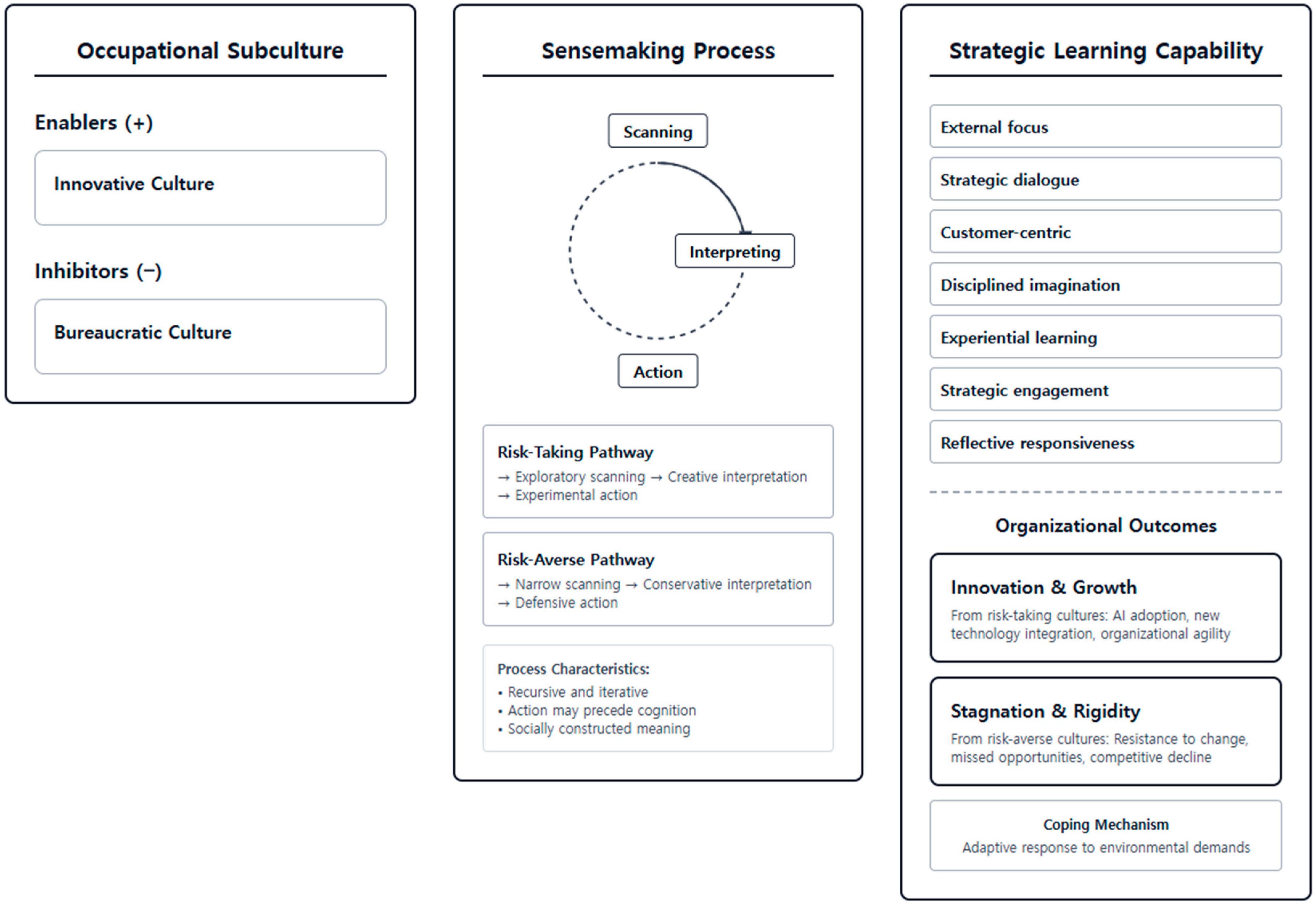
- Path A. Strategic Learning Capability (Innovation Pathway): When sensemaking is facilitated by an innovative subculture characterized by risk-taking orientation, the organization develops strategic learning capability through exploratory scanning, creative interpretation, and experimental action. This risk-taking pathway enables the organization to achieve innovation and growth through adaptive responses including external focus, strategic dialog, customer-centricity, disciplined imagination, experiential learning, strategic engagement, and reflective responsiveness. The cyclical, non-linear sensemaking process produces emergent strategy-making that embraces AI adoption, new technology integration, and organizational agility in response to environmental demands.
- Path B. Organizational Coping (Conservative Pathway): Conversely, when sensemaking is constrained by a bureaucratic subculture characterized by risk aversion and rigidity toward failure, the organization follows a conservative pathway marked by narrow scanning, conservative interpretation, and defensive action. This risk-averse orientation leads to organizational stagnation and rigidity, manifesting as resistance to change, missed opportunities, and competitive decline. In this state, the organization defaults to a coping mechanism where strategic learning capabilities are inhibited, and the organization remains detached from innovative possibilities, maintaining rule-bound behavior and status quo bias.
3.2. Sensemaking Model for SLC
4. Implications for Practice and Research
4.1. Implications for Research
4.2. Implications for Practice and OD
5. Conclusions
Limitations and Future Directions
Funding
Institutional Review Board Statement
Informed Consent Statement
Data Availability Statement
Acknowledgments
Conflicts of Interest
References
- Anderson, B. S., Covin, J. G., & Slevin, D. P. (2009). Understanding the relationship between entrepreneurial orientation and strategic learning capability: An empirical investigation. Strategic Entrepreneurship Journal, 3(3), 218–240. [Google Scholar] [CrossRef]
- Arend, R. J., Zhao, Y. L., Song, M., & Im, S. (2017). Strategic planning as a complex and enabling managerial tool. Strategic Management Journal, 38(8), 1741–1752. [Google Scholar] [CrossRef]
- Bloor, G., & Dawson, P. (1994). Understanding professional culture in organizational context. Organization Studies, 15(2), 275–295. [Google Scholar] [CrossRef]
- Brosseau, D., Ebrahim, S., Handscomb, C., & Thaker, S. (2019, May 10). The journey to an agile organization. McKinsey & Company. [Google Scholar]
- Brown, A. D. (2000). Making sense of inquiry sensemaking. Journal of Management Studies, 37(1). [Google Scholar] [CrossRef]
- Casey, A. J., & Goldman, E. F. (2010). Enhancing the ability to think strategically: A learning model. Management Learning, 41(2), 167–185. [Google Scholar] [CrossRef]
- Chermack, T. J., Lynham, S. A., & van der Merwe, L. (2006). Exploring the relationship between scenario planning and perceptions of learning organization characteristics. Futures, 38(7), 767–777. [Google Scholar] [CrossRef]
- Chiva-Gómez, R. (2003). The facilitating factors for organizational learning: Bringing ideas from complex adaptive systems. Knowledge and Process Management, 10(2), 99–114. [Google Scholar] [CrossRef]
- Drazin, R., Glynn, M. A., & Kazanjian, R. K. (1999). Multilevel theorizing about creativity in organizations: A sensemak-ing perspective. Academy of Management Review, 24(2), 286–307. [Google Scholar] [CrossRef]
- Egan, T. M. (2008). The relevance of organizational subculture for motivation to transfer learning. Human Resource Development Quarterly, 19(4), 299–322. [Google Scholar] [CrossRef]
- Feldman, M. S. (1989). Order without design: Information production and policy making. Stanford University Press. [Google Scholar]
- Frankwick, G. L., Ward, J. C., Hutt, M. D., & Reingen, P. H. (1994). Evolving patterns of organizational beliefs in the formation of strategy. The Journal of Marketing, 58, 96–110. [Google Scholar] [CrossRef]
- Grundy, T. (1994). Strategic Learning in action: How to accelerate and sustain business change. McGraw-Hill. [Google Scholar]
- Guiette, A., & Vandenbempt, K. (2016). Learning in times of dynamic complexity through balancing phenomenal qualities of sensemaking. Management Learning, 47(1), 83–99. [Google Scholar] [CrossRef]
- Hajkowicz, S. (2015). Global megatrends: Seven patterns of change shaping our future. Csiro Publishing. [Google Scholar]
- Hansen, C. D., Kahnweiler, W. M., & Wilensky, A. S. (1994). Human resource development as an occupational culture through organizational stories. Human Resource Development Quarterly, 5(3), 253–268. [Google Scholar] [CrossRef]
- Harris, S. G. (1994). Organizational culture and individual sensemaking: A schema-based perspective. Organization Science, 5(3), 309–321. [Google Scholar] [CrossRef]
- Hofstede, G., Neuijen, B., Ohayv, D. D., & Sanders, G. (1990). Measuring organizational cultures: A qualitative and quantitative study across twenty cases. Administrative Science Quarterly, 35, 286–316. [Google Scholar] [CrossRef]
- Holt, R., & Cornelissen, J. (2014). Sensemaking revisited. Management Learning, 45(5), 525–539. [Google Scholar] [CrossRef]
- Jung, J., Nam, C., Lee, E., & Kim, S. (2016). Subculture by autonomy and group cohesion and its effect on job satisfaction of R&D professionals in an R&D organization. Journal of Management & Organization, 22(2), 154–172. [Google Scholar] [CrossRef]
- Kalliola, S., & Nakari, R. (2007). Renewing occupational cultures—Bridging boundaries in learning spaces. International Journal of Educational Research, 46(3–4), 190–203. [Google Scholar] [CrossRef]
- Kucharska, W. (2021). Wisdom from experience Paradox: Organizational learning, mistakes, hierarchy and maturity issues. Electronic Journal of Knowledge Management, 19(2), 105–117. [Google Scholar] [CrossRef]
- Kulkarni, S., Cristofaro, M., & Ramamoorthy, N. (2024). Evolutionary sensemaking: A managerial metacognitive dynamic capability to reduce information asymmetry. Management Decision, 62(13), 201–222. [Google Scholar] [CrossRef]
- Kuwada, K. (1998). Strategic learning: The continuous side of discontinuous strategic change. Organization Science, 9(6), 719–736. [Google Scholar] [CrossRef]
- Lok, P., Westwood, R., & Crawford, J. (2005). Perceptions of organisational subculture and their significance for organisational commitment. Applied Psychology, 54(4), 490–514. [Google Scholar] [CrossRef]
- Maitlis, S., Vogus, T. J., & Lawrence, T. B. (2013). Sensemaking and emotion in organizations. Organizational Psychology Review, 3(3), 222–247. [Google Scholar] [CrossRef]
- Moon, H. (2013). Organizational strategic learning capability: Exploring the dimensions [Doctoral dissertation, University of Georgia]. [Google Scholar]
- Moon, H., & Lee, C. (2014). The mediating effect of knowledge-sharing processes on organizational cultural factors and knowledge management effectiveness. Performance Improvement Quarterly, 26(4), 25–52. [Google Scholar] [CrossRef]
- Moon, H., & Ruona, W. (2015). Toward a deeper understanding of strategic learning. Leadership and Organization Development Journal, 36(6), 657–674. [Google Scholar] [CrossRef]
- Moon, H., Ruona, W., & Valentine, T. (2017). Organizational strategic learning capability: Exploring the Dimensions. European Journal of Training & Development, 41(3), 222–240. [Google Scholar]
- Morgan, G. (1986). Images of organization. Sage Publications. [Google Scholar]
- Muggleton, D. (2000). Inside subculture. Berg Publishers. [Google Scholar]
- Neill, S., McKee, D., & Rose, G. M. (2007). Developing the organization’s sensemaking capability: Precursor to an adaptive strategic marketing response. Industrial Marketing Management, 36(6), 731–744. [Google Scholar] [CrossRef]
- Pandza, K., & Thorpe, R. (2009). Creative search and strategic sense-making: Missing dimensions in the concept of dynamic capabilities. British Journal of Management, 20(1), 118–131. [Google Scholar] [CrossRef]
- Sackmann, S. A. (1992). Culture and subcultures: An analysis of organizational knowledge. Administrative Science Quarterly, 37(1), 140–161. [Google Scholar] [CrossRef]
- Sadler-Smith, E. (2007). Inside intuition. Routledge. [Google Scholar]
- Sandberg, J., & Tsoukas, H. (2011). Grasping the logic of practice: Theorizing through practical rationality. Academy of Management Review, 36(2), 338–360. [Google Scholar] [CrossRef]
- Schein, E. H. (1988). Organizational culture. Sloan School of Management, MIT. [Google Scholar]
- Schein, E. H. (1992). Organizational culture and leadership: A dynamic view. John Wiley & Sons. (Original work published 1985). [Google Scholar]
- Schein, E. H. (1993). On dialogue, culture, and organizational learning. Organizational Dynamics, 22(2), 40–52. [Google Scholar] [CrossRef]
- Schein, E. H. (2010). Organizational culture and leadership (Vol. 2). John Wiley & Sons. [Google Scholar]
- Sirén, C. A. (2012). Unmasking the capability of strategic learning: A validation study. The Learning Organization, 19(6), 497–517. [Google Scholar] [CrossRef]
- Slater, S. F., & Narver, J. C. (2000). The positive effect of a market orientation on business profitability: A balanced replication. Journal of Business Research, 48(1), 69–73. [Google Scholar] [CrossRef]
- Stasser, G., & Dietz-Uhler, B. (2001). Collective choice, judgment, and problem solving. In Blackwell handbook of social psychology: Group processes (Vol. 3, pp. 31–55). Blackwell Publishers Ltd. [Google Scholar]
- Thomas, J. B., Sussman, S. W., & Henderson, J. C. (2001). Understanding “strategic learning”: Linking organizational learning, knowledge management, and sensemaking. Organization Science, 12(3), 331–345. [Google Scholar] [CrossRef]
- Trice, H. M. (1993). Occupational subcultures in the workplace (No. 26). Cornell University Press. [Google Scholar]
- Trice, H. M., & Beyer, J. M. (1993). The cultures of work organization. Prentice Hall. [Google Scholar]
- Van Maanen, J., & Barley, S. R. (1982). Occupational communities: Culture and control in organizations (No. TRONR10). Available online: https://apps.dtic.mil/sti/tr/pdf/ADA122826.pdf (accessed on 5 January 2026).
- Vänttinen, M., & Pyhältö, K. (2009). Strategy process as an innovative learning environment. Management Decision, 47(5), 778–791. [Google Scholar] [CrossRef]
- Weick, K. E. (1979). The social psychology of organizing (2nd ed.). McGraw-Hill. [Google Scholar]
- Weick, K. E. (1995). Sensemaking in organizations. Sage Publications. [Google Scholar]
- Weick, K. E. (2001). Making sense of the organization. Blackwell Publishing. [Google Scholar]
- Weick, K. E. (2012). Organized sensemaking: A commentary on processes of interpretive work. Human Relations, 65(1), 141–153. [Google Scholar] [CrossRef]
- Weick, K. E., Sutcliffe, K. M., & Obstfeld, D. (2005). Organizing and the process of sensemaking. Organization Science, 16(4), 409–421. [Google Scholar] [CrossRef]
- Wibeck, V., & Linnér, B. O. (2021). Sense-making analysis: A framework for multi-strategy and cross-country research. International Journal of Qualitative Methods, 20, 1609406921998907. [Google Scholar] [CrossRef]
- Yorks, L., & Nicolaides, A. (2012). A conceptual model for developing mindsets for strategic insight under conditions of complexity and high uncertainty. Human Resource Development Review, 11(2), 182–202. [Google Scholar] [CrossRef]



| Researchers | Definitions | |
|---|---|---|
| (Hansen et al., 1994) | Members of an occupational subculture develop a similar worldview and act as a reference group through self-definitions common and unusual emotional demands, a failure to socially distinguish work from non-work, and a belief that their self-image is enhanced by their work. (p. 255) | Develop a similar worldview |
| (Schein, 1985/1992, 1993) | The cultural unit to be an organization and the subcultures to be whatever cultures arise in the divisions, departments, and other fairly stable subgroups of that organization (p. 256) | various subcultures stemming from subgroups of organizations |
| (Schein, 2010) | Subcultures share many of the assumptions of the total organization, but also hold assumptions beyond those of the total organization, usually reflecting their functional tasks, the occupation of their members, or their unique experiences. (p. 55) | Holding assumptions beyond those of the total organization |
| (Trice, 1993) | Cultural fuzziness allows subcultures, which is separated from elements in the core. | Separated elements from the core |
| (Trice & Beyer, 1993) | The most distinctive source of subculture in work organizations are people’s occupations. “As they interact and work together, members of occupations come to share a similar view of their work and, more generally, of the world in which they perform it” (p. 180) | sharing a similar view of their work |
| (Van Maanen & Barley, 1982) | “Subculture can share almost nothing in common” | Sharing nothing in common (-) |
| (Bloor & Dawson, 1994) | “A patterned system of perceptions, meanings, and beliefs about the organization which facilitates sense-making amongst a group of people sharing common experiences and guides individual behavior at work” (p. 276) | Sharing common experiences and facilitating sensemaking |
| Scholars | Focus on |
|---|---|
| (Brown, 2000) | Those processes of interpretation and meaning production whereby individuals and groups reflect on and interpret phenomena and produce intersubjective accounts (pp. 45–46). |
| (Feldman, 1989) | An interpretive process that is necessary “for organizational members to understand and to share understandings about such features of the organization in terms of what it is about, what it does well and poorly, what the problems it faces are, and how it should resolve them” (p. 19, as cited in Weick, 1995, p. 5). |
| (Harris, 1994) | Being culturally shaped by a group of individuals. |
| (Neill et al., 2007) | A bundle of collective routines that shape what information is assimilated, how it is interpreted, and which actions are considered (pp. 731–732) |
| (Pandza & Thorpe, 2009) | An uncertainty-reducing cognitive process of initial sensemaking that activates purposeful action and retrospective sensemaking that enables managers to understand the appropriateness and usefulness of the development of novel knowledge and its fit into business opportunity” (p. 124). |
| (Sackmann, 1992) | Organizational members attribute meaning to events, which are mechanisms that “include the standards and rules for perceiving, interpreting, believing, and acting that are typically used in a given cultural setting” (p. 5). |
| (Thomas et al., 2001) | The reciprocal interaction of information seeking, meaning ascription, and action, which means that environmental scanning, interpretation, and “associated responses” are all included. |
| (Weick et al., 2005) | Organized as the experience of being thrown into an ongoing, unknowable, unpredictable streaming of experience. |
Disclaimer/Publisher’s Note: The statements, opinions and data contained in all publications are solely those of the individual author(s) and contributor(s) and not of MDPI and/or the editor(s). MDPI and/or the editor(s) disclaim responsibility for any injury to people or property resulting from any ideas, methods, instructions or products referred to in the content. |
© 2026 by the author. Licensee MDPI, Basel, Switzerland. This article is an open access article distributed under the terms and conditions of the Creative Commons Attribution (CC BY) license.
Share and Cite
Moon, H. Unpacking the Black Box: How Occupational Subculture and Sensemaking Drive Strategic Learning Capability. Adm. Sci. 2026, 16, 147. https://doi.org/10.3390/admsci16030147
Moon H. Unpacking the Black Box: How Occupational Subculture and Sensemaking Drive Strategic Learning Capability. Administrative Sciences. 2026; 16(3):147. https://doi.org/10.3390/admsci16030147
Chicago/Turabian StyleMoon, Hanna. 2026. "Unpacking the Black Box: How Occupational Subculture and Sensemaking Drive Strategic Learning Capability" Administrative Sciences 16, no. 3: 147. https://doi.org/10.3390/admsci16030147
APA StyleMoon, H. (2026). Unpacking the Black Box: How Occupational Subculture and Sensemaking Drive Strategic Learning Capability. Administrative Sciences, 16(3), 147. https://doi.org/10.3390/admsci16030147