1. Introduction
Over the past two decades, persistent ethical scandals, governance crises, and global socio-environmental challenges have eroded trust in organisational leadership, exposing the limitations of short-term, performance-driven models (
Pless, 2023;
Waldman & Balven, 2014). In response, responsible leadership (RL) has emerged as a paradigm that integrates ethical responsibility, stakeholder inclusivity, and sustainable development, positioning leaders as stewards of financial, social, human, and environmental capital (
Pless & Maak, 2011;
Doh & Quigley, 2014).
Distinct from traditional leader–follower-focused theories, RL emphasises relational accountability and multi-stakeholder engagement, encompassing employees, communities, investors, regulators, and future generations. Since its conceptualisation in the early 2000s, RL scholarship has progressed from normative foundations to empirical operationalisation across sectors (
J. J. de Klerk & Jooste, 2023;
Lin et al., 2024). Yet the field remains fragmented, with ongoing debates over definitional boundaries, overlaps with ethical, authentic, servant, and transformational leadership, and limited generalisability beyond Western contexts (
Haque et al., 2025;
Witt & Stahl, 2016).
Despite growing scholarly attention, limited comprehensive PRISMA-guided systematic synthesis currently maps the evolution, theoretical integration, and empirical validation of RL over the past two decades. Existing reviews, such as
M. de Klerk (
2024), have offered narrative or region-specific reflections on RL but have not followed a transparent or replicable protocol. Consequently, there remains a lack of methodological coherence and clarity regarding how RL definitions, conceptual models, and empirical measures have developed across global contexts. This systematic review directly addresses this gap by applying a PRISMA 2020 framework (
Page et al., 2021) to ensure analytical rigour, reproducibility, and transparency in the synthesis of RL literature between 2000 and 2025.
Building on earlier conceptual syntheses such as
M. de Klerk (
2024) and
Maak and Pless (
2006), which primarily examined RL within limited theoretical or regional frames, this review uniquely consolidates both conceptual and empirical research globally. It systematically identifies definitional convergence, theoretical trajectories, and gaps in measurement and contextual representation, thereby advancing RL scholarship beyond prior descriptive or narrative accounts.
The inclusion of South Africa within this introduction serves to illustrate one of several emerging contexts where RL remains under-conceptualised and empirically underrepresented. While this review is global in scope, South Africa exemplifies broader conditions prevalent across the Global South, marked by socio-economic inequality, historical legacies, and deficits of institutional trust, that underscore the necessity of extending RL frameworks beyond Western-centric paradigms (
Voegtlin & Scherer, 2017;
Miska & Mendenhall, 2018;
Koen, 2025). The South African example is therefore used not as a focal case but as an illustrative lens through which the study highlights persistent global gaps in RL conceptualisation and measurement across diverse organisational settings.
The overarching aim of this PRISMA-guided systematic literature review is to critically synthesise and consolidate the fragmented body of research on RL in organisational contexts from 2000 to 2025, by mapping key definitions, theoretical foundations, empirical trends, and research gaps, in order to address conceptual fragmentation and provide a robust foundation for future theoretical, empirical, and culturally diverse research and practice. In doing so, the review not only consolidates two decades of RL scholarship but also introduces a structured analytical framework to guide future research on responsible leadership as an emerging, measurable construct. This framework is grounded in the methodological rigour and conceptual foundations established in
Koen (
2025), ensuring that the synthesis is both theoretically coherent and empirically verifiable.
The review process was conducted in accordance with the PRISMA 2020 Expanded Statement (
Page et al., 2021) to ensure methodological transparency and replicability (see
Appendix B for the reporting checklist).
The contribution of this study is threefold. First, it offers a consolidated and critically informed mapping of RL scholarship, resolving definitional ambiguities and elucidating theoretical intersections. Second, it assesses prevailing methodological approaches and challenges in RL research, providing recommendations for enhancing empirical rigour. Third, it adopts a contextual perspective by underscoring the imperative for culturally attuned and geographically inclusive studies. Accordingly, this review addresses international imperatives for leadership frameworks that are ethically robust, stakeholder-oriented, and equipped to confront the multifaceted systemic challenges confronting contemporary organisations and societies.
4. Results
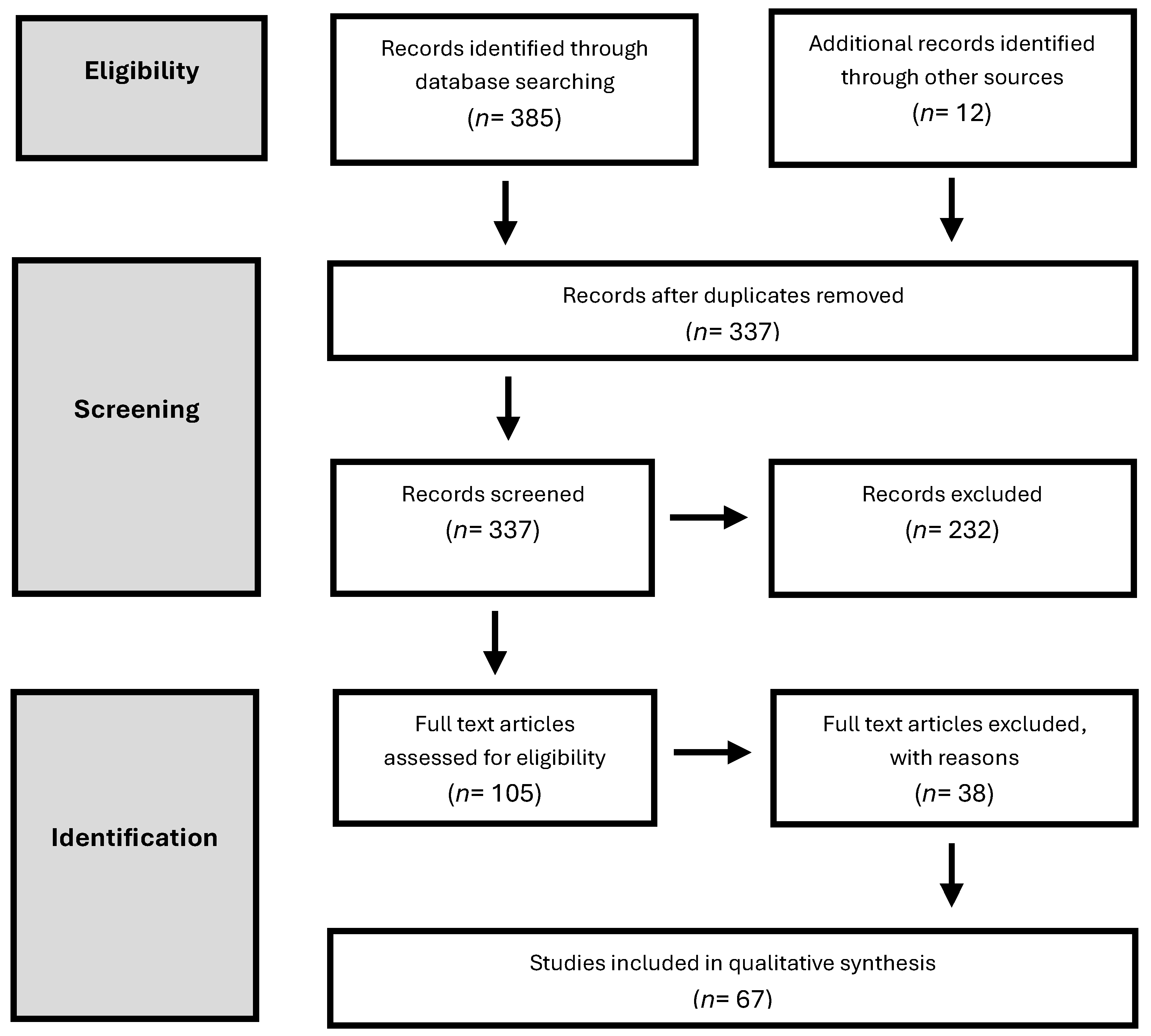
The results of the PRISMA-guided review are presented below, corresponding to the identification, screening, and synthesis phases. Results are presented in accordance with PRISMA 2020 items 16–20, as summarised in
Appendix B. The results of the systematic literature review are presented in a series of tables, compiled and analysed.
Table 1 summarised the developmental trajectory of RL.
Table 2,
Table 3,
Table 4 and
Table 5 present information on the authors’ affiliation, publishing journal, type of publication, and the stated purpose of the study across the literature examined.
Table 4 and
Table 5 should be read with
Table A1,
Table A2,
Table A3,
Table A4 and
Table A5 (see
Appendix A) with a discussion about the empirical RL studies included in the review. These tables summarise a range of methodological features, such as: whether epistemological assumptions were reported (
Table 5); the geographical locations and types of samples used in the studies (A1); sampling techniques and study timeframes (A2); the analytical methods applied in quantitative research (A3); the qualitative analysis methods employed (A4); and the analytical approaches used in mixed-methods studies (A6). Together, these tables provide a comprehensive outlook of the conceptual, methodological, and thematic characteristics of RL research published between 2000 and 2025.
From the 67 journal articles reviewed, 24 distinct definitions were extracted and presented in
Table 1, clearly illustrating the considerable diversity in how RL is conceptualised as a leadership theory.
Table 1 clearly shows that the process of defining RL has evolved. It started as a stakeholder-oriented, values-based, and relational concept. Key pioneers were
Maak and Pless (
2006),
Maak and Pless (
2006), and
Voegtlin et al. (
2012). Today, RL is a broader, multifaceted paradigm. It now integrates ethical decision-making, social responsibility, sustainability, and strategic accountability. This shift responds to complex global contexts. Initially focused on building trusting relationships and balancing diverse stakeholder interests beyond mere shareholder value, the construct has progressively incorporated environmental, societal, employee, and governance dimensions, as evidenced by contributions from
Miska and Mendenhall (
2018),
Kempster et al. (
2019), and more recent works (
Haque et al., 2025;
Nakra & Kashyap, 2025;
Usman et al., 2025).
Despite the absence of a single definition of RL, it is widely seen as a holistic, dialogue-driven approach. It casts leaders as stewards who build relationships and promote long-term organisational and societal sustainability amid ethical, regulatory, and ecological challenges.
Table 2,
Table 3,
Table 4 and
Table 5 present information on the authors’ affiliation, publishing journal, type of publication, and the stated purpose of the study across the literature examined.
Table 5 should be read with
Table A1,
Table A2,
Table A3,
Table A4 and
Table A5 (see
Appendix A) with a discussion about the empirical RL studies included in the review. These tables summarise a range of methodological features, such as: whether epistemological assumptions were reported; the geographical locations and types of samples used in the studies (A1); sampling techniques and study timeframes (A2); the analytical methods applied in quantitative research (A3); the qualitative analysis methods employed (A4) and the analytical approaches used in mixed-methods studies (A6). Together, these tables provide a comprehensive outlook of the conceptual, methodological, and thematic characteristics of RL research published between 2000 and 2025 (June).
Table 2 summarises the
institutional affiliations of authors contributing to both theoretical and empirical publications on RL, organised by publication period. Although not central to the conceptual synthesis,
Table 2 provides contextual insight into the institutional distribution of RL research, illustrating the geographic concentration of scholarly output over time. Three distinct categories of institutional affiliation were identified: (1) Single African institutions (including South African universities), which contributed 12% of the total reviewed publications; (2) Single non-African (international) institutions, which accounted for 49% of the total output; and (3) Collaborative international institutions, responsible for the remaining 39%. Notably, instances where African (or South African) institutions collaborated with international counterparts were rare, with only one such cross-regional collaboration identified, and were thus grouped into the third category due to their minimal representation.
Within the first category, publications originating from African institutions, primarily South African, were limited. Of the eight papers identified, six were affiliated with South African universities, including two from the University of South Africa. Other contributions were observed from institutions in Nigeria and Kenya. Importantly, no publications from this category were found prior to 2015, underscoring the relatively recent academic engagement with RL from within the African continent. The second category, representing individual international institutions, comprised the largest share of publications, 33 out of 67 articles (49%). These were linked to 28 unique institutions, with nine based in the United States, four in China, and others located in countries such as the United Kingdom, Australia, and Switzerland. A limited number (nine) of these publications appeared before 2015, suggesting a significant increase in international scholarly output on RL within the last decade. In the third category, representing collaborations between international institutions (with occasional African involvement), four publications were produced through partnerships among U.S.-based institutions. Additional collaborations were noted between institutions in Australia and Switzerland, as well as among organisations in Singapore, Austria, China, and Israel. As with the other categories, many of these joint efforts have emerged since 2015. Despite the growing global interest, only 12% of all reviewed publications were affiliated with African institutions, with South African universities contributing 9%. This highlights a clear research gap and emphasises the need for increased scholarly attention on RL from within African organisational contexts. As indicated in
Table 2, the institutional affiliations are largely concentrated in universities located within OECD and BRICS countries, with minimal representation from other regions. The relative uniformity of values reflects a concentration of RL research in established academic networks, supporting previous observations of limited global diversity and contextual representation (
Miska & Mendenhall, 2018;
Voegtlin & Scherer, 2017).
The key publication outlets (i.e., journals most frequently publishing RL-related research) from 2004 to 2025 are presented in
Table 3.
Table 3 presents the distribution of the 67 reviewed publications across various
academic journals, based on the data extracted during the systematic literature review. A clear increase in publication activity is observed in the most recent period (2020–June 2025), which accounts for more than half of the total articles. This is followed by a notable rise in journal publications between 2015 and 2019.
Although interest in RL began to emerge more prominently from 2010 to 2014, only five journal publications were identified prior to 2010, underscoring the relatively recent growth of academic inquiry in this field. The Journal of Business Ethics was the most frequently represented outlet, contributing 12 of the 67 reviewed articles (approximately 18%).
Known for advancing research on ethical issues in business, this journal promotes interdisciplinary perspectives and welcomes diverse methodological approaches to enrich ethical understanding in corporate settings. Its strong representation in this review highlights its significant role in shaping discourse on RL.
The second-most prominent journal was the Academy of Management Perspectives, contributing four articles (6%). This journal focuses on publishing evidence-based insights with clear implications for management practice and policy. Its orientation toward actionable knowledge, rather than purely theoretical contributions, makes it a fitting platform for studies on RL within organisational settings. Both the Journal of Leadership and Organisational Studies and Emerald Open Research each accounted for three articles (4%), demonstrating their growing interest in publishing research that investigates effective leadership behaviours at the individual, group, and organisational levels. These journals aim to expand leadership theory and inform practice through innovative research contributions.
Additional journals that contributed multiple publications include Leadership, Sustainability, Journal of Business Research, Leadership & Organisation Development Journal, and the International Journal of Organisational Leadership, among others. Together, these platforms formed the journal base for the 67 publications included in the review.
Table 4 categorises the reviewed literature by
publication type and period, distinguishing between theoretical contributions and empirical research. The empirical works are further classified by methodological approach; namely, qualitative, quantitative, and mixed-methods studies. Of the total articles analysed, 32 publications (48%) were theoretical in nature, while 35 publications (52%) employed empirical methodologies. Within the empirical subset, 9 publications (13%) used qualitative designs, 18 publications (27%) were based on quantitative approaches, and 8 publications (12%) adopted mixed methods. A temporal analysis reveals that prior to 2010, research output, both theoretical and empirical on RL within organisational contexts was minimal. The decade spanning 2010 to 2019 witnessed a notable increase in scholarly engagement with the topic. Notably, research activity intensified in the period from 2020 to 2025, suggesting a growing academic interest in RL as a developing theoretical construct that warrants further empirical investigation.
A further analysis of all the 67 publications was conducted to determine whether
epistemological assumptions were explicitly stated. These assumptions were identified through references to terms such as epistemology, research paradigm, or philosophical approach. The 32 (of the 35 empirical publications) clearly articulated their epistemological stance. An additional 4% (3 publications) did not reference any epistemological foundation. These results should also be read with
Table A3,
Table A4 and
Table A5 in
Appendix A.
Among the empirical studies that did indicate their philosophical positioning, quantitative designs were most prevalent, represented by 16 publications. Qualitative studies accounted for eight of the reviewed articles, while the mixed-methods approach featured in four. A temporal review spanning two decades (2004–2025) revealed a gradual increase in the explicit reporting of epistemological paradigms, indicating a maturing scholarly focus on methodological transparency. Of the 35 publications that met the criteria for this assessment, 25% adopted a positivist orientation, a philosophical stance that typically underpins quantitative methodologies, grounded in the application of natural science methods to social inquiry (
Celikates & Flynn, 2023). It emphasises observable, measurable phenomena and the generation of objective knowledge based on empirical evidence (
Jean Lee, 1992). Conversely, 38% of the studies aligned with an interpretivist paradigm, most often applying qualitative methods. Interpretivism views reality as socially constructed through shared meanings and lived experiences (
Bogdan & Biklen, 2003;
Kivunja & Kuyini, 2017), highlighting the importance of contextual understanding and meaning making in leadership studies (
Awa Uduma & Sylva, 2015;
Tekin & Kotaman, 2013).
A relatively small subset (11%) of publications adopted a constructivist perspective, which typically supports mixed-methods research. Constructivism positions knowledge as co-created through individual and collective experiences, shaped by cultural and social influences (
Hwang, 1996). This paradigm supports a more dynamic interpretation of RL, especially within diverse organisational environments.
Table 5 follows with a breakdown of the aim of the studies by time period across both theoretical and empirical publications.
Table 5 presents an analysis of the reviewed publications’
research aims, categorised into three primary purposes: the development of new theoretical frameworks, the review of existing theories, and critical evaluations of established theory.
The analysis revealed that the predominant focus of RL research within organisational settings has been on the development of new theory, with 43 out of 67 publications falling into this category. This trend mirrors patterns identified in earlier findings, reaffirming the emergent and evolving nature of RL as a scholarly construct. Notably, the past decade has witnessed the most substantial growth in theory-building efforts within this domain. Between 2010 and 2019, followed by 2020 to 2025, a combined total of 35 publications—amounting to 52% of the overall sample—focused on generating novel theoretical contributions. In contrast, the period prior to 2010 reflects minimal theoretical advancement, indicating that academic engagement with this topic only gained momentum in more recent years.
Alongside theory development, 27% of publications (18 articles) aimed to synthesise and review existing theoretical contributions, while only 6 publications (9%) engaged in critical assessment or deconstruction of current frameworks. This distribution suggests a clear scholarly inclination towards conceptual expansion and exploration rather than critique or empirical validation. Overall, the findings from
Table 5 suggest that RL continues to be a conceptual space under construction, with scholars prioritising the expansion of theoretical understanding over critical evaluation or testing of existing models.
The
geographical origins of the empirical studies were analysed according to the location of the research samples (see
Table A1 for details). The findings reveal a marked concentration in the Global North, with the United States accounting for the largest share (17%), followed by South Africa and China (11% each), and the United Kingdom (9%). Contributions from other countries, such as Germany, Switzerland, and Finland, were modest (3% each), while representation from regions including Australia and Kenya remained limited. This distribution underscores a significant geographical bias in the existing RL literature, signalling the need for future research to explore underrepresented contexts in the Global South and beyond.
As outlined in
Table A2, empirical studies employed diverse
sampling strategies. Purposive stratified sampling was the most common (29%), reflecting intentional efforts to include relevant subgroups. Convenience and random sampling were each used in 17% of studies, while snowball sampling appeared in 9%. Notably, 6% of studies failed to specify the sampling method, which limits transparency and reproducibility. Overall, the prevalence of purposive approaches, particularly in qualitative and mixed-methods research, which highlights a focus on the practical operationalisation of the study, over pure representativeness.
Mixed-sector organisational samples (public and private combined) dominated (31%), followed by student populations (23%), the latter often chosen for accessibility. Public-sector employees (6%), community leaders (3%), and non-profit/NGO participants (3%) were markedly under-represented, with a further 6% of studies not clearly reporting sample composition. This distribution indicates a reliance on readily available or general organisational populations and points to underexplored contexts in public administration, civil society, and community leadership.
Cross-sectional designs overwhelmingly prevailed (69%), capturing data at a single time point. The remaining 31% of studies provided no explicit framing of the research design. This strong preference for cross-sectional approaches reveals a significant gap in longitudinal research, restricting insights into the evolution, sustainability, and long-term effects of the RL phenomenon.
Taken together, these methodological patterns underscore both the field’s current practices and key opportunities for future empirical work: greater transparency in reporting, broader sectoral inclusion, and increased adoption of longitudinal designs to deepen understanding of RL dynamics.
The analytical techniques employed in quantitative research were reviewed, taking into consideration that most studies combined several data collection and analysis methods simultaneously; therefore, the categories are often non-mutually exclusive and overlap in practice.
A pronounced shift toward quantitative methodologies is evident, with 13 of the 18 empirical studies published between 2020 and 2025, reflecting a recent intensification of interest in quantifiable approaches to RL (see
Table A3). Surveys dominated data collection (67%), followed by scale development and secondary/archival data (17% each). Common analytical techniques included structural equation modelling (SEM; 15%), regression analysis and descriptive statistics (13% each), factor analysis (11%), reliability testing (9%), and chi-square tests (7%), with less frequent use of methods such as aggregate rank analysis (4%) and model-fit evaluation (13%).
Overall, studies in RL continue to rely on conventional statistical tools, the past five years have seen increasing adoption of more sophisticated techniques. This rising methodological complexity signals a growing emphasis on empirical rigour, validated measurement, and analytical precision in RL scholarship.
The
analytical strategies employed in qualitative research were also examined (see
Table A4). Among the nine qualitative or mixed-method studies, interviews were the predominant data collection technique (used in four studies), supplemented by open-ended questionnaires (two studies) and a range of other approaches, including case studies, biographical analysis, focus groups, and participant observation, each employed in two instances. This demonstrates moderate diversity in data-gathering strategies.
For data analysis, content analysis was the most common approach (three studies), followed by thematic analysis (two studies). Additional techniques, such as discourse analysis, appreciative inquiry, triangulation, and explicit validity/reliability discussions, appeared once or twice each.
An overview of
data collection and analysis techniques employed in the mixed-methods studies was also conducted (see
Table A5). Mixed-methods studies (
n = 5) deliberately combined qualitative and quantitative approaches to achieve triangulation and a more comprehensive view of RL. Interviews (as qualitative methodology) dominated data collection (80% of mixed-methods studies), complemented by participant observation, content analysis, and thematic analysis (each used in two studies), providing rich contextual depth. On the other hand, the most common quantitative analytical techniques were reliability testing, descriptive statistics, factor analysis, and regression analysis (each in two studies), with correlation analysis and
t-tests each appearing once.
Overall, the mixed-methods strand exemplifies pluralistic design, effectively merging the nuanced, experiential insights of qualitative inquiry with the measurable precision of quantitative methods.
4.1. Summary of Core Findings
The systematic literature review on the conceptualisation and application of RL in organisational contexts identified four key findings, each tied to central thematic insights that are explored in more depth in the following sections. Collectively, these findings enhance our understanding of how RL is manifested in both theoretical, research and practical terms within organisations.
Finding 1: This systematic review affirms that RL is inherently
relational and multi-faceted in nature. Far from constituting a singular or monolithic construct, RL emerges as a complex, multi-dimensional leadership paradigm that intersects with, yet extends beyond, established frameworks such as ethical, servant, and transformational leadership (
Maak & Pless, 2006;
Sargam & Pandey, 2024). Its distinctive hallmark lies in an explicit relational orientation that deliberately foregrounds stakeholder engagement, the cultivation of social capital, and the prioritisation of mutual respect and accountability (
Voegtlin, 2011). In an era characterised by increasing organisational complexity and interdependence, this stakeholder-centric approach positions RL as particularly salient, offering a robust foundation for inclusive decision-making and collaborative leadership practices that are essential for sustainable organisational success.
Finding 2: A consistent finding throughout the reviewed literature is the profound
interconnectedness between RL and CSR. Responsible leaders are repeatedly positioned as primary architects and drivers of CSR initiatives, leveraging their authority to integrate ethical principles and societal responsiveness into the core of organisational strategy (
Maak & Pless, 2006). Beyond strengthening internal ethical cultures, these leaders simultaneously enhance organisational legitimacy, bolster reputational capital, and mitigate socio-ethical risks (
Maitlo et al., 2023;
Rosyada et al., 2024). This integrated pursuit of economic performance and societal purpose underscores RL’s pivotal function as a strategic mechanism for generating long-term, stakeholder-inclusive value.
Finding 3: A further finding from the reviewed literature is the consistent link between RL and
long-term organisational sustainability outcomes. Leaders who embed ethical decision-making, environmental stewardship, and social accountability into organisational priorities significantly strengthen resilience and adaptive capacity in the face of complex and volatile operating environments (
Xuetong et al., 2024;
Wang et al., 2025). Far from being limited to short-term financial indicators, RL aligns closely with the principles of sustainable development by incorporating broader ecological and societal imperatives into strategic governance. This orientation not only enables organisations to navigate global challenges more effectively but also sustains legitimacy, stakeholder trust, and enduring competitive advantage.
Finding 4: Despite substantial theoretical advancement in the field of RL, a marked
disconnect persists between conceptual elaboration and practical implementation. The present review reveals a notable scarcity of contextually grounded empirical studies, with limited evidence drawn from diverse cultural, institutional, and sectoral environments (
S. H. Siddiqui et al., 2023;
Fleck & Hutchinson, 2025). Moreover, the literature continues to lack robust, operational frameworks that translate RL principles into actionable practices for organisational leaders. Addressing this theory–practice divide necessitates intensified collaboration between academia and industry to develop culturally sensitive, empirically validated, and practically oriented models that can effectively guide the cultivation and institutionalisation of responsible leadership (
Boonyota et al., 2025).
4.2. Overview of Core Themes
Theme 1: A core finding of this systematic review is the profound and reciprocal integration of CSR within the RL construct. Across the reviewed literature, CSR is consistently conceptualised both as a constitutiv dimension of RL and as one of its primary outcomes, with responsible leaders positioned as pivotal architects who institutionalise CSR principles into organisational strategy and culture.
This robust linkage underscores that responsible leaders are distinguished not merely by the pursuit of economic objectives but by their deliberate alignment of organisational behaviour with broader societal values and expectations. Consequently, RL emerges not only as a distinctive leadership paradigm but also as a strategic enabler that operationalises and advances comprehensive CSR agendas.
Theme 2: A further significant finding of this systematic review is the
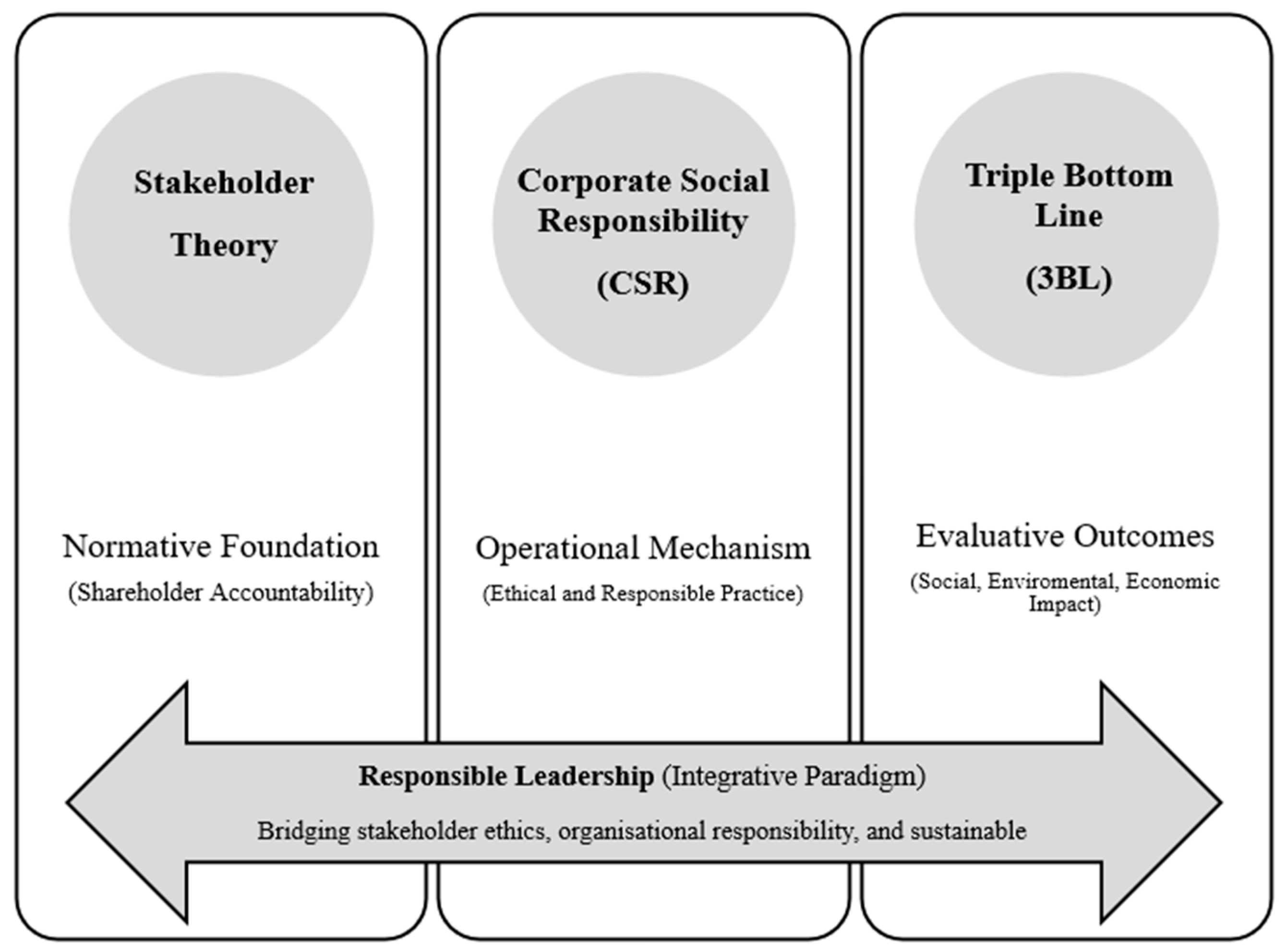
centrality of ST as the primary theoretical foundation for RL. Building on
Freeman’s (
1984) seminal proposition and its contemporary elaborations (e.g.,
Valentinov, 2024;
Hargrave & Smith, 2025), the literature consistently frames organisations as accountable to a broad constellation of stakeholders—employees, communities, suppliers, and the natural environment—rather than shareholders alone. This stakeholder-oriented ontology underpins RL, positioning leaders as stewards who balance competing interests through inclusive, ethically grounded, and dialogic practices (
Maak & Pless, 2006;
Pless & Maak, 2011).
Across the 67 reviewed publications, close to 20% explicitly invoke ST when conceptualising RL, confirming its status as the dominant interpretive lens. This theoretical anchorage drives a marked departure from traditional hierarchical and shareholder-primacy models toward relational, collaborative approaches in which leadership legitimacy derives from the capacity to foster trust, transparency, fairness, and shared value creation (
Miska & Mendenhall, 2018;
Waldman & Balven, 2014). By embedding stakeholder inclusivity and ethical judgement at the core of decision-making, RL enhances organisational responsiveness to societal expectations, strengthens social license to operate, and equips firms to manage reputational risks and regulatory pressures more effectively. Ultimately, the integration of ST reveals RL as a paradigmatic shift toward participatory governance and long-term stakeholder-oriented stewardship essential for resilience and legitimacy in an era of heightened globalisation and sustainability demands.
Theme 3: A prominent finding of this systematic review is the widespread adoption of the
3BL framework, as originally proposed by
Elkington and Rowlands (
1999) and recently reaffirmed (
Agyefi-Mensah et al., 2025), as a key interpretive lens for RL. Across the reviewed studies, 14 publications (approximately 21%) explicitly employ the 3BL model, underscoring RL’s commitment to simultaneously advancing economic viability, social equity, and environmental stewardship.
From an
economic perspective, responsible leaders integrate long-term financial sustainability with ethical business practices, embedding social responsibility into supply chains, labour policies, and strategic decision-making while moving beyond short-term profit maximisation (
F. Siddiqui et al., 2023).
RL strongly aligns with the
social dimension of 3BL by prioritising stakeholder inclusion, fairness, and welfare. Leaders actively champion initiatives that reduce inequality, enhance community well-being, and foster organisational justice (
Maak & Pless, 2006;
Maitlo et al., 2023).
Responsible leaders emerge as catalysts for ecological (
environmental) sustainability, driving resource-efficient practices, green innovation, and climate-conscious strategies that minimise environmental harm and strengthen corporate ecological accountability (
Miska & Mendenhall, 2018;
Abraham, 2024).
The consistent application of the 3BL framework reveals RL as a holistic leadership paradigm that redefines organisational success beyond financial performance. By balancing profitability with societal and environmental imperatives, RL responds directly to escalating stakeholder and societal expectations, positioning it as a transformative approach for achieving sustainable 3BL value creation in modern-day organisations (
Amir et al., 2022).
Theme 4: Finally, and closely aligned to Theme 3, is the fundamental role of
ethical foundations, rooted in ST, in defining and strengthening RL. Ethical decision-making and accountability emerged as a dominant dimension, appearing in over 25% of the reviewed studies. Responsible leaders are characterised by their deliberate foresight in assessing the moral implications of decisions, consistently prioritising long-term stakeholder well-being and societal benefit over short-term gains (
Voegtlin, 2011;
McLoughlin et al., 2025).
Far from being limited to regulatory compliance, ethical leadership within RL entails proactive cultivation of organisational integrity, embedding fairness, transparency, and accountability into both culture and operational practice (
Xuetong et al., 2024;
Waldman & Balven, 2014). Leaders are expected to assume full ownership of the intended and unintended consequences of their actions, thereby serving as moral exemplars who shape employee behaviour, reduce misconduct, and reinforce value alignment across the organisation (
Brown & Treviño, 2006;
Abdulai et al., 2025).
In an era frequently marked by corporate scandals and eroded public trust, this ethical orientation functions as a critical safeguard, enhancing stakeholder confidence, organisational legitimacy, and resilience. Ultimately, ethical decision-making and accountability are not peripheral attributes but constitutive cornerstones of RL, enabling leaders to navigate complexity, sustain trust-based relationships, and drive enduring, stakeholder-inclusive value creation.
In summary, the results presented above describe the conceptual, methodological, and contextual characteristics of RL scholarship between 2000 and 2025. The following section moves beyond description to interpret and contextualise these findings considering established theoretical frameworks; Stakeholder Theory, Corporate Social Responsibility, and the Triple Bottom Line, to identify the field’s main conceptual trajectories, practical implications, and future research opportunities.