1. Introduction
Classical economists identified “capital” in its tangible sense—as money or human-made goods used in the production process (
Mas-Machuca & Marimon, 2019). It is a resource or collection of resources that can be accumulated or depleted, exchanged for other forms of capital, and unequally distributed (
Wladis et al., 2024). Holistic capital is the synergistic value derived from the combined effects of human, behavioral, social, and spiritual capital. It reflects a comprehensive spectrum that provides growth, performance, and sustainability beyond customary financial or human capital models. Solving organizational issues requires a harmonious blend of different types of capital (
Beretti et al., 2013). A few suggested capitals include human, behavioral, psychological, social, spiritual, and natural capital.
This study is expected to contribute to the literature, arguing that scientific and technological innovations are insufficient to address modern issues and achieve sustainable growth and development. Human behavior can be leveraged to solve organizational problems, as behavioral innovations are ideal to overcome the limitations of scientific and technological innovations. Furthermore, behavioral solutions are less capital-intensive than scientific and technological innovations in bringing about favourable changes (
Allcott & Mullainathan, 2010) and enhancing subjective well-being (
Beretti et al., 2013).
The literature suggests that human resources is conceptualized in fragmented, siloed groupings (
Crabtree, 2018). A few of them include human capital, behavioral capital, social capital, and spiritual capital. Each of these has been examined in isolation, on the presumption that they are independent. No single capital is capable of explaining human thriving or performance. Recent research on human behavior and functioning indicates that these capitals are intertwined, symbiotic, and synergetic.
The literature identifies several forms of capital—including human, social, psychological, spiritual, and natural capital. Most of these operate at the macro level, and the capitals work at parallel levels. Though these existing capital frameworks offer insights into specific resource domains, they examine these resources in isolation. This form of compartmentalization or silos fails to capture the comprehensive interdependence among the various forms of individual resources, which function collectively to outline adaptive behaviors and performance in the current organizational environment. Hence, this study adopted a stricter, more conservative inclusion criterion within the Conservation of Resources theory. Inclusion was limited to capitals that are internally integrated, psychologically stimulated, and behaviorally significant at the micro or individual level. Accordingly, HolC encompasses human, behavioral, social, and spiritual capital, as these represent an inherent dispositional resource pool that can generate inherent resource-gain spirals during decision-making. Multiple other capitals, such as natural, financial, or structural external asset-based capitals, are excluded because they do not function as ingrained, individualized resources within the CoR framework. Additionally, these four capitals form a meta-construct for a host of reasons. They represent the various levels of human competence and functioning, such as cognitive, behavioral, relational, and existential, interacting dynamically to produce outcomes, rather than functioning in discrete silos. For instance, individuals use human capital (HC) driven by skills through behavioral capital (BC), which involves behavioral patterns, and utilize spiritual capital (SpC) derived from relational environments. All these are guided by SpC, which is derived from a deeper understanding of the self (
Vasconcelos, 2021). However, most capitals have ignored the moral and spiritual dimensions. The other capitals, devoid of discipline and moral grounding derived from SpC, are bound to fail (
Sulphey, 2022,
2023b;
Vasconcelos, 2021). This is because other capital theories do not address essential aspects such as meaning, purpose, and transcendence. Empirical evidence suggests that purpose aids performance, meaning it guides ethicality, and that spirituality, inner coherence, and transcendence enhance resilience and well-being (
Mas-Machuca & Marimon, 2019;
Stead & Stead, 2014). Hence, capital requires a relook to include essential existential resources. The novelty of the proposed HolC is in conceptualizing the resources as a higher-order construct whose synergetic effects exceed the explanatory capacity of the individual capital constructs.
Several behavioral, cognitive, and emotional skills, social connectedness, and transcendence determine individual and organizational success. The current literature shows that different forms of capital operate in isolation, underscoring the need for an integrated framework. This research addresses the following question: Which capital can reflect the complex nature of human competencies and capabilities in modern work environments and facilitate thriving and value creation, leading to a competitive advantage and superior firm performance? This is a research question that has hitherto not been addressed in the literature, presenting a gap worth investigating.
This work is organized as follows.
Section 2 presents the methodology followed in this study. The following section presents the theoretical underpinnings and different capitals, including HC, BC, SC, and SpC.
Section 4 proposes solutions and introduces holistic capital (HolC) as a behavioral innovation, grounded in the available literature and anecdotal evidence. This section presents a conceptual holistic capital (HolC) framework that extends existing efforts.
Section 5 discusses the utility of HolC, highlighting its relevance in the current business environment. Implications and general conclusions follow this section. The paper concludes with a summary and suggestions for further research. Throughout the article, the authors draw generalizable lessons from various empirical studies. Axiomatic to the current research work is the belief that there is the potential for significant advantages for individuals and their respective organizations by combining these capitals into HolC, which is likely to bring experience and expertise, be creative and innovative, demonstrate team spirit, adapt to change, assume leadership roles, and participate in mentoring within the organization. These are only a few of their valuable skills.
2. Methodology
The study was conducted to reformulate HolC to illuminate and capture the phenomenon in light of emerging realities. The study conceptualizes and constructs a unified theoretical framework for HolC from the multidisciplinary literature, examines its fundamental philosophy, and proposes a conceptual analysis. To this end, the study integrated multiple related concepts and theories to develop a comprehensive conceptual framework as proposed by
Sulphey (
2026). This study is transdisciplinary, spanning across various disciplines, including Economics, Sociology, Psychology, and related fields. Due to its transdisciplinary nature, following
Jaakkola (
2020) and
Shepherd and Suddaby (
2017), this research employed a systematic, constructive, conceptual research design grounded in an integrative review and theory-building. This methodology is suited to visualizing, integrating, and synthesizing interdisciplinary concepts that lack a consistent theoretical footing (
Glaser, 1978;
Patton, 2002;
Xin et al., 2013). The advantage of this methodology is that it is integrative and reflexive, involving less linear sequencing and more concurrent data collection, analysis, and theory building (
Chinn & Kramer, 2014).
Initially, an extensive, purposive literature review was conducted (
Miles & Huberman, 1994;
Patton, 2002) across the identified domains, including Economics, Sociology, Psychology, and related disciplines in the Saudi Digital Library, which comprises databases such as Scopus, Web of Science, and EBSCOhost. The inclusion criteria were limited to peer-reviewed journals on various capital frameworks and their workplace outcomes. This method facilitated the maintenance of a conceptually robust and integrative synthesis of the literature. The study adopted a structured conceptual review design to synthesize the literature relevant to the development of HolC. The objective was not merely narrative integration but systematic identification and analytical consolidation of resource-based constructs across human, psychological, behavioral, social, and spiritual domains.
Towards this end, various theories of economic and social capital (
Bourdieu, 1986;
Coleman, 1990;
Putnam, 2002), human and psychological capital (
Luthans et al., 2015), natural capital (
Ekins et al., 2003), and spiritual capital (
Berger & Hefner, 2003;
Bourdieu, 1984;
Woodberry, 2003) were considered. In addition, the study examined emerging constructs, including vitality and existential capital. Peer-reviewed articles, seminal books, and other theoretical materials from various repositories that explicitly theorize multiple forms and dimensions of capital were used. Citation tracking was also an effective method to identify required materials. The available literature was searched to examine the ontological assumptions of each capital; for instance, what is the particular capital?
The metatriangulation technique proposed by
Lewis and Grimes (
1999) was applied to bridge paradigmatic perspectives, such as positivist, interpretivist, and critical. The integrative dimension that emerged was then organized iteratively into HolC, comprising human, behavioral, social, and spiritual capital. The study was limited to these capital dimensions because no additional sources or relationships emerged due to theoretical saturation from metatriangulation. This suggests adequate validation. Additionally, expert validation was done by presenting the proposed framework to five scholars in different related disciplines. Suggestions and feedback from experts were included iteratively. To assume coherence, explanatory, and descriptive power, the comprehensiveness, parsimony, and logical consistency were assessed as suggested by
Whetten (
1989). This comprehensive, time-tested method provided a rigorous, transparent, and replicable pathway for conceptualizing HolC. This method facilitates transcending disciplinary silos and provides the edifice for a unified HolC theory. The researcher’s interdisciplinary background in related fields such as Economics, Psychology, and Management facilitated the interpretation of the literature.
To further enhance rigor, the conceptualization of HolC follows established principles of construct development, including domain specification, boundary clarification, and dimensional justification (
MacKenzie et al., 2011). This ensures that HolC is not merely an aggregation of existing capitals but a theoretically bounded higher-order construct with a distinct integrative logic.
3. Theoretical Background
This study draws on the Dual Interest Theory (DIT), which provides an integrative framework for behavioral novelties. The DIT proposes that individuals are motivated by ego-based self-interest, which most individuals often balance between the two (
Czap et al., 2012). This theory presents a formal method of expressing the internal tension in individuals. It is a social phenomenon that emphasizes the more nuanced concept of own-interest rather than self-interest. Own interest entails an open approach, which is uncomfortable for some. The other interest also displays the degree of mindfulness, which could initiate empathy (
Lynne & Czap, 2024). Thus, the theory highlights joint, inseparable variables encompassing self-centered and empathetic propensities (
Singer & Lamm, 2009). It is a dual-utility flexible model that recognizes jointness, providing delight and peace of mind. DIT proposes that being mindful of other interests helps individuals maximize their self-interests (
Lynne & Czap, 2024). Therefore, individuals tend to revert to a hedonistic and primordial (self-interest-only) path. Hence, DIT generally proposes that individuals inherently strike the best possible balance between self- and other-interest. Empirical evidence suggests that DIT ideally explains social and behavioral outcomes better than mere self-interest. The theory proposes that humans pursue outcomes that enhance self-orientation or other-orientation.
This study draws on the Conservation of Resources (CoR) theory (
Hobfoll, 2010), which provides an integrative framework for behavioral novelties. The theory considers resources as entities that have value in themselves and as means to attain cherished goals. The entities include objects, such as assets, and personal characteristics, such as health and well-being, optimism, confidence, and conditions of individuals, as well as multiple energies, such as time, money, or knowledge. These resources contribute towards individual identity and differentiate them from others (
Hobfoll, 2002). The essential principle of this theory is that individuals strive to maintain, safeguard, and develop the resources they need.
Hobfoll (
1989,
2002) proposes that individuals with these resources can address and cope with all forms of environmental demands. However, those with lesser resource reserves are vulnerable and susceptible to distress (
Hobfoll, 2002). CoR theory argues for the integration of human resources, and, as per its tenets, resources seldom exist in isolation. They are often embedded in an integrated, interconnected framework, underscoring the need for conceptually necessary holistic capital that reflects various personal and intangible capitals.
CoR theory emerged from resource and psychosocial theories of human motivation and extends prior theories by recognizing that environmental factors threaten and deplete resources, and that the combined effects of subjective perceptions are essential to address this (
Lazarus & Folkman, 1984). In contrast to other resource theories, this theory is of high value because it goes beyond merely linking resources to performance. According to the CoR theory, resources are objects, conditions, personal characteristics, and energies that are essential to thriving (
Hobfoll, 1989). The components of HolC are derived from this theory and are presented in
Table 1.
Rational Choice Theory
Rational choice theory is a normative theory that provides a model for understanding and predicting human behavior (
Tan, 2014). This theory can be applied to various social interactions, including sociological, legal, and political problems. It seeks to identify the most efficient and optimal way to attain a goal under given conditions and constraints (
Elster, 1986). Its focus is on the means and not the ends. Each HolC component derived from the CoR theory is presented in the following sections.
4. Human Capital (HC)
Human capital (HC), which encompasses the knowledge, skills, and abilities of individual employees, is a component of intellectual capital (IC). It is derived from IC, which is diversified and extends beyond classical economic theory (
Molodchik et al., 2012). Social scientists, such as
Roslender et al. (
2006) and
Sofian et al. (
2008), have identified that IC has multiple components. According to
Sofian et al. (
2008), IC encompasses knowledge and experience, professional knowledge and skills, goal relationships, and technological capacities, the synergy of which can enhance organizational performance. HC is central to the IC base (
Stewart, 1997). HC is the set of knowledge assets attributed to an organization that contributes to an improved competitive position by adding value to defined key stakeholders (
Marr & Schiuma, 2003). According to
Kim and Mahoney (
2007), HC “resides in human resources and cannot be alienated from them.” The organization does not own it. HC is acquired over time from various sources (
Backes-Gellner & Moog, 2013). A few of them include internal development, procurement, contracting, and coalition (
Lepak & Snell, 1999).
Halim (
2010) conceptualized HC as the skills and abilities that an employee brings to value-adding processes, including professional competence, social competence, employee motivation, and leadership ability. It is reflected in the knowledge, skills, abilities, and other individual characteristics that contribute to a firm’s performance and success (
Esho & Verhoef, 2020). HC is the intelligence of any organization (
Curado & Bontis, 2007), which facilitates the knowledge-creation process and serves as a source of innovation and renewal (
Boisot, 2002). The essence of HC is individual knowledge (
Curado & Bontis, 2007). It reflects the individual’s ability to learn and acquire knowledge on behalf of the organization (
McKnight & Bontis, 2002;
Stovel & Bontis, 2002).
Hudson (
1993) identified HC as a combination of genetic, instructional, experiential, and personal attitude factors. Further, HC is the result of an individual’s implicit knowledge. The HC base of high-level managers and professionals defines organizational success. HC is identified as cherished and exceptional, unique and inimitable, and cannot be substituted by competitors with any other resource (
Wright et al., 1994). According to
Edvinsson and Malone (
1997, p. 358), HC involves “knowledge that can be converted into value.” According to
Roslender et al. (
2006), HC is intangible and cannot be objectively evaluated. It is often identified as something purchased by employers and that incurs a cost to the organization. HC provides value for money for the organization, which is tough to determine.
HC is often categorized as a type of IC (
Roslender et al., 2006). HC encompasses employee qualifications (educational and vocational), work-related knowledge, competencies, experience, expertise, and capacities for creativity and innovation (
Brooking, 1996;
W. Li et al., 2024;
Lynn, 1998). It could also include occupational and psychometric assessments, as well as cultural diversity. Overall, it encompasses the various human attributes an employee brings to their organization with their employment. Some social scientists, such as
Roslender et al. (
2006), include the capacity to work as a team, change readiness, leadership, and mentoring capability. Thus, it could encompass all the attributes that employers seek when purchasing their workforce’s labor power.
do Rosà and Vaz (
2006) and
Uzzi (
1996) argued that HC promotes knowledge generation and transfers, influencing firm performance and leading to sustainable competitive advantage.
Welbourne and Pardo-del-Val (
2009) and
Shih et al. (
2010) argue that HC and relational capital are inherently connected.
Welbourne and Pardo-del-Val (
2009) observed that the two are intrinsically linked and can maintain and nurture relationships, thereby contributing to firm performance. Organizations that cultivate relational capital could be differentiated from others (
Welbourne & Pardo-del-Val, 2009). The association between the two is well supported by the resource-based view, emphasizing bundles and combinations of resources (
Barney, 1991). This connection is supported by the social capital theory (
Nahapiet & Ghoshal, 1998). The theory suggests creating and maintaining connections between non-imitable, implicit, exceptional, and robust resources. These resources could translate into strategic assets that boost organizational performance and competitive advantage (
Stiles & Kulvisaechana, 2004).
5. Behavioral Capital (BC)
Based on the seminal work of
Kahneman (
2003), BC is identified as “the latent potential” for behavioral changes to affect and improve the quality of organizational environments.
Schooling and Kuh (
2000) defined BC as:
“The accumulation of positive individual attributes such as social competence, decision-making and problem-solving skills, coping strategies, personal efficacy, self-esteem, attitudes, and values that help the individual remain resilient in times of adversity or take advantage of talents and opportunities.”
This comprehensive definition indicates the components of BC. Thus, it can be assumed that BC involves attributes such as social competencies required to address societal issues, as well as a range of human and psychological traits. The definition also points to its ability to utilize all available talents and opportunities effectively. Ecological economics proposes four primary types of capital that interact within a complex, dynamic system to contribute to human well-being. The four capitals are natural capital, human capital, built capital, and social capital (
Vemuri & Costanza, 2006).
Beretti et al. (
2013) contend that BC is the fifth capital that interrelates with others.
Another conceptualization of BC was presented by
Barborič et al. (
2018). In this conceptualization, they offered the broad concept of “territorial capital.” In addition, the concept was identified as having social and cultural components, which were further categorized into tangible and intangible components, named physical capital and behavioral capital, respectively. All tangible capital was identified as physical capital. BC was conceptualized to include social, human, cognitive, relational, and political capital. BC can be developed by tracking ongoing organizational activities. The different capitals presented here can exponentially reinforce each other’s growth.
BC involves the accumulation of various social and cognitive skills (
Aloulou & Amari, 2025;
Kuh et al., 2004), which contribute to well-being (
Cinar et al., 2008), foster a work ethic, and lead to achievement (
Hevey, 2016). It is an essential ingredient for individual success.
Wojewódzka-Wiewiórska (
2017) proposed that BC involves trust, shared norms, and values.
AICD (
2020) identified BC as having metacognitive, motivational, and behavioral attributes that could benefit organizational teamwork and dynamics. It involves various acquired behaviors and examines the mechanisms through which each functions. In line with
Beretti et al. (
2013), BC has the potential to elicit latent behavioral changes that improve the quality of the organizational environment. It is also possible that BC can change various traditional paradigms and facilitate sustainability and sustainable development (
Beretti et al., 2013).
BC directly and indirectly influences many aspects of human behavior, shaping positive behavioral decisions throughout a person’s life. Additionally, it affects many facets of human existence, making it easier to adopt positive behaviors and a goal-oriented mindset (
Steptoe et al., 2010). BC cannot be measured in terms of money, but it is noted by those watching it. Any customers—internal and external—would remember it, thereby enhancing the organization’s reputation. It can influence any resume, but it does not belong in it. Although it is not measurable, it has a direct impact on most other attributes. Like other worthwhile behavioral traits, BC can be challenging to acquire and maintain.
According to
Osóch and Tessar (
2019), BC is grounded in specific manifestations of cooperation and collaboration, including the exchange and seamless flow of information within the organization, as well as the value attributed to learning and cognitive development. It dives deeper into an individual’s psychological and emotional competencies. BC is inherited and acquired in the early stages of life and develops through childhood into adolescence, influenced by various family characteristics. According to
Avey et al. (
2009) and
Youssef and Luthans (
2007), BC facilitates employee resilience.
Discussions indicate that BC can impact the bottom line. It can be leveraged through an understanding of relevant behavioral sciences. It can be quantified by advanced analytics. Effective nurturing of BC will help deliver consistent, efficient, and effective services across all organizational activities, thereby offering highly coveted customer value and delight, both internal and external (
Kahneman, 2003;
Osóch & Tessar, 2019;
Steptoe et al., 2010;
Wojewódzka-Wiewiórska, 2017).
6. Social Capital (SC)
Social capital (SC) encompasses organizational characteristics such as reciprocity, interpersonal networks, and social trust. It facilitates coordinated actions, fosters positive attitudes, enhances societal efficiency and mental health, and alleviates negative emotions (
Norstrand & Xu, 2012). It also encompasses developing human relationships to foster fresh ideas, concepts, and projects (
Vasconcelos, 2021). Although it does not exclusively focus on gaining monetary wealth, it is considered ideal for building “meaning and value” (
Zohar & Marshall, 2004, p. 21).
There are two viewpoints regarding SC (
H. Li et al., 2024). For instance,
Bourdieu (
1986) defined it as “the aggregate of the actual or potential resources which are linked to possession of a durable network of more or less institutionalized relationships of mutual acquaintance and recognition.”
Putnam (
2002) defines it as “features of social organizations such as networks, norms, and social trust that facilitate coordination and cooperation for mutual benefit.” Thus, the former considers it an individual resource, while the latter considers it an organizational resource. However, they are closely related (
H. Li et al., 2024).
Adler and Kwon (
2002) defined it as “the goodwill available to individuals or groups. Its source lies in the structure and content of the actor’s social relations.” According to
Maak (
2007), SC encompasses individual networks, relationships, standards, values, and responsible leadership. It involves the bonds formed and maintained among individuals in organizations through the processes of giving and receiving (
Ruth et al., 1999).
Empirical evidence suggests that SC is reciprocal, significantly impacts job satisfaction, and is a valuable investment (
H. Li et al., 2024;
Samuel-Azran et al., 2025). It mitigates the possibility of mental health issues by easing negative emotions experienced by individuals. A lack of SC could result in a broader array of issues, including environmental, social, and ethnic resentments, social disparities, and unhappiness (
Peterson et al., 2025;
Vasconcelos, 2021).
7. Spiritual Capital (SpC)
Spiritual capital (SpC) was developed in the 1980s to link the tangible (economic growth) and intangible (spirituality) aspects of capital (
Bruce & Plocha, 1999). This was proposed on the condition that spirituality has a positive impact on individuals, yielding favorable results (
Mas-Machuca & Marimon, 2019). The term “spiritual capital” was introduced and developed by
Iannaccone (
1990) and
Finke and Stark (
1988). Spirituality focuses on individual experiences derived from inner strength (
Petchsawang, 2008). According to
Rima (
2020), spirituality brings “vitality, life, and motivation to wealth, profit, advantage, and power.” It is an individual resource derived from an organization’s culture, encompassing shared motives, collective behaviors, and attitudes (
Taghizadeh Yazdi, 2015). Spirituality can lead to behavioral change and, in turn, a corresponding shift in business culture. As a holistic resource, it can penetrate human behavior at a profound level and facilitate a seamless, transformative change process. In the workplace, spirituality involves having “compassion for others and experiencing a conscious inner awareness in pursuit of meaningful work, thus achieving transcendence” (
Petchsawang & Duchon, 2009). It is essential to appreciate that workplace spirituality helps employees become mentally enriched, spiritually fulfilled, and experience soulful satisfaction (
Marques et al., 2011).
Workplace spirituality is a combination of personal experiences and organizational background that is directly associated with critical organizational variables. In addition, workplace spirituality offers profound meaning and purpose in life, as well as fulfillment in one’s work (
Petchsawang & McLean, 2017). Spiritual capital applies at various levels. A few of them include the individual (
Alruwayti & Sulphey, 2024;
Zohar & Marshall, 2004), the organization (
Middlebrooks & Noghiu, 2007;
Sulphey & Naushad, 2019), and society (
Baker & Miles-Watson, 2008).
According to
Dahlgaard-Park (
2012), most earlier theories on people ignore the spiritual and ethical dimensions of gratifying human needs. Now, there is an appreciation for a spiritual approach to managing individuals as it strives to develop the human (
Wasiluk, 2013). It is natural for individuals to yearn for a profound sense of purpose and to be often motivated by spiritual rather than material benefits. They tend to put in extra time and effort voluntarily to enable task achievement (
Kolodinsky et al., 2008). Workplace spirituality tends to reduce deviance, increase engagement, stimulate innovation, and enhance performance (
Jnaneswar & Sulphey, 2021).
8. Conceptualization of HolC
In general parlance, the term capital, used for decades, suggests something material, utilitarian, and economic. Evidence indicates that the term is fragmented, limited, and often mechanical. It can be considered outdated, rooted primarily in classical economics and, to a minor extent, in organizational behavior models. Materialism, social skills, and knowledge alone are insufficient in the current, rapid-paced work settings. A host of behavioral, cognitive, and emotional skills, social connectedness, transcendence, and ethical and moral grounding determine individual and organizational success. Hence, based on the critical realist ontology proposed by
Bhaskar (
1975) and the integrative pluralism of
Frost and Stablein (
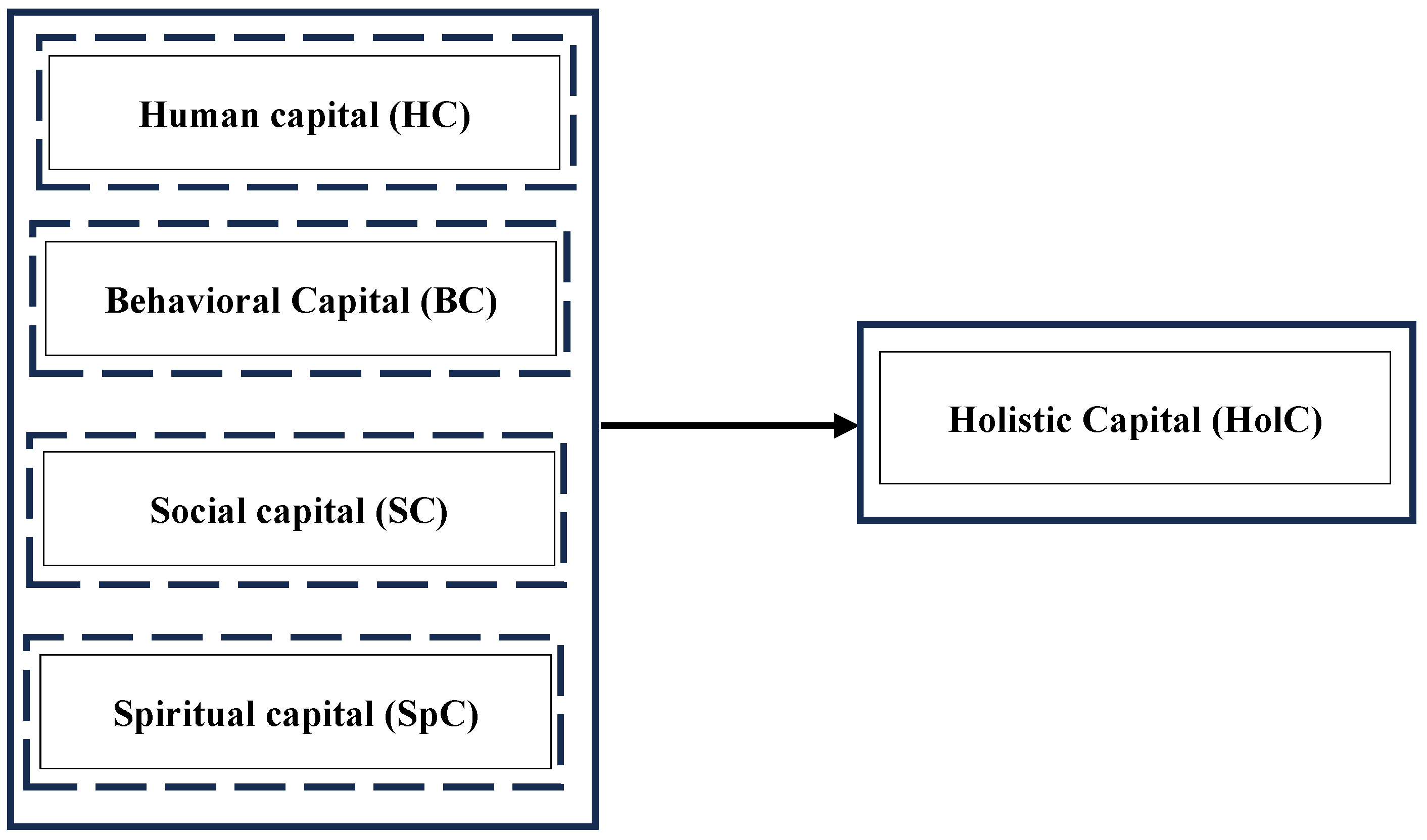
1992), the study acknowledged that different forms of capital operate at stratified levels of reality, underscoring the need for an integrated framework. The proposed HolC, which involves human, behavioral, social, and spiritual capital, reflects the intense complexity of human competencies and capabilities in modern work environments. The conceptualization is presented as
Figure 1.
The proposed HolC is likely to contribute to the literature by conceptualizing the various resource domains as a cohesive higher-order construct that is empirically distinctive rather than as independent components. According to
Judge et al. (
2002),
Schwab (
2013), and
Sulphey (
2023a), a higher-order concept is fairly stable and distinguishable from other constructs. While individual capitals concentrate on discrete resources, the higher-order HolC underscores cross-domain resources and their collective influence on behavioral regulation and performance. In the proposed framework, HolC is likely to reflect the synergistic configuration of multiple forms of the component capitals. The dynamic interrelationships between the component capitals would support adaptive functioning and sustained efficiency and effectiveness.
A conceptualization of HolC was necessary because traditional logic and conceptions of capital fail to account for the “whole person.” Most existing conceptualizations treated humans as economic units—for instance, as possessors of skills and networks. The core fundamental drivers of human action, such as inherent behavioral predispositions, values, morals, and inner meaning, were not given adequate focus. These gaps have led to issues such as theoretical confusion, overlap, and conceptual ambiguity. Earlier capital frameworks focused primarily on aspects such as functional, relational, and psychological resources. Scant conceptual literature exists about a unified dispositional structure integrating cognitive competence, behavior, social relatedness, and meaningfulness. While human capital addresses cognitive competence, behavioral capital is associated with behavior, social capital is associated with social relatedness, and spiritual capital discusses meaningfulness. This study introduces the HolC framework, extending earlier models by integrating these dimensions into a cohesive, profound inner disposition that influences decision-making and value creation.
This holistic framework promotes consistency, coherence, integration, and parsimony in understanding the construct by presenting a “whole-person” capability. Furthermore, SpC, the component of HolC, can facilitate the creation, strengthening, binding together, and sustaining of all the other component capitals.
Additionally, according to the tenets of the Spillover theory, when individuals are content spiritually, their pleasure spreads to their professional lives (
Kolodinsky et al., 2008). It develops mental strength and consequent engagement, positively influencing employees’ perceptions of the organization. Most current capital models operate in silos and lack cohesion. The proposed HolC reflects the complexity of human competence in the modern work environment, providing explanations for outcomes such as psychological and physical well-being, thriving, engagement, creativity, and morality, superior to any single form of capital. It can foster normative conduct, deriving collaborative networks that can facilitate long-term organizational sustainability. This work thus presents an integrated theoretical model that explains how HolC, as a meta-construct, engenders value and consequential competitive advantage and performance. The integrated frameworks in which HolC is conceptualized offer multiple benefits, such as reducing redundancy, achieving theoretical synergy, synthesizing discrete and fragmented constructs, and producing a whole-person effect. Holistic capital is defined as the complex integration of human, behavioral, social, and spiritual resources that collectively enable individuals to function, thrive, and contribute meaningfully to their organizations and societies. It epitomizes the full range of human capabilities, such as being ethical, creative, connected, and energetic.
9. Discussion
The extant literature shows that various capitals are sources of competitive advantage and superior organizational performance (
Crook et al., 2011;
Esho & Verhoef, 2020;
Nyberg et al., 2018;
Peterson et al., 2025). Prime among them, identified in this study, are human, behavioral, social, and spiritual capital. These are valuable intangible assets that explain various practical aspects of business activities. Prior research has robustly confirmed a positive association between social capital and psychological well-being. Additionally, organizations need to develop SpC as a force to tackle sustainability issues (
Astrachan et al., 2020). SpC, which extends beyond a sensitive and vegetative nature, exerts influence in almost all spheres of life, instilling strength and revitalizing healthy dynamics personally, socially, and professionally. When there is SpC, individuals naturally yearn for a profound sense of purpose and are often motivated by spirituality rather than materialism. This natural yearning, triggered by SpC, acts as behavioral glue, binding all the other capital frameworks into a cohesive whole. This cohesive whole, cherished as “holistic capital,” can enhance employee performance and improve overall organizational performance.
The HolC was conceptualized based on multidisciplinary literature and emerging realities. Being transdisciplinary in nature, this research employed a systematic, constructive, conceptual research design grounded in an integrative review and theory-building (
Jaakkola, 2020;
Shepherd & Suddaby, 2017). The study adopted a unified theoretical framework and integrated multiple related concepts and theories to conceptualize the construct. This methodology is integrative and reflexive, involving less linear sequencing and more concurrent data collection, analysis, and theory building, as proposed by
Chinn and Kramer (
2014). The advantages of this methodology helped propose an interdisciplinary HolC framework, a non-material form of capital that is consistent, coherent, integrated, and parsimonious, as it presents a “whole-person” capability. Since it is derived from human investments and can involve multiple forms of capital, it can preserve and enhance human skills and capacities. An examination of the construct and the components suggests that an individual who possesses HolC is likely to exhibit all the characteristics of its constituent components.
This study examines HolC across theoretical, methodological, empirical, and practical dimensions. The theoretical dimension draws on established capital and resource-based perspectives, including human capital theory (
Cameron & Dutton, 2003), social capital theory (
Bourdieu, 1986), psychological capital (
Luthans et al., 2004;
Luthans & Youssef, 2004,
2007), spiritual capital (
Malloch, 2008,
2010), and Conservation of Resources theory (
Hobfoll, 1989), which collectively provide the conceptual backdrop for understanding HolC as a resource pool. Methodologically, the study reviewed and identified approaches to construct development and reconceptualization (
DeVellis & Thorpe, 2017). On the empirical dimension, this work synthesized the available research literature demonstrating the role of various capitals in influencing individual performance, decision-making, and well-being (
Luthans et al., 2007;
Hobfoll et al., 2018). In the practical dimension, the study examined the relevance of various capitals towards individual and organizational effectiveness, and sustainability (
Bozbura et al., 2007;
Hatch & Dyer, 2004;
Pedrini, 2007). Thus, this multidimensional review enabled a comprehensive understanding of HolC and provided a coherent framework. Thus, this study implies that the conceptualization of HolC has enabled better alignment with contemporary organizational realities and has integrated cognitive, behavioral, and spiritual disciplines, thereby fostering a “whole-person” capability. The study has theoretical and practical implications as it offers better explanatory power for individual and organizational performance, moral and ethical issues, employee engagement and thriving, and human resilience. The theoretical contribution of this higher-order concept lies in its ability to provide a unified conceptualization for understanding the multidimensional nature of individual capitals. Thus, by integrating discrete capital constructs into a single framework, HolC extends
Hobfoll’s (
2011) Conservation of Resources theory and provides a comprehensive explanation of how diverse resources can be mobilized to address the complex, evolving work environments.
Despite its rigorous methodology and advantages, the study has a few limitations. Though the study’s constructive conceptual approach facilitated synthesis across paradigmatic disciplinary boundaries, one of the main limitations is that it remains fundamentally interpretive. Future empirical work could use mixed methods to operationalize and examine the HolC framework. Towards this, future research could use techniques such as surveys, case studies, and longitudinal designs. There may be other capitals that could enhance HolC’s cohesion and capability, which could be examined in future research.
10. Conclusions
This paper presents a conceptual framework for HolC, foregrounding it through an interdisciplinary approach. Evidence suggests the concept is neither elusive nor impracticable. The concept is a serious, remarkably neglected, and understudied issue that warrants further attention given its immense benefits. As intangible capital, HolC can deliver substantial individual and organizational gains, as well as inner pleasure and well-being. Focusing on HolC facilitates a move in a different direction, away from the materialistic path. Holistic capital requires intense theoretical and empirical examination.
This study examined the ideal form of capital that can effectively represent the multifaceted nature of human competencies in complex modern work settings. The study identified HolC, which integrates human, behavioral, social, and spiritual capital, as better able to capture the complexity of contemporary capability structures. This framework focuses on the complex and dynamic roles and the adaptive demands at the individual level. It complements existing capital constructs and offers an integrative view of how resources influence behavioral outcomes in the complex work environment. Additionally, HolC identifies competencies as basic internal resources involving cognitive, behavioral, relational, and meaning-oriented dimensions ideal for success and adaptability. The proposed framework provides a background for future empirical examination of individual and firm competitiveness and performance, extending the concepts embedded in capital theory by proposing it as a deep, integrative construct related to human capabilities, ideal for the present complex business world. Given the conceptual nature of this paper, these assertions should be viewed with caution, recognizing that the concepts need to be empirically validated. Further, the boundary conditions are clearly defined, thereby enhancing the empirical validation of theoretical accuracy.
The framework comprises several positive constructs, such as human, behavioral, social, and spiritual capital, that encourage individuals to draw on their inner strengths, capacities, positive feelings, states, and aspirations to engage enthusiastically in worthy behaviors and achieve individual self-fulfillment and organizational success. This innovative, integrative framework suggests going beyond customary work–life purposes. Consistent with the extant literature on positive psychology, organizational behavior, Sociology, and workplace spirituality, and integrating these perspectives, the proposed conceptual model suggests that individuals can capitalize on virtues, inner strengths, positive feelings, capabilities, and aspirations to develop outstanding human qualities and build HolC. It is envisioned that HolC will help individuals achieve well-being, higher levels of resilience at work, and the consequent individual and organizational success. Overall, it is assumed that this integrative model would be entirely feasible and would trigger scholarly examination and further development of the construct.
Author Contributions
Conceptualization, S.M.M. and M.N.; methodology, S.M.M.; software, M.N.; validation, M.N.; formal analysis, S.M.M.; investigation, S.M.M.; resources, M.N.; data curation, M.N.; writing—original draft preparation, S.M.M.; writing—review and editing, M.N.; visualization, S.M.M.; supervision, S.M.M.; project administration, M.N.; funding acquisition, M.N. All authors have read and agreed to the published version of the manuscript.
Funding
This research was funded by Prince Sattam bin Abdulaziz University for funding this research work through the project number (PSAU/2025/2025/02/37748) And The APC was funded by Prince Sattam bin Abdulaziz University under the project number (PSAU/2025/2025/02/37748).
Institutional Review Board Statement
Not applicable.
Informed Consent Statement
Not applicable.
Data Availability Statement
No new data were created or analyzed in this study.
Acknowledgments
The authors extend their appreciation to Prince Sattam bin Abdulaziz University for funding this research work through the project number (PSAU/2025/2025/02/37748).
Conflicts of Interest
The authors declare no conflict of interest.
References
- Adler, P. S., & Kwon, S.-W. (2002). Social capital: Prospects for a new concept. Academy of Management Review, 27(1), 17–40. [Google Scholar] [CrossRef] [Scilit]
- AICD. (2020). Delving into board-meeting dynamics. Australian Institute of Company Directors. Available online: https://www.aicd.com.au/board-of-directors/performance/effectiveness/cultivating-high-performance-boards.html (accessed on 20 November 2022).
- Allcott, H., & Mullainathan, S. (2010). Energy. Behavior and energy policy. Science (New York, NY), 327(5970), 1204–1205. [Google Scholar] [CrossRef] [Scilit] [PubMed]
- Aloulou, W. J., & Amari, A. (2025). The influence of psychological capital on entrepreneurial intentions among fresh graduates in saudi arabia: A mediation analysis using the theory of planned behaviour. Vision: The Journal of Business Perspective. [Google Scholar] [CrossRef] [Scilit]
- Alruwayti, H., & Sulphey, M. M. (2024). Can core self-evaluation, workplace spirituality, and mindfulness result in task performance: Evidence from Saudi Arabian organizations. Problems and Perspectives in Management, 22(3), 39–54. [Google Scholar] [CrossRef] [Scilit]
- Astrachan, J. H., Binz Astrachan, C., Campopiano, G., & Baù, M. (2020). Values, spirituality and religion: Family business and the roots of sustainable ethical behavior. Journal of Business Ethics, 163(4), 637–645. [Google Scholar] [CrossRef] [Scilit]
- Avey, J. B., Luthans, F., & Jensen, S. M. (2009). Psychological capital: A positive resource for combating employee stress and turnover. Human Resource Management, 48(5), 677–693. [Google Scholar] [CrossRef] [Scilit]
- Backes-Gellner, U., & Moog, P. (2013). The disposition to become an entrepreneur and the jacks-of-all-trades in social and human capital. The Journal of Socio-Economics, 47, 55–72. [Google Scholar] [CrossRef] [Scilit]
- Baker, C., & Miles-Watson, J. (2008). Exploring secular spiritual capital: An engagement in religious and secular dialogue for a common future? International Journal of Public Theology, 2(4), 442–464. [Google Scholar] [CrossRef] [Scilit]
- Barborič, B., Baloh, M., Zuti, B., Podani, K., Udvari, B., Lukovics, M., Burzacchini, A., Philipp, A., & Winter, M. (2018). Territorial attractiveness monitoring platform: A handbook for policy planners. URBASOFIA SRL, Geodetski Inštitut Slovenije. [Google Scholar]
- Barney, J. (1991). Firm resources and sustained competitive advantage. Journal of Management, 17(1), 99–120. [Google Scholar] [CrossRef] [Scilit]
- Beretti, A., Figuières, C., & Grolleau, G. (2013). Behavioral innovations: The missing capital in sustainable development? Ecological Economics, 89, 187–195. [Google Scholar] [CrossRef] [Scilit]
- Berger, P. L., & Hefner, R. W. (2003). Spiritual capital in comparative perspective. In P. L. Berger, & G. Redding (Eds.), The hidden form of capital: Spiritual influences in societal progress (pp. 10–11). Anthem Press. [Google Scholar]
- Bhaskar, R. (1975). Forms of realism. Philosophica, 15(1), 99–127. [Google Scholar] [CrossRef] [Scilit]
- Boisot, M. (2002). Changing organizations: Business networks in the new political economy. Sage Publications. [Google Scholar]
- Bourdieu, P. (1984). A social critique of the judgement of taste. Harvard University Press. [Google Scholar]
- Bourdieu, P. (1986). The forms of capital. In J. G. Richardson (Ed.), Handbook of theory and research for the sociology of education (pp. 241–258). Greenwood Press. [Google Scholar]
- Bozbura, F. T., Beskese, A., & Kahraman, C. (2007). Prioritization of human capital measurement indicators using fuzzy AHP. Expert Systems with Applications, 32(4), 1100–1112. [Google Scholar] [CrossRef] [Scilit]
- Brooking, A. (1996). Intellectual capital: Core asset for the third millennium enterprise. Thomson Business Preee. [Google Scholar]
- Bruce, W., & Plocha, E. F. (1999). Reflections on maintaining a spirituality in the government workplace: What it means and how to do it. International Journal of Organization Theory & Behavior, 2(3–4), 325–347. [Google Scholar] [CrossRef] [Scilit]
- Cameron, K., & Dutton, J. (Eds.). (2003). Positive organizational scholarship: Foundations of a new discipline. Berrett-Koehler Publishers. [Google Scholar]
- Chinn, P. L., & Kramer, M. K. (2014). Knowledge development in nursing: Theory and process. Elsevier Health Sciences. [Google Scholar]
- Cinar, A. B., Murtomaa, H., & Tseveenjav, B. (2008). The life-course approach in assessment of dental health: A cross sectional study among Finnish and Turkish pre-adolescents. European Journal of Dentistry, 2(03), 153–160. [Google Scholar] [CrossRef] [Scilit]
- Coleman, J. S. (1990). Commentary: Social institutions and social theory. American Sociological Review, 55(3), 333–339. [Google Scholar] [CrossRef] [Scilit]
- Crabtree, A. (2018). Sustainability and climate change: Human development and human responsibilities. In Routledge handbook of development ethics (pp. 209–225). Routledge. [Google Scholar]
- Crook, T. R., Todd, S. Y., Combs, J. G., Woehr, D. J., & Ketchen, D. J., Jr. (2011). Does human capital matter? A meta-analysis of the relationship between human capital and firm performance. Journal of Applied Psychology, 96(3), 443. [Google Scholar] [CrossRef] [Scilit]
- Curado, C., & Bontis, N. (2007). Managing intellectual capital: The MIC matrix. International Journal of Knowledge and Learning, 3(2–3), 316–328. [Google Scholar] [CrossRef] [Scilit]
- Czap, N. V., Czap, H. J., Khachaturyan, M., Lynne, G. D., & Burbach, M. (2012). Walking in the shoes of others: Experimental testing of dual-interest and empathy in environmental choice. The Journal of Socio-Economics, 41(5), 642–653. [Google Scholar] [CrossRef] [Scilit]
- Dahlgaard-Park, S. M. (2012). Core values–the entrance to human satisfaction and commitment. Total Quality Management & Business Excellence, 23(2), 125–140. [Google Scholar]
- DeVellis, R. F., & Thorpe, C. T. (2017). Scale development: Theory and applications (4th ed.). Sage Publications. [Google Scholar]
- do RosÃ, M., & Vaz, J. L. (2006). Intellectual capital and value creation: Evidence from the por-tuguese banking industry. Electronic Journal of Knowledge Management, 4(1), 11–20. [Google Scholar]
- Edvinsson, L., & Malone, M. S. (1997). Intellectual capital. Harper Business. [Google Scholar]
- Ekins, P., Simon, S., Deutsch, L., Folke, C., & De Groot, R. (2003). A framework for the practical application of the concepts of critical natural capital and strong sustainability. Ecological Economics, 44(2–3), 165–185. [Google Scholar] [CrossRef] [Scilit]
- Elster, J. (1986). Rational choice. NYU Press. [Google Scholar]
- Esho, E., & Verhoef, G. (2020). A holistic model of human capital for value creation and superior firm performance: The Strategic factor market model. Cogent Business & Management, 7(1), 1728998. [Google Scholar] [CrossRef] [Scilit]
- Finke, R., & Stark, R. (1988). Religious economies and sacred canopies: Religious mobilization in American cities, 1906. American Sociological Review, 53(1), 41–49. [Google Scholar] [CrossRef] [Scilit]
- Frost, P. J., & Stablein, R. E. (1992). Doing exemplary research. Sage. [Google Scholar]
- Glaser, B. G. (1978). Theoretical sensitivity. Advances in the methodology of grounded theory. The Sociology Press. [Google Scholar]
- Halim, S. (2010). Statistical analysis on the intellectual capital statement. Journal of Intellectual Capital, 11(1), 61–73. [Google Scholar] [CrossRef] [Scilit]
- Hatch, N. W., & Dyer, J. H. (2004). Human capital and learning as a source of sustainable competitive advantage. Strategic Management Journal, 25(12), 1155–1178. [Google Scholar] [CrossRef] [Scilit]
- Hevey, D. (2016). Cracking the talent development code of the iY generation time to upgrade. Insurance, Jan-Mar, 18–21. [Google Scholar]
- Hobfoll, S. E. (1989). Conservation of resources: A new attempt at conceptualizing stress. American Psychologist, 44(3), 513. [Google Scholar] [CrossRef]
- Hobfoll, S. E. (2002). Social and psychological resources and adaptation. Review of General Psychology, 6(4), 307–324. [Google Scholar] [CrossRef]
- Hobfoll, S. E. (2010). Conservation of resources theory: Its implication for stress, health, and resilience. The Oxford Handbook of Stress, Health, and Coping, 127, 147. [Google Scholar]
- Hobfoll, S. E. (2011). Conservation of resource caravans and engaged settings. Journal of Occupational and Organizational Psychology, 84(1), 116–122. [Google Scholar] [CrossRef] [Scilit]
- Hobfoll, S. E., Halbesleben, J., Neveu, J.-P., & Westman, M. (2018). Conservation of resources in the organizational context: The reality of resources and their consequences. Annual Review of Organizational Psychology and Organizational Behavior, 5, 103–128. [Google Scholar] [CrossRef] [Scilit]
- Hudson, W. J. (1993). Intellectual capital: How to build it, enhance it, use it. Wiley. [Google Scholar]
- Iannaccone, L. R. (1990). Religious practice: A human capital approach. Journal for the Scientific Study of Religion, 29(3), 297–314. [Google Scholar] [CrossRef] [Scilit]
- Jaakkola, E. (2020). Designing conceptual articles: Four approaches. AMS Review, 10(1), 18–26. [Google Scholar] [CrossRef] [Scilit]
- Jnaneswar, K., & Sulphey, M. (2021). A study on the relationship between workplace spirituality, mental wellbeing and mindfulness. Management Science Letters, 11(3), 1045–1054. [Google Scholar] [CrossRef] [Scilit]
- Judge, T. A., Erez, A., Bono, J. E., & Thoresen, C. J. (2002). Are measures of self-esteem, neuroticism, locus of control, and generalized self-efficacy indicators of a common core construct? Journal of Personality and Social Psychology, 83(3), 693. [Google Scholar] [CrossRef]
- Kahneman, D. (2003). Maps of bounded rationality: Psychology for behavioral economics. American Economic Review, 93(5), 1449–1475. [Google Scholar] [CrossRef] [Scilit]
- Kim, J., & Mahoney, J. T. (2007). Appropriating economic rents from resources: An integrative property rights and resource-based approach. International Journal of Learning and Intellectual Capital, 4(1–2), 11–28. [Google Scholar] [CrossRef] [Scilit]
- Kolodinsky, R. W., Giacalone, R. A., & Jurkiewicz, C. L. (2008). Workplace values and outcomes: Exploring personal, organizational, and interactive workplace spirituality. Journal of Business Ethics, 81(2), 465–480. [Google Scholar] [CrossRef] [Scilit]
- Kuh, D., Power, C., Blane, D., & Bartley, M. (2004). Socioeconomic pathways between childhood and adult health. In D. Kuh, & Y. Ben-Shlomo (Eds.), A life course approach to chronic disease epidemiology (2nd ed., pp. 371–395). Oxford University Press. [Google Scholar]
- Lazarus, R. S., & Folkman, S. (1984). Stress, appraisal, and coping. Springer. [Google Scholar]
- Lepak, D. P., & Snell, S. A. (1999). The human resource architecture: Toward a theory of human capital allocation and development. Academy of Management Review, 24(1), 31–48. [Google Scholar] [CrossRef] [Scilit]
- Lewis, M. W., & Grimes, A. I. (1999). Metatriangulation: Building theory from multiple paradigms. Academy of Management Review, 24(4), 672–690. [Google Scholar] [CrossRef] [Scilit]
- Li, H., Yi, H., Renn, O., & Li, J. (2024). The role of social capital in managing risks: A bibliometric analysis and literature review. Journal of Risk Research, 27(4), 500–523. [Google Scholar] [CrossRef] [Scilit]
- Li, W., Peng, Y., Yang, J., & Sazzad Hossain, M. (2024). Human capital structure and innovation efficiency under technological progress: Evidence from China. Sage Open, 14(3), 1–16. [Google Scholar] [CrossRef] [Scilit]
- Luthans, F., Luthans, K. W., & Luthans, B. C. (2004). Positive psychological capital: Beyond human and social capital. Business Horizons, 47(1), 45–50. [Google Scholar] [CrossRef] [Scilit]
- Luthans, F., & Youssef, C. M. (2004). Human, social, and now positive psychological capital management: Investing in people for competitive advantage. Organizational Dynamics, 33(2), 143–160. [Google Scholar] [CrossRef] [Scilit]
- Luthans, F., & Youssef, C. M. (2007). Emerging positive organizational behavior. Journal of Management, 33(3), 321–349. [Google Scholar] [CrossRef] [Scilit]
- Luthans, F., Youssef, C. M., & Avolio, B. J. (2007). Psychological capital: Developing the human competitive edge. Oxford University Press. [Google Scholar]
- Luthans, F., Youssef-Morgan, C. M., & Avolio, B. J. (2015). Psychological capital and beyond. Oxford University Press. [Google Scholar]
- Lynn, B. (1998). Intellectual capital: Key to value added success in the next millennium. CMA-the Management Accounting Magazine, 72(1), 10–16. [Google Scholar]
- Lynne, G. D., & Czap, N. V. (2024). Towards dual interest theory in metaeconomics. Journal of Interdisciplinary Economics, 36(1), 7–25. [Google Scholar] [CrossRef] [Scilit]
- Maak, T. (2007). Responsible leadership, stakeholder engagement, and the emergence of social capital. Journal of Business Ethics, 74(4), 329–343. [Google Scholar] [CrossRef] [Scilit]
- MacKenzie, S. B., Podsakoff, P. M., & Podsakoff, N. P. (2011). Construct measurement and validation procedures in MIS and behavioral research: Integrating new and existing techniques. MIS Quarterly, 35(2), 293–334. [Google Scholar] [CrossRef] [Scilit]
- Malloch, T. R. (2008). Spiritual enterprise: Doing virtuous business. Encounter Books. [Google Scholar]
- Malloch, T. R. (2010). Spiritual capital and practical wisdom. In G. Lenssen, N. C. Smith, & R. Strand (Eds.), The Oxford handbook of business and spirituality. Oxford University Press. [Google Scholar]
- Marques, J., Dhiman, S., & Biberman, J. (2011). Workplace spirituality. In Managing in the twenty-first century: Transforming toward mutual growth (pp. 79–118). Springer. [Google Scholar]
- Marr, B., & Schiuma, G. (2003). Business performance measurement–past, present and future. Management Decision, 41(8), 680–687. [Google Scholar] [CrossRef] [Scilit]
- Mas-Machuca, M., & Marimon, F. (2019). Holistic spiritual capital: Definition and its measurement. International Journal of Organization Theory & Behavior, 22(1), 96–110. [Google Scholar] [CrossRef] [Scilit]
- McKnight, B., & Bontis, N. (2002). E-improvisation: Collaborative groupware technology expands the reach and effectiveness of organizational improvisation. Knowledge and Process Management, 9(4), 219–227. [Google Scholar] [CrossRef] [Scilit]
- Middlebrooks, A., & Noghiu, A. (2007). Reconceptualizing spiritual capital: A meso-model for organizational leadership. Integrating Spirituality and Organizational Leadership, 675, 681. [Google Scholar]
- Miles, M. B., & Huberman, A. M. (1994). Qualitative data analysis: An expanded sourcebook. SAGE Publications. [Google Scholar]
- Molodchik, M., Shakina, E., & Bykova, A. (2012). Intellectual capital transformation evaluating model. Journal of Intellectual Capital, 13(4), 444–461. [Google Scholar] [CrossRef] [Scilit]
- Nahapiet, J., & Ghoshal, S. (1998). Social capital, intellectual capital, and the organizational advantage. Academy of Management Review, 23(2), 242–266. [Google Scholar] [CrossRef] [Scilit]
- Norstrand, J. A., & Xu, Q. (2012). Social capital and health outcomes among older adults in China: The urban–rural dimension. The Gerontologist, 52(3), 325–334. [Google Scholar] [CrossRef] [Scilit]
- Nyberg, A., Reilly, G., Essman, S., & Rodrigues, J. (2018). Human capital resources: A call to retire settled debates and to start a few new debates. The International Journal of Human Resource Management, 29(1), 68–86. [Google Scholar] [CrossRef] [Scilit]
- Osóch, B., & Tessar, K. (2019). Diversification of social capital of sailing community and development of tourist services of the szczecin lagoon. Studies of the Industrial Geography Commission of the Polish Geographical Society, 33(3), 85–99. [Google Scholar] [CrossRef] [Scilit]
- Patton, M. Q. (2002). Two decades of developments in qualitative inquiry: A personal, experiential perspective. Qualitative Social Work, 1(3), 261–283. [Google Scholar] [CrossRef] [Scilit]
- Pedrini, M. (2007). Human capital convergences in intellectual capital and sustainability reports. Journal of Intellectual Capital, 8(2), 346–366. [Google Scholar] [CrossRef] [Scilit]
- Petchsawang, P. (2008). Workplace spirituality and buddhist meditation [Ph.D. thesis, The University of Tennessee]. [Google Scholar]
- Petchsawang, P., & Duchon, D. (2009). Measuring workplace spirituality in an Asian context. Human Resource Development International, 12(4), 459–468. [Google Scholar] [CrossRef] [Scilit]
- Petchsawang, P., & McLean, G. N. (2017). Workplace spirituality, mindfulness meditation, and work engagement. Journal of Management, Spirituality & Religion, 14(3), 216–244. [Google Scholar] [CrossRef] [Scilit]
- Peterson, P. E., Dills, A. K., & Shakeel, M. D. (2025). Social capital, families, friendships, and inter-generational mobility. Journal of Family Issues, 46(9), 1484–1512. [Google Scholar] [CrossRef] [Scilit]
- Putnam, R. D. (Ed.). (2002). Democracies in flux: The evolution of social capital in contemporary society. Oxford University Press. [Google Scholar] [CrossRef] [Scilit]
- Rima, S. D. (2020). Spiritual capital: A moral core for social and economic justice. Gower. [Google Scholar] [CrossRef] [Scilit]
- Roslender, R., Stevenson, J., & Kahn, H. (2006). Employee wellness as intellectual capital: An accounting perspective. Journal of Human Resource Costing & Accounting, 10(1), 48–64. [Google Scholar] [CrossRef] [Scilit]
- Ruth, J. A., Otnes, C. C., & Brunel, F. F. (1999). Gift receipt and the reformulation of interpersonal relationships. Journal of Consumer Research, 25(4), 385–402. [Google Scholar] [CrossRef] [Scilit]
- Samuel-Azran, T., Goldberg, S., Hayat, T., & Amichai-Hamburger, Y. (2025). The social side of online learning: How social capital can enhance online learning. Sage Open, 15(1), 1–7. [Google Scholar] [CrossRef] [Scilit]
- Schooling, C., & Kuh, D. (2000). A life course perspective on women’s health behaviours. In A life course-approach to women’s health. Oxford Academic Books. [Google Scholar] [CrossRef] [Scilit]
- Schwab, D. P. (2013). Research methods for organizational studies. Psychology Press. [Google Scholar]
- Shepherd, D. A., & Suddaby, R. (2017). Theory building: A review and integration. Journal of Management, 43(1), 59–86. [Google Scholar] [CrossRef] [Scilit]
- Shih, K.-H., Liu, Y.-T., Jones, C., & Lin, B. (2010). The indicators of human capital for financial institutions. Expert Systems with Applications, 37(2), 1503–1509. [Google Scholar] [CrossRef] [Scilit]
- Singer, T., & Lamm, C. (2009). The social neuroscience of empathy. Annals of the New York Academy of Sciences, 1156(1), 81–96. [Google Scholar] [CrossRef] [Scilit]
- Sofian, M., Aghakhani, A., Velayati, A. A., Banifazl, M., Eslamifar, A., & Ramezani, A. (2008). Risk factors for human brucellosis in Iran: A case–control study. International Journal of Infectious Diseases, 12(2), 157–161. [Google Scholar] [CrossRef] [Scilit] [PubMed]
- Stead, J. G., & Stead, W. E. (2014). Building spiritual capabilities to sustain sustainability-based competitive advantages. Journal of Management, Spirituality & Religion, 11(2), 143–158. [Google Scholar] [CrossRef] [Scilit]
- Steptoe, A., Freedland, K., Jennings, J. R., Llabre, M. M., Manuck, S. B., & Susman, E. J. (2010). Handbook of behavioral medicine. Academy of Behavioral Medicine. [Google Scholar]
- Stewart, G. (1997). Supply-chain operations reference model (SCOR): The first cross-industry framework for integrated supply-chain management. Logistics Information Management, 10(2), 62–67. [Google Scholar] [CrossRef] [Scilit]
- Stiles, P., & Kulvisaechana, S. (2004). Human capital and performance in public sector. Judge Institute of Management, University of Cambridge. [Google Scholar]
- Stovel, M., & Bontis, N. (2002). Voluntary turnover: Knowledge management–friend or foe? Journal of Intellectual Capital, 3(3), 303–322. [Google Scholar] [CrossRef] [Scilit]
- Sulphey, M. M. (2022). A meta-analytic literature study on the relationship between workplace spirituality and sustainability. Journal of Religion and Health, 61(6), 4674–4695. [Google Scholar] [CrossRef] [Scilit]
- Sulphey, M. M. (2023a). An Islamic perspective of workplace rectitude. Asian Journal of Business Ethics, 12(2), 323–346. [Google Scholar] [CrossRef] [Scilit]
- Sulphey, M. M. (2023b). Workplace spirituality, self-compassion and mindfulness as antecedents of employee mental wellbeing. South Asian Journal of Business Studies, 12(2), 269–292. [Google Scholar]
- Sulphey, M. M. (2026). Reconceptualizing workplace thriving and setting future research agenda. Psychologica Belgica, 66(1), 1–17. [Google Scholar] [CrossRef] [Scilit]
- Sulphey, M. M., & Naushad, M. (2019). The position of intellectual capital among Saudi banks. Marketing and Management of Innovations, 19(04), 11–21. [Google Scholar] [CrossRef] [Scilit]
- Taghizadeh Yazdi, M. R. (2015). Quantitative assessment of spiritual capital in changing organizations by principal component analysis and fuzzy clustering. Journal of Organizational Change Management, 28(3), 469–485. [Google Scholar] [CrossRef] [Scilit]
- Tan, E. (2014). Human capital theory: A holistic criticism. Review of Educational Research, 84(3), 411–445. [Google Scholar] [CrossRef] [Scilit]
- Uzzi, B. (1996). The sources and consequences of embeddedness for the economic performance of organizations: The network effect. American Sociological Review, 61(4), 674–698. [Google Scholar] [CrossRef] [Scilit]
- Vasconcelos, A. F. (2021). Individual spiritual capital: Meaning, a conceptual framework and implications. Journal of Work-Applied Management, 13(1), 117–141. [Google Scholar] [CrossRef] [Scilit]
- Vemuri, A. W., & Costanza, R. (2006). The role of human, social, built, and natural capital in explaining life satisfaction at the country level: Toward a National Well-Being Index (NWI). Ecological Economics, 58(1), 119–133. [Google Scholar] [CrossRef] [Scilit]
- Wasiluk, K. L. (2013). Beyond eco-efficiency: Understanding CS through the IC practice lens. Journal of Intellectual Capital, 14(1), 102–126. [Google Scholar] [CrossRef] [Scilit]
- Welbourne, T. M., & Pardo-del-Val, M. (2009). Relational capital: Strategic advantage for small and medium-size enterprises (SMEs) through negotiation and collaboration. Group Decision and Negotiation, 18(5), 483–497. [Google Scholar] [CrossRef] [Scilit]
- Whetten, D. A. (1989). What constitutes a theoretical contribution? Academy of Management Review, 14(4), 490–495. [Google Scholar] [CrossRef] [Scilit]
- Wladis, C., Fay, M. P., & Hachey, A. C. (2024). The holistic capital model: Time and body capital as sources of inequity. AERA Open, 10, 23328584241255626. [Google Scholar] [CrossRef] [Scilit]
- Wojewódzka-Wiewiórska, A. (2017). The importance of the leader programme 2007–2013 in the rural areas development in Poland. Research for Rural Development, 2, 97–103. [Google Scholar] [CrossRef] [Scilit]
- Woodberry, R. D. (2003). Researching spiritual capital. Academia.Edu. [Google Scholar]
- Wright, P. M., McMahan, G. C., & McWilliams, A. (1994). Human resources and sustained competitive advantage: A resource-based perspective. International Journal of Human Resource Management, 5(2), 301–326. [Google Scholar] [CrossRef] [Scilit]
- Xin, S., Tribe, J., & Chambers, D. (2013). Conceptual research in tourism. Annals of Tourism Research, 41, 66–88. [Google Scholar] [CrossRef] [Scilit]
- Youssef, C. M., & Luthans, F. (2007). Positive organizational behavior in the workplace: The impact of hope, optimism, and resilience. Journal of Management, 33(5), 774–800. [Google Scholar] [CrossRef] [Scilit]
- Zohar, D., & Marshall, I. (2004). Spiritual capital: Wealth we can live by. Berrett-Koehler Publishers. [Google Scholar]
| Disclaimer/Publisher’s Note: The statements, opinions and data contained in all publications are solely those of the individual author(s) and contributor(s) and not of MDPI and/or the editor(s). MDPI and/or the editor(s) disclaim responsibility for any injury to people or property resulting from any ideas, methods, instructions or products referred to in the content. |