Article

Changes in the ESG Discourses of Korean Global B2B Corporations Before and After Trump’s Second Term: A Social Media-Based Text Mining Analysis


1
Innopoiesis, Korea University, Seoul 02841, Republic of Korea
2
Department of Business Administration, University of Seoul, Seoul 02504, Republic of Korea
*
Author to whom correspondence should be addressed.
Adm. Sci. 2026, 16(3), 145; https://doi.org/10.3390/admsci16030145
Submission received: 23 January 2026 / Revised: 26 February 2026 / Accepted: 9 March 2026 / Published: 16 March 2026
(This article belongs to the Section Strategic Management)

Abstract

This study empirically investigates how Environmental, Social, and Governance (ESG) discourses among major Korean Business-to-Business (B2B) corporations (POSCO, LG Chem, and HD Hyundai) were reconfigured in the context of former President Trump’s re-election campaign and the 2024 U.S. presidential election. The observation periods were divided into the Pre-Trump period (1 May 2023 to 30 April 2024) and the Post-Trump period (1 May 2024 to 30 April 2025). External discourses were examined using social media, news, and blog posts, while internal discourses were analyzed through the CEO’s New Year addresses from 2021 to 2025. Keyword frequency analysis and co-occurrence network analysis, conducted via the ‘Sometrend’ platform, were combined to trace structural transitions in corporate discourses. The results show that: (1) the relative share and network centrality of environmental (E) keywords declined in the Post-Trump period, with several environmental terms losing core positions and becoming peripheral or bridging nodes, while policy- and economic-related terms increased; (2) social (S) and governance (G) keywords appeared only sporadically and remained peripheral across periods; (3) temporal concentrations of policy–economic keywords coincided with significant political and market-related events, such as financial volatility in 2023 and the tariff policy announcement in February 2025, indicating temporal alignment rather than deterministic causality; (4) firm-level differences were evident: POSCO exhibited the most pronounced structural shift, LG Chem’s discourses increasingly emphasized supply chain and investment-related terms alongside environmental keywords, and HD Hyundai showed a shift toward more risk- and operation-oriented keywords in the later period; and (5) CEO New Year addresses displayed directionally consistent patterns with external discourse, supporting cross-textual alignment. These findings demonstrate that ESG discourse is not a fixed normative language but a strategically adaptive frame that varies according to political–economic contexts and industrial conditions. The relative weakening of the environmental frame in terms of discourse centrality, alongside the strengthening of the policy–economic frame, differed by industry, reflecting variations in regulatory exposure and operational characteristics. By observing ESG discourses longitudinally and comparatively, this study provides empirical evidence of how political and industrial dynamics reshape corporate discourses and CEO communication. Moreover, keyword frequency and co-occurrence network analysis are validated as effective methods for identifying discourse shifts, offering both academic contributions and practical implications for corporate communication analysis.

1. Introduction

Environmental, Social, and Governance (ESG) communication has become a central element of corporate legitimacy worldwide (Gillan et al., 2021). Yet ESG is not a fixed or universally shared norm. Instead, it is continually reshaped in response to institutional pressures, regulatory developments, and political conflict. A growing body of research demonstrates that corporate sustainability language evolves as firms adapt to changing external environments. ESG has expanded from an ethical vocabulary toward a governance mechanism associated with resilience in times of crisis (Park et al., 2022), while simultaneously becoming integrated into investor-oriented financial rationalities (MacNeil & Esser, 2022). Longitudinal textual studies further show that corporations systematically recalibrate their terminology in line with broader institutional expectations (Arvidsson, 2023; Arvidsson & Sabelfeld, 2023).
From an institutional perspective, ESG discourse reflects the interaction between law, discipline, and security. Nielsen and Villadsen (2023), analyzing Danish firms, argue that sustainability language should be understood as an outcome of governance regimes that define acceptable conduct and allocate responsibility. In this view, what firms say about ESG depends less on intrinsic commitment than on how legitimacy is structured by surrounding authorities.
In recent years, those authorities have become increasingly politicized. In the United States, ESG has shifted from managerial practice to public controversy. Hilson (2024) describes this transformation as involving both discursive politicizations, where the meaning of ESG becomes contested, and substantive politicization, where regulatory and legal interventions seek to limit or redirect its application. Organizational communication scholars similarly warn that ESG risks are being reduced to instrumental reputation management and call for renewed attention to internal political contestation (Weder & Stranzl, 2025).
While these debates are often examined in Western contexts, the institutional trajectory of ESG in South Korea differs in important ways. Rather than emerging primarily from shareholder activism or voluntary coalitions, Korean ESG infrastructure has been strongly shaped by state coordination and regulatory design. During the early 2020s, policymakers moved to close the gap between investor demand for comparable information and uneven corporate reporting practices. The Ministry of Trade, Industry and Energy introduced the K-ESG Guidelines in 2022, consolidating more than 3000 metrics into 61 standardized indicators spanning disclosure, environmental, social, and governance categories (ISS ESG, 2023). In parallel, the Ministry of Environment implemented the K-Taxonomy to define environmentally sustainable economic activities and guide capital toward nationally prioritized transition areas (ISS ESG, 2023).
Market institutions reinforced this direction. The Korea Exchange began publishing disclosure analyses, highlighting model practices, and encouraging greater standardization among listed firms (Kim et al., 2026). Although mandatory ESG reporting for large corporations was initially scheduled to be phased in the mid-2020s, the Financial Services Commission postponed implementation to after 2026 to maintain international alignment (ISS ESG, 2023). Nevertheless, voluntary participation expanded dramatically. The number of companies issuing sustainability reports rose from 78 in 2021 to 225 in 2025, with especially high adoption among firms with substantial assets and market capitalization (Kim et al., 2026).
This policy-driven trajectory raises an important analytical problem. If Korean firms adopt ESG primarily within a framework of regulatory coordination and modernization, do their narratives resemble those observed in Western economies, where market actors and political polarization play a more visible role? Or do domestic institutional arrangements produce distinct communicative priorities emphasizing compliance, industrial competitiveness, and risk management?
The question becomes particularly urgent given that Korean corporations are deeply embedded in global trade and capital networks. Korean B2B conglomerates are tightly linked to North American industrial ecosystems through overseas investment, joint ventures, and supply chain integration. Recent disclosures document rapid regional asset expansion, multi-billion-dollar battery partnerships, and sustained cooperation with U.S.-based manufacturers and defense-related industries. LG Energy Solution operates nine manufacturing and joint venture facilities across the United States and Canada, with tangible assets exceeding 38 trillion KRW globally (LG Energy Solution, 2025). POSCO’s North American assets grew from 527 billion KRW in 2023 to 1858 billion KRW in 2024, with the region accounting for 9% of steel export revenue (POSCO Holdings, 2025). HD Hyundai maintains U.S. operations through its Houston-based subsidiary, serving government-linked vessels and securing contracts with major energy companies such as Chevron (HD Hyundai, 2025). This structural exposure means that regulatory and political developments in the United States operate as material strategic signals rather than distant geopolitical events.
The recent politicization of ESG in the United States, therefore, represents more than a distant ideological dispute. It functions as an external signal that can reshape how globally exposed suppliers justify environmental and social commitments. When sustainability initiatives are reframed as politically contentious, firms operating across jurisdictions may shift from normative language toward more strategic or economically defensive narratives. Against this background, the political transition surrounding the 2024 U.S. presidential election offers a unique opportunity to observe potential discursive adjustment. Changes in regulatory orientation, trade priorities, and administrative rhetoric may influence how foreign corporations anticipate market reactions and future constraints.
This study investigates whether such external political dynamics are reflected in the ESG communication of three major Korean B2B corporations: POSCO, LG Chem, and HD Hyundai. These firms were selected because they occupy central positions in export-oriented heavy industries that are highly exposed to global supply chains, foreign capital, and regulatory developments in advanced markets, particularly the United States. It compares two equal periods surrounding the election, May 2023 to April 2024 and May 2024 to April 2025, using text-mining approaches. Although external discourse does not directly reveal managerial intention, it constitutes the reputational and interpretive environment within which corporations respond to evaluation by investors, regulators, and stakeholders.
External discourse is analyzed through social media and news coverage, while internal discourse is traced through CEOs’ New Year addresses. By examining keyword frequencies and co-occurrence structures, the research evaluates whether corporate narratives shift from normative justification toward strategic framing centered on risk, compliance, and economic rationality. Through this comparison, the study aims to clarify how nationally structured ESG systems interact with politicized international environments. It asks whether Korean firms maintain continuity with domestic institutional guidance or recalibrate their discourse in response to contested meanings emerging from Western markets. By doing so, the study extends the literature on ESG politicization beyond Western contexts, demonstrates how globally exposed firms reinterpret institutional expectations under geopolitical uncertainty, and provides a relatively rare integrated comparison between external evaluative environments and internal executive communication.

2. Theoretical Framework

2.1. Adaptability of ESG Discourse and CEO Communication

ESG has recently been discussed in corporate management not only as a normative discourse aimed at promoting the notion of the “good company,” but also as a strategic concept representing a “company strong in crisis” (Park et al., 2022).
ESG functions not merely as an ethical requirement but as a strategic framework for building trust with stakeholders and creating long-term value. Several studies have reported that ESG is linked to corporate performance through financial channels such as cost of capital, debt, and equity (Postiglione et al., 2024). Aggregated evidence from more than 2200 primary studies suggests that the ESG–CFP relationship is generally non-negative and often positive, and that positive correlation patterns have remained stable over time (Friede et al., 2015).
In this context, ESG discourse tends to be strategically reconfigured in response to institutional changes. While CSR highlighted corporations’ external social responsibilities, ESG has evolved into a financialization model centered on investors’ risk-return perspectives. In this process, investor and capital market demands have significantly influenced corporate ESG practices (MacNeil & Esser, 2022). Such transformations, accompanied by changes in discourse and keyword composition, illustrate that ESG discourse is not a fixed normative language but a form of strategic communication that is flexibly adjusted to environmental, political, and economic conditions (Nielsen & Villadsen, 2023).
Corporate reports and CEO letters serve as key texts that reveal this adaptability. Previous research has shown that the use of ESG-related vocabulary has increased in large-scale text analyses since the 2010s (Nielsen & Villadsen, 2023). In particular, CEO letters have consistently adjusted their framing in response to policy, regulatory, and socio-political events (Arvidsson, 2023; Arvidsson & Sabelfeld, 2023). Thus, CEO communication reflects the institutional and political contexts confronting corporations while simultaneously reconstructing ESG as a strategic language to signal stakeholders.

2.2. Politicization of ESG in the United States

Beginning in 2021, Republican politicians launched coordinated anti-ESG legislation across multiple states, framing ESG as “woke capitalism” and accusing financial institutions of imposing progressive political agendas on corporations (Harmes, 2025; Bennett & Uldam, 2024). This legislative wave expanded rapidly, with specific impacts detailed in Section 2.7.
The backlash extended to the asset management industry and corporate disclosure practices. Some asset managers stepped back from climate-focused alliances amid intensifying political contestation surrounding ESG (Harmes, 2025). Corporate opposition to the SEC’s proposed climate disclosure rules varied significantly: while average sentiment among commenting firms was supportive, opposition was particularly pronounced among energy firms and those with high Scope 1 emissions (Lashitew & Mu, 2024). Bennett and Uldam (2024) characterize this period as CSR entering a “disinformation age,” marked by systemic political attacks on ESG values from illiberal movements and a strategic corporate retreat from sustainability commitments.
The 2025 Trump administration accelerated this regulatory rollback. According to the White House (White House, 2025a), the “Unleashing American Energy” executive order issued on 20 January 2025, paused the disbursement of funds appropriated through the Inflation Reduction Act and the Infrastructure Investment and Jobs Act, revoked twelve climate-related executive orders from the previous administration, directed agencies to eliminate the “electric vehicle mandate,” and disbanded the Interagency Working Group on the Social Cost of Greenhouse Gases. These actions may increase regulatory uncertainty for firms that have invested in ESG-aligned strategies, particularly those dependent on federal climate incentives (Strine, 2025).
For Korean export-oriented firms with significant exposure to U.S. markets, this politicization of ESG presents three potential risks. First, regulatory uncertainty may threaten the viability of investments predicated on stable ESG policy frameworks, particularly in sectors reliant on IRA subsidies. Second, reputational risk may emerge from the need to balance expectations of pro-ESG European investors and regulators with the anti-ESG political climate in key U.S. states. Third, market-access risk could arise as some state governments have begun considering ESG stances in contracting and investment decisions (Tang et al., 2024).

2.3. Analytical Framework: Trump as a Proxy for Geopolitical Uncertainty

The analytical framework of this study treats Trump’s re-election not as a singular causal shock, but as a crystallization point for three broader structural mechanisms through which U.S. political signals influence Korean B2B corporations:
(1)
Regulatory Uncertainty: The rollback of climate policies creates direct threats to ESG-aligned investments. Strine (2025) documents how the anti-ESG movement intimidated corporate leaders and institutional investors into backtracking on climate commitments, with major financial institutions (BlackRock, State Street, and JPMorgan Chase) withdrawing from Climate Action 100+ in early 2024. Anti-ESG legislation at the state level further compounds regulatory unpredictability. Texas Senate Bill 13 (2021) prohibits state entities from doing business with financial institutions that “boycott energy companies,” while Florida’s State Board of Administration mandated that pension fund investments “must be based only on pecuniary factors,” excluding ESG considerations (Shanor & Light, 2023; Risteski, 2024).
(2)
Supply Chain Reconfiguration Risks: Trade policy shifts have already forced Korean manufacturers to restructure their U.S. operations. Bown (2024) documents how IRA domestic-content requirements requiring critical minerals to be extracted or processed in the U.S. or Free Trade Agreement partners, and battery components to be manufactured in North America, prompted Korean EV battery makers (LG Energy Solution, SK On) to undertake substantial supply chain reorientation outside China. Korean battery companies expected to benefit from IRA Section 45X production tax credits ($35/kWh for cells, $10/kWh for modules), but meeting Section 30D sourcing constraints imposed significant compliance costs. Such adjustments incentivize firms to emphasize operational resilience and cost management over normative ESG language, as supply chain risks become material financial exposures rather than voluntary commitments.
(3)
Market-Access Threats: Korean B2B firms face reputational dilemmas when serving both pro-ESG European investors and anti-ESG U.S. state governments. Tang et al. (2024) found that anti-ESG regulations approved in 18 states (2021–2023) led to 0.8–3.5% cumulative abnormal stock returns for fuel energy firms around the regulation approval dates, reflecting market segmentation in which investors perceive reduced ESG pressure as value-enhancing for carbon-intensive sectors. Corporate opposition to climate disclosure rules has been particularly pronounced among high-Scope-1-emissions firms and energy companies (Lashitew & Mu, 2024). Thus, “Trump’s second term” functions as a temporal marker for heightened geopolitical protectionism rather than a deterministic causal variable. The anti-ESG backlash represents a systemic political movement involving coordinated state-level legislation, federal-level congressional investigations, and shifts in asset managers’ strategies (Harmes, 2025). By early 2024, this movement had resulted in widespread legislative adoption across both Republican- and swing-state jurisdictions (see Section 2.7 for detailed timeline). Bennett and Uldam (2024) characterize this period as “CSR entering a disinformation age,” marked by systemic attacks from far-right politicians and think tanks that branded ESG as “woke capitalism,” forcing major corporations to retreat from public sustainability commitments: BlackRock stopped using the term “ESG” after $4 billion in fund losses, and Disney’s CEO announced with drawal from “culture wars” following political reprisals.
Discourse shifts, therefore, reflect firms’ anticipatory adaptation to this broader political–economic climate, symbolized by, but not reducible to, Trump-specific policies. This distinction aligns with our methodological choice to examine temporal alignment rather than causal attribution (Section 3.1).

2.4. Moderating Effects of Political and Geopolitical Risks

Political and geopolitical risks act as moderating variables in shaping corporate ESG discourses. Broadstock et al. (2021) showed that, during the financial crisis triggered by the COVID-19 pandemic, Chinese CSI300 firms with stronger ESG performance experienced significantly smaller stock price declines than their weaker counterparts, indicating that ESG can function as a stabilizing mechanism that mitigates financial risk and preserves value in times of crisis.
Abdullah et al. (2024), analyzing firm-level data from 41 countries, found that geopolitical risk generally weakens ESG performance. Still, in countries with higher levels of peace, such risks can actually improve ESG performance. Similarly, Erzurumlu et al. (2025), using data from 37 countries, reported that while higher levels of risk tend to expand overall ESG engagement, the effects differ across dimensions: environmental (E) performance is weakened, whereas social (S) and governance (G) performance tend to be maintained or even strengthened.
Taken together, these findings suggest that political and geopolitical risks may be linked to a weakening of environmental (E) performance and related keywords, while simultaneously reinforcing policy–economic and S and G keywords across periods. Such effects are likely to vary depending on national, industrial, and firm-specific contexts. If these performance patterns are reflected in corporate discourse, S and G keywords may gain prominence as firms seek to signal resilience in non-environmental dimensions. This possibility warrants empirical testing in the context of Korean B2B corporations facing heightened U.S. political uncertainty. Building on these general patterns, recent empirical evidence identifies specific mechanisms through which distinct types of political and geopolitical risks reshape corporate ESG strategies. Regulatory uncertainty, exemplified by the U.S. anti-ESG legislative wave and the 2025 executive order discussed in Section 2.2, has prompted firms to adjust their ESG disclosure priorities. Additionally, trade and regulatory conflicts impose direct compliance costs: the U.S. Inflation Reduction Act (IRA) has been associated with manufacturers such as LG Chem reconfiguring supply chains to satisfy domestic-content thresholds (Bown, 2024).
These examples underscore that political and geopolitical risks do not necessarily constrain ESG engagement uniformly; rather, they selectively amplify certain dimensions (e.g., governance transparency, supply chain due diligence) while moderating emphasis on others (e.g., specific environmental targets).

2.5. Industrial and Regulatory Context: Implications for B2B Manufacturing and Heavy Industry

Industry-specific regulation and supply chain risks are critical factors shaping corporate ESG discourses. B2B sectors such as steel, chemicals, and heavy industry are structurally exposed to environmental and policy risks, including carbon emissions, safety regulations, and international trade restrictions. Consequently, ESG discourses in these industries tend to place greater emphasis on regulatory compliance and cost considerations.
Arvidsson and Sabelfeld (2023) reported that in industries under stronger regulatory pressure, CEOs devote relatively greater attention to policy and economic considerations. Similarly, Nielsen and Villadsen (2023), through large-scale text analysis, identified temporal and sectoral differences in ESG vocabulary use, showing that policy- and economy-related expressions tend to hold centrality within the discourse of sectors such as B2B manufacturing and heavy industry.
MacNeil and Esser (2022) argued that the transition from CSR to ESG has reinforced the financialization model from an investor’s perspective. They further emphasized that, particularly in highly regulated industries, ESG should be reconstructed not merely as a capital market indicator but as a framework embedded across corporate governance structures and decision-making processes.
Yang et al. (2024), analyzing data from Chinese manufacturing firms, reported that green technological innovation (GTI) improves ESG performance. Market-based environmental regulations (e.g., green finance and carbon emissions trading) further strengthen this effect. Similarly, Gao et al. (2025), examining an intelligent manufacturing pilot program (IMPP), found that participating firms improved their ESG performance, with such improvements attributable to the promotion of green innovation and the more efficient allocation of financial resources.
The mechanism by which regulatory environments shape ESG discourse becomes especially pronounced in capital-intensive, high-carbon-footprint industries. In such sectors, regulatory compliance translates directly into material financial risks, including carbon pricing, border adjustment tariffs, and exclusion from public procurement, which incentivize firms to prioritize policy–economic language over values-based appeals. Unlike consumer-facing firms that leverage ethical narratives to build brand equity, B2B manufacturers address specialized stakeholders (institutional buyers, regulators, auditors) whose evaluations hinge on certification standards and measurable compliance metrics. This structural divergence helps explain why ESG communication in heavy industry often emphasizes technical specifications, regulatory alignment, and cost mitigation rather than broader sustainability commitments.
Therefore, industrial and regulatory contexts play a critical role in shaping corporate ESG discourses. In particular, in B2B manufacturing and heavy industries with high environmental exposure, ESG discourses tend to display a sharper differentiation between environment (E)-related keywords and policy-economic keywords (framing).

2.6. Text-Based Approach and Analytical Tools: Frequency and Network Analysis

To examine pre-post differences in ESG discourse, this study employs frequency analysis and co-occurrence network analysis of large-scale, publicly available texts. A text-based approach is valid because non-financial narratives, such as corporate reports, CEO letters, news, and social media, reflect temporal shifts in discourse.
Yoon et al. (2023) analyzed keyword frequencies in ESG management reports to trace the diffusion of ESG issues in South Korean companies. while Ferjančič et al. (2024) identified the structural characteristics and central keywords of sustainability discourse through co-occurrence networks.
Co-occurrence network analysis is particularly valuable because it moves beyond simple frequency counts to quantify the connectivity and centrality of keywords within a discourse. Nielsen and Villadsen (2023) demonstrated how dominant frames shifted over time by analyzing Danish corporate ESG reports, while Arvidsson and Sabelfeld (2023) reported that CEO communication rearranges central keywords in response to regulatory and political pressures. These studies suggest that combining frequency and network analyses provides a practical methodological approach to empirically identify pre- and Post-Trump differences in corporate discourse, particularly between policy–economic and ESG frames.
Accordingly, this study builds on prior methodological contributions to observe pre- and Post-Trump differences in ESG discourse through keyword frequency distributions and network centrality measures. This approach is well-suited to testing the relative salience and structural changes between policy/economic and environmental frames.

2.7. Pre- and Post-Trump Comparative Framework and Predictions

As established in Section 2.3, this study treats Trump’s re-election as a crystallization point for broader anti-ESG political dynamics rather than a deterministic causal variable. Critically, this movement predated his candidacy: by January 2024, 38 states had introduced 318 anti-ESG bills since 2021, of which 37 had become law (Harmes, 2025). This timeline justifies our methodological focus on temporal alignment rather than causal attribution.
Drawing on prior theories and empirical findings, this study sets May 2024 as the reference point and compares two equal-length periods: before (pre) and after (post). This division reflects the timeline from former President Trump’s re-election announcement through his return to power and subsequent policy implementation. Notably, the major political events of the 2024 U.S. presidential elections, such as primaries, debates, the general election, victory confirmation, and inauguration, likely influenced external discourse and sentiment structures surrounding Korean global B2B corporations. The periods are defined as follows:
  • Pre-Trump period: 1 May 2023–30 April 2024 (from Trump’s re-election announcement through the Republican nomination and the whole campaign period)
  • Post-Trump period: 1 May 2024–30 April 2025 (from Trump’s likely victory through confirmation and the early stage of the 47th presidency)
The corpus was constructed by integrating social media, news, and blog texts collected via ‘Sometrend’ with the CEO’s New Year addresses of corporations. ‘Sometrend’ is an AI-based big data analytics platform that provides time-series keyword metrics, association networks, and sentiment analysis across social media, news, and blogs in Korea (https://some.co.kr/, accessed on 10 June 2025). In this study, ‘Sometrend’ indicators were used to calculate the time-series distribution of keyword shares across platforms and to track structural changes in core and bridging terms through association and co-occurrence network analysis. This combined approach of text-based time-series and network analysis follows prior research traditions (Ferjančič et al., 2024; Nielsen & Villadsen, 2023).
Previous studies have indicated that political and economic contexts influence ESG discourse and performance. For example, Hoang et al. (2025) found that political polarization weakens the sensitivity of corporate governance to performance, while Tang et al. (2024) reported that anti-ESG regulations affect corporate market reactions and performance. Abdullah et al. (2024) showed that geopolitical risk generally weakens ESG performance but can have divergent effects depending on national contexts.
Erzurumlu et al. (2025) further demonstrated that while higher levels of risk expand overall ESG participation, the responses differ across dimensions: E performance weakens, whereas S and G performances remain stable or strengthen. Industry-level studies also support this differentiation: Yang et al. (2024) showed that green technological innovation enhances ESG performance, particularly under market-based environmental regulation, while Gao et al. (2025) found that intelligent-manufacturing pilot programs (IMPP) improve ESG outcomes through green innovation and more efficient allocation of financial resources.
Based on this empirical evidence, the following predictions are proposed:
P1: Industries with high environmental exposure will exhibit greater shifts in ESG discourses between the two periods.
P2: Political–economic keywords will significantly increase in share and network centrality in the post-period compared to the pre-period.
P3: Environmental (E) keywords will decline in relative share and network centrality in the post-period compared to the pre-period.
P4: Social (S) and governance (G) keywords will significantly increase in share and network centrality in the post-period compared to the pre-period.

3. Materials and Methods

3.1. Research Objectives and Scope

This study examines the differences in the share and network centrality of ESG-related keywords and policy–economic keywords by dividing the timeline into two equal periods: the Pre-Trump period (1 May 2023–30 April 2024) and the Post-Trump period (1 May 2024–30 April 2025), with May 2024 as the reference point. The analysis integrates two data sources: (1) external discourse from social media, news, and blogs, and (2) internal discourse from the CEO’s New Year addresses (2021–2025) from POSCO (Pohang, Republic of Korea), LG Chem (Seoul, Republic of Korea), and HD Hyundai (Seongnam, Republic of Korea). This dual dataset enables a simultaneous comparison of changes in both external and internal discourse. Data collection procedures are detailed in Section 3.2.
Two equal 12-month periods were defined to capture the political transition: Pre-Trump (1 May 2023–30 April 2024) and Post-Trump (1 May 2024–30 April 2025). The Pre-Trump period encompasses the Republican primaries, including the Iowa caucus and Super Tuesday, during which ESG-related policy and trade issues surrounding Korean B2B corporations were recontextualized. The Post-Trump period covers the general election campaign, Trump’s victory, and the early phase of his second presidency following the 20 January 2025 inauguration, providing a timeframe to test whether signals of regulatory adjustments and strengthened protectionism are reflected in discourse structure. By defining equal-length periods, the study controls for seasonality and trend effects, aligning keyword-frequency and co-occurrence-network results with political events to ensure analytical clarity.
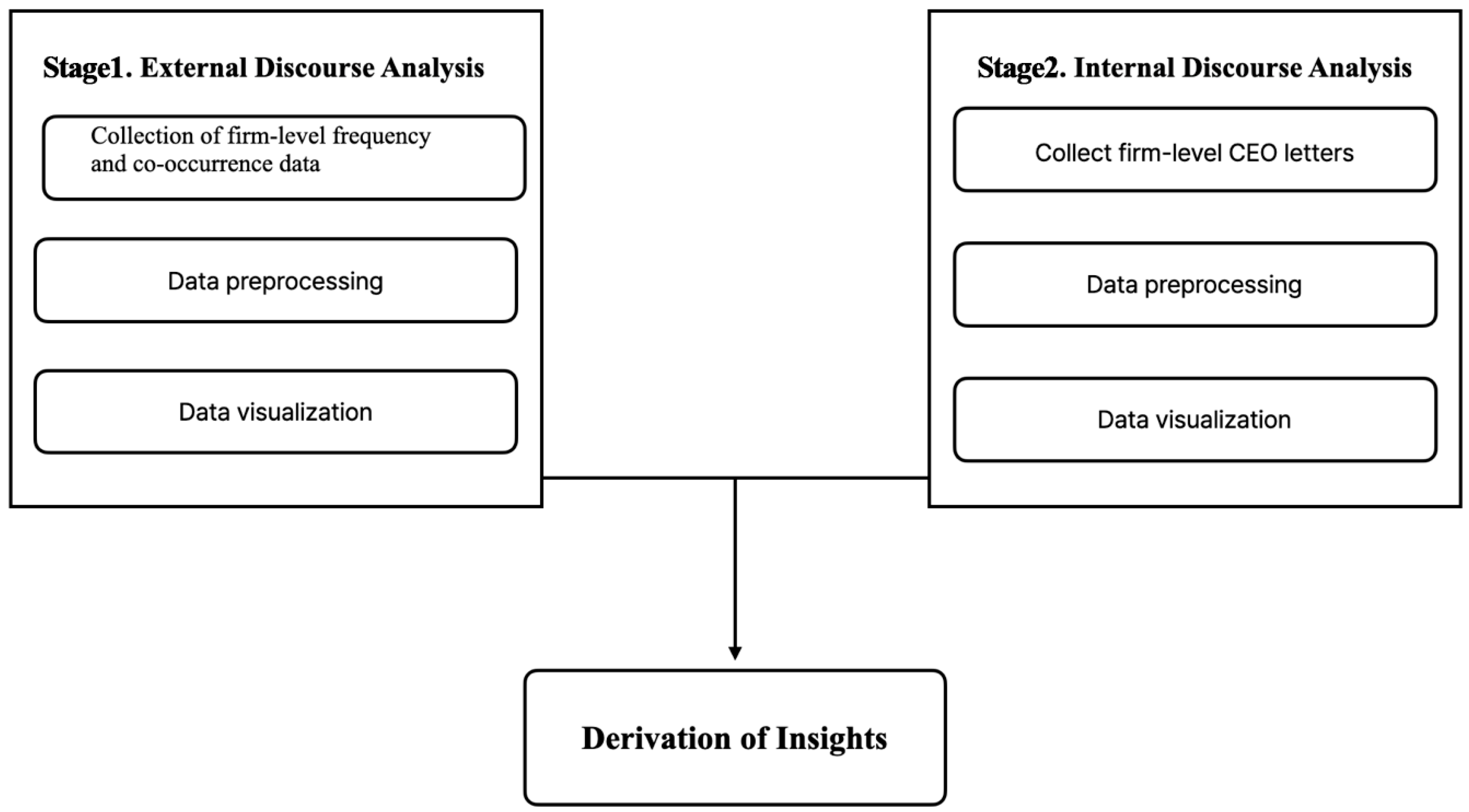
Three Korean B2B corporations were selected: POSCO (steel), LG Chem (chemicals/batteries), and HD Hyundai (heavy industry/shipbuilding). These firms are structurally exposed to U.S. trade and environmental regulations, regularly publish ESG reports, and issue annual CEO addresses, making them suitable for longitudinal discourse analysis. The three firms also represent varied ESG response patterns by sector POSCO showing the most pronounced structural shift, LG Chem a gradual supply chain-driven reconfiguration, and HD Hyundai a more gradual transition making this a purposive comparative sample designed to capture both common patterns and sectoral variations. The overall analytical procedure is summarized in Figure 1. Specific search identifiers for each firm are provided in Section 3.2.

3.2. Analytical Procedure

External discourse data were collected from Sometrend (https://some.co.kr, accessed on 10 June 2025). This AI-based Korean big data analytics platform aggregates content from multiple channels, including social media, online forums, blogs, and major news outlets.
The platform provides time-series keyword metrics, association networks, and sentiment analysis. Internal discourse data comprised 15 CEO New Year addresses (2021–2025) from POSCO, LG Chem, and HD Hyundai.
Search Query Construction
Sometrend queries combined corporate identifiers with the inclusion term “ESG”
Corporate Identifiers
  • POSCO: Primary term “포스코” (Korean, “POSCO”), Synonym “posco”
  • LG Chem: Primary term “lg화학” (Korean, “LG Chem”), Synonym “lgchem”
  • HD Hyundai: Primary term “hd현대” (Korean, “HD Hyundai”), Synonym “현대중공업” (legacy name: “Hyundai Heavy Industries”)
Query Structure (applied to all three firms)
Primary: [Corporate name in Korean] | Synonym: [English variant] | Include: esg | Exclude: none
No ticker symbols or subsidiary names were included; Sometrend’s association algorithm captured co-occurring terms automatically. According to the platform documentation, association terms are generated based on the frequency of co-occurrence within the same documents or posts.
Collection Period
  • Pre-Trump: May 2023–April 2024 (12 months)
  • Post-Trump: May 2024–April 2025 (12 months)
Keyword Dictionary and Classification
Sometrend monthly data provided the top associated keywords. Keywords were classified into four categories using a pre-defined dictionary of 147 terms: Environment (30 keywords including carbon neutrality, battery, hydrogen, GHG, and renewable energy), Social (30 keywords including labor union, safety, community, human rights, and welfare), Governance (11 keywords including board of directors, CEO, governance structure, voting rights, and risk), and Politics·Economy (76 keywords including tariff, Trump, interest rate, investment, policy, global market, and performance). LG Chem used a reduced 84-keyword dictionary (22 Environment, 16 Social, 14 Governance, 32 Politics·Economy) tailored to the battery/chemical sector. The list is given in Appendix A (Table A1 for POSCO and HD Hyundai; Table A2 for LG Chem).
Classification Logic: Keywords were matched against the dictionary using regular expressions in R (version 4.5.1). For ambiguous keywords matching multiple categories, a priority order was applied: Environment → Social → Governance → Politics–Economy. Unmatched keywords were excluded.
Data Preprocessing
Step 1: Duplicate Removal
Sometrend applied duplicate handling; near-duplicates were retained because they could reflect repeated exposure effects in the information environment.
Step 2: Retweet/Repost Exclusion
Only original posts were retained according to the platform’s classification, while news content republished across outlets was preserved.
Step 3: Language Handling
The corpus was predominantly Korean-based, upon manual inspection of randomly sampled posts, with English terms and mixed Korean–English content. Foreign terms transliterated (e.g., “Trump” → “트럼프”). A custom transliteration dictionary developed iteratively during pilot coding ensured consistency.
Final Corpus
The final corpus comprised ~348 unique keywords per firm per period (~29 keywords/month × 12 months), representing the most frequently discussed items identified by the platform.

3.3. External Discourse Analysis

External discourse reflects the discursive environment in which firms operate, including media framing, stakeholder expectations, public sentiment, and not direct corporate messages (McCombs & Shaw, 1972; DiMaggio & Powell, 1983).
Frequency Analysis
Monthly keyword frequencies were aggregated by category to calculate: (1) total frequency per category per month, (2) category percentage share, and (3) pre–post mean comparison.
Co-occurrence Network Analysis
Co-occurrence Definition: Two keywords were considered co-occurring if they appeared in the same monthly keyword list extracted by Sometrend. Because the platform output used in this study is a monthly keyword list (rather than full-text documents accessible to the researchers), co-occurrence is defined at the monthly list level.
Time-slice and Edge Weighting: The network was constructed using a monthly time-slice (12 months per period). Edge weights represent the number of months (out of 12) in which a given keyword pair appeared together within the monthly keyword lists.
Thresholding and Rationale: Only edges with weight ≥ 3 were retained. This threshold identifies keyword pairs that co-occurred in at least three months during the period, allowing the analysis to focus on relatively persistent patterns rather than on one-off monthly co-appearances. The monthly time-slice was chosen because (1) it aligns with Sometrend’s native data aggregation unit; (2) it captures discourse co-salience at the temporal scale at which political and market events typically unfold (weeks to months); and (3) it follows prior ESG discourse network studies employing comparable temporal windows (Ferjančič et al., 2024; Nielsen & Villadsen, 2023).
Network Construction: Keywords co-occurring in monthly lists formed edges, with weights representing co-occurrence frequency across 12 months. Node attributes included category assignment (Environment/Social/Governance/Politics·Economy) and degree centrality (rescaled to node size 4–10). Networks were visualized using the Kamada–Kawai layout, and degree centrality and betweenness centrality were calculated to identify hub and bridging keywords. Category centrality was calculated as the proportion of high-centrality nodes per category.
Metrics: Three metrics were calculated: (1) Degree Centrality (hub keywords), (2) Betweenness Centrality (bridge keywords), and (3) Category Centrality (proportion of high-centrality nodes per category). Transparent dummy nodes were added for Social/Governance categories when no keywords met the threshold to maintain visual comparability across periods while preventing distortion of statistical metrics; these were excluded from calculations. Korean keywords (98 major terms) were translated to English for international readability (e.g., 산업 → Industry, 탄소중립 → Carbon Neutrality, 트럼프 → Trump).

3.4. Internal Discourse Analysis

CEO New Year addresses (2021–2025) were processed with KoNLP (Okt tokenizer). Nouns were extracted, and stop words (generic terms such as “our”, “vision”, “Happy New Year”, and brand names) were removed. The top 30 keywords per year were extracted based on frequency and manually categorized into four groups: (1) ESG (eco-friendly, carbon, safety, and board of directors), (2) Policy Risks (tariff, regulation, supply chain, and policy), (3) Structural Risks (uncertainty, survival, and crisis), and (4) Affective Markers (expectation, anxiety, and challenge). This enabled comparison of internal shifts from ESG to policy–economic framing against external trends.
Five limitations are acknowledged: (1) Sometrend’s proprietary algorithms (channel classification, duplication, and bot filtering) limit reproducibility; nevertheless, the platform is widely used in academic and industry research for monitoring Korean digital discourse, and the methodological approach combining text-based time-series and network analysis follows established research traditions (Ferjančič et al., 2024; Nielsen & Villadsen, 2023); (2) single primary search terms per firm without ticker symbols or subsidiary names may incompletely capture discourse, though subsidiary mentions may be captured via co-occurrence; (3) the Korean-dominant corpus limits generalizability to English discourse, and foreign-term coverage via a custom dictionary developed during pilot coding may be incomplete; (4) external discourse represents the discursive environment rather than direct corporate messaging, and media bias or stakeholder framing may skew interpretation; (5) the priority-based classification rule (Environment > Social > Governance > Politics–Economy) may oversimplify ambiguous keywords (e.g., “hydrogen” as environmental vs. political–economic).

4. Results

4.1. Comparison of Overall ESG Discourse Between the Two Periods

In the Pre-Trump period, environment-centered ESG keywords such as climate, carbon, and renewable energy occupied core positions in both frequency distributions and co-occurrence networks, indicating that environmental themes served as central organizing frames for discourse. By contrast, in the Post-Trump period, political–economic keywords, including regulation, trade, cost, and policy, emerged as network hubs. Meanwhile, environmental keywords were repositioned to play peripheral or bridging roles rather than disappear altogether.

4.2. Firm-Level Comparisons

4.2.1. POSCO (Steel)

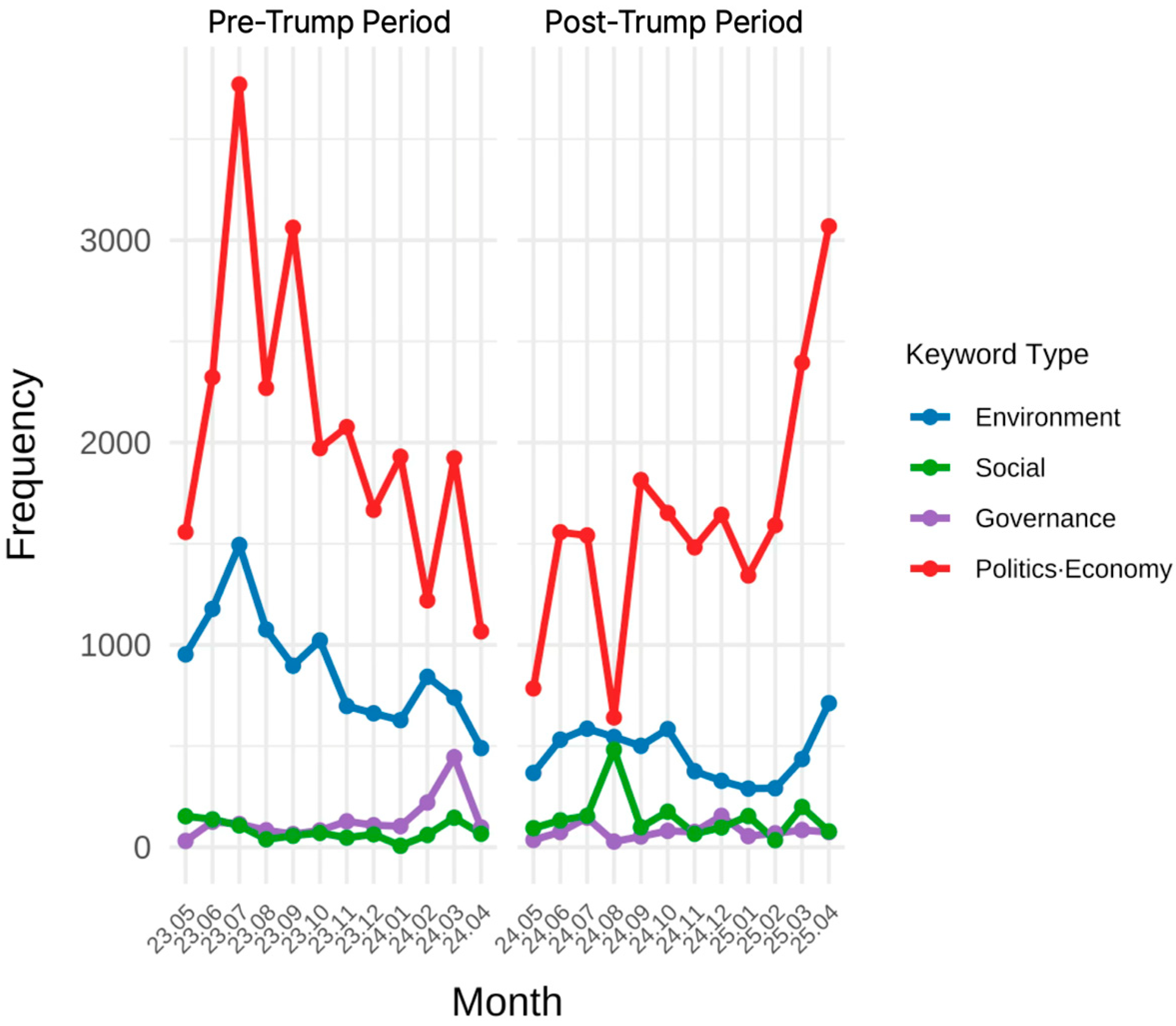
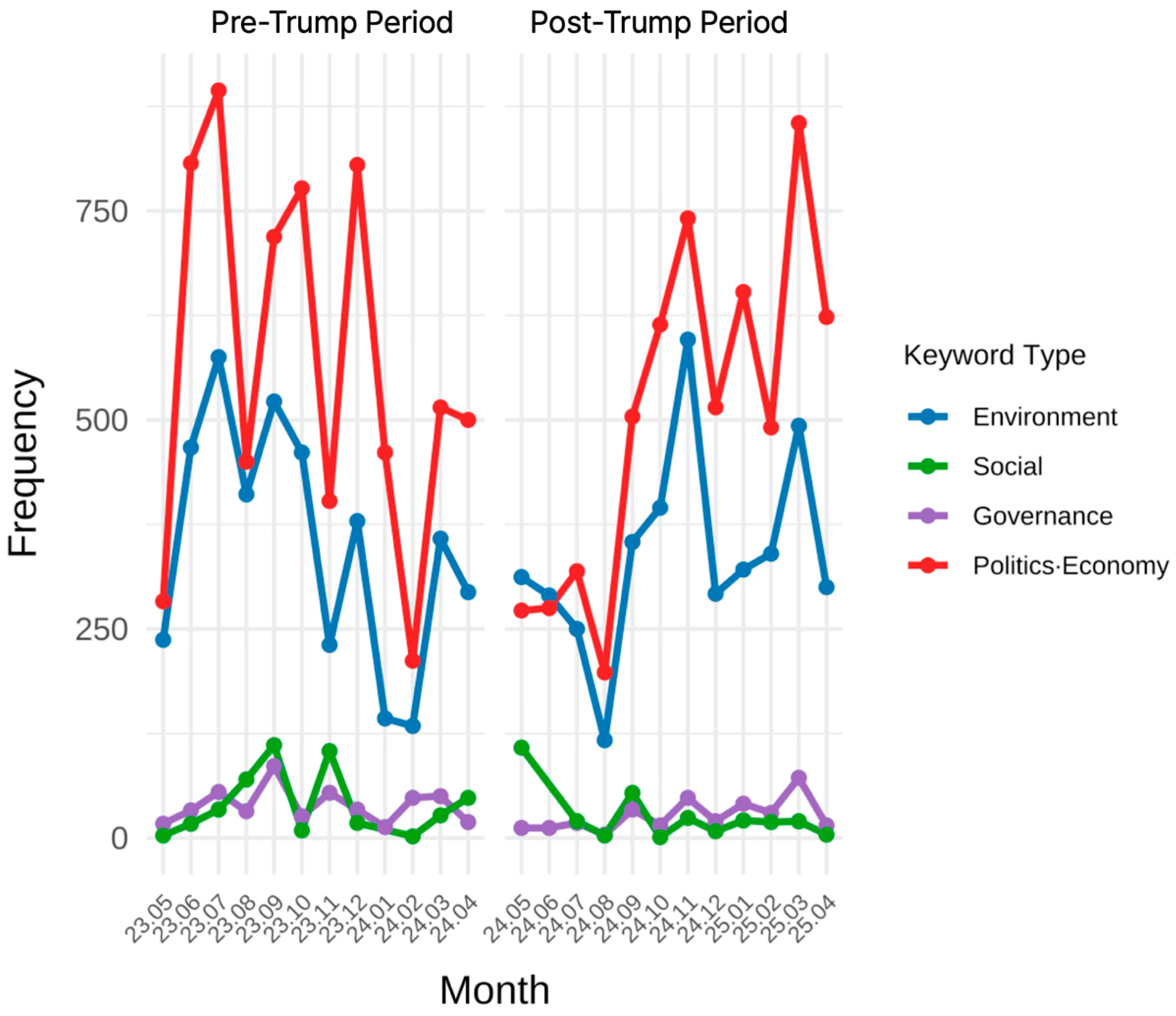
Importantly, the monthly frequency trends (Figure 2) already suggest this structural transition. Politics–Economy keywords dominate the overall volume across both periods, with pronounced fluctuations, and show a noticeable rise in the post-period. In contrast, Environment keywords remain secondary and appear relatively weaker in the post-period. In contrast, Social and Governance keywords stay consistently low and stable throughout the timeline, indicating limited month-to-month variation compared to the other two categories.
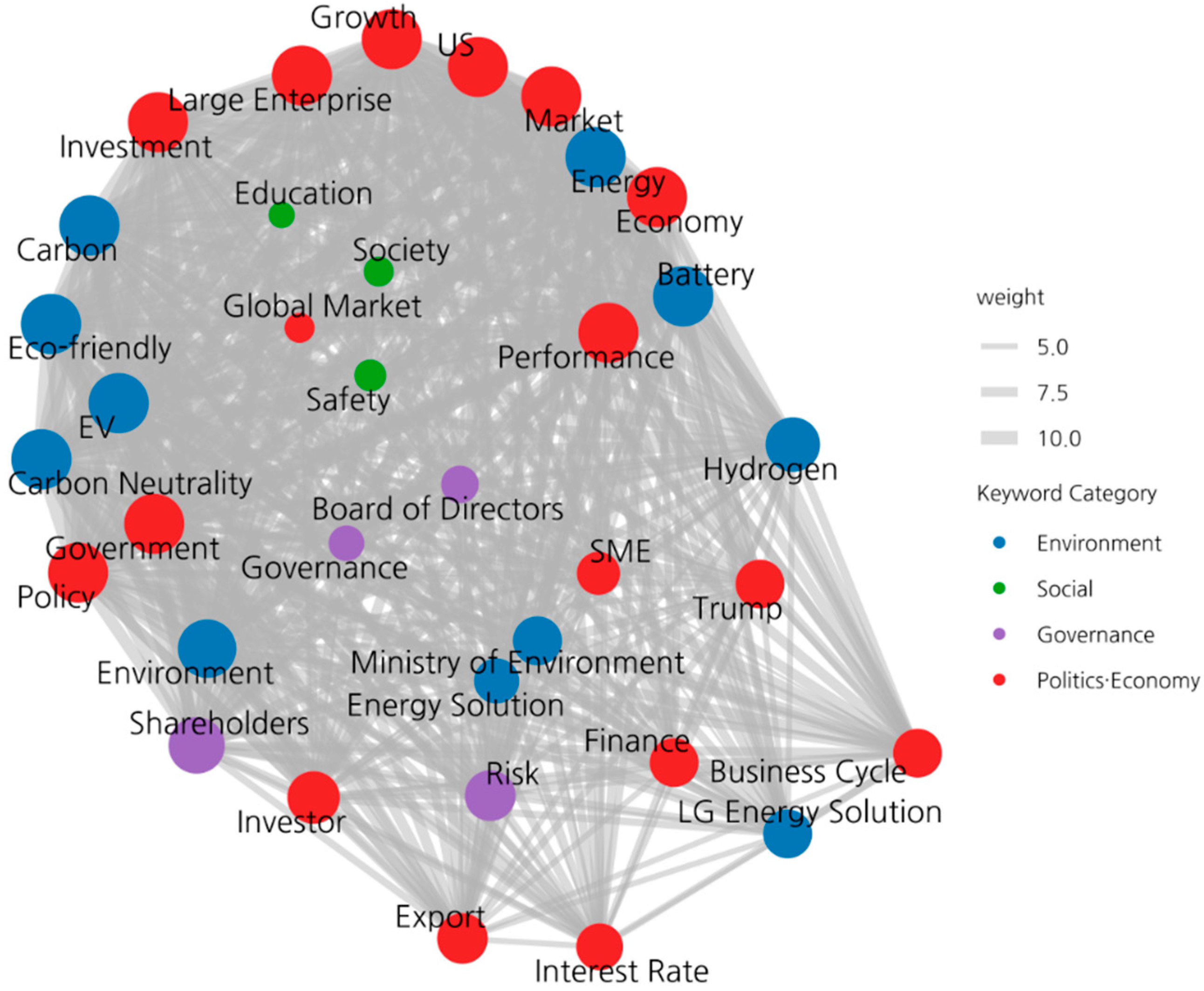
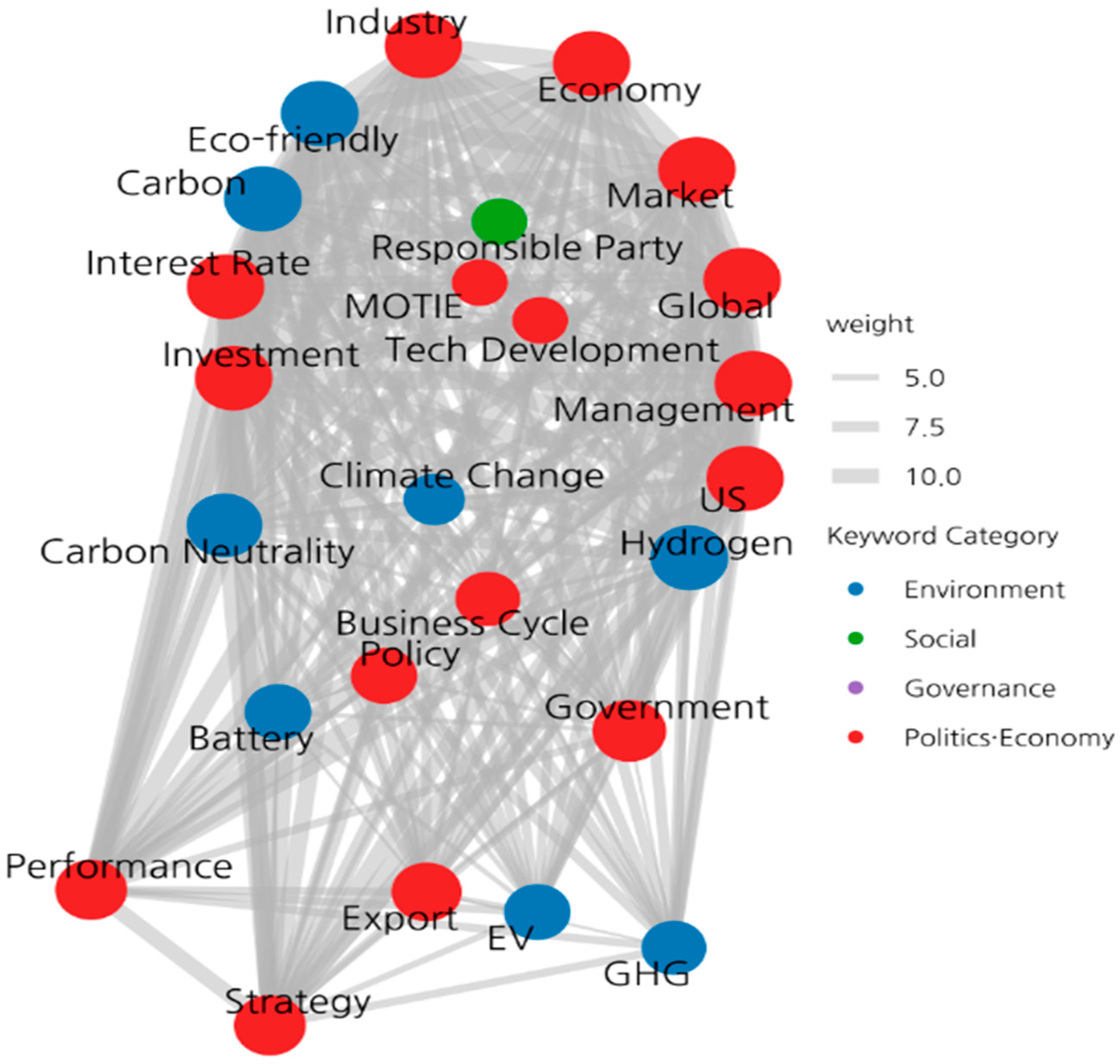
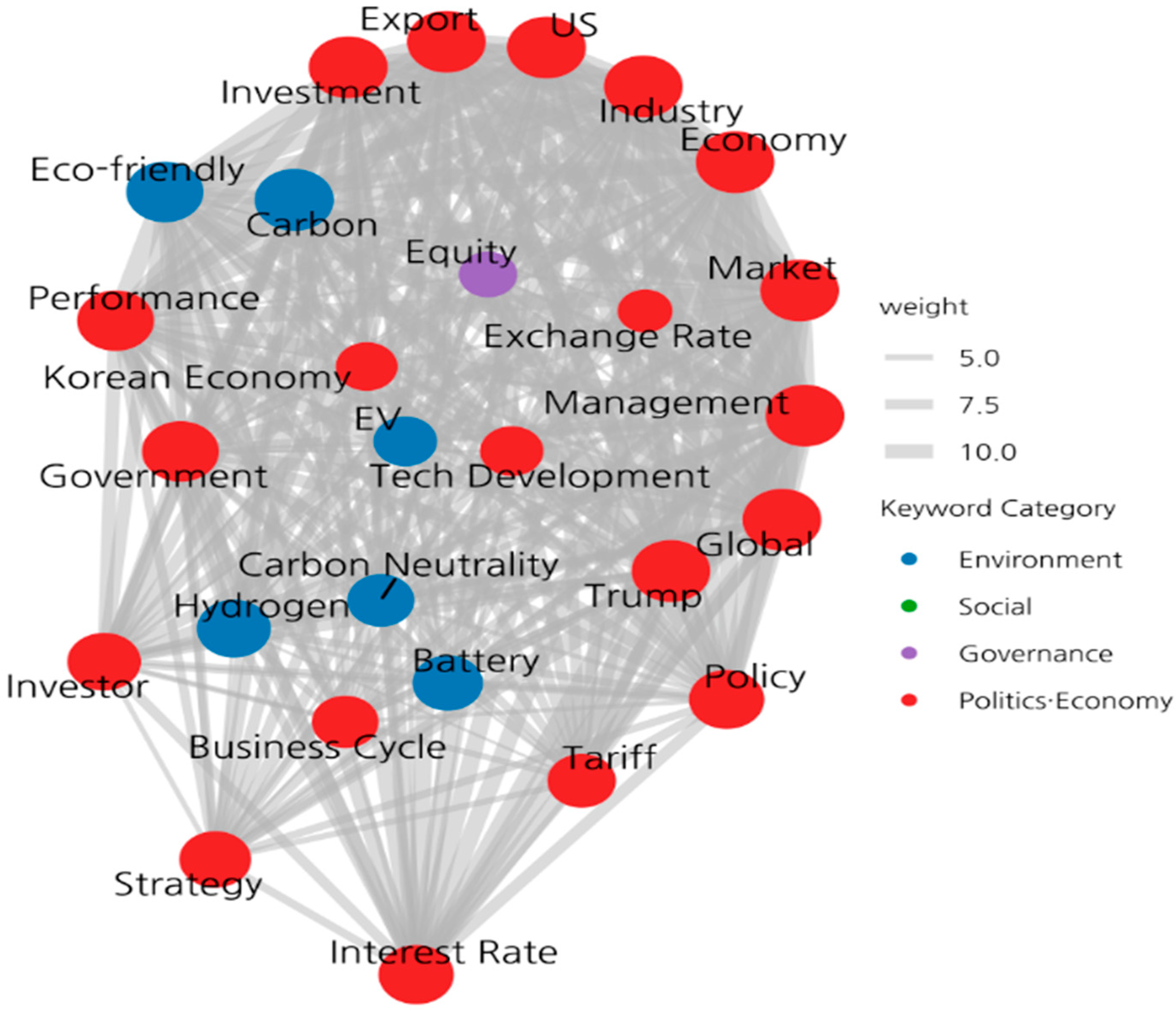
In the Pre-Trump network (Figure 3), carbon, greenhouse gases, electric vehicles, and batteries formed the most central connections, creating an environment-centered structure. By contrast, in the Post-Trump network (Figure 4), policy, interest rate, export, global, and performance emerged as core nodes. At the same time, environmental keywords such as battery, hydrogen, and carbon neutrality were repositioned as bridge nodes. Overall, the network’s core axis shifted from environment to policy–economy, consistent with the monthly frequency patterns shown in Figure 2.
Social (S) and Governance (G) keywords remained relatively low-frequency and peripheral in both periods, with occasional appearances of terms such as labor union, strike, board of directors, and risk. However, these did not exhibit centrality shifts strong enough to drive a core reconfiguration.
According to the top keywords from POSCO’s CEO New Year addresses (Table 1), the discourses in 2021–2023 were primarily characterized by values- and organization-oriented themes, including we, value, society, citizen, expansion, and strengthening. Alongside these terms, environmental-related keywords such as eco-friendly and carbon appeared consistently, although they did not dominate the overall frequency distribution. During this period, growth- and capability-related terms such as investment, research, development, and expansion were repeatedly emphasized, suggesting a discourse focused on organizational cohesion and long-term development.
In contrast, the discourse in 2024–2025 placed greater emphasis on pragmatic and operational themes. Keywords related to organizational execution and structural capacity, such as supply chain, material, infrastructure, people, and strengthening, became more prominent. At the same time, value-oriented collective terms (e.g., we) declined in relative salience. Environmental keywords, particularly eco-friendly, continued to appear in both years, indicating continuity rather than disappearance. Overall, the keyword distribution suggests a shift in emphasis from collective and developmental narratives to more concrete, execution-oriented messaging in the later period.

4.2.2. LG Chem (Chemicals)

LG Chem reflects the characteristics of the chemical industry, which is structurally exposed to supply chain risks and fluctuations in international raw material prices. In the Pre-Trump period, environment-centered ESG keywords such as climate change, carbon emission reduction, and sustainability occupied relatively central positions, and environmental terms formed tightly connected clusters within the co-occurrence network. During this phase, ESG-related language was closely linked to the industrial transition and green technologies, serving as an important organizing frame for the discourse.
In the Post-Trump period, however, a noticeable reconfiguration of discourse structure was observed. Political–economic keywords, including raw material prices, global regulation, supply chain, and trade risk, gained prominence and increasingly operated as bridging or central nodes within the network. At the same time, the relative centrality of ESG-related terms declined. Frequency analysis likewise indicated a reduction in the relative share of environmental (E) keywords, alongside a steady expansion of policy–economic categories.
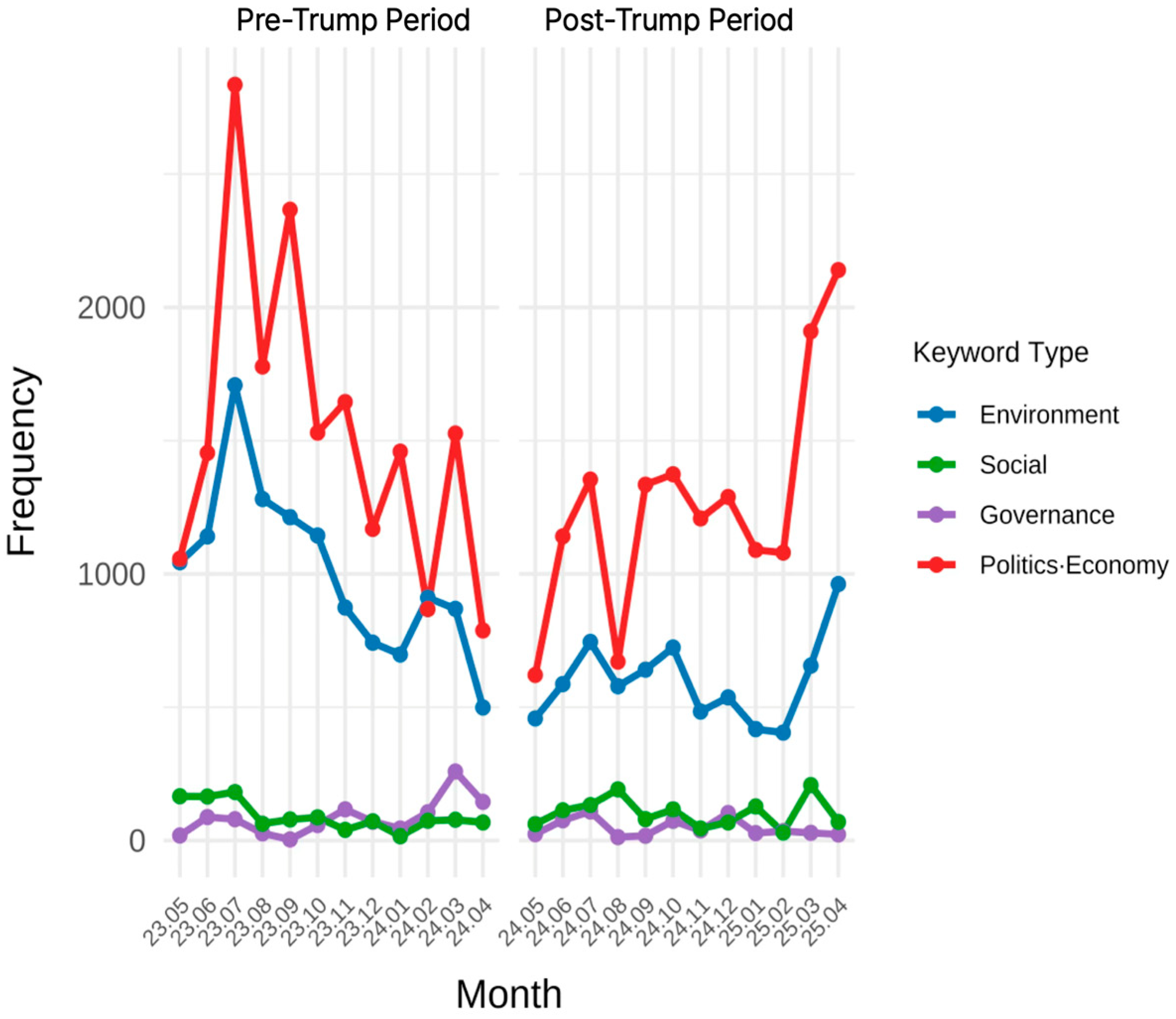
Taken together, these patterns suggest that LG Chem’s ESG discourse became increasingly articulated alongside policy–economic considerations, with environmental themes losing their previously central positioning rather than disappearing altogether. This reflects a relative shift in discursive emphasis from a predominantly normative ESG framing toward a more policy–economic and operationally oriented configuration (Figure 5).
In the early Pre-Trump period (May–July 2023), expectations for the expansion of battery materials and structural transition created a generally positive tone. However, the top associated terms consistently included financial and macroeconomic variables such as market, interest rates, investments, stock prices, and performance. From August to October 2023, supply chain strategies became more pronounced, but they also coincided with negative developments, including declining EV demand and weak performance of cathode materials.
Between November 2023 and January 2024, policy and competitive risks, including the IRA, minimum tax policies, and patent disputes, intensified, further expanding uncertainty. In February and April 2024, quarterly earnings and macroeconomic responses dominated the discourse, with some supply and production terms appearing but not structured within an ESG framework.
In the Post-Trump period, the influence of policy and trade variables became clearly more pronounced. May and July 2024 were relatively stable, but in June, tariffs and in July, the Trump election, and supply keywords emerged as leading terms, bringing political and industrial-structural risks to the forefront. In August and October 2024, expectations and concerns intersected, with the Trump keyword appearing repeatedly.
From November 2024 to January 2025, negative sentiment prevailed alongside market downturns and policy uncertainty, though a partial rebound was observed in January 2025. At the critical event of Trump’s tariff policy announcement in February 2025 (White House, 2025b), a marked spike in the frequency of policy-economic terms was observed, and during February–April 2025, tariff, Trump, market, performance, and investment consistently remained at the top.
Overall, this time-series trend confirms the ongoing transition from an environment-centered discourse toward a policy-economic-centered discourse (Figure 5).
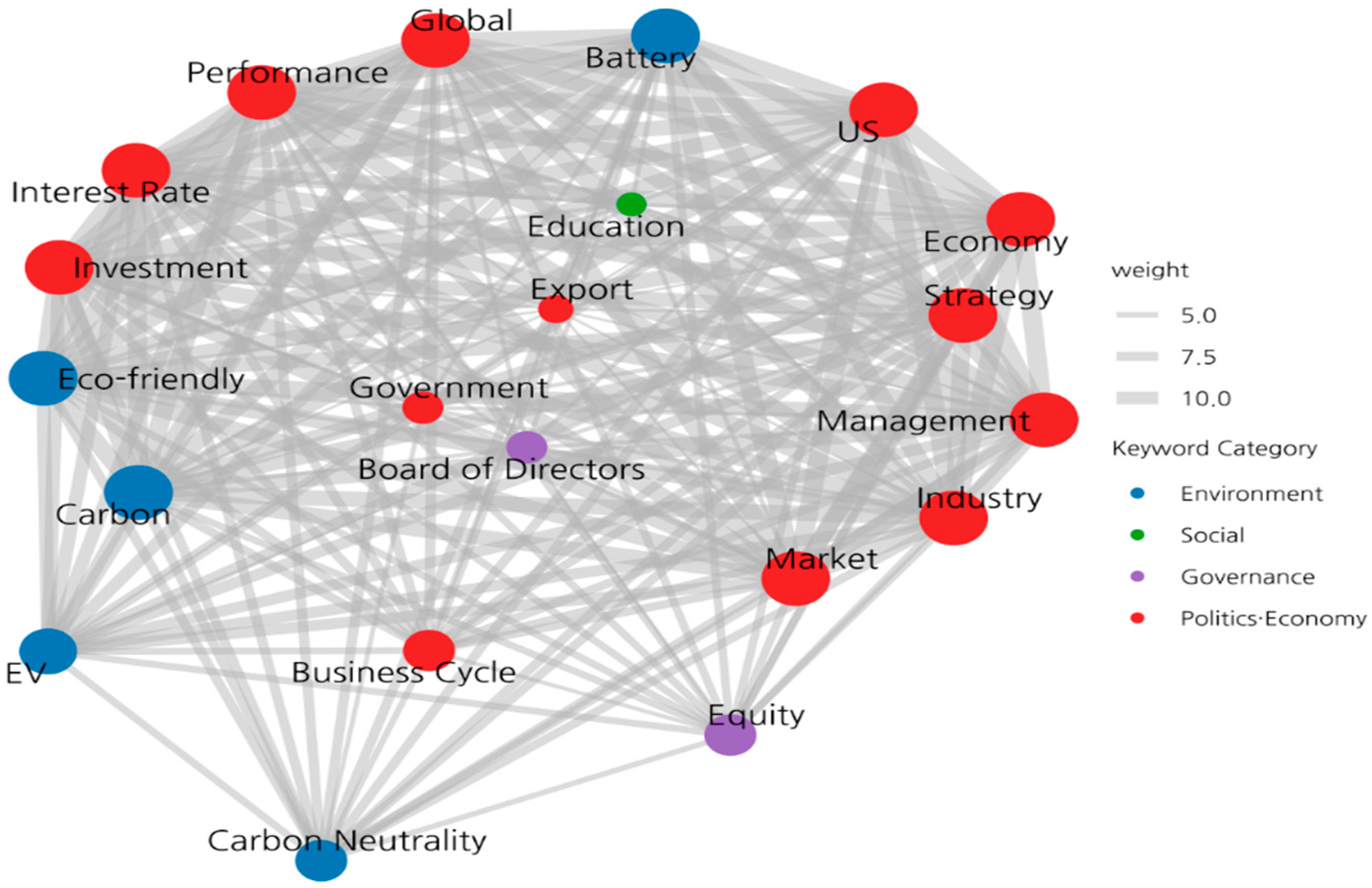
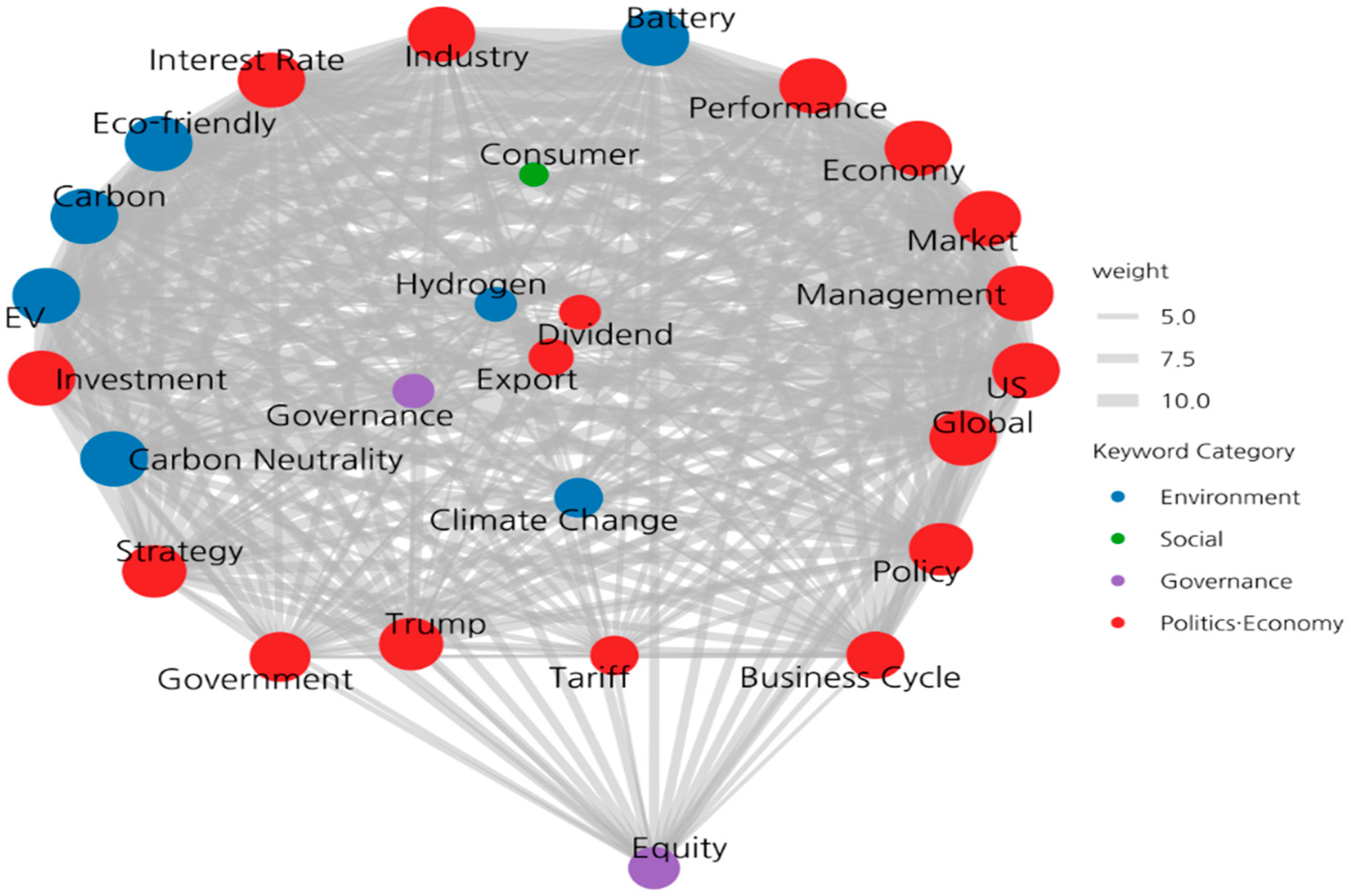
In the Pre-Trump network (Figure 6), nodes related to environment and technology, such as battery, carbon, and electric vehicle, were interlinked with terms like market, economy, and strategy. Still, the overall core was structured around the environmental axis. By contrast, in the Post-Trump network (Figure 7), nodes from the policy–economic category, such as tariff, policy, business cycle, management, global, United States, and performance, secured centrality, while environmental terms, such as battery, carbon, and eco-friendly, were repositioned as bridge nodes. Although some governance (G) keywords (e.g., equity) exhibited high connectivity, the overall frequency and direction of the category remained subordinate to the policy–economic core.
The core axis of the network thus shifted from environment to policy-economy, consistent with the monthly frequency trends presented earlier. Social (S) and Governance (G) keywords remained low-frequency and peripheral across both periods. While specific terms such as strike, responsibility, board of directors, and equity occasionally appeared, these did not generate structural changes strong enough to drive a core reconfiguration.
According to the top keywords from LG Chem’s CEO New Year addresses (Table 2), the discourse in 2021–2022 was characterized by a combination of safety-, technology-, and transition-related themes, with safety and technology appearing consistently across both years. Environmental keywords such as carbon and eco-friendly were also present, indicating continued attention to environmental considerations alongside discussions of investment and transition.
In 2023–2024, carbon and response remained recurrent keywords, while terms related to investment, supply chain, and the United States appeared more frequently. This suggests an increasing emphasis on organizational response and external operating conditions, rather than a purely values- or environment-centered narrative.
By 2025, the most frequent keywords shifted toward investment, competition, and technology, with safety and eco-friendly terms continuing to appear at lower frequencies. Overall, the keyword distribution indicates a gradual change in emphasis toward market- and strategy-oriented messaging, while environmental and safety-related themes persisted rather than disappeared.

4.2.3. HD Hyundai (Heavy Industry and Energy)

HD Hyundai is structurally exposed to energy transition and international policy risks. In the Pre-Trump period, keywords such as eco-friendly energy, technological innovation, and decarbonization functioned as representative ESG terms occupying central positions, with ESG-related categories securing both centrality and betweenness within the network. During this phase, ESG keywords were integrated into the discourse on corporate innovation and transition, resulting in a relatively positive, future-oriented framing.
In the Post-Trump period, however, political–economic keywords became increasingly prominent in both network centrality and betweenness. Terms such as international trade, policy regulation, economic risk, and cost emerged as central hubs. At the same time, ESG-related keywords exhibited reduced connectivity and were repositioned toward more peripheral or bridging roles. Frequency analysis likewise showed a decline in the relative share of ESG categories, alongside an expansion of policy–economic keywords within the discourse structure. Taken together, these patterns suggest that heightened uncertainty in the global energy market and emerging signals of protectionism were reflected in, and articulated alongside, corporate discourse through temporal correspondence rather than deterministic causation (Figure 8).
In the early Pre-Trump period (May–July 2023), expectations for a recovery in shipbuilding and an expansion of global orders created a positive tone. However, the breakdown of wage negotiations in July highlighted labor-management conflicts, introducing instability.
From August to October 2023, optimism persisted amid expectations of improved third-quarter performance and successful orders, though concerns about an economic slowdown continued. Between November 2023 and January 2024, uncertainty intensified amid external factors such as exchange rate and interest rate fluctuations and order delays, even as expectations for a strong fourth-quarter performance emerged. In February and April 2024, large-scale LNG carrier orders and positive first-quarter earnings expectations acted as upward drivers, while risk-related keywords such as stranded assets and financial market instability also emerged.
In the Post-Trump period, the influence of policy and trade variables became more pronounced. May–July 2024 was relatively stable, but in July, keywords such as Trump and election spiked sharply, bringing political risk to the forefront.
From August to October 2024, concerns about intensified competition with Chinese shipbuilders and global economic slowdown repeatedly appeared. Between November 2024 and January 2025, macro- and policy-related keywords such as tariffs, exchange rates, and interest rates consistently ranked in the top positions.
At the critical event of Trump’s tariff policy announcement in February 2025 (White House, 2025b), a distinct spike in political–economic terms was observed. This was followed in March by the full resumption of short selling, combined with concerns over reciprocal tariffs, which amplified volatility. In April 2025, external keywords such as defense industry, export, and global rose in prominence (Figure 8).
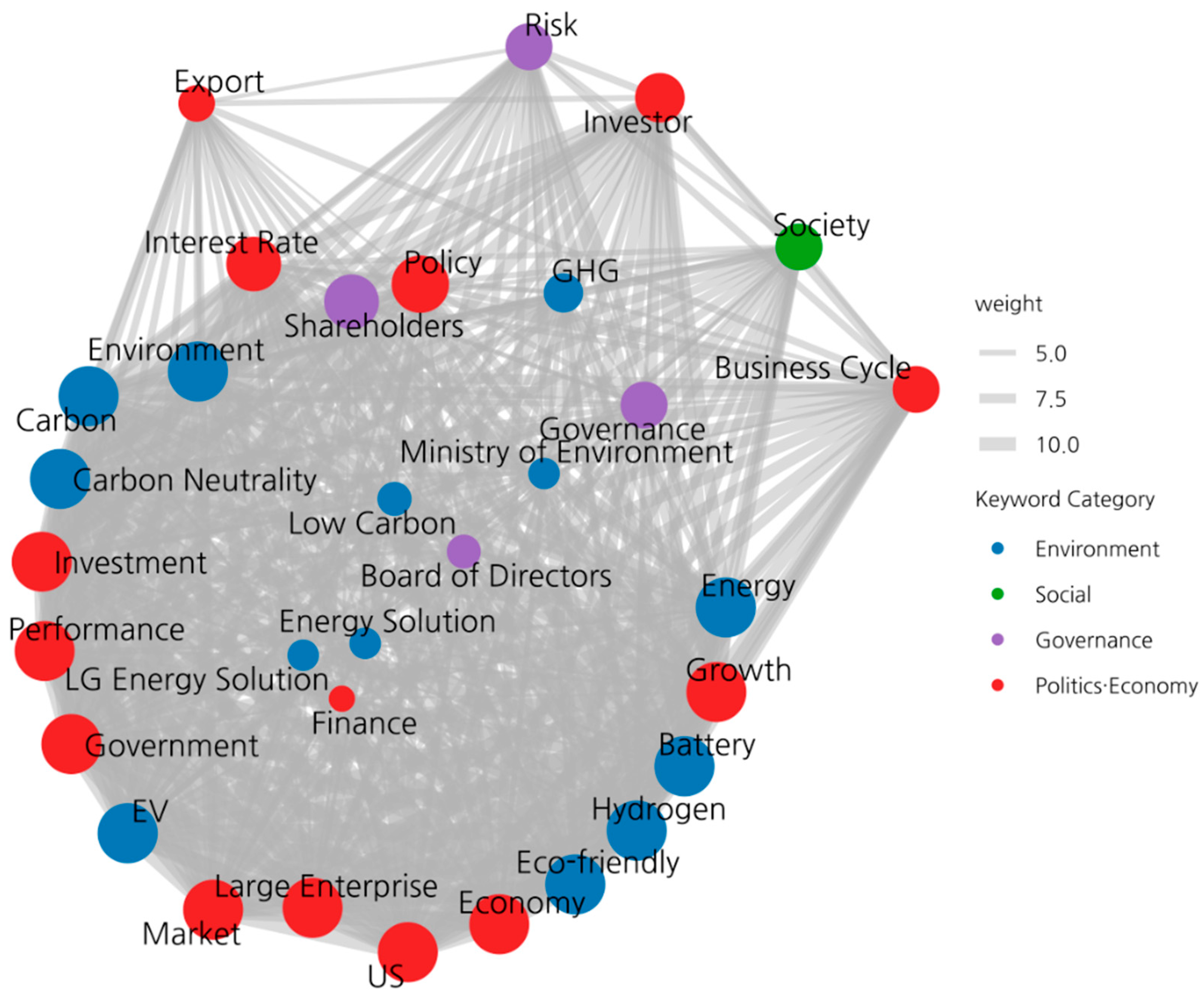
As seen in Figure 9, nodes from the environmental category, such as greenhouse gases, hydrogen, electric vehicles, and carbon neutrality, shared a core structure alongside market, business cycle, and policy, forming a mixed central configuration.
By contrast, in the Post-Trump network (Figure 10), nodes from the policy–economic category, such as tariff, policy, interest rate, business cycle, export, United States, and global, secured centrality, while environmental nodes, such as carbon, battery, and eco-friendly, were repositioned as bridges. Although some governance (G) nodes (e.g., equity) showed high connectivity, they were insufficient to drive a core reconfiguration.
The core axis of the network thus shifted from environment to policy-economy, structurally consistent with the monthly frequency trends. Social (S) keywords remained relatively low-frequency and peripheral across both periods, with occasional appearances of labor conflict, safety, and equity. Still, these did not induce structural changes strong enough to drive a reorganization of the core.
According to the top keywords from HD Hyundai’s CEO New Year addresses (Table 3), the discourse from 2021 to 2023 was primarily characterized by innovation- and industry-related terms, including technology, energy, transition, and economy.
Environmental-related keywords such as eco-friendly and carbon appeared intermittently during this period, though they did not dominate the overall distribution. In 2024–2025, keywords associated with operational risk and industrial conditions, such as safety, shipbuilding, and China, became more prominent, with safety emerging as the most frequent term in 2025. Overall, the keyword distribution suggests a shift in emphasis toward more risk-aware and execution-oriented messaging in the later period.

5. Discussion

5.1. Interpreting Discourse Shifts: Temporal Alignment vs. Causal Attribution

A central interpretive question is whether the observed discourse shifts represent responses to Trump-specific policies or to broader structural forces. Our findings decisively support the latter interpretation, based on three lines of evidence.
First, temporal patterns indicate pre-existing sensitivity to macroeconomic risks. Discourse shifts began during the Pre-Trump period, with pronounced spikes in policy-economic keywords coinciding with financial volatility in 2023 (Figure 2, Figure 5 and Figure 8) and global supply chain disruptions. Abdullah et al. (2024) found that geopolitical risk generally weakens firm-level ESG performance, with effects varying by national context. Erzurumlu et al. (2025) demonstrated that while higher risk levels expand overall ESG engagement, environmental (E) performance typically declines under geopolitical stress, whereas social (S) and governance (G) aspects frequently remain stable or enhance. Our finding that E keywords declined in network centrality while S/G remained peripheral aligns with this cross-national evidence.
Second, firm-level variations reflect industry-specific exposure rather than uniform political reactions. POSCO’s pronounced structural shift corresponds to direct regulatory exposure in steel production and carbon-intensive operations (Tang et al., 2024). LG Chem’s gradual transition reflects supply chain reconfiguration pressures documented by Bown (2024), as IRA domestic-content requirements forced battery manufacturers to restructure North American investments. HD Hyundai’s shift toward risk- and operation-oriented keywords mirrors concerns about tariffs and export restrictions. Yang et al. (2024) found that Chinese manufacturing firms’ ESG performance improves through green technological innovation under market-based environmental regulations, but such improvements depend critically on sector-specific innovation capacity.
Third, the persistence of environmental keywords in bridging roles—rather than their complete disappearance—indicates strategic repositioning. Arvidsson and Sabelfeld (2023) documented how Swedish CEO sustainability communication exhibits “adaptive framing” in response to socio-political events, maintaining substantive environmental content while adjusting rhetorical emphasis. Nielsen and Villadsen (2023) similarly found that Danish firms’ ESG vocabulary shifts “tactically” over time, with policy- and economy-related expressions gaining prominence in heavily regulated sectors. Our network analysis (Figure 3, Figure 4, Figure 6, Figure 7, Figure 9 and Figure 10) shows environmental nodes transitioning from core to bridge positions—connecting policy–economic clusters with residual environmental themes—consistent with adaptive framing rather than abandonment.
Thus, Trump’s election functions as a crystallization point that amplified pre-existing trends rather than initiating them. Harmes (2025) characterizes the anti-ESG backlash as reflecting deeper tensions within “asset manager capitalism,” in which large institutional investors face conflicting pressures. Shanor and Light (2023) describe anti-ESG legislation as part of broader “anti-woke capitalism” campaigns. In this context, Korean firms’ discourse adjustments represent rational anticipatory responses to systemic regulatory fragmentation, not reactive compliance with Trump’s rhetoric. This distinction is critical: firms are not abandoning ESG but recalibrating discursive emphasis to navigate contested legitimacy across jurisdictions. Park et al. (2022) argue that ESG has evolved from representing the “good company” toward signifying the “company strong in crisis,” particularly following COVID-19’s demonstration that higher ESG ratings mitigate financial volatility. The transition from environmental-to-policy–economic discourse we observe reflects this broader evolution: Korean B2B firms are reframing ESG from normative commitments to operational resilience and regulatory risk management.

5.2. The Peripheral Status of Social (S) and Governance (G) Discourse

The finding that social and governance keywords remained consistently peripheral across both periods (constituting only 3–7% of total keyword mentions, as shown in Figure 2, Figure 5 and Figure 8) challenges theoretical expectations. Erzurumlu et al. (2025) found that while geopolitical risk weakens environmental (E) performance across 37 countries, social (S) and governance (G) dimensions typically remain stable or improve as firms adopt short-term adaptive tactics. Our discourse analysis partially supports this pattern: E keywords declined in centrality, yet S/G did not rise in centrality or even maintain visibility. We propose three non-exclusive explanations.
First, institutionalized “table stakes”: For capital-intensive B2B firms in heavily regulated sectors, social and governance standards may be sufficiently institutionalized that they no longer require discursive justification. MacNeil and Esser (2022) argue that the transition from CSR to ESG reinforced a financialization model prioritizing investor risk-return perspectives, which systematically emphasizes quantifiable environmental metrics (carbon emissions, energy efficiency) over less tangible S/G dimensions. Yoon et al. (2023), analyzing Korean ESG reports, found that governance keywords formed distinct clusters in dedicated standardized sections rather than integrated strategic narratives, suggesting S/G have become minimum standards assumed by stakeholders rather than differentiated competitive signals.
Second, differential sensitivity to U.S. political shocks: Unlike environmental commitments, which face direct federal and state-level rollback (as documented by Strine, 2025; Risteski, 2024), social and governance practices are more insulated. Corporate opposition to the SEC’s climate disclosure rules was concentrated among high-emissions firms (Lashitew & Mu, 2024), whereas governance regulations faced less politicized contestation. Tang et al. (2024) found that anti-ESG regulations in 18 states (2021–2023) primarily restricted fossil fuel divestment and climate-based investment screening, not labor practices or board composition. For Korean B2B firms, E discourse became politically contested in ways that S/G did not.
Third, audience segmentation and channel differentiation: Social and governance issues may be communicated through specialized channels not captured by our social media and news dataset. Ferjančič et al. (2024) found significant misalignment between sustainability report topics and external ESG scores, with extensive disclosure on traditional governance topics negatively correlated with ESG ratings. This suggests that high-volume reporting may even be penalized as a legitimacy tool masking poor substantive practice. If Korean B2B firms adopt a segmented communication strategy (addressing institutional investors through formal reports while using public discourse primarily for market-facing narratives), our methodology would systematically under-represent S/G dimensions. This pattern may also reflect a broader dynamic identified by Weder and Stranzl (2025), who argue that sustainability communication becomes instrumental when it focuses on external reporting and reputation management rather than cultivating internal ‘conversational spaces’ where organizational members can question and debate sustainability principles. Without such agonistic internal discourse, sustainability topics risk remaining ‘master narratives’ detached from organizational action, communicated primarily to satisfy regulatory compliance rather than driving transformative practice. This depoliticization dynamic may particularly affect S/G dimensions, which lack the urgent external political contestation that environmental issues currently face.
These three explanations are not mutually exclusive. Korean B2B firms likely experience S/G peripheralization through multiple mechanisms: financial materiality frameworks deprioritize non-quantifiable metrics; U.S. political backlash targets environmental issues more than governance; and specialized regulatory channels absorb S/G communication. This finding extends Erzurumlu et al.’s (2025) cross-national evidence in an important way: while geopolitical risk maintains or improves S/G performance in some national contexts, it does not necessarily elevate S/G discourse salience in Korean B2B public communication. The divergence between performance (what firms do) and discourse (what firms say publicly) suggests strategic decoupling. Firms maintain substantive S/G practices to satisfy regulators while emphasizing policy–economic resilience in public communication. Importantly, this result differs from both Erzurumlu et al.’s (2025) finding of performance stability and P4’s prediction that S/G keywords would increase Post-Trump, indicating that discourse adaptation follows a selective rather than comprehensive ESG reframing logic.

5.3. Theoretical Implications: Strategic Reframing or Discursive Dilution?

The observed transition from environmental-centered to policy–economic-centered ESG discourse raises a fundamental theoretical question: does this shift represent strategic reframing that enhances corporate resilience, or discursive dilution that undermines ESG’s normative purpose? Beyond adjudicating between these interpretations, this study contributes to ESG theory in three ways.
First, it empirically demonstrates that ESG discourse functions as a strategically adaptive communicative resource rather than a fixed normative language. The observed environmental-to-policy–economic transition extends Park et al.’s (2022) finding that ESG evolved from “good company” ethics toward “company strong in crisis” resilience. This challenge static conceptions of ESG institutionalization, showing that discourse reconfigures rapidly in response to geopolitical uncertainty even in state-coordinated ESG regimes like Korea’s.
Second, the study reveals a critical divergence between ESG discourse and performance dimensions. While Erzurumlu et al. (2025) found that geopolitical risk weakens environmental (E) performance but maintains or strengthens social (S) and governance (G) dimensions across 37 countries, our discourse analysis shows that S/G keywords remained peripheral in the public communication of Korean B2B firms despite theoretical expectations.
This suggests strategic decoupling: firms may maintain substantive S/G practices to satisfy regulators while emphasizing policy–economic resilience in external discourse to address stakeholder uncertainty. Future research should empirically test whether discourse patterns correlate with operational ESG metrics (Scope 1/2/3 emissions, worker safety, board independence) or are merely rhetorical adaptations.
Third, the findings validate text-mining methodologies for tracking real-time discourse shifts in contested institutional environments. Keyword frequency and co-occurrence network analysis effectively captured structural transitions that traditional content analysis might overlook. The temporal alignment between external discourse (social media, news) and internal discourse (CEO addresses) offers methodological validation for using public data sources to proxy broader stakeholder environments, particularly in contexts where formal ESG reports lag behind rapidly evolving political signals.

5.4. Generalizability and Boundary Conditions

Three structural boundary conditions constrain generalizability. First, industry-specific exposure varies substantially. Our sample comprises heavy manufacturing B2B firms facing direct exposure to trade policy, carbon border mechanisms, and supply chain reconfiguration. Erzurumlu et al. (2025) found that geopolitical risk systematically reduces environmental performance, strongest in the energy and materials sectors. Ferjančič et al. (2024) documented that climate-risk topics correlate positively with ESG scores in industrials, while governance disclosure correlates negatively. Service-oriented firms (finance, retail, and platforms) may prioritize social and governance dimensions differently, as stakeholder pressures stem from consumer sentiment rather than supply chain compliance (Yoon et al., 2023). The pronounced environmental-to-policy–economic shift may be specific to trade-exposed heavy manufacturing.
Second, national institutional context and regulatory regimes mediate discourse strategies. Korea’s export-oriented economy and high dependence on the U.S. market amplify sensitivity to U.S. policy signals (Bown, 2024; Tang et al., 2024). Erzurumlu et al. (2025) showed that firms in developing economies respond more strongly to geopolitical risk, whereas firms in developed markets respond more strongly to domestic political risk. European firms, subject to EU Taxonomy and CSRD mandates, face binding disclosure obligations reducing strategic discretion (Ferjančič et al., 2024). Yoon et al. (2023) found that Korean firms emphasize domestic partnerships over global SDG 17, reflecting localized sustainability framing. The timing of the Trump election functions as a crystallization point within Korea’s institutional structure; cross-national replication requires accounting for regulatory and political economy variations.
Third, supply chain position differentiates strategic priorities. Primary suppliers such as POSCO, LG Chem, and HD Hyundai are subject to direct regulatory scrutiny and contractual ESG requirements from OEM buyers seeking to green their value chains (Bown, 2024). Conversely, final-goods brands prioritize visible S/G commitments as brand-differentiation tools (Yoon et al., 2023; Ferjančič et al., 2024), where reputational risk may drive discourse independently of policy cycles. Our findings illuminate that anticipatory policy-risk mitigation by primary suppliers is a mechanism that may not generalize to downstream or brand-oriented firms.

6. Conclusions

6.1. Summary of Findings

This study examined how ESG discourse among three major Korean B2B corporations (POSCO, LG Chem, and HD Hyundai) shifted during the 2024 U.S. presidential election cycle, comparing two twelve-month periods (Pre-Trump: May 2023 to April 2024; Post-Trump: May 2024 to April 2025). Using keyword frequency analysis and co-occurrence network analysis of external discourse (social media, news, and blogs via the Sometrend platform) and internal discourse (CEO New Year addresses from 2021 to 2025), we tested four hypotheses and documented five main findings.
P1 was supported. POSCO and LG Chem exhibited pronounced structural transitions, while HD Hyundai demonstrated a more gradual trajectory within the same directional shift. P2 was strongly supported across all three firms. P3 was consistently supported, with environmental nodes transitioning from core to bridge positions (Figure 3, Figure 4, Figure 6, Figure 7, Figure 9 and Figure 10). P4 was not supported; S/G keywords remained peripheral (3–7% of mentions) across both periods. This contrasts with Erzurumlu et al.’s (2025) cross-national finding that geopolitical risk maintains or improves S/G performance dimensions, suggesting that discourse adaptation may diverge from operational ESG practices. The five empirical findings are as follows.
First, environmental (E) keywords declined in relative share and network centrality in the Post-Trump period, while policy–economic keywords increased. In the Pre-Trump period, carbon, carbon neutrality, electric vehicles, and batteries constituted network cores; in the Post-Trump period, tariffs, policies, interest rates, exports, and performance occupied central positions. Environmental keywords were repositioned as peripheral or bridging nodes rather than disappearing, indicating structural reconfiguration.
Second, the Social (S) and Governance (G) keywords remained peripheral across both periods, accounting for only 3–7% of total mentions. Although terms like labor conflict, safety, board of directors, and equity appeared sporadically, they did not drive structural transitions. This challenges theoretical predictions (Erzurumlu et al., 2025) that geopolitical risk would strengthen S/G dimensions.
Third, temporal correspondence with major external events was observed. In June 2023, macro-financial keywords spiked across all firms; following the February 2025 tariff announcement, policy–economic keywords increased sharply, suggesting discourse shifts coincide with political and market events rather than represent deterministic causality.
Fourth, firm-level differences reflected industry characteristics. POSCO exhibited the most pronounced transition from an environment-centered to a policy–economic core. LG Chem showed a relative weakening of environment-centered ESG language, with battery supply chain discourse increasingly articulated alongside policy–economic terms. HD Hyundai retained environmental exposure during the Pre-Trump period but shifted toward a policy- and trade-risk-centered approach in the Post-Trump period.
Fifth, cross-validation with the CEO New Year addresses confirmed directionally consistent patterns. In 2021–2023, technology, transition, and energy appeared frequently; in 2024–2025, supply chain, safety, and labor became more prominent, reinforcing the shift toward risk-aware, operationally oriented messaging observed in external discourse.
These discourse shifts should not be interpreted as permanent structural realignments. The observed reframing is better understood as contingent adaptation to a specific geopolitical conjuncture. Whether the policy–economic emphasis persists beyond the current U.S. administration depends on whether anti-ESG legislative momentum continues. The Korean firms examined here operate within a state-coordinated ESG infrastructure (K-ESG Guidelines, K-Taxonomy) that remains institutionally stable regardless of U.S. political cycles; accordingly, a partial reversion toward environmental and normative ESG framing is plausible if U.S. policy signals stabilize or if domestic regulatory enforcement intensifies. Future research should therefore track whether the discourse patterns documented here represent a durable strategic repositioning or a temporary adjustment that recedes as the geopolitical context shifts.

6.2. Practical Implications

The findings offer actionable implications for three stakeholder groups. For corporate communication managers, the study highlights that ESG discourse serves as a risk signal under political uncertainty. The shift toward policy–economic framing may constitute a legitimate adaptation to regulatory fragmentation (Harmes, 2025; Shanor & Light, 2023), but firms must balance adaptive rhetoric with substantive performance accountability to avoid perceptions of greenwashing.
Communication strategies should differentiate by audience: technical ESG metrics for institutional investors (via formal sustainability reports), policy-risk narratives for public stakeholders (via media engagement), and operational resilience messaging for supply chain partners. For policymakers, the findings underscore tensions between domestic ESG institutionalization (K-ESG Guidelines, K-Taxonomy) and geopolitical pressures from key export markets. Korea’s state-coordinated ESG framework emphasizes standardized disclosure and regulatory compliance, yet firms operating in fragmented international environments face contradictory legitimacy demands pro-ESG mandates in the EU (CSRD) versus anti-ESG legislation in U.S. states. Policymakers should consider adaptive regulatory frameworks that acknowledge firms’ need for strategic communication flexibility while maintaining substantive performance requirements and accountability mechanisms.
For investors and ESG rating agencies, the study demonstrates that discourse analysis can serve as an early-warning system for strategic repositioning. Monitoring keyword centrality shifts and network reconfiguration may reveal firms’ anticipatory adaptation to regulatory uncertainty before formal ESG ratings reflect operational changes. Analysts should triangulate public discourse, formal sustainability reports, and operational metrics (emissions data, safety records, board composition) to assess whether firms engage in strategic reframing that maintains substantive commitments or rhetorical decoupling that undermines ESG integrity. Executives should anticipate continued politicization of ESG in key export markets, requiring scenario planning for discourse adaptation under divergent regulatory regimes.

6.3. Limitations and Future Research

This study has six methodological limitations. First, Sometrend’s proprietary algorithms for channel classification, duplicate removal, and bot filtering limit reproducibility. Second, single primary search terms per firm (without ticker symbols or subsidiary names) may not fully capture the breadth of discourse. Third, the Korean-language focus limits generalizability to English-language ESG communication. Fourth, external discourse analysis represents media framing and stakeholder environments rather than direct corporate messaging, potentially introducing bias. Fifth, priority-based keyword classification (Environment > Social > Governance > Politics–Economy) may oversimplify ambiguous terms. Sixth, the internal discourse analysis relies on a limited corpus of 15 CEO New Year addresses (2021–2025, five per firm), which may not fully capture rapid environmental changes, granular strategic shifts, or the full range of executive communication. Future research should triangulate findings using alternative platforms, multilingual datasets, and internal corporate communications to address these constraints.
Four research directions merit attention. First, linking discourse patterns to hard ESG performance metrics (Scope 1/2/3 emissions, worker safety incidents, board independence scores) would empirically test whether observed shifts correspond to operational changes or represent rhetorical decoupling. Second, comparative analysis across regulatory regimes (Korea’s K-ESG vs. EU CSRD mandates vs. U.S. state-level frameworks) would illuminate how institutional context shapes discourse adaptation strategies. Third, extending the analytical framework to service sectors and consumer-facing firms would test generalizability beyond trade-exposed B2B manufacturing. Fourth, longitudinal tracking beyond the Trump administration would assess whether discourse recalibrates under alternative political contexts or represents durable structural adaptation to regulatory fragmentation and geopolitical risk.

Author Contributions

Conceptualization, Y.P. and S.L.; methodology, Y.P. and S.L.; software, Y.P.; validation, Y.P. and S.L.; formal analysis, Y.P.; investigation, Y.P.; resources, Y.P. and S.L.; data curation, Y.P.; writing—original draft preparation, Y.P. and S.L.; writing—review and editing, Y.P. and S.L.; visualization, Y.P.; supervision, S.L.; project administration, S.L.; funding acquisition, S.L. All authors have read and agreed to the published version of the manuscript.

Funding

This work was supported by the 2025 Research Fund of the University of Seoul grant number [202504051001].

Institutional Review Board Statement

Not applicable.

Informed Consent Statement

Not applicable.

Data Availability Statement

The data used in this study are not publicly available due to platform access restrictions and copyright limitations, but are available from the corresponding author upon reasonable request.

Conflicts of Interest

The authors declare no conflicts of interest.

Appendix A. Keyword Classification Dictionary

This appendix presents the pre-defined keyword dictionaries used to classify the Sometrend-extracted terms into four categories: Environment (E), Social (S), Governance (G), and Politics·Economy (P). Two versions were used: a full 147-term dictionary for POSCO and HD Hyundai, and a reduced 84-term dictionary tailored to the battery/chemical sector for LG Chem.
Table A1. Full dictionary for POSCO and HD Hyundai (147 keywords).
Environment Keywords (n = 30):
climate change (기후변화), climate crisis (기후위기), battery (배터리), battery pack (배터리팩), hydrogen (수소), hydrogen energy (수소에너지), hydrogen fuel cell (수소연료전지), renewable energy (신재생에너지, 재생에너지), energy efficiency (에너지효율), greenhouse gas (온실가스), GHG reduction (온실가스감축), low-carbon (저탄소), electric vehicle (전기차), eco-friendly (친환경), green energy (친환경에너지), eco-friendly vehicle (친환경차), carbon (탄소), carbon reduction (탄소감축), carbon border (탄소국경), carbon emission (탄소배출), carbon credit (탄소배출권), carbon emissions volume (탄소배출량), carbon neutrality (탄소중립), carbon neutrality realization (탄소중립실현), wind power (풍력), offshore wind (해상풍력)
Social Keywords (n = 30):
Ministry of Employment and Labor (고용노동부), labor (노동), labor ministry (노동부), worker (노동자), labor union (노동조합), education (교육), trainee (교육생), education center (교육센터), donation (기부), donation fund (기부금), talent donation (재능기부), culture (문화), corporate culture (기업문화), welfare (복지), welfare center (복지관), welfare facility (복지시설), volunteer (봉사), volunteer activity (봉사활동), volunteering (자원봉사), social welfare organization (사회복지법인), social responsibility (사회적책임), consumer (소비자), safety (안전), Korea Occupational Safety and Health Agency (안전보건공단), safety performance (안전성), human rights (인권), local community (지역사회), sense of responsibility (책임감), responsible management (책임경영), person in charge (책임자)
Governance Keywords (n = 11):
CEO, chief executive officer (대표이사), leadership (리더십), audit (사외), voting rights (의결권), director (이사), chairman (이사장), foundation chairman (재단이사장), board of directors (이사회), governance structure (지배구조), stake/equity (지분)
Politics·Economy Keywords (n = 76):
AI, OpenAI (오픈AI), ESG management (ESG경영), sustainable management (지속가능경영), win-win management (상생경영), FOMC, FOMC meeting (FOMC회의), economy/business cycle (경기), high interest rate (고금리), management (경영), management rights (경영권), manager (경영자), business administration department (경영학과), management innovation (경영혁신), economy (경제), economic policy (경제정책), economic cooperation (경제협력), economic growth rate (경제성장률), tariff (관세), global, global standard (글로벌스탠다드), global market (글로벌시장), interest rate (금리), interest rate preferential (금리우대), interest rate cut (금리인하), technology development (기술개발), new technology (신기술), Trump (트럼프), United States (미국), shared growth (동반성장), Fair Trade Commission (동반성장위, 동반성장위원회), Maeil Business Newspaper (매일경제), Korea Economic Daily (한국경제), Korea Enterprises Federation (한국경제인협회), bio industry (바이오산업), defense industry (방위산업), high-tech industry (첨단산업), industry (산업), Ministry of Trade Industry and Energy (산업부, 산업통상자원부), industrial use (산업용), industrial transformation (산업전환), dividend (배당), trade protectionism (보호무역, 보호무역주의), facility investment (설비투자), export (수출), Korea Eximbank (수출입은행, 한국수출입은행), market (시장), market share (시장점유율), performance/earnings (실적), Aekyung Industry (애경산업), Korea Institute of Energy Technology (에너지기술연구원, 한국에너지기술연구원), Korea Environmental Industry & Technology Institute (한국환경산업기술원), securities market (유가증권시장), capital market (자본시장), general investor (일반투자자), institutional investor (기관투자자), investment (투자), investment sentiment (투자심리), investor (투자자), investment strategy (투자전략), strategy (전략), government (정부), administration (행정부), policy (정책), local economy (지역경제), local economy revitalization (지역경제활성화), exchange rate (환율)
Table A2. Reduced dictionary for LG Chem (84 keywords).
Environment Keywords (n = 22):
carbon (탄소), carbon neutrality (탄소중립), greenhouse gas (온실가스), climate (기후), electric vehicle (전기차), hydrogen (수소), energy (에너지), renewable (재생), recycling (재활용), eco-friendly (친환경), solar power (태양광), wind power (풍력), single-use product zero challenge (1회용품제로챌린지), smart factory (스마트팩토리), factory (공장), low-carbon (저탄소), waste (폐기물), LG Energy Solution (lg에너지솔루션), climate change (기후변화), battery (배터리), green energy (그린에너지), energy efficiency (에너지효율)
Social Keywords (n = 16):
labor (노동), welfare (복지), employment (고용), human rights (인권), diversity (다양성), youth (청년), local (지역), social contribution (사회공헌), volunteer (봉사), donation (기부), consumer (소비자), education (교육), safety (안전), culture (문화), responsibility (책임), volunteering (자원봉사)
Governance Keywords (n = 14):
board of directors (이사회), director (이사), outside director (사외이사), governance (거버넌스), audit (감사), internal control (내부통제), CEO, stake/equity (지분), leadership (리더십), voting rights (의결권), management (경영진), transparent management (투명경영), governance structure (지배구조)
Politics·Economy Keywords (n = 32):
government (정부), legislation (법안), policy (정책), regulation (규제), interest rate (금리), business cycle (경기), FOMC, trade (무역), export (수출), import (수입), GDP, exchange rate (환율), investment (투자), global (글로벌), industry (산업), market (시장), economy (경제), technology (기술), AI, digital transformation (디지털전환), R&D, M&A, management (경영), executive (경영진), performance (실적), stock market (주식시장), capital market (자본시장), institutional investor (기관투자자), economic growth rate (경제성장률), dividend (배당), shared growth (동반성장), chief executive officer (최고경영자)
Note on Classification Logic:
Keywords from Sometrend monthly data were matched against these dictionaries using regular expressions in R. When a keyword matched multiple categories, a priority order was applied: Environment → Social → Governance → Politics·Economy. Keywords that did not match any dictionary term were excluded from the analysis. This approach enabled systematic categorization of ~348 unique keywords per firm per 12-month period extracted by the Sometrend platform.

References

  1. Abdullah, M., Tiwari, A. K., Hossain, M. R., & Abakah, E. J. A. (2024). Geopolitical risk and firm-level environmental, social, and governance (ESG) performance. Journal of Environmental Management, 363, 121245. [Google Scholar] [CrossRef] [Scilit]
  2. Arvidsson, S. (2023). CEO talk of sustainability in CEO letters: Towards the inclusion of a sustainability embeddedness and value-creation perspective. Sustainability Accounting, Management and Policy Journal, 14(7), 2661. [Google Scholar] [CrossRef] [Scilit]
  3. Arvidsson, S., & Sabelfeld, S. (2023). Adaptive framing of sustainability in CEO letters. Accounting, Auditing & Accountability Journal, 36(9), 161199. [Google Scholar] [CrossRef] [Scilit]
  4. Bennett, W. L., & Uldam, J. (2024). Corporate social responsibility in the disinformation age. Management Communication Quarterly, 38(4), 864–896. [Google Scholar] [CrossRef] [Scilit]
  5. Bown, C. P. (2024). How the United States solved South Korea’s problems with electric vehicle subsidies under the Inflation Reduction Act. Journal of World Trade, 58(1), 1–34. [Google Scholar] [CrossRef] [Scilit]
  6. Broadstock, D. C., Chan, K., Cheng, L. T. W., & Wang, X. (2021). The role of ESG performance during times of financial crisis: Evidence from COVID-19 in China. Finance Research Letters, 38, 101716. [Google Scholar] [CrossRef] [Scilit]
  7. DiMaggio, P. J., & Powell, W. W. (1983). The iron cage revisited: Institutional isomorphism and collective rationality in organizational fields. American Sociological Review, 48(2), 147–160. [Google Scholar] [CrossRef] [Scilit]
  8. Erzurumlu, Y. O., Gozgor, G., Lau, C. K. M., Soliman, A. M., & Turkkan, M. (2025). The effects of geopolitical and political risks on corporate ESG practices. Journal of Environmental Management, 386, 125747. [Google Scholar] [CrossRef] [Scilit] [PubMed]
  9. Ferjančič, U., Ichev, R., Lončarski, I., Montariol, S., Pelicon, A., Pollak, S., Sitar Šuštar, K., Toman, A., Valentinčič, A., & Žnidaršič, M. (2024). Textual analysis of corporate sustainability reporting and corporate ESG scores. International Review of Financial Analysis, 96, 103669. [Google Scholar] [CrossRef] [Scilit]
  10. Friede, G., Busch, T., & Bassen, A. (2015). ESG and financial performance: Aggregated evidence from more than 2000 empirical studies. Journal of Sustainable Finance & Investment, 5(4), 210–233. [Google Scholar] [CrossRef] [Scilit]
  11. Gao, D., Tan, L., & Chen, Y. (2025). Smarter is greener: Can intelligent manufacturing improve enterprises’ ESG performance? Humanities and Social Sciences Communications, 12, 529. [Google Scholar] [CrossRef] [Scilit]
  12. Gillan, S. L., Koch, A., & Starks, L. T. (2021). Firms and social responsibility: A review of ESG and CSR research in corporate finance. Journal of Corporate Finance, 66, 101889. [Google Scholar] [CrossRef] [Scilit]
  13. Harmes, A. (2025). The anti-ESG backlash and asset manager capitalism. Politics & Society, 53(4), 603629. [Google Scholar] [CrossRef] [Scilit]
  14. HD Hyundai. (2025). HD Hyundai integrated report 2024: Bridging the future. Available online: https://esg.hd.com/upload/admin/report/1757040254933/2024%20HD%20Hyundai%20Marine%20Solution%20Sustainability%20Report%20(Published%20in%202025).pdf (accessed on 16 February 2026).
  15. Hilson, C. (2024). Climate change and the politicization of ESG in the US. Frontiers in Political Science, 6, 1332399. [Google Scholar] [CrossRef] [Scilit]
  16. Hoang, T., Ngo, P. T. H., & Zhang, L. (2025). Polarized corporate boards. Journal of Corporate Finance, 91, 102697. [Google Scholar] [CrossRef] [Scilit]
  17. ISS ESG. (2023). ESG regulation in South Korea: Disclosure guidance. ISS Insights. Available online: https://insights.issgovernance.com/posts/esg-regulation-in-south-korea-disclosure-guidance/ (accessed on 16 February 2026).
  18. Kim, J. M., Min, S., Kim, J. P., Lee, W., Shin, J., & Lee, J. M. (2026). KRX analysis of 2025 sustainable management report disclosures. Available online: https://www.kimchang.com/en/insights/detail.kc?sch_section=4&idx=33856 (accessed on 16 February 2026).
  19. Lashitew, A., & Mu, Y. (2024). Corporate opposition to climate change disclosure regulation in the United States. Climate Policy, 25(3), 422–437. [Google Scholar] [CrossRef] [Scilit]
  20. LG Energy Solution. (2025). LG Energy Solution ESG report 2024. Available online: https://www.lgensol.com/upload/file/download/LG_Energy_Solution_2024_ESG_Report_KR.pdf (accessed on 16 February 2026).
  21. MacNeil, I., & Esser, I.-M. (2022). From a financial to an entity model of ESG. European Business Organization Law Review, 23, 945. [Google Scholar] [CrossRef] [Scilit]
  22. McCombs, M. E., & Shaw, D. L. (1972). The agenda-setting function of mass media. Public Opinion Quarterly, 36(2), 176–187. [Google Scholar] [CrossRef] [Scilit]
  23. Nielsen, H., & Villadsen, K. (2023). The ESG discourse is neither timeless nor stable: How Danish companies ‘tactically’ embrace ESG concepts. Sustainability, 15(3), 2766. [Google Scholar] [CrossRef] [Scilit]
  24. Park, J., Choi, W., & Jung, S.-U. (2022). Exploring trends in environmental, social, and governance themes and their sentimental value. over time. Frontiers in Psychology, 13, 890435. [Google Scholar] [CrossRef] [Scilit]
  25. POSCO Holdings. (2025). Form 20-F: Annual report for the fiscal year ended 31 December 2024. U.S. Securities and Exchange Commission. Available online: https://www.sec.gov/Archives/edgar/data/889132/000119312525104983/d928283d20f.htm (accessed on 16 February 2026).
  26. Postiglione, M., Carini, C., & Falini, A. (2024). ESG and firm value: A hybrid literature review on cost of capital implications from Scopus database. Corporate Social Responsibility and Environmental Management, 31(6), 64576480. [Google Scholar] [CrossRef] [Scilit]
  27. Risteski, D. (2024). Politics before pensions: How new ESG rules expose public pension system vulnerabilities. University of Colorado Law Review, 95, 805837. [Google Scholar]
  28. Shanor, A., & Light, S. E. (2023). Anti-woke capitalism, the First Amendment, and the decline of libertarianism. Northwestern University Law Review, 118(2), 347430. [Google Scholar]
  29. Strine, L. E., Jr. (2025). Ignorance is strength: Climate change, corporate governance, politics, and the English language. Journal of Law and Political Economy, 5, 170220. [Google Scholar] [CrossRef] [Scilit]
  30. Tang, O., Shi, X., & Jiu, L. (2024). Value creation or political trick? An event study on anti-ESG regulations. Finance Research Letters, 65, 105530. [Google Scholar] [CrossRef] [Scilit]
  31. Weder, F., & Stranzl, J. (2025). Conversational spaces enabling conversational contestation: Making sustainability communication in organizations political (again). Public Relations Review, 51(4), 102614. [Google Scholar] [CrossRef] [Scilit]
  32. White House. (2025a). Executive order: Unleashing American energy. Available online: https://www.whitehouse.gov/presidential-actions/2025/01/unleashing-american-energy/ (accessed on 16 February 2026).
  33. White House. (2025b). Memorandum on reciprocal trade and tariffs. Available online: https://www.whitehouse.gov/articles/2025/02/reciprocal-trade-and-tariffs/ (accessed on 16 February 2026).
  34. Yang, J., Zuo, Z., Li, Y., & Guo, H. (2024). Manufacturing enterprises move towards sustainable development: ESG performance, market-based environmental regulation, and green technological innovation. Journal of Environmental Management, 372, 123244. [Google Scholar] [CrossRef] [Scilit] [PubMed]
  35. Yoon, J., Han, S., Lee, Y., & Hwang, H. (2023). Text mining analysis of ESG management reports in South Korea: Comparison with Sustainable Development Goals. SAGE Open, 13(3), 21582440231202896. [Google Scholar] [CrossRef] [Scilit]
Figure 1. Research analysis procedure.
Admsci 16 00145 g001
Figure 2. Monthly keyword frequency graph for POSCO.
Admsci 16 00145 g002
Figure 3. Co-occurrence network of POSCO keywords in the Pre-Trump period.
Admsci 16 00145 g003
Figure 4. Co-occurrence network of POSCO keywords in the Post-Trump period.
Admsci 16 00145 g004
Figure 5. Monthly keyword frequency graph for LG Chem.
Admsci 16 00145 g005
Figure 6. Co-occurrence network of LG Chem keywords in the Pre-Trump period.
Admsci 16 00145 g006
Figure 7. Co-occurrence network of LG Chem keywords in the Post-Trump period.
Admsci 16 00145 g007
Figure 8. Monthly keyword frequency graph for HD Hyundai.
Admsci 16 00145 g008
Figure 9. Co-occurrence network of HD Hyundai keywords in the Pre-Trump period.
Admsci 16 00145 g009
Figure 10. Co-occurrence network of HD Hyundai keywords in the Post-Trump period.
Admsci 16 00145 g010
Table 1. Keyword analysis of POSCO’s CEO New Year addresses.
20212022202320242025
KeywordsFreqKeywordsFreqKeywordsFreqKeywordsFreqKeywordsFreq
We7Value4We15Eco-friendly10Hope12
Value6Strengthening4Eco-friendly12Expansion6People8
Society6Citizen4Expansion12Leap5Strengthening5
Citizen6We4Securing11Securing5Boldness5
Promotion5Product4Investment10Strengthening4Journey5
Expansion5Steel4Research7Establishment4We4
Company5Eco-friendly4Promotion7Supply Chain3Eco-friendly4
Safety4Development3Strengthening6Material3Happiness4
Fostering4Preparation3Change6Talent3ROK3
Continuity4Change3Economy5Infrastructure3Expansion3
Creation4Society3Opportunity5Continuity3Economy2
Carbon4Era3Field5Blue Dragon3Culture2
Doing4Strategy3Sustainability5Sales3Change2
Acceleration4COVID-193Steel5Unity3Love2
Improvement3Expansion3Value4Reconciliation3Success2
Health3Securing3Discovery4Diffusion3Material2
Opportunity3Acceleration2Derived4Acceleration2Citizen2
Effort3Domestic/
International
2Love4Development2Start2
Leap3Opportunity2Success4Construction Infrastructure2Energy2
Table 2. Keyword analysis of LG Chem’s CEO New Year addresses.
20212022202320242025
KeywordsFreqKeywordsFreqKeywordsFreqKeywordsFreqKeywordsFreq
Technology8Technology11Technology11Economy2Safety7
Economy2Accident5Energy6Competition1Shipbuilding5
Transition2Energy3Economy4Technology1China5
Competition1Response2Uncertainty2Labor1Bereaved Families4
Labor1Transition2Safety2Response1Investment3
U.S.1Shipbuilding2Transition2U.S.1Economy2
Uncertainty1Eco-friendly2Eco-friendly2Uncertainty1Technology2
Crisis1Industry1Investment2Export1Opportunity2
Shipbuilding1Hydrogen1Supply Chain1Safety1Response2
Safety1Labor1Energy1U.S.2
Investment1U.S.1Crisis1Accident2
China1Outlook1Competition1
Carbon1Shipbuilding1Industry1
China1Export1
Population Decline1
Table 3. Keyword analysis of HD Hyundai’s CEO New Year addresses.
20212022202320242025
KeywordsFreqKeywordsFreqKeywordsFreqKeywordsFreqKeywordsFreq
Safety5Safety8Carbon6Carbon5Investment6
Technology4Carbon5Response4Response3Competition5
Opportunity3Uncertainty4Opportunity2Investment3Technology5
Carbon3Transition4U.S.2Supply Chain2Response3
Investment3Investment4Eco-friendly2Opportunity2Opportunity2
Response2Response3Investment2Transition2Safety2
Economy1Opportunity2Competitio1Economy1Eco-friendly2
Transition1U.S.2Technology1U.S.1U.S.1
Eco-friendly2Uncertainty1Safety1Uncertainty1
Price1Safety1Eco-friendly1Export1
Economy1Crisis1 Transition1
Technology1Transition1 Carbon1
Industry1
Policy1
Disclaimer/Publisher’s Note: The statements, opinions and data contained in all publications are solely those of the individual author(s) and contributor(s) and not of MDPI and/or the editor(s). MDPI and/or the editor(s) disclaim responsibility for any injury to people or property resulting from any ideas, methods, instructions or products referred to in the content.