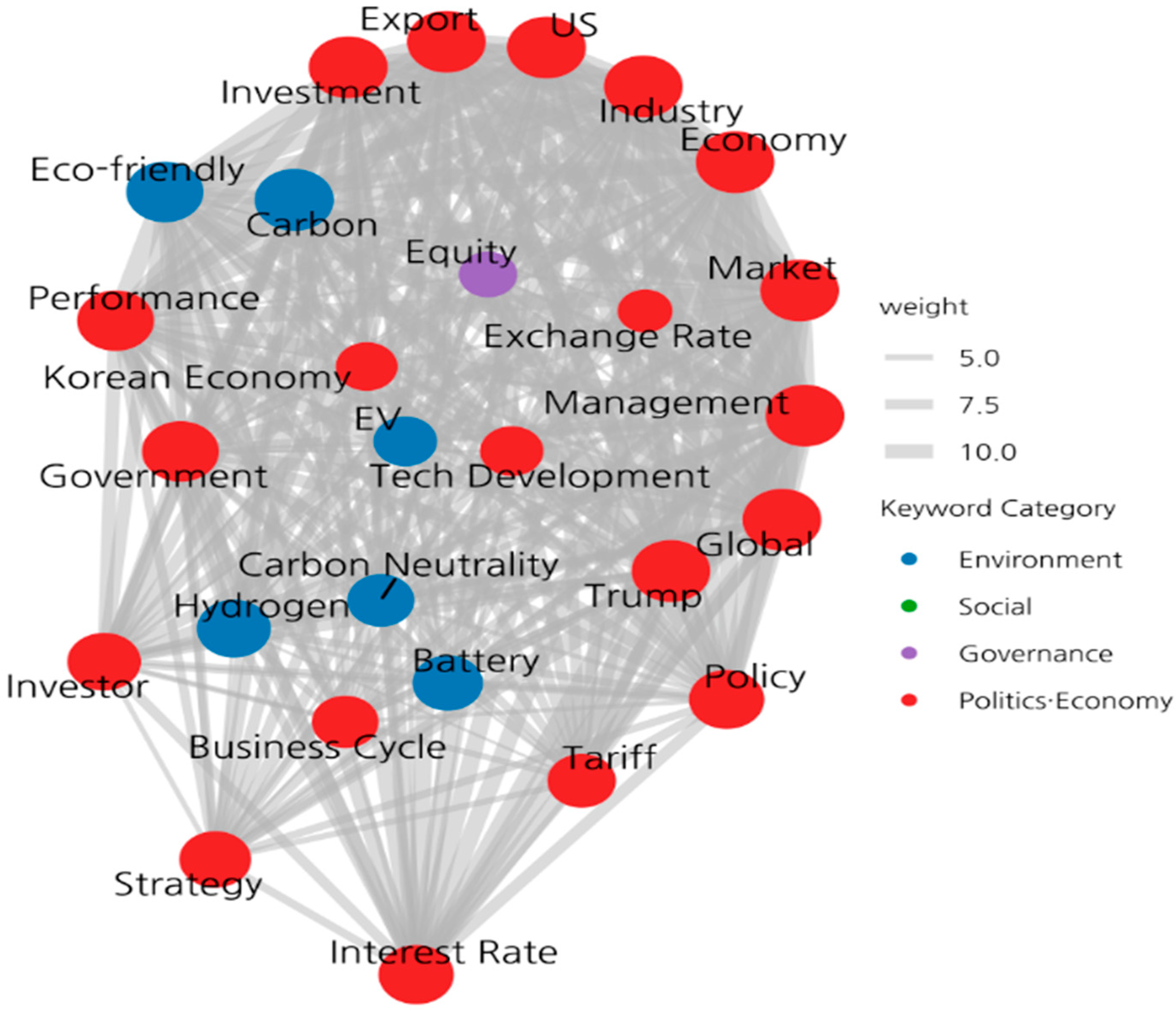
Changes in the ESG Discourses of Korean Global B2B Corporations Before and After Trump’s Second Term: A Social Media-Based Text Mining Analysis


Abstract
1. Introduction
2. Theoretical Framework
2.1. Adaptability of ESG Discourse and CEO Communication
2.2. Politicization of ESG in the United States
2.3. Analytical Framework: Trump as a Proxy for Geopolitical Uncertainty
- (1)
- Regulatory Uncertainty: The rollback of climate policies creates direct threats to ESG-aligned investments. Strine (2025) documents how the anti-ESG movement intimidated corporate leaders and institutional investors into backtracking on climate commitments, with major financial institutions (BlackRock, State Street, and JPMorgan Chase) withdrawing from Climate Action 100+ in early 2024. Anti-ESG legislation at the state level further compounds regulatory unpredictability. Texas Senate Bill 13 (2021) prohibits state entities from doing business with financial institutions that “boycott energy companies,” while Florida’s State Board of Administration mandated that pension fund investments “must be based only on pecuniary factors,” excluding ESG considerations (Shanor & Light, 2023; Risteski, 2024).
- (2)
- Supply Chain Reconfiguration Risks: Trade policy shifts have already forced Korean manufacturers to restructure their U.S. operations. Bown (2024) documents how IRA domestic-content requirements requiring critical minerals to be extracted or processed in the U.S. or Free Trade Agreement partners, and battery components to be manufactured in North America, prompted Korean EV battery makers (LG Energy Solution, SK On) to undertake substantial supply chain reorientation outside China. Korean battery companies expected to benefit from IRA Section 45X production tax credits ($35/kWh for cells, $10/kWh for modules), but meeting Section 30D sourcing constraints imposed significant compliance costs. Such adjustments incentivize firms to emphasize operational resilience and cost management over normative ESG language, as supply chain risks become material financial exposures rather than voluntary commitments.
- (3)
- Market-Access Threats: Korean B2B firms face reputational dilemmas when serving both pro-ESG European investors and anti-ESG U.S. state governments. Tang et al. (2024) found that anti-ESG regulations approved in 18 states (2021–2023) led to 0.8–3.5% cumulative abnormal stock returns for fuel energy firms around the regulation approval dates, reflecting market segmentation in which investors perceive reduced ESG pressure as value-enhancing for carbon-intensive sectors. Corporate opposition to climate disclosure rules has been particularly pronounced among high-Scope-1-emissions firms and energy companies (Lashitew & Mu, 2024). Thus, “Trump’s second term” functions as a temporal marker for heightened geopolitical protectionism rather than a deterministic causal variable. The anti-ESG backlash represents a systemic political movement involving coordinated state-level legislation, federal-level congressional investigations, and shifts in asset managers’ strategies (Harmes, 2025). By early 2024, this movement had resulted in widespread legislative adoption across both Republican- and swing-state jurisdictions (see Section 2.7 for detailed timeline). Bennett and Uldam (2024) characterize this period as “CSR entering a disinformation age,” marked by systemic attacks from far-right politicians and think tanks that branded ESG as “woke capitalism,” forcing major corporations to retreat from public sustainability commitments: BlackRock stopped using the term “ESG” after $4 billion in fund losses, and Disney’s CEO announced with drawal from “culture wars” following political reprisals.
2.4. Moderating Effects of Political and Geopolitical Risks
2.5. Industrial and Regulatory Context: Implications for B2B Manufacturing and Heavy Industry
2.6. Text-Based Approach and Analytical Tools: Frequency and Network Analysis
2.7. Pre- and Post-Trump Comparative Framework and Predictions
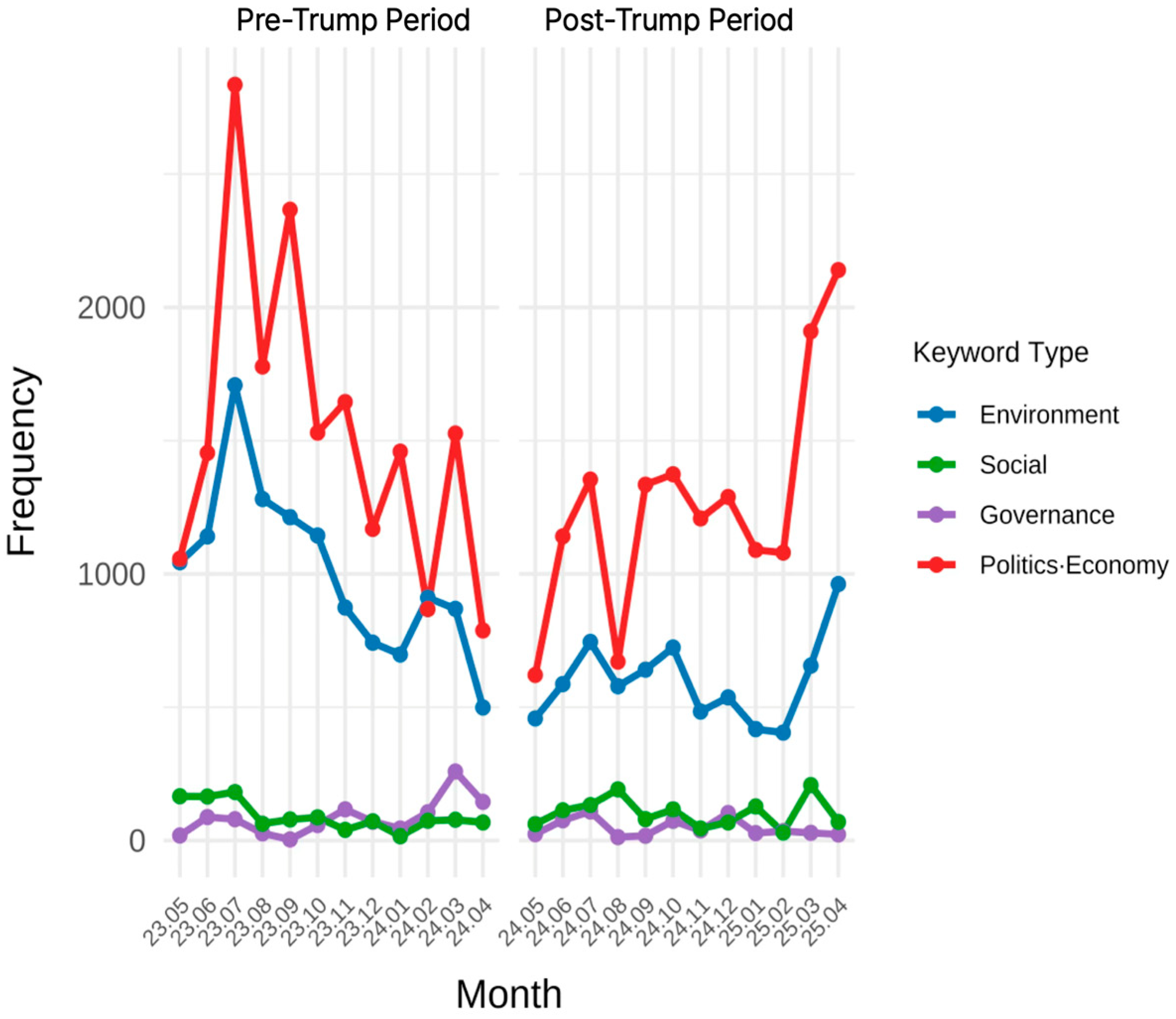
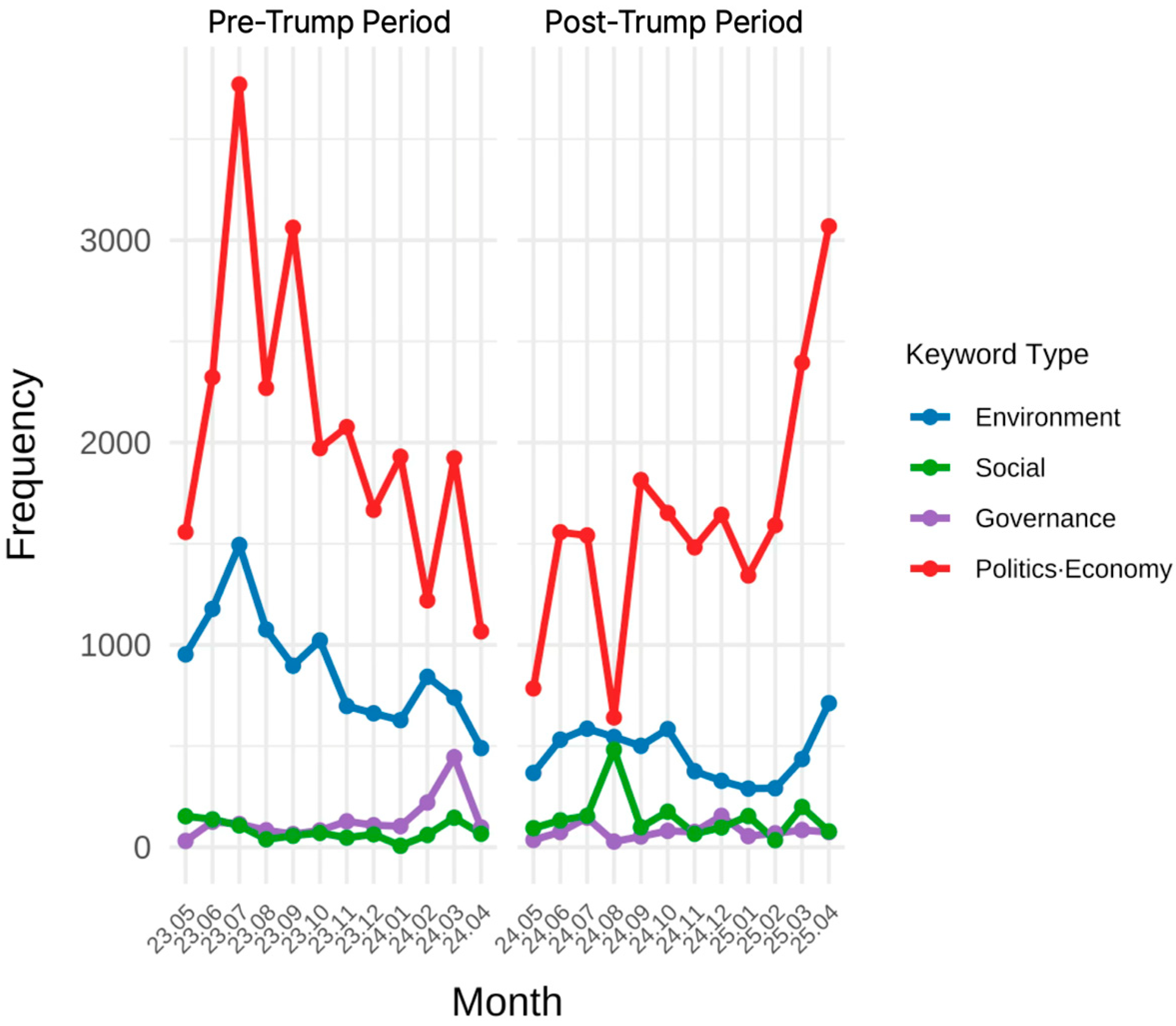
- Pre-Trump period: 1 May 2023–30 April 2024 (from Trump’s re-election announcement through the Republican nomination and the whole campaign period)
- Post-Trump period: 1 May 2024–30 April 2025 (from Trump’s likely victory through confirmation and the early stage of the 47th presidency)
3. Materials and Methods
3.1. Research Objectives and Scope
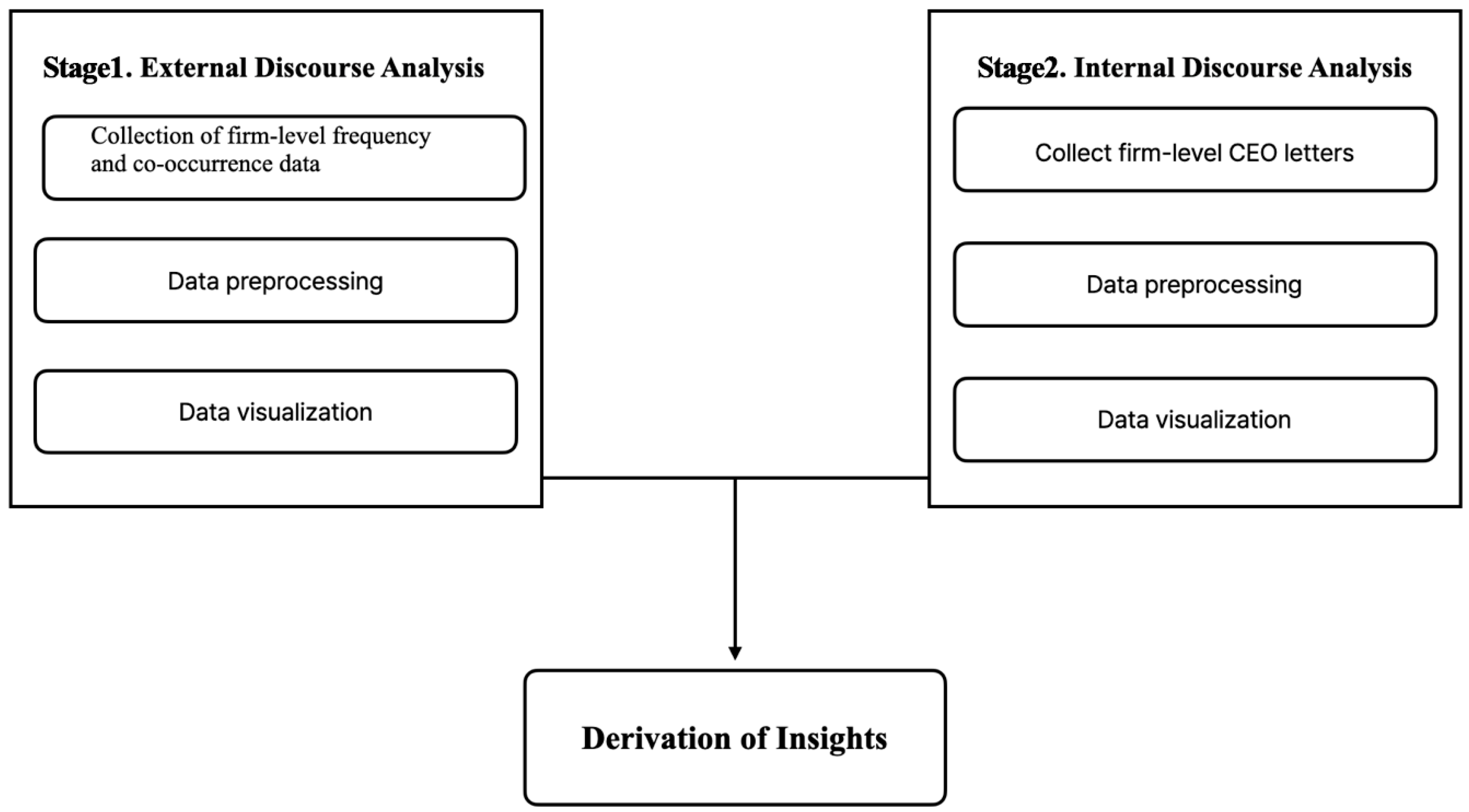
3.2. Analytical Procedure
- POSCO: Primary term “포스코” (Korean, “POSCO”), Synonym “posco”
- LG Chem: Primary term “lg화학” (Korean, “LG Chem”), Synonym “lgchem”
- HD Hyundai: Primary term “hd현대” (Korean, “HD Hyundai”), Synonym “현대중공업” (legacy name: “Hyundai Heavy Industries”)
- Pre-Trump: May 2023–April 2024 (12 months)
- Post-Trump: May 2024–April 2025 (12 months)
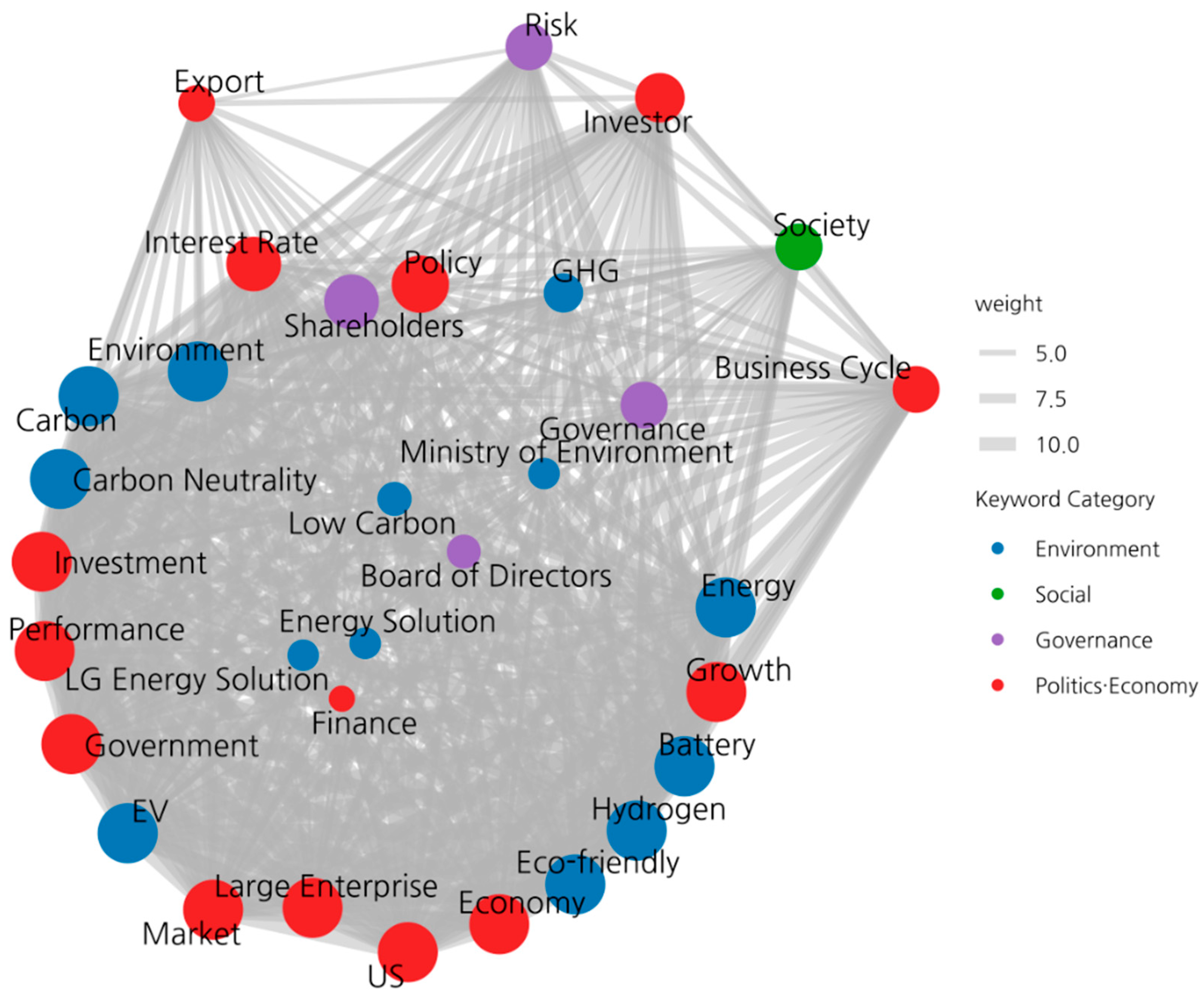
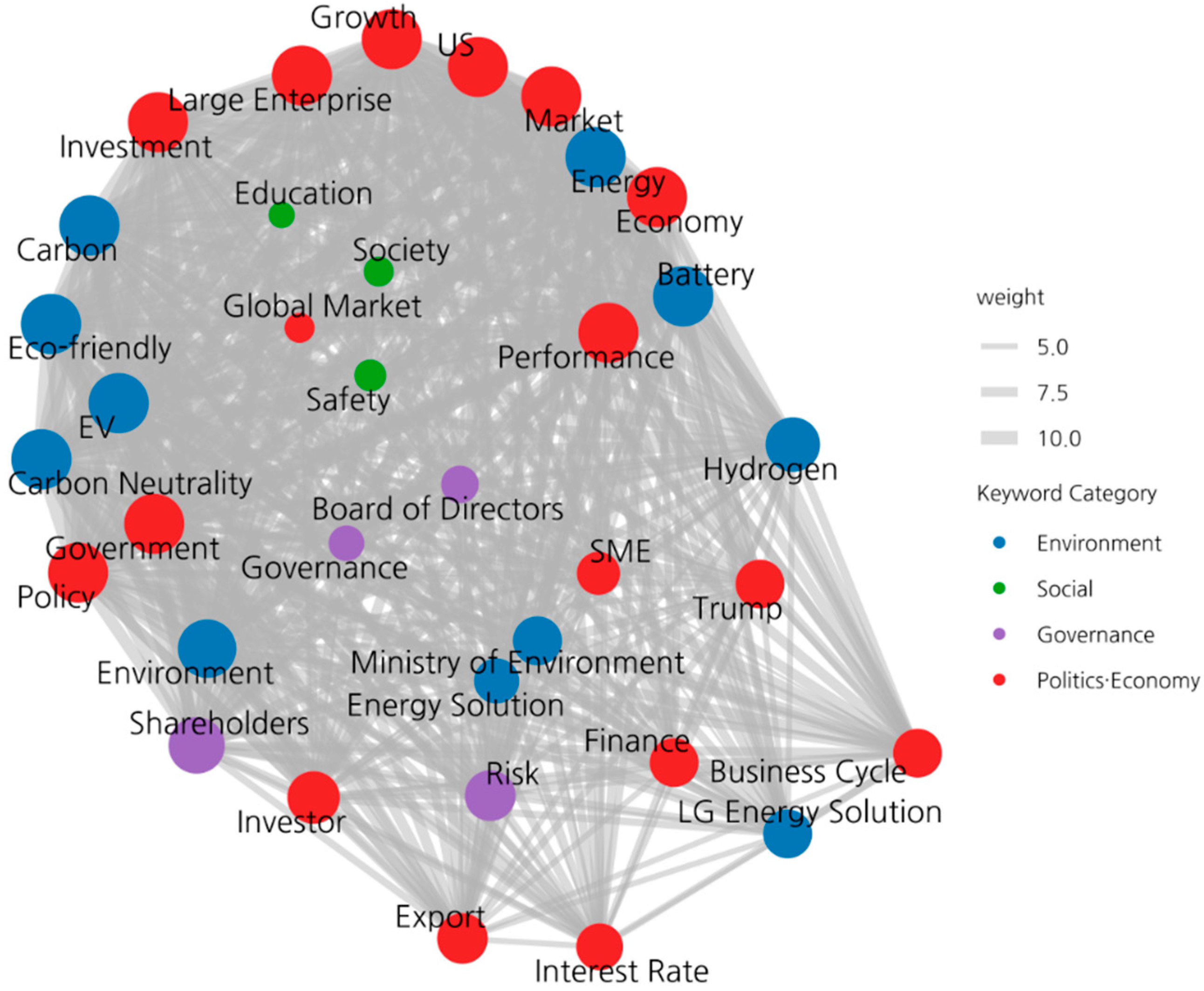
3.3. External Discourse Analysis
3.4. Internal Discourse Analysis
4. Results
4.1. Comparison of Overall ESG Discourse Between the Two Periods
4.2. Firm-Level Comparisons
4.2.1. POSCO (Steel)
4.2.2. LG Chem (Chemicals)
4.2.3. HD Hyundai (Heavy Industry and Energy)
5. Discussion
5.1. Interpreting Discourse Shifts: Temporal Alignment vs. Causal Attribution
5.2. The Peripheral Status of Social (S) and Governance (G) Discourse
5.3. Theoretical Implications: Strategic Reframing or Discursive Dilution?
5.4. Generalizability and Boundary Conditions
6. Conclusions
6.1. Summary of Findings
6.2. Practical Implications
6.3. Limitations and Future Research
Author Contributions
Funding
Institutional Review Board Statement
Informed Consent Statement
Data Availability Statement
Conflicts of Interest
Appendix A. Keyword Classification Dictionary

| Environment Keywords (n = 30): |
| climate change (기후변화), climate crisis (기후위기), battery (배터리), battery pack (배터리팩), hydrogen (수소), hydrogen energy (수소에너지), hydrogen fuel cell (수소연료전지), renewable energy (신재생에너지, 재생에너지), energy efficiency (에너지효율), greenhouse gas (온실가스), GHG reduction (온실가스감축), low-carbon (저탄소), electric vehicle (전기차), eco-friendly (친환경), green energy (친환경에너지), eco-friendly vehicle (친환경차), carbon (탄소), carbon reduction (탄소감축), carbon border (탄소국경), carbon emission (탄소배출), carbon credit (탄소배출권), carbon emissions volume (탄소배출량), carbon neutrality (탄소중립), carbon neutrality realization (탄소중립실현), wind power (풍력), offshore wind (해상풍력) |
| Social Keywords (n = 30): |
| Ministry of Employment and Labor (고용노동부), labor (노동), labor ministry (노동부), worker (노동자), labor union (노동조합), education (교육), trainee (교육생), education center (교육센터), donation (기부), donation fund (기부금), talent donation (재능기부), culture (문화), corporate culture (기업문화), welfare (복지), welfare center (복지관), welfare facility (복지시설), volunteer (봉사), volunteer activity (봉사활동), volunteering (자원봉사), social welfare organization (사회복지법인), social responsibility (사회적책임), consumer (소비자), safety (안전), Korea Occupational Safety and Health Agency (안전보건공단), safety performance (안전성), human rights (인권), local community (지역사회), sense of responsibility (책임감), responsible management (책임경영), person in charge (책임자) |
| Governance Keywords (n = 11): |
| CEO, chief executive officer (대표이사), leadership (리더십), audit (사외), voting rights (의결권), director (이사), chairman (이사장), foundation chairman (재단이사장), board of directors (이사회), governance structure (지배구조), stake/equity (지분) |
| Politics·Economy Keywords (n = 76): |
| AI, OpenAI (오픈AI), ESG management (ESG경영), sustainable management (지속가능경영), win-win management (상생경영), FOMC, FOMC meeting (FOMC회의), economy/business cycle (경기), high interest rate (고금리), management (경영), management rights (경영권), manager (경영자), business administration department (경영학과), management innovation (경영혁신), economy (경제), economic policy (경제정책), economic cooperation (경제협력), economic growth rate (경제성장률), tariff (관세), global, global standard (글로벌스탠다드), global market (글로벌시장), interest rate (금리), interest rate preferential (금리우대), interest rate cut (금리인하), technology development (기술개발), new technology (신기술), Trump (트럼프), United States (미국), shared growth (동반성장), Fair Trade Commission (동반성장위, 동반성장위원회), Maeil Business Newspaper (매일경제), Korea Economic Daily (한국경제), Korea Enterprises Federation (한국경제인협회), bio industry (바이오산업), defense industry (방위산업), high-tech industry (첨단산업), industry (산업), Ministry of Trade Industry and Energy (산업부, 산업통상자원부), industrial use (산업용), industrial transformation (산업전환), dividend (배당), trade protectionism (보호무역, 보호무역주의), facility investment (설비투자), export (수출), Korea Eximbank (수출입은행, 한국수출입은행), market (시장), market share (시장점유율), performance/earnings (실적), Aekyung Industry (애경산업), Korea Institute of Energy Technology (에너지기술연구원, 한국에너지기술연구원), Korea Environmental Industry & Technology Institute (한국환경산업기술원), securities market (유가증권시장), capital market (자본시장), general investor (일반투자자), institutional investor (기관투자자), investment (투자), investment sentiment (투자심리), investor (투자자), investment strategy (투자전략), strategy (전략), government (정부), administration (행정부), policy (정책), local economy (지역경제), local economy revitalization (지역경제활성화), exchange rate (환율) |
| Environment Keywords (n = 22): |
| carbon (탄소), carbon neutrality (탄소중립), greenhouse gas (온실가스), climate (기후), electric vehicle (전기차), hydrogen (수소), energy (에너지), renewable (재생), recycling (재활용), eco-friendly (친환경), solar power (태양광), wind power (풍력), single-use product zero challenge (1회용품제로챌린지), smart factory (스마트팩토리), factory (공장), low-carbon (저탄소), waste (폐기물), LG Energy Solution (lg에너지솔루션), climate change (기후변화), battery (배터리), green energy (그린에너지), energy efficiency (에너지효율) |
| Social Keywords (n = 16): |
| labor (노동), welfare (복지), employment (고용), human rights (인권), diversity (다양성), youth (청년), local (지역), social contribution (사회공헌), volunteer (봉사), donation (기부), consumer (소비자), education (교육), safety (안전), culture (문화), responsibility (책임), volunteering (자원봉사) |
| Governance Keywords (n = 14): |
| board of directors (이사회), director (이사), outside director (사외이사), governance (거버넌스), audit (감사), internal control (내부통제), CEO, stake/equity (지분), leadership (리더십), voting rights (의결권), management (경영진), transparent management (투명경영), governance structure (지배구조) |
| Politics·Economy Keywords (n = 32): |
| government (정부), legislation (법안), policy (정책), regulation (규제), interest rate (금리), business cycle (경기), FOMC, trade (무역), export (수출), import (수입), GDP, exchange rate (환율), investment (투자), global (글로벌), industry (산업), market (시장), economy (경제), technology (기술), AI, digital transformation (디지털전환), R&D, M&A, management (경영), executive (경영진), performance (실적), stock market (주식시장), capital market (자본시장), institutional investor (기관투자자), economic growth rate (경제성장률), dividend (배당), shared growth (동반성장), chief executive officer (최고경영자) |
| Note on Classification Logic: |
| Keywords from Sometrend monthly data were matched against these dictionaries using regular expressions in R. When a keyword matched multiple categories, a priority order was applied: Environment → Social → Governance → Politics·Economy. Keywords that did not match any dictionary term were excluded from the analysis. This approach enabled systematic categorization of ~348 unique keywords per firm per 12-month period extracted by the Sometrend platform. |
References
- Abdullah, M., Tiwari, A. K., Hossain, M. R., & Abakah, E. J. A. (2024). Geopolitical risk and firm-level environmental, social, and governance (ESG) performance. Journal of Environmental Management, 363, 121245. [Google Scholar] [CrossRef] [Scilit]
- Arvidsson, S. (2023). CEO talk of sustainability in CEO letters: Towards the inclusion of a sustainability embeddedness and value-creation perspective. Sustainability Accounting, Management and Policy Journal, 14(7), 2661. [Google Scholar] [CrossRef] [Scilit]
- Arvidsson, S., & Sabelfeld, S. (2023). Adaptive framing of sustainability in CEO letters. Accounting, Auditing & Accountability Journal, 36(9), 161199. [Google Scholar] [CrossRef] [Scilit]
- Bennett, W. L., & Uldam, J. (2024). Corporate social responsibility in the disinformation age. Management Communication Quarterly, 38(4), 864–896. [Google Scholar] [CrossRef] [Scilit]
- Bown, C. P. (2024). How the United States solved South Korea’s problems with electric vehicle subsidies under the Inflation Reduction Act. Journal of World Trade, 58(1), 1–34. [Google Scholar] [CrossRef] [Scilit]
- Broadstock, D. C., Chan, K., Cheng, L. T. W., & Wang, X. (2021). The role of ESG performance during times of financial crisis: Evidence from COVID-19 in China. Finance Research Letters, 38, 101716. [Google Scholar] [CrossRef] [Scilit]
- DiMaggio, P. J., & Powell, W. W. (1983). The iron cage revisited: Institutional isomorphism and collective rationality in organizational fields. American Sociological Review, 48(2), 147–160. [Google Scholar] [CrossRef] [Scilit]
- Erzurumlu, Y. O., Gozgor, G., Lau, C. K. M., Soliman, A. M., & Turkkan, M. (2025). The effects of geopolitical and political risks on corporate ESG practices. Journal of Environmental Management, 386, 125747. [Google Scholar] [CrossRef] [Scilit] [PubMed]
- Ferjančič, U., Ichev, R., Lončarski, I., Montariol, S., Pelicon, A., Pollak, S., Sitar Šuštar, K., Toman, A., Valentinčič, A., & Žnidaršič, M. (2024). Textual analysis of corporate sustainability reporting and corporate ESG scores. International Review of Financial Analysis, 96, 103669. [Google Scholar] [CrossRef] [Scilit]
- Friede, G., Busch, T., & Bassen, A. (2015). ESG and financial performance: Aggregated evidence from more than 2000 empirical studies. Journal of Sustainable Finance & Investment, 5(4), 210–233. [Google Scholar] [CrossRef] [Scilit]
- Gao, D., Tan, L., & Chen, Y. (2025). Smarter is greener: Can intelligent manufacturing improve enterprises’ ESG performance? Humanities and Social Sciences Communications, 12, 529. [Google Scholar] [CrossRef] [Scilit]
- Gillan, S. L., Koch, A., & Starks, L. T. (2021). Firms and social responsibility: A review of ESG and CSR research in corporate finance. Journal of Corporate Finance, 66, 101889. [Google Scholar] [CrossRef] [Scilit]
- Harmes, A. (2025). The anti-ESG backlash and asset manager capitalism. Politics & Society, 53(4), 603629. [Google Scholar] [CrossRef] [Scilit]
- HD Hyundai. (2025). HD Hyundai integrated report 2024: Bridging the future. Available online: https://esg.hd.com/upload/admin/report/1757040254933/2024%20HD%20Hyundai%20Marine%20Solution%20Sustainability%20Report%20(Published%20in%202025).pdf (accessed on 16 February 2026).
- Hilson, C. (2024). Climate change and the politicization of ESG in the US. Frontiers in Political Science, 6, 1332399. [Google Scholar] [CrossRef] [Scilit]
- Hoang, T., Ngo, P. T. H., & Zhang, L. (2025). Polarized corporate boards. Journal of Corporate Finance, 91, 102697. [Google Scholar] [CrossRef] [Scilit]
- ISS ESG. (2023). ESG regulation in South Korea: Disclosure guidance. ISS Insights. Available online: https://insights.issgovernance.com/posts/esg-regulation-in-south-korea-disclosure-guidance/ (accessed on 16 February 2026).
- Kim, J. M., Min, S., Kim, J. P., Lee, W., Shin, J., & Lee, J. M. (2026). KRX analysis of 2025 sustainable management report disclosures. Available online: https://www.kimchang.com/en/insights/detail.kc?sch_section=4&idx=33856 (accessed on 16 February 2026).
- Lashitew, A., & Mu, Y. (2024). Corporate opposition to climate change disclosure regulation in the United States. Climate Policy, 25(3), 422–437. [Google Scholar] [CrossRef] [Scilit]
- LG Energy Solution. (2025). LG Energy Solution ESG report 2024. Available online: https://www.lgensol.com/upload/file/download/LG_Energy_Solution_2024_ESG_Report_KR.pdf (accessed on 16 February 2026).
- MacNeil, I., & Esser, I.-M. (2022). From a financial to an entity model of ESG. European Business Organization Law Review, 23, 945. [Google Scholar] [CrossRef] [Scilit]
- McCombs, M. E., & Shaw, D. L. (1972). The agenda-setting function of mass media. Public Opinion Quarterly, 36(2), 176–187. [Google Scholar] [CrossRef] [Scilit]
- Nielsen, H., & Villadsen, K. (2023). The ESG discourse is neither timeless nor stable: How Danish companies ‘tactically’ embrace ESG concepts. Sustainability, 15(3), 2766. [Google Scholar] [CrossRef] [Scilit]
- Park, J., Choi, W., & Jung, S.-U. (2022). Exploring trends in environmental, social, and governance themes and their sentimental value. over time. Frontiers in Psychology, 13, 890435. [Google Scholar] [CrossRef] [Scilit]
- POSCO Holdings. (2025). Form 20-F: Annual report for the fiscal year ended 31 December 2024. U.S. Securities and Exchange Commission. Available online: https://www.sec.gov/Archives/edgar/data/889132/000119312525104983/d928283d20f.htm (accessed on 16 February 2026).
- Postiglione, M., Carini, C., & Falini, A. (2024). ESG and firm value: A hybrid literature review on cost of capital implications from Scopus database. Corporate Social Responsibility and Environmental Management, 31(6), 64576480. [Google Scholar] [CrossRef] [Scilit]
- Risteski, D. (2024). Politics before pensions: How new ESG rules expose public pension system vulnerabilities. University of Colorado Law Review, 95, 805837. [Google Scholar]
- Shanor, A., & Light, S. E. (2023). Anti-woke capitalism, the First Amendment, and the decline of libertarianism. Northwestern University Law Review, 118(2), 347430. [Google Scholar]
- Strine, L. E., Jr. (2025). Ignorance is strength: Climate change, corporate governance, politics, and the English language. Journal of Law and Political Economy, 5, 170220. [Google Scholar] [CrossRef] [Scilit]
- Tang, O., Shi, X., & Jiu, L. (2024). Value creation or political trick? An event study on anti-ESG regulations. Finance Research Letters, 65, 105530. [Google Scholar] [CrossRef] [Scilit]
- Weder, F., & Stranzl, J. (2025). Conversational spaces enabling conversational contestation: Making sustainability communication in organizations political (again). Public Relations Review, 51(4), 102614. [Google Scholar] [CrossRef] [Scilit]
- White House. (2025a). Executive order: Unleashing American energy. Available online: https://www.whitehouse.gov/presidential-actions/2025/01/unleashing-american-energy/ (accessed on 16 February 2026).
- White House. (2025b). Memorandum on reciprocal trade and tariffs. Available online: https://www.whitehouse.gov/articles/2025/02/reciprocal-trade-and-tariffs/ (accessed on 16 February 2026).
- Yang, J., Zuo, Z., Li, Y., & Guo, H. (2024). Manufacturing enterprises move towards sustainable development: ESG performance, market-based environmental regulation, and green technological innovation. Journal of Environmental Management, 372, 123244. [Google Scholar] [CrossRef] [Scilit] [PubMed]
- Yoon, J., Han, S., Lee, Y., & Hwang, H. (2023). Text mining analysis of ESG management reports in South Korea: Comparison with Sustainable Development Goals. SAGE Open, 13(3), 21582440231202896. [Google Scholar] [CrossRef] [Scilit]




| 2021 | 2022 | 2023 | 2024 | 2025 | |||||
|---|---|---|---|---|---|---|---|---|---|
| Keywords | Freq | Keywords | Freq | Keywords | Freq | Keywords | Freq | Keywords | Freq |
| We | 7 | Value | 4 | We | 15 | Eco-friendly | 10 | Hope | 12 |
| Value | 6 | Strengthening | 4 | Eco-friendly | 12 | Expansion | 6 | People | 8 |
| Society | 6 | Citizen | 4 | Expansion | 12 | Leap | 5 | Strengthening | 5 |
| Citizen | 6 | We | 4 | Securing | 11 | Securing | 5 | Boldness | 5 |
| Promotion | 5 | Product | 4 | Investment | 10 | Strengthening | 4 | Journey | 5 |
| Expansion | 5 | Steel | 4 | Research | 7 | Establishment | 4 | We | 4 |
| Company | 5 | Eco-friendly | 4 | Promotion | 7 | Supply Chain | 3 | Eco-friendly | 4 |
| Safety | 4 | Development | 3 | Strengthening | 6 | Material | 3 | Happiness | 4 |
| Fostering | 4 | Preparation | 3 | Change | 6 | Talent | 3 | ROK | 3 |
| Continuity | 4 | Change | 3 | Economy | 5 | Infrastructure | 3 | Expansion | 3 |
| Creation | 4 | Society | 3 | Opportunity | 5 | Continuity | 3 | Economy | 2 |
| Carbon | 4 | Era | 3 | Field | 5 | Blue Dragon | 3 | Culture | 2 |
| Doing | 4 | Strategy | 3 | Sustainability | 5 | Sales | 3 | Change | 2 |
| Acceleration | 4 | COVID-19 | 3 | Steel | 5 | Unity | 3 | Love | 2 |
| Improvement | 3 | Expansion | 3 | Value | 4 | Reconciliation | 3 | Success | 2 |
| Health | 3 | Securing | 3 | Discovery | 4 | Diffusion | 3 | Material | 2 |
| Opportunity | 3 | Acceleration | 2 | Derived | 4 | Acceleration | 2 | Citizen | 2 |
| Effort | 3 | Domestic/ International | 2 | Love | 4 | Development | 2 | Start | 2 |
| Leap | 3 | Opportunity | 2 | Success | 4 | Construction Infrastructure | 2 | Energy | 2 |
| 2021 | 2022 | 2023 | 2024 | 2025 | |||||
|---|---|---|---|---|---|---|---|---|---|
| Keywords | Freq | Keywords | Freq | Keywords | Freq | Keywords | Freq | Keywords | Freq |
| Technology | 8 | Technology | 11 | Technology | 11 | Economy | 2 | Safety | 7 |
| Economy | 2 | Accident | 5 | Energy | 6 | Competition | 1 | Shipbuilding | 5 |
| Transition | 2 | Energy | 3 | Economy | 4 | Technology | 1 | China | 5 |
| Competition | 1 | Response | 2 | Uncertainty | 2 | Labor | 1 | Bereaved Families | 4 |
| Labor | 1 | Transition | 2 | Safety | 2 | Response | 1 | Investment | 3 |
| U.S. | 1 | Shipbuilding | 2 | Transition | 2 | U.S. | 1 | Economy | 2 |
| Uncertainty | 1 | Eco-friendly | 2 | Eco-friendly | 2 | Uncertainty | 1 | Technology | 2 |
| Crisis | 1 | Industry | 1 | Investment | 2 | Export | 1 | Opportunity | 2 |
| Shipbuilding | 1 | Hydrogen | 1 | Supply Chain | 1 | Safety | 1 | Response | 2 |
| Safety | 1 | Labor | 1 | Energy | 1 | U.S. | 2 | ||
| Investment | 1 | U.S. | 1 | Crisis | 1 | Accident | 2 | ||
| China | 1 | Outlook | 1 | Competition | 1 | ||||
| Carbon | 1 | Shipbuilding | 1 | Industry | 1 | ||||
| China | 1 | Export | 1 | ||||||
| Population Decline | 1 | ||||||||
| 2021 | 2022 | 2023 | 2024 | 2025 | |||||
|---|---|---|---|---|---|---|---|---|---|
| Keywords | Freq | Keywords | Freq | Keywords | Freq | Keywords | Freq | Keywords | Freq |
| Safety | 5 | Safety | 8 | Carbon | 6 | Carbon | 5 | Investment | 6 |
| Technology | 4 | Carbon | 5 | Response | 4 | Response | 3 | Competition | 5 |
| Opportunity | 3 | Uncertainty | 4 | Opportunity | 2 | Investment | 3 | Technology | 5 |
| Carbon | 3 | Transition | 4 | U.S. | 2 | Supply Chain | 2 | Response | 3 |
| Investment | 3 | Investment | 4 | Eco-friendly | 2 | Opportunity | 2 | Opportunity | 2 |
| Response | 2 | Response | 3 | Investment | 2 | Transition | 2 | Safety | 2 |
| Economy | 1 | Opportunity | 2 | Competitio | 1 | Economy | 1 | Eco-friendly | 2 |
| Transition | 1 | U.S. | 2 | Technology | 1 | U.S. | 1 | U.S. | 1 |
| Eco-friendly | 2 | Uncertainty | 1 | Safety | 1 | Uncertainty | 1 | ||
| Price | 1 | Safety | 1 | Eco-friendly | 1 | Export | 1 | ||
| Economy | 1 | Crisis | 1 | Transition | 1 | ||||
| Technology | 1 | Transition | 1 | Carbon | 1 | ||||
| Industry | 1 | ||||||||
| Policy | 1 | ||||||||
Disclaimer/Publisher’s Note: The statements, opinions and data contained in all publications are solely those of the individual author(s) and contributor(s) and not of MDPI and/or the editor(s). MDPI and/or the editor(s) disclaim responsibility for any injury to people or property resulting from any ideas, methods, instructions or products referred to in the content. |
© 2026 by the authors. Licensee MDPI, Basel, Switzerland. This article is an open access article distributed under the terms and conditions of the Creative Commons Attribution (CC BY) license.
Share and Cite
Park, Y.; Lee, S. Changes in the ESG Discourses of Korean Global B2B Corporations Before and After Trump’s Second Term: A Social Media-Based Text Mining Analysis. Adm. Sci. 2026, 16, 145. https://doi.org/10.3390/admsci16030145
Park Y, Lee S. Changes in the ESG Discourses of Korean Global B2B Corporations Before and After Trump’s Second Term: A Social Media-Based Text Mining Analysis. Administrative Sciences. 2026; 16(3):145. https://doi.org/10.3390/admsci16030145
Chicago/Turabian StylePark, Youngbin, and Sungho Lee. 2026. "Changes in the ESG Discourses of Korean Global B2B Corporations Before and After Trump’s Second Term: A Social Media-Based Text Mining Analysis" Administrative Sciences 16, no. 3: 145. https://doi.org/10.3390/admsci16030145
APA StylePark, Y., & Lee, S. (2026). Changes in the ESG Discourses of Korean Global B2B Corporations Before and After Trump’s Second Term: A Social Media-Based Text Mining Analysis. Administrative Sciences, 16(3), 145. https://doi.org/10.3390/admsci16030145