Article

Trust, Digital Capability, and Knowledge Sharing: An Opportunity for Technological Innovation


by
Rohit Kumar Nanduri
* and
Liliana Canquiz Rincón
Postdoctoral Program in Educational Quality, Universidad Superior de Guadalajara, Guadalajara 44100, Jalisco, Mexico
*
Author to whom correspondence should be addressed.
Adm. Sci. 2026, 16(3), 139; https://doi.org/10.3390/admsci16030139

Submission received: 20 January 2026 / Revised: 12 February 2026 / Accepted: 25 February 2026 / Published: 11 March 2026

Abstract

The rapid pace of digital transformation has increased organizations’ reliance on digital technologies and collaborative systems as key drivers of technological innovation. However, the mechanisms through which digital trust, digital technology, and digital capability shape innovation performance—particularly through knowledge sharing—remain insufficiently explored. This study examined the relationships among these digital enablers and innovation performance, positioning knowledge sharing as a central mediating mechanism grounded in the Knowledge-Based View and Open Innovation Theory. A quantitative research design was adopted, and data were collected through a structured survey of 280 professionals working in IT, software development, telecommunications, and other technology-intensive industries. Convenience sampling was employed, and statistical analyses were conducted using SPSS to assess reliability, validity, and structural relationships. The findings revealed that digital trust, digital technology, and digital capability significantly enhance knowledge-sharing practices, which in turn positively influence innovation performance. Moreover, knowledge sharing was found to play a critical mediating role in translating digital enablers into innovation outcomes. This study contributes to the digital innovation literature by highlighting the importance of digital preparedness and collaborative knowledge practices in fostering technological innovation. The findings also offer practical insights for organizations seeking to strengthen innovation performance by developing digital capabilities, fostering trust, and promoting effective knowledge-sharing cultures in technology-intensive environments.

1. Introduction

The pace of digital transformation (DT) has led to a process of networks and spaces, promoting technical innovation and increasingly introducing new actors on the market. The increased momentum of digital technologies has allowed individuals to seize new opportunities to share knowledge when mentioning specific services and products within businesses. Technologies that move across social media (i.e., LinkedIn, Instagram, and Facebook) to digital mediums (i.e., Zoom, weblogs, Skype and Microsoft Teams), online resources, and big data changed the process in which information was spread, generated and exchanged throughout various landscapes (Deng et al., 2023). These digital skills achieved the necessary momentum needed to succeed and uplift DT into business. Online skills indicated a diversified potential that motivate companies to design new products and procedures to comply with the evolution of markets. This has involved the sound exploitation of technological possibilities as well as the enhancement of techniques, in which human resources and intellectual property are committed to embracing major digital technologies. This potential led to digital processes that occupy the ability to develop new structures automatically and show powerful results, despite the fact that they lacked the purposeful planning of a single creator or external entity (Martínez-Peláez et al., 2023). Binary potential and orientation possessed a notable influence upon digital innovation, which also moderated the interplay among firm performance, digital ability and digital direction (Rupeika-Apoga et al., 2022). Given the results, varied businesses became aware of the importance of open innovation as a crucial competency required to maintain a competitive edge (Yun et al., 2024). Open innovation suggested partnering with external entities for enlargement of market potential, increments in internal innovation, and advanced products (Onetti, 2021). Scholars argue that enterprises must enlarge their innovation processes in heterogenous departments, instead of isolated emphasis on internal improvements (Hervas-Oliver et al., 2021), and elevate their tactical responsiveness by utilizing external sources and improving collaborative synergies (Hutton et al., 2024).
Open innovation also experienced challenges, involving mismanagement, opportunistic conduct and data leakage via external partners (Dabić et al., 2023; Kumari et al., 2024). Poor trust was demonstrated as a key obstruction to collaborations (Dabić et al., 2023; Madanaguli et al., 2023; Mubarak & Petraite, 2020). In this context, digital trust was defined as confidence in digital procedures and platforms used for communication and cooperation (Mubarak & Petraite, 2020; World Economic Forum, 2022), which enabled open innovation. For instance, Microsoft found that embedding Azure’s blockchain capabilities delivered a secure and transparent cloud computing landscape that introduced digital trust, encourages collaboration, and caters to the delivery of a diverse span of solutions and services (Chaudhary et al., 2022). Nevertheless, most of the open innovation papers emphasized organizational resources, risk governance and partner expertise, which largely left the potential of digital trust underexplored (Blomqvist et al., 2024). This distinction emphasizes the need for a more nuanced inquiry regarding the interplay between open innovation and digital trust.
From the “Knowledge-Based View (KBV)” lens, researchers argued that digital trust encouraged open innovation through the skills, expertise and knowledge sharing among businesses (Le & Le, 2023; Sial et al., 2023; Singh et al., 2021). With the ability to foster a culture of learning, knowledge sharing encouraged competitive benefits by assembling diversified complementary resources (Sial et al., 2023), which could uphold an entire organization’s performance (Radtke et al., 2023). As per the reviews, the unification of technology via inter-organizational partnership enhanced trust (Cepa & Schildt, 2019), which also prompted advancements in technological infrastructure and, in turn, encouraged knowledge sharing (M. Wang et al., 2023). When digital trust exists, organizations become more likely to share competencies and less likely to risk opportunistic exploitation from partners (Abu El-Ella et al., 2016). On the other hand, knowledge sharing speeds up the innovation of goods and services while enhancing the quality of the outcomes (Kmieciak, 2021). Microsoft, for instance, could further illustrate this mechanism by informing its secure Azure settings to reduce data-sharing hazards among competitors, hence catering to a free exchange of ideas and insights throughout organizations (Chaudhary et al., 2022). In summary, knowledge sharing can be acknowledged as a significant framework that connects digital trust, transformation and capabilities with enriched open innovation.
The following noteworthy questions were addressed in the literature:
(1)
How is the knowledge-sharing process in technology-intensive organizations and ecosystems impacted by digital trust, digital capability and digital technology?
(2)
To what extent is the interplay among innovation performance and these digital characteristics moderated by information sharing?
(3)
What lessons can be learned by organizations looking to utilize digitally collaborative environment software for enhancing innovation performance?
Furthermore, this study extended the current body of knowledge regarding digital transformation and innovation management by contributing to both practical and theoretical understandings of the challenges related to leveraging open-source technology. It investigated the ability of digital trust, digital capability and digital technology to affect knowledge sharing and innovation performance. Although prior studies have examined digital technology, digital capability, and digital trust separately, limited research has integrated these digital antecedents within a unified explanatory model. Moreover, the existing literature often investigated the direct effects of digital investment on innovation performance, overlooking the mediating role of knowledge sharing as a central mechanism. There is, therefore, a clear gap in understanding how digital enablers collectively affect innovation outcomes within digitally collaborative and technology-intensive environments. This study provided further details of how digital aspects enable efficient knowledge transfer by merging the insights presented by the Open Innovation Theory and the Knowledge-Based View. Moreover, the findings provided practical guidance for firms seeking to strengthen innovation outcomes by improving collaborative knowledge practices, digital readiness and improving trust.

2. Materials and Methods

2.1. Materials

2.1.1. Innovation and Open-Source Technology

Software, tools and platforms with openly obtainable resources code for alteration, dissemination and usage refer to the concept of open-source technology (Asparouhova, 2020). Mostly, people work on the advancement of open-source technology according to a “share-a-like license” (such as the GNU GPL v3), which is recognized to prompt and bolster innovation potential. Thus, irrespective of successfulness or competitiveness of the organization or business, empowering open source could cater to the global community, united to embrace these innovations that contribute to new capabilities and concepts faster, effectively and better, compared to internal departments working on exclusive implications. Moreover, the open-source and free software community demonstrated that future incarnations of the technology have eroded development costs (Pearce, 2020).
Open-source technology also took on the role of inspiring collaborative innovation, where an organization could use the knowledge networks as well as collective intelligence that exists externally. It facilitates fastening prototyping, interoperability and transparency, which could increase the rate of technological breakthrough diffusion (Ali et al., 2025). Community development ensured that organizations were able to test various ideas and, also, co-create value without the heavy ownership burden. The facts also show that open-source ecosystems promote technological democratization as small businesses and startups now possess access to advanced tools and play an important role in global innovation (Blind et al., 2021). As an effect, open-source practices started to gain incremental recognition as strategic enablers that improve innovation capability, increase organizational ability and reduce redundancy in dynamic digital settings.

2.1.2. Digital Trust

Considering recent reviews, trust referred to a complicated social–psychological notion that enables people to have positive presumptions about other individuals’ actions, such as giving up and taking risks (Chen et al., 2025). According to previous research, trust is a necessity to reduce opportunism (H. Tang et al., 2023), alternating formal contracts (Kmieciak, 2021), and credit failures (Stephany et al., 2021). The significance of digital trust within inter-organizational collaboration was demonstrated by the certainty that trust could be transformed from being human-focused to technology-embedded, considering the growing fame of digital technologies in commercial and social interactions (Kluiters et al., 2023). Stakeholders’ presumptions that digital frameworks would surely protect stakeholder interests and satisfy social norms (World Economic Forum, 2022) demonstrate the potential of digital trust during inter-organizational collaboration. Their belief in technologies, platforms and actors to craft dependable mechanisms was mirrored in digital trust within networked contexts (Kluiters et al., 2023). In the latest technologies, this notion of trust could encourage equitable gains and cater for adaptability (Kluiters et al., 2023).
Irrespective of how much its operations were complicated, reviews indicated that digital trust encouraged open innovation by enabling knowledge sharing and effective collaboration (Mubarak & Petraite, 2020). It might immediately promote absorptive ability and information exchange (Brockman et al., 2018; C. Wang et al., 2020) or rapidly reduce teamwork costs (Kmieciak, 2021; Mubarak & Petraite, 2020; M. Wang et al., 2023), but excessive trust could leverage dangers. Its impact could also be influenced by circumstantial situations, including technological intensity (Brockman et al., 2018), environmental unpredictability (L. Wang et al., 2011), or poor legal systems (Kong et al., 2021). Inner business assets remain to be investigated, regardless of the fact that most reviews emphasized external conditions. Moreover, traditional interpersonal, social and inter-organizational trust were substituted by digital trust (Capestro et al., 2024; Hameed & Naveed, 2019; Kmieciak, 2021), mirroring the necessity to investigate the way trust in digital mechanisms encourages cooperation.
In addition to these, digital trust had a significant role in increasing information integrity, accountability and data transparency across digital ecosystems (van de Hoven et al., 2021). Additionally, it established confidence in blockchain-enabled collaborations, smart contracts and automated decision-making systems that minimize bias and human error (Polcumpally et al., 2024). Firms that cultivate digital trust could establish resilient networks, and, here, participants become more prone to co-develop innovations securely and share proprietary knowledge (Scholapurapu & Deepa, 2025). In open-source settings, maintaining digital trust encourages long-term participation and strengthens reputation capital, thereby amplifying collective innovation outcomes (Lakshman et al., 2025). So, digital trust not only promotes cooperation but also sustains the credibility of partnerships and digital ecosystems.

2.1.3. Digital Technology

In recent times, different reviews have focused on the adoption and innovation of digital technology, within organizational and individual contexts. In its turn, nowadays digital transformation appears to be one of the key factors in companies in terms of competitiveness and economic transformation (Shahadat et al., 2023). The integration of digital technologies in manufacturing, innovation, and service delivery became a critical trigger in this process. The processes, data, and enabling technologies, such as additive manufacturing, robotics, virtual/augmented reality, cloud computing and big data, were digitalized, which led to optimism for innovation and competitive advantage (Blichfeldt & Faullant, 2021). They refer to innovation-approved processes through advances that maintain customization, market agility and efficiency, which supports the shift of performance providers to goods manufacturers (Nambisan et al., 2019). With an example in mind, robotics maintains precision of production, as well as cost-effectiveness, irrespective of the presence of digital platforms that allow for an interim investigation cycle to be achieved in the fields of chemicals, food and pharmaceuticals (Bhardwaj et al., 2025; Blichfeldt & Faullant, 2021). Nowadays, companies are able to design unique products, which were largely sanctioned by the practical analytical findings that deduce market consistency and forecasting. Mostly, the outcomes of innovation were associated with the presence of concurrent dependence on the level (degree of knowledge created and exploitation) and the breadth of technology integration (span of technologies utilized), overall enhancing the innovation capacity of a company.
DT also enabled joint innovation by enabling the smooth integration of external and internal knowledge into cloud-based applications and open platforms (Gupta et al., 2025). It appears to be teamwork that accelerates the process of developing products and enhancing quick problem solving so that firms can stay aligned with the rapidly evolving markets. Then, the integration of AI and IoT in service and manufacturing sectors provided real-time data, which could be utilized for prediction of maintenance and maximization of operational performance (Kalusivalingam et al., 2020). With adoption of technologies in organizations, the skills of delivering customized solutions and dynamism in responding to customer needs led to their constant innovation and enhancement of competitive advantages.

2.1.4. Digital Capability

Digital capabilities were brought in house to accommodate businesses so as to address technologies along the path to better decision making, operations, strategic goals and service delivery (Vial, 2021). Compared to this, there were limited instances of arguments established in the sectors of the state, on whether digital potentials could achieve similar outcome advantages to those achieved by private companies (Arkhipova & Bozzoli, 2018). Digital capabilities represent a variety of competence in automation, data-driven decision analytics, workforce facilitation and consumer interface modernization (Haffke et al., 2017). The prospects of data analytics became the source of first-hand performance and planning insight through predictive modeling, decision support mechanism and practical dashboard visualizations (Awan et al., 2021). AI and automation maximized these surface insights and customized communications and workflows, which were based on machine learning (ML) algorithms, natural language programming (NLP) and process integration (Ghosh et al., 2022). Moreover, cloud solutions also offered scalable and fault-tolerant computing resources that nurtured the impervious information exchange and instant equipping of the digital implications of heightened public sector responsiveness (Arogundade & Palla, 2023). Regarding consumer interface competency, these included the use of social media platforms that contributed to civic engagement, feedback and participation, as well as mobile accessibility to simplify queries, self-service and transactions. The potential to simplify the dynamism of public services was achieved by public organizations via the perfect user experience through digital delivery media (Atobishi et al., 2024). Finally, workforce progression dynamic warranted digital collaboration devices, initiating technological change management and reskilling efforts to reach the future of advanced potentials.
Moreover, digital capabilities augment the absorptive capacity of a firm, when organizations display an ability to explore, exploit and internalize external knowledge to achieve strategic gains (Kastelli et al., 2024). In addition, good digital capabilities were also considered as strategic organizational enablers to redesign resources in a short period of time, be innovative through constant experimentation and adapt to technological shocks (Ardolino et al., 2025). Digitally capable organizations hold a better place to encompass various streams of data and maintain knowledge-sharing cultures, along with cross-functional collaboration in open and collaborative settings (Ahmad et al., 2023). These capabilities not only enhanced operational resilience but also helped to lead to long-term innovation capability by aligning digital tools with strategic goals and organizational learning processes.

2.1.5. Knowledge Sharing

As claimed by Serenko and Bontis (2016), today, knowledge sharing is acknowledged as the most significant theme of research in management domains. In contrast to this, Helmstädter (2003) acknowledged knowledge sharing as the interplay of human resources accompanying knowledge as a raw material. Knowledge sharing referred to the exchange of skills, tacit and experience, and explicit knowledge within employees. This also provided the capability to shift information, expert insights and framed experiences within practices. Conceptualizing a dynamic perspective, the effort by which corporations possess access to other and their own organizational knowledge builds upon knowledge sharing (Castaneda & Cuellar, 2020). Researchers conceptualized knowledge sharing as a participant’s anticipation in an organization to compliment others with knowledge that they had acquired or created (Obrenovic et al., 2020). Respecting the act of deriving knowledge availability to others referred to the sharing of knowledge concept. Given this diversified standpoint, knowledge sharing built upon mechanism of transferring organizational knowledge and experience into business processes among individuals via communication channels (Yeboah, 2023). Knowledge sharing achieved criticality in both the application and creation of business knowledge, which act as necessary processes to build knowledge management and organizational innovation.
In contemporary digital settings, knowledge sharing is increasingly supported by open-source ecosystems, communities of practice and collaborative platforms that facilitate collective problem solving and real-time exchange (Zamiri & Esmaeili, 2024). Furthermore, effective knowledge sharing improved organizational learning by enabling employees to incorporate different insights and transform discrete information into actionable intelligence (Mohanty et al., 2024). Subsequently, digital tools, including virtual collaboration spaces, cloud-based repositories and enterprise social networks, further increased the quality, speed and reach of knowledge flows (Kumar, 2024). Firms that embed such mechanisms could cultivate a culture of mutual support and transparency, ultimately improving decision-making effectiveness and innovation capability.

2.1.6. Innovation Performance

In modern times, processing innovation, the administration of open innovation, gradually became the mainstay of innovation (S. Wang et al., 2025). Open innovation was proclaimed as a positive effort towards new product development (NPD) that purposefully featured and managed outflows and inflows of knowledge throughout organizational boundaries (T. Tang et al., 2021). Most significantly, the digital innovation potential started to be defined as utility of the centralization of computing, information, connectivity and communication technologies into the innovation procedures, embedding new product development, enhancement of production procedures, reformation of organizational models and transforming and crafting business models (Fichman et al., 2014; Nambisan et al., 2017); thus, its recognition became increasingly essential. Given the rigorous advancement of digital technology, the dissemination and storage speed of knowledge and information necessary for innovation were enhanced greatly; thus, search costs and communication were significantly reduced, along with the focus on innovation, which started to shift cautiously from the corporation to the distributed organization that possessed unpredictability (Kornberger, 2017). Therefore, distributed innovation started to gain traction as the most significant determinant for digital innovation. On the other hand, Bogers and West (2012) explained that reviewing innovation’s distributed process mainly involved two dimensions: user innovation and open innovation. Even if it constitutes open innovation that overrides business margins or user innovation that collaborates with users, it might assist enterprises to obtain diversified knowledge and varied resources to improve performance of corporate innovation. In point of fact, the distributed innovation strategy started to play a notable role in enterprises’ innovation performance (T. Tang et al., 2021). With respect to the digital landscape, as digital innovation built upon the nature of platforms, distribution and their combination, the catalyst impact of distributed innovation became more prominent in relation to corporate digital innovation.
Innovation performance reflects the ability of a firm to implement and generate new processes, products and ideas that increase competitiveness (Canbul & Çemberci, 2023). Additionally, it depends on the quality of collaborative capabilities, technological readiness and knowledge integration (Ullah et al., 2024). Strong digital foundation and effective knowledge sharing remarkably improve innovation outcomes, allowing organizations to respond dynamically to changing environments.

2.1.7. Research Model and Hypothesis

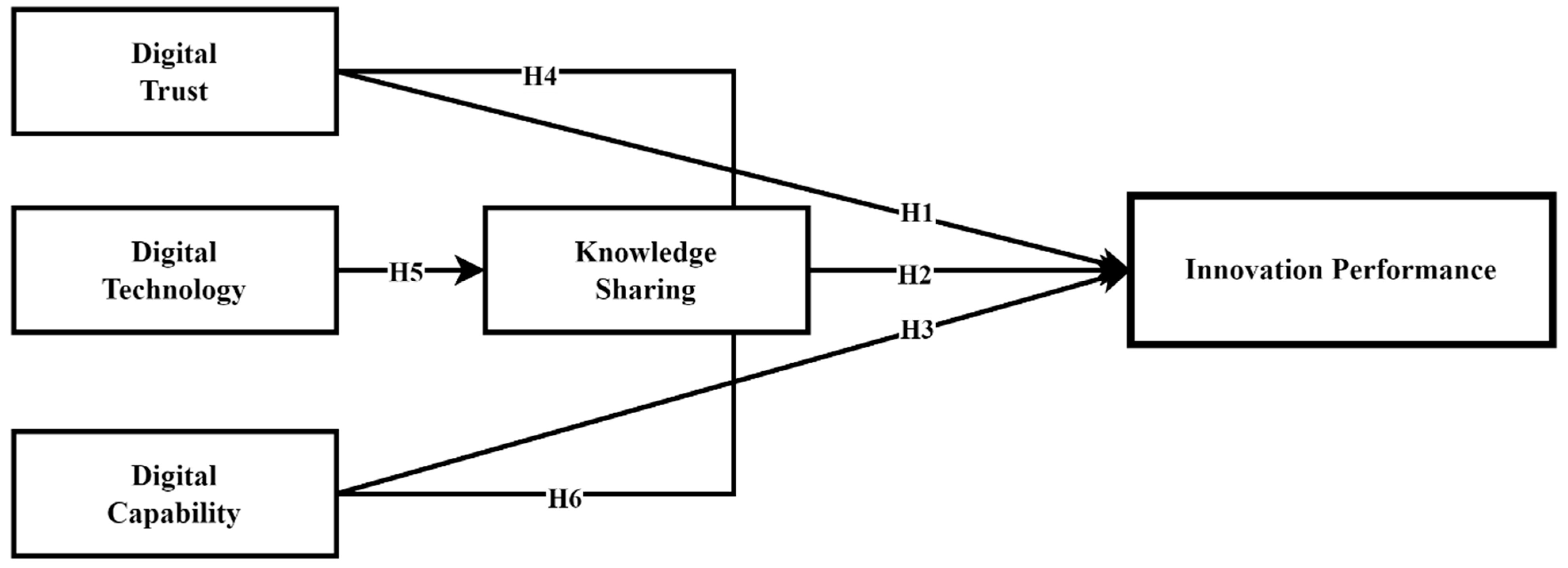
The conceptual framework below derives the review synopsis to investigate the role of digital technology, digital capability and digital trust to strengthen innovation performance via knowledge sharing. The framework demonstrates knowledge sharing in the mainstay process that connects digital factors with innovation. Figure 1, below, presents the stated research framework.

2.1.8. Knowledge Sharing and Digital Trust

The trust element spread inter-organizational knowledge sharing and collaboration. As seen in the digital world, trust could be moved between interpersonal relationships and trust in technologies, processes, and digital platforms (Kluiters et al., 2023). Digital trust dilutes around the misuse of data, security breaches, or exploitation, which help firms to share sensitive knowledge without fear (Mubarak & Petraite, 2020). According to existing studies, digital trust accounts for a reduction in the supervision value and incorporation of optimism into the climate of interactions (Brockman et al., 2018; C. Wang et al., 2020). Based on the findings, companies with digital trust at a higher level may be more able to move more towards knowledge exchange activities.
H1. 
Digital trust positively influences knowledge sharing.

2.1.9. Knowledge Sharing and Digital Technology

Innovation and joint involvement can be generated through the creation of digital technological centralization infrastructures. Such tools include, but are not limited to, big data analytics, cloud computing, collaborative platforms and robotics. These constitute the potential to create version control, distributed problem solving and real-time communication (Butkiene et al., 2025). Such innovations confer greater ability to utilize the value of transactions, when expanding optimism of knowledge sharing across all margins. Confirmed facts approved that companies applying disrupted innovative communication reflect greater efficiency to develop cooperation, integrating external sources (Bettiol et al., 2023). In this respect, centralization of DT has been assumed to enable knowledge sharing.
H2. 
Digital technology positively influences knowledge sharing.

2.1.10. Knowledge Sharing and Digital Capability

Digital capability directs organizational efficiency to reconfigure and integrate digital assets to address challenges and opportunities (Sousa-Zomer et al., 2020). Firms processing robust digital abilities are better positioned to adapt, utilize and absorb knowledge out of outer sources (Abourokbah et al., 2023). Similarly, such abilities also empower responsiveness to manage digital platforms, affirming efficient utility of exchanged knowledge for innovation. Previous reviews show that digital capability encourages both process and service innovation by upholding knowledge unification (Aliasghar et al., 2019; Li et al., 2022). Thus, businesses with significant digital capability became the most likely to benefit from and engage in knowledge sharing.
H3. 
Digital capability positively influences knowledge sharing.

2.1.11. Knowledge Sharing as a Mediator for Innovation Performance

Knowledge sharing acts as an intermediate force in enhancing the relationship be-tween digital trust and innovation performance (Le & Le, 2023). Organizations that are well digitalized are able to capture, process, and distribute information successfully (Sousa-Zomer et al., 2020). Once digital trust occurs at the organizational level, people are better able to share knowledge, ideas and expertise. This teamwork boosts innovation performance and creativity, as well as problem-solving skills, which, in the end, contribute to building sustainable organizational growth (T. Tang et al., 2021).
H4. 
Knowledge sharing positively mediates the relationship between digital trust and innovation performance.
H5. 
Knowledge sharing positively mediates the relationship between digital technology and innovation performance.
H6. 
Knowledge sharing positively mediates the relationship between digital capability and innovation performance.

2.2. Methods

A quantitative research design was followed in this review, while a systematic approach was utilized to examine these phenomena with the aid of statistical methods and numerical data. A cross-sectional survey design was adopted as it allows for the simultaneous examination of multiple latent constructs within digitally collaborative and technology-intensive contexts. Structural equation modelling (SEM) was employed due to the complexity of the proposed mediated relationships. This technique was used to test hypotheses; identify relationships, causal effects or patterns; and measure variables (Fischer et al., 2023). This study embedded a survey method as a significant data collection instrument to obtain numerical data (Bihu, 2021) from businesses engaged in innovation activities and technology-intensive digitally collaborative environments. The participants belong to firms engaged in technology-intensive domains, such as IT services, telecommunications, software development and manufacturing, given that they actively depend on knowledge sharing and digital collaboration with respect to innovation. The non-probability sampling technique under the convenience sampling approach was administered, in which participants were recruited due to their availability and ease of recruitment accessibility (Simkus, 2022). This technique was utilized to define and reach firms operating in technology-intensive sectors, where digital collaboration and knowledge sharing support innovation (O’Neil et al., 2021) as well as cooperative R&D initiatives. The selection and adaptation of measurement scales were carefully grounded in the established literature, with reliability and validity rigorously assessed using Cronbach’s alpha, composite reliability, AVE, and discriminant validity criteria. Primarily, the respondents consisted of IT leaders, R&D professionals and managers who have direct exposure to innovation practices and digital technology implementation. Overall, 280 valid responses were obtained, which is recognized as ideal for statistical analysis and compatible with the criteria for “structural equation modeling (SEM)”. These were promoted through a structured questionnaire that was used to collect the data through online dissemination across industry associations, online collaboration channels and professional networks. A Five-Point Likert scale was utilized, which underlies various constructs elaborated into the survey questionnaire that even went beyond a range of 1 (strongly disagree) to 5 (strongly agree) through the adherence of various themes of digital technology, digital trust, knowledge sharing, digital capability and innovation performance. This study used IBM SPSS Statistics 31.0.2.0 to analyze the gathered data (see Supplementary Materials). SPSS is a computer program used to process statistical data quickly and precisely, and it provides various outputs desired by decision makers (Ariawan & Wahyuni, 2020). Preliminary tests and descriptive statistics such as validity and reliability assessments were performed using SPSS. Although this study was motivated by open and collaborative digital environments, the survey did not directly measure participation in open-source projects. Instead, it focused on digital capability, digital trust, digital technology, and knowledge sharing as foundational enablers of innovation in technology-intensive organizations.
The participants’ anonymity was affirmed. With respect to reducing the issues related to typical methodical biases, the questionnaire was reassessed by experienced practitioners and academic experts to confirm validity and content clarity. In addition, the “Harman’s one-factor test” was used while performing data analysis to address and lessen concerns related to potential bias.

3. Results

3.1. Characteristics of the Study Participants

The sample was representative of a very highly educated male and experienced technology-oriented workforce, most of which work in software development and IT services. The majority of the respondents were of mid-career experience (6–10 years), worked in large organizations, and demonstrated extensive exposure to digital and digitally collaborative environments, meaning they had a solid background considering the topics of digital trust, capability, and knowledge sharing, as shown in Table 1.

3.2. Descriptive Analysis

The descriptive findings indicate that all variables, such as digital trust and digital technology, digital capability, knowledge sharing, and innovation performance, had mean scores of approximately 3.0, corresponding to the moderate perceptions of the respondents. The standard deviations of 1.13–1.50 show that there was a lot of variation in the responses, as shown in Table 2. Skewness values were near to zero, with a more or less symmetrical distribution, and negative kurtosis was consistently observed, which demonstrated that response patterns were flatter and more dispersed. Knowledge sharing and innovation performance had the greatest variability, which suggested that different organizations possessed varied experiences in both areas. In general, the data indicate the absence of both strong agreement and disagreement, indicating possibilities for organizations to build stronger digital trust, capabilities, and knowledge-sharing practices to improve the outcomes of innovation.

3.3. Results of the Data Normality Test

All Kolmogorov–Smirnov tests show significant p-values (0.000), indicating that none of the item-level variables follow a normal distribution, as shown in Table 3. The consistently high test statistics confirm deviations from normality, suggesting the data are non-parametric and supporting the use of robust or SEM-based techniques that do not require strict normality.

3.4. Reliability Analysis

The mean scores of all constructs were moderate, with a range of 3.0, which suggested a neutral or a slightly positive perception. Standard deviations implied different dispersions of responses, with the highest values for knowledge sharing and innovation performance. The values of alpha (0.906–0.971) showed the best internal reliability, which proves that all measurement scales were very consistent and could be analyzed further, as in Table 4.

3.5. KMO Analysis for Sample Adequacy

The KMO value of 0.962 showed that there was excellent sampling adequacy, which proved that the dataset was very appropriate in terms of factor analysis. The significance of the Bartlett Test (p = 0.000) indicated that there was enough correlation between the variables in Table 5. The combination of these findings supported the suitability of the exploratory or confirmatory factor analysis carried out on the constructs.

3.6. Correlation Matrix of Study Variables

Positive correlations between all constructs were strong and significant (p < 0.01). Knowledge sharing had the best correlation with innovation performance (r = 0.834), followed by digital capability and digital technology, shown in Table 6. There was also moderate correlation between digital trust and all the variables. In general, the findings suggested mutually supportive relationships between the constructs to confirm the hypothesized model relationships.

3.7. Measurement Model Evaluation

3.7.1. Results of the Measurement Model Assessment

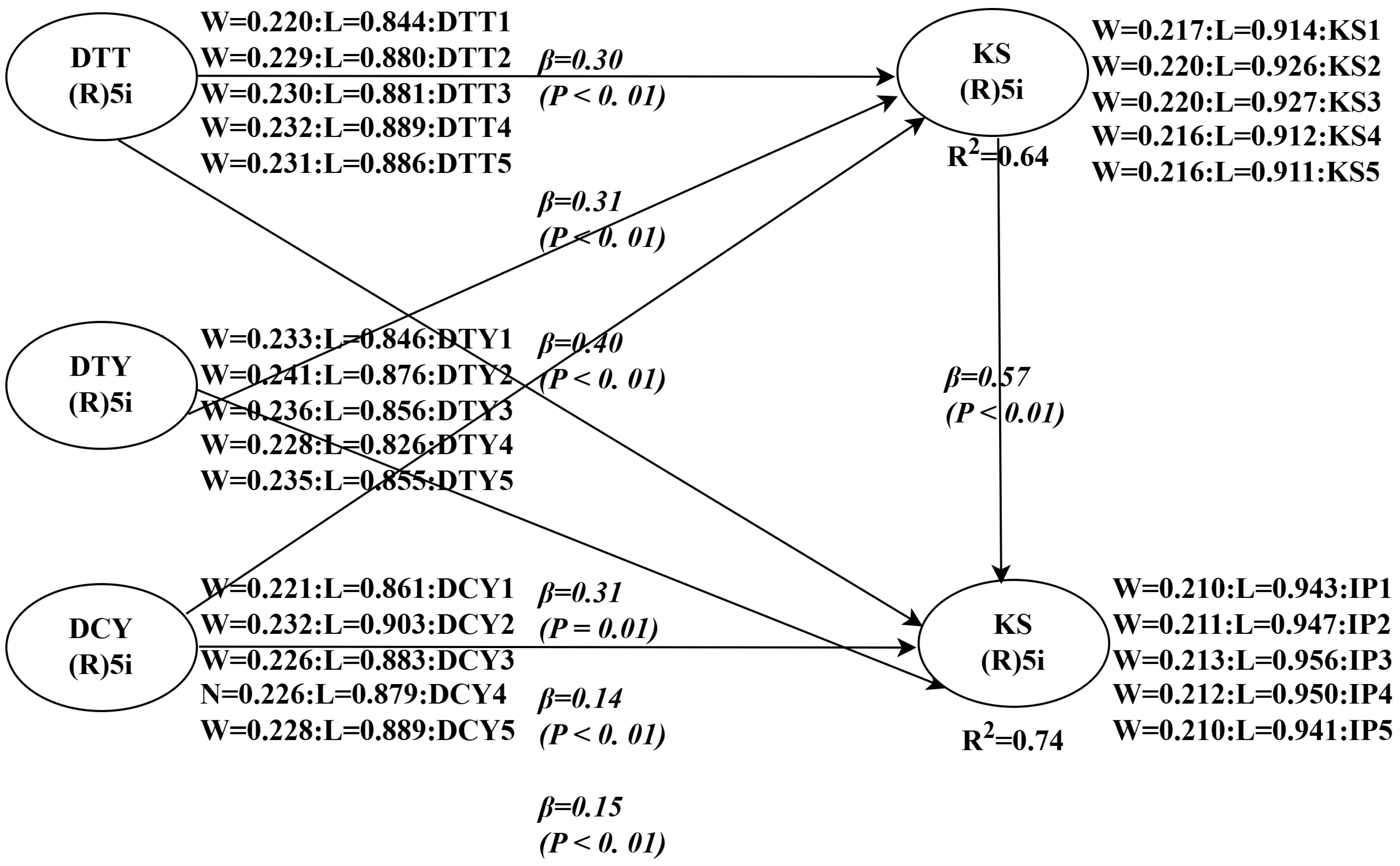
The model indicated that constructs had strong and significant relationships. Digital trust, digital technology and digital capability had a positive effect on knowledge sharing, with 64% variance. Knowledge sharing was a good predictor of innovation performance (β = 0.57), and all three digital factors had a direct effect on innovation performance, with the overall R2 being 0.74, which was very high, as shown in Figure 2.
There was a high loading for all items in their respective constructs, and the factor loading was above 0.80, which is a good indication of convergent validity. Knowledge sharing and innovation performance demonstrated the greatest loadings (≥0.91), which means the measurement quality was very high. The high loadings and clear measurement model indicated that each construct was strong, and they are clearly defined in the measurement model shown in Table 7.
Construct Reliability and Validity
The constructs exhibited a high level of reliability, and Cronbach’s Alpha and composite reliability scores were far better than the accepted level. Convergent validity was strong due to the AVE scores (0.726–0.897), as shown in Table 8. The values of VIF were below 5, which implied that there were no issues of multicollinearity. On the whole, the measurement model was sound, reliable and statistically valid in structural analysis.
Discriminant Validity
The inter-construct correlations were lower than the diagonal values (√AVE), which proved the high discriminant validity. The constructs had stronger ties with their indicators than with the other constructs in Table 9. Relationships between the variables were moderate to strong, and the distinctness between the √AVE values was a clear indication that the constructs were statistically differentiated and well defined.

3.7.2. Inner Structural Model

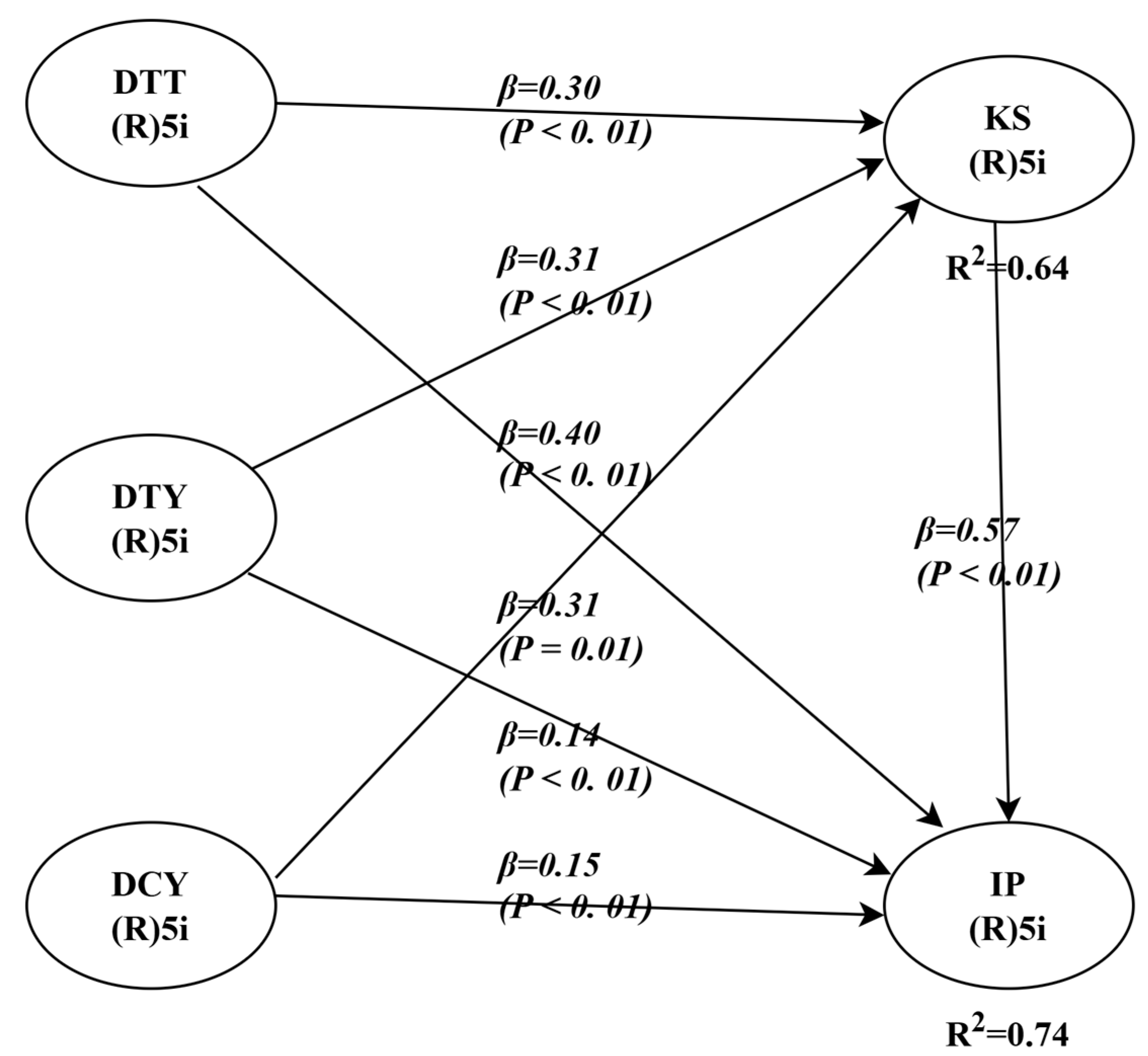
Digital trust, digital technology, and digital capability were important predictors of knowledge sharing and explained 64% of its variance in the structural model. The impact of knowledge sharing on innovation performance was strong, and all three digital factors had a strong direct effect on innovation performance. Comprehensively, the model had a high explanatory power, with R2 = 0.74, as shown in Figure 3.
Direct, Indirect, and Total Effects
Each of the direct paths was important. Knowledge sharing had the greatest impact on innovation performance (β = 0.568, f2 = 0.474). Knowledge sharing was more affected by digital capability than digital technology and digital trust. The three digital constructs imparted direct positive effects on innovation performance, albeit weak enough to suggest a complementary effect, as shown in Table 10.
There were indirect paths via knowledge sharing, and these substantiated its mediating effect between the three digital constructs and innovation performance, as shown in Table 11. The mediation between digital capability remained the most effective, followed by digital technology and digital trust. These findings revealed that knowledge sharing appeared to be an important mechanism, in which digital capabilities could be translated into better innovation outcomes.
The overall impacts indicated that all digital constructs had a great impact on both knowledge sharing and innovation performance. Digital capability showed the highest overall effects on the two outcomes, followed by digital technology and digital trust. Knowledge sharing emerged as the strongest predictor of innovation performance, which proved it to be at the center of generating organizational innovation performance, as shown in Table 12.
The model was very predictive, and digital trust, digital technology and digital capability accounted for 64% of the variance in knowledge sharing. The explanatory power was even greater for innovation performance (74%), as shown in Table 13. Excellent predictive relevance was established by the values of Q2 (>0), which implied that the model was clearly used to predict knowledge-sharing behavior and innovation outcomes.
Harman’s one-factor test was conducted to assess potential common method bias. The results showed that the first factor explained 55.135% of the total variance, while multiple additional factors with eigenvalues greater than one were also extracted, as shown in Table 14. This indicated that the variance was distributed across several factors rather than being dominated by a single factor. Therefore, common method bias did not appear to be a serious concern in this study.
Hypotheses Testing
Each of the six hypotheses was accepted. It increased knowledge sharing considerably regarding digital trust, digital technology and digital capability, showing the most important impact, as shown in Table 15. The relationships between all three digital constructs and innovation performance were also mediated by knowledge sharing, which made evident its central role in an act of converting digital strengths into better innovation performance.

4. Discussion

4.1. Section Introduction

In this section, we outline a critical interpretation of the empirical findings, whereby they are associated with the conceptual model in this study and the existing literature. It describes the influences of digital trust, digital technology and digital capability on knowledge-sharing practices and innovation performance. To explore the theoretical, practical, and contextual implications, the Discussion summarizes the statistical results.

4.2. Key Findings

The research aimed at investigating the impact of three digital antecedents, namely digital trust (DTT), digital technology (DTY), and digital capability (DCY), on knowledge sharing (KS) and innovation performance (IP) in the context of technology-intensive organizational settings. The findings contributed a number of important conclusions. High reliability (CA = 0.906–0.971) and validity indices (AVE = 0.726–0.897) of the constructs indicated the strength of the measurement model. The structural model was also found to be effective as the values of R2 were knowledge sharing, 0.642, and innovation performance, 0.739, indicating its high predictivity. These baseline measures allowed us to interpret the structural relationships with a lot of confidence.
The first important finding was that all three digital constructs, namely DTT, DTY, and DCY, had a significant impact on knowledge sharing. Digital capability proved to be the best predictor (β = 0.405), and it outperformed both digital technology (β = 0.306) and digital trust (β = 0.300). This suggested that the capacity, as opposed to the access to technology or belief in digital systems, was the most decisive factor in cultivating knowledge exchange behavior (Awan et al., 2021). By developing digital skills, data literacy, and mastery of systems, organizations can enable employees to be better equipped to navigate digital tools and make them more comfortable transferring knowledge across platforms (Sial et al., 2023). This was consistent with the modern view that digital capability is a primary enabler of digital transformation (Vial, 2021), not only in terms of technical proficiency but also the adaptive learning behaviors.
Digital technology also exhibited a significant effect on knowledge sharing. This means that the current digital infrastructure, such as cloud solutions, collaboration tools, digital platforms and collaborative technologies, and digital repositories, offer critical platforms for knowledge sharing (Gupta et al., 2025). The moderate coefficient, however, indicated that technology itself was inadequate without the human abilities to accompany it. This supports socio-technical theories, claiming that technology must be combined with people-related competencies to achieve its maximum value (Deng et al., 2023). Digital trust (however, it is also relatively weak) also had a great impact on knowledge sharing. Confidence in online systems, the security of data, the stability of the platform, and the safety of the communication space helped to make people share knowledge without the fear of theft and abuse, as well as monitoring. This outcome reaffirmed digital trust as a key psychological antecedent in the digital collaboration setting (Mubarak & Petraite, 2020; World Economic Forum, 2022), which was also reflected in the literature in organizational and information science regarding trust as a core requirement of open knowledge flows.
The second significant result was that knowledge sharing was a strong predictor of innovation performance (β = 0.568) and, thus, the strongest factor in the model. This indicated that organizational innovation was based on the willingness of the employees to share their ideas, insights, problem-solving techniques, and technical experiences (Ullah et al., 2024). In idea recombination, reducing redundancy, and increasing the organizational learning cycles, all the major components of innovation and knowledge sharing accelerate (Obrenovic et al., 2020). The findings showed that knowledge sharing was not just another organizational behavior but a strategic channel, with the help of which digital strength could be converted into the outcomes of innovation (Yeboah, 2023). This supports the premise that knowledge flow is the blood of an innovation ecosystem, especially in infrastructures that are technologically focused and where solutions change swiftly and are dependent on collective intelligence.
An important idea stands out under the circumstances of focusing on both the direct and indirect impacts of digital constructs on the performance of innovation. The three constructs had strong direct impacts on innovation performance: DCY (β = 0.152), DTY (β = 0.144), and DTT (β = 0.130). However, the values were comparatively small. On the other hand, DCY (0.230), DTY (0.174), and DTT (0.170) showed far greater indirect impacts because of information sharing. This meant that the main avenue where a digital antecedent affects innovation was not direct but indirect via knowledge sharing. This mediation ensured that the presence of digital resources or trust-based mechanisms was not the only component of the innovation equation (Deng et al., 2023; Mubarak & Petraite, 2020); the actual transformative force was present when organizations used these resources to drive cross-functional knowledge exchange.
Digital capability again demonstrated the largest indirect influence, which proved its centrality. The high level of digital skills and competencies enabled the employees to share, apply, and experiment with knowledge, thereby increasing the innovation outcomes (Awan et al., 2021; Ardolino et al., 2025). This implied that the development of capabilities, i.e., training, digital skill building, agile learning systems, was not only supportive but essential. Digital upskilling in organizations would consequently lead to a higher likelihood of converting technological potential into tangible innovations. The indirect position of digital technology underlined the fact that only when users share knowledge in the context of digital technology can the tools and platforms play a significant role in facilitating the innovation process (Helmstädter, 2003). This observation was subversive of the techno-deterministic views that technology determines innovation on its own. Rather, it favors a more holistic perspective: technology offers the platform but individuals offer the generative processes, transforming digital functionality into innovative output (Martínez-Peláez et al., 2023).
The indirect contribution of digital trust referred to the fact that trust created a psychologically safe digital environment (Chen et al., 2025), in which employees feel free to contribute their insights. A lack of trust could lead to the underuse of advanced technologies, limiting abilities due to fear or opposition. Trust, therefore, is the social lubricant of digital collaboration (Kluiters et al., 2023). This finding took on practical significance in the current organizations owing to the increased level of digital surveillance, cybersecurity threats, and data privacy issues in the contemporary context. A credible digital environment could be a condition to open up innovation in digital ecosystems. Moreover, the large values of Q2 (0.643 in KS; 0.740 in IP) ensured that the model had high predictive relevance, and the conclusions made by the model can be considered to be reliable. Together with the large path coefficients and effect sizes (f2), the results provided a consistent story: digital capability, technology, and trust had a role to play, although it was their synergistic product that contributed to knowledge-sharing behavior (Kumar, 2024).
In addition, these findings also corresponded to the general theoretical frameworks. They were consistent with the Knowledge-Based View (KBV) that argues knowledge to be the most strategically important resource for gaining competitive advantage (Sial et al., 2023). The findings reiterated that digital systems and competencies increased organizational learning mechanisms that, in turn, contributed to innovation (Mohanty et al., 2024). All in all, the findings affirmed that digital transformation programs must extend beyond the implementation of technology. For the best innovation performance, organizations are advised to build digital capabilities and permit trust-based environments, where knowledge can freely flow in digital networks. The success of the innovation outcomes in dynamic digital ecosystems was determined by their synergy.

4.3. Section Summary

Digital trust, digital technology and digital capability in relation to performance and knowledge sharing for innovation led to another issue that was touched upon in this section. The findings underscore the fact that knowledge sharing is constituted as the strongest predictor and intermediary. Digital capability was found to be the greatest antecedent. Overall, it can be stated that this study focused on the idea of human–digital collaboration as the primary success factor in the process of innovation.

5. Conclusions

This study examined how digital trust, digital technology, and digital capability influenced knowledge-sharing behaviors and innovation performance within technologically intensive organizational environments. The findings demonstrated that, while all three digital constructs significantly contributed to innovation outcomes, their effects were strongest when channeled through effective knowledge sharing. Knowledge sharing emerged as the central mechanism through which digital strengths were transformed into meaningful and sustainable innovation performance.
Among the three antecedents, digital capability proved to be the most influential. The results highlighted that equipping employees with digital skills, literacy, and adaptability is not merely supportive but strategically essential. Organizations that invest in building digital capability are able to foster confident and empowered employees who actively share knowledge and leverage digital tools to drive innovation. In this sense, digital capability functions as a core strategic resource rather than an auxiliary competency.
Digital technology also played a critical enabling role by providing the infrastructure and collaborative platforms necessary for storing, exchanging, and integrating knowledge. However, the findings confirmed that technology alone did not automatically generate innovation. Its value was materialized only when individuals actively used digital systems to exchange and apply knowledge, underscoring the importance of organizational cultures that promote collaboration, experimentation, and continuous learning.
Although comparatively smaller in magnitude, digital trust remained a vital facilitating factor. Trust in digital systems, data integrity, and online security fostered psychological safety, encouraging employees to share knowledge openly without fear of misuse. This digital confidence strengthened collaborative knowledge flows across teams and departments.
The significant mediation effects reinforced the view that innovation was not purely a technological outcome but a socio-organizational process grounded in knowledge exchange. For organizations seeking sustained innovation performance, digital investments must, therefore, be aligned with strategies that cultivate knowledge circulation, cross-functional collaboration, and shared learning.
Overall, this study contributed theoretically by clarifying the central role of knowledge sharing in digital innovation networks and by empirically demonstrating that digital readiness yields optimal results when integrated with behavioral and social enablers. The findings supported a balanced approach to digital transformation, where technology, trust, and capability operate collectively through knowledge-sharing processes to drive sustainable innovation success.

5.1. Recommendation

The multi-layered approach is one which must be adopted by organizations that want to reinforce performance in innovation. First, invest strategically in the development of digital capability by training and developing digital upskilling and competency-based learning frameworks. Developing worker skills will result in assured activities in digital tools and knowledge networks. Second, improve digital technology infrastructure through the incorporation of collaborative tools, open-source systems, and secure communication tools that allow for knowledge transfer. Third, establish digital trust through the policies of enhancing cybersecurity, openness in data control, and cognitive safety in online work environments. The organizational system must also develop rewards to knowledge-sharing behavior by using a recognition system, cross-functional collaboration, and communities of practice. By aligning technological, human, and cultural enablers, organizations can successfully transform these digital strengths into meaningful innovation deliverables.

5.2. Research Limitations and Future Direction

This study is subject to several limitations that must be considered when interpreting the findings. First, the cross-sectional research design restricted the ability to draw causal inferences among the examined variables. Second, the use of self-reported data might have increased the risk of common method bias, although this concern was assessed using Harman’s one-factor test. Third, the sample was drawn primarily from technology-intensive industries, which limited the generalizability of the findings to other industrial contexts. In addition, the use of convenience sampling further constrained the external validity of the results beyond digitally intensive organizational settings. Moreover, this study did not empirically distinguish between open-source and proprietary technological environments, which might influence innovation dynamics in different ways. Future research could address these limitations by adopting longitudinal research designs to capture changes in digital capabilities and trust over time, incorporating objective performance indicators or multi-source data to reduce potential method bias, and examining additional mediating variables such as digital literacy, organizational learning, or collaborative culture. Comparative studies across industries or national contexts would also provide deeper insights into the contextual variations in digital trust, technology adoption, and innovation processes.

Supplementary Materials

The following supporting information can be downloaded at: https://www.mdpi.com/article/10.3390/admsci16030139/s1.

Author Contributions

Conceptualization, R.K.N. and L.C.R.; methodology, R.K.N.; formal analysis, R.K.N.; investigation, R.K.N.; writing—original draft preparation, R.K.N.; writing—review and editing, L.C.R.; supervision, L.C.R. All authors have read and agreed to the published version of the manuscript.

Funding

This research received no external funding.

Institutional Review Board Statement

Ethical review and approval were not required for this study in accordance with local legislation and institutional requirements, as the research involved anonymous survey data and did not collect identifiable personal information.

Informed Consent Statement

All participants provided informed consent prior to data collection.

Data Availability Statement

The dataset and the analysis used in this study will be made available upon reasonable request.

Conflicts of Interest

The authors declare no conflicts of interest.

Abbreviations

The following abbreviations are used in this manuscript:
DTDigital transformation
KBVKnowledge-based view
MLMachine learning
NLPNatural language programming
NPDNew product development
DTDigital trust
DTYDigital technology
KSKnowledge sharing
IPInnovation performance
DCDigital capability

References

  1. Abourokbah, S. H., Mashat, R. M., & Salam, M. A. (2023). Role of absorptive capacity, digital capability, agility, and resilience in supply chain innovation performance. Sustainability, 15(4), 3636. [Google Scholar] [CrossRef]
  2. Abu El-Ella, N., Bessant, J., & Pinkwart, A. (2016). Revisiting the honorable merchant: The reshaped role of trust in open innovation: Trust in open innovation. Thunderbird International Business Review, 58(3), 261–275. [Google Scholar] [CrossRef]
  3. Ahmad, T., Boit, J., & Aakula, A. (2023). The role of cross-functional collaboration in digital transformation. Journal of Computational Intelligence and Robotics, 3(1), 205–242. [Google Scholar]
  4. Ali, A., Yin, J., Li, F. F., & Cui, H. (2025). Pathway toward an open source ecosystem in power systems: A blueprint for collaborative innovation and software sustainability. IEEE Electrification Magazine, 13(2), 58–67. [Google Scholar] [CrossRef]
  5. Aliasghar, O., Rose, E. L., & Chetty, S. (2019). Where to search for process innovations? The mediating role of absorptive capacity and its impact on process innovation. Industrial Marketing Management, 82, 199–212. [Google Scholar] [CrossRef]
  6. Ardolino, M., Bino, A., Ciano, M. P., & Bacchetti, A. (2025). Enabling digital capabilities with technologies: A multiple case study of manufacturing supply chains in disruptive times. Systems, 13(1), 39. [Google Scholar] [CrossRef]
  7. Ariawan, R., & Wahyuni, A. (2020). The effect of applying TPS type cooperative learning model assisted by SPSS software on students’ skills in IT-based statistical data analysis course. Journal of Physics: Conference Series, 1581(1), 012027. [Google Scholar] [CrossRef]
  8. Arkhipova, D., & Bozzoli, C. (2018). Digital capabilities. In G. Bongiorno, D. Rizzo, & G. Vaia (Eds.), CIOs and the digital transformation: A new leadership role (pp. 121–146). Springer International Publishing. [Google Scholar] [CrossRef]
  9. Arogundade, O. R., & Palla, K. (2023). Virtualization revolution: Transforming cloud computing with scalability and agility. International Advanced Research Journal in Science, Engineering and Technology, 10, 619–632. [Google Scholar] [CrossRef]
  10. Asparouhova, N. (2020). Working in public: The making and maintenance of open source software. Stripe Press. Available online: https://books.google.com/books?hl=en&lr=&id=zxjBEAAAQBAJ&oi=fnd&pg=PT20&dq=Open-source+technology+refers+to+software,+platforms,+and+tools+whose+source+code+is+freely+available+for+use,+modification,+and+distribution.&ots=9zI51dGP2t&sig=gaLeXI5GH_R9IqFsvxJHDSTMjzQ (accessed on 24 February 2026).
  11. Atobishi, T., Moh’d Abu Bakir, S., & Nosratabadi, S. (2024). How do digital capabilities affect organizational performance in the public sector? The mediating role of the organizational agility. Administrative Sciences, 14(2), 37. [Google Scholar] [CrossRef]
  12. Awan, U., Shamim, S., Khan, Z., Zia, N. U., Shariq, S. M., & Khan, M. N. (2021). Big data analytics capability and decision-making: The role of data-driven insight on circular economy performance. Technological Forecasting and Social Change, 168, 120766. [Google Scholar] [CrossRef]
  13. Bettiol, M., Capestro, M., Di Maria, E., & Grandinetti, R. (2023). Leveraging on intra-and inter-organizational collaboration in Industry 4.0 adoption for knowledge creation and innovation. European Journal of Innovation Management, 26(7), 328–352. [Google Scholar] [CrossRef]
  14. Bhardwaj, A., Kumar, S. V., Vinukonda, A., Ramakrishna, K., Srivastava, S., Rajendran, S. P., & Sharma, P. (2025). Robotics and automation: Revolutionizing research and development. In Evolving landscapes of research and development: Trends, challenges, and opportunities (pp. 313–338). IGI Global Scientific Publishing. Available online: https://www.igi-global.com/chapter/robotics-and-automation/369482 (accessed on 24 February 2026).
  15. Bihu, R. (2021). Questionnaire survey methodology in educational and social science studies. International Journal of Quantitative and Qualitative Research Methods, 9(3), 40–60. [Google Scholar]
  16. Blichfeldt, H., & Faullant, R. (2021). Performance effects of digital technology adoption and product & service innovation–A process-industry perspective. Technovation, 105, 102275. [Google Scholar]
  17. Blind, K., Böhm, M., Grzegorzewska, P., Katz, A., Muto, S., Pätsch, S., & Schubert, T. (2021). The impact of open source software and hardware on technological independence, competitiveness and innovation in the EU economy. Final Study Report. European Commission. [Google Scholar] [CrossRef]
  18. Blomqvist, K., Hurmelinna-Laukkanen, P., & Mention, A.-L. (2024). Toward integrating trust in open innovation. In The Oxford handbook of open innovation. Oxford University Press. Available online: https://academic.oup.com/edited-volume/56000/chapter/440985748 (accessed on 24 February 2026).
  19. Bogers, M., & West, J. (2012). Managing distributed innovation: Strategic utilization of open and user innovation. Creativity and Innovation Management, 21(1), 61–75. [Google Scholar] [CrossRef]
  20. Brockman, P., Khurana, I. K., & Zhong, R. (2018). Societal trust and open innovation. Research Policy, 47(10), 2048–2065. [Google Scholar] [CrossRef]
  21. Butkiene, R., Gudonienė, D., Čeponienė, L., Vaiciukynas, E., Virkus, S., Dickel, J., Rocio, V., & Coelho, J. (2025). Digital transformation: Handbook for digital transformation specialists. Available online: https://epubl.ktu.edu/object/elaba:229176238/229176238.pdf (accessed on 24 February 2026).
  22. Canbul, A., & Çemberci, M. (2023). Innovation capability as key to competitive advantage: Relation of product innovation capability, process innovation capability, and firm performance. Journal of International Trade, Logistics and Law, 9(1), 134–142. [Google Scholar]
  23. Capestro, M., Rizzo, C., Kliestik, T., Peluso, A. M., & Pino, G. (2024). Enabling digital technologies adoption in industrial districts: The key role of trust and knowledge sharing. Technological Forecasting and Social Change, 198, 123003. [Google Scholar] [CrossRef]
  24. Castaneda, D. I., & Cuellar, S. (2020). Knowledge sharing and innovation: A systematic review. Knowledge and Process Management, 27(3), 159–173. [Google Scholar] [CrossRef]
  25. Cepa, K., & Schildt, H. (2019). Technological embeddedness of inter-organizational collaboration processes. In J. Sydow, & H. Berends (Eds.), Research in the sociology of organizations (pp. 91–115). Emerald Publishing Limited. [Google Scholar] [CrossRef]
  26. Chaudhary, S., Kaur, P., Talwar, S., Islam, N., & Dhir, A. (2022). Way off the mark? Open innovation failures: Decoding what really matters to chart the future course of action. Journal of Business Research, 142, 1010–1025. [Google Scholar] [CrossRef]
  27. Chen, J., Cai, W., Luo, J., & Mao, H. (2025). How does digital trust boost open innovation? Evidence from a mixed approach. Technological Forecasting and Social Change, 212, 123953. [Google Scholar] [CrossRef]
  28. Dabić, M., Daim, T., Bogers, M. L., & Mention, A.-L. (2023). The limits of open innovation: Failures, risks, and costs in open innovation practice and theory. Technovation, 126, 102786. [Google Scholar] [CrossRef]
  29. Deng, H., Duan, S. X., & Wibowo, S. (2023). Digital technology driven knowledge sharing for job performance. Journal of Knowledge Management, 27(2), 404–425. [Google Scholar] [CrossRef]
  30. Fichman, R. G., Dos Santos, B. L., & Zheng, Z. (2014). Digital innovation as a fundamental and powerful concept in the information systems curriculum. MIS Quarterly, 38(2), 329–354. [Google Scholar] [CrossRef]
  31. Fischer, H. E., Boone, W. J., & Neumann, K. (2023). Quantitative research designs and approaches. In Handbook of research on science education (pp. 28–59). Routledge. Available online: https://api.taylorfrancis.com/content/chapters/edit/download?identifierName=doi&identifierValue=10.4324/9780367855758-3&type=chapterpdf (accessed on 24 February 2026).
  32. Ghosh, S., Hughes, M., Hodgkinson, I., & Hughes, P. (2022). Digital transformation of industrial businesses: A dynamic capability approach. Technovation, 113, 102414. [Google Scholar] [CrossRef]
  33. Gupta, S. T., Joshi, P., Kaur, A., & Kumar, P. (2025). Digital tools and technologies: Enabling knowledge sharing and collaborative business culture. In Knowledge sharing and fostering collaborative business culture (pp. 297–328). IGI Global Scientific Publishing. Available online: https://www.igi-global.com/chapter/digital-tools-and-technologies/373284 (accessed on 24 February 2026).
  34. Haffke, I., Kalgovas, B., & Benlian, A. (2017). Options for transforming the IT function using bimodal IT. MIS Quarterly Executive, 16(2), 101. [Google Scholar]
  35. Hameed, W. U., & Naveed, F. (2019). Coopetition-based open-innovation and innovation performance: Role of trust and dependency evidence from Malaysian high-tech SMEs. Pakistan Journal of Commerce and Social Sciences (PJCSS), 13(1), 209–230. [Google Scholar]
  36. Helmstädter, E. (2003). The institutional economics of knowledge sharing: Basic issues. In The economics of knowledge sharing (pp. 11–38). Edward Elgar Publishing. Available online: https://www.elgaronline.com/edcollchap/book/9781035305018/book-part-9781035305018-10.xml (accessed on 24 February 2026).
  37. Hervas-Oliver, J.-L., Sempere-Ripoll, F., & Boronat-Moll, C. (2021). Technological innovation typologies and open innovation in SMEs: Beyond internal and external sources of knowledge. Technological Forecasting and Social Change, 162, 120338. [Google Scholar] [CrossRef]
  38. Hutton, S., Demir, R., & Eldridge, S. (2024). A microfoundational view of the interplay between open innovation and a firm’s strategic agility. Long Range Planning, 57(3), 102429. [Google Scholar] [CrossRef]
  39. Kalusivalingam, A. K., Sharma, A., Patel, N., & Singh, V. (2020). Enhancing predictive maintenance in manufacturing using Machine learning algorithms and IoT-driven data analytics. International Journal of AI and ML, 1(3). Available online: https://cognitivecomputingjournal.com/index.php/IJAIML-V1/article/view/50 (accessed on 24 February 2026).
  40. Kastelli, I., Dimas, P., Stamopoulos, D., & Tsakanikas, A. (2024). Linking digital capacity to innovation performance: The mediating role of absorptive capacity. Journal of the Knowledge Economy, 15(1), 238–272. [Google Scholar] [CrossRef]
  41. Kluiters, L., Srivastava, M., & Tyll, L. (2023). The impact of digital trust on firm value and governance: An empirical investigation of US firms. Society and Business Review, 18(1), 71–103. [Google Scholar] [CrossRef]
  42. Kmieciak, R. (2021). Trust, knowledge sharing, and innovative work behavior: Empirical evidence from Poland. European Journal of Innovation Management, 24(5), 1832–1859. [Google Scholar] [CrossRef]
  43. Kong, D., Zhao, Y., & Liu, S. (2021). Trust and innovation: Evidence from CEOs’ early-life experience. Journal of Corporate Finance, 69, 101984. [Google Scholar] [CrossRef]
  44. Kornberger, M. (2017). The visible hand and the crowd: Analyzing organization design in distributed innovation systems. Strategic Organization, 15(2), 174–193. [Google Scholar] [CrossRef]
  45. Kumar, A. (2024, April 27). Knowledge transfer in the digital age: Investigating the mechanisms and challenges. Available online: https://papers.ssrn.com/sol3/papers.cfm?abstract_id=4809874 (accessed on 24 February 2026).
  46. Kumari, P., Shankar, A., Behl, A., Pereira, V., Yahiaoui, D., Laker, B., Gupta, B. B., & Arya, V. (2024). Investigating the barriers towards adoption and implementation of open innovation in healthcare. Technological Forecasting and Social Change, 200, 123100. [Google Scholar] [CrossRef]
  47. Lakshman, K., Ranjita, P. K., Selvakumar, P., & Manjunath, T. C. (2025). The role of digital platforms in open innovation. In Open innovation strategies for effective competitive advantage (pp. 287–314). IGI Global Scientific Publishing. Available online: https://www.igi-global.com/chapter/the-role-of-digital-platforms-in-open-innovation/371996 (accessed on 24 February 2026).
  48. Le, T. T., & Le, P. B. (2023). High-involvement HRM practices stimulate incremental and radical innovate ion: The roles of knowledge sharing and market turbulence. Journal of Open Innovation: Technology, Market, and Complexity, 9(1), 100006. [Google Scholar] [CrossRef]
  49. Li, L., Zhu, W., Wei, L., & Yang, S. (2022). How can digital collaboration capability boost service innovation? Evidence from the information technology industry. Technological Forecasting and Social Change, 182, 121830. [Google Scholar] [CrossRef]
  50. Madanaguli, A., Dhir, A., Talwar, S., Clauss, T., Kraus, S., & Kaur, P. (2023). Diving into the uncertainties of open innovation: A systematic review of risks to uncover pertinent typologies and unexplored horizons. Technovation, 119, 102582. [Google Scholar] [CrossRef]
  51. Martínez-Peláez, R., Ochoa-Brust, A., Rivera, S., Félix, V. G., Ostos, R., Brito, H., Félix, R. A., & Mena, L. J. (2023). Role of digital transformation for achieving sustainability: Mediated role of stakeholders, key capabilities, and technology. Sustainability, 15(14), 11221. [Google Scholar] [CrossRef]
  52. Mohanty, A., Keswani, B., Mohanty, S. K., Mohapatra, A. G., Nayak, S., & Akhtar, M. M. (2024). Synergizing knowledge management in the era of Industry 4.0: A technological revolution for organizational excellence. In R. Kumar, V. Jain, V. C. Ibarra, C. A. Talib, & V. Kukreja (Eds.), Knowledge management and industry revolution 4.0 (1st ed., pp. 39–85). Wiley. [Google Scholar] [CrossRef]
  53. Mubarak, M. F., & Petraite, M. (2020). Industry 4.0 technologies, digital trust and technological orientation: What matters in open innovation? Technological Forecasting and Social Change, 161, 120332. [Google Scholar] [CrossRef]
  54. Nambisan, S., Lyytinen, K., Majchrzak, A., & Song, M. (2017). Digital innovation management. MIS Quarterly, 41(1), 223–238. [Google Scholar] [CrossRef]
  55. Nambisan, S., Wright, M., & Feldman, M. (2019). The digital transformation of innovation and entrepreneurship: Progress, challenges and key themes. Research Policy, 48(8), 103773. [Google Scholar] [CrossRef]
  56. Obrenovic, B., Jianguo, D., Tsoy, D., Obrenovic, S., Khan, M. A. S., & Anwar, F. (2020). The enjoyment of knowledge sharing: Impact of altruism on tacit knowledge-sharing behavior. Frontiers in Psychology, 11, 1496. [Google Scholar] [CrossRef]
  57. O’Neil, M., Cai, X., Muselli, L., Pailler, F., & Zacchiroli, S. (2021). The coproduction of open source software by volunteers and big tech firms. University of Canberra. [Google Scholar] [CrossRef]
  58. Onetti, A. (2021). Turning open innovation into practice: Trends in European corporates. Journal of Business Strategy, 42(1), 51–58. [Google Scholar] [CrossRef]
  59. Pearce, J. M. (2020). Economic savings for scientific free and open source technology: A review. HardwareX, 8, e00139. [Google Scholar] [CrossRef]
  60. Polcumpally, A. T., Pandey, K. K., Kumar, A., & Samadhiya, A. (2024). Blockchain governance and trust: A multi-sector thematic systematic review and exploration of future research directions. Heliyon, 10(12), e32975. [Google Scholar] [CrossRef]
  61. Radtke, R. R., Speklé, R. F., & Widener, S. K. (2023). Flourish or flounder: Do trust-centric management controls encourage knowledge sharing and team performance? Accounting, Organizations and Society, 107, 101429. [Google Scholar] [CrossRef]
  62. Rupeika-Apoga, R., Petrovska, K., & Bule, L. (2022). The Effect of Digital Orientation and Digital Capability on Digital Transformation of SMEs during the COVID-19 Pandemic. Journal of Theoretical and Applied Electronic Commerce Research, 17(2), 669–685. [Google Scholar] [CrossRef]
  63. Scholapurapu, P. K., & Deepa, K. (2025). Cybersecurity strategies for ensuring digital trust and business continuity. Available online: https://papers.ssrn.com/sol3/papers.cfm?abstract_id=5346970 (accessed on 24 February 2026).
  64. Serenko, A., & Bontis, N. (2016). Negotiate, reciprocate, or cooperate? The impact of exchange modes on inter-employee knowledge sharing. Journal of Knowledge Management, 20(4), 687–712. [Google Scholar] [CrossRef]
  65. Shahadat, M. M. H., Nekmahmud, M., Ebrahimi, P., & Fekete-Farkas, M. (2023). Digital technology adoption in smes: What technological, environmental and organizational factors influence in emerging countries? Global Business Review, Advanced online publication. [Google Scholar] [CrossRef]
  66. Sial, M. A., Paul, Z. I., Rafiq, Z., & Abid, G. (2023). Does mobile technology shape employee socialization and enable tacit knowledge sharing in public sector organizations. Journal of Open Innovation: Technology, Market, and Complexity, 9(3), 100089. [Google Scholar] [CrossRef]
  67. Simkus, J. (2022, October 6). Convenience sampling: Definition, method and examples. Simply Psychology. [Google Scholar]
  68. Singh, S. K., Gupta, S., Busso, D., & Kamboj, S. (2021). Top management knowledge value, knowledge sharing practices, open innovation and organizational performance. Journal of Business Research, 128, 788–798. [Google Scholar] [CrossRef]
  69. Sousa-Zomer, T. T., Neely, A., & Martinez, V. (2020). Digital transforming capability and performance: A microfoundational perspective. International Journal of Operations & Production Management, 40(7/8), 1095–1128. [Google Scholar] [CrossRef]
  70. Stephany, F., Braesemann, F., & Graham, M. (2021). Coding together—Coding alone: The role of trust in collaborative programming. Information, Communication & Society, 24(13), 1944–1961. [Google Scholar] [CrossRef]
  71. Tang, H., Yao, Q., Boadu, F., & Xie, Y. (2023). Distributed innovation, digital entrepreneurial opportunity, IT-enabled capabilities, and enterprises’ digital innovation performance: A moderated mediating model. European Journal of Innovation Management, 26(4), 1106–1128. [Google Scholar] [CrossRef]
  72. Tang, T., Fisher, G. J., & Qualls, W. J. (2021). The effects of inbound open innovation, outbound open innovation, and team role diversity on open source software project performance. Industrial Marketing Management, 94, 216–228. [Google Scholar] [CrossRef]
  73. Ullah, S., Ahmad, T., Kukreti, M., Sami, A., & Shaukat, M. R. (2024). How organizational readiness for green innovation, green innovation performance and knowledge integration affects sustainability performance of exporting firms. Journal of Asia Business Studies, 18(2), 519–537. [Google Scholar] [CrossRef]
  74. van de Hoven, J., Comandé, G., Ruggieri, S., Domingo-Ferrer, J., Musiani, F., Giannotti, F., Pratesi, F., & Stauch, M. (2021). Towards a digital ecosystem of trust: Ethical, legal and societal implications. Opinio Juris in Comparatione, 1(1/2021), 131–156. [Google Scholar]
  75. Vial, G. (2021). Understanding digital transformation: A review and a research agenda. In Managing digital transformation. Routledge. [Google Scholar]
  76. Wang, C., Chin, T., & Lin, J.-H. (2020). Openness and firm innovation performance: The moderating effect of ambidextrous knowledge search strategy. Journal of Knowledge Management, 24(2), 301–323. [Google Scholar] [CrossRef]
  77. Wang, L., Yeung, J. H. Y., & Zhang, M. (2011). The impact of trust and contract on innovation performance: The moderating role of environmental uncertainty. International Journal of Production Economics, 134(1), 114–122. [Google Scholar] [CrossRef]
  78. Wang, M., Wang, Y., & Mardani, A. (2023). Empirical analysis of the influencing factors of knowledge sharing in industrial technology innovation strategic alliances. Journal of Business Research, 157, 113635. [Google Scholar] [CrossRef]
  79. Wang, S., Zhao, S., Fan, X., Zhang, B., & Shao, D. (2025). The impact of open innovation on innovation performance: The chain mediating effect of knowledge field activity and knowledge transfer. Information Technology and Management, 26(2), 139–161. [Google Scholar] [CrossRef]
  80. World Economic Forum. (2022). Earning digital trust: Decision-making for trustworthy technologies. Insight Report. World Economic Forum. [Google Scholar]
  81. Yeboah, A. (2023). Knowledge sharing in organization: A systematic review. Cogent Business & Management, 10(1), 2195027. [Google Scholar] [CrossRef]
  82. Yun, J. J., Zhao, X., & Liu, Z. (2024). Regulation architecture of open innovation under digital transformation: Case study on telemedicine and for-profit-hospital. Journal of Open Innovation: Technology, Market, and Complexity, 10(1), 100252. [Google Scholar] [CrossRef]
  83. Zamiri, M., & Esmaeili, A. (2024). Methods and technologies for supporting knowledge sharing within learning communities: A systematic literature review. Administrative Sciences, 14(1), 17. [Google Scholar] [CrossRef]
Figure 1. Conceptual framework.
Admsci 16 00139 g001
Figure 2. Outer measurement model.
Admsci 16 00139 g002
Figure 3. Inner structural model.
Admsci 16 00139 g003
Table 1. Demographic characteristics.
Demographic VariablesFrequencyPercent
AgeBelow 25155.4
25–3410035.7
35–448229.3
45–546322.5
55 and above207.1
Total280100.0
GenderFemale7727.5
Male18967.5
Prefer not to say145.0
Total280100.0
Highest Educational QualificationDiploma/Associate Degree279.6
Bachelor’s Degree9634.3
Master’s Degree11842.1
Doctorate/PhD2910.4
Professional Certification82.9
Vocational Training20.7
Total280100.0
Current Job Role/PositionData Scientist51.8
IT Leader/Head7827.9
Product Owner41.4
Project Manager/Coordinator5820.7
R&D Manager/Specialist7627.1
Software/Technology Developer5921.1
Total280100.0
Years of Professional ExperienceLess than 2 years217.5
2–5 years4014.3
6–10 years9734.6
11–15 years7125.4
More than 15 years5118.2
Total280100.0
Industry/SectorBioTech82.9
Cloud Computing Services31.1
FinTech31.1
IT Services7827.9
Manufacturing/Industrial Technology4215.0
Software Development10537.5
Telecommunications4114.6
Total280100.0
Organization Size (Number of Employees)Small (1–49)207.1
Medium (50–249)9333.2
Large (250 or more)16759.6
Total280100.0
Experience with Digital/digitally collaborative environmentsLess than 1 year186.4
1–3 years4014.3
4–6 years8630.7
7–10 years8831.4
More than 10 years4817.1
Total280100.0
Table 2. Descriptive statistics for all variables.
VariablesNMinMaxMeanStd. DeviationSkewnessKurtosis
Digital Trust (DTT)DTT1280152.991.1390.043−0.730
DTT2280153.041.160−0.084−0.812
DTT3280153.001.142−0.044−0.726
DTT4280152.981.193−0.015−0.819
DTT5280152.991.1450.000−0.849
Digital Technology (DTY)DTY1280153.021.178−0.035−0.741
DTY2280153.011.1390.001−0.705
DTY3280153.021.1730.039−0.762
DTY4280153.071.132−0.134−0.672
DTY5280153.001.139−0.132−0.653
Digital Capability (DCY)DCY1280152.971.183−0.107−0.773
DCY2280152.951.192−0.076−0.875
DCY3280152.931.2260.073−0.955
DCY4280152.911.1470.133−0.644
DCY5280152.961.209−0.016−0.859
Knowledge Sharing (KS)KS1280153.011.3470.040−1.161
KS2280152.981.3290.065−1.099
KS3280153.031.298−0.024−1.016
KS4280153.011.363−0.047−1.232
KS5280152.971.3140.024−1.100
Innovation Performance (IP)IP1280153.131.484−0.163−1.340
IP2280153.061.498−0.079−1.404
IP3280153.081.483−0.023−1.378
IP4280153.081.453−0.116−1.338
IP5280153.061.504−0.053−1.438
Table 3. Normality analysis.
VariablesKolmogorov-Smirnov
StatisticdfSig.
Digital Trust (DTT)DTT10.1692800.000
DTT20.1672800.000
DTT30.1712800.000
DTT40.1662800.000
DTT50.1682800.000
Digital Technology (DTY)DTY10.1762800.000
DTY20.1702800.000
DTY30.1752800.000
DTY40.1802800.000
DTY50.1962800.000
Digital Capability (DCY)DCY10.1892800.000
DCY20.1662800.000
DCY30.1682800.000
DCY40.1872800.000
DCY50.1642800.000
Knowledge-Sharing (KS)KS10.1582800.000
KS20.1512800.000
KS30.1482800.000
KS40.1782800.000
KS50.1522800.000
Innovation Performance (IP)IP10.1582800.000
IP20.1602800.000
IP30.1672800.000
IP40.1722800.000
IP50.1672800.000
Table 4. Reliability analysis using Cronbach’s Alpha.
ConstructsNo. of ItemsMeanStd. DeviationCronbach’s Alpha (CA)
Digital Trust (DTT)53.001.0130.924
Digital Technology (DTY)53.020.9820.906
Digital Capability (DCY)52.941.0520.929
Knowledge-Sharing (KS)53.001.2210.953
Innovation Performance (IP)53.081.4060.971
Table 5. KMO test for sample adequacy.
KMO and Bartlett’s Test
Kaiser–Meyer–Olkin Measure of Sampling Adequacy0.962
Bartlett’s Test of SphericityApprox. Chi-Square7087.348
df300
Sig.0.000
Table 6. Correlation analysis.
CorrelationsIPDTTDTYDCYKS
IPPearson Correlation10.574 **0.636 **0.650 **0.834 **
Sig. (2-tailed) 0.0000.0000.0000.000
N280280280280280
DTTPearson Correlation0.574 **10.441 **0.381 **0.581 **
Sig. (2-tailed)0.000 0.0000.0000.000
N280280280280280
DTYPearson Correlation0.636 **0.441 **10.499 **0.640 **
Sig. (2-tailed)0.0000.000 0.0000.000
N280280280280280
DCYPearson Correlation0.650 **0.381 **0.499 **10.665 **
Sig. (2-tailed)0.0000.0000.000 0.000
N280280280280280
KSPearson Correlation0.834 **0.581 **0.640 **0.665 **1
Sig. (2-tailed)0.0000.0000.0000.000
N280280280280280
** Correlation is significant at the 0.01 level (2-tailed).
Table 7. Outer loadings.
ConstructsDigital Trust (DTT)Digital Technology (DTY)Digital Capability (DCY)Knowledge Sharing (KS)Innovation Performance (IP)
DTT10.844
DTT20.880
DTT30.881
DTT40.889
DTT50.886
DTY1 0.846
DTY2 0.876
DTY3 0.856
DTY4 0.826
DTY5 0.855
DCY1 0.861
DCY2 0.903
DCY3 0.883
DCY4 0.879
DCY5 0.889
KS1 0.914
KS2 0.926
KS3 0.927
KS4 0.912
KS5 0.911
IP1 0.943
IP2 0.947
IP3 0.956
IP4 0.950
IP5 0.941
Table 8. Construct reliability and validity using CA, CR and AVE.
ConstructsCronbach’s Alpha (CA)Composite Reliability (CR)Average Variance Extracted (AVE)Collinearity Statistics (VIF)
Digital Trust (DTT)0.9240.9430.7681.586
Digital Technology (DTY)0.9060.9300.7261.816
Digital Capability (DCY)0.9290.9470.7801.911
Knowledge Sharing (KS)0.9530.9640.8423.962
Innovation Performance (IP)0.9710.9780.8973.768
Table 9. Discriminant validity: Farnell–Larcker criterion.
ConstructsDTTDTYDCYKSIP
DTT0.768
DTY0.4410.726
DCY0.3810.4980.780
KS0.5810.6390.6650.842
IP0.5740.6360.6490.8340.897
Table 10. Direct effects.
Direct Pathsβ (Path Coefficient)SEt-ValueEffect Size (f2)
DTT → KS0.3000.0575.26 **0.176
DTY → KS0.3060.0575.37 **0.196
DCY → KS0.4050.0567.23 **0.270
DTT → IP0.1300.0592.20 *0.075
DTY → IP0.1440.0582.48 *0.091
DCY → IP0.1520.0582.62 *0.099
KS → IP0.5680.05410.52 **0.474
* Significant at 0.05 level; ** Significant at 0.01 level.
Table 11. Indirect effects.
Indirect Pathsβ (Indirect Effect)SEt-ValueEffect Size (f2)
DTT → KS → IP0.1700.0414.15 **0.098
DTY → KS → IP0.1740.0414.24 **0.111
DCY → KS → IP0.2300.0415.61 **0.150
** Significant at 0.01 level.
Table 12. Total effects.
Total Pathsβ (Total Effect)SEt-ValueEffect Size (f2)
DTT → KS0.3000.0575.26 **0.176
DTY → KS0.3060.0575.37 **0.196
DCY → KS0.4050.0567.23 **0.270
DTT → IP0.3000.0575.26 **0.173
DTY → IP0.3170.0575.56 **0.202
DCY → IP0.3820.0566.82 **0.249
KS → IP0.5680.05410.52 **0.474
** Significant at 0.01 level.
Table 13. R-square, adjusted R-square, and Q2.
R2Adjusted R2Q2
Knowledge Sharing (KS)0.6420.6380.643
Innovation Performance (IP)0.7390.7350.740
Table 14. Harman’s one-factor test: total variance explained (unrotated solution).
ComponentEigenvalue% of VarianceCumulative %
113.78455.13555.135
22.4369.74564.881
31.8607.44272.322
41.3445.37777.700
Extraction Method: Principal Component Analysis.
Table 15. Hypotheses testing.
HypothesisPath/Relationship Testedβ (Coefficient)t-ValueInference
H1DTT → KS0.3005.26 **Supported
H2DTY → KS0.3065.37 **Supported
H3DCY → KS0.4057.23 **Supported
H4DTT → KS → IP0.1704.15 **Supported
H5DTY → KS → IP0.1744.24 **Supported
H6DCY → KS → IP0.2305.61 **Supported
** Significant at 0.01 level.
Disclaimer/Publisher’s Note: The statements, opinions and data contained in all publications are solely those of the individual author(s) and contributor(s) and not of MDPI and/or the editor(s). MDPI and/or the editor(s) disclaim responsibility for any injury to people or property resulting from any ideas, methods, instructions or products referred to in the content.