Systematic Review

Planning to Act Green: A Systematic Review of the Theory of Planned Behavior in Employee Green Behavior Research


Department of Philosophy, Sociology, Education, and Applied Psychology (FISPPA), University of Padova, 35131 Padova, Italy
*
Author to whom correspondence should be addressed.
Adm. Sci. 2026, 16(3), 136; https://doi.org/10.3390/admsci16030136

Submission received: 22 January 2026 / Revised: 25 February 2026 / Accepted: 3 March 2026 / Published: 10 March 2026
(This article belongs to the Section Organizational Behavior)

Abstract

This systematic review synthesizes empirical applications of the theory of planned behavior to employee green behavior, including only studies that are consistent with the theory’s assumptions and methodological requirements. In doing so, the review reconciles a fragmented, discipline-specific body of knowledge, provides a rigorous assessment of the TPB’s validity in organizational contexts, and clarifies standards for theory-consistent refinement and extension. Seventeen peer-reviewed articles published since 2011 were retained after independent screening. Findings indicate a marked increase in TPB-based research since 2020, predominantly in Asian contexts, and a strong reliance on extended models—most frequently including personal norm and seldom organizational factors—while relatively few studies implemented the traditional framework with measures of salient beliefs. Most investigations focused on resource-conservation behaviors defined at a high level of generality and relied on convenience samples of employees from heterogeneous organizational and industrial settings. Across studies, belief-based constructs were positively associated with intentions, with attitudes as the strongest antecedent, and intentions consistently predicted behavior. At the same time, many investigations relied on cross-sectional self-reports and assessments of either intention or behavior. Finally, most studies fail to provide theoretical and empirical justifications for including additional relationships. Implications for advancing TPB-based research on employee green behavior are discussed.

1. Introduction

Anthropogenic climate change poses substantial challenges to societies worldwide, with profound economic and public health implications. Within this context, organizations occupy a pivotal yet ambivalent position: they are both major contributors to climate change through their considerable carbon emissions and key agents in the transition toward a low-carbon, environmentally sustainable economy (Bentler & Maier, 2025). Reflecting this dual role, international agreements and policy frameworks—such as the European Green Deal and the Corporate Sustainability Reporting Directive (CSRD)—have increasingly emphasized corporate responsibility for environmental sustainability, prompting many companies to integrate environmental objectives into their bottom line (Bentler & Maier, 2025).
Despite the growing institutionalization of sustainability policies, the effectiveness and long-term success of organizational environmental initiatives ultimately depend on employees’ day-to-day pro-environmental behaviors, which collectively shape the organization’s overall environmental performance (Boiral et al., 2015). Accordingly, research on organizational and occupational psychology has devoted increasing attention to understanding the psychological mechanisms underlying employee green behavior, with numerous studies that have sought to identify the determinants of sustainable workplace practices and the processes through which these determinants translate into behavior (Zacher et al., 2023). Among the theoretical frameworks employed in this literature, the theory of planned behavior (TPB; Ajzen, 1991) has emerged as one of the most widely applied socio-cognitive models for predicting and explaining pro-environmental behaviors in organizational contexts (Yuriev et al., 2020b).
At the same time, research on the microfoundations of organizational environmental sustainability spans multiple disciplinary traditions and has produced multiple conceptualizations, operationalizations, and labels for employee green behavior over the past two decades. More than a dozen terms have been used to describe the phenomenon (Ones & Dilchert, 2012), and recent reviews identify multiple definitions and over 30 measurement scales assessing ostensibly similar constructs (Francoeur et al., 2021; Katz et al., 2022). In parallel, research has shown that employee green behavior is shaped by several factors operating at individual (e.g., stable individual differences and within-person processes), organizational (e.g., processes and practices characterizing the work environment), and institutional (e.g., regulatory frameworks and broader cultural norms) levels of analysis (Zacher et al., 2023). As a result, TPB-based research in this domain has examined heterogeneous behavioral criteria and varying configurations of antecedents, mediators, and moderators that extend beyond the theory’s canonical structure, yielding a body of knowledge that appears fragmented and in need of systematic integration.
Against this backdrop, research syntheses can play a crucial role in providing a comprehensive understanding of cumulative evidence. However, existing reviews on TPB-based research in the environmental domain have not distinguished between domestic and workplace green behaviors and have primarily relied on scoping methodologies or bibliometric analyses (e.g., Si et al., 2019; Yuriev et al., 2020b). While such approaches are useful for mapping the breadth and nature of existing research, they do not assess the methodological quality of studies prior to inclusion or provide a critical evaluation of theory testing (Arksey & O’Malley, 2005). A notable exception is Katz et al.’s (2022) meta-analysis, which quantitatively synthesized zero-order relationships among the TPB’s core constructs and employee green behavior, and tested a path model linking the theory’s reflective variables (attitude, subjective norm, and perceived behavioral control) to behavior through the mediation of pro-environmental intentions. Although Katz et al.’s (2022) work represents an important step forward, this synthesis relied on operationalizations of key TPB constructs that were not fully aligned with the theory’s original conceptual specification. For instance, attitude toward the behavior was operationalized as a composite indicator combining general and behavior-specific pro-environmental attitudes. Similarly, subjective norm was defined by aggregating conceptually distinct normative constructs into a single indicator, diverging from Ajzen’s original definition of subjective norm as perceived social pressure to perform the target behavior.
Taken together, these considerations underscore the need for an updated systematic review of TPB-based research on employee green behavior that adheres closely to the theory’s assumptions and methodological requirements. Accordingly, the present study aims to summarize and critically appraise TPB-based research on employee green behavior, with three interrelated objectives: (a) to examine how the TPB has been used in studies of workplace pro-environmental practices, the results of these applications, and the nature and theoretical justification of extensions to the traditional model; (b) to assess the extent to which TPB’s core propositions have been supported in employee green behavior research; and (c) to document the methodological characteristics and patterns of model testing across studies. By integrating cumulative evidence from the extant literature, this work seeks to reconcile a fragmented, discipline-specific body of knowledge, examine the TPB’s explanatory adequacy in the domain of employee green behavior, and identify directions for theory-consistent refinement and future empirical development.

2. Theoretical Framework

2.1. The Theory of Planned Behavior and Its Underlying Assumptions

Prototypical of the social cognition approach, TPB is considered a belief-based model of behavioral decision-making grounded in the premise that human social behavior follows reasonably and consistently from the information or salient beliefs individuals hold about the behavior under consideration (Fishbein & Ajzen, 2010). These beliefs originate from a variety of sources, such as personal experiences, social interactions, and exposure to cultural and informational contexts (i.e., background factors), and regardless of their origin, are assumed to guide the decision to engage in or refrain from a given action.
Central to the theory is the assumption that the immediate antecedent of any target behavior is the intention to perform that behavior, defined as the degree to which an individual is motivated and willing to invest effort in carrying out the action (Ajzen, 1991). As a general rule, the stronger an individual’s intention, the more likely it is that the behavior will be performed. Intention, in turn, is determined by three reflective constructs—attitude toward the behavior, subjective norm, and perceived behavioral control (PBC)—which, consistent with Fishbein’s (1963) expectancy-value model, are conceptualized as functions of salient accessible behavioral, normative, and control beliefs, respectively (for a detailed exposition of the expectancy-value formulation underlying the formation of the TPB’s reflective constructs, see Document S1 in the Supplementary Materials). Attitude reflects the overall positive or negative evaluation of performing the action, subjective norm captures the perceived social pressure to engage in or refrain from the behavior, and PBC refers to a sense of capability with respect to the behavior. PBC is also assumed to exert a direct effect on behavior, particularly in situations where the action is not entirely under volitional control.
Noteworthy, PBC was not originally conceptualized as a direct determinant of behavior but rather as a moderator of the intention–behavior relationship (Hagger et al., 2022). Lack of requisite skills and abilities, as well as environmental constraints, may prevent individuals from acting in line with their intentions. Consequently, the extent to which individuals have actual control over behavioral performance depends on their ability to overcome these barriers and on the presence of facilitating factors, such as experience or assistance from others (Ajzen, 2020). In this vein, when actual control is high, intentions are more likely to be carried out. In many instances, however, measures of actual control are not available; thus, researchers often use PBC as a proxy for actual control (Hagger et al., 2022). To the extent that perceived control accurately reflects actual control, it can interact with intentions in the prediction of behavior, such that intentions are more likely to predict behavior when PBC is high rather than low (Fishbein & Ajzen, 2010). Nevertheless, because empirical studies have seldom provided support for the interaction between perceived control and intention in predicting behavior, this interaction hypothesis has received relatively limited attention (La Barbera & Ajzen, 2020). As a result, most applications of the theory have treated PBC as a direct predictor of behavior, with a status equal to that of intention (Hagger et al., 2022).
Irrespective of these considerations, an important prerequisite for any TPB-based study is the explicit definition of the behavior in terms of the target at which it is directed, the action involved, the context in which it occurs, and the relevant time frame—often referred to as the TACT elements of the behavior. Each of these elements can be defined at varying levels of specificity or generality; however, once the behavior has been specified, it is essential that all constructs in the model be measured at corresponding levels of these four elements. This assumption, known as the principle of compatibility (Ajzen, 1988), ensures that measures of attitude, subjective norm, perceived control, and intention refer to the same behavior under investigation. Prediction of intention and behavior is expected to be optimized when measurement correspondence across constructs is high and attenuated when it is low or even absent.
Another important assumption underlying the TPB is the principle of sufficiency, which posits that attitude, subjective norm, and PBC capture the proximal determinants of intention, and that intention and PBC are the only factors determining behavior; thus, additional constructs should not be necessary when the theory is properly specified and measured (Ajzen, 2020). However, just as the theory of reasoned action (TRA, Fishbein & Ajzen, 1975) was extended to produce the TPB by adding actual and perceived behavioral control, it is also possible to include other predictors not already part of the theory. Importantly, extensions are legitimized provided that the proposed factor can be defined and measured in terms of the target, action, context, and time elements that characterize the behavioral criterion—that is, consistent with the principle of compatibility—and can be conceptualized as an independent determinant of intention or behavior beyond the theory’s core constructs (Ajzen, 2020).
In sum, the TPB specifies a structured system of behavioral prediction in which intention functions as the proximal determinant of action, shaped by three belief-based constructs: attitude, subjective norm, and PBC. The theory is grounded in the principles of compatibility and sufficiency. The former assumes measurement correspondence between predictors and the behavioral criterion, whereas the latter posits that its core constructs are sufficient to account for intention and behavior. Finally, TPB further assumes that its traditional framework can be extended by introducing additional predictor variables, provided that such inclusions are theoretically and empirically justified. These core elements delineate the conceptual boundaries of the TPB and provide the theoretical benchmark against which the eligibility criteria, coding strategy, and evaluative judgments were applied in the present review.

2.2. Strengths and Limitations in TPB-Based Research on Environmental Sustainability

The enduring prominence of the TPB in environmental research can be attributed to several strengths inherent to its framework, particularly its flexibility and parsimony in accounting for the complex processes underlying human action. First, despite the assumption of sufficiency, the TPB remains open to the inclusion of additional predictors, affording the theory considerable flexibility and broad applicability across behavioral domains. Second, the model’s parsimonious structure offers a concise yet comprehensive account of how intentions are formed and translated into action (Miller, 2017). Third, the theory enables the systematic identification of the salient beliefs underlying a given behavior and the assessment of their relative importance within a target population. Because such beliefs are context- and behavior-specific, this methodological approach allows scholars to investigate similar behaviors across different settings and provides practitioners with a theoretically grounded basis for developing context-sensitive interventions tailored to specific populations (Yuriev et al., 2020b).
Evidence from research syntheses generally supports the TPB’s predictive validity in the broader environmental domain and in studies of workplace pro-environmental practices. For example, Yuriev et al.’s (2020b) scoping review reported that traditional TPB models explain, on average, 45.9% of the variance in intentions and 37.2% of the variance in behavior. Notably, studies employing extended TPB frameworks tend to achieve higher explanatory power, with average increases of approximately 12.1% in explained variance for intentions and 10.5% for behavior (Yuriev et al., 2020b). Convergent findings emerge from Katz et al.’s (2022) meta-analysis on employee green behavior, which showed that a TPB-based path model accounted for 63.3% of the variance in pro-environmental intentions and 27.4% of the variance in behavior.
Notwithstanding these encouraging findings, several challenges persist. From a theoretical standpoint, the TPB has been criticized for its exclusive emphasis on reasoned decision-making, which may overlook the role of affective and intuitive processes in guiding behavior (Sniehotta et al., 2014). Relatedly, the theory’s assumption that individuals make behavioral choices based on cost–benefit evaluations has been questioned, as many behaviors, particularly in the environmental domain, are also driven by prosocial, altruistic, or moral considerations (Botetzagias et al., 2015). Another frequently discussed limitation concerns the well-documented “intention–behavior gap”—that is, the discrepancy frequently observed between an individual’s stated intentions and their actual behavior. Within environmental research, this issue is further compounded by the lack of validated instruments for assessing pro-environmental behavior, the frequently overlooked role of behavioral, normative, and control beliefs in shaping intention formation and behavior, and the predominant reliance on cross-sectional designs (Yuriev et al., 2020b).
Recent qualitative reviews of TPB-based research in the environmental domain have highlighted further methodological and conceptual shortcomings (see Yuriev et al., 2020b). First, many studies fail to report quantitative data on explained variance in intentions and behavior, which limits the assessment of the theory’s predictive validity. Second, a substantial proportion of research focuses exclusively on intentions, even though intentions do not always translate into action and changes in intention may not necessarily result in behavioral change (Ajzen, 2020). Deviations from Fishbein and Ajzen’s (2010) guidelines for questionnaire development have also raised concerns regarding the reliability and validity of findings. Finally, while extended TPB models are frequently employed, researchers have often overlooked domain-specific factors that model intention formation and behavior. Within the organizational context, such limitations are particularly salient: research on employee green behavior has often overlooked contextual factors—such as organizational barriers, leadership practices, and structural supports—that may facilitate or constrain employee green behavior, spurring calls to integrate socio-cognitive variables with constructs rooted in environmental management and occupational psychology research (e.g., Katz et al., 2022).

2.3. Conceptualization and Scope of Employee Green Behavior

Notwithstanding the numerous definitions proposed in the literature, current conceptualizations in organizational and occupational psychology define employee green behavior (EGB) as a multifaceted domain of job performance that encompasses a broad set of meaningful actions through which employees contribute to or detract from environmental sustainability within organizational contexts (Zacher et al., 2023). Importantly, EGB is scalable, meaning that it can be assessed in terms of how frequently employees perform such actions, how well they perform them, and the overall magnitude of their impact on organizational environmental outcomes (Ones & Dilchert, 2012). Relatedly, the definition incorporates both positive and negative forms of green behavior. While the former benefit the natural environment, the latter comprise actions that risk or directly result in environmental harm (i.e., counterproductive sustainability behaviors; Dilchert, 2018). Finally, EGB can be enacted across hierarchical levels and may include pro-environmental practices undertaken by both employees and managers (Boiral et al., 2015).
Building on this overarching conceptualization, employee green behavior can be further described along three continuous dimensions (Francoeur et al., 2021). The first distinguishes between behaviors that are formally prescribed as part of employees’ core tasks or those that rely on employees’ discretion and initiative (Ones et al., 2018). This distinction has given rise to two components of EGB—required and voluntary behaviors (e.g., Norton et al., 2015). However, recent work has argued that this dichotomy is unnecessary and potentially misleading, as the same action may be considered in-role or extra-role depending on employees’ formal responsibilities and the organization’s environmental practices, and because it conflates motivational factors with behavioral content itself (Ones et al., 2018).
The second dimension differentiates direct from indirect behaviors (Smith & O’Sullivan, 2012). Direct pro-environmental behaviors reflect employees’ actions to benefit or harm the environment (e.g., waste separation), whereas indirect behaviors involve encouraging others at work to act in more environmentally friendly ways (e.g., signing an environmental petition) and may target coworkers, supervisors, or customers.
Finally, the third dimension concerns the impact of the behavior, which can range from low- or local-impact actions (e.g., extending domestic behavior to work settings) to high- or wide-impact initiatives (e.g., voicing suggestions for improving environmental sustainability to upper management).
Additionally, in an effort to provide a comprehensive account of the multifaceted nature of EGB, Ones and Dilchert (2012) developed a content-based taxonomy of individual-level environmental performance—known as the green five taxonomy—based on over a thousand critical incidents collected in the United States and Europe. This framework classifies EGB into psychologically meaningful categories and hierarchically organizes them according to their performance similarities, from an overarching pro-environmental performance factor at the top, to five broad dimensions (transforming, conserving, avoiding, influencing others, and taking initiatives), and seventeen narrower subcategories below them (Ones et al., 2018). A detailed description of the taxonomy, including the conceptual definition of each dimension and illustrative examples, is provided in Supplementary Materials (Table S1).
The “direct vs. indirect” and “local vs. wide impact” dimensions, together with the green five taxonomy framework, were employed to classify and analyze the types of EGB investigated across the included studies. The in-role versus extra-role distinction was not retained as an analytical dimension, as it reflects context-dependent role expectations rather than a constitutive component of the EGB construct.

3. Materials and Methods

To ensure a rigorous, transparent, and reproducible synthesis of the literature on TPB applications to employee green behavior, the review protocol was designed and implemented in accordance with the preferred reporting items for systematic reviews and meta-analyses (PRISMA) guidelines (Page et al., 2021), which provide a rigorous and reproducible framework for identifying, screening, and selecting empirical studies (see Supplementary Materials, Document S1, for the PRISMA checklist). The review protocol was not formally preregistered.
Given the interdisciplinary nature of both EGB and TPB-based research in organizational contexts and the substantial heterogeneity in behavioral conceptualizations (e.g., specific actions vs. general behavioral categories), model specifications (i.e., classical structure, extended models, or combined frameworks), and outcome variables (i.e., measures of intention, behavior, or both), a qualitative synthesis was deemed most appropriate to achieve the aims of this review. Adopting a meta-analytic approach would have required aggregating effect sizes derived from conceptually non-equivalent behavioral criteria and partially distinct TPB-based models, thereby obscuring theoretically meaningful distinctions. In addition, the inconsistent specification of intention and behavior as dependent variables across studies would have necessitated either restricting the synthesis to a subset of outcomes or statistically pooling effects across different intention–behavior pathways, limiting the interpretability of aggregated estimates. Accordingly, evidence was systematically coded and narratively synthesized through a structured vote-counting approach, aimed at mapping the theoretical applications of the TPB in employee green behavior research, key antecedents and outcomes examined, and the principal methodological features characterizing extant literature.
Data extraction and synthesis followed the theory–context–characteristics–methodology (TCCM) framework proposed by Paul and Rosado-Serrano (2019), which provides a well-established structure for organizing and presenting findings in a conceptually coherent and transparent manner. The TCCM framework was further adopted for its capacity to facilitate the identification of theoretical, contextual, and methodological gaps, as well as promising avenues for future research (Rozenkowska, 2023).

3.1. Eligibility Criteria

In line with best practices for systematic reviews and to ensure the inclusion of studies directly relevant to the overarching objective of this research, a set of inclusion and exclusion criteria was defined prior to screening and data collection. To be included, studies had to meet the following criteria: (a) examine pro-environmental intentions or behaviors as dependent variables; (b) use samples composed exclusively of employees, including both frontline workers and managers; (c) explicitly adopted the TPB as the guiding theoretical framework and assess at least three of its core constructs (i.e., attitude, subjective norm, perceived behavioral control, and intention), thereby preserving the structural logic of the model as an integrated system of behavioral prediction rather than a collection of isolated predictors; (d) employ a quantitative or mixed-method design and report original empirical data (i.e., only primary studies were included); (e) operationalize TPB constructs in accordance with the principle of compatibility; and (f) define and measure the TPB components in a manner theoretically consistent with the theory’s conceptual specifications (see Fishbein & Ajzen, 2010). In particular, studies that merely referenced the TPB without testing its core predictive structure, or that relied on construct operationalizations that diverged from the theory’s conceptual definitions, were excluded. Likewise, a lack of measurement correspondence between the TPB’s core constructs and the definition of the behavioral criterion (i.e., the principle of compatibility) was grounds for exclusion.
Studies were retained if they focused exclusively on behavioral intentions or on actual behaviors, or if they examined multiple pro-environmental behaviors within the same investigation. Likewise, no distinction was made between behaviors enacted within the physical workplace and work-related behaviors occurring outside the workplace (e.g., commuting behaviors). Studies involving farmers were included when participants were explicitly identified as workers of agricultural organizations. Conversely, studies with mixed samples comprising both employees and non-employed individuals were excluded. Research based on secondary or third-party datasets (e.g., national surveys) was also excluded, as such data sources typically lack respondent traceability (Yuriev et al., 2018).
With respect to publications’ characteristics, only peer-reviewed journal articles published in English were included, given the need to ensure methodological quality and linguistic accuracy in data extraction. Grey literature (e.g., dissertations, reports, conference proceedings) was excluded, as it often lacks systematic peer evaluation. Publications in other languages were excluded due to resource constraints.

3.2. Literature Search

To systematically identify eligible relevant research published in peer-reviewed journals, a search strategy was developed and implemented across multiple databases. The literature search was first conducted on 14 November 2023 and updated on 27 March 2025. Three major academic databases—Web of Science, Scopus, and ABI/Inform Complete—were selected for their extensive indexing of peer-reviewed journals articles in psychology, management, and environmental research. The search was restricted to articles published between January 2011 and March 2025, including articles in press. The starting point was chosen based on evidence from the systematic review by Yuriev et al. (2018), which documented a marked increase in scholarly interest in employee green behavior beginning in 2011. It is worth noting that a manual search using Google Scholar did not yield any relevant peer-reviewed articles prior to this period.
The search strategy was structured around three conceptual categories: (a) pro-environmental behavior, (b) employee population, and (c) theoretical framework. The theoretical framework category explicitly included the terms “theory of planned behavior” and “TPB”, along with related expressions (e.g., “theory of reasoned action”) to account for terminological variation across studies. For each category, a comprehensive list of approximately forty keywords was composed. Keywords within the same category were combined using the “OR” Boolean operator, and the three categories were linked using “AND” to ensure that all retrieved records simultaneously referred to employee samples, pro-environmental behaviors, and the TPB framework. To improve the precision of the search, exclusion terms such as “consumer”, “citizen”, and “student” were added using the “NOT” operator. Searches were performed in the “abstract–title–keywords” fields, and the results were limited to articles published in English in peer-reviewed journals. The complete search strings used for each database are provided in Supplementary Materials (Document S2).

3.3. Selection of Articles

A PRISMA flow diagram illustrating the screening and selection processes is provided in the Supplementary Materials (Figure S1). Study titles, abstracts, and full texts were screened using the Rayyan application.
The search strategy identified 698 records across all databases. After removing 223 duplicates, 475 unique records remained for screening. Following the recommendations of Petticrew and Roberts (2008), two independent reviewers screened all records by examining titles and abstracts to assess their relevance to the eligibility criteria. The level of inter-rater agreement was substantial (Cohen’s kappa = 0.83), indicating high consistency between raters. Any discrepancies were discussed with a third reviewer until consensus was reached among all three judges. After this step, 118 records were retained for full-text assessment. The same independent screening procedure was applied during the full-text stage. Agreement between raters remained substantial (Cohen’s kappa = 0.77). After applying the inclusion and exclusion criteria, 27 articles were deemed eligible and included in the final sample. A complete list of these articles, together with key publication characteristics, is provided in Supplementary Materials (Table S2). The principal methodological and contextual features of the included studies, together with a summary of their main findings, are presented in Supplementary Materials (Table S3).

3.4. Data Extraction and Coding of Primary Studies

To ensure a rigorous and transparent synthesis of the selected articles, a structured data extraction and coding procedure was developed. Relevant information from each primary study was systematically organized in a pre-defined Excel spreadsheet, and qualitative content analysis was used to identify and categorize recurring patterns across studies. Coding was performed by one author, who re-coded all studies after a three-month interval to assess intra-rater reliability; the agreement rate between the two rounds was 92%, indicating a high level of consistency.
First, publication characteristics were coded, including study identification number, authors and title, year of publication, country of data collection, journal name, and quartile ranking. This information was extracted to map the distribution and evolution of TPB-based research on employee green behavior across time and publication outlets. Second, study characteristics were coded according to the four overarching dimensions of the TCCM framework, which were further divided into several detailed subcategories. For example, we break down the “Context” category into seven subcategories: the type of organization where the data were collected (i.e., public, private, or non-governmental), industry sector, the presence or absence of organizational sustainability policies, inclusion of behavioral measures and measures of intention, the type of participants recruited (e.g., frontline employees, managers), and the scope of employee green behavior/intention assessed. In the latter case, we used the “direct vs. indirect” and “local vs. wide impact” dimensions (see Section 2.2 for a detailed explanation), together with the green five taxonomy framework (see Supplementary Materials, Table S1). Furthermore, an additional fifth category was created to document the empirical verification of TPB-based hypotheses across studies, recording the extent to which the hypothesized relationships were supported by the data (fully, partially, or not at all) and specifying which associations were not empirically corroborated.
The unit of analysis for coding the empirical findings was the direct structural association specified in each TPB-based model. Accordingly, coding focused on: (a) direct relationships among the theory’s core constructs (e.g., the relationship between attitude and intention; the relationship between intention and behavior); (b) direct effects of additional predictors introduced in extended models (e.g., the relationship between personal norm and intention; the relationship between personal norm and attitude); and (c) moderation effects involving core or extended variables (e.g., the interaction between habit and subjective norm in predicting intention). When studies tested multiple behavioral criteria or alternative model configurations within the same investigation, each direct association was coded independently to preserve analytical precision. Empirical support for each coded relationship was determined based on the statistical results reported in the primary study. Indirect effects (e.g., intention mediating the relationship between attitude and behavior) were not systematically coded, as the primary objective of the review was to evaluate the implementation and empirical support of the TPB’s core predictive structure and its extensions, rather than to analyze mediation mechanisms within primary studies. The complete coding scheme, including all dimensions, categories, and subcategories used for data extraction, is reported in Supplementary Materials (Table S4).

4. Results

4.1. Literature Trends

Scholarly interest in TPB-based research on employee green behavior has grown markedly in recent years (see Figure S2 in the Supplementary Materials). Only a few articles were published before 2018 (k = 7), whereas publication activity increased substantially from 2020 onward (k = 20), reaching its highest point between 2022 and 2024 (k = 11).
Although research on employee green behavior remains relatively nascent, this upward trend may reflect a rapidly expanding recognition of the importance of individual sustainable activities within organizational settings (for a systematic review, see Yuriev et al., 2018). It may also, in part, be attributed to the publication of Yuriev et al.’s (2020b) scoping review, which explicitly identified the paucity of TPB-based studies on workplace pro-environmental practices and thereby stimulated increased scholarly attention to this research domain.
Despite this increase, the geographical distribution of studies remains uneven (Figure S2). The reviewed papers were conducted across 12 countries, yet nearly half of them (k = 13) originated from only two: China and the United States. A further 22% of the publications claimed to have analyzed data from three countries—Iran, the Netherlands, and South Africa (two studies each). The remaining articles were distributed across Bangladesh, Canada, Italy, Malaysia, Uganda, the United Kingdom, and Vietnam (one study each). In one case, the country of data collection was not reported. These findings suggest that TPB-based research in the field is geographically concentrated, with a strong emphasis on East Asian contexts and limited representation from other world regions.
Finally, with respect to publication domains, most articles appeared in journals classified as Q1 (k = 16) or Q2 (k = 9) according to the Scimago Journal Rank classification, which primarily belong to the fields of environmental management, sustainability, and organizational or applied psychology (see Supplementary Materials, Table S2). This pattern mirrors the inherently interdisciplinary nature of employee green behavior and underscores that TPB-based research in this area occupies a distinctive niche at the intersection of environmental sciences and organizational and occupational psychology.

4.2. Empirical Applications of TPB in Employee Green Behavior Research

As shown in Table 1, nearly two thirds of the reviewed studies (59%) applied extended versions of the TPB, incorporating one or more additional constructs beyond the theory’s core components (e.g., Canova & Manganelli, 2020; Costa et al., 2022; Fatoki, 2020; Gao et al., 2017). Among these (see Supplementary Materials, Table S5), personal norm emerged as the most frequently included predictor, featuring in half of the extended models (k = 8). Other reccurent extensions included descriptive and injunctive norm (k = 5) and behavior-specific knowledge (k = 3). Environmental concern and habit appeared in two studies each. Moreover, some studies sought to integrate socio-cognitive and organizational-level predictors within the same framework, complementing the TPB model with variables such as perceived green organizational climate and leadership support (two studies each). Additional extensions involved: (a) normative and moral factors (k = 3), including ascription of responsibility, workplace social norms, and moral obligations; (b) affective and value-based constructs (k = 5), such as environemental awareness, perceived environmental benefits and risks, values, and anticipated emotions; (c) knowledge, experience, and skills (k = 5), such as user experience, educational level, training, and information need; and (d) contextual and policy-related factors (k = 6), such as project constraints, economic viability, exemplary leadership, and perceived ease of access to environmental facilities. Across these extensions, the explained variance in intentions ranged from 24.0% to 76.0%, and from 13.0% to 67.0% in behavior (see Table 1).
A smaller yet subtantial proportion of studies (approximately one third) combined the TPB with other theoretical frameworks. The most common integrations involved the norm activation model (NAM; Schwartz, 1977) and the value–belief–norm theory (VBN; Stern et al., 1999), both of which emphasize moral obligations and internalized values as drivers of sustainable action. A smaller subset of studies drew on reasoning-based frameworks, particularly the behavior reasoning theory (BRT; Westaby, 2005), which focuses on the motivational role of reasons for and against engaging in a given behavior. One study (Chi et al., 2023) incorporated both normative and reasoning-based perspectives, explaining the overlap in totals. Among these combined approaches, the proportion of explained variance in intentions ranged from 34.7% to 77.0% (Table 1). Unfortunately, the only available information on the proportion of explained variance in behavior was provided by Rastegari et al. (2023), indicating that a TPB-NAM integration accounted for 32.4% of behavioral variance. In all other combined-model applications, behavioral outcomes were either not assessed or, when measured, the corresponding variance values were not provided.
Only a minority of studies relied on the traditional TPB model. Among these, two included behavioral, normative, and control beliefs, reporting explained variance in intentions ranging from 38.0% to 79.0%. None of the studies assessing indirect variables included measures of actual behavior, resulting in missing values for the proportion of explained variance in behavior. Likewise, among the studies applying the traditional TPB model without assessing beliefs, one measured behavior only—omitting intention—while the other assessed intention but did not report the proportion of explained variance. As such, Table 1 presents a missing entry for intention and a single observed value, rather than a range, for behavior.
It is worth noting that roughly two thirds of the studies introducing additional predictors did not explicitly test whether the extended model improved the amount of variance explained in intentions or behaviors relative to the core TPB framework. Of the sixteen studies identified, twelve omitted any assessment of the incremental explanatory power of the extended model, whereas three provided partial evidence of increased predictive validity but did not assess whether each additional predictor made a meaningful and necessary contribution to the model’s explanatory power.

4.3. Employee Green Behavior in TPB-Based Research

4.3.1. Classification of Employee Green Behavior in the Reviewed Studies

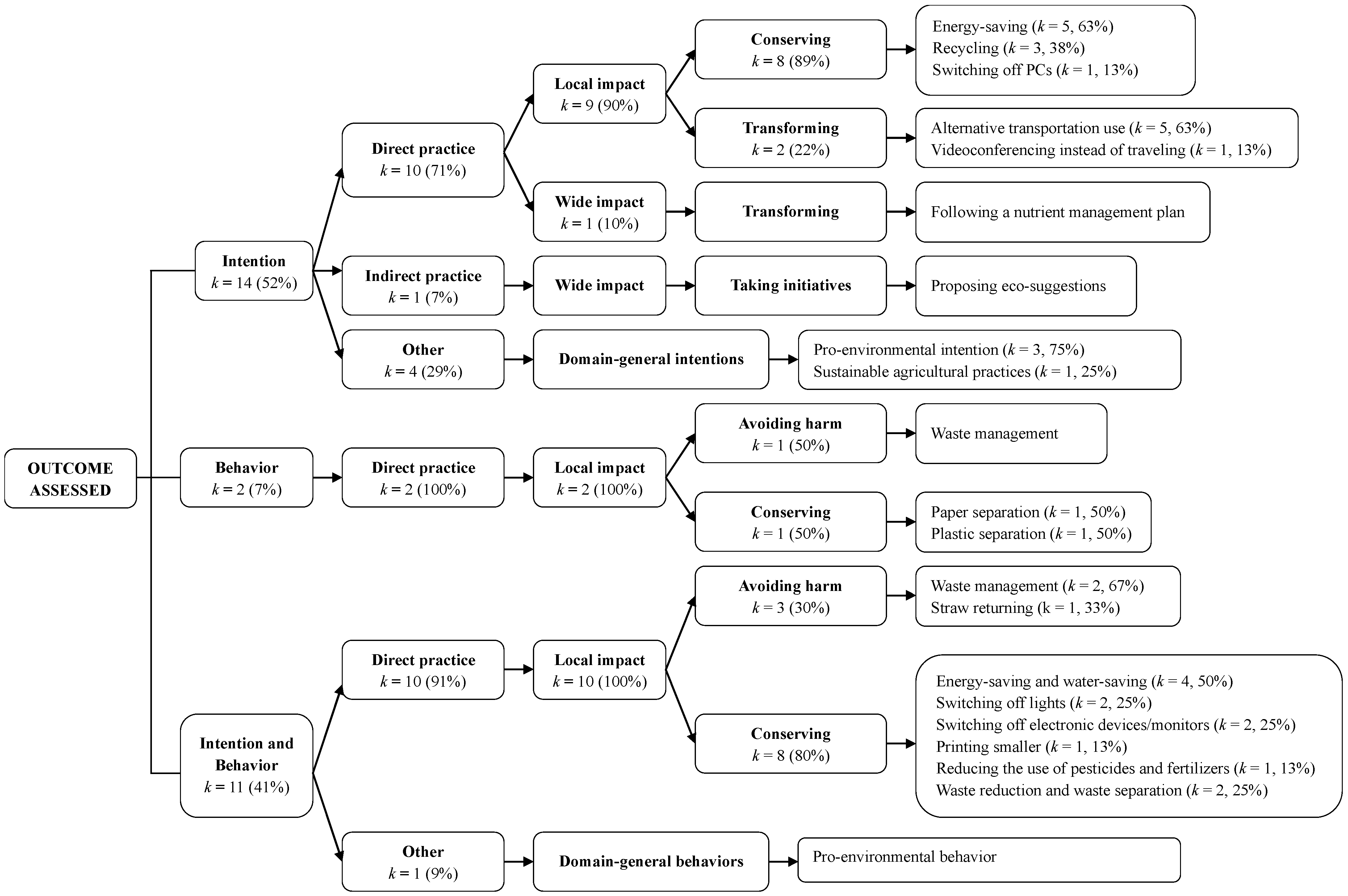
Figure 1 provides a schematic representation of the type and level of sustainable activities investigated across the reviewed studies, classified according to Smith and O’Sullivan’s (2012) dimensions (direct vs. indirect; local vs. wide impact) and Ones and Dilchert’s (2012) green five taxonomy (for a detailed explanation, see Table S1 in the Supplementary Materials). To offer a comprehensive overview of how environmental practices have been examined within the TPB framework, the figure also distinguishes based on the dependent variable assessed (intention, behavior, or both).
Just over half of the studies (k = 14) focused exclusively on the prediction of intentions, whereas only two examined behaviors alone. The remaining eleven studies assessed both intention and behavior. Several studies examined multiple dependent variables: one included four distinct behaviors (Lo et al., 2014), two assessed three outcomes each (e.g., Greaves et al., 2013), and three tested TPB-based models separately for two dependent variables (e.g., Canova & Manganelli, 2020; Costa et al., 2022).
Among studies focusing on intentions, most investigated direct practices, typically involving local-impact actions aimed at preserving natural resources and avoiding wastefulness or modifying work processes and products to reduce environmental impact. Only one study examined direct, wide-impact actions (Daxini et al., 2019), while another (Yuriev et al., 2020a) analyzed employees’ intention to propose eco-suggestions at work, which represents an indirect, wide-impact activity. A smaller subset of investigations employed domain-general measures of intention, including pro-environmental intentions and sustainable agricultural practices (e.g., Meng et al., 2022; Savari et al., 2023).
A similar pattern emerged among studies measuring actual behavior, which predominantly targeted direct, low-impact actions, with no investigations addressing indirect or wide-impact behaviors. One study examined waste management behavior (Muniandy et al., 2021), reflecting actions intended to avoid negative environmental harm and improving resource management, whereas another assessed paper and plastic separation as distinct outcomes (Costa et al., 2022), representing behaviors oriented towards resource conservation. Likewise, studies that measured both intention and behavior focused almost exclusively on direct, local-impact actions—primarily concerning resource-preserving practices such as switching off non-essential lights, printing smaller, and reducing the use of pesticides and fertilizers (e.g., Lo et al., 2014). A smaller number of studies examined behaviors oriented towards monitoring environmental impact, preventing pollution, and strengthening ecosystem integrity (e.g., Xie et al., 2021). One additional study assessed behavior as a composite category of distinct pro-environmental actions (Blok et al., 2015).
Finally, across the 36 distinct dependent variables coded, roughly two thirds (64%) were defined at a high level of generality, extending the action element to overarching behavioral categories such as energy-saving (e.g., Fatoki, 2020) or recycling (e.g., Greaves et al., 2013). By contrast, a smaller subset focused on highly specific behaviors, including switching off personal computers, commuting to university via alternative transportation, using videoconference instead of traveling, separating paper and plastic waste, and switching off non-essential lights (e.g., Canova & Manganelli, 2020; Costa et al., 2022; Yuriev et al., 2020a).

4.3.2. Contextual Characteristics of the Reviewed Studies

The reviewed studies were conducted across a diverse range of organizational and occupational settings, predominantly involving employee samples (k = 19). A smaller proportion of investigations included both employees and managers (k = 3), whereas only one study focused exclusively on managers. The remaining four studies recruited farmers. With respect to organizational sector, more than two thirds of the investigations (k = 18) did not specify whether the organizations were private, public, or non-governmental. Among those that did, approximately one fifth (k = 5) were conducted in private-sector organizations. The remaining studies involved public-sector organizations (k = 2), mixed samples including both private and public entities (k = 1), or combinations of public-sector and non-governmental organizations (k = 1). Concerning the industrial domain, roughly one quarter of the studies (k = 7) did not report on the industry in which the organization operates. Among those that did, higher education institutions accounted for around 11% of the total (k = 3), while the hospitality and tourism and manufacturing sectors together represented the most frequently examined industries (approximately 15% of all studies; k = 4). Two investigations were conducted within the information and communication technology (ICT) sector, whereas healthcare, energy, and retail were each represented by a single study. Finally, in nearly three quarters of the reviewed studies (k = 20), the presence or absence of formal environmental policies or procedures within the organizations was not reported. Among the few studies that provided this information, most referred to organizations with general environmental policies (k = 5), while only two explicitly mentioned the existence of specific sustainability initiatives, such as energy conservation programs (Xie et al., 2021) or waste management practices (Akulume & Kiwanuka, 2016).

4.4. The Nomological Network of Employee Green Behavior in TPB-Based Research

This section summarizes the relational patterns and key findings identified across the reviewed studies. Table 2 presents how the core TPB constructs were examined in relation to intention and behavior, including their associations with additional variables incorporated in extended or combined models. In contrast, Table 3 illustrates how additional variables were used to predict the TPB’s core constructs, as well as intention and behavior. In both tables, when it comes to combined models, only variables associated with the theory’s belief-based components were reported; relationships involving constructs outside the TPB framework were not included, as they fall beyond the scope of the present review.
As illustrated in Table 2, consistent with the theory’s central tenets, behavior-specific attitudes were examined as direct predictors of intention in most studies. Across these investigations, the relationship between attitude and intention was overwhelmingly positive (k = 21). Only two studies (Cao et al., 2022; Ding et al., 2023) reported nonsignificant associations, suggesting that the attitudinal component generally operates as a robust motivational determinant of intention formation within EGB research.
A similar pattern emerged for subjective norm, which was modeled as a direct predictor of intention in more than two thirds of the studies. In approximately three quarters of these investigations (k = 13), subjective norm was positively associated with intention. However, four studies (e.g., Daxini et al., 2019; Fatoki, 2023) did not confirm this association. In some instances, the strength of the subjective norm–intention link also varied across specific behaviors within the same study. For example, Lo et al. (2014), who examined four distinct energy-saving actions—two related to printing (printing smaller and avoiding e-mail printing) and two to switching behaviors (switching off lights and monitors)—found that subjective norm significantly predicted intentions for three of the four actions but not for switching off lights. Similarly, Canova and Manganelli (2020) found that subjective norm was significantly associated with the intention to switch off non-essential lights but not to completely turn off electronic devices.
PBC was conceptualized as a direct predictor of intention in nearly all studies, and almost nine in ten of these (k = 21) reported a positive association between employees perceived control over the target behavior and their intention to perform the action in question. Only three investigations (e.g., Wu et al., 2017; X. Xu et al., 2020) did not confirm the expected relationship. As with subjective norm, the predictive strength of PBC occasionally differed across specific behaviors within the same study. For instance, Greaves et al.(2013) examined intentions to switch off computers when leaving the desk, to use videoconferencing instead of traveling, and to recycle workplace waste, finding significant effects of PBC for the first two behaviors but not for recycling. PBC was also modeled as a direct predictor of behavior in roughly one third of the studies, and a positive effect was reported in more than half of these (k = 4). Three investigations found no direct association (e.g., Blok et al., 2015), while X. Xu et al. (2020) reported that the strength of the PBC–behavior link depended on the situational context: perceived control significantly predicted energy-saving behavior in shared offices but not in single-occupancy offices. It is noteworthy that none of the reviewed studies examined the moderating role of PBC in the intention–behavior relationship.
Consistent with the theory’s core proposition that stronger intentions increase the likelihood of corresponding actions, intention was examined as a direct predictor of behavior in approximately half of the reviewed studies. The remaining cases can be explained by the fact that, in several instances, measures of either intention or behavior were not included in the study design (e.g., Chi et al., 2023; Yuriev et al., 2020a). Across studies assessing both constructs, the intention–behavior relationship was positive in nearly all cases (k = 10). Only one study (Wu et al., 2017) reported that contractors’ readiness to manage construction and demolition waste did not significantly predict their actual waste management behavior.
Beyond the canonical structure of the TPB, a small subset of studies introduced alternative relationships among the model’s core constructs that depart from its original propositions (see Table 2). Approximately 15% of the investigations modeled attitude or subjective norm as direct predictors of behavior, with three studies examining both associations concurrently (e.g., Costa et al., 2022) and one testing the effect of attitude alone (Blok et al., 2015). In some cases, these specifications reflected the study design, as certain investigations assessed behavior without including measures of intention (e.g., Cao et al., 2022). In others, both intention and behavior were assessed, with the direct association between attitude—or subjective norm—and behavior introduced on empirical rather than theoretical grounds (e.g., Blok et al., 2015). A further, though limited, observation concerned the positional specification of TPB components within the theory’s predictive architecture. Specifically, three studies modeled subjective norm as a direct predictor of attitude (e.g., Ding et al., 2023); one study (Z. Xu et al., 2024) hypothesized a direct association between PBC and attitude; and one investigation (Ding et al., 2023) specified subjective norm as a direct predictor of PBC. Once again, the rational underlying these specifications appears to be largely empirical.
As shown in Table 2, in some instances the belief-based determinants of intention were further modeled as predictors of personal norm (e.g., Meng et al., 2022) or ascription of responsibility (e.g., Rastegari et al., 2023). For example, Chi et al. (2023) combined TPB with NAM and BRT to explore hospitality and tourism employees’ pro-environmental intention, and found that attitude, subjective norm, and PBC were all positively associated with personal norm. A comparable pattern was observed in the study of Ding et al. (2023), which combined TPB and NAM to investigate contractors’ construction and demolition waste management intention and found a positive association between subjective norm and personal norm. Finally, a positive relationship between subjective norm and ascription of responsibility—as well as between PBC and ascription of responsibility—was reported in the study of Cao et al. (2022). By contrast, Rastegari et al. (2023), who investigated retailers’ fruit waste management intention, found that the effect of attitude on ascription of responsibility was nonsignificant.
Table 3 summarizes how additional variables were examined in the prediction of the TPB belief-based constructs, intention and behavior. Within the moral domain, the most frequently examined constructs included personal norm, awareness of consequences, and ascription of responsibilities. Among these, personal norm—modeled in nearly all studies as antecedent of intention—consistently exerted a positive effect on employees’ willingness to perform the target behavior, with the sole exception of Li et al. (2018). Notably, in some cases, the strength of the relationship varied according to the specific behavior examined (e.g., Lo et al., 2014). In addition, personal norm was defined as a direct predictor of behavior (e.g., Blok et al., 2015) and attitude (Li et al., 2018), with positive associations emerging in all cases. Awareness of consequences was predominantly modeled as a direct predictor of attitude (e.g., Chi et al., 2023), with all studies reporting positive associations. Additionally, approximately one third of the investigations examined its associations with intention (e.g., Fatoki, 2023), and one study tested a direct link with subjective norm (Rastegari et al., 2023). Positive effects were consistently observed across all analyses. Finally, ascription of responsibility was conceptualized as an antecedent of intention in most studies, with three investigations reporting positive relationships (e.g., Fatoki, 2023). Moreover, X. Xu et al. (2020) examined its association with PBC, finding that employees who felt more personally accountable for the environmental consequences of their actions also perceived greater control over performing energy-saving behaviors.
Consistent with later theoretical refinements of the TPB, which acknowledge that normative influence may also arise from perceptions of significant others’ behavior (Fishbein & Ajzen, 2010), around one fifth of the studies broke down subjective norm into its injunctive and descriptive components (e.g., Gao et al., 2017; Ru et al., 2022). Across all these investigations, both normative dimensions were conceptualized as direct determinants of intention (see Table 3). The relationship between descriptive norm and intention was generally positive, with the sole exception of X. Xu et al. (2021), who reported a nonsignificant effect. Findings concerning injunctive norm, however, were mixed: two studies identified significant positive associations (Dung et al., 2024; Ru et al., 2022), whereas two others did not (Gao et al., 2017; X. Xu et al., 2021). Noteworthy, X. Xu et al. (2020) observed that the predictive effects of both normative components varied across contexts. Specifically, injunctive norm was positively related to intention in single-occupancy offices but not in shared offices, whereas the opposite pattern emerged for descriptive norm.
With respect to contextual influences, the most frequently examined organizational factors included organizational and governmental supervision, perceived green organizational climate, and leadership support (Table 3). For example, X. Xu et al. (2021) found that organizational supervision exerted a positive effect on employees’ energy-saving behavior, while Wu et al. (2017) reported that governmental supervision was positively associated with contractors’ intention to manage construction and demolition waste. Perceived green organizational climate was modeled either as a direct predictor of TPB belief-based constructs (Costa et al., 2022) or as a direct determinant of employees’ energy-saving intention (Fatoki, 2023), with positive associations observed in both cases. Finally, leadership support was positively related to employees’ pro-environmental behavior, although no significant effects were found for pro-environmental intention (Blok et al., 2015). Costa et al. (2022) also examined the interaction between leadership support and perceived green organizational climate in predicting attitude, subjective norm, and PBC, but the hypothesized moderating role was not supported.
As illustrated in Table 3, other additional variables include habit, environmental concern, behavior-specific knowledge, and reasons for and against behavior. Habit was examined in two studies (e.g., Canova & Manganelli, 2020), modeled as a direct predictor of both intention and behavior. Across both investigations, stronger habits were positively associated with employees’ intentions to perform switching and printing behaviors, although a corresponding effect on actual behavior emerged only in Lo et al. (2014). Canova and Manganelli (2020) also explored the moderating role of habit within the TPB framework, conceptualizing it as a boundary condition in the relationship between intention and behavior, as well as between the belief-based constructs and intention. The analyses revealed a negative interaction between cognitive attitude and habit, suggesting that the positive effect of cognitive attitude on employees’ intention to switch off electronic devices was stronger among individuals with weaker habits, whereas it became nonsignificant for those with stronger habits. Moreover, habit moderated the effect of subjective norm on intention, such that the relationship was significant only for employees reporting high levels of habit when predicting the intention to switch off electronic devices. A further interaction effect emerged for the intention to switch off non-essential lights, where the PBC–intention association was significant solely among employees with low habits. However, no other significant interaction effects were observed, suggesting that the moderating influence of habit within the TPB framework may be behavior specific.
Environmental concern was included in three studies, all of which modeled it as an antecedent of intention (e.g., Islam et al., 2024; Ru et al., 2022). Across all investigations, greater concern for environmental issues was positively associated with employees’ willingness to engage in energy-saving (Fatoki, 2023; Ru et al., 2022) and recycling practices (Islam et al., 2024).
Behavior-specific knowledge was examined in four investigations (e.g., Li et al., 2018; Xie et al., 2021), typically conceptualized as either a direct predictor of behavior (Akulume & Kiwanuka, 2016; Li et al., 2018) or an antecedent of attitude and PBC (Ru et al., 2022). Positive associations were observed in the relationships with both attitude and PBC, whereas findings regarding actual behavior were less consistent (Table 3). For example, Li et al. (2018) reported that higher knowledge on waste reduction practices positively predicted contractors’ waste reduction behavior, while Akulume and Kiwanuka (2016) found a counterintuitive negative effect of knowledge of color-coded waste bins on employees’ healthcare waste management behavior. In addition, Xie et al. (2021) examined energy-saving knowledge as a moderator in the relationship between organizational interventions aimed at encouraging employees to save energy at work and the TPB’s core constructs, with results indicating a positive interaction between knowledge and organizational interventions in predicting attitude and PBC, whereas no significant moderating effect was observed for subjective norm.
Finally, drawing from the integration of the TPB and BRT, two studies incorporated reasons for and against behavior as direct predictors of attitude, subjective norm, and PBC (Chi et al., 2023; Meng et al., 2022). Reasons for behavior were conceptualized as a higher-order construct encompassing social, environmental, and economic benefits, whereas reasons against behavior represented a higher-order factor composed of three lower-order barriers: cost, increased workload, and lack of support. In both investigations, reasons for behavior were positively associated with attitude, subjective norm, and PBC. In contrast, findings concerning reasons against behavior were more variable: Meng et al. (2022) reported negative associations with both attitude and subjective norm, but a nonsignificant relationship with PBC, whereas Chi et al. (2023) found a negative effect only on attitude.

4.5. Methodological Features of TPB-Based Research on Employee Green Behavior

Table 4 presents a synthesis of the methodological characteristics of the reviewed studies. Almost all investigations adopted a quantitative approach, with only three employing a mixed-method research paradigm that included a pilot stage. Two investigations included a pilot study aimed at identifying the most readily accessible behavioral, normative, and control beliefs within the target population (Greaves et al., 2013; Yuriev et al., 2020a), whereas Meng et al. (2022) used a qualitative phase to generate items representing first-order factors of reasons for and against behavior. Consistent with Fishbein and Ajzen’s (2010) guidelines, belief elicitation in the first two studies was conducted through semi-structured interviews, and the most salient beliefs were subsequently identified via content analysis. Both investigations also included a preliminary step to select target behaviors: in Yuriev et al. (2020a), participants voted on the most relevant pro-environmental actions during focus group discussions, while in Greaves et al. (2013), behavior selection was based on facilitated workshops where employees identified actions not yet commonly performed but potentially impactful for improving their organization’s environmental performance. In the study by Meng et al. (2022), item generation was instead based on online focus group discussions, and the most frequently mentioned benefits and barriers were identified through content analysis.
Furthermore, most studies were cross-sectional and relied on correlational designs. Data were typically collected through online or paper-based questionnaires, predominantly self-administered and, to a lesser extent, interviewer-administered (Cao et al., 2022; Daxini et al., 2019; Rastegari et al., 2023). A notable exception was the study by Canova and Manganelli (2020), which adopted a prospective design with a one-month time lag between the assessment of belief-based constructs and intention (Time 1) and the measurement of the two self-reported energy-saving behaviors (Time 2), in line with the recommendations of Fishbein and Ajzen’s (2010) for questionnaire development.
Nearly three quarters of the studies relied on non-probability sampling strategies, with convenience sampling being the most frequently employed approach. In contrast, only a small number of investigations used probability-based procedures, primarily simple random sampling and, in one case, multistage stratified sampling. With respect to sample size, most studies involved between 200 and 499 participants, whereas smaller and larger samples were comparatively uncommon. Only one study involved more than 1000 respondents, and one did not provide information on the exact sample size. Gender composition was specified in most investigations, with approximately two thirds including balanced samples. Nonetheless, a few studies exhibited gender-skewed distributions—one female-dominated and four male-dominated—whereas three did not report gender composition at all, limiting the evaluation of sample representativeness.
Analytically, all reviewed studies employed regression-based techniques. Almost all investigations employed structural equation modeling (SEM) to simultaneously estimate measurement and structural parameters, typically preceded by confirmatory factor analysis (CFA) for model validation and reliability assessment. Within this group, both covariance-based and variance-based (PLS-SEM) approaches were adopted. Notably, two studies implemented multigroup SEM procedures to examine whether the hypothesized psychological processes operated equivalently across theoretically meaningful subgroups, comparing participants across organizational types (Lo et al., 2014) and educational levels (Xie et al., 2021). Finally, four investigations tested hypothesized relationships using general linear models (e.g., Blok et al., 2015; Canova & Manganelli, 2020), whereas two relied on generalized linear modeling frameworks to account for dichotomous dependent variables (e.g., Akulume & Kiwanuka, 2016; Daxini et al., 2019). It is worth noting that Daxini et al. (2019) first conducted a latent class analysis (LCA) to classify farmers into three groups based on sociodemographic and contextual characteristics and, subsequently, performed a latent class binary logistic regression to estimate the effects of TPB-based predictors on farmers’ intention to adopt a nutrient management plan and to compare parameter estimates across the identified classes (traditional farmers, supplementary income farmers, and business-oriented farmers).

5. Discussion

Foremost among the theoretical frameworks used to explain employee green behavior is the theory of planned behavior, which has been extensively applied to a wide array of workplace sustainability actions and has shown substantial predictive utility across multiple pro-environmental behavior domains. Although previous meta-analytic and scoping reviews provide general support for its central predictions, these syntheses have typically focused on mapping the broad research landscape without distinguishing between domestic and organizational contexts or estimating average effect sizes from TPB-based models that did not fully comply with the theory’s conceptual and methodological requirements (e.g., Katz et al., 2022; Yuriev et al., 2020b). As a result, they offer limited insight into how the TPB has been implemented and tested within employee green behavior research and do not provide a transparent, theory-aligned assessment of cumulative evidence. Addressing this gap, the current study delivers a systematic synthesis of TPB-based research on organizational environmental sustainability that is explicitly grounded in the core propositions and assumptions of the theory of planned behavior, with the aim of informing theory development and highlighting key conceptual and methodological issues that merit further refinement.
The main findings of the review can be summarized as follows. First, scholarly interest in TPB-based research on employee green behavior has increased markedly since 2020, particularly in Asian contexts. Second, most investigations relied on extended TPB models, with personal norm emerging as the most frequently included additional predictor of intention and behavior. Third, the overwhelming majority of studies examined direct, local-impact actions oriented towards resource conservation, often defined at a high level of generality (e.g., energy-saving and recycling practices). Fourth, data were primarily collected from employees across diverse organizational sectors and industries. Fifth, positive associations between the TPB’s core predictors and intention, as well as between intention and behavior, consistently emerged across the included studies. Sixth, most studies employed cross-sectional designs and relied on self-reported behavioral measures. Finally, regression-based analytical techniques, most prominently structural equation modeling, were the dominant strategies for testing the hypotheses. At the same time, several conceptual and methodological challenges were identified. Notably, a substantial proportion of studies retrieved at the full-text stage were excluded because they did not fully comply with the TPB’s conceptual and methodological requirements. In addition, limited attention has been devoted to organizational factors and to the systematic identification of salient behavioral, normative, and control beliefs. Many investigations measured either intention or behavior without including measures of both constructs, thereby precluding the empirical assessment of the intention–behavior relationship. Furthermore, when extensions were introduced, theoretical justifications and tests of incremental validity beyond the TPB’s core predictions were seldom provided.

5.1. Theory-Consistent Implementation of the TPB in Employee Green Behavior Research

The first observation that warrants emphasis concerns the extent to which the TPB has been implemented in ways consistent with its theoretical and methodological assumptions. Initial screening of titles and abstracts retrieved through the search strategy, after duplicate removal, yielded 118 records that met the eligibility criteria for full-text screening. This process ultimately resulted in the inclusion of 27 articles in the final analyzed sample. Of the 91 excluded items, most were removed because they failed to satisfy essential requirements of the TPB, including appropriate operationalization of its core predictors and measurement correspondence in belief-based constructs, intention and behavior. Many studies also tested partial versions of the theory that omitted its key components despite explicitly claiming to apply a TPB-based model. Such departures suggest that, in numerous cases, the TPB is invoked nominally rather than implemented as a fully specified model of behavioral prediction grounded in its conceptual and measurement assumptions (see Fishbein & Ajzen, 2010). These shortcomings critically limit the possibility of evaluating the theory’s explanatory contribution to the organizational environmental domain for at least two reasons. First, because predictive validity strictly depends on the compatibility between the measures of belief-based constructs, intention, and behavior, violations of measurement correspondence compromise the interpretability of resulting findings. Specifically, effects may appear trivial or inconsistent not because of theoretical limitations but because of measurement artefacts. Second, partial applications produce findings that are difficult to compare across studies, constraining the possibility of testing the theory’s ancillary predictions or of examining the consistency of its core propositions using synthesized data. Given ongoing debates regarding the TPB’s predictive validity and calls for more complex models of behavioral prediction (e.g., Sniehotta et al., 2014), rigorous implementations that adhere to Ajzen’s (1991, 2002) requirements remain essential.
Importantly, the reduction from 118 full-text records to 27 eligible articles should not be interpreted as evidence of limited scholarly interest in the TPB-based research within the organizational sustainability domain. Rather, it reflects the application of stringent, theory-consistent inclusion criteria developed to evaluate the TPB as a fully specified model of behavioral prediction grounded in its assumptions. The substantial number of exclusions highlights a broader pattern in the literature: while the TPB is frequently cited as a guiding framework, it is less often implemented in ways that fully adhere to its conceptual and methodological requirements. In this vein, the relatively small subset of qualifying studies is a meaningful finding of the present review, as it suggests the need for greater conceptual precision and methodological rigor in future applications of the theory in employee green behavior research.

5.2. Empirical Support for the Core Predictive Structure of the TPB

Beyond these observations, consistent patterns emerged regarding the TPB’s core hypotheses. Attitudes, subjective norms, and perceived behavioral control typically accounted for unique variance in pro-environmental intentions and positive intention–behavior associations were observed in nearly all studies including behavioral measures. Notably, these effects typically held even when additional predictors were introduced alongside the theory’s traditional constructs. Moreover, whenever standardized path coefficients were reported, behavior-specific attitudes emerged as the strongest predictor of intentions, and intentions, in turn, emerged as the strongest predictor of behavior, providing tentative support for the sufficiency assumption of the TPB. Collectively, these findings suggest that employee green behavior can be meaningfully understood within a reasoned-action framework, at least for behaviors defined within the scope examined in the reviewed studies. In particular, the results provide preliminary support for the view that employee green behavior is, at least in part, guided by a decision-making process grounded in employees’ evaluation of behavioral consequences, perceptions of social pressure, and assessments of personal capability.
Nonetheless, while most of the selected studies found positive effects of belief-based constructs on intentions, evidence for a direct effect of perceived behavioral control on behavior was less consistent. Among the seven studies that tested this association, two reported nonsignificant effects, and one suggested that contextual variation influenced the magnitude of the relationship. Such findings may imply that employees perceive the target behavior as largely under volitional control; however, alternative explanations remain plausible—most notably, potential discrepancies between perceived and actual control. In such cases, research in health psychology has shown that perceived behavioral control would moderate the effect of the other belief-based construct on intention and of intention on behavior, in a downward direction (Hagger et al., 2022). Within the environmental domain, recent work provides parallel evidence (La Barbera & Ajzen, 2020, 2021). Unfortunately, none of the reviewed studies tested such interaction hypotheses, highlighting the need for future research to give renewed attention to potential moderation effects involving PBC.

5.3. Model Extensions and Justification

While the previous section focused on the TPB’s classical predictive structure, the present section shifts to the ways in which researchers have extended the model beyond its traditional configuration.
Overall, the patterns observed in our dataset closely mirror trends described in broader environmental research. As also noted in Yuriev et al.’s (2020b) scoping review, TPB-based studies in organizational settings predominantly rely on extended models in which personal norm is the most frequently added predictor. Frequent extensions also include the descriptive component of subjective norm, behavior-specific knowledge, environmental concern, and habit.
Personal norms generally showed positive associations with both intention and behavior, providing preliminary support for the idea—well-established in the broader environmental literature—that individuals’ willingness to act pro-environmentally, as well as green behavior enactment, is not driven solely by utilitarian cost–benefit considerations. This is consistent with Fishbein and Ajzen’s (2010) proposal that, when behaviors have a clear altruistic dimension, such as in the case of pro-environmental actions, including a measure of personal norm in TPB-based models may be warranted to determine whether it contributes meaningfully to the prediction of intention and behavior.
For descriptive norms, positive associations with intention were generally observed. However, some contextual variability also emerged. In particular, descriptive norms appeared particularly influential in shared workplaces, whereas their associations with intentions were weak or non-significant in single-occupancy offices. Overall, these findings lend support for later refinements of the TPB distinguishing between normative influences stemming from perceived social expectations versus relevant others’ own behavior.
With respect to knowledge and environmental concern, most studies treated them as a direct predictor of behavior or intention. Within the TPB, however, such variables are better conceptualized as background factors whose influence should operate indirectly through their effects on belief-based constructs. The few studies partially testing this proposition reported positive associations between both predictors and the proximal antecedents of intention, offering tentative support for treating knowledge and environmental concern as distal antecedents of intention or behavior. Given that the TPB provides a coherent account of how background factors may shape behavioral decision-making, future research would benefit from modeling these variables in ways that are more closely aligned with the theory’s specification.
Turning to habit, the pattern of findings is more complex. Specifically, Lo et al. (2014) reported small-to-large effects of both habit and intention on printing and switching behaviors, whereas Canova and Manganelli (2020) found no significant effects of habit for switching behaviors. Nonetheless, the fact that either habit or intention tended to emerge as the predominant predictor in most cases aligns with dual-process perspectives, which posit that behavior may be governed primarily by either an automatic, cue-driven route or a reasoned, deliberative route (Hagger et al., 2023). However, because both studies relied on self-report habit indexes that capture individuals’ experience of automaticity rather than the underlying automatic processes themselves, these findings should be interpreted with caution. Given that individuals have limited access to the executive processes underlying habitual action (Gardner & Tang, 2014), self-reports may conflate habit with other forms of non-deliberative responses or may lead respondents to retrospectively label certain actions as “habitual” (Hagger et al., 2015). A more rigorous operationalization of habit construct in future research is therefore needed, as it would help clarify how automatic tendencies related to reasoned processes with respect to the employee green behavior domain.
Beyond the specific patterns associated with each additional construct, a more general issue concerns the empirical criteria used to justify model extensions. As previously discussed, although the TPB allows for the inclusion of additional predictors, such extensions require theoretical justification and empirical evaluation. Any proposed variable should evidently enhance the prediction of intention or behavior beyond what is already accounted for by attitude, subjective norms, and perceived behavioral control. Yet, across the studies reviewed, extended TPB models were rarely compared with the theory’s standard formulation, and incremental validity was seldom assessed, limiting the capacity to determine whether expanded models provided significant advantages over the traditional structure. Thus, research would benefit from adhering more consistently to the criteria articulated by the TPB for model extension (see Ajzen, 2020; Fishbein & Ajzen, 2010), ensuring that proposed additions are conceptually warranted and empirically useful for advancing the prediction of employee green behavior.

5.4. Underrepresentation of Organizational Factors, Contextual Differences, and Wide-Impact Behaviors

Beyond issues of model specification, the review revealed a structural imbalance in the behavioral criteria assessed and contextual factors examined in TPB-based research on employee green behavior. In particular, consistent with the scoping review by Yuriev et al. (2020b) on the theory’s applications to the environmental context, our findings highlighted that studies overwhelmingly focus on conserving behaviors—especially energy-saving and recycling—defined at varying levels of specificity (e.g., switching off electronic devices; Canova & Manganelli, 2020) or generality (e.g., waste management; Wu et al., 2017). This narrow behavioral focus coincides with a second substantive gap: the systematic underrepresentation of organization-related factors. Although employee green behavior is widely acknowledged to be context-dependent, constructs capturing features of the work environment are seldom integrated across the included studies, despite sharp relevance in adjacent research streams (for reviews on employee green behavior, see, for example, Inoue & Alfaro-Barrantes, 2015; Yuriev et al., 2018; Zacher et al., 2023). This pattern extends to studies combining the TPB with other theoretical perspectives, which overwhelmingly draw from social and environmental psychology, most prominently the norm activation model, while conceptual models grounded in organizational or occupational psychology are virtually absent. Most studies also neglected sector- or industry-specific processes or the presence of environmental policies and regulatory requirements, although such factors are likely to shape both the salience and feasibility of employee green behavior and to determine whether actions are voluntary or mandated. It is important to note that, in the few studies that integrated organizational factors into TPB-based models (e.g., Blok et al., 2015; Costa et al., 2022; Fatoki, 2020), such variables were positioned as proximal predictors of intention or behavior, even though the TPB conceptualizes contextual influences as background factors that inform the underlying salient beliefs, which subsequently model their directly measured counterparts.
A first research priority therefore concerns the systematic integration of organization-related constructs in ways that remain consistent with the theory’s predictive architecture—particularly by modeling socio-contextual variables as sources of variation in belief-based constructs, rather than forcing them as direct predictors of intention or behavior. Additionally, future research could also consider integrating the TPB with organizationally grounded frameworks, such as Norton et al.’s (2015) multilevel model of culture and climate and Young et al.’s (2015) process framework of macro-determinants of employee green behavior, which offer a conceptually coherent basis for specifying how societal, organizational, group-based, and individual-level antecedents jointly shape workplace sustainable practices. Greater attention to sector- and industry-specific dynamics is also needed to understand how structural factors influence employee engagement in environmental practices and to select behaviors that are meaningful within a given organizational context (see Greaves et al., 2013). Finally, expanding the behavioral focus of outcomes examined remains essential: current research largely investigates low-impact behaviors while overlooking wide-impact practices, such as those aimed at influencing others, challenging unsustainable routines, or advocating for greener procedures.

5.5. Methodological Limitations in TPB Applications

A first important consideration concerns the limited attention devoted to identifying salient beliefs and to subsequently assessing their relative importance within a specific population. Although belief elicitation and evaluation arguably represent the TPB’s principal added value for applied research, only two studies incorporated indirectly measured belief-based constructs in model testing (Greaves et al., 2013; Yuriev et al., 2020a). As a result, one of the theory’s central explanatory mechanisms, the belief-to-construct pathway, remains underexamined in organizational applications of the theory. This pattern mirrors broader evidence across environmental and health domains (e.g., Simpson-Rojas, 2025; Yuriev et al., 2020b) and likely reflects a persistent tendency in TPB-based applications to rely almost exclusively on directly measured constructs. Interestingly, studies including both indirect and direct measures reported that beliefs exerted both the expected indirect effect on intention, via their corresponding reflective constructs, and additional direct associations with intention above and beyond directly measured variables. Given that salient beliefs are assumed to be implicated in the mechanism through which interventions lead to individuals’ behavior change (Lee & Albarracín, 2025), systematic efforts to identify the beliefs that should be prioritized for promoting employee green behavior represent a promising avenue for future research. This recommendation is especially pertinent for studies explicitly aiming to inform intervention design. However, as the evidence reviewed here also suggests that direct measures of attitude, subjective norm, and PBC do not fully account for the effects attributable to their corresponding formative indicators (belief composites) on intentions (see Greaves et al., 2013; Yuriev et al., 2020a), these considerations apply equally to researchers seeking to use the theory for predictive purposes.
A further methodological concern involves the selection and measurement of the criterion variable. Over half of the reviewed studies assessed intention without including a corresponding behavioral measure. Conceptually, the TPB positions intention as the immediate antecedent of behavior; studies omitting behavioral measures therefore preclude any evaluation of the intention–behavior relationship, despite the well-recognized “intention–behavior gap”. Empirically, although intention is often portrayed as a strong predictor of behavior, changes in circumstances (e.g., the availability of new information) may alter individuals’ readiness to act, and even stable intentions can fail to translate into action due to constraints outside individual’s volitional control, such as insufficient resources or skills and external impediments (Fishbein & Ajzen, 2010). A related shortcoming concerns the widespread use of retrospective behavioral measures rather than prospective assessments. In nearly all reviewed studies, participants reported their intentions and, on the same occasion, provided self-reports of past or current behavior. Because present intentions are likely to reflect past experiences, retrospective behavioral reports may correlate more strongly with intention due to a consistency bias (Canova & Manganelli, 2020). These considerations underscore two priorities. First, future studies should include both intention and behavior measures, assessed prospectively as suggested by Fishbein and Ajzen (2010). Second, greater methodological effort is needed to obtain behavioral measures with a higher degree of objectiveness (e.g., informant reports, trained observers, or device-based indicators; Lange & Dewitte, 2019).

6. Conclusions

By systematically mapping the empirical landscape of TPB-based research on employee green behavior and evaluating its conceptual and methodological development, this review addresses three interrelated objectives: examining how the theory has been applied in organizational contexts, assessing the extent to which empirical findings support its core predictions, and documenting the methodological characteristics of cumulative evidence.
With respect to the first objective, findings showed that although the TPB is frequently referenced, its application is heterogeneous. A substantial share of the retrieved studies did not fully adhere to the theory’s conceptual and methodological requirements, and extensions were often introduced without explicit theoretical justifications or formal tests of incremental validity. This pattern does not suggest a lack of interest in the TPB; rather, it reflects variability in the degree to which the theory is implemented as a fully specified model of behavioral prediction grounded in its assumptions. Regarding empirical support, the available evidence is consistent with the TPB’s core predictive structure. However, several of the theory’s foundational propositions remain underexamined—most notably, the moderating role of PBC in the intention–behavior link and the belief-based foundations of attitude, subjective norm, and perceived behavioral control. Consequently, while the theory’s core predictions receive support, some of its ancillary and process-level assumptions have yet to be systematically evaluated within this domain. Finally, in relation to the methodological characteristics of cumulative evidence, the extant literature is predominantly based on cross-sectional designs and self-reported behavioral indicators, and, in most instances, intention and behavior were not assessed within the same analytical model. As a result, current evidence permits inference about associative patterns but provides limited insight into the extent to which intentions translate into employee green behavior under organizational constraints.
Of course, there are caveats to this analysis that warrant acknowledgment. First, excluding grey literature and research outputs published in languages other than English may have introduced selection bias. Future studies could mitigate this risk by broadening inclusion criteria. Second, the search strategy could be strengthened by complementing database searches with additional approaches, such as manually reviewing journals most likely to publish TPB-based studies on employee green behavior and screening the reference lists of prior reviews and of studies retained for full-text assessment (see Grimaldi et al., 2023). Finally, future systematic reviews may build on the present synthesis by extending the analysis of structural relations among TPB-based constructs and environmentally relevant behavior. In particular, subsequent reviews could evaluate whether behavioral intention functions as the proximal mediating variable through which belief-based determinants (i.e., attitude, subjective norm, and perceived behavioral control), as well as additional predictors introduced in extended TPB models, promote behavioral enactment. Such an approach would allow a more direct assessment of the TPB’s central proposition that reasoned action processes constitute the underlying mechanism upon which individuals make behavioral decisions within organizational sustainability contexts. Moreover, future syntheses may complement theory-driven inclusion criteria with formal methodological quality appraisal. While the present review evaluated studies in light of TPB’s foundational assumptions, subsequent work could incorporate risk-of-bias assessment tools (e.g., the Newcastle–Ottawa Scale or the Critical Appraisal Skills Programme for observational studies) to evaluate the overall methodological quality of eligible studies.
Notwithstanding these shortcomings, the current review represents the first systematic, theory-aligned attempt to provide a comprehensive understanding of how the TPB has been applied to organizational environmental sustainability. On the one hand, our findings provide novel insights into how TPB has been used to explain employee green behavior; on the other hand, it clarifies the conditions under which its validity and utility in this domain can be meaningfully evaluated. In this sense, we call for greater attention to the principles articulated in Fishbein and Ajzen’s (2010) monograph; otherwise, progress in TPB-based explanations of EGB is likely to remain constrained.

Supplementary Materials

The following supporting information can be downloaded at https://www.mdpi.com/article/10.3390/admsci16030136/s1. Document S1: PRISMA checklist; Document S2: formation of theory of planned behavior’s reflective indicators; Table S1: the Green Five Taxonomy, Document S3: full query string used in each database; Figure S1: PRISMA flow diagram of the selection process; Table S2: publication characteristics; Table S3: characteristics of the included studies; Table S4: coding procedure; Figure S2: heatmap of the geographical and temporal distribution of studies; Table S5: additional constructs included in studies adopting extended TPB models.

Author Contributions

Conceptualization, E.F., L.C. and A.B.; methodology, E.F.; software, E.F.; validation, L.C. and A.B.; formal analysis, E.F. and L.C.; investigation, E.F. and L.C.; resources, L.C. and A.B.; data curation, E.F.; writing—original draft preparation, E.F.; writing—review and editing, L.C. and A.B.; visualization, E.F.; supervision, L.C. and A.B.; project administration, L.C. and A.B.; funding acquisition, L.C. and A.B. All authors have read and agreed to the published version of the manuscript.

Funding

This research received no external funding.

Institutional Review Board Statement

Not applicable.

Informed Consent Statement

Not applicable.

Data Availability Statement

Data is contained within the article or Supplementary Materials.

Acknowledgments

The authors thank Mattia Levisaro for his assistance in the screening and selection of articles.

Conflicts of Interest

The authors declare no conflicts of interest.

References

  1. Ajzen, I. (1988). Attitudes, personality, and behavior. Dorsey. [Google Scholar]
  2. Ajzen, I. (1991). The theory of planned behavior. Organizational Behavior and Human Decision Processes, 50(2), 179–211. [Google Scholar] [CrossRef]
  3. Ajzen, I. (2002). Perceived behavioral control, self-efficacy, locus of control, and the theory of planned behavior 1. Journal of Applied Social Psychology, 32(4), 665–683. [Google Scholar] [CrossRef]
  4. Ajzen, I. (2020). The theory of planned behavior: Frequently asked questions. Human Behavior and Emerging Technologies, 2(4), 314–324. [Google Scholar] [CrossRef]
  5. Akulume, M., & Kiwanuka, S. N. (2016). Health care waste segregation behavior among health workers in Uganda: An application of the theory of planned behavior. Journal of Environmental and Public Health, 2016(1), 8132306. [Google Scholar] [CrossRef] [PubMed]
  6. Arksey, H., & O’Malley, L. (2005). Scoping studies: Towards a methodological framework. International Journal of Social Research Methodology, 8(1), 19–32. [Google Scholar] [CrossRef]
  7. Bentler, D., & Maier, G. W. (2025). Validation of the employee pro-environmental attitudes and behavior scale. PsyArXiv. [Google Scholar] [CrossRef]
  8. Blok, V., Wesselink, R., Studynka, O., & Kemp, R. (2015). Encouraging sustainability in the workplace: A survey on the pro-environmental behaviour of university employees. Journal of Cleaner Production, 106, 55–67. [Google Scholar] [CrossRef]
  9. Boiral, O., Paillé, P., & Raineri, N. (2015). The nature of employees’ pro-environmental behaviors. In J. L. Robertson, & J. Barling (Eds.), The psychology of green organizations (pp. 12–32). Oxford University Press. [Google Scholar]
  10. Botetzagias, I., Dima, A. F., & Malesios, C. (2015). Extending the theory of planned behavior in the context of recycling: The role of moral norms and of demographic predictors. Resources, Conservation and Recycling, 95, 58–67. [Google Scholar] [CrossRef]
  11. Canova, L., & Manganelli, A. M. (2020). Energy-saving behaviours in workplaces: Application of an extended model of the theory of planned behaviour. Europe’s Journal of Psychology, 16(3), 384. [Google Scholar] [CrossRef]
  12. Cao, H., Li, F., Zhao, K., Qian, C., & Xiang, T. (2022). From value perception to behavioural intention: Study of Chinese smallholders’ pro-environmental agricultural practices. Journal of Environmental Management, 315, 115179. [Google Scholar] [CrossRef]
  13. Chi, X., Meng, B., Lee, H., Chua, B. L., & Han, H. (2023). Pro-environmental employees and sustainable hospitality and tourism businesses: Exploring strategic reasons and global motives for green behaviors. Business Strategy and the Environment, 32(7), 4167–4182. [Google Scholar] [CrossRef]
  14. Costa, A., Mouro, C., & Duarte, A. P. (2022). Waste separation—Who cares? Organizational climate and supervisor support’s role in promoting pro-environmental behaviors in the workplace. Frontiers in Psychology, 13, 1082155. [Google Scholar] [CrossRef] [PubMed]
  15. Daxini, A., Ryan, M., O’Donoghue, C., Barnes, A. P., & Buckley, C. (2019). Using a typology to understand farmers’ intentions towards following a nutrient management plan. Resources, Conservation and Recycling, 146, 280–290. [Google Scholar] [CrossRef]
  16. Dilchert, S. (2018). Counterproductive sustainability behaviors and their relationship to personality traits. International Journal of Selection and Assessment, 26(1), 49–56. [Google Scholar] [CrossRef]
  17. Ding, Z., Wen, X., Zuo, J., & Chen, Y. (2023). Determinants of contractor’s construction and demolition waste recycling intention in China: Integrating theory of planned behavior and norm activation model. Waste Management, 161, 213–224. [Google Scholar] [CrossRef]
  18. Dung, L. N. T., Nguyen, Q. N., & Hien, L. T. D. (2024). Explaining the energy-saving behavioral intention of workers in industrial zones. International Journal of Energy Economics and Policy, 14(6), 80–87. [Google Scholar] [CrossRef]
  19. Fatoki, O. (2020). Determinants of hotel employees’ electricity saving intention: Extending the theory of planned behaviour. Entrepreneurship and Sustainability Issues, 8(2), 86. [Google Scholar] [CrossRef]
  20. Fatoki, O. (2023). Antecedents of workplace energy saving behaviour: An integration of the theory of planned behaviour and norm activation model. International Journal of Energy Economics and Policy, 13(4), 394–403. [Google Scholar] [CrossRef]
  21. Fishbein, M. (1963). An investigation of the relationships between beliefs about an object and the attitude toward that object. Human Relations, 16, 233–240. [Google Scholar] [CrossRef]
  22. Fishbein, M., & Ajzen, I. (1975). Belief, attitude, intention and behavior: An introduction to theory and research. Addison-Wesley. [Google Scholar]
  23. Fishbein, M., & Ajzen, I. (2010). Predicting and changing behavior: The reasoned action approach. Psychology Press. [Google Scholar]
  24. Francoeur, V., Paillé, P., Yuriev, A., & Boiral, O. (2021). The measurement of green workplace behaviors: A systematic review. Organization & Environment, 34(1), 18–42. [Google Scholar] [CrossRef]
  25. Gao, L., Wang, S., Li, J., & Li, H. (2017). Application of the extended theory of planned behavior to understand individual’s energy saving behavior in workplaces. Resources, Conservation and Recycling, 127, 107–113. [Google Scholar] [CrossRef]
  26. Gardner, B., & Tang, V. (2014). Reflecting on non-reflective action: An exploratory think-aloud study of self-report habit measures. British Journal of Health Psychology, 19, 258–273. [Google Scholar] [CrossRef] [PubMed]
  27. Greaves, M., Zibarras, L. D., & Stride, C. (2013). Using the theory of planned behavior to explore environmental behavioral intentions in the workplace. Journal of Environmental Psychology, 34, 109–120. [Google Scholar] [CrossRef]
  28. Grimaldi, M., Bacaro, V., Natale, V., Tonetti, L., & Crocetti, E. (2023). The longitudinal interplay between sleep, anthropometric indices, eating behaviors, and nutritional aspects: A systematic review and meta-analysis. Nutrients, 15(14), 3179. [Google Scholar] [CrossRef] [PubMed]
  29. Hagger, M. S., Cheung, M. W. L., Ajzen, I., & Hamilton, K. (2022). Perceived behavioral control moderating effects in the theory of planned behavior: A meta-analysis. Health Psychology, 41(2), 155. [Google Scholar] [CrossRef]
  30. Hagger, M. S., Hamilton, K., Phipps, D. J., Protogerou, C., Zhang, C. Q., Girelli, L., Mallia, L., & Lucidi, F. (2023). Effects of habit and intention on behavior: Meta-analysis and test of key moderators. Motivation Science, 9(2), 73. [Google Scholar] [CrossRef]
  31. Hagger, M. S., Rebar, A. L., Mullan, B., Lipp, O. V., & Chatzisarantis, N. L. (2015). The subjective experience of habit captured by self-report indexes may lead to inaccuracies in the measurement of habitual action. Health Psychology Review, 9(3), 296–302. [Google Scholar] [CrossRef]
  32. Inoue, Y., & Alfaro-Barrantes, P. (2015). Pro-environmental behavior in the workplace: A review of empirical studies and directions for future research. Business and Society Review, 120(1), 137–160. [Google Scholar] [CrossRef]
  33. Islam, M. S., Hasan, N., Islam, M. S., Akter, T., Rafsun, M. F., & Fouji, M. M. H. (2024). Investigating waste recycling intentions of top management in Bangladesh’s leather industry: A hybrid analytical framework. Cleaner Waste Systems, 8, 100140. [Google Scholar] [CrossRef]
  34. Katz, I. M., Rauvola, R. S., Rudolph, C. W., & Zacher, H. (2022). Employee green behavior: A meta-analysis. Corporate Social Responsibility and Environmental Management, 29(5), 1146–1157. [Google Scholar] [CrossRef]
  35. La Barbera, F., & Ajzen, I. (2020). Control interactions in the theory of planned behavior: Rethinking the role of subjective norm. Europe’s Journal of Psychology, 16(3), 401. [Google Scholar] [CrossRef]
  36. La Barbera, F., & Ajzen, I. (2021). Moderating role of perceived behavioral control in the theory of planned behavior: A preregistered study. Journal of Theoretical Social Psychology, 5(1), 35–45. [Google Scholar] [CrossRef]
  37. Lange, F., & Dewitte, S. (2019). Measuring pro-environmental behavior: Review and recommendations. Journal of Environmental Psychology, 63, 92–100. [Google Scholar] [CrossRef]
  38. Lee, H., & Albarracín, D. (2025). From beliefs to behavior: Clarifying the roles of attitudes and context. Journal of Consumer Psychology, 36(1), 151–155. [Google Scholar] [CrossRef]
  39. Li, J., Zuo, J., Cai, H., & Zillante, G. (2018). Construction waste reduction behavior of contractor employees: An extended theory of planned behavior model approach. Journal of Cleaner Production, 172, 1399–1408. [Google Scholar] [CrossRef]
  40. Lo, S. H., Peters, G. J. Y., van Breukelen, G. J., & Kok, G. (2014). Only reasoned action? An interorganizational study of energy-saving behaviors in office buildings. Energy Efficiency, 7(5), 761–775. [Google Scholar] [CrossRef]
  41. Meng, B., Lee, M. J., Chua, B. L., & Han, H. (2022). An integrated framework of behavioral reasoning theory, theory of planned behavior, moral norm and emotions for fostering hospitality/tourism employees’ sustainable behaviors. International Journal of Contemporary Hospitality Management, 34(12), 4516–4538. [Google Scholar] [CrossRef]
  42. Miller, Z. D. (2017). The enduring use of the theory of planned behavior. Human Dimensions of Wildlife, 22(6), 583–590. [Google Scholar] [CrossRef]
  43. Muniandy, G., Anuar, M. M., Foster, B., Saputra, J., Johansyah, M. D., Khoa, T. T., & Ahmed, Z. U. (2021). Determinants of sustainable waste management behavior of Malaysian academics. Sustainability, 13(8), 4424. [Google Scholar] [CrossRef]
  44. Norton, T. A., Parker, S. L., Zacher, H., & Ashkanasy, N. M. (2015). Employee green behavior: A theoretical framework, multilevel review, and future research agenda. Organization & Environment, 28(1), 103–125. [Google Scholar] [CrossRef]
  45. Ones, D. S., & Dilchert, S. (2012). Employee green behaviors. In S. E. Jackson, D. S. Ones, & S. Dilchert (Eds.), Managing HR for environmental sustainability (pp. 85–116). Jossey-Bass/Wiley. [Google Scholar]
  46. Ones, D. S., Wiernik, B. M., Dilchert, S., & Klein, R. M. (2018). Multiple domains and categories of employee green behaviours: More than conservation. In V. K. Wells, D. Gregory-Smith, & D. Manika (Eds.), Research handbook on employee pro-environmental behaviour (pp. 13–38). Edward Elgar Publishing. [Google Scholar]
  47. Page, M. J., McKenzie, J. E., Bossuyt, P. M., Boutron, I., Hoffmann, T. C., Mulrow, C. D., Shamseer, L., Tetzlaff, J. M., & Moher, D. (2021). Updating guidance for reporting systematic reviews: Development of the PRISMA 2020 statement. Journal of Clinical Epidemiology, 134, 103–112. [Google Scholar] [CrossRef]
  48. Paul, J., & Rosado-Serrano, A. (2019). Gradual internationalization vs born-global/international new venture models: A review and research agenda. International Marketing Review, 36(6), 830–858. [Google Scholar] [CrossRef]
  49. Petticrew, M., & Roberts, H. (2008). Systematic reviews in the social sciences: A practical guide. John Wiley & Sons. [Google Scholar]
  50. Rastegari, H., Petrescu, D. C., & Petrescu-Mag, R. M. (2023). Factors affecting retailers’ fruit waste management: Behavior analysis using the theory of planned behavior and norm activation model. Environmental Development, 47, 100913. [Google Scholar] [CrossRef]
  51. Rozenkowska, K. (2023). Theory of planned behavior in consumer behavior research: A systematic literature review. International Journal of Consumer Studies, 47(6), 2670–2700. [Google Scholar] [CrossRef]
  52. Ru, X., Chen, M., Wang, S., & Chen, Z. (2022). Does environmental concern fail to predict energy-saving behavior? A study on the office energy-saving behavior of employees of Chinese Internet companies. Environment, Development and Sustainability, 24(11), 12691–12711. [Google Scholar] [CrossRef]
  53. Savari, M., Damaneh, H. E., Damaneh, H. E., & Cotton, M. (2023). Integrating the norm activation model and theory of planned behaviour to investigate farmer pro-environmental behavioural intention. Scientific Reports, 13(1), 5584. [Google Scholar] [CrossRef]
  54. Schwartz, S. H. (1977). Normative influences on altruism. In L. Berkowitz (Ed.), Advances in experimental social psychology (Vol. 10, pp. 221–279). Academic Press. [Google Scholar]
  55. Si, H., Shi, J. G., Tang, D., Wen, S., Miao, W., & Duan, K. (2019). Application of the theory of planned behavior in environmental science: A comprehensive bibliometric analysis. International Journal of Environmental Research and Public Health, 16(15), 2788. [Google Scholar] [CrossRef]
  56. Simpson-Rojas, D. V. (2025). Meta-analysis of the theory of planned behavior in physical activity [Doctoral dissertation, University of California]. ProQuest. Available online: https://escholarship.org/content/qt28k911m9/qt28k911m9.pdf (accessed on 4 September 2025).
  57. Smith, A. M., & O’Sullivan, T. (2012). Environmentally responsible behaviour in the workplace: An internal social marketing approach. Journal of Marketing Management, 28(3–4), 469–493. [Google Scholar] [CrossRef]
  58. Sniehotta, F. F., Presseau, J., & Araújo-Soares, V. (2014). Time to retire the theory of planned behaviour. Health Psychology Review, 8(1), 1–7. [Google Scholar] [CrossRef]
  59. Stern, P. C., Dietz, T., Abel, T., Guagnano, G. A., & Kalof, L. (1999). A value-belief-norm theory of support for social movements: The case of environmentalism. Human Ecology Review, 6(2), 81–97. Available online: https://www.jstor.org/stable/24707060 (accessed on 4 September 2025).
  60. Westaby, J. D. (2005). Behavioral reasoning theory: Identifying new linkages underlying intentions and behavior. Organizational Behavior and Human Decision Processes, 98(2), 97–120. [Google Scholar] [CrossRef]
  61. Wu, Z., Ann, T. W., & Shen, L. (2017). Investigating the determinants of contractor’s construction and demolition waste management behavior in Mainland China. Waste Management, 60, 290–300. [Google Scholar] [CrossRef] [PubMed]
  62. Xie, C., Ding, H., Zhang, H., Yuan, J., Su, S., & Tang, M. (2021). Exploring the psychological mechanism underlying the relationship between organizational interventions and employees’ energy-saving behaviors. Energy Policy, 156, 112411. [Google Scholar] [CrossRef]
  63. Xu, X., Chen, C. F., Li, D., & Menassa, C. (2020). Energy saving at work: Exploring the role of social norms, perceived control and ascribed responsibility in different office layouts. Frontiers in Built Environment, 6, 16. [Google Scholar] [CrossRef]
  64. Xu, X., Xiao, B., & Li, C. Z. (2021). Analysis of critical factors and their interactions influencing individual’s energy conservation behavior in the workplace: A case study in China. Journal of Cleaner Production, 286, 124955. [Google Scholar] [CrossRef]
  65. Xu, Z., Meng, W., Li, S., Chen, J., & Wang, C. (2024). Driving factors of farmers’ green agricultural production behaviors in the multi-ethnic region in China based on NAM-TPB models. Global Ecology and Conservation, 50, e02812. [Google Scholar] [CrossRef]
  66. Young, W., Davis, M., McNeill, I. M., Malhotra, B., Russell, S., Unsworth, K., & Clegg, C. W. (2015). Changing behaviour: Successful environmental programmes in the workplace. Business Strategy and the Environment, 24(8), 689–703. [Google Scholar] [CrossRef]
  67. Yuriev, A., Boiral, O., Francoeur, V., & Paillé, P. (2018). Overcoming the barriers to pro-environmental behaviors in the workplace: A systematic review. Journal of Cleaner Production, 182, 379–394. [Google Scholar] [CrossRef]
  68. Yuriev, A., Boiral, O., & Guillaumie, L. (2020a). Evaluating determinants of employees’ pro-environmental behavioral intentions. International Journal of Manpower, 41(7), 1005–1019. [Google Scholar] [CrossRef]
  69. Yuriev, A., Dahmen, M., Paillé, P., Boiral, O., & Guillaumie, L. (2020b). Pro-environmental behaviors through the lens of the theory of planned behavior: A scoping review. Resources, Conservation and Recycling, 155, 104660. [Google Scholar] [CrossRef]
  70. Zacher, H., Rudolph, C. W., & Katz, I. M. (2023). Employee green behavior as the core of environmentally sustainable organizations. Annual Review of Organizational Psychology and Organizational Behavior, 10(1), 465–494. [Google Scholar] [CrossRef]
Figure 1. Categorization of outcome variables assessed across the included studies. Note. k = number of studies. For a detailed explanation of behavioral categories, see Section 2.2 and Table S1. Intentions or behaviors that did not fit the established classification of outcome variables were assigned the label “Other”. Percentages are calculated on the total number of studies (N = 27). Percentages for subcategories are calculated on the number of studies within the parent category. Totals may not sum to 100% because some studies assessed more than one outcome.
Admsci 16 00136 g001
Table 1. Applied theoretical frameworks (N = 27).
Theoretical Frameworkk (%)% Variance in Intention% Variance in Behavior
Theory of planned behavior (TPB)2 (7%)54.8%
TPB with accessible beliefs2 (7%)38.0–79.0%
TPB extended with additional variables16 (59%)24.0–76.0%13.0–67.0%
TPB combined with other theories8 (30%)34.7–77.0%32.4%
 Normative theories7 (88%)34.7–77.0%32.4%
 Reasoning-based theories2 (25%)70.0–71.6%
Note. k = number of studies. Percentages for the main theoretical frameworks are calculated on the total number of studies. Percentages for subcategories (i.e., within “TPB with other theories”) are calculated on the number of studies within the parent category. Totals may not sum to 100% because some studies applied more than one framework. Ranges of explained variance are shown only when reported by at least one study in that category; “–” indicates that the explained variance for intention or behavior is unavailable in the included studies, either because the construct was not measured or because the study did not report the value for explained variance.
Table 2. Relationship patterns of traditional theory of planned behavior constructs (N = 27).
ConstructRolek (%)Relationship
Attitude toward the behaviorAntecedent of intention23 (85%)Mainly positive
Direct predictor of behavior4 (15%)Mixed
Antecedent of ascription of responsibility1 (4%)Nonsignificant
Antecedent of personal norm2 (7%)Positive
Subjective normAntecedent of intention18 (67%)Mainly positive
Direct predictor of behavior3 (11%)Mainly positive
Antecedent of attitude3 (11%)Mainly positive
Antecedent of PBC1 (4%)Positive
Antecedent of ascription of responsibility1 (4%)Positive
Antecedent of personal norm4 (15%)Positive
Perceived behavioral controlAntecedent of intention24 (89%)Mainly positive
Direct predictor of behavior7 (26%)Mixed
Antecedent of attitude1 (4%)Positive
Antecedent of ascription of responsibility1 (4%)Positive
Antecedent of personal norm2 (7%)Positive
IntentionAntecedent of behavior11 (41%)Mainly positive
Note. k = number of studies. Percentages for each construct are calculated on the total number of studies. Totals may not sum to 100% because some studies tested multiple relationships for the same construct. When a study tested the same relationship separately for different outcomes, each test was treated as within-study evidence and reported under a single study entry (k = 1). Direction labels within the “Relationship” category were coded as follows: Positive = all studies reported a significant positive association. Mainly positive = most studies reported a significant positive association, with occasional nonsignificant results. Nonsignificant = no study found a significant effect. Mixed = inconsistent findings across studies or across different outcomes within the same study.
Table 3. Relationship patterns of additional variables with TPB’s core constructs, intention, and behavior (N = 27).
Construct (k)Rolek (%)Relationship
Awareness of consequences (6)Antecedent of intention2 (33%)Positive
Antecedent of attitude5 (83%)Positive
Antecedent of subjective norm1 (17%)Positive
Ascription of responsibility (5)Antecedent of intention4 (80%)Mainly positive
Antecedent of PBC1 (20%)Positive
Behavior-specific knowledge (4)Direct predictor of behavior2 (67%)Mixed
Antecedent of attitude1 (33%)Positive
Antecedent of PBC1 (33%)Positive
Moderator of the relationship between organizational interventions 2 and attitude, subjective norm, PBC 1 (33%)Mainly positive
Descriptive norm (5)Antecedent of intention5 (100%)Mainly positive
Environmental concern (3)Antecedent of intention2 (67%)Positive
Antecedent of attitude, subjective norm, and PBC 1 (33%)Positive
Green organizational climate (2)Antecedent of intention1 (50%)Positive
Antecedent of attitude, subjective norm, and PBC 1 (50%)Positive
Habit (2)Antecedent of intention2 (100%)Positive
Direct predictor of behavior2 (100%)Mixed
Moderator of the relationship between intention and behavior1 (50%)Nonsignificant
Moderator of the relationship between affective and cognitive attitude, subjective norm, PBC and intention1 (50%)Mixed
Supervision 1 (2)Direct predictor of behavior 2 (100%)Positive
Injunctive norm (5)Antecedent of intention 5 (100%)Mixed
Leadership support (2)Antecedent of intention 1 (50%)Nonsignificant
Direct predictor of behavior 1 (50%)Positive
Moderator of the relationship between green organizational climate and attitude, subjective norm, PBC 1 (50%)Nonsignificant
Personal norm (14)Antecedent of intention 13 (93%)Mainly positive
Direct predictor of behavior2 (14%)Positive
Antecedent of attitude1 (7%)Positive
Reasons for behavior (2)Antecedent of attitude, subjective norm, and PBC 2 (100%)Positive
Reasons against behavior (2)Antecedent of attitude, subjective norm, and PBC2 (100%)Mixed
Note. 1 Supervision systems operating at both the organizational and governmental levels. 2 Organizational interventions construct was defined as the programs and mechanisms implemented by a company with the objective of encouraging employees to save energy at work. k = number of studies. PBC = Perceived Behavioral Control. Percentages for each construct are calculated on the total number of studies. Percentages for subcategories are calculated on the number of studies within the parent category. Because some studies include multiple constructs and/or test multiple relationships involving the same construct, totals may not sum to 100%. When a study tested the same relationship separately for different outcomes, each test was treated as a within-study evidence and reported under a single study entry (k = 1). Direction labels within the “Relationship” category were coded as follows: Positive = all studies reported a significant positive association. Mainly positive = most studies reported a significant positive association, with occasional nonsignificant results. Nonsignificant = no study found a significant effect. Mixed = inconsistent findings across studies or across different outcomes within the same study.
Table 4. Methodological characteristics of the included studies (N = 27).
Methodological FeatureCategoryk%
Research approachQuantitative2493%
Mixed-method311%
Study designCross-sectional2696%
Prospective14%
Data collection methodPilot study311%
 Semi-structured interview267%
 Online focus group133%
Main study2489%
 Self-administered questionnaire625%
 Online self-administered questionnaire1250%
 Paper self-administered questionnaire521%
 Paper and online self-administered questionnaire14%
 Interviewer-administered questionnaire311%
Sampling strategyNon-probability2074%
 Convenience1575%
 Snowball210%
 Quota315%
Probability-based726%
 Simple random sampling686%
 Multistage stratified (proportional allocation)114%
Sample size (n)Fewer than 20027%
200–4991970%
500–999415%
1000 or more14%
Not reported14%
Gender balanceBalanced1867%
Female-skewed14%
Male-skewed415%
Not specified415%
Analytic frameworkPilot study311%
 Content analysis3100%
Main study2489%
 General linear model (GLM)417%
 Generalized linear model (GLiM)27%
 Structural equation modeling (SEM)1563%
 Partial Least Squares SEM (PLS-SEM)729%
Note. k = number of studies. Percentages are calculated on the total number of studies. Percentages for subcategories are calculated on the number of studies within the parent category. Totals may not sum to 100% because some studies included a pilot phase. Under sampling strategy, one study reported using a census procedure as sampling approach, but it was reclassified as a non-probability convenience sample due to the absence of a defined sampling frame and incomplete population coverage. Gender balance was coded based on the proportion of women in the sample as follows: balanced = 45–55%, female-skewed = higher or equal to 66%, male-skewed = fewer or equal to 34%.
Disclaimer/Publisher’s Note: The statements, opinions and data contained in all publications are solely those of the individual author(s) and contributor(s) and not of MDPI and/or the editor(s). MDPI and/or the editor(s) disclaim responsibility for any injury to people or property resulting from any ideas, methods, instructions or products referred to in the content.