Article

Employee Training, Types of Activity, and Prevention of Opportunistic Behaviour

by
Markus Hagemeister
1,*,
José Alfredo Delgado-Guzmán
2 and
Arturo Rodríguez-Castellanos
3,4
1
Independent Researcher, 44357 Dortmund, Germany
2
Faculty of Accounting and Administration, Circuito Exterior Ciudad Universitaria, National Autonomous University of Mexico UNAM, Coyoacán, Ciudad de México 04510, Mexico
3
Doctorate School, Bilbao Campus, University of the Basque Country UPV/EHU, 48015 Bilbao, Spain
4
Spanish Royal Academy of Economic and Financial Sciences RACEF, 08003 Barcelona, Spain
*
Author to whom correspondence should be addressed.
Adm. Sci. 2026, 16(3), 137; https://doi.org/10.3390/admsci16030137
Submission received: 29 December 2025 / Revised: 27 February 2026 / Accepted: 2 March 2026 / Published: 11 March 2026

Abstract

In today’s world, characterised by rapid technological advances, particularly in AI, companies are compelled to acquire knowledge through employee training. This article seeks to empirically validate four hypotheses derived from a theoretical model identifying key factors firms should consider when investing in training. The hypotheses concern the most suitable type of knowledge for companies to invest in, according to their production processes, as well as the mechanisms for preventing opportunistic behaviour by trained employees. Cross-frequency tables are analysed using data obtained from a sample of 105 Mexican companies operating in both manufacturing and services sectors, representing an appropriate approach given the nature of the data. The results partially support the model. Manufacturing firms tend to train employees in specific skills and use simultaneous training to prevent opportunistic behaviour, whereas companies with heterogeneous production processes predominantly invest in general knowledge. However, firms providing professional services invest more in general knowledge than predicted by the model, contrasting with evidence from Spanish companies in the same industry. These findings suggest that the model should be refined to account for the possible complementarity between specific and general knowledge in training and for differences in institutional, cultural, and economic environments.

1. Introduction

In order to secure and maintain a competitive advantage, companies must innovate in terms of their products, processes, and organizational structures. This is particularly pertinent in the current era, which is characterized by the emergence of numerous technological advances (Schwab, 2016, 2024), particularly in artificial intelligence (AI) (Jan et al., 2023; Kondratenko, 2023), and more recently in its generative AI variant (Orchard & Tasiemski, 2023; Adedoyin & Christiansen, 2024; López-Solís et al., 2025).
According to the ‘Resource-Based View’ approach (Barney, 1991, 2001), a company’s sustainable competitive advantage is associated with its resource base and ability to combine these resources effectively. However, knowledge is currently the most important strategic resource (Bergh et al., 2025). Consequently, a company can be viewed as either a “knowledge creator” or a “learning organization” (Tsoukas & Mylonopoulos, 2004; Mihi Ramírez et al., 2011; Örtenblad, 2020). However, small and medium-sized enterprises (SMEs) often lack the critical mass necessary to generate the knowledge needed to sustain their businesses internally. Even large companies often find it difficult to independently develop the knowledge necessary to remain competitive in all their activities. One possible solution to these challenges is to obtain external knowledge by collaborating with knowledge providers (Emden-Grand et al., 2006), through sourcing (Caloghirou et al., 2004; Asimakopoulos et al., 2020; Ganotakis et al., 2025) or acquisition (Kaba & Ramaiah, 2020; Gligah et al., 2021; Li & Gao, 2023).
Employee training is an important procedure for acquiring external knowledge. In light of recent developments in digitization, AI, and other technological advances, it is evident that leading companies prioritize training their technical and non-technical employees to develop their skills (Chui et al., 2022; Weritz, 2022; Meçik, 2024; Yadav & Gupta, 2025). On the other hand, AI applications such as ‘digital twins’, the ‘manufacturing metaverse’, ‘virtual learning factories’ and ‘mixed reality’ (Attaran & Celik, 2023; Mula et al., 2024; Yang et al., 2025; Lang et al., 2026) can improve employee training methods.
It could be argued that generative AI has made information accessible to all companies via LLMs, meaning knowledge is no longer a valuable driver of competitive advantage. However, it is important to distinguish between ‘information’ and ‘knowledge’. While equal access to information is desirable, the ability to select relevant information, interpret it correctly and process it to create knowledge depends on human talent. Knowledge creation depends on human capacities, judgements and perceptions (Boisot & Canals, 2004). Therefore, the ability to create better knowledge remains the basis for competitive advantage.
Knowledge-focused human resource policies, such as training, moderate the relationship between knowledge exploitation, innovation capacity, and innovation performance (Dwomoh et al., 2015; Akay & Kunday, 2018; Castillo-Apraiz & Matey de Antonio, 2020; Le & Son, 2024).
It should be noted that training, first and foremost, affects the individual productivity of employees. Better-trained employees are more productive (Arulsamy et al., 2023; Nzimakwe & Utete, 2024; Saleh & Azimi, 2025). Second, employees can share their acquired knowledge with others. As this new knowledge is integrated into the organization, the company’s overall productivity increases (Engidaw et al., 2024; Danko & Crhová, 2025; Hussain et al., 2025). Third, training offers companies real options, as it enables the future development of other knowledge and skill sets (Berk & Kaše, 2010).
Considering the above, Hagemeister and Rodríguez-Castellanos (2019) developed a theoretical model that can identify the main factors and conditions companies should consider when investing in employee training. This model considers the three aforementioned aspects: the effect of training on individual productivity, integrating new knowledge into the company’s existing knowledge base, and the consequences of the real options generated by that new knowledge. Additionally, the model establishes measures to prevent opportunistic behaviour by employees receiving training. The model differentiates between two types of acquired knowledge (specific and general) and two types of companies (homogeneous or heterogeneous production processes).
This study aims to empirically validate four main hypotheses derived from the model, particularly those concerning the relationship between types of production processes in companies and the training they provide employees, and those related to actions aimed at preventing opportunistic behaviour. Specifically, our research aims to answer the following research questions: given the relationship between types of production processes and the types of training that companies provide to their employees, do the characteristics of a company’s production processes influence the knowledge areas in which it invests for training purposes? More specifically, do companies with homogeneous production processes tend to provide their employees with specific training, while those with heterogeneous production processes tend to provide general training? And in terms of preventing opportunistic behaviour among trained employees, does the type of knowledge imparted in training influence their behaviour and the measures companies adopt to prevent it? Specifically, do companies that invest in training focused on specific knowledge tend to provide simultaneous training to groups of employees to prevent renegotiating their salaries? And do companies that invest in general knowledge training establish training-related incentive systems to prevent trained employees from leaving or threatening to leave?
Since the theoretical propositions derived directly from the model are difficult to verify, hypotheses were adapted to real-world company conditions. A questionnaire based on these hypotheses was developed and administered to a sample of Mexican company executives. Cross-tabulation was used to analyse the survey results and determine whether the hypotheses were validated.
The findings offer partial support for the model’s validity, since manufacturing firms tend to focus on developing their employees’ specific skills and rely on simultaneous training to deter opportunistic actions. Also, companies with heterogeneous production processes mainly invest in training that builds general knowledge. However, firms dedicated to delivering professional services engage in general knowledge training to a greater extent than the model predicts. This behaviour differs from that of Spanish companies in the same industry, which act in accordance with the model. There is no definitive explanation for this discrepancy. It may be because service companies cover a wider range of activities than is generally assumed, although their behaviour in other areas does not suggest this. Cultural, institutional, or labour market differences between the two countries may also play a role. However, we believe that the most likely cause lies in the complementarity between general and specific knowledge, given the peculiarities of their clientele.
This article adds to the existing literature on human resource training policies by demonstrating how companies can select different combinations of training types depending on the homogeneity or heterogeneity of their production processes. It also demonstrates how to avoid or reduce opportunistic behaviour associated with training in specific skills by offering simultaneous training to groups of employees.
The structure of the rest of the document is as follows. Next, in Section 2, “Theoretical Framework“, we first provide a brief review of the literature on the aspects considered in this work, highlighting the gap in research that this study aims to bridge. Then, we present a theoretical model that aims to overcome these problems. Finally, we present the hypotheses to be tested, which are derived from the model. In Section 3, “Materials and Methods“, we will first present the questionnaire designed to validate the proposed hypotheses; the sample obtained is presented below. Finally, we will outline the method and the techniques employed to analyse the survey data and validate the aforementioned hypotheses. Section 4 shows the results of testing the different hypotheses. Section 5, “Discussion” first considers the fulfilment of the hypotheses and their implications for the literature on the subject and for the validity of the model used. Next, it presents the managerial implications of the results. The limitations of the study are shown below, and the section concludes with the scope for future study, indicating possible future lines of research. Notes and bibliographical references appear below.

2. Theoretical Framework

2.1. Literature Review

Numerous studies have established a positive correlation between training and various business success indicators, including sales (Bartel, 2000; Rosales-Córdova & Llanos, 2021; Carmona-Benítez & Rosales-Córdova, 2024), profitability (Huselid & Becker, 1996; D’Arcimocles, 1997; Bartel, 2000), stock market performance (Molina & Ortega, 2003; García-Zambrano et al., 2018; García-Zambrano, 2022, 2025), above-average sector profits (McGahan & Porter, 2003; Calzarrosa & Gelenbe, 2004), and a combination of these variables (Aragón et al., 2003; Danvila & Sastre, 2009; Slavic & Berber, 2019; Arokiasamy et al., 2024).
These results can be attributed to three main factors. First, acquiring new knowledge through training can increase employee efficiency in the workplace (Bartel, 1994; Vidal-Salazar et al., 2012; Siddiqui, 2018; Upadhyay, 2018; Arulsamy et al., 2023; Nzimakwe & Utete, 2024; Saleh & Azimi, 2025). Second, sharing this knowledge with other employees and integrating it into the organization’s existing knowledge base can promote company-wide efficiency (Nonaka, 1991; Rezaei et al., 2016; Crhová & Matošková, 2019; Engidaw et al., 2024; Le & Son, 2024; Mehner et al., 2024; Danko & Crhová, 2025; Escribá-Carda et al., 2025; Hussain et al., 2025).
Third, certain knowledge acquired through training can represent a “real option”, because it allows for the development of additional knowledge and skills that companies can leverage in the future. Human resource training shares characteristics with options, specifically, it is a “knowledge option” (Bhattacharya & Wright, 2005; Nembhard et al., 2005; Jacobs, 2007; Berk & Kaše, 2010). Consequently, the Real Options Approach (Amram & Kulatilaka, 1999; Trigeorgis & Reuer, 2017), based on the theory of financial option valuation (Black & Scholes, 1973), can be applied to employee training. However, it should be noted that there are critical differences between knowledge options and financial options and even real options related to physical assets (Adner & Levinthal, 2004; Coff & Laverty, 2007).
Although it has been emphasized that employees should possess certain general knowledge and be trained if they do not, the importance of specific knowledge has increased in the face of growing pressure to improve productivity (Andreu et al., 2008). Several authors suggest that companies should primarily invest in training that imparts specific knowledge because it is difficult to reproduce (Becker, 1962; Smits, 2007). However, there may be circumstances in which companies have a vested interest in training their employees in general knowledge. This could be because there is a complementarity between the general and specific knowledge that employees can acquire through training (Casas-Arce, 2004; Kessler & Lülfesmann, 2006), or because of imperfections in the labour market (Leuven, 2005), such as workers’ search costs (Acemoglu, 1998), asymmetric information regarding the productivity of skilled employees (Acemoglu & Pischke, 1998, 1999; Autor, 2001; Cappelli, 2002), or task complexity (Booth & Zoega, 2000). Some empirical studies seem to corroborate this second line of reasoning (Cappelli, 2002; Schøne, 2004; Albanese & Aliberti, 2024).
But, in any case, companies may hesitate to invest in both specific and generic training because training can encourage opportunistic behaviour by increasing employees’ bargaining power to obtain higher wages (Rajan & Zingales, 1998; Lentz & Roys, 2024) or enabling them to leave the company for another job (hold-up problem) (Lee et al., 2024; Jun & Eckardt, 2025). Companies’ urgent desire to provide training in new techniques, such as IA, could stimulate even more opportunistic behaviour. However, companies can take steps to prevent this behaviour. They can establish various types of incentive systems to retain employees who have received training, such as training contracts, permanence agreements and retention bonuses (Batlle-Carbó, 2025), professional development plans linked to progressive employee training, and so on (Moen & Rosén, 2004). This is particularly relevant in companies where technical progress and innovation are important for achieving business results (Pichler, 1993). A lack of incentives is one factor that contributes to the ineffectiveness of training processes (Azeem et al., 2024).
Until recently, however, no study had suggested a link between companies’ production processes and the types of knowledge they consider appropriate for training. Nor had any study addressed the role that ‘knowledge options’ could play in a company’s decision to train its employees in general knowledge. Of particular interest is the link between the above and the measures that companies can take to prevent employees from engaging in opportunistic behaviour once they have been trained. Hagemeister and Rodríguez-Castellanos (2019) responded precisely to this research gap, presenting a theoretical model capable of filling it. Therefore, a summary of this model is provided below.

2.2. The Model

2.2.1. General Structure

The model developed by Hagemeister and Rodríguez-Castellanos (2019) integrates knowledge management and real option approaches. Also identifies the primary factors and environmental conditions companies should consider when investing in employee training programs. The model addresses the aforementioned aspects: increased individual employee productivity resulting from new knowledge acquired through training, the impact of incorporating this knowledge into the company’s existing knowledge base, the consequences of real options arising from new knowledge, and possible employee opportunism. Additionally, the model distinguishes between two types of acquired knowledge—specific and general—and categorizes companies based on whether their production processes are homogeneous or heterogeneous.
Given that the objective of this work is to empirically validate some of the hypotheses derived from the aforementioned model, its basic structure is presented below.
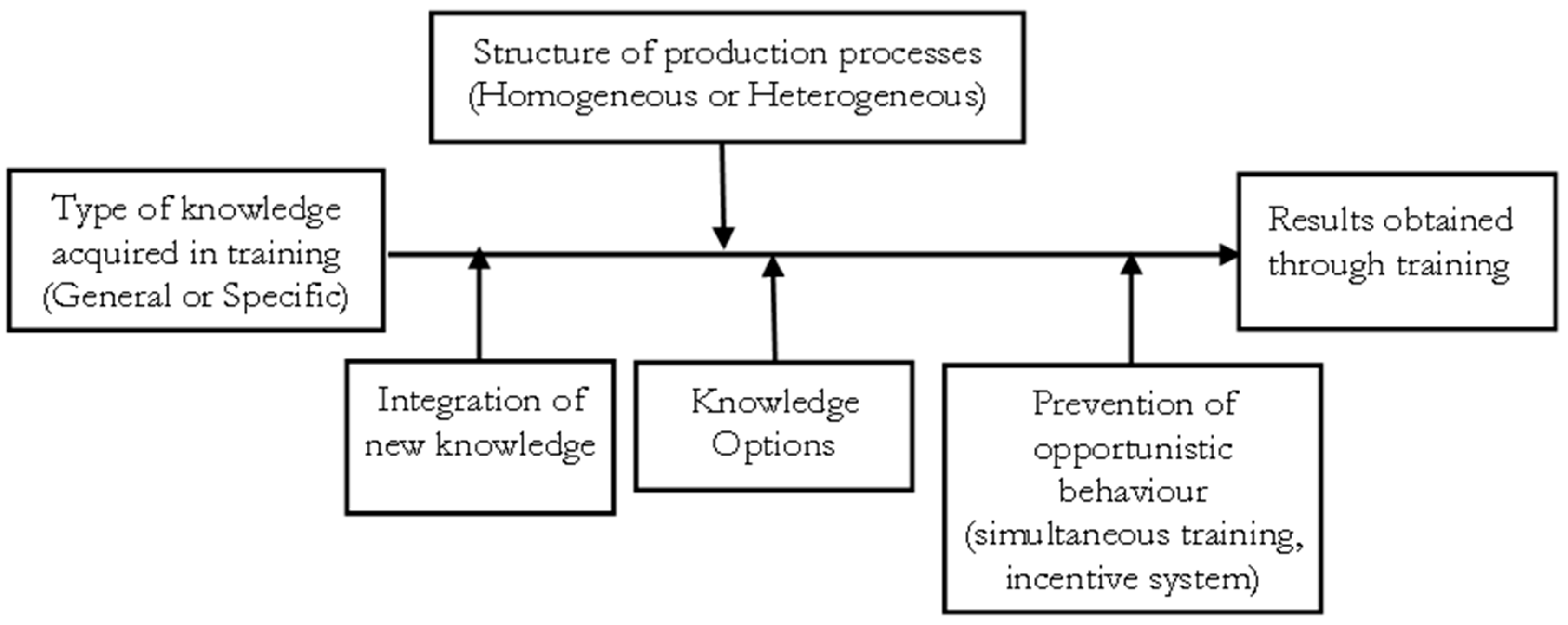
The model presented in Hagemeister and Rodríguez-Castellanos (2019), summarised in Hagemeister et al. (2024), comprises the following elements, as shown in Figure 1.
The company invests in employee training, and the model assumes the training of a single employee.
The following variables must be considered:
-
Input variable: The knowledge acquired by the employee in training. This may be specific, i.e., tailored to the company’s exclusive production processes (e.g., assembly line work, operation of specific machines, and use of the company’s artificial intelligence applications, etc.), or general, which increases employee productivity for any company (e.g., languages, general business management, and generic software and artificial intelligence, etc.).
-
Output variable: results obtained by the company thanks to the new knowledge acquired by individuals through training.
-
Moderating variables: these affect the relationship between the knowledge acquired through training and the results obtained. They can be of two types:
-
Those related to the structure of production processes. The model distinguishes two extreme cases in this regard: homogeneity of production processes, where the processes carried out by each employee are the same as those carried out by other employees in the company; and heterogeneity of production processes, where each employee carries out a different process.
-
Those related to organizational, management, and market aspects that favour the generation and appropriation of value through training. The first type includes those that promote integrating new knowledge with the existing knowledge base in the organization. The second type increases the value of the “knowledge options” resulting from training. The third type contributes to preventing opportunistic behaviour by employees.

2.2.2. Effects of Moderating Variables

If we consider the moderating variables at the bottom of this figure and the conditions that favour their effect on the generation and appropriation of value by the company with respect to new knowledge obtained by employees through training, the model indicates the following.
First, with regard to the integration of new knowledge, this effect is favoured by the following circumstances:
-
The proportion of knowledge linked to production processes is high.
-
The company’s organizational culture encourages knowledge sharing.
-
The company has developed effective formal mechanisms and routines for adopting and exchanging internal knowledge.
-
Employees are capable of absorbing and sharing knowledge, and willing to do so.
-
Technological tools for the adoption and exchange of knowledge are significantly developed.
On the other hand, the value of knowledge options derived from new knowledge acquired through training increases mainly as a function of the uncertainty associated with production processes and the environment. This is why the aforementioned work considers three associated circumstances:
-
Production processes at the company level are more complex.
-
The markets in which the firm operates are more complex.
-
The environment is more dynamic.
Finally, regarding the prevention of opportunistic behaviour by those receiving training, such behaviour may manifest as an intention to renegotiate remuneration, or leaving the company to find another job, or threatening to do so, as previously indicated. In the case of a company that invests in training specific knowledge, such behaviour would manifest primarily in the first possibility. This can be prevented by providing simultaneous training to a large number of employees. In the case of a company that invests in general knowledge training, opportunistic behaviour would mainly manifest as the second possibility. This can be mitigated by designing an incentive system for professional development linked to the training received.
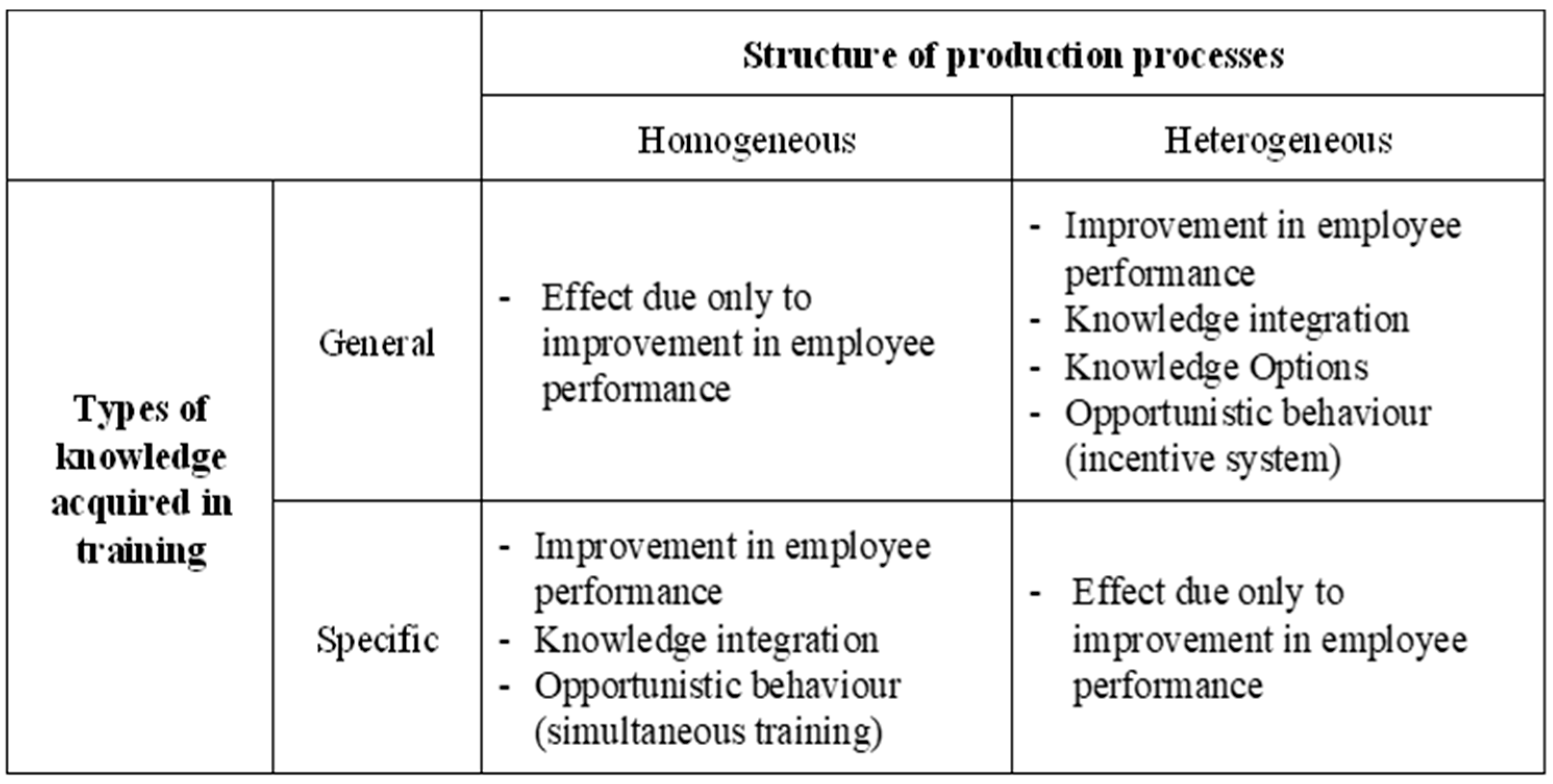
Moving on to the moderating variable at the top of the figure, the model also shows that depending on the type of knowledge acquired and the structure of the company’s production processes, the effects on results differ. Figure 2 summarizes and structures these considerations.
Thus, in a company with homogeneous production processes that provides training exclusively in general knowledge or in a company with heterogeneous production processes that provides training in specific knowledge, the training does not increase the company’s productivity beyond the possible effect on the individual productivity of the person receiving the training.
However, in a company with homogeneous production processes that provides training in specific knowledge, knowledge integration may occur, favoured by the aforementioned circumstances. Conversely, opportunistic behaviour may occur, which, as indicated, can be mitigated by training a large number of employees simultaneously.
If a company with heterogeneous production processes provides its employees with general knowledge training, three effects appear: knowledge integration, knowledge options, and possible opportunistic behaviour. It is important to note that the potential positive outcomes of investing in general training for employees of this type of company, in terms of the knowledge options generated by this training, are not dependent on the motivations for such investment as proposed in the literature, such as complementarity between types of knowledge or labour market imperfections. In other words, even if there is no complementarity between general and specific knowledge and the labour market is perfect, the positive effects of general training on knowledge options would still be evident, as would companies’ interest in providing it to their employees.
And as previously mentioned, the opportunistic behaviour of employees receiving training can be mitigated by designing an incentive system that includes professional development incentives associated with the training received.

2.3. Hypotheses

Based on the model presented, Hagemeister and Rodríguez-Castellanos (2019) derive a series of propositions, which can be operationalised as hypotheses for empirical validation. However, this work aims to test only a part of the model—specifically, four hypotheses—rather than the entire model and all the hypotheses that can be derived from it. On the other hand, since the model considers extreme cases, the hypotheses proposed have been formulated with the knowledge that an empirical study involving real companies will encounter intermediate circumstances.
Based on the productive structure of companies and the types of knowledge acquired in training, as shown in Figure 2, companies with greater homogeneity in their production processes are expected to train their employees in specific knowledge, which yields the best results. Conversely, training in general knowledge is expected to be more prevalent in companies with greater heterogeneity in their production processes. For this reason, we present two hypotheses:
H1. 
Companies with greater homogeneity in their production processes will invest more in training employees in specific knowledge than companies with greater heterogeneity in their production processes.
H2. 
Companies with greater heterogeneity in their production processes will invest more in training employees in general knowledge than companies with greater homogeneity in their production processes.
Regarding the prevention of opportunistic behaviour, training in specific knowledge may encourage employees to renegotiate their compensation. This behaviour can be avoided by providing simultaneous training to a large number of employees. In the case of general knowledge training, employees may decide to leave the company. This behaviour can be avoided or reduced by designing a system of incentives associated with the training received. Therefore, we set out the following two hypotheses:
H3. 
Companies that provide preferential training in specific knowledge will tend to train a large number of employees simultaneously.
H4. 
Companies that provide their employees with preferential training in general knowledge will tend to design incentive systems associated with that training.
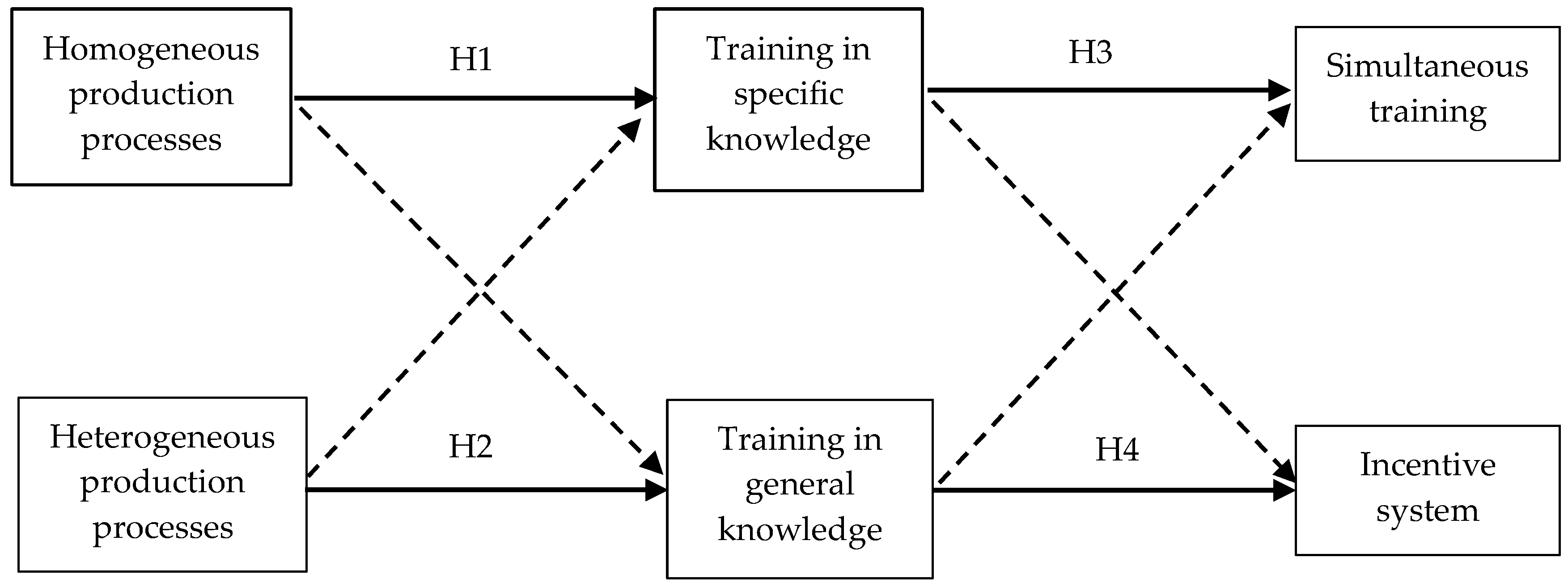
Figure 3 shows the structure of the hypotheses to clarify them.
As can be seen, companies with homogeneous production processes can invest in training for both specific and general knowledge, but hypothesis H1 is that they will prefer to invest in the former. We therefore indicate this possibility as a continuous line, as opposed to investing in general knowledge, which is shown as a broken line.
Companies with heterogeneous production processes can also invest in both types of training. However, according to hypothesis H2, they will prefer to invest in general knowledge training (solid line) rather than specific knowledge training (dashed line).
On the other hand, according to H3, companies that train their employees in specific skills to prevent opportunistic behaviour (mainly salary renegotiation) will tend to provide simultaneous training (solid line) rather than other measures, such as establishing incentive systems (dashed line).
Finally, according to H4, companies that invest in training in general knowledge to prevent opportunistic behaviour by trained employees (mainly leaving the company) will tend to establish incentive systems (solid line) rather than provide simultaneous training (dashed line).
It can also be observed that, if both H1 and H3 were fulfilled simultaneously, companies with homogeneous production processes would tend to provide simultaneous training. Conversely, if both H2 and H4 were fulfilled simultaneously, companies with heterogeneous production processes would tend to establish incentive systems.

3. Materials and Methods

3.1. Questionnaire

To test the hypotheses formulated, a questionnaire was designed to be completed online1. To develop it, several factors that could verify these hypotheses were considered, based on the model shown in Figure 1. These factors are:
-
Structure of production processes
-
Type of knowledge acquired
-
Moderating factors, internal and environmental
-
Results obtained
Participants were asked to rate the importance of each factor on a Likert scale.
Accordingly, the questionnaire consisted of the following sections:
-
Position of the respondent in the company and characteristics of the company (sector, size, manufacturing versus services, technologies versus intellectual capital, specific or generic training).
-
Characteristics of the respondent’s role in the company (specialization, repetitive nature, complexity).
-
Aspects related to the respondent’s training in the company (type of training, shared training, incentives, motivation).
-
Ways and means of sharing and managing knowledge in the company.
-
Results obtained with the training acquired.
-
Internal and external environment of production activities (product life cycle duration, market dynamics, internationalization of the value chain, external shocks as opportunities).
The questionnaire was validated by academic and business experts. Specifically, seven people validated the initial questionnaire proposed by the researchers: two businesspeople from the Mexican National Chamber of the Transformation Industry, three researchers from the Postgraduate Programme in Management Sciences at the National Autonomous University of Mexico (UNAM), and two academics from the Faculty of Accounting and Administration at UNAM. The validation process was therefore qualitative and tripartite in nature, involving a review of all items and the proposal of corrections to concepts and terms to avoid ambiguity or misunderstanding. This ensured that the items correctly corresponded to the intended variables and were adapted to the Mexican business environment.
Subsequently, business and university associations in Mexico were contacted to request that company executives who had developed training programs for their employees complete the questionnaire. The type of executives targeted by the survey were senior managers: managing directors, area directors, general managers, area managers, supervisors and heads of area. A time slot was granted for those who wished to complete the questionnaire to access it.

3.2. Sample

The questionnaire was completed in the third quarter of 2023. Ultimately, 105 valid questionnaires were collected. Therefore, the sample has been formed with the companies corresponding to the validly answered questionnaires.
Table 1 shows the sample’s distribution by industry and company size.
The sample size is not large enough to be considered representative. However, we understand that there are no significant biases in the sample, whether by industry or by size. Thus, in terms of the first characteristic, the distribution of the sample by industry is very varied, with no apparent bias.
In terms of size, a relatively high proportion of companies have more than 251 employees. It should be noted, however, that the group under study is not all Mexican companies, but rather, those with training programs. Since most Mexican SMEs and micro-enterprises do not invest in training their employees (Rosales-Córdova & Llanos, 2021; Carmona-Benítez & Rosales-Córdova, 2024), it is likely that the sample is not biased with respect to the population of Mexican companies that do provide employee training2.
Based on these considerations, while the sample cannot be considered statistically representative, we believe it is large enough for the results to be relevant and interesting.

3.3. Method and Techniques

Testing of the hypotheses was mainly carried out in a ‘verification context’, in which observational facts are sought to verify, corroborate, confirm or validate a hypothesis, thereby consolidating it inductively (Hahn, 2013). Some authors argue that the degree of scientific truth attained in the ‘falsification context’ surpasses what can be achieved in the ‘verification context’. However, in many cases, particularly in certain social science fields, designing procedures that fulfil the falsification criterion is either impossible or extremely challenging. Indeed, in the field of human resource management, the verification context is frequently employed (Drouin-Rousseau et al., 2023; Rehmani et al., 2023). Thus, as we shall see, cross-tabulation tables have been constructed and analysed in order to verify the hypotheses. Additionally, the ‘falsification context’ was employed to calculate and examine the ‘Chi Square’, ‘Likelihood Quotient’ and ‘Linear-with-Linear Correlation Test’ statistics.
Regarding the technique used, various crosstabs were prepared and analysed to validate the presented hypotheses. To this end, the open-access statistical package PSPP, version 2.0.0, has been applied.
The first crosstab was designed to validate H1 and H2.
Specifically, it considers “Types of Activity” in relation to “Types of Training”. It was created by representing, in each row, the frequencies of responses according to a Likert scale for the question about the activities that the respondent’s company carries out. The value “1” corresponds to a company exclusively engaged in manufacturing, and the value “7” corresponds to a company exclusively engaged in providing professional services. Intermediate values on the scale correspond to companies that carry out both activities with greater service intensity as the value increases. The columns include the frequency of responses according to the same scale for the question about the type of training the corresponding company provides to its employees. In this case, the value “1” refers to training in specific or specialized knowledge, while the value “7” refers to training in general knowledge. Intermediate values reflect a combination of these two types of training with an increased emphasis on general knowledge as the value on the scale increases.
On the other hand, to “operationalize” the hypotheses, it is reasonable to assume that the greatest heterogeneity in production processes occurs among companies with mixed dedication to manufacturing and services. The least heterogeneity occurs among companies dedicated exclusively to manufacturing or services. This approach may be considered limited, but we opted for it after concluding that including the concepts of ‘homogeneity/heterogeneity of production processes’ in a questionnaire could result in misleading responses.
According to H1, H2 and the previous assumption, companies exclusively or preferentially dedicated to manufacturing (rows 1 and 2, which correspond to the same values on the Likert scale) or professional services (rows 6 and 7, also corresponding to values on the scale) should mainly train in specific knowledge. These companies would present the greatest homogeneity or least heterogeneity of production processes. Companies in the central rows (values 3, 4, and 5) have an equal or almost equal combination of manufacturing and service activities. They should predominantly train in general knowledge. This is an “ideal” approach, but it can be used for comparison with actual results.
However, although the contrast statistics in Table 3 have been obtained by considering all categories of the Likert scale (1 to 7), the results have been shown by combining rows 1–2, 3–4–5, and 6–7 to obtain greater visual clarity. As for the columns, rows 1, 2, and 3 have been unified on one side and rows 5, 6, and 7 on the other (see Table 2).
To validate H3, a crosstab was created and analysed from the “Types of Training” and “Simultaneous Training” categories. For this variable, possible answers range from “absolutely no” (value 1) to “absolutely yes” (value 7). It is expected that companies that mainly provide training in specific knowledge (rows 1, 2, and 3) will tend to provide simultaneous training (values on the scale and columns 5, 6, and 7), while those that prefer to provide general knowledge training (rows 5, 6, and 7) will not provide simultaneous training or will do so rarely (values 1, 2, 3, and 4 in their corresponding columns). As in the previous case, the contrast statistics (Table 5) were obtained considering all categories of the Likert scale. However, the results have been unified in terms of rows (1, 2, and 3 on the one hand; 5, 6, and 7 on the other) and columns (1, 2, and 3 on the one hand; 5, 6, and 7 on the other), as seen in Table 4 below.
Finally, to validate H4, a crosstab was created and analysed for “Types of Training” and “Incentive System”. As in the previous table, the possible responses for the latter variable range from “absolutely no” (value 1) to “absolutely yes” (value 7). As expected, companies that primarily provide training in specific knowledge (rows 1, 2, and 3) rarely establish incentive systems associated with training (values 1, 2, 3, and 4 in the corresponding columns), while those that prefer to provide general knowledge training (rows 5, 6, and 7) tend to establish them (values 5, 6, and 7 in the corresponding columns). Although all categories of the Likert scale were considered when preparing the contrast statistics (Table 7), the results combine rows 1, 2, and 3 with rows 5, 6, and 7 and columns 1, 2, and 3 with columns 5, 6, and 7 (Table 6).
We will now proceed to the presentation and analysis of these tables.

4. Results

4.1. Types of Activity (Homogeneous/Heterogeneous Production Processes)—Types of Training

First, we will examine whether the first two hypotheses regarding the relationship between types of activities and training provided to employees are met. Table 2 shows the results of the cross-tabulation of frequencies between these two variables.
The types of activity are shown in the rows, and the types of training are shown in the columns. As indicated, the frequency results corresponding to the perception category values 1 and 2 on the Likert scale have been unified for the types of activity. This results in a row that includes companies with exclusive or almost exclusive dedication to manufacturing. The frequency results corresponding to values 6 and 7 have also been unified, resulting in a row that includes companies with exclusive or almost exclusive dedication to professional services. Similarly, categories with values 3, 4, and 5 have been unified, corresponding to companies with the most heterogeneous production processes, as they have fairly balanced combinations of manufacturing and service dedication. Regarding type of training, the results corresponding to ratings 1, 2, and 3 on the scale have been grouped, resulting in a column corresponding to companies in which training in specific knowledge predominates. The same has been done with the categories corresponding to ratings 5, 6, and 7, resulting in a column of companies in which training in general knowledge predominates. Category 4 has been maintained and corresponds to the column that groups companies with a balanced investment in training for general and specific knowledge.
In each box the corresponding absolute frequency is indicated first. Immediately below (row): the percentage proportion of that frequency with respect to the total frequency of the corresponding row, as indicated in the last column. Subsequently (column): the percentage proportion of that frequency with respect to the total frequency of the corresponding column, as indicated in the last row. Finally (total): the percentage proportion of that frequency relative to the total sample considered.
Thus, we see that by row (type of activity) only 17 companies (16.2% of the total sample) are primarily engaged in manufacturing, while 62 companies (59% of the total sample—more than half) are exclusively or predominantly engaged in providing professional services. Meanwhile, 26 companies (24.8% of the total sample) distribute their activities equally or nearly equally between manufacturing and services.
Regarding the columns, 26 respondents (24.8% of the total sample) stated that their companies invest solely or predominantly in specific training for their employees. Meanwhile, 54 respondents (51.4% of the total sample) indicated that their companies invest solely or preferentially in general knowledge. Meanwhile, 25 respondents (23.9% of the total sample) selected a value of “4” for the category, which corresponds to an equal distribution of training in general and specific knowledge.
Starting with the first box in the table (exclusive or almost exclusive dedication to manufacturing with predominance of training in specific knowledge), we see that it groups together ten companies, nearly 60% of those primarily engaged in manufacturing. This proportion is much higher than that of the group of companies in the total sample that invest predominantly in specific knowledge training. Therefore, there is a clear tendency for companies that are exclusively or primarily engaged in manufacturing—and that have little heterogeneity in their production processes—to invest in specific knowledge training. This is consistent with H1.
However, when we consider the other group of companies with little heterogeneity in their production processes (specifically those engaged exclusively or almost exclusively in professional services, corresponding to rows 5, 6, and 7), we see that the results obtained are not in line with the aforementioned hypothesis. Out of 62 companies, only 11 (17.7% of the group) provide training predominantly in specific knowledge in accordance with H1, while 38 (61.3%) invest predominantly in general knowledge training. Therefore, a significant majority of companies in this group do not behave in accordance with H1.
In terms of companies with little heterogeneity in their production processes, the results relating to types of training are consistent with H1 for those exclusively or predominantly engaged in manufacturing. However, this is not the case for companies whose exclusive or predominant activity is professional services. Thus, H1 is only partially validated.
Now, consider companies with mixed activities and, as has been assumed, more heterogeneous production processes (rows 3, 4, and 5). According to H2, there should be a preeminence of general knowledge training. Indeed, this is the case: out of 26 companies, 11 (42.3% of the group) provide predominantly general knowledge training. Thus, a “majority minority” complies with this hypothesis. However, a very similar group of 10 companies (38.5%) provides balanced training in general and specific knowledge. This seems to indicate that, although companies with heterogeneous production processes tend to train mainly in general knowledge, thus validating H2, they also invest significantly in specific training.
Table 3 shows the corresponding statistics for the dependence and correlation tests of the two considered variables. Note that all categories of the Likert scale were considered to produce these statistics.
As can be seen, the relationships between “Types of activity” and “Types of training” are significant, also in linear correlation. This is consistent with what is observed in Table 2 and the partial fulfilment of H1. Indeed, low values in “Types of activity” (relating to companies exclusively or almost exclusively engaged in manufacturing) correspond to low values in “Types of training” (relating to training that is predominantly specific in nature), which is consistent with H1. However, high values in “Types of activity” (relating to companies exclusively or almost exclusively dedicated to professional services) correspond to high values in “Types of training” (relating to training that is predominantly general in nature), which is inconsistent with H1, since, according to the hypothesis, companies with greater homogeneity in their production processes should show low values in the “Types of training” variable, i.e., they should predominantly train in specific knowledge. Otherwise, while a non-linear relationship was expected (low and high values of ‘types of activity’ should correspond to low values of ‘types of training’), a significant linear relationship appears.
As for H2, according to this hypothesis, intermediate values in “Types of activity” (i.e., companies with greater heterogeneity in production processes) should correspond to high values in “Types of training”, i.e., training that is predominantly general in nature. According to Table 2, this occurs to a large extent, which is consistent with the hypothesis. However, as we have seen, these companies also tend to invest in both types of knowledge, which corresponds to the linear relationship identified.

4.2. Types of Training—Simultaneous Training

Below, we outline the process for validating H3. This hypothesis refers to companies that primarily train their employees in specific skills and provide simultaneous training to large groups of people to prevent opportunistic behaviour. Table 4 shows the results of the cross-frequency table between these two characteristics.
The rows show the types of training and the columns show whether the training is simultaneous. Regarding the types of training, the frequency results have been unified as in the previous table. As for simultaneous training, as already indicated, the frequencies of categories 1, 2, 3, and 4 have been unified. This results in a column that includes companies in which simultaneous training is predominantly not provided. There are also categories 5, 6, and 7. These correspond to companies in which simultaneous training is mainly provided. The boxes show the layout of absolute and relative frequencies per row, column, and total, as in Table 2.
Looking at the table, we see that information is available for only 92 companies. By row (types of training), 26 respondents (28.3% of the total sample in this case) state that their companies invest only or predominantly in specific training, 47 (51.1% of the sample) indicate sole or preferential investment in general knowledge, and 19 (20.6%) state that their companies provide equal or almost equal training in general and specific knowledge. By column, according to respondents, 43 companies (46.7% of the total) do not usually provide simultaneous training and 49 companies (53.3%) usually do. Thus, the distribution between the two is almost equal.
Next, we will consider whether the hypothesis is fulfilled. For this, we should take into account the row “Predominance of training in specific knowledge”. Out of 26 companies, 16, or 61.5%, fall under “Predominantly yes”, while 10 companies, or 38.5%, fall under “Predominantly no”. These figures indicate a greater inclination toward simultaneous training than the sample as a whole, thus validating H3. However, according to this hypothesis, companies that provide general knowledge training primarily should not provide simultaneous training. Nevertheless, the figures indicate that a majority (26 companies, or 55.3%) do so; however, this figure is hardly different from the 53.3% of the total population that does so.
The statistics relating to the tests of dependence and correlation between types of training and simultaneous training are shown in Table 5.
Note that “ideal” compliance with H3 would imply a negative linear relationship between the two characteristics. Lower values in the “Types of Training” category should correspond to higher values in the “Predominantly Yes” category, and vice versa. As seen in Table 4, however, this is only partially the case. This is corroborated by the lack of statistical significance shown in Table 5.

4.3. Types of Training—Incentive System

We will now examine the fulfilment of H4, which refers to the relationship between types of training provided to employees and incentive systems linked to external training. The cross-frequency table between these two variables is shown in Table 6.
As in Table 4, the rows show the types of training, combining the frequencies. The columns show the degree to which an incentive system has been established. In this case, the frequencies of categories 1, 2, 3, and 4 have been unified. This results in a column that includes companies that predominantly do not establish incentives. It also includes companies in categories 5, 6, and 7. These categories correspond to companies that do tend to establish incentives. The boxes are arranged with the absolute and relative frequencies as in Table 2 and Table 4.
Information is available for 91 companies in this case. By row (type of training), 26 companies (28.6% of the sample) invest solely or predominantly in specific training; 46 companies (50.5% of the sample) invest solely or preferentially in general knowledge; and 19 companies (20.9%) provide equal amounts of training in general and specific knowledge. By column, 72 companies (79.1%) do not usually provide incentives for external training, while 19 (20.9%) do. Therefore, we can see that nearly 80% of companies do not establish incentives linked to training.
To verify the hypothesis, we would expect the “Predominantly yes” box in the “Predominance of training in general knowledge” row to include a majority of companies, or at least a proportion clearly higher than that of the sample as a whole. However, this proportion (19.6%) is a minority and is very similar to, if not lower than, that of the sample as a whole. Therefore, H4 is not validated.
However, looking at the row corresponding to “Predominance of training in specific knowledge”, we see that the “Predominantly no” box shows a large proportion (88.5%). This indicates that, on the one hand, companies that invest in training specific knowledge provide simultaneous training (Table 4). On the other hand, these companies do not establish incentive systems (Table 6), which is in line with the model. Conversely, companies that invest primarily in general knowledge provide simultaneous training (Table 4) and do not establish incentive systems (Table 6), thus acting contrary to the model.
As in previous cases, Table 7 shows the statistics relating to the tests of dependence and correlation between types of training and the establishment of incentive systems linked to training.
“Ideal” compliance with H3 would imply a positive linear relationship between the two characteristics. Higher values in the first characteristic (“Types of Training”) should correspond to higher values in the second characteristic (“Predominantly yes”), and vice versa. However, as observed in Table 7, this only happens partially for companies that preferentially invest in training specific skills. This is corroborated statistically by the lack of significance shown in Table 7.

5. Discussion

5.1. Compliance with the Hypotheses

In view of the results obtained, we will consider the degree to which the four hypotheses derived from the theoretical model presented by Hagemeister and Rodríguez-Castellanos (2019) are validated.
First, regarding H1, which refers to companies’ tendency to preferentially invest in training specific knowledge when they have more homogeneous production processes, this hypothesis is validated in companies exclusively or predominantly engaged in manufacturing. However, it is not validated in companies solely or predominantly engaged in professional services, as they mainly provide general knowledge training. Therefore, this hypothesis is only partially validated. This lack of validation is almost exclusively due to companies that are predominantly engaged in providing professional services. These companies account for more than half of the sample and significantly condition the overall result.
These results are interesting to compare with those obtained in a previous study conducted by us, which tested the same hypotheses on a smaller sample of Spanish companies (Hagemeister et al., 2024). Unlike the current study, that study validated H1, as companies with homogeneous production processes—those dedicated solely or almost solely to manufacturing and those dedicated to professional services—tended to train in specific types of knowledge.
Regarding the tendency of Mexican companies that are exclusively or nearly exclusively dedicated to professional services to preferentially train in general knowledge, it is difficult to find an explanation for this behaviour within the context of the formulated model. One possibility is that these companies actually have greater heterogeneity in their production processes than we assumed. In that case, H2 would apply to them. However, as we will see later regarding the verification of H3 and H4, this does not seem to be the case. Another possibility is that, if these companies primarily engage in advisory and consulting work for Mexican SMEs and micro-enterprises, they must consider the situation of these companies. Most of these companies do not invest in training their human resources (Rosales-Córdova & Llanos, 2021; Carmona-Benítez & Rosales-Córdova, 2024). This forces them to address many shortcomings of the companies they serve, which may include a lack of specific and general knowledge. Therefore, they must also train their staff in general knowledge.
Turning to H2, which addresses the tendency of companies with more heterogeneous production processes to invest in general knowledge training, the results are consistent, thus validating the hypothesis. However, as mentioned earlier, a significant proportion of these companies invest in specific knowledge training in the same proportion as general knowledge training. Compared to the results obtained in Hagemeister et al. (2024), the evidence regarding this hypothesis was inconclusive in the Spanish case, as people employed in companies with more heterogeneous production processes received more training in both general and specific knowledge. The aforementioned study attributed this result to the possibility that heterogeneous production processes at the company level require many specialists who must receive significant training in specific knowledge. This explanation may also be valid regarding the results obtained in Mexican companies since companies with more heterogeneous production processes tend to invest more in general knowledge training, yet a significant proportion also provide specific knowledge training.
Regarding the prevention of opportunistic behaviour and considering H3, which refers to companies’ tendency to provide simultaneous training when they preferentially invest in specific knowledge training, the results show that this hypothesis is validated. However, while it would be expected that companies that predominantly invest in general knowledge do not provide simultaneous training, this turns out not to be the case. These companies, mainly those dedicated exclusively or almost exclusively to providing professional services, exhibit anomalous behaviour that is difficult to explain within the presented model.
As for H4, the hypothesis is not validated when considering the correspondence between the types of training provided to employees and the establishment of incentive systems linked to external training received. This is again due to the anomalous behaviour of professional services companies, which predominantly invest in general knowledge training. A similar hypothesis is true for Spanish companies compared to Hagemeister et al. (2024), although it refers to companies with heterogeneous production processes which are the ones that invest in general knowledge training in Spain.
Therefore, of the four hypotheses presented, two (H2 and H3) have been validated, one (H1) is partially validated, and one (H4) is not validated. The partial validation, or lack of validation, of these hypotheses is due exclusively to the anomalous behaviour of Mexican companies dedicated solely or primarily to professional services, which make up the majority of the sample. Those companies predominantly invest in general knowledge training, mostly provide simultaneous training and do not establish incentive systems, thus acting contrary to the model3. This anomalous behaviour cannot be directly explained by the model. One possible explanation for the different behaviour of service companies in Spain and Mexico could lie in the cultural, institutional, and labour market differences between these two countries. While these differences are important, we believe that a more plausible explanation, as indicated above, is that since these companies mainly engage in advisory and consulting work for SMEs and micro-enterprises that do not invest in employee training, they are forced to remedy these shortcomings by training their own staff in general knowledge. Therefore, in this type of company, training employees in general knowledge would complement training in specific knowledge. Both types of training are necessary for these companies to carry out their activities effectively, in line with proposals derived from theoretical models such as those of Casas-Arce (2004) and Kessler and Lülfesmann (2006).
Indeed, the complementarity in the types of knowledge provided by training is also present in the development of AI-supported training. As Mula et al. (2024) have indicated, the use of these techniques has shifted from has evolved from a focus on specific knowledge to enhance the learning curve in industrial environments (e.g., assembly, maintenance, operation, and manufacturing), to complementing this purpose with training in general knowledge, such as the creation of a preventive culture (hazard identification, risk reduction, emergency protocol), and fostering social interactions.
With regard to the scarcity of incentive systems shown by Mexican service companies, the impact of AI appears to elicit similar behaviour among other service companies. Thus, Brüll et al. (2025) demonstrate that in German legal service companies, updated beliefs about the impact of AI boost investment intentions in training; however, expectations of wage pass-through remain limited. It seems that, in this case, companies hope to prevent potential opportunistic behaviour by employees through means other than establishing incentive systems, such as providing simultaneous training or making other types of internal adjustments—or perhaps by combining both approaches.
Another important aspect of investment in training that is not considered in this paper is how to measure its effectiveness, particularly when it comes to training driven by new technologies. While there is ample evidence of the positive impact of training on business results, certain types of training, such as anti-phishing training, have limited success in fostering sustained behavioural change among employees (Marshall et al., 2024). This underlines the need for more rigorous evaluation mechanisms and outcome measures to determine the effectiveness of training programmes.
This work has helped to bridge the gap identified in the literature review by showing that companies with heterogeneous production processes can be induced to invest in general knowledge training for their employees through the knowledge options that can be generated through employee training. It also demonstrates that the opportunistic behaviour of employees receiving specific knowledge training, such as seeking to renegotiate their remuneration, can be prevented by offering simultaneous training to a sufficiently large group of employees.
However, Mexican professional services companies do not behave in accordance with the model. The most plausible explanation refers to the compensatory role of these companies given the lack of investment in training by their client companies, Mexican SMEs. Consequently, they are compelled to provide their own employees with general knowledge that their clients’ employees lack. In this type of company, training employees in general knowledge complements training in specific knowledge. However, while there is literature that proposes the complementarity of knowledge as a reason for training employees in general knowledge, the specific case of complementarity found here—the compensatory capacity of general knowledge with respect to clients’ shortcomings in this regard—had not been considered in the previous literature and is therefore a relevant contribution of this work.
In view of the above, we understand that the model needs to be refined. This should take into account the possible complementarity of the types of knowledge imparted in employee training, including the potential compensatory role of general knowledge in service companies. It should also consider the search for more accurate measurements of the variables under consideration, as well as cultural diversity and economic environments.

5.2. Managerial Implications

If the results are considered generalizable, inferences can be drawn for company management. First, if production processes within organizations are not highly heterogeneous, then the optimal results for companies, at least in manufacturing, will be achieved through training in specific skills. However, companies with more heterogeneous production processes can benefit from training in both general and specific knowledge. For these companies, training employees in specific knowledge may be necessary for competitiveness, while training all employees in general knowledge may be sufficient.
Another inference is that, to prevent opportunistic behaviour, it is advisable for companies that invest in specific training for their employees to provide simultaneous training.
Finally, the results of this study, together with those of others—especially recent ones linked to training with AI applications—suggest that, when designing training programmes for their employees, companies should bear in mind that it may be necessary to supplement general knowledge with specific knowledge in order to achieve effective results. This is particularly relevant when operating in heterogeneous environments with different cultural and economic features, since, as has been shown, the characteristics of the training provided by client companies to their employees must also sometimes be considered.

5.3. Limitations

This study is not without limitations. Perhaps the main limitation is that the sample cannot be considered fully representative of all Mexican companies with employee training programs, so the results cannot be generalized automatically. Furthermore, with a larger and more representative sample, multivariate analyses could have been performed, allowing the use of control variables and facilitating causal interpretation.
Another limitation lies in approximating the concept of ‘production process homogeneity/heterogeneity’ using activity types (manufacturing, services, or a combination of both). If introducing these concepts directly into a questionnaire could lead to misleading responses, as has been indicated, it may be possible to devise a questionnaire that incorporates measured heterogeneity items, enabling the degree of homogeneity/heterogeneity of a company’s production processes to be identified more directly and reliably.
Conversely, single-item measures for key constructs (e.g., knowledge specificity, simultaneous training and incentive systems) reduce measurement reliability. Multi-item scales that have been validated would improve the signal and enable latent-variable models. Furthermore, this would have allowed for the application of more sophisticated statistical procedures than those used, which the characteristics of the obtained data have not made possible.

5.4. Scope for Future Study

Future studies should be based on larger, more representative samples. Among other things, these samples will enable us to distinguish between different subtypes of companies, such as those categorised by sector or size, and to check whether these subtypes influence training choices. Furthermore, they should consider the presented findings regarding the need for companies with more heterogeneous production processes to address training in general and specific skills simultaneously. They should also consider the characteristics of small consulting and advisory firms, whose main clientele includes SMEs and micro-enterprises. This may lead these firms to train their own human resources in general knowledge.
Additionally, efforts should be made to design questionnaires that can more directly and reliably identify the degree of homogeneity/heterogeneity of a company’s production processes.
Furthermore, future studies should use multi-item scales that have been validated. This would allow for psychometric validation and enable other types of advanced multivariate statistical analysis through latent-variable models.
Another area with broad research potential is the design of more rigorous evaluation mechanisms and outcome measures to determine the effectiveness of training programmes.
Finally, when conducting studies on employee training in a multinational context, it is important to consider differences in culture, institutions and the labour market between countries.

Author Contributions

Conceptualization, M.H. and A.R.-C.; methodology, M.H. and A.R.-C.; software, M.H.; validation, J.A.D.-G. and A.R.-C.; formal analysis, M.H.; investigation, M.H., J.A.D.-G. and A.R.-C.; resources, A.R.-C.; data curation, J.A.D.-G.; Writing—original draft preparation, M.H. and A.R.-C.; writing—review & editing, J.A.D.-G.; supervision, A.R.-C.; project administration, M.H.; funding acquisition, A.R.-C. All authors have read and agreed to the published version of the manuscript.

Funding

This research received no external funding.

Institutional Review Board Statement

Ethical review and approval were waived for this study due to in accordance with the autonomous statutes of the National Autonomous University of Mexico (UNAM) which govern teaching and research, no specific institutional approval was required for the surveys and field data collection conducted in this study. The research complies with UNAM’s policy that such activities do not require special permission when the results are used for aggregated scientific dissemination.

Informed Consent Statement

Informed consent was obtained from all subjects involved in the study.

Data Availability Statement

The original contributions presented in this study are included in the article. Further inquiries can be directed to the corresponding author.

Conflicts of Interest

The authors declare no conflict of interest.

Notes

1
The questionnaire was also designed to validate other hypotheses, although here we will focus on the four formulated.
2
One way to demonstrate the representativeness of the sample would be to show how similar the distribution of firms that provide training to their employees by sector and size in the Mexican economy is to the corresponding distribution in the sample. Unfortunately, despite the existence of various business chambers in Mexico with an interest in employee training, no sufficiently detailed data or statistics are available about the set of Mexican companies that provide training to their employees.
3
This behaviour, which the model does not explain, is evident in Mexican professional services companies’ lack of detectable relationships between investment in general knowledge training and characteristics linked to the value of the knowledge options that could be generated by that training, such as the complexity of production processes and markets or environmental dynamism. This suggests that these companies do not recognize the potential of general knowledge acquired by employees to generate knowledge options. The results in this regard are not shown here but are available upon request.

References

  1. Acemoglu, D. (1998). Training and innovation in an imperfect labour market. The Review of Economic Studies, 64(3), 445–464. [Google Scholar] [CrossRef]
  2. Acemoglu, D., & Pischke, J.-S. (1998). Why do firms train? Theory and evidence. The Quarterly Journal of Economics, 113(1), 79–119. [Google Scholar] [CrossRef]
  3. Acemoglu, D., & Pischke, J.-S. (1999). The structure of wages and investment in general training. The Journal of Political Economy, 107(3), 539–572. [Google Scholar] [CrossRef]
  4. Adedoyin, F. F., & Christiansen, B. (Eds.). (2024). Generative AI and multifactor productivity in business. IGI Global. [Google Scholar] [CrossRef]
  5. Adner, R., & Levinthal, D. A. (2004). What is not a real option: Considering boundaries for the application of real options to business strategy. Academy of Management Review, 29(1), 74–85. [Google Scholar] [CrossRef]
  6. Akay, E., & Kunday, O. (2018). An empirical study of HRM systems, human and social capital development and their influence on innovation capabilities. International Journal of Managerial Studies and Research, 6(5), 21–39. [Google Scholar] [CrossRef]
  7. Albanese, M., & Aliberti, M. (2024). Workplace training unpacked: Labor market competition and investment in general skills. Center for Open Science. [Google Scholar] [CrossRef]
  8. Amram, M., & Kulatilaka, N. (1999). Real options: Managing strategic investment in an uncertain world. Harvard Business School Press. [Google Scholar]
  9. Andreu, R., Baiget, J., & Canals Parera, A. (2008). Firm-specific knowledge and competitive advantage: Evidence and KM practices. Knowledge and Process Management, 15(2), 97–106. [Google Scholar] [CrossRef]
  10. Aragón, A., Barba, M. I., & Sanz, R. (2003). Effects of training on business results. The International Journal of Human Resource Management, 14(6), 956–980. [Google Scholar] [CrossRef]
  11. Arokiasamy, L., Fujikawa, T., Piaralal, S. K., & Arumugam, T. (2024). Role of HRM practices in organization performance: A survey approach. International Journal of Sociotechnology and Knowledge Development, 16(1), 1–32. [Google Scholar] [CrossRef]
  12. Arulsamy, A. S., Singh, I., Kumar, M. S., Panchal, J. J., & Baja, K. K. (2023). Employee training and development enhancing employee performance—A study. Samdarshi, 16(3), 406–416. Available online: https://www.researchgate.net/publication/373775939_Employee_Training_and_Development_Enhancing_Employee_Performance_-_A_Study (accessed on 1 March 2026).
  13. Asimakopoulos, G., Revilla, A. J., & Slavova, K. (2020). External knowledge sourcing and firm innovation efficiency. British Journal of Management, 31, 123–140. [Google Scholar] [CrossRef]
  14. Attaran, M., & Celik, B. G. (2023). Digital Twin: Benefits, use cases, challenges, and opportunities. Decision Analytics Journal, 6, 100165. [Google Scholar] [CrossRef]
  15. Autor, D. H. (2001). Why do temporary help firms provide free general skills training? The Quarterly Journal of Economics, 116(4), 1409–1448. [Google Scholar] [CrossRef]
  16. Azeem, F., Atta, S. H., Rasheed, K., Rafique, M. S., & Faisal, M. (2024). Why training and development programs don’t improve employee productivity. European Journal of Applied Science, Engineering and Technology, 2(3), 142–150. [Google Scholar] [CrossRef] [PubMed]
  17. Barney, J. (1991). Firm resources and sustained competitive advantage. Journal of Management, 17(1), 99–120. [Google Scholar] [CrossRef]
  18. Barney, J. (2001). Resource-Based theories of competitive advantage: A ten year retrospective on the resource-based view. Journal of Management, 27(6), 643–650. [Google Scholar] [CrossRef]
  19. Bartel, A. P. (1994). Productivity gains from the implementation of employee training programs. Industrial Relations, 33(4), 411–425. [Google Scholar] [CrossRef]
  20. Bartel, A. P. (2000). Measuring the employer’s return on investments in training: Evidence from the literature. Industrial Relations, 39(3), 502–524. [Google Scholar] [CrossRef]
  21. Batlle-Carbó, A. (2025). How to keep talent through permanence agreements and retention bonuses. Available online: https://bloglaboral.garrigues.com/en/how-to-keep-talent-through-permanence-agreements-and-retention-bonuses (accessed on 18 January 2026).
  22. Becker, G. S. (1962). Investment in human capital: A theoretical analysis. Journal of Political Economy, 70(5), 9–49. [Google Scholar] [CrossRef]
  23. Bergh, D. D., D’Oria, L., Crook, T. R., & Roccapriore, A. (2025). Is knowledge really the most important strategic resource? A meta-analytic review. Strategic Management Journal, 46(1), 3–18. [Google Scholar] [CrossRef]
  24. Berk, A., & Kaše, R. (2010). Establishing the value of flexibility created by training: Applying real options methodology to a single HR practice. Organization Science, 21(3), 765–780. [Google Scholar] [CrossRef]
  25. Bhattacharya, M., & Wright, P. M. (2005). Managing human assets in an uncertain world: Applying real options theory to HRM. The International Journal of Human Resource Management, 16(6), 929–948. [Google Scholar] [CrossRef]
  26. Black, F., & Scholes, M. (1973). The pricing of options and corporate liabilities. Journal of Political Economy, 81(3), 637–654. [Google Scholar] [CrossRef]
  27. Boisot, M., & Canals, A. (2004). Data, information and knowledge: Have we got it right? Journal of Evolutionary Economics, 14, 43–67. [Google Scholar] [CrossRef]
  28. Booth, A., & Zoega, G. (2000). Why do firms invest in general training? ‘Good’ firms and ‘Bad’ firms as a source of monopsony power. CEPR discussion papers 2536, C.E.P.R. discussion papers. RePEc:cpr:ceprdp:2536. Available online: https://ideas.repec.org/p/cpr/ceprdp/2536.html (accessed on 1 March 2026).
  29. Brüll, E., Mäurer, S., & Rostam-Afschar, D. (2025). Beliefs about bots: How employers plan for AI in white-collar work. IZA Dincussion Paper No. 18225. IZA Institute of Labor Economics. Available online: https://docs.iza.org/dp18225.pdf (accessed on 3 January 2026).
  30. Caloghirou, Y., Ioanna Kastelli, I., & Tsakanikas, A. (2004). Internal capabilities and external knowledge sources: Complements or substitutes for innovative performance? Technovation, 24(1), 29–39. [Google Scholar] [CrossRef]
  31. Calzarrosa, M. C., & Gelenbe, E. (2004). Performance tools and applications to networked systems. Springer. [Google Scholar] [CrossRef]
  32. Cappelli, P. (2002). Why do employers pay for college? (NBER working paper No. w9225). Available online: https://ssrn.com/abstract=332269 (accessed on 28 January 2026).
  33. Carmona-Benítez, R. B., & Rosales-Córdova, A. (2024). Efficiency analysis of human capital investments at micro and large-sized enterprises in the manufacturing sector using data envelopment analysis. Economies, 12(8), 213. [Google Scholar] [CrossRef]
  34. Casas-Arce, P. (2004). Firm provision of general training and specific human capital acquisition. Economics Series. Working Papers 198. University of Oxford, Department of Economics. Available online: https://ora.ox.ac.uk/objects/uuid:9b481fad-367e-485f-831c-61d37cde4961 (accessed on 28 January 2026).
  35. Castillo-Apraiz, J., & Matey de Antonio, J. (2020). The mediating role of personnel training between innovation and performance: Evidence from the German pharmaceutical industry. Management Letters/Cuadernos de Gestión, 20(3), 41–52. [Google Scholar] [CrossRef]
  36. Chui, M., Roberts, R., & Yee, L. (2022). Generative AI is here: How tools like ChatGPT could change your business. McKinsey & Company. Available online: https://www.mckinsey.com/capabilities/quantumblack/our-insights/generative-ai-is-here-how-tools-like-chatgpt-could-change-your-business (accessed on 10 January 2023).
  37. Coff, R. W., & Laverty, K. J. (2007). Real options meet organizational theory: Coping with path dependencies, agency costs, and organizational form. Advances in Strategic Management, 24, 333–361. [Google Scholar] [CrossRef]
  38. Crhová, Z., & Matošková, J. (2019). The link between knowledge sharing and organizational performance: Empirical evidence from the Czech Republic. International Journal of Knowledge Management, 15(3), 1–23. [Google Scholar] [CrossRef]
  39. Danko, L., & Crhová, Z. (2025). Rethinking the role of knowledge sharing on organizational performance in knowledge-intensive business services. Journal of the Knowledge Economy, 16, 13873–13893. [Google Scholar] [CrossRef]
  40. Danvila, I., & Sastre, M. A. (2009). Human capital and sustainable competitive advantage: An analysis of the relationship between training and performance. International Entrepreneurship and Management Journal, 5(1), 139–166. [Google Scholar] [CrossRef]
  41. D’Arcimocles, C. H. (1997). Human resource policies and company performance. A quantitative approach using longitudinal data. Organisation Studies, 18(5), 857–874. [Google Scholar] [CrossRef]
  42. Drouin-Rousseau, S., Fernet, C., Austin, S., Fabi, B., & Morin, A. J. S. (2023). Employee human resource management values: Validation of a new concept and scale. Frontiers in Psychology, 14, 1049657. [Google Scholar] [CrossRef] [PubMed]
  43. Dwomoh, G., Boachie, W. K., & Kwarteng, K. (2015). The relationship between organizations’ acquired knowledge, skills, abilities (SKAs) and shareholders wealth maximization: The mediating role of training investment. Journal of Investment and Management, 4(5), 171–179. [Google Scholar] [CrossRef]
  44. Emden-Grand, Z., Calantone, R. J., & Droge, C. (2006). Collaborating for new product development: Selecting the partner with the maximum potential to create value. Journal of Product Innovation Management, 23(4), 330–341. [Google Scholar] [CrossRef]
  45. Engidaw, A. E., Ning, J., & Zou, W. (2024). Does knowledge sharing enhance the job performance of employees? The mediating role of engagement. Knowledge Management Research & Practice, 22(5), 528–542. [Google Scholar] [CrossRef]
  46. Escribá-Carda, N., Canet-Giner, T., & Balbastre-Benavent, F. (2025). The role of engagement and knowledge-sharing in the high-performance work systems–innovative behaviour relationship. European Journal of Management and Business Economics, 34(4), 422–442. [Google Scholar] [CrossRef]
  47. Ganotakis, P., Yeung, M., Angelidou, S., Konara, P., & Saridakis, C. (2025). Knowledge sourcing strategy and radical innovative performance: A temporal approach. Industrial Marketing Management, 124, 95–112. [Google Scholar] [CrossRef]
  48. García-Zambrano, L. (2022). Employees’ training investment as key factor of intangible resources’ stock value. Studies of Applied Economics, 40(2), 1–13. [Google Scholar] [CrossRef]
  49. García-Zambrano, L. (2025). Investment in training as a determinant of intangible value: Human resources sustainability model. Journal of Business, 16(2), 81–99. [Google Scholar] [CrossRef]
  50. García-Zambrano, L., Rodríguez-Castellanos, A., & García-Merino, J. D. (2018). Impact of investments in training and advertising on the market value relevance of a company’s intangibles: The effect of the economic crisis in Spain. European Research on Management and Business Economics, 24(1), 27–32. [Google Scholar] [CrossRef]
  51. Gligah, B. K., Zaidin, N., & Salleh, N. Z. B. M. (2021). The linkage between knowledge acquisition, learning flexibility, and product innovation in small and medium enterprises. International Journal of Academic Research in Economics and Management Sciences, 10(3), 340–358. [Google Scholar] [CrossRef]
  52. Hagemeister, M., & Rodríguez-Castellanos, A. (2019). Knowledge acquisition, training, and the firm’s performance: A theoretical model of the role of knowledge integration and knowledge options. European Research on Management and Business Economics, 25(2), 48–53. [Google Scholar] [CrossRef]
  53. Hagemeister, M., Rodríguez-Castellanos, A., & Delgado-Guzmán, J. A. (2024). Employee training, knowledge integration, knowledge options and avoidance of opportunistic behaviour: An empirical analysis. In VV.AA., mobility, wellbeing and technology in age of global disruptions. XXXI international conference AEDEM |Istambul 2023| (pp. 198–221). European Academic Publisher. [Google Scholar]
  54. Hahn, H. A. (2013). The conundrum of verification and validation of social science-based models. Procedia Computer Science, 16, 878–887. [Google Scholar] [CrossRef]
  55. Huselid, M. A., & Becker, B. E. (1996). Methodological issues in cross-sectional and panel estimates of the human resource-firm performance link. Industrial Relations, 35(3), 400–422. [Google Scholar] [CrossRef]
  56. Hussain, Z., Khan, A., Qureshi, M. A., Sharipudin, M.-N. S., & Alkara, I. (Eds.). (2025). Knowledge sharing and fostering collaborative business culture. IGI Global. [Google Scholar] [CrossRef]
  57. Jacobs, B. (2007). Real options and human capital investment. Labour Economics, 14(6), 913–925. [Google Scholar] [CrossRef]
  58. Jan, Z., Ahamed, F., Mayer, W., Patel, N., Grossmann, G., Stumptner, M., & Kuusk, A. (2023). Artificial intelligence for industry 4.0: Systematic review of applications, challenges, and opportunities. Expert Systems with Applications, 216, 119456. [Google Scholar] [CrossRef]
  59. Jun, M., & Eckardt, R. (2025). Training and employee turnover: A social exchange perspective. Business Research Quarterly, 28(1), 304–323. [Google Scholar] [CrossRef]
  60. Kaba, A., & Ramaiah, C. K. (2020). Measuring knowledge acquisition and knowledge creation: A review of the literature. Library Philosophy and Practice (e-Journal), 4723. Available online: https://digitalcommons.unl.edu/libphilprac/4723 (accessed on 7 July 2025).
  61. Kessler, A. S., & Lülfesmann, C. (2006). The theory of human capital revisited: On the interaction of general and specific investments. The Economic Journal, 116(514), 903–923. [Google Scholar] [CrossRef]
  62. Kondratenko, Y. (2023). Increasing role of artificial intelligence in human activity: Development, implementation, and perspectives. Spanish Royal Academy of Economic and Financial Sciences. Available online: https://racef.es/es/node/5729 (accessed on 18 March 2023).
  63. Lang, S., Pfister, T., & Kaupp, T. (2026). Training-effectiveness of a mixed reality system for human–robot collaboration in industrial settings. Computers & Education: X Reality, 8, 100135. [Google Scholar] [CrossRef]
  64. Le, P. B., & Son, T. T. (2024). How knowledge-based HRM practices and market turbulence foster organizational innovation capability: A two-path mediating role of knowledge sharing. Journal of Advances in Management Research, 21(2), 267–289. [Google Scholar] [CrossRef]
  65. Lee, M., Lee, G., Lim, K., Moon, H., & Doh, J. (2024). Machine learning-based causality analysis of human resource practices on firm performance. Administrative Sciences, 14, 75. [Google Scholar] [CrossRef]
  66. Lentz, R., & Roys, N. (2024). Training and search on the job. Review of Economic Dynamics, 53, 123–146. [Google Scholar] [CrossRef]
  67. Leuven, E. (2005). The economics of private sector training: A survey of the literature. Journal of Economic Surveys, 19(1), 91–111. [Google Scholar] [CrossRef]
  68. Li, Q., & Gao, H. (2023). How external knowledge acquisition contribute to innovation performance: A chain mediation model. Sage Open, 13(4), 1–17. [Google Scholar] [CrossRef]
  69. López-Solís, O., Luzuriaga-Jaramillo, A., Bedoya-Jara, M., Naranjo-Santamaría, J., Bonilla-Jurado, D., & Acosta-Vargas, P. (2025). Effect of generative artificial intelligence on strategic decision-making in entrepreneurial business initiatives: A systematic literature review. Administrative Sciences, 15(2), 66. [Google Scholar] [CrossRef]
  70. Marshall, N., Sturman, D., & Auton, J. C. (2024). Exploring the evidence for email phishing training: A scoping review. Computers & Security, 139, 103695. [Google Scholar] [CrossRef]
  71. McGahan, A. M., & Porter, M. E. (2003). The emergence and sustainability of abnormal profits. Strategic Organization, 1(1), 79–108. [Google Scholar] [CrossRef]
  72. Meçik, O. (Ed.). (2024). Reskilling the workforce for technological advancement. IGI Global. [Google Scholar] [CrossRef]
  73. Mehner, L., Rothenbusch, S., & Kauffeld, S. (2024). How to maximize the impact of workplace training: A mixed-method analysis of social support, training transfer and knowledge sharing. European Journal of Work and Organizational Psychology, 34(2), 201–217. [Google Scholar] [CrossRef]
  74. Mihi Ramírez, A., García Morales, V. J., & Martín Rojas, R. (2011). Knowledge creation, organizational learning and their effects on organizational performance. Inzinerine Ekonomika—Engineering Economics, 22(3), 309–318. [Google Scholar] [CrossRef]
  75. Moen, E. R., & Rosén, Å. (2004). Does poaching distort training? The Review of Economic Studies, 71(4), 1143–1162. [Google Scholar] [CrossRef]
  76. Molina, J. A., & Ortega, R. (2003). Effects of employee training on the performance of North-American firms. Applied Economics Letters, 10(9), 549–552. [Google Scholar] [CrossRef]
  77. Mula, J., Sanchis, R., de la Torre, R., & Becerra, P. (2024). Extended reality and metaverse technologies for industrial training, safety and social interaction. IFAC PapersOnLine, 58(19), 575–580. [Google Scholar] [CrossRef]
  78. Nembhard, D. A., Nembhard, H. B., & Qin, R. (2005). A real options model for work-force cross-training. The Engineering Economist, 50(2), 95–116. [Google Scholar] [CrossRef]
  79. Nonaka, I. (1991). The knowledge-creating company (pp. 96–104). Harvard Business Review, November–December. Available online: https://hbr.org/2007/07/the-knowledge-creating-company (accessed on 1 March 2026).
  80. Nzimakwe, T. I., & Utete, R. (2024). Staff training and employee performance: Perspectives of the workplace. International Journal of Business Ecosystem & Strategy, 6(1), 80–86. [Google Scholar] [CrossRef]
  81. Orchard, T., & Tasiemski, L. (2023). The rise of Generative AI and possible effects on the economy. Economics and Business Review, 9(2), 9–26. [Google Scholar] [CrossRef]
  82. Örtenblad, A. R. (2020). The Oxford handbook of the learning organization. Oxford University Press. [Google Scholar] [CrossRef]
  83. Pichler, E. (1993). Cost-sharing of general and specific training with depreciation of human capital. Economics of Education Review, 12(2), 117–124. [Google Scholar] [CrossRef][Green Version]
  84. Rajan, R. G., & Zingales, L. (1998). Power in a theory of the firm. The Quarterly Journal of Economics, 113(2), 387–432. [Google Scholar] [CrossRef]
  85. Rehmani, K., Ahmed, S., Rafique, M., & Ishaque, A. (2023). From validation to execution: Exploring the practical implementation of the conjoint framework of quality management and high-performance work systems. Heliyon, 9(6), e16718. [Google Scholar] [CrossRef]
  86. Rezaei, G., Gholami, H., Shaharou, A. B. M., Saman, M. Z. M., Zakuan, N., & Najmi, M. (2016). Relationship among culture of excellence, organisational performance and knowledge sharing: Proposed conceptual framework. International Journal of Productivity and Quality Management, 19(4), 446–465. [Google Scholar] [CrossRef]
  87. Rosales-Córdova, A., & Llanos, L.-F. (2021). Efecto de la inversión en capacitación en las ventas y sueldos de las PyMES. Investigación Administrativa, 49(127), 45–62. Available online: http://www.redalyc.org/articulo.oa?id=456065109005 (accessed on 6 January 2021).
  88. Saleh, M. Y., & Azimi, H. (2025). Impact of Training & Development (T&D) on employee’s Performance & Productivity (P&P). International Journal of Multidisciplinary Approach Research and Science, 3(1), 365–376. [Google Scholar] [CrossRef]
  89. Schøne, P. (2004). Firm-financed training: Firm-specific or general skills? Empirical Economics, 29, 885–900. [Google Scholar] [CrossRef]
  90. Schwab, K. (2016). The fourth industrial revolution. World Economic Forum. [Google Scholar]
  91. Schwab, K. (2024). The Fourth Industrial Revolution: What it means, how to respond. In Z. Simsek, C. Heavey, & B. C. Fox (Eds.), Handbook of research on strategic leadership in the fourth industrial revolution (pp. 29–34). Edward Elgar Publishing. [Google Scholar]
  92. Siddiqui, A. (2018). Role of training and development methods in raising employee performance. Kaav International Journal of Economics, Commerce & Business Management, 5(1), 7–11. [Google Scholar]
  93. Slavic, A., & Berber, N. (2019). The role of training practice in improving organizational performance in selected countries of the Danube region. The Engineering Economist, 30(1), 81–93. [Google Scholar] [CrossRef]
  94. Smits, W. (2007). Industry-specific or generic skills? Conflicting interests of firms and workers. Labour Economics, 14(3), 653–663. [Google Scholar] [CrossRef]
  95. Trigeorgis, L., & Reuer, J. J. (2017). Real options theory in strategic management. Strategic Management Journal, 38(1), 42–63. [Google Scholar] [CrossRef]
  96. Tsoukas, H., & Mylonopoulos, N. (2004). Organizations as knowledge systems: Knowledge, learning and dynamic capabilities. Palgrave Macmillan. [Google Scholar] [CrossRef]
  97. Upadhyay, R. (2018). Role of training and development on employee performance: A quantitative investigation. Psychology and Education, 55(1), 563–571. [Google Scholar] [CrossRef]
  98. Vidal-Salazar, M. D., Hurtado-Torres, N. E., & Matías-Reche, F. (2012). Training as a generator of employee capabilities. The International Journal of Human Resource Management, 23(13), 2680–2697. [Google Scholar] [CrossRef]
  99. Weritz, P. (2022). Hey leaders, it’s time to train the workforce: Critical skills in the digital workplace. Administrative Sciences, 12, 94. [Google Scholar] [CrossRef]
  100. Yadav, S., & Gupta, S. K. (2025). Exploring the potential of artificial neural networks for improving training acquisition and management in the IT sector: Data-driven analysis. In B. Alareeni (Ed.), The digital edge: Transforming business systems for strategic success, volume 2. Studies in systems, decision and control (Vol. 604, pp. 359–369). Springer. [Google Scholar] [CrossRef]
  101. Yang, H., Aqlan, F., & Zhao, R. (2025). Towards smart manufacturing metaverse via digital twinning in extended reality. arXiv, arXiv:2510.16280v1. [Google Scholar] [CrossRef]
Figure 1. Model. Factors and environmental conditions companies should consider when investing in employee training programs. Source: Own work according to Hagemeister et al. (2024), p. 202.
Admsci 16 00137 g001
Figure 2. Effects of employee training on results according to the structure of production processes and type of knowledge acquired as set out in the model. Source: Own work according to Hagemeister et al. (2024), p. 204.
Admsci 16 00137 g002
Figure 3. Structure of the hypotheses. Source: Own work.
Admsci 16 00137 g003
Table 1. Distribution of the sample of Mexican companies surveyed, categorized by industry and size.
IndustrySize (No. Employees)
TypeFreq. (%)No. EmployeesFreq. (%)
Mechanical Engineering7 (6.7)≤1014 (13.0)
Energy 4 (3.8)11–5015 (13.9)
Management Consulting10 (9.5)5114 (13.0)
Automotive manufacturing5 (4.8)101–2507 (6.6)
Metalworking6 (5.7)≥25158 (53.7)
Medical technology12 (11.4)Total valid108 (100)
Software engineering3 (2.8)Missing Values5
Aerospace2 (1.9)Total113
Research institute8 (7.6)
Financial services 9 (8.6)
Environmental technologies.13 (12.4)
Tourism Services11 (10.5)
Public administration1 (0.9)
Other14 (13.4)
Total valid105 (100)
Missing Values8
Total113
Source: Own work.
Table 2. Crosstab Types of Activity—Types of Training.
Predominance of
Training in Specific Knowledge
Balance of Training in General and Specific KnowledgePredominance of
Training in General Knowledge
Total
Exclusive or almost exclusive dedication to manufacturing10
58.8% (row)
38.5% (column)
9.5% (total)
2
11.8% (row)
8.0% (column)
1.9% (total)
5
29.4% (row)
9.2% (column)
4.8% (total)
17
100% (row)
-
16.2% (total)
Greater heterogeneity of production processes5
19.2% (row)
19.2% (column)
4.8% (total)
10
38.5% (row)
40.0% (column)
9.5% (total)
11
42.3% (row)
20.4% (column)
10.5% (total)
26
100% (row)
-
24.8% (total)
Exclusive or almost exclusive dedication to professional services11
17.7% (row)
42.3% (column)
10.5% (total)
13
21.0% (row)
52.0% (column)
12.4% (total)
38
61.3% (row)
70.4% (column)
36.1% (total).
62
100% (row)
-
59% (total)
Total26
100% (column)
24.8% (total)
25
100% (column)
23.8% (total)
54
100% (column)
51.4% (total)
105
 
100% (total)
Row: proportion (as a percentage) of each frequency value relative to the total frequency in each category of activity types. Column: proportion (as a percentage) of each frequency value relative to the total frequency in each category of formation types. Total: proportion (as a percentage) of each frequency value relative to the total sample. Source: Own work.
Table 3. Types of Activity—Types of Training: Tests.
StatisticsValuedfAsymptotic Sig. (2-Sided)
Pearson Chi Square (χ2)51.56360.045
Likelihood Quotient51.12360.049
Linear-with-linear correlation test9.7110.002
N of valid cases105
df: degrees of freedom. Source: Own work.
Table 4. Crosstab Types of Training—Simultaneous Training.
Predominantly NoPredominantly YesTotal
Predominance of training in specific knowledge10
38.5% (row)
23.3% (column)
10.9% (total)
16
61.5% (row)
32.7% (column)
17.4% (total)
26
100.0% (row)
-
28.3% (total)
Balance of training in general and specific knowledge12
63.2% (row)
27.9% (column)
13% (total)
7
36.8% (row)
14.3% (column)
7.6% (total)
19
100.0% (row)
-
20.6% (total)
Predominance of training in general knowledge21
44.7% (row)
48.8% (column)
22.8% (total)
26
55.3% (row)
53.1% (column)
28.3% (total)
47
100.0% (row)
-
51.1% (total)
Total43
100.0% (column)
46.7% (total)
49
100.0% (column)
53.3% (total)
92
 
100.0 (total)
Row: proportion (as a percentage) of each frequency value relative to the total frequency in each category of activity types. Column: proportion (as a percentage) of each frequency value relative to the total frequency in each category of formation types. Total: proportion (as a percentage) of each frequency value relative to the total sample. Source: Own work.
Table 5. Types of Training—Simultaneous Training: Tests.
StatisticsValuedfAsymptotic Sig. (2-Sided)
Pearson Chi Square (χ2)39.12360.332
Likelihood Quotient40.54360.277
Linear-with-linear correlation test0.1010.751
N of valid cases92
df: degrees of freedom. Source: Own work.
Table 6. Crosstab Types of Training—Incentive System.
Predominantly NoPredominantly YesTotal
Predominance of training in specific knowledge23
88.5% (row)
31.9% (column)
25.3% (total)
3
11.5% (row)
15.8% (column)
3.3% (total)
26
100.0% (row)
-
28.6% (total)
Balance of training in general and specific knowledge12
63.2% (row)
16.7% (column)
13.2% (total)
7
36.8% (row)
36.8% (column)
7.7% (total)
19
100.0% (row)
-
20.9% (total)
Predominance of training in general knowledge37
80.4% (row)
51.4% (column)
40.6% (total)
9
19.6% (row)
47.4% (column)
9.9% (total)
46
100.0% (row)
-
50.5% (total)
Total72
100.0% (column)
79.1% (total)
19
100.0% (column)
20.9% (total)
91
 
100.0 (total)
Row: proportion (as a percentage) of each frequency value relative to the total frequency in each category of activity types. Column: proportion (as a percentage) of each frequency value relative to the total frequency in each category of formation types. Total: proportion (as a percentage) of each frequency value relative to the total sample. Source: Own work.
Table 7. Types of Training—Incentive System: Tests.
StatisticsValuedfAsymptotic Sig. (2-Sided)
Pearson Chi Square (χ2)33.10360.607
Likelihood Quotient41.29360.250
Linear-with-linear correlation test0.8010.371
N of valid cases91
df: degrees of freedom. Source: Own work.
Disclaimer/Publisher’s Note: The statements, opinions and data contained in all publications are solely those of the individual author(s) and contributor(s) and not of MDPI and/or the editor(s). MDPI and/or the editor(s) disclaim responsibility for any injury to people or property resulting from any ideas, methods, instructions or products referred to in the content.