1. Introduction
The concept of Environmental, Social, and Governance (ESG) practices has emerged as a central framework for organizational sustainability since its introduction by the United Nations in 2004 and the launch of the Principles for Responsible Investment (PRI) in 2006 (
Doni & Johannsdottir, 2019). ESG practices extend the traditional financial evaluation of firms by emphasizing environmental responsibility, social equity, and governance integrity as drivers of long-term stakeholder value. Organizations increasingly recognize ESG as both a compliance requirement and a strategic orientation that shapes corporate reputation, financial stability, and workforce engagement.
Further, employee performance and employee retention have become critical human capital outcomes. Performance reflects employees’ ability to achieve efficiency, productivity, and quality of work (
Martins et al., 2021), while retention refers to an organization’s capacity to sustain its workforce by reducing turnover and fostering long-term commitment. High performance ensures competitiveness, whereas strong retention prevents costly knowledge loss and protects organizational continuity (
Barney, 1991).
Some previous studies suggest that ESG practices influence employee outcomes by shaping motivation, engagement, and organizational identification. Environmental practices strengthen employees’ pride and technical skills, social practices enhance well-being and loyalty, and governance practices reinforce fairness and trust (
Efunniyi et al., 2024;
Luthans & Youssef-Morgan, 2017). Yet, the literature remains fragmented. Much of the ESG discourse has emphasized external outcomes such as investor attraction and consumer trust (
Arvidsson & Dumay, 2022;
Sklavos et al., 2025), while relatively fewer studies focus on employee-level outcomes such as performance and retention. Existing research only addresses workplace-related outcomes such as job satisfaction, organizational commitment, and engagement (
Kumari et al., 2021;
Newman et al., 2020), often ignoring or giving less attention to retention. Few studies conducted in developed countries have directly associated ESG or Corporate Social Responsibility (CSR) practices with employee performance and turnover intentions (
De Stefano et al., 2018). Hence, whether or not ESG practices can change employee performance and retention specifically in volatile, uncertain, and fragile environments remains insufficiently recognized. Thus, existing research is largely concentrated in developed economies, overlooking fragile or crisis-affected contexts where ESG adoption is uneven, and where its effects on employee outcomes remain underexplored.
This study responds to these gaps by situating ESG practices within the field of sustainable Human Resource Management (HRM) and examining their role in Lebanese organizations. Lebanon represents a particularly salient case. Economic collapse, energy shortages, and institutional fragility have undermined workforce stability and accelerated emigration (
Bitar, 2021;
Hitti et al., 2025). Thus, Lebanon represents a critical case for examining the ESG–employee outcomes nexus due to its compounded crises. The 2019 financial collapse eroded trust in institutions, impoverished large segments of the workforce, and accelerated emigration (
Bitar, 2021). Energy shortages have entrenched reliance on polluting generators, while the 2020 Beirut Port explosion underscored the fragility of infrastructure and governance. Despite weak state enforcement, bottom-up sustainability efforts have emerged. Households and firms are increasingly adopting solar energy, reframing crisis as an entry point for ecological reform (
Dagher et al., 2025). At the organizational level, firms have experimented with green HRM policies such as recycling initiatives and ecological workplace adjustments. On the social side, the economic crisis has heightened job insecurity, prompting organizations to emphasize employee well-being, flexible work, and professional development to slow attrition (
Hitti et al., 2025). In governance, some firms have sought to improve transparency and ethical management to reassure stakeholders, although entrenched corruption and weak oversight remain systemic barriers (
Gallego-Álvarez & Rodriguez-Dominguez, 2025).
In such a turbulent context, ESG practices may serve as both a resilience mechanism for firms and a retention strategy for employees. In volatile and uncertain environments, instability and insecurity can be very destructive. ESG practices can serve as a stabilizer that helps organizations manage resources more efficiently, lower operational disruptions, enhance employees’ well-being, and reduce stress (
Arvidsson & Dumay, 2022;
Henisz et al., 2019). In addition, ESG practices can also play an important role in increasing transparency and trustworthiness through governance, reducing employees’ turnover rate, and maintaining employees’ performance (
Alves et al., 2025;
Ok & Park, 2025). Thereby, ESG practices are crucial to organizational resilience, especially in unstable and uncertain contexts.
This unique context, characterized by environmental stress, social vulnerability, and fragile governance, provides a relevant setting to examine whether employees’ perceptions of ESG practices are meaningfully associated with employee performance and retention. In Lebanon, where brain drain and organizational instability are pressing, understanding the role of ESG is not only a theoretical contribution but also a practical imperative for business survival and societal resilience.
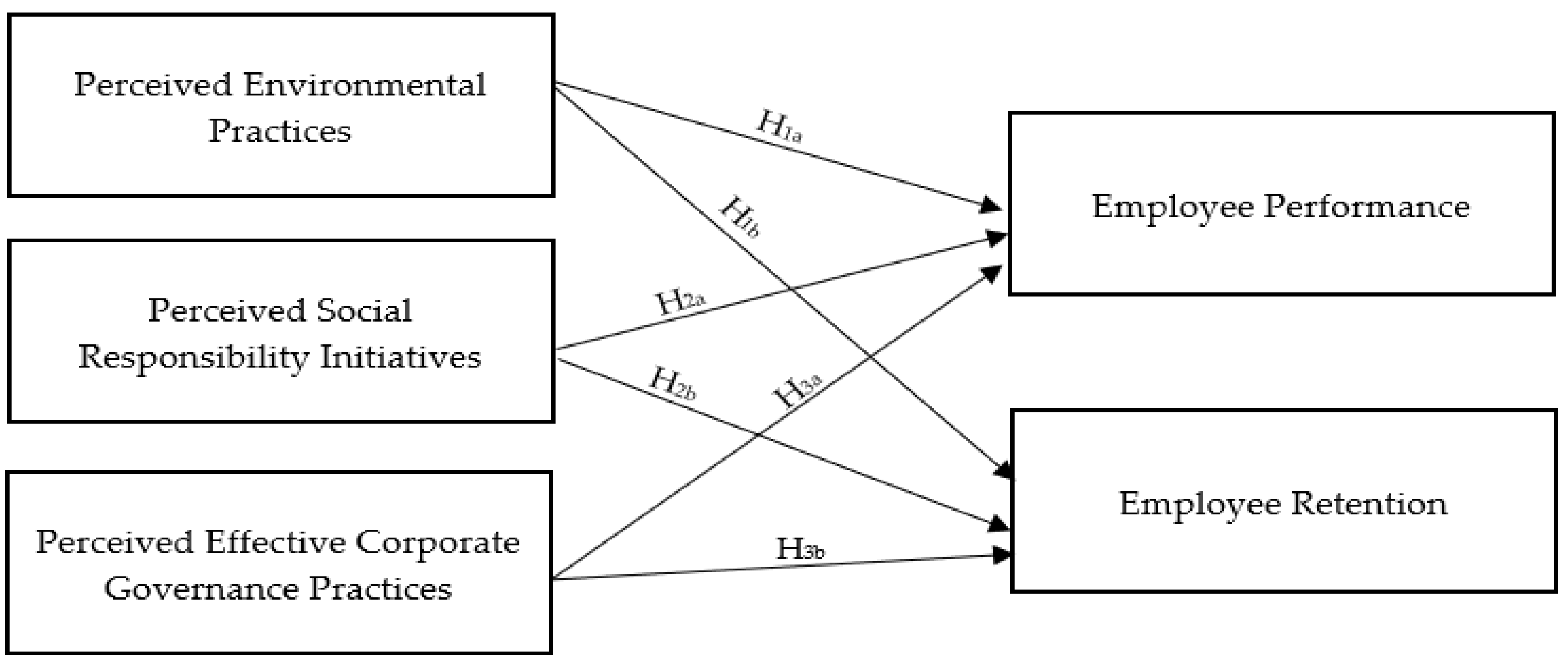
Based on the problem statement and to address the gap in the literature, this study aims to answer the following main research question: What is the association between employee perception of ESG practices and employee performance and retention in Lebanese organizations?
The study makes three main contributions. First, it advances ESG scholarship by shifting the analytical focus from external legitimacy and financial outcomes to employee-level consequences, thereby addressing a persistent gap in the literature. Second, it provides context-specific empirical evidence from Lebanon, a crisis-affected economy where ESG adoption is both constrained and strategically salient, enriching the understanding of ESG dynamics beyond stable institutional settings. Finally, it offers actionable insights for managers and policymakers by demonstrating how ESG-aligned HRM practices function as internal mechanisms for enhancing employee performance and retention, contributing to workforce resilience and sustainable organizational development.
3. Methodology
This study adopts a positivist philosophy and a deductive approach, testing theory-driven hypotheses on the associations between employees’ perception of ESG practices and employee outcomes.
3.1. Measures
A quantitative mono-method was employed, using a structured questionnaire for data collection. The questionnaire was divided into three sections.
Section 1 contains demographics.
Section 2 included 15 items related to ESG practices across three pillars. In this section, respondents indicated their level of agreement on a 5-point Likert scale ranging from 1 (strongly disagree) to 5 (strongly agree). The measurement items were not adopted from previous studies. They were based on an extensive review of the ESG, employee performance, and retention literature and grounded in established theoretical frameworks. First, 5 items are related to environmental practices (emission reduction targets, green training, recruitment branding, investment in renewable energy). Second, 5 items are related to social practices (well-being programs, anti-discrimination policies, CSR participation, diversity and inclusion, feedback use, and grounded in Stakeholder Theory and SET, which highlight that employees, as key stakeholders, respond to fairness, inclusion, and well-being investments with loyalty, engagement, and enhanced performance. Third, 5 items are related to governance practices (ethical leadership, transparent reporting, safe reporting channels, compliance monitoring, accountability). Those items are anchored in the SET, which stresses that fair governance, accountability, and procedural justice foster reciprocal trust and reduce turnover intentions. The last section included 10 items related to employee outcomes. Employee performance was measured using 5 items related to motivation, skill development, recognition, engagement, and quality of work. Those items were supported by the RBV and PsyCap, which view high-performing employees as strategic resources strengthened by ESG-driven training, recognition, and optimism. Employee retention included 5 items related to intention to stay, loyalty, recommending employer, reduced turnover desire, and trust/security. This construct is grounded on SET and PsyCap, since reciprocal support, fairness, and enhanced psychological resources (hope, resilience, optimism, self-efficacy) reduce attrition and strengthen long-term loyalty.
The questionnaire was originally developed in English, which is widely used and well understood in Lebanese professional and organizational settings. English is commonly employed as a working language in many Lebanese firms, particularly in managerial, industrial, and corporate contexts. Therefore, no translation was deemed necessary. A pilot test was conducted with a small group of respondents (n = 10) to ensure clarity, relevance, and cultural appropriateness of the items before full-scale data collection.
Table 1 summarizes the operationalization of all constructs, including the number of items and theoretical grounding. All constructs in this study were operationalized as employees’ subjective perceptions of ESG practices and their self-reported performance and retention intentions rather than objective organizational indicators.
3.2. Data Collection
Participation in this study was open to currently employed individuals aged 18 or older who worked for Lebanese organizations that reported at least one ESG-related practice. Respondents were required to confirm active employment status before proceeding with the questionnaire. According to the United States Agency for International Development (USAID), over 100 Lebanese companies have joined the Lebanon ESG Stewardship Program, reflecting growing but voluntary adoption. Based on these estimates, the population size was approximated at 150 organizations. Using the Qualtrics sample size calculator, the recommended sample size was 385 (95% confidence level; 5% margin of error).
The questionnaire was distributed through Google Forms and required approximately 8–10 min to complete. A probability-based sampling approach was initially intended; however, due to access constraints, data were collected using a non-probability, convenience-based sampling approach. Email invitations, professional networks, and digital platforms were used, and thus the response rate could not be calculated. A final sample size of 495 valid responses was obtained. The online survey required responses to all items, resulting in no missing data in the final dataset. Consequently, no imputation procedures were required.
Participation was voluntary and anonymous. An informed consent statement preceded the questionnaire, explaining the study’s objectives, assuring confidentiality, and affirming the right to withdraw at any stage. Ethical approval was obtained.
3.3. Data Analysis
The data were analyzed through a sequence of validity, reliability, and structural modeling tests using JASP software version 0.95.4.0. Sampling adequacy and factorability were first confirmed via the Kaiser–Meyer–Olkin (KMO) and Bartlett’s Tests of Sphericity. Internal consistency was then verified through Cronbach’s alpha (α) and McDonald’s omega (ω), while convergent and discriminant validity were established using the Average Variance Extracted (AVE) and Heterotrait–Monotrait (HTMT) ratios. Composite Reliability (CR) was also examined. Model fitness was assessed based on indices such as the Root Mean Square Error of Approximation (RMSEA) and the Goodness of Fit Index (GFI). Finally, Structural Equation Modeling (SEM) was conducted to test the hypothesized associations. SEM was selected because the study involves multiple latent constructs measured by multiple indicators and hypothesized simultaneous associations, allowing for the joint estimation of measurement and structural models while accounting for measurement error. SEM was conducted using the Maximum Likelihood (ML) estimator. Although the measurement items were assessed on five-point Likert scales, such scales are commonly treated as continuous variables in SEM when categories exceed four points and distributions approximate normality. Common Method Bias was assessed using Harman’s single-factor test. The results revealed that the first factor accounted for 33.3% of the total variance, which is below the 50% threshold, suggesting that common method bias is unlikely to substantially affect the results.
6. Conclusions
6.1. Theoretical Implications
This study advances the literature on ESG and sustainable HRM by explicitly linking employees’ perception of environmental, social, and governance practices to employee performance and retention through four complementary theoretical lenses: Stakeholder Theory, SET, RBV, and PsyCap.
From a Stakeholder Theory perspective, the findings extend prior work by demonstrating that ESG practices generate not only external legitimacy and societal value but also tangible internal benefits for employees. By empirically showing that ESG initiatives enhance performance and retention, particularly in a crisis-driven environment, the study reinforces the position of employees as central stakeholders whose well-being and productivity are critical to sustainable value creation.
Consistent with SET, the results confirm that employees reciprocate perceived organizational investments in environmental responsibility, social well-being, and ethical governance with higher performance and stronger retention intentions. This reciprocal mechanism is especially salient in fragile institutional contexts, where ESG practices function as signals of organizational support, fairness, and long-term commitment, thereby strengthening employee loyalty and effort.
Drawing on the RBV, the study contributes by positioning ESG-aligned human capital as a strategic organizational resource. The strong explanatory power of ESG practices for employee performance and retention suggests that sustainability-oriented HRM practices help develop and retain valuable, skilled, and committed employees who are difficult to imitate, thereby reinforcing competitive advantage even under adverse economic conditions.
Finally, through the lens of PsyCap, the findings highlight ESG practices as contextual enablers of positive psychological resources such as resilience, optimism, and self-efficacy. In Lebanon’s crisis-affected work environment, social and governance practices appear particularly important in sustaining employee motivation and commitment, offering empirical support for PsyCap theory in non-Western, high-uncertainty settings.
In brief, these contributions enrich ESG and HRM scholarship by integrating sustainability, governance, and employee-level outcomes within a unified theoretical framework, while extending these theories to a vulnerable institutional ecosystem that remains underrepresented in prior research.
6.2. Practical Implications
The findings of this study provide several implications for managers, HR directors, and business leaders trying to enhance job performance and retain employees.
First, managers can integrate sustainability into the core business strategy, rather than considering it as a peripheral module. By incorporating social and environmental goals into a corporation’s mission, operations, and decision-making processes, employees are greatly motivated and engaged while executing their tasks. As such, they express more commitment and loyalty to their companies. Plus, HR managers can bring into line recruitment processes, performance appraisal, and reward systems to reflect sustainability and CSR objectives. For instance, incorporating sustainability goals in performance evaluations or enlisting applicants who contribute to CSR projects can strengthen desired worker conduct and engagement.
Further, organizations that exhibit sincere commitment to environmental global issues, sustainability, and ethical governance can strengthen their employer branding in this regard, to attract new skills, especially young talents, as emerging generations are increasingly keen to seek purpose-driven workplaces that reflect their environmental and social values. Managers and business leaders can connect employees’ day-to-day job tasks with a greater purpose via CSR and sustainability initiatives. When employees believe that their company contributes positively to society and the environment, they are more likely to demonstrate better performance and remain loyal to their organization. Also, companies should promote a culture that heightens sustainability and responsibility as part of daily business conduct. This can be accomplished through employee training, participatory CSR programs, and inclusive decision-making, which in turn strengthen employees’ sense of belonging and organizational commitment. In addition, clear accountability structures, ethical leadership, and transparent communication should also be integrated into the organizational culture to underline both fairness and integrity that support employee satisfaction and retention.
Lastly, business leaders are prompted to regularly monitor and transparently communicate the outlooks on sustainability and governance initiatives (e.g., reduced environmental footprint, community contributions, ethical milestones) to their staff. This contributes to sustaining the connection between responsible business practices and organizational success.
In brief, by recognizing that sustainable, socially responsible, and well-governed activities bolster internal outcomes, business leaders and managers are encouraged to invest in these practices, not only as moral or reputational strategies, but also as strategic motors of work performance and retention, achieving long-term organizational resilience. The findings suggest that investing in ESG practices yields internal organizational returns by enhancing employee performance and retention, thereby supporting workforce resilience and long-term sustainability in turbulent economic environments
6.3. Limitations of the Study and Future Perspectives
Despite its contributions, this study has several limitations. First, the use of convenience sampling limits the generalizability of the findings beyond the surveyed respondents. Although the sample size is adequate for SEM analysis, it represents employees working in Lebanese organizations that have already adopted ESG practices, thereby excluding firms with limited or no ESG engagement. Future research could employ probabilistic or stratified sampling techniques by including organizations at different stages of ESG adoption. Second, the study relies on a cross-sectional, self-reported survey design, which restricts causal inference, and the findings reflect employees’ subjective evaluations rather than objective ESG performance indicators. Future studies could strengthen causal interpretation by adopting longitudinal, experimental, or mixed-method designs, as well as incorporating objective performance indicators or multi-source data. Third, the context is limited to Lebanon, a crisis-affected and institutionally fragile economy. Although this context represents a key contribution of the study, it may also limit the transferability of the findings to more stable institutional environments. Comparative or cross-country studies could further examine whether the observed associations between ESG practices and employee outcomes hold across different economic, cultural, and regulatory contexts. Also, because organizational identifiers were not collected to preserve respondent anonymity, potential within-firm clustering effects could not be modeled. Future research may adopt multi-level modeling approaches to examine firm-level influences. Addressing these limitations in future research would help refine the understanding of ESG–employee outcome associations and enhance the robustness and external validity of sustainability-oriented HRM frameworks.
In brief, this study contributes by shifting ESG research toward employee-level outcomes and by providing evidence from a crisis-affected, underexplored context. It shows that ESG practices are associated with both employee performance and retention, highlighting governance as the strongest dimension. These findings support the view that ESG-aligned HRM can generate internal workforce benefits that complement its external legitimacy role, offering guidance for organizations operating under institutional fragility.