1. Introduction
Tourism is one of the fastest-growing sectors globally, and thus, it generates valuable economic impacts in tourist destinations. However, rapid development and economic progress are accompanied by negative effects, reflected in environmental and social impacts (
UNWTO, 2023). Given these circumstances, it is necessary to establish strategic frameworks that would incorporate sustainability principles into the market-oriented practices of tourism firms. Although the focus of sustainability is often associated with environmental measures, it in fact requires systemic changes. Such changes are reflected in the manner in which companies adapt to the changing tourist market, interact with stakeholders, and introduce innovative practices in order to achieve long-term value creation (
Feng & Goli, 2023;
Pasqualotto et al., 2023;
Ul-Durar et al., 2023).
Within this perspective, market orientation (MO) emerges as a foundational strategic mechanism that enables tourism firms to monitor consumer and market needs while adapting accordingly (
Kohli & Jaworski, 1990;
Narver & Slater, 1990). MO can also be viewed as an instrument that encourages the design of sustainable products and services (
Mitchell et al., 2013). Growing empirical evidence demonstrates the positive influence of MO on the implementation of circular economy (CE) practices, while simultaneously enhancing sustainability performance (
Hoffmann & Marticke, 2024;
Oliveira Rosa & de Oliveira Paula, 2023;
Schmidt et al., 2021). The concept of Sustainable Market Orientation (SMO) also appears in the literature, which incorporates environmental and social objectives and, as such, promotes distributed decision-making (
Lučić, 2020;
Mitchell et al., 2013).
Understanding the complexity of the relationship between MO and CE is of vital importance, since prior studies emphasize the role of innovation (INN) as the key pathway. Through this said pathway, MO and SMO can both generate positive CE practices and sustainability outcomes. In this context, market-oriented firms are more innovative and more eager to adopt new technologies and integrate both environmental and social aspects into product or service design (
Giang, 2022;
Santos et al., 2021;
Sari & Indriani, 2023;
Strippoli et al., 2024). In tourism, CE adoption is influenced by different aspects, such as environmental, supply chain, economic, informational, legal, market, organizational, public, social, and technological factors (
Pasqualotto et al., 2023). Although the transition from a linear to a circular model necessitates technical and organizational INN, empirical studies that link CE adoption directly to sustainability outcomes in tourism remain scarce (
Axhami et al., 2023).
Based on the previous insights, this study introduces the Tourism Cooperative (TC) framework as a form of destination governance, the main aim of whose is to connect all actors in tourism into a novel system. Based on the principles of social, economic, and environmental sustainability, the system is bound to be led by shared institutional and stakeholder responsibility (
Castree, 2003;
Haraway, 2016). From a theoretical perspective, the TC model functions according to gravitational and rotational principles in the Solar System. Just as the planets orbit the Sun, while maintaining the same distance, the tourism firms likewise “orbit” the “core” of the TC, where experts are located within the fields of MO, CE, INN, and overall sustainability. Tourism stakeholders have the opportunity to receive adequate advice and practical examples from these experts in order to establish a sustainable business model. Local communities also have the opportunity to join this system.
Considering other forms of destination governance, e.g., collaborative governance, destination networks, and destination management organizations (DMOs), the TC framework aims to overcome their main barriers. More precisely, they are all grounded on collaborative principles between stakeholders through institutional frameworks. However, it is uncertain whether tourism firms and local communities receive necessary information and resources for transitioning to sustainable operations (
Bichler & Lösch, 2019;
Bono i Gispert et al., 2023;
Panagiotopoulou & Skoultsos, 2025). In summary, this approach views tourist destinations as unique systems with limited resources and highlights the importance of a comprehensive overview and understanding of the complexity involved in achieving sustainable tourism development.
Based on the evidence above, the fundamental matter of this study addresses the exploration of mechanisms at the level of tourist destinations that would enable tourism firms to direct their operations towards sustainable development. In this regard, the following objectives are defined:
Testing the causal relationship between MO, CE, and INN;
Examining the influence of CE on sustainability outcomes;
Evaluating CE as a mediator between MO and all sustainability dimensions;
Exploring the influence of INN on sustainability.
2. Theoretical Framework
2.1. Market Orientation, Innovation, and Circular Economy
The adoption of CE principles at the micro level, that is, at the level of tourism firms, is in and of itself complex and requires the participation of a large number of actors in order to adequately adapt the entire organizational structure of the firm. Based on a systematic literature review,
Pasqualotto et al. (
2023) singled out ten factors and barriers influencing CE: environmental, supply chain, economic, information, legal, market, organizational, public, social, and technological factors. Among these categories, market dynamics permeate almost all structures, because it encompasses both organizational conditions as well as consumer and competitor orientations. Therefore, it can be concluded that MO plays an important role in the practical application of CE practices (
Hoffmann & Marticke, 2024;
Pasqualotto et al., 2023;
Schmidt et al., 2021).
Academic interest in researching the influence that MO has on CE has intensified, and studies provide evidence of this direct link. For example,
Hoffmann and Marticke (
2024) showed that MO positively influences CE implementation in German SMEs.
Schmidt et al. (
2021) found that MO fosters the transition towards circular business models. It has been observed that all aspects of MO can encourage the implementation of CE principles. In this context, customer orientation can help identify and analyze the needs of consumers, especially those that align with the principles of sustainability. Competitor orientation serves as a basis for achieving a competitive position in the market and examining the ways in which the competition creates value through eco-innovation. Furthermore, inter-functional coordination enables the transformation of internal structure of enterprises, which functions as a single system, into collaboration that fosters closed-loop orientation (
Aboalhool et al., 2024;
Haskas et al., 2021;
Ismail et al., 2023).
Previous studies have mostly shown a positive relationship between MO and CE (
Aboalhool et al., 2024;
Hoffmann & Marticke, 2024;
Schmidt et al., 2021). However, it is important to point out the limitations of context-specific research in tourism, which impede the generalization of results. Tourism is a dynamic process, dependent on numerous internal conditions and external factors, especially regarding sustainability-related issues. Overall, the literature suggests that MO may serve as a catalyst for CE. These findings support the formulation of the first hypothesis:
H1a. MO has a direct positive effect on CE.
A growing body of research shows a strong positive relationship between MO and INN in tourism firms. It has been demonstrated that MO, encompassing customer, competitor, and inter-functional coordination, encourages the adoption of innovative solutions in business operations (
Čivre & Gomezelj Omerzel, 2015;
Sari & Indriani, 2023). This is understandable, since market-oriented and innovative enterprises achieve higher profitability and returns on investment and are also more inclined to introduce digital technologies (
Al-Romeedy & Khairy, 2024;
Cheng et al., 2022;
Kandampully et al., 2023;
Papaioannou et al., 2018). The structural link between MO and INN in tourism has been widely investigated in different spatial contexts and tourism sectors, consistently confirming their positive correlation (
Chandran et al., 2024;
Elgarhy & Abou-Shouk, 2023;
Giang, 2022;
Jalilvand, 2017). Although there is a solid theoretical basis indicating that market-oriented subjects tend to innovate, previous empirical research lacks evidence of both organizational and technological causal relationships between MO and different types of INN (
Al-Romeedy & Khairy, 2024;
Chandran et al., 2024;
Kandampully et al., 2023;
D. Zhou et al., 2025). Based on previous evidence, the following hypothesis was established:
H1b. MO has a direct positive effect on INN.
The tourism and hospitality industry is increasingly transitioning from linear “take-make-dispose” models to the adoption of circular approaches that minimize waste (
Segarra-Oña et al., 2024). INN, as the term itself suggests, includes novel procedures and techniques that help companies keep pace with technological changes and implement them. This is especially important in tourism, where the need for sustainable development plays a primary role (
Nassanbekova et al., 2023). However, empirical evidence on INN’s effectiveness in driving CE is still fragmented. Positive examples exist, but their main drawback is reflected in the reduced ability to interpret results across different geographical contexts (
Suchek et al., 2021;
Surya et al., 2024), particularly concerning isolated island destinations inherently limited in resources. Moreover, there is a lack of studies monitoring the long-term effects that innovative solutions would have on CE practices in such cases (
Segarra-Oña et al., 2024).
On the other hand, the adoption of INN in business is accompanied by certain barriers, such as a focus on short-term economic results, limited resources, or institutional regulations. Together, these barriers prevent innovative solutions from becoming widespread (
Chountalas et al., 2024;
Lagioia et al., 2024). In addition,
Lagioia et al. (
2024) found that there is a satisfactory level of sustainability awareness in the surveyed hotels in southern Italy. However, the implementation of CE practices remains negligible. Overall, there is a solid research base suggesting that INN encourages businesses to shift towards CE solutions. However, the implementation of both INN and CE requires more extensive research, since numerous factors influence this relationship, along with the underlying structure of the constructs examined. Therefore, the following hypothesis was formulated:
H1c. INN has a direct positive effect on CE.
Prior research supports INN’s mediation effect on the relationship between MO and CE (
Haskas et al., 2021;
Ismail et al., 2023). Tourism companies whose business models are oriented towards monitoring and evaluating consumer needs, competitors’ activities, and inter-departmental collaboration are more inclined to adopt innovative solutions in developing products and delivering services that encourage CE (
Al-Romeedy & Khairy, 2024;
Čivre & Gomezelj Omerzel, 2015;
Sari & Indriani, 2023). It is also important to note that digital and eco-innovations are particularly prominent in this context (
Nassanbekova et al., 2023;
Segarra-Oña et al., 2024;
Surya et al., 2024). In addition, innovative and circular business models can help overcome certain financial, organizational, and knowledge constraints (
Chountalas et al., 2024;
Lagioia et al., 2024;
Yadav et al., 2024). Although the existing evidence supports the structural relationship MO → INN → CE, a more substantial approach is needed in tourism studies to support its longer-term significance. Thus, it is proposed that:
H1d. INN mediates the relationship between MO and CE.
2.2. Circular Economy and Sustainability Outcomes
Previous investigations have shown broad consensus in recognizing CE practices as a tool that helps achieve overall sustainability. It is worth mentioning that the focus has gradually shifted from focusing on environmental sustainability (ENVS) as a crucial dimension, towards social and economic sustainability (ECONS) as well, and subsequently highlighting the importance of global partnership (GP), which permeate all spheres of sustainability (
Pratap Singh et al., 2023;
Rodríguez et al., 2020;
Sa Liow, 2024). Although there are certain studies that highlight the direct connection between CE and social sustainability (SOCS) (
Bosone & Nocca, 2022;
Remenyik et al., 2025), in the current study, hypothesis H2a was not statistically justified, making it necessary to introduce GP as a mediator.
When it comes to the connection between CE and the dimensions of sustainability related to the economy and environment, several studies confirm their causal relationship. In terms of economic effects, CE can be regarded as a tool for reducing costs and achieving efficient resource use (
José Carvalho et al., 2024;
Sharma et al., 2024). On the other hand, the benefits of introducing CE practices at ENVS are reflected not only in waste reduction but also in the development of green INN, which is of particular importance for achieving long-term sustainability goals (
Hasnawati & Irmawati, 2024;
Radosavljevic & Mihailovic, 2024;
Sa Liow, 2024;
Tomassini & Cavagnaro, 2022;
Zaki & Farrag, 2024).
Collaboration among tourism stakeholders has been found to be influenced by CE (
Bosone & Nocca, 2022;
Singh et al., 2023). Such cooperation among tourism firms, communities, and governments constitutes the theoretical and practical basis of GP, which is why it was necessary to introduce GP as a mediator in the CE–SOCS relationship in the model examined in this study (
Axhami et al., 2023;
Bosone & Nocca, 2022;
José Carvalho et al., 2024;
Remenyik et al., 2025;
Sharma et al., 2024).
The above-mentioned insights lead to the formulation of the following set of hypotheses:
H2b. CE has a direct positive effect on ECONS.
H2c. CE has a direct positive effect on ENVS.
H2d. CE has a direct positive effect on GP.
H2e. GP mediates the relationship between CE and SOCS.
2.3. Circular Economy as a Mediator Between Market Orientation and Sustainability
The research to date has shown relatively limited interest in examining the mediating role of CE in the structural link between MO and determinants of sustainability. Based on the fact that previous studies examined individual influences, that is, the contribution of MO to applying CE principles (
Hoffmann & Marticke, 2024;
Pasqualotto et al., 2023;
Schmidt et al., 2021) as well as widely established knowledge that CE promotes the achievement of Sustainable Development Goals (SDGs) (
Pratap Singh et al., 2023;
Rodríguez et al., 2020;
Sa Liow, 2024), it can therefore be concluded that it is justified to investigate a causal relationship where CE acts as a mediator between MO and sustainability.
Moving towards individual sustainability dimensions, there are indications justifying the link MO → CE → SOCS, since MO supports resource circularity, and CE practices significantly contribute to the achievement of social goals in tourist destinations (
Hasnawati & Irmawati, 2024). Nevertheless, preliminary testing in this study did not confirm this mediation. Consequently, hypothesis H3a was removed, and GP was included as a mediator between CE and SOCS. This indicates the primary role of institutional collaborations and stakeholder cooperation in realizing SOCS benefits.
The mediating role of CE in sustainability dimensions related to economy and environment is still relatively limited. It is mainly based on the positive contribution of CE practices to sustainability, with MO elements such as product design, competitive strategies, and inter-departmental coordination reflected in concrete CE actions (
Axhami et al., 2023;
Bux & Amicarelli, 2023;
Zaki & Farrag, 2024). In addition to the mentioned structural relationships, a role of MO as a predictor of the CE–GP relationship has only been investigated to a limited extent (
Bosone & Nocca, 2022;
Singh et al., 2023). Based on the previous analysis, the following three hypotheses were established:
H3b. CE mediates the relationship between MO and ECONS.
H3c. CE mediates the relationship between MO and ENVS.
H3d. CE mediates the relationship between MO and GP.
2.4. Innovation’s Role in Sustainability Through Circular Economy and Global Partnership
In previous studies on the relationship between INN and sustainability in tourism, it has been demonstrated that innovative practices exert a particular influence on ENVS. Tourism firms can significantly reduce their environmental impact through the adoption of innovative solutions (
Ismailov et al., 2024). In the same way, digital INNs can further mitigate environmental impacts, such as waste generation and energy and water consumption, and facilitate carbon footprint reduction (
Elkhwesky et al., 2024;
Kubíková & Rudý, 2024). However, several barriers have been recognized to impede the achievement of environmental benefits. Institutional frameworks and local collaboration stand out in this regard (
Renfors, 2022), along with inappropriate indicators that fail to clearly capture sustainability actions (
Santos et al., 2021). Therefore, the following hypothesis is developed:
H4a. INN has a direct positive effect on ENVS.
The connection between INN and GP formation in tourism is understood through innovative mechanisms that can help establish more effective cooperation at both the national and international levels (
Gebeshuber & Majlis, 2011). This is particularly important in the case of institutional partnerships, since practical examples are mainly related to lower levels of cooperation, i.e., local and regional cooperation (
J.-J. Kim & Lee, 2022;
Polukhina et al., 2024;
Turčinović et al., 2025). In this context,
Renfors (
2022) highlights certain limitations of circular innovative solutions in tourism due to the fact that not all firms operate under the same conditions for applying new approaches. This supports findings from the systematic literature review conducted by
Santos et al. (
2021), who called for more in-depth analyses for both INN and sustainability indicators. The reason is that without institutional support, INN cannot adequately impact development towards sustainable tourist destinations. This theoretical basis provided a solid foundation for the formation of the following hypothesis, which was added to the alternative model:
H4b. INN has a direct positive effect on GP.
The research to date has not yet examined the mediating role of GP in the relationship between INN and SOCS. However, drawing on the literature sources that examined individual relationships, it is possible to establish that this relationship has adequate theoretical support for further investigation. Accordingly,
González-Morcillo et al. (
2023) indicated the need to introduce mediation factors for the connection between INN and SOCS, although they did not explicitly mention partnerships. Conversely, international collaboration might impede local or regional sustainability goals. Namely, in international cooperation, certain objectives are often focused rather on economic effects instead of a comprehensive set that includes environmental and social goals (
Bramwell & Lane, 2011;
Higgins-Desbiolles, 2020). Based on all of the above, there is a need to examine the indirect role of INN on SOCS via GP, and the following hypothesis was formulated:
H4c. INN affects SOCS indirectly via GP.
All business structures strive to achieve economic goals, which indicates the need to examine factors that can accelerate their achievement. In this context, and in the transition to sustainable business models that require modern technological and organizational solutions, it is necessary to consider factors such as INN and CE (
Manniche et al., 2018). Academic studies have already examined the mentioned relationship. For instance,
Marco-Lajara et al. (
2024) conducted their research in Spain, specifically in the hospitality sector. After an extensive quantitative analysis, it was established that CE practices mediate the relationship between INN and economic outcomes. Similarly,
Gusmerotti et al. (
2024), who conducted research in nine Mediterranean destinations among 127 tourism stakeholders, also confirmed the aforementioned causal relationship. However,
Kirchherr et al. (
2018) pointed out real obstacles that tourism firms may encounter when attempting to achieve economic goals through INN and CE practices. Business structures set up in this way most often lead to positive economic outcomes in the long term. On the other hand, SMEs, due to certain resource constraints, may be hindered from adopting innovative and circular business models (
Kirchherr et al., 2018). Therefore, the following hypothesis was introduced in the alternative model:
H4d. INN affects ECONS indirectly via CE.
Since it has been proven that INN can foster CE mechanisms through the application of organizational and digital technological achievements (
Chountalas et al., 2024;
Lagioia et al., 2024) and that circular business models require appropriate institutional support (
Bosone & Nocca, 2022;
Singh et al., 2023), it is therefore justified to examine the following mediation relationship: INN → CE → GP. Accordingly,
Renfors (
2022) concluded that innovative circular practices may serve as the foundation for institutional cooperation.
Although there are barriers that prevent tourism enterprises from adopting innovative practices leading them to rely on local partnerships (
Elkhwesky et al., 2024;
Ismailov et al., 2024), innovative solutions in the field of CE help establish cooperation at higher institutional levels (
Gusmerotti et al., 2024;
Santos et al., 2021;
Strippoli et al., 2024). Moreover, the practical application of CE practices, such as waste minimization, renewable energy adoption, and clean water systems, in itself requires the formation of cooperation at all levels of action (
Gusmerotti et al., 2024;
Strippoli et al., 2024). In the context of tourism, a primary role is played by management mechanisms at the level of the destinations themselves as well as cooperation between the private and public sectors (
J.-J. Kim & Lee, 2022;
Polukhina et al., 2024). Based on all the above, the alternative model was extended to include the following hypothesis:
H4e. INN affects GP indirectly via CE.
2.5. The Tourism Cooperative Framework
The proposed TC framework is inspired by the works of
Castree (
2003) and
Haraway (
2016).
Castree (
2003) noticed a complex relationship between nature and society in which they are intertwined. They ought to be viewed as a relationship network as opposed to being viewed in isolation. The crucial factor is the fact that the ecological concerns do not require only technical solutions. Rather, they require being addressed and therefore being solved by the multi-actors. Similarly,
Haraway (
2016) recognized, alongside human factors, the importance of biotic and abiotic powers of Earth in shaping the socio-ecological processes. Furthermore, the necessity of collective action and striving for the common good was pointed out, which represents the core concept of this research. Brought into context of this research, the TC is a proposal of destination governance. With emphasis on multi-actor cooperation, it aims to guide tourism firms towards sustainable development.
The inspiration for the TC theoretical framework was found in the main principles by which the planets move in the Solar System, those being gravity and orbital motion. Metaphorically speaking, the Sun has been represented as the main institutional framework and the planets as the variety of fields of experts, which in this case are MO, CE, INN, and sustainability. This complex system works by the principle of collaborative action, shared governance, and equitable access to resources. More specifically, tourism experts mutually cooperate and have access to all tourist-flow information, on the basis of which adequate guidelines are formed, aiming to direct tourism operations towards sustainability. Tourism providers, namely, tourism firms and local communities, if needed, can ask for concrete guidelines that will be tailored to their business operations, which can help them to integrate sustainability practices in the most efficient way.
With regard to destination governance, it is necessary to point out several different concepts in the tourism literature. For instance, the main goal of collaborative governance is the inclusion of all tourism stakeholders where all actors are interconnected through certain mechanisms in selected spheres of activity (
Barandiarán et al., 2019;
Bichler & Lösch, 2019;
Reina-Usuga et al., 2024). In addition, their mutual communication and opportunity to use publicly available recommendations help them improve the effectiveness of business operations, which is particularly important in online tourism management (
Lian & Li, 2025). Another form is destination networks, which use data on the movement of tourists and inter-destination connections in order to establish patterns of planning and management (
Xu et al., 2024). This form of destination governance also finds its application in online networking activities (
Herasimovich et al., 2024). Furthermore, it is important to highlight the DMOs that play a vital role in promoting destinations, developing products and services, and providing support to local communities. Their key influence is also recognized in the area of sustainable tourism (
MacEachern et al., 2024). Local communities are the foundation of tourist destinations, providing authenticity and a unique peculiar identity. In this context, community-based tourism has been recognized to foster all sustainability dimensions (
Cvijanović et al., 2025;
Jackson, 2025).
The main drawback of all the mentioned mechanisms is the absence of an adequate institutional framework that would provide support to tourism firms, which are the main providers of tourist services. The described concepts are important for the functioning of tourist destinations, and their core is mutual collaboration between stakeholders. However, the main concern is whether tourism firms genuinely have access to all the information, as well as whether they possess adequate resources to track all the changes on the market and adapt accordingly. In this regard, the main advantage of the TC framework is that tourism service providers, tourism firms and local communities, have the opportunity to receive specific guidelines from experts in the fields of MO, CE, and INN, with the aim of directing their business operations towards sustainable principles. In other words, the TC is an institution that functions and provides support primarily at the local level. These mechanisms are then connected to higher levels: regional and national.
3. Materials and Methods
3.1. Research Context and Sampling
This study was conducted on the island of Tenerife, located in the Canary archipelago, Spain. Due to the high economic dependence of the island on tourism, which causes increasing spatial and social pressures, its distance from mainland Spain, and limited resources, there is a need to evaluate existing measures and introduce new tourism development programs that will be based on sustainable development. Recently, certain sustainability policies and measures have been established that represent the important step towards sustainable tourism development, like the Sustainability Charter for Activities in Nature (
Web Tenerife, n.d.) and the island’s proclamation as a Biosphere Destination (
Biosphere Tourism, 2021).
The research was conducted in two phases. The first phase included interviews with 12 tourism experts who were presented with a preliminary survey. Based on their opinions and feedback, a final survey was developed to examine four constructs: MO, CE, INN, and selected SDGs. The survey was conducted through an online questionnaire between April and August 2025. In order to ensure that all the contacted firms operate in accordance with the principles of sustainability, Turismo de Tenerife, as the leading public institution on the island, contacted the respondents by email using its database. The email contained a link to the survey, and it was explicitly stated that anonymity would be preserved. A total of 108 tourism firms that practice sustainability measures participated in the survey.
3.2. Respondent Profile
Empirical research included 108 tourism firms operating in four different tourism sectors: accommodation, transport, travel agencies and tour operators, and active or cultural tourism. The largest number of firms were in the active or cultural tourism and accommodation sectors (43 firms, 39.8%; 41 firms, 38.0%, respectively). Travel agencies and tour operators accounted for almost 15% of respondents (16 firms), while only 2 firms were from the transport sector. The ‘other’ subgroup comprised 6 firms (5.6%). Regarding the size of the firms, most were SMEs. More precisely, small enterprises (<5 employees) included 41 firms, medium-sized enterprises (5–30 employees) involved 34 firms, medium-large enterprises (31–50 employees) included only 6 firms, and large enterprises (50+ employees) comprised 27 firms. In the context of establishment years, they ranged from 1959 to 2023.
3.3. Instruments and Measures
Measuring instruments for the four investigated scales were developed on the basis of a comprehensive literature review. For the MO and INN constructs, scales that have already been proven reliable in previous research were used with certain wording adjustments (
Deng & Dart, 1994;
D. Kim et al., 2012;
OECD, 2005;
Sargeant & Mohamad, 1999;
Thongsri & Chang, 2019;
K. Z. Zhou et al., 2009). For CE and selected SDGs, based on a review of the literature and the specific contexts of the examined tourist destination, unique measurement scales were established (
Manniche et al., 2018;
Marrucci et al., 2024;
Menegaki, 2018;
Rodríguez et al., 2020;
UN, 2017;
UNWTO, 2016).
The questionnaire formed in this way included 4 multi-item constructs. In other words, MO consisted of four dimensions with 4 items for each of them (see
Table S1). CE had five subgroups with three or four items for each of them (see
Table S2). The INN construct included 5 subcategories also with three to four items each (see
Table S3). Finally, the ten measured SDGs were divided into the following sustainability outcomes: social, economic, environmental, and global partnerships. Each of the mentioned outcomes included three SDGs, except for partnerships, which applied only to SDG 17 (see
Table S4).
All items were measured on a seven-point Likert scale ranging from 1 (“not at all”) to 7 (“very well”). The scale provides significantly more reliable results than, e.g., the 5-point Likert scale in quantitative research, and it enables much more precise answer evaluation. This was confirmed in the academic literature (
Joshi et al., 2015) as well as by some experts who were interviewed in the first phase of the research, thereby ensuring content validity. Although some researchers state that a midpoint could be excluded, providing respondents with the option to agree or disagree with the statements (
Chyung et al., 2017), the neutral position is still maintained because it often occurs in practice that respondents do not have a clear opinion (
Abulela & Khalaf, 2024;
Chyung et al., 2017). In terms of the psychometric properties of the scale, primarily reliability and validity, it is demonstrated that they are significantly better when there is an option of neutral opinion (
Kankaraš & Capecchi, 2025).
PLS-SEM in SmartPLS 4.1 was used for statistical data processing. As a non-parametric method, it does not require data to be normally distributed, and it is suitable for relatively small samples and for examining mediating effects (
Hair et al., 2022;
Henseler et al., 2016). After a preliminary reliability analysis, i.e., testing Cronbach’s alpha, SDG 8, and SDG 9, and one item from both SDG 11 and SDG 12 were excluded to achieve acceptable internal consistency. For all constructs, the mean values of their sub-dimensions were used, since these are guidelines that must be followed to improve estimation stability (
Hair et al., 2022;
Henseler et al., 2016). Also, in order to achieve a satisfactory model fit, it was necessary to subsequently modify additional specific constructs (
Hair et al., 2022;
Henseler et al., 2016). Thus, for example, ECONS and CE have remained with only one measurement variable each. This will be explained in more detail in the next section.
3.4. Structural Framework
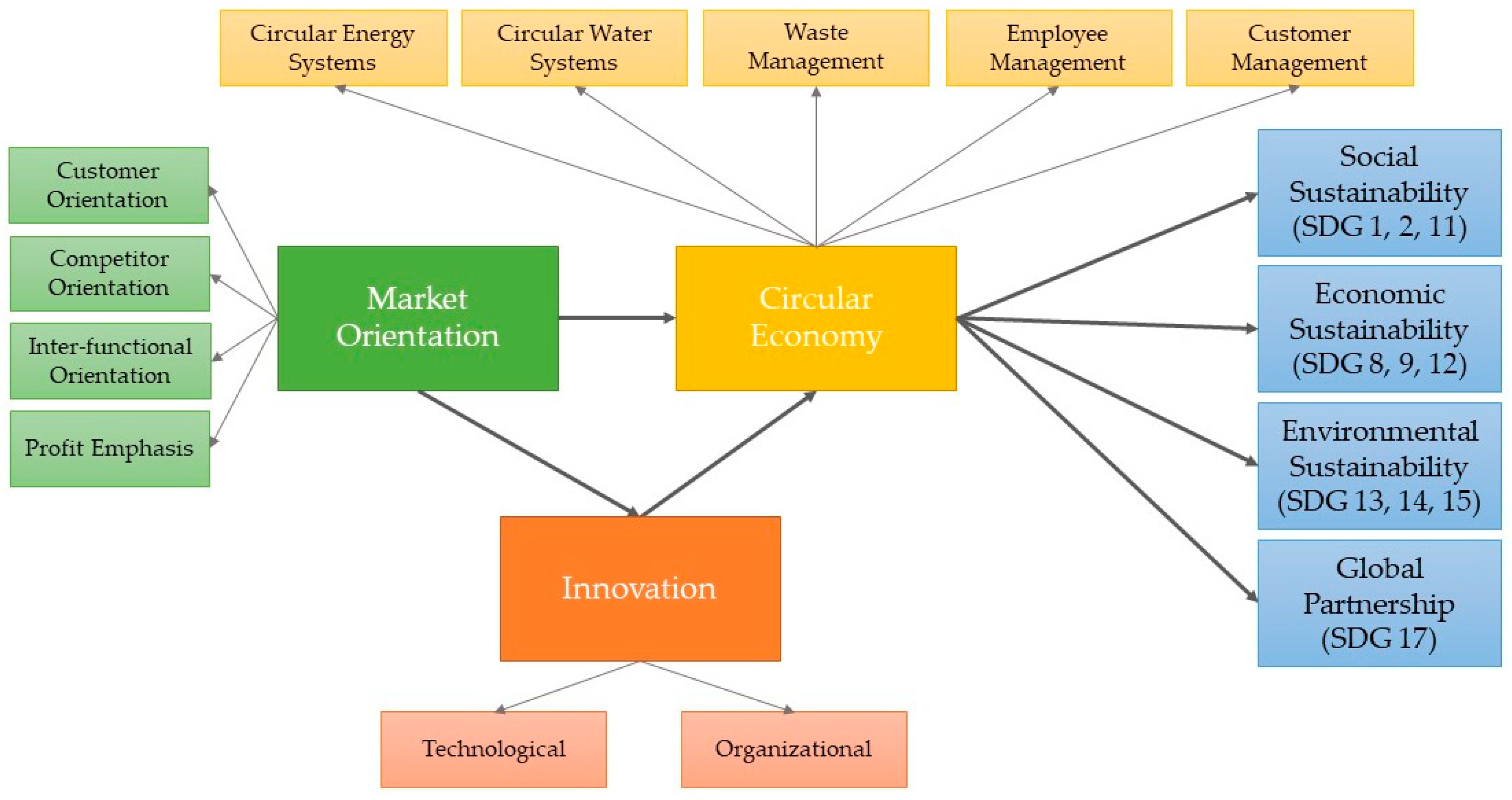
This study proposes a conceptual model (
Figure 1), which is tested using Partial Least Squares Structural Equation Modeling (PLS-SEM) through SmartPLS. Such an approach enables the simultaneous examination of direct, indirect, and mediating relationships within the proposed framework.
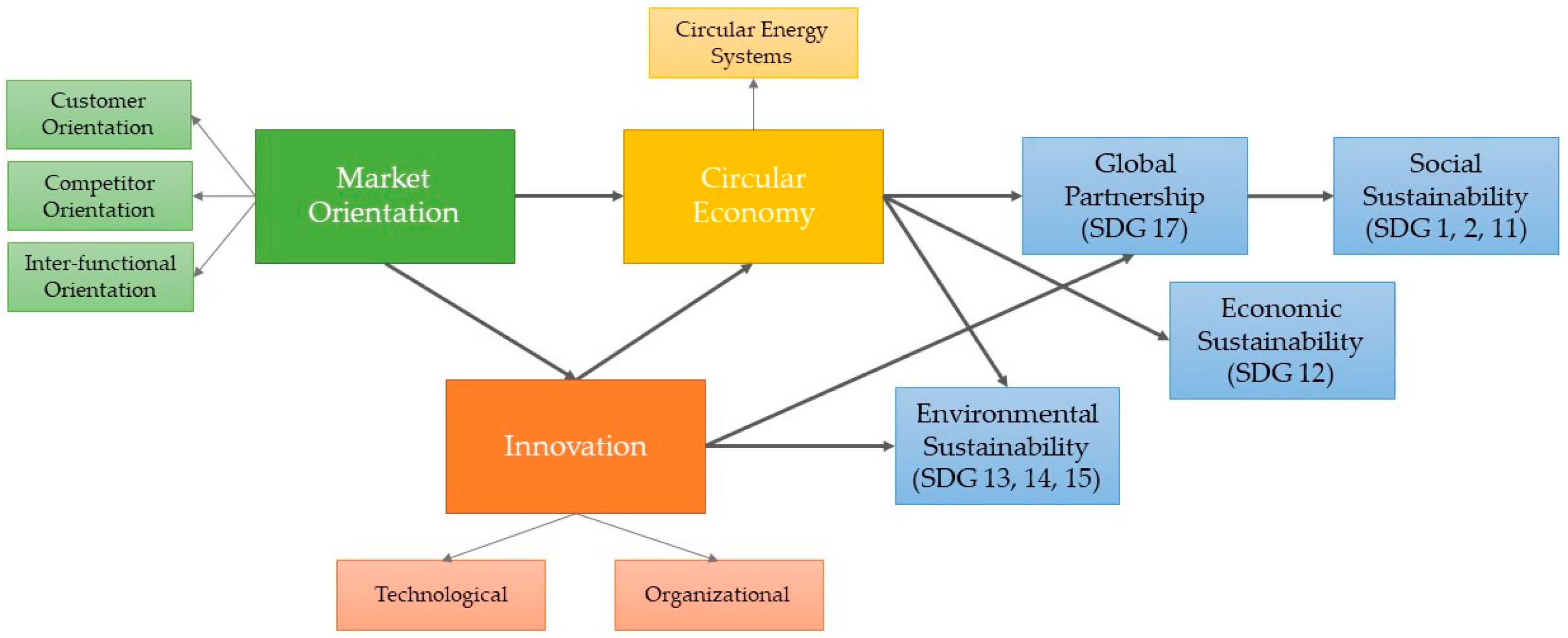
Prior to final testing, it was necessary to redefine the proposed model, since preliminary analyses showed a lack of statistical significance for certain links, while other subsequently added relationships have been proven to be theoretically and practically justified (
Figure 2). The direct link between CE and SOCS (H2a) was removed due to lack of support. Moreover, GP and INN emerged as key mediators and drivers of sustainability outcomes. Hence, GP takes position as a mediator between SOCS and CE (H2e), with an addition of a new set of hypotheses (H4a–H4e) to directly and indirectly link INN with sustainable practices.
The final model includes the following four main hypotheses:
H1 tests the relationship between MO, INN, and CE, including the mediating role of INN;
H2 examines the influence of CE on sustainability outcomes, including the mediation effect CE → GP → SOCS;
H3 evaluates CE as a mediator between MO and all sustainability dimensions;
H4 explores the influence of INN on sustainability, both directly and indirectly via CE and GP.
4. Analysis and Results
4.1. Evaluation of the Measurement Model
4.1.1. Indicator Reliability (Outer Loadings)
Indicator reliability was evaluated using standardized outer loadings. According to
Hair et al. (
2022), values above 0.70 mean that the items perfectly measure the latent variable, while values between 0.60 and 0.70 can also be considered acceptable. The items in this study indicated strong internal reliability, since all loadings exceeded 0.80. However, three items (MO4, INN2, CE2) had values below 0.70 and were removed because they negatively affected discriminant validity.
4.1.2. Internal Consistency Reliability
Internal consistency reliability was assessed using Cronbach’s alpha, rho_A, and composite reliability (rho_c). These values range from 0 to 1. Values closer to 1 indicate stronger reliability, and values above 0.70 are generally accepted, while values above 0.80 are regarded as optimal (
Dijkstra & Henseler, 2015;
Hair et al., 2022;
Nunnally & Bernstein, 1994). All measurement constructs in this research showed satisfactory internal consistency reliability, as shown in
Table 1. In other words, Cronbach’s alpha values ranged from 0.725 to 0.906, rho_A values from 0.725 to 0.910, and composite reliability values exceeded 0.844.
4.1.3. Convergent Validity (AVE)
Convergent validity was examined using the average variance extracted (AVE). Following the proposal of
Fornell and Larcker (
1981), values above 0.50 are accepted because they indicate that the items explain more than half of the variance in their indicators. As demonstrated in
Table 2, all constructs had AVE values ranging from 0.803 to 0.928, indicating that satisfactory convergent validity was achieved.
4.1.4. Discriminant Validity (HTMT and Cross-Loadings)
Discriminant validity was evaluated using the HTMT ratio and cross-loadings (
Hair et al., 2022). Its values range from 0 to 1, with values closer to 0 indicating that the constructs differ from each other. Values above 0.90 indicate a lack of discriminant validity (
Henseler et al., 2015).
The cross-loading matrix showed that CE3, CE4, CE5, and INN3 loaded strongly on multiple constructs. This means that there is some conceptual overlap between them and that discriminant validity is impaired. After they were removed, all other indicators showed satisfactory cross-loadings, indicating that they differ empirically. This left the CE construct with one indicator. However, in exploratory research, single indicators are accepted if they conceptually and theoretically describe the corresponding variable (
Diamantopoulos et al., 2012). In this case, CE retained items related to circular energy systems, more precisely renewable energy use, energy-saving policies, and eco-friendly transportation.
The HTMT values are shown in
Table 3. It is important to note that all values were below the threshold of 0.85, except for the GP–ENVS pair. However, the value of 0.852 is acceptable, as it is only slightly above the recommended limit. In some studies, values up to 0.90 can be accepted (
Hair et al., 2022;
Henseler et al., 2015). This suggests that in further research, special attention should be paid to the conceptualization of ENVS and GP, because numerous environmental activities and measures are only possible when there is institutional cooperation.
4.1.5. Collinearity (VIF—Outer Model)
Variance Inflation Factor (VIF) values were analyzed to assess multicollinearity. The VIF values for each predictive construct should be below 3.3, although values below 5.0 can also be accepted (
Hair et al., 2022). Almost all indicators met the aforementioned stricter criterion except for two GP indicators (SDG 17.2 = 3.468; SDG 17.3 = 3.494). Since their values are slightly above 3.3 and these indicators do not distort other indicators of the measurement model, it was decided to retain them.
4.2. Evaluation of the Structural Model
4.2.1. Coefficient of Determination
The coefficient of determination (R
2) represents the amount of variance in an endogenous construct explained by all exogenous constructs associated with it. Values of 0.67, 0.33, and 0.19 are taken as thresholds that indicate substantial, moderate, and weak explanatory power (
Chin, 1998). In the model examined in this study, the following values were obtained: CE (0.271), ECONS (0.510), ENVS (0.516), GP (0.374), INN (0.398), and SOCS (0.462). Almost all constructs demonstrate moderate to substantial explanatory strength, except for CE (0.271), whose explanatory power can still be accepted since it is a single indicator. To test statistical significance (t-values and
p-values), a bootstrapping procedure with 5000 subsamples was performed.
4.2.2. Effect Size (f2)
The coefficient f
2 shows the extent to which an exogenous latent variable contributes to the R
2 value of the endogenous latent variable (
Hair et al., 2022). The values that represent guidelines for the strength of the influence between latent variables are 0.02, 0.15, and 0.35, indicating small, medium, and large impacts (
Cohen, 1988). The analysis of the results in the current research showed that CE had a very large effect on ECONS (f
2 = 1.041) and small effects on ENVS (0.224) and GP (0.136). Such a dominant effect of CE on ECONS is mainly due to the fact that CE is the only predictor of ECONS in the model (
Hair et al., 2022). Regarding the construct INN, it demonstrated large effects on CE (0.372) and ENVS (0.406) and a small effect on GP (0.216). Moving to MO, it had a small effect on CE (0.134) and a large effect on INN (0.661). Finally, GP exhibited a large effect on SOCS (0.859), which confirms the extremely important role of partnerships in social outcomes. Overall, it can be concluded that all exogenous constructs strongly predict the corresponding endogenous constructs and contribute to achieving sustainability outcomes.
4.2.3. Predictive Relevance (Q2)
Predictive relevance (Q
2) was evaluated using the PLSpredict procedure (
Shmueli et al., 2019). It is important that the obtained values are positive because this indicates the ability of the model to predict the corresponding endogenous constructs. A blindfolding procedure was used to calculate the Q
2 value. The threshold values of 0.02, 0.15, and 0.35 indicate small, medium, and large influence, respectively (
Hair et al., 2022). In this study, the constructs INN (0.370), SOCS (0.100), GP (0.091), and ENVS (0.085) demonstrated medium to large predictive ability for the corresponding endogenous constructs. However, a single indicator construct of CE and the construct of ECONS had slightly negative values (−0.024 and −0.014, respectively). Since ECONS has one direct link in the model, namely, CE, to some extent, it was expected that Q
2 values would be the lowest here. Moreover, ECONS was measured solely on the basis of two SDG 12 items. In summary, interpretation of Q
2 for CE and ECONS must be taken with caution, and their conceptualization should be refined in further research.
4.3. Testing of the Research Hypotheses
Based on the evaluation of the measurement and structural models, the testing of hypotheses was conducted using the statistical software SmartPLS 4. It is important to note that the initial model underwent certain changes. Thereby, some hypotheses were discarded, while others were subsequently added. The initial model included three main hypotheses (H1–H3) examining direct and mediating relationships among MO, INN, CE, and four sustainability dimensions. After preliminary testing, hypothesis H2a, which predicted a direct impact of CE on SOCS, was discarded due to insufficient statistical justification. Namely, by including GP as a predictor of SOCS, the coefficient of determination for SOCS substantially increased (from R2 = 0.059 to R2 = 0.462). Thus, the new hypothesis H2e was formulated which positions GP as a mediating variable between CE and SOCS. Furthermore, it was necessary to introduce a new set of hypotheses (H4a–H4e) that allowed the role of INN to be viewed comprehensively.
In this way, INN is seen as the main driver of sustainability, which was proven through preliminary SmartPLS analysis. Furthermore, these hypotheses are derived from previous academic research that confirmed almost all the relationships (
Coelho de Souza Filho et al., 2025;
Gusmerotti et al., 2024;
Ismailov et al., 2024;
Manniche et al., 2018;
Polukhina et al., 2024). It is worth mentioning that for Hypotheses H4c and H4e, academic evidence is still lacking. The alternative model set up in this way enables a better understanding of all the cause-and-effect relationships that exist between MO, CE, INN, and sustainability outcomes. The refinements that were performed indicate the complexity of the concept of sustainability as well as the multitude of direct and indirect influences that determine it.
4.3.1. Direct Effects Among Constructs
The first hypothesis (H1a), which examines the direct influence of MO on CE, showed statistical significance (
p = 0.001). However, contrary to expectations, this influence is negative (β = −0.402). Previous research highlights the positive influence of MO on CE (
Hoffmann & Marticke, 2024;
Schmidt et al., 2021), which can be clarified through short-term and long-term performance indicators established by firms. Namely, most firms face the necessity of achieving profitability in a short time interval, while the investment of resources in sustainable practices must be considered in the long term.
Contrary to this negative impact, the results obtained for the next hypothesis, H1b, indicate a positive and strong impact of MO on INN (β = 0.631,
p < 0.001), which is in line with previous research in this area (
Chandran et al., 2024;
Elgarhy & Abou-Shouk, 2023;
Giang, 2022;
Jalilvand, 2017). Similarly, the result of hypothesis H1c, which examines the relationship between INN and CE, also showed a positive and strong influence (β = 0.671,
p < 0.001). Although previous research is fragmented to a certain extent and often points to barriers that prevent innovative solutions in the application of CE principles (
Chountalas et al., 2024;
Lagioia et al., 2024;
Suchek et al., 2021;
Surya et al., 2024), this research confirms their positive relationship.
In the structural model, three hypotheses that connect CE and sustainability outcomes were examined. Hypothesis H2b investigates the direct impact that the implementation of circular practices has on ECONS. This influence is statistically significant, and it is important to emphasize that this relationship showed the strongest mutual influence in the tested model (β = 0.714,
p < 0.001). Moving further to the influence of CE on ENVS, the obtained results for hypothesis H2c depict a statistically significant and moderate influence (β = 0.362,
p < 0.001). A relatively lower influence, which can also be described as moderate, was established for hypothesis H2d, that is, the influence of CE on GP (β = 0.321,
p < 0.001). These results confirm findings in previous research where CE is seen as a tool for achieving sustainability outcomes (
Hasnawati & Irmawati, 2024;
José Carvalho et al., 2024;
Radosavljevic & Mihailovic, 2024;
Sharma et al., 2024). On the contrary, according to previous studies (
Bosone & Nocca, 2022;
Remenyik et al., 2025), it was expected to prove the positive impact of CE on SOCS. However, hypothesis H2a was excluded from the model since it was necessary to introduce the GP variable as a mediator in order to achieve a satisfactory model fit.
The next two direct impacts are additional hypotheses that were inserted in the alternative model and link INN with ENVS and GP, respectively. Both relationships are moderate and statistically significant, with the influence of INN on ENVS being slightly more intense (β = 0.488,
p < 0.001) than the influence of INN on GP (β = 0.404,
p < 0.001). These links have been confirmed in previous research, which highlights the extremely important role that innovative solutions play in the preservation of the environment and the formation of strong institutional links (
Elkhwesky et al., 2024;
Gebeshuber & Majlis, 2011;
Ismailov et al., 2024;
Kubíková & Rudý, 2024;
Polukhina et al., 2024).
In summary, the analyzed direct effects show the extremely important role that INN and CE play in achieving sustainable changes and practices. The role of MO comes to the fore in its impact on INN, while the connection between CE and SOCS needs to be further examined; it possibly needs to be determined whether there are certain mediators or moderators that form this connection as well. An overview of direct impacts with statistical results is presented in
Table 4.
4.3.2. Mediation Effects Among Constructs
The first mediation effect examined in the structural model is hypothesis H1d, which showed that INN partially mediates the relationship between MO and CE. The direct effect of MO on CE was negative and significant (β = −0.402, p = 0.001), while the indirect effect via INN was positive (β = 0.423, p < 0.001), yielding a total effect close to zero (β = 0.021). Although this hypothesis was confirmed, it should be noted that the strength of this mediation relationship is weak.
Turning to hypothesis H2e, results indicate partial mediation of GP in the relationship between CE and SOCS. The direct effect of CE on SOCS was negative (β = −0.165, p = 0.032), while the indirect effect via GP was positive (β = 0.244, p = 0.001). The total effect (β = 0.079) confirmed this hypothesis and showed that partnerships play an important role in translating circular practices into social outcomes. However, this connection is weak, and as with the previous hypothesis, these results should be interpreted in accordance with the context of the research.
Considering the proposed mediating effect of CE on the MO–SOCS relationship, that is, hypothesis H3a, both the direct (β = 0.158, p = 0.108) and indirect effects (β = 0.053, p = 0.125) were non-significant. Therefore, this hypothesis was removed from the final model because it undermined the model fit. In contrast, the predictor variable GP was introduced.
Regarding hypothesis H3b, which investigates the mediation effect of MO → CE → ECONS, it is proven. Namely, the direct effect of MO on ECONS was non-significant (β = −0.082, p = 0.221), while the indirect effect via CE was significant and negative (β = −0.289, p = 0.001). This caused the overall impact to be marked as moderate and negative. Similar results were obtained for hypothesis H3c, with the overall effect being slightly weaker (β = −0.147, p = 0.008), as well as for hypothesis H3d (β = −0.144, p = 0.022). All these relationships have MO as a predictor variable, where its extremely negative influence on CE is crucial.
Finally, hypothesis H4e demonstrated partial mediation of CE in the INN → GP relationship, where INN showed a direct effect on GP (β = 0.404, p < 0.001) as well as an indirect effect through CE (β = 0.215, p = 0.001), resulting in a strong total effect (β = 0.619).
All of the aforementioned indirect effects are presented in detail in
Table 5.
5. Discussion
The results of this research indicate the extraordinary complexity that tourism firms face in directing their business towards sustainable paths. Contrary to certain effects that were confirmed again in this research, some results appeared to be completely unexpected, and several additional direct and indirect links were introduced. Beginning with MO, it must be emphasized that its extremely negative impact on circular practices is not in line with previous research (
Hoffmann & Marticke, 2024;
Schmidt et al., 2021). Namely, MO includes customer orientation, competitor orientation, and inter-functional coordination. This means that the focus on customer satisfaction, monitoring competitors, and harmonizing internal operations may come into conflict with the long-term investments that CE implies. Therefore, support within the TC framework is particularly important because it contains mechanisms for harmonizing cooperation and competition, key to achieving long-term goals. This is in line with research confirming that MO must have integrated sustainable practices in order to have a positive effect on CE (
Aboalhool et al., 2024) and the fact that there are other factors that must be observed in this relationship to be positive, such as closed-loop orientation (
Schmidt et al., 2021).
On the contrary, this study confirmed the considerable impact that MO has on the application of innovative solutions as well as the influence of INN in transitioning towards CE business models. These insights are consistent with previous research conducted in this field (
Chandran et al., 2024;
Chountalas et al., 2024;
Elgarhy & Abou-Shouk, 2023;
Giang, 2022;
Jalilvand, 2017;
Lagioia et al., 2024;
Suchek et al., 2021;
Surya et al., 2024). These findings reconfirm that firms that adopt a comprehensive MO, i.e., follow the needs of customers and the dynamics of competition, striving to enhance internal organization efficiency through information and knowledge sharing, have a greater tendency to introduce innovative solutions in the mentioned processes, which often include digitization (
Čivre & Gomezelj Omerzel, 2015;
Giang, 2022;
Jalilvand, 2017;
Sari & Indriani, 2023). Similarly, companies that positively embrace INN are more likely to preserve energy efficiency through CE processes since circular practices inherently require innovative solutions (
Chountalas et al., 2024;
Lagioia et al., 2024;
Suchek et al., 2021;
Surya et al., 2024).
Taking this a step further, the mediation effect of MO → INN → CE was examined. However, the total effect is weak and close to zero, which is in contrast to previous studies (
Haskas et al., 2021;
Ismail et al., 2023). The reason for this lies in the strong negative effect on the MO–CE relationship. However, bearing in mind that the CE construct is represented as a single indicator, future research should establish this construct in greater detail at the conceptual level. Moreover, if the relationship between MO and CE were positive, consequently, the mentioned mediation effect would be proportionally greater. In further analysis of the role that MO plays in mediating effects directed towards sustainability, all relationships showed negative effects.
Focusing on the CE construct as a predictor of sustainability outcomes, the obtained results confirm previous findings. It has been demonstrated that CE serves as a tool for achieving sustainability, primarily referring to ECONS, ENVS, and GP (
Hasnawati & Irmawati, 2024;
José Carvalho et al., 2024;
Radosavljevic & Mihailovic, 2024;
Sharma et al., 2024). Contrary to expectations, the influence of CE on SOCS did not reach statistical significance. However, institutional collaboration played a major role here, considering that GP has been proven to have a mediating effect in relationships, namely, CE–SOCS and INN–SOCS. The first mediation was identified as partial, while the second represented full mediation. These mediation effects and their confirmation in this research are important for the further understanding of how mutual cooperation among stakeholders, as well as with institutions, contributes to the transition towards sustainable tourism development. For instance, if the implementation of circular practices or innovative solutions involves cooperation between tourism stakeholders, the local community also experiences benefits through education, employment, and reduction in environmental pressures. In this way, long-term SOCS is achieved.
Considering the role that INN has as a predictor variable in direct and mediation effects, its crucial role in processes aimed at sustainability has been confirmed. Contrary to expectations, it was necessary to introduce a new set of hypotheses treating innovative practices and solutions as a key variable directed towards CE and subsequently towards ECONS and GP or directly towards sustainability outcomes. Although the academic literature on the mediating role of INN examined in this study is relatively limited (
Gusmerotti et al., 2024;
Kirchherr et al., 2018;
Marco-Lajara et al., 2024;
Polukhina et al., 2024;
Renfors, 2022), the confirmation of all hypotheses related to INN confirms that it is a key factor for achieving sustainability.
In accordance with previous studies (
Elkhwesky et al., 2024;
Ismailov et al., 2024;
Kubíková & Rudý, 2024), the direct effect of INN on ENVS was confirmed. INNs are an extremely effective mechanism in transforming business operations towards ENVS through efficient use of resources, digitalization, and thus timely reactions and quick adaptation to market changes. Furthermore, INN encourages cooperation between tourism stakeholders, primarily at the local and regional level in tourist destinations (
J.-J. Kim & Lee, 2022;
Polukhina et al., 2024;
Turčinović et al., 2025). The application of innovative technical and organizational measures implies collaboration with other tourism firms, governmental and non-governmental organizations, and industry networks or associations.
Overall, these findings confirm the complexity of the sustainability mechanism and lay a solid foundation for the TC framework, the theoretical concept on which this research is based. All dimensions of sustainability must be viewed as an interconnected system, dependent on the internal ways of business processes in tourism firms, their connections with other stakeholders, and external factors where adequate institutional support plays the most significant role (
Castree, 2003;
Haraway, 2016;
Latour & Porter, 2009;
Teece, 2007). The TC model is designed to constantly monitor changes in the volatile tourism market, primarily the dynamics of competition and demand needs. In terms of INN, knowledge sharing and digitalization stand out as key factors that contribute to directing firm operations towards achieving energy efficiency and then towards sustainability components. In the field of CE, it is important to highlight both environmental benefits and value creation, as this approach reveals the overall benefits of switching to circular business models in the long term. In summary, the TC framework has strong potential to facilitate transition towards achieving the SDGs.
6. Theoretical and Practical Implications
This empirical study contains several important theoretical implications that are crucial for further understanding of the interconnectedness between market dynamics, circular practices, innovative solutions, and sustainability outcomes, as well as everything that has been examined through the theoretical concept of mutual collaboration among tourism stakeholders. Beginning with the necessity of cooperation at all levels (micro, meso, and macro), the TC framework aims to overcome existing barriers that primarily arise from institutional frameworks, which to a certain extent prevent a faster transition to sustainable tourism development. By connecting all tourism stakeholders into a single unit with access to resources in the form of information and positive practices, a healthy tourism mechanism emerges, functioning on the principles of knowledge sharing and mutual cooperation. In this way, the postulates of anthropocentrism are overcome, placing the environment at the center of the system (
Castree, 2003;
Haraway, 2016).
Moving on to the examined constructs, the extremely negative effect that MO has on circular practices must be interpreted in the context of short- and long-term goals. Namely, MO and CE are conceptually different mechanisms and often lead to different forms of revenue generation. Therefore, MO may hinder the transition to sustainable tourism development to a certain extent. Putting these insights into a wider context, MO leads to negative impacts on mediation through CE towards sustainability outcomes.
INN has proven to play a particularly dominant role as a dynamic mechanism that comprehensively contributes to sustainability. The development of technological and organizational INN cannot be viewed in isolation, but it is necessary to place them in a wider context whose adequate orientation will yield benefits for overall sustainability (
Geissdoerfer et al., 2017;
Schiederig et al., 2012).
The importance of GPs, primarily as a condition for achieving SOCS, can be analyzed through collaboration aimed at generating benefits for local communities. Since they represent the main pillar of tourism development and the primary providers of the overall offer, GP emerges as a necessity for all management mechanisms in tourist destinations (
Elkington, 1997;
Lozano, 2015).
From a practical perspective, there are several important domains that can shape the further development of the entire tourism system, beginning with local communities, followed by tourism firms, destination managers, and, finally, relevant institutions and policymakers. First, the recognized role of MO in establishing a sustainable way of doing business was not confirmed in this research. In contrast, tourism firms should direct their internal processes towards adopting innovative technological and organizational solutions that will enable them to operate more efficiently. This, in turn, will facilitate the transition to sustainable business models. Positive practices will encourage local communities and SMEs to engage in INN. It is also important to highlight the role of the institutional framework in tourist destinations. With their advisory services, practical guides, and regulations, they can significantly accelerate the transition to sustainable development (
Haskas et al., 2021;
Ismailov et al., 2024).
Considering the adoption of the CE principle, this mechanism cannot be viewed in isolation. It requires a gradual application where collaboration plays a key role. It is also necessary to highlight the role of regulations and incentives issued by higher management bodies, which can facilitate the transition to circular practices. Altogether, these measures can enhance social impacts and strengthen cooperation at all levels, which will eventually contribute to the creation of a coherent tourism system.
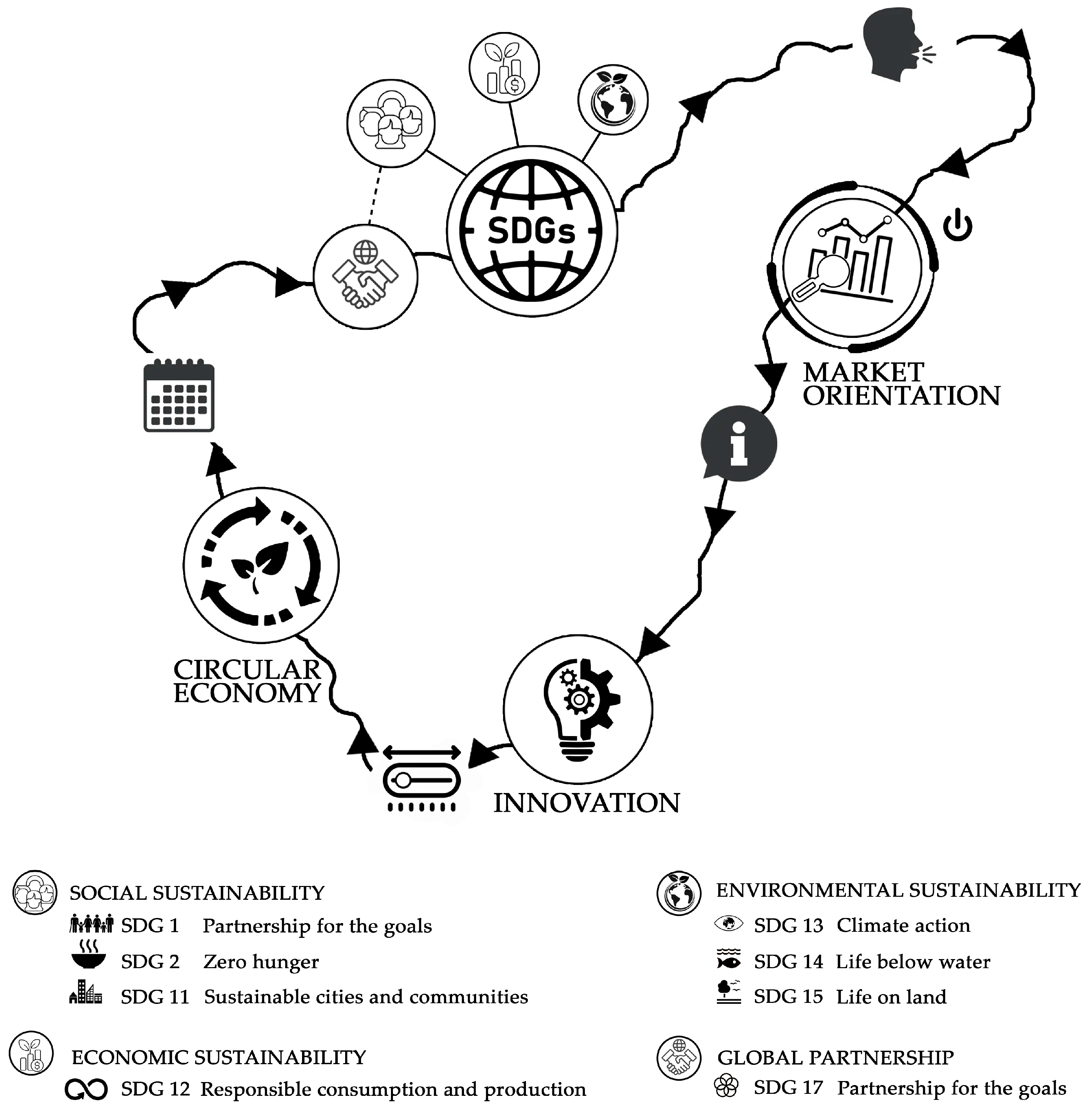
Finally, the complete practical application of the TC framework, illustrated through the example of the island destination Tenerife, is illustrated in
Figure 3. The sustainable development of tourism is a cyclical process dependent on dynamic changes in the environment. All four examined constructs play a role in this dynamic mechanism. Starting from the MO, this instrument enables the creation of a strong structure that will be able to act adequately on the tourist market by monitoring the supply, competition, and internal flows of companies. INN, therefore, serves to technologically and organizationally elevate companies to a higher level of business in line with current achievements, particularly in the field of digitization. Together, MO and INN will facilitate the gradual adoption of CE practices, which will ultimately lead to comprehensive sustainable business. Overall, directing towards sustainable development is a complex process, requiring the active participation of all subjects and constant monitoring of changes.
7. Conclusions
Traditionally, tourist destinations had a business model aimed at quantitative growth and achieving economic goals, where social and environmental elements were marginalized. However, awareness of the negative effects of mass tourism conditioned the need for transformation in accordance with the postulates of sustainable development. In this transition of business operations, it is necessary to find the most effective way that will address the SDGs. Therefore, the central research question of this study entails finding a comprehensive mechanism to enable tourism providers, mainly tourism firms, to place their operations on sustainable pillars. Accordingly, the TC conceptual framework grounded on mutual collaboration, shared governance, and equal availability of resources was formed. Inspired by natural processes and the fulfillment of overall sustainability, this framework was the initial point for investigating specific mechanisms that will directly or indirectly contribute to tourism firms directing their business towards sustainable goals.
Through comprehensive research of tourism literature, it was established that the MO, CE, and INN constructs can significantly accelerate sustainable development. Therefore, the interrelationships between the mentioned elements were empirically tested. The results of the structural model indicate that MO has a statistically significant effect on both CE and INN, with the effect of MO on CE having a negative sign. At the same time, CE and INN have a direct impact on all dimensions of sustainability, but also an indirect effect through mediation relations, which confirms their key role in achieving sustainable development of tourist destinations. Furthermore, GPs are an important prerequisite for achieving SOCS, since mutual cooperation between tourism stakeholders supports local employment, creates economic opportunities for vulnerable groups, and encourages local products and services.
8. Limitations and Future Research
This study has several limitations that should be acknowledged. First, the research was conducted on the island destination of Tenerife, which suffers from strong spatial, environmental, and social pressures of tourism dynamics. Although these research findings can be transferred to other small island destinations, to a certain extent, all the specificities of the internal and external factors that develop tourist destinations must be taken into account. This primarily refers to destinations that have similar structural and institutional conditions, such as island destinations in the Mediterranean or Southeast Asia. Accordingly, future research should focus on examining this model in other context-specific destinations.
Second, based on the type and method of research, several limitations and guidelines should be noted for further research work. Namely, this study is based on quantitative research which in itself limits the broad interpretation of the results and the understanding of factors that are not included in the survey questionnaire and which would emerge after the qualitative research. That being said, this is why mixed-method research is the most preferred. Afterward, the respondents filled out the survey themselves without supervision, which is also an important part in research, in order to obtain more precise data from the field. Finally, a larger sample size is necessary, which would eventually enable cross-sectoral surveys. It is important to emphasize the disparity in the number of tourism companies by subsectors. The active or cultural tourism and accommodation sectors comprise almost 80% of respondents, which is a consequence of their dominance on the market, while transport firms are fewer in number and usually integrated into larger firms.
Third, regarding the examined constructs, the single-indicator construct of CE, which included only energy efficiency, needs to be defined in such a way so there is no conceptual overlap with the SDGs, which is a significant challenge in the academic research community because these two concepts are closely related and it is often challenging to establish a clear boundary between them.
Fourth, the role that INNs have as a key mechanism in the realization of CE and SDG practices is special in this field of work. So far, there is a small amount of data, especially regarding the mediation effects where INN, through GP, promotes SOCS, and through CE, enables the achievement of ECONS and GP.
Fifth, this research initially included ten SDGs, of which SDG 8 and SDG 9 had to be excluded from the analysis due to poor internal consistency. Therefore, for future research, it would be useful to include all SDGs, with particular emphasis on the role that cooperation and collaboration play in achieving SOCS.
Supplementary Materials
The following supporting information can be downloaded at:
https://www.mdpi.com/article/10.3390/admsci16030109/s1, Table S1: Market Orientation (MO) Dimensions, Items, and Sources; Table S2: Circular Economy (CE) Dimensions, Items, and Sources; Table S3: Innovation (INN) Dimensions, Items, and Sources; Table S4: SDGs Dimensions, Items, and Sources.
Author Contributions
Conceptualization, I.T. and E.P.-L.; Methodology, I.T.; Software, I.T.; Validation, I.T.; Formal analysis, I.T.; Investigation, I.T. and E.P.-L.; Resources, I.T.; Data curation, I.T.; Writing—original draft, I.T.; Writing—review & editing, E.P.-L.; Visualization, I.T.; Supervision, E.P.-L.; Project administration, E.P.-L. All authors have read and agreed to the published version of the manuscript.
Funding
This research received no external funding.
Institutional Review Board Statement
According to local and national regulations, as well as EU Regulation 2016/679 (GDPR) and Spanish Organic Law 3/2018 on Personal Data Protection and Guarantee of Digital Rights (LOPDGDD), ethics committee or Institutional Review Board approval is not required for anonymous, non-invasive survey research that poses no risk to participants.
Informed Consent Statement
Informed consent was obtained from all subjects involved in the study.
Data Availability Statement
Data is available on request from the corresponding author.
Conflicts of Interest
The authors declare no conflict of interest.
Abbreviations
The following abbreviations are used in this manuscript:
| MO | Market orientation |
| CE | Circular economy |
| INN | Innovation |
| SDGs | Sustainable Development Goals |
| SOCS | Social sustainability |
| ECONS | Economic sustainability |
| ENVS | Environmental sustainability |
| GP | Global partnership |
References
- Aboalhool, T., Alzubi, A., & Iyiola, K. (2024). Humane entrepreneurship in the circular economy: The role of green market orientation and green technology turbulence for sustainable corporate performance. Sustainability, 16(6), 2517. [Google Scholar] [CrossRef] [Scilit]
- Abulela, M. A. A., & Khalaf, M. A. (2024). Does the number of response categories impact validity evidence in self-report measures? A scoping review. Sage Open, 14(1), 21582440241230363. [Google Scholar] [CrossRef] [Scilit]
- Al-Romeedy, B. S., & Khairy, H. A. (2024). Eco-innovation and hospitality and tourism business resilience. In M. Bari, M. Soliman, & E. Alaverdov (Eds.), Shifts in knowledge sharing and creativity for business tourism (pp. 17–36). IGI Global Scientific Publishing. [Google Scholar] [CrossRef] [Scilit]
- Axhami, M., Ndou, V., Milo, V., & Scorrano, P. (2023). Creating value via the circular economy: Practices in the tourism sector. Administrative Sciences, 13(7), 166. [Google Scholar] [CrossRef] [Scilit]
- Barandiarán, X., Restrepo, N., & Luna, Á. (2019). Collaborative governance in tourism: Lessons from Etorkizuna Eraikiz in the Basque Country, Spain. Tourism Review, 74(4), 902–914. [Google Scholar] [CrossRef] [Scilit]
- Bichler, B. F., & Lösch, M. (2019). Collaborative governance in tourism: Empirical insights into a community-oriented destination. Sustainability, 11(23), 6673. [Google Scholar] [CrossRef] [Scilit]
- Biosphere Tourism. (2021, April 26). Tenerife has been recognized as a biosphere sustainable destination. Biosphere Tourism. Available online: https://www.biospheretourism.com/en/blog/tenerife-has-been-recognized-as-a-biosphere-sustainable-destination/239 (accessed on 12 September 2025).
- Bono i Gispert, O., Anton Clavé, S., & Casadesús Fa, M. (2023). The internalization of participation and coherence dimensions of governance in tourism destination management organizations—An exploratory approach. Sustainability, 15(3), 2449. [Google Scholar] [CrossRef] [Scilit]
- Bosone, M., & Nocca, F. (2022). Human circular tourism as the tourism of tomorrow: The role of travellers in achieving a more sustainable and circular tourism. Sustainability, 14(19), 12218. [Google Scholar] [CrossRef] [Scilit]
- Bramwell, B., & Lane, B. (2011). Critical research on the governance of tourism and sustainability. Journal of Sustainable Tourism, 19(4–5), 411–421. [Google Scholar] [CrossRef] [Scilit]
- Bux, C., & Amicarelli, V. (2023). Circular economy and sustainable strategies in the hospitality industry: Current trends and empirical implications. Tourism and Hospitality Research, 23(4), 624–636. [Google Scholar] [CrossRef] [Scilit]
- Castree, N. (2003). Environmental issues: Relational ontologies and hybrid politics. Progress in Human Geography, 27(2), 203–211. [Google Scholar] [CrossRef] [Scilit]
- Chandran, V., Ahmed, T., Jebli, F., Josiassen, A., & Lang, E. (2024). Developing innovation capability in the hotel industry, who and what is important? A mixed methods approach. Tourism Economics, 30(3), 728–748. [Google Scholar] [CrossRef] [Scilit]
- Cheng, B.-L., Abu, N. K., Yap, C. S., Mansori, S., & Cham, T.-H. (2022). Service-driven advocacy: From tourists’ felicity to preeminent destination loyalty. Asian Journal of Business Research, 12(1), 124–146. [Google Scholar] [CrossRef] [Scilit]
- Chin, W. W. (1998). The partial least squares approach for structural equation modeling. In G. A. Marcoulides (Ed.), Modern methods for business research (pp. 295–336). Lawrence Erlbaum Associates Publishers. [Google Scholar]
- Chountalas, P. T., Chatzifoti, N., Alexandropoulou, A., & Georgakellos, D. A. (2024). Analyzing barriers to innovation management implementation in sustainable tourism using DEMATEL method. World, 5(4), 1004–1022. [Google Scholar] [CrossRef] [Scilit]
- Chyung, S. Y. Y., Roberts, K., Swanson, I., & Hankinson, A. (2017). Evidence-based survey design: The use of a midpoint on the likert scale. Performance Improvement, 56(10), 15–23. [Google Scholar] [CrossRef] [Scilit]
- Coelho de Souza Filho, J. J., dos Anjos, S. J. G., dos Anjos, F. A., & Kuhn, V. R. (2025). Tourism innovation ecosystems: Insights from theory and empirical validation. Tourism and Hospitality, 6(5), 272. [Google Scholar] [CrossRef] [Scilit]
- Cohen, J. (1988). Statistical power analysis for the behavioral sciences. Lawrence Erlbaum Associates. [Google Scholar]
- Cvijanović, D., Karabašević, D., Vujko, A., Vukotić, S., Popović, G., & Mirčetić, V. (2025). The future is community-led: Rethinking rural tourism sustainability through the bregenzerwald model. Sustainability, 17(12), 5450. [Google Scholar] [CrossRef] [Scilit]
- Čivre, Ž., & Gomezelj Omerzel, D. (2015). The behaviour of tourism firms in the area of innovativeness. Economic Research-Ekonomska Istraživanja, 28(1), 312–330. [Google Scholar] [CrossRef] [Scilit]
- Deng, S., & Dart, J. (1994). Measuring market orientation: A multi-factor, multi-item approach. Journal of Marketing Management, 10(8), 725–742. [Google Scholar] [CrossRef] [Scilit]
- Diamantopoulos, A., Sarstedt, M., Fuchs, C., Wilczynski, P., & Kaiser, S. (2012). Guidelines for choosing between multi-item and single-item scales for construct measurement: A predictive validity perspective. Journal of the Academy of Marketing Science, 40(3), 434–449. [Google Scholar] [CrossRef] [Scilit]
- Dijkstra, T. K., & Henseler, J. (2015). Consistent partial least squares path modeling. MIS Quarterly, 39(2), 297–316. [Google Scholar] [CrossRef] [Scilit]
- Elgarhy, S. D., & Abou-Shouk, M. (2023). Effects of entrepreneurial orientation, marketing, and innovation capabilities, on market performance: The mediating effect of sustainable competitive advantage. International Journal of Contemporary Hospitality Management, 35(6), 1986–2004. [Google Scholar] [CrossRef] [Scilit]
- Elkhwesky, Z., El Manzani, Y., & Elbayoumi Salem, I. (2024). Driving hospitality and tourism to foster sustainable innovation: A systematic review of COVID-19-related studies and practical implications in the digital era. Tourism and Hospitality Research, 24(1), 115–133. [Google Scholar] [CrossRef] [Scilit]
- Elkington, J. (1997). Cannibals with Forks: The triple bottom line of 21st Century business. Capstone. [Google Scholar]
- Feng, X., & Goli, A. (2023). Enhancing business performance through circular economy: A comprehensive mathematical model and statistical analysis. Sustainability, 15(16), 12631. [Google Scholar] [CrossRef] [Scilit]
- Fornell, C., & Larcker, D. F. (1981). Evaluating structural equation models with unobservable variables and measurement error. Journal of Marketing Research, 18(1), 39–50. [Google Scholar] [CrossRef] [Scilit]
- Gebeshuber, I. C., & Majlis, B. Y. (2011). 3D corporate tourism: A concept for innovation in nanomaterials engineering. International Journal Materials Engineering Innovation, 2(1), 38–48. [Google Scholar] [CrossRef] [Scilit]
- Geissdoerfer, M., Savaget, P., Bocken, N. M. P., & Hultink, E. J. (2017). The circular economy—A new sustainability paradigm? Journal of Cleaner Production, 143, 757–768. [Google Scholar] [CrossRef] [Scilit]
- Giang, L. H. (2022). The relationship between market orientation, innovation and business performance of hotel and restaurant businesses in Ho Chi Minh City: The moderating role of business environment. International Journal of Current Science Research and Review, 5(4), 1138–1146. [Google Scholar] [CrossRef] [Scilit]
- González-Morcillo, S., Horrach-Rosselló, P., Valero-Sierra, O., & Mulet-Forteza, C. (2023). Forgotten effects of active tourism activities in Spain on sustainable development dimensions. Environment, Development and Sustainability, 25(10), 10743–10763. [Google Scholar] [CrossRef] [Scilit]
- Gusmerotti, N. M., Carlesi, S., Iannuzzi, T., & Testa, F. (2024). The role of tourism in boosting circular transition: A measurement system based on a participatory approach. Journal of Sustainable Tourism, 32(5), 961–985. [Google Scholar] [CrossRef] [Scilit]
- Hair, J. F., Hult, G. T. M., Ringle, C. M., & Sarstedt, M. (2022). A primer on Partial Least Squares Structural Equation Modeling (PLS-SEM) (3rd ed.). Sage. [Google Scholar]
- Haraway, D. J. (2016). Tentacular thinking: Anthropocene, capitalocene, chthulucene. In Staying with the trouble (pp. 30–57). Duke University Press. [Google Scholar] [CrossRef] [Scilit]
- Haskas, Y., Mujahid, B., Arif, N. F., Riyadi, S., & Arief, A. S. (2021). Encourage small business environmental sustainability performance by market orientation and environmental innovation. IOP Conference Series: Earth and Environmental Science, 737(1), 012018. [Google Scholar] [CrossRef] [Scilit]
- Hasnawati, H., & Irmawati, I. (2024). Integrating circular economy practices for sustainable maritime tourism development in bone regency, Indonesia. Journal of Education, Humaniora and Social Sciences (JEHSS), 7(2), 384–394. [Google Scholar] [CrossRef] [Scilit]
- Henseler, J., Hubona, G., & Ray, P. A. (2016). Using PLS path modeling in new technology research: Updated guidelines. Industrial Management and Data Systems, 116(1), 2–20. [Google Scholar] [CrossRef] [Scilit]
- Henseler, J., Ringle, C. M., & Sarstedt, M. (2015). A new criterion for assessing discriminant validity in variance-based structural equation modeling. Journal of the Academy of Marketing Science, 43(1), 115–135. [Google Scholar] [CrossRef] [Scilit]
- Herasimovich, V., Alzua-Sorzabal, A., & Guereño-Omil, B. (2024). Online networking behaviour of tourism stakeholders in a multi-destination region: A hyperlink network analysis. Journal of Destination Marketing & Management, 31, 100844. [Google Scholar] [CrossRef] [Scilit]
- Higgins-Desbiolles, F. (2020). Socialising tourism for social and ecological justice after COVID-19. Tourism Geographies, 22(3), 610–623. [Google Scholar] [CrossRef] [Scilit]
- Hoffmann, A., & Marticke, N. (2024). Action or reaction? Entrepreneurial and market orientation for implementing circular economy practices in German SMEs. European Conference on Innovation and Entrepreneurship, 19(1), 252–262. [Google Scholar] [CrossRef] [Scilit]
- Ismail, I. J., Amani, D., & Changalima, I. A. (2023). Strategic green marketing orientation and environmental sustainability in sub-Saharan Africa: Does green absorptive capacity moderate? Evidence from Tanzania. Heliyon, 9(7), e18373. [Google Scholar] [CrossRef] [Scilit] [PubMed]
- Ismailov, T., Ilieva, L., Todorova, L., & Marinov, M. (2024). Implementing innovations that provide sustainable solutions in the tourism sector. Revista de Gestão Social e Ambiental, 18(11), e09246. [Google Scholar] [CrossRef] [Scilit]
- Jackson, L. A. (2025). Community-based tourism: A catalyst for achieving the united nations sustainable development goals one and eight. Tourism and Hospitality, 6(1), 29. [Google Scholar] [CrossRef] [Scilit]
- Jalilvand, M. R. (2017). The effect of innovativeness and customer-oriented systems on performance in the hotel industry of Iran. Journal of Science and Technology Policy Management, 8(1), 43–61. [Google Scholar] [CrossRef] [Scilit]
- José Carvalho, A., Moreira, S. B., & Carvalho, L. (2024). Circular Economy as a factor in the sustainability of the tourism sector. A study applied to accommodation and restaurants in the municipality of Setúbal (Portugal). In V. Bevanda, & S. Štetić (Eds.), 8th international thematic monograph—Modern management tools and economy of tourism sector in present era (pp. 1–20). Association of Economists and Managers of the Balkans. [Google Scholar] [CrossRef] [Scilit]
- Joshi, A., Kale, S., Chandel, S., & Pal, D. (2015). Likert scale: Explored and explained. British Journal of Applied Science & Technology, 7(4), 396–403. [Google Scholar] [CrossRef] [Scilit]
- Kandampully, J., Bilgihan, A., Van Riel, A. C. R., & Sharma, A. (2023). Toward holistic experience-oriented service innovation: Co-creating sustainable value with customers and society. Cornell Hospitality Quarterly, 64(2), 161–183. [Google Scholar] [CrossRef] [Scilit]
- Kankaraš, M., & Capecchi, S. (2025). Neither agree nor disagree: Use and misuse of the neutral response category in Likert-type scales. METRON, 83(1), 111–140. [Google Scholar] [CrossRef] [Scilit]
- Kim, D., Kumar, V., & Kumar, U. (2012). Relationship between quality management practices and innovation. Journal of Operations Management, 30(4), 295–315. [Google Scholar] [CrossRef] [Scilit]
- Kim, J.-J., & Lee, C.-J. (2022). A tourist’s gaze on local tourism governance: The relationship among local tourism governance and brand equity, tourism attachment for sustainable tourism. Sustainability, 14(24), 16477. [Google Scholar] [CrossRef] [Scilit]
- Kirchherr, J., Piscicelli, L., Bour, R., Kostense-Smit, E., Muller, J., Huibrechtse-Truijens, A., & Hekkert, M. (2018). Barriers to the circular economy: Evidence from the European Union (EU). Ecological Economics, 150, 264–272. [Google Scholar] [CrossRef] [Scilit]
- Kohli, A. K., & Jaworski, B. J. (1990). Market orientation: The construct, research propositions, and managerial implications. Journal of Marketing, 54(2), 1–18. [Google Scholar] [CrossRef] [Scilit]
- Kubíková, Ľ., & Rudý, S. (2024). Identification of Slovak tourists’ attitudes towards digitalization for circular economy and waste management. In M. Busu, & V. Vargas (Eds.), Proceedings of the international conference on business excellence (pp. 856–869). De Gruyter. [Google Scholar] [CrossRef] [Scilit]
- Lagioia, G., Amicarelli, V., Strippoli, R., Bux, C., & Gallucci, T. (2024). Sustainable and circular practices in the hotel industry in Southern Italy: Opportunities, barriers and trends in food waste management. British Food Journal, 126(1), 428–452. [Google Scholar] [CrossRef] [Scilit]
- Latour, B., & Porter, C. (2009). Politics of nature: How to bring the sciences into democracy. Harvard University Press. [Google Scholar]
- Lian, T., & Li, S. (2025). A study of collaborative governance of online users tourism information. Current Issues in Tourism, 28(12), 1895–1916. [Google Scholar] [CrossRef] [Scilit]
- Lozano, R. (2015). A holistic perspective on corporate sustainability drivers. Corporate Social Responsibility and Environmental Management, 22(1), 32–44. [Google Scholar] [CrossRef] [Scilit]
- Lučić, A. (2020). Measuring sustainable marketing orientation—Scale development process. Sustainability, 12(5), 1734. [Google Scholar] [CrossRef] [Scilit]
- MacEachern, J., MacInnis, B., MacLeod, D., Munkres, R., Jaspal, S. K., Kinay, P., & Wang, X. (2024). Destination management organizations’ roles in sustainable tourism in the face of climate change: An overview of Prince Edward Island. Sustainability, 16(7), 3049. [Google Scholar] [CrossRef] [Scilit]
- Manniche, J., Larsen, K. T., Brandt Broegaard, R., & Holland, E. (2018). Destination: A circular tourism economy A handbook for transitioning toward a circular economy within the tourism and hospitality sectors in the South Baltic Region. Centre for Regional and Tourism Research. Available online: https://circulareconomy.europa.eu/platform/sites/default/files/cirtoinno-handbook_eng-rev.-4.pdf (accessed on 13 October 2025).
- Marco-Lajara, B., Úbeda-García, M., Poveda-Pareja, E., & Manresa-Marhuenda, E. (2024). Importance of culture and innovation in behaviors towards the circular economy in Spanish hotels. In M. Segarra-Oña, V. Santamarina-Campos, & Á. Peiró-Signes (Eds.), Managing the transition to a circular economy (pp. 91–100). Springer. [Google Scholar] [CrossRef] [Scilit]
- Marrucci, L., Daddi, T., & Iraldo, F. (2024). Creating environmental performance indicators to assess corporate sustainability and reward employees. Ecological Indicators, 158, 111489. [Google Scholar] [CrossRef] [Scilit]
- Menegaki, A. N. (2018). Economic aspects of cyclical implementation in Greek sustainable hospitality. International Journal of Tourism Policy, 8(4), 271. [Google Scholar] [CrossRef] [Scilit]
- Mitchell, R., Wooliscroft, B., & Higham, J. E. S. (2013). Applying sustainability in national park management: Balancing public and private interests using a sustainable market orientation model. Journal of Sustainable Tourism, 21(5), 695–715. [Google Scholar] [CrossRef] [Scilit]
- Narver, J. C., & Slater, S. F. (1990). The effect of market orientation on business profitability. Journal of Marketing, 54(4), 20–35. [Google Scholar] [CrossRef] [Scilit]
- Nassanbekova, S., Yeshenkulova, G., & Ibadildin, N. (2023). Influence of digital technologies on transition to a circular economy in tourism: Values and barriers. Journal of Environmental Management and Tourism, 14(7), 2871–2879. [Google Scholar] [CrossRef] [Scilit]
- Nunnally, J. C., & Bernstein, I. H. (1994). Psychometric theory (3rd ed.). McGraw-Hill, Inc. [Google Scholar]
- OECD. (2005). Oslo manual: Guidelines for collecting and interpreting innovation data (3rd ed.). OECD and Eurostat. [Google Scholar]
- Oliveira Rosa, B., & de Oliveira Paula, F. (2023). Circular economy adoption by European small and medium-sized enterprises: Influence on firm performance. Review of Business Management, 25(3), 421–438. [Google Scholar] [CrossRef] [Scilit]
- Panagiotopoulou, P., & Skoultsos, S. (2025). Stakeholders’ involvement in sustainable destination management: A systematic literature review of existing multi-stakeholder frameworks and approaches. Tourism and Hospitality, 6(5), 250. [Google Scholar] [CrossRef] [Scilit]
- Papaioannou, A., Kriemadis, T., Kapetaniou, P., Yfantidou, G., & Kourtesopoulou, A. (2018). Customer oriented strategy and business performance in tourism and hospitality industry. In V. Katsoni, & K. Velander (Eds.), Strategic innovative marketing and tourism (pp. 417–432). Springer Proceedings in Business and Economics. [Google Scholar] [CrossRef] [Scilit]
- Pasqualotto, C., Callegaro-De-Menezes, D., & Schutte, C. S. L. (2023). An overview and categorization of the drivers and barriers to the adoption of the circular economy: A systematic literature review. Sustainability, 15(13), 10532. [Google Scholar] [CrossRef] [Scilit]
- Polukhina, A., Sheresheva, M., Napolskikh, D., & Lezhnin, V. (2024). Regional tourism ecosystem as a tool for sustainable development during the economic crisis. Sustainability, 16(2), 884. [Google Scholar] [CrossRef] [Scilit]
- Pratap Singh, S., Sajnani, M., & Arora, G. K. (2023). Tourism industry and circular economy: Deep interlinkages. Prabandhan: Indian Journal of Management, 16(5), 8–17. [Google Scholar] [CrossRef] [Scilit]
- Radosavljevic, K., & Mihailovic, B. (2024). Green hotels between circular economy objectives and sustainable development goals. In J. Andrei, M. M. Vasić, L. Chivu, & B. Kuzman (Eds.), Marketing and resource management for green transitions in economies (pp. 75–104). IGI Global Scientific Publishing. [Google Scholar] [CrossRef] [Scilit]
- Reina-Usuga, L., Camino, F., Gomez-Casero, G., & Jara Alba, C. A. (2024). Rural tourism initiatives and their relationship to collaborative governance and perceived value: A review of recent research and trends. Journal of Destination Marketing & Management, 34, 100926. [Google Scholar] [CrossRef] [Scilit]
- Remenyik, B., Szőke, B., Veres, B., & Dávid, L. D. (2025). Innovative sustainability practices in ecotourism and the hotel industry: Insights into circular economy and community integration. Journal of Infrastructure, Policy and Development, 9(1), 10946. [Google Scholar] [CrossRef] [Scilit]
- Renfors, S.-M. (2022). Circular Economy in tourism: Overview of recent developments in research. Matkailututkimus, 18(1), 47–63. [Google Scholar] [CrossRef] [Scilit]
- Rodríguez, C., Florido, C., & Jacob, M. (2020). Circular economy contributions to the tourism sector: A critical literature review. Sustainability, 12(11), 4338. [Google Scholar] [CrossRef] [Scilit]
- Sa Liow, M. L. (2024). Punctilious on SDGs. In P. Kumar, S. Gupta, M. Korstanje, P. Rout, & Madhurima (Eds.), Managing tourism and hospitality sectors for sustainable global transformation (pp. 92–114). IGI Global Scientific Publishing. [Google Scholar] [CrossRef] [Scilit]
- Santos, V., Sousa, M. J., Costa, C., & Au-Yong-Oliveira, M. (2021). Tourism towards sustainability and innovation: A systematic literature review. Sustainability, 13(20), 11440. [Google Scholar] [CrossRef] [Scilit]
- Sargeant, A., & Mohamad, M. (1999). Business performance in the UK hotel sector—Does it pay to be market oriented? The Service Industries Journal, 19(3), 42–59. [Google Scholar] [CrossRef] [Scilit]
- Sari, T. M. D., & Indriani, F. (2023). Assessing the link between market orientation and hotel performance: The mediating role of value-based marketing innovation. Journal of Hospitality and Tourism Insights, 6(5), 2339–2358. [Google Scholar] [CrossRef] [Scilit]
- Schiederig, T., Tietze, F., & Herstatt, C. (2012). Green innovation in technology and innovation management—An exploratory literature review. R&D Management, 42(2), 180–192. [Google Scholar] [CrossRef] [Scilit]
- Schmidt, C. V. H., Kindermann, B., Behlau, C. F., & Flatten, T. C. (2021). Understanding the effect of market orientation on circular economy practices: The mediating role of closed-loop orientation in German SMEs. Business Strategy and the Environment, 30(8), 4171–4187. [Google Scholar] [CrossRef] [Scilit]
- Segarra-Oña, M., Peiró-Signes, Á., Sánchez-Planelles, J., & Poveda-Pareja, E. (2024). Circular economy self-assessment tool for hotels. In M. Segarra-Oña, V. Santamarina-Campos, & Á. Peiró-Signes (Eds.), Managing the transition to a circular economy (pp. 101–118). SpringerBriefs in Business. [Google Scholar] [CrossRef] [Scilit]
- Sharma, V., Bumra, C., & Vats, V. (2024). Circular economy in tourism industry. In F. Mobo (Ed.), Advancing sustainable development goals with educational technology (pp. 117–142). IGI Global Scientific Publishing. [Google Scholar] [CrossRef] [Scilit]
- Shmueli, G., Sarstedt, M., Hair, J. F., Cheah, J.-H., Ting, H., Vaithilingam, S., & Ringle, C. M. (2019). Predictive model assessment in PLS-SEM: Guidelines for using PLSpredict. European Journal of Marketing, 53(11), 2322–2347. [Google Scholar] [CrossRef] [Scilit]
- Singh, S. P., Sajnani, M., & Arora, G. K. (2023). Circular economy of tourism in Delhi. Prabandhan: Indian Journal of Management, 16(12), 28–39. [Google Scholar] [CrossRef] [Scilit]
- Strippoli, R., Gallucci, T., & Ingrao, C. (2024). Circular economy and sustainable development in the tourism sector—An overview of the truly-effective strategies and related benefits. Heliyon, 10(17), e36801. [Google Scholar] [CrossRef] [Scilit]
- Suchek, N., Fernandes, C. I., Kraus, S., Filser, M., & Sjögrén, H. (2021). Innovation and the circular economy: A systematic literature review. Business Strategy and the Environment, 30(8), 3686–3702. [Google Scholar] [CrossRef] [Scilit]
- Surya, I. B. K., Kot, S., Astawa, I. P., Rihayana, I. G., & Arsha, I. M. R. M. (2024). Unlocking sustainability through innovation: A green HR approach for hospitality industry. Virtual Economics, 7(2), 50–62. [Google Scholar] [CrossRef] [Scilit]
- Teece, D. J. (2007). Explicating dynamic capabilities: The nature and microfoundations of (sustainable) enterprise performance. Strategic Management Journal, 28(13), 1319–1350. [Google Scholar] [CrossRef] [Scilit]
- Thongsri, N., & Chang, A. K.-H. (2019). Interactions among factors influencing product innovation and innovation behaviour: Market orientation, managerial ties, and government support. Sustainability, 11(10), 2793. [Google Scholar] [CrossRef] [Scilit]
- Tomassini, L., & Cavagnaro, E. (2022). Circular economy: A paradigm to critically rethink sustainability in tourism and hospitality. In A. Farmaki, L. Altinay, & X. Font (Eds.), Planning and managing sustainability in tourism (pp. 1–12). Springer. [Google Scholar] [CrossRef] [Scilit]
- Turčinović, M., Vujko, A., & Stanišić, N. (2025). Community-led sustainable tourism in rural areas: Enhancing wine tourism destination competitiveness and local empowerment. Sustainability, 17(7), 2878. [Google Scholar] [CrossRef] [Scilit]
- Ul-Durar, S., Awan, U., Varma, A., Memon, S., & Mention, A.-L. (2023). Integrating knowledge management and orientation dynamics for organization transition from eco-innovation to circular economy. Journal of Knowledge Management, 27(8), 2217–2248. [Google Scholar] [CrossRef] [Scilit]
- United Nations (UN). (2017). Tourism and the sustainable development goals—Journey to 2030. World Tourism Organization & United Nations Development Programme. Available online: https://www.undp.org/sites/g/files/zskgke326/files/publications/UNWTO_UNDP_Tourism%20and%20the%20SDGs.pdf (accessed on 12 September 2025).
- United Nations World Tourism Organization (UNWTO). (2016). The tourism sector and the sustainable development goals: Responsible tourism, a global commitment. UNWTO & UN Global Compact. [Google Scholar]
- United Nations World Tourism Organization (UNWTO). (2023). Tourism: A driver for shared prosperity—Key insights. In Tourism: A driver for shared prosperity—Key insights. World Tourism Organization (UNWTO). [Google Scholar] [CrossRef] [Scilit]
- Web Tenerife. (n.d.). Charter for the sustainability of activities in the nature. Available online: https://www.webtenerife.co.uk/what-to-do/nature/charter-sustainability/ (accessed on 12 September 2025).
- Xu, J., Su, T., Cheng, X., & Chen, H. (2024). Exploring the destination network in the context of tourism mobility: A multi-scale analytical framework. Current Issues in Tourism, 28(8), 1197–1219. [Google Scholar] [CrossRef] [Scilit]
- Yadav, A. K., Kanwal, P., & Dewasiri, N. J. (2024). Circular business models with resource sharing and product-as-a-service. In M. N. Tunio, A. Rashid, M. A. Qureshi, J. A. Qureshi, & R. Rasheed (Eds.), Intersecting entrepreneurship, internationalization, and green innovation (pp. 197–234). IGI Global Scientific Publishing. [Google Scholar] [CrossRef] [Scilit]
- Zaki, K., & Farrag, M. (2024). The impact of circular economy on environmental performance in the tourism and hospitality industry: The role of low-carbon behavior and eco-friendly behavior. The International Journal of Tourism and Hospitality Studies, 7(2), 285–304. [Google Scholar] [CrossRef] [Scilit]
- Zhou, D., Kohtamäki, M., Peng, X., & Kong, X. (2025). How digital orientation impacts service innovation in hotels: The role of digital capabilities and government support. Tourism Economics, 31(2), 221–244. [Google Scholar] [CrossRef] [Scilit]
- Zhou, K. Z., Brown, J. R., & Dev, C. S. (2009). Market orientation, competitive advantage, and performance: A demand-based perspective. Journal of Business Research, 62(11), 1063–1070. [Google Scholar] [CrossRef] [Scilit]
| Disclaimer/Publisher’s Note: The statements, opinions and data contained in all publications are solely those of the individual author(s) and contributor(s) and not of MDPI and/or the editor(s). MDPI and/or the editor(s) disclaim responsibility for any injury to people or property resulting from any ideas, methods, instructions or products referred to in the content. |