Driving Innovation: Entrepreneurial Leadership in the Jordanian IT Sector, the Role of Artificial Intelligence



Abstract
1. Introduction
- To what extent do Entrepreneurial Leadership practices impact Innovation Performance in the Jordanian IT sector?
- Does Artificial Intelligence (in terms of organizational awareness and level of use) moderate the relationship between Entrepreneurial Leadership and Innovation Performance?
2. Literature Review and Hypotheses Development
2.1. Introduction
2.2. The Converging Domains: Entrepreneurial Leadership
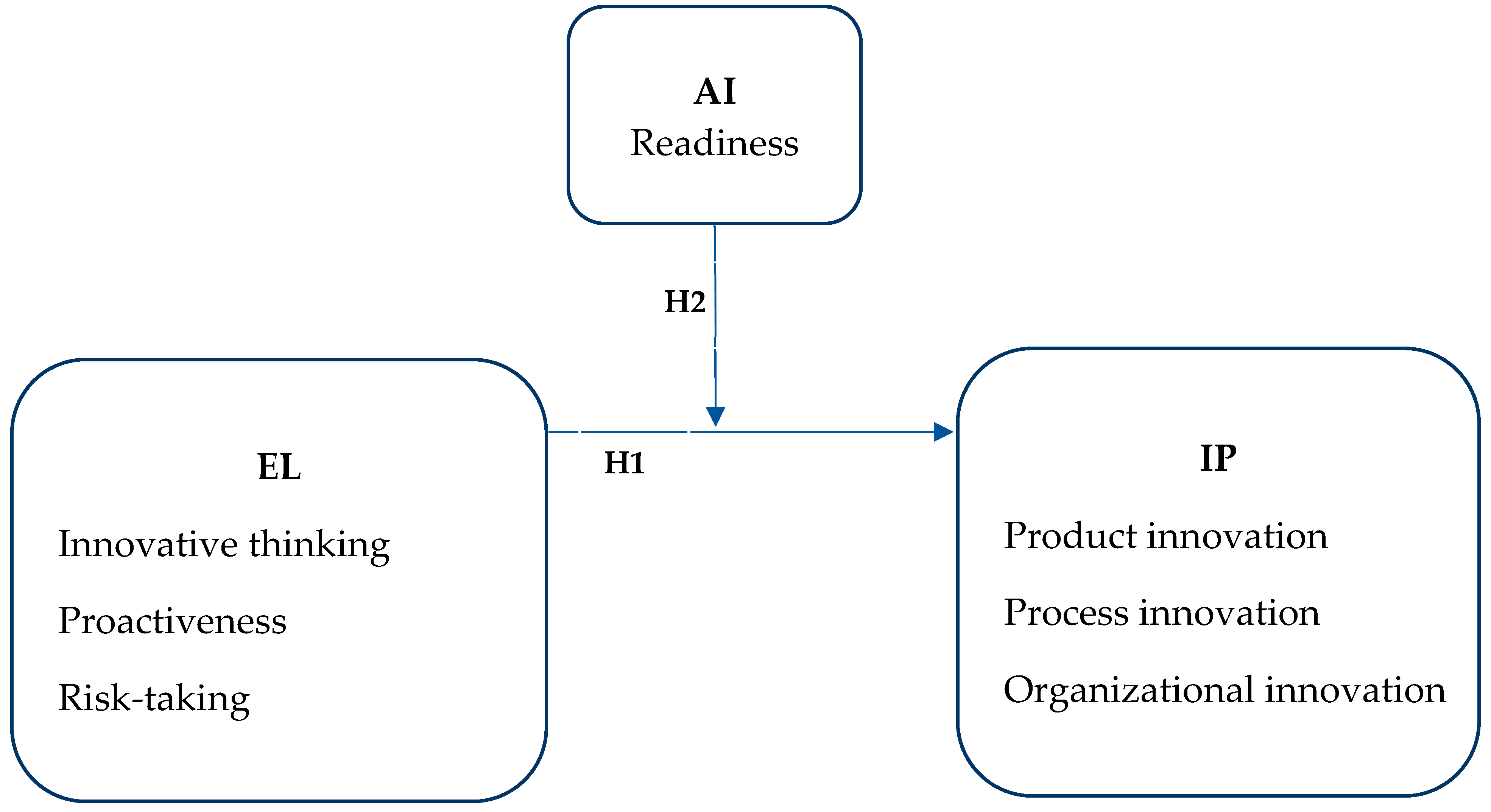
- Innovative Thinking: Encouraging creativity and novel solutions.
- Proactiveness: Anticipating and aggressively competing in the market.
- Risk-Taking: Willingness to undertake calculated risks.
2.3. The Outcome Variable: Innovation Performance
- Product Innovation: New or significantly improved goods/services.
- Process Innovation: New or improved production/delivery methods.
- Organizational Innovation: New business practices or workplace organization.
2.4. Review of Empirical Studies on Entrepreneurial Leadership and Innovation
2.5. Entrepreneurial Leadership and Innovation Performance: The Direct Link
2.6. The Moderating Role of Artificial Intelligence
2.7. The Jordanian Context and the Research Gap
2.8. Research Model and Hypotheses
3. Research Methodology
3.1. Introduction
3.2. Research Design
3.3. Population and Sampling
3.4. Data Collection Instrument and Procedure
3.4.1. Instrument Development
- Part A: Demographic and organizational data.
- Part B: Multi-item scales for main constructs (see Table 2).
3.4.2. Data Collection Procedure
3.5. Validity and Reliability
3.5.1. Pilot Study and Reliability
3.5.2. Validity Assessment
- Content Validity: Established through literature grounding and expert review.
- Construct Validity: Assessed via Exploratory Factor Analysis (EFA). The Kaiser-Meyer-Olkin (KMO) measure ranged from 0.77 to 0.87, and Bartlett’s Test was significant (p < 0.001) (Hair et al., 2019).
- Common Method Bias (CMB): Harman’s single-factor test indicated that the first factor explained 38.7% of the variance (<50% threshold), suggesting CMB is not a major concern. EFA results, factor loadings, and variances showing loadings > 0.5 and cumulative variance > 60% for each construct.
3.6. Data Analysis Techniques
- Data Screening: Checked for missing values, outliers, multicollinearity (VIF < 5), and normality (Skewness/Kurtosis within ±2).
- Descriptive Statistics: Summarized demographics and variable central tendencies.
- Inferential Analysis:
- -
- Pearson’s Correlation: Examined bivariate relationships.
- -
- Hierarchical Multiple Regression: Tested hypotheses with control variables (firm size, job role, experience) included in Step 1.
4. Data Analysis and Results
4.1. Introduction
4.2. Sample Characteristics
4.3. Assessment of Measurement Model
4.4. Descriptive Statistics and Data Screening
4.5. Hypothesis Testing
5. Discussion and Conclusions
5.1. Discussion of Key Findings
5.1.1. The Direct Impact
5.1.2. The Non-Significant Moderating Role of Artificial Intelligence
- Technology–Organization–Environment (TOE) Framework: The non-significant moderating effect can be attributed to significant barriers across TOE dimensions. Technologically, despite global advancements, local AI infrastructure may still be immature, with firms relying on generic, off-the-shelf solutions rather than tailored systems (Enholm et al., 2021; Verma et al., 2024). Organizationally, skill gaps and a lack of “AI literacy” among both leaders and employees may prevent the deep integration necessary for AI to transform leadership processes (Shrestha et al., 2023). Environmentally, the regulatory and ecosystem support for sophisticated AI integration in Jordan may still be evolving, focusing more on adoption than strategic exploitation.
- Diffusion of Innovation (DOI) Theory: The moderate mean score for AI adoption (3.32) strongly suggests that, across sampled firms, AI is likely in the early to mid-stages of the diffusion curve (Rogers, 2010). At this stage, AI is predominantly adopted for task automation and isolated operational efficiency (e.g., data analysis, customer service chatbots) rather than for strategic decision support or innovation enhancement that could synergize with EL (Russo, 2024; Mikalef & Gupta, 2023). AI is used by the organization but is not yet woven into the fabric of its leadership and innovation systems.
5.2. Implications
- Contextual Validation and Extension: This study robustly reinforces EL as a critical antecedent to IP, extending its empirical validation to the under-researched Middle Eastern IT context. It thereby strengthens the cross-cultural applicability of RBV and dynamic capabilities theory, showing that the micro-foundations of sensing and seizing are universally critical, albeit with contextual nuances in which dimensions are most potent (Kuratko et al., 2023).
- Nuancing Technology-Leadership Interaction Models: It challenges and refines prevailing models that often assume straightforward positive interactions between advanced technologies and leadership. By introducing the concept of technological moderation readiness, it provides a more conditional and realistic framework for future research, suggesting that the integration stage and organizational context are critical boundary conditions (Raisch & Krakowski, 2023).
- Shifting the Discourse on AI’s Role: The study moves the discourse from “if” AI matters to “how and when” it matters in the leadership-innovation nexus. It positions AI as a potential independent variable or a contextual condition, rather than a universal moderator, aligning with calls for more contingency-based approaches in innovation research (Mikalef & Gupta, 2023).
- For Leaders & Executives: Prioritize the development of EL competencies, especially proactiveness and risk-taking, through targeted training and experiential learning. Simultaneously, cultivate personal and organizational AI literacy to transition from mere adoption to strategic integration.
- For Policymakers: Develop national and sectoral strategies that move beyond promoting AI adoption. Focus on building the foundational pillars of technological moderation readiness: investing in digital infrastructure, fostering university-industry partnerships for skill development (e.g., in AI ethics and strategic deployment), and creating incentives for firms that demonstrate mature, integrative use of AI (Verma et al., 2024).
- For Firms (IT Firms in Particular): Conduct an honest audit of your technological moderation readiness. Align AI initiatives directly with strategic innovation goals, and ensure that investments in technology are matched by investments in change management, process redesign, and human capital development to create a synergistic environment where leadership and technology can co-evolve (Shrestha et al., 2023).
5.3. Limitations and Future Research
- Employing longitudinal designs to capture how the EL-AI-IP relationship evolves as AI maturity increases within firms and the national ecosystem.
- Using mixed-methods approaches, particularly qualitative case studies, to deeply explore the organizational barriers and facilitators of AI integration that quantitative surveys cannot fully unveil.
- Replicating the study in other sectors (e.g., manufacturing, healthcare) and cultural contexts to test the boundary conditions of our findings and the universality of the technological moderation readiness concept.
- Investigating alternative models, including other potential moderators (e.g., organizational learning culture, digital transformation strategy) and mediators (e.g., team psychological safety, dynamic knowledge management) that may link EL and IP (Borges et al., 2024).
- Developing and empirically validating a multidimensional scale to measure the proposed construct of technological moderation readiness.
5.4. Conclusions
Author Contributions
Funding
Institutional Review Board Statement
Informed Consent Statement
Data Availability Statement
Conflicts of Interest
References
- Abaddi, S. (2024). The dynamics of digital entrepreneurship and innovation ecosystems in Jordan. Journal of Innovation and Entrepreneurship, 13, 29. [Google Scholar] [CrossRef]
- Alalawneh, A. A. F., Alkhatib, S. F., & Abu Abbass, M. H. (2022). Social media usage and innovation performance: The case of fashion SMEs in Jordan. International Journal of Fashion Design, Technology and Education, 15(2), 221–232. [Google Scholar] [CrossRef]
- Alegre, J., & Chiva, R. (2013). Linking entrepreneurial orientation and firm performance: The role of organizational learning capability and innovation performance. Journal of Small Business Management, 51(4), 491–507. [Google Scholar] [CrossRef]
- Almashawreh, K., Al-Adwan, A. S., & Al-Zoubi, M. (2024). Artificial intelligence adoption in Jordanian SMEs: The role of IT knowledge and organizational readiness. Journal of Science and Technology Policy Management, 16(7), 1167–1198. [Google Scholar] [CrossRef]
- Al-Omar, S. Y., Alkhatib, S. F., & Alalawneh, A. A. (2024). Leveraging social media to enhance the digital innovation process and innovation performance in Jordanian SMEs. Journal of Logistics Informatics and Service Science, 11(6), 343–367. Available online: https://www.aasmr.org/liss/Vol.11/No.6/Vol.11.No.6.20.pdf (accessed on 1 May 2025).
- Alrifae, Y., Al-Henzab, J., & Tarhini, A. (2024). The impact of entrepreneurial leadership on corporate sustainability in the Jordanian pharmaceutical industry. Sustainability, 16(3), 1123. [Google Scholar] [CrossRef]
- Al-Sharif, M., Al-Azzam, M. K., & Al-Mimi, M. (2023). The influence of entrepreneurial leadership on innovation in technology firms. Journal of Innovation and Entrepreneurship, 12(1), 15. [Google Scholar] [CrossRef]
- Alshurideh, M., Al Kurdi, B., & Salloum, S. A. (2024). The impact of entrepreneurial leadership on organizational innovation and competitive advantage: Evidence from the Jordanian insurance sector. Journal of Innovation & Knowledge, 9(1), 100–112. [Google Scholar] [CrossRef]
- Ataei, P., Karimi, H., & Zarei, R. (2024). The role of entrepreneurial leadership, intellectual capital, innovativeness culture, and entrepreneurial orientation in entrepreneurial opportunity recognition by students. Journal of Open Innovation: Technology, Market, and Complexity, 10(2), 100265. [Google Scholar] [CrossRef]
- Bagheri, A., Akbari, M., & Artang, A. (2022). The impact of entrepreneurial leadership on nurses’ innovation behavior: The mediating role of job crafting. Journal of Nursing Management, 30(5), 1224–1234. [Google Scholar] [CrossRef]
- Bani-Melhem, A. J., Aboelmaged, M., & Alkhatib, S. F. (2025). Driving service performance: The interplay of innovation and resilience in food retail supply chain. Business Process Management Journal. ahead-of-print. [Google Scholar] [CrossRef]
- Borges, A. F., Laurindo, F. J., & Spínola, M. M. (2024). The AI leadership gap: Building organizational readiness for artificial intelligence. Journal of Business Research, 174, 114–125. [Google Scholar]
- Cai, W., Lysova, E. I., Khapova, S. N., & Bossink, B. A. (2020). The impact of entrepreneurial leadership on innovative work behavior: Examining mediation and moderation mechanisms. Sustainability, 12(23), 10148. [Google Scholar] [CrossRef]
- Cycyota, C. S., & Harrison, D. A. (2006). What (not) to expect when surveying executives: A meta-analysis of top manager response rates and techniques over time. Organizational Research Methods, 9(2), 133–160. [Google Scholar] [CrossRef]
- Enholm, I. M., Papagiannidis, E., Mikalef, P., & Krogstie, J. (2021). Artificial intelligence and business value: A literature review. Information Systems Frontiers, 24(5), 1709–1734. [Google Scholar] [CrossRef]
- Ercantan, K., Eyupoglu, Ş. Z., & Ercantan, Ö. (2024). The entrepreneurial leadership, innovative behaviour, and competitive advantage relationship in manufacturing companies: A key to manufactural development and sustainable business. Sustainability, 16(6), 2407. [Google Scholar] [CrossRef]
- Fontana, A., & Musa, S. (2016). The impact of entrepreneurial orientation on innovation performance: The mediating role of knowledge management. Journal of Business Research, 69(11), 4950–4958. [Google Scholar]
- Gama, F., & Magistretti, S. (2025). Artificial intelligence in innovation management: A review of innovation capabilities and a taxonomy of AI applications. Journal of Product Innovation Management, 42(1), 76–111. [Google Scholar] [CrossRef]
- Gupta, V., MacMillan, I. C., & Surie, G. (2004). Entrepreneurial leadership: Developing and measuring a cross-cultural construct. Journal of Business Venturing, 19(2), 241–260. [Google Scholar] [CrossRef]
- Hair, J. F., Black, W. C., Babin, B. J., & Anderson, R. E. (2019). Multivariate data analysis (8th ed.). Cengage Learning. Available online: https://www.cengage.uk/c/multivariate-data-analysis-8e-hair (accessed on 1 May 2025).
- Hayes, A. F. (2018). Introduction to mediation, moderation, and conditional process analysis: A regression-based approach (2nd ed.). Guilford Press. Available online: https://www.guilford.com/books/Introduction-to-Mediation-Moderation-and-Conditional-Process-Analysis/Andrew-Hayes/9781462549030 (accessed on 1 May 2025).
- Hoang, G., Luu, T. T., Nguyen, T. T., Tang, T. T. T., & Pham, N. T. (2024). Entrepreneurial leadership fostering service innovation in the hospitality firms: The roles of knowledge acquisition, market-sensing capability and competitive intensity. International Journal of Contemporary Hospitality Management, 36(4), 1143–1169. [Google Scholar] [CrossRef]
- Iansiti, M., & Lakhani, K. R. (2020). Competing in the age of ai: Strategy and leadership when algorithms and networks run the world. Harvard Business Review Press. Available online: https://hbr.org/2020/01/competing-in-the-age-of-ai (accessed on 1 May 2025).
- Kero, A., & Bogale, A. (2023). A systematic review of resource-based view and dynamic capabilities of firms and future research avenues. International Journal of Sustainable Development & Planning, 18(10), 3137–3154. [Google Scholar] [CrossRef]
- Kuratko, D. F., Hornsby, J. S., & Covin, J. G. (2023). Entrepreneurial leadership in the 21st century: Strategic resource orchestration for innovation. Journal of Small Business Management, 61(2), 273–298. [Google Scholar]
- Latham, S., & Braun, M. (2023). Proactive leadership in uncertain times: A configurational approach to innovation in emerging economies. International Journal of Entrepreneurial Behavior & Research, 29(11), 1–22. [Google Scholar]
- Lee, J., Kim, M., & Choi, J. N. (2020). Promoting employee creativity through a supportive and competitive culture: The role of entrepreneurial leadership. Journal of Creative Behavior, 54(2), 347–360. [Google Scholar] [CrossRef]
- Mikalef, P., & Gupta, M. (2021). Artificial intelligence capability: Conceptualization, measurement calibration, and empirical study on its impact on organizational creativity and firm performance. Information & Management, 58(3), 103434. [Google Scholar] [CrossRef]
- Mikalef, P., & Gupta, M. (2023). Artificial intelligence capability: Conceptualization, measurement alignment, and performance impact. Journal of Information Technology, 38(2), 209–232. [Google Scholar]
- MODE. (2020). Jordan AI strategy and implementation plan 2023–2027. Ministry of Digital Economy and Entrepreneurship. Available online: https://www.modee.gov.jo/ebv4.0/root_storage/en/eb_list_page/40435648.pdf (accessed on 1 May 2025).
- Nguyen, T. H., Newby, M., & Macaulay, M. J. (2021). Information technology adoption in small and medium-sized enterprises: A meta-analysis. Journal of Small Business Management, 59(4), 587–617. [Google Scholar] [CrossRef]
- Nguyen, T. M., Le, T. T., & Tran, M. D. (2021). The impact of entrepreneurial leadership on SMEs’ performance: The mediating effects of organizational factors. Heliyon, 7(10), e08213. [Google Scholar] [CrossRef] [PubMed]
- Pauceanu, A. M., Rabie, N., Moustafa, A., & Jiroveanu, D. C. (2021). Entrepreneurial leadership and sustainable development—A systematic literature review. Sustainability, 13(21), 11695. [Google Scholar] [CrossRef]
- Raisch, S., & Krakowski, S. (2023). Artificial intelligence and management: The automation–augmentation paradox. Academy of Management Review, 48(1), 192–210. [Google Scholar]
- Renko, M., El Tarabishy, A., Carsrud, A. L., & Brännback, M. (2015). Understanding and measuring entrepreneurial leadership style. Journal of Small Business Management, 53(1), 54–74. [Google Scholar] [CrossRef]
- Rogers, E. M. (2010). Diffusion of innovations (4th ed.). Simon and Schuster. [Google Scholar]
- Russo, D. (2024). Beyond adoption: Achieving AI integration through organizational learning. Technovation, 133, 102987. [Google Scholar] [CrossRef]
- Santoro, G., Thrassou, A., Bresciani, S., & Del Giudice, M. (2020). The interplay between entrepreneurial leadership and innovation performance: A knowledge management perspective. Journal of Knowledge Management. ahead-of-print. [Google Scholar] [CrossRef]
- Saunders, M. N. K., Lewis, P., & Thornhill, A. (2019). Research methods for business students (8th ed.). Pearson. Available online: https://www.pearson.com/en-gb/subject-catalog/p/research-methods-for-business-students/P200000004196/9781292428968 (accessed on 1 May 2025).
- Sawaean, F., & Ali, K. (2019). The impact of entrepreneurial leadership and learning orientation on organizational performance of SMEs: The mediating role of innovation capacity. Management Science Letters, 10(2), 369–380. [Google Scholar] [CrossRef]
- Sharma, V., & Bhat, D. A. R. (2022, August 14). Co-creation and service innovation as performance indicators in the hospitality. Available online: https://ssrn.com/abstract=4189899 (accessed on 1 May 2025). [CrossRef]
- Shrestha, Y. R., Krishna, V., & von Krogh, G. (2023). Augmenting organizational learning with artificial intelligence: A framework for managing technological change. Long Range Planning, 56(4), 102–118. [Google Scholar]
- Teece, D. J. (2023). The evolution of the dynamic capabilities framework. In The oxford handbook of dynamic capabilities. Oxford University Press. [Google Scholar]
- Tukiran, M., Herlina, E., & Anwar, S. (2021). The effect of entrepreneurial leadership on organizational performance: Literature review. Marginal, 1(1), 25–33. Available online: https://repo.driyarkara.ac.id/2066/ (accessed on 1 May 2025).
- Verma, S., Singh, V., & Bhattacharya, P. (2024). Building national AI ecosystems: A policy framework for emerging economies. Technology in Society, 76, 102–115. [Google Scholar]
- Wamba-Taguimdje, S. L., Fosso Wamba, S., Kala Kamdjoug, J. R., & Tchatchouang Wanko, C. E. (2020). Influence of artificial intelligence (AI) on firm performance: The business value of AI-based transformation projects. Business Process Management Journal, 26(7), 1893–1924. [Google Scholar] [CrossRef]
- Widyani, A. A. D., Landra, N., Sudja, N., Ximenes, M., & Sarmawa, I. W. G. (2020). The role of ethical behavior and entrepreneurial leadership to improve organizational performance. Cogent Business & Management, 7, 1747827. [Google Scholar] [CrossRef]


| Author(s) & Year | Context | Independent Variables | Dependent Variables | Key Findings Related to El & Innovation |
|---|---|---|---|---|
| Cai et al. (2020) | Chinese Tech SMEs | Entrepreneurial Leadership | Innovative Work Behavior | EL significantly boosts innovative behavior. The firm’s innovative environment mediates this effect. |
| T. H. Nguyen et al. (2021) | A meta-analysis integrating 59 studies | IT adoption | Resources and market turbulence were the main predictors of IT adoption in SMEs when testing only the direct relationships (MASEM). | |
| T. M. Nguyen et al. (2021) | Vietnamese IT SMEs | Entrepreneurial Leadership | SME Performance | EL enhances performance through mediators like team creativity and dynamic capabilities, which are core to innovation. |
| Alalawneh et al. (2022) | Jordanian Fashion SMEs | Social Media Usages | Innovation Performance | Social media usages have a significant positive impact on the innovation performance within the Jordanian fashion SMEs |
| Alshurideh et al. (2024) | Jordanian Insurance Sector | Entrepreneurial Leadership | Organizational Innovation | EL is a critical driver of innovation and long-term competitiveness within a Jordanian context. |
| Sawaean and Ali (2019) | Kuwaiti SMEs | Entrepreneurial Leadership, Learning Orientation | Organizational Performance | EL has a significant positive impact, with innovation capacity acting as a key mediator. |
| Al-Omar et al. (2024) | Jordanian SMEs | Social media usages | Digital Innovation Process and Innovation Performance | SM usage assists SMEs in idea generation, experimentation, and implementation stages to improve revenues from new products and services. |
| Tukiran et al. (2021) | Literature Review | Entrepreneurial Leadership | Organizational Performance | The review concludes that EL has a positive influence on performance by fostering employee creativity and innovation. |
| Bani-Melhem et al. (2025) | Food Retail supply chain | SC Innovation | SC Resiliency and Service Performance | SCI exerts both direct and indirect positive effects on SVP. |
| Construct | Type | Key Dimensions/Focus | Items | Sample Source For Scale Adaptation |
|---|---|---|---|---|
| ENTREPRENEURIAL LEADERSHIP (EL) | Independent | Innovative Thinking, Proactiveness, Risk-Taking | 15 | Gupta et al. (2004); Renko et al. (2015) |
| INNOVATION PERFORMANCE (IP) | Dependent | Product, Process, Organizational Innovation | 15 | Alegre and Chiva (2013) |
| ARTIFICIAL INTELLIGENCE (AI) | Moderator | Awareness and Level of Use | 7 | Adapted from Enholm et al. (2021) |
| Construct | Dimension | Items | Cronbach’s Alpha |
|---|---|---|---|
| ENTREPRENEURIAL LEADERSHIP | Innovative Thinking | 5 | 0.91 |
| Proactiveness | 5 | 0.91 | |
| Risk-Taking | 5 | 0.88 | |
| INNOVATION PERFORMANCE | Product Innovation | 5 | 0.78 |
| Process Innovation | 5 | 0.84 | |
| Organizational Innovation | 5 | 0.81 | |
| ARTIFICIAL INTELLIGENCE | --- | 7 | 0.92 |
| Characteristic | Category | Frequency | Percentage |
|---|---|---|---|
| GENDER | Male | 88 | 54.3% |
| Female | 74 | 45.7% | |
| EDUCATION LEVEL | Bachelor’s Degree | 142 | 87.6% |
| Postgraduate | 18 | 11.1% | |
| Higher Diploma | 2 | 1.2% | |
| JOB ROLE | Programmer | 80 | 49.3% |
| Engineer | 45 | 27.7% | |
| Managerial | 24 | 14.8% | |
| Customer Relationship | 13 | 8.0% | |
| YEARS OF EXPERIENCE | 5 years or less | 102 | 63.0% |
| 6–9 years | 36 | 22.2% | |
| 10–14 years | 15 | 9.3% | |
| 15 years or more | 9 | 5.6% |
| Characteristic | Category | Frequency | Percentage |
|---|---|---|---|
| COMPANY SIZE (Employees) | 101–250 | 61 | 37.7% |
| 50–100 | 38 | 23.5% | |
| Less than 50 | 34 | 21.0% | |
| More than 250 | 29 | 17.9% | |
| PRIMARY SECTOR | Software Development | 91 | 56.2% |
| IT Services | 36 | 22.2% | |
| Other (e.g., Data, Cybersecurity) | 22 | 13.6% | |
| Telecommunications | 13 | 8.0% |
| Construct | Dimension | Items | Cronbach’s Alpha |
|---|---|---|---|
| ENTREPRENEURIAL LEADERSHIP (EL) | Innovative Thinking | 5 | 0.857 |
| Pro-activeness | 5 | 0.884 | |
| Risk-Taking | 5 | 0.853 | |
| INNOVATION PERFORMANCE (IP) | Product Innovation | 5 | 0.815 |
| Process Innovation | 5 | 0.859 | |
| Organizational Innovation | 5 | 0.872 | |
| ARTIFICIAL INTELLIGENCE (AI) | --- | 7 | 0.895 |
| Construct | Mean | Std. Deviation | Interpretation |
|---|---|---|---|
| ENTREPRENEURIAL LEADERSHIP (EL) | 3.64 | 0.58 | Medium-High |
| INNOVATION PERFORMANCE (IP) | 3.56 | 0.61 | Medium-High |
| ARTIFICIAL INTELLIGENCE (AI) | 3.32 | 0.72 | Medium |
| Variable | 1. EL | 2. IP | 3. AI |
|---|---|---|---|
| 1. ENTREPRENEURIAL LEADERSHIP (EL) | 1 | ||
| 2. INNOVATION PERFORMANCE (IP) | 0.720 ** | 1 | |
| 3. ARTIFICIAL INTELLIGENCE (AI) | 0.431 ** | 0.553 ** | 1 |
| Predictor | Model 1 | Model 2 | ||
|---|---|---|---|---|
| β | t | β | t | |
| Control Variables | ||||
| Firm Size | 0.08 | 0.08 | ||
| Job Role | 0.05 | 0.05 | ||
| Experience | 0.03 | 0.03 | ||
| STEP 1: DIRECT EFFECTS | ||||
| ENTREPRENEURIAL LEADERSHIP (EL) | 0.591 | 10.511 *** | 0.590 | 10.456 *** |
| ARTIFICIAL INTELLIGENCE (AI) | 0.299 | 5.319 *** | 0.299 | 5.297 *** |
| STEP 2: INTERACTION EFFECT | ||||
| EL × AI | −0.004 | −0.177 | ||
| MODEL SUMMARY | ||||
| R2 | 0.591 | 0.591 | ||
| ADJUSTED R2 | 0.586 | 0.584 | ||
| F-STATISTIC | 114.712 *** | 76.226 *** | ||
| ΔR2 | 0.000 | |||
| Hypothesis | Relationship | Result |
|---|---|---|
| H1 | Entrepreneurial Leadership → Innovation Performance | Supported |
| H1A | Innovative Thinking → Innovation Performance | Supported |
| H1B | Pro-activeness → Innovation Performance | Supported |
| H1C | Risk-Taking → Innovation Performance | Supported |
| H2 | AI moderates the EL → IP relationship | Not Supported |
Disclaimer/Publisher’s Note: The statements, opinions and data contained in all publications are solely those of the individual author(s) and contributor(s) and not of MDPI and/or the editor(s). MDPI and/or the editor(s) disclaim responsibility for any injury to people or property resulting from any ideas, methods, instructions or products referred to in the content. |
© 2026 by the authors. Licensee MDPI, Basel, Switzerland. This article is an open access article distributed under the terms and conditions of the Creative Commons Attribution (CC BY) license.
Share and Cite
Al-khatib, S.F.; Bani Sakher, F.M. Driving Innovation: Entrepreneurial Leadership in the Jordanian IT Sector, the Role of Artificial Intelligence. Adm. Sci. 2026, 16, 74. https://doi.org/10.3390/admsci16020074
Al-khatib SF, Bani Sakher FM. Driving Innovation: Entrepreneurial Leadership in the Jordanian IT Sector, the Role of Artificial Intelligence. Administrative Sciences. 2026; 16(2):74. https://doi.org/10.3390/admsci16020074
Chicago/Turabian StyleAl-khatib, Saleh Fahed, and Fatima Mahmoud Bani Sakher. 2026. "Driving Innovation: Entrepreneurial Leadership in the Jordanian IT Sector, the Role of Artificial Intelligence" Administrative Sciences 16, no. 2: 74. https://doi.org/10.3390/admsci16020074
APA StyleAl-khatib, S. F., & Bani Sakher, F. M. (2026). Driving Innovation: Entrepreneurial Leadership in the Jordanian IT Sector, the Role of Artificial Intelligence. Administrative Sciences, 16(2), 74. https://doi.org/10.3390/admsci16020074