1. Introduction
Professional burnout among secondary school principals represents a critical challenge threatening the sustainability of educational leadership and the quality of education systems worldwide. The principalship has evolved into one of the most demanding positions in education, requiring leaders to navigate administrative responsibilities, instructional leadership, stakeholder management, and crisis response simultaneously (
Marinac et al., 2025;
D. DeMatthews et al., 2021;
D. E. DeMatthews et al., 2023). This multifaceted role creates unique stressors that distinguish school principals from other educational professionals and contribute to concerning rates of professional exhaustion, emotional detachment, and diminished sense of accomplishment (
Horwood et al., 2021;
Sibisanu et al., 2024;
Karaevli, 2024).
Burnout among educational leaders carries profound implications that extend well beyond individual well-being. When principals experience burnout, their decision-making capacity becomes impaired, instructional leadership effectiveness declines, and school governance suffers (
Dicke et al., 2022;
Persson et al., 2021). Research demonstrates that principal burnout cascades throughout school systems, negatively affecting teacher morale, organizational climate, and ultimately student outcomes (
Marsh et al., 2022/2023;
Leksy et al., 2023). Understanding principal burnout is therefore not merely a matter of occupational health but a fundamental concern for educational quality and system sustainability. As recent scholarship on occupational health management emphasizes, addressing workplace stress requires context-specific investigation and evidence-based intervention strategies (
Ramos et al., 2022).
The modern secondary school principal navigates between various, often conflicting demands. Principals are expected to address diverse student needs in academics, behavior, and socio-emotional development while simultaneously managing an increasingly diverse teaching faculty (
Dulude & Milley, 2021;
Nadeem, 2024;
F. Wang et al., 2022). They must execute shifting education reforms and policies, develop productive relationships with parents and community stakeholders, and ensure safe, compliant operations despite limited resources. These challenges have intensified in recent years as accountability pressures have increased, resources have diminished, and societal expectations have expanded to include social-emotional skill development alongside academic preparation (
Zheng & Wu, 2022;
Gordon-Gould & Hornby, 2023;
Tefera et al., 2023).
1.1. The Multidimensional Nature of Burnout
Professional burnout constitutes a psychological syndrome comprising three interrelated but distinct dimensions that manifest differently across individuals (
Maslach et al., 1996;
Edú-Valsania et al., 2022). Emotional exhaustion, the first and most visible dimension, refers to the depletion of emotional and psychological resources, characterized by chronic fatigue, loss of energy, and feeling overwhelmed by work demands (
Nadon et al., 2022;
Van Dam, 2021). This dimension typically emerges as the initial indicator of burnout, manifesting when principals experience psychological depletion, struggle to face work demands, or feel they can no longer continue (
Khammissa et al., 2022;
Kalamara & Richardson, 2022;
Bui et al., 2022).
Depersonalization, the second dimension, encompasses cynicism, emotional detachment, and impersonal treatment of those receiving services (
Alexaki et al., 2025;
Wu et al., 2024;
Zhai et al., 2025). In educational contexts, principals experiencing depersonalization distance themselves emotionally from students, teachers, and parents. They may begin viewing students as objects rather than individuals, lose sensitivity to others’ needs, and perceive themselves as becoming increasingly callous. This emotional distancing initially functions as a defensive mechanism against overwhelming emotional demands but ultimately undermines the interpersonal relationships essential for effective school leadership (
Fortuna & Golonka, 2024;
Arango-Lasprilla et al., 2025;
Tosun & Çetin, 2025).
Personal achievement, the third dimension, reflects individuals’ assessment of their professional competence and work success. Diminished personal achievement signifies perceptions of ineffectiveness, reduced professional self-efficacy, and declining satisfaction with work accomplishments (
Bourne et al., 2021;
Bandura, 2023;
Pham Thi & Duong, 2024). Notably, research indicates that many principals maintain high personal achievement scores concurrently with elevated emotional exhaustion, suggesting complex compensatory strategies through which individuals seek meaning and satisfaction despite occupational stress (
X. Yang & Du, 2024;
Friesen et al., 2023;
Zhou et al., 2022;
García-Salirrosas et al., 2025).
While these three dimensions are empirically well-established, significant questions remain regarding their manifestation among school principals compared to classroom teachers. Teachers experience burnout primarily through direct, sustained student interaction, whereas principals encounter burnout through multiple channels, including administrative overload, stakeholder conflict, policy implementation pressures, and systemic constraints. How these dimensional patterns differ between educators in classroom versus leadership roles—and critically, how gender intersects with role-specific stressors—represents a notable gap in current understanding. Drawing on stress-coping theory (
Lazarus & Folkman, 1984) and social role theory (
Eagly & Wood, 2012), we propose that gendered socialization may lead to differential responses to shared occupational stressors, a proposition requiring systematic empirical investigation.
1.2. The Secondary School Context
Secondary school leadership presents distinct challenges that differentiate it from primary education environments. Secondary principals manage larger, more complex organizations where teaching faculty are divided into subject-matter departments with specialized expertise and considerable professional autonomy (
Fleming et al., 2023;
Arnold et al., 2023;
Kruse & Edge, 2023). Unlike primary school leaders who typically oversee generalist educators, secondary principals must navigate multiple curriculum areas without possessing expertise in most fields. Additionally, they work with adolescents undergoing significant developmental transitions while simultaneously preparing for diverse post-secondary pathways, adding complexity to leadership responsibilities (
Kelly, 2023;
Saltmarsh, 2024;
Doyle Fosco et al., 2025).
Administrative demands prove particularly intensive in secondary settings. Secondary principals must coordinate multiple academic departments, manage extensive extracurricular programs, develop complex scheduling arrangements, and address disciplinary matters that often involve more severe behaviors than those encountered in primary schools (
Jerrim & Sims, 2022;
Hinds & Sanchez, 2022;
Herman et al., 2022). The pressure to improve standardized test performance, increase graduation rates, and ensure college readiness intensifies the stress experienced throughout secondary education. This academic pressure becomes especially acute when schools are publicly ranked and when principal evaluations depend substantially on student achievement metrics (
Kim & Jung, 2022;
Gewirtz et al., 2021;
Ragusa et al., 2023).
Furthermore, secondary school principals confront competing stakeholder interests that become more pronounced as students approach adulthood. Parents may hold conflicting expectations regarding academic rigor, college preparation, and student autonomy (
Haynes & Gurley, 2022;
Brown et al., 2024). Teachers may advocate for classroom autonomy and professional discretion while simultaneously facing standardization and accountability mandates from central administration. Students themselves increasingly assert independence and challenge authority, creating complex interpersonal dynamics that principals must navigate while maintaining focus on educational goals (
L. Chen & Lin, 2024;
Kaufman et al., 2022;
Jackson et al., 2022;
Kotilainen & Takala, 2025;
Sortwell et al., 2026).
Despite these well-documented demands, research specifically examining burnout among secondary school principals—as distinct from primary principals or teachers—remains limited. The unique stressor profile of secondary leadership, characterized by organizational complexity, subject-specialist coordination, adolescent developmental challenges, and high-stakes accountability, warrants dedicated investigation rather than subsumption within broader educator burnout studies.
1.3. Gender Dimensions in Educational Leadership
Despite increasing female representation in educational leadership, gender remains an important yet underexplored variable for understanding principal burnout. Research suggests that male and female principals may experience and respond to occupational stress through distinct pathways, though the mechanisms underlying these differences remain inadequately theorized (
Sibisanu et al., 2024;
Marsh et al., 2022/2023). Gender patterns appear to emerge not merely in stress exposure but in stress appraisal, coping strategy selection, and meaning-making processes (
Agu et al., 2025;
Su-Keene et al., 2024).
Social role theory (
Eagly & Wood, 2012) provides a theoretical foundation for understanding gendered burnout patterns. According to this perspective, gender socialization creates differential expectations for emotional expression and interpersonal behavior. Male principals may have internalized norms encouraging emotional restraint and control, potentially predisposing them toward depersonalization as a stress-coping mechanism. What manifests as emotional distancing may represent learned strategies for managing distress while maintaining professional composure, even as such strategies undermine the relational connections essential for educational leadership (
Agu et al., 2025;
Elomaa & Eskelä-Haapanen, 2023;
S. Chen et al., 2023). Female leaders, conversely, may employ socialized strategies emphasizing interpersonal connection maintenance and emotional engagement, potentially enabling sustained achievement satisfaction despite exhaustion (
Leo et al., 2022;
Karakose et al., 2021;
X. Wang et al., 2024;
Love et al., 2024).
Gender intersects with other factors to create additional complexity within the feminized profession of education. Male principals may experience role conflict between societal expectations for caring, nurturing leadership, and masculine norms emphasizing authority and emotional distance (
Martínez et al., 2021;
García-Moya et al., 2025). Female principals often navigate a ‘double bind’ wherein they are expected to embody natural nurturing qualities while simultaneously projecting decisive, firm leadership—facing criticism for being perceived as either ‘too soft’ or ‘too tough’ (
Jakubowski & Sitko-Dominik, 2021;
Butler-Barnes et al., 2022;
Masoom, 2021).
While theoretical frameworks suggest mechanisms through which gender might influence burnout patterns, empirical investigation of these propositions in educational leadership contexts remains limited. Most existing studies treat gender as a demographic control variable rather than investigating how gendered socialization produces differential burnout manifestations. Understanding whether male and female principals follow distinct pathways from exhaustion to depersonalization or achievement maintenance represents both a theoretical priority and a practical necessity for designing effective interventions.
1.4. The Greek Educational Context
Despite extensive research on educator burnout in Anglo-American and Northern European contexts, Southern European countries remain significantly underrepresented in the international literature (
Barnes & Calvert, 2023;
Hilal et al., 2024). This geographical imbalance limits understanding of how cultural, economic, and organizational factors shape burnout patterns across diverse educational systems. Greece presents a particularly compelling context for investigation for several interconnected reasons.
First, the prolonged economic crisis beginning in 2010 and subsequent austerity measures created unique pressures on Greek educational institutions (
Martindale, 2022;
Arrieta, 2022). Educational spending was reduced, teacher salaries were cut, hiring was frozen, and schools increasingly relied on contract personnel. Many schools now operate with inadequate resources for maintenance, support services, and basic educational materials. This resource-constrained environment intensifies the challenges principals face in maintaining educational quality, potentially creating distinctive burnout patterns not observed in more affluent educational systems. The uncertainty affecting contract employees—reported to comprise nearly half the workforce in some educational areas—compounds stress for principals managing precarious staffing situations (
Rex & Campbell, 2022;
Barford & Gray, 2022).
Second, the Greek educational system’s centralized structure, characterized by extensive bureaucratic requirements and limited principal autonomy, creates conditions that may intensify burnout risk (
Heikkinen et al., 2021;
Cansoy et al., 2025;
Kougias et al., 2023). Principals must navigate complex administrative procedures while having restricted authority to address local challenges, potentially heightening feelings of powerlessness that contribute to burnout. Recent educational reforms emphasizing inclusive education, school autonomy initiatives, and pedagogical modifications have introduced additional demands during transitional implementation periods (
Traianou, 2023;
Constantia et al., 2023;
Pashiardis & Kafa, 2022).
Third, Greek cultural values introduce dimensions that may influence burnout patterns in ways not captured by research conducted elsewhere. The concept of ‘philotimo’—a complex cultural value encompassing honor, dignity, and pride in fulfilling obligations—may compel principals to maintain demanding personal standards despite significant personal cost (
Balasi et al., 2023;
Wermke et al., 2022). The collectivist orientation common in Greek culture, emphasizing shared responsibility and interpersonal harmony, may shape how principals experience and respond to occupational stress (
Hammersley-Fletcher et al., 2021). Traditional gender role expectations, while evolving, remain more pronounced in Greek society than in some Northern European contexts, potentially influencing how male and female principals differentially experience burnout (
Roskam et al., 2022).
Investigating burnout among Greek secondary school principals therefore contributes essential comparative data to the international literature while illuminating how cultural, economic, and organizational factors interact to shape burnout experiences. Such context-specific research aligns with emerging recommendations in occupational health scholarship emphasizing the importance of situated investigation (
Ramos et al., 2022).
1.5. Contemporary Challenges and Emerging Stressors
Contemporary global developments have introduced unprecedented pressures that compound established burnout factors. The COVID-19 pandemic required principals to rapidly implement distance education, integrate unfamiliar technologies, and support teacher adaptation to novel instructional modalities (
Lien et al., 2023;
Dare & Saleem, 2022). For secondary school principals specifically, these challenges included maintaining rigorous academic programs, ensuring student engagement during isolation, and addressing adolescent mental health concerns exacerbated by peer separation (
Reyes-Guerra et al., 2021;
Upadyaya et al., 2021).
The post-pandemic educational environment continues to present evolving pressures. School leaders now work to address learning losses accumulated during remote instruction, manage elevated student behavioral and mental health difficulties as adolescents readjust to in-person schooling, and support educators experiencing their own exhaustion and professional burnout (
Alsaleh, 2021;
D. DeMatthews et al., 2023;
Taylor et al., 2023). The accelerated integration of educational technology, while offering new opportunities, has introduced additional demands for technology leadership competencies that many principals have had to develop rapidly (
Aldosemani & Al Khateeb, 2022;
Kaufman et al., 2022).
Moreover, societal and political polarization increasingly affects schools. Principals must navigate communities with conflicting perspectives regarding curriculum content, social issues, and schools’ societal responsibilities (
Brezicha et al., 2024;
Goniewicz et al., 2023). They serve as mediators between competing ideological positions while maintaining focus on educational mission. These demands require interpersonal skills and emotional resilience that extend beyond traditional leadership preparation, potentially exceeding sustainable capacity under current working conditions (
Verlie & Blom, 2022;
Riddle et al., 2022).
1.6. Research Gaps and Study Significance
Existing research establishes that professional burnout manifests through three interrelated dimensions—emotional exhaustion, depersonalization, and reduced personal accomplishment—and that these dimensions show some gender-differentiated patterns across occupational contexts (
Maslach et al., 1996;
Purvanova & Muros, 2010;
Edú-Valsania et al., 2022). Meta-analytic evidence suggests women tend to report higher emotional exhaustion while men show elevated depersonalization, though these patterns vary by occupation and cultural context. The educational sector consistently shows high burnout prevalence, with teachers and administrators reporting concerning levels across multiple nations (
Dicke et al., 2022;
Persson et al., 2021). Research has also documented the specific stressors facing school principals, including administrative overload, accountability pressures, stakeholder conflict, and resource constraints.
Despite this foundation, critical gaps persist that limit both theoretical understanding and practical intervention. First, research specifically examining principal burnout remains substantially less developed than teacher burnout research, despite principals’ unique stressor profiles and their pivotal influence on school effectiveness. Second, Southern European educational contexts, including Greece, are markedly underrepresented in the international literature, constraining the understanding of how cultural and economic factors shape burnout patterns. Third, and most significantly, the mechanisms underlying gender differences in burnout remain theoretically underdeveloped—most studies treat gender as a demographic variable rather than investigating how gendered socialization and role expectations produce differential burnout manifestations. Understanding whether male and female principals follow distinct pathways from exhaustion to depersonalization or achievement maintenance, and identifying the mechanisms driving such divergence, represents both a theoretical and practical priority.
1.7. Scope of Research
This study addresses these gaps through a dual contribution. Descriptively and quantitatively, it establishes baseline prevalence data for burnout dimensions among Greek secondary school principals and systematically documents gender differences across these dimensions. This provides needed empirical evidence from an underrepresented Southern European context, enabling international comparison while attending to cultural specificity. Interpretively and theoretically, the study moves beyond prevalence description to propose the Gendered Burnout Response Model (GBRM)—a conceptual framework explaining how shared occupational stressors may produce divergent burnout profiles through gender-differentiated coping pathways. This dual contribution responds to calls for both context-specific evidence and theoretical advancement in occupational health research (
Ramos et al., 2022).
The study’s unique contributions include: (a) the first systematic investigation of gender-specific burnout profiles among Greek secondary school principals; (b) examination of all three burnout dimensions rather than composite measures, enabling the identification of dimensional patterns; (c) application of theoretical frameworks (social role theory, stress-coping theory) to interpret gender differences; and (d) development of a conceptual model generating testable hypotheses for future research.
1.8. Research Questions
The preceding review reveals that while burnout’s three-dimensional structure is well-established, the specific mechanisms through which gender influences principal burnout remain inadequately theorized and investigated. Social role theory suggests that socialization creates differential expectations for emotional expression and coping between men and women (
Eagly & Wood, 2012). The transactional stress model (
Lazarus & Folkman, 1984) proposes that stress outcomes depend not only on stressor exposure but on individual appraisal and coping resources—resources that may be gendered through socialization. These theoretical frameworks provide potential explanations for gender-differentiated burnout patterns, yet empirical investigation in educational leadership contexts remains limited. The following research questions emerged directly from these identified gaps:
Primary Research Question [RQ1]:
What is the prevalence of professional burnout among secondary school principals in Greece, and how does it manifest across the dimensions of emotional exhaustion, depersonalization, and personal achievement?
Secondary Research Questions:
[RQ2]: Are there significant gender differences in the overall prevalence of burnout among secondary school principals?
[RQ3]: How do male and female principals differ in their experience of depersonalization?
[RQ4]: Are there gender differences in personal achievement perceptions despite similar exhaustion levels?
[RQ5]: What relationships exist between burnout dimensions and demographic variables?
[RQ6]: How do the three burnout dimensions interrelate, and do these correlational patterns differ by gender?
These research questions emerged directly from the identified theoretical and empirical gaps. The primary question addresses the fundamental need for prevalence data in an underrepresented context. RQ2–RQ4 operationalize the central theoretical proposition that gender influences burnout manifestation patterns through differential responses to shared stressors. RQ5 acknowledges that burnout occurs within demographic context and that factors such as age, experience, and school characteristics may influence patterns. RQ6 examines dimensional interrelationships that may reveal whether male and female principals experience burnout as an integrated syndrome or as relatively independent dimensional profiles—a distinction carrying important implications for understanding burnout mechanisms and designing targeted interventions.
These research questions collectively enable a comprehensive examination of burnout prevalence, dimensional patterns, and gender influences among secondary school principals. The findings promise to inform targeted interventions supporting principal well-being while advancing the theoretical understanding of burnout as a complex, multifaceted phenomenon shaped by individual, organizational, and cultural factors.
2. Materials and Methods
2.1. Research Design
This study employed a cross-sectional survey design to investigate professional burnout among secondary school principals in Greece, with particular attention to gender differences across burnout dimensions. The cross-sectional approach enabled a systematic assessment of burnout prevalence and dimensional patterns at a specific point in time, facilitating comparison with international research while providing context-specific data for the Greek secondary education environment. This design is well-suited for establishing prevalence estimates, identifying group differences, and generating hypotheses for future longitudinal investigation.
The research design was structured to address six research questions examining burnout levels (RQ1–RQ3) and gender differences (RQ4–RQ6) across the three dimensions of emotional exhaustion, depersonalization, and personal achievement. The quantitative approach enables a statistical analysis of dimensional patterns and gender comparisons while permitting effect size estimation to assess practical significance beyond statistical significance.
2.2. Participants and Sampling
2.2.1. Sampling Strategy
The study employed a census survey design targeting all secondary school principals within Fokida Prefecture, Greece. Rather than selecting a sample from a larger population, this approach sought participation from every principal in the defined geographical area. Of the 65 secondary schools operating within the prefecture during the study period, 54 principals participated, yielding a response rate of 83.1%. This near-complete coverage minimizes selection bias concerns that would arise from sampling procedures and provides comprehensive representation of the target population.
It is important to clarify that the sampling approach constitutes a census of the defined population rather than purposive sampling. While eligibility was restricted to individuals currently holding principal positions (ensuring relevance to educational leadership rather than general teaching contexts), within this defined population, all individuals were targeted for participation rather than purposively selected based on specific characteristics. The 83.1% response rate substantially reduces non-response bias concerns that would affect probability sampling approaches.
2.2.2. Regional Context and Justification
Fokida Prefecture was selected as the study site based on several methodological and practical considerations. Geographically, Fokida represents a mixed urban–rural profile characteristic of many Greek prefectures, with the sample distribution reflecting 50% urban schools, 42.6% semi-urban schools, and 7.4% rural or mountainous locations. This distribution parallels national patterns more closely than would an exclusively metropolitan sample (e.g., Athens, Thessaloniki) or an exclusively rural sample.
Administratively, Fokida operates under the same centralized Ministry of Education directives, curriculum requirements, and accountability frameworks as other Greek prefectures, suggesting structural comparability for educational leadership demands. The prefecture includes the full range of secondary school types present in the Greek system, including general lyceums, vocational schools (EPAL), and specialized secondary institutions.
Practically, the manageable number of schools (approximately 65) enabled census-level coverage, strengthening internal validity by eliminating sampling error. While these characteristics support the study’s representativeness for similar Greek prefectures with mixed urban–rural profiles, generalization to distinct contexts—particularly large metropolitan centers or island communities with unique operational challenges—should be approached cautiously. These limitations are explicitly addressed in the Discussion.
2.2.3. Participant Characteristics
The final sample comprised 54 secondary school principals, including 37 males (68.5%) and 17 females (31.5%). This gender distribution mirrors the broader gender composition of secondary school leadership in Greek education, where male principals remain overrepresented despite increasing female entry into educational leadership. Detailed demographic characteristics are presented in
Table 1.
Key descriptive statistics include:
Age: The mean age was 52.3 years (SD = 6.8, range = 38–62 years). The distribution concentrated in later career stages, with 46.3% aged 51–60 years, 29.6% aged 41–50 years, and 18.5% over 60 years. Only 5.6% were aged 31–40 years, reflecting the typical career trajectory to principalship in the Greek system.
Teaching Experience: Participants reported a mean of 24.6 years in education (SD = 7.2). The majority (75.9%) had served more than 16 years, indicating substantial professional experience prior to and during leadership roles.
Principal Experience: Mean years in principal roles was 8.7 years (SD = 5.2, range = 1–23 years). The distribution showed 27.8% with 1–5 years of principal experience, 38.9% with 6–10 years, 29.6% with 11–15 years, and 3.8% with more than 15 years.
Educational Attainment: All participants held at least a university degree, with 40.8% possessing postgraduate qualifications (31.5% master’s degrees, 5.6% second bachelor’s degrees, 3.7% doctoral degrees).
School Characteristics: Participating principals led schools ranging from 85 to 420 students (M = 215, SD = 98). School types included general lyceums (62%), vocational schools (28%), and specialized secondary institutions (10%).
Personal Circumstances: The majority of participants were married (63%) and had children (81.5%), suggesting most principals balanced professional leadership responsibilities with significant family commitments.
2.2.4. Sample Size Considerations and Statistical Power
The sample size of 54 participants, including 17 females, warrants explicit consideration regarding statistical power for detecting gender differences. A priori power analysis using G*Power 3.1.9.7 (
Faul et al., 2009) indicated that with an α = 0.05 and total N = 54, the Mann–Whitney U test has adequate power (0.80) to detect medium-to-large effects (d ≥ 0.70, equivalent to r ≥ 0.33). This threshold aligns with effect sizes observed in prior meta-analyses of gender differences in burnout (
Purvanova & Muros, 2010), where gender effects on depersonalization typically ranged from d = 0.40 to d = 0.80.
However, the modest female subsample (n = 17) limits power for detecting smaller effects and increases the risk of Type II error for subtle gender differences. Post hoc sensitivity analysis indicates that with the achieved sample (n1 = 37, n2 = 17), α = 0.05, and power = 0.80, the minimum detectable effect size is d = 0.74 (r = 0.35). Consequently, non-significant findings in gender comparisons should be interpreted cautiously—they may reflect either genuine similarity between groups or insufficient power to detect real but smaller differences. Statistically significant findings, in contrast, can be interpreted with greater confidence given that they emerged despite the conservative sample size and represent effects exceeding the medium-effect threshold.
These power considerations are acknowledged as limitations, and recommendations for future research with larger, more balanced samples are provided in the
Section 4.
2.3. Instrumentation
2.3.1. Demographic Questionnaire
A demographic questionnaire collected information on participant characteristics including gender, age, marital status, parental status, educational qualifications, years of teaching service, years of principal experience, school location (urban/semi-urban/rural), school type, and school size. These variables were selected based on their documented associations with burnout in the educational leadership literature and enable an examination of potential covariates in
Section 2.6.4.
2.3.2. Maslach Burnout Inventory-Educators Survey (MBI-ES)
Burnout was assessed using the Maslach Burnout Inventory-Educators Survey (MBI-ES;
Maslach et al., 1996), the most extensively validated instrument for measuring educator burnout and widely considered the ‘gold standard’ in burnout assessment. The MBI-ES comprises 22 items distributed across three subscales corresponding to the three dimensions of professional burnout:
Emotional Exhaustion (9 items): Assesses feelings of being emotionally overextended and exhausted by work. Example items include ‘I feel emotionally drained from my work’ and ‘I feel tired when I get up in the morning and have to face another day at school’. Higher scores indicate greater emotional exhaustion (score range: 0–54).
Depersonalization (5 items): Measures impersonal responses and detached attitudes toward service recipients. Example items include ‘I feel I treat some students as if they were impersonal objects’ and ‘I’ve become more callous toward people since I took this job’. Higher scores indicate greater depersonalization (score range: 0–30).
Personal Achievement (8 items): Assesses feelings of competence and successful achievement in work. Example items include ‘I feel I’m positively influencing other people’s lives through my work’ and ‘I’ve accomplished many worthwhile things in this job’. Notably, this subscale is reverse-scored for burnout interpretation: lower scores indicate greater burnout (reduced personal achievement), while higher scores indicate preserved achievement (score range: 0–48).
All items employed a 7-point frequency scale: 0 (never), 1 (a few times a year or less), 2 (once a month or less), 3 (a few times a month), 4 (once a week), 5 (a few times a week), and 6 (every day).
2.3.3. Greek Adaptation and Validity Evidence
The Greek version of the MBI-ES used in this study has been validated in prior research with Greek educators (
Kokkinos, 2006;
Platsidou & Agaliotis, 2008).
Kokkinos (
2006) demonstrated that the Greek MBI-ES maintains the three-factor structure of the original instrument, with confirmatory factor analysis supporting the distinction between emotional exhaustion, depersonalization, and personal achievement dimensions among Greek teachers. Internal consistency coefficients in that validation study ranged from 0.77 to 0.89 across subscales, comparable to the original instrument.
For the present sample, we conducted additional validity checks to confirm construct stability. Item-total correlations within each subscale ranged from 0.42 to 0.78, all exceeding the 0.30 threshold recommended for adequate item discrimination (
Nunnally & Bernstein, 1994). Inter-subscale correlations followed expected patterns: emotional exhaustion correlated positively with depersonalization (r = 0.42,
p < 0.001) and negatively with personal achievement (r = −0.38,
p < 0.01), while depersonalization correlated negatively with personal achievement (r = −0.51,
p < 0.001). These patterns replicate the dimensional structure reported in the original instrument and Greek validation studies, supporting construct validity for the present sample (
Table 2).
2.4. Data Collection Procedure
Data collection occurred during the 2023–2024 academic year using a secure online survey platform. This timing ensured that the principals’ responses reflected active occupational experiences rather than retrospective recall during vacation periods when stressors would be reduced.
The online administration format was selected for several reasons. First, it enabled complete anonymity, which was considered essential given the sensitive nature of burnout disclosure among educational leaders. Second, it facilitated participation across geographically dispersed school locations within the prefecture. Third, it ensured standardized administration conditions across all participants.
Initial contact was made through official educational administration channels, with regional education authorities providing endorsement and distributing survey invitations to all secondary school principals in Fokida Prefecture. The survey remained open for four weeks, with reminder emails sent to non-responders after two weeks. Technical support was available throughout the data collection period, though uptake was minimal, indicating adequate technological familiarity among participants. The 83.1% response rate suggests high engagement with the burnout topic among the target population.
2.5. Ethical Considerations
This research adhered to international ethical standards for educational research as outlined in the Declaration of Helsinki and complied with the European Union’s General Data Protection Regulation (GDPR). Institutional Review Board approval was obtained prior to data collection.
Participation was entirely voluntary. Informed consent was obtained electronically prior to questionnaire completion, with participants explicitly acknowledging an understanding of the study purposes, procedures, and their right to withdraw at any time without consequence. Complete anonymity was maintained throughout: no identifying information (names, specific school names, IP addresses) was collected, and demographic categories were sufficiently broad to prevent individual identification.
Data were stored on encrypted servers accessible only to the research team and will be securely archived for five years following publication before secure deletion, in accordance with institutional data management requirements. Given the sensitive nature of burnout disclosure, information about psychological support resources was provided to all participants.
2.6. Data Analysis
Statistical analyses were conducted using IBM SPSS Statistics version 28.0, with the significance level set at α = 0.05 for all inferential tests. The analytical approach was designed to address each research question systematically while employing methods appropriate for the data characteristics identified through preliminary testing.
2.6.1. Preliminary Analyses
Prior to primary analyses, data were screened for accuracy, missing values, and statistical assumptions. Missing data were minimal, affecting less than 2% of responses, and were handled through listwise deletion to maintain analytical consistency. Normality testing using Shapiro–Wilk tests revealed significant departures from normality for all burnout dimension scores (all p < 0.001), with emotional exhaustion showing moderate negative skew and depersonalization showing positive skew. These distributional characteristics, combined with the ordinal nature of the response scale, indicated nonparametric approaches for subsequent analyses.
2.6.2. Descriptive Statistics
Comprehensive descriptive statistics were calculated for all study variables. For burnout dimensions, means, standard deviations, ranges, and frequency distributions were computed to address Research Questions 1–3 regarding burnout prevalence. Item-level frequency analyses examined response patterns to identify the periodicity of specific burnout symptoms (e.g., proportion experiencing symptoms monthly, weekly, or daily). These descriptive analyses provided a foundational understanding of burnout patterns before examining group differences.
2.6.3. Gender Comparisons: Analytical Strategy Justification
Mann–Whitney U tests were employed to examine gender differences across burnout dimensions, addressing Research Questions 4–6. The selection of this nonparametric approach was based on multiple considerations:
First, Shapiro–Wilk tests indicated significant departures from normality for burnout dimension scores, violating assumptions required for parametric alternatives such as independent-samples t-tests.
Second, the MBI-ES employs ordinal response categories (frequency ratings), and while summated scales are often treated as interval-level, the underlying measurement level supports rank-based analysis.
Third, the unequal group sizes (n = 37 males, n = 17 females) could affect homogeneity of variance assumptions required for parametric tests. The Mann–Whitney U test makes no assumptions about population distributions or variance equality, providing robust comparisons under these conditions.
Fourth, while robust parametric alternatives exist (e.g., Welch’s t-test, bootstrapped confidence intervals, generalized linear models with appropriate link functions), the Mann–Whitney U test was selected for its widespread use in burnout research, facilitating comparison with prior studies employing similar analytical approaches.
Statistical significance was evaluated at α = 0.05. To assess practical significance beyond statistical significance, effect sizes were calculated for all significant comparisons using the formula r = Z/√N, where Z is the standardized test statistic and N is the total sample size. Effect sizes were interpreted following
Cohen’s (
1988) conventions: r ≈ 0.10 indicates a small effect, r ≈ 0.30 indicates a medium effect, and r ≈ 0.50 indicates a large effect (
Table 3).
2.6.4. Supplementary Analyses
Additional exploratory analyses were conducted to contextualize primary findings. Spearman rank correlation coefficients examined relationships between burnout dimensions and between burnout dimensions and demographic variables. This nonparametric correlation approach was appropriate given the non-normal distributions of burnout variables. These correlational analyses informed the interpretation of dimensional interrelationships and potential covariates.
Mean rank differences from Mann–Whitney U comparisons were examined to understand the direction and magnitude of gender differences beyond significance testing. Rank data directly indicate which group tends to score higher on each measure, providing interpretable effect direction information.
2.7. Reliability and Validity Analysis
Internal consistency reliability was evaluated using Cronbach’s alpha coefficients for each MBI-ES subscale. All coefficients exceeded the 0.70 threshold considered acceptable for research purposes (
Nunnally & Bernstein, 1994): Emotional Exhaustion α = 0.83, Depersonalization α = 0.79, and Personal Achievement α = 0.85. These values fall within the range reported in the original instrument development (
Maslach et al., 1996) and Greek validation studies (
Kokkinos, 2006), indicating that the subscales functioned with adequate internal consistency in this sample.
The slightly higher alpha for Personal Achievement (0.85) compared to the original version (0.71) may reflect cultural patterns in how Greek principals conceptualize professional accomplishment, potentially influenced by the ‘philotimo’ cultural value emphasizing honor in fulfilling obligations. However, this interpretation is speculative and would require cross-cultural comparative research to confirm.
As noted in
Section 2.3.3, validity evidence supporting the Greek MBI-ES includes prior factor-analytic confirmation of the three-dimensional structure (
Kokkinos, 2006) and the expected pattern of inter-subscale correlations observed in the present sample. These psychometric properties support the appropriateness of the MBI-ES for assessing burnout dimensions among Greek secondary school principals.
2.8. Methodological Considerations and Limitations
Several methodological decisions warrant explicit justification and acknowledgment of associated limitations:
Online Administration: While online data collection may present barriers for participants uncomfortable with technology, this concern was minimal given that contemporary principals routinely use digital administrative systems. Online administration ensured complete anonymity for sensitive burnout disclosure and standardized conditions across participants.
Timing: Data collection during the active academic year (rather than vacation periods) ensured that responses reflected current occupational experiences. However, timing within the academic year (e.g., early vs. late semester) was not controlled and may have influenced stress levels.
Scale Retention: The original 7-point frequency scale was retained rather than adapting to a 5-point format, ensuring comparability with international research while preserving response variance for meaningful statistical analysis.
Complete Instrument: The full 22-item MBI-ES was administered rather than abbreviated versions, ensuring comprehensive dimension coverage essential for exploratory gender comparisons.
Analytical Scope: The present analyses focus on bivariate gender comparisons using nonparametric tests. While this approach is appropriate for the exploratory research questions and sample size, it does not permit an examination of more complex relationships. Future research with larger samples should employ multivariate approaches such as moderated-mediation models to examine how personal characteristics (e.g., personality traits, coping styles, self-efficacy) may moderate or mediate the relationship between gender and burnout dimensions. Such analyses would require substantially larger samples to ensure adequate statistical power for detecting interaction effects.
Cross-Sectional Design: The cross-sectional design permits the identification of associations but cannot establish temporal precedence or causation. Whether observed gender differences represent stable patterns or develop over time in leadership roles cannot be determined from these data.
Self-Report: Exclusive reliance on self-report measures introduces potential response biases, including social desirability effects that may particularly affect depersonalization disclosure. Future research should consider multi-method approaches including behavioral observation, physiological indicators, or multi-rater assessments.
3. Results
3.1. Participant Demographics
The final sample comprised 54 secondary school principals from Fokida Prefecture, Greece, representing 83.1% of all principals in the region. The sample included 37 males (68.5%) and 17 females (31.5%), reflecting the gender composition of secondary school leadership in Greek education.
Participants represented an experienced leadership cohort, with the majority aged 51–60 years and possessing extensive professional backgrounds. Educational attainment was notably high, with all participants holding university degrees and over 40% possessing postgraduate qualifications. Most principals balanced professional responsibilities with family commitments. Complete demographic characteristics are presented in
Table 1.
3.2. Burnout Dimension Analysis
3.2.1. Emotional Exhaustion Levels (RQ1)
Analysis of emotional exhaustion revealed substantial levels of work-related fatigue among principals. The subscale mean score indicated moderate to high exhaustion across the sample (see
Table 4 for complete item-level statistics).
The majority of principals (74.1%) reported experiencing mental exhaustion at least monthly. Item-level analysis showed that perceptions of working very hard produced the highest endorsement, followed by feelings of mental exhaustion and general work exhaustion. Only 3.7% of principals reported never experiencing mental exhaustion, indicating the near-universal presence of this symptom within the sample.
Frequency patterns showed that exhaustion symptoms occurred predominantly on a monthly rather than daily basis for most principals, with approximately half reporting monthly occurrences and smaller proportions reporting weekly symptoms.
3.2.2. Depersonalization Patterns (RQ2)
Depersonalization scores indicated moderate levels across the sample, with notable variation among principals (see
Table 5). The item receiving the highest endorsement concerned perceptions of being blamed by students for their problems.
Frequency analysis indicated that 55.6% of principals reported treating students impersonally at least monthly, while 11.1% reported never experiencing this symptom. Similarly, 50% reported reduced sensitivity toward others at least monthly, while 18.5% reported never experiencing this symptom. These distributions indicate that depersonalization affects the majority but not all principals.
3.2.3. Personal Achievement Levels (RQ3)
Despite elevated exhaustion and moderate depersonalization, principals reported high levels of personal achievement (see
Table 6). The highest endorsement appeared for perceptions of having achieved remarkable things in the role, followed by ability to create comfortable atmospheres and understanding student feelings.
Frequency analysis revealed that 40.7% of principals reported strong feelings of accomplishment multiple times per month, with an additional 14.8% reporting such feelings daily. Similarly, 42.6% reported creating comfortable environments for students multiple times monthly.
3.3. Gender Differences in Burnout Dimensions
3.3.1. Emotional Exhaustion by Gender (RQ4)
Mann–Whitney U tests revealed no statistically significant gender differences in emotional exhaustion. None of the nine emotional exhaustion items showed significant differences between male and female principals (all
p > 0.05). Effect sizes were uniformly small (r = 0.03–0.23). Complete results are presented in
Table 7.
Mean rank comparisons showed similar distributions between male and female principals across all exhaustion indicators, with neither gender consistently scoring higher.
3.3.2. Depersonalization by Gender (RQ5)
Mann–Whitney U tests revealed significant gender differences in two of five depersonalization indicators (
Table 8). Male principals scored significantly higher than female principals in reduced sensitivity toward people (U = 208.00,
p = 0.033, r = 0.29) and lack of concern for student outcomes (U = 212.50,
p = 0.044, r = 0.27). Both effect sizes fell in the small-to-medium range, indicating meaningful practical differences.
Mean rank comparisons showed that male principals scored higher in all depersonalization indicators, though differences reached statistical significance only for reduced sensitivity (male rank = 30.38 vs. female rank = 21.24) and lack of concern (male rank = 30.26 vs. female rank = 21.50). The remaining three items showed similar patterns but did not reach statistical significance.
3.3.3. Personal Achievement by Gender (RQ6)
Mann–Whitney U tests revealed significant gender differences favoring female principals on six of eight personal achievement indicators (
Table 9). Effect sizes ranged from r = 0.27 to r = 0.35, representing small-to-medium effects with practical significance.
The largest differences appeared for ‘achieved remarkable things’ (U = 185.00, p = 0.011, r = 0.35) and ‘create comfortable atmosphere’ (U = 189.00, p = 0.014, r = 0.34). Female principals also scored significantly higher on feeling energetic (p = 0.029, r = 0.30), positive influence on students (p = 0.043, r = 0.28), dealing with problems effectively (p = 0.046, r = 0.27), and understanding student feelings (p = 0.049, r = 0.27).
Two achievement indicators—feeling good at day’s end and dealing calmly with problems—showed similar directional patterns favoring females but did not reach statistical significance (p = 0.095 and p = 0.141, respectively). Mean ranks showed female principals scoring higher than males on all eight indicators.
3.4. Synthesis of Burnout Profiles
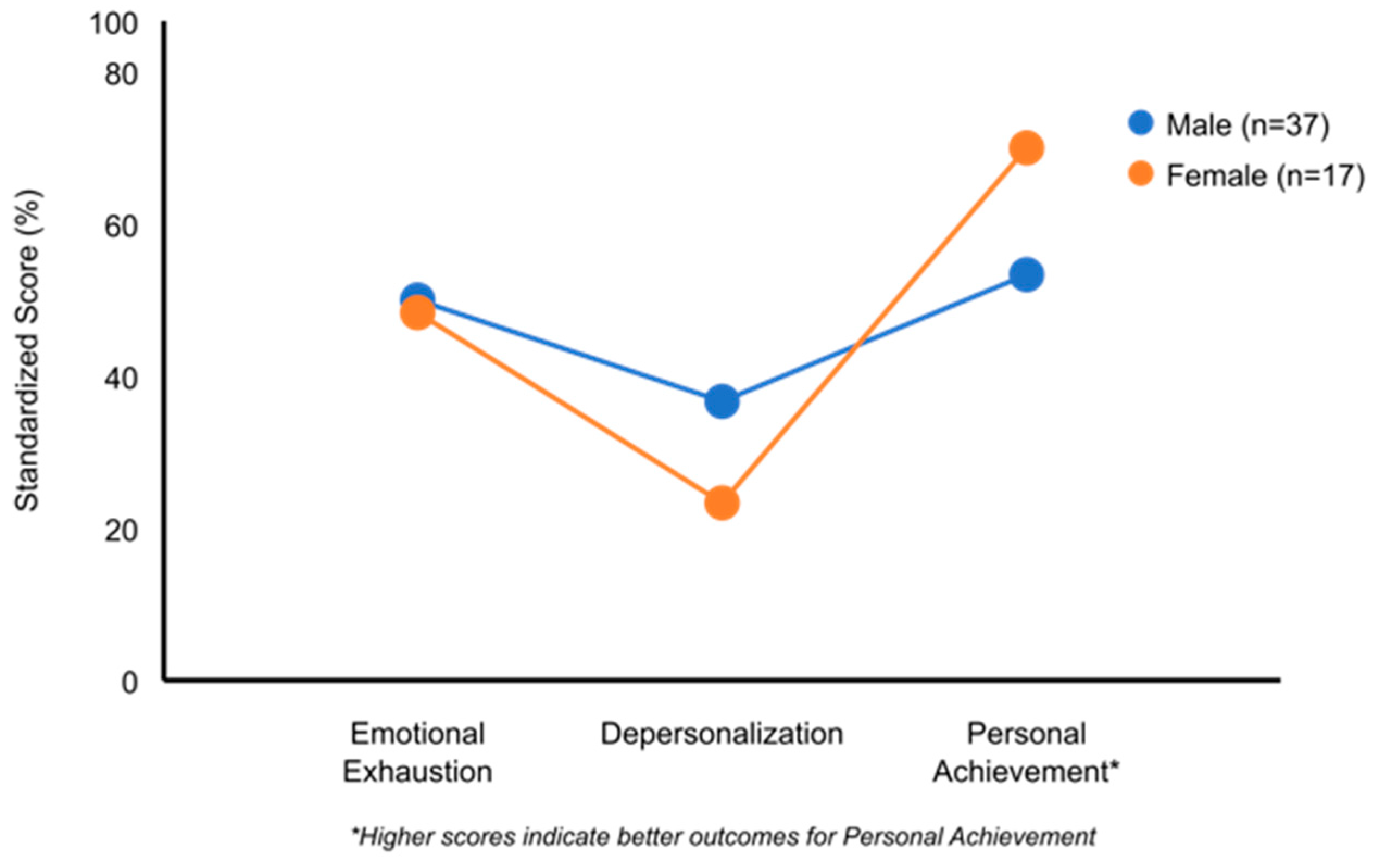
Figure 1 presents a comparative visualization of the burnout dimension profiles by gender. To enable comparison across dimensions with different numbers of items and scoring ranges, raw scores were transformed to a standardized 0–100 scale.
Standardization Methodology: Dimension scores were transformed using linear scaling with the formula: Standardized Score = (Raw Score/Maximum Possible Score) × 100. This rescaling preserves relative standing within each dimension while enabling cross-dimensional visualization. For Emotional Exhaustion (9 items, range 0–54), scores were divided by 54 and multiplied by 100. For Depersonalization (5 items, range 0–30), scores were divided by 30 and multiplied by 100. For Personal Achievement (8 items, range 0–48), scores were divided by 48 and multiplied by 100. For display consistency, all dimensions were oriented so that higher values indicate more problematic outcomes; Personal Achievement scores were reversed for visualization purposes only (actual data maintain original scoring direction).
The visualization revealed that male and female principals showed similar standardized scores on emotional exhaustion. However, male principals showed higher standardized depersonalization scores while female principals showed higher standardized personal achievement scores. These visual patterns correspond to the statistical findings reported in
Section 3.3.1,
Section 3.3.2 and
Section 3.3.3.
3.5. Correlation Patterns Among Burnout Dimensions
Spearman correlation analysis examined relationships among the three burnout dimensions (
Table 10). Emotional exhaustion was positively correlated with depersonalization (rs = 0.42,
p < 0.001) and negatively correlated with personal achievement (rs = −0.38,
p < 0.01). Depersonalization showed a strong negative correlation with personal achievement (rs = −0.51,
p < 0.001).
Interpretation: Emotional exhaustion showed a moderate positive correlation with depersonalization, indicating that principals experiencing higher exhaustion also tended to report greater emotional distancing. Both exhaustion and depersonalization were negatively correlated with personal achievement, with the depersonalization–achievement relationship being the strongest (rs = −0.51), suggesting that emotional distancing is most strongly associated with reduced feelings of professional accomplishment.
Exploratory analysis of correlation patterns by gender revealed differences in dimensional interrelationships. Among male principals, intercorrelations between dimensions were stronger than among female principals. Complete gender-stratified correlations are presented in
Table 11.
Interpretation: Gender-stratified analyses revealed notably different correlation patterns. Among the male principals, all intercorrelations were stronger and statistically significant: the exhaustion–depersonalization correlation was rs = 0.51 (vs. rs = 0.28 for females), and the depersonalization–achievement correlation was rs = −0.58 (vs. rs = −0.39 for females). Among female principals, none of the correlations reached statistical significance, though this may partly reflect the smaller subsample size (n = 17), limiting statistical power.
These patterns suggest that male principals may experience burnout as a more tightly integrated syndrome, where deterioration in one dimension is strongly associated with deterioration in others. Female principals, in contrast, appear to maintain greater independence between burnout dimensions, potentially explaining how they sustain high personal achievement despite experiencing equivalent exhaustion levels. However, this interpretation should be considered tentative given the small female subsample, which limits the reliability of the gender-stratified correlations.
The summary table (
Table 12) highlights that all three intercorrelations were stronger among male principals, with differences ranging from 0.19 to 0.23 in absolute magnitude. This consistent pattern of tighter dimensional integration among males supports the interpretation that gender may influence the structure of burnout experiences, not only the levels of individual dimensions.
3.6. Summary of Findings
The results are summarized below in relation to each research question:
RQ1 (Emotional Exhaustion Levels): The majority of principals (74.1%) reported experiencing emotional exhaustion symptoms at least monthly. Subscale means indicated moderate to high exhaustion levels.
RQ2 (Depersonalization Levels): Moderate depersonalization was observed, with 55.6% of principals reporting impersonal treatment of students at least monthly. Notable variation existed, with 11–18% reporting never experiencing specific symptoms.
RQ3 (Personal Achievement Levels): Despite exhaustion, principals reported high personal achievement, with over 40% experiencing strong feelings of accomplishment multiple times monthly.
RQ4 (Gender Differences in Emotional Exhaustion): No significant gender differences emerged for any emotional exhaustion indicator (all p > 0.05). Effect sizes were uniformly small (r = 0.03–0.23).
RQ5 (Gender Differences in Depersonalization): Male principals showed significantly higher depersonalization in two indicators: reduced sensitivity (p = 0.033, r = 0.29) and lack of concern for students (p = 0.044, r = 0.27). Effect sizes were small-to-medium.
RQ6 (Gender Differences in Personal Achievement): Female principals showed significantly higher personal achievement in six of eight indicators (p = 0.011–0.049, r = 0.27–0.35). Effect sizes were small-to-medium.
Correlation Analysis: Burnout dimensions were significantly intercorrelated in expected directions. Gender-stratified analysis revealed stronger intercorrelations among male principals than female principals.
4. Discussion
4.1. Interpretation of Findings by Research Question
This study examined professional burnout among secondary school principals in Greece, addressing six research questions probing burnout prevalence and gender differences across emotional exhaustion, depersonalization, and personal achievement dimensions. The findings reveal complex patterns that challenge unitary conceptualizations of burnout while illuminating how gender may influence burnout manifestation. The following discussion interprets these findings in relation to each research question, situates them within the existing literature, and proposes a conceptual framework for understanding the observed patterns.
4.1.1. Burnout Prevalence: Emotional Exhaustion (RQ1) and Gender Differences (RQ4)
Summary of Findings: The majority of principals (74.1%) reported experiencing mental exhaustion at least monthly, with only 3.7% reporting no exhaustion symptoms. Mann–Whitney U tests revealed no significant gender differences across all nine emotional exhaustion indicators (all p > 0.05), with uniformly small effect sizes (r = 0.03–0.23).
Comparison with Prior Research: These prevalence rates align with international findings on principal burnout.
Dicke et al. (
2022) reported that 68–72% of Australian principals experienced regular exhaustion symptoms, while
Persson et al. (
2021) found 71% prevalence among Swedish principals. The present finding of 74.1% monthly exhaustion falls within this established range, suggesting that Greek secondary principals experience exhaustion levels comparable to their international counterparts despite distinct cultural and organizational contexts.
The absence of gender differences in emotional exhaustion is consistent with meta-analytic evidence.
Purvanova and Muros (
2010), in their meta-analysis of 183 studies, found that gender differences in emotional exhaustion were negligible (d = 0.10), indicating that men and women experience similar exhaustion levels across occupational contexts. The present null findings (r = 0.03–0.23) replicate this pattern among Greek educational leaders.
Possible Explanations: The universal exhaustion pattern likely reflects structural demands inherent to the principalship—administrative overload, accountability pressures, and resource constraints—that affect all leaders regardless of gender. In the Greek context, the centralized educational system imposes standardized demands on all principals, while post-austerity resource constraints create shared challenges. The pattern of predominantly monthly (rather than daily) exhaustion symptoms may reflect cyclical stress tied to administrative deadlines, reporting requirements, and accumulated workload that peaks periodically. However, this interpretation requires longitudinal investigation to confirm.
4.1.2. Depersonalization Patterns (RQ2) and Gender Differences (RQ5)
Summary of Findings: Moderate depersonalization was observed overall, with 55.6% of principals reporting impersonal treatment of students at least monthly. Significant gender differences emerged: male principals scored significantly higher on reduced sensitivity (p = 0.033, r = 0.29) and lack of concern for students (p = 0.044, r = 0.27). Effect sizes were in the small-to-medium range.
Comparison with Prior Research: The finding that male principals show elevated depersonalization replicates well-established patterns in the burnout literature.
Purvanova and Muros (
2010) reported a consistent gender difference favoring higher male depersonalization (d = 0.23), and the present effect sizes (r = 0.27–0.29, equivalent to approximately d = 0.56–0.61) exceeded this meta-analytic average, suggesting particularly pronounced gender differences in the Greek educational context.
Similar patterns have been observed among educators specifically.
Fardous and Afzal (
2022) found elevated depersonalization among male college educators compared to female colleagues in Pakistan.
Lau et al. (
2005) reported higher cynicism among male teachers in Hong Kong. The consistency of this pattern across diverse cultural contexts suggests robust gender differences in depersonalization that transcend specific organizational or national settings.
Possible Explanations: Several interpretations warrant consideration, though none were directly tested in this study. First, gendered socialization may create differential coping repertoires: masculine norms emphasizing emotional restraint and control may predispose men toward emotional distancing as a stress-coping strategy. Second, the feminized context of education may create role strain for male leaders navigating between nurturing leadership expectations and masculine identity, with depersonalization serving to manage this tension. Third, traditional Greek gender norms, which remain more pronounced than in some Northern European contexts, may amplify these patterns. These interpretations remain speculative pending research directly measuring coping strategies, gender role identification, and cultural values.
Notably, 11–18% of principals reported never experiencing depersonalization symptoms, indicating individual variation in vulnerability or resilience that challenges deterministic models, positing inevitable progression from exhaustion to depersonalization.
4.1.3. Personal Achievement (RQ3) and Gender Differences (RQ6)
Summary of Findings: Despite elevated exhaustion, principals reported high overall personal achievement. Significant gender differences favored female principals on six of eight indicators (p = 0.011–0.049), with effect sizes ranging from r = 0.27 to r = 0.35 (small-to-medium). The largest differences appeared for ‘achieved remarkable things’ (r = 0.35) and ‘create comfortable atmosphere’ (r = 0.34).
Comparison with Prior Research: The finding that female principals maintain higher achievement despite equivalent exhaustion represents a less commonly reported pattern in the burnout literature. While
Purvanova and Muros (
2010) found minimal gender differences in personal accomplishment in their meta-analysis (d = 0.08), the present effect sizes (r = 0.27–0.35) substantially exceed this average.
However, some studies reported similar patterns.
Greenglass and Burke (
1988) found that female managers reported higher job satisfaction and accomplishment than male counterparts despite similar stress levels. More recently, research on educational leadership has noted that female principals often report higher self-efficacy and job satisfaction (
Jang & Alexander, 2022). The present findings extend this pattern specifically to the personal achievement dimension of burnout.
The paradox of high achievement coexisting with high exhaustion challenges linear burnout models that assume dimensions deteriorate in tandem. This pattern suggests that burnout dimensions may operate with relative independence, particularly for female leaders.
Possible Explanations: Several mechanisms may contribute to female principals’ achievement maintenance, though these were not directly measured. First, feminine socialization emphasizing relational orientation may enable sustained satisfaction from interpersonal aspects of leadership even under stress. Second, female principals may define achievement more broadly to include relationship quality and supportive climate, providing multiple sources of professional satisfaction. Third, transformational leadership behaviors more commonly exhibited by women (
Bass & Avolio, 1994) may generate immediate positive feedback that reinforces achievement perceptions. Fourth, the Greek cultural value of ‘philotimo’ may operate differentially, with female principals channeling this obligation toward relationship maintenance while male principals focus on task completion. These interpretations require qualitative investigation to assess their validity.
4.1.4. Dimensional Interrelationships and Gender-Stratified Patterns
Summary of Findings: Spearman correlations revealed expected patterns: emotional exhaustion correlated positively with depersonalization (rs = 0.42) and negatively with personal achievement (rs = −0.38), while depersonalization correlated negatively with achievement (rs = −0.51). Exploratory gender-stratified analysis indicated stronger intercorrelations among male principals than female principals.
Comparison with Prior Research: The overall correlation pattern replicates established findings.
Lee and Ashforth (
1996), in their meta-analysis, reported mean correlations of r = 0.52 between exhaustion and depersonalization and r = −0.33 between exhaustion and achievement. The present correlations fall within the expected ranges, supporting construct validity.
The finding of differential correlation strength by gender is noteworthy. If replicated, it would suggest that male principals experience burnout as a more integrated syndrome where dimensions deteriorate together, while female principals maintain greater independence between dimensions—potentially explaining how they sustain achievement despite exhaustion. However, this interpretation is tentative given the small female subsample (n = 17), which limits the reliability of gender-stratified correlations.
4.2. Theoretical Framework: The Gendered Burnout Response Model
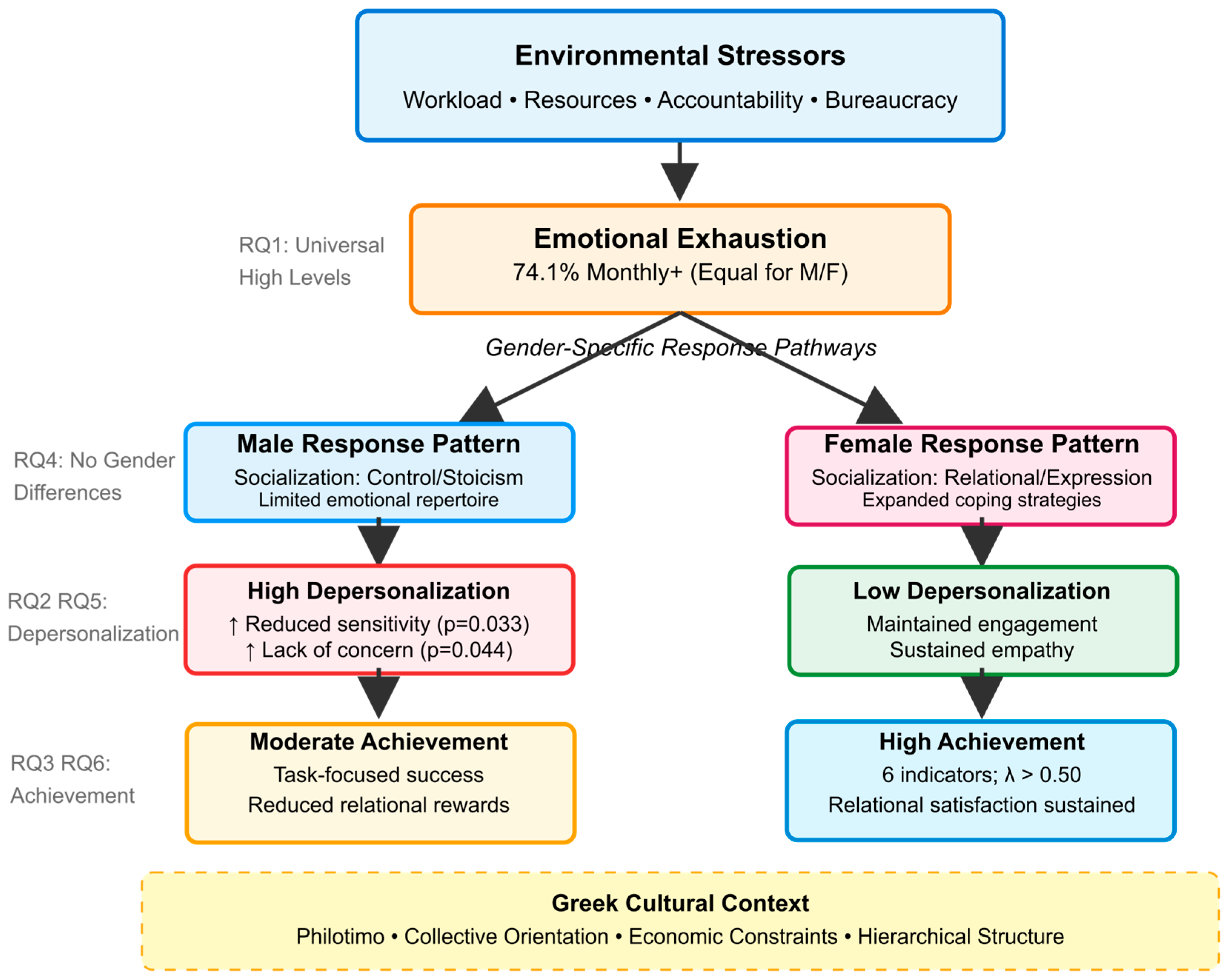
Based on the patterns observed across research questions, we propose the Gendered Burnout Response Model (GBRM) as a conceptual framework for understanding the findings. It is essential to emphasize that the GBRM represents a theoretical interpretation of the observed data rather than an empirically validated causal model. The proposed mechanisms were not directly measured in this study, and the framework should be understood as generating testable hypotheses for future research rather than providing confirmed explanations (
Figure 2).
4.2.1. Model Components and Empirical Linkages
The GBRM comprises three core propositions, each explicitly linked to observed findings:
Proposition 1—Shared Stressor Exposure: Structural demands of the principalship create equivalent emotional exhaustion regardless of gender.
Empirical basis: No significant gender differences in emotional exhaustion (RQ4); both genders reported 74.1% monthly exhaustion prevalence.
Implication: Workplace stressors affect male and female principals similarly at the exhaustion level.
Proposition 2—Gender-Differentiated Coping Pathways: Gendered socialization creates divergent stress responses, with male socialization facilitating emotional distancing and female socialization facilitating relational maintenance.
Empirical basis: Males showed significantly higher depersonalization (RQ5; r = 0.27–0.29); females showed significantly higher achievement (RQ6; r = 0.27–0.35).
Implication: Gender shapes how principals respond to exhaustion, not whether they experience it.
Proposition 3—Divergent Burnout Profiles: These differential pathways produce distinct burnout configurations—male principals trend toward exhaustion-with-depersonalization; female principals toward exhaustion-with-preserved-achievement.
Empirical basis: Stronger dimensional intercorrelations among males; looser correlations among females.
Implication: Burnout manifests as a more integrated syndrome for males and a more compartmentalized experience for females.
4.2.2. Model Limitations and Future Testing
The GBRM’s proposed mechanisms—gendered coping styles, socialization effects, cultural norm influence—were not directly measured in this study. The model therefore represents conceptual interpretation rather than empirical validation. Future research should directly assess: (a) coping strategy repertoires by gender, (b) gender role identification and adherence, (c) cultural values regarding emotional expression, and (d) leadership style and relational orientation. Such research would enable empirical testing of the GBRM’s propositions.
4.3. Practical Implications
The findings generate implications for intervention at multiple levels. Each recommendation is explicitly linked to specific study outcomes.
4.3.1. Policy Level Interventions
Finding Addressed: Universal emotional exhaustion regardless of gender (RQ1, RQ4) indicates systemic rather than individual-level causes requiring structural intervention.
Recommended Actions:
Administrative Burden Reduction: Ministry of Education policies should streamline bureaucratic reporting requirements and reduce compliance documentation demands. Specific actions could include consolidating redundant reporting systems, extending deadline timelines, and eliminating non-essential administrative tasks.
Resource Allocation: Policies should ensure adequate staffing levels, including administrative support personnel who can share the principals’ workload. Post-austerity resource restoration should prioritize leadership support.
Accountability Framework Reform: Current accountability systems should be evaluated for their contribution to principal stress, with consideration of developmental rather than purely evaluative approaches.
Mandatory Wellness Monitoring: Policies could require periodic burnout assessment for principals, with results informing support allocation and early intervention.
4.3.2. Regional Education Department Level Interventions
Finding Addressed: Gender-differentiated burnout patterns (RQ5, RQ6) suggest need for targeted support approaches.
Recommended Actions:
Peer Support Networks: Establish regional principal mentoring and peer support programs. These networks can facilitate sharing of effective coping strategies, with female principals’ achievement-maintenance approaches potentially benefiting male colleagues.
Gender-Informed Leadership Training: Professional development programs should incorporate modules on emotional intelligence, stress management, and maintaining engagement. Training for male principals might specifically address recognizing and countering depersonalization tendencies.
Targeted Resource Allocation: Departments should consider providing additional support for principals showing burnout indicators, with awareness that support needs may differ by gender (e.g., emotional engagement support for males; boundary-setting support for females).
Professional Coaching Access: Provide access to executive coaching or counseling services, with coaches trained in gender-informed approaches to leadership stress.
4.3.3. School Level Interventions
Finding Addressed: High achievement maintenance by female principals despite exhaustion (RQ6) raises sustainability concerns; male depersonalization (RQ5) threatens school climate.
Recommended Actions:
Distributed Leadership Implementation: Implementing distributed leadership models can reduce principal burden while developing teacher leadership capacity and providing principals with collaborative support.
Boundary-Setting Support: For female principals maintaining high achievement despite exhaustion, interventions should legitimize work–life boundaries and prevent organizational exploitation of resilience. This might include explicit workload policies and recognition of sustainable practices.
Relationship Maintenance Programs: For male principals showing depersonalization, school-level interventions might include structured opportunities for meaningful student and staff interaction, perspective-taking exercises, and climate monitoring.
Recognition Systems: Develop recognition approaches that acknowledge diverse achievements, including relationship quality, supportive climate creation, and staff development—contributions that female principals may emphasize and that benefit school communities.
4.4. Cultural Context and Research Question Implications
The Greek educational context shapes the observed patterns in important ways. The centralized educational system, with standardized requirements across schools, may explain why exhaustion levels do not differ by gender—all principals face equivalent structural demands regardless of gender. Post-austerity resource constraints create shared challenges that may overwhelm individual differences in stress susceptibility.
Greek cultural norms regarding gender may amplify the differentiated response patterns. Traditional gender role expectations, while evolving, remain more pronounced than in some Northern European contexts. These norms may exert pressure on male principals toward emotional restraint and on female principals toward relational maintenance. The cultural value of ‘philotimo’—encompassing honor, dignity, and obligation fulfillment—may contribute to achievement maintenance, particularly among principals who channel this value toward professional commitment despite personal cost.
However, these cultural interpretations remain speculative. Cross-cultural comparative research directly measuring cultural values and their relationship to burnout patterns would be required to confirm these propositions.
4.5. Limitations
Several limitations warrant acknowledgment, each suggesting directions for future research:
The sample (N = 54, including n = 17 females) provides adequate power for medium-to-large effects but may miss smaller gender differences. The single-region design (Fokida Prefecture) limits generalizability to other Greek regions or international contexts.
The cross-sectional design cannot establish whether gender differences emerge immediately upon assuming principalship or develop over time. Temporal precedence and causation cannot be determined.
Exclusive reliance on self-report data introduces potential response biases, particularly social desirability effects that may affect depersonalization disclosure. No behavioral or physiological validation was conducted.
The study did not control for potentially confounding variables including age, years of principal experience, total teaching experience, school size, student demographics, socioeconomic context, or personal characteristics (personality traits, coping styles, self-efficacy). Observed gender differences may be partially attributable to these unmeasured factors.
The GBRM’s proposed mechanisms (gendered coping, cultural norms, socialization effects) were not directly measured, leaving the model at the conceptual rather than empirical validation stage.
The Greek context, while providing valuable cultural insights, limits generalization to other educational systems and cultures. Patterns observed in a centralized, post-austerity, Southern European context may not replicate in decentralized, well-resourced, or culturally distinct settings.
4.6. Future Research Directions
The research questions posed above provide many directions for further research to explore. Longitudinal studies need to be conducted to find out whether the gender differences identified in RQ5 and RQ6 are observed right after becoming principals or whether they are observed over a period of time. Following up on RQ1, RQ2, and RQ3 on the variables of emotional exhaustion, depersonalization, and achievement can identify points of critical intervention (
Y. Yang, 2025;
Mittleman, 2022;
Hay et al., 2021;
N. Wang et al., 2023;
Eccles & Wigfield, 2023;
Baguri et al., 2022;
Elrod et al., 2022;
Jang & Alexander, 2022).
Mixed-methods research can provide more insight into patterns uncovered within our research questions using our quantitative data. To gain insight into how male principals perceive their experience with depersonalization on their jobs or how female principals are able to sustain high levels of achievement despite experiencing exhaustion (RQ6), or to gain insight into how principals experience meaningful acceptance or demand for respect on their jobs to uncover reasons for gender-driven exhaustion patterns on their jobs, we can conduct qualitative research studies on RQ5 and RQ6. To gain insight into how principals experience job-related exhaustion, phenomenological research approaches could be employed to address RQ1, drawing on methodological frameworks from prior studies (
Persson et al., 2021;
Antonopoulou et al., 2025;
García-Salirrosas et al., 2025;
Garrote et al., 2021;
Gkintoni et al., 2022,
2025;
Grice et al., 2024;
Dicke et al., 2022;
Sortwell et al., 2026).
Intervention studies must assess whether gender-oriented strategies informed by RQ5 and RQ6 can be more beneficial than general interventions. Comparison between intervention data for male principals conducted on depersonalization-themed strategies and data for female principals on sustainability-themed support would ensure the applicability of our research. The universal exhaustion described in RQ1 and RQ4 points to including stress management strategies in general intervention contexts to manage stressors within organizations, as reported in most studies cited above (
Gkintoni & Halkiopoulos, 2025a,
2025b;
Miralles-Cardona, 2025;
Miralles-Cardona et al., 2021;
Atanasova et al., 2024;
Halkiopoulos et al., 2025;
Sicuan, 2024).
5. Conclusions
This study provides preliminary evidence regarding professional burnout among secondary school principals in Greece, with particular attention to gender patterns across burnout dimensions. The findings suggest several tentative conclusions that warrant replication before definitive claims can be made.
First, emotional exhaustion appears prevalent among Greek secondary principals regardless of gender, with approximately three-quarters experiencing symptoms at least monthly. This pattern suggests that structural demands of the principalship create shared stress experiences affecting all leaders, pointing to the need for systemic rather than individual-level interventions.
Second, the findings indicate that gender may shape burnout manifestation through different response pathways. Male principals showed higher depersonalization (small-to-medium effects), while female principals maintained higher personal achievement despite equivalent exhaustion. These patterns suggest that gender influences not whether principals experience stress, but how they respond to it—a distinction with important implications for intervention design.
Third, based on these patterns, we propose the Gendered Burnout Response Model (GBRM) as a conceptual framework suggesting that shared stressors produce divergent burnout profiles through gender-differentiated coping pathways. However, this model represents theoretical interpretation rather than empirically validated explanation, and its proposed mechanisms require direct investigation in future research.
Several important caveats temper these conclusions. The single-region sample, modest female subsample size (n = 17), cross-sectional design, and absence of controls for potential confounders (age, experience, school characteristics) limit the certainty with which findings can be interpreted. The observed patterns should be understood as indicative rather than definitive, requiring replication in larger, more diverse samples before informing policy or practice with confidence.
Pending such replication, the findings tentatively support dual intervention approaches: systemic reforms addressing organizational stressors that drive universal exhaustion, alongside gender-sensitive strategies addressing the differentiated ways male and female principals respond to occupational stress. Such approaches would recognize that effective support for educational leaders must attend to both structural conditions and individual response patterns.
The broader significance of this work extends beyond individual principal well-being to educational system sustainability. Principal burnout affects school climate, teacher retention, student outcomes, and community engagement. As educational institutions face mounting challenges requiring sustained, effective leadership, understanding gender patterns in burnout becomes important for ensuring that all principals—regardless of gender—receive support enabling sustainable leadership that serves educational communities.




 ,
,