Leading the Digital Transformation of Education: The Perspective of School Principals


Abstract
1. Introduction
- RQ1
- How do school principals assess key aspects of the strategic management of digitalisation within their organisations?
- RQ2
- What profiles of digital leadership emerge from principals’ declared leadership styles and managerial practices, and what are the defining characteristics of these profiles?
2. Theoretical Framework
2.1. Digital Leadership and Managerial Strategies for Developing Organisational Maturity
2.2. Evolution of the Concept and Key Frameworks
2.3. Principal Leadership for Developing School Digital Capacity: Styles and Effective Practices
2.4. Contextual Factors and Challenges in the Implementation of Digital Leadership
2.5. The Bulgarian Context of Digitalisation and Managerial Perspectives
- Limited institutional capacity to mitigate the effects of disadvantaged socio-economic conditions (poverty, bilingualism, low parental education). “In Bulgaria, the difference in mathematics performance between students with advantaged and disadvantaged socio-economic status is 108 points, which exceeds the OECD average of 93 points” (Bulgaria results from participation in PISA, 2022, p. 24).
- “Educational segregation”—schools operate within specific socio-economic settings and a competitive environment. Funding mechanisms based on “per student and per class” combined with demographic characteristics often lead to the clustering of students with similar abilities and results within the same schools. “PISA 2018 data show that in OECD countries nearly one-third (29%) of the variance in student performance is attributable to school-level factors. In Bulgaria, this figure reaches 55%, placing the country alongside Germany, the Netherlands, Israel, and others” (Bulgaria results from participation, 2018, p. 49).
- Quasi-market conditions and the push towards school autonomy, without mechanisms that incentivise quality over quantity of students (Parvanova, 2020). As a result, the school system can be described as highly fragmented, encompassing a diverse range of managerial visions, practices, and leadership styles—including those related to digitalisation. Each school, depending on its context, characteristics, and current state of development, integrates digitalisation differently and conceptualises its significance through distinct paradigms—strategic, operational, educational, administrative, etc.
3. Research Methodology
3.1. Research Aim
3.2. Approach and Research Design
- Quantitative stage (quan): A nationally representative survey (N = 349) mapping general trends in school leaders’ self-assessments regarding the strategic management of digitalisation. This stage provides the national contextual framework. The qualitative sample (N = 30) is a structurally defined subset of the quantitative sample (N = 349), selected through quota sampling to ensure maximum variation.
- Qualitative stage (QUAL): An in-depth analysis of managerial conceptions and practices through a two-step procedure with 30 school principals: preliminary written questionnaires followed by semi-structured interviews, thematic coding, and cluster analysis. The aim is to achieve deep understanding and conceptualisation of leadership styles and managerial strategies.
3.3. Quantitative Phase
3.3.1. Sample
3.3.2. Instrument
3.3.3. Psychometric Properties
3.3.4. Data Collection and Analysis Procedure
3.4. Qualitative Phase
3.4.1. Sample
3.4.2. Instruments
3.4.3. Analysis
- Leadership and change management;
- Collaboration and networks;
- School digitalisation;
- Contextual challenges and constraints.
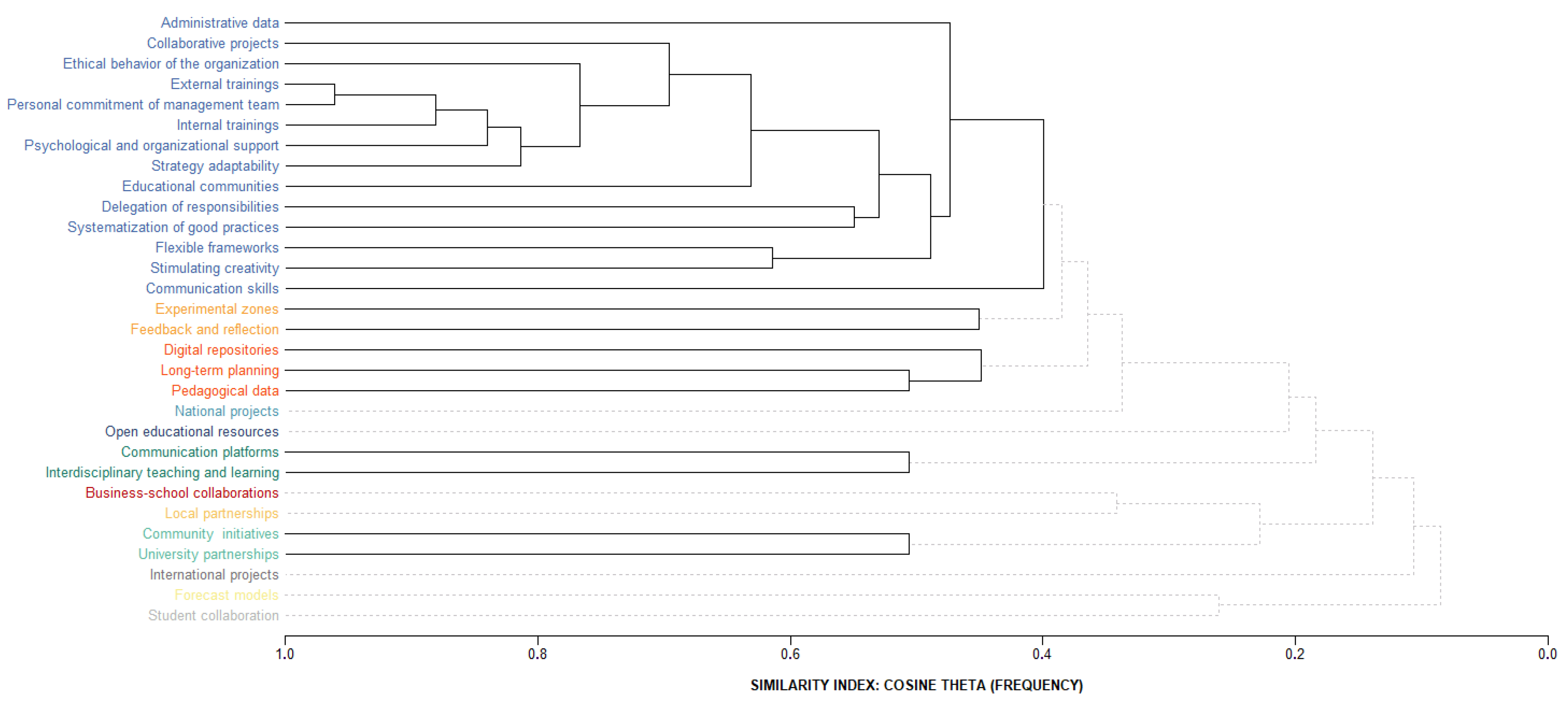
- Empirical saturation: When the threshold falls below 0.5, the number of connected codes increases exponentially (e.g., at 0.4, 52 codes are included), which introduces noise and diminishes interpretative clarity. When the threshold exceeds 0.6, only nine codes remain, which eliminates important nuances. The 0.5 threshold represents an elbow point at which thematic richness and analytical precision are optimally balanced.
- Interpretative distinctiveness: Analysis of the dendrogram (Figure 1) shows that at a coefficient ≥ 0.5, clearly delineated thematic groups emerge, allowing the identification of conceptually related managerial practices.
- Thematic representativeness: The 18 selected codes appear in interviews with at least 40% of the school principals, ensuring a balance between representativeness and specificity.
- Representativeness: The three clusters encompass two thirds of the sample, ensuring empirical breadth and a sufficiently robust basis for theoretical generalisation.
- Maximum variation: They demonstrate the full spectrum of managerial approaches—from highly strategic and resource-rich (Cluster 1), through balanced, pragmatic models emphasising results (Cluster 5), to strongly adaptive approaches focused on operational support (Cluster 4). This varied selection makes it possible to identify both shared and context-specific practices (Vila-Henninger et al., 2024).
- Analytical clarity: These clusters exhibit the most clearly expressed and conceptually coherent patterns, with high internal homogeneity, which facilitates the interpretative synthesis between empirical observations and theoretical constructs.
- Theoretical productivity: They represent contrastive cases (Timmermans & Tavory, 2012), whose comparison reveals the mechanisms through which digital leadership adapts to varying institutional contexts.
- Cluster 2 (2 schools) and Cluster 6 (3 schools): Their very small size limits the possibility of identifying stable patterns across the principals’ narratives.
- Cluster 3 (3 schools): Displays high internal heterogeneity, suggesting the presence of hybrid or transitional forms—schools combining elements of different leadership styles without a clearly dominant logic.
- Outliers (3 schools): Represent unique configurations requiring a separate, case-by-case analysis beyond the scope of a typological approach.
- At higher thresholds (e.g., 0.6–0.7), all codes merge into only 2–3 groups, limiting the ability to identify specific roles and practices of leaders across clusters.
- At lower thresholds (e.g., 0.3–0.4), the same codes appear in a single overarching group common to all clusters, resulting in the loss of distinct connections emerging from principals’ reported actions, attitudes, and judgements.
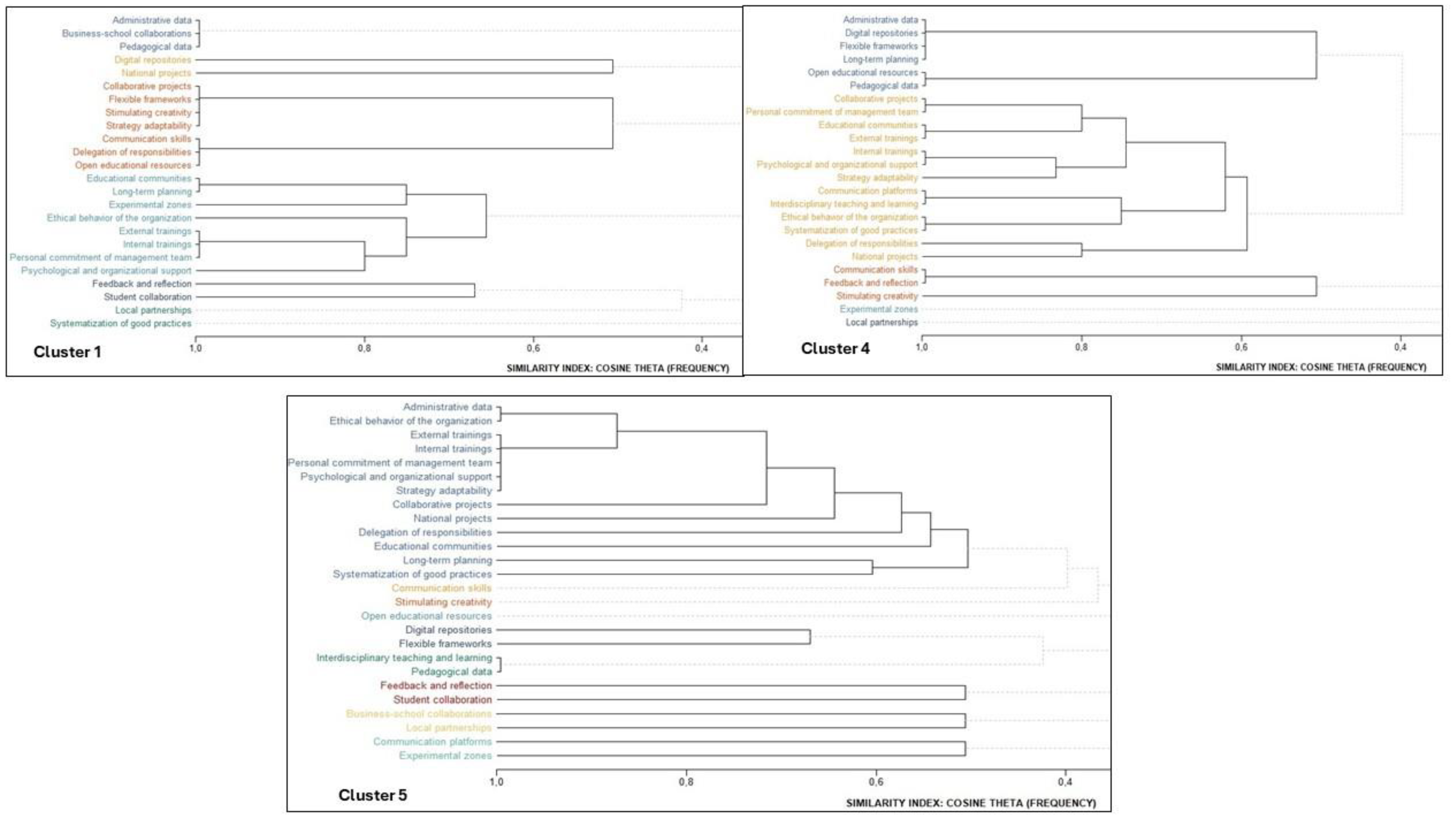
- Differences in the number of subclusters of codes (i.e., groups of interrelated practices);
- Differences in the number of codes within each subcluster (indicating the complexity and breadth of managerial approaches);
- Differences in the strength of links between specific codes and subclusters (indicating the centrality or peripheral nature of certain practices).
- The visual clustering patterns (which codes tend to co-occur);
- The textual content of the interviews (what principals explicitly say);
- Theoretical frameworks of digital leadership (how leadership is conceptualised in the literature).
- The codes “long-term planning” + “professional learning communities” + “internal/external training” + “personal commitment of school leadership” form a tightly connected group (coefficient > 0.8).
- The codes “collaborative projects” + “school–business partnerships” + “encouraging creativity” form a second strongly connected group.
- Textual confirmation (from Cluster 1 interviews):
- Principals consistently speak about “vision”, “a multi-year perspective”, “strategic planning”.
- They emphasise “teamwork”, “professional communities”, “sharing experience”.
- Theoretical conceptualisation:
- The combination of long-term planning + systematic training + partnerships aligns with strategic leadership (Hallinger & Heck, 2011).
- The emphasis on communities + shared experience + collaboration aligns with collaborative leadership (Harris & DeFlaminis, 2016).
3.4.4. Sequential Integration of Quantitative and Qualitative Data
- The quantitative sample provides representativeness and a picture of typical strategic digital management practices.
- The qualitative sample enables the identification of typological profiles, specificities, and mechanisms underlying principals’ self-assessments—enhancing the interpretative power and depth of the research strategy and providing contextual meaning to the numerical quantitative results.
3.5. Ethical Considerations
4. Results
4.1. Principals’ Assessments of Key Aspects of the Strategic Management of Digitalisation in Their Schools
4.2. Managerial Practices and Leadership Styles in School Digitalisation
4.2.1. Cluster Analysis
4.2.2. Analysis of Managerial Practices and Leadership Styles Within the School Clusters
- Communication and Open Resources (coefficient 1.0)
- 2.
- Collaboration and Creativity (coefficient 0.95)
- 3.
- Strategic Planning and Professional Communities (coefficient 0.91)
- 4.
- Systematic Training and Leadership Engagement (coefficient 0.88)
- 5.
- Partnerships and Data-Driven Decisions (coefficient 0.85)
- 6.
- Strategic Adaptability (coefficient 0.82)
- Systematic internal training and exchange of expertise;
- Participation in external professional development;
- Building partnerships with external organisations and the business sector;
- Use of pedagogical and administrative data to inform decisions;
- Encouraging creative and innovative projects.
- A strong focus on communication and feedback;
- Promotion of collaboration and team culture;
- Long-term strategic planning;
- Context-sensitive adaptability;
- Active support for professional development.
- Innovative resources and competence-based selection (coefficient 1.0)
- 2.
- Communication and reflection (coefficient 0.96)
- 3.
- Platforms for interdisciplinary integration (coefficient 0.93)
- 4.
- Leadership engagement and project work (coefficient 0.90)
- 5.
- Ethics and systematisation of practices (coefficient 0.88)
- 6.
- Need for strategic vision (coefficient 0.85)
- 7.
- Personalised internal training (coefficient 0.82)
- 8.
- External training and professional communities (coefficient 0.79)
- Establishing professional learning communities and working groups;
- Organising internal and external training;
- Encouraging collaborative projects;
- Systematising and discussing good practices;
- Ensuring ethical use of digital resources;
- Maintaining digital repositories and platforms.
- Active involvement of school leadership in observation and support;
- Encouragement of exchange among colleagues regardless of hierarchy;
- Commitment to ethical standards;
- Flexibility in adapting training to staff needs;
- Absence of systematic long-term planning in some schools.
- Interdisciplinary integration and data-driven approach (coefficient 0.89)
- 2.
- Leadership engagement and organisational support (coefficient 0.87)
- 3.
- Systematic and regular qualification (coefficient 0.84)
- 4.
- Ethical regulation and administrative control (coefficient 0.81)
- 5.
- Adaptive strategy (coefficient 0.78)
- Collecting and analysing pedagogical and administrative data;
- Implementing interdisciplinary projects;
- Organising internal training for experience-sharing;
- Funding participation in external qualification programmes;
- Ensuring ethical standards and copyright compliance.
- Centralised organisational support combined with team autonomy;
- Structured monitoring of results and administrative requirements;
- Strong emphasis on ethical standards;
- Balanced use of internal and external training;
- Support for interdisciplinary integration.
4.2.3. Validation of the Clusters Through Educational Outcomes
- Quartile 1: Below 25% (lowest results);
- Quartile 2: Between 25% and 50%;
- Quartile 3: Between 50% and 75%;
- Quartile 4: Above 75% (highest results).
- Predominant values—the typical level of achievement;
- Mean compactness—internal similarity within the cluster (mean absolute difference between pairs of schools); lower values = greater homogeneity;
- Mean fluctuation—stability over time (mean absolute year-to-year change); lower values = more stable results (see Table 6).
- Compactness (0.905): High internal homogeneity—the schools are highly similar in terms of outcomes.
- Fluctuation (0.273): Minimal variation—stability over time.
- Compactness (1.429): Lowest internal homogeneity—substantial internal differences.
- Fluctuation (0.416): Moderate—results are relatively stable (with one exception).
- Compactness (1.095): Moderate homogeneity—some internal variation.
- Fluctuation (0.545): Highest of the three clusters—unstable performance.
5. Discussion
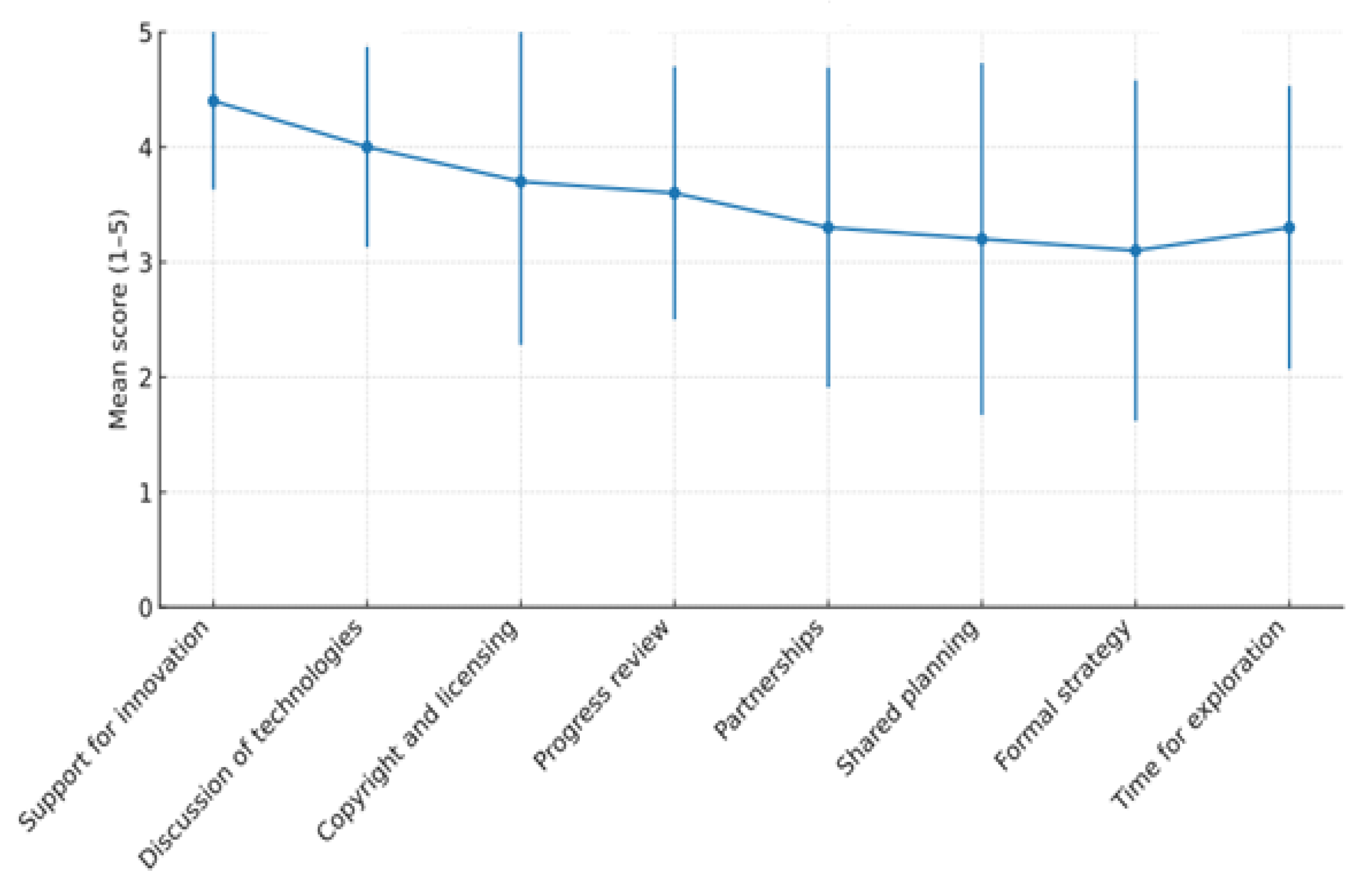
- The “high-support–low-institutionalisation” paradox
- 2.
- Contextual determination of leadership styles
- 3.
- Adaptiveness as a Universal Strategy
- 1.
- Moving from universal support to differentiated strategic frameworks.
- 2.
- Moving from individual tools to systemic capacity building for strategic institutionalisation
- 3.
- Resourcing and adaptive capacity in contexts of structural inequality
6. Conclusions
Author Contributions
Funding
Institutional Review Board Statement
Informed Consent Statement
Data Availability Statement
Acknowledgments
Conflicts of Interest
Abbreviations
| SELFIE | Self-reflection on Effective Learning by Fostering the use of Innovative Educational technologies |
| DigCompOrg | Digitally competent organisation |
Appendix A
- 1.
- LEADERSHIP AND CHANGE MANAGEMENT
- 1.1.
- Support for innovation and sustainable development
- Internal training
- External training
- Psychological and organisational support
- Stimulating creativity
- Experimental zones
- Flexible frameworks
- 1.2.
- Strategic vision and institutional commitment
- Strategy adaptability
- Personal commitment of management team
- Delegation of responsibilities
- Long-term planning
- Ethical behaviour of the organisation
- Communication skills
- 1.3.
- Management through data and evidence
- Administrative data
- Pedagogical data
- Forecast models
- 2.
- COOPERATION AND NETWORKS
- 2.1.
- External networks and partnerships
- National projects
- Local partnerships
- Business–school collaborations
- University partnerships
- International projects
- Community initiatives
- Collaborative projects
- 2.2.
- Intra-institutional cooperation and sharing
- Collaborative projects
- Systematisation of good practices
- Digital repositories
- Communication platforms
- Open educational resources
- Interdisciplinary learning
- 2.3.
- Culture of learning and reflection
- Educational communities
- Feedback and reflection
- Student collaboration
References
- Afshari, M., Bakar, K. A., Luan, W. S., Samah, B. A., & Fooi, F. S. (2009). Factors affecting teachers’ use of information and communication technology. International Journal of Instruction, 2(1), 77–104. Available online: https://www.oalib.com/research/2180529 (accessed on 25 May 2025).
- Anderson, R. E., & Dexter, S. (2005). School technology leadership: An empirical investigation of prevalence and effect. Educational Administration Quarterly, 41(1), 49–82. [Google Scholar] [CrossRef]
- Arafeh, S. (2015). Educational technology leadership for educational leaders: An integrated technology leadership model. In N. M. Haynes, S. Arafeh, & C. McDaniels (Eds.), Educational leadership: Perspectives on preparation and practice (pp. 247–258). University Press of America. Available online: https://www.researchgate.net/publication/277010459_Educational_Technology_Leadership_for_Educational_Leaders_An_Integrated_Technology_Leadership_Model (accessed on 17 May 2025).
- Avolio, B. J., Kahai, S. S., & Dodge, G. E. (2000). E-leadership: Implications for theory, research, and practice. The Leadership Quarterly, 11(4), 615–668. [Google Scholar] [CrossRef]
- Banoğlu, K., Vanderlinde, R., Çetin, M., & Aesaert, K. (2023). Role of school principals’ technology leadership practices in building a learning organization culture in public K–12 schools. Journal of School Leadership, 33(1), 66–91. [Google Scholar] [CrossRef]
- Bass, B. M. (1985). Leadership and performance beyond expectations. Free Press. [Google Scholar]
- Bocconi, S., & Lightfoot, M. (2021). Scaling up and integrating the SELFIE tool for schools’ digital capacity in education and training systems (A. Brolpito, N. Giannoutsou, R. Hippe, & P. Kampylis, Eds.). European Training Foundation. Available online: https://www.etf.europa.eu/sites/default/files/2021-03/integrating_selfie_in_education_and_training_0.pdf (accessed on 13 June 2025).
- Braun, V., & Clarke, V. (2006). Using thematic analysis in psychology. Qualitative Research in Psychology, 3(2), 77–101. [Google Scholar] [CrossRef]
- Bulgaria results from participation. (2018). MOH. Available online: https://io.mon.bg/sites/default/files/uploads/docs/2019-12/PISA_2018_3.12_2019.pdf (accessed on 22 June 2025).
- Bulgaria results from participation in PISA. (2022). Ministry of Education and Science. Available online: https://io.mon.bg/sites/default/files/uploads/docs/2023-12/PISA_2022_site3_1.pdf (accessed on 22 June 2025).
- Burns, J. M. (2012). Leadership. Open Road Media. [Google Scholar]
- Caneva, C., & Pulfrey, C. (2023). Digital capacity building in schools: Strategies, challenges, and outcomes. Médiations et médiatisations, 18(13), 45–64. [Google Scholar] [CrossRef]
- Carey, J. D. (2011). Building instructional leadership capacity of school leaders through technology integration [Ph.D. dissertation, Rowan University]. Available online: https://rdw.rowan.edu/etd/42 (accessed on 3 May 2025).
- Carter, N., Bryant-Lukosius, D., DiCenso, A., Blythe, J., & Neville, A. J. (2014). The use of triangulation in qualitative research. Oncology Nursing Forum, 41(5), 545–547. [Google Scholar] [CrossRef]
- Castaño Muñoz, J., Vuorikari, R., Costa, P., Hippe, R., & Kampylis, P. (2023). Teacher collaboration and students’ digital competence: Evidence from the SELFIE tool. European Journal of Teacher Education, 46(3), 476–497. [Google Scholar] [CrossRef]
- Chamakiotis, P., & Panteli, N. (2011). E-leadership styles for global virtual teams. In Global business: Concepts, methodologies, tools and applications (pp. 1688–1706). IGI Global. Available online: https://scholar.google.com/citations?user=k5h3dJsAAAAJ (accessed on 9 June 2025).
- Charmaz, K. (2014). Constructing grounded theory (2nd ed.). SAGE Publications. [Google Scholar]
- Collier, D., LaPorte, J., & Seawright, J. (2012). Putting typologies to work: Concept formation, measurement, and analytic rigor. Political Research Quarterly, 65(1), 217–232. [Google Scholar] [CrossRef]
- Conrads, J., Rasmussen, M., Winters, N., Geniet, A., & Langer, L. (2017). Digital education policies in Europe and beyond: Key design principles for more effective policies. In C. Redecker, P. Kampylis, M. Bacigalupo, & Y. Punie (Eds.), EUR 29000 EN. Publications Office of the European Union. [Google Scholar] [CrossRef]
- Corbin, J. M., & Strauss, A. (1990). Grounded theory research: Procedures, canons, and evaluative criteria. Qualitative Sociology, 13(1), 3–21. [Google Scholar] [CrossRef]
- Creswell, J. W., & Miller, D. L. (2000). Determining validity in qualitative inquiry. Theory into Practice, 39(3), 124–130. [Google Scholar] [CrossRef]
- Creswell, J. W., & Plano Clark, V. L. (2018). Designing and conducting mixed methods research (3rd ed.). SAGE Publications. [Google Scholar]
- Dexter, S. (2019). The role of leadership for information technology in education: Systems of practices. In J. Voogt, G. Knezek, R. Christensen, & K. W. Lai (Eds.), Second handbook of information technology in primary and secondary education. Springer International Handbooks of Education. Springer. [Google Scholar] [CrossRef]
- Esplin, N. L., Stewart, C., & Thurston, T. N. (2018). Technology leadership perceptions of Utah elementary school principals. Journal of Research on Technology in Education, 50(4), 305–317. [Google Scholar] [CrossRef]
- European Commission. (2001). The eLearning action plan: Designing tomorrow’s education (COM(2001) 172 final). European Commission. Available online: https://eur-lex.europa.eu/LexUriServ/LexUriServ.do?uri=COM:2001:0172:FIN:EN:PDF (accessed on 17 July 2025).
- European Commission. (2012). Rethinking education: Investing in skills for better socio-economic outcomes (COM(2012) 669 final). European Commission. Available online: https://eur-lex.europa.eu/legal-content/EN/TXT/?uri=CELEX:52012DC0669 (accessed on 18 July 2025).
- European Commission. (2013). Survey of schools: ICT in education. European Commission. Available online: http://www.eun.org/ (accessed on 18 July 2025).
- European Commission. (2020). Digital education action plan 2021–2027. European Commission. Available online: https://education.ec.europa.eu/ (accessed on 17 July 2025).
- European Commission, Joint Research Centre. (2018). SELFIE. Publications Office of the EU. Available online: https://ec.europa.eu/education/schools-go-digital (accessed on 18 July 2025).
- Fisk, P. (2002). The making of a digital leader. European Business Forum, 9, 42–45. [Google Scholar] [CrossRef]
- Fullan, M. (2013). Stratosphere: Integrating technology, pedagogy, and change knowledge. Alberta Journal of Educational Research, 62(4), 429–432. [Google Scholar] [CrossRef]
- Fullan, M. (2014). Teacher development and educational change. Routledge. [Google Scholar]
- Fullan, M., & Boyle, A. (2014). Big-city school reforms. Teachers College Press. [Google Scholar]
- Fullan, M., & Quinn, J. (2015). Coherence. Corwin Press. [Google Scholar]
- Greenleaf, R. K. (1977). Servant leadership: A journey into the nature of legitimate power and greatness. Paulist Press. [Google Scholar]
- Greenleaf, R. K. (2013). Servant leadership. Paulist Press. [Google Scholar]
- Gronn, P. (2002). Distributed leadership as a unit of analysis. The Leadership Quarterly, 13(4), 423–451. [Google Scholar] [CrossRef]
- Guest, G., & McLellan, E. (2003). Distinguishing the trees from the forest: Applying cluster analysis to thematic qualitative data. Field Methods, 15(2), 186–201. [Google Scholar] [CrossRef]
- Gurr, D. (2004). ICT, leadership in education and e-leadership. Discourse: Studies in the Cultural Politics of Education, 25(1), 113–124. Available online: https://eric.ed.gov/?id=EJ939305 (accessed on 28 May 2025). [CrossRef]
- Hallinger, P., & Heck, R. H. (2011). Exploring the journey of school improvement. School Effectiveness and School Improvement, 22(1), 1–27. [Google Scholar] [CrossRef]
- Hargreaves, A., & Fullan, M. (2012). Professional capital. Teachers College Press. [Google Scholar]
- Harris, A., & DeFlaminis, J. (2016). Distributed leadership in practice. Management in Education, 30(4), 141–146. [Google Scholar] [CrossRef]
- Hitt, D. H., & Tucker, P. D. (2016). Systematic review of key leader practices. Review of Educational Research, 86(2), 531–569. [Google Scholar] [CrossRef]
- Hollingsworth, M., & Mrazek, R. (2004). Information technology leadership in education: An Alberta needs assessment. Learning and Technology Research, Stakeholder Technology Branch. Alberta Learning. [Google Scholar]
- Hopkins, D., Stringfield, S., Harris, A., Stoll, L., & Mackay, T. (2014). School and system improvement. School Effectiveness and School Improvement, 25(2), 257–281. [Google Scholar] [CrossRef]
- International Society for Technology in Education. (2009). ISTE standards for administrators. ISTE. Available online: https://cdn.iste.org/www-root/Libraries/Images/Standards/Download/ISTE%20Standards%20for%20Administrators%2C%202009%20(Permitted%20Educational%20Use).pdf (accessed on 30 May 2025).
- International Society for Technology in Education. (2018). ISTE standards for education leaders. ISTE. Available online: https://www.iste.org/ (accessed on 18 May 2025).
- Jameson, J. (2013). e-Leadership in higher education: The fifth “age” of educational technology research. British Journal of Educational Technology, 44(6), 889–915. [Google Scholar] [CrossRef]
- Kalita, E., Oyelere, S. S., Gaftandzhieva, S., Rajesh, K. N. V. P. S., Jagatheesaperumal, S. K., Mohamed, A., Elbarawy, Y. M., Desuky, A. S., Hussain, S., Cifci, M. A., Theodorou, P., Hilčenko, S., Hazarika, J., & Ali, T. (2025). Educational data mining: A 10-year review. Discover Computing, 28, 81. Available online: https://link.springer.com/article/10.1007/s10791-025-09589-z (accessed on 9 July 2025). [CrossRef]
- Kampylis, P., Punie, Y., & Devine, J. (2015). Promoting effective digital-age learning. Publications Office of the EU. [Google Scholar] [CrossRef]
- Leithwood, K., & Seashore-Louis, K. (2011). Linking leadership to student learning. John Wiley & Sons. [Google Scholar]
- Maulana, I., Sirajuddin, S., Susanti, R., Sari, E., & Karnati, N. (2024). Adaptive leadership in the digital era. Jurnal Edusci, 2(2), 115–124. [Google Scholar] [CrossRef]
- McDonagh, A., & McGarr, O. (2015). Technology leadership or technology somnambulism? Irish Educational Studies, 34(1), 55–68. [Google Scholar] [CrossRef]
- Metcalf, W., & LaFrance, J. (2013). Technology leadership preparedness. Journal of Research in Education, 23(1), 58–75. Available online: https://www.semanticscholar.org/paper/Technology-Leadership-Preparedness%3A-Principals’-Metcalf-LaFrance/0f057b33d429a3a0bc8b006aa0aa4445d4ccea40 (accessed on 27 May 2025).
- Ministry of Education and Science. (2021). Distant education 2020–2021. Available online: https://www.mon.bg/ (accessed on 25 May 2025).
- Mizova, B., & Peytcheva-Forsyth, R. (2024, June 25–28). Bulgarian national priorities for ICT in education [Paper presentation]. 19th Iberian Conference on Information Systems and Technologies, Slamanca, Spain. [Google Scholar]
- Niekler, A., & Jähnichen, P. (2012). Matching results of LDA for text. In Proceedings of ICCM (pp. 317–322). Available online: https://www.researchgate.net/publication/267887762_Matching_Results_of_Latent_Dirichlet_Allocation_for_Text (accessed on 14 June 2025).
- Okunlola, J. O., & Naicker, S. R. (2024). Digital leadership in education. F1000Research, 14, 687. Available online: https://f1000research.com/articles/14-687 (accessed on 14 June 2025).
- Parvanova, Y. (2020). Market mechanisms in school education. Bulgaria. [Google Scholar]
- Patton, M. Q. (2014). Qualitative research & evaluation methods. Sage. [Google Scholar]
- Pautz, S., & Sadera, W. A. (2017). Leadership practice in a one-to-one computing initiative. Computers in the Schools, 34(1–2), 45–59. [Google Scholar] [CrossRef]
- Peytcheva-Forsyth, R., & Mizova, B. (2025, June 16–19). Perspective of Bulgarian school principals [Paper presentation]. 20th Iberian Conference on Information Systems and Technologies, Lisbon, Portugal. [Google Scholar]
- Richardson, J. W., & Sterrett, W. L. (2018). District technology leadership then and now. Educational Administration Quarterly, 54(4), 589–616. [Google Scholar] [CrossRef]
- Romero, C., & Ventura, S. (2020). Educational data mining. Wiley Interdisciplinary Reviews: Data Mining and Knowledge Discovery, 10(3), e1355. [Google Scholar] [CrossRef]
- Sağbaş, M., & Erdoğan, F. A. (2022). Digital leadership. İstanbul Kent Üniversitesi İnsan ve Toplum Bilimleri Dergisi, 3(1), 17–29. Available online: https://dergipark.org.tr/tr/pub/itbfkent/issue/68585/1024253 (accessed on 23 June 2025).
- Schrum, L., & Levin, B. B. (2016). Twenty-first century leadership for learning. International Journal of Leadership in Education, 19(1), 17–39. [Google Scholar] [CrossRef]
- Senge, P. M. (1990). The fifth discipline. The art and practice of the learning organization. Doubleday/Currency. [Google Scholar]
- Spillane, J. P. (2006). Towards a theory of leadership practice. In Rethinking schooling (pp. 208–242). Routledge. [Google Scholar]
- Timmermans, S., & Tavory, I. (2012). Theory construction in qualitative research. Sociological Theory, 30(3), 167–186. [Google Scholar] [CrossRef]
- Timotheou, S., Miliou, O., Dimitriadis, Y., Sobrino, S. Y., Giannoutsou, N., Cachia, R., Monés, A. M., & Ioannou, A. (2023). Impacts of digital technologies on education. Education and Information Technologies, 28(6), 6695–6726. [Google Scholar] [CrossRef]
- Tømte, C. E. (2024). Conceptualisation of professional digital competence. Computers & Education, 222, 105151. [Google Scholar] [CrossRef]
- Troussas, C., Krouska, A., & Virvou, M. (2023). Enhancing personalized educational content recommendation through cosine similarity-based knowledge graphs and contextual signals. Information, 14(9), 505. [Google Scholar] [CrossRef]
- Vanderlinde, R., & van Braak, J. (2010). The e-capacity of primary schools. Development of a conceptual model and scale construction from a school improvement perspective. Computers & Education, 55(2), 541–553. [Google Scholar] [CrossRef]
- Vila-Henninger, L., Dupuy, C., Van Ingelgom, V., Caprioli, M., Teuber, F., Pennetreau, D., Bussi, M., & Le Gall, C. (2024). Abductive coding: Theory building and qualitative (Re)analysis. Sociological Methods & Research, 53(2), 968–1001. [Google Scholar] [CrossRef]
- Yee, D. L. (2000). Images of school principals’ information and communications technology leadership. Technology, Pedagogy and Education, 9(3), 287–302. [Google Scholar] [CrossRef]



| Gender | N | Professional Experience | N | Managerial Experience | N |
| Women | 25 | Up to 10 years | 8 | Up to 5 years | 14 |
| Men | 5 | 11–20 years | 2 | 5–10 years | 3 |
| 21–30 years | 7 | 11–20 years | 8 | ||
| Over 30 years | 13 | Over 20 years | 3 | ||
| School Type | N | School Size | N | Location | N |
| Basic (Primary/Lower Secondary) | 16 | Small | 10 | Village | 14 |
| Comprehensive (Secondary) | 5 | Medium | 10 | Regional town | 12 |
| Vocational school | 3 | Large | 9 | City | 4 |
| Primary school | 3 | Not specified | 1 | ||
| School of Arts | 1 | ||||
| Other | 2 |
| Node | Group 1 | Group 2 | Similarity |
|---|---|---|---|
| 1 | External trainings | Personal commitment of management team | 0.964 |
| 2 | Node 1 | Internal trainings | 0.883 |
| 3 | Node 2 | Psychological and organizational support | 0.841 |
| 4 | Node 3 | Strategy adaptability | 0.814 |
| 5 | Ethical behaviour of the organization | Node 4 | 0.766 |
| 6 | Collaborative projects | Node 5 | 0.694 |
| 7 | Node 6 | Educational communities | 0.628 |
| 8 | Flexible frameworks | Stimulating creativity | 0.611 |
| 9 | Delegation of responsibilities | Systematization of good practices | 0.545 |
| 10 | Node 7 | Node 9 | 0.525 |
| 11 | Long-term planning | Pedagogical data | 0.5 |
| 12 | Community initiatives | University partnerships | 0.5 |
| 13 | Communication platforms | Interdisciplinary teaching and learning | 0.5 |
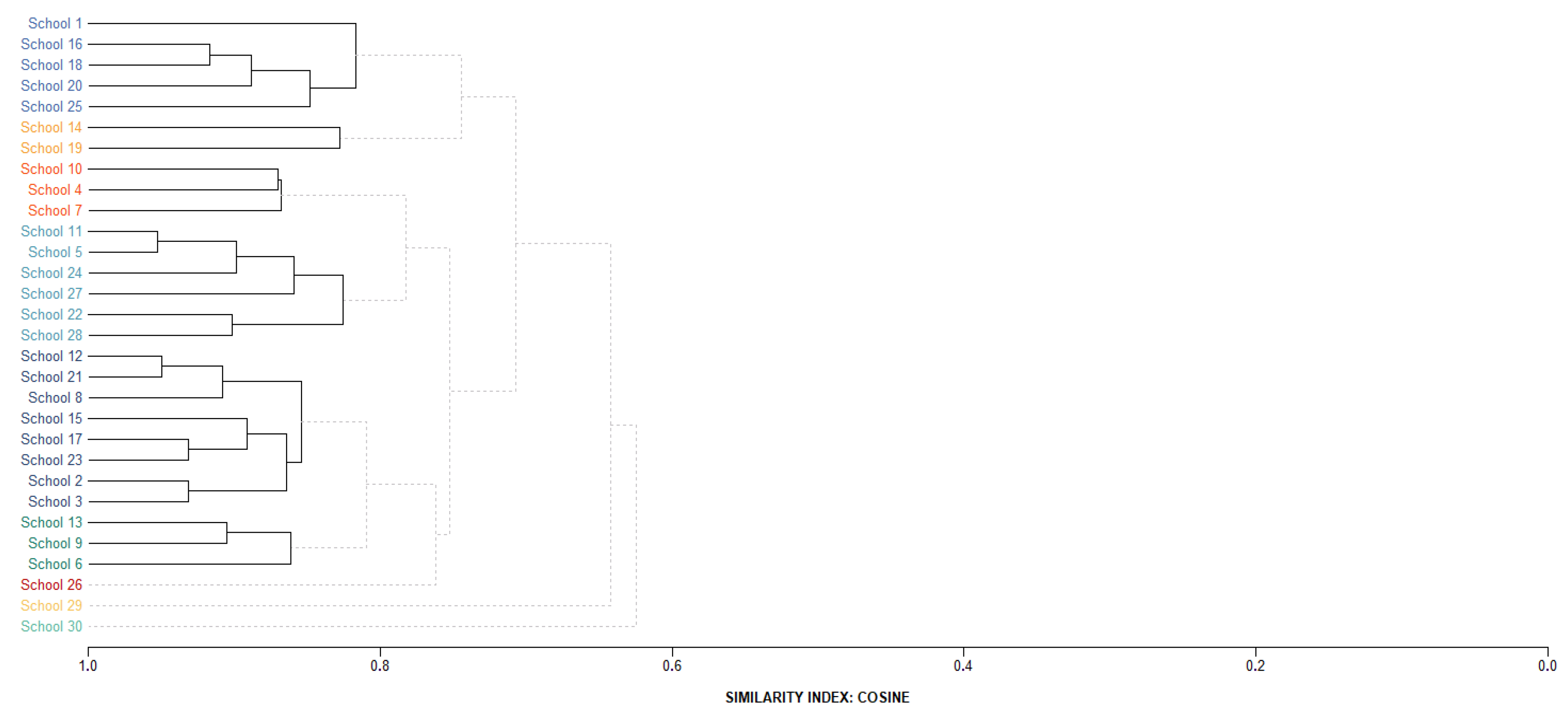
| Threshold | Number of Clusters | Issue |
|---|---|---|
| 0.7 | 2 | Excessive generalisation (21 of the 30 schools merge into a single cluster) |
| 0.8 | 6 | Optimal balance between differentiation and interpretability |
| 0.9 | 12 | Excessive fragmentation (1–2 schools per cluster) |
| Nationally Representative Sample (359 Schools, 349 Leaders) | Integration | Analytical Sample (30 Principals) |
|---|---|---|
| Stratified by school type, region, size, position, experience, and qualification | → | Reflects structural and contextual diversity—urban/rural, small/large schools, different achievement profiles |
| Initial analysis examines the aggregated trends from the SELFIE scale | → | Subsequent analysis explores the underlying arguments and managerial strategies in depth at interview level |
| Ensures national representativeness of self-assessments regarding strategic management | → | Enables the identification of digital leadership profiles and the mechanisms behind leaders’ self-assessments |
| The 30 principals represent a structured subset of the national sample | → | Student performance data (NEA/SME) are used to characterise the institutional context of the identified profiles |
| No Cluster | Cluster 1 | Cluster 2 | Cluster 3 | Cluster 4 | Cluster 5 | Cluster 6 | ||
|---|---|---|---|---|---|---|---|---|
| Number of Cases | 3 | 5 | 2 | 3 | 6 | 8 | 3 | |
| Location | Regional city | 2 | 4 | 1 | 2 | 1 | 2 | 1 |
| Town | 2 | 1 | 1 | |||||
| Village | 1 | 1 | 1 | 1 | 3 | 5 | 1 | |
| School size | Large | 4 | 1 | 2 | 3 | 1 | ||
| Medium | 1 | 1 | 2 | 2 | 2 | 1 | ||
| Small | 2 | 1 | 1 | 2 | 3 | 1 | ||
| School type | Primary school | 3 | 2 | 1 | 2 | 6 | ||
| Lower secondary school | 3 | 1 | 2 | |||||
| Specialised/Profiled secondary school | 1 | 1 | 1 | 1 | ||||
| Combined school | 1 | |||||||
| Primary (Grades 1–4) | 1 | 1 | 1 |
| First Quartile | Second Quartile | Third Quartile | Fourth Quartile | Mean Compactness | Mean Fluctuation | |
|---|---|---|---|---|---|---|
| Cluster 1 | 0 | 9 | 23 | 22 | 0.905 | 0.273 |
| Cluster 4 | 28 | 11 | 12 | 12 | 1.429 | 0.416 |
| Cluster 5 | 36 | 22 | 17 | 6 | 1.095 | 0.545 |
Disclaimer/Publisher’s Note: The statements, opinions and data contained in all publications are solely those of the individual author(s) and contributor(s) and not of MDPI and/or the editor(s). MDPI and/or the editor(s) disclaim responsibility for any injury to people or property resulting from any ideas, methods, instructions or products referred to in the content. |
© 2026 by the authors. Licensee MDPI, Basel, Switzerland. This article is an open access article distributed under the terms and conditions of the Creative Commons Attribution (CC BY) license.
Share and Cite
Mizova, B.; Parvanova, Y.; Peytcheva-Forsyth, R. Leading the Digital Transformation of Education: The Perspective of School Principals. Adm. Sci. 2026, 16, 57. https://doi.org/10.3390/admsci16010057
Mizova B, Parvanova Y, Peytcheva-Forsyth R. Leading the Digital Transformation of Education: The Perspective of School Principals. Administrative Sciences. 2026; 16(1):57. https://doi.org/10.3390/admsci16010057
Chicago/Turabian StyleMizova, Bistra, Yonka Parvanova, and Roumiana Peytcheva-Forsyth. 2026. "Leading the Digital Transformation of Education: The Perspective of School Principals" Administrative Sciences 16, no. 1: 57. https://doi.org/10.3390/admsci16010057
APA StyleMizova, B., Parvanova, Y., & Peytcheva-Forsyth, R. (2026). Leading the Digital Transformation of Education: The Perspective of School Principals. Administrative Sciences, 16(1), 57. https://doi.org/10.3390/admsci16010057