1. Introduction
Corporate Social Responsibility (CSR) has evolved from a primarily environmental and humanistic activity into a strategic governance framework. Through this framework, organisations respond to environmental challenges, stakeholder expectations, and long-term sustainability goals (
Al-Asfour, 2025). CSR is no longer limited to external reporting or symbolic initiatives. Instead, it has become embedded in organisational decision-making, operational practices, and digital transformation strategies (
Z. Sun et al., 2024).
Higher education institutions (HEIs) occupy a distinctive position within CSR. As knowledge-rich and socially influential organisations, they play a central role in shaping sustainable development agendas (
Herman, 2025). HEIs are not only academic and research centres. They are also large-scale organisational actors whose digital infrastructures and technological choices generate substantial environmental and social impacts. Consequently, HEIs are increasingly expected to demonstrate credible, internally rooted CSR strategies that align sustainability commitments with governance and operational practices (
Gidage & Bhide, 2024).
Within this context, Green Artificial Intelligence (GAI) has emerged as a promising internal CSR strategy. GAI refers to AI systems designed to minimise computational requirements, reduce carbon emissions, and enhance energy efficiency while maintaining functional and educational performance (
Alasmari & Alzahrani, 2025). Importantly, GAI enables organisations to operationalise environmental CSR. It embeds sustainability principles directly into digital systems, decision-making processes, and institutional infrastructures (
Rahman et al., 2025).
Despite growing global commitments to sustainability and responsible digital transformation, HEIs continue to face challenges in translating these goals into governance practices. GAI has been widely discussed as a technical solution for reducing energy consumption and environmental impact. However, limited empirical attention has been paid to how university leaders evaluate and commit to GAI as a governance model. This gap is critical, as leaders shape strategic priorities and define CSR agendas. Their decisions ultimately determine whether sustainability initiatives remain symbolic or achieve substantive organisational impact.
Universities currently employ a wide range of GAI tools to support sustainability-oriented decision-making and reduce energy consumption. These include AI-based Smart Energy Management Systems (SEMS) for optimising lighting, HVAC operations, and campus energy forecasting (
Ali et al., 2024). They also include Energy-Efficient Machine Learning models (EEML) that use compression and low-power inference to reduce computational load (
Yu, 2024).
Other applications involve AI-enabled Virtual and Remote Laboratories (VR-Labs), which lower material use and energy-intensive physical experimentation (
Sethi & Singh, 2024), as well as AI-driven sustainability dashboards that visualise emissions, energy use, and resource flows (
Chigbu & Makapela, 2025). Additional tools include lightweight generative AI for teaching and administration (
Guo et al., 2025), and AI-based campus transport and mobility optimisation systems. Collectively, these technologies promote sustainable campus operations, efficient resource management, and improved environmental stewardship (
Cirianni et al., 2023).
The global sustainability agenda was formalised in 2015 with the launch of the Sustainable Development Goals (SDGs). These goals call for coordinated international action to support prosperity while protecting the planet by 2030 (
Costantini, 2019). In response, Digital Sustainability (DS) has emerged as a strategic pathway that promotes the responsible use of digital technologies. DS seeks to balance environmental protection with improved learning quality, administrative efficiency, resource optimisation, and innovation (
Arora & Mishra, 2019;
Palmer, 2015).
DS aligns closely with several SDGs, including clean energy (SDG 7), quality education (SDG 4), sustainable infrastructure (SDG 9), and climate action (SDG 13) (
Belényesi & Sasvári, 2025;
Hanemann, 2019). However, translating these global commitments into effective, institution-level CSR practices remains challenging.
Although national transformation strategies—particularly in emerging economies such as Saudi Arabia—emphasise sustainability and digital innovation, a persistent gap remains between CSR intentions and implementation. Empirical evidence on the adoption of GAI within institutional CSR strategies is limited. More importantly, little is known about how higher education leaders perceive, evaluate, and commit to AI-based Green CSR governance as a means of fulfilling environmental and social responsibility objectives.
Recent research increasingly suggests that sustainability-oriented digital technologies should be understood as governance-level CSR decisions rather than routine technology adoption processes (
Akhtar et al., 2025;
Al-Qahtani et al., 2024;
Fan et al., 2025;
Nations, 2022). Leadership commitment, institutional infrastructure, and stakeholder expectations play decisive roles in determining whether CSR initiatives move beyond symbolic compliance toward substantive impact. In this respect, GAI provides a valuable empirical context for examining how perceptions of leadership, organisational readiness, and stakeholder influence shape CSR strategies.
To examine these dynamics, this study adopts the Unified Theory of Acceptance and Use of Technology (UTAUT) as an explanatory framework. Rather than conceptualising adoption as an end-user or operational decision, UTAUT is applied to CSR-driven governance decision-making. Although UTAUT was initially developed to explain individual technology acceptance, prior research demonstrates that its core constructs can meaningfully account for governance-level and strategic adoption decisions when interpreted through a CSR lens (
Li & Liu, 2024;
Majeed & Rasheed, 2025b).
Within this framework, performance expectancy reflects leaders’ assessments of CSR value creation and sustainability performance, rather than individual productivity gains. Social influence captures normative pressures exerted by internal and external stakeholders, consistent with stakeholder theory. Facilitating conditions represent governance capacity, policy readiness, institutional accountability, and organisational infrastructure required for credible CSR implementation.
Effort expectancy is examined from a leadership perspective, in which perceived implementation complexity may influence decision-making, whereas operational tasks are typically delegated to specialised units. Integrating UTAUT within a CSR governance framework thus enables this study to explain how sustainability priorities reshape adoption drivers at the leadership level.
Accordingly, this study reframes Green Artificial Intelligence (GAI) adoption in universities as an internal Corporate Social Responsibility (CSR) governance decision, rather than a purely technical or operational choice (
Camilleri, 2024;
Jamali & Mirshak, 2007). While prior research has predominantly focused on digital efficiency, computational performance, and environmental costs, empirical evidence remains limited regarding how organisational leaders prioritise, evaluate, and commit to GAI within broader CSR and digital sustainability frameworks (
Crossley et al., 2021).
This study addresses this gap by integrating CSR governance logic with an expanded Unified Theory of Acceptance and Use of Technology (UTAUT) framework, focusing on higher education leaders and examining the moderating roles of gender and cultural context. By empirically positioning GAI adoption within a CSR governance framework, this study contributes to the literature on strategic CSR implementation and environmentally responsible digital transformation. Likewise, it further provides evidence-based insights for leaders and policymakers seeking to design credible, inclusive, and institutionally embedded sustainability strategies. Theoretically, the study is grounded in the well-established distinction between symbolic CSR and strategic CSR (
Jamali, 2008).
The findings demonstrate that sustainability-oriented digital transformation through GAI operates as a form of strategic CSR, requiring governance readiness, leadership commitment, and stakeholder alignment, rather than symbolic intent or declarative sustainability commitments (
Freeman et al., 2010).
Although UTAUT provides the structural template for modelling adoption intentions, the present study is theoretically anchored in CSR governance theory. Specifically, legitimacy-seeking, stakeholder salience, and CSR capability/readiness are theorised as the core causal factors that reorder traditional UTAUT drivers at the leadership level (
Crossley et al., 2021).
Under this governance-oriented perspective, facilitating conditions and social influence become more decisive than usability-oriented considerations, reflecting the strategic and accountability-driven nature of leadership decision-making. Accordingly, UTAUT constructs are treated as operational specifications of CSR governance, rather than as stand-alone behavioural predictors.
This study advances Corporate Social Responsibility (CSR) theory by proposing that sustainability-oriented digital technologies are adopted not through user-centric acceptance logic, but through governance-level CSR. Specifically, GAI adoption is conceptualised as a legitimacy-seeking, stakeholder-responsive, and capability-dependent governance decision, rather than a usability-driven technology choice.
While UTAUT provides an empirical structure for modelling adoption intentions, the causal logic of this study is firmly grounded in CSR governance theory. Accordingly, legitimacy preservation, stakeholder salience, and organisational CSR readiness are theorised as the primary drivers that reshape traditional adoption determinants at the leadership level. This governance-based reframing constitutes the study’s central theoretical contribution (
Camilleri, 2024).
2. Literature Review and Hypothesis
2.1. GAI as Internal CSR Governance for Digital Sustainability
Recent years have witnessed growing global attention to the environmental sustainability of artificial intelligence, commonly referred to as Green Artificial Intelligence (GAI). GAI encompasses AI-driven solutions designed to minimise energy consumption, reduce carbon emissions, and optimise computational efficiency while maintaining functional and organisational performance (
Regona et al., 2024). Within higher education institutions (HEIs), these technologies increasingly extend beyond technical optimisation. They now reflect broader institutional responsibility and governance priorities (
Gidage & Bhide, 2024).
In practice, GAI in universities spans multiple application domains. These include AI-based Smart Energy Management Systems (SEMS) used to optimise campus lighting, heating, ventilation, and air-conditioning. They also include Energy-Efficient Machine Learning models (EEML), which reduce computational load through model compression and low-power inference (
Ali et al., 2024). Other applications involve Virtual and Remote Laboratories (VR-Labs) that reduce material waste and the energy-intensive use of physical experimentation.
Universities also deploy AI-driven sustainability dashboards that visualise real-time environmental indicators such as energy use, emissions, and water consumption (
Yu, 2024). Additional tools include lightweight generative AI systems for teaching and administration, as well as AI-based campus transport and mobility optimisation systems that improve efficiency and lower emissions (
Sethi & Singh, 2024). Collectively, these systems enhance operational sustainability and support greener campus management (
Regona et al., 2024).
Prior research consistently shows that AI, when deployed responsibly, can enhance environmental sustainability. It can improve resource efficiency, reduce waste, and optimise energy-intensive processes (
Regona et al., 2024;
Salem, 2025a;
Singh & Kaunert, 2024). However, literature also highlights important risks. Large-scale or poorly governed AI deployment can generate significant ecological costs, particularly when high-performance models require intensive computation and energy use (
Bolón-Canedo et al., 2024;
Regona et al., 2024). This duality underscores a critical distinction. CSR governance through AI alone does not guarantee sustainability outcomes. Instead, sustainability depends on how AI systems are selected, governed, and embedded within organisational strategies.
This distinction is especially salient for universities. As knowledge-intensive and socially accountable institutions, HEIs are increasingly expected to align digital transformation initiatives with environmental stewardship and stakeholder expectations. In this context, GAI functions not merely as a technical innovation. Rather, it operates as an internal CSR governance mechanism that reflects leadership priorities, institutional accountability, and long-term sustainability commitments. Decisions to invest in energy-efficient AI infrastructure or low-carbon digital systems are therefore best understood as strategic CSR choices rather than routine technology upgrades.
Despite this relevance, most existing studies focus on categorising GAI technologies or assessing their technical performance. Far less attention has been paid to how higher education leaders perceive and evaluate GAI as a strategic instrument for advancing Digital Sustainability. In the Saudi higher education context, recent research indicates increasing institutional interest in sustainable AI infrastructure. However, empirical evidence on leadership-level adoption intentions and governance-driven decision-making remains limited. Few studies examine how leaders assess GAI not only in terms of efficiency or usability, but also as a means of fulfilling CSR and sustainability obligations.
To address this gap, the present study positions Green CSR governance through AI within a CSR and Digital Sustainability governance framework. It empirically examines how higher education leaders form intentions to adopt GAI technologies as part of their institutional responsibility strategies. This focus provides a necessary foundation for understanding GAI adoption as a leadership-driven and value-laden decision embedded within broader CSR and sustainability agendas.
2.2. Governance Logic and Corporate Social Responsibility Theory
Corporate Social Responsibility (CSR) theory conceptualises sustainability initiatives as governance-level choices through which organisations secure legitimacy, manage stakeholder expectations, and translate responsibility commitments into substantive practice rather than symbolic signalling (
Jamali & Mirshak, 2007). Additionally, a legitimacy perspective organisations adopt visible, sustainability-oriented practices to align with prevailing social norms and maintain continued approval from key audiences, including regulators, communities, and evaluators (
Hestad et al., 2021).
In parallel, stakeholder theory posits that adoption priorities reflect stakeholder salience: when stakeholders possess power, legitimacy, and urgency, leaders are more likely to endorse initiatives that protect reputational standing and institutional trust (
Freeman et al., 2010).
Critically, CSR implementation research distinguishes between symbolic CSR, which involves declarative commitments without operational capacity, and strategic CSR, which entails credible sustainability actions supported by internal resources, accountability, and measurable performance outcomes (
Idowu & Louche, 2011). Consequently, in governance-level decisions, leaders prioritise (i) legitimacy protection, (ii) stakeholder validation, and (iii) CSR capability and readiness as essential preconditions for credible implementation.
In addition, positioning Green Artificial Intelligence (GAI) as an internal CSR governance mechanism implies that leaders will evaluate adoption drivers differently from operational end-users (
Bolón-Canedo et al., 2024).
Specifically, leaders’ intentions are expected to be shaped most strongly by: a) CSR value creation, reflected in GAI’s ability to improve sustainability outcomes and strengthen institutional legitimacy (
Crossley et al., 2021); (b) stakeholder-driven legitimacy pressures, arising from expectations and endorsements by salient internal and external actors; and (c) governance capacity, referring to whether the organisation possesses the infrastructure, policies, expertise, and accountability structures required to implement GAI substantively (
Birkstedt et al., 2023).
In contrast, usability-oriented considerations are expected to play a lesser role, as governance-level adoption decisions are not grounded in routine hands-on interaction but in strategic feasibility, accountability, and legitimacy concerns (
S. Wang et al., 2024). Accordingly, the Unified Theory of Acceptance and Use of Technology (UTAUT) constructs are employed in this study as an operational specification of CSR governance: performance expectancy captures CSR value creation; social influence reflects stakeholder legitimacy pressures (
Toader et al., 2024); facilitating conditions represent CSR capability and readiness (
Hrnjica et al., 2024); and effort expectancy denotes perceived governance complexity and coordination burden rather than individual ease of use (
Lin & Lee, 2025).
To ensure conceptual clarity, this study defines its core constructs from the perspectives of leadership-driven CSR and digital sustainability. Higher education leaders are evaluated based on the extent to which GAI contributes to environmental sustainability goals, reputational standing, regulatory compliance, and operational efficiency (
Bhambri et al., 2025). Each construct is interpreted as reflecting governance-level decision-making rather than operational system use (
AlSagri & Sohail, 2024). Accordingly,
Table 1 presents the conceptual definitions and links them explicitly to Green CSR governance objectives.
Therefore, based on CSR governance theory, this study conceptualises GAI adoption as a legitimacy- and capability-dependent commitment rather than an end-user acceptance choice. Likewise, UTAUT is used as an empirical tool to test how the CSR framework—stakeholder salience, legitimacy-seeking, and organisational readiness—shapes the adoption drivers, with high effects on facilitating conditions and social influence than on effort expectancy at the leadership level.
2.3. Higher Education Leaders’ Intentions as Drivers of Green CSR Governance Through AI
Although the Unified Theory of Acceptance and Use of Technology (UTAUT) provides empirical structure for modelling adoption intentions, the present study is theoretically anchored in Corporate Social Responsibility (CSR) governance theory (
Idowu & Louche, 2011). Specifically, this research conceptualises Green Artificial Intelligence (GAI) adoption as a governance-level CSR decision driven by legitimacy preservation, stakeholder salience, and organisational CSR capability, rather than by individual-level technology acceptance logic (
Freeman et al., 2010).
From a CSR governance perspective, leadership decisions regarding sustainability-oriented digital technologies are not neutral evaluations of usefulness or ease of use. Instead, they represent strategic judgements about institutional legitimacy, reputational accountability, and the organisation’s capacity to translate responsibility commitments into substantive practice (
Crossley et al., 2021). Accordingly, UTAUT constructs are reinterpreted as operational manifestations of CSR: performance expectancy reflects anticipated CSR value creation and legitimacy gains; social influence captures stakeholder-driven normative pressures; facilitating conditions represent CSR capability and governance readiness; and effort expectancy denotes perceived coordination and oversight burden rather than system usability (
Z. Sun et al., 2024).
In addition, this reframing explains why adoption drivers manifest differently in CSR-driven governance contexts compared with end-user technology adoption. In particular, legitimacy and capability considerations elevate the relative importance of facilitating conditions and social influence, while diminishing the role of effort expectancy (
Freeman et al., 2010). By theorising UTAUT constructs as governance-level expressions of CSR decision-making, the study advances CSR literature beyond symbolic responsibility narratives and demonstrates how responsibility is operationalised through internal digital infrastructure and leadership-level strategic choice (
Al-Asfour, 2025;
Jamali & Mirshak, 2007). This governance-centred integration constitutes the study’s core theoretical contribution.
Furthermore, leaders’ intentions to adopt GAI are theorised as a CSR governance decision rather than an end-user acceptance choice. Likewise, CSR research demonstrates that organisations adopt sustainability practices not only for efficiency gains, but also to secure legitimacy, maintain stakeholder support, and enact strategic CSR through substantive internal practices rather than symbolic commitments (
Bolón-Canedo et al., 2024;
Chigbu & Makapela, 2025;
Van Staveren & Müller-Zimmermann, 2025).
Accordingly, leaders evaluate Green AI through: (1) legitimacy-seeking (alignment with societal norms and expectations); (2) stakeholder salience (pressure from powerful/legitimate/urgent stakeholders); and (3) CSR capability building (governance readiness and accountability structures that enable credible implementation). Thus, these predictors explain why the relative influence of adoption drivers can differ in CSR-driven contexts.
H1. Performance Expectancy (PE) positively influences higher education leaders’ behavioural intention (BI) to adopt GAI tools.
Additionally, from a CSR perspective, “performance” is not limited to operational gains; it reflects institutional value creation tied to sustainability outcomes and reputational/legitimacy benefits (
Katou & Kafetzopoulos, 2025). Consequently, strategic CSR theory argues that organisations adopt sustainability initiatives when leaders perceive them as generating shared value—improving societal/environmental outcomes while strengthening organisational viability (
Aftab et al., 2026).
Therefore, leaders are more likely to support Green AI when they expect it to deliver measurable sustainability performance (e.g., energy efficiency, emissions reduction) and enhance CSR credibility (e.g., legitimacy, reputation, stakeholder trust) (
Chakraborty et al., 2025;
Chigbu & Makapela, 2025). Hence, this CSR value-creation provides a theory-driven basis for why PE should predict BI in governance settings.
Similarly, within CSR governance, leaders typically do not evaluate effort in terms of personal usability. Rather than EE, it reflects the governance burden of coordinating policy, accountability, and cross-unit implementation. In addition, CSR implementation research highlights that even when sustainability initiatives are normatively valued, they can remain symbolic if organisations anticipate high coordination and monitoring costs (
Mehmood et al., 2025;
Risi et al., 2023).
Therefore, lower perceived governance complexity, achieved through integration without significant disruption and with manageable oversight, should increase leaders’ willingness to endorse Green AI (
Hutson, 2025). However, consistent with CSR capability logic, leaders may prioritise legitimacy and readiness over effort, suggesting EE can be weaker in governance-level contexts than in end-user settings.
Based on a CSR governance perspective, leaders primarily evaluate GAI on implementability, accountability, and protection of legitimacy, rather than on personal ease of use (
Jamali & Mirshak, 2007). Accordingly, CSR capability and stakeholder-backed legitimacy pressures are expected to dominate intention formation (FC and SI), whereas effort expectancy is theorised to be attenuated because operational complexity is typically delegated and does not constitute the core basis for governance endorsement (
Hestad et al., 2021).
In addition, the higher education leaders typically do not engage directly in the day-to-day use of digital systems (
Gidage & Bhide, 2024). Their effort expectancy (EE) assessments are therefore strategic. Leaders focus on governance and organisational impact rather than personal ease of use. They may also assume that specialised support units can manage technical challenges (
Yu, 2024).
H2. Effort Expectancy (EE) positively influences higher education leaders’ BI to adopt GAI tools.
Furthermore, CSR theory emphasises that sustainability decisions are strongly shaped by stakeholder expectations, particularly when stakeholders possess power, legitimacy, and urgency (
Idowu & Louche, 2011). In higher education, key stakeholders—including government bodies, accreditation agencies, ranking systems, sustainability evaluators, and internal governance actors—can intensify normative pressure for credible environmental responsibility (
Lambin & Thorlakson, 2018;
Testa et al., 2018).
Similarly, legitimacy theory suggests that leaders adopt visible, sustainability-oriented practices to align with dominant norms and secure ongoing social approval (
Boeske, 2023). Consequently, SI should enhance leaders’ intentions to adopt Green AI because it demonstrates stakeholder-backed legitimacy and diminishes reputational risks linked to neglecting sustainability.
Although SI is a central determinant in UTAUT research, its role may differ for leaders evaluating sustainability-oriented technologies. Normative pressures from peers, accreditation bodies, and sustainability communities are particularly salient in resource-constrained contexts, shaping leaders’ endorsement of GAI initiatives (
Khalid, 2024;
Regona et al., 2024;
Singh & Kaunert, 2024).
H3. Social Influence (SI) positively influences higher education leaders’ BI to adopt GAI tools.
Furthermore, the adoption of CSR governance intentions depends highly on whether the organisation can genuinely implement sustainability commitments rather than more symbolically endorse them (
Camilleri, 2024). Similarly, CSR research distinguishes between symbolic declarations and credible practice, emphasising that substantive CSR requires organisational capacities—resources, governance frameworks, accountability, and operational readiness (
Aftab et al., 2026).
Accordingly, FC functions as a CSR capability mechanism: when leaders perceive sufficient infrastructure, expertise, policy structures, and resources, they regard Green AI as feasible to implement credibly and withstand scrutiny and audits (
Al-Asfour, 2025). This explains why FC can be particularly influential in CSR-driven technology adoption decisions, in which implementation credibility is central to legitimacy. Within CSR governance, FC therefore acts as a legitimacy-seeking mechanism that reinforces adoption intentions when GAI is institutionally supported and socially expected (
Ogbeibu et al., 2024).
H4. Facilitating Conditions (FC) positively influence higher education leaders’ BI to adopt GAI tools.
Accordingly, relative importance differs under CSR governance because Green AI adoption is evaluated as a legitimate and accountability-sensitive CSR commitment. Likewise, leadership intentions should be driven more by: (i) perceived CSR capability (FC) and (ii) stakeholder validation (SI) than by individual usability considerations (EE). Additionally, theorisation anticipates a governance-level pattern in which readiness and legitimacy predominate.
Gender has been widely examined as a moderating variable in technology adoption research (
Belényesi & Sasvári, 2025;
Bhambri et al., 2025). Its role is particularly relevant when adoption decisions involve CSR governance rather than the use of operational technology. Prior studies suggest that male and female leaders may differ in how they assess risk, responsibility, ethical implications, and long-term organisational impact (
Bhambri et al., 2025;
Bolón-Canedo et al., 2024).
H5. Gender moderates the relationship between PE and BI in the adoption of GAI tools.
H6. Gender moderates the relationship between EE and BI in the adoption of GAI tools.
GAI adoption is closely linked to environmental responsibility and institutional legitimacy. Sustainability-oriented communities may exert stronger social influence on female leaders than on male leaders (
Yaman & Aras, 2025).
H7. Gender moderates the relationship between SI and BI in the adoption of GAI tools.
Facilitating conditions reflect governance readiness and infrastructural capacity. Examining gender as a moderator provides insight into how institutional support translates into adoption intentions across leadership profiles (
H. Sun & Zhang, 2006).
H8. Gender moderates the relationship between FC and BI in the adoption of GAI tools.
H9. Cultural context moderates the relationship between PE and BI in the adoption of GAI tools.
Cultural norms further shape tolerance for complexity and technological change (
Regona et al., 2024). These norms influence how leaders evaluate effort-related considerations when assessing GAI as a CSR initiative.
H10. Cultural context moderates the relationship between EE and BI in the adoption of GAI tools.
H11. Cultural context moderates the relationship between SI and BI in the adoption of GAI tools.
H12. Cultural context moderates the relationship between FC and BI in the adoption of GAI tools.
To address these gaps, this study conceptualises GAI adoption as a CSR-driven governance decision. By empirically examining leadership intentions using an expanded UTAUT framework within a multicultural institutional context and incorporating gender and cultural moderators, the study advances understanding of how sustainability-oriented AI moves beyond technical deployment toward strategic, governance-based CSR implementation.
3. Materials and Methods
3.1. Sample and Research Population
This study was conducted in higher education institutions (HEIs) in Saudi Arabia. It targeted higher education leaders whose roles involve institutional governance and strategic decision-making. These roles included deans and vice-deans, department heads, digital-transformation and IT leaders, and sustainability and strategic-planning officers.
A highly multicultural workforce characterises Saudi HEIs. Leadership and faculty communities commonly include both Saudi nationals and expatriate academics from diverse national backgrounds. This context provides an analytically meaningful setting for examining the moderating role of cultural context. In this study, cultural context is operationalised as national or cultural background. This approach enables examination of Green CSR governance through AI within a shared institutional environment.
A total of 421 valid responses were obtained. Respondents represented ten national and cultural groups working within Saudi HEIs, including Saudi Arabia, Egypt, Jordan, Sudan, Tunisia, India, Pakistan, Bangladesh, Singapore, and the Philippines. These groups were treated as a pragmatic proxy for cultural context. At the same time, it is acknowledged that culture is multi-dimensional and cannot be fully captured by nationality alone (see
Table 2).
Beyond heuristic guidelines such as the “10× rule,” sample adequacy was assessed using recommended minimum sample size approaches for PLS-SEM. Kock and Hadaya propose the inverse square root and gamma-exponential methods as more robust techniques for sample size estimation (
Leguina, 2015). Based on the observed path coefficients and the complexity of the model, the final sample size (N = 421) provides strong statistical power for estimating both structural relationships and interaction effects (
Hair et al., 2021).
3.2. Questionnaire and Collecting Data
Data were collected using a structured questionnaire comprising three sections. The first section presented an informed consent statement. This statement explained the purpose of the study and emphasised the voluntary and anonymous nature of participation. The second section collected respondents’ demographic characteristics, including gender and national or cultural background. The third section included validated multi-item measures assessing the study constructs. All items were rated using a five-point Likert scale, ranging from 1 (Strongly Disagree) to 5 (Strongly Agree). Higher scores indicated stronger endorsement of each construct.
Moreover, the survey was created using validated measurement items from previous studies. Additionally, Performance Expectancy (PE) was assessed using five items (PE1–PE5), refined from (
Chen et al., 2020). As well, Effort Expectancy (EE) was measured using five subscales (EE1–EE5) as described in (
Elshaer et al., 2025a,
2025b). Likewise, Social Influence (SI) was assessed using five items (SI1–SI5) adopted from. Furthermore, Facilitating Conditions (FC) were measured using four adjusted questions (FC1–FC4) adapted from studies by (
Elshaer et al., 2025b). Additionally, Behavioural Intentions (BI) were calculated using four modified questions (BI1–BI4), adapted from studies (
Alshebami et al., 2023;
Roe et al., 2025;
Zhang & Jiang, 2025).
To ensure content validity, the survey was reviewed by 28 bilingual experts in computer science, information technology, and higher education. These experts evaluated the clarity, relevance, and contextual appropriateness of the items for the Saudi higher education environment. Based on expert and pilot feedback, minor revisions were made to improve contextual clarity. Specific items, including FC1, FC5, SI2, and BI4, were refined. (All the study measures are shown in
Appendix A.)
Participation in the study was entirely voluntary, and respondents were assured that their responses would remain anonymous. The survey link was distributed via email to senior leaders across universities in the Kingdom of Saudi Arabia (KSA). While this approach enhanced response relevance and engagement, it may have introduced some degree of social desirability bias due to institutional framing.
This limitation is acknowledged and addressed in the Discussion section. Future research is encouraged to adopt mixed-method designs, indirect questioning techniques, or triangulation using behavioural and institutional data. Data collection was conducted over 12 months, from November 2024 to November 2025.
4. Results
The psychometric properties of the measurement model are presented in
Table 3. The results demonstrate strong indicator reliability, convergent validity, and internal consistency, providing a robust foundation for evaluating leaders’ intentions to adopt Green Artificial Intelligence (GAI).
All item loadings exceed the recommended threshold of 0.70, indicating satisfactory indicator reliability. The Average Variance Extracted (AVE) values range from 0.711 to 0.846, all above the minimum criterion of 0.50, thereby confirming convergent validity. In addition, Composite Reliability (CR) values range from 0.926 to 0.957, and Cronbach’s alpha values range from 0.884 to 0.937. These results exceed the recommended threshold of 0.70 and demonstrate excellent internal consistency across all constructs.
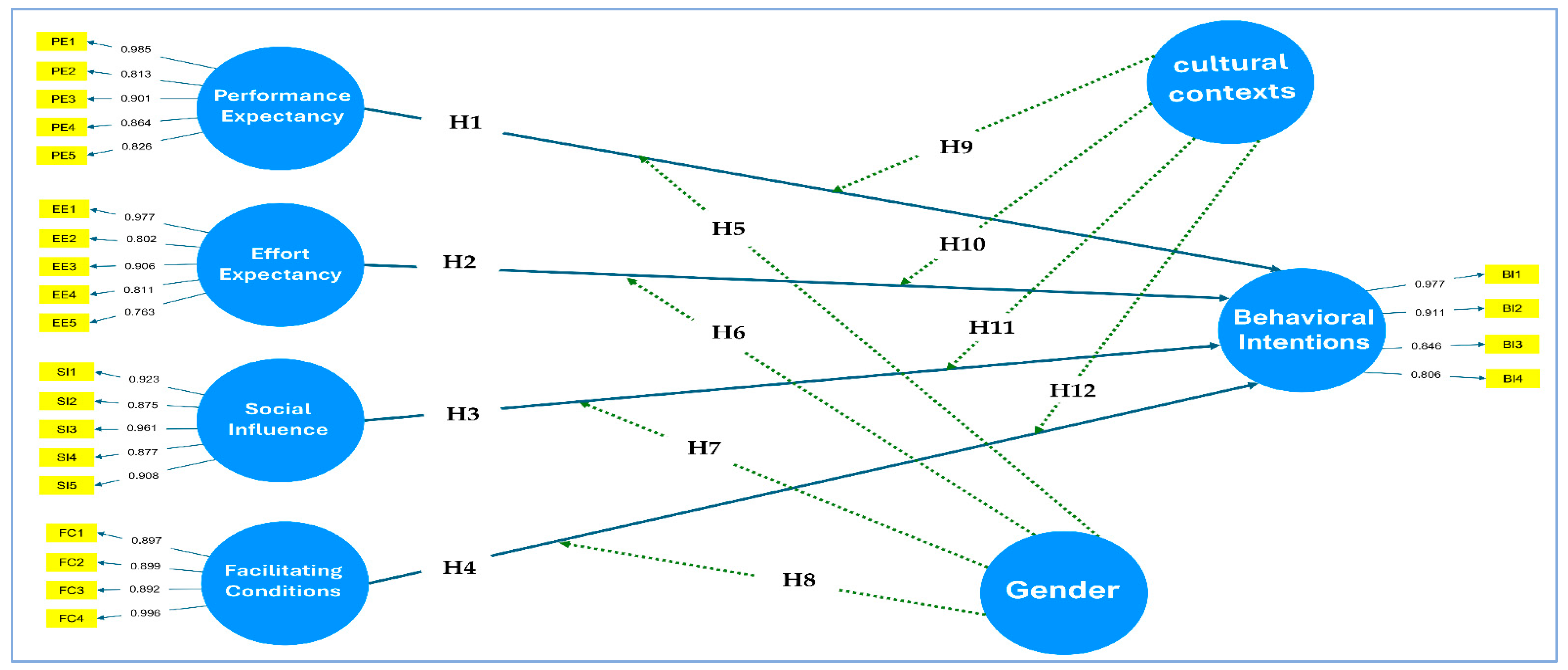
Performance Expectancy (PE) shows strong standardised loadings (0.813–0.985), with an AVE of 0.747 and a CR of 0.935. This confirms its relevance in capturing leaders’ perceptions of GAI’s value for achieving sustainable digital outcomes. Effort Expectancy (EE) exhibits consistent loadings (0.763–0.977), an AVE of 0.711, and a CR of 0.928, indicating reliable measurement of perceived implementation complexity at the governance level. Social Influence (SI) displays particularly high loadings (0.875–0.961), an AVE of 0.826, and a CR of 0.957, underscoring the importance of institutional and peer pressures in shaping adoption intentions.
Facilitating Conditions (FC) demonstrate uniformly high loadings (0.892–0.996), with an AVE of 0.846 and a CR of 0.951, reflecting strong perceived organisational readiness for sustainable AI integration. Behavioural Intention (BI) is also reliably measured, with loadings ranging from 0.806 to 0.977, an AVE of 0.759, and a CR of 0.926. This confirms the construct’s ability to capture leaders’ readiness to adopt GAI over time.
All constructs exceed recommended thresholds for measurement quality. The strong internal consistency and convergent validity confirm the robustness of the measurement model. These results provide a reliable basis for subsequent structural model analysis and hypothesis testing and offer initial insights into cross-sectional adoption patterns of GAI within the strategic framework of Digital Sustainability among higher education leaders (see
Figure 1).
The PLS-SEM framework and cross-loadings analysis used to assess discriminant validity are presented in
Table 4. In PLS-SEM, discriminant validity is established when each indicator loads more strongly on its assigned construct than on any other construct (
Leguina, 2015), ensuring that each latent variable captures a distinct conceptual domain.
Table 4 reports the cross-loading matrix for the measurement model. The results show that all indicators load highest on their respective constructs, thereby satisfying the established discriminant validity threshold. No indicator exhibits problematic cross-loadings indicative of conceptual overlap among constructs.
Performance Expectancy (PE) items (PE1–PE5) display their strongest loadings on the PE construct (e.g., PE1 = 0.985), with substantially lower loadings on other constructs (≤0.405). This pattern confirms the distinctiveness of performance-related beliefs regarding GAI among higher education leaders. Similarly, Effort Expectancy (EE) indicators (EE1–EE5) load most strongly on EE (e.g., EE1 = 0.977), clearly exceeding their loadings on other dimensions. This finding supports the empirical separation of perceived effort from other adoption drivers.
Social Influence (SI) items (SI1–SI5) also demonstrate strong loadings on their intended construct (e.g., SI3 = 0.961), with only modest cross-loadings on unrelated constructs (generally < 0.41). This indicates that normative, peer, and institutional pressures are uniquely represented within the model. Facilitating Conditions (FC) items (FC1–FC4) show very high loadings on FC (e.g., FC4 = 0.996), far exceeding their cross-loadings on other constructs (≤0.375). This confirms that institutional readiness and infrastructural support are perceived independently of performance and effort considerations. Behavioural Intention (BI) items (BI1–BI4) load most strongly on BI (e.g., BI2 = 0.977) and exhibit substantially weaker associations with all other constructs (≤0.386), confirming the unidimensionality of the intention construct.
Generally, the cross-loading results provide clear evidence of discriminant validity. Each indicator is strongly associated with its intended construct, and no substantial cross-loading threatens construct purity. These findings are consistent with the high AVE, CR, and Cronbach’s alpha values reported in
Table 3. They are further corroborated by additional discriminant validity assessments, including the Fornell–Larcker criterion and the Heterotrait–Monotrait (HTMT) ratio.
Taken together, these results confirm that the measurement model is both statistically sound and theoretically coherent. The established discriminant validity provides a solid foundation for subsequent structural model analysis and hypothesis testing within this cross-sectional study.
Table 5 presents the results of the Fornell–Larcker criterion, which assesses discriminant validity by comparing the square root of each construct’s Average Variance Extracted (AVE) with its correlations with other constructs. Discriminant validity is confirmed when the square root of the AVE exceeds all corresponding inter-construct correlations. The results indicate that this condition is satisfied for all constructs in the model.
For Performance Expectancy (PE), the square root of AVE (0.864) exceeds its correlations with Effort Expectancy (EE = 0.624), Social Influence (SI = 0.591), Facilitating Conditions (FC = 0.538), and Behavioural Intention (BI = 0.552). This indicates that PE represents a distinct latent construct. Similarly, EE demonstrates a square root of AVE of 0.843, which is higher than its correlations with all other constructs, supporting its empirical uniqueness.
Social Influence (SI) exhibits the highest diagonal value (0.909), clearly exceeding its correlations with other constructs (ranging from 0.591 to 0.601). This finding suggests that social and institutional pressures are uniquely captured within the model. Facilitating Conditions (FC) also show strong discriminant validity, with a square root of AVE of 0.920, well above its correlations with SI (0.584) and EE (0.566). Behavioural Intention (BI) exhibits a diagonal loading of 0.871, exceeding the correlations with PE (0.552), EE (0.545), SI (0.599), and FC (0.562), confirming that adoption intention is a standalone latent construct.
These results indicate that each construct explains more variance in its indicators than it shares with other constructs, thereby satisfying the Fornell–Larcker criterion. When considered alongside the strong factor loadings and cross-loading results, the findings further reinforce the construct validity of the measurement model. In this cross-sectional study, the results validate the distinct conceptual roles of PE, EE, SI, FC, and BI in shaping the adoption of GAI as a Digital Sustainability strategy among higher education leaders.
Table 6 presents the results of the Heterotrait–Monotrait Ratio (HTMT) analysis, which is a rigorous and widely accepted method for assessing discriminant validity in variance-based structural equation modelling (
Hair et al., 2021). Discriminant validity is established when HTMT values fall below the recommended thresholds of 0.85 (conservative) or 0.90 (liberal).
In this study, all HTMT values among the five core constructs—Performance Expectancy (PE), Effort Expectancy (EE), Social Influence (SI), Facilitating Conditions (FC), and Behavioural Intention (BI)—are well below the conservative threshold of 0.85. This provides strong empirical evidence of discriminant validity across the measurement model. The HTMT value between PE and EE is 0.71, indicating a clear conceptual distinction despite their theoretical relatedness. The highest HTMT value is 0.72, observed between EE and SI, which remains comfortably below the threshold. This suggests that, although these constructs are related in the context of AI-enabled green CSR governance, they are not empirically redundant.
The lowest HTMT value is 0.61, observed between PE and FC, reinforcing the conceptual separation between expected performance outcomes and enabling organisational conditions. In addition, all HTMT values involving BI range from 0.62 to 0.69. These results indicate that higher education leaders’ intentions to adopt GAI are statistically distinct from expectancy-related beliefs, social pressures, and facilitating conditions.
These findings are consistent with the Fornell–Larcker criterion, in which each construct’s AVE square root exceeds its inter-construct correlations. They are also aligned with the high factor loadings, low cross-loadings, and strong AVE, CR, and Cronbach’s alpha values reported earlier. Collectively, the HTMT analysis confirms that the measurement model demonstrates robust construct distinctiveness and theoretical clarity. This supports the validity of the proposed framework and ensures that each latent variable captures a unique, non-overlapping dimension of GAI adoption behaviour among higher education leaders driving Digital Sustainability.
As shown in
Table 7, the PLS-SEM structural model, bootstrapped with 5000 samples, was used to test the hypothesised direct and moderating effects. The results show that Performance Expectancy (PE) has a significant positive impact on Behavioural Intention (BI), supporting H1 (β = 0.295, t = 4.21,
p < 0.001). This finding indicates that higher education leaders are primarily motivated to adopt GAI by their belief in its performance and sustainability benefits.
In contrast, Effort Expectancy (EE) does not significantly influence BI (H2: β = 0.083, t = 1.23, p = 0.219). This suggests that perceived ease of use alone is insufficient to drive adoption at the leadership level. Social Influence (SI) has a significant positive effect on BI (H3: β = 0.256, t = 3.98, p < 0.001), highlighting the importance of peer, cultural, and organisational norms. Similarly, Facilitating Conditions (FC) significantly predict BI (H4: β = 0.311, t = 5.02, p < 0.001), emphasising the critical role of institutional readiness and digital infrastructure in enabling Digital Sustainability.
Gender-based moderation analysis (H5–H8) reveals significant interaction effects for PE × Gender (H5: β = 0.118, t = 2.61, p = 0.009), SI × Gender (H7: β = 0.162, t = 3.42, p = 0.001), and FC × Gender (H8: β = 0.199, t = 3.79, p < 0.001). These results suggest that male and female leaders differ in how they interpret performance benefits, social expectations, and institutional support when forming adoption intentions. However, EE × Gender is not significant (H6: β = 0.054, t = 1.01, p = 0.312), indicating that perceptions of usability are largely consistent across genders.
With respect to cultural context (H9–H12), significant moderating effects are observed for EE × Cultural Context (H10: β = 0.228, t = 3.05, p = 0.002) and FC × Cultural Context (H12: β = 0.214, t = 2.94, p = 0.004). This indicates that institutional and societal cultures shape how leaders evaluate usability and enabling conditions. In contrast, PE × Cultural Context (H9: β = 0.071, t = 1.38, p = 0.168) and SI × Cultural Context (H11: β = 0.067, t = 1.09, p = 0.273) are not significant, suggesting that performance benefits and social expectations surrounding GAI are perceived more universally.
The model explains a substantial proportion of variance in BI (R2 = 0.648), indicating that approximately 65% of leaders’ adoption intentions are explained by the proposed predictors and moderators. This exceeds the recommended threshold for behavioural research (R2 > 0.50), confirming the model’s strong explanatory power. Generally, the results highlight PE, SI, and FC as the key enablers of GAI adoption in higher education.
The significant moderating effects of gender and cultural context underscore the need for inclusive, context-sensitive digital transformation strategies and provide evidence-based guidance for leaders and policymakers advancing GAI-driven sustainability.
5. Discussion
The findings demonstrate that Green CSR governance through AI operates at the governance level rather than as an operational or technical choice. Facilitating Conditions (FC) emerged as the strongest predictor of adoption intention. This highlights the central role of organisational CSR infrastructure, leadership commitment, and institutional accountability in enabling responsible innovation.
In addition, the significant influence of Social Influence (SI) indicates that both internal and external stakeholder expectations shape CSR-oriented digital transformation. These stakeholders include peers, institutional leadership, accreditation bodies, and sustainability-focused communities.
Together, these results confirm that environmental digital strategies must be embedded within leadership-driven CSR governance frameworks. Without such embedding, sustainability initiatives risk remaining symbolic rather than achieving long-term institutional impact.
This study advances the literature on digital transformation in higher education by explicitly focusing on the adoption of Green AI at the leadership level. By applying an extended UTAUT framework, the study provides new insights into how Digital Sustainability initiatives are evaluated and endorsed by senior decision-makers in emerging economies.
Using variance-based structural equation modelling (PLS-SEM), the research empirically validates the roles of performance expectancy (PE), effort expectancy (EE), social influence (SI), and facilitating conditions (FC). These findings offer both conceptual clarification and empirical evidence for understanding GAI adoption as a strategic governance process.
The structural model confirms that PE, SI, and FC significantly predict leaders’ intentions to adopt GAI. Among these factors, FC shows the strongest effect (β = 0.311, t = 5.02,
p < 0.001). This underscores the importance of institutional readiness, digital infrastructure, and leadership support for enabling the adoption of sustainability-focused AI. The result aligns with prior studies emphasising organisational support and resource availability as prerequisites for successful technology integration in higher education (
Mondal et al., 2024).
Performance Expectancy (β = 0.295,
p < 0.001) and Social Influence (β = 0.256,
p < 0.001) also significantly influence adoption intention. These findings indicate that leaders are more likely to endorse GAI when they recognise clear performance and sustainability benefits and when peers and institutions socially validate adoption. This supports earlier research highlighting the importance of perceived utility and normative pressure in environmentally responsible technology adoption (
Salem & Khalil, 2025;
Z. Wang et al., 2025).
In contrast, EE does not significantly predict senior leaders’ intention to adopt. The governance-oriented nature of GAI adoption in higher education can explain this. Unlike students or operational users examined in many UTAUT studies (
Li & Liu, 2024;
Majeed & Rasheed, 2025a), senior leaders rarely engage in hands-on system use. Strategic considerations, such as institutional impact, regulatory alignment, CSR legitimacy, and long-term sustainability outcomes, instead shape their decisions.
Because operational tasks are delegated to specialised units, system usability is less central to leadership; EE becomes secondary to governance capacity, stakeholder expectations, and anticipated performance benefits. This finding reinforces the argument that technology acceptance models function differently in leadership-driven and CSR-oriented contexts.
While the present findings indicate that EE does not significantly influence higher education leaders’ intentions to adopt GAI, several prior studies report contrasting results in which EE emerged as a significant predictor of adoption intentions. For example, studies examining AI-supported learning systems and digital platforms among students and instructors consistently find EE to be a strong determinant of BI, as ease of use directly affects day-to-day engagement and learning efficiency (
Ahmed, 2024;
Park et al., 2022;
Z. Wang et al., 2025). In these contexts, users are operational actors who interact directly with AI systems, making perceived complexity and usability highly salient.
Similarly, research applying UTAUT to sustainability-oriented digital tools at the user or practitioner level—such as green banking applications or carbon-tracking systems—has reported significant EE effects, particularly where users bear direct responsibility for system operation and behavioural change (
Liu et al., 2025;
Majeed & Rasheed, 2025a). These findings suggest that when adoption decisions involve hands-on usage, effort-related considerations play a central role.
In contrast, the present study focuses explicitly on senior higher education leaders, whose adoption decisions are governance-driven rather than usage-driven. Unlike students, instructors, or frontline employees, leaders rarely engage directly with AI systems. Instead, they evaluate technologies based on strategic impact, institutional legitimacy, and alignment with CSR and sustainability objectives. Operational complexity and system usability are typically delegated to specialised IT or sustainability units, thereby diminishing the relevance of EE at the leadership level.
This divergence highlights an important boundary condition for UTAUT-based models: Effort Expectancy appears to lose explanatory power when adoption decisions shift from individual system use to strategic CSR governance. In this sense, the non-significant EE finding does not contradict prior research but rather complements it by demonstrating that adoption drivers are context- and role-dependent.
The comparison underscores that leadership-level adoption of sustainability-oriented AI should be theorised differently from end-user technology acceptance, reinforcing the study’s central argument that Green AI adoption in universities constitutes a governance-level CSR decision rather than a technical usability choice.
The moderation analysis provides further insights. Gender significantly moderates the relationships between PE, SI, and FC and BI (supporting H5, H7, and H8). This suggests that male and female leaders interpret performance benefits, social expectations, and institutional support differently when evaluating GAI initiatives. These differences highlight the importance of inclusive and gender-responsive adoption strategies that recognise diverse leadership perspectives. The results are consistent with prior studies demonstrating the influence of gender on technology-related decision-making in educational contexts (
Al-Zahrani & Alasmari, 2024;
Alshahrani et al., 2024).
Cultural context also plays a meaningful moderating role. It significantly influences the effects of EE and FC on adoption intention (supporting H10 and H12). This indicates that local norms, institutional cultures, and regional priorities shape how leaders assess usability and enabling conditions. However, cultural context does not moderate the effects of PE or SI (H9 and H11 are rejected). This suggests that perceived performance benefits and social expectations related to GAI are relatively universal across cultural backgrounds. These findings reinforce the need for context-sensitive implementation strategies while recognising the broadly shared value of sustainability-oriented AI (
Al-Zahrani & Alasmari, 2024;
Mondal et al., 2024).
From a theoretical perspective, this study integrates key insights from stakeholder theory, legitimacy theory, and governance-based CSR frameworks (
Camilleri, 2024;
Shkalenko & Nazarenko, 2024;
Yang et al., 2025). Social influence reflects stakeholder pressures from academic peers, institutional leadership, and sustainability communities. At the same time, legitimacy theory explains why leaders adopt GAI to align institutional practices with evolving societal expectations regarding environmental responsibility and digital sustainability (
Chakraborty et al., 2025;
Jong & Ganzaroli, 2024). The strong effect of facilitating conditions further demonstrates that responsible innovation depends on organisational capacity, policy readiness, and infrastructural support, not merely on individual intent.
The findings position GAI adoption as a governance-embedded, legitimacy-seeking, and stakeholder-responsive CSR practice. By integrating technical, educational, environmental, and contextual dimensions within a single analytical model, this study advances understanding of sustainable AI adoption in higher education. From a practical perspective, the results provide evidence-based guidance for leaders and policymakers seeking to design ethical, inclusive, and sustainability-oriented digital strategies. These insights support the development of resilient and future-ready approaches to Digital Sustainability in higher education.
From a theoretical standpoint, the findings extend CSR theory by explaining how responsibility is operationalised through digital transformation rather than expressed solely through symbolic commitments. The study proposes a governance-centred model of sustainable AI adoption that moves beyond technical implementation and isolated digital use cases. Consistent with CSR governance logic, the empirical dominance of facilitating conditions and social influence demonstrates that leaders evaluate GAI adoption as a legitimacy- and capability-dependent CSR commitment, rather than as a usability-driven technology choice.
6. Theoretical Contributions
This study advances Corporate Social Responsibility (CSR) theory by conceptualising Green Artificial Intelligence (GAI) adoption as an internal CSR governance policy rather than as an operational or symbolic sustainability initiative. Much of the prior CSR literature has focused on external manifestations of responsibility, such as sustainability reporting, reputational signalling, or stakeholder communication. In contrast, the present findings demonstrate that CSR is increasingly enacted through internal digital infrastructure and leadership-level decision-making.
By framing GAI as a governance-level choice embedded in institutional strategy, this study extends CSR theory toward a practice-based and infrastructure-oriented understanding of responsibility. The results provide empirical support for the distinction between strategic and symbolic CSR. Specifically, sustainability-oriented AI adoption in higher education is shown to be driven by substantive organisational conditions, rather than by compliance or symbolic alignment alone.
The dominance of facilitating conditions and social influence, together with the non-significance of effort expectancy, offers further theoretical insight. These patterns indicate that leaders prioritise institutional readiness, accountability, and stakeholder legitimacy over system usability. These finding challenges assumptions commonly derived from individual-level technology adoption studies.
The study also contributes to technology adoption theory by demonstrating that the Unified Theory of Acceptance and Use of Technology (UTAUT) behaves differently when applied within a CSR governance context. Rather than positioning UTAUT as the primary theoretical contribution, this research employs it as an explanatory lens. Through this lens, the study shows how sustainability imperatives reorder the drivers of adoption at the leadership level. Generally, the findings extend CSR theory by explaining how responsibility is operationalised through digital transformation. The study offers a governance-centred model of sustainable AI adoption that moves beyond technical implementation and isolated digital use cases.
7. Practical Contributions
The findings of this study offer clear and actionable guidance for universities seeking advanced Digital Sustainability through Green Artificial Intelligence (GAI) as an internal Corporate Social Responsibility (CSR) governance mechanism. Because facilitating conditions, performance expectancy, and social influence emerged as the strongest drivers of adoption intentions among senior leaders, practical initiatives should prioritise governance capacity rather than usability-oriented interventions.
In this context, strategic alignment and institutional readiness are more critical than system-level ease of use. First, universities should formally institutionalise GAI within their governance structures.
Sustainability-oriented AI initiatives should be embedded in strategic plans, CSR frameworks, and digital transformation roadmaps. In addition, GAI practices—such as intelligent energy management systems, AI-driven sustainability dashboards, and energy-efficient machine learning models—should be explicitly linked to institutional sustainability targets and key performance indicators.
Second, institutions should strengthen facilitating conditions. This requires investment in interoperable digital infrastructure, robust data governance frameworks, and dedicated support units that integrate expertise in IT, sustainability, and analytics. Establishing clear ownership and coordination can further reduce implementation barriers.
Third, universities should strategically leverage social influence. Visible leadership endorsement, peer benchmarking, and targeted internal communication can frame GAI adoption as a legitimate and value-adding CSR practice. Highlighting successful pilot projects can further reinforce normative support.
From a policy perspective, leadership should prioritise long-term investment in scalable GAI infrastructure. Transparent governance guidelines and inclusive, context-sensitive implementation strategies are also essential.
These actions confirm that successful GAI adoption depends on governance readiness and leadership legitimacy, rather than on technical simplicity alone.
8. Conclusions
This study validated an empirically tested model that explains higher education leaders’ intentions to adopt Green Artificial Intelligence (GAI) as a governance-level mechanism to advance Corporate Social Responsibility (CSR) and Digital Sustainability.
The findings show that facilitating conditions, performance expectancy, and social influence are the primary drivers of leaders’ adoption intentions, indicating that GAI uptake is shaped more by institutional readiness, strategic value, and stakeholder legitimacy than by usability considerations. This supports the view that GAI adoption in universities represents a strategic CSR decision embedded in governance capacity and organisational accountability.
The results also highlight that CSR-driven digital transformation is context-sensitive. The moderating effects of gender and cultural context suggest that leaders’ interpretations of sustainability value, stakeholder expectations, and institutional support vary across profiles and environments.
Accordingly, universities should avoid one-size-fits-all implementation approaches and instead adopt inclusive, adaptive governance strategies that account for local norms, leadership diversity, and organisational structures.
From a sustainability perspective, the adoption of GAI is clearly aligned with key Sustainable Development Goals (SDGs). By enabling energy-efficient digital systems, GAI can support clean and affordable energy (SDG 7); by strengthening AI-enhanced learning and institutional services, it can contribute to quality education (SDG 4); by fostering responsible digital ecosystems, it can advance industry, innovation, and infrastructure (SDG 9); and by supporting monitoring and predictive analytics for environmental management, it can reinforce climate action (SDG 13). These linkages underscore GAI’s potential to strengthen sustainability outcomes when implemented through credible governance arrangements.
Typically, this study reinforces that higher education leaders are active agents of sustainability-oriented transformation. When universities provide enabling conditions, align GAI with CSR priorities, and mobilise stakeholder support, GAI can serve as a practical pathway to durable digital sustainability—particularly within the Saudi higher education context.
9. Opportunities, Limitations, and Future Research
Despite providing strong empirical support for the proposed GAI adoption model, this study has several limitations that also create opportunities for future research. First, the cross-sectional research design does not permit causal inference. Although the hypothesised relationships are theoretically grounded, future studies should adopt longitudinal or experimental designs to examine how leaders’ adoption intentions evolve over time in response to policy reforms, technological maturity, accreditation requirements, and sustainability regulations.
Second, the study focuses exclusively on higher education leaders working in Saudi Arabia. While this context offers valuable insights into leadership-driven CSR governance within emerging economies, it may limit the generalisability of the findings. Universities differ from for-profit corporations in their governance structures, mission priorities, and stakeholder systems. Higher education institutions face distinctive legitimacy audiences, including accreditation bodies, public accountability, rankings, and societal expectations related to education and sustainability. These features may intensify normative pressures and shape adoption decisions differently from corporate environments governed primarily by market, investor, or shareholder logics. Consequently, the relative salience of stakeholder-driven social influence and the dominance of facilitating conditions as a credibility mechanism may not transfer directly to corporate contexts. Nevertheless, the underlying CSR identified in this study—legitimacy-seeking, stakeholder salience, and CSR capability/readiness—are well established across organisational forms. Future research should replicate and compare the model in corporate sectors such as manufacturing, energy, and finance to examine whether stakeholder configurations and governance constraints alter the relative importance of UTAUT pathways.
Third, the reliance on self-reported survey data may introduce social desirability bias and common method variance. Future studies are encouraged to triangulate methods by incorporating objective indicators, institutional sustainability audits, system usage data, and qualitative interviews. Fourth, the current model centres primarily on leaders’ perspectives, whereas GAI adoption is inherently a multi-stakeholder process. Incorporating the views of administrators, policymakers, faculty, students, IT staff, and industry partners would enrich understanding of competing priorities and implementation dynamics. Finally, future research should broaden the theoretical scope by integrating perspectives from technology ethics, organisational change, and sustainability science while examining concrete outcomes such as digital carbon reduction, learning equity, and AI literacy development.