From Managing Humans to Keeping Humans: How Ethical Culture and Team Support Drive Retention in Healthcare

 , , , ,
  and
and
Abstract
1. Introduction
2. Theoretical Framework
2.1. Organizational Culture in Healthcare: Ethics and Managerial Competence
2.2. Team Support
2.3. Job Satisfaction and Turnover Intention in Healthcare
2.4. Hypothesis Development
2.4.1. Organizational Culture and Team Support
2.4.2. Organizational Culture and Job Satisfaction
2.4.3. Ethics, Team Support and Turnover Intention
2.4.4. The Mediating Role of Team Support
3. Materials and Methods
3.1. Measures
3.2. Data Collection
3.3. Sampling and Respondents
3.4. Demographic Profile of Respondents
4. Results
4.1. Measurement Model Assessment
Convergent and Discriminant Validity
4.2. Structural Model Results
5. Discussion
5.1. Theoretical Implications
5.2. Practical and Managerial Implications
5.3. Limitations and Future Research
6. Conclusions
Author Contributions
Funding
Institutional Review Board Statement
Informed Consent Statement
Data Availability Statement
Conflicts of Interest
References
- Abou Hashish, E. A. (2017). Relationship between ethical work climate and nurses’ perception of organizational support, commitment, job satisfaction and turnover intent. Nursing Ethics, 24(2), 151–166. [Google Scholar] [CrossRef]
- Açıkgöz, A., & Günsel, A. (2011). The effects of organizational climate on team innovativeness. Procedia—Social and Behavioral Sciences, 24, 920–927. [Google Scholar] [CrossRef][Green Version]
- Akhavan, P., Ebrahim Sanjaghi, M., Rezaeenour, J., & Ojaghi, H. (2014). Examining the relationships between organizational culture, knowledge management and environmental responsiveness capability. VINE, 44(2), 228–248. [Google Scholar] [CrossRef]
- Albarqi, M. N. (2024). Assessing the impact of multidisciplinary collaboration on quality of life in older patients receiving primary care: Cross sectional study. Healthcare, 12(13), 1258. [Google Scholar] [CrossRef] [PubMed]
- Ammari, N., & Gantare, A. (2025). Ethical climate and turnover intention among nurses: A scoping review. Nursing Ethics, 32(5), 1434–1457. [Google Scholar] [CrossRef] [PubMed]
- Anderson, J. C., & Gerbing, D. W. (1988). Structural equation modeling in practice: A review and recommended two-step approach. Psychological Bulletin, 103(3), 411–423. [Google Scholar] [CrossRef]
- Boyatzis, R. E. (1993). The competent manager: A model for effective performance. John Wiley & Sons. [Google Scholar]
- Byrne, B. M. (2016). Structural equation modeling with AMOS: Basic concepts, applications, and programming (3rd ed.). Routledge. [Google Scholar] [CrossRef]
- Caldeira, R., & Infante-Moro, A. (2025). The importance of ethics in organisations, their leaders, and sustainability. Administrative Sciences, 15(9), 372. [Google Scholar] [CrossRef]
- Džambić, A., Hadziahmetovic, N., Sateeshchandra, N. G., Chelabi, K., & Fountis, A. (2025). Linking leadership and retention: Emotional exhaustion and creativity as mechanisms in the information technology sector. Administrative Sciences, 15(8), 309. [Google Scholar] [CrossRef]
- Edmondson, A. (1999). Psychological safety and learning behavior in work teams. Administrative Science Quarterly, 44(2), 350–383. [Google Scholar] [CrossRef]
- Eisenberger, R., Huntington, R., Hutchison, S., & Sowa, D. (1986). Perceived organizational support. Journal of Applied Psychology, 71(3), 500–507. [Google Scholar] [CrossRef]
- Eva, N., Newman, A., Miao, Q., Wang, D., & Cooper, B. (2020). Antecedents of duty orientation and follower work behavior: The interactive effects of perceived organizational support and ethical leadership. Journal of Business Ethics, 161(3), 627–639. [Google Scholar] [CrossRef]
- Field, A. (2004). Discovering statistics using IBM SPSS statistics (6th ed.). SAGE Publications Ltd. [Google Scholar]
- Fornell, C., & Larcker, D. F. (1981). Evaluating structural equation models with unobservable variables and measurement error. Journal of Marketing Research, 18(1), 39–50. [Google Scholar] [CrossRef]
- Gaskin, J. (2016). Confirmatory factor analysis. Available online: https://statwiki.gaskination.com/index.php/CFA (accessed on 1 October 2025).
- Golob, T. F. (2003). Structural equation modeling for travel behavior research. Transportation Research Part B: Methodological, 37(1), 1–25. [Google Scholar] [CrossRef]
- Griffin, M. A., Patterson, M. G., & West, M. A. (2001). Job satisfaction and teamwork: The role of supervisor support. Journal of Organizational Behavior, 22(5), 537–550. [Google Scholar] [CrossRef]
- Hair, J. F. (Ed.). (2010). Multivariate data analysis (7th ed.). Pearson Prentice Hall. [Google Scholar]
- Hair, J. F., Black, W. C., Tatham, R. L., & Anderson, R. E. (1998). Multivariate data analysis (5th ed.). Prentice Hall. [Google Scholar]
- Hair, J. F., Hult, G. T. M., Ringle, C. M., Sarstedt, M., Danks, N. P., & Ray, S. (2021). Partial least squares structural equation modeling (PLS-SEM) using R: A workbook. Springer International Publishing. [Google Scholar] [CrossRef]
- Hebles, M., Trincado-Munoz, F., & Ortega, K. (2022). Stress and turnover intentions within healthcare teams: The mediating role of psychological safety, and the moderating effect of COVID-19 worry and supervisor support. Frontiers in Psychology, 12, 758438. [Google Scholar] [CrossRef]
- Hoppock, R. (1935). Job satisfaction. Harper & Brothers. [Google Scholar]
- Hornsby, J. S., Kuratko, D. F., & Zahra, S. A. (2002). Middle managers’ perception of the internal environment for corporate entrepreneurship: Assessing a measurement scale. Journal of Business Venturing, 17(3), 253–273. [Google Scholar] [CrossRef]
- House, J. S. (1981). Work stress and social support. Addison-Wesley. [Google Scholar]
- Hu, L.-T., & Bentler, P. M. (1995). Evaluating model fit. In R. H. Hoyle (Ed.), Structural equation modeling: Concepts, issues, and applications. Sage. [Google Scholar]
- Jankelová, N., Joniaková, Z., & Čambalíková, A. (2023). Factors supporting the job satisfaction of the middle healthcare management—The role of work conditions, managerial competencies and social support. Ekonomický Časopis, 71(6–7), 428–457. [Google Scholar] [CrossRef]
- Jentsch, A., Hoferichter, F., Blömeke, S., König, J., & Kaiser, G. (2023). Investigating teachers’ job satisfaction, stress and working environment: The roles of self-efficacy and school leadership. Psychology in the Schools, 60(3), 679–690. [Google Scholar] [CrossRef]
- Joe, S.-W., Hung, W.-T., Chiu, C.-K., Lin, C.-P., & Hsu, Y.-C. (2018). To quit or not to quit: Understanding turnover intention from the perspective of ethical climate. Personnel Review, 47(5), 1062–1076. [Google Scholar] [CrossRef]
- Jöreskog, K. G. (1993). Testing structural equation models (Vol. 154). SAGE Publications. [Google Scholar]
- Kim, H., & Kim, E. G. (2021). A meta-analysis on predictors of turnover intention of hospital nurses in South Korea (2000–2020). Nursing Open, 8(5), 2406–2418. [Google Scholar] [CrossRef]
- Kim, H., Kim, H., & Oh, Y. (2023). Impact of ethical climate, moral distress, and moral sensitivity on turnover intention among haemodialysis nurses: A cross-sectional study. BMC Nursing, 22(1), 55. [Google Scholar] [CrossRef]
- Koys, D. J., & DeCotiis, T. A. (1991). Inductive measures of psychological climate. Human Relations, 44(3), 265–285. [Google Scholar] [CrossRef]
- Li, J., Li, S., Jing, T., Bai, M., Zhang, Z., & Liang, H. (2022). Psychological safety and affective commitment among Chinese hospital staff: The mediating roles of job satisfaction and job burnout. Psychology Research and Behavior Management, 15, 1573–1585. [Google Scholar] [CrossRef]
- Liu, Z., Yan, X., Xie, G., Lu, J., Wang, Z., Chen, C., Wu, J., & Qing, W. (2025). The effect of nurses’ perceived social support on turnover intention: The chain mediation of occupational coping self-efficacy and depression. Frontiers in Public Health, 13, 1527205. [Google Scholar] [CrossRef]
- Locke, E. A. (1976). Handbook of industrial and organizational psychology. Rand McNally. [Google Scholar]
- Macdonald, S., & Maclntyre, P. (1997). The generic job satisfaction scale: Scale development and its correlates. Employee Assistance Quarterly, 13(2), 1–16. [Google Scholar] [CrossRef]
- Maffoni, M., Sommovigo, V., Giardini, A., Paolucci, S., & Setti, I. (2020). Dealing with ethical issues in rehabilitation medicine: The relationship between managerial support and emotional exhaustion is mediated by moral distress and enhanced by positive affectivity and resilience. Journal of Nursing Management, 28(5), 1114–1125. [Google Scholar] [CrossRef] [PubMed]
- March, J. G., & Simon, H. A. (1958). Organizations. Wiley. [Google Scholar]
- McClelland, D. C. (1973). Testing for competence rather than for “intelligence”. American Psychologist, 28(1), 1–14. [Google Scholar] [CrossRef]
- Michaels, C. E., & Spector, P. E. (1982). Causes of employee turnover: A test of the Mobley, Griffeth, Hand, and Meglino model. Journal of Applied Psychology, 67(1), 53–59. [Google Scholar] [CrossRef]
- Mirzaei, A., Imashi, R., Saghezchi, R. Y., Jafari, M. J., & Nemati-Vakilabad, R. (2024). The relationship of perceived nurse manager competence with job satisfaction and turnover intention among clinical nurses: An analytical cross-sectional study. BMC Nursing, 23(1), 528. [Google Scholar] [CrossRef]
- Mobley, W. H. (1977). Intermediate linkages in the relationship between job satisfaction and employee turnover. Journal of Applied Psychology, 62(2), 237–240. [Google Scholar] [CrossRef]
- Mobley, W. H., Griffeth, R. W., Hand, H. H., & Meglino, B. M. (1979). Review and conceptual analysis of the employee turnover process. Psychological Bulletin, 86(3), 493–522. [Google Scholar] [CrossRef]
- Mottaz, C. J. (1988). Determinants of organizational commitment. Human Relations, 41(6), 467–482. [Google Scholar] [CrossRef]
- Nugroho, F. I., & Muafi, M. (2021). The effect of ethical climate and job satisfaction on turnover intention mediated by organizational commitment. JBTI: Jurnal Bisnis: Teori Dan Implementasi, 12(1), 12–22. [Google Scholar] [CrossRef]
- O’Callaghan, C., & Sadath, A. (2025). Exploring job satisfaction and turnover intentions among nurses: Insights from a cross-sectional study. Cogent Psychology, 12(1), 2481733. [Google Scholar] [CrossRef]
- O’donovan, R., & Mcauliffe, E. (2020). A systematic review of factors that enable psychological safety in healthcare teams. International Journal for Quality in Health Care, 32(4), 240–250. [Google Scholar] [CrossRef]
- Orcan, F. (2020). Parametric or non-parametric: Skewness to test normality for mean comparison. International Journal of Assessment Tools in Education, 7(2), 255–265. [Google Scholar] [CrossRef]
- Paksoy, M., Soyer, F., & Çalık, F. (2017). The impact of managerial communication skills on the levels of job satisfaction and job commitment. Journal of Human Sciences, 14(1), 642–652. [Google Scholar] [CrossRef]
- Rogg, K. L., Schmidt, D. B., Shull, C., & Schmitt, N. (2001). Human resource practices, organizational climate, and customer satisfaction. Journal of Management, 27(4), 431–449. [Google Scholar] [CrossRef]
- Santiago-Torner, C. (2025). Moderating effects of telework intensity on the relationship between ethical climate, affective commitment and burnout in the Colombian electricity sector amid the COVID-19 pandemic. Behavioral Sciences, 15(10), 1409. [Google Scholar] [CrossRef] [PubMed]
- Schein, E. H. (2010). Organizational culture and leadership (Vols. 1–2). John Wiley & Sons. [Google Scholar]
- Schwepker, C. H. (2001). Ethical climate’s relationship to job satisfaction, organizational commitment, and turnover intention in the salesforce. Journal of Business Research, 54(1), 39–52. [Google Scholar] [CrossRef]
- Shadur, M. A., Kienzle, R., & Rodwell, J. J. (1999). The relationship between organizational climate and employee perceptions of involvement: The importance of support. Group & Organization Management, 24(4), 479–503. [Google Scholar] [CrossRef]
- Suwaidan, H., Alsubaie, S., Nassani, A., & Aljarallah, K. (2022). The impact of organizational support and ethical climate on turnover intention: Job satisfaction as a mediator. Arab Journal of Administration, 43, 227–238. [Google Scholar]
- Swalhi, A., Mnisri, K., Amari, A., & Hofaidhllaoui, M. (2023). The role of ethical organisational climate in enhancing international executives’ individual and team creativity. International Journal of Innovation Management, 27(01n02), 2350010. [Google Scholar] [CrossRef]
- Tett, R. P., & Meyer, J. P. (1993). Job satisfaction, organizational commitment, turnover intention, and turnover: Path analyses based on meta-analytic findings. Personnel Psychology, 46(2), 259–293. [Google Scholar] [CrossRef]
- Victor, B., & Cullen, J. B. (1988). The organizational bases of ethical work climates. Administrative Science Quarterly, 33(1), 101–125. [Google Scholar] [CrossRef]
- Weng, S.-J., Kim, S.-H., & Wu, C.-L. (2016). Underlying influence of perception of management leadership on patient safety climate in healthcare organizations—A mediation analysis approach. International Journal for Quality in Health Care, 29, 111–116. [Google Scholar] [CrossRef]
- Williams, B., Onsman, A., & Brown, T. (2010). Exploratory factor analysis: A five-step guide for novices. Australasian Journal of Paramedicine, 8, 1–13. [Google Scholar] [CrossRef]
- Wolf, E. J., Harrington, K. M., Clark, S. L., & Miller, M. W. (2013). Sample size requirements for structural equation models: An evaluation of power, bias, and solution propriety. Educational and Psychological Measurement, 73(6), 913–934. [Google Scholar] [CrossRef]
- Woodruffe, C. (1993). What is meant by a competency? Leadership & Organization Development Journal, 14(1), 29–36. [Google Scholar] [CrossRef]
- Xia, W., Fan, Y., Bai, J., Zhang, Q., & Wen, Y. (2024). The relationship between organizational climate and job satisfaction of kindergarten teachers: A chain mediation model of occupational stress and emotional labor. Frontiers in Psychology, 15, 1373892. [Google Scholar] [CrossRef]
- Zaheer, S., Ginsburg, L., Wong, H. J., Thomson, K., Bain, L., & Wulffhart, Z. (2021). Acute care nurses’ perceptions of leadership, teamwork, turnover intention and patient safety—A mixed methods study. BMC Nursing, 20(1), 134. [Google Scholar] [CrossRef] [PubMed]
- Zhu, X., Wholey, D. R., Cain, C., & Natafgi, N. (2017). Staff turnover in assertive community treatment (Act) teams: The role of team climate. Administration and Policy in Mental Health and Mental Health Services Research, 44(2), 258–268. [Google Scholar] [CrossRef] [PubMed]


| Variable | Scale | Items | Source |
|---|---|---|---|
| ORGANIZATIONAL CULTURE (MANAGERIAL COMPETENCE) | 8 items; 5-point Likert | 1. “My manager is easy to talk to about job related problems” | (Rogg et al., 2001) |
| 2. “My manager backs me up and lets me learn from my mistakes” | |||
| 3. “Managers follow through on commitment” | |||
| 4. “Managers clearly communicate work objectives and responsibilities” | |||
| 5. “Managers take action on new ideas provided by employees” | |||
| 6. “Work is fairly distributed to employees” | |||
| 7. “Employees trust each other” | |||
| 8. “Managers consistently treat everyone with respect” | |||
| ORGANIZATIONAL CULTURE (ETHICS) | 6 items; 5-point Likert | 1. “Our institution has a formal, written code of ethics” | (Koys & DeCotiis, 1991) |
| 2. “Our institution enforces a code of ethics” | |||
| 3. “Our institution has policies regarding ethical behavior” | |||
| 4. “In our institution, unethical behavior is not tolerated” | |||
| 5. “Behaviors that result in personal gain but do not comply with ethical behavior are condemned” | |||
| 6. “Behaviors that result in institutional gain but do not comply with ethical behavior are condemned” | |||
| TEAM SUPPORT | 4 items, 5-point Likert | 1. My co-workers are helpful to me in getting my job done. | (Mottaz, 1988) |
| 2. I am satisfied with the supportive attitude of my co-workers at work. | |||
| 3. Everyone contributes to a team effort in educational activities. | |||
| 4. My co-workers and I co-operate more often than we compete. | |||
| JOB SATISFACTION | 10 items, 5-point Likert | 1. I get along with supervisors | (Macdonald & Maclntyre, 1997) |
| 2. All my talents and skills are used | |||
| 3. I feel good about my job | |||
| 4. I receive recognition for a job well done | |||
| 5. I feel good about working at this company | |||
| 6. I feel close to the people at work | |||
| 7. I feel secure about my job | |||
| 8. I believe management is concerned about me | |||
| 9. On the whole I believe work is good for my physical health | |||
| 10. My wages are good | |||
| TURNOVER INTENTION | 3 items, 5-point Likert | 1. I often seriously consider leaving my current job. | (Michaels & Spector, 1982) |
| 2. I intend to quit my current job. | |||
| 3. I have started to look for other jobs. |
| Category | Subcategory | n | % |
|---|---|---|---|
| GENDER | Female | 268 | 61.9% |
| Male | 162 | 37.4% | |
| EDUCATION LEVEL | Bachelor’s degree | 170 | 39.5% |
| Doctorate degree | 79 | 18.4% | |
| High school degree | 29 | 6.7% | |
| Master’s degree | 152 | 35.3% | |
| AGE | 18–20 | 9 | 2.1% |
| 20–30 | 97 | 22.6% | |
| 30–40 | 144 | 33.5% | |
| 40–50 | 87 | 20.2% | |
| 50–60 | 75 | 17.4% | |
| 60+ | 18 | 4.2% | |
| MARITAL STATUS | Divorced | 24 | 5.5% |
| Married | 263 | 60.7% | |
| Single | 135 | 31.2% | |
| Widower/widow | 8 | 1.8% | |
| POSITION | Clinic/Hospital/Institution Management | 6 | 1.4% |
| Department Head | 38 | 8.8% | |
| Pharmaceutical technician | 2 | 0.5% | |
| Head of Clinic | 8 | 1.8% | |
| Junior Doctor | 57 | 13.2% | |
| Laboratory Technician | 4 | 0.9% | |
| Nurse | 41 | 9.5% | |
| Nurse Head | 6 | 1.4% | |
| Other | 13 | 3% | |
| Pharmacist | 12 | 2.8% | |
| Physiotherapist | 7 | 1.6% | |
| Radiology Engineer | 4 | 0.9% | |
| Resident Doctor | 80 | 18.5% | |
| Senior Doctor | 5 | 1.2% | |
| Administrative worker | 1 | 0.2% | |
| Specialist Doctor | 146 | 33.7% | |
| COUNTRY | Bosnia and Herzegovina | 430 | 100% |
| INSTITUTION TYPE | Private Healthcare Institution | 106 | 24.5% |
| Public Healthcare Institution | 324 | 74.8% | |
| INSTITUTION CATEGORY | Primary Healthcare Level | 170 | 39.5% |
| Secondary Healthcare Level | 77 | 17.9% | |
| Tertiary Healthcare Level | 183 | 42.6% |
| Construct | Dimension | Cronbach’s Alpha | Total Number of Items | Number of Deleted Items |
|---|---|---|---|---|
| Organizational Culture | Ethics | 0.907 | 6 | 0 |
| Managerial Competence | 0.922 | 8 | 3 | |
| Team Support | No dimension | 0.861 | 4 | 0 |
| Turnover Intention | No dimension | 0.918 | 3 | 0 |
| Job Satisfaction | No dimension | 0.806 | 10 | 7 |
| Pattern Matrix | |||||
|---|---|---|---|---|---|
| Factor | |||||
| 1 | 2 | 3 | 4 | 5 | |
| ET_6 | 0.917 | ||||
| ET_5 | 0.882 | ||||
| ET_4 | 0.862 | ||||
| ET_3 | 0.772 | ||||
| ET_2 | 0.728 | ||||
| ET_1 | 0.640 | ||||
| MC_3 | 0.912 | ||||
| MC_4 | 0.899 | ||||
| MC_5 | 0.897 | ||||
| MC_2 | 0.837 | ||||
| MC_8 | 0.719 | ||||
| TS_1 | 0.863 | ||||
| TS_4 | 0.856 | ||||
| TS_2 | 0.855 | ||||
| TS_3 | 0.778 | ||||
| TI_3 | 0.978 | ||||
| TI_2 | 0.955 | ||||
| TI_1 | 0.840 | ||||
| JS_3 | 0.969 | ||||
| JS_7 | 0.781 | ||||
| JS_5 | 0.715 | ||||
| CR | AVE | MSV | MaxR(H) | Job_ Satisfaction | OC_ Ethics | Turnover_ Intention | Team_ Support | OC__Managerial_ Competence | |
|---|---|---|---|---|---|---|---|---|---|
| Job_Satisfaction | 0.811 | 0.591 | 0.596 | 0.835 | 0.769 | ||||
| OC_Ethics | 0.909 | 0.628 | 0.598 | 0.943 | 0.734 | 0.792 | |||
| Turnover_Intention | 0.920 | 0.794 | 0.518 | 0.967 | −0.720 | −0.521 | 0.891 | ||
| Team_Support | 0.864 | 0.616 | 0.504 | 0.974 | 0.710 | 0.694 | −0.515 | 0.785 | |
| OC__Managerial_Competence | 0.922 | 0.704 | 0.598 | 0.980 | 0.772 | 0.773 | −0.620 | 0.688 | 0.839 |
| Path | β (Standardized Estimate) | C.R. | p-Value | Supported? |
|---|---|---|---|---|
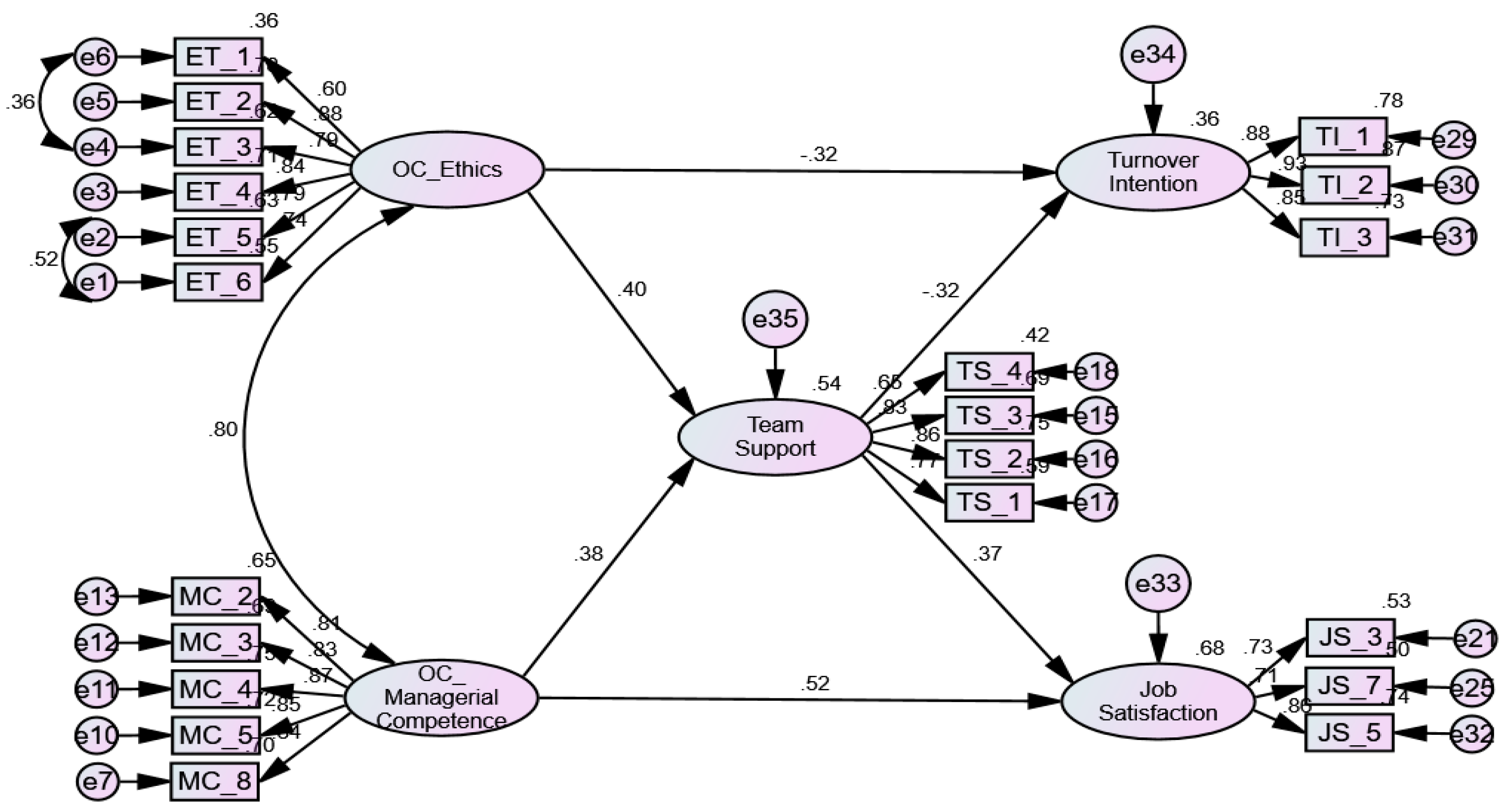
| OC_ET → TS | 0.396 | 5.016 | *** | Yes |
| OC_MC → TS | 0.381 | 4.933 | *** | Yes |
| TS → TI | −0.324 | −4.662 | *** | Yes |
| OC_ET → TI | −0.322 | −4.648 | *** | Yes |
| TS → JS | 0.371 | 5.973 | *** | Yes |
| OC_MC → JS | 0.523 | 8.157 | *** | Yes |
| Mediation Path | Indirect Effect (Estimate) | 95% CI (Lower, Upper) | p-Value | Supported |
|---|---|---|---|---|
| OC_ET → TS → TI | −0.165 | [−0.280, −0.088] | 0.001 | Yes |
| OC_ET → TS → JS | 0.109 | [0.054, 0.198] | 0.001 | Yes |
| OC_MC → TS → TI | −0.138 | [−0.280, −0.041] | 0.004 | Yes |
| OC_MC → TS → JS | 0.092 | [0.044, 0.166] | 0.001 | Yes |
Disclaimer/Publisher’s Note: The statements, opinions and data contained in all publications are solely those of the individual author(s) and contributor(s) and not of MDPI and/or the editor(s). MDPI and/or the editor(s) disclaim responsibility for any injury to people or property resulting from any ideas, methods, instructions or products referred to in the content. |
© 2025 by the authors. Licensee MDPI, Basel, Switzerland. This article is an open access article distributed under the terms and conditions of the Creative Commons Attribution (CC BY) license.
Share and Cite
Sehanovic, A.; Sehanovic, L.; Hadziahmetovic, N.; Sehanovic, A.; Kohlmann, S.; Fountis, A. From Managing Humans to Keeping Humans: How Ethical Culture and Team Support Drive Retention in Healthcare. Adm. Sci. 2026, 16, 4. https://doi.org/10.3390/admsci16010004
Sehanovic A, Sehanovic L, Hadziahmetovic N, Sehanovic A, Kohlmann S, Fountis A. From Managing Humans to Keeping Humans: How Ethical Culture and Team Support Drive Retention in Healthcare. Administrative Sciences. 2026; 16(1):4. https://doi.org/10.3390/admsci16010004
Chicago/Turabian StyleSehanovic, Aida, Lejla Sehanovic, Nereida Hadziahmetovic, Anida Sehanovic, Sabina Kohlmann, and Anastasios Fountis. 2026. "From Managing Humans to Keeping Humans: How Ethical Culture and Team Support Drive Retention in Healthcare" Administrative Sciences 16, no. 1: 4. https://doi.org/10.3390/admsci16010004
APA StyleSehanovic, A., Sehanovic, L., Hadziahmetovic, N., Sehanovic, A., Kohlmann, S., & Fountis, A. (2026). From Managing Humans to Keeping Humans: How Ethical Culture and Team Support Drive Retention in Healthcare. Administrative Sciences, 16(1), 4. https://doi.org/10.3390/admsci16010004