Going Green in SMEs: Unpacking How Innovative Work Behavior Impacts Employee Commitment Through a Mediated–Moderated Model

 ,
,  , ,
, ,  ,
,
Abstract
1. Introduction
2. Literature Review and Hypotheses Justification
2.1. Green Innovative Work Behavior GIWB
2.2. Perceived Greenwashing
2.3. Green Work Exhaustion
2.4. The Mediating Effects of Perceived Greenwashing and Green Work Exhaustion
2.5. The Moderating Role of Management Support
3. Materials and Methods
3.1. Instruments and Scales
3.2. Sampling and Participants Selection
3.3. Statistical Methods
4. Results
4.1. Validity and Reliability Estimation
4.2. Hypotheses Testing (Inner Model)
5. Discussion
5.1. Findings and Theoretical Contributions
5.2. Practical Suggestions
5.3. Limitations and Future Research
5.4. Conclusions
Author Contributions
Funding
Institutional Review Board Statement
Informed Consent Statement
Data Availability Statement
Conflicts of Interest
Appendix A
- −
- I usually introduce small innovations into my green practice.
- −
- I often develop new procedures to improve my everyday green practice.
- −
- I often succeed in transforming my innovative ideas into practical green solutions.
- −
- I often develop new green solutions to solve problems.
- −
- My hotel has poor social and environmental performance but sells itself as socially responsible.
- −
- My hotel misleads others about its social responsibility practices.
- −
- My hotel misrepresents the social and/or environmental benefits of its products and services.
- −
- I feel emotionally drained from engaging in green innovation efforts at work.
- −
- I feel burned out by the continuous push for green and sustainable work initiatives.
- −
- It is physically straining for me to get through a workday because of the demands of green-related innovation tasks.
- −
- My manager motivates me to come to him/her with new ideas.
- −
- My manager always financially rewards good ideas.
- −
- My manager supports me in implementing good ideas as soon as possible.
- −
- My manager is tolerant of mistakes and errors during the implementation of something new.
- −
- My manager is able to obtain support for my proposal also outside our department.
- −
- I really care about the environmental concern of my hotel.
- −
- I would feel guilty about not supporting the environmental efforts of my hotel.
- −
- The environmental concern of my hotel means a lot to me.
- −
- I feel a sense of duty to support the environmental efforts of my hotel.
- −
- I really feel as if my hotel’s environmental problems are my own.
- −
- I feel personally attached to the environmental concern of my hotel.
- −
- I strongly value the environmental efforts of my hotel.
References
- Ahmed, H. A. M., Abdelghani, A. A. A., Fayyad, S., & Rashwan, K. A. (2025). From commitment to action: The mediating effect of environmental identity in green buying, with eco-conscious behavior as a moderator. Administrative Sciences, 15(8), 303. [Google Scholar] [CrossRef]
- Akhavan, P., Hosseini, S. M., Abbasi, M., & Manteghi, M. (2015). Knowledge-sharing determinants, behaviors, and innovative work behaviors. Aslib Journal of Information Management, 67(5), 562–591. [Google Scholar] [CrossRef]
- Al-Ayed, S. (2024). Green innovation influenced by employee innovative work behavior via moderating role of innovative leaderships. Cogent Business & Management, 11(1), 2393741. [Google Scholar] [CrossRef]
- Allen, N. J., & Meyer, J. P. (1990). The measurement and antecedents of affective, continuance and normative commitment to the organization. Journal of Occupational Psychology, 63(1), 1–18. [Google Scholar] [CrossRef]
- Alreahi, M., Bujdosó, Z., Kabil, M., Akaak, A., Benkó, K. F., Setioningtyas, W. P., & Dávid, L. D. (2022). Green human resources management in the hotel industry: A systematic review. Sustainability, 15(1), 99. [Google Scholar] [CrossRef]
- Alyahia, M., Azazz, A. M. S., Fayyad, S., Elshaer, I. A., & Mohammad, A. A. A. (2024). Greenwashing behavior in hotels industry: The role of green transparency and green authenticity. Sustainability, 16(3), 1050. [Google Scholar] [CrossRef]
- Alzadjali, B., Abualigah, A., & Karatepe, O. M. (2026). How does green empowering leadership promote environmental performance? Unfolding the roles of green intrinsic motivation and green innovative work behavior. International Journal of Hospitality Management, 132, 104382. [Google Scholar] [CrossRef]
- Amrutha, V. N., & Geetha, S. N. (2020). A systematic review on green human resource management: Implications for social sustainability. Journal of Cleaner Production, 247, 119131. [Google Scholar] [CrossRef]
- Arshad, M., Zhang, K., Khan, M., Khan, M. S., & Sulaiman, R. (2025). Fostering employee green behavior through inclusive leadership: Roles of sustainable HRM practices and commitment to organizational change. Journal of Organizational Change Management, 38(5), 983–1001. [Google Scholar] [CrossRef]
- Bakker, A. B., & Demerouti, E. (2007). The job demands-resources model: State of the art. Journal of Managerial Psychology, 22(3), 309–328. [Google Scholar] [CrossRef]
- Bissing-Olson, M. J., Iyer, A., Fielding, K. S., & Zacher, H. (2013). Relationships between daily affect and pro-environmental behavior at work: The moderating role of pro-environmental attitude. Journal of Organizational Behavior, 34(2), 156–175. [Google Scholar] [CrossRef]
- Brañes, L., Gamarra, M. F., Guillen, N. K., & Regalado, M. (2025). Avoiding greenwashing through the application of effective green marketing: The case of hospitality industry in lima city—Peru. Sustainability, 17(17), 7605. [Google Scholar] [CrossRef]
- Brislin, R. W. (1980). Translation and content analysis of oral and written materials. Handbook of Cross-Cultural Psychology, 2(2), 349–444. [Google Scholar]
- Chang, C. (2016). The determinants of green product innovation performance. Corporate Social Responsibility and Environmental Management, 23(2), 65–76. [Google Scholar] [CrossRef]
- Chen, H., Bernard, S., & Rahman, I. (2019). Greenwashing in hotels: A structural model of trust and behavioral intentions. Journal of Cleaner Production, 206, 326–335. [Google Scholar] [CrossRef]
- Chen, J., & Liu, L. (2020). Customer participation, and green product innovation in SMEs: The mediating role of opportunity recognition and exploitation. Journal of Business Research, 119, 151–162. [Google Scholar] [CrossRef]
- Christensen, L. T., Morsing, M., & Thyssen, O. (2013). CSR as aspirational talk. Organization, 20(3), 372–393. [Google Scholar] [CrossRef]
- Cohen, J. (2013). Statistical power analysis for the behavioral sciences. Academic Press. [Google Scholar]
- Delmas, M. A., & Burbano, V. C. (2011). The drivers of greenwashing. California Management Review, 54(1), 64–87. [Google Scholar] [CrossRef]
- Dumont, J., Shen, J., & Deng, X. (2017). Effects of green HRM practices on employee workplace green behavior: The role of psychological green climate and employee green values. Human Resource Management, 56(4), 613–627. [Google Scholar] [CrossRef]
- El Gouna Hotels. (2024, April 2). El Gouna hotels stay green. El Gouna Red Sea. Available online: https://www.elgouna.com/blog/el-gouna-hotels-stay-green (accessed on 21 December 2025).
- Elshaer, I. A., Azazz, A. M. S., Alshebami, A. S., Abdulaziz, T. A., Mansour, M. A., & Fayyad, S. (2024a). Internal green marketing orientation and business performance: The role of employee environmental commitment and green organizational identity. International Journal of Innovative Research and Scientific Studies, 7(1), 211–225. [Google Scholar] [CrossRef]
- Elshaer, I. A., Azazz, A. M. S., & Fayyad, S. (2023). Green human resources and innovative performance in small- and medium-sized tourism enterprises: A mediation model using PLS-SEM data analysis. Mathematics, 11(3), 711. [Google Scholar] [CrossRef]
- Elshaer, I. A., Azazz, A. M. S., Mansour, M. A., & Fayyad, S. (2025). Perceived greenwashing and employee non-green behavior: The roles of prevention-focused green crafting and work alienation. Cogent Business & Management, 12(1), 2449592. [Google Scholar] [CrossRef]
- Elshaer, I. A., Azazz, A. M. S., Semlali, Y., Mansour, M. A., Elziny, M. N., & Fayyad, S. (2024b). The nexus between green transformational leadership, employee behavior, and organizational support in the hospitality industry. Administrative Sciences, 14(6), 107. [Google Scholar] [CrossRef]
- Fornell, C., & Larcker, D. F. (1981). Evaluating structural equation models with unobservable variables and measurement error. Journal of Marketing Research, 18(1), 39–50. [Google Scholar] [CrossRef]
- Gatti, L., Seele, P., & Rademacher, L. (2019). Grey zone in—Greenwash out. A review of greenwashing research and implications for the voluntary-mandatory transition of CSR. International Journal of Corporate Social Responsibility, 4(1), 6. [Google Scholar] [CrossRef]
- Glavas, A., & Godwin, L. N. (2013). Is the perception of ‘Goodness’ good enough? Exploring the relationship between perceived corporate social responsibility and employee organizational identification. Journal of Business Ethics, 114(1), 15–27. [Google Scholar] [CrossRef]
- Green Star Hotel. (2025). GSH-certified hotels. Available online: https://www.greenstarhotel.org/ (accessed on 21 December 2025).
- Hair, J. F., Ringle, C. M., & Sarstedt, M. (2011). PLS-SEM: Indeed a silver bullet. Journal of Marketing Theory and Practice, 19(2), 139–152. [Google Scholar] [CrossRef]
- Hair, J. F., Risher, J. J., Sarstedt, M., & Ringle, C. M. (2019). When to use and how to report the results of PLS-SEM. European Business Review, 31(1), 2–24. [Google Scholar] [CrossRef]
- Henseler, J., Hubona, G., & Ray, P. A. (2016). Using PLS path modeling in new technology research: Updated guidelines. Industrial Management & Data Systems, 116(1), 2–20. [Google Scholar] [CrossRef]
- Henseler, J., Ringle, C. M., & Sarstedt, M. (2015). A new criterion for assessing discriminant validity in variance-based structural equation modeling. Journal of the Academy of Marketing Science, 43(1), 115–135. [Google Scholar] [CrossRef]
- Herscovitch, L., & Meyer, J. P. (2002). Commitment to organizational change: Extension of a three-component model. Journal of Applied Psychology, 87(3), 474–487. [Google Scholar] [CrossRef]
- Hobfoll, S. E. (1989). Conservation of resources: A new attempt at conceptualizing stress. American Psychologist, 44(3), 513–524. [Google Scholar] [CrossRef]
- Jager, J., Putnick, D. L., & Bornstein, M. H. (2017). II. More than just convenient: The scientific merits of homogeneous convenience samples. Monographs of the Society for Research in Child Development, 82(2), 13–30. [Google Scholar] [CrossRef]
- Jameel, A., Sahito, N., Guo, W., Hussain, A., Kanwel, S., & Khan, S. (2025). The influence of supportive leadership on hospitality employees’ green innovative work behavior: The mediating role of innovative climate and psychological empowerment. Frontiers in Psychology, 16, 1565408. [Google Scholar] [CrossRef]
- Janssen, O. (2000). Job demands, perceptions of effort-reward fairness and innovative work behaviour. Journal of Occupational and Organizational Psychology, 73(3), 287–302. [Google Scholar] [CrossRef]
- Jiang, W., & Wong, J. K. W. (2016). Key activity areas of corporate social responsibility (CSR) in the construction industry: A study of China. Journal of Cleaner Production, 113, 850–860. [Google Scholar] [CrossRef]
- Karatepe, O. M. (2013). High-performance work practices and hotel employee performance: The mediation of work engagement. International Journal of Hospitality Management, 32, 132–140. [Google Scholar] [CrossRef]
- Khan, K., Gogia, E. H., Shao, Z., Rehman, M. Z., & Ullah, A. (2025). The impact of green HRM practices on green innovative work behaviour: Empirical evidence from the hospitality sector of China and Pakistan. BMC Psychology, 13(1), 96. [Google Scholar] [CrossRef]
- Kim, E.-H., & Lyon, T. P. (2015). Greenwash vs. brownwash: Exaggeration and undue modesty in corporate sustainability disclosure. Organization Science, 26(3), 705–723. [Google Scholar] [CrossRef]
- Kim, Y. J., Kim, W. G., Choi, H.-M., & Phetvaroon, K. (2019). The effect of green human resource management on hotel employees’ eco-friendly behavior and environmental performance. International Journal of Hospitality Management, 76, 83–93. [Google Scholar] [CrossRef]
- Kock, N. (2015). Common method bias in PLS-SEM: A full collinearity assessment approach. International Journal of E-Collaboration, 11(4), 1–10. [Google Scholar] [CrossRef]
- Li, W., Li, W., Seppänen, V., & Koivumäki, T. (2022). How and when does perceived greenwashing affect employees’ job performance? Evidence from China. Corporate Social Responsibility and Environmental Management, 29(5), 1722–1735. [Google Scholar] [CrossRef]
- Liu, X., Yu, X., & Xing, W. (2022). Green product innovation via green transformational leadership and employees’ OCBE: The moderating role of green organizational climate—Empirical evidence from China’ manufacturing enterprises. Polish Journal of Environmental Studies, 31(5), 4487–4498. [Google Scholar] [CrossRef]
- Lukes, M., & Stephan, U. (2017). Measuring employee innovation: A review of existing scales and the development of the innovative behavior and innovation support inventories across cultures. International Journal of Entrepreneurial Behavior & Research, 23(1), 136–158. [Google Scholar] [CrossRef]
- Lyon, T. P., & Montgomery, A. W. (2015). The means and end of greenwash. Organization & Environment, 28(2), 223–249. [Google Scholar] [CrossRef]
- Ma, Y., Zhao, S., Chen, J., Hu, C., & Qu, J. (2024). Perceived greenwashing and employee green behavior: The roles of green organizational identity and self-serving leadership. Business Ethics, the Environment & Responsibility, 34(4), 1475–1486. [Google Scholar] [CrossRef]
- Majeed, S., & Kim, W. G. (2023). A reflection of greenwashing practices in the hospitality industry: A scoping review. International Journal of Contemporary Hospitality Management, 35(3), 1125–1146. [Google Scholar] [CrossRef]
- Norton, T. A., Parker, S. L., Zacher, H., & Ashkanasy, N. M. (2015). Employee green behavior: A theoretical framework, multilevel review, and future research agenda. Organization & Environment, 28(1), 103–125. [Google Scholar] [CrossRef]
- Nunnally, J. C. (1994). Psychometric theory 3E. McGraw-Hill. [Google Scholar]
- Nyilasy, G., Gangadharbatla, H., & Paladino, A. (2014). Perceived greenwashing: The interactive effects of green advertising and corporate environmental performance on consumer reactions. Journal of Business Ethics, 125(4), 693–707. [Google Scholar] [CrossRef]
- Ong, M., Mayer, D. M., Tost, L. P., & Wellman, N. (2018). When corporate social responsibility motivates employee citizenship behavior: The sensitizing role of task significance. Organizational Behavior and Human Decision Processes, 144, 44–59. [Google Scholar] [CrossRef]
- Paillé, P., & Boiral, O. (2013). Pro-environmental behavior at work: Construct validity and determinants. Journal of Environmental Psychology, 36, 118–128. [Google Scholar] [CrossRef]
- Paillé, P., Boiral, O., & Chen, Y. (2013). Linking environmental management practices and organizational citizenship behaviour for the environment: A social exchange perspective. The International Journal of Human Resource Management, 24(18), 3552–3575. [Google Scholar] [CrossRef]
- Paillé, P., & Raineri, N. (2015). Linking perceived corporate environmental policies and employees eco-initiatives: The influence of perceived organizational support and psychological contract breach. Journal of Business Research, 68(11), 2404–2411. [Google Scholar] [CrossRef]
- Parida, S., & Brown, K. (2021). Green human resource management and green innovation. In Responsible management in emerging markets: A multisectoral focus (pp. 159–183). Springer International Publishing. [Google Scholar] [CrossRef]
- Piwowar-Sulej, K., & Iqbal, Q. (2025). A novel approach to green innovative work behavior: Green HRM and employee participation. Baltic Journal of Management, 20(6), 39–59. [Google Scholar] [CrossRef]
- Podsakoff, P. M., MacKenzie, S. B., & Podsakoff, N. P. (2012). Sources of method bias in social science research and recommendations on how to control it. Annual Review of Psychology, 63(1), 539–569. [Google Scholar] [CrossRef] [PubMed]
- Raineri, N., & Paillé, P. (2016). Linking corporate policy and supervisory support with environmental citizenship behaviors: The role of employee environmental beliefs and commitment. Journal of Business Ethics, 137(1), 129–148. [Google Scholar] [CrossRef]
- Renwick, D. W. S., Redman, T., & Maguire, S. (2013). Green human resource management: A review and research agenda. International Journal of Management Reviews, 15(1), 1–14. [Google Scholar] [CrossRef]
- Robertson, J. L., & Barling, J. (2013). Greening organizations through leaders’ influence on employees’ pro-environmental behaviors. Journal of Organizational Behavior, 34(2), 176–194. [Google Scholar] [CrossRef]
- Robertson, J. L., Montgomery, A. W., & Ozbilir, T. (2023). Employees’ response to corporate greenwashing. Business Strategy and the Environment, 32(7), 4015–4027. [Google Scholar] [CrossRef]
- Sahibzada, Y. A., Ali, M., Toru, N., Farooq Jan, M., & Ellahi, A. (2025). Exploitative leadership and green innovative behavior of hospitality employees: Mediation of emotional exhaustion and moderation of perceived organization support. Journal of Hospitality and Tourism Insights, 8(5), 1847–1866. [Google Scholar] [CrossRef]
- Schaufeli, W. B., Leiter, M. P., & Kalimo, R. (1995). The general burnout inventory: A self-report questionnaire to assess burnout at the workplace. Work, Stress and Health, 95(9), 14–16. [Google Scholar]
- Schaufeli, W. B., & Taris, T. W. (2014). A critical review of the job demands-resources model: Implications for improving work and health. In Bridging occupational, organizational and public health (pp. 43–68). Springer. [Google Scholar] [CrossRef]
- Schuberth, F., Rademaker, M. E., & Henseler, J. (2023). Assessing the overall fit of composite models estimated by partial least squares path modeling. European Journal of Marketing, 57(6), 1678–1702. [Google Scholar] [CrossRef]
- Seele, P., & Gatti, L. (2017). Greenwashing revisited: In search of a typology and accusation-based definition incorporating legitimacy strategies. Business Strategy and the Environment, 26(2), 239–252. [Google Scholar] [CrossRef]
- Shahbaz, M. H., Naseem, M. A., Battisti, E., & Alfiero, S. (2024). The effect of green intellectual capital and innovative work behavior on green process innovation performance in the hospitality industry. Journal of Intellectual Capital, 25(2/3), 402–422. [Google Scholar] [CrossRef]
- Singh, R. (2009). Does my structural model represent the real phenomenon? A review of the appropriate use of Structural Equation Modelling (SEM) model fit indices. The Marketing Review, 9(3), 199–212. [Google Scholar] [CrossRef]
- Sobaih, A. E. E., Gharbi, H., Hasanein, A. M., & Elnasr, A. E. A. (2022). The mediating effects of green innovation and corporate social responsibility on the link between transformational leadership and performance: An examination using sem analysis. Mathematics, 10(15), 2685. [Google Scholar] [CrossRef]
- Tang, G., Chen, Y., Jiang, Y., Paillé, P., & Jia, J. (2018). Green human resource management practices: Scale development and validity. Asia Pacific Journal of Human Resources, 56(1), 31–55. [Google Scholar] [CrossRef]
- Tang, Y., Chen, Y.-J., Shao, Y.-F., & Cao, Q. (2022). The impact of sustainable transformational leadership on sustainable innovation ambidexterity: Empirical evidence from green building industries of China. Frontiers in Public Health, 10, 814690. [Google Scholar] [CrossRef]
- Tavakol, M., & Dennick, R. (2011). Making sense of Cronbach’s alpha. International Journal of Medical Education, 2, 53–55. [Google Scholar] [CrossRef]
- Testa, F., Boiral, O., & Iraldo, F. (2018a). Internalization of environmental practices and institutional complexity: Can stakeholders pressures encourage greenwashing? Journal of Business Ethics, 147(2), 287–307. [Google Scholar] [CrossRef]
- Testa, F., Miroshnychenko, I., Barontini, R., & Frey, M. (2018b). Does it pay to be a greenwasher or a brownwasher? Business Strategy and the Environment, 27(7), 1104–1116. [Google Scholar] [CrossRef]
- Walker, K., & Wan, F. (2012). The harm of symbolic actions and green-washing: Corporate actions and communications on environmental performance and their financial implications. Journal of Business Ethics, 109(2), 227–242. [Google Scholar] [CrossRef]
- Wang, X., Chen, Y., Liu, Y., & Zhang, R. (2025). Mitigating or aggravating muck: Investigating the double-edged impact of greenwashing on employee green behavior. Asia Pacific Journal of Management. ahead-of-print. [Google Scholar] [CrossRef]
- Zaman, S. I., Qabool, S., Anwar, A., & Khan, S. A. (2025). Green human resource management practices: A hierarchical model to evaluate the pro-environmental behavior of hotel employees. Journal of Hospitality and Tourism Insights, 8(4), 1217–1249. [Google Scholar] [CrossRef]
- Zhang, B., Yang, L., Cheng, X., & Chen, F. (2021). How does employee green behavior impact employee well-being? An empirical analysis. International Journal of Environmental Research and Public Health, 18(4), 1669. [Google Scholar] [CrossRef]
- Zhang, Y., Luo, Y., Zhang, X., & Zhao, J. (2019). How green human resource management can promote green employee behavior in china: A technology acceptance model perspective. Sustainability, 11(19), 5408. [Google Scholar] [CrossRef]



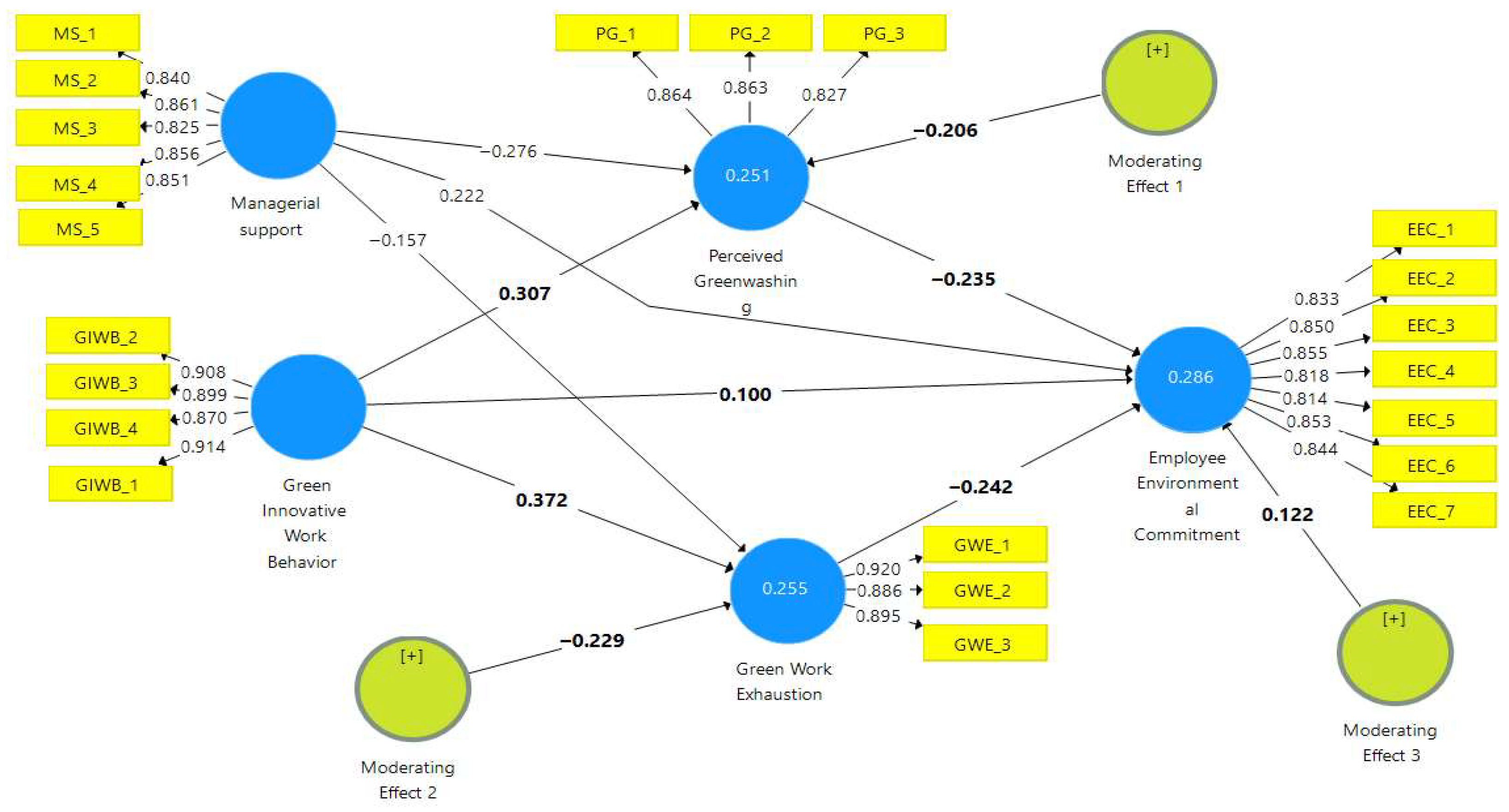
| Factors and Variables | λ | VIF | t | σ | SK | KU |
|---|---|---|---|---|---|---|
| Green innovative work behavior (GIWB) (α = 0.920, CR = 0.943, AVE = 0.807, Inner VIF = 1.293) | ||||||
| GIWB_1 | 0.914 | 3.384 | 3.184 | 1.422 | −0.137 | −1.287 |
| GIWB_2 | 0.908 | 3.247 | 3.119 | 1.429 | −0.073 | −1.326 |
| GIWB_3 | 0.899 | 3.119 | 3.155 | 1.415 | −0.104 | −1.301 |
| GIWB_4 | 0.870 | 2.625 | 3.141 | 1.384 | −0.069 | −1.267 |
| Perceived greenwashing (PG) (α = 0.810, CR = 0.887, AVE = 0.724, Inner VIF = 1.789) | ||||||
| PG_1 | 0.864 | 1.812 | 3.167 | 1.307 | −0.112 | −1.114 |
| PG_2 | 0.863 | 1.816 | 3.200 | 1.333 | −0.122 | −1.185 |
| PG_3 | 0.827 | 1.693 | 3.172 | 1.362 | −0.097 | −1.228 |
| Green work exhaustion (GWE) (α = 0.883, CR = 0.928, AVE = 0.811, Inner VIF = 1.361) | ||||||
| GWE_1 | 0.920 | 2.898 | 3.055 | 1.456 | −0.040 | −1.377 |
| GWE_2 | 0.886 | 2.313 | 3.167 | 1.436 | −0.145 | −1.327 |
| GWE_3 | 0.895 | 2.452 | 3.115 | 1.453 | −0.111 | −1.358 |
| Employee environmental commitment (EEC) (α = 0.930, CR = 0.943, AVE = 0.703) | ||||||
| EEC_1 | 0.833 | 2.424 | 2.969 | 1.406 | 0.050 | −1.263 |
| EEC_2 | 0.850 | 2.675 | 2.936 | 1.412 | 0.084 | −1.263 |
| EEC_3 | 0.855 | 2.864 | 2.969 | 1.445 | 0.050 | −1.324 |
| EEC_4 | 0.818 | 2.328 | 3.002 | 1.442 | 0.049 | −1.328 |
| EEC_5 | 0.814 | 2.298 | 2.916 | 1.443 | 0.103 | −1.326 |
| EEC_6 | 0.853 | 2.791 | 2.931 | 1.448 | 0.078 | −1.338 |
| EEC_7 | 0.844 | 2.639 | 2.936 | 1.447 | 0.065 | −1.341 |
| Management support (MS) (α = 0.901, CR = 0.927, AVE = 0.717, Inner VIF = 1.137) | ||||||
| MS_1 | 0.840 | 2.205 | 2.671 | 1.377 | 0.315 | −1.167 |
| MS_2 | 0.861 | 2.484 | 2.704 | 1.369 | 0.293 | −1.151 |
| MS_3 | 0.825 | 2.138 | 2.594 | 1.351 | 0.375 | −1.076 |
| MS_4 | 0.856 | 2.625 | 2.520 | 1.358 | 0.455 | −1.020 |
| MS_5 | 0.851 | 2.485 | 2.649 | 1.397 | 0.310 | −1.203 |
| 1 | 2 | 3 | 5 | 6 | |
|---|---|---|---|---|---|
| 1. Employee Environmental Commitment | 0.838 | ||||
| 2. Green Innovative Work Behavior | −0.099 | 0.898 | |||
| 3. Green Work Exhaustion | −0.365 | 0.406 | 0.900 | ||
| 4. Managerial Support | 0.356 | −0.013 | −0.192 | 0.847 | |
| 5. Perceived Greenwashing | −0.391 | 0.340 | 0.347 | −0.306 | 0.851 |
| 1 | 2 | 3 | 5 | 6 | |
|---|---|---|---|---|---|
| 1. Employee Environmental Commitment | |||||
| 2. Green Innovative Work Behavior | 0.105 | ||||
| 3. Green Work Exhaustion | 0.402 | 0.450 | |||
| 4. Managerial Support | 0.388 | 0.042 | 0.214 | ||
| 5. Perceived Greenwashing | 0.448 | 0.391 | 0.409 | 0.357 |
| Hypothesis | β | t | p | F2 | Remark | |
|---|---|---|---|---|---|---|
| Direct Paths | ||||||
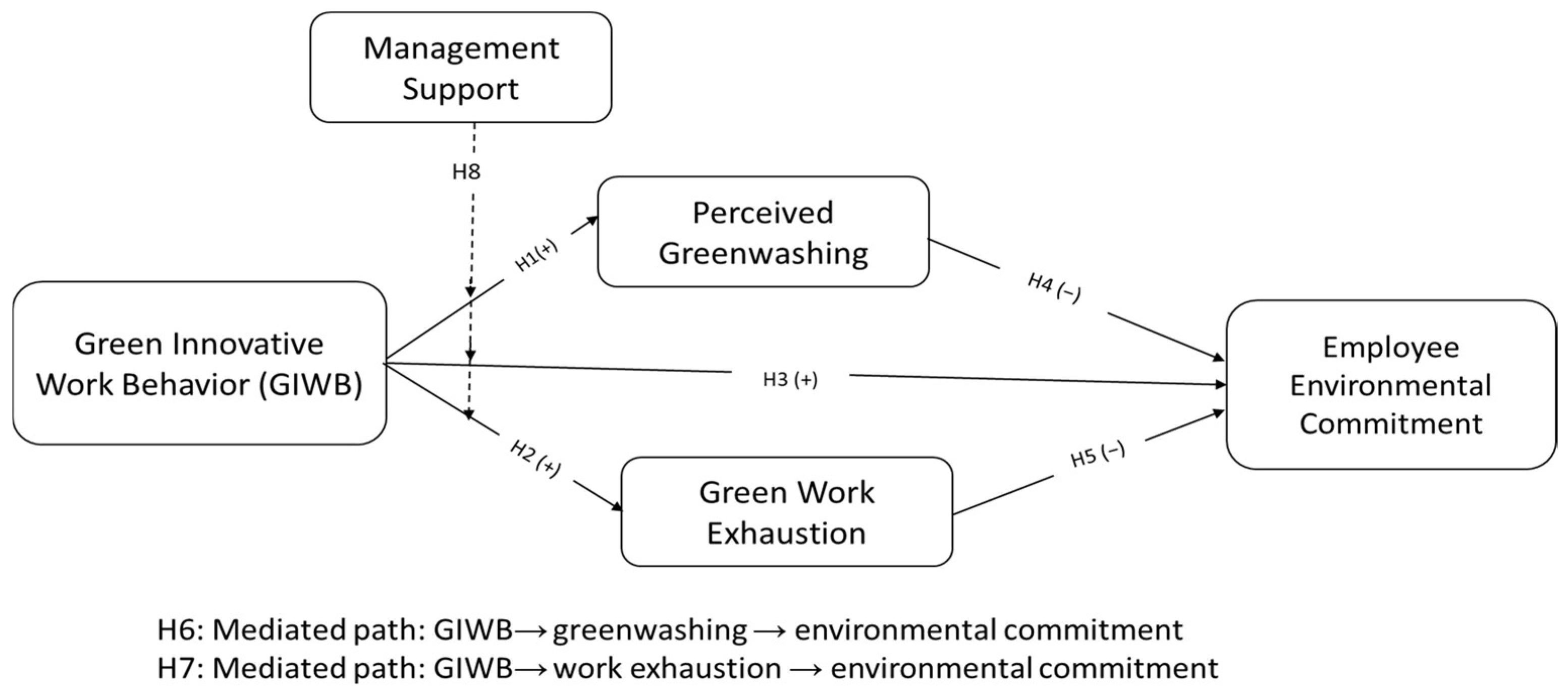
| H1: GIWB → PG | 0.307 | 7.482 | 0.000 | 0.124 | ✔ | |
| H2: GIWB → GWE | 0.372 | 9.485 | 0.000 | 0.183 | ✔ | |
| H3: GIWB → EEC | 0.100 | 2.060 | 0.039 | 0.011 | ✔ | |
| H4: PG → EEC | −0.235 | 4.880 | 0.000 | 0.057 | ✔ | |
| H5: GWE → EEC | −0.242 | 4.997 | 0.000 | 0.060 | ✔ | |
| Indirect mediating effect | Confidence intervals | |||||
| H6: GIWB → PG → EEC | −0.072 | 3.971 | 0.000 | −0.135 | −0.052 | ✔ |
| H7: GIWB → GWE → EEC | −0.090 | 4.230 | 0.000 | −0.112 | −0.041 | ✔ |
| Moderating effects | ||||||
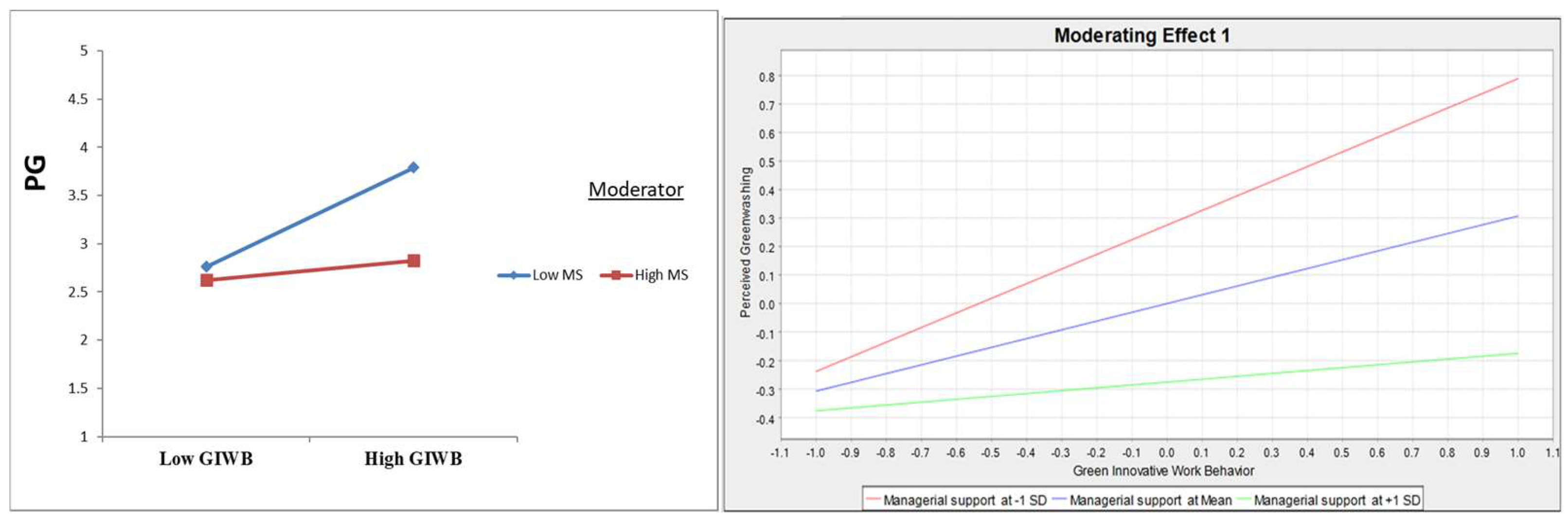
| H8a: GIWB × MS → PG | −0.206 | 5.133 | 0.000 | −0.288 | −0.125 | ✔ |
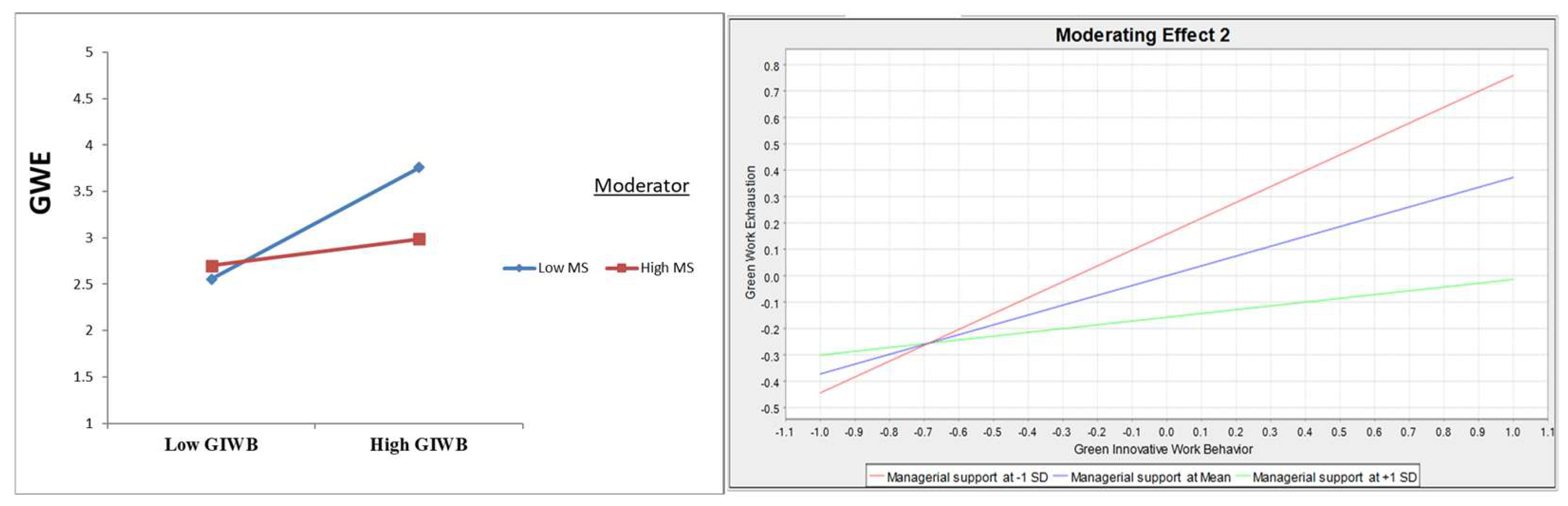
| H8b: GIWB × MS → GWE | −0.229 | 5.830 | 0.000 | −0.305 | −0.152 | ✔ |
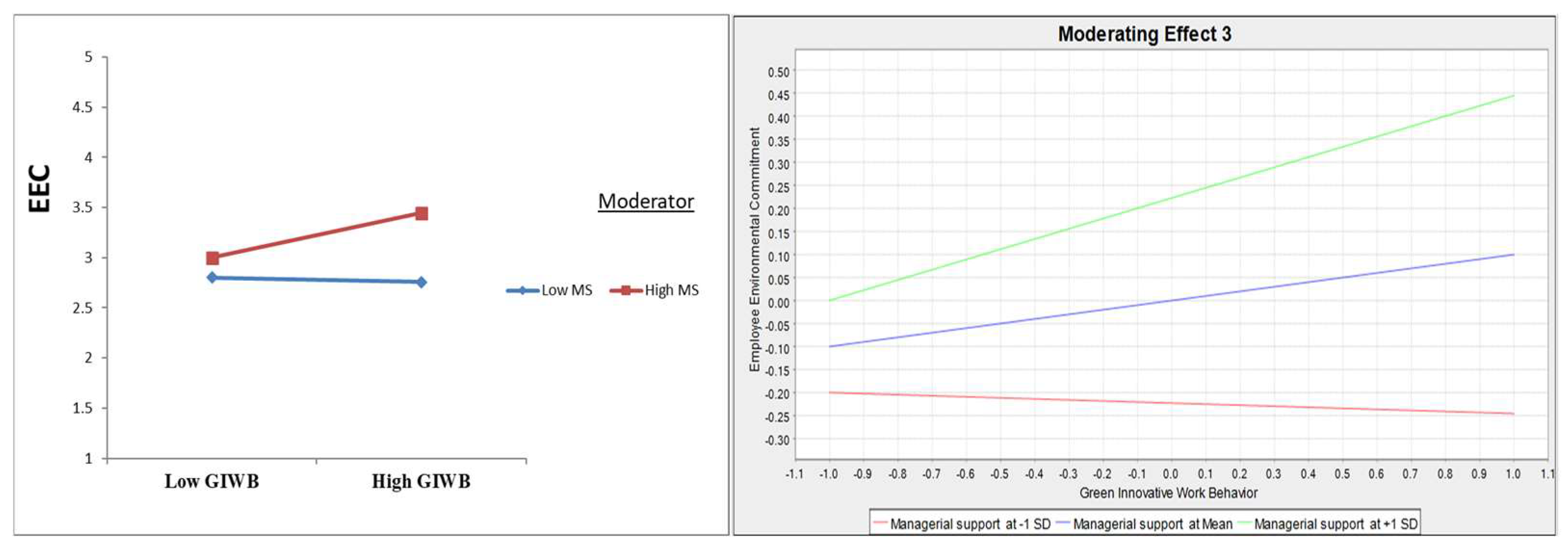
| H8c: GIWB × MS → EEC | 0.122 | 2.867 | 0.004 | 0.036 | 0.204 | |
| Employee Environmental Commitment | R2 | 0.286 | Q2 | 0.186 | ||
| Green Work Exhaustion | R2 | 0.255 | Q2 | 0.192 | ||
| Perceived Greenwashing | R2 | 0.251 | Q2 | 0.169 | ||
Disclaimer/Publisher’s Note: The statements, opinions and data contained in all publications are solely those of the individual author(s) and contributor(s) and not of MDPI and/or the editor(s). MDPI and/or the editor(s) disclaim responsibility for any injury to people or property resulting from any ideas, methods, instructions or products referred to in the content. |
© 2026 by the authors. Licensee MDPI, Basel, Switzerland. This article is an open access article distributed under the terms and conditions of the Creative Commons Attribution (CC BY) license.
Share and Cite
Elshaer, I.A.; Kooli, C.; Azazz, A.M.S.; Fayyad, S.; Algezawy, M.; Mohammad, A.A.A. Going Green in SMEs: Unpacking How Innovative Work Behavior Impacts Employee Commitment Through a Mediated–Moderated Model. Adm. Sci. 2026, 16, 27. https://doi.org/10.3390/admsci16010027
Elshaer IA, Kooli C, Azazz AMS, Fayyad S, Algezawy M, Mohammad AAA. Going Green in SMEs: Unpacking How Innovative Work Behavior Impacts Employee Commitment Through a Mediated–Moderated Model. Administrative Sciences. 2026; 16(1):27. https://doi.org/10.3390/admsci16010027
Chicago/Turabian StyleElshaer, Ibrahim A., Chokri Kooli, Alaa M. S. Azazz, Sameh Fayyad, Mohamed Algezawy, and Abuelkassem A. A. Mohammad. 2026. "Going Green in SMEs: Unpacking How Innovative Work Behavior Impacts Employee Commitment Through a Mediated–Moderated Model" Administrative Sciences 16, no. 1: 27. https://doi.org/10.3390/admsci16010027
APA StyleElshaer, I. A., Kooli, C., Azazz, A. M. S., Fayyad, S., Algezawy, M., & Mohammad, A. A. A. (2026). Going Green in SMEs: Unpacking How Innovative Work Behavior Impacts Employee Commitment Through a Mediated–Moderated Model. Administrative Sciences, 16(1), 27. https://doi.org/10.3390/admsci16010027